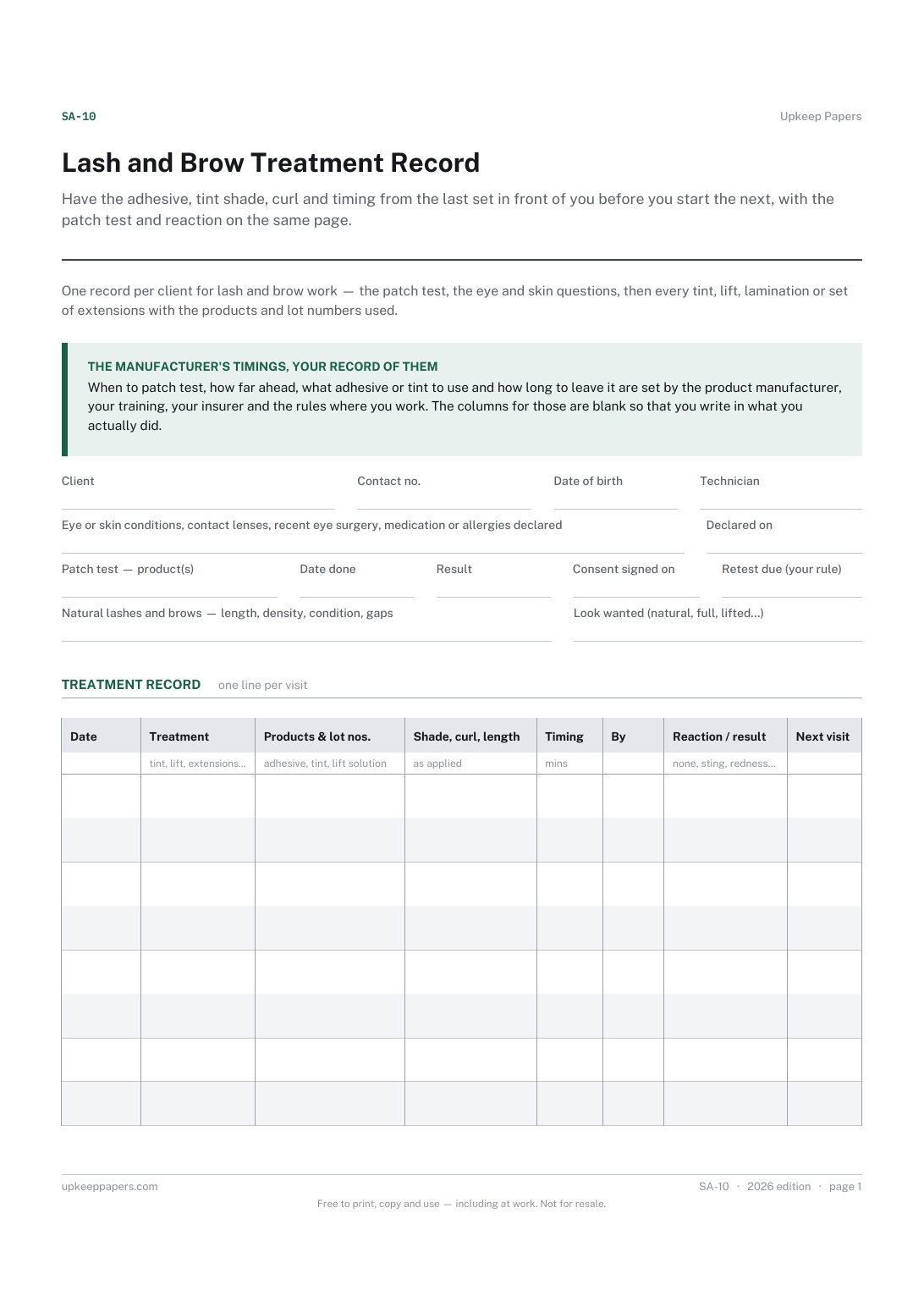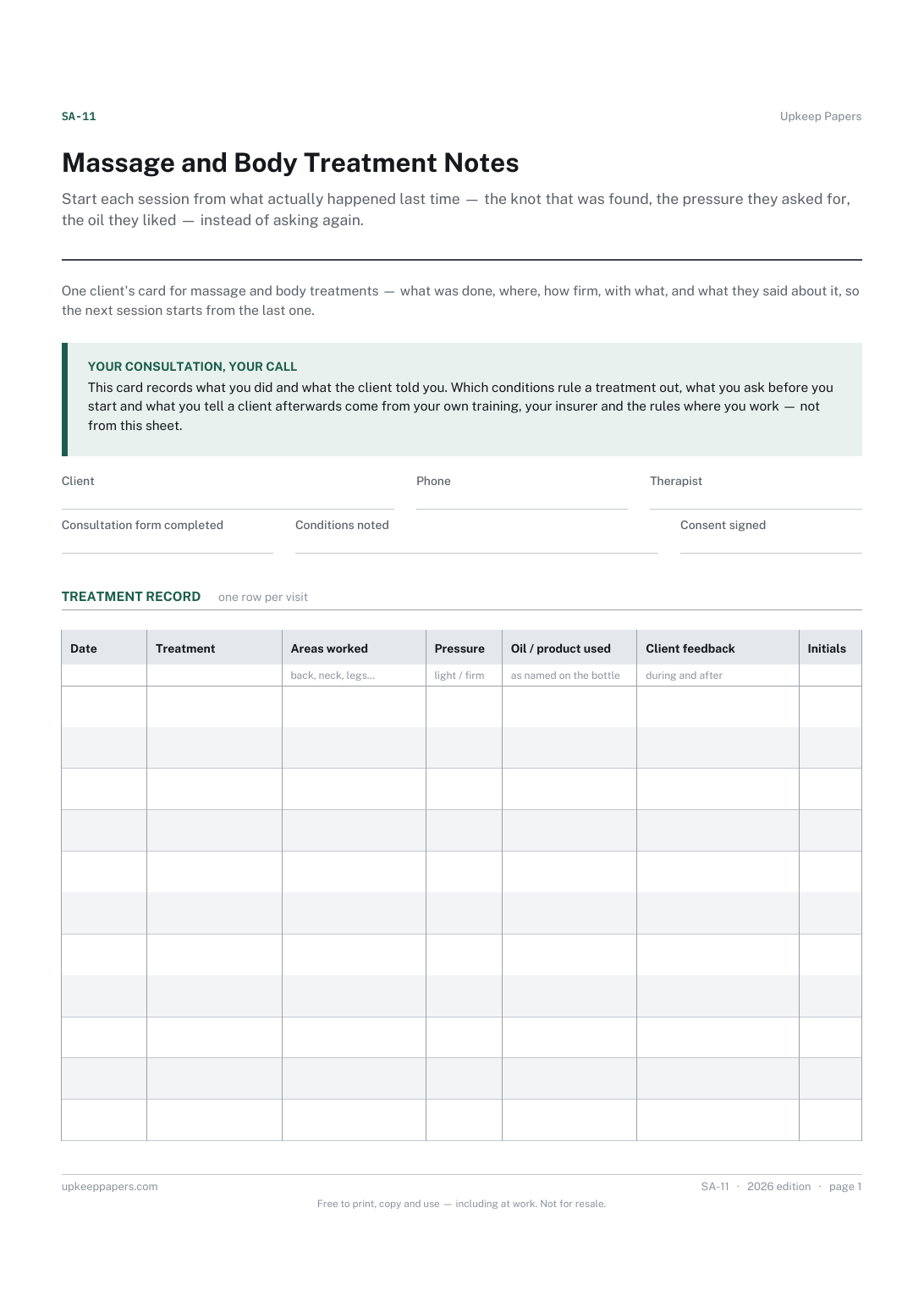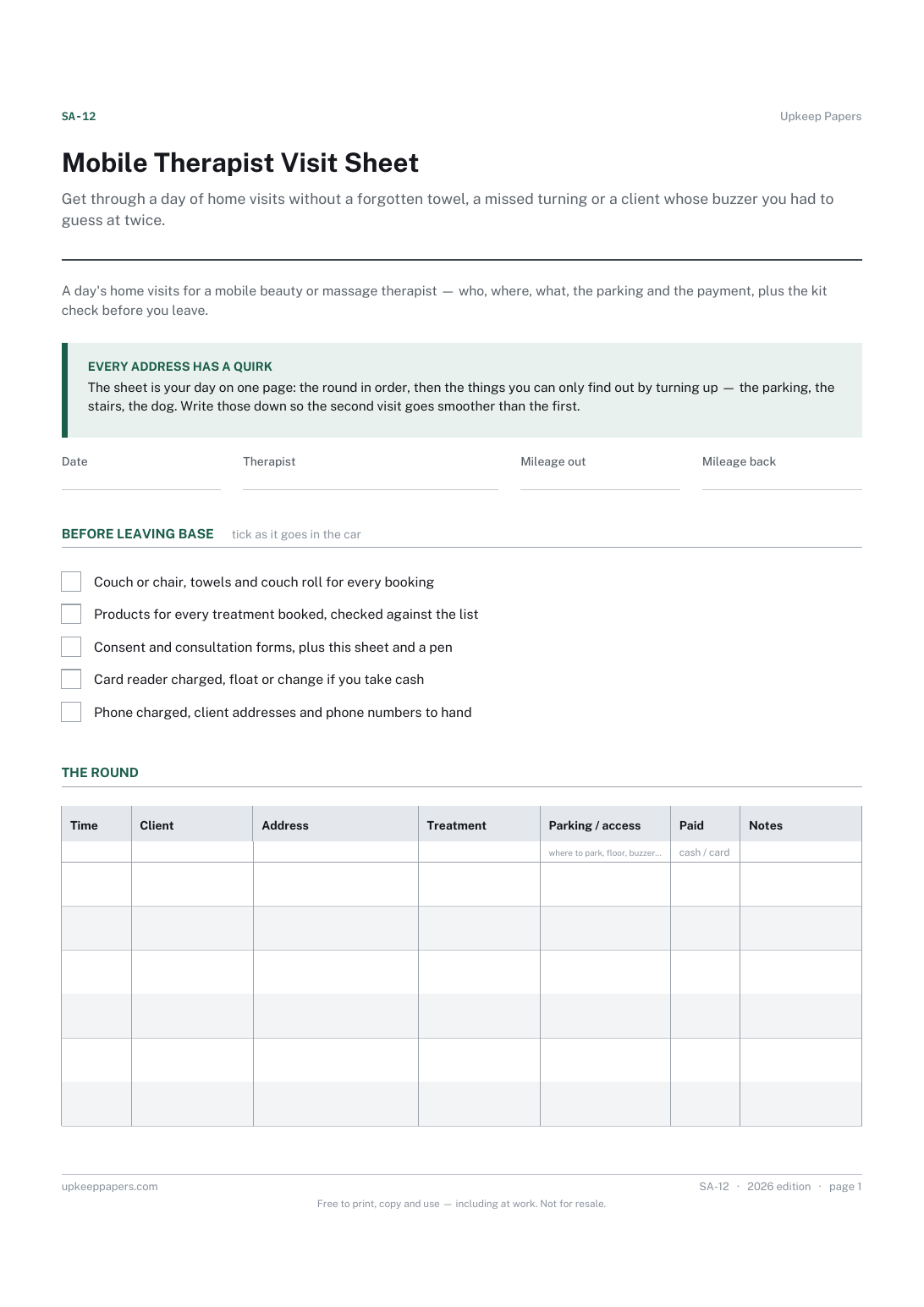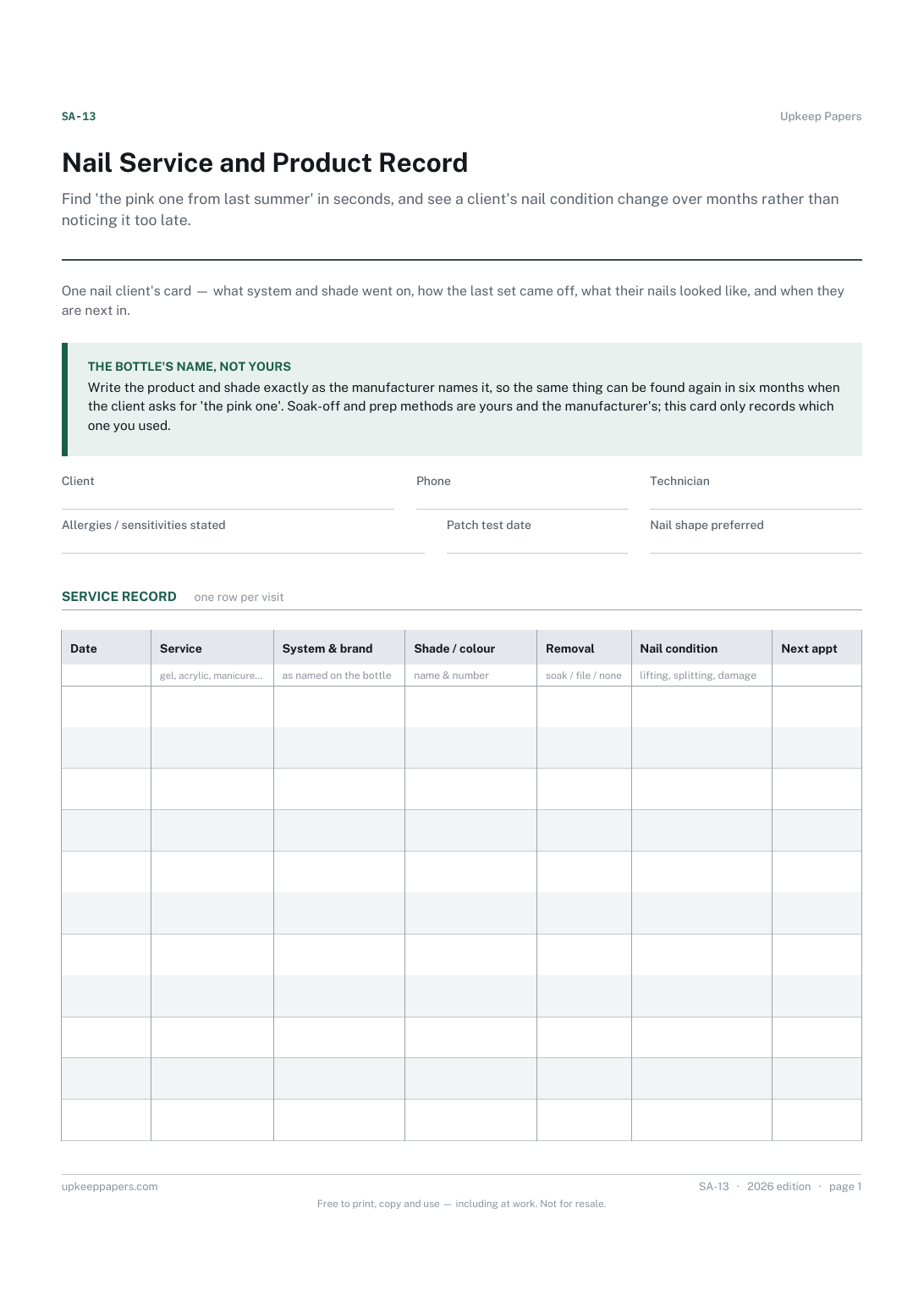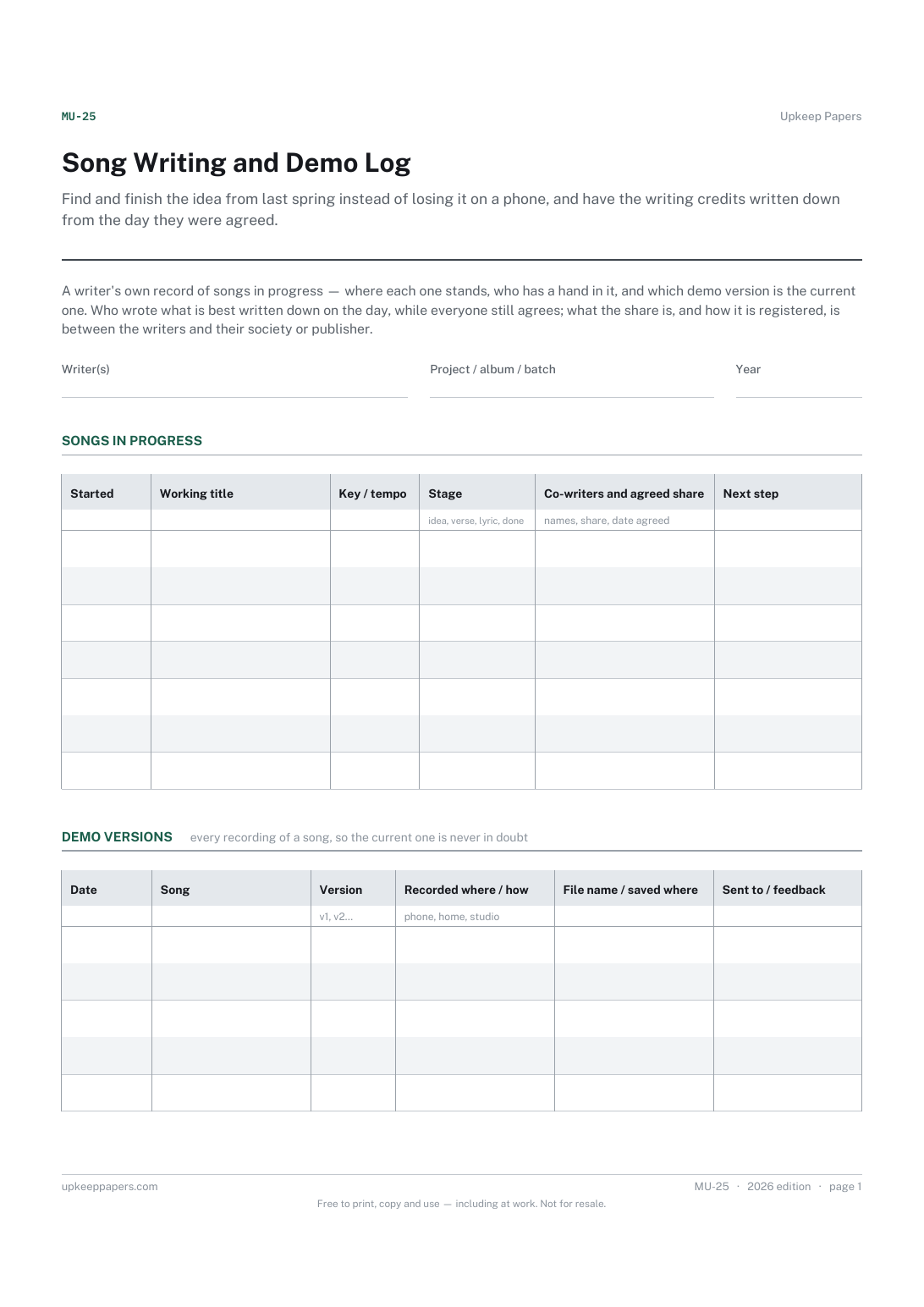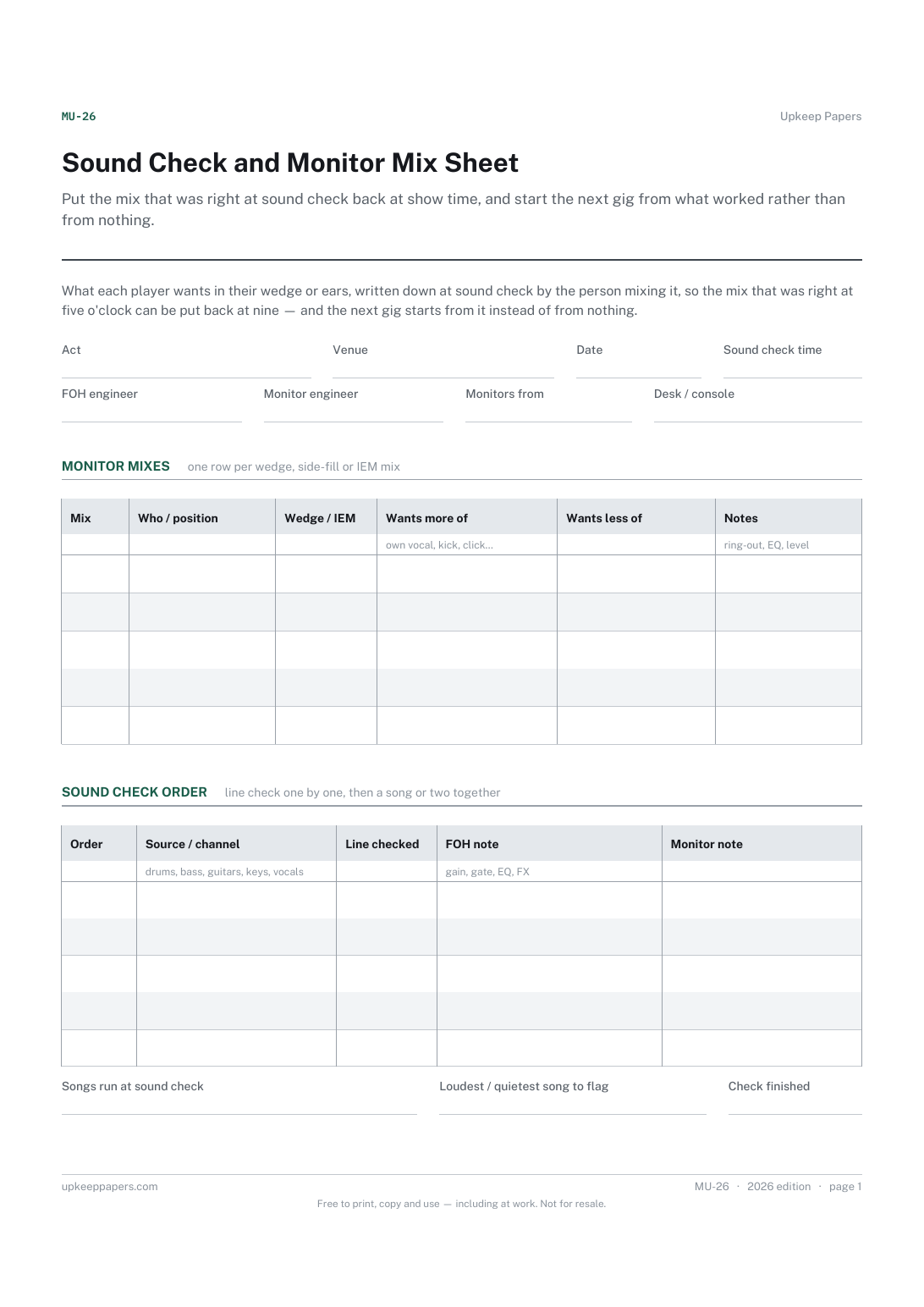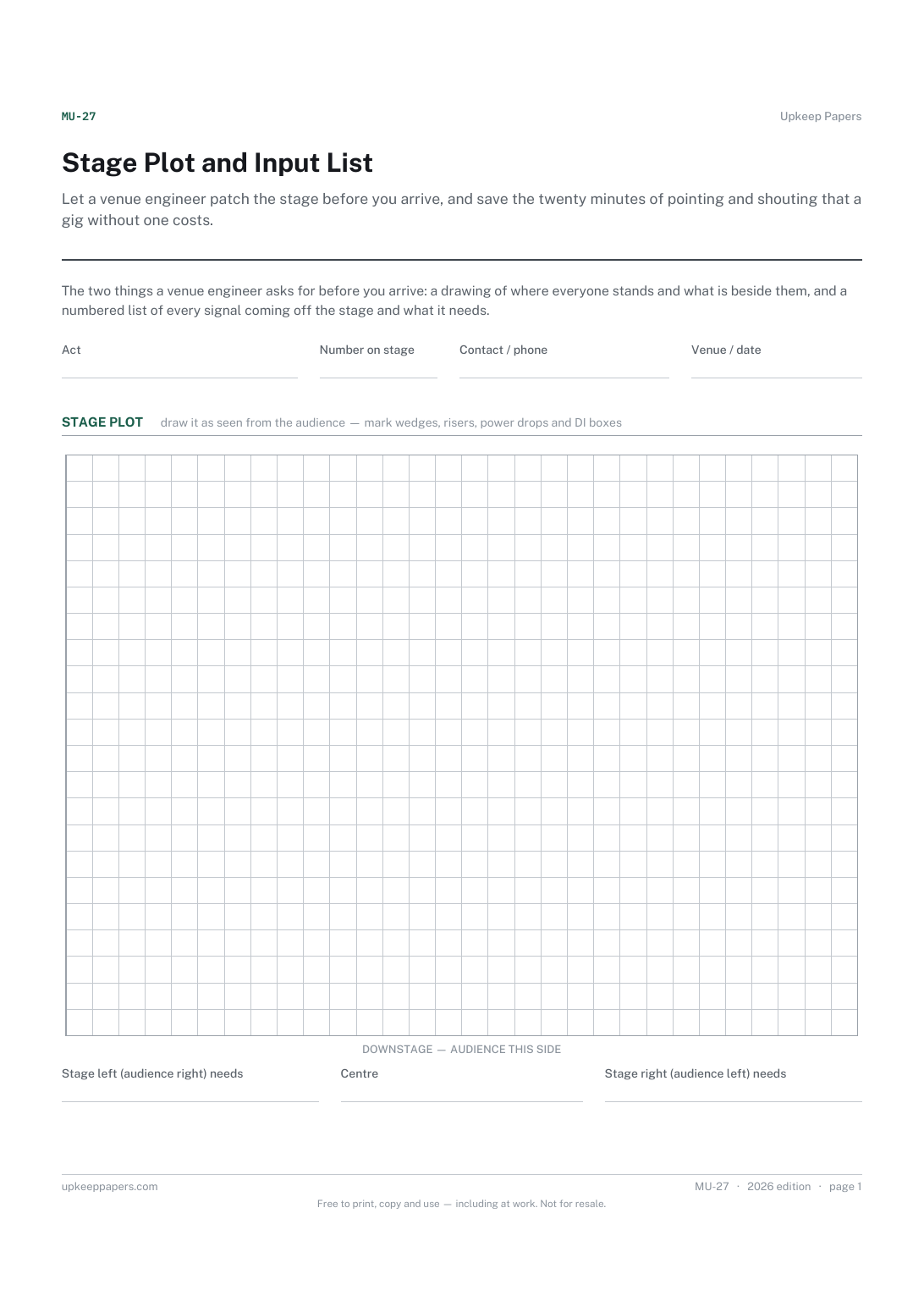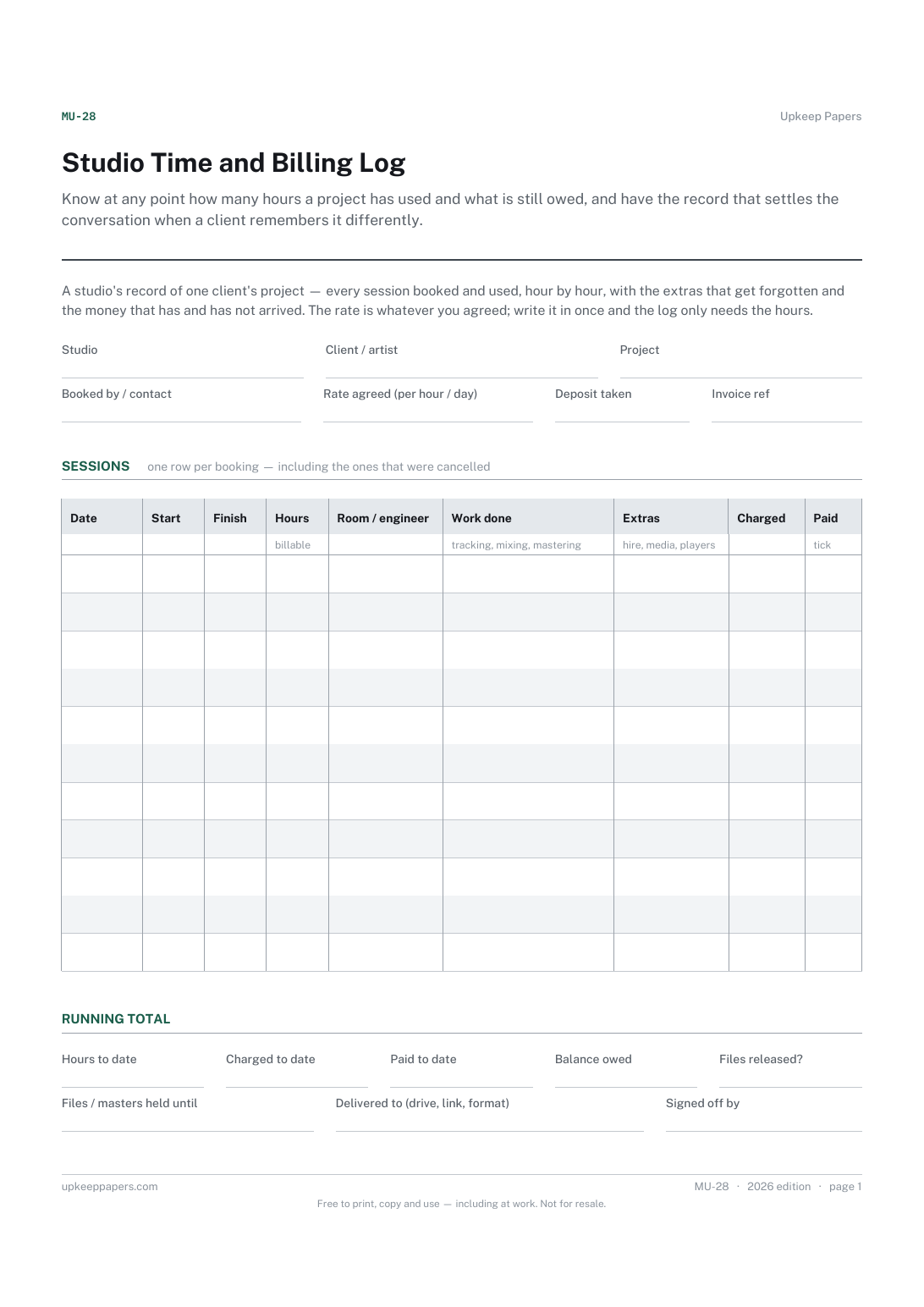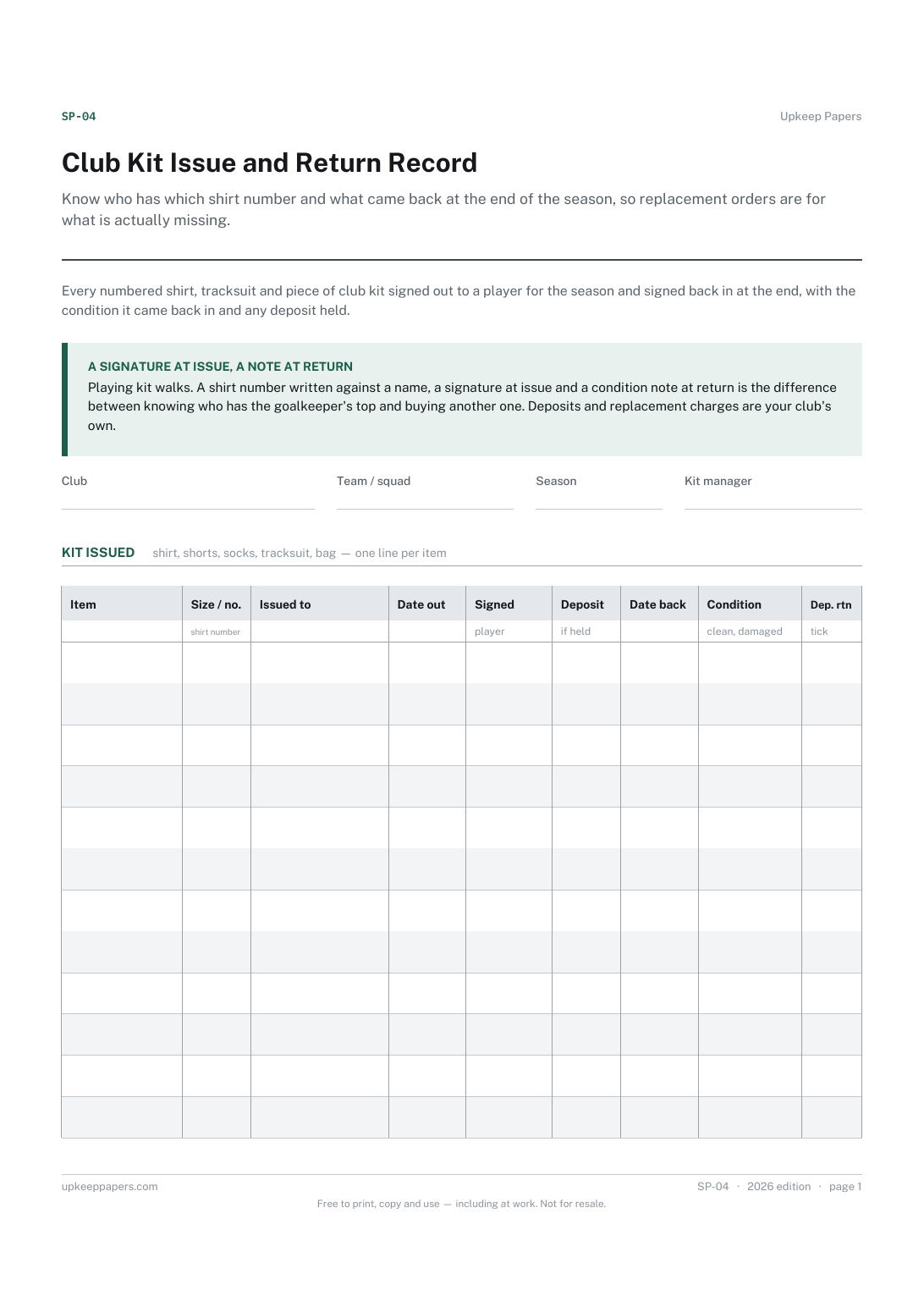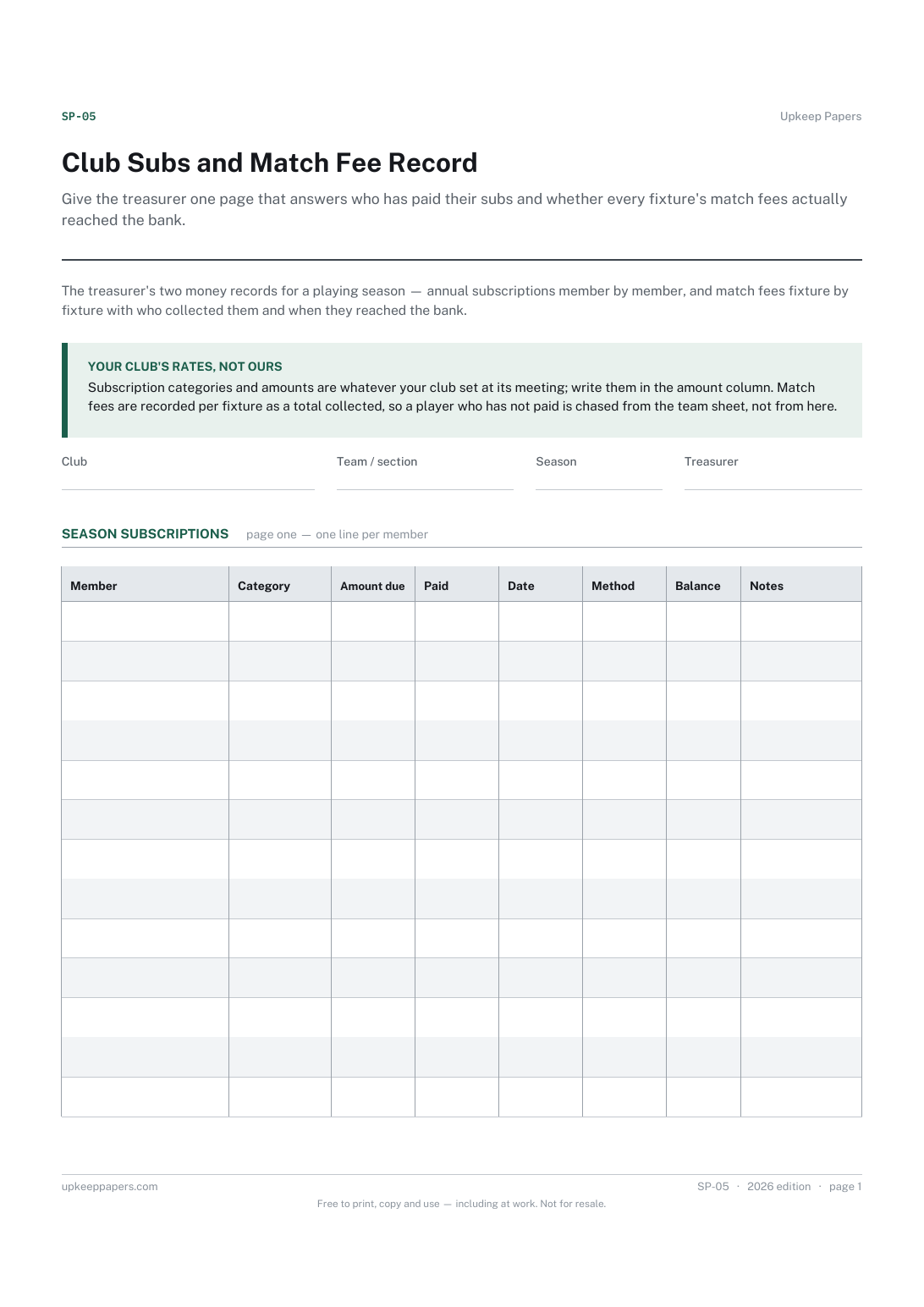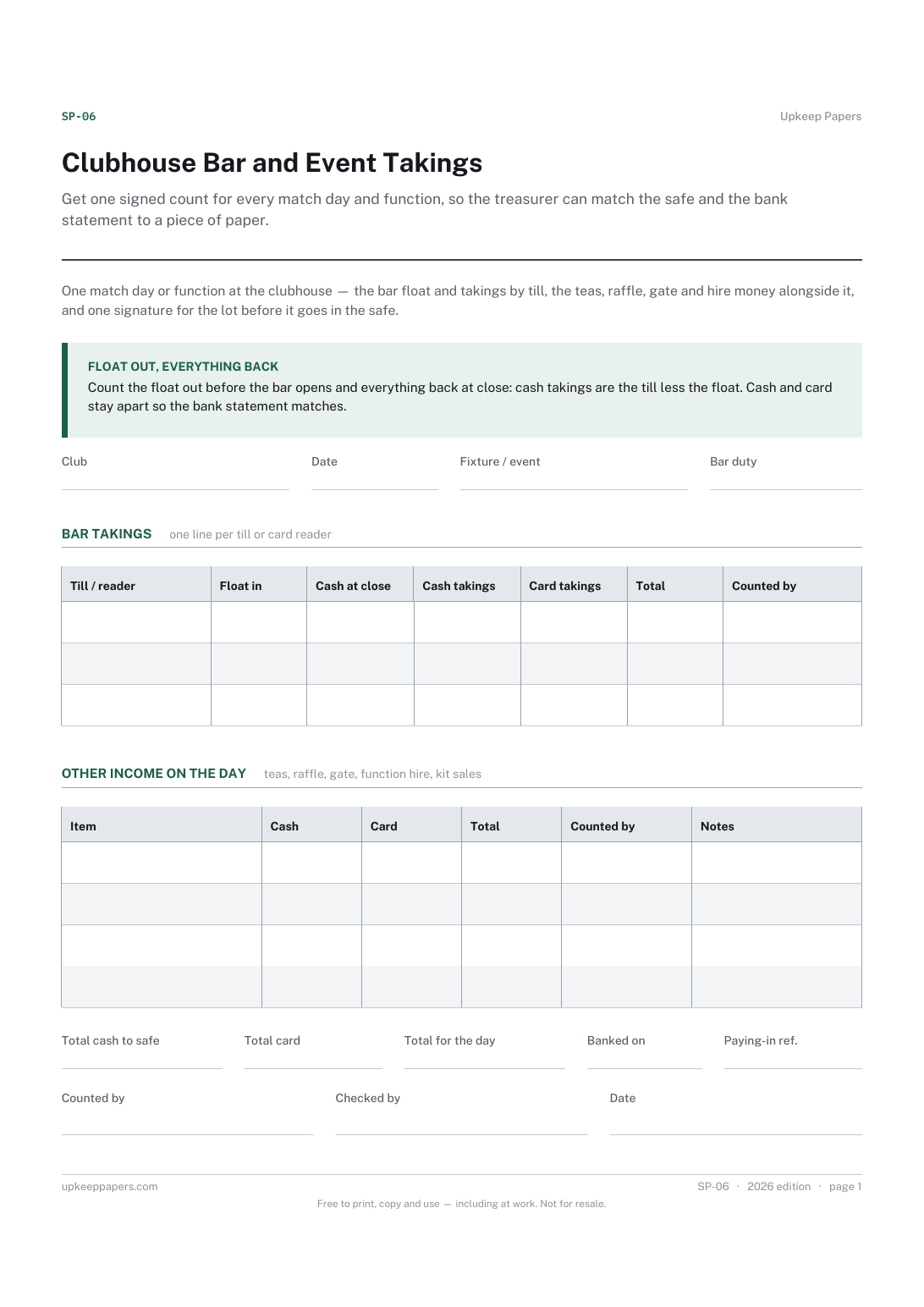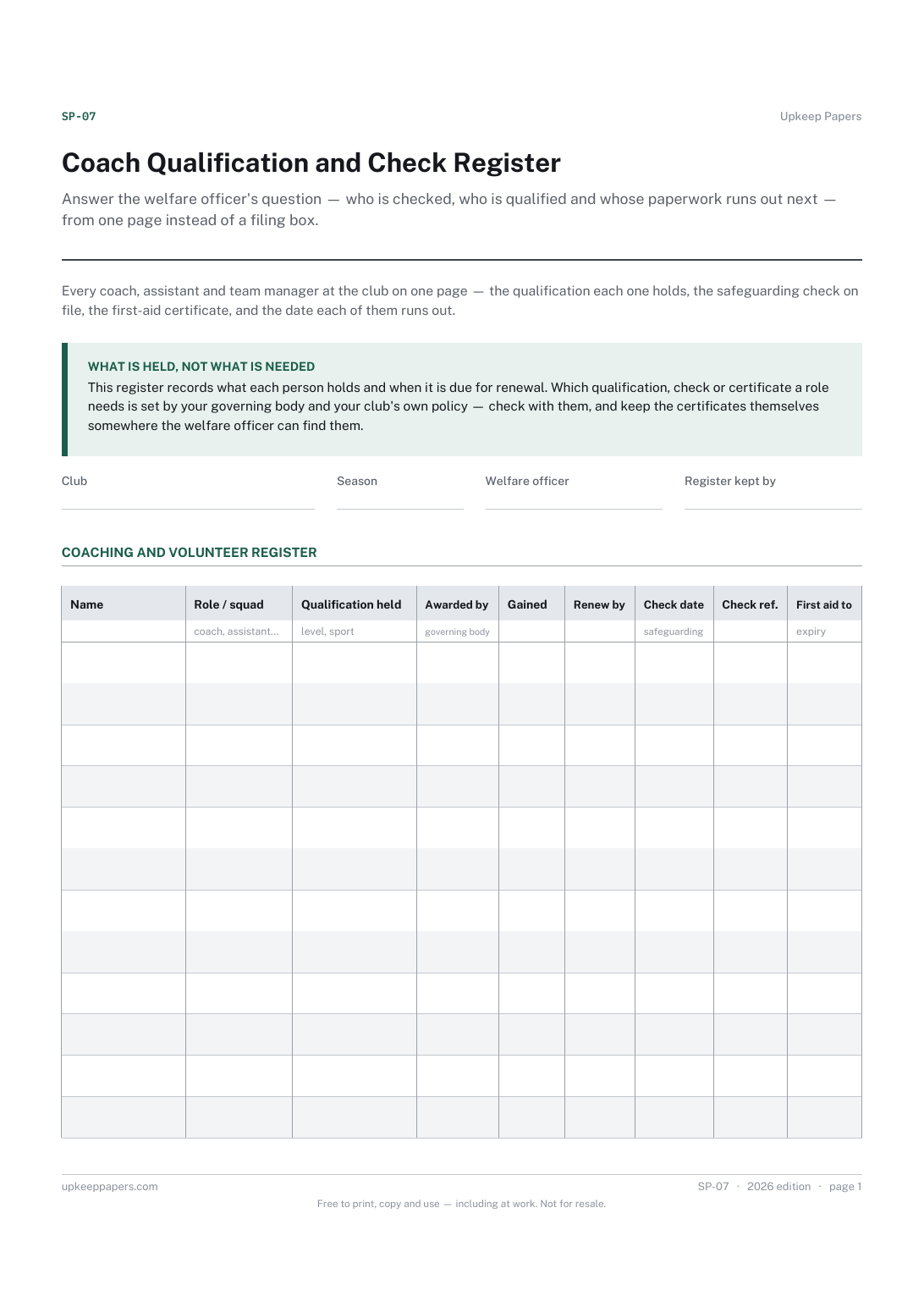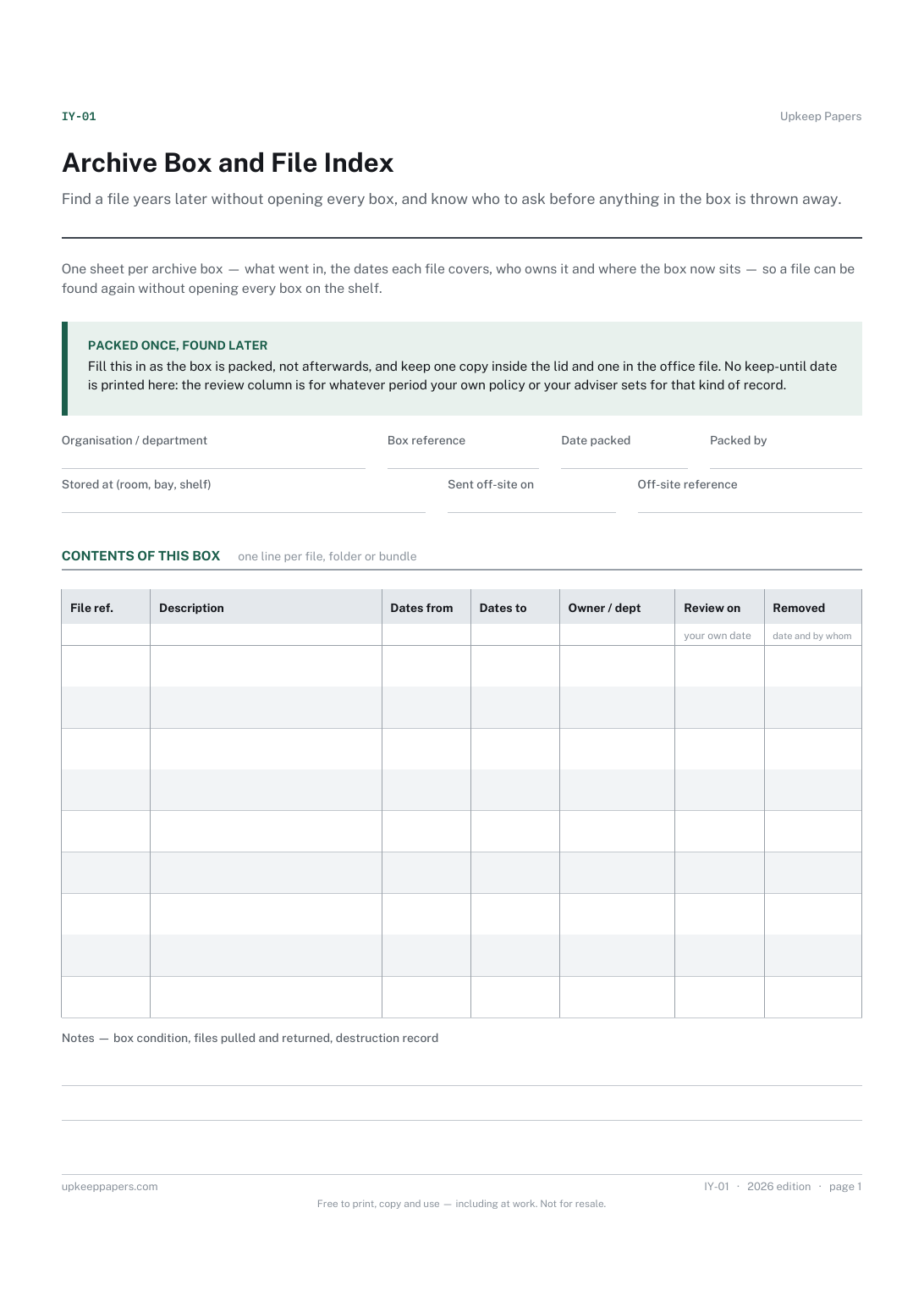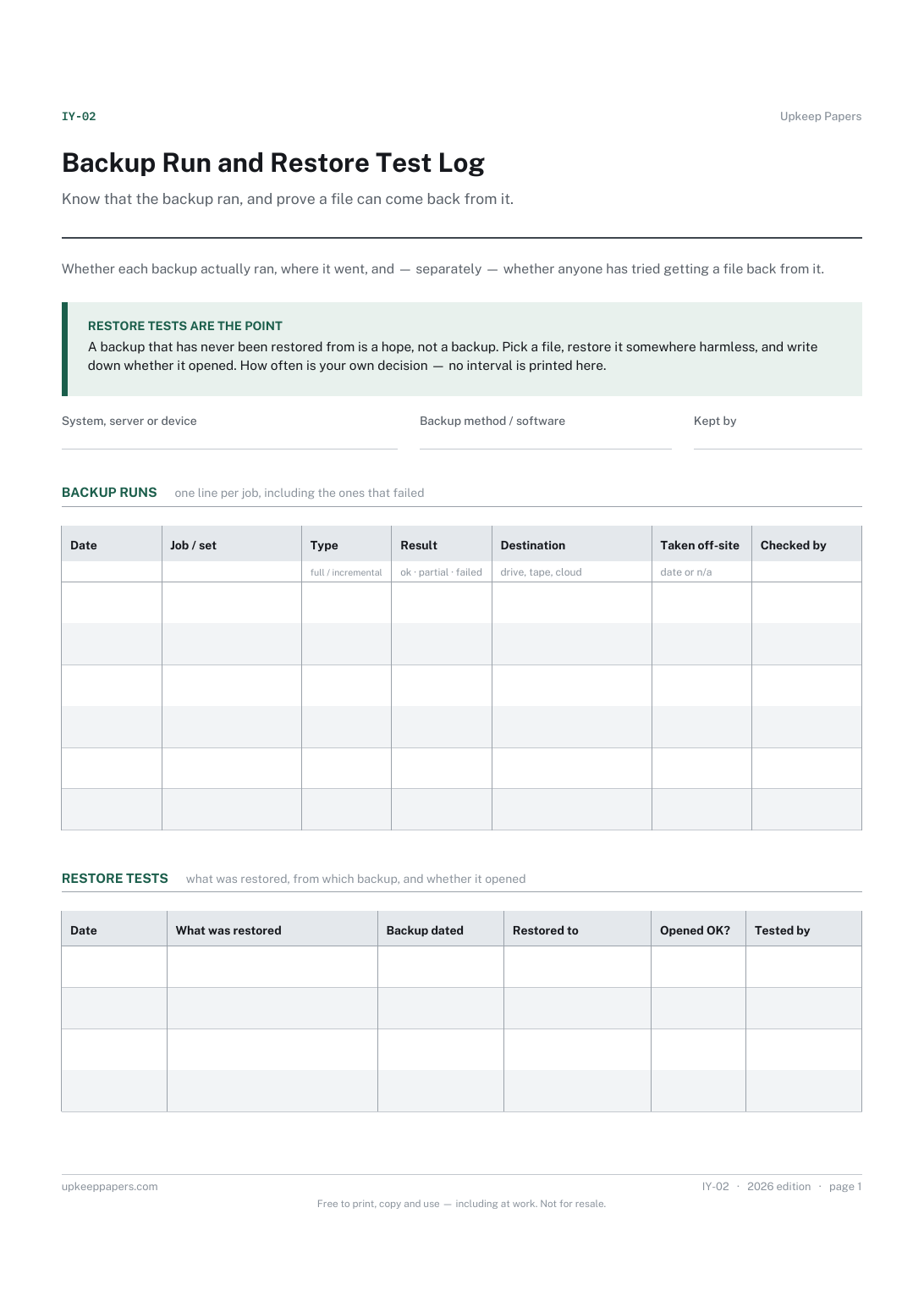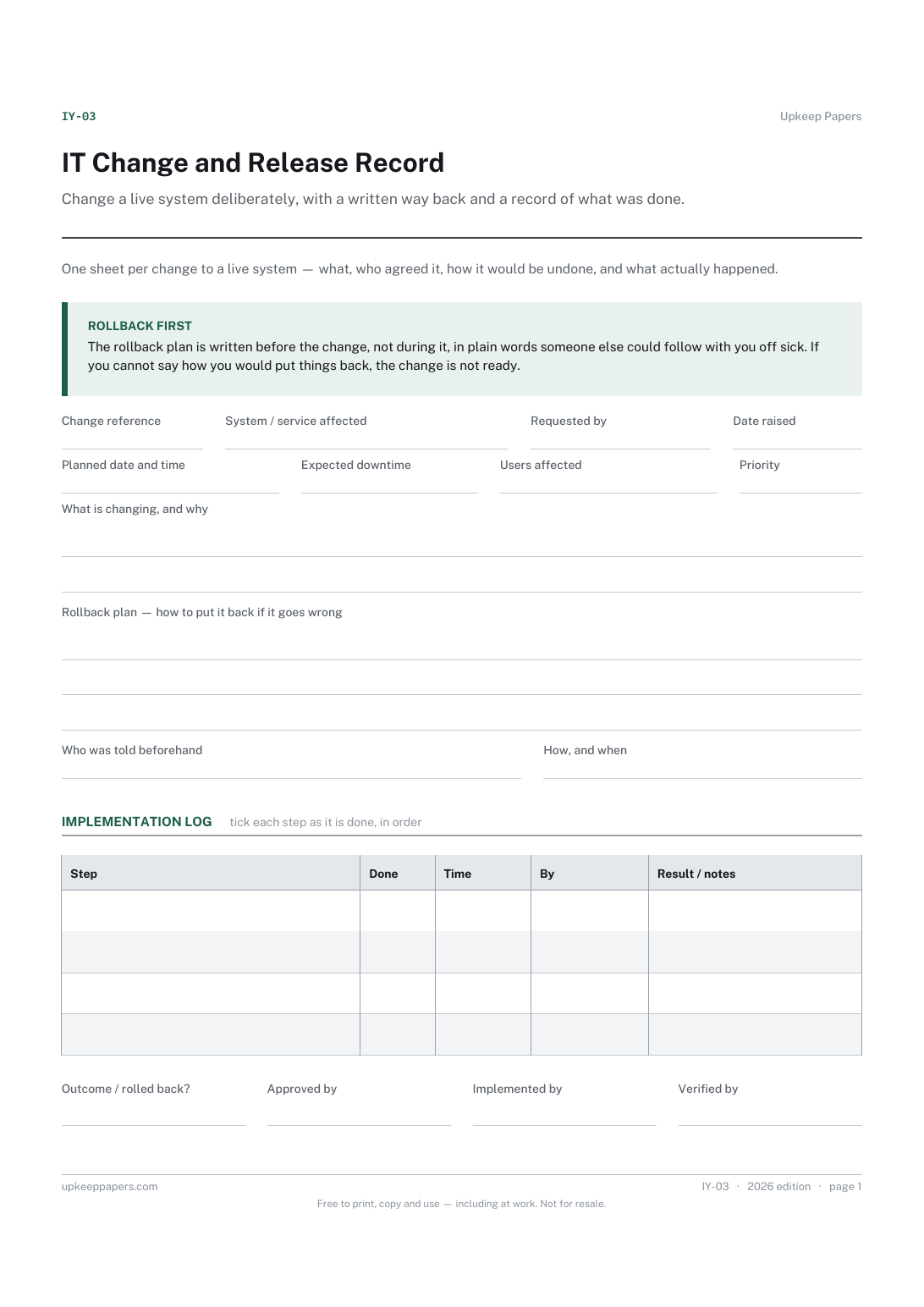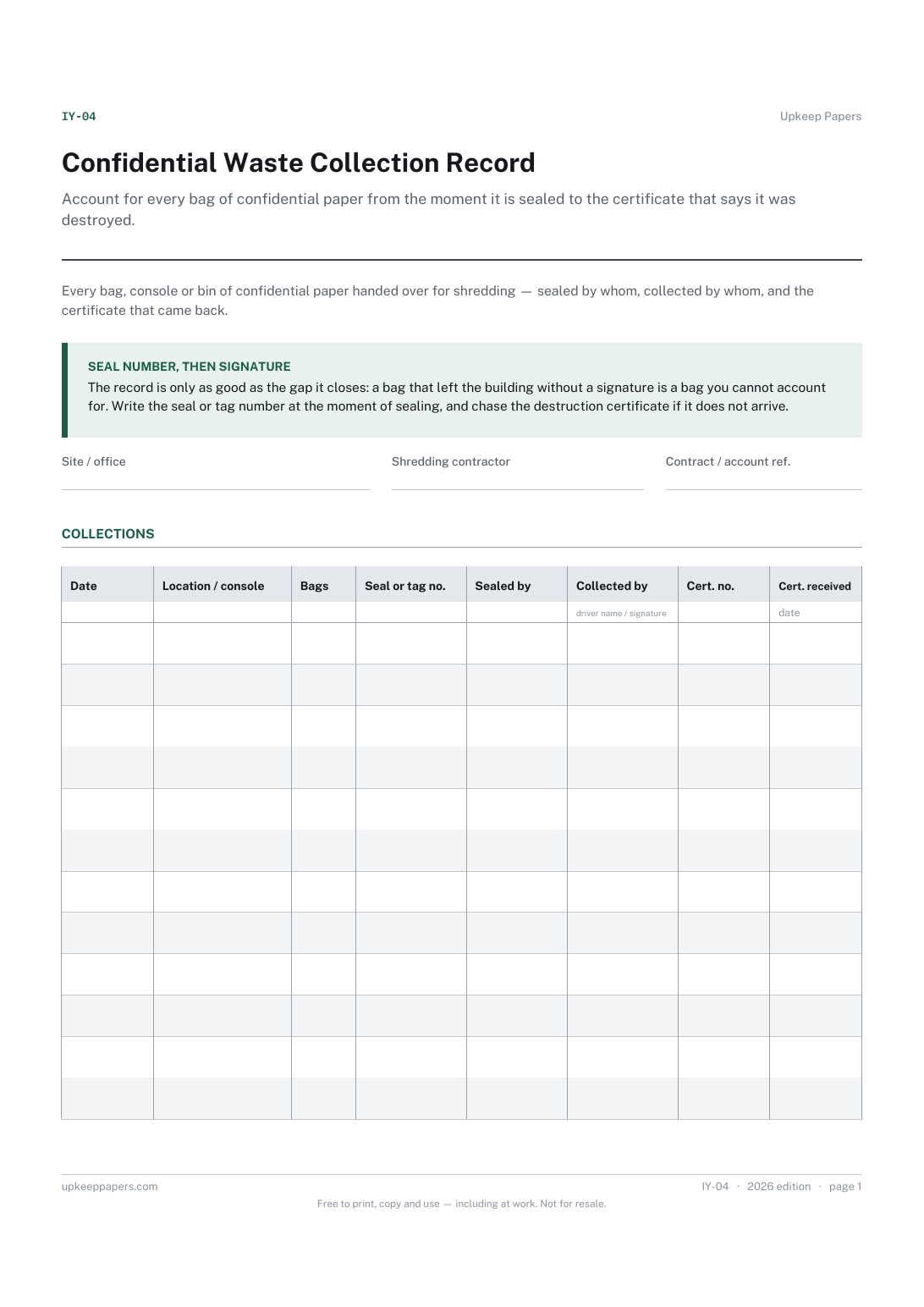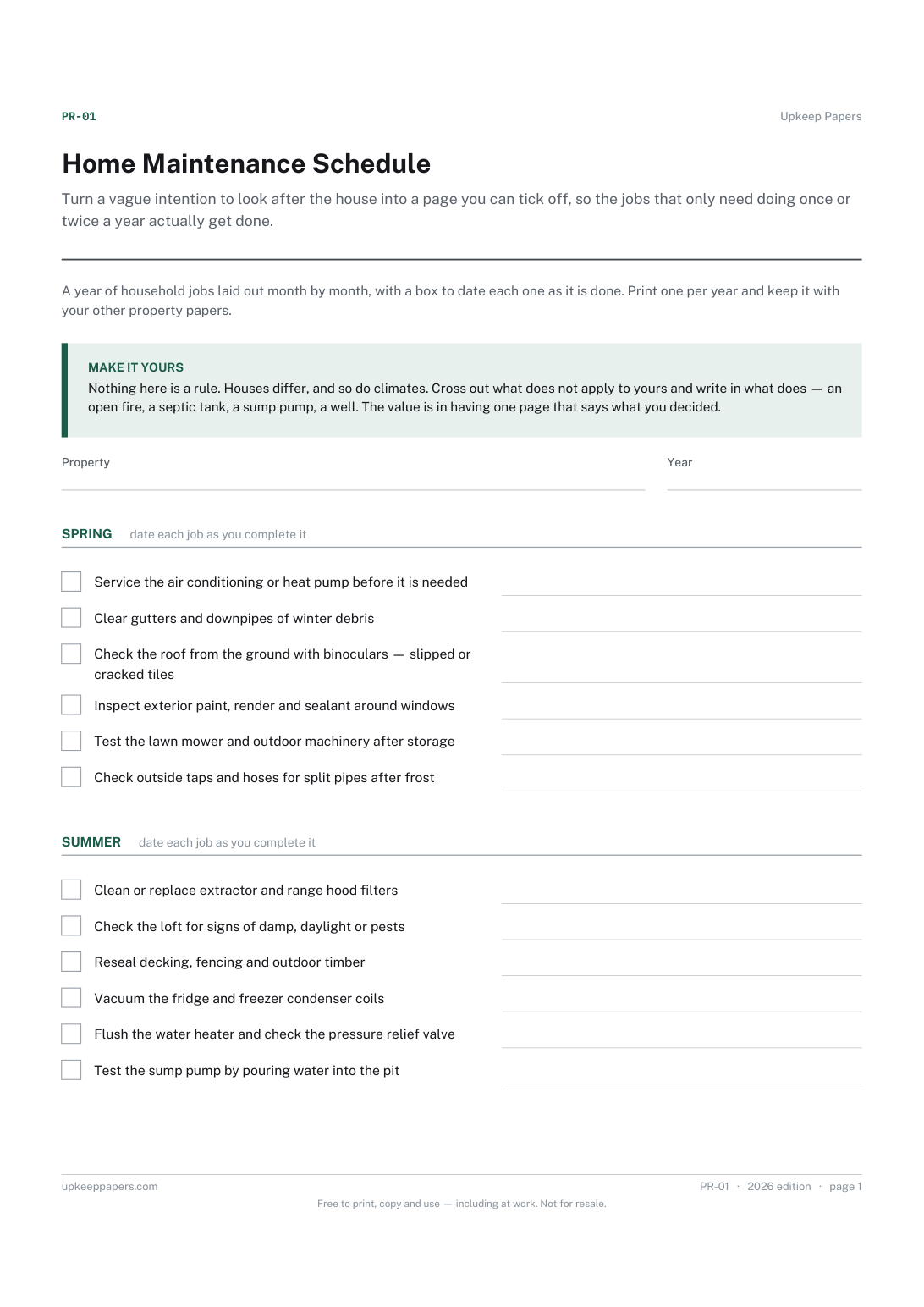
Home Maintenance Schedule
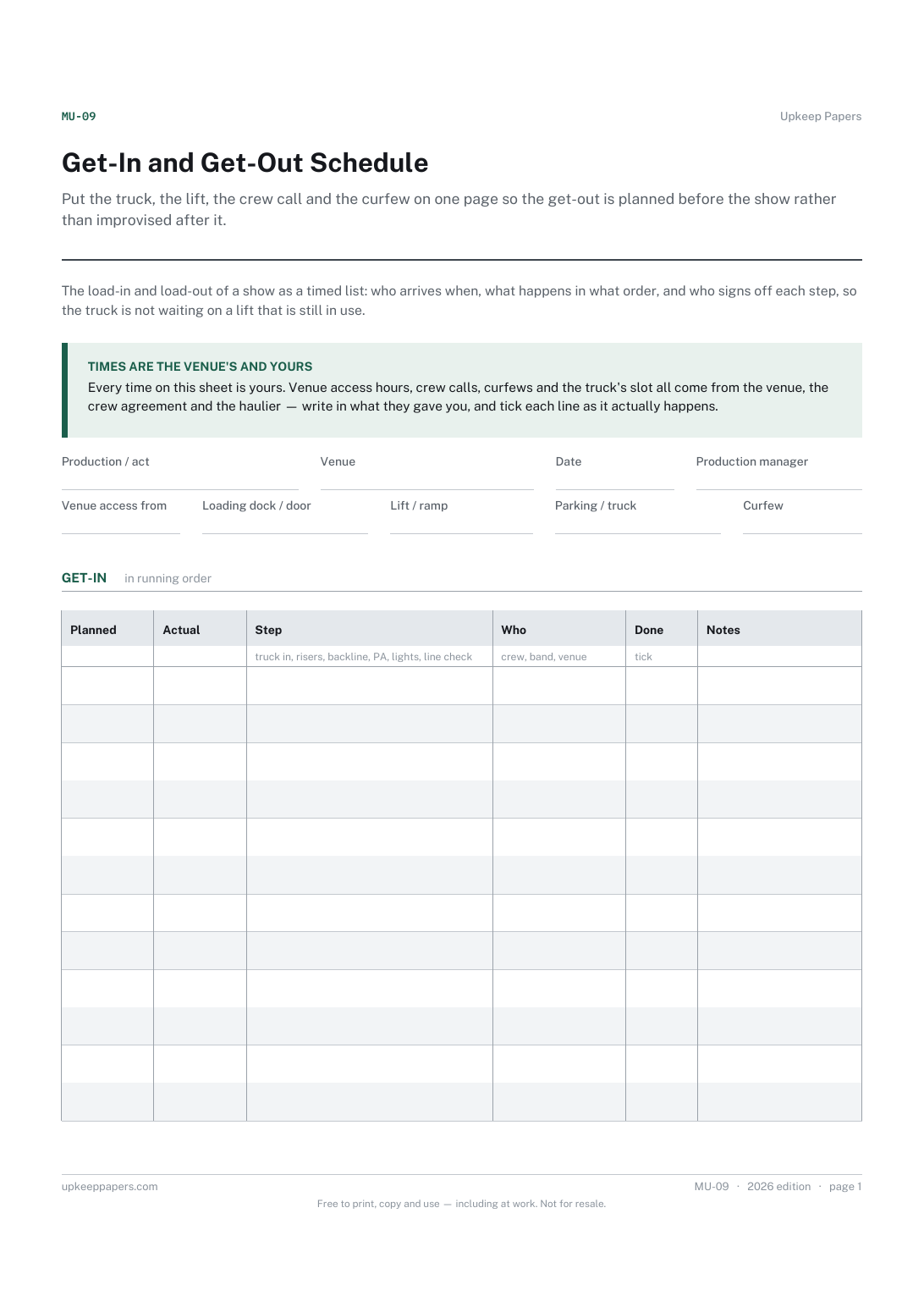
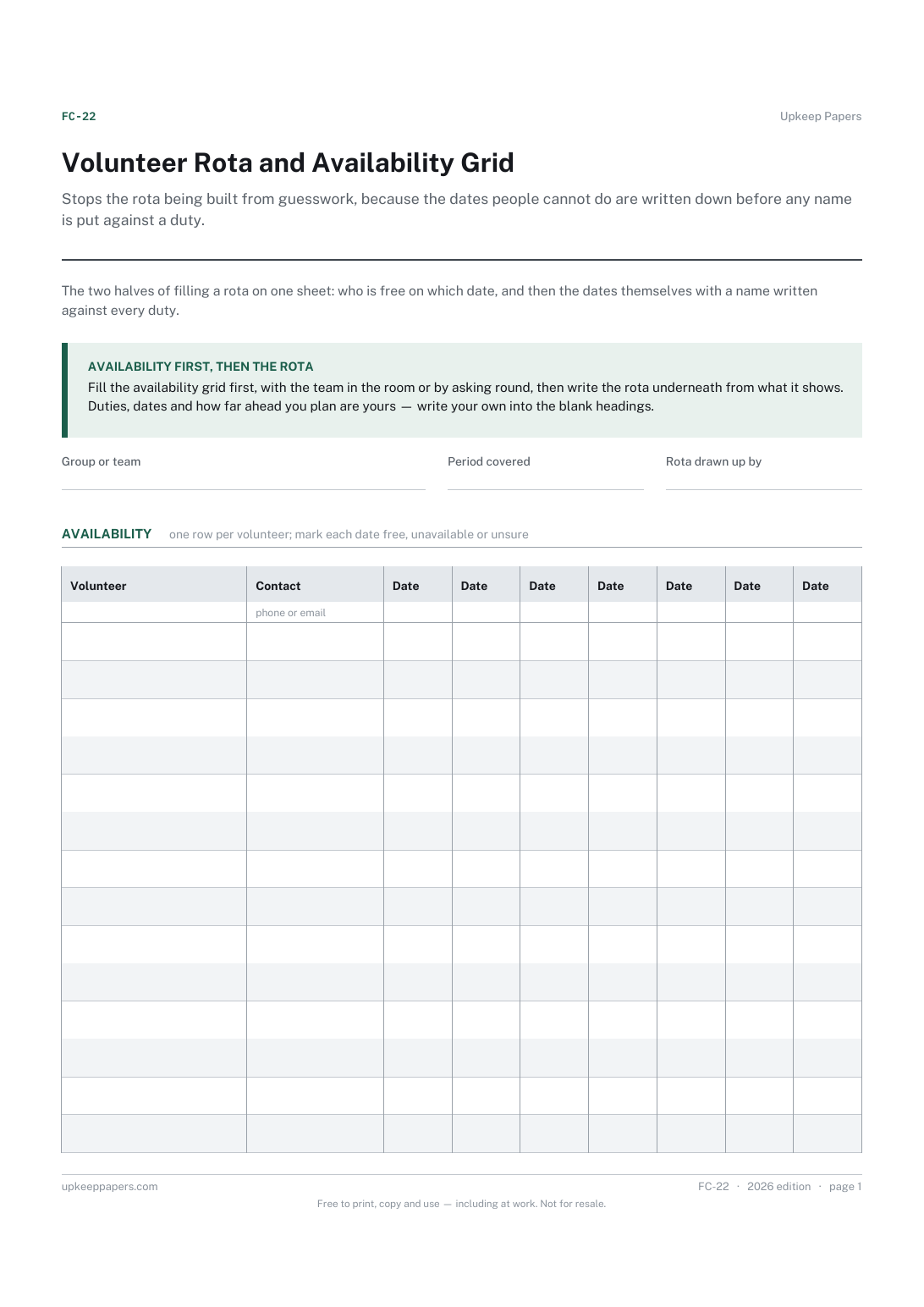
Turn a vague intention to look after the house into a page you can tick off, so the jobs that only need doing once or twice a year actually get done.
PR-01 2 pages
Everything here is free. Making it takes time and money. Everything here is free.
 Buy us a coffee
 The library
Every sheet is free, ungated and available in four files: A4 and US Letter, print and fillable. Jump to a category, or scroll the lot. Looking for a planner, budget or tracker that calculates? Those are in the resource collection.
The paperwork that covers the whole building — service history, registers, warranties and the seasonal rounds.
Turn a vague intention to look after the house into a page you can tick off, so the jobs that only need doing once or twice a year actually get done.
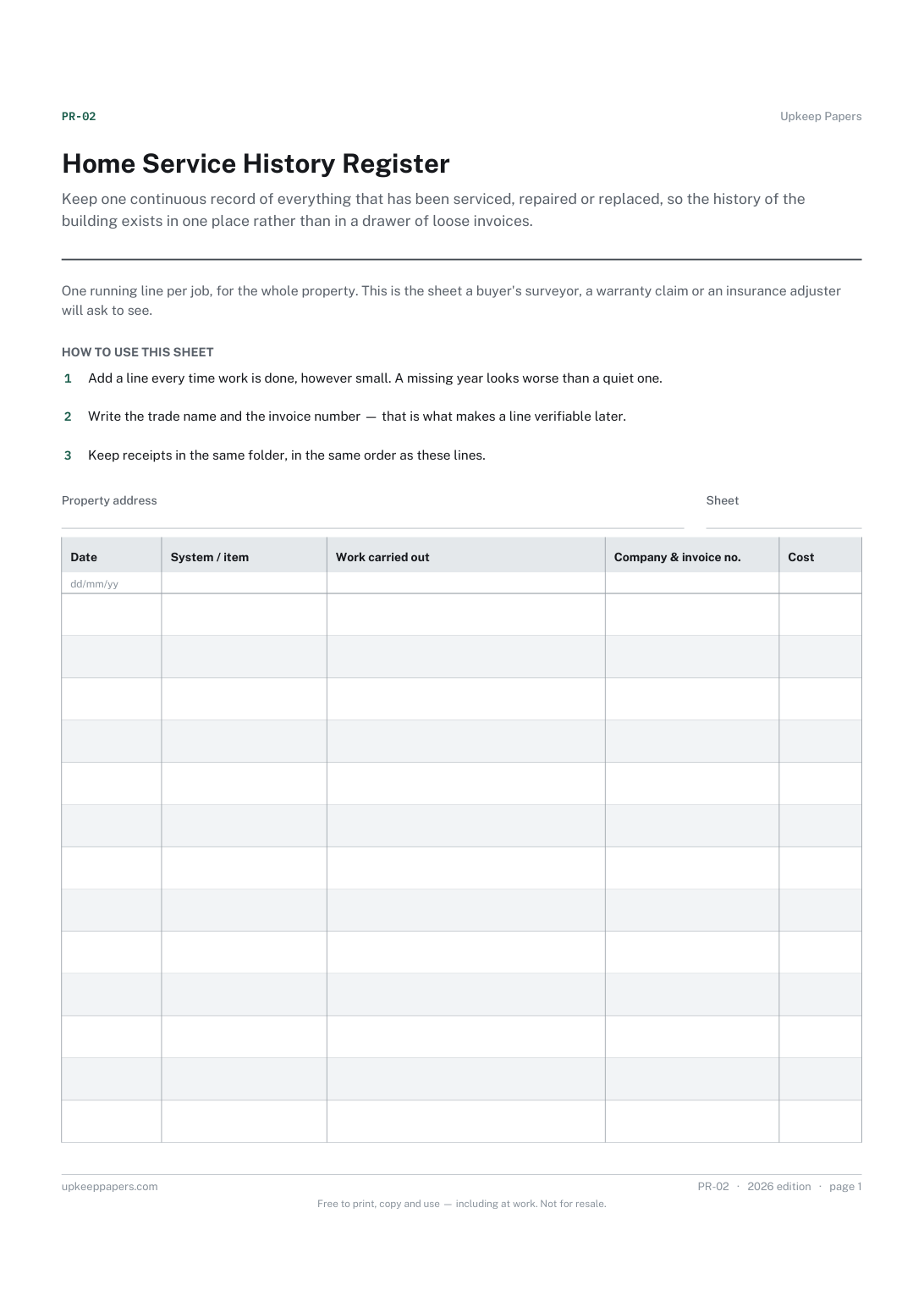
Keep one continuous record of everything that has been serviced, repaired or replaced, so the history of the building exists in one place rather than in a drawer of loose invoices.
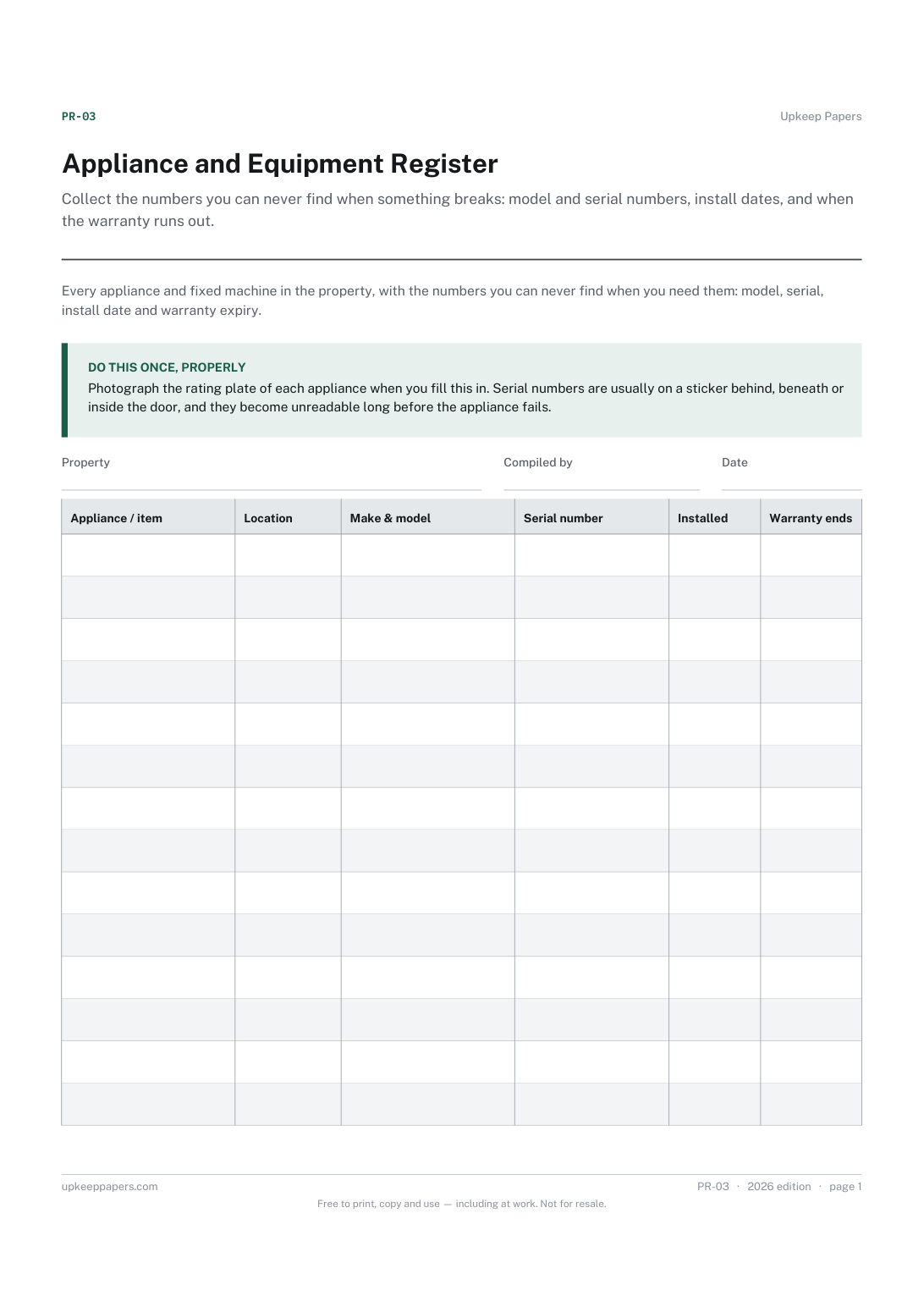
Collect the numbers you can never find when something breaks: model and serial numbers, install dates, and when the warranty runs out.
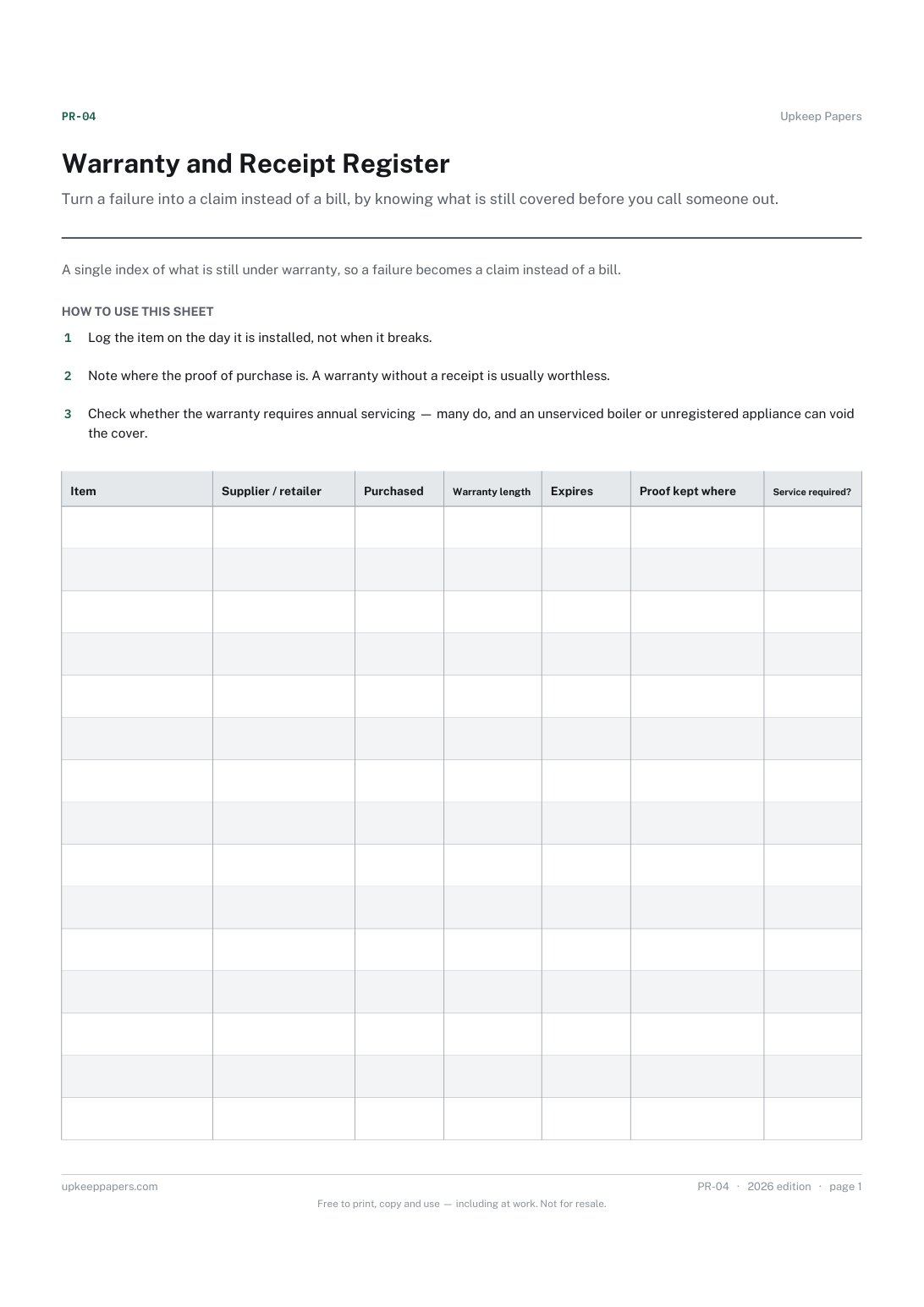
Turn a failure into a claim instead of a bill, by knowing what is still covered before you call someone out.
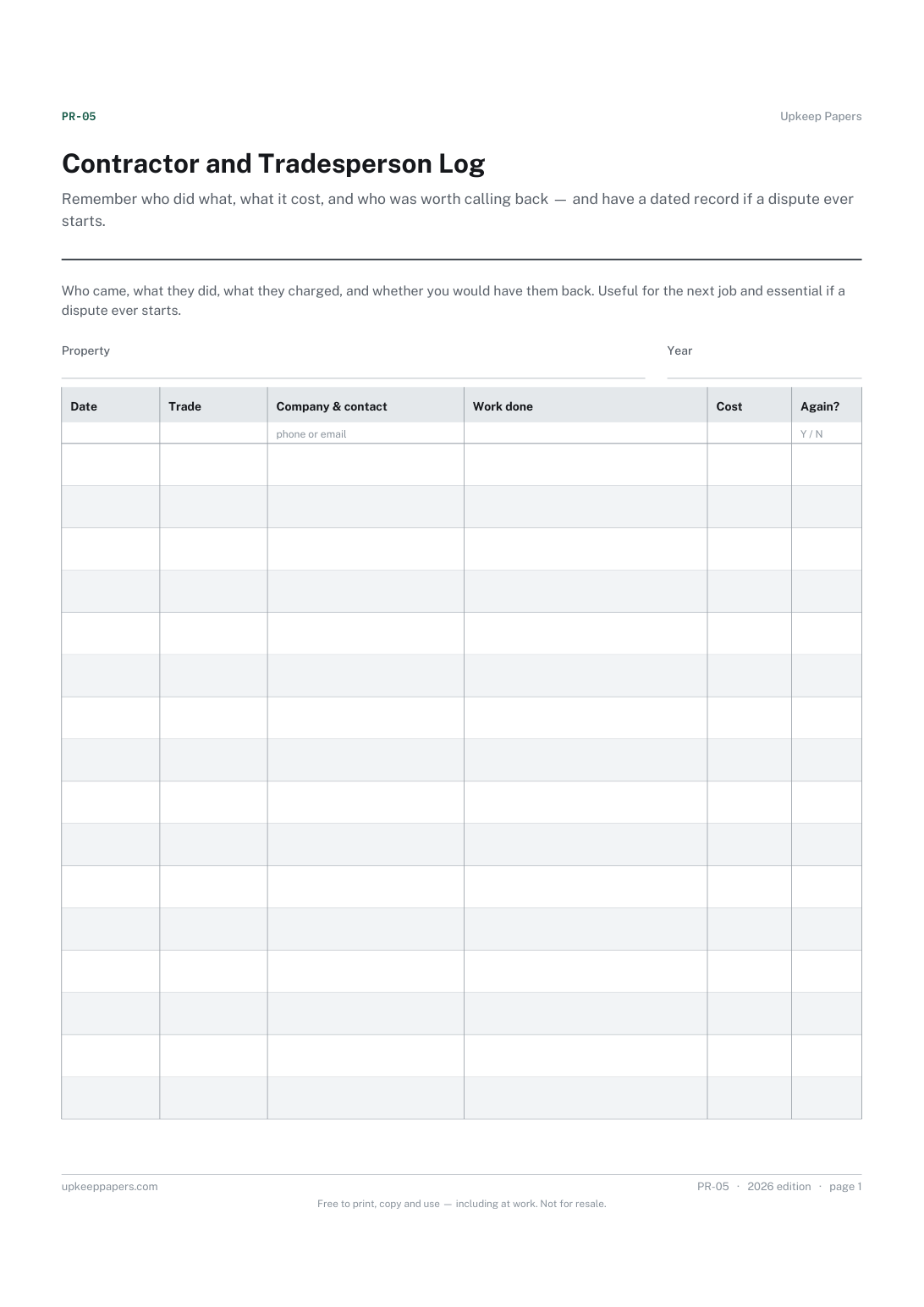
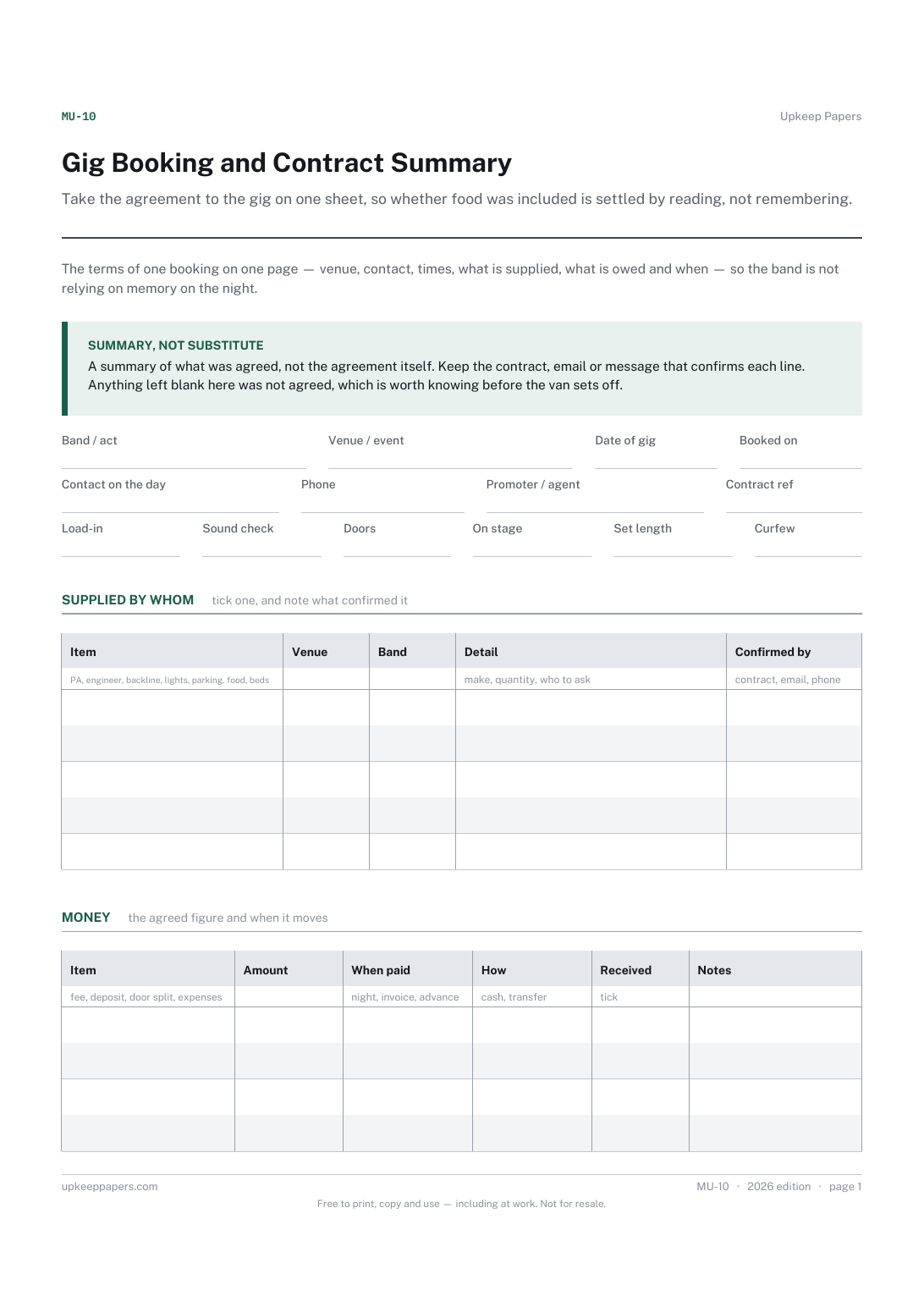
Remember who did what, what it cost, and who was worth calling back — and have a dated record if a dispute ever starts.
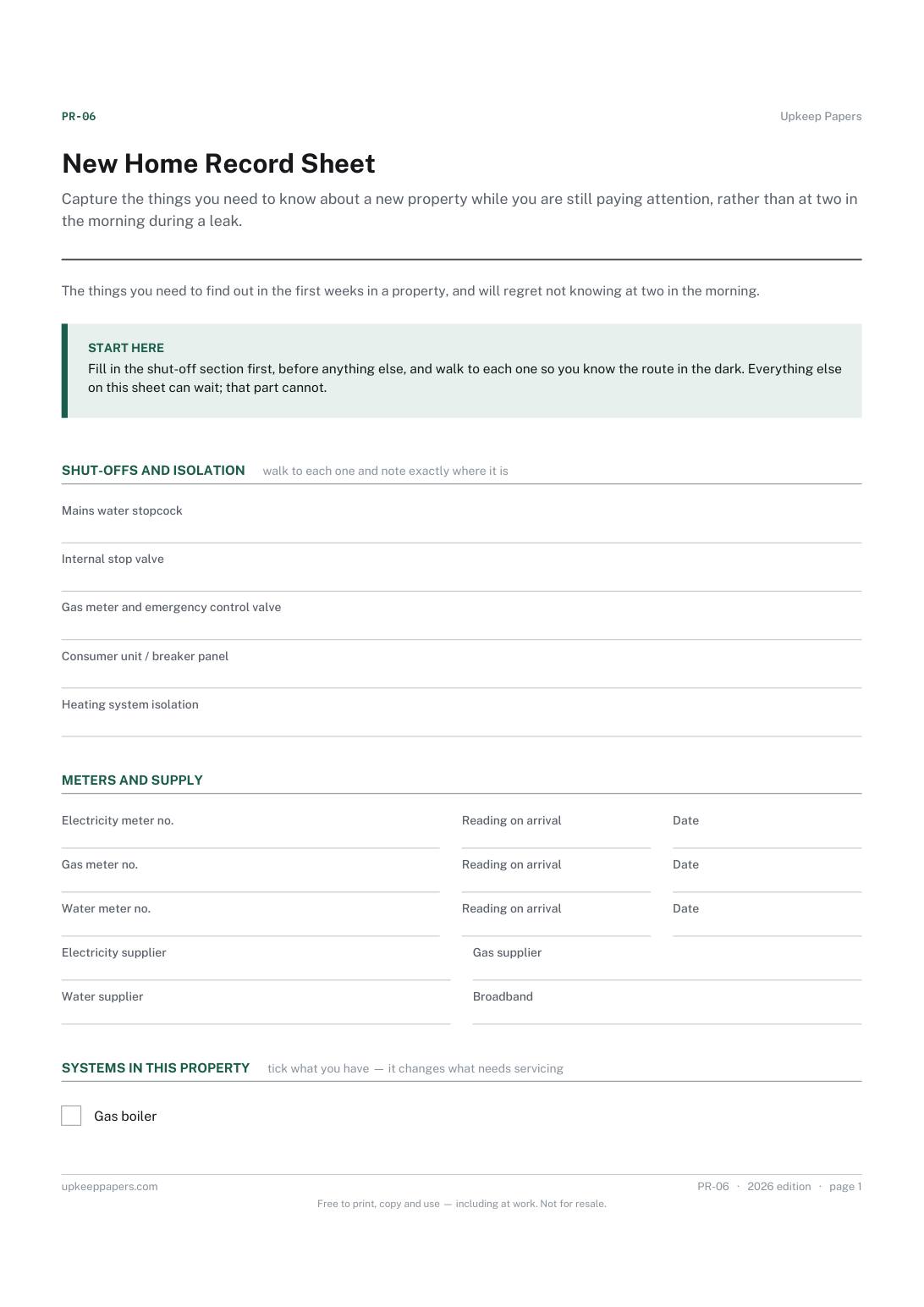
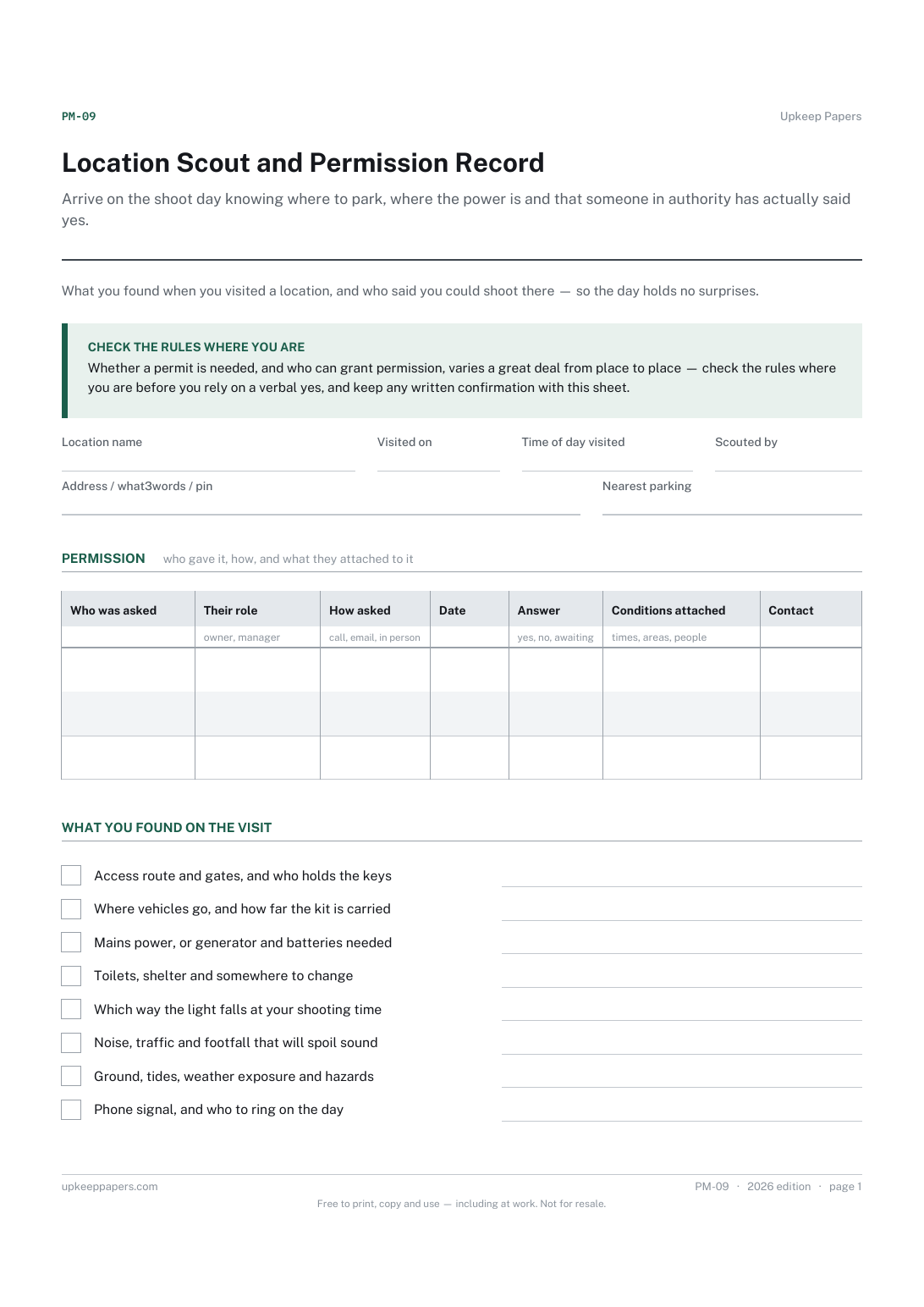
Capture the things you need to know about a new property while you are still paying attention, rather than at two in the morning during a leak.
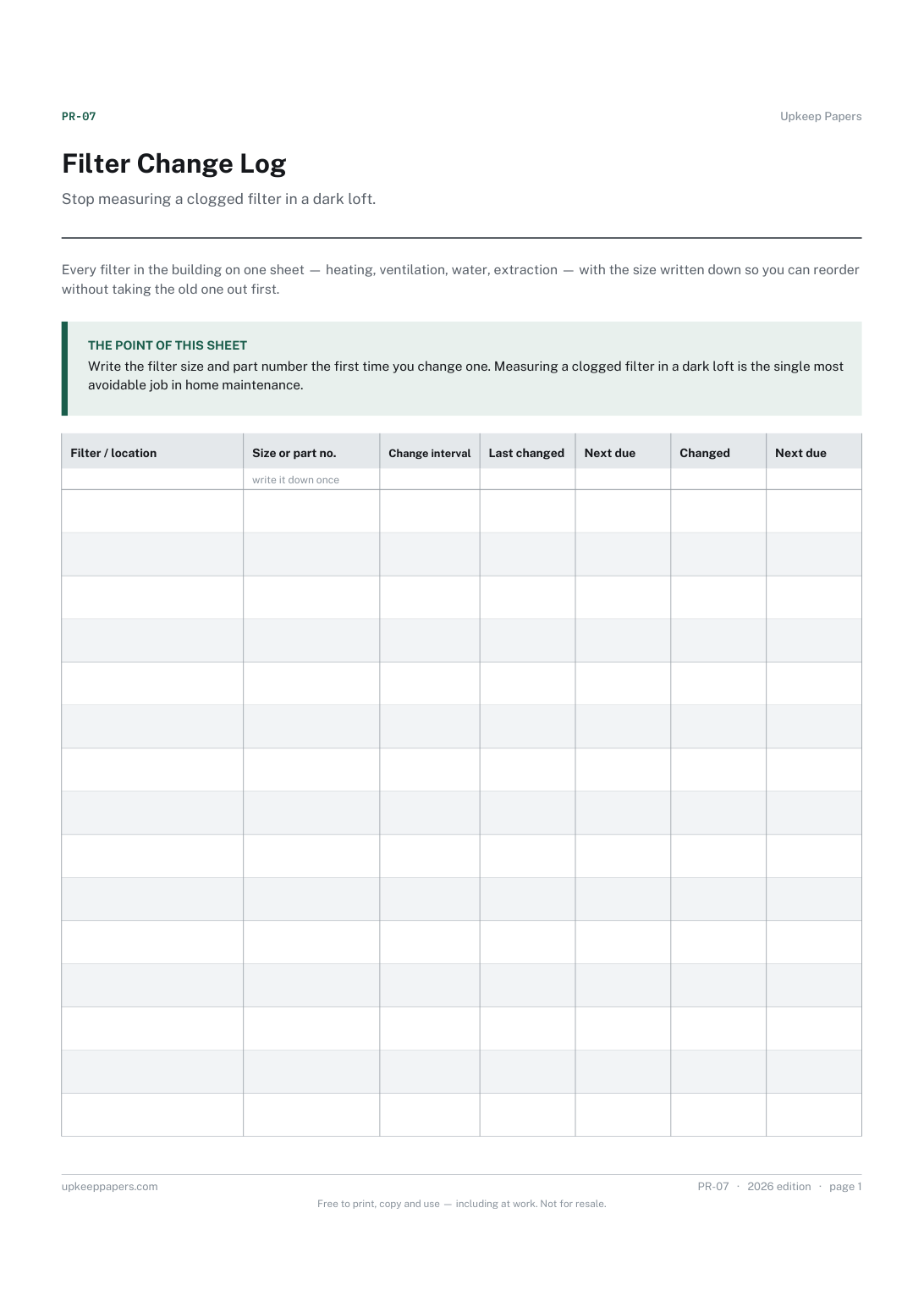
Stop measuring a clogged filter in a dark loft. Write the size down the first time, then reorder without taking the old one out.
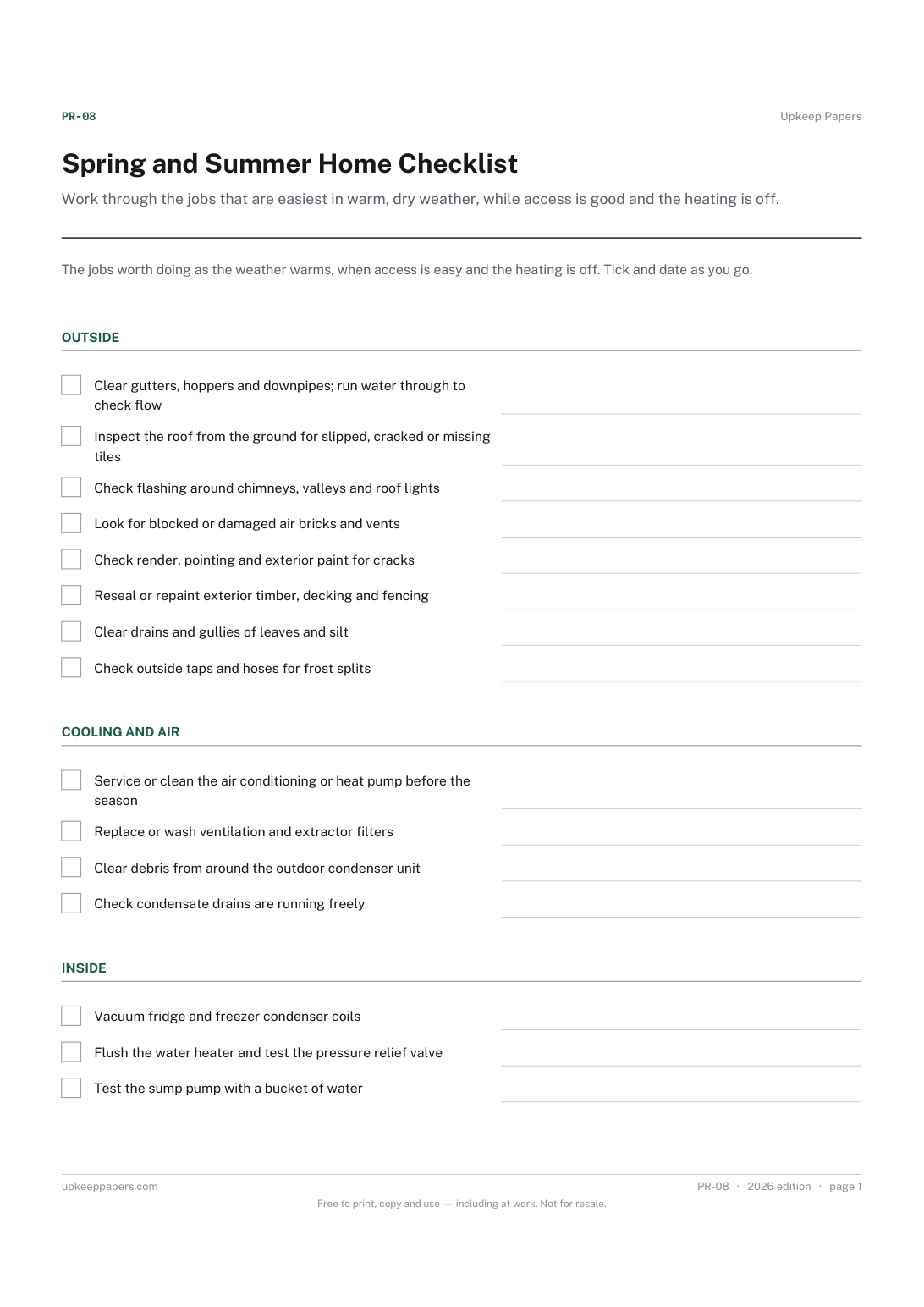
Work through the jobs that are easiest in warm, dry weather, while access is good and the heating is off.
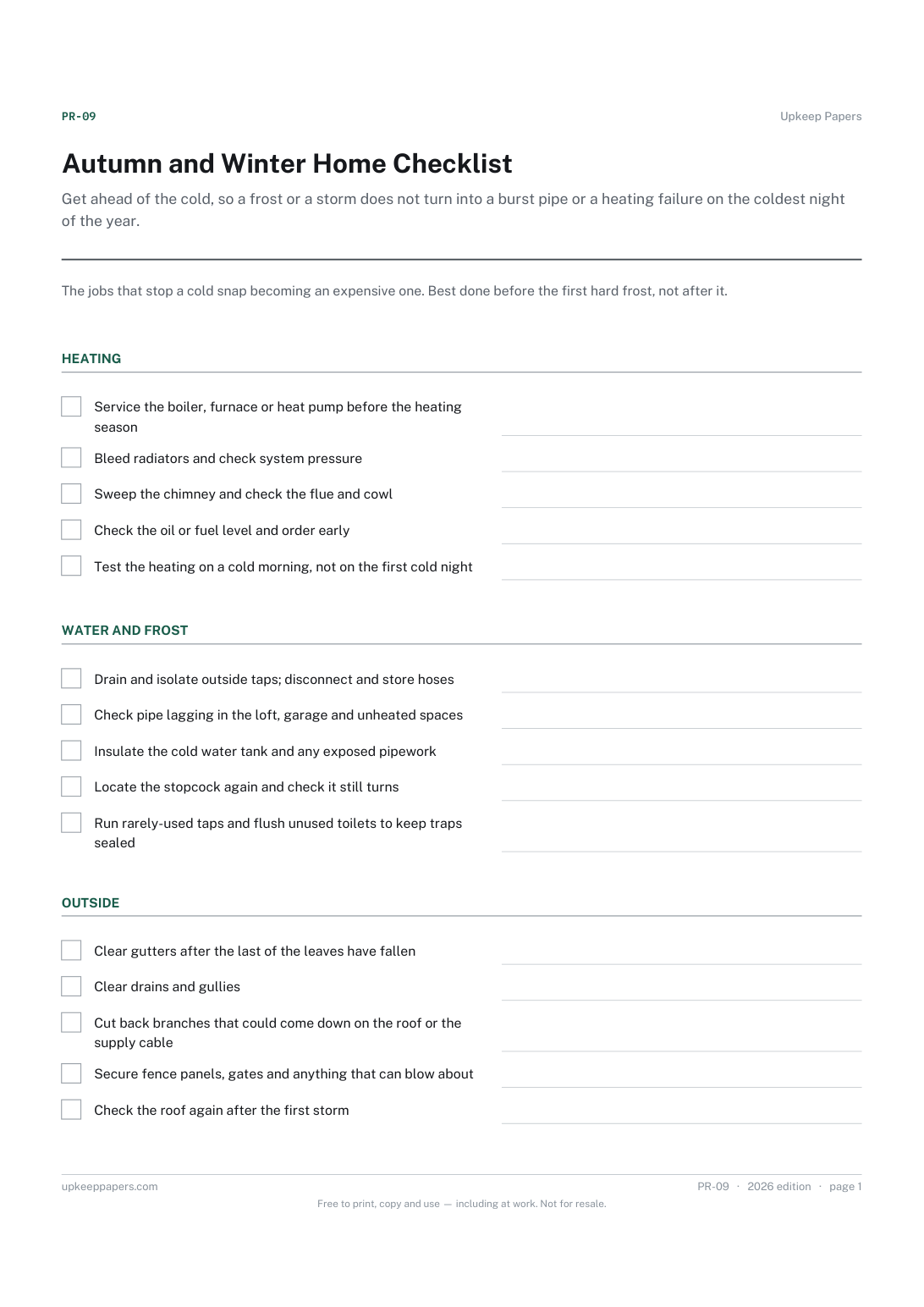
Get ahead of the cold, so a frost or a storm does not turn into a burst pipe or a heating failure on the coldest night of the year.
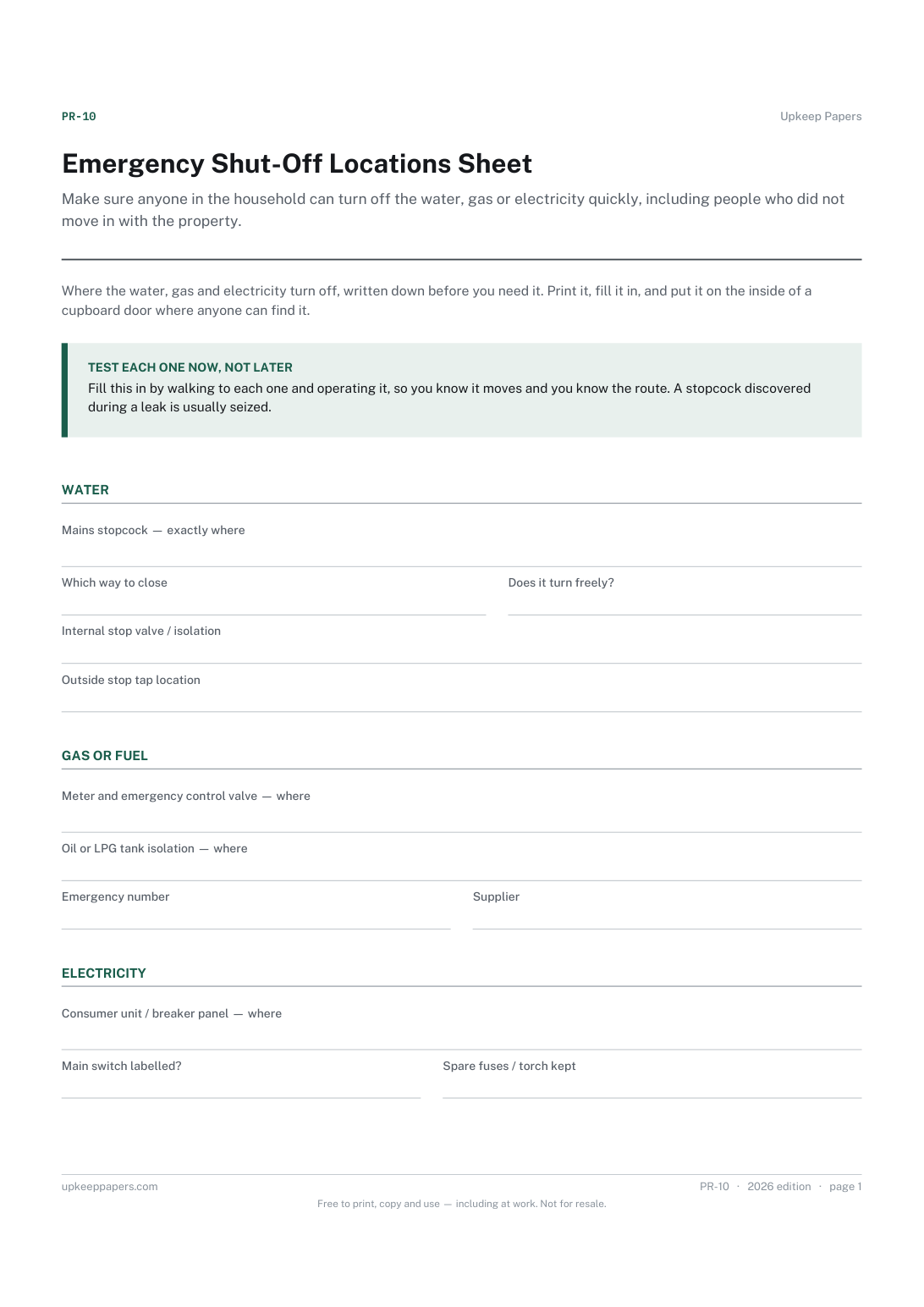
Make sure anyone in the household can turn off the water, gas or electricity quickly, including people who did not move in with the property.
List what you own before you need to, so a claim or a police report starts from a document rather than from trying to remember a burgled room.
Know what is in the boxes without going up into the loft, by numbering the boxes and keeping the list on paper.
Record what went on which wall so a touch-up in three years is one trip to one shop instead of an afternoon of matching.
Measure every opening once, properly, and record all three measurements, so quotes and orders come from the same figures.
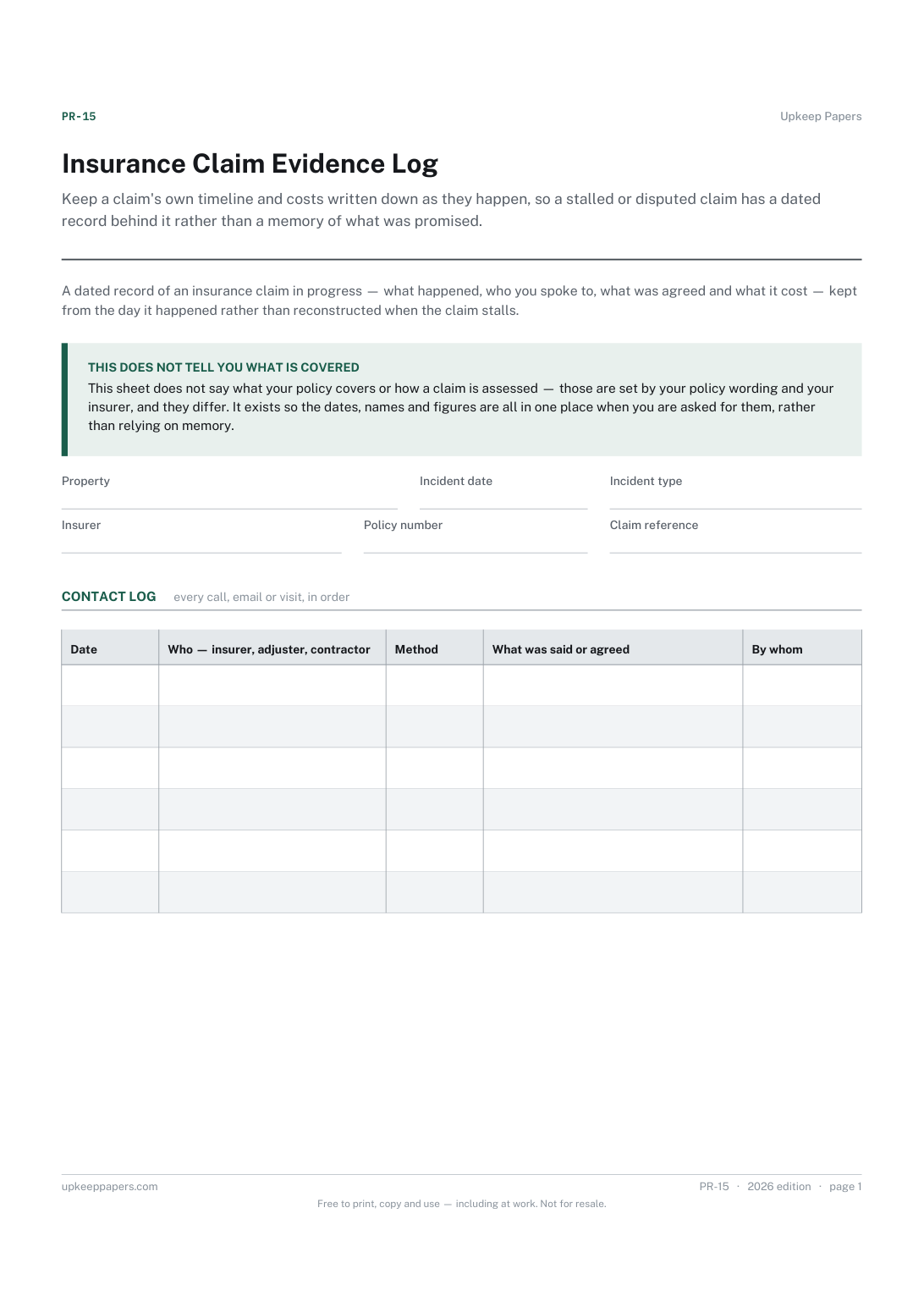
Keep a claim's own timeline and costs written down as they happen, so a stalled or disputed claim has a dated record behind it rather than a memory of what was promised.
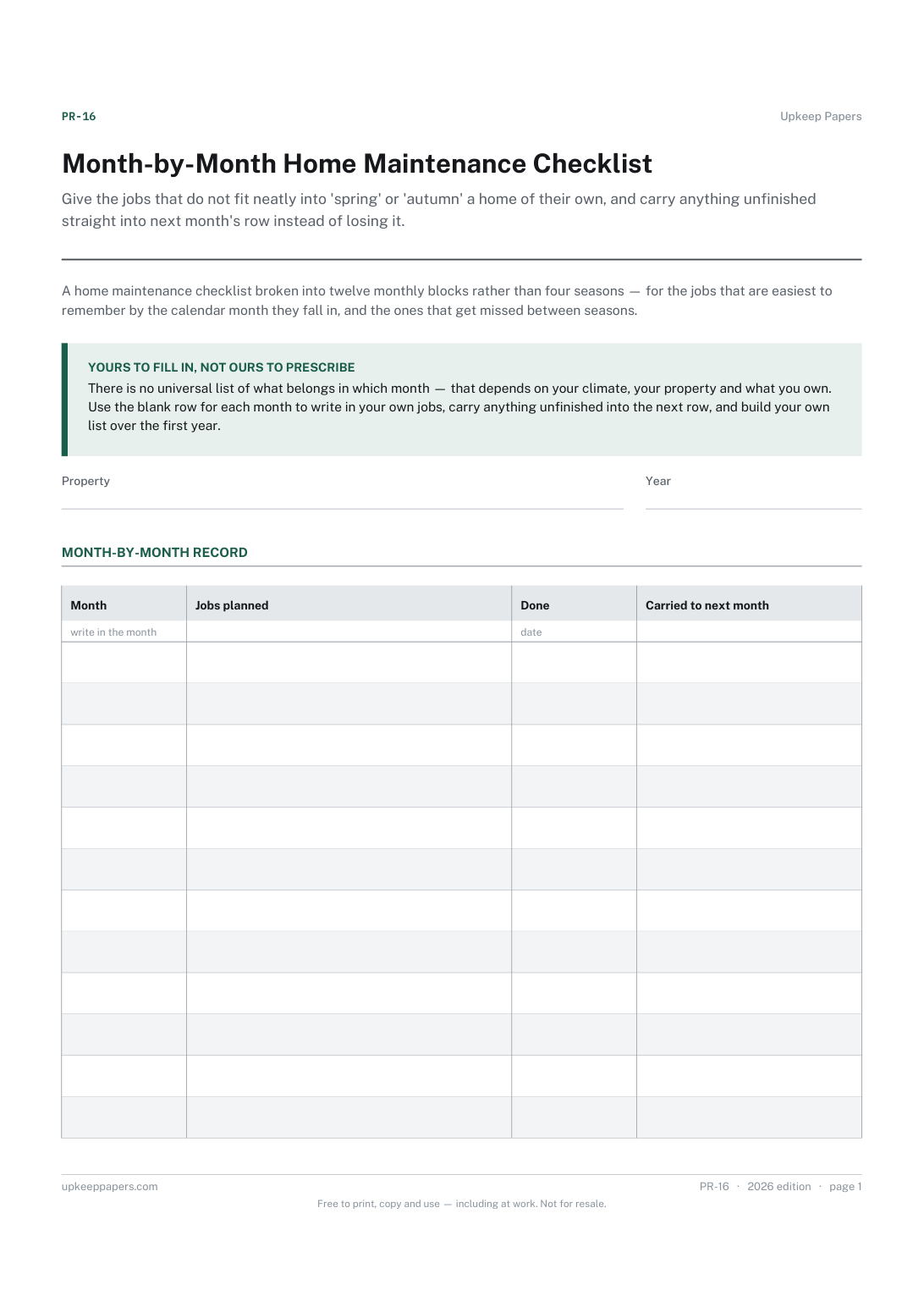
Give the jobs that do not fit neatly into 'spring' or 'autumn' a home of their own, and carry anything unfinished straight into next month's row instead of losing it.
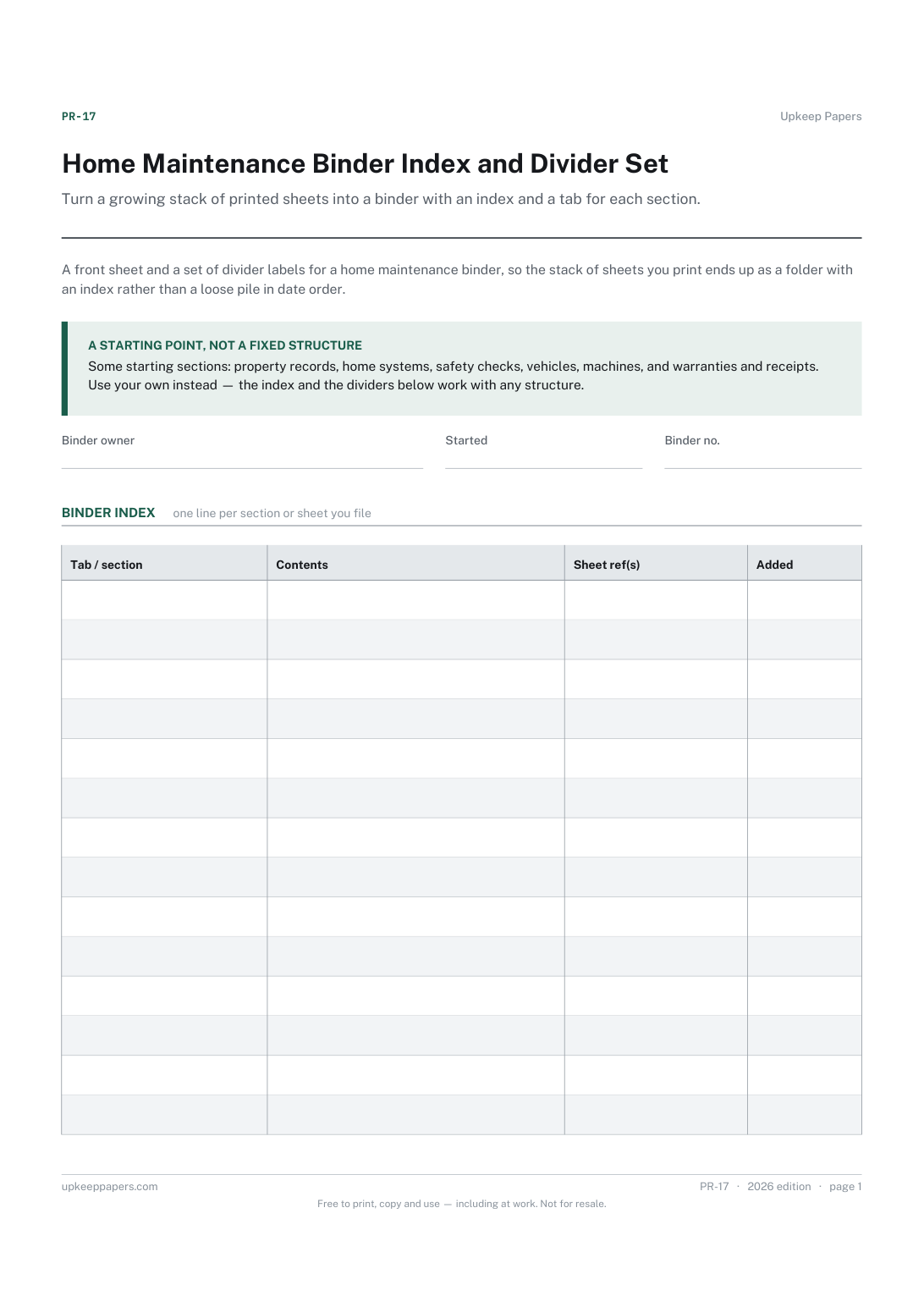
Turn a growing stack of printed sheets into a binder with an index and a tab for each section, so a particular record is findable in seconds rather than by flicking through everything.
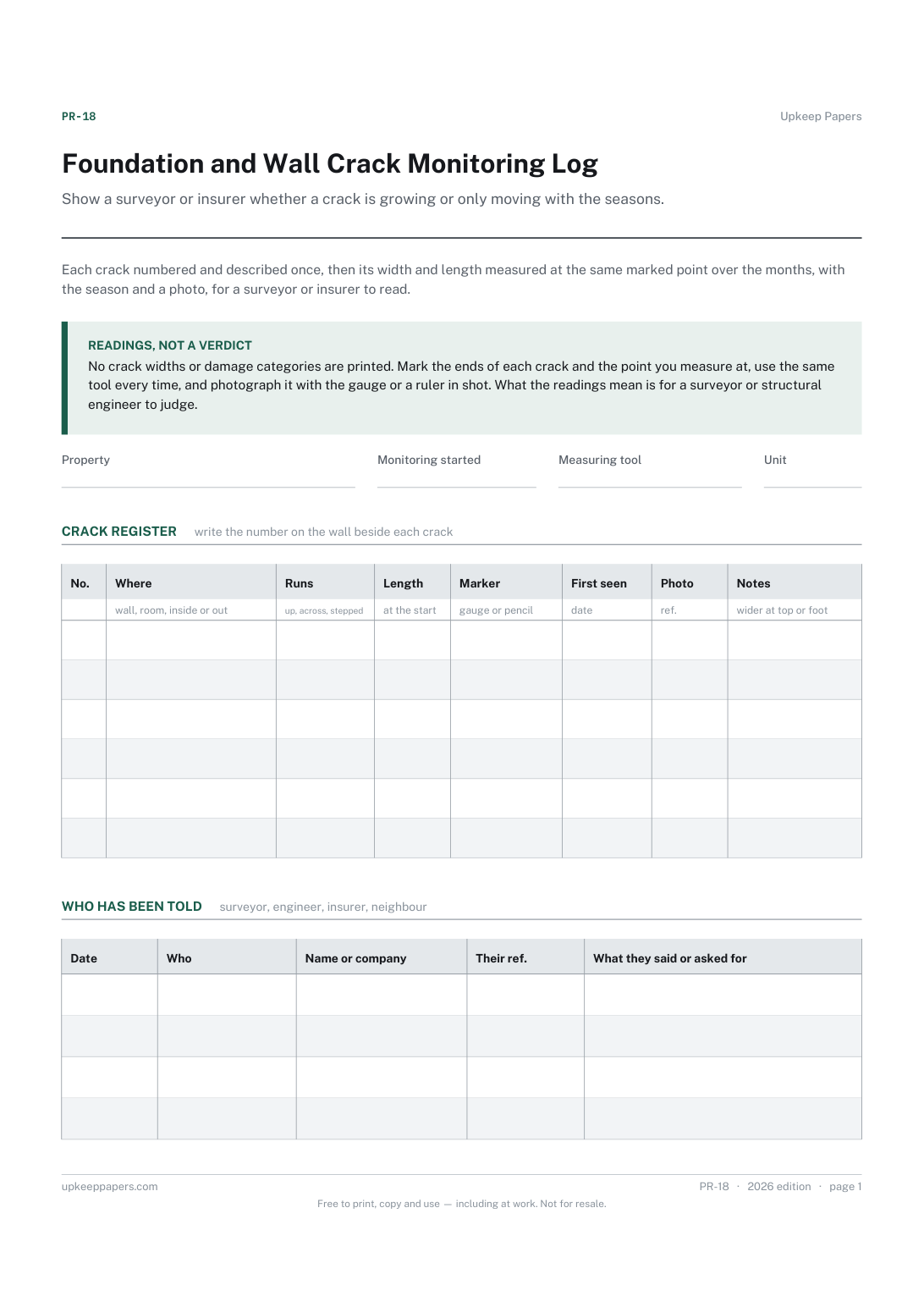
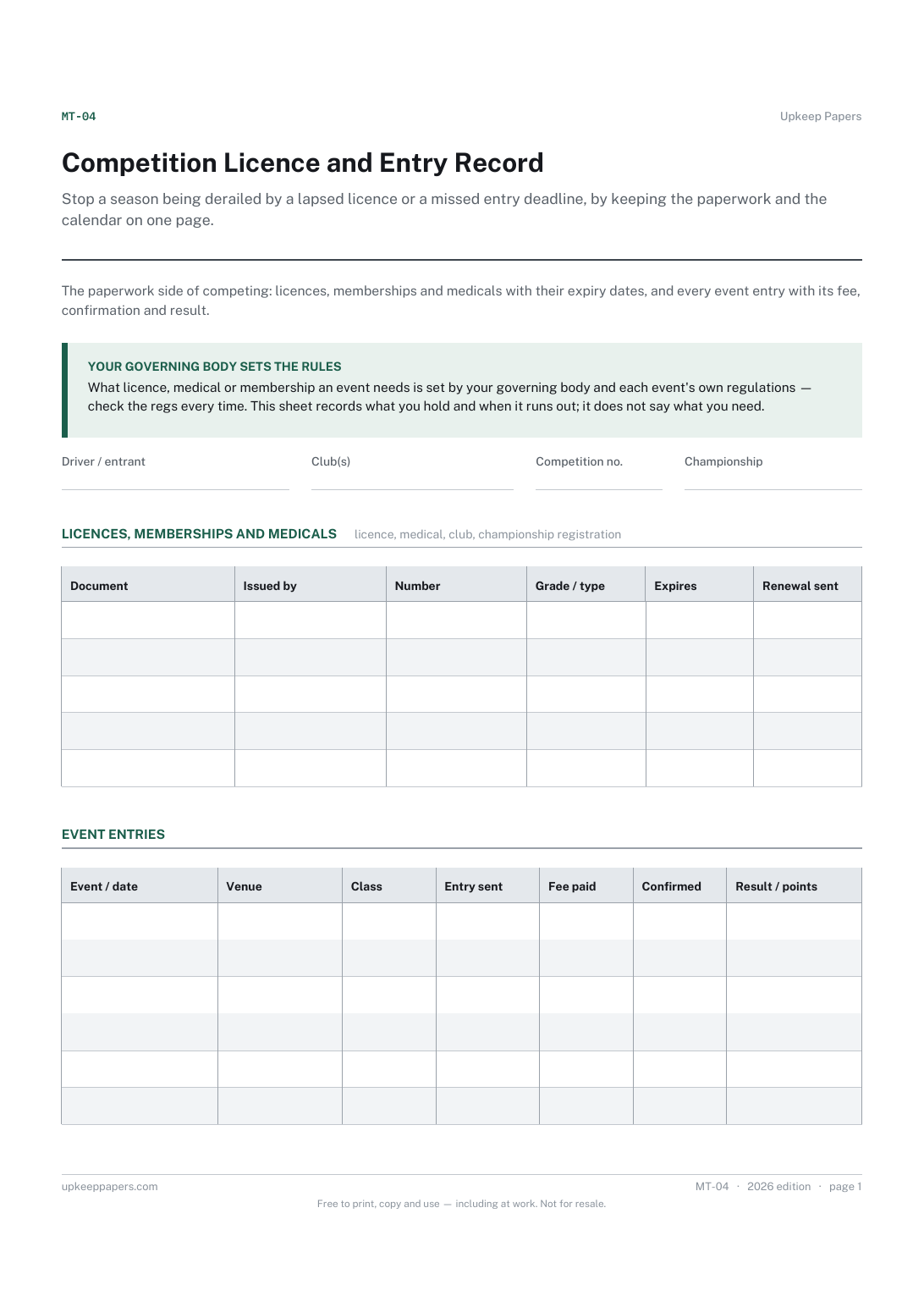
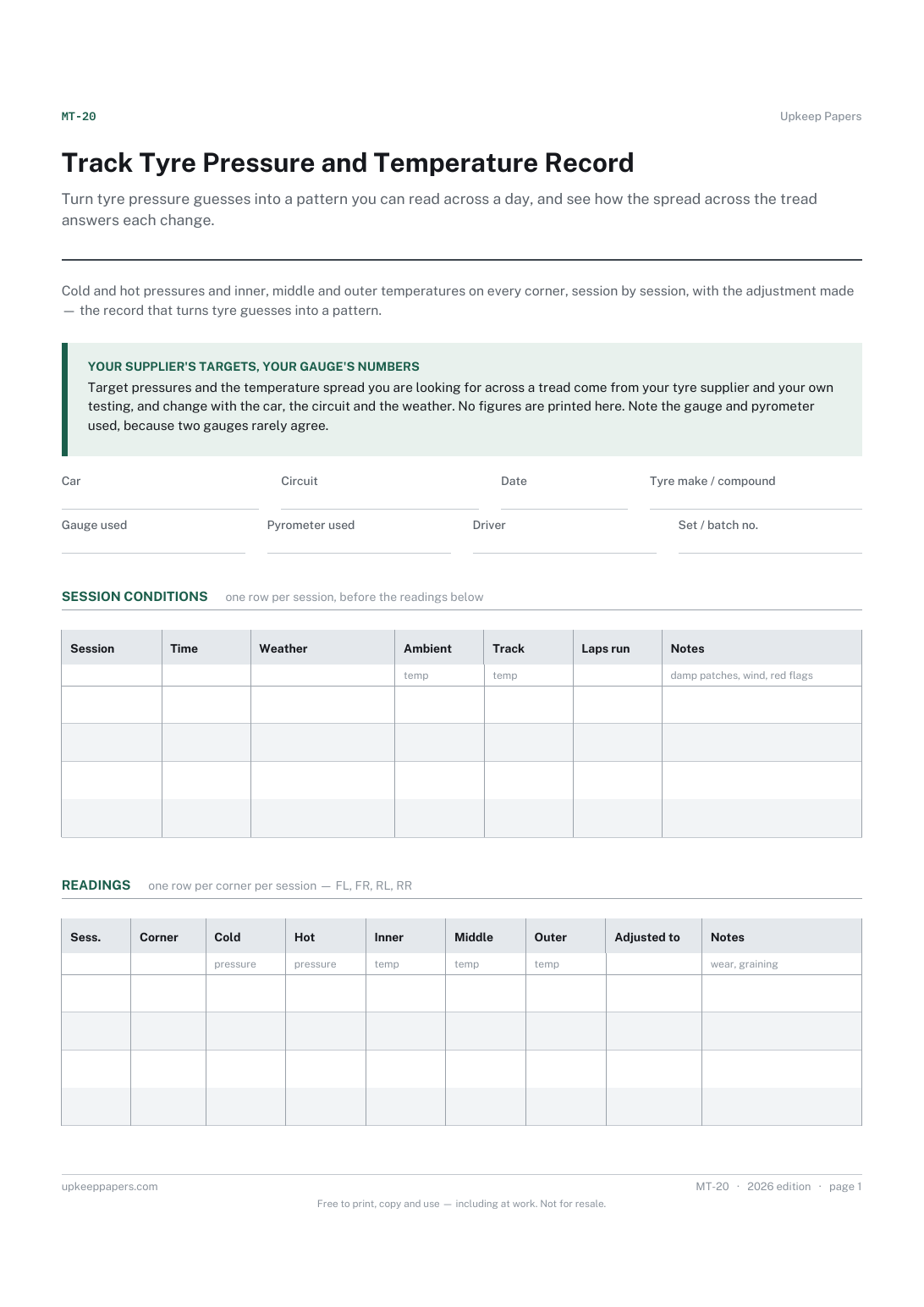
Show a surveyor or insurer whether a crack is growing or only moving with the seasons. The readings are taken the same way every time, so they can be compared.
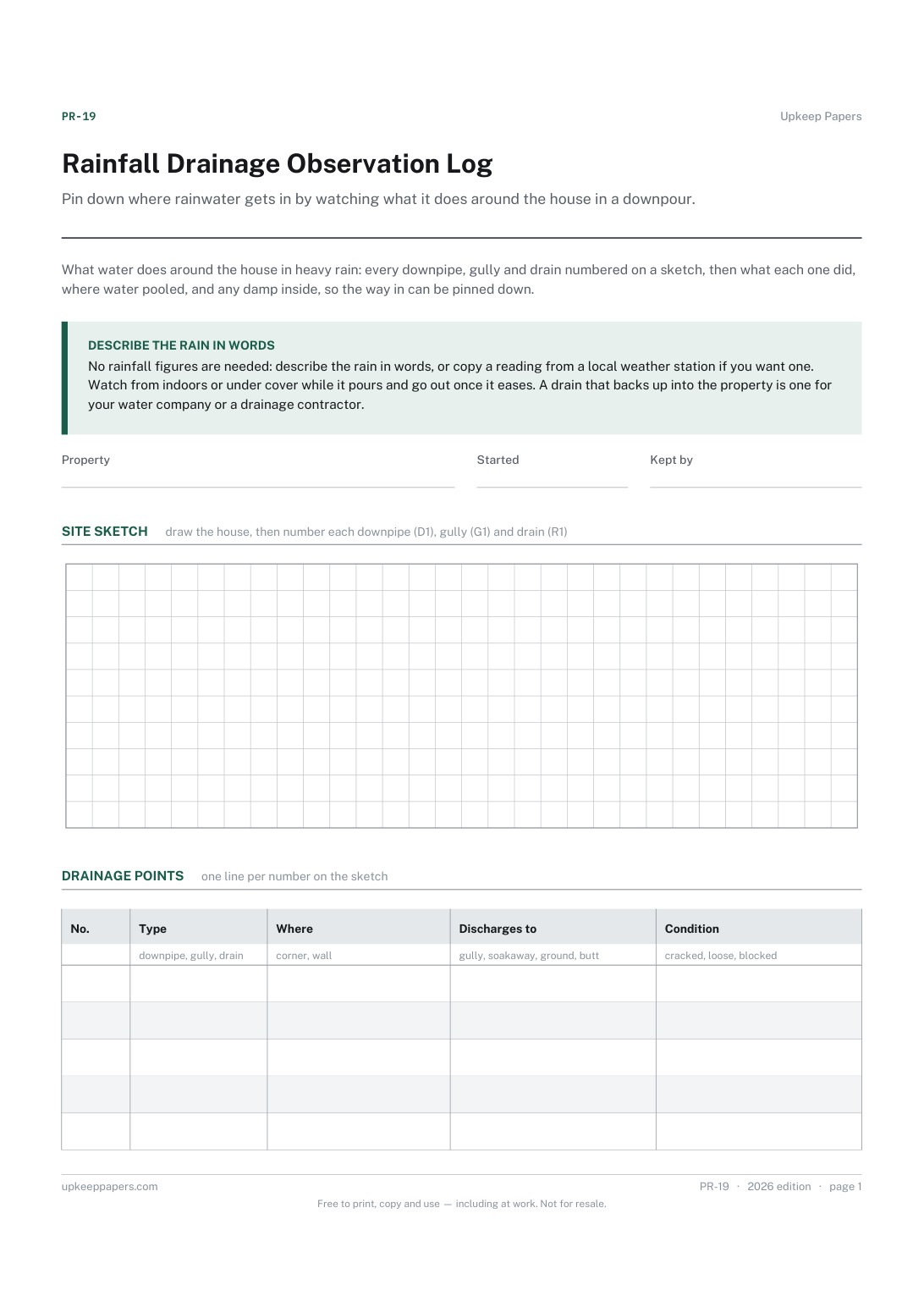
Pin down where rainwater gets in by watching what it does around the house in a downpour. Outside and inside go on the same line, so the link shows.
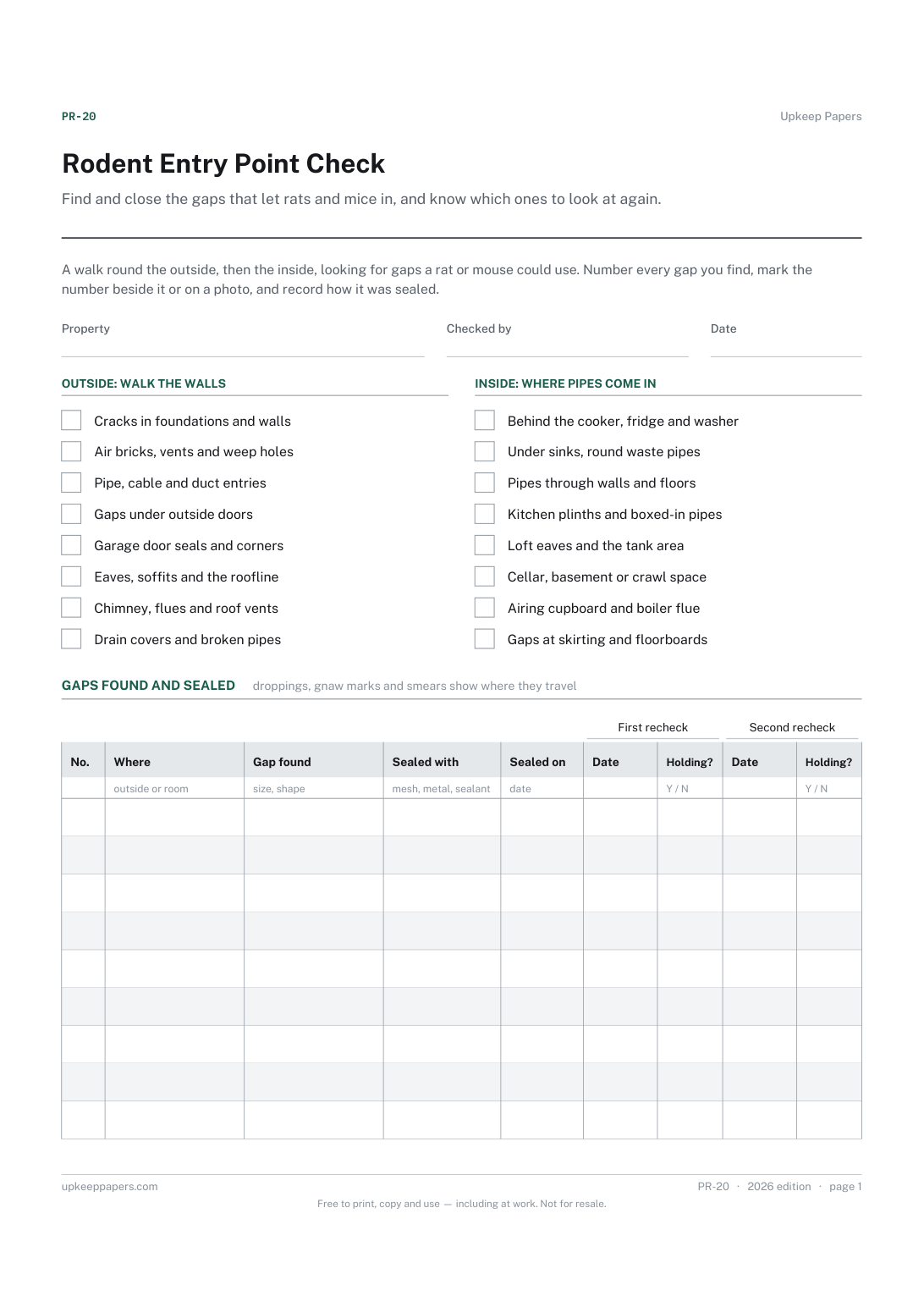
Find and close the gaps that let rats and mice in, and know which ones to look at again. A numbered gap with a recheck date is easier to follow up than a memory.
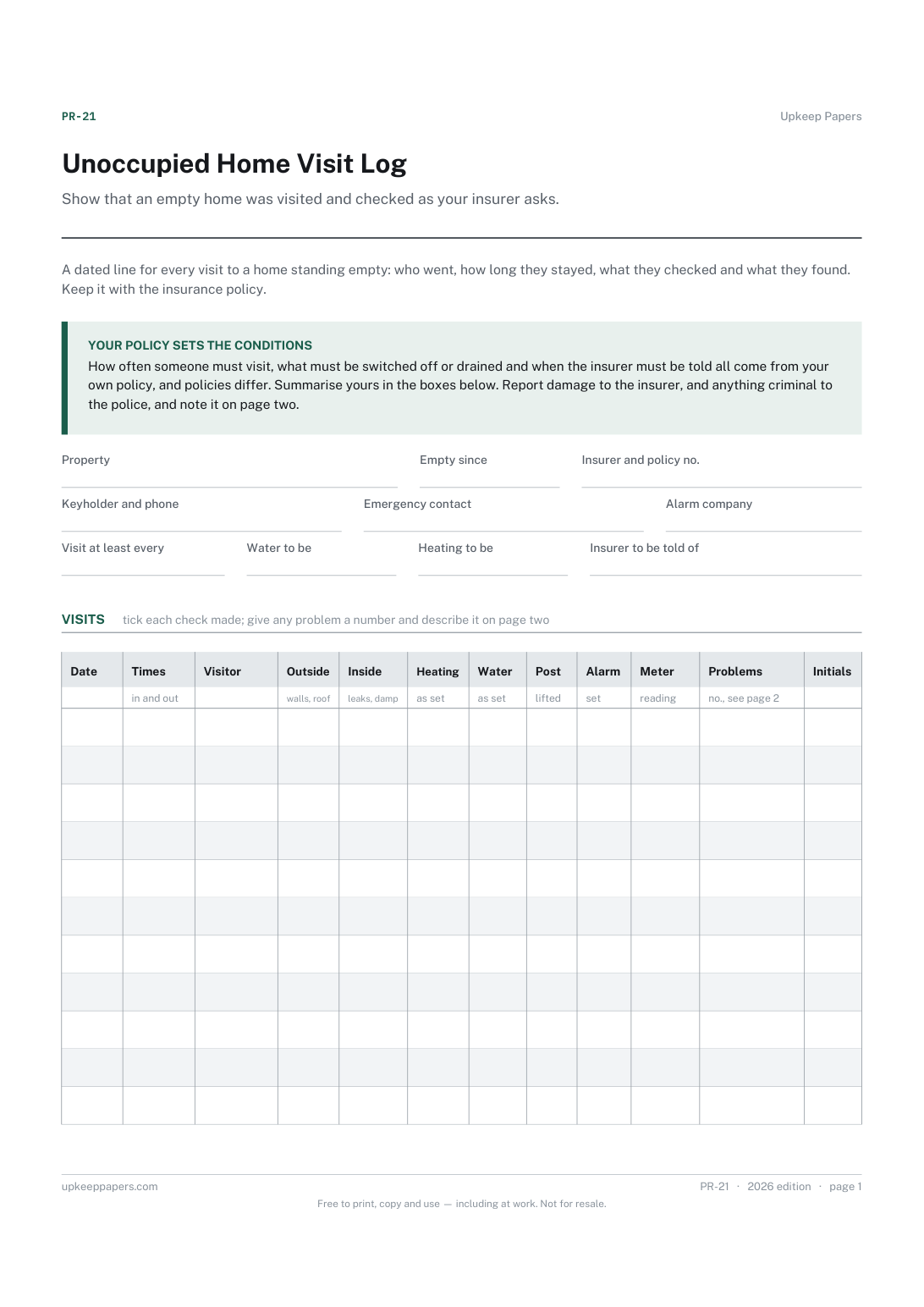
Show that an empty home was visited and checked as your insurer asks. Every visit gets a dated, initialled line, and anything found is logged with who was told.
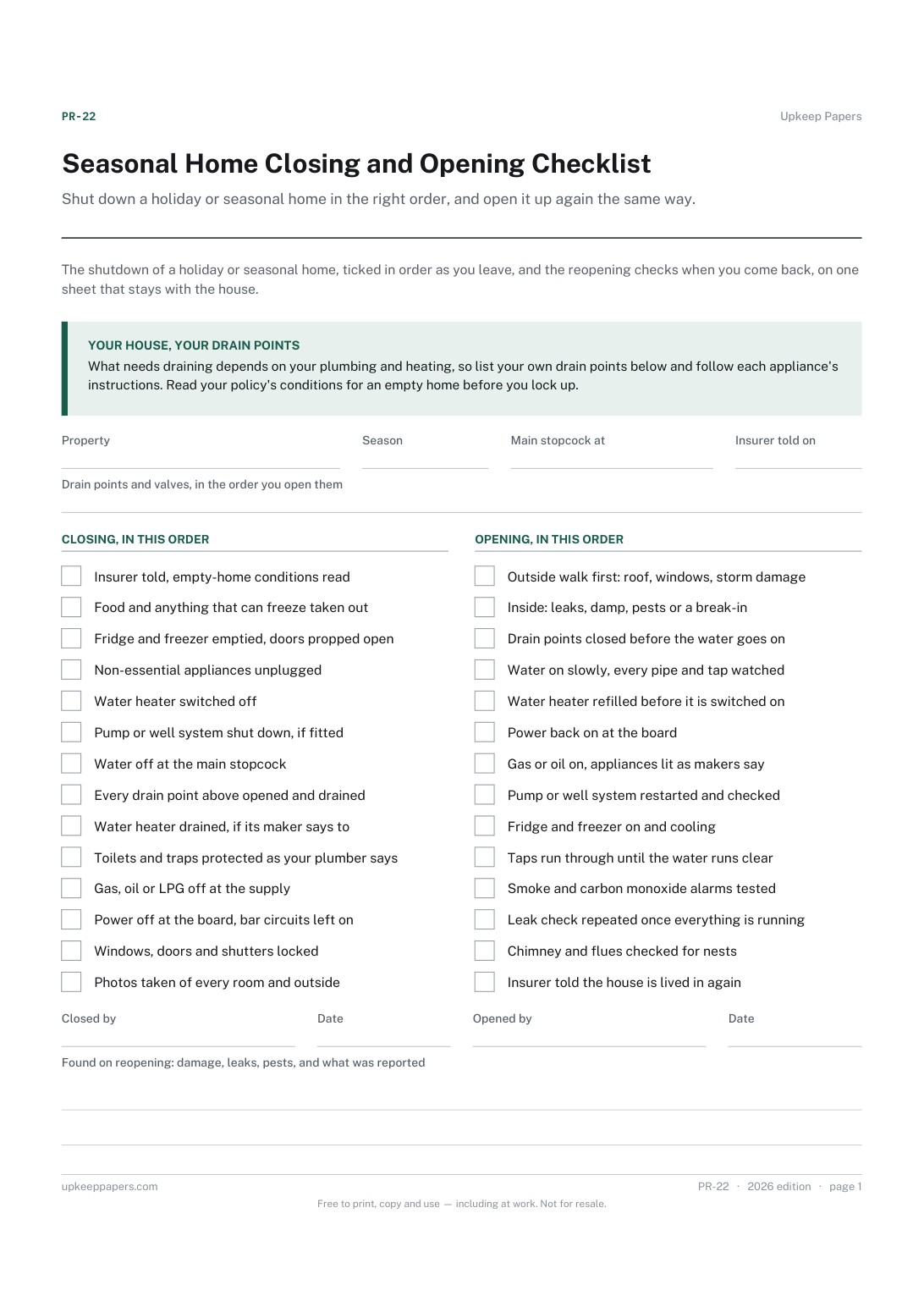
Shut down a holiday or seasonal home in the right order, and open it up again the same way. The signed sheet also shows when and how the house was winterised.
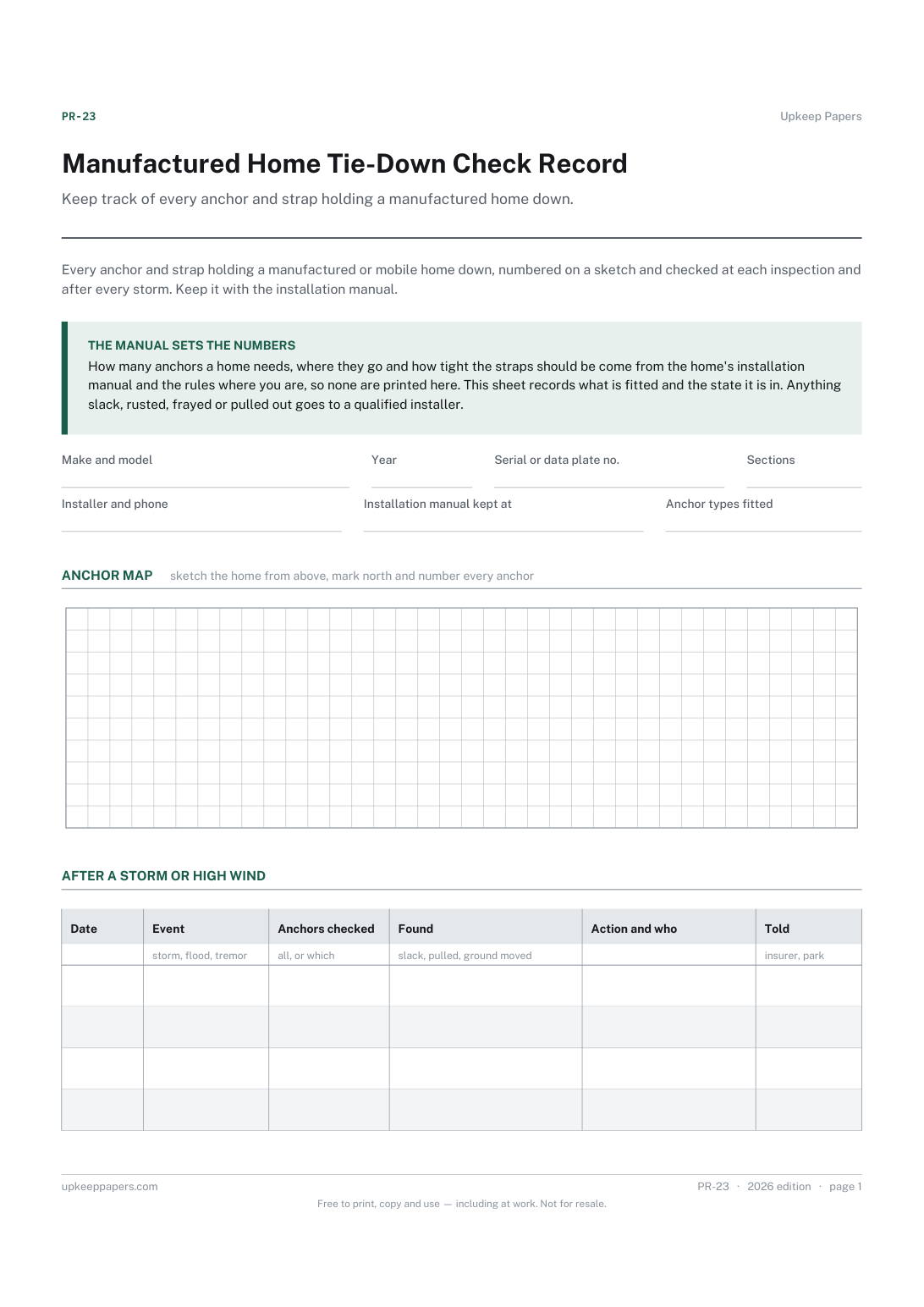
Keep track of every anchor and strap holding a manufactured home down. A slack or rusted strap shows up as a code in the grid long before a storm finds it.
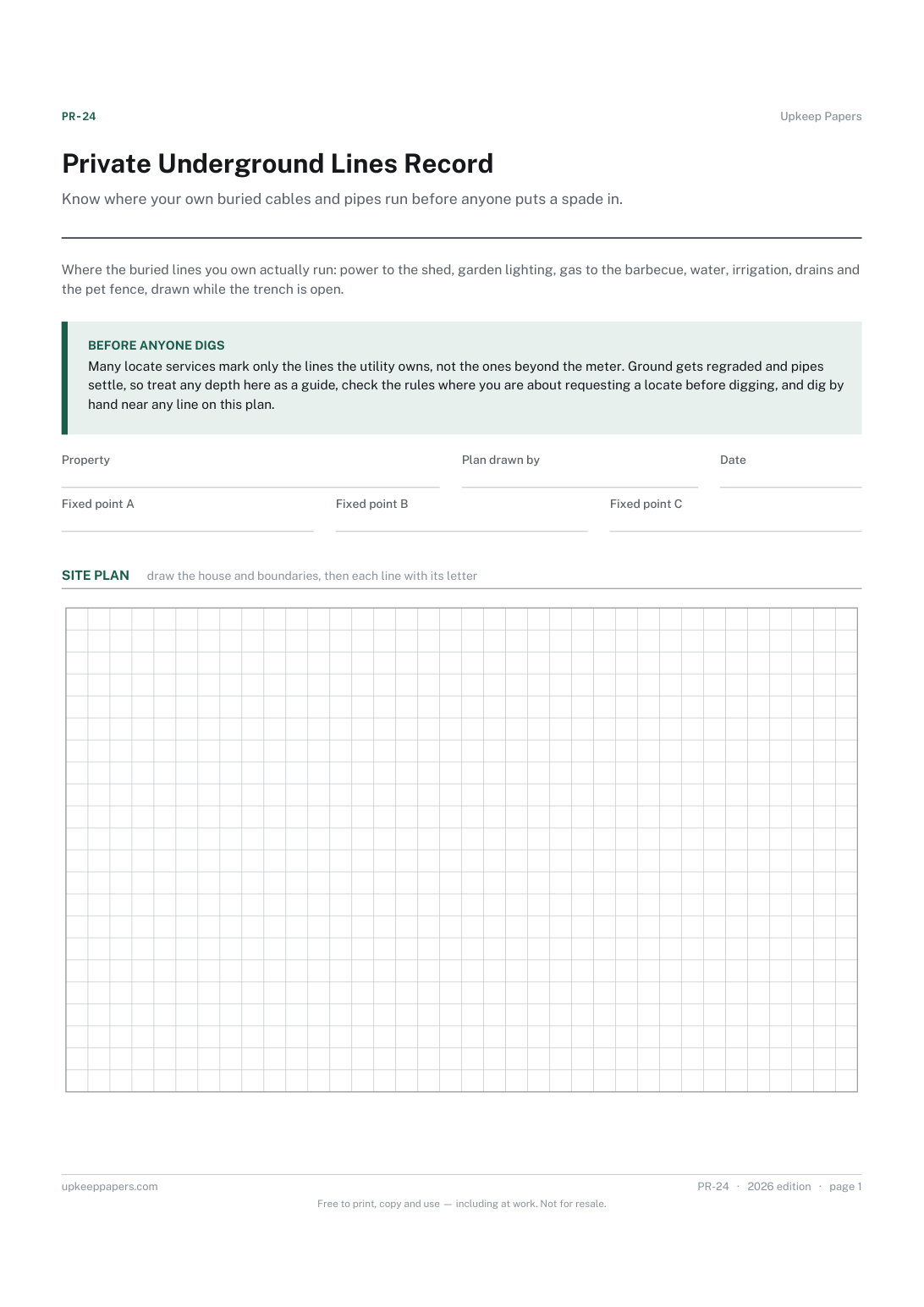
Know where your own buried cables and pipes run before anyone puts a spade in. Locate services may mark only the utility's lines, so this record covers the rest.
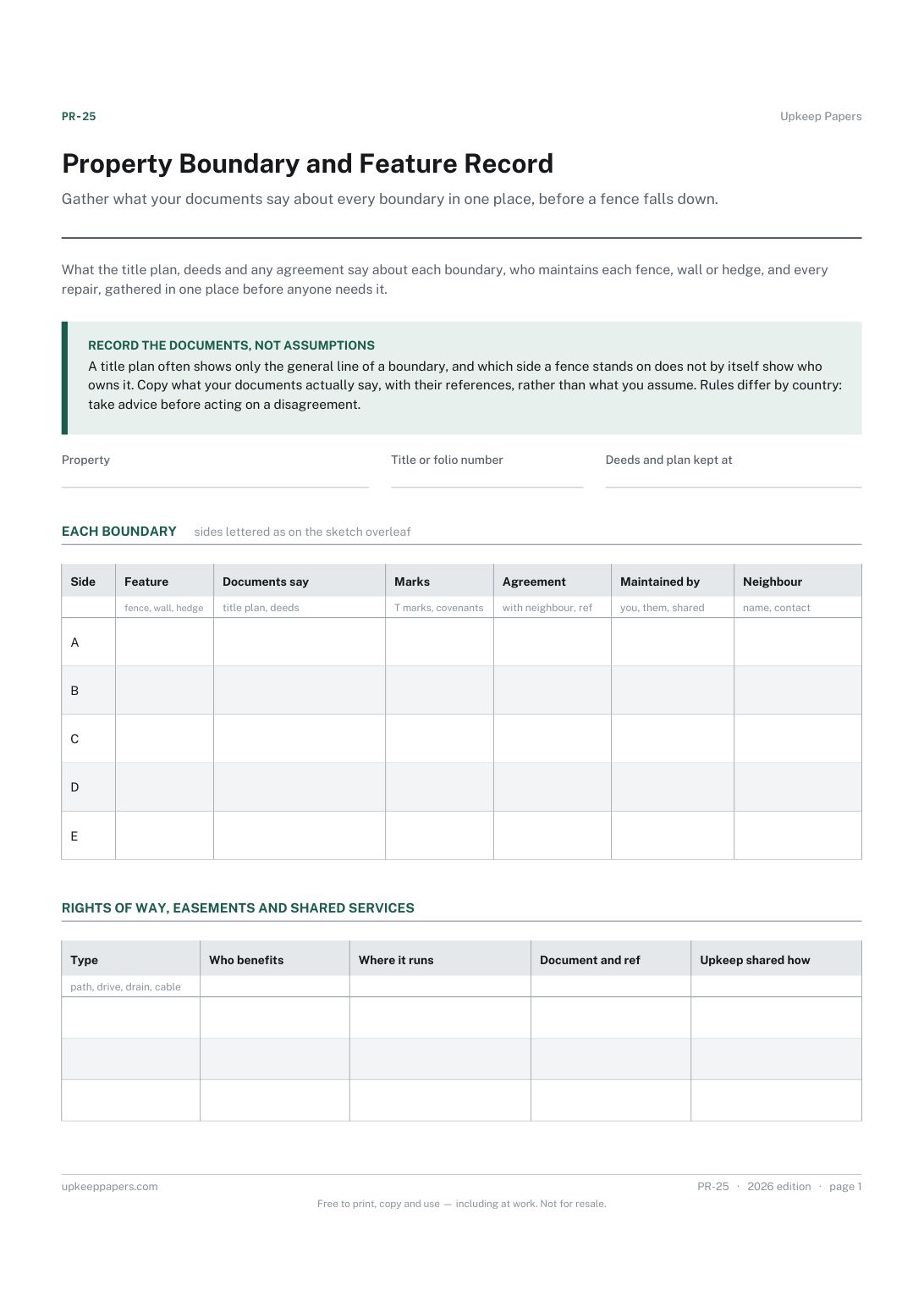
Gather what your documents say about every boundary in one place, before a fence falls down. When a repair is due, who maintains it already has a written answer.
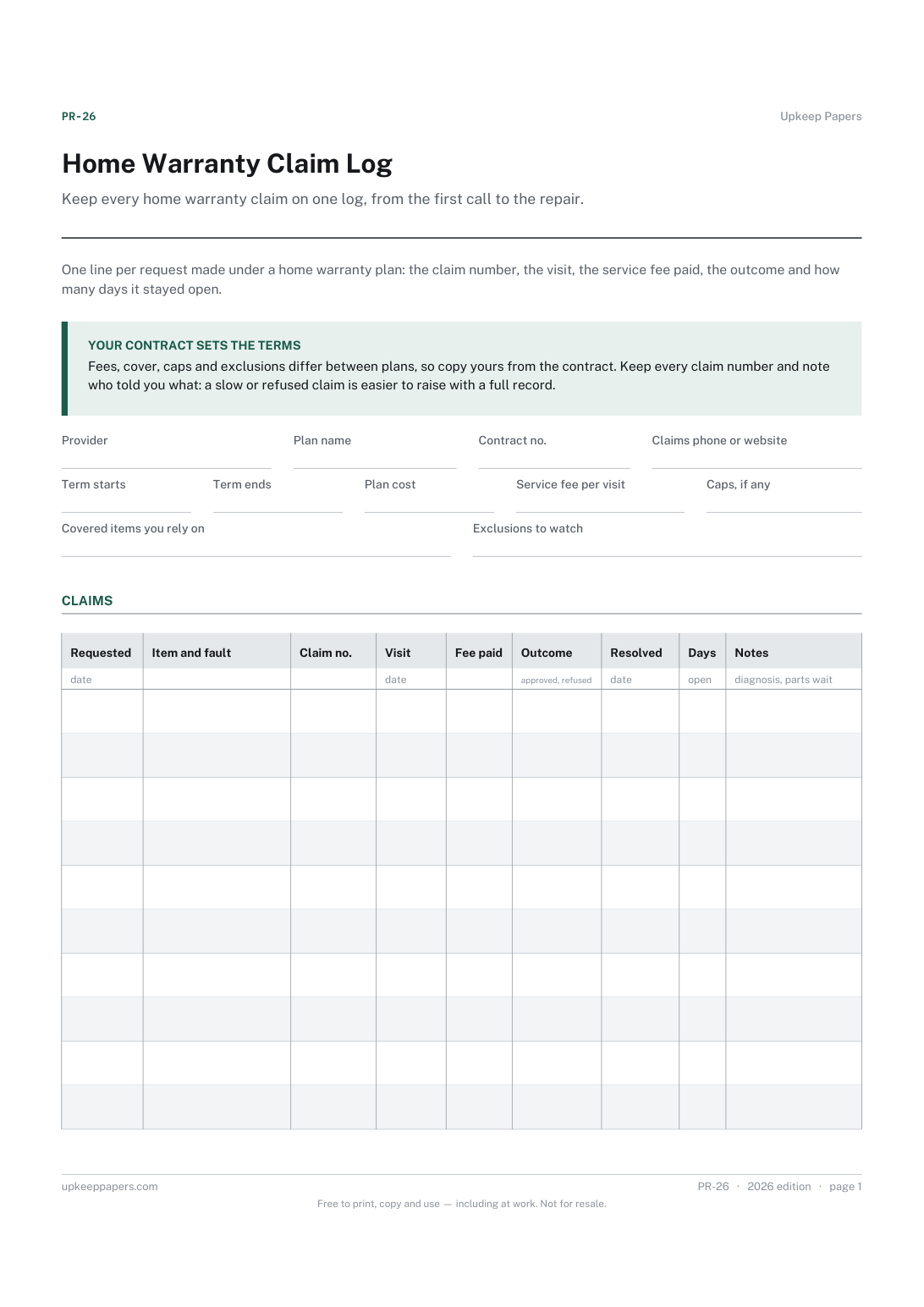
Keep every home warranty claim on one log, from the first call to the repair. Slow visits, repeat refusals and the fees you have paid then show up as a pattern.
Heating, hot water, ventilation, drainage and water supply — the fixed systems that need servicing on a schedule.
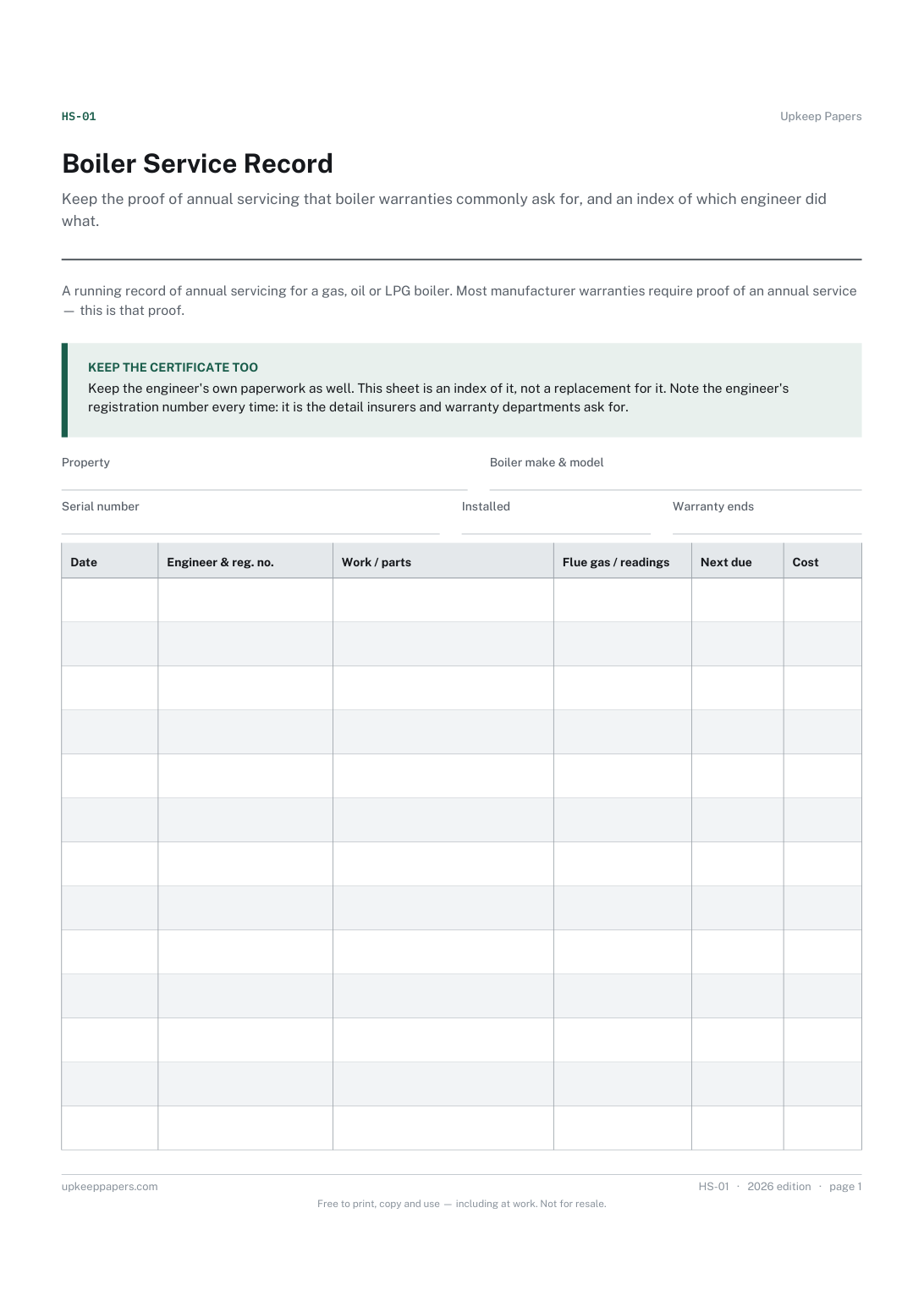
Keep the proof of annual servicing that boiler warranties commonly ask for, and an index of which engineer did what.
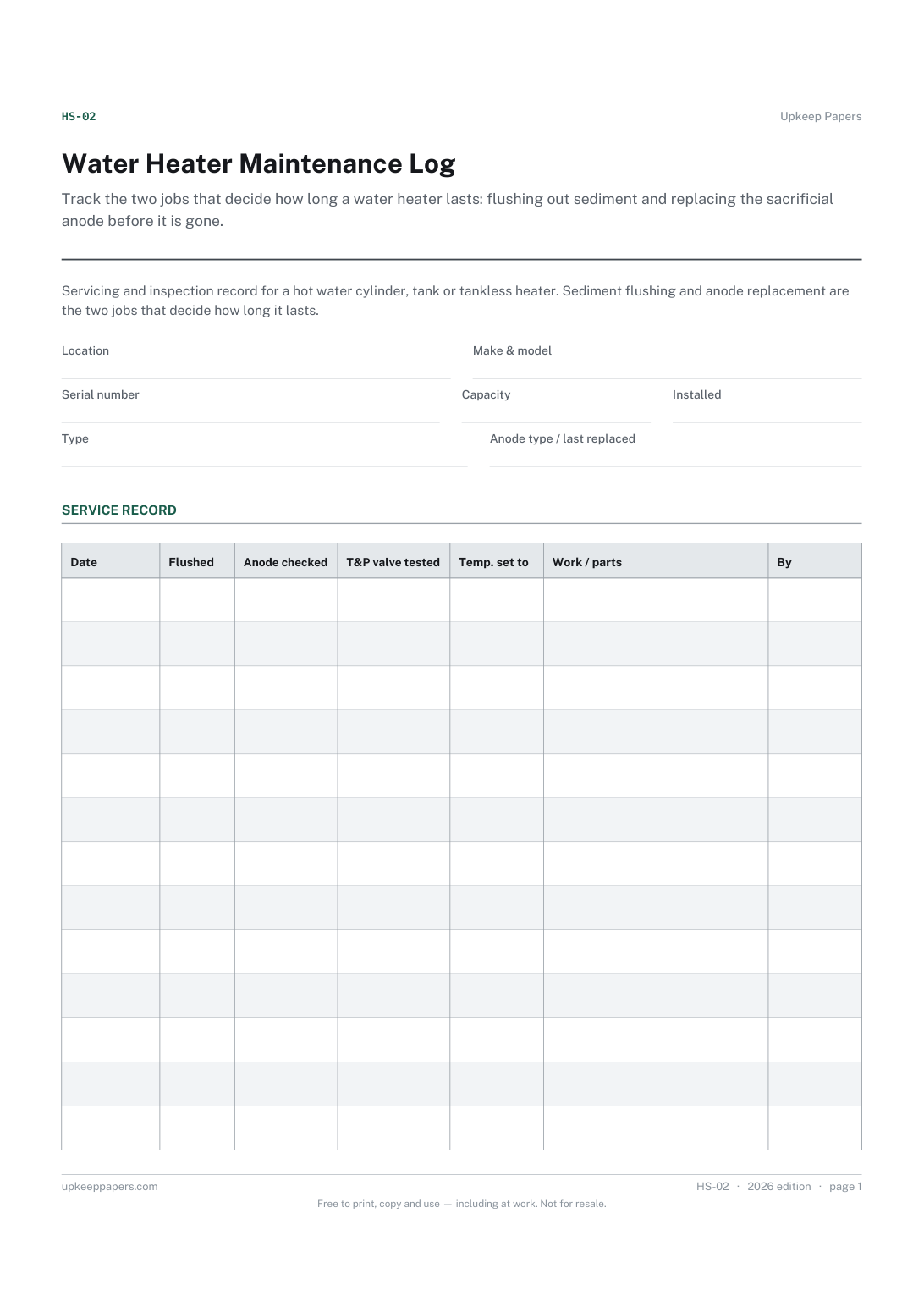
Track the two jobs that decide how long a water heater lasts: flushing out sediment and replacing the sacrificial anode before it is gone.
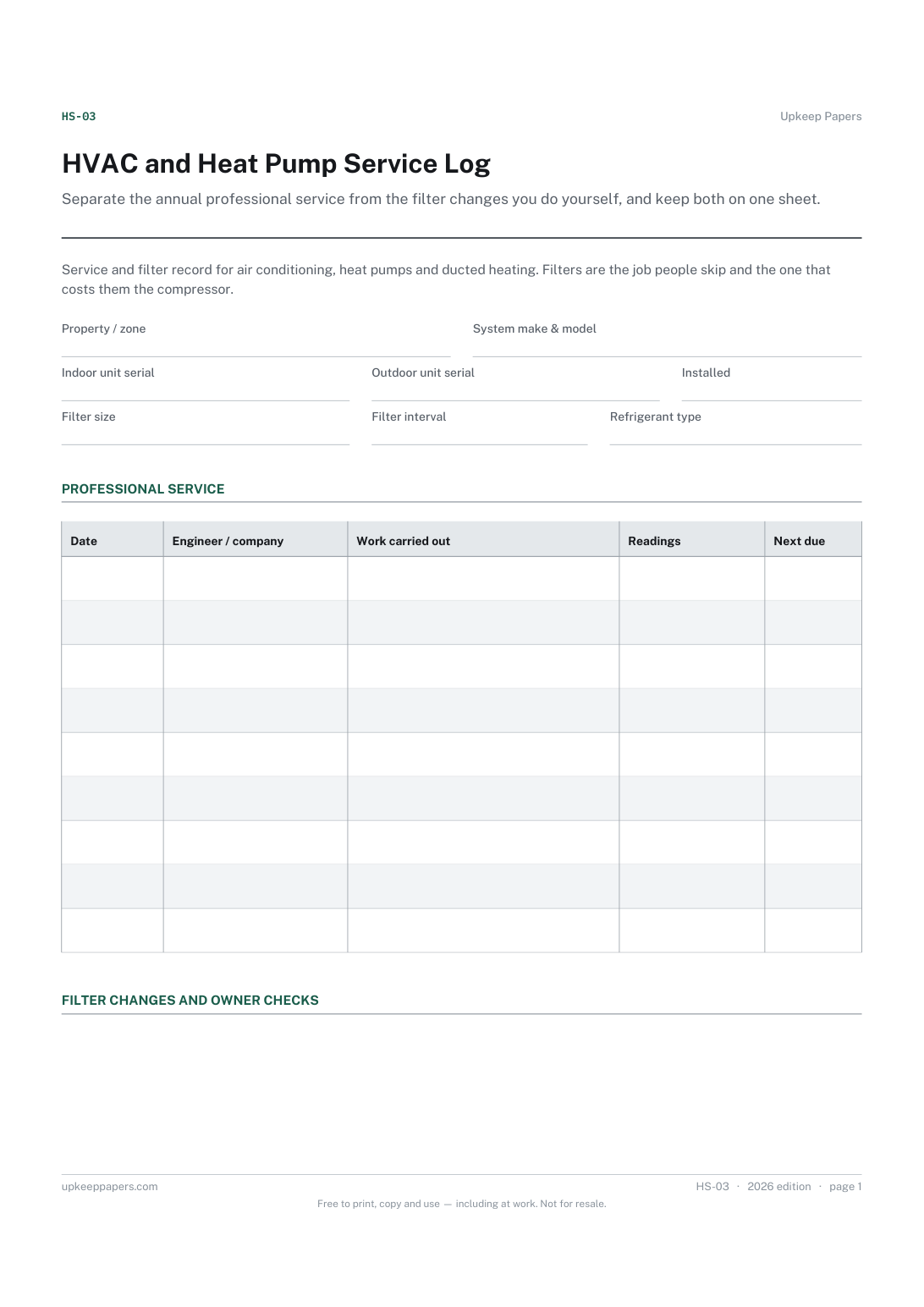
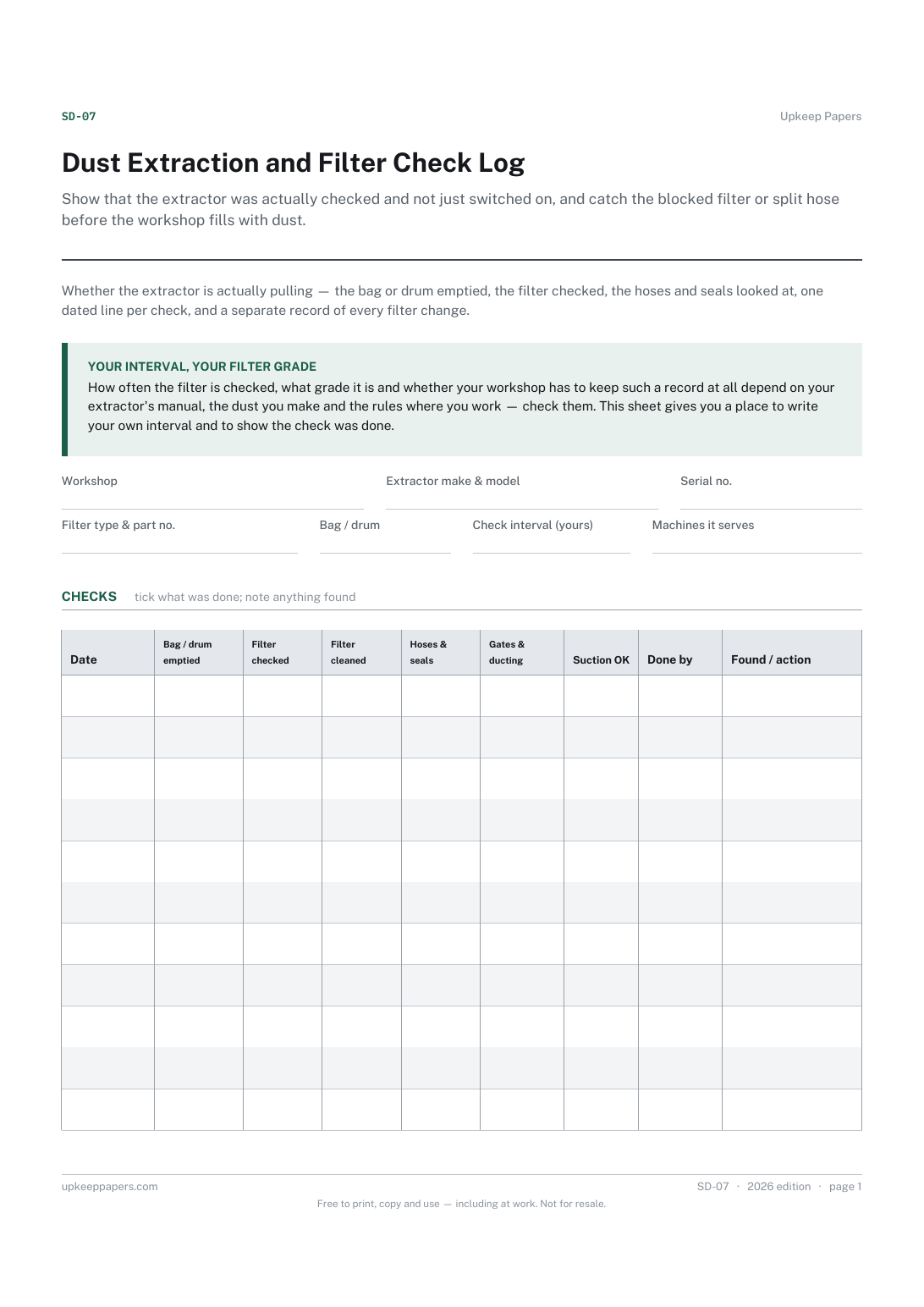
Separate the annual professional service from the filter changes you do yourself, and keep both on one sheet.
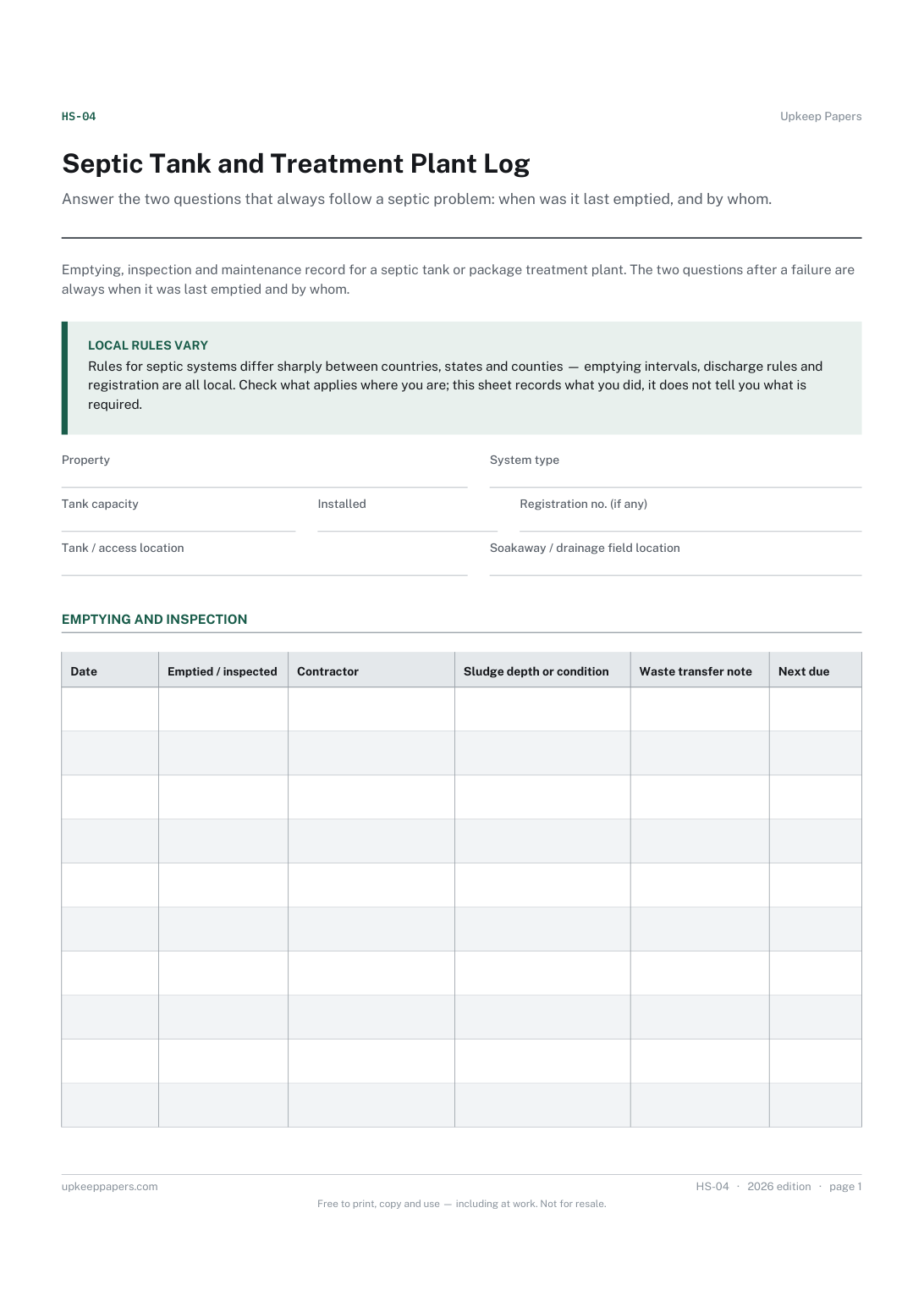
Answer the two questions that always follow a septic problem: when was it last emptied, and by whom.
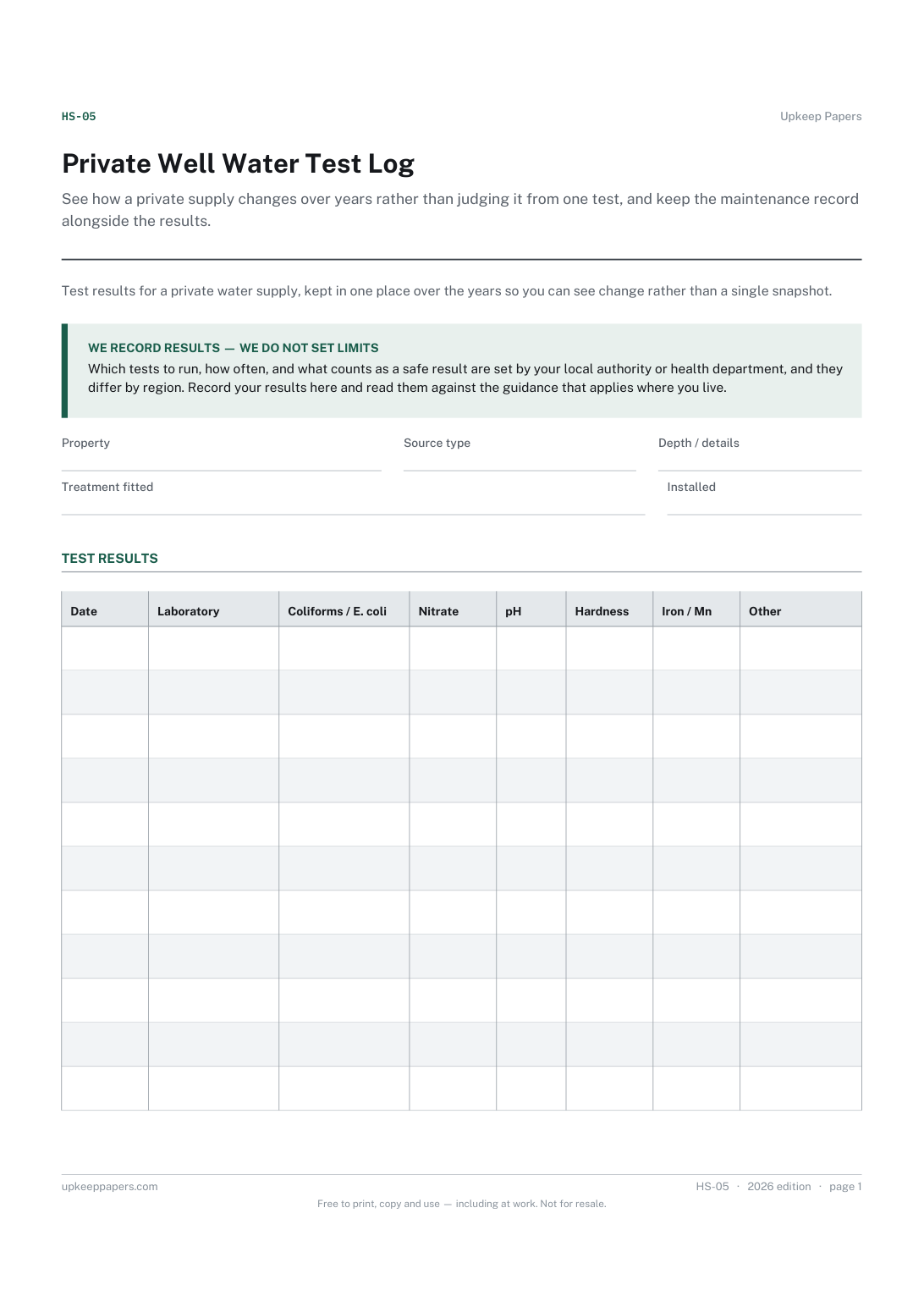
See how a private supply changes over years rather than judging it from one test, and keep the maintenance record alongside the results.
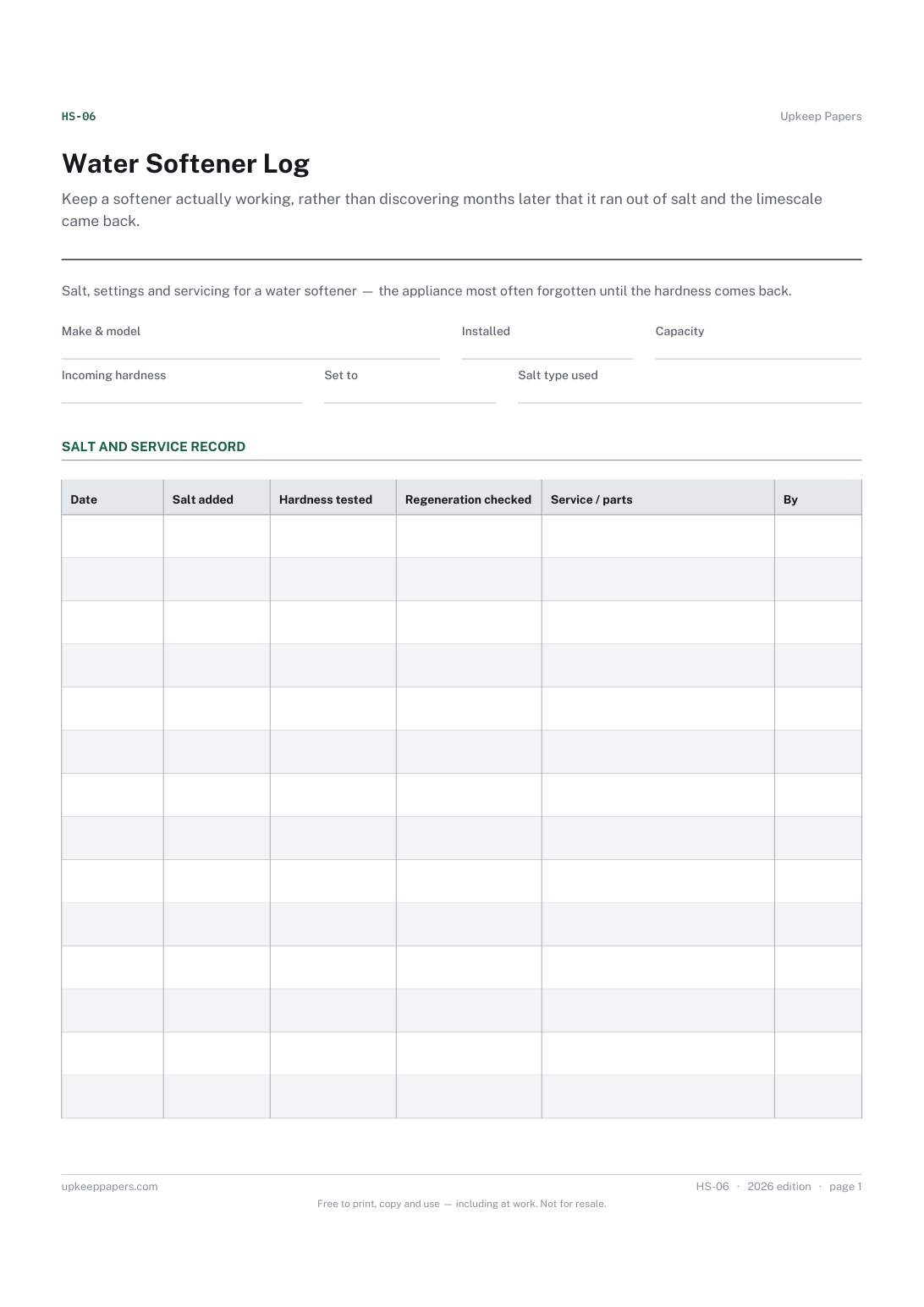
Keep a softener actually working, rather than discovering months later that it ran out of salt and the limescale came back.
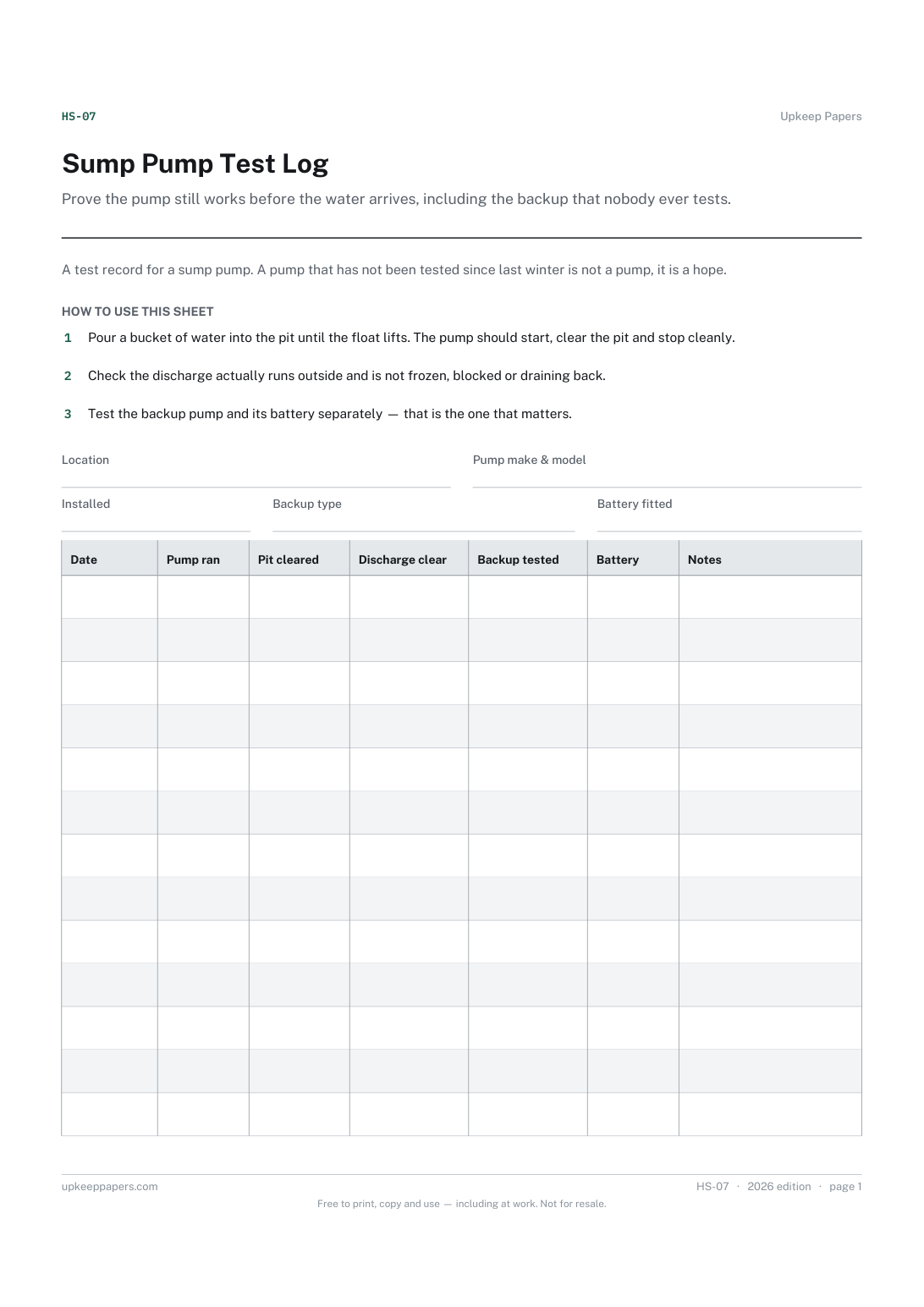
Prove the pump still works before the water arrives, including the backup that nobody ever tests.
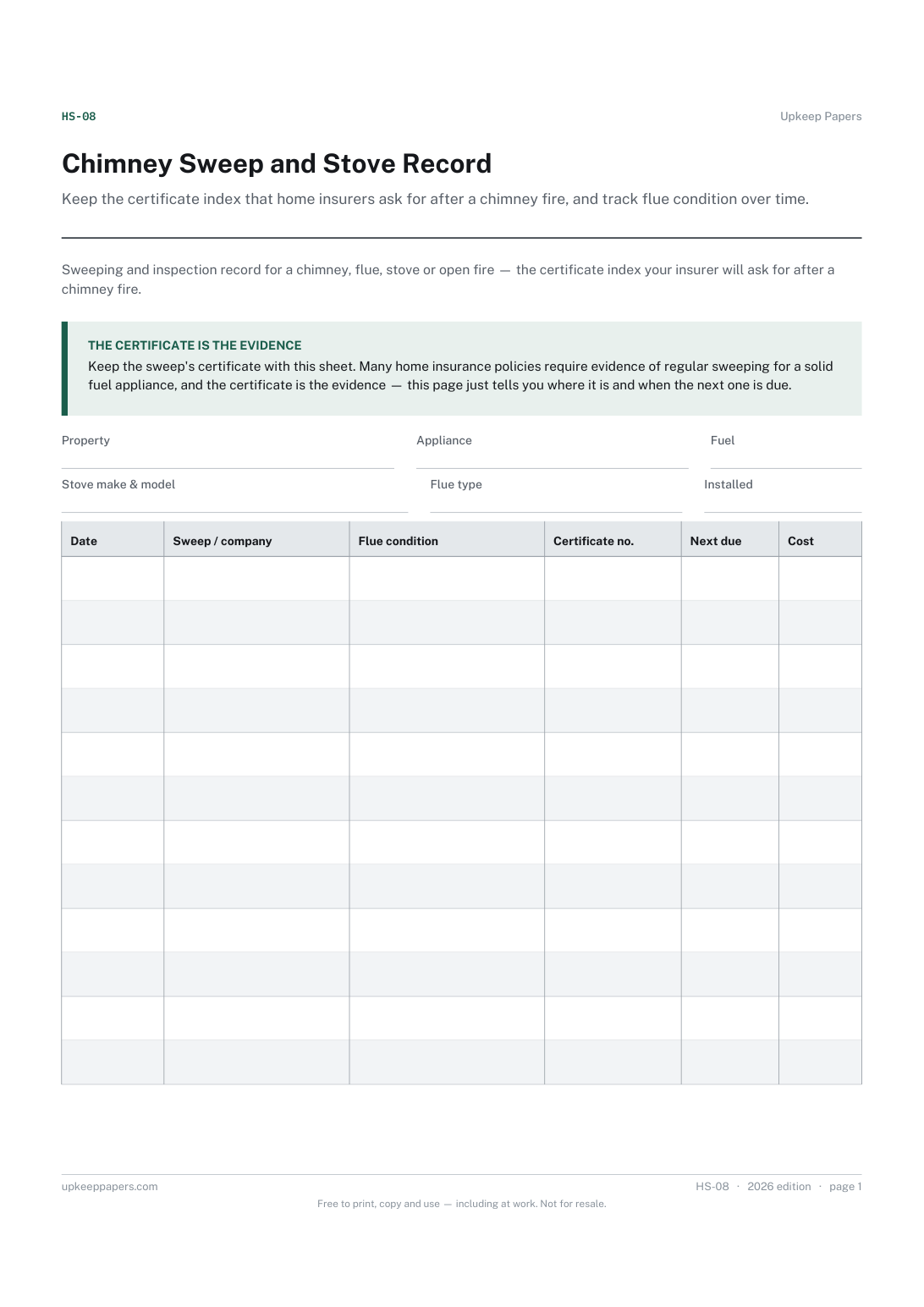
Keep the certificate index that home insurers ask for after a chimney fire, and track flue condition over time.
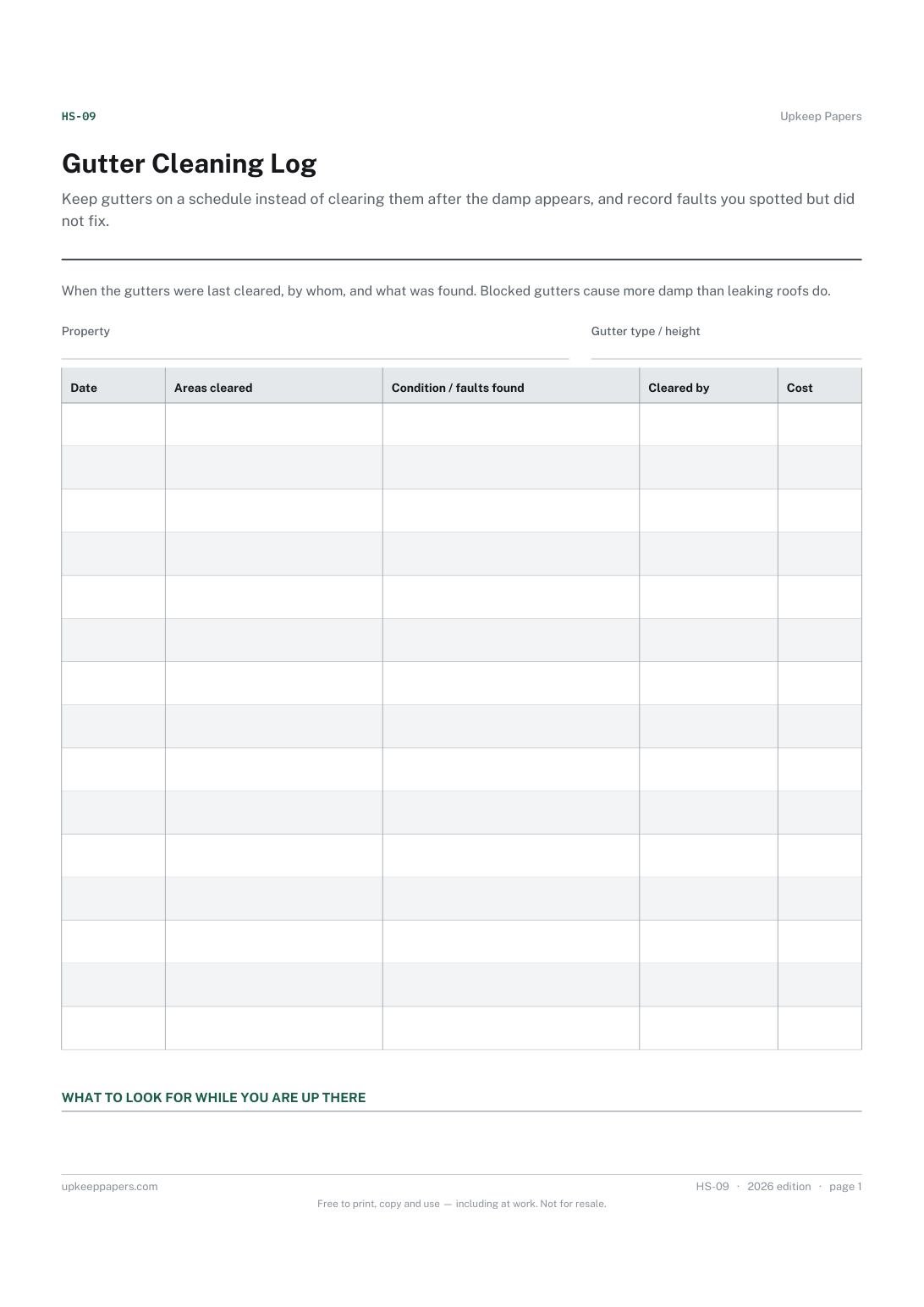
Keep gutters on a schedule instead of clearing them after the damp appears, and record faults you spotted but did not fix.
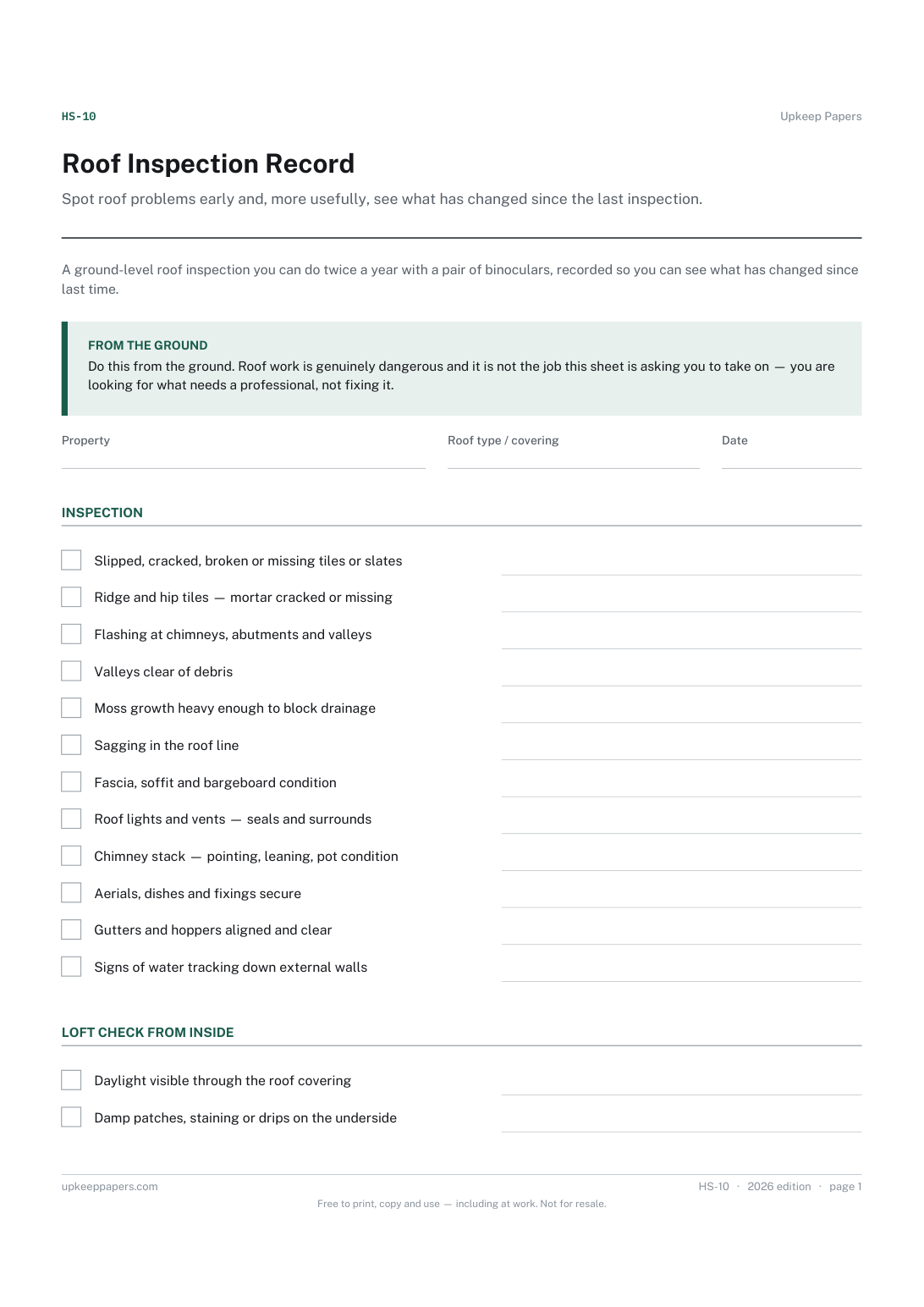
Spot roof problems early and, more usefully, see what has changed since the last inspection.
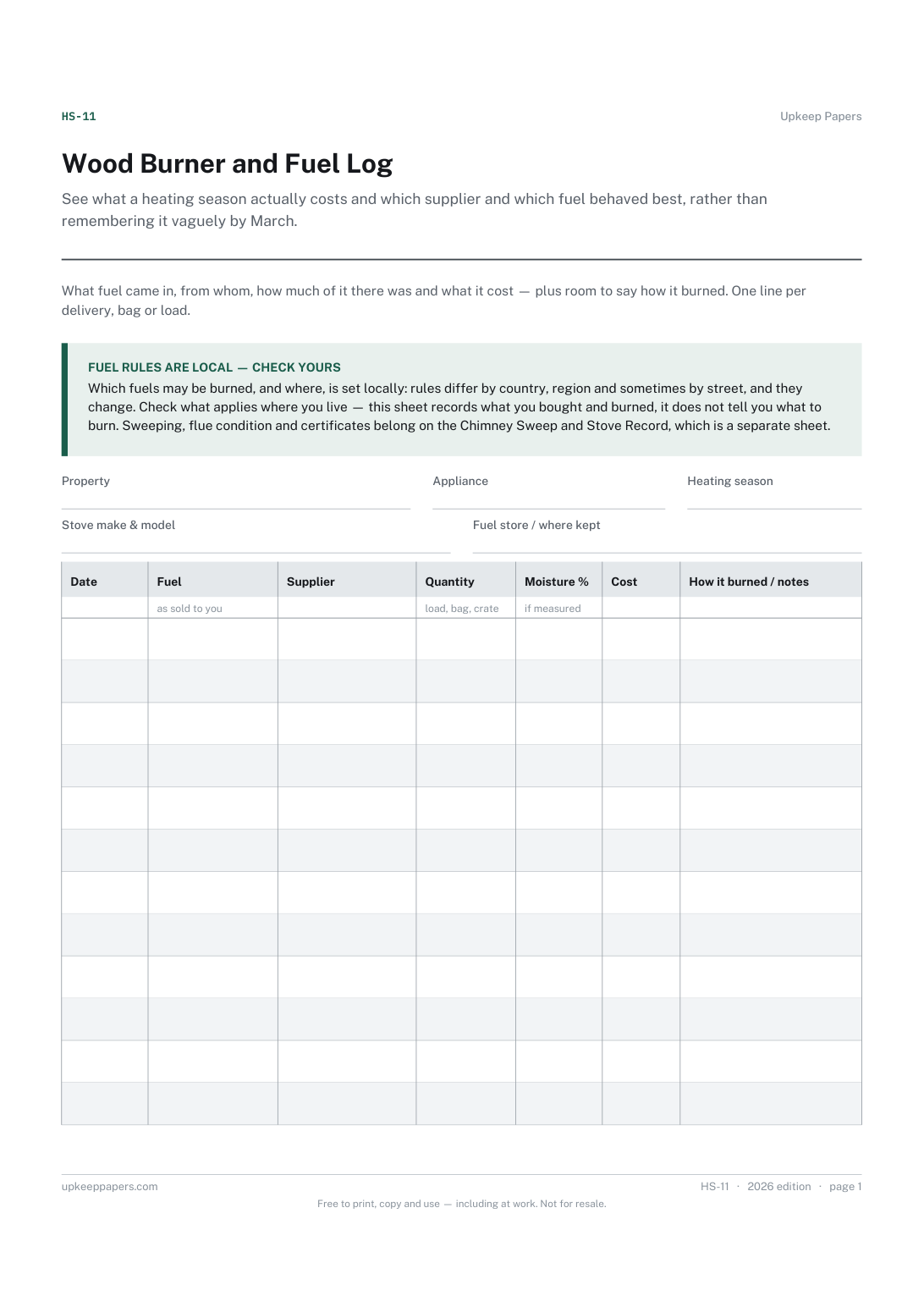
See what a heating season actually costs and which supplier and which fuel behaved best, rather than remembering it vaguely by March.
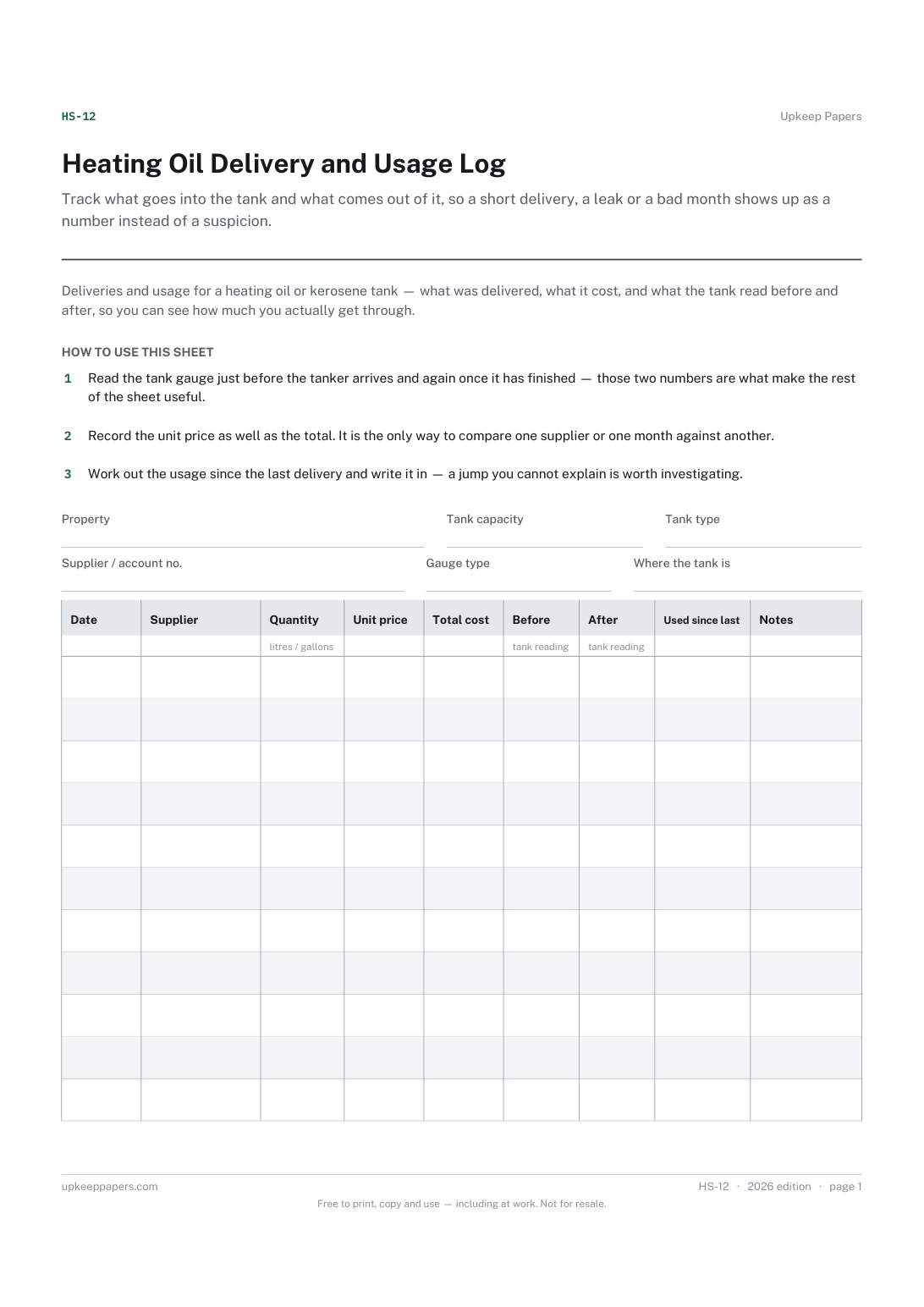
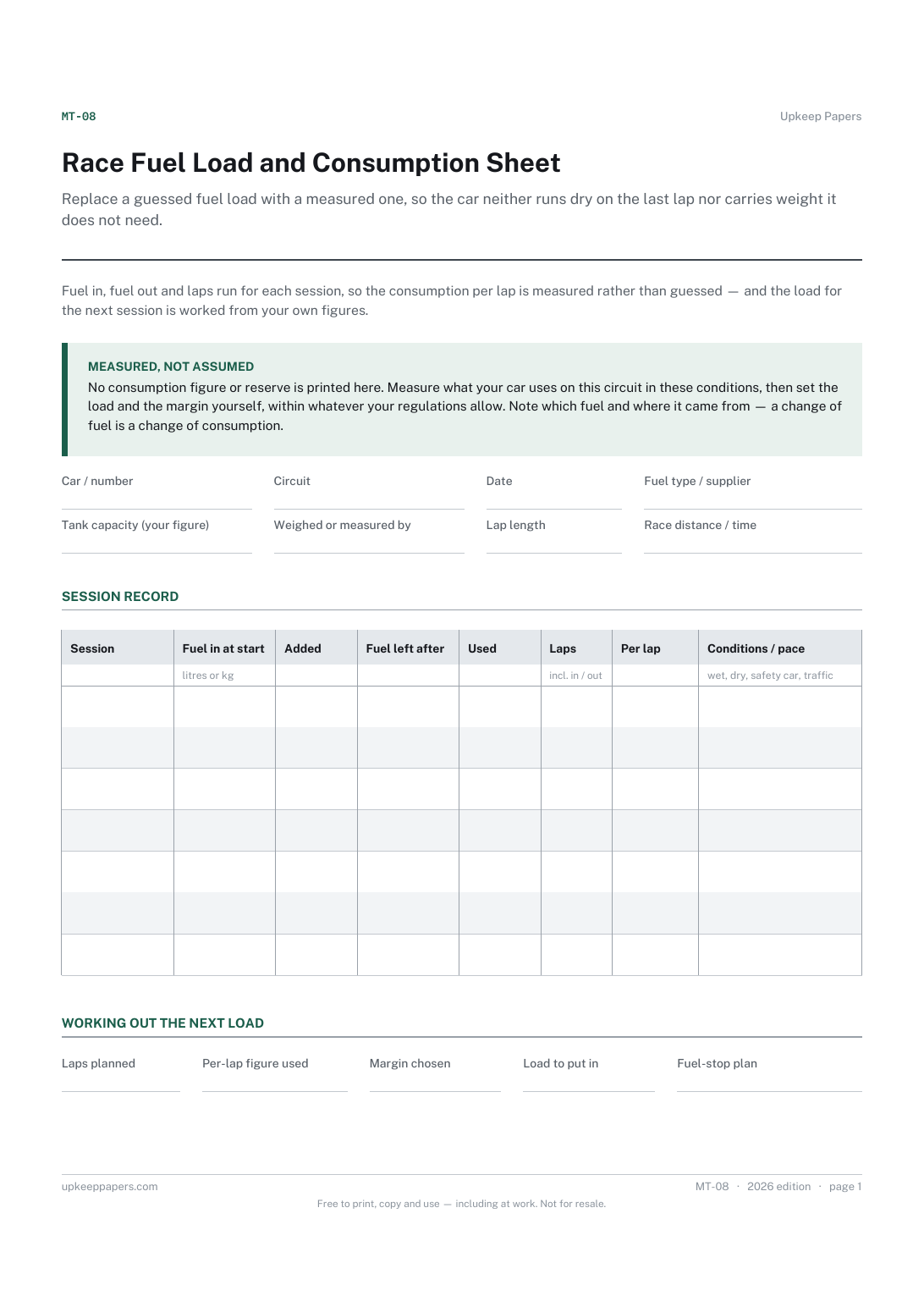
Track what goes into the tank and what comes out of it, so a short delivery, a leak or a bad month shows up as a number instead of a suspicion.
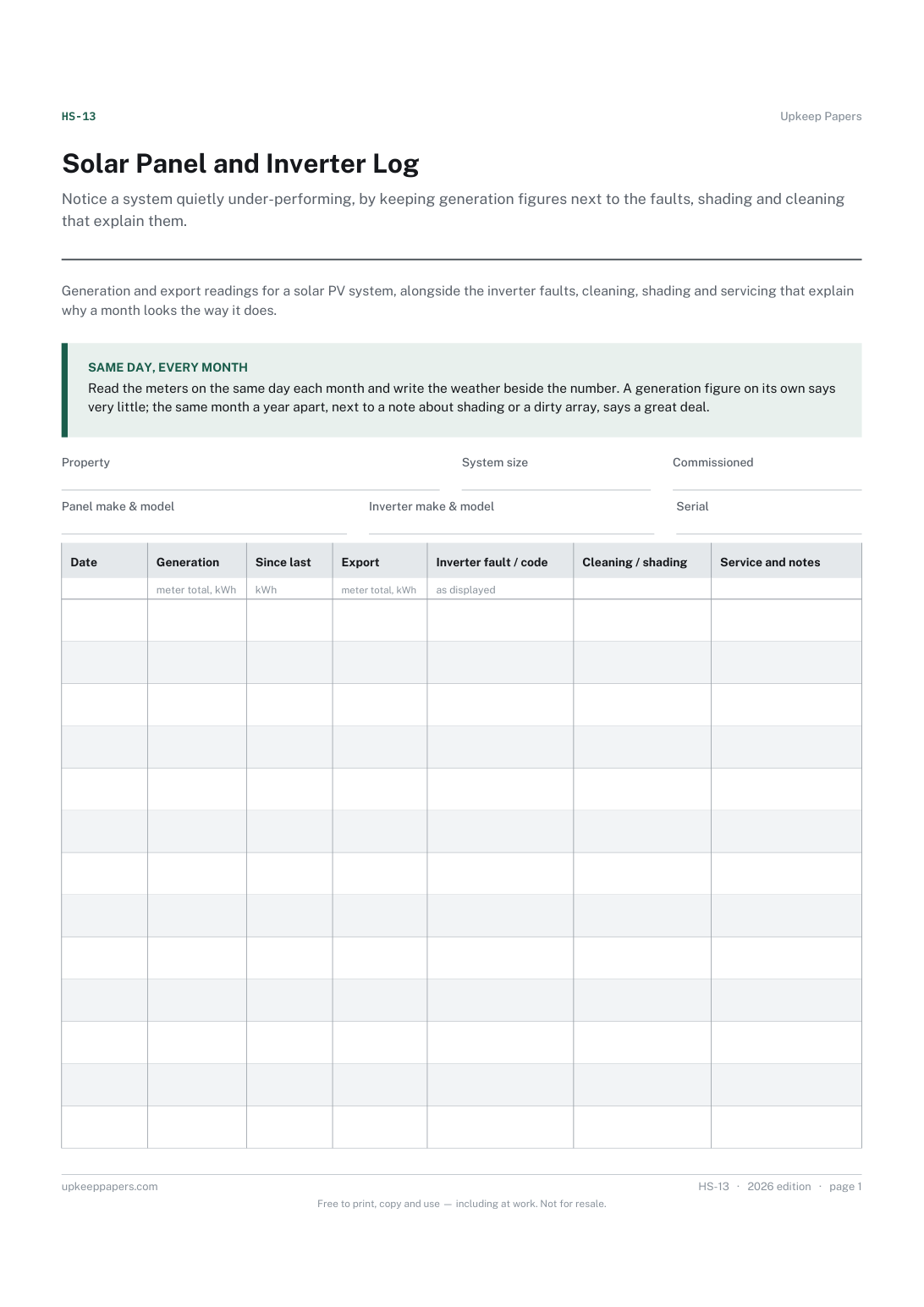
Notice a system quietly under-performing, by keeping generation figures next to the faults, shading and cleaning that explain them.
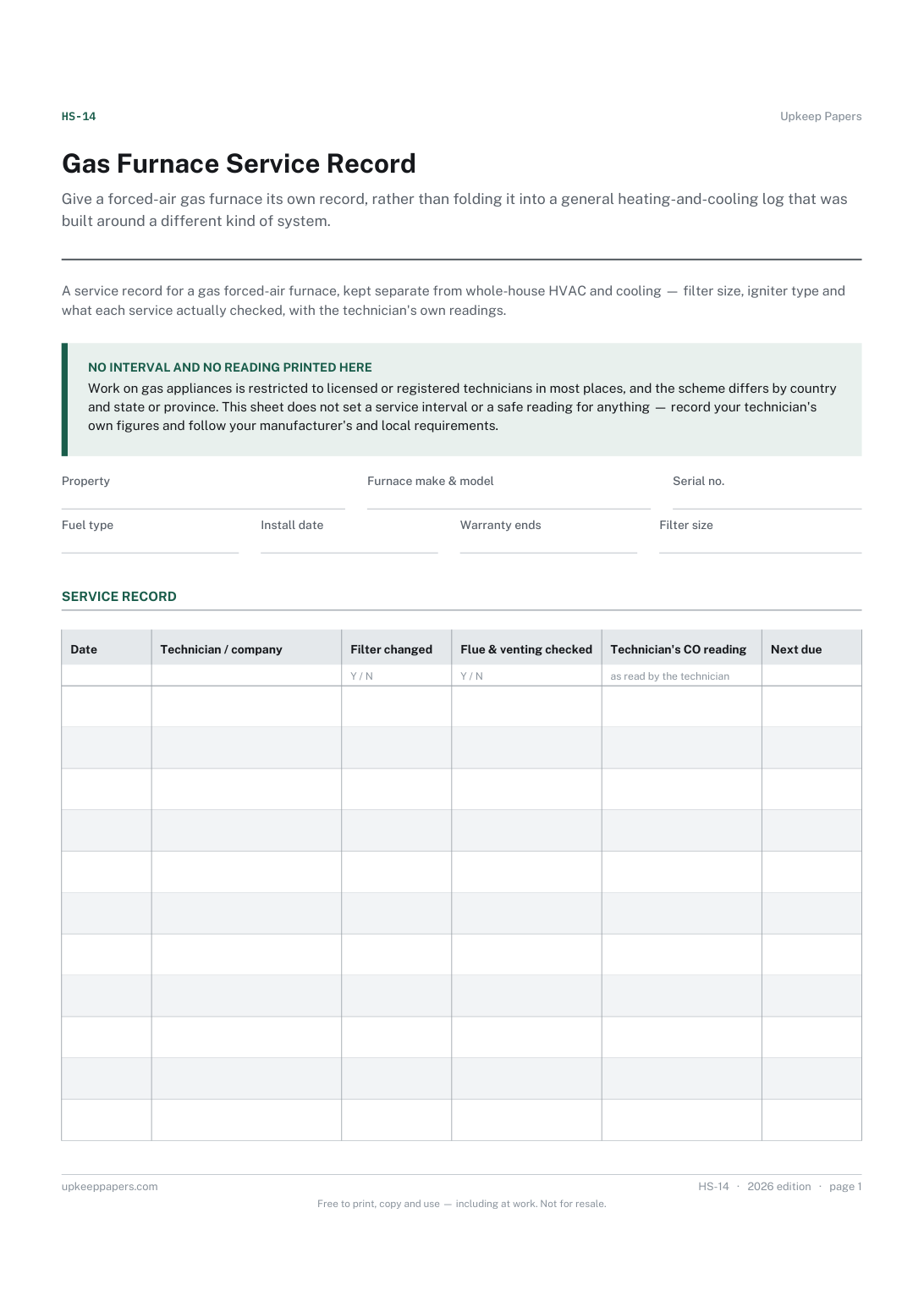
Give a forced-air gas furnace its own record, rather than folding it into a general heating-and-cooling log that was built around a different kind of system.
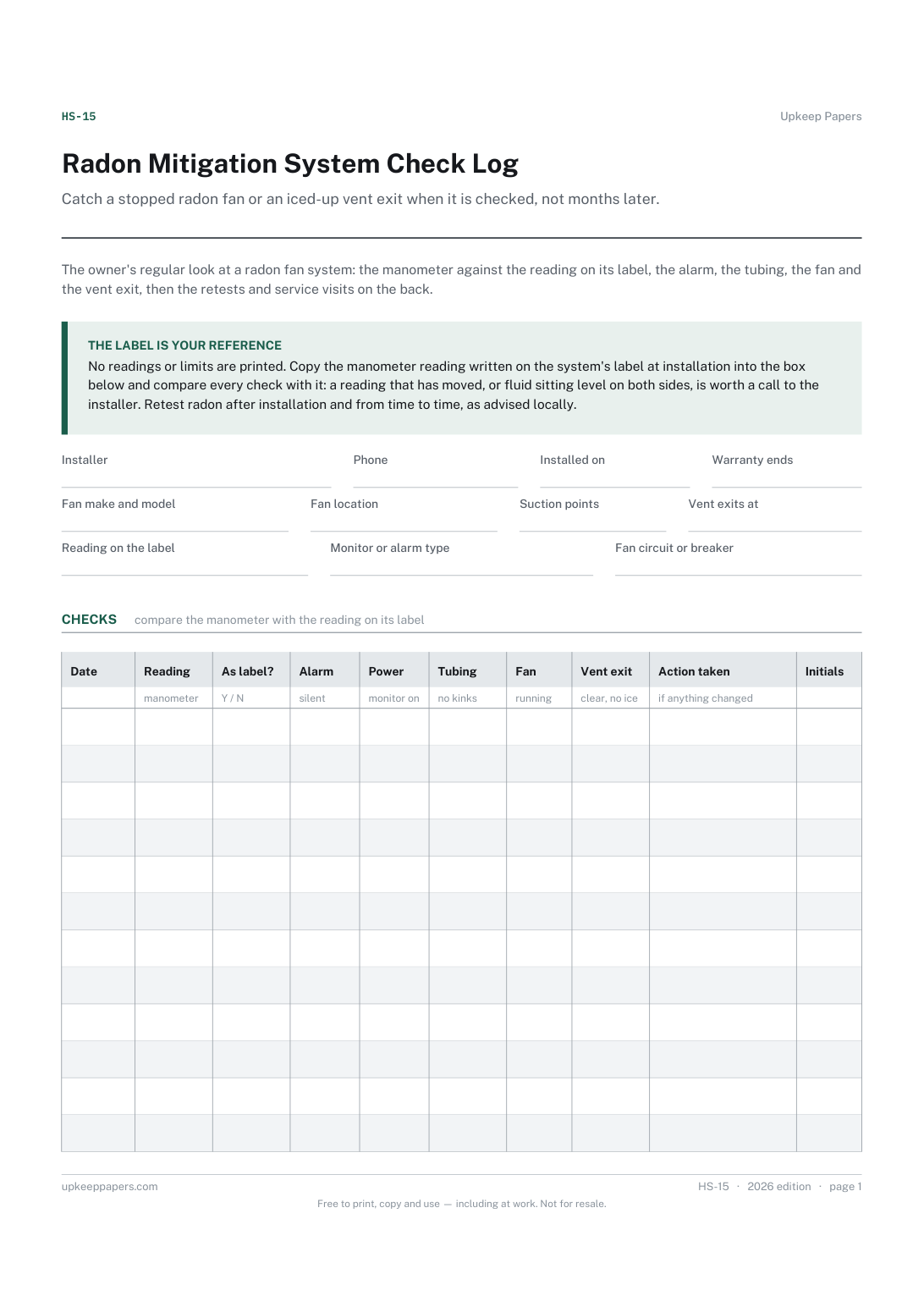
Catch a stopped radon fan or an iced-up vent exit when it is checked, not months later. Every check compares the manometer with the reading on its label.
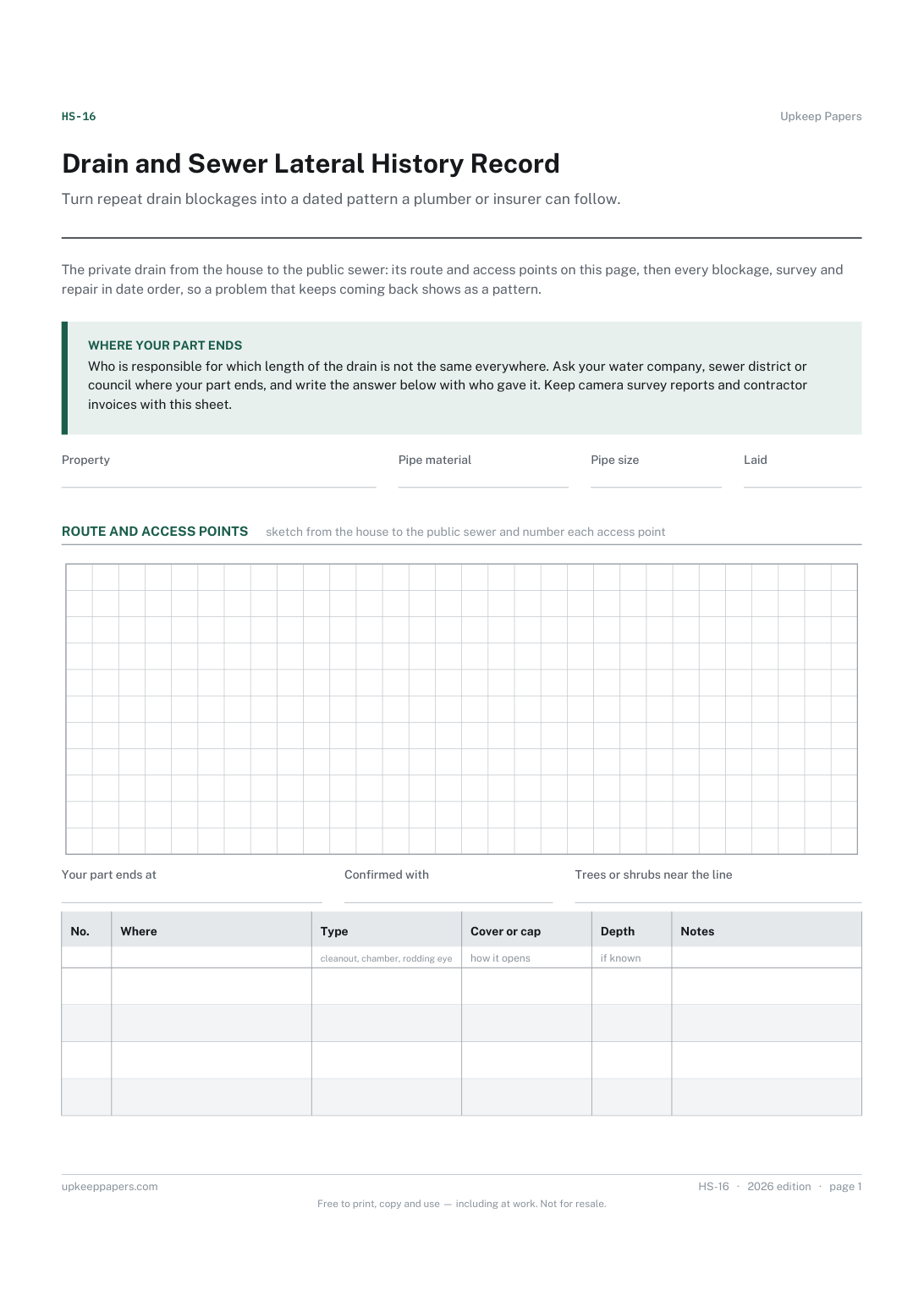
Turn repeat drain blockages into a dated pattern a plumber or insurer can follow. A camera survey or a repair quote can then be read against the line's whole history.
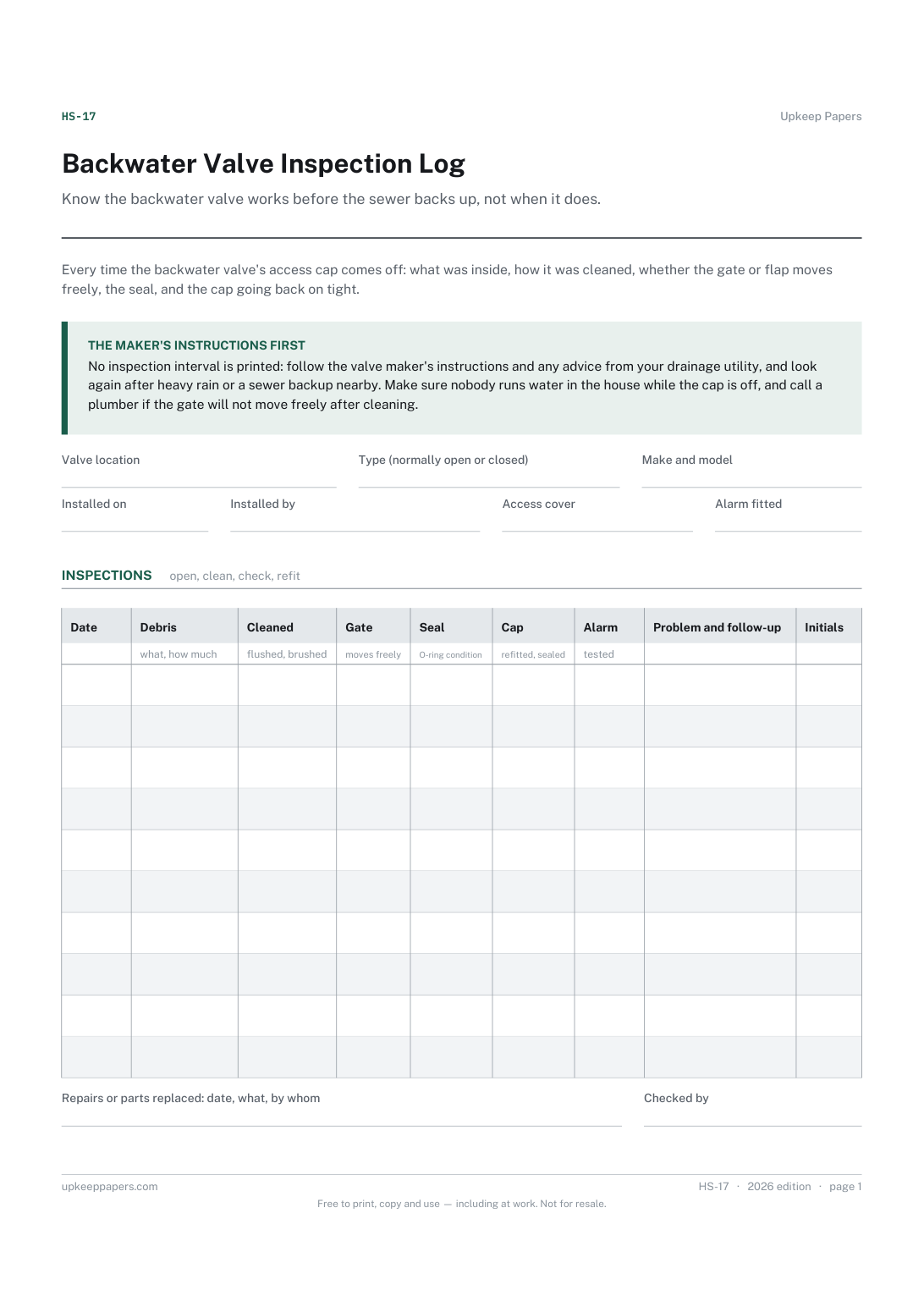
Know the backwater valve works before the sewer backs up, not when it does. Each line dates one opening, cleaning and check of the gate and seal.
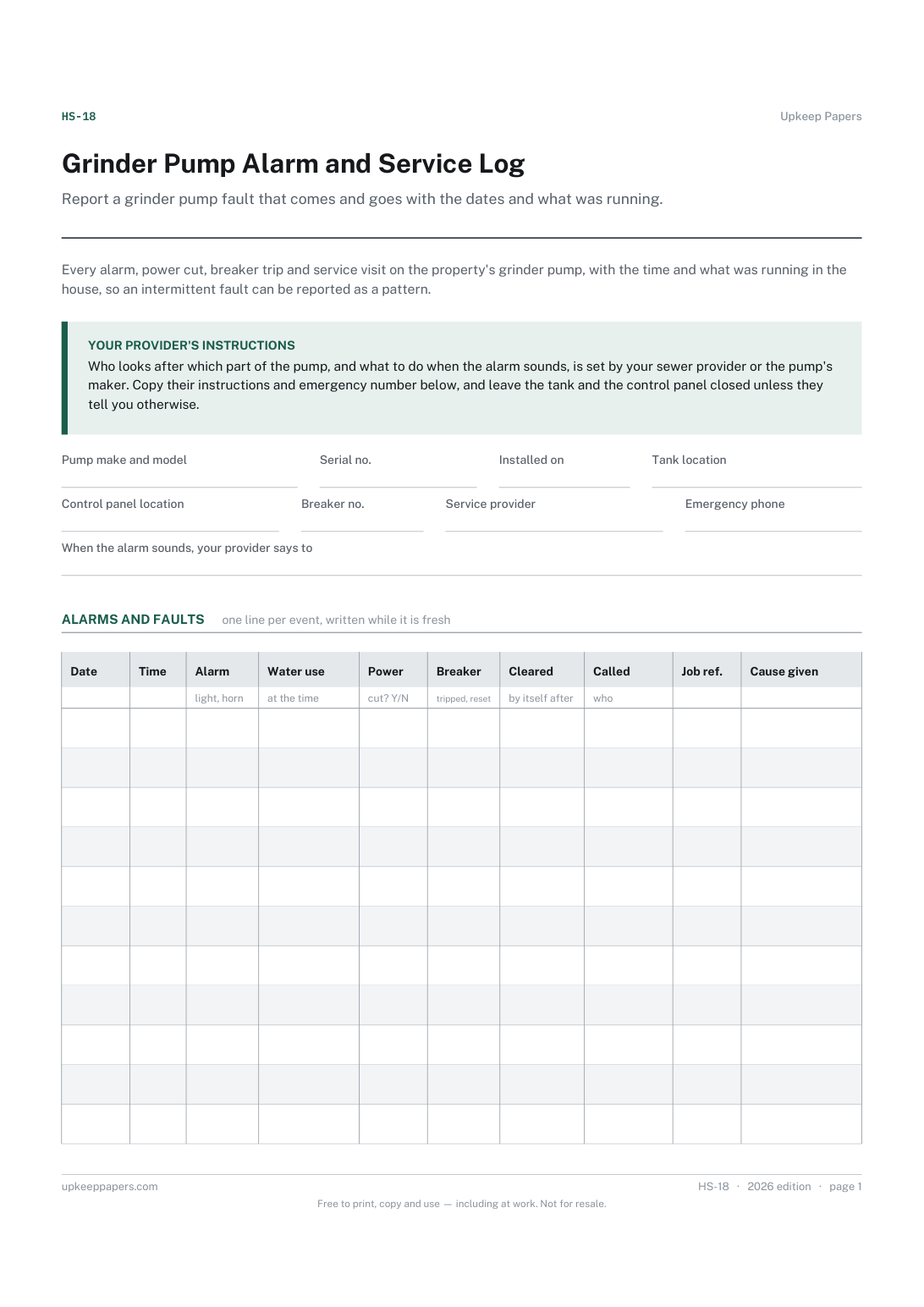
Report a grinder pump fault that comes and goes with the dates and what was running. An engineer can do far more with a pattern than with one call.
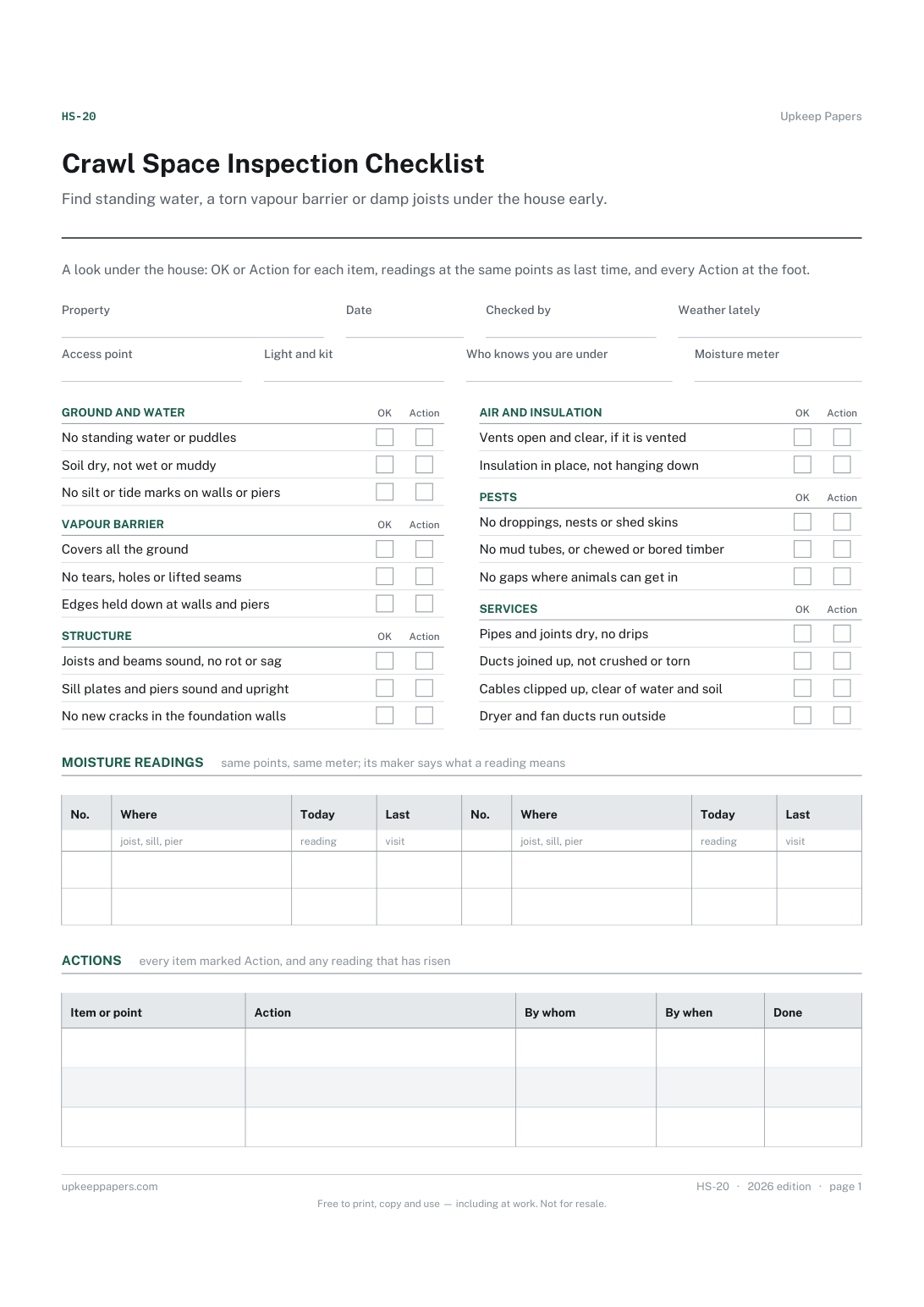
Find standing water, a torn vapour barrier or damp joists under the house early. Readings at the same named points show whether the space is getting wetter.
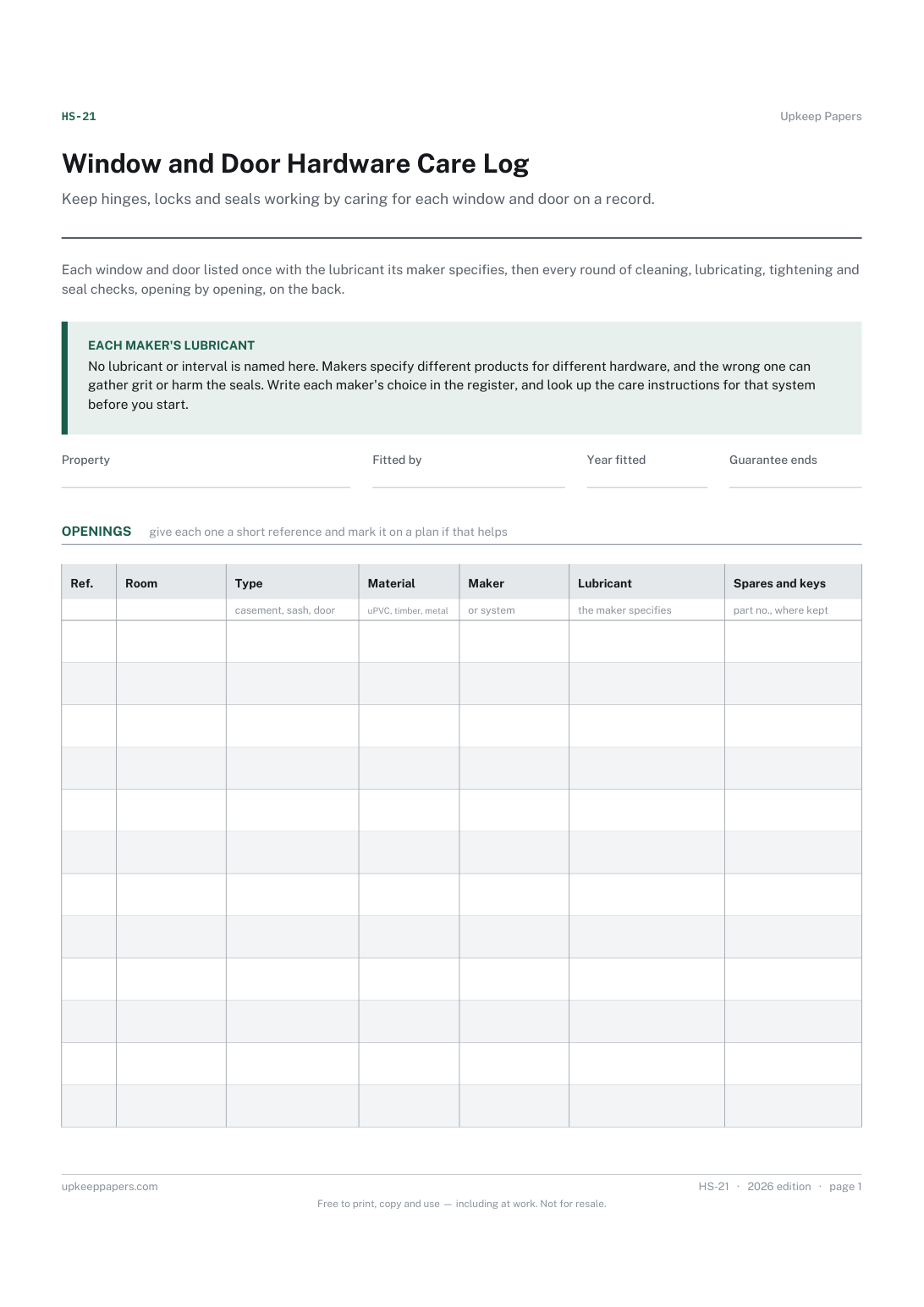
Keep hinges, locks and seals working by caring for each window and door on a record. A stiff handle or a blocked drainage slot is noted the first time it shows.
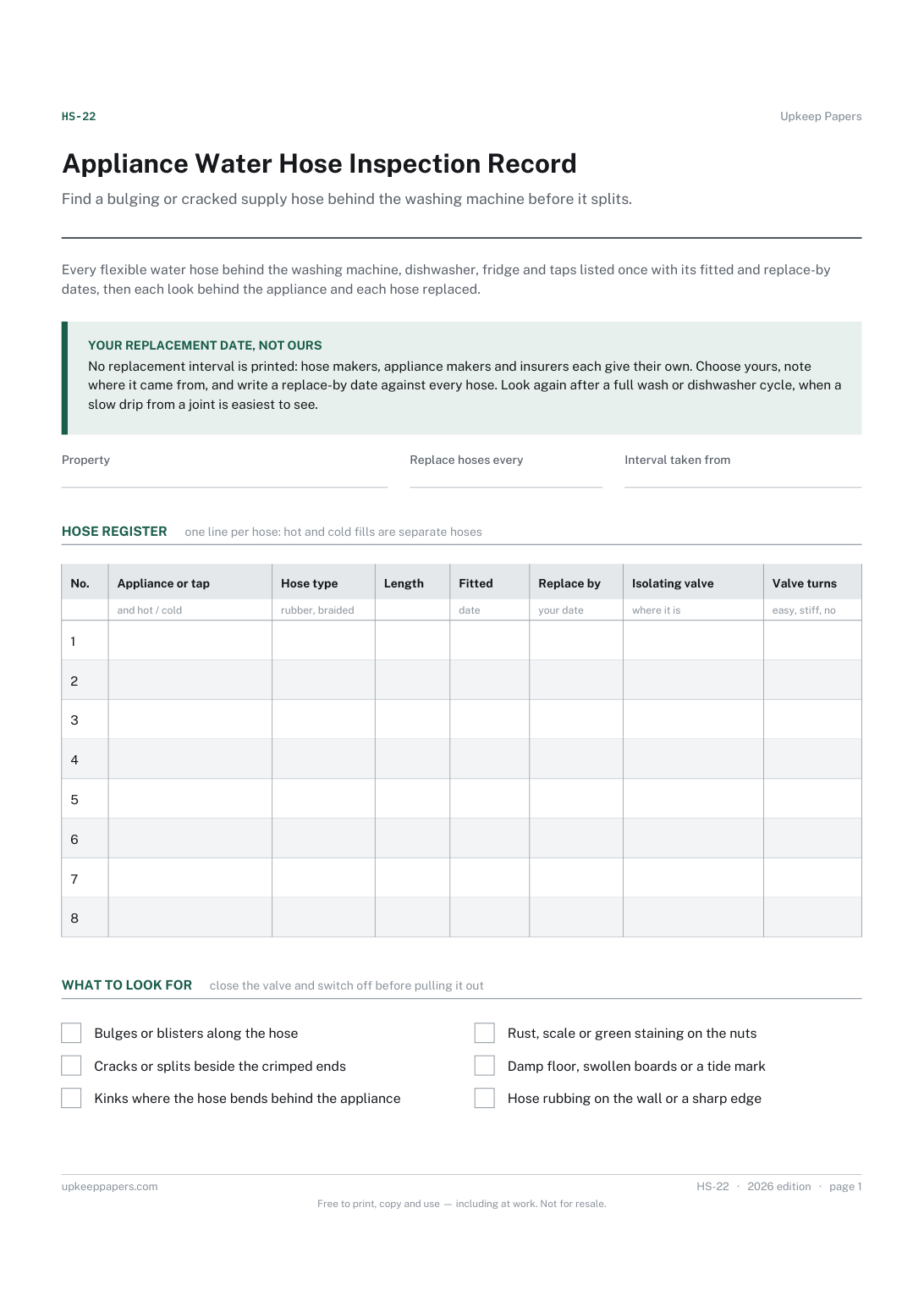
Find a bulging or cracked supply hose behind the washing machine before it splits. Each hose gets a fitted date and a replace-by date you choose, so an ageing one is changed on purpose rather than after a flood.
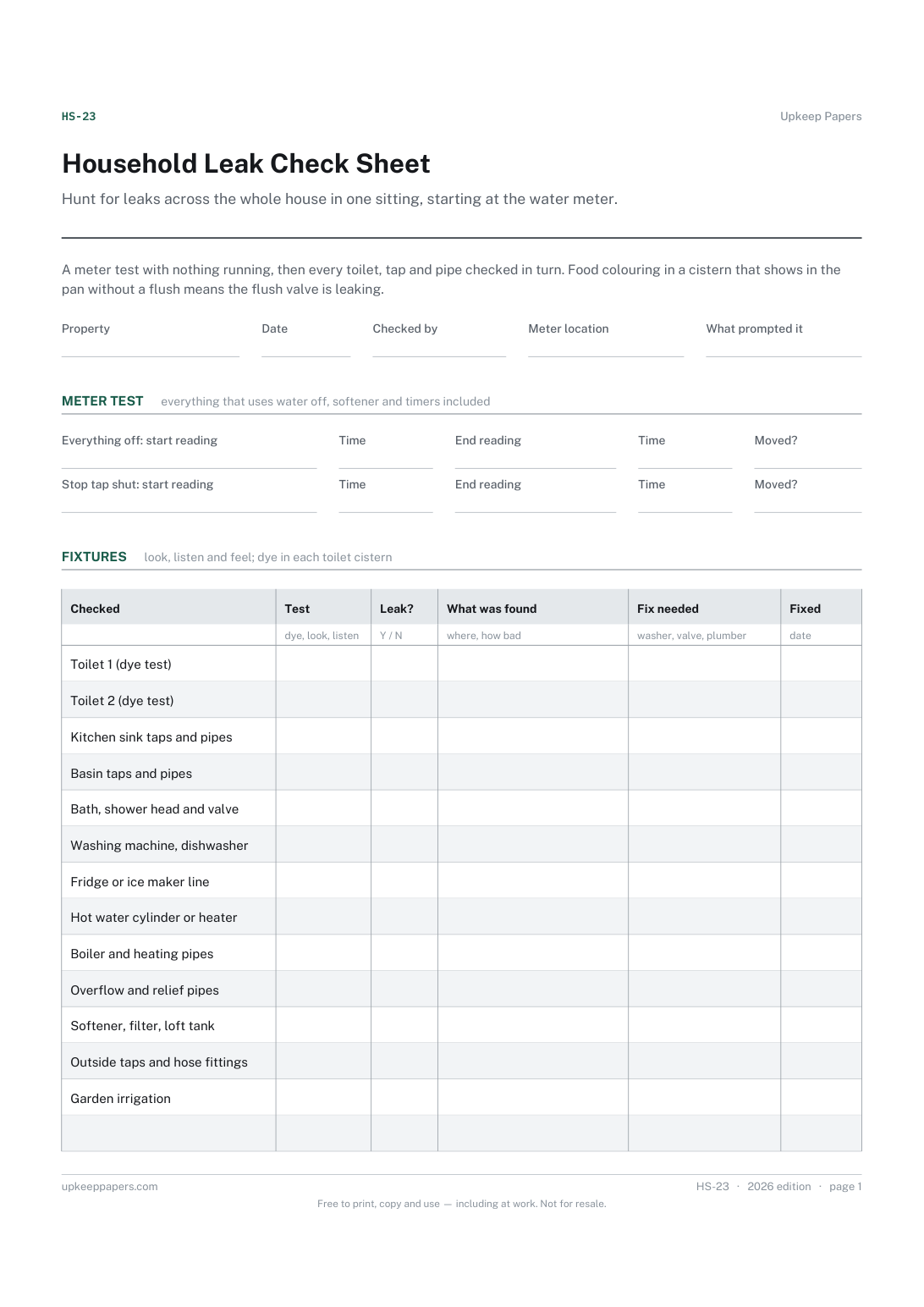
Hunt for leaks across the whole house in one sitting, starting at the water meter. Every toilet, tap and outside pipe gets a line, so a dripping cistern or a weeping relief pipe is found and fixed rather than paid for on the bill.
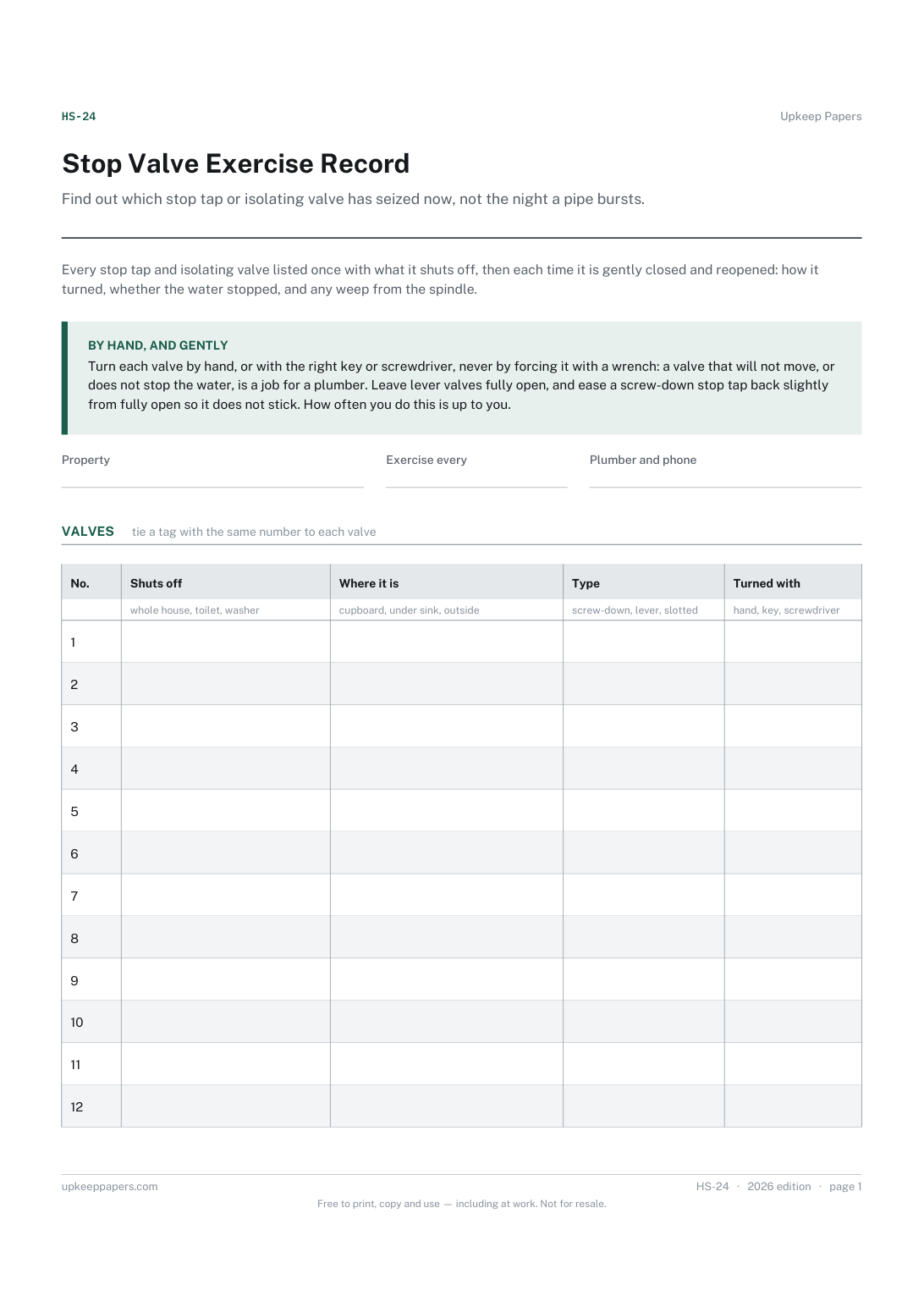
Find out which stop tap or isolating valve has seized now, not the night a pipe bursts. Each valve is listed once, and each gentle turn off and back on is written down with how it felt.
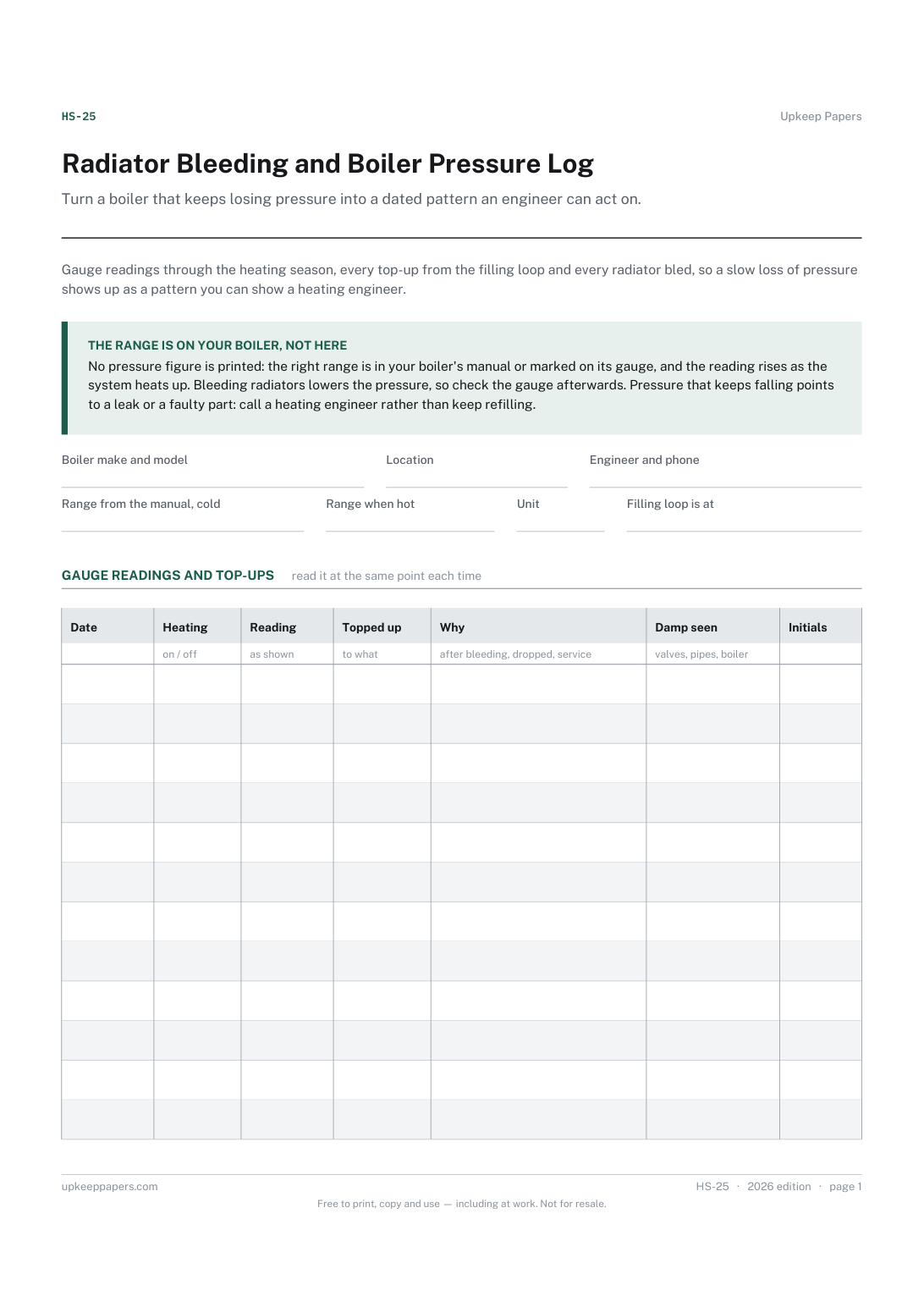
Turn a boiler that keeps losing pressure into a dated pattern an engineer can act on. Every gauge reading, top-up and radiator bled goes on one record across the heating season.
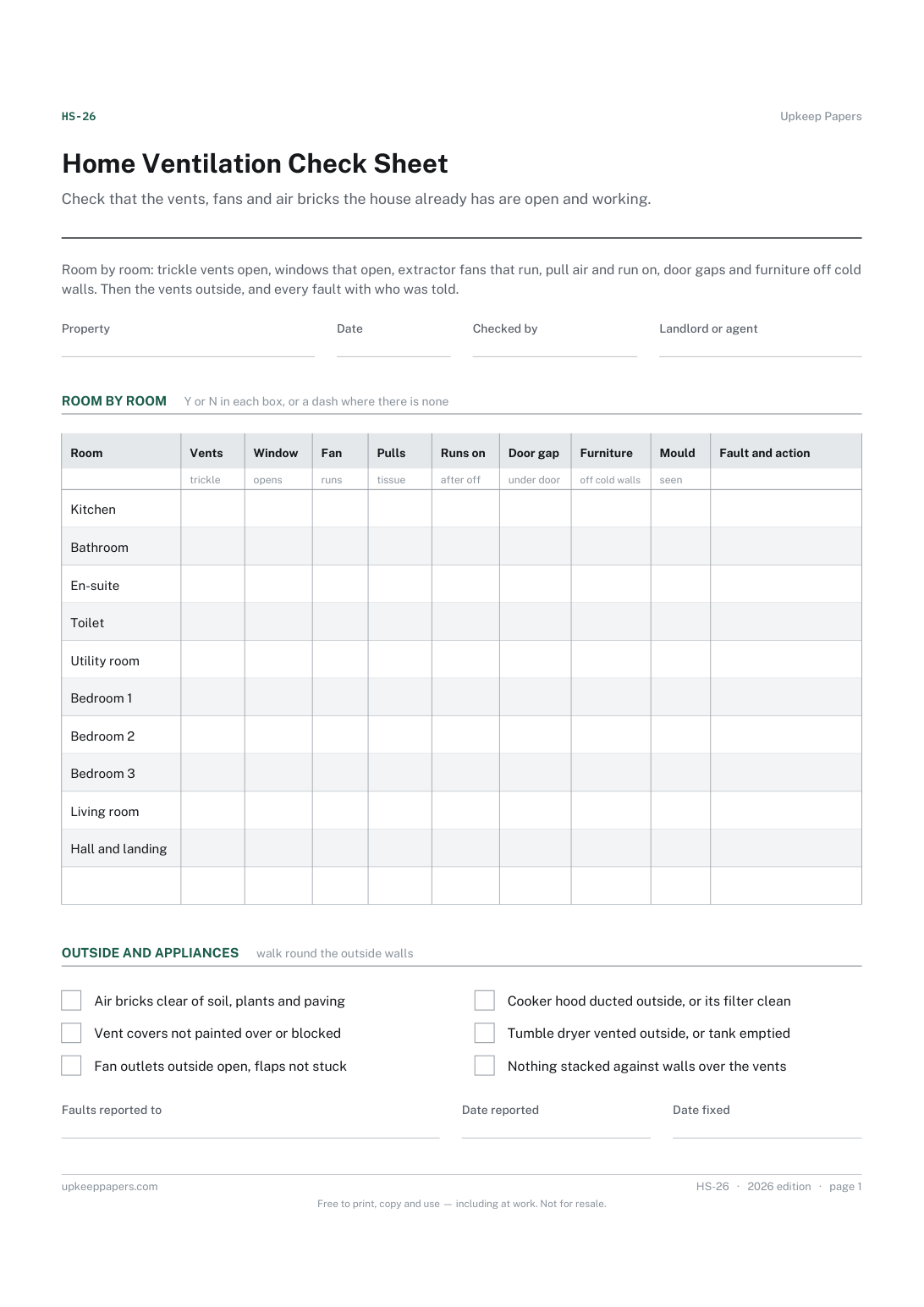
Check that the vents, fans and air bricks the house already has are open and working. Closed trickle vents, dead fans and buried air bricks are easy to miss, and this puts each one on paper with who was told.
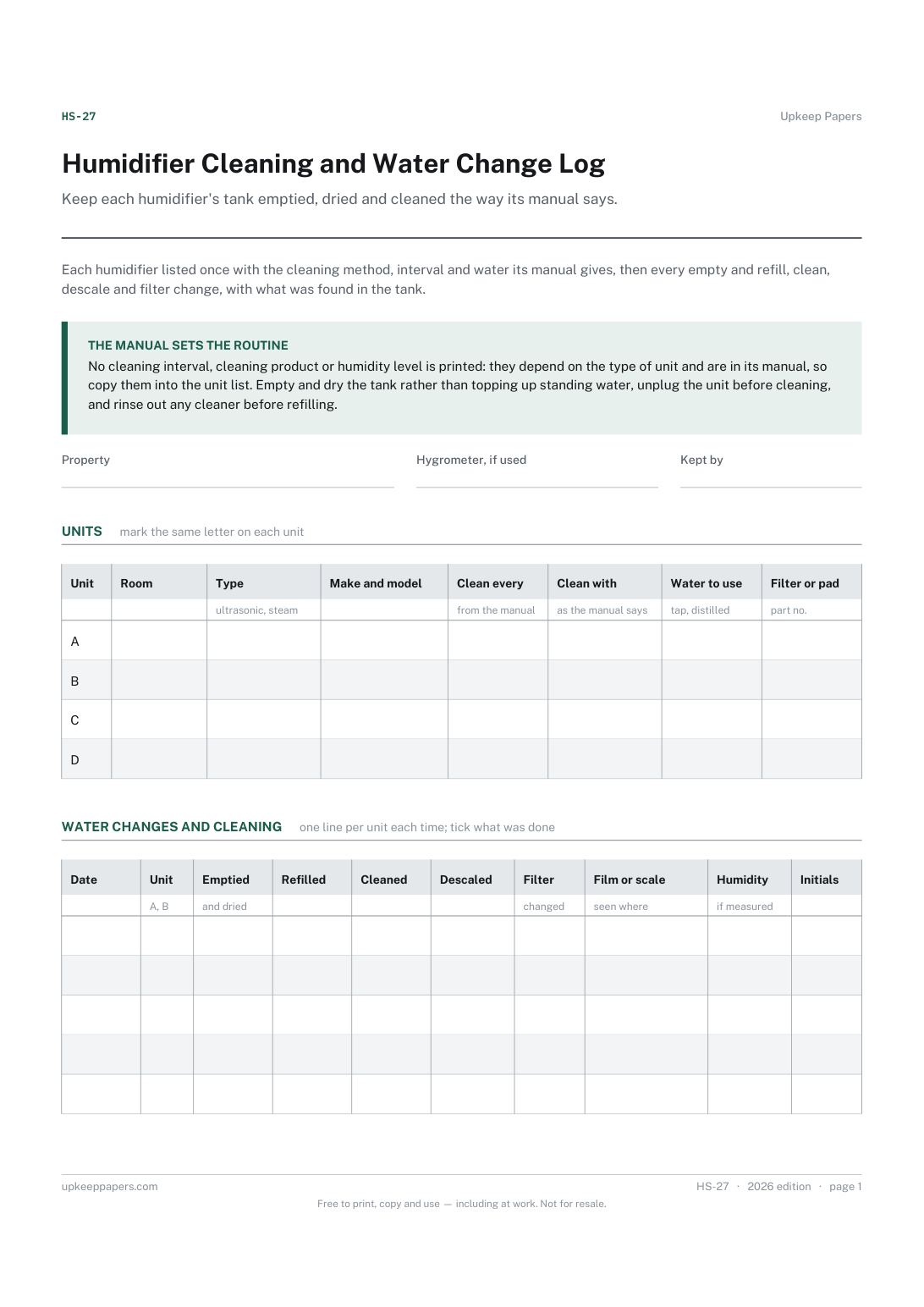
Keep each humidifier's tank emptied, dried and cleaned the way its manual says. Water left standing in a tank, and scale on its parts, are what the makers' cleaning instructions are there to prevent.
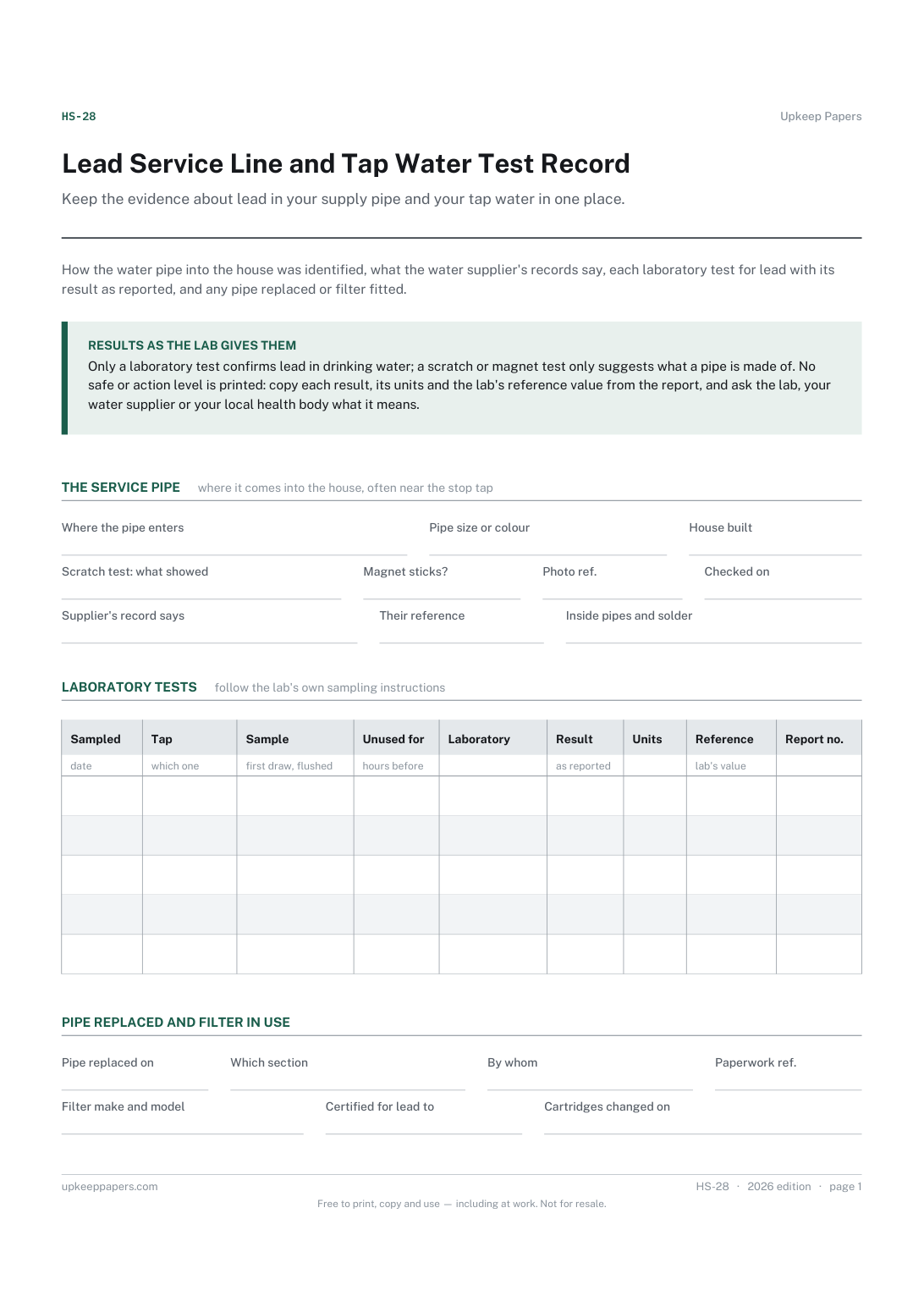
Keep the evidence about lead in your supply pipe and your tap water in one place. How the pipe was identified, what the supplier says, every lab result as reported, and any pipe replaced or filter fitted.
Alarm tests, extinguisher checks and the records that prove they happened.
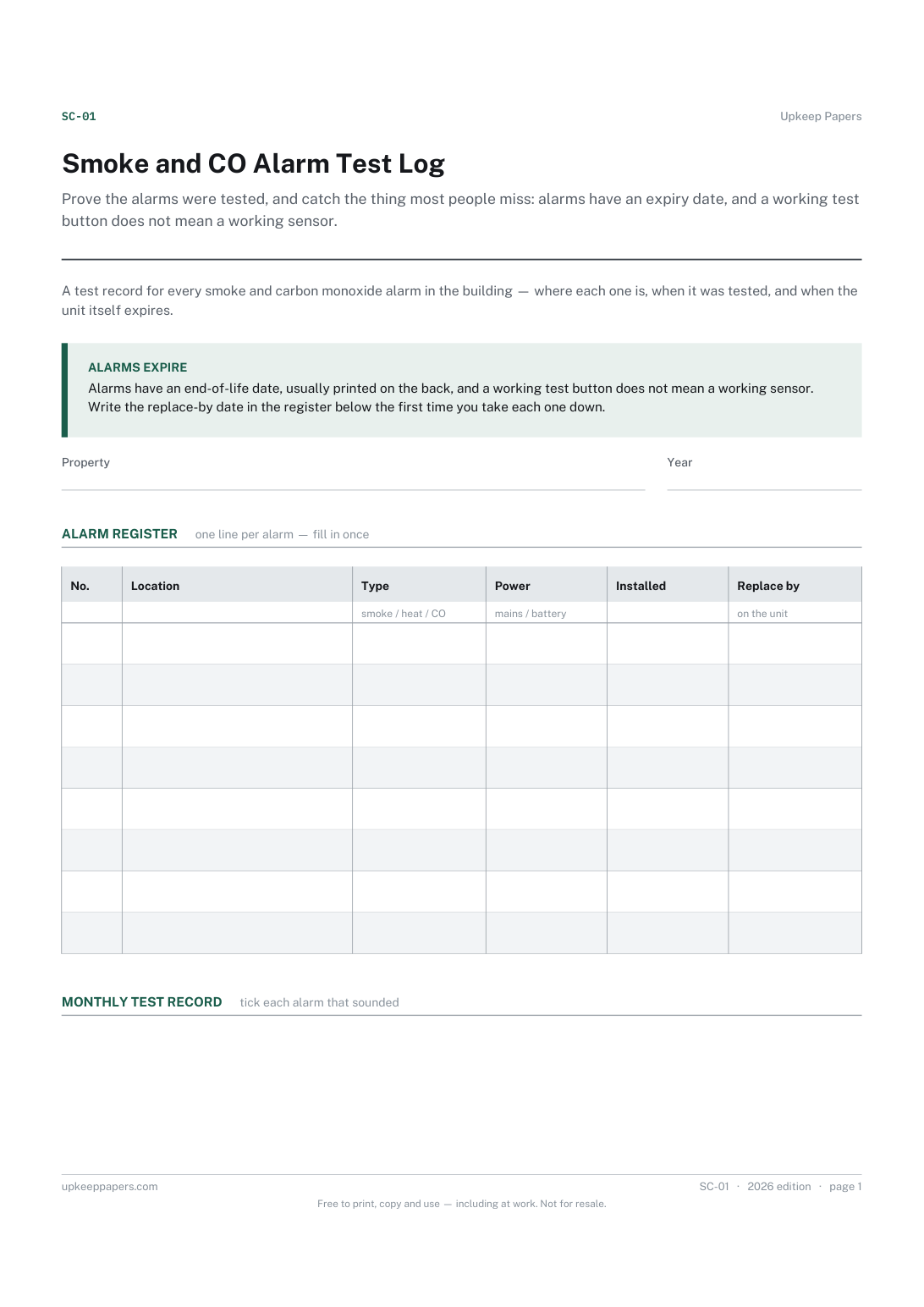
Prove the alarms were tested, and catch the thing most people miss: alarms have an expiry date, and a working test button does not mean a working sensor.
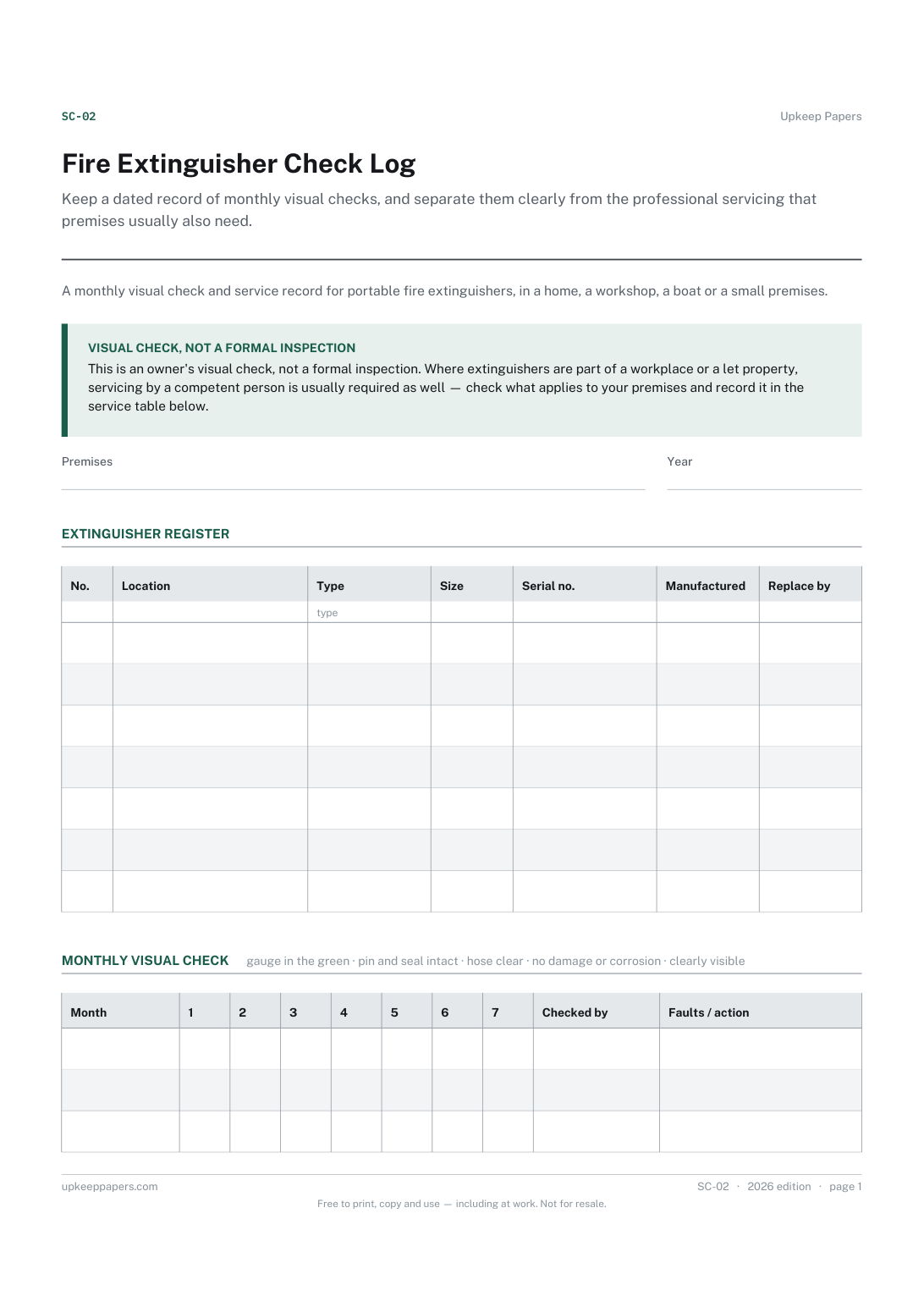
Keep a dated record of monthly visual checks, and separate them clearly from the professional servicing that premises usually also need.
Put the numbers somebody needs in one place, so a house-sitter, a babysitter, a visiting relative or a tenant is not searching for them at the worst moment.
Record a drill in a way that captures what went badly, which is the only part that makes the next one better.
Put one person's emergency contacts and practical details on a single page, in the order somebody should actually work through them.
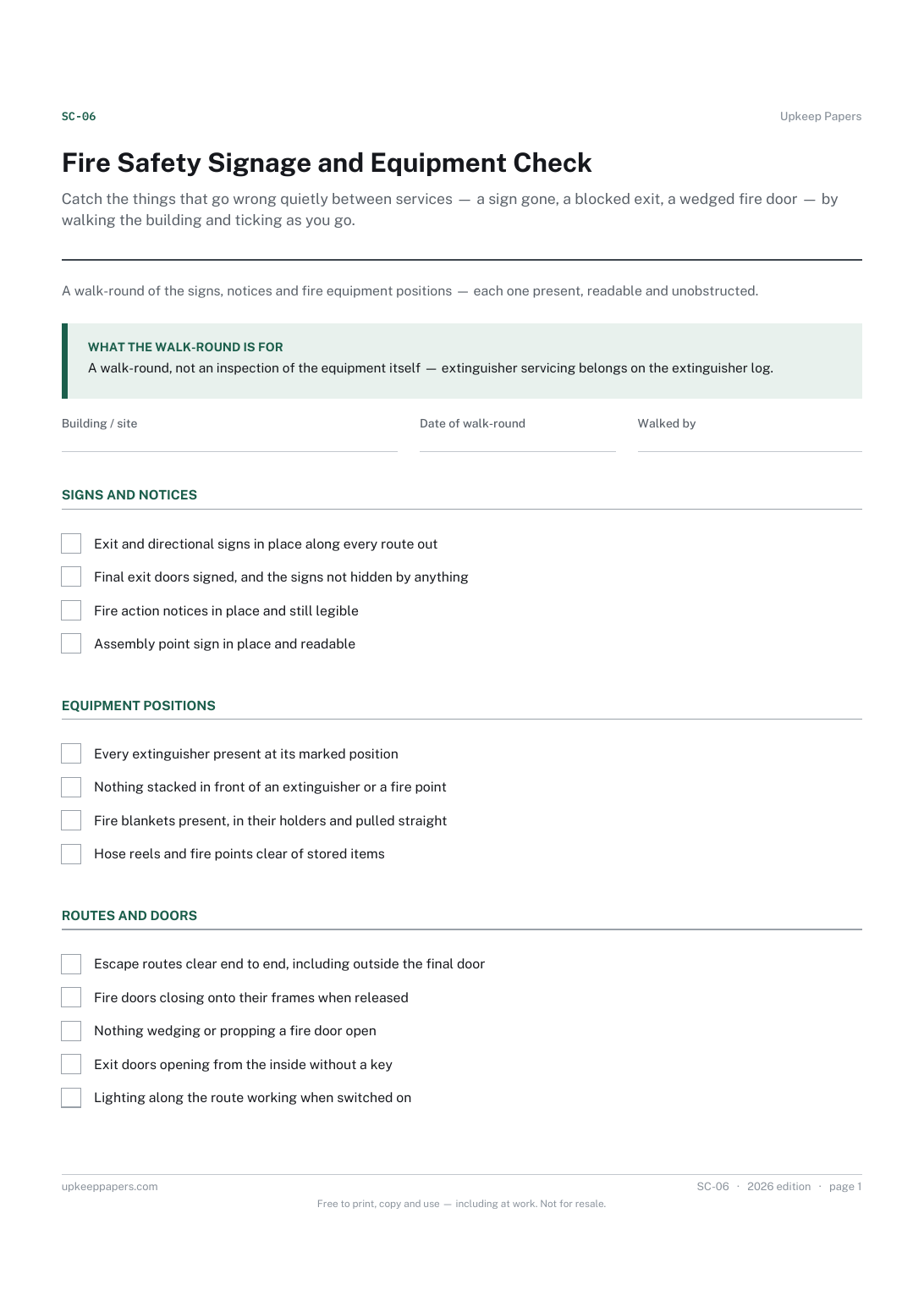
Catch the things that go wrong quietly between services — a sign gone, a blocked exit, a wedged fire door — by walking the building and ticking as you go.
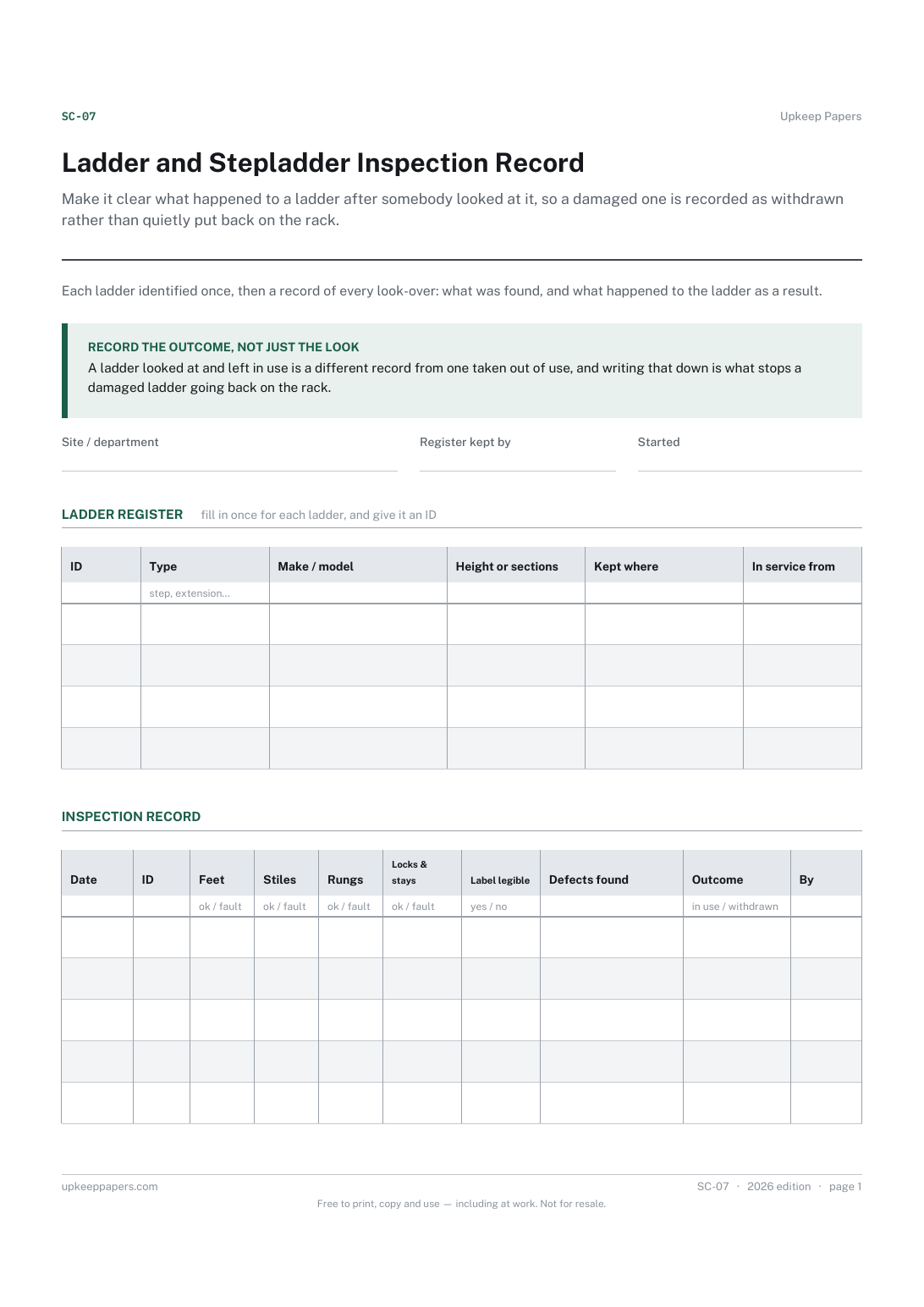
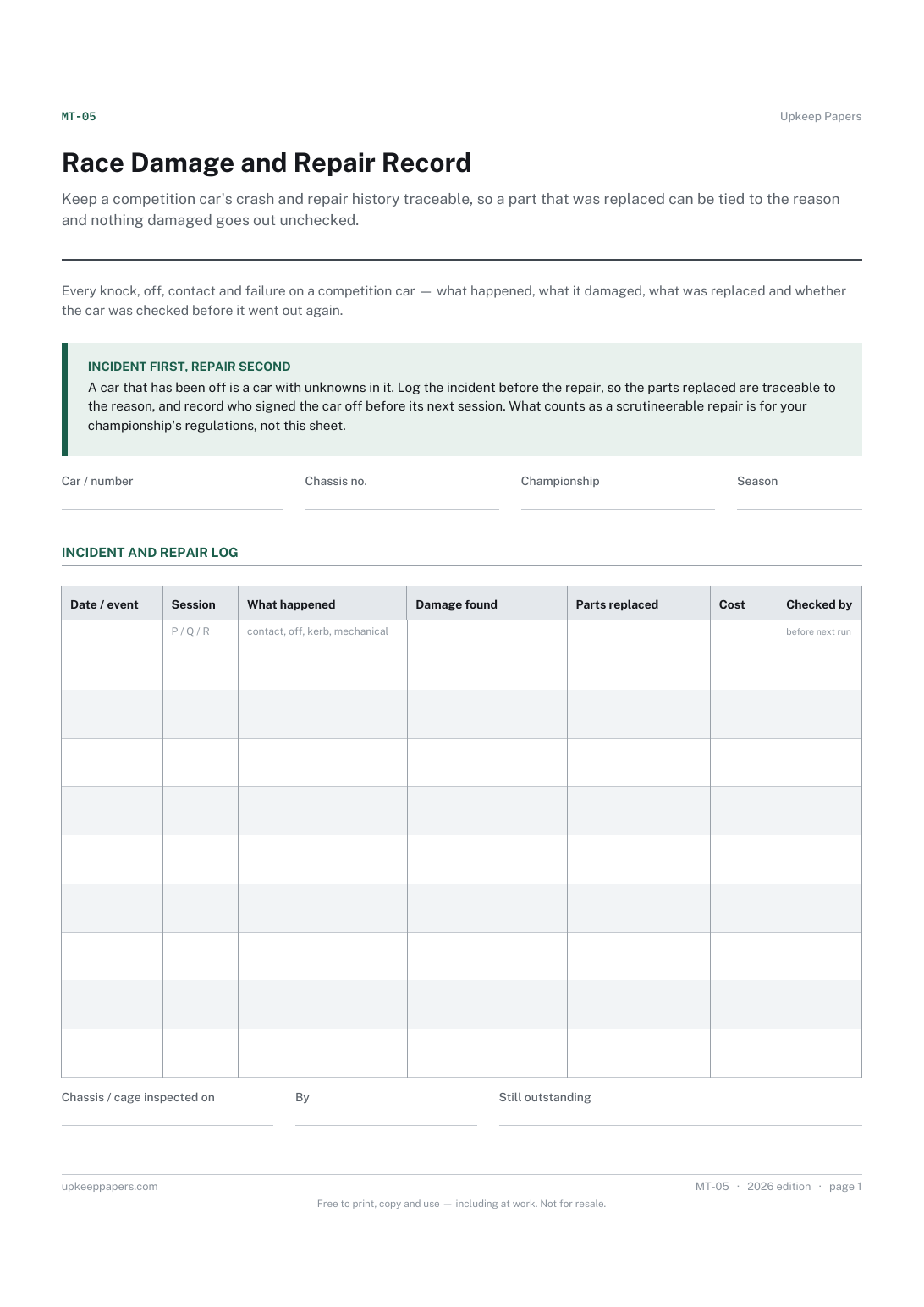
Make it clear what happened to a ladder after somebody looked at it, so a damaged one is recorded as withdrawn rather than quietly put back on the rack.
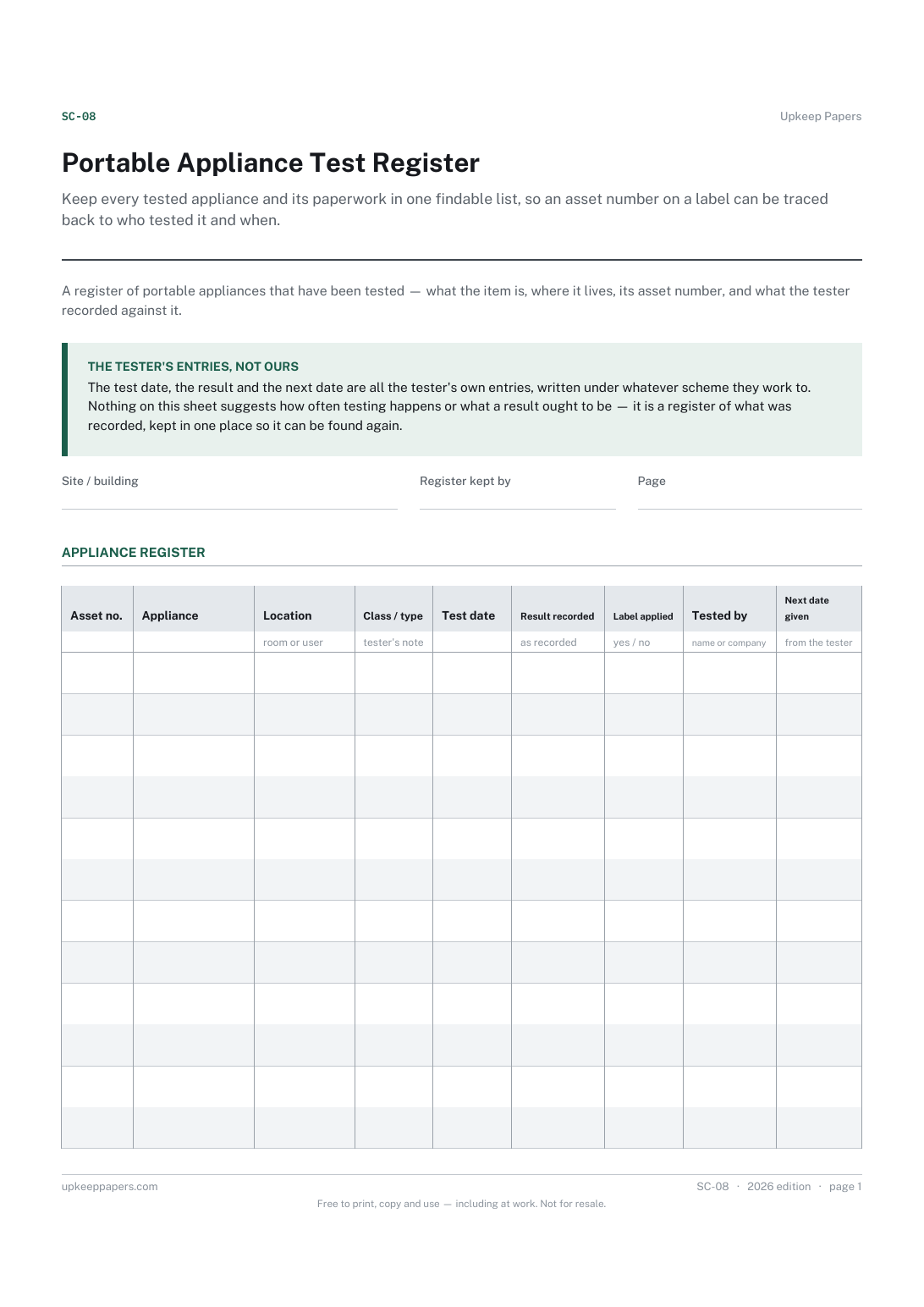
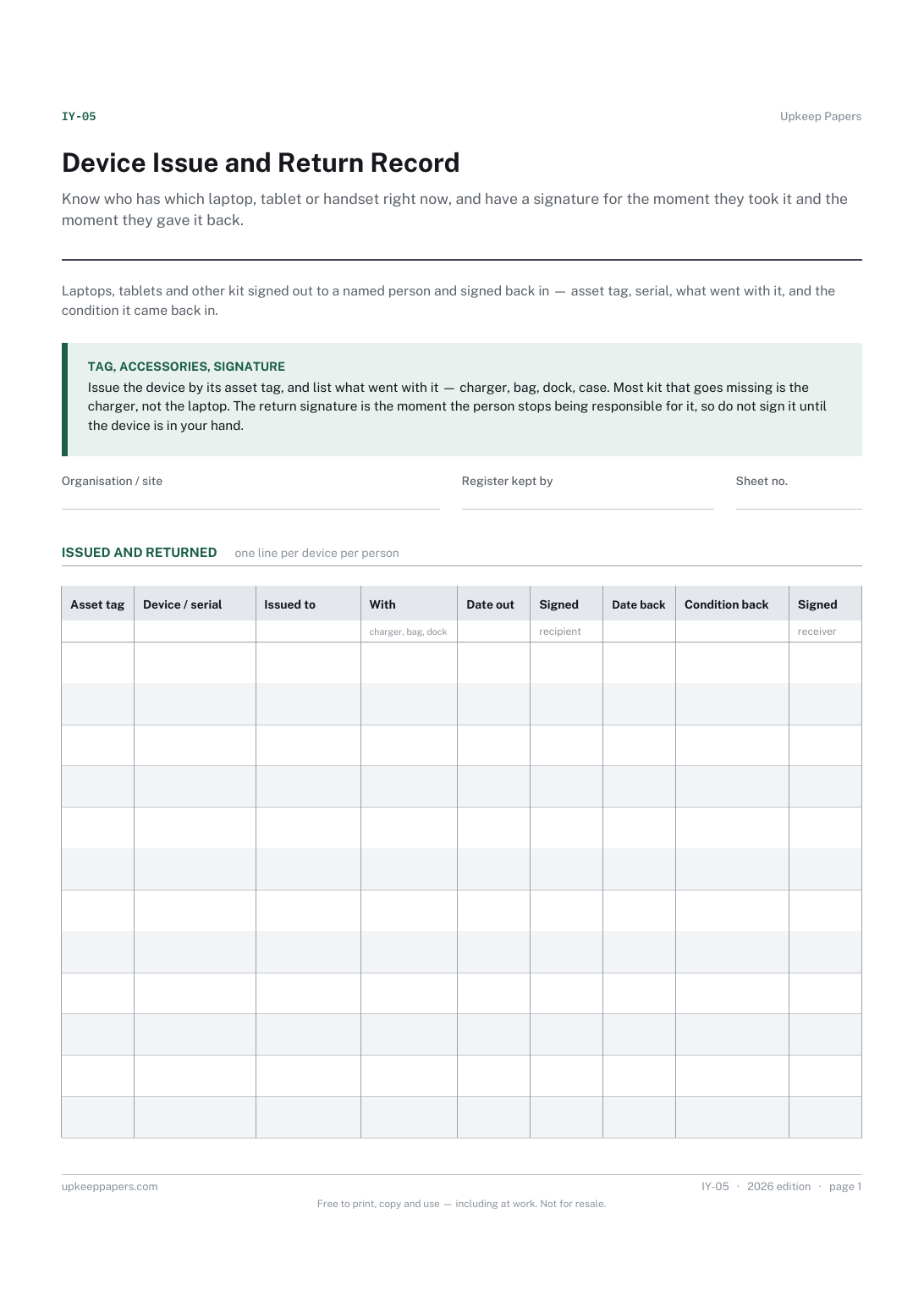
Keep every tested appliance and its paperwork in one findable list, so an asset number on a label can be traced back to who tested it and when.
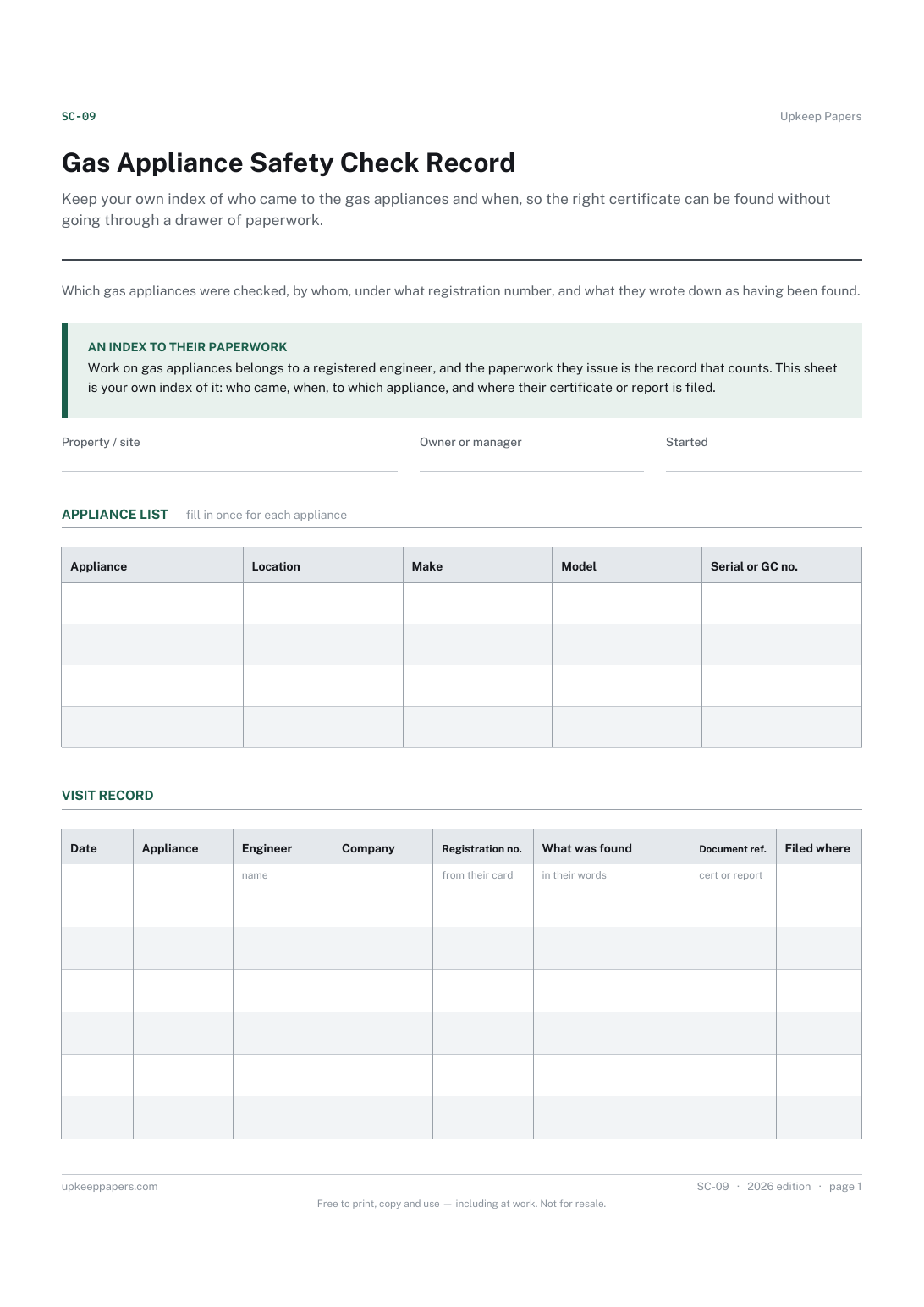
Keep your own index of who came to the gas appliances and when, so the right certificate can be found without going through a drawer of paperwork.
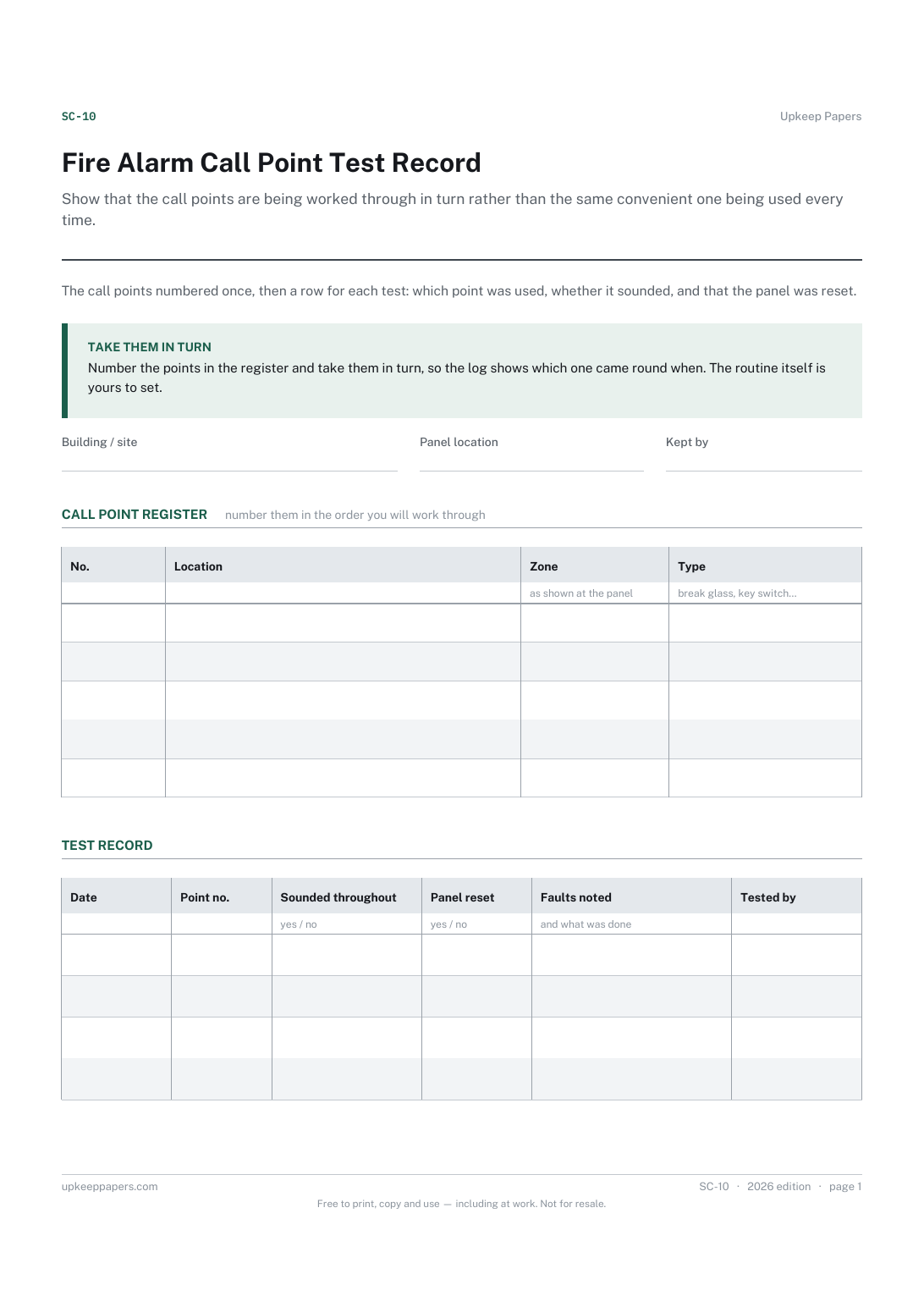
Show that the call points are being worked through in turn rather than the same convenient one being used every time.
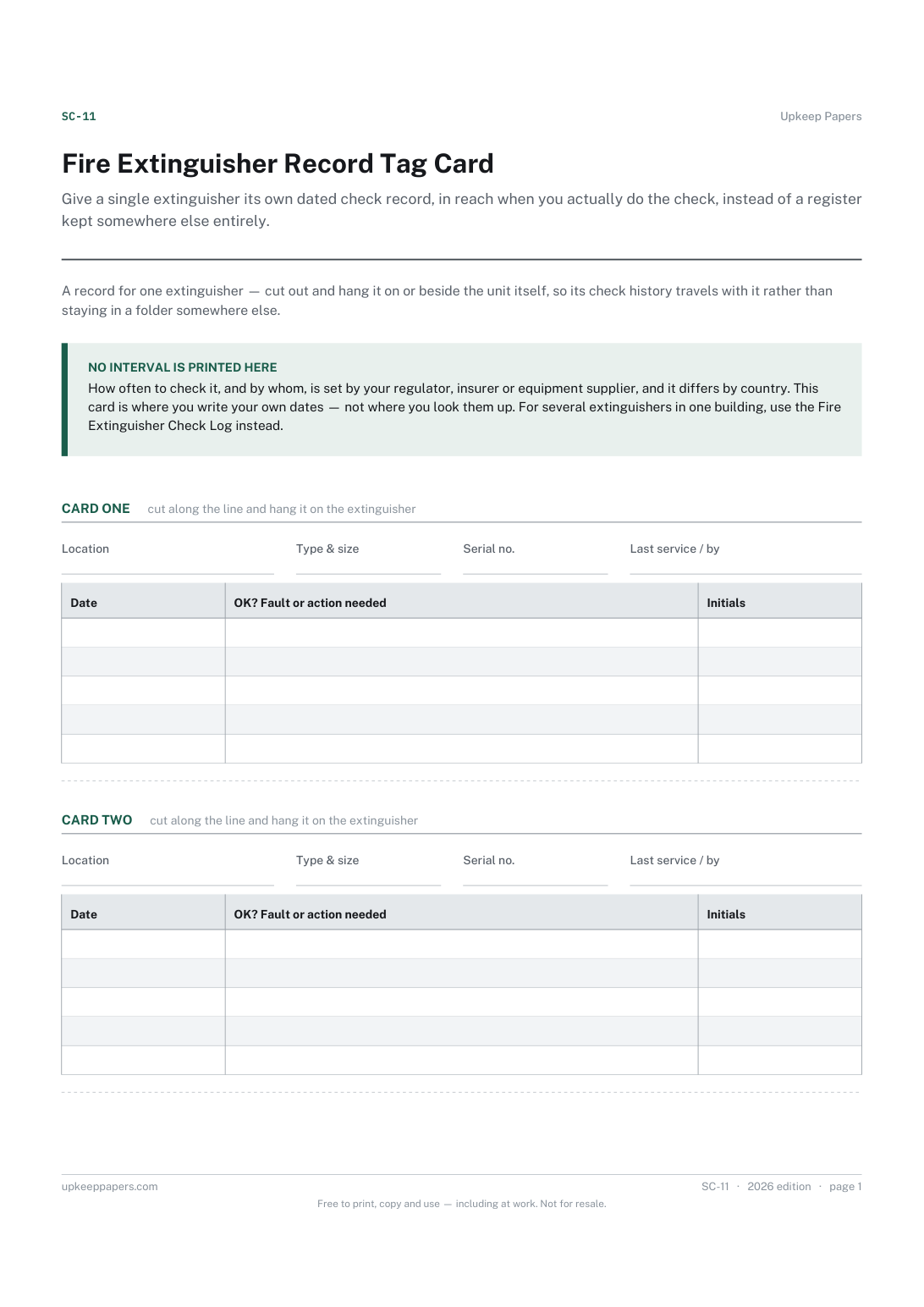
Give a single extinguisher its own dated check record, in reach when you actually do the check, instead of a register kept somewhere else entirely.
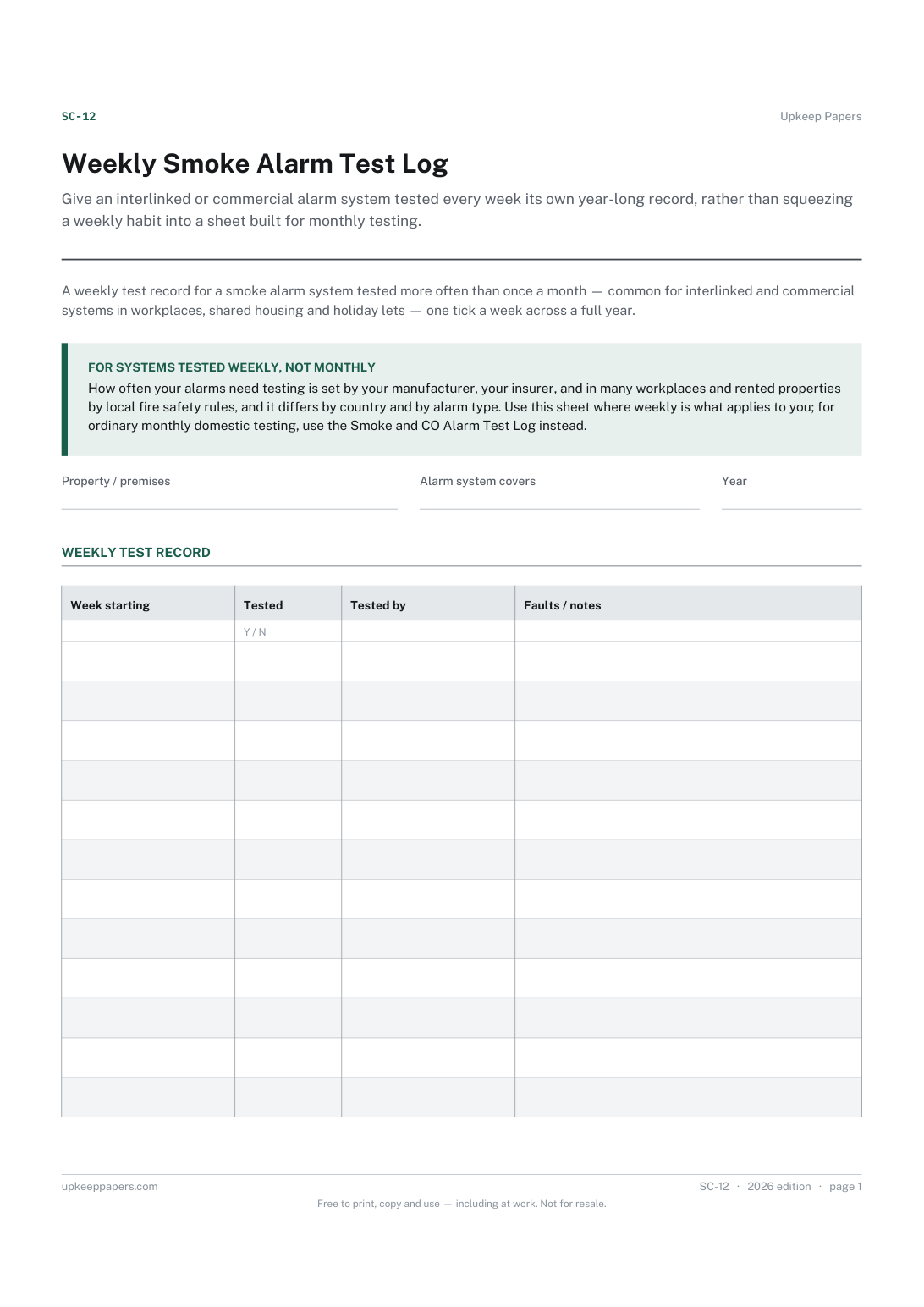
Give an interlinked or commercial alarm system tested every week its own year-long record, rather than squeezing a weekly habit into a sheet built for monthly testing.
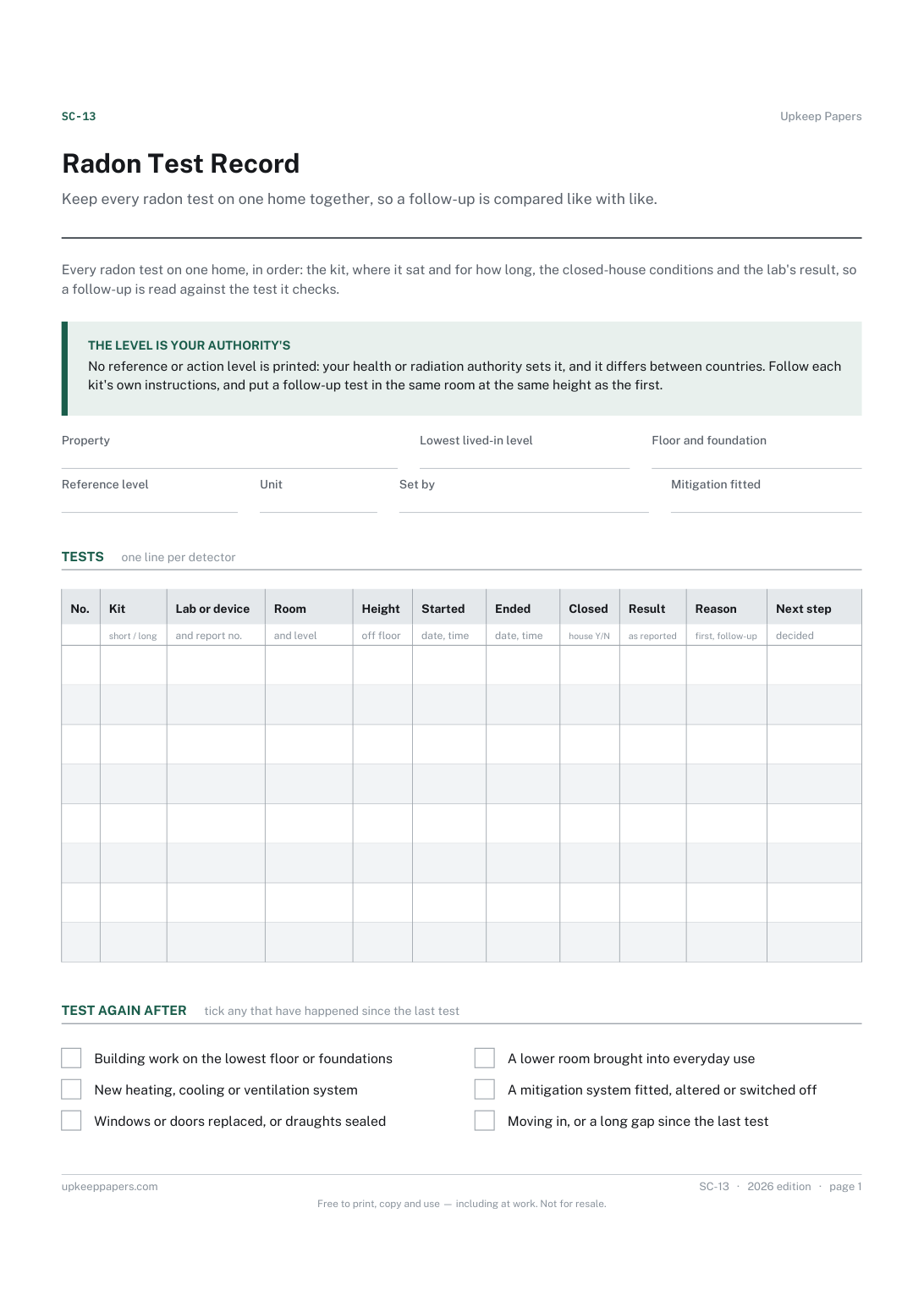
Keep every radon test on one home together, so a follow-up is compared like with like. Each line also says why the test was done and what was decided after it.
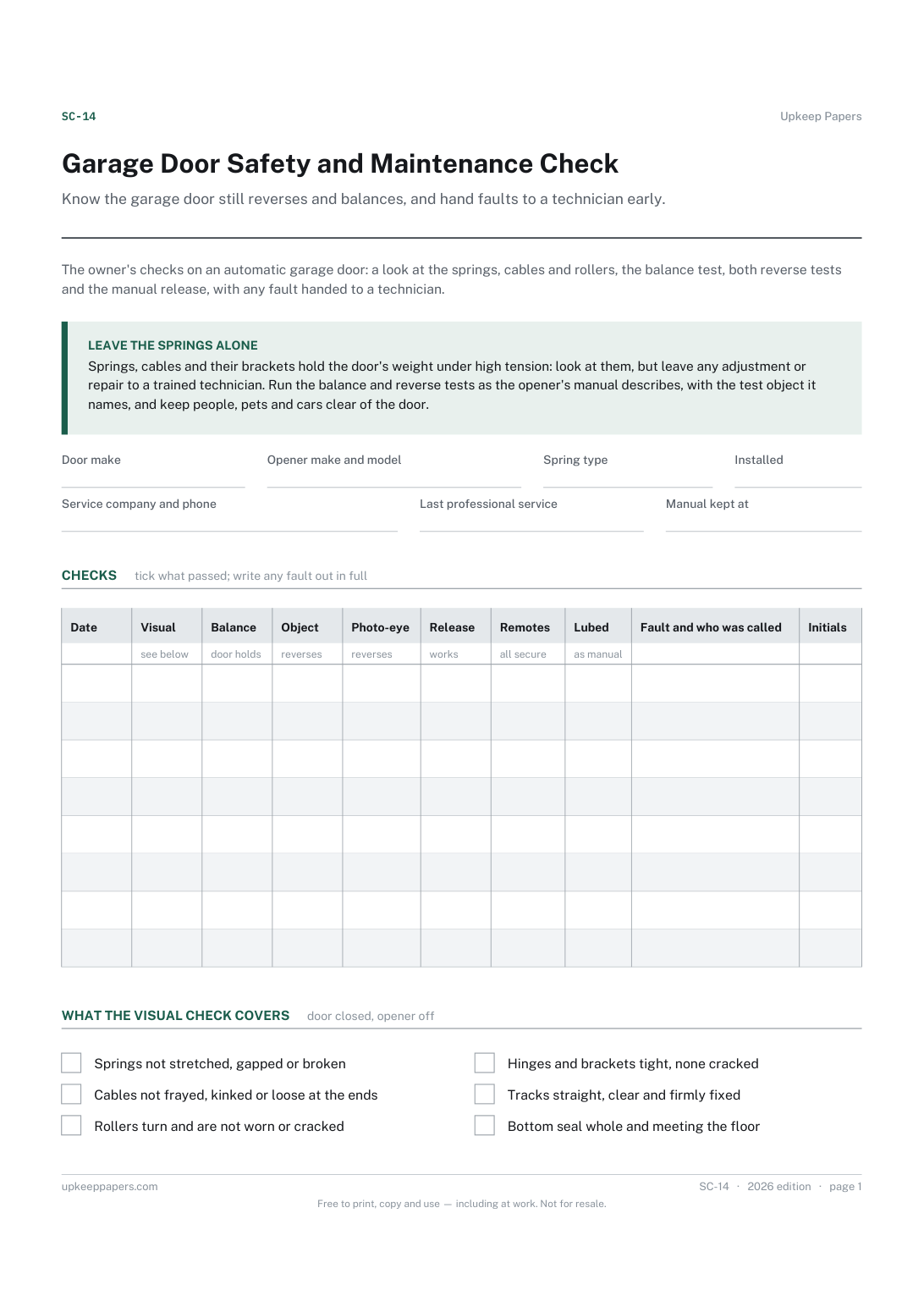
Know the garage door still reverses and balances, and hand faults to a technician early. A door that fails a reverse test is one to stop relying on.
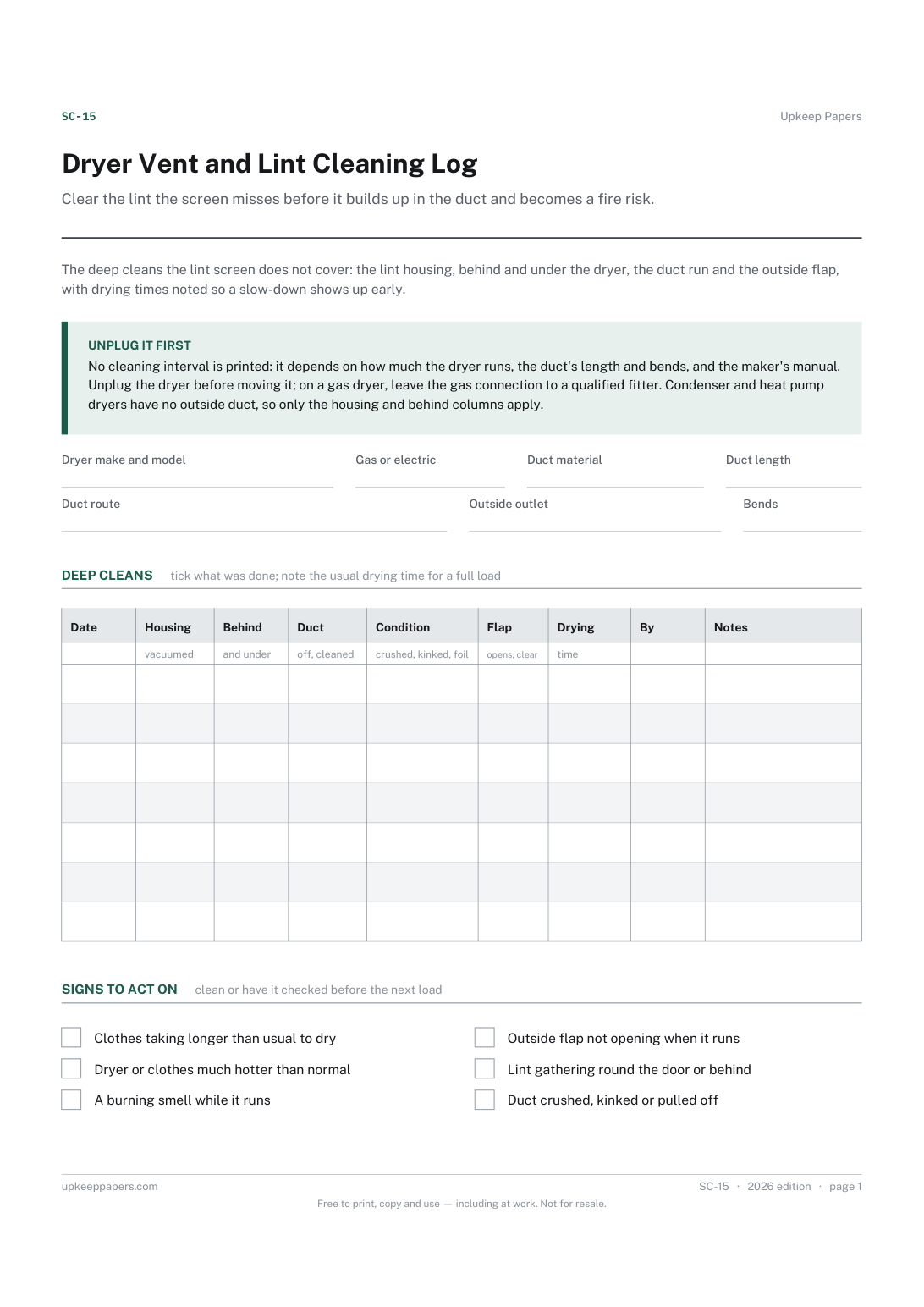
Clear the lint the screen misses before it builds up in the duct and becomes a fire risk. The drying time column shows a duct starting to clog.
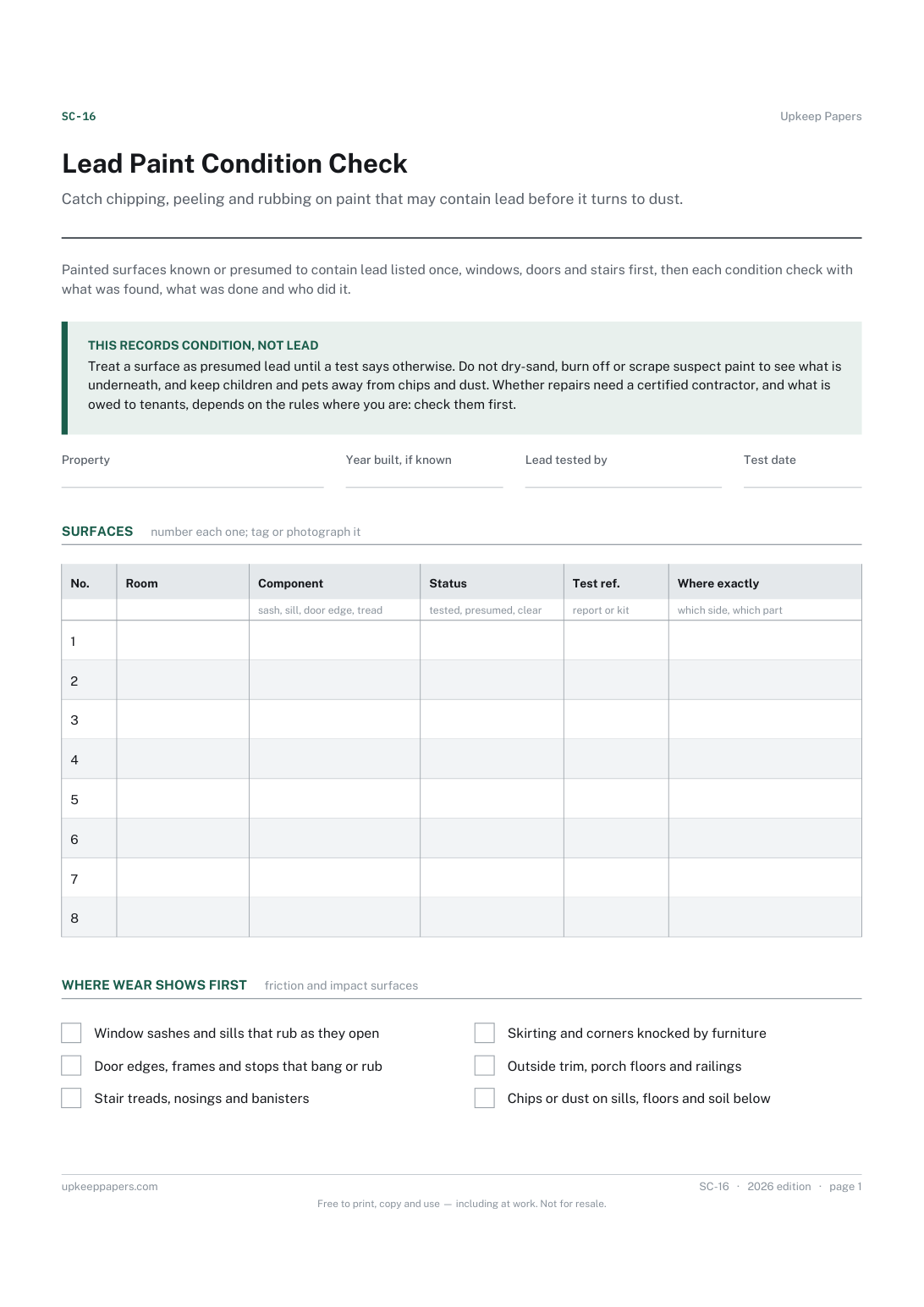
Catch chipping, peeling and rubbing on paint that may contain lead before it turns to dust. Each surface is listed once with its test status, then checked in turn with the repair made.
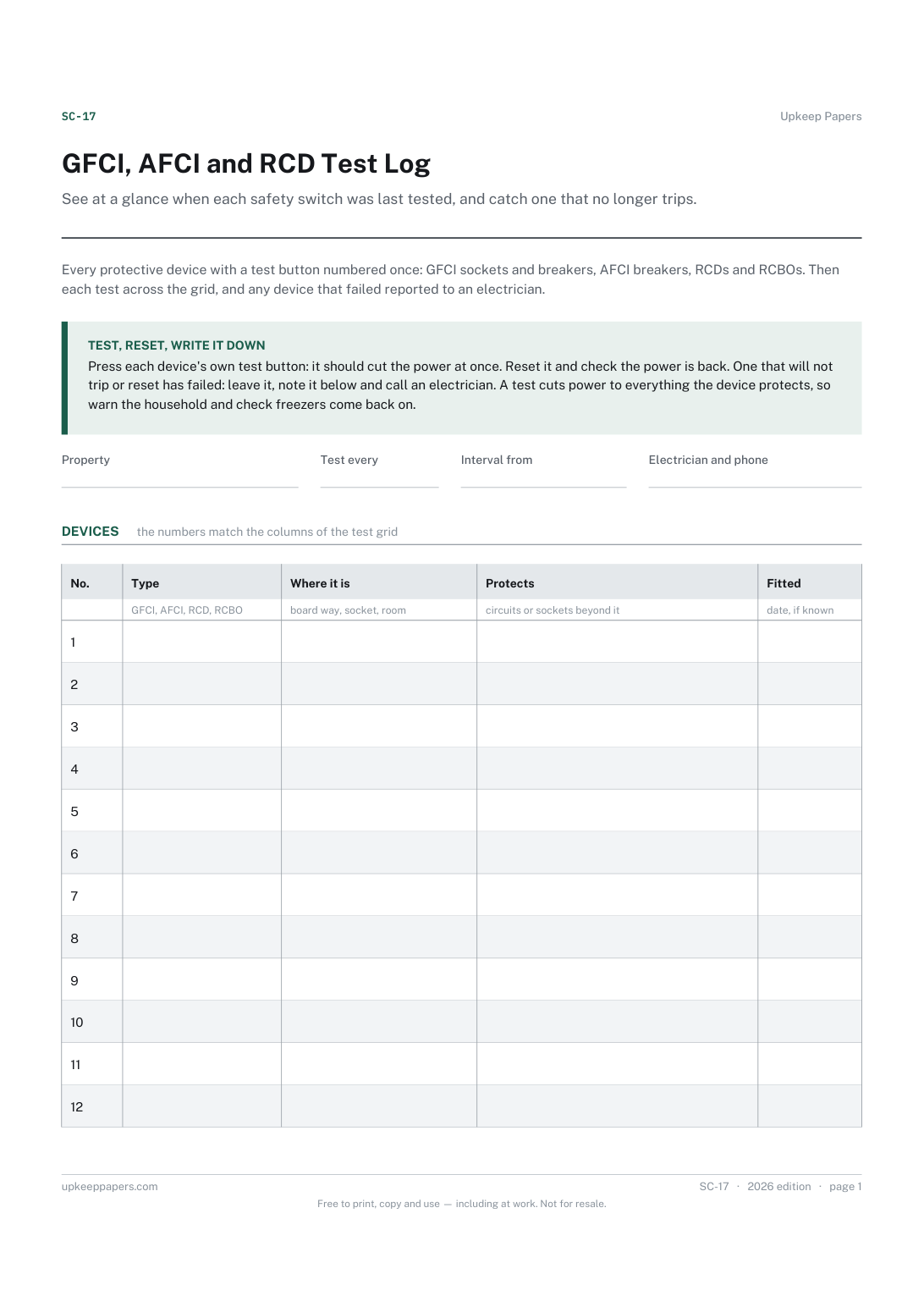
See at a glance when each safety switch was last tested, and catch one that no longer trips. Every device with a test button is numbered once, then each test goes across the grid.
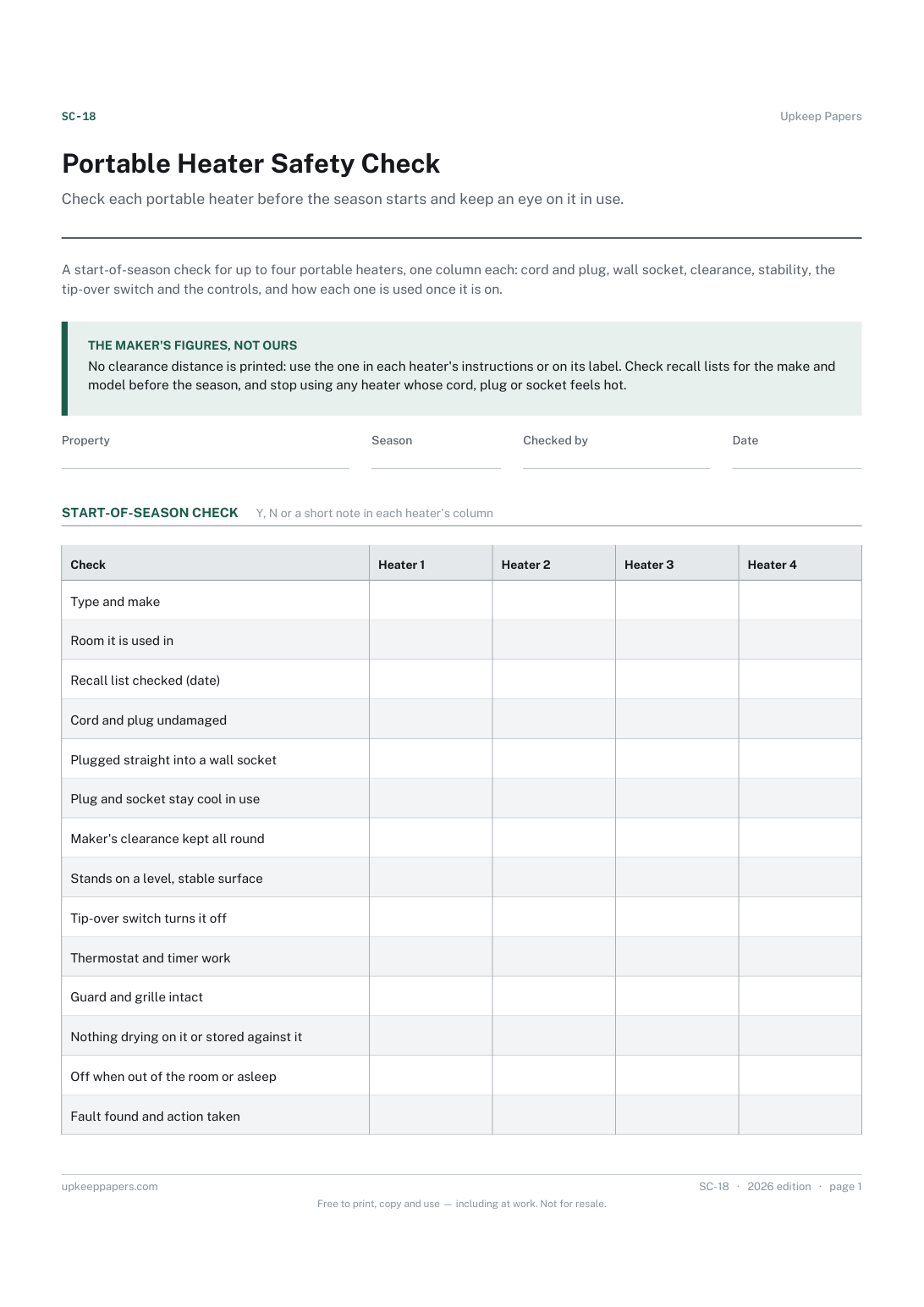
Check each portable heater before the season starts and keep an eye on it in use. Each heater gets a column, so a frayed cord or a dead tip-over switch is written down rather than noticed and forgotten.
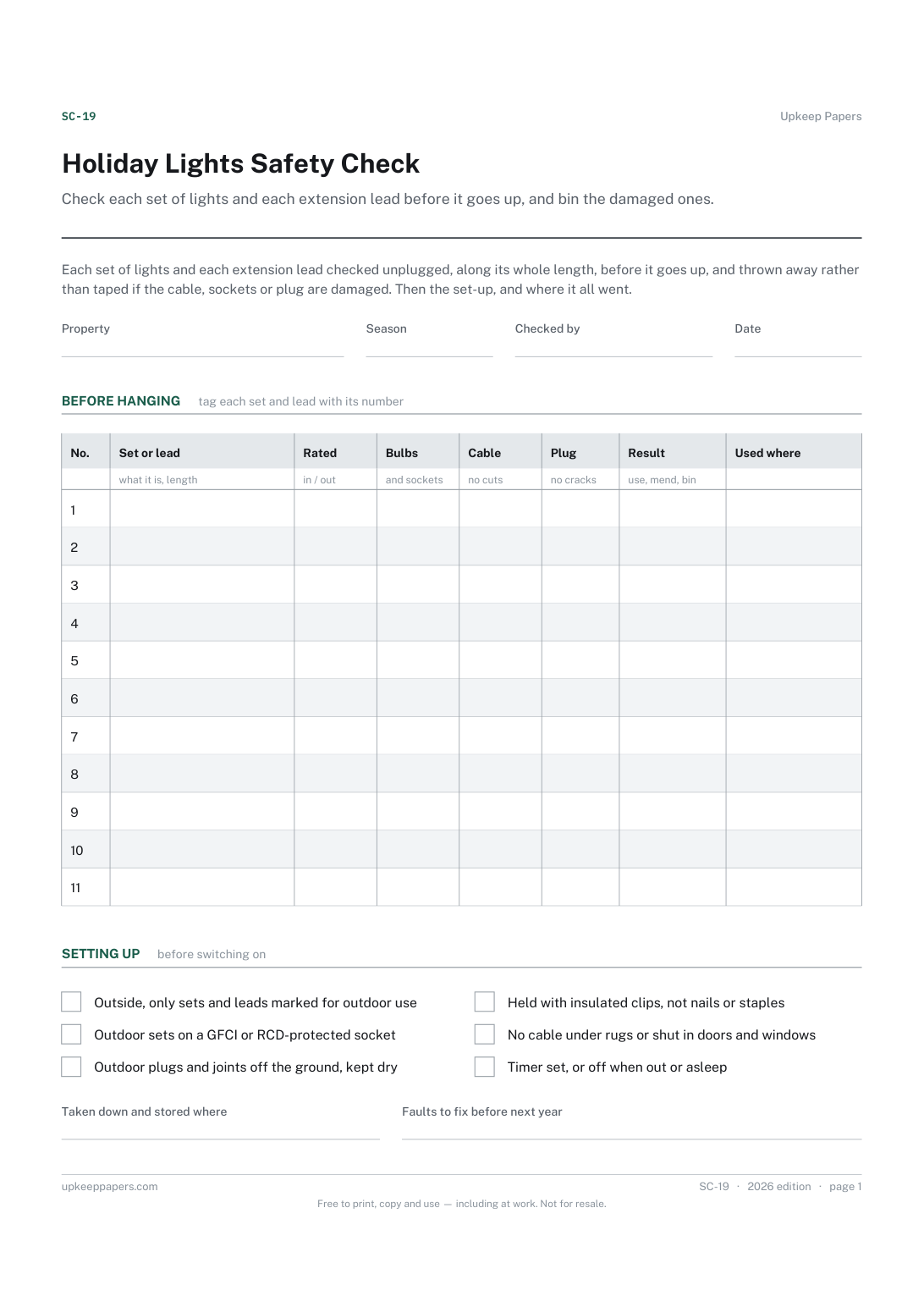
Check each set of lights and each extension lead before it goes up, and bin the damaged ones. Ratings, safety-switch protection and fixings are written down, with where it all went afterwards.
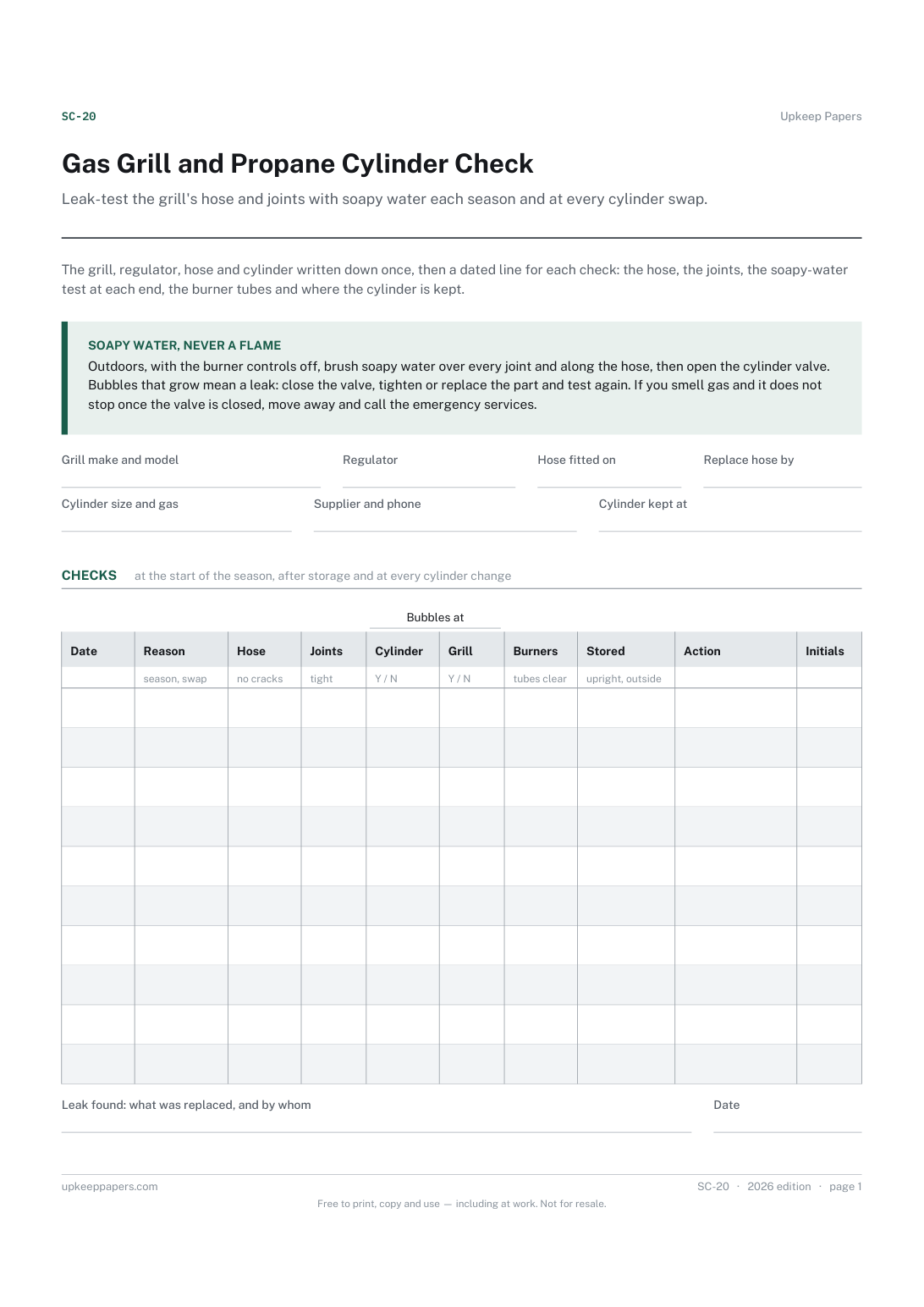
Leak-test the grill's hose and joints with soapy water each season and at every cylinder swap. The hose, regulator and burner tubes get a dated line, so a perished hose is replaced before it leaks.
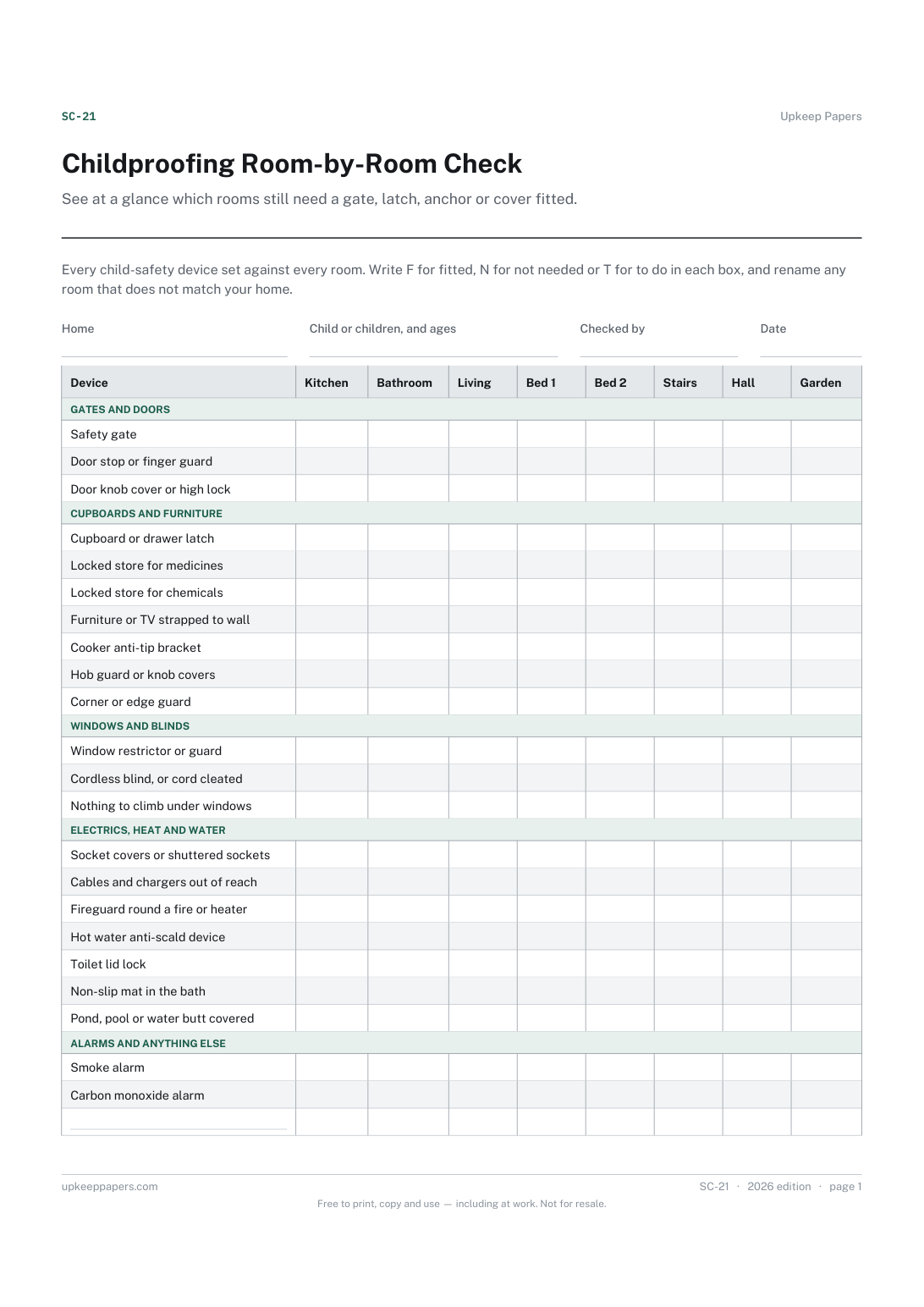
See at a glance which rooms still need a gate, latch, anchor or cover fitted. The recheck page catches the device that has worked loose or been left undone.
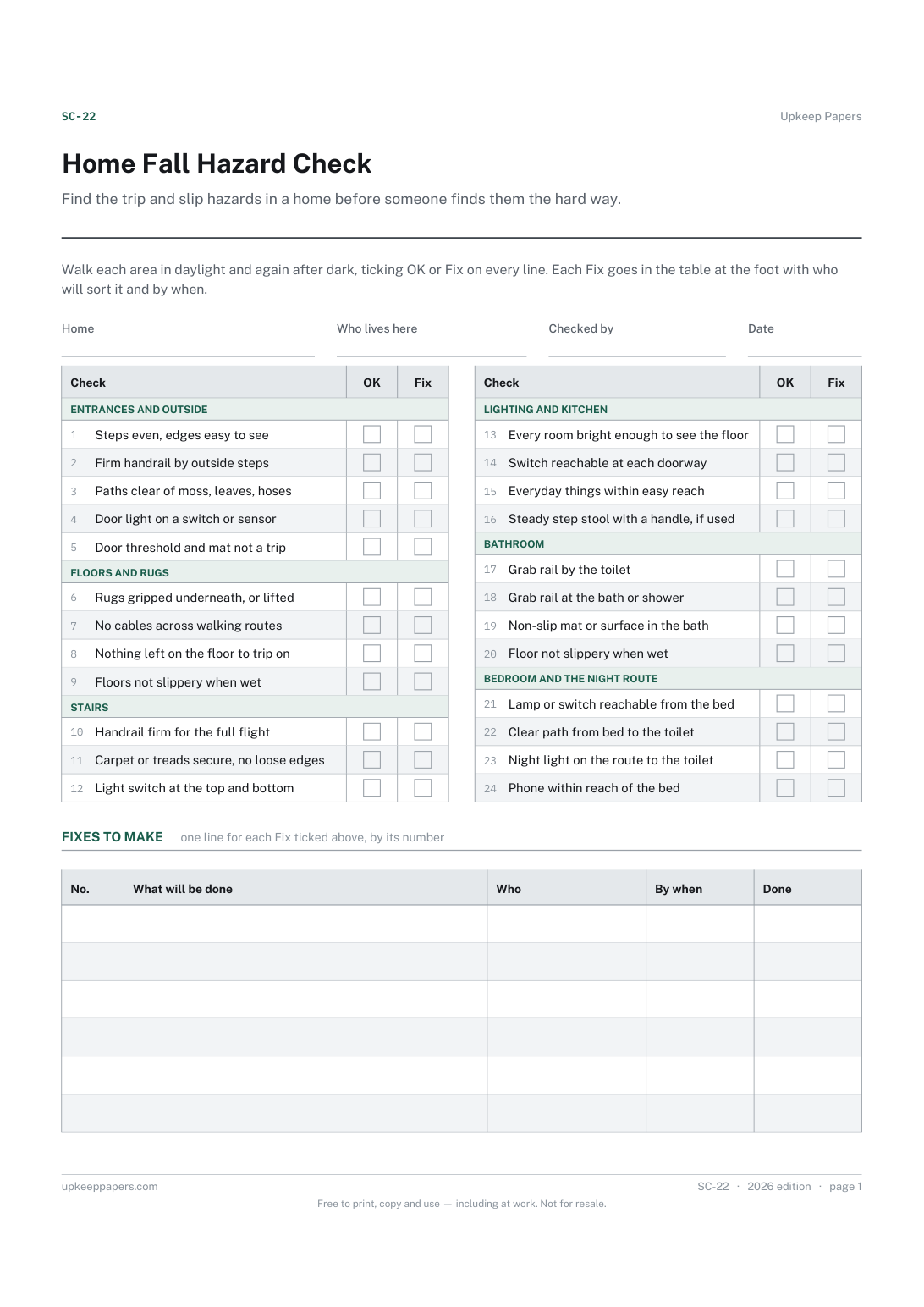
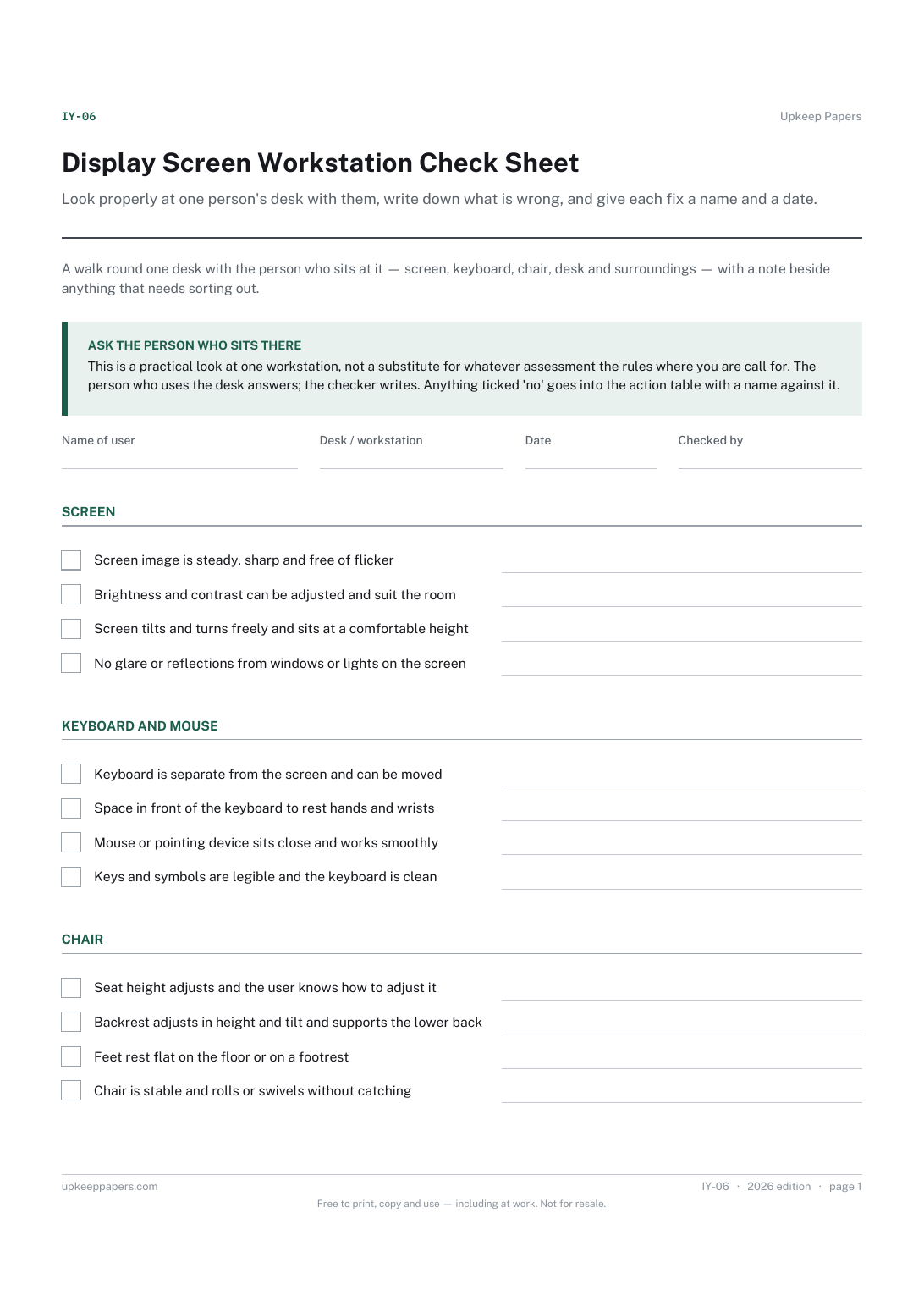
Find the trip and slip hazards in a home before someone finds them the hard way. Each Fix ticked becomes a line at the foot with a name and a date, so it actually gets done.
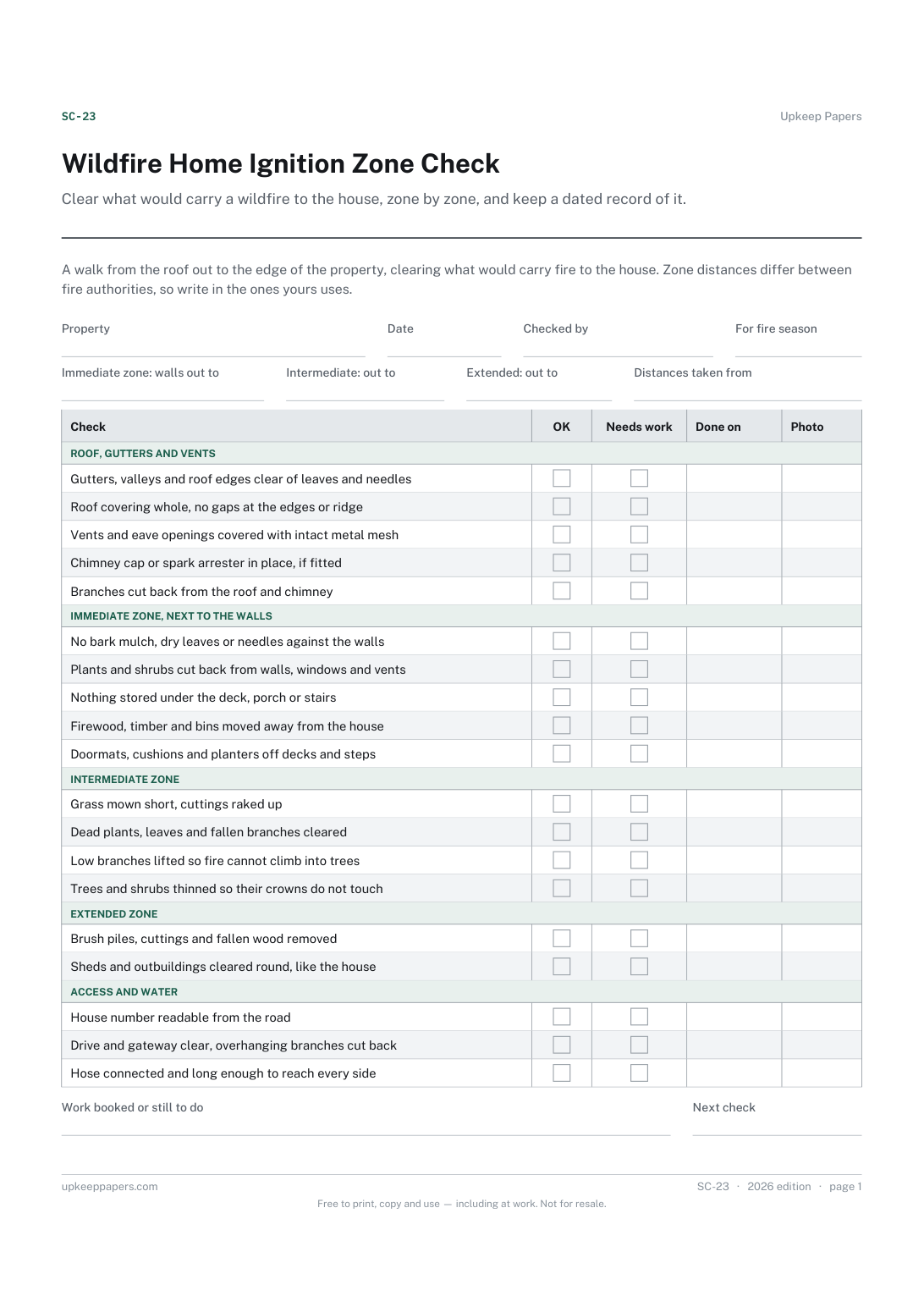
Clear what would carry a wildfire to the house, zone by zone, and keep a dated record of it. The photo column gives you evidence for an inspection or an insurer.
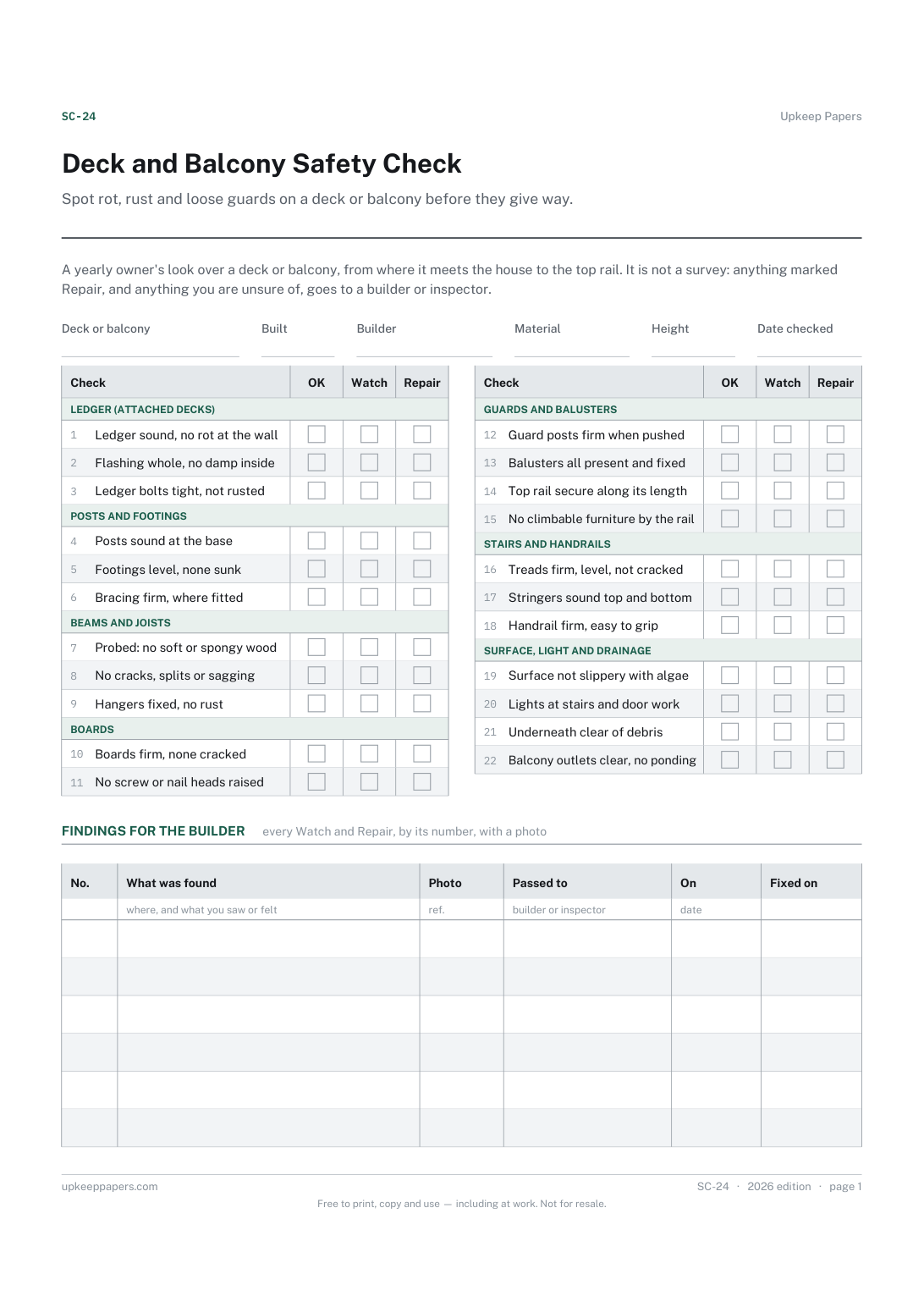
Spot rot, rust and loose guards on a deck or balcony before they give way. Every Watch or Repair goes on one list with its photo, ready to hand to a builder.
Mowers, saws, generators, washers, compressors and tractors — hour-based servicing and the part numbers you can never find.
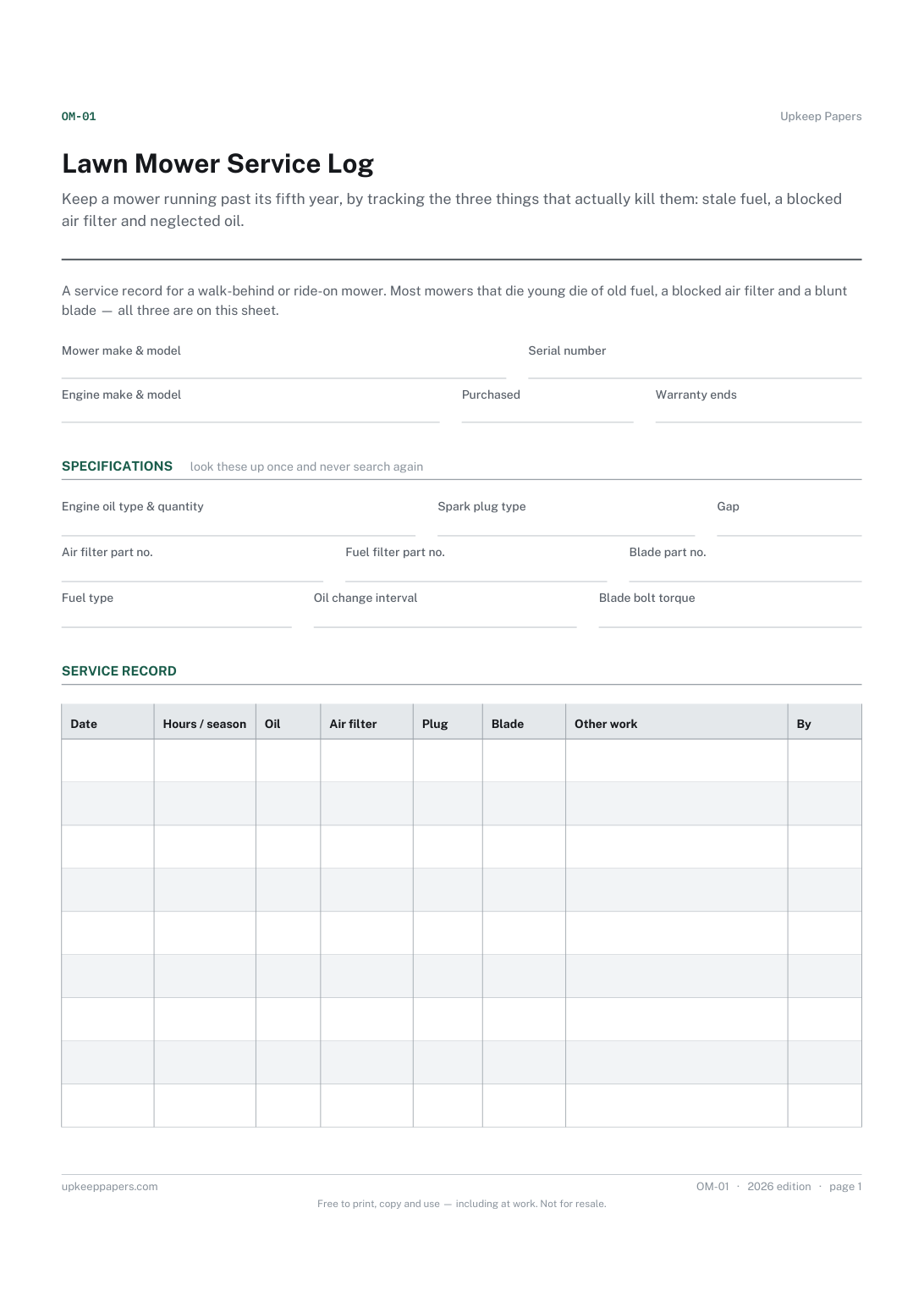
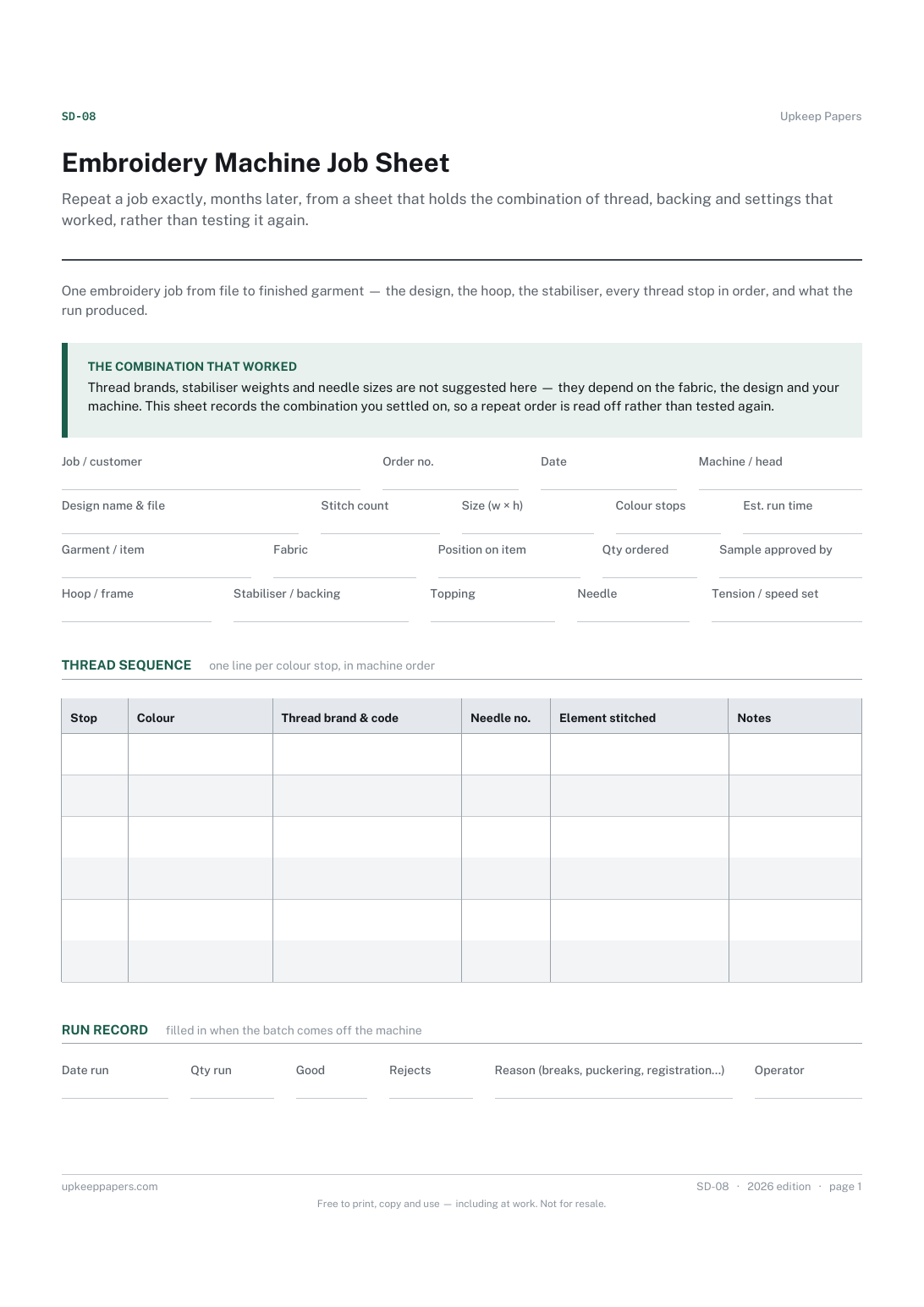
Keep a mower running past its fifth year, by tracking the three things that actually kill them: stale fuel, a blocked air filter and neglected oil.
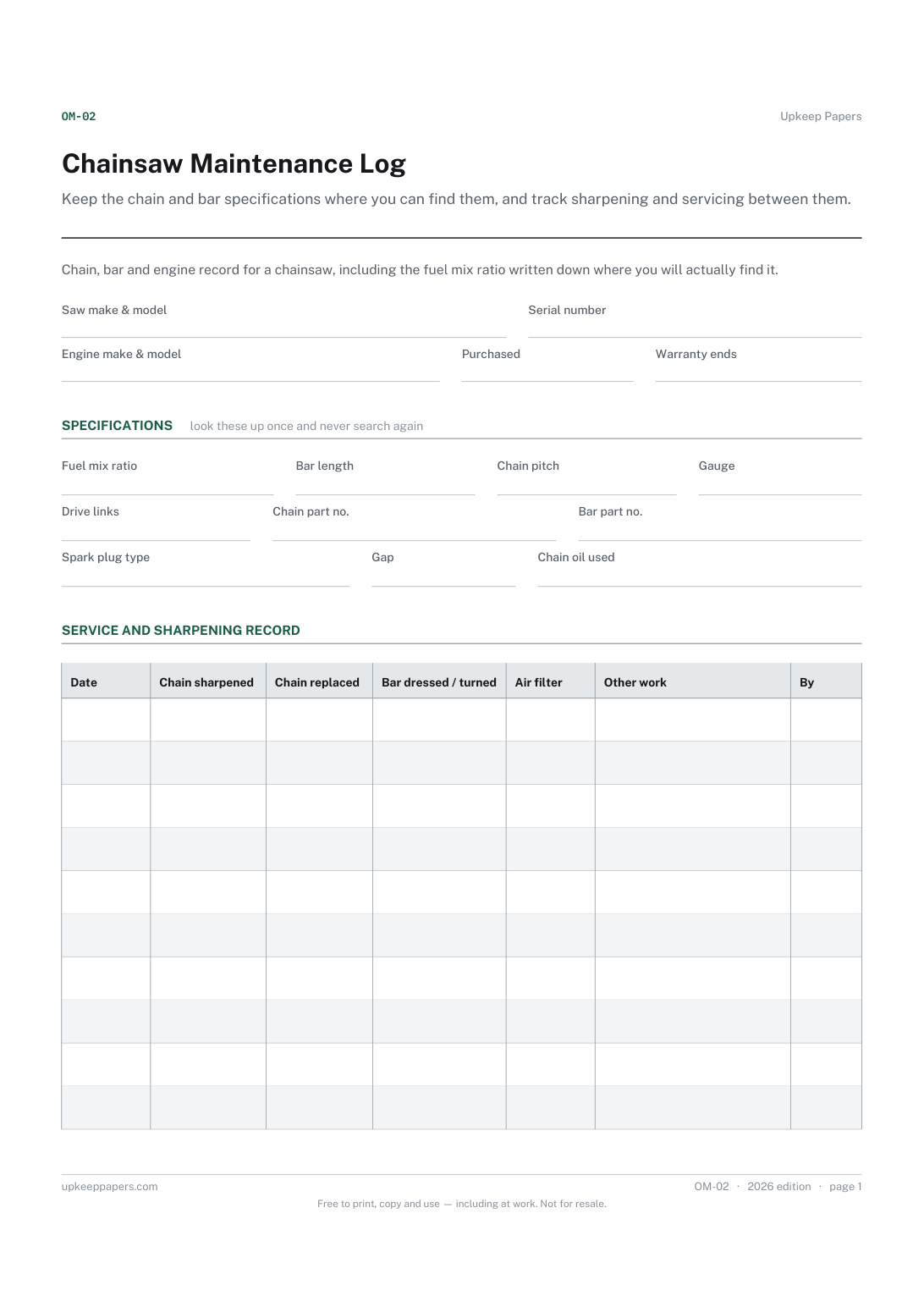
Keep the chain and bar specifications where you can find them, and track sharpening and servicing between them.
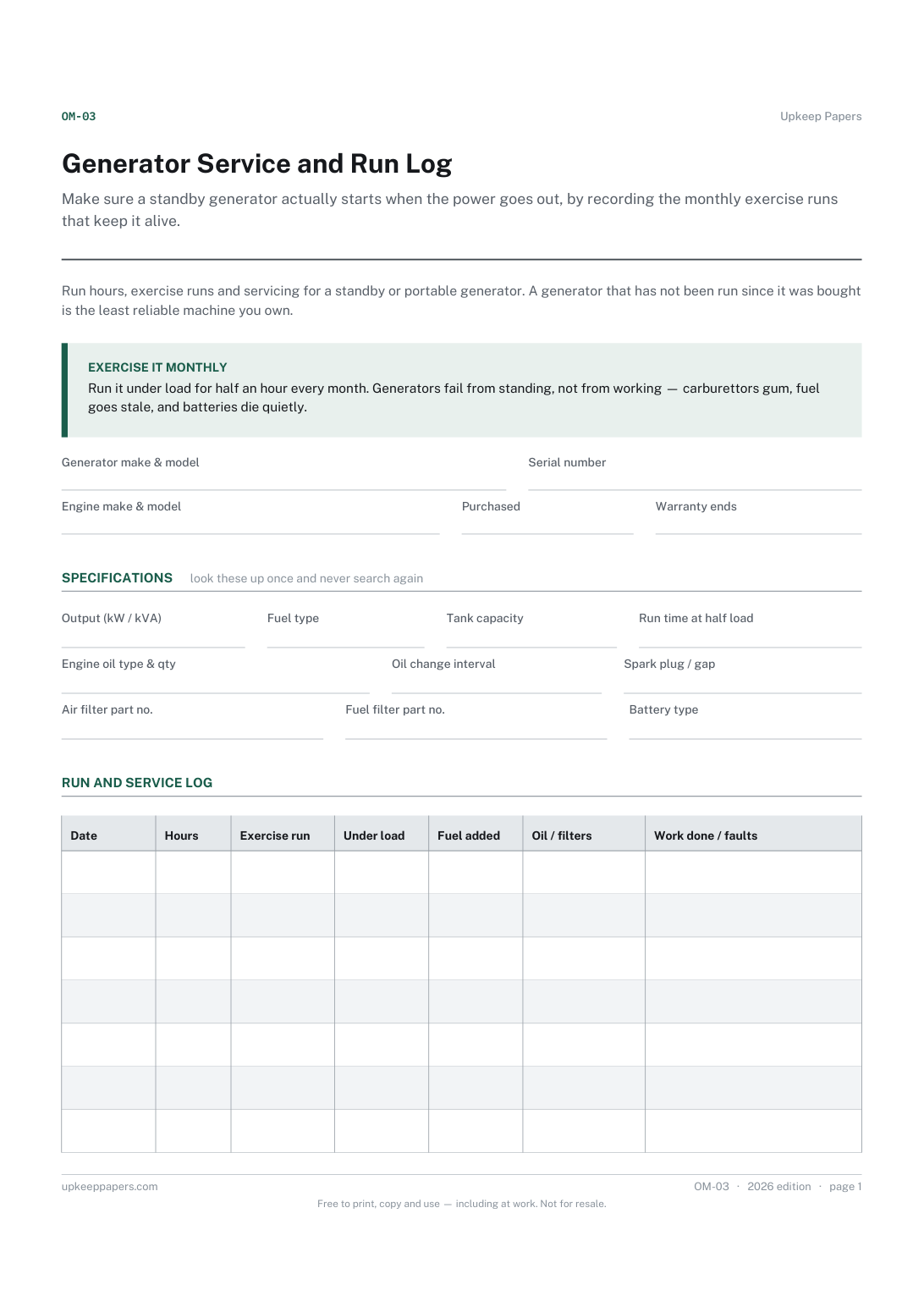
Make sure a standby generator actually starts when the power goes out, by recording the monthly exercise runs that keep it alive.
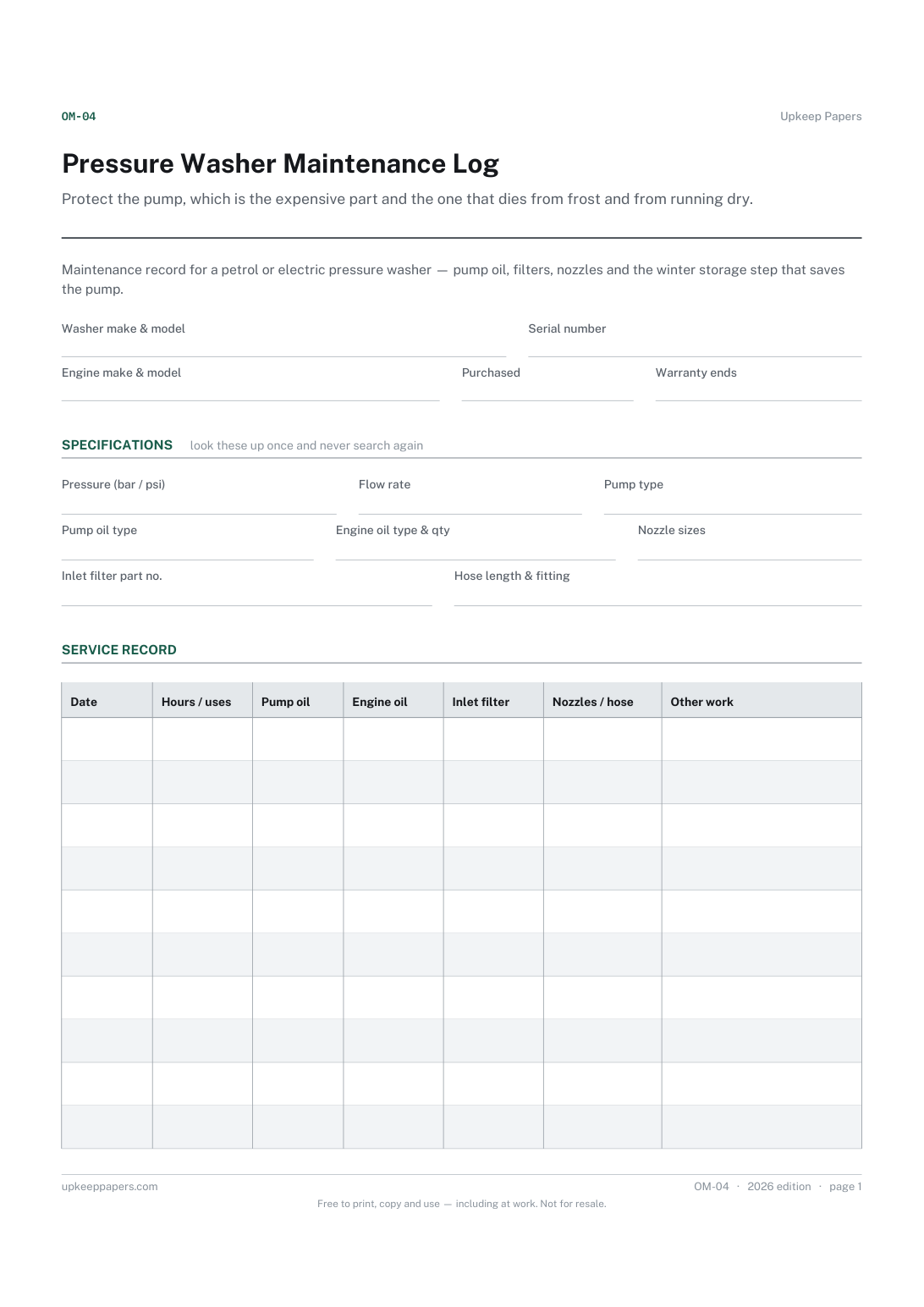
Protect the pump, which is the expensive part and the one that dies from frost and from running dry.
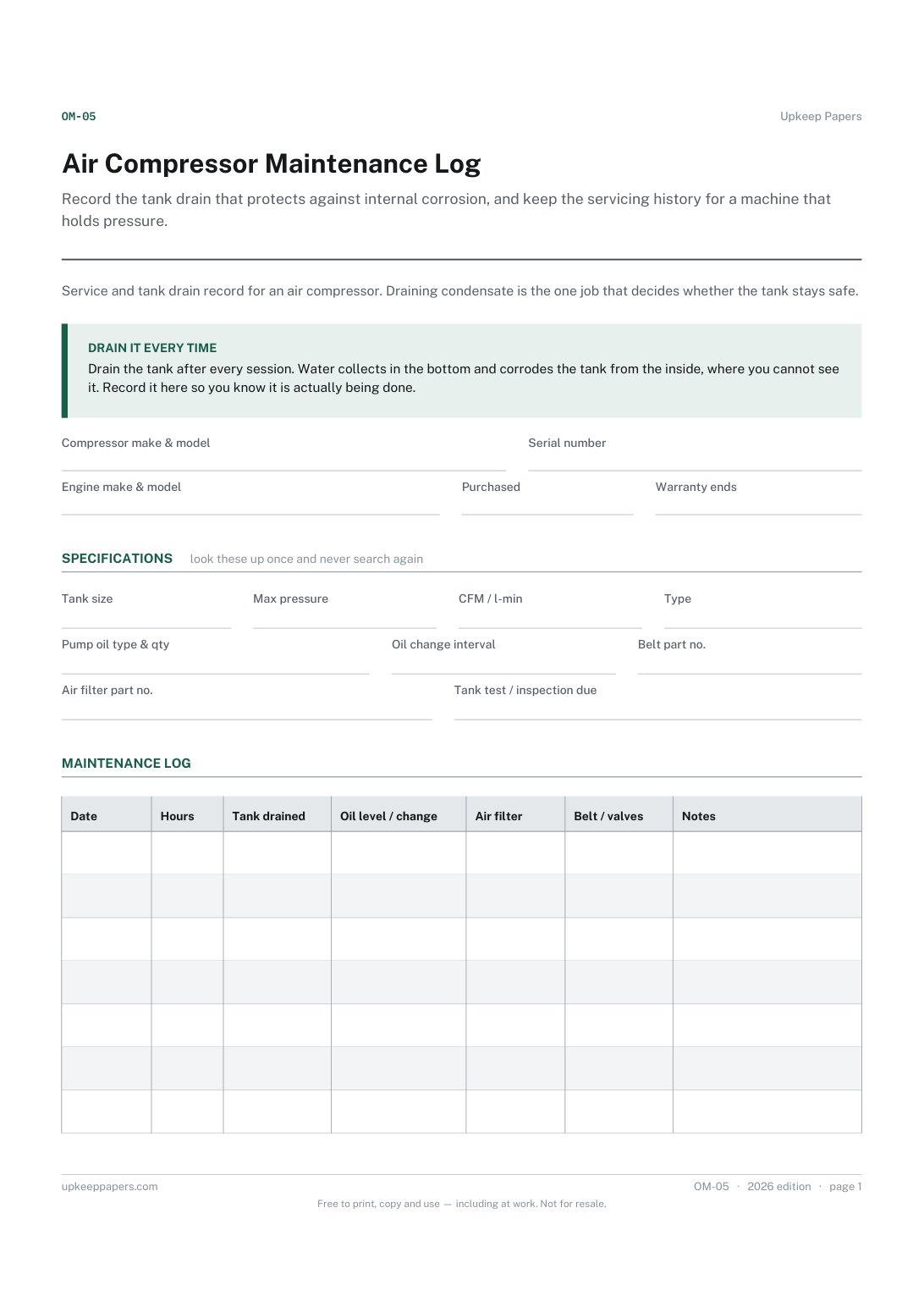
Record the tank drain that protects against internal corrosion, and keep the servicing history for a machine that holds pressure.
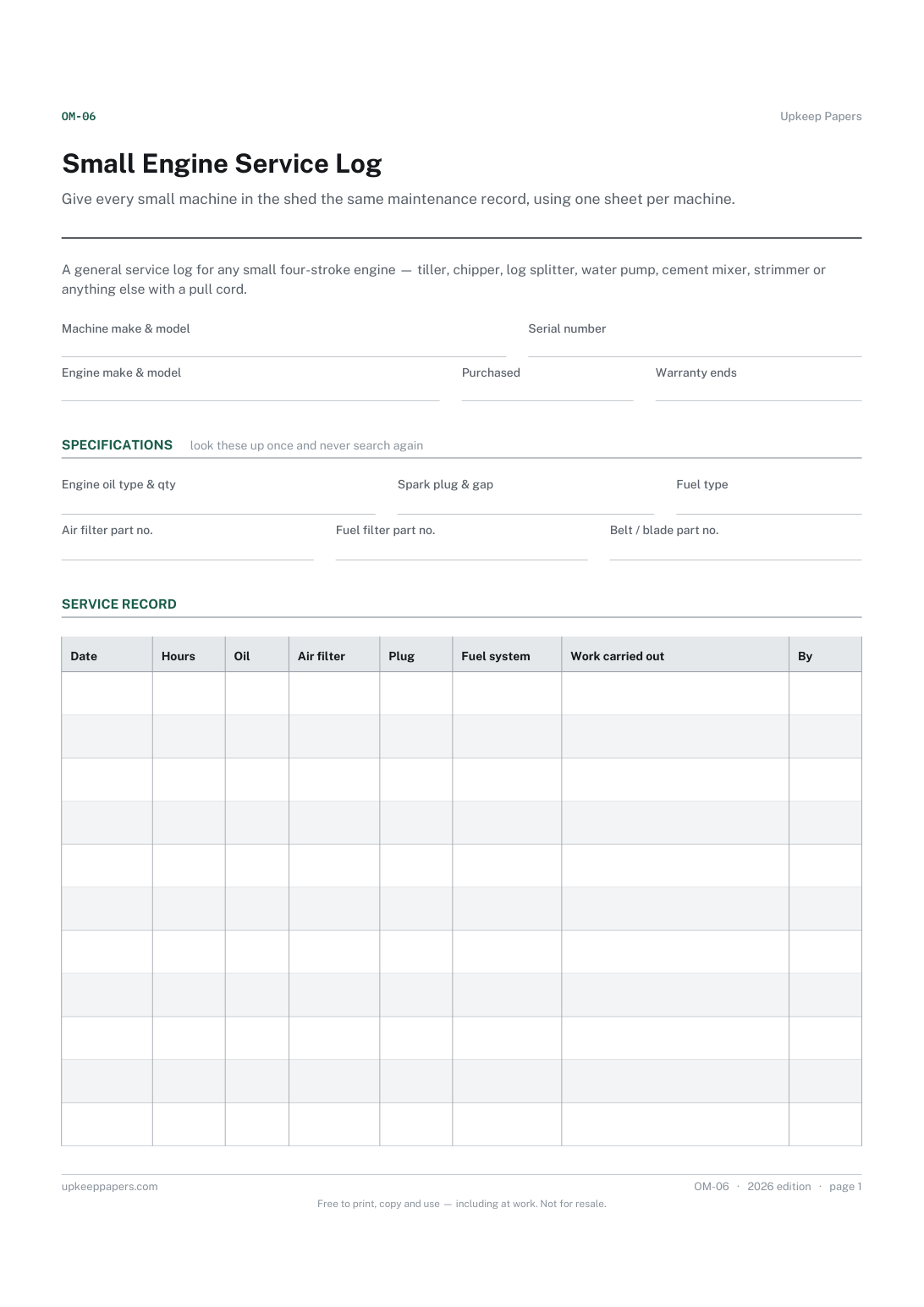
Give every small machine in the shed the same maintenance record, using one sheet per machine.
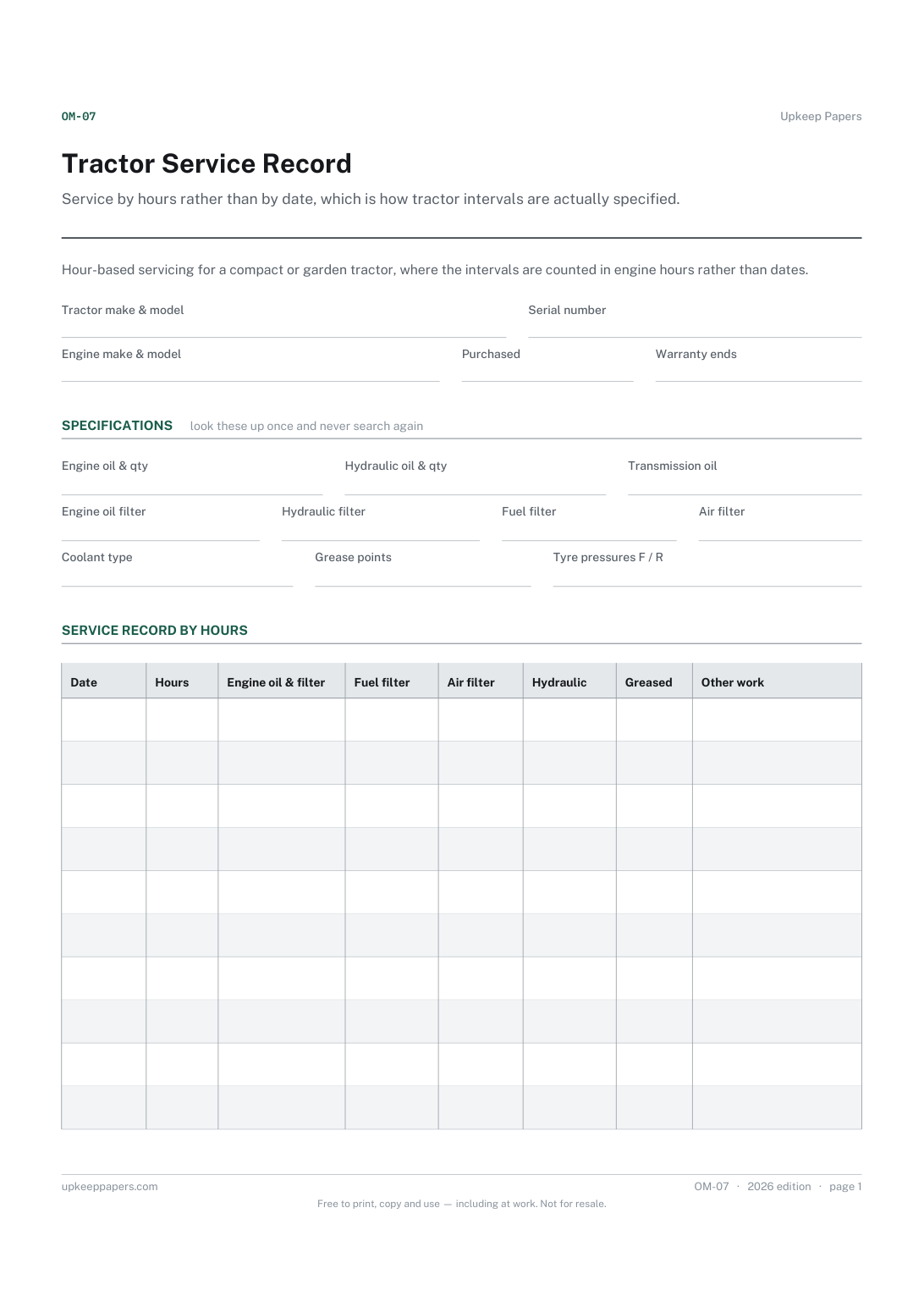
Service by hours rather than by date, which is how tractor intervals are actually specified.
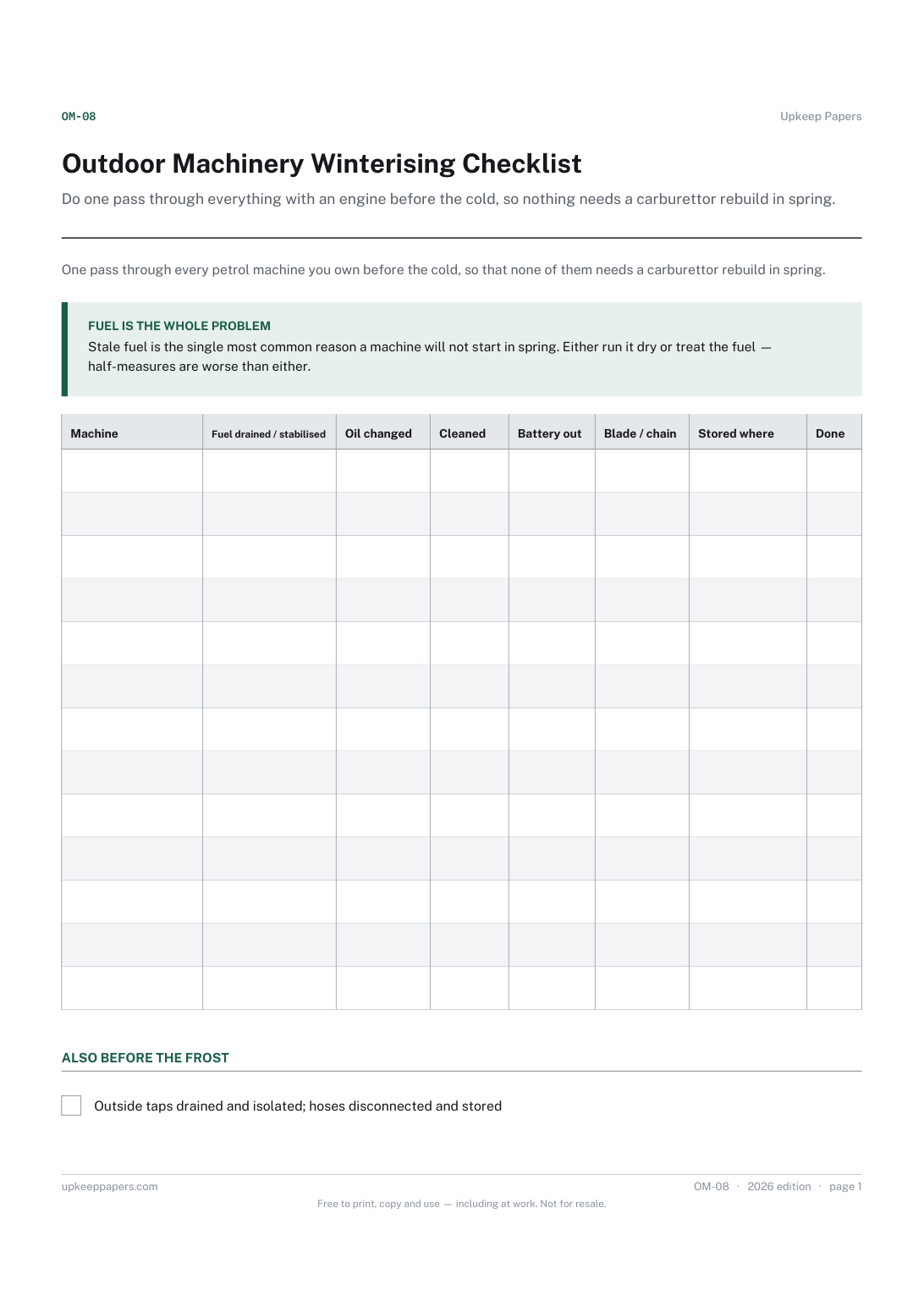
Do one pass through everything with an engine before the cold, so nothing needs a carburettor rebuild in spring.
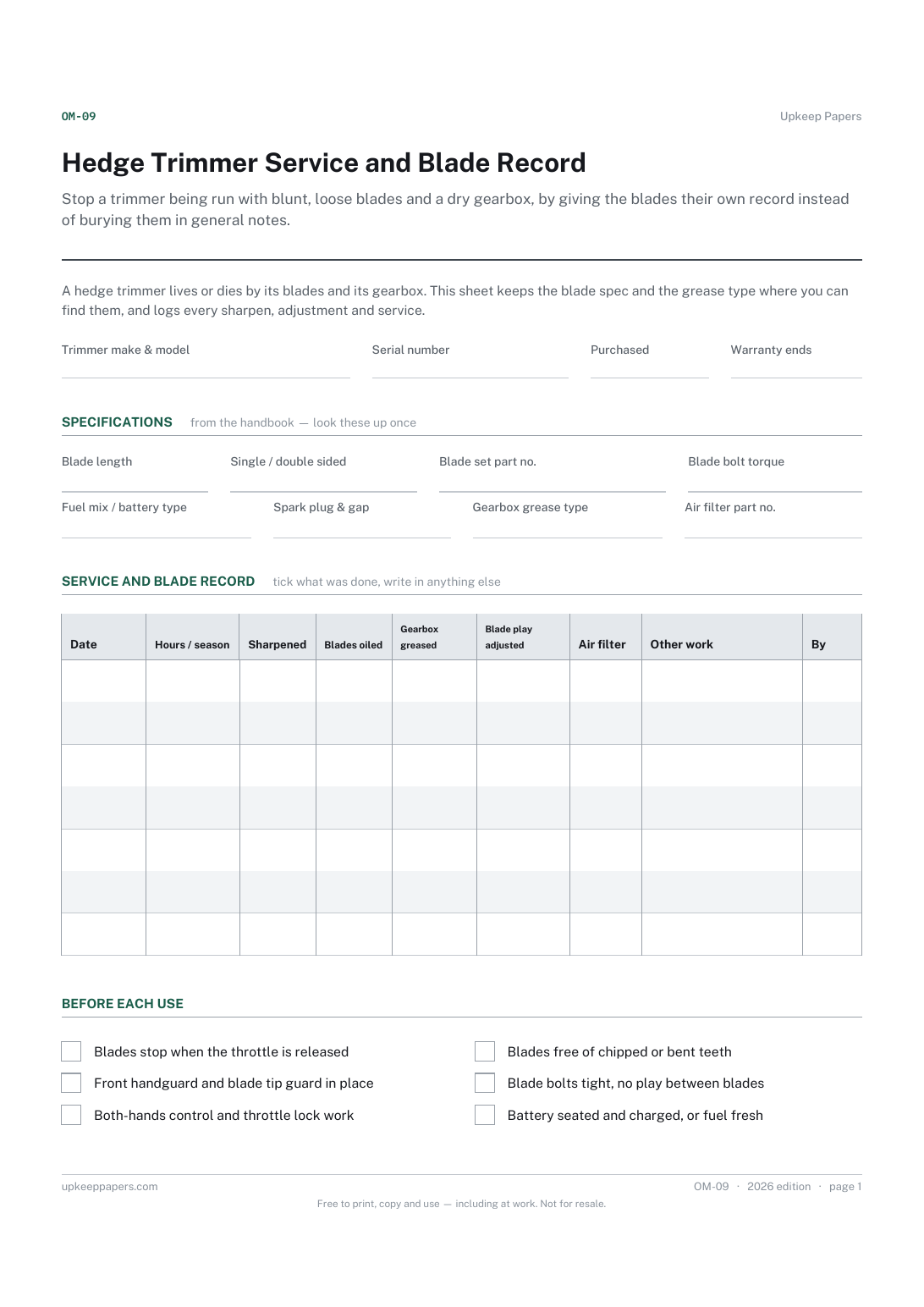
Stop a trimmer being run with blunt, loose blades and a dry gearbox, by giving the blades their own record instead of burying them in general notes.
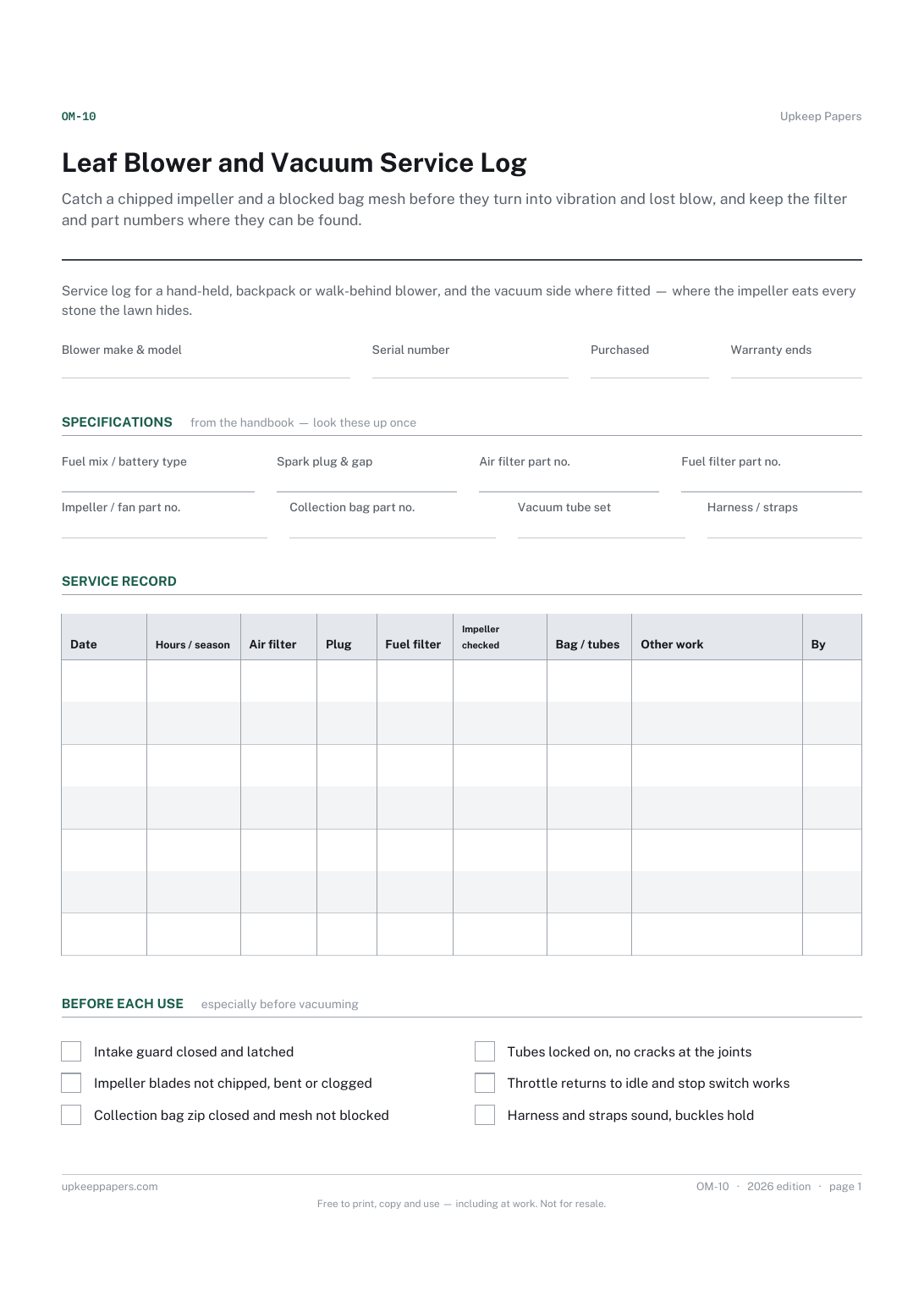
Catch a chipped impeller and a blocked bag mesh before they turn into vibration and lost blow, and keep the filter and part numbers where they can be found.
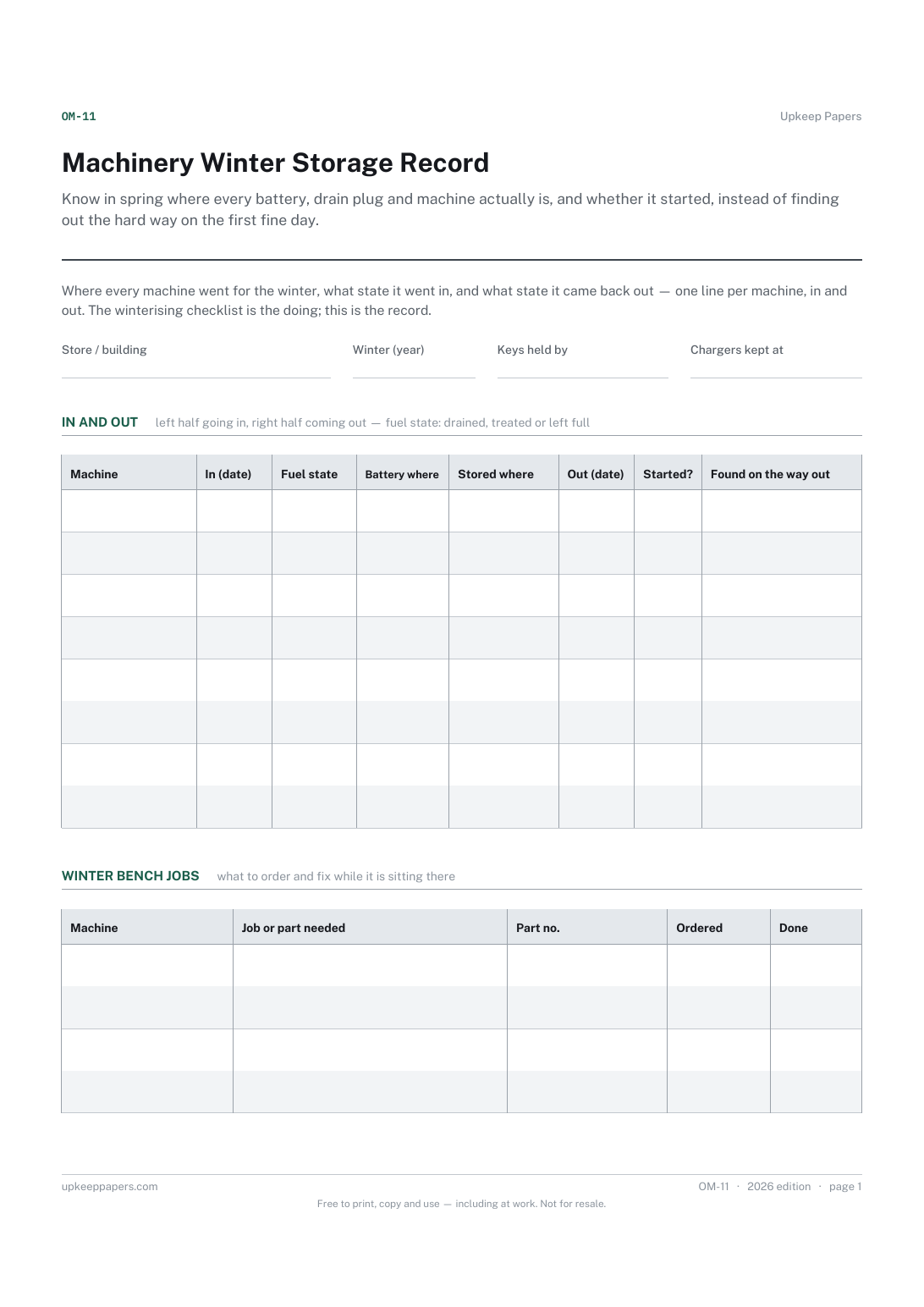
Know in spring where every battery, drain plug and machine actually is, and whether it started, instead of finding out the hard way on the first fine day.
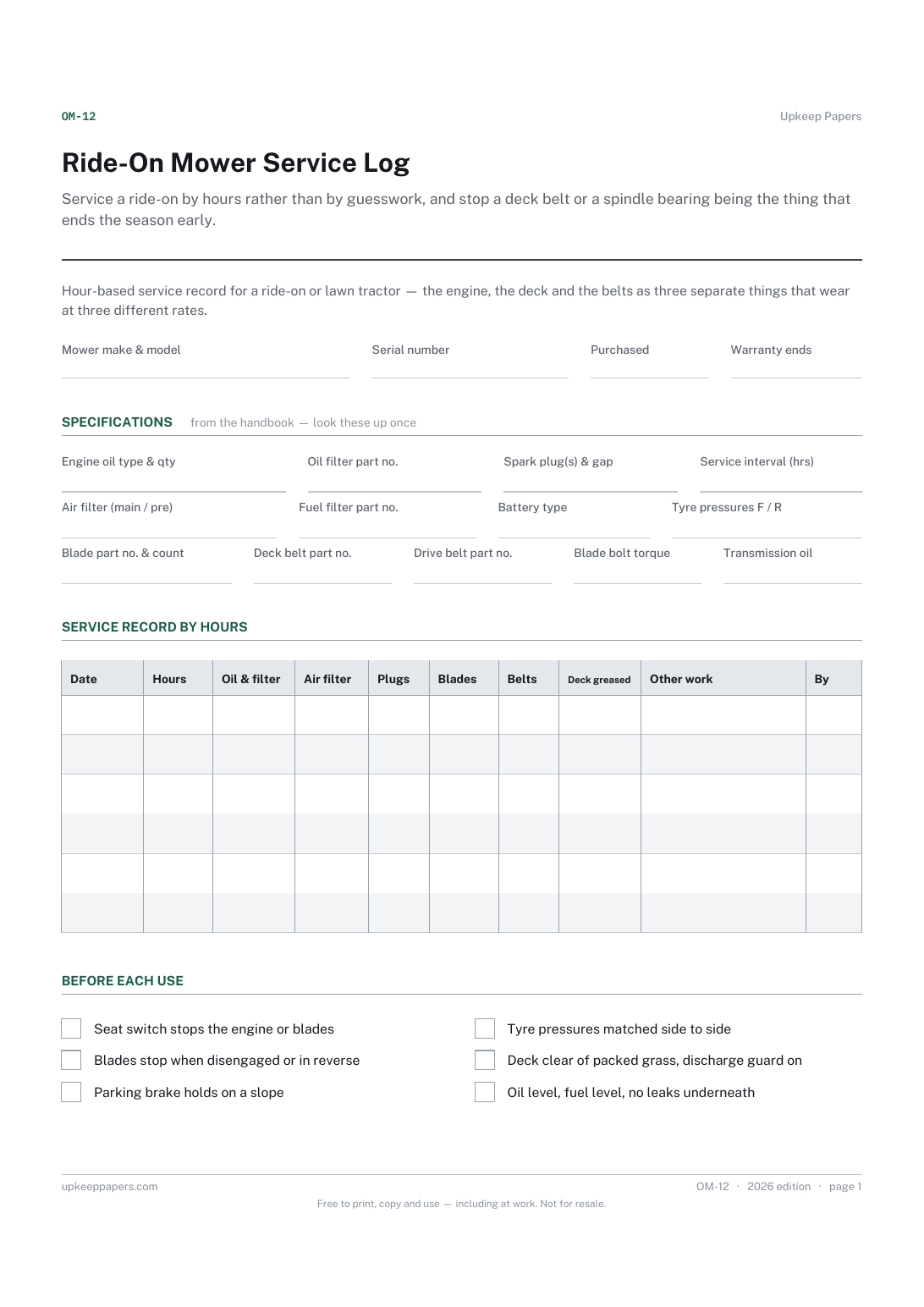
Service a ride-on by hours rather than by guesswork, and stop a deck belt or a spindle bearing being the thing that ends the season early.
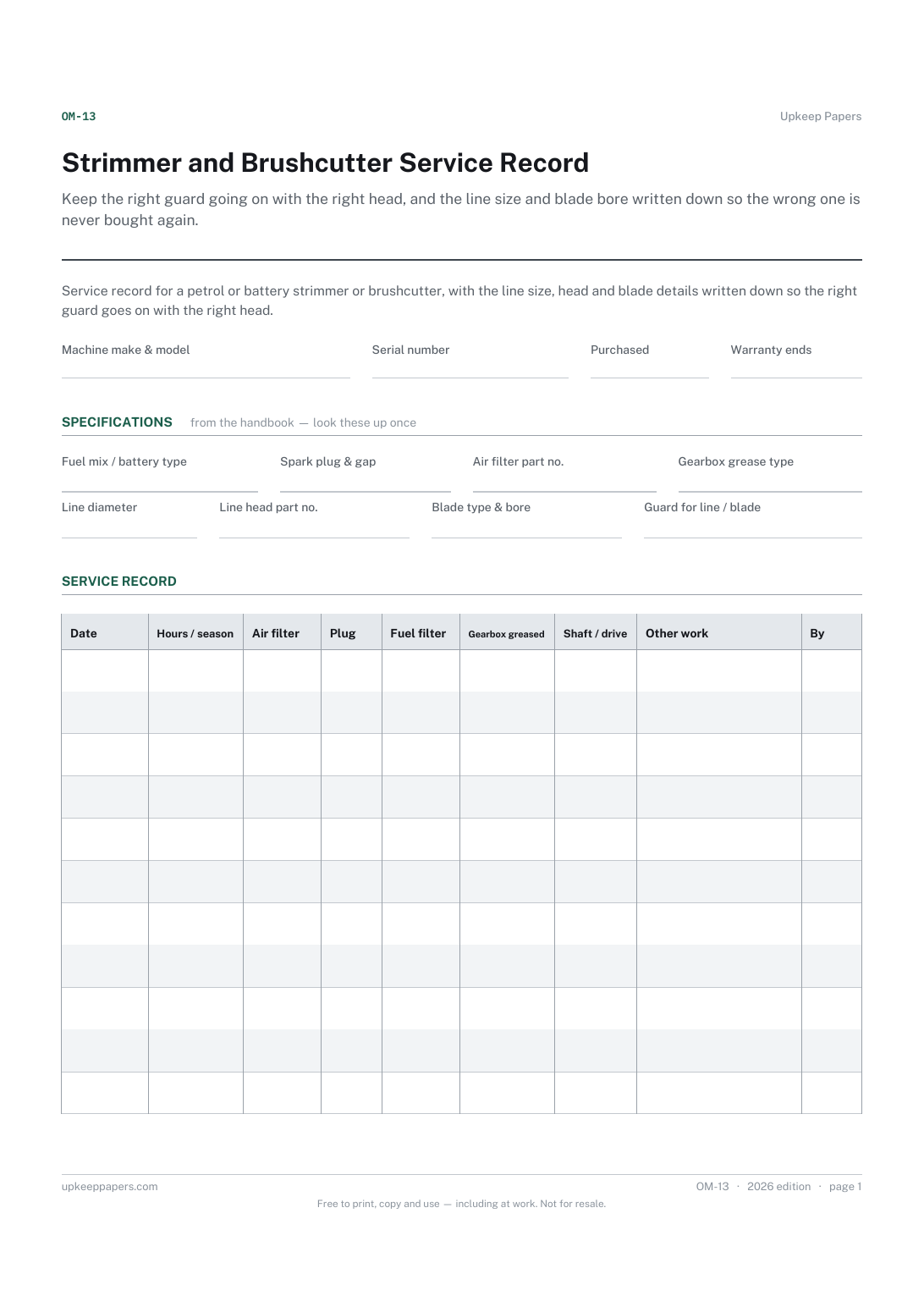
Keep the right guard going on with the right head, and the line size and blade bore written down so the wrong one is never bought again.
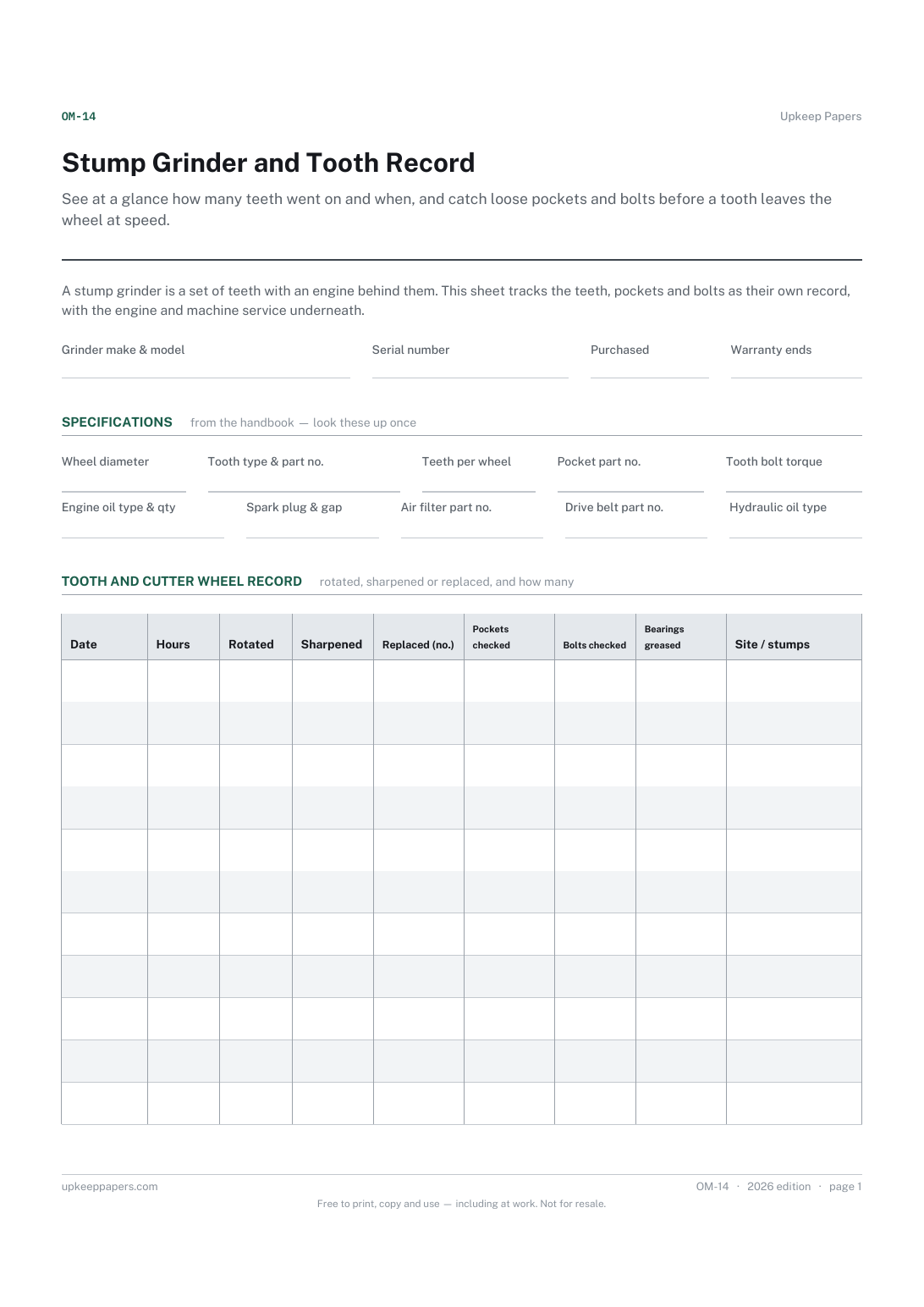
See at a glance how many teeth went on and when, and catch loose pockets and bolts before a tooth leaves the wheel at speed.
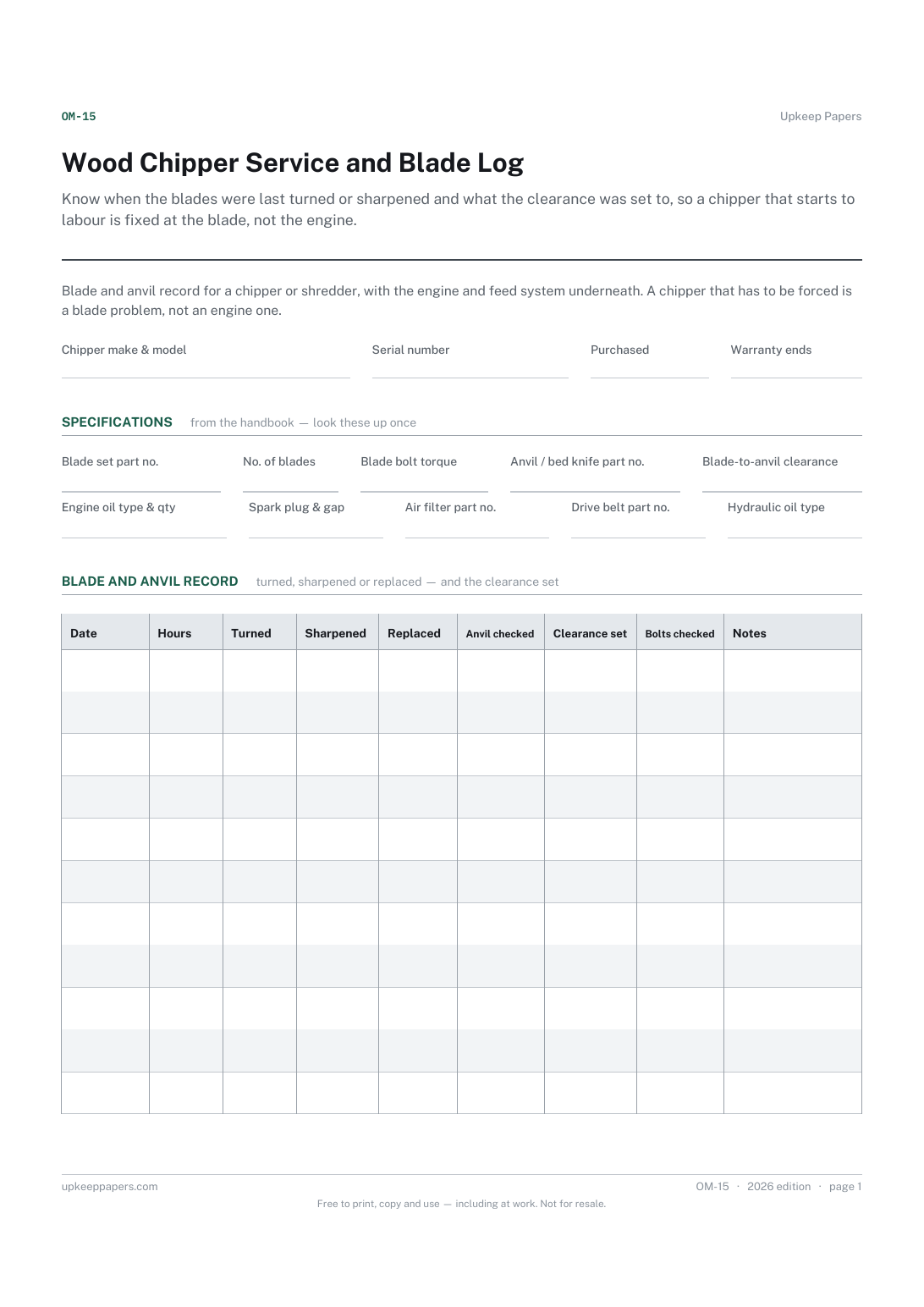
Know when the blades were last turned or sharpened and what the clearance was set to, so a chipper that starts to labour is fixed at the blade, not the engine.
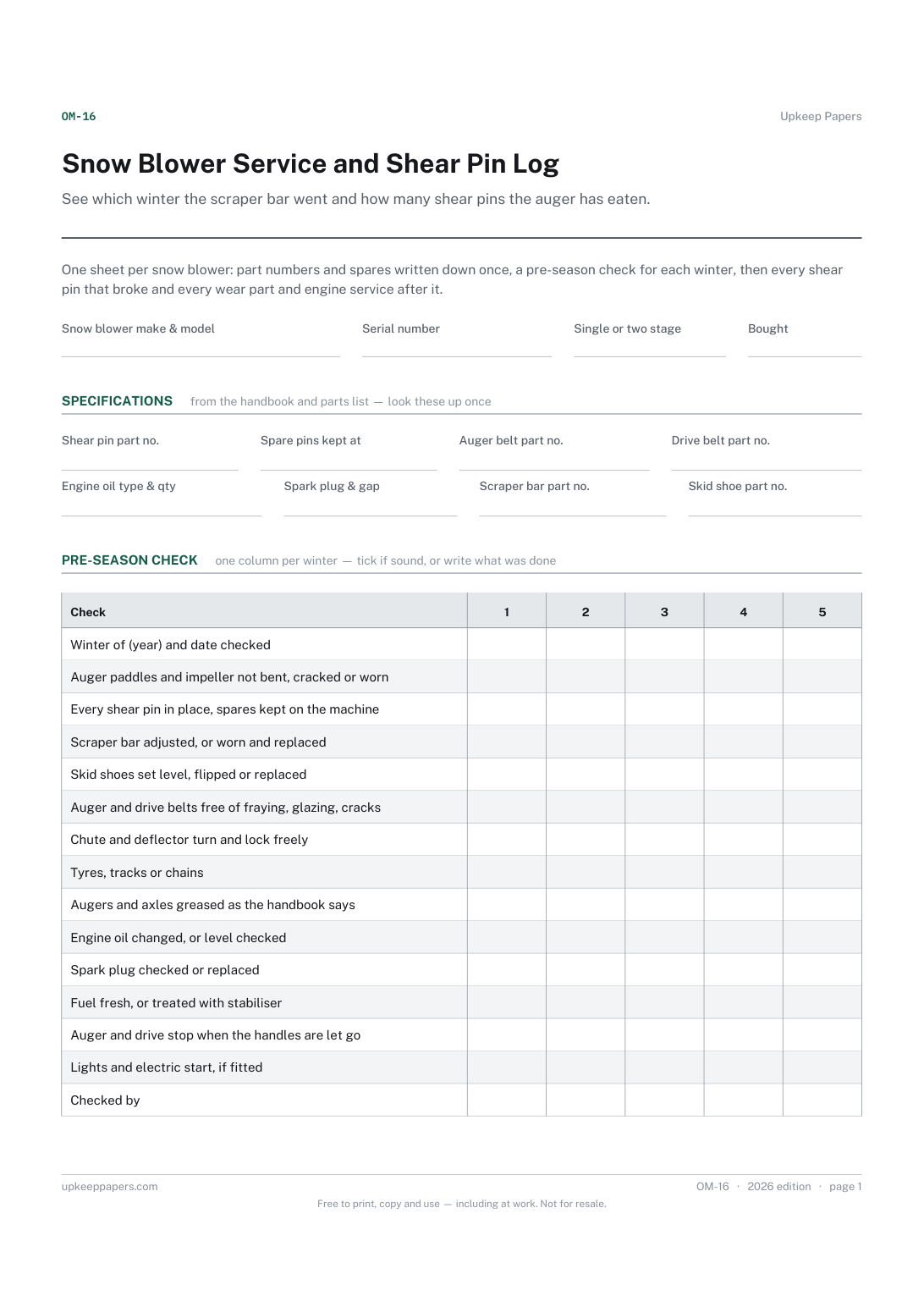
See which winter the scraper bar went and how many shear pins the auger has eaten. The part numbers sit at the top, so the right shear pin is bought, not a bolt that happens to fit the hole.
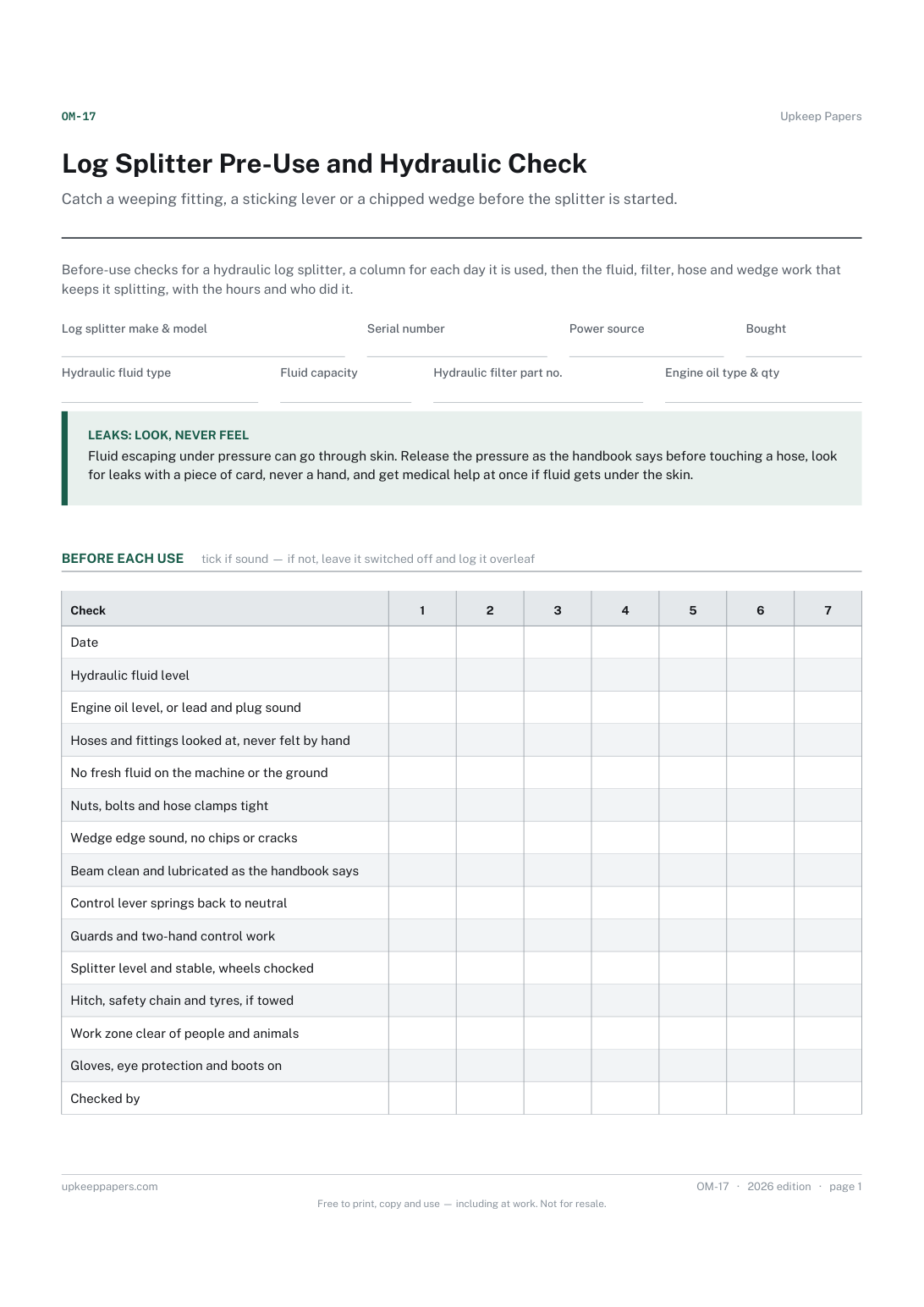
Catch a weeping fitting, a sticking lever or a chipped wedge before the splitter is started. The back keeps the fluid, filter, hose and wedge history by hours.
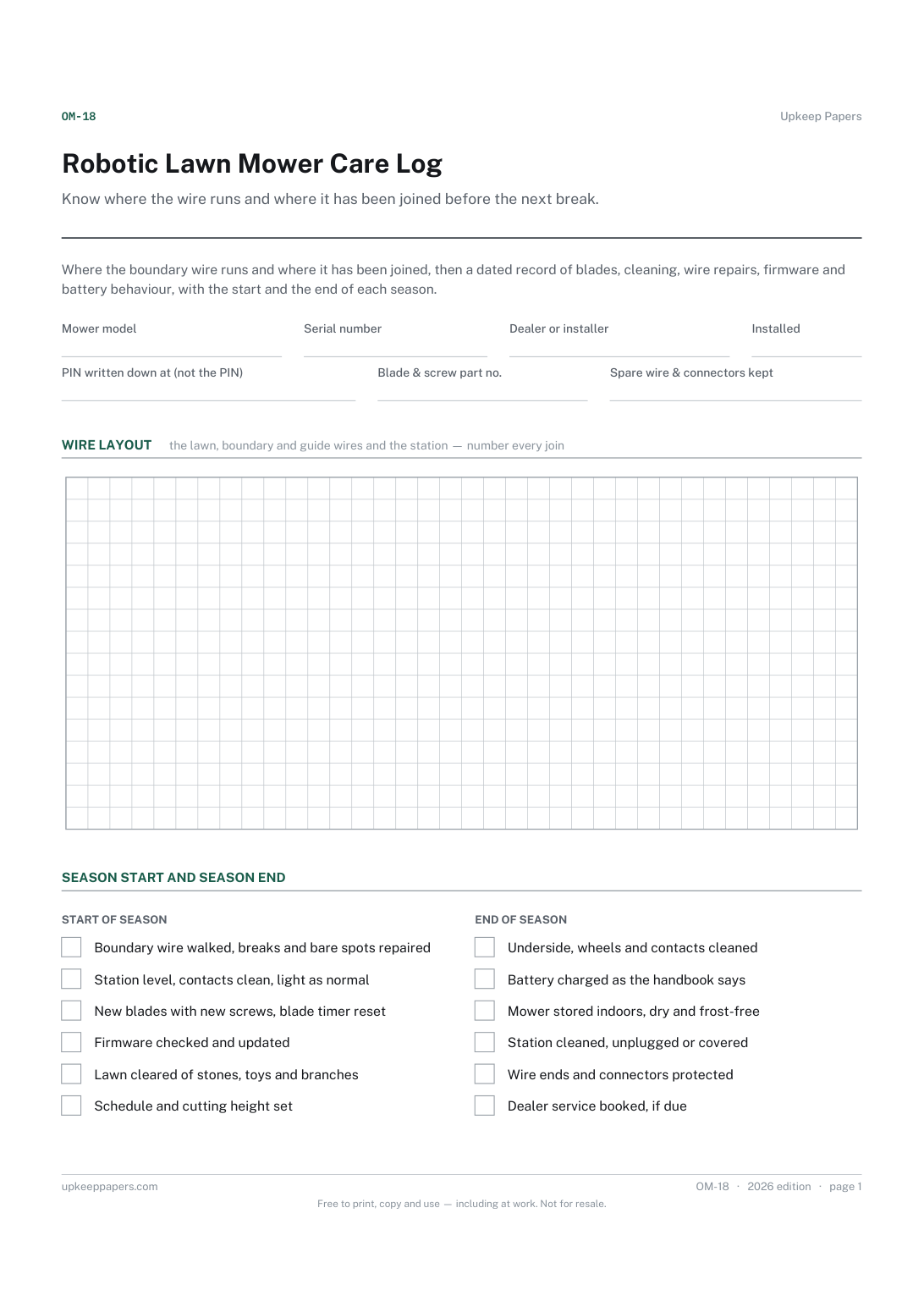
Know where the wire runs and where it has been joined before the next break. Blade changes, firmware and battery behaviour are kept season by season alongside.
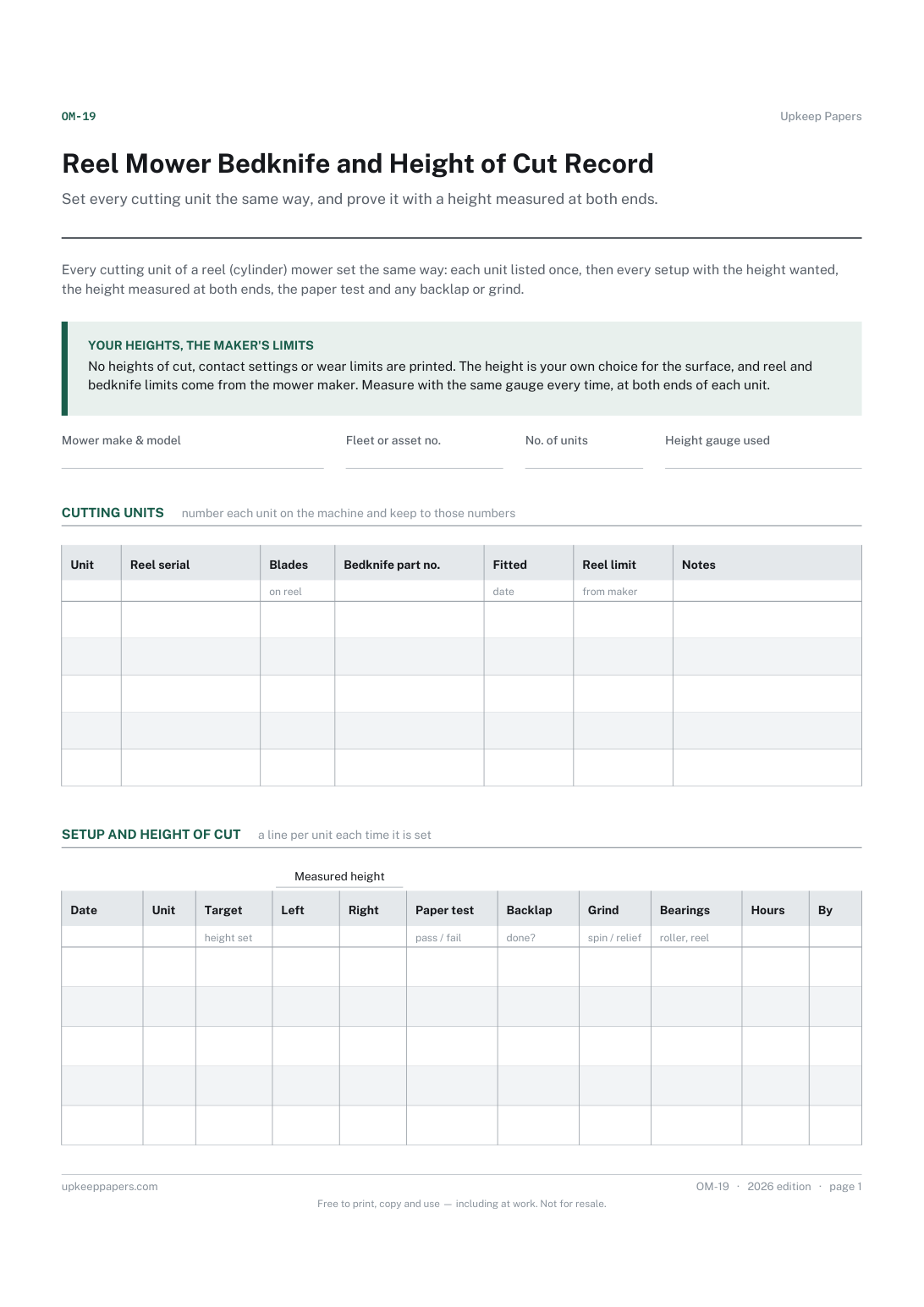
Set every cutting unit the same way, and prove it with a height measured at both ends. Streaking or an uneven cut can then be traced to one unit, not the whole machine.
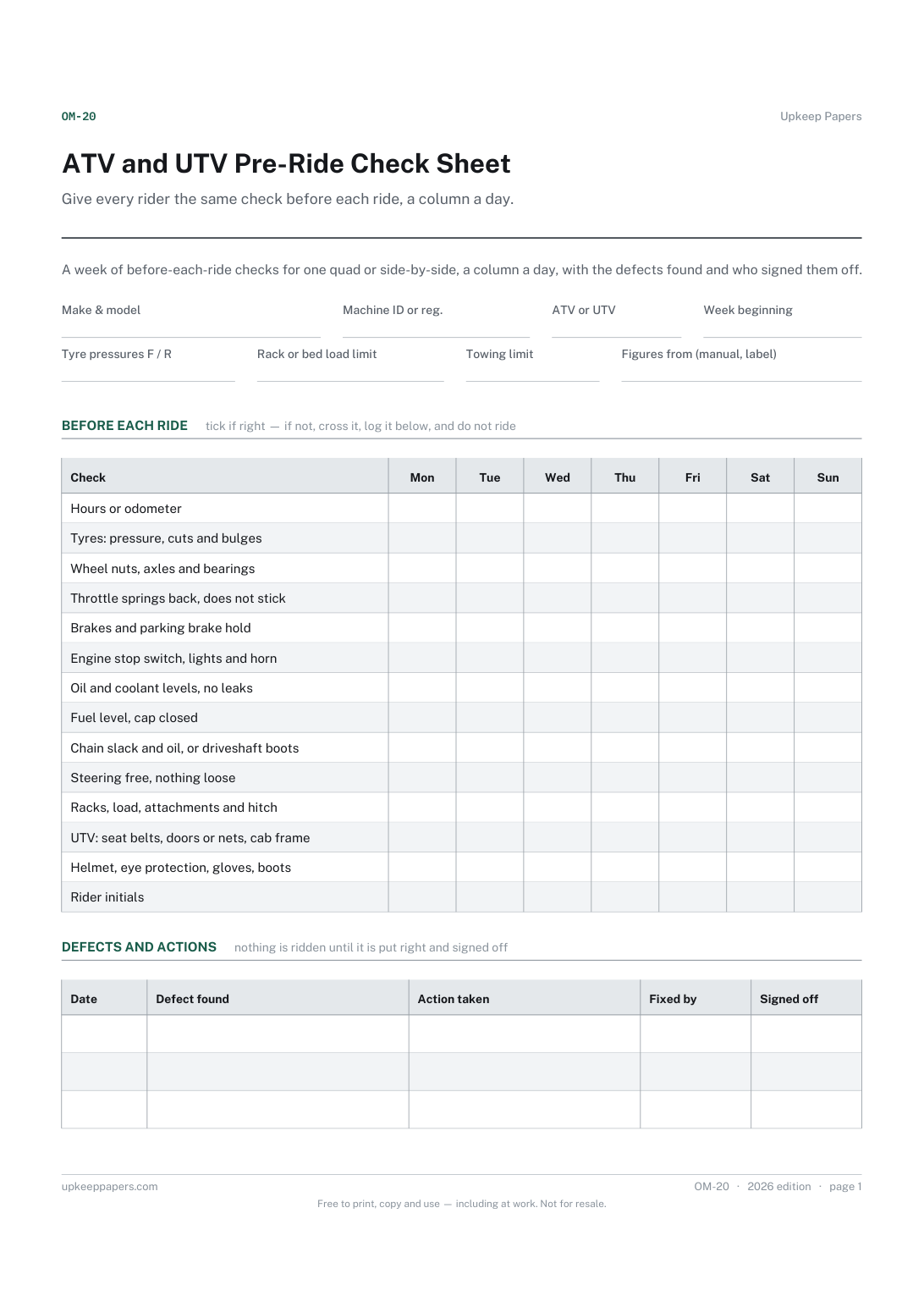
Give every rider the same check before each ride, a column a day. A soft tyre or a sticking throttle is then found in the yard rather than on a slope.
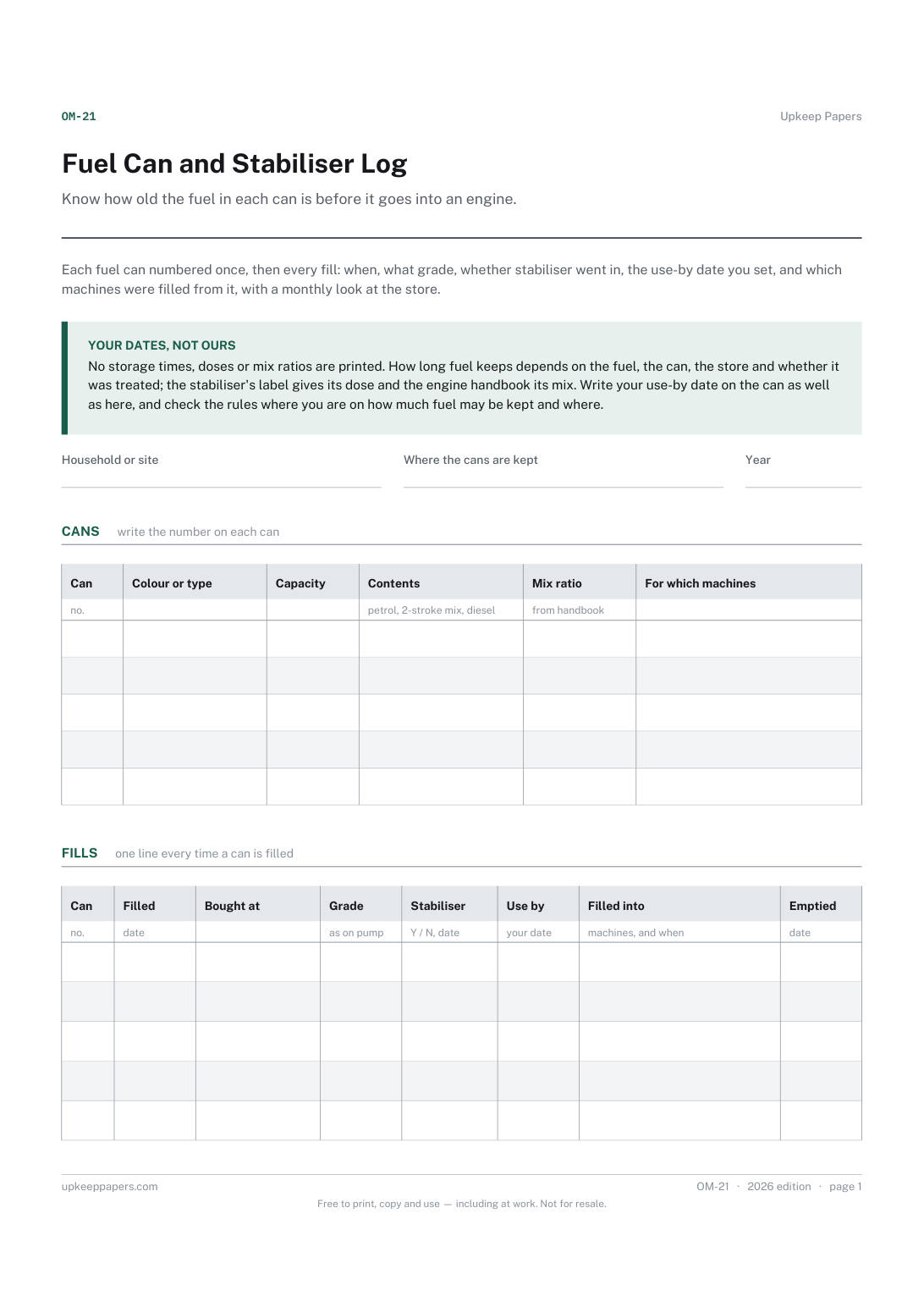
Know how old the fuel in each can is before it goes into an engine. Guessing is how a carburettor ends up being cleaned in spring.
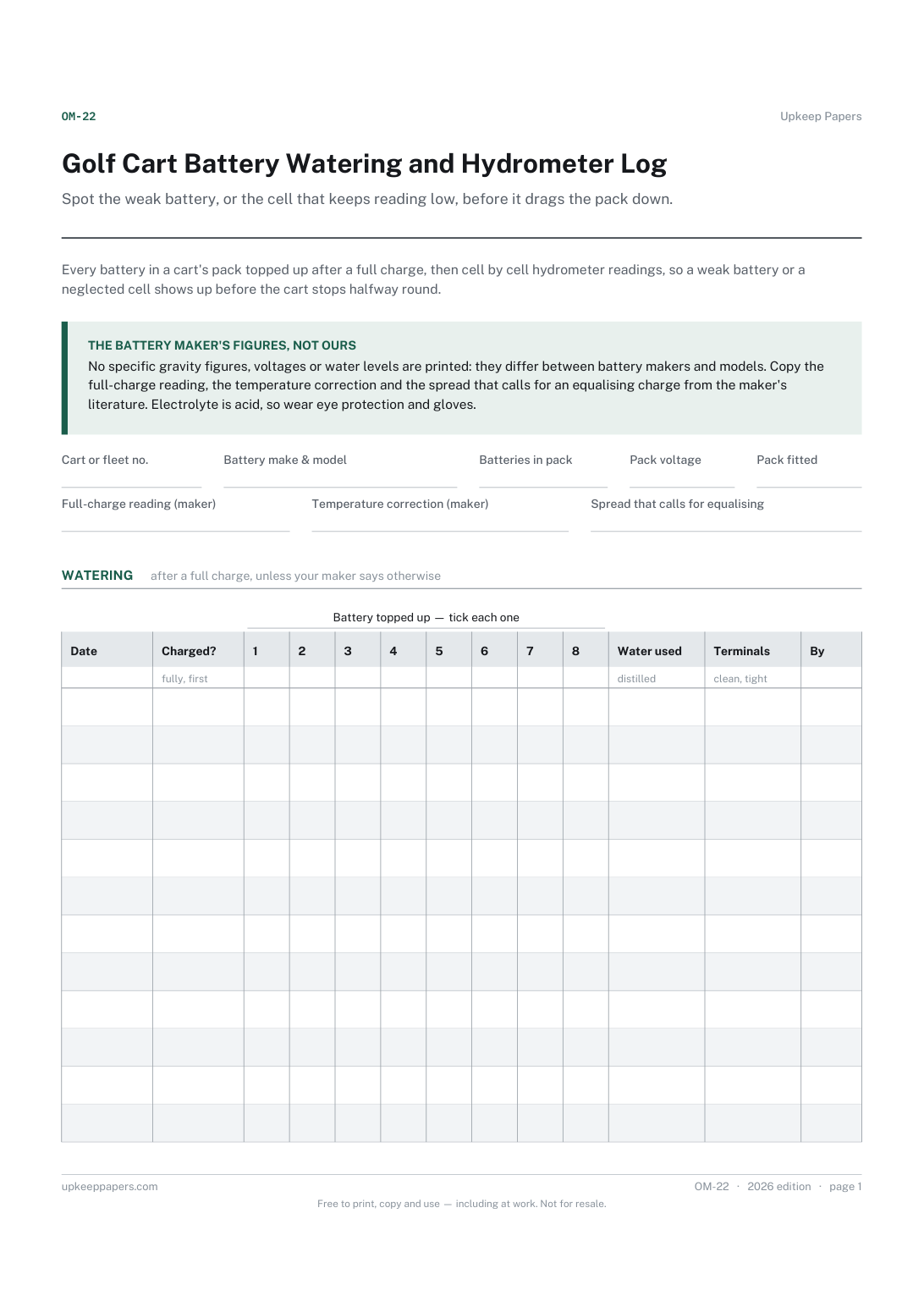
Spot the weak battery, or the cell that keeps reading low, before it drags the pack down.
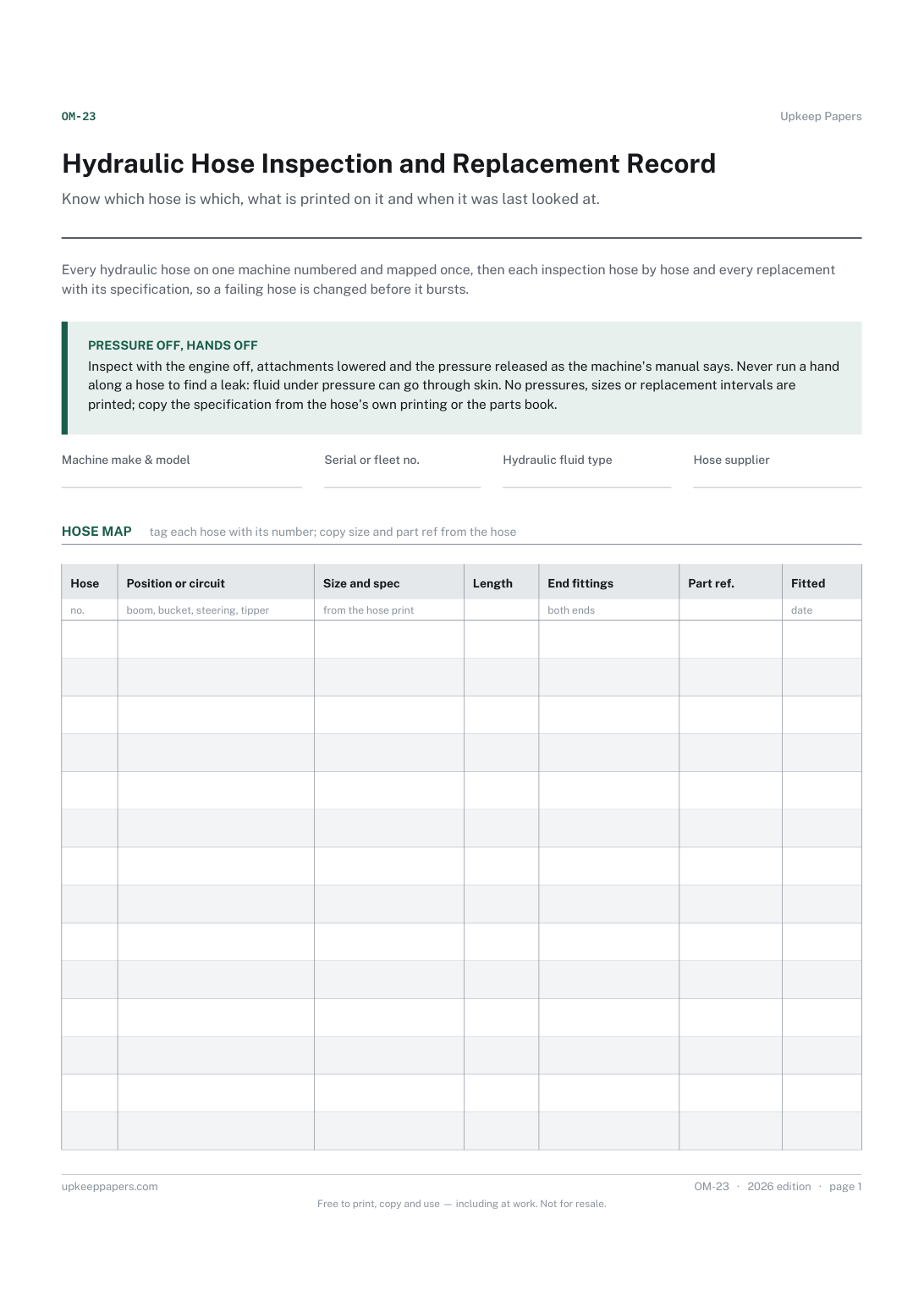
Know which hose is which, what is printed on it and when it was last looked at. A worn hose is then changed in the yard rather than bursting on the job.
Cars, motorcycles, motorhomes, trailers and boats — service history, schedules and pre-use inspections.
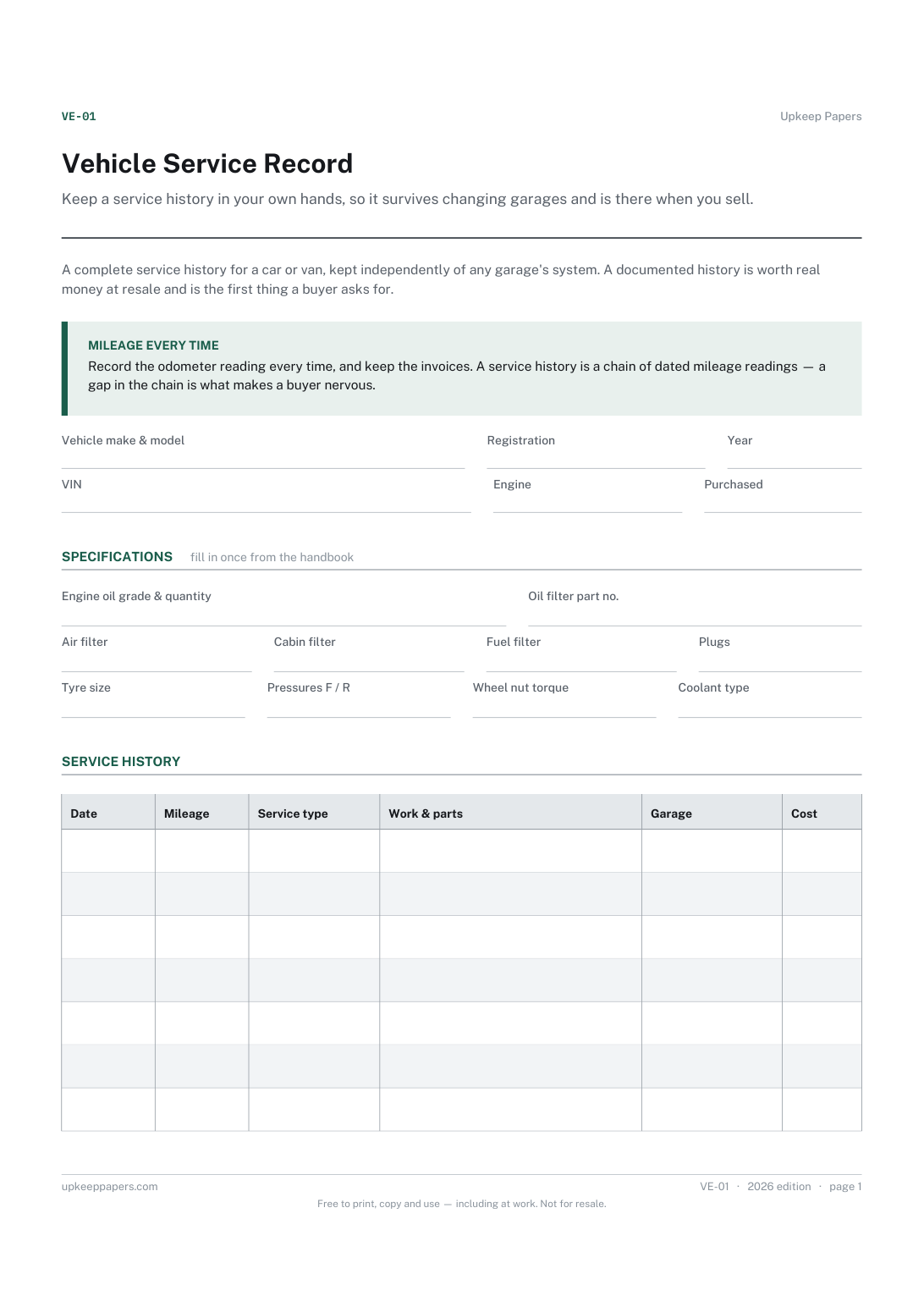
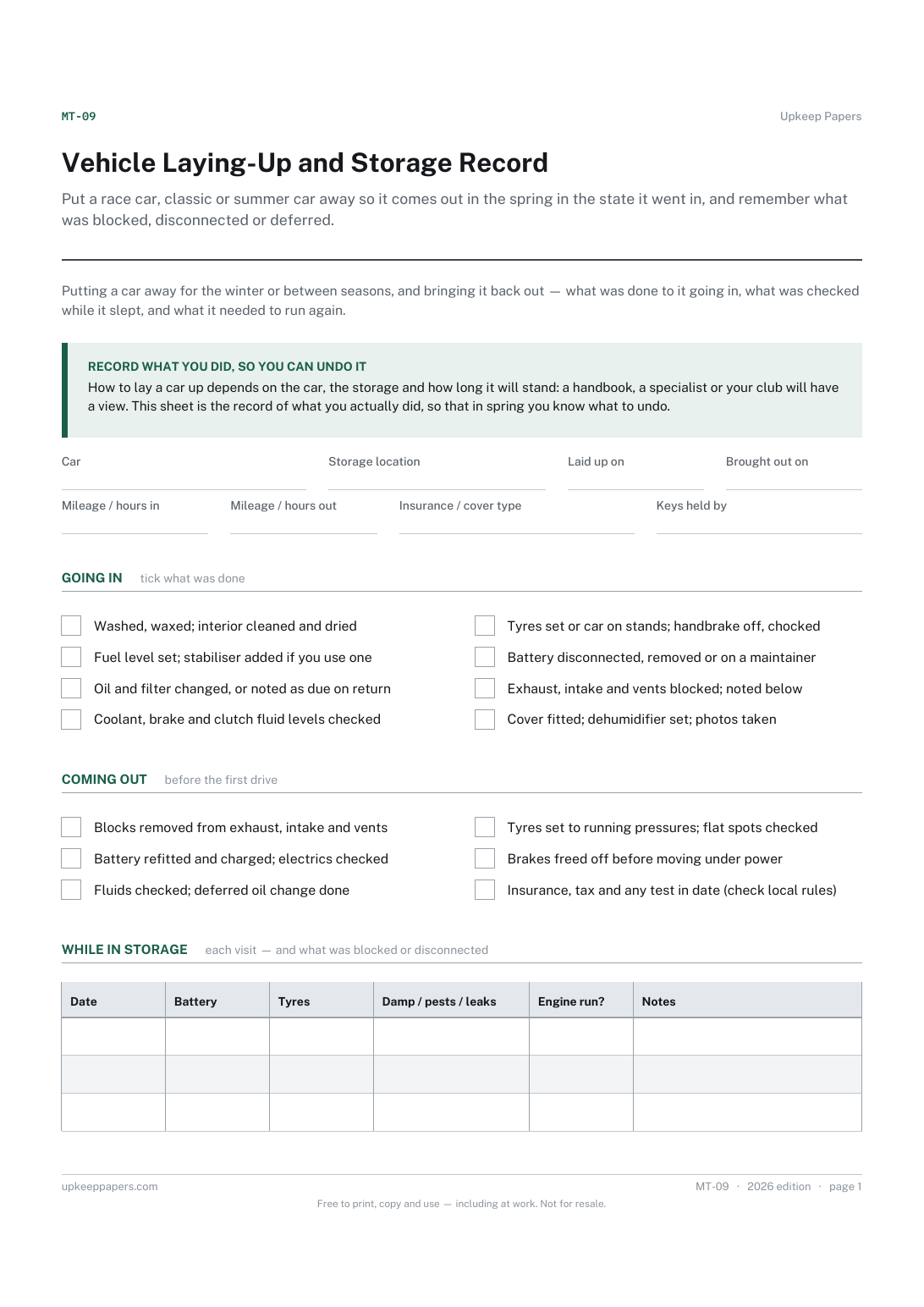
Keep a service history in your own hands, so it survives changing garages and is there when you sell.
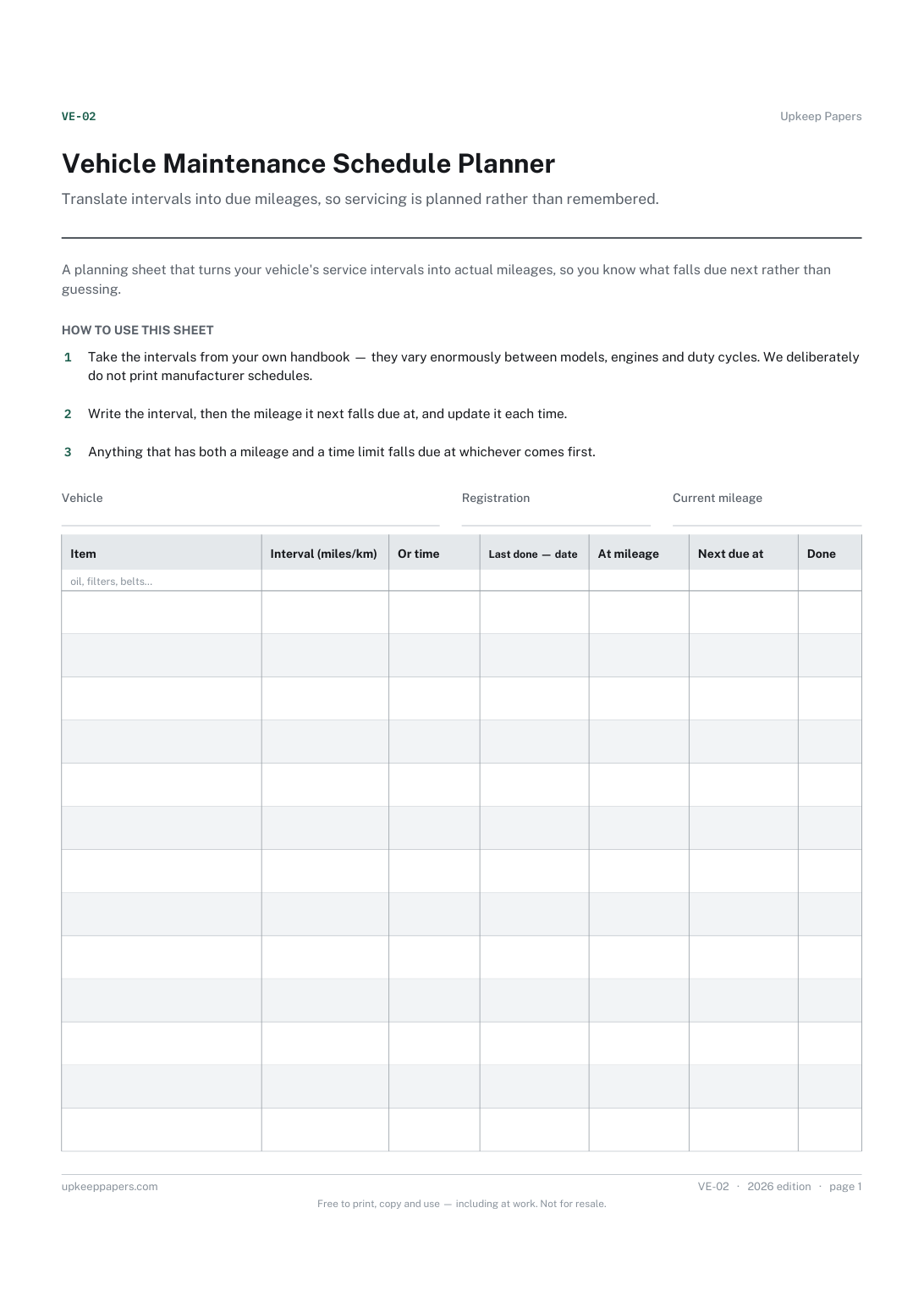
Translate intervals into due mileages, so servicing is planned rather than remembered.
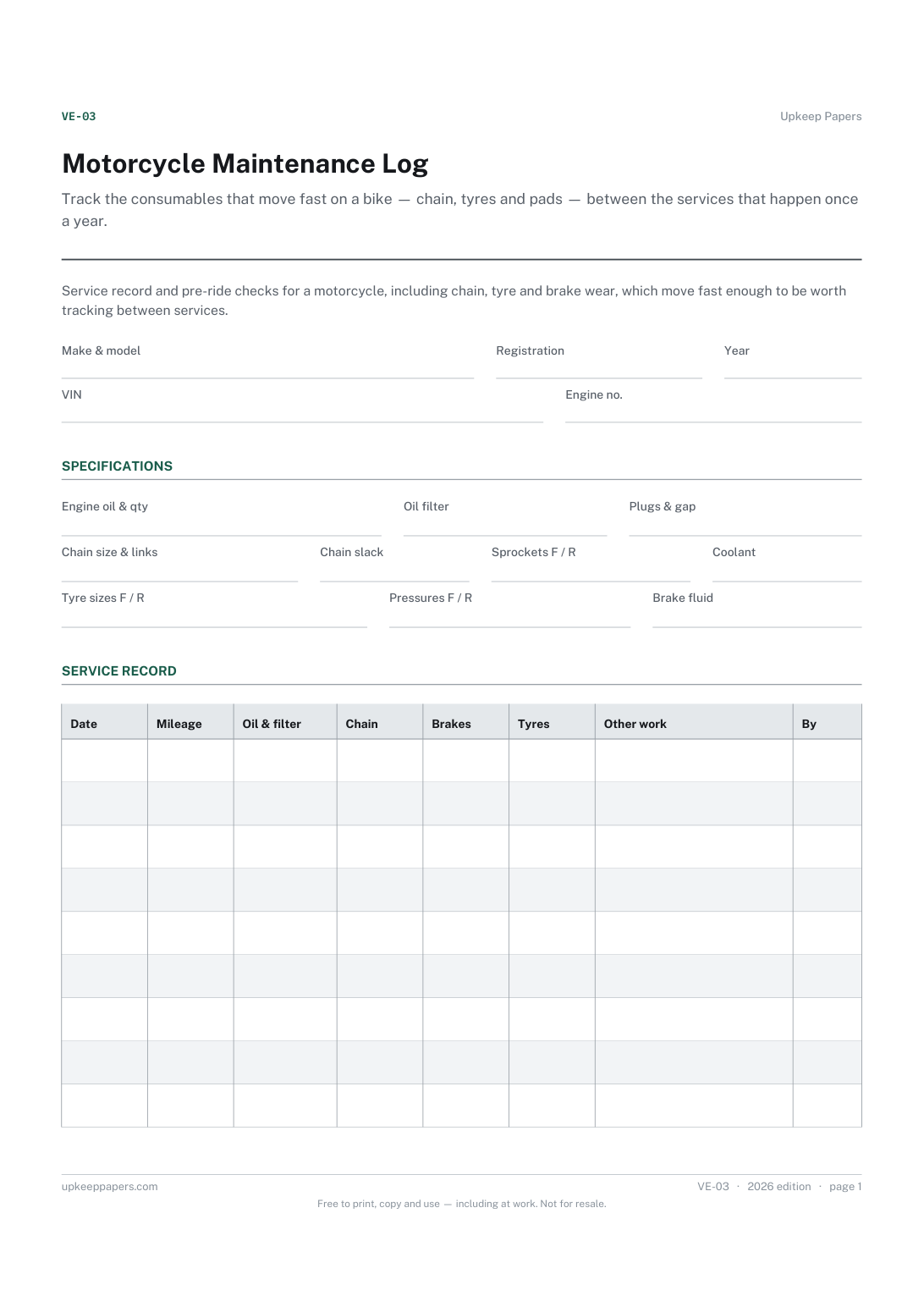
Track the consumables that move fast on a bike — chain, tyres and pads — between the services that happen once a year.
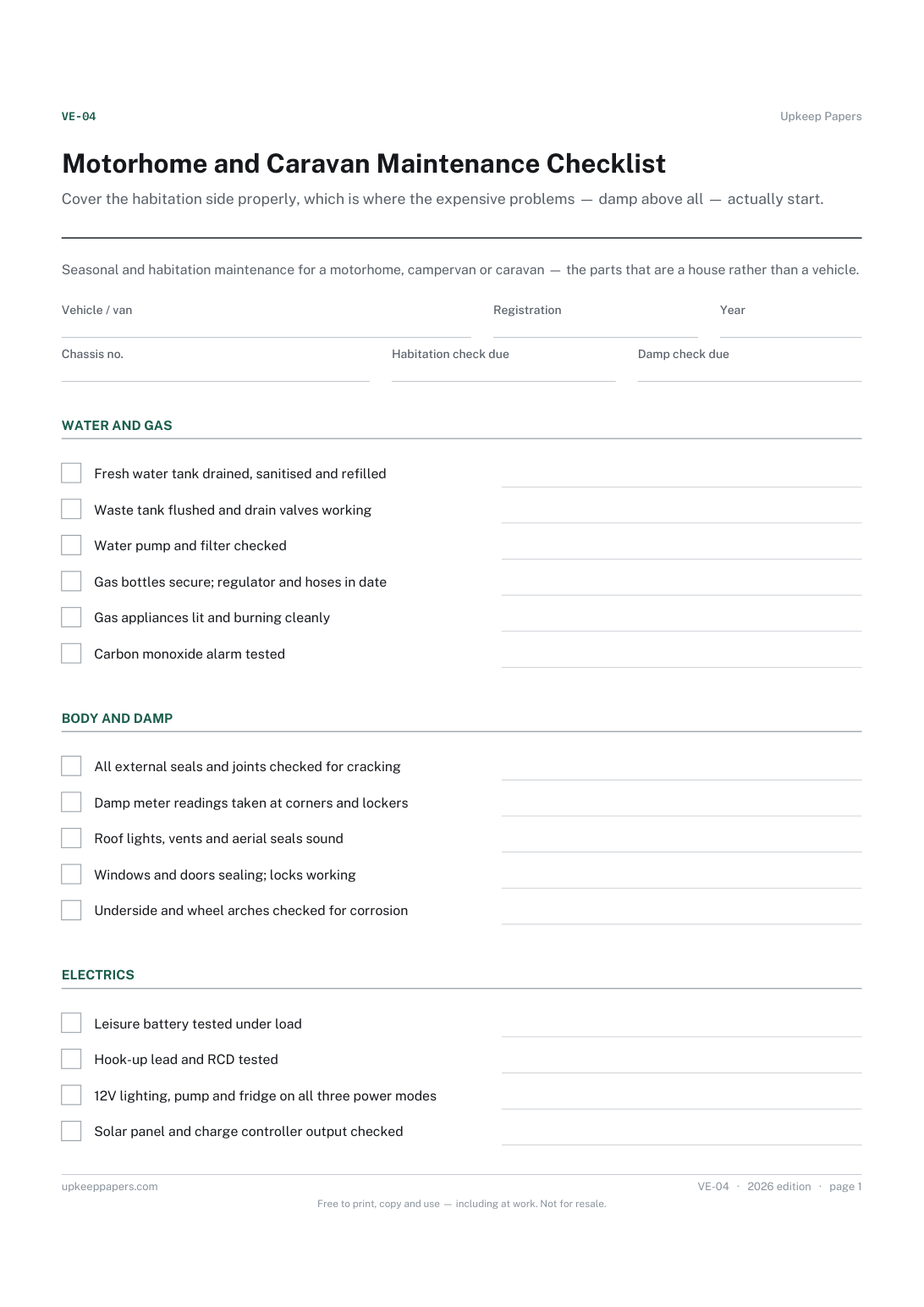
Cover the habitation side properly, which is where the expensive problems — damp above all — actually start.
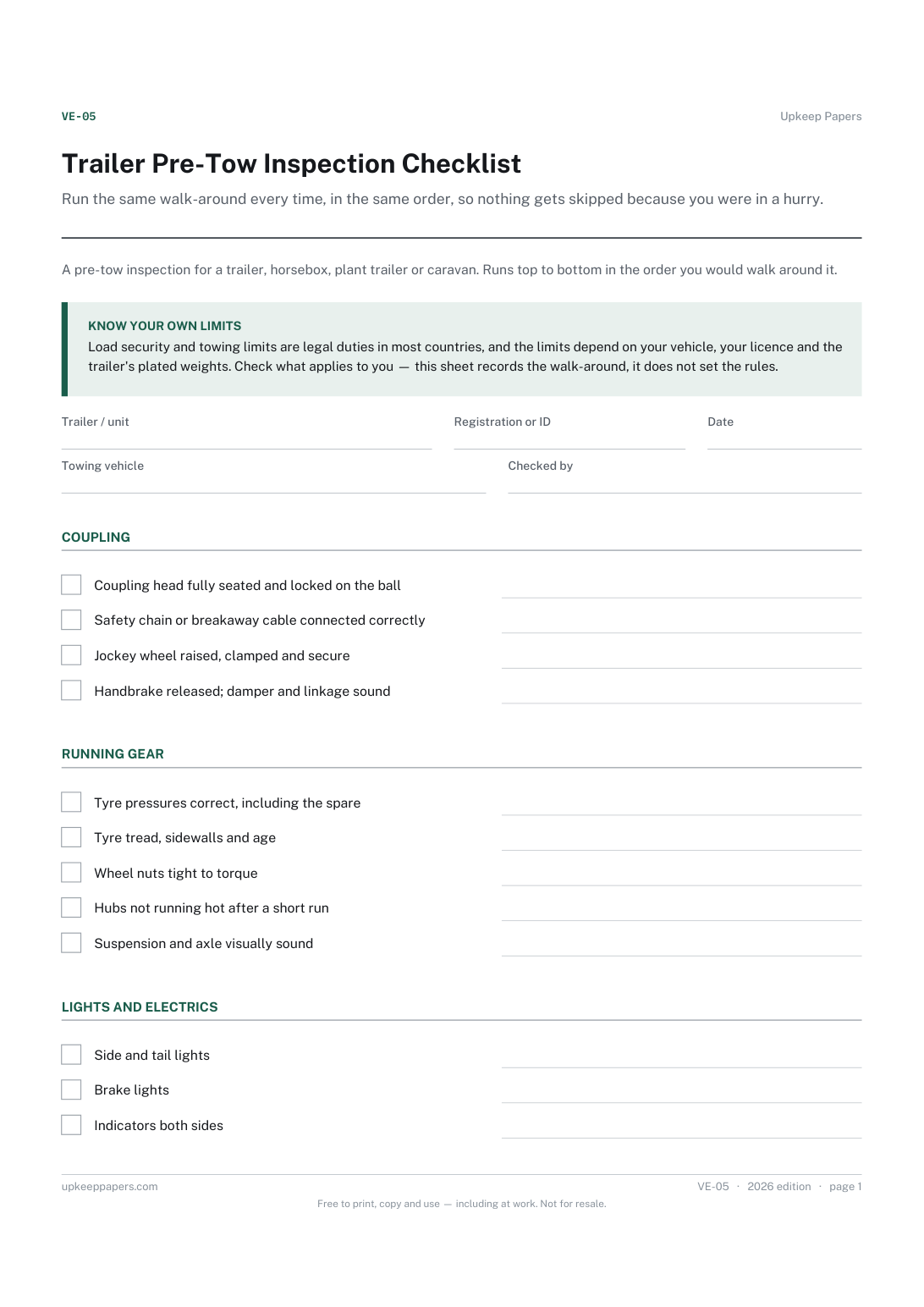
Run the same walk-around every time, in the same order, so nothing gets skipped because you were in a hurry.
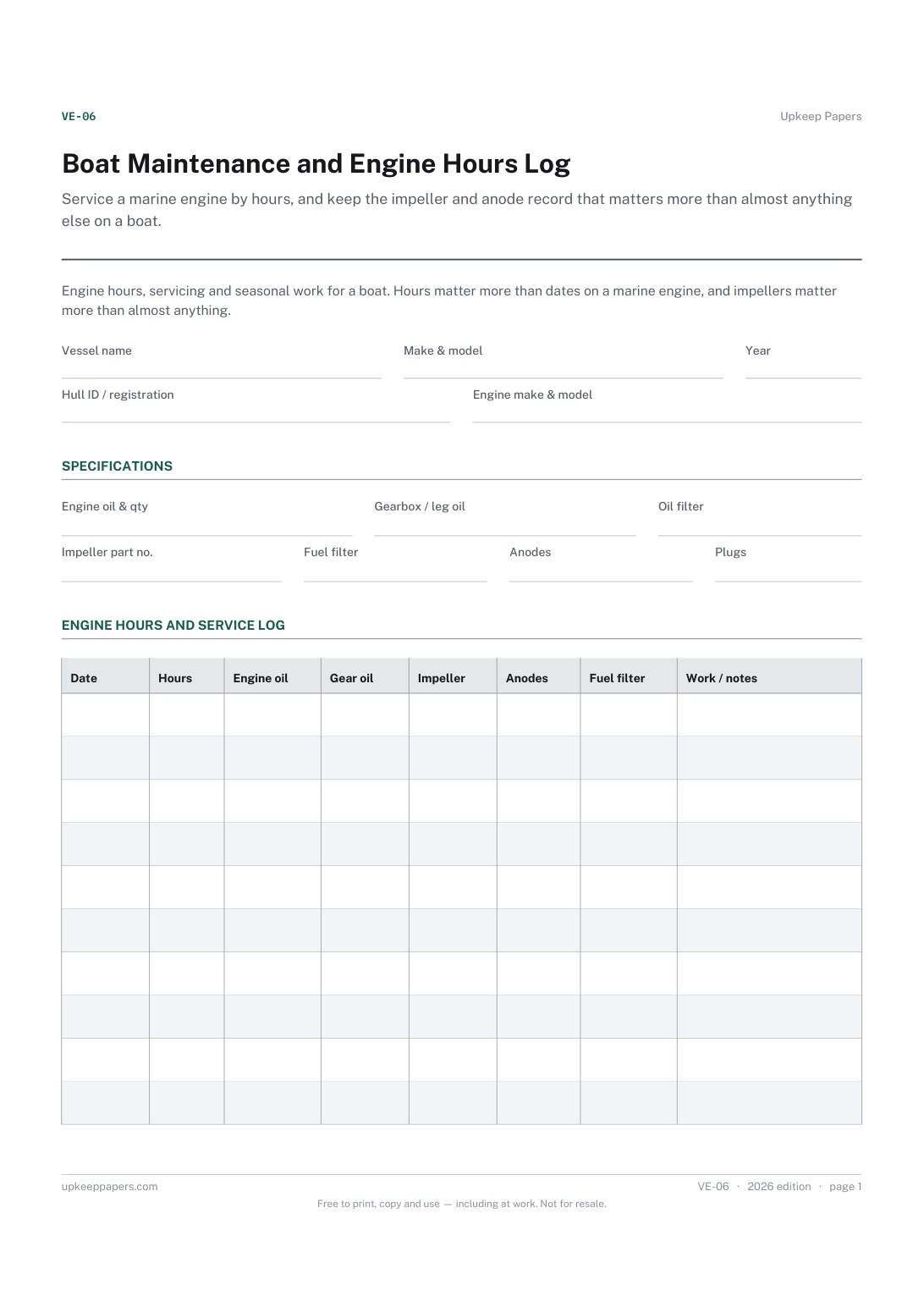
Service a marine engine by hours, and keep the impeller and anode record that matters more than almost anything else on a boat.
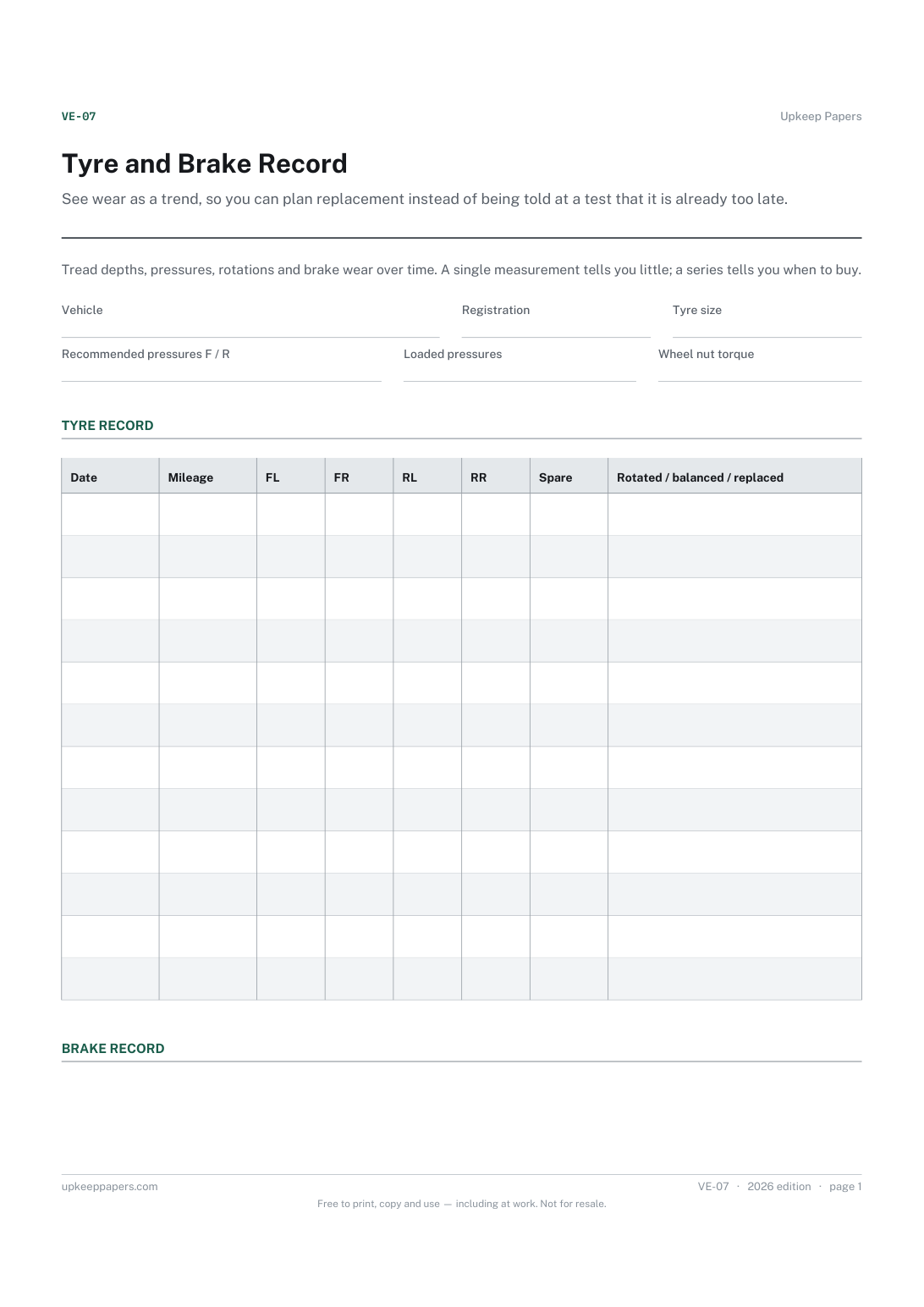
See wear as a trend, so you can plan replacement instead of being told at a test that it is already too late.
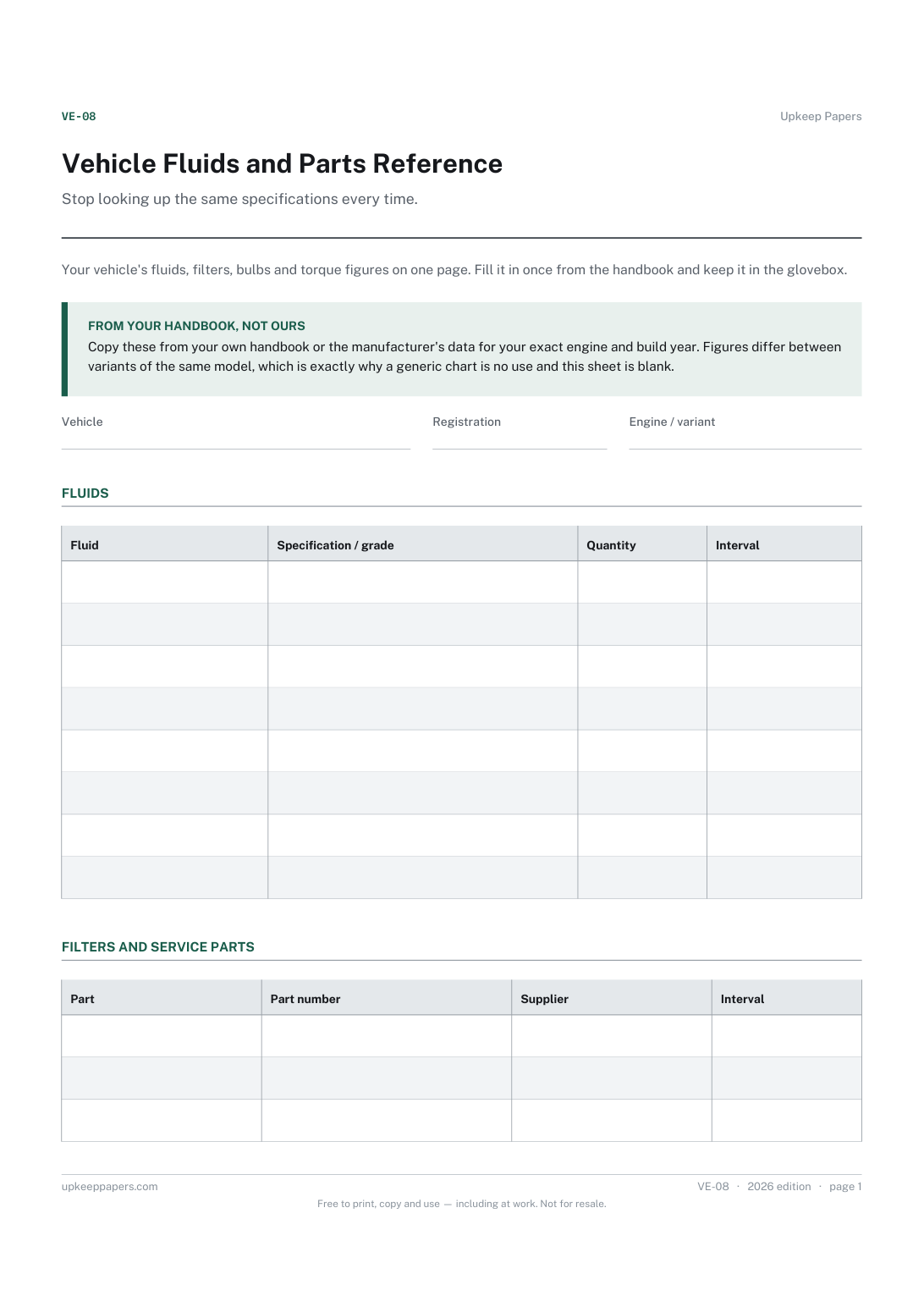
Stop looking up the same specifications every time. Fill it in once from the handbook and keep it with the vehicle.
Track servicing against distance and record chain wear, which is what decides whether a cheap chain change becomes an expensive cassette.
Fill in once the details you are asked for by a garage, an insurer, a parts counter or a hire firm and can never find.
Keep the single most asked-about piece of a vehicle's service history in a form a buyer can actually read.
Put the price in writing before the work starts, which is what prevents most garage disputes.
Record the check before driving and the journeys after it on one sheet per day.
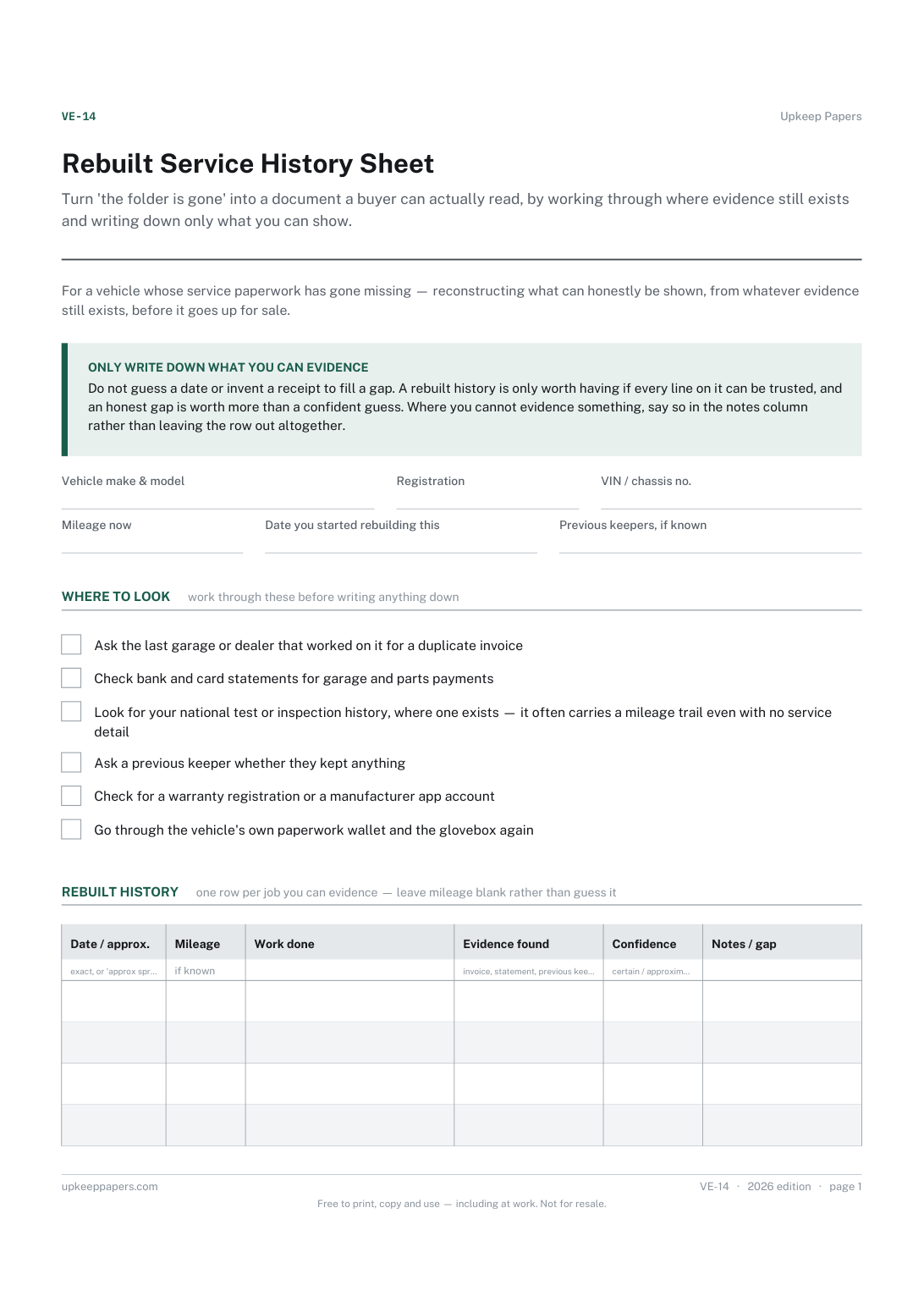
Turn 'the folder is gone' into a document a buyer can actually read, by working through where evidence still exists and writing down only what you can show.
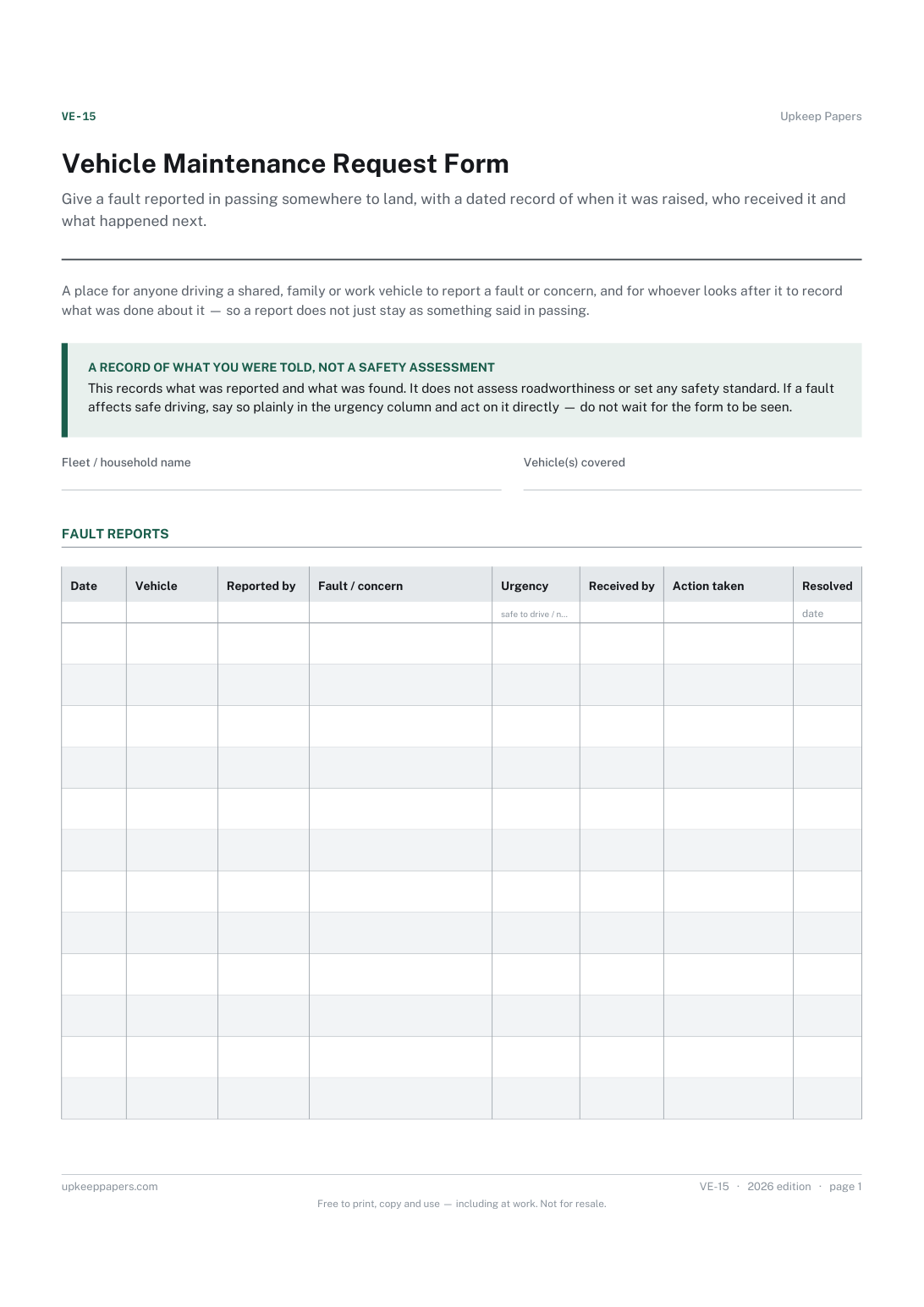
Give a fault reported in passing somewhere to land, with a dated record of when it was raised, who received it and what happened next.
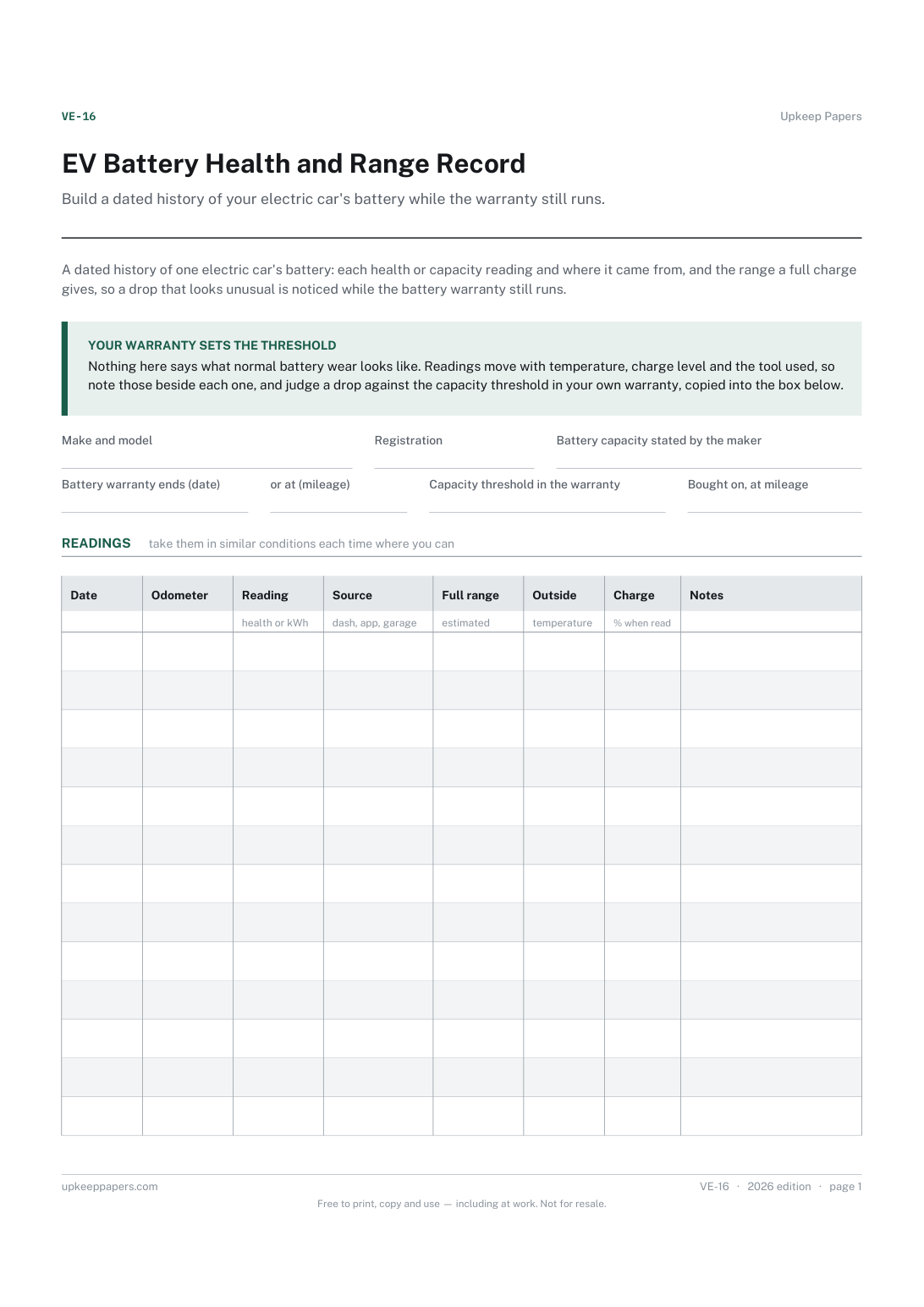
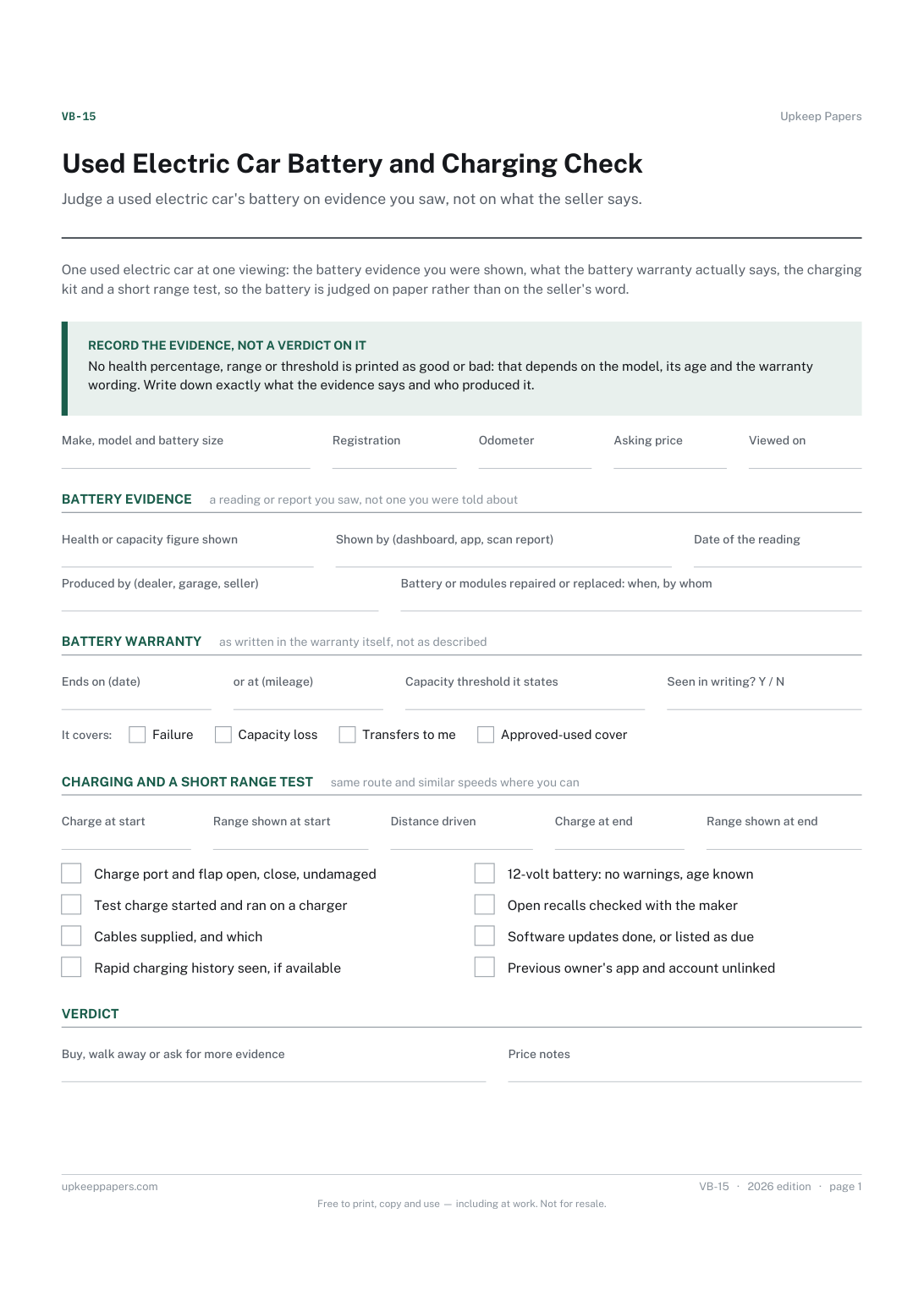
Build a dated history of your electric car's battery while the warranty still runs. An unusual drop then stands out against your own earlier readings.
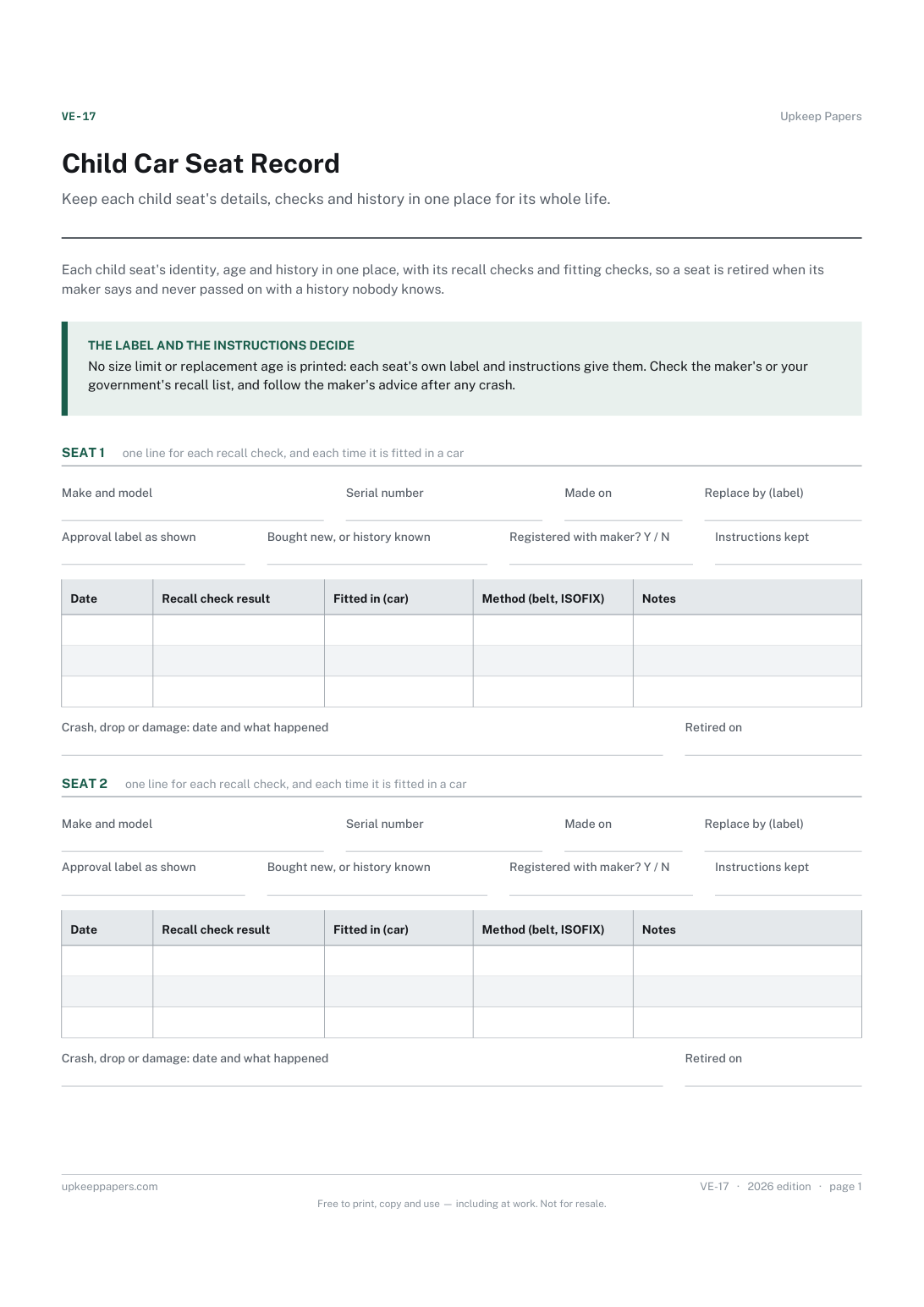
Keep each child seat's details, checks and history in one place for its whole life. A seat is retired on time and never passed on without its story.
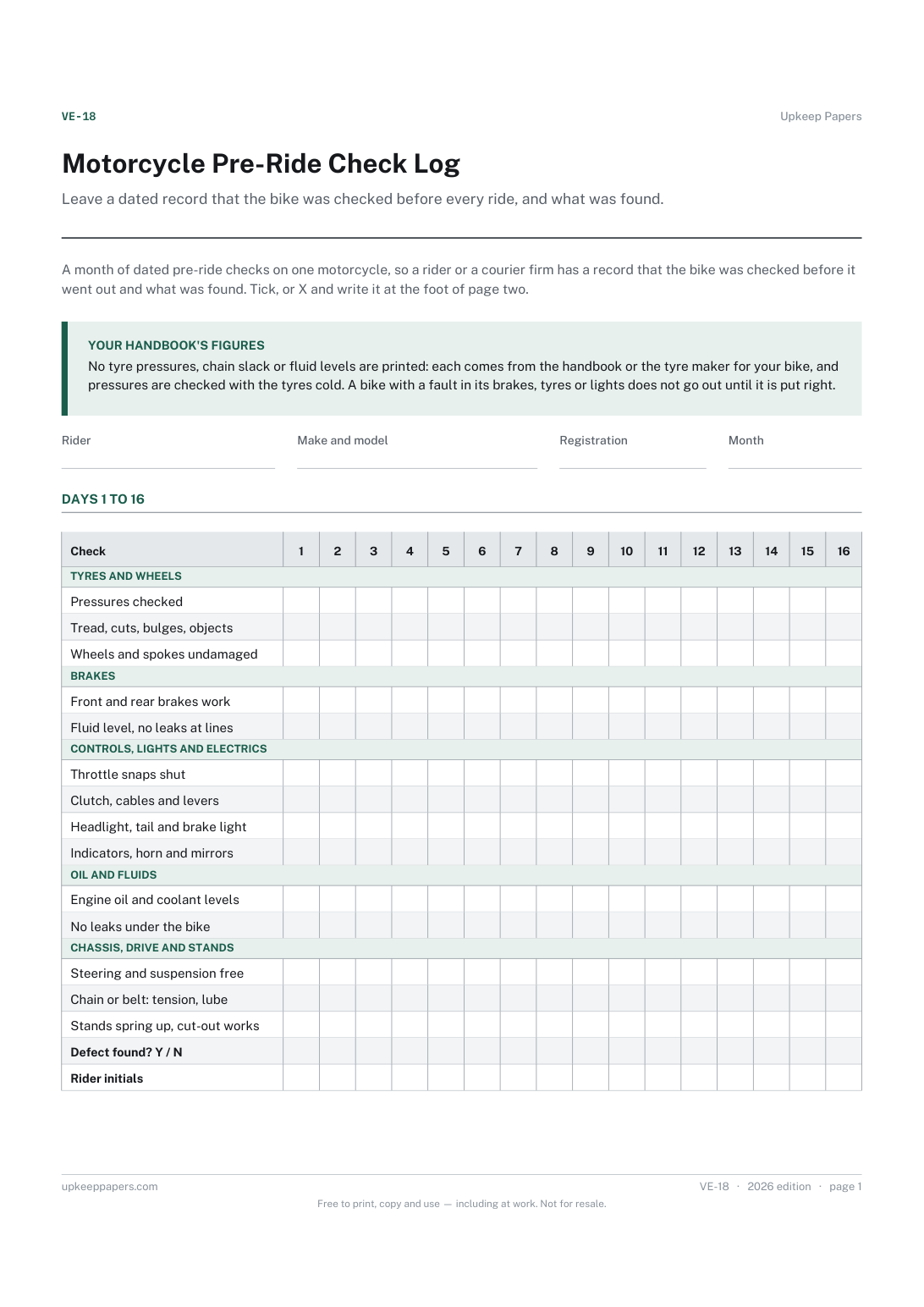
Leave a dated record that the bike was checked before every ride, and what was found. Useful to a courier firm with several bikes and riders.
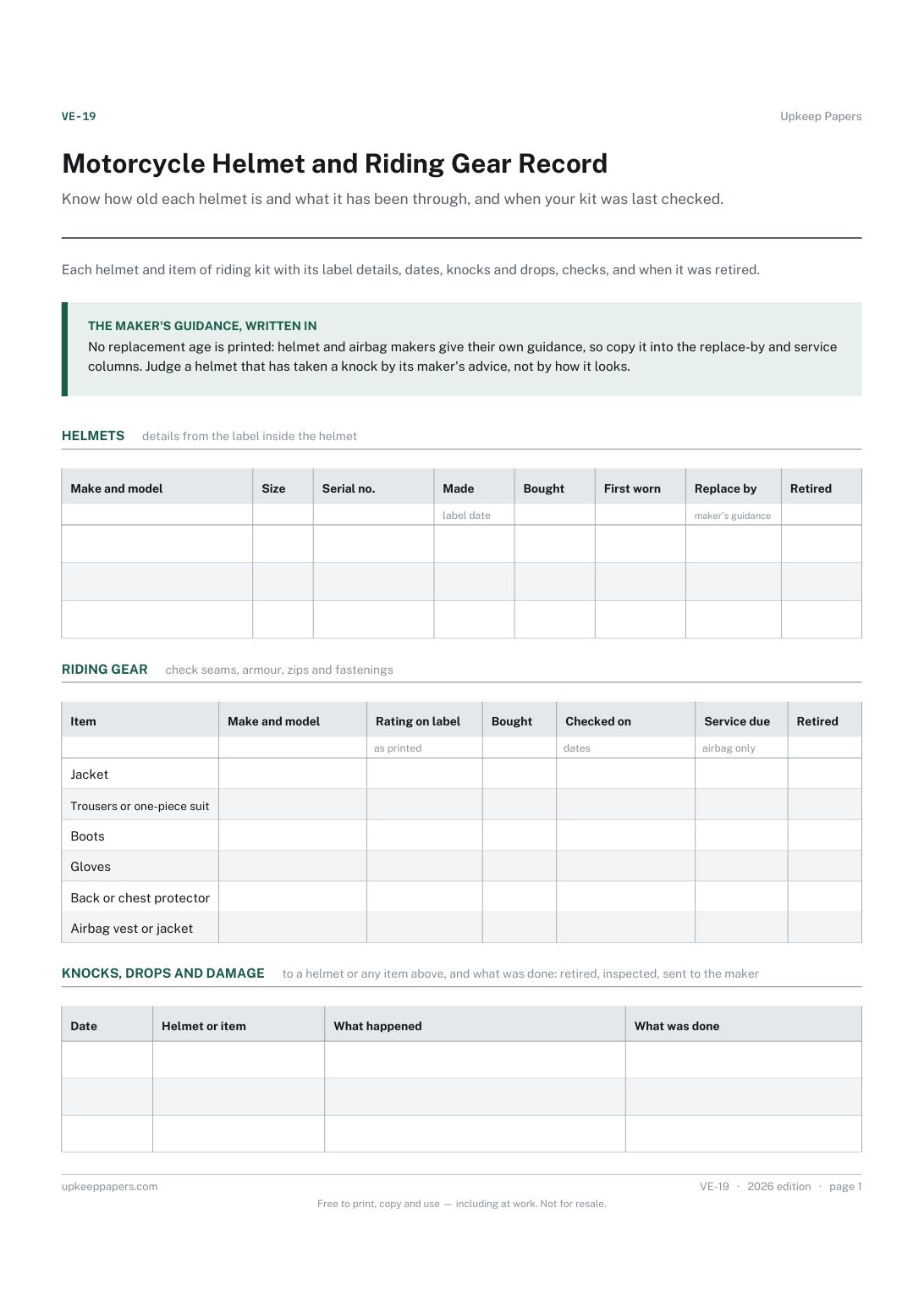
Know how old each helmet is and what it has been through, and when your kit was last checked. A knocked or aged helmet is then replaced, not kept out of habit.
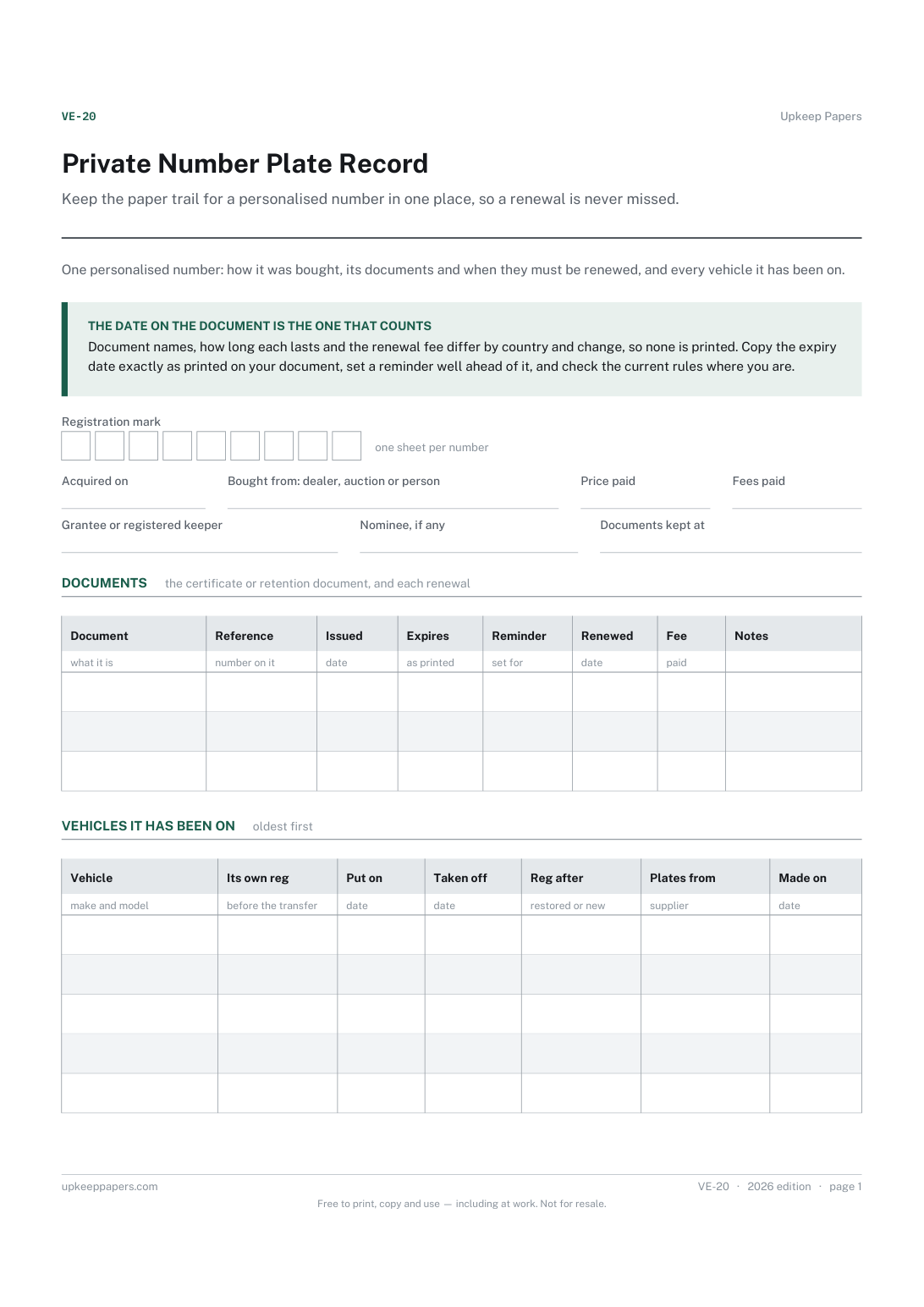
Keep the paper trail for a personalised number in one place, so a renewal is never missed. Every vehicle it has been on is listed, with the registration each was given back.
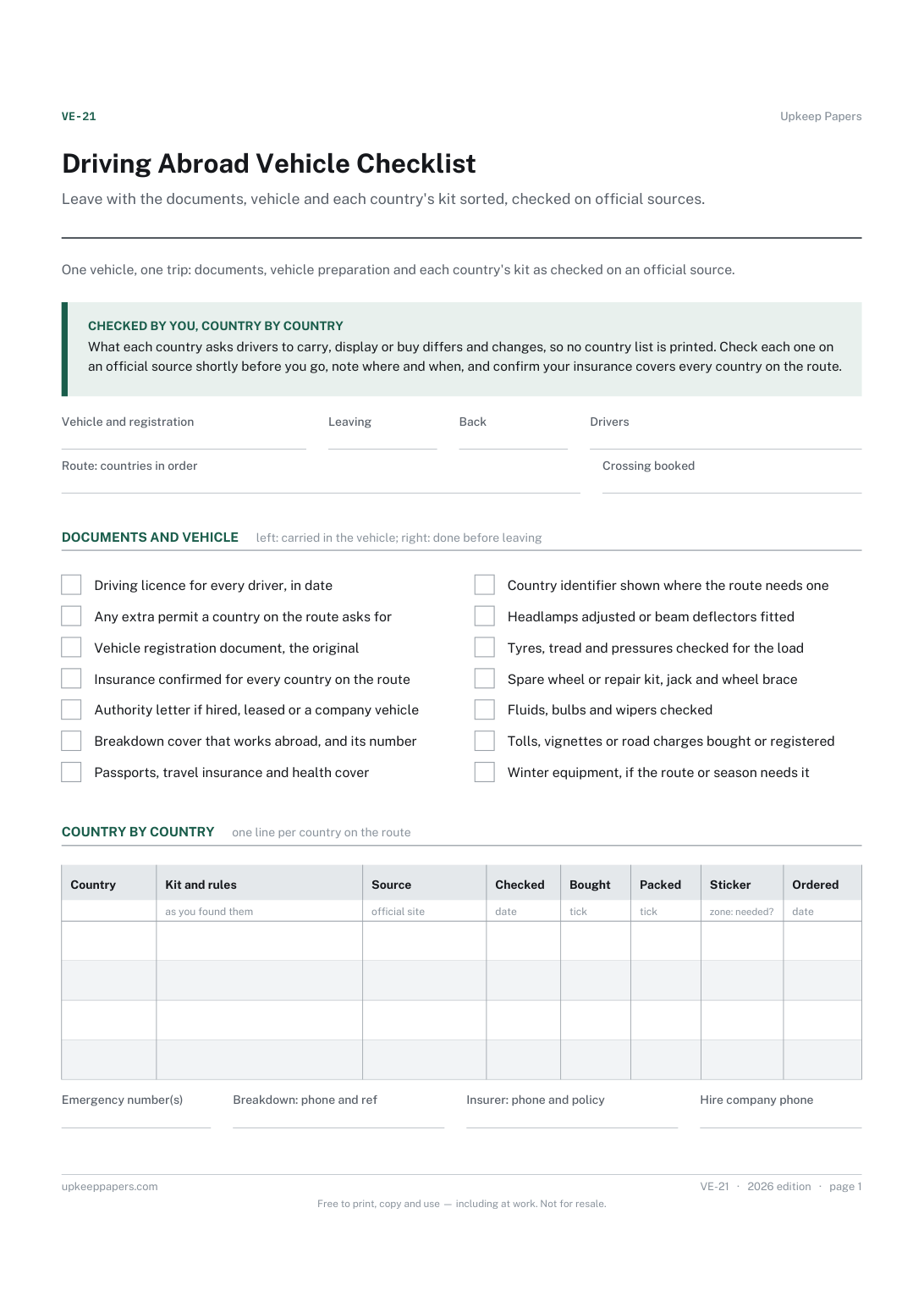
Leave with the documents, vehicle and each country's kit sorted, checked on official sources. Each country gets its own line, with where and when you checked it.
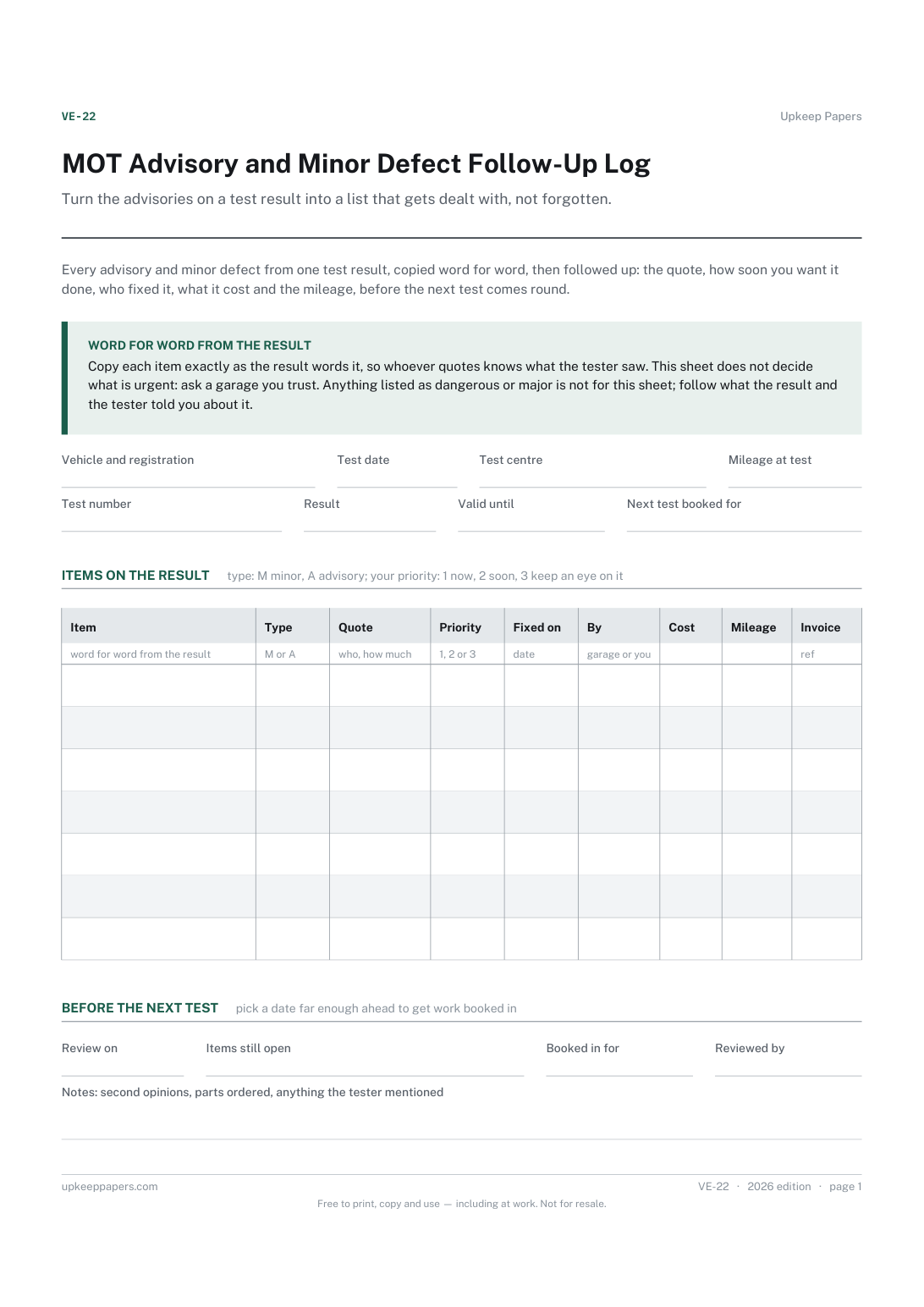
Turn the advisories on a test result into a list that gets dealt with, not forgotten. The review before the next test shows what is still open while there is time to book it in.
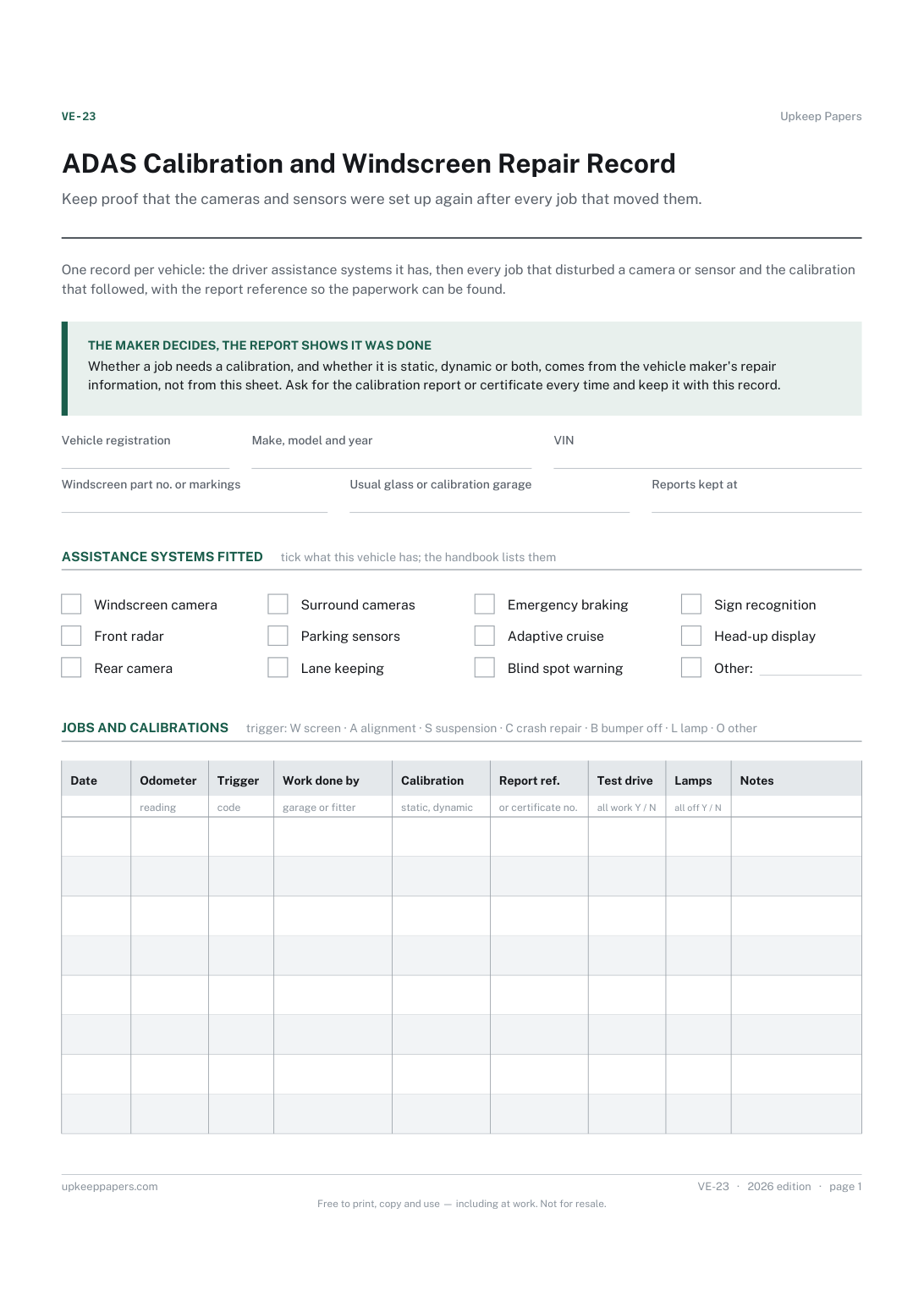
Keep proof that the cameras and sensors were set up again after every job that moved them. The report reference on each line finds the certificate again when someone asks for it.
Pools, hot tubs and private water supplies — chemistry logs and test records.
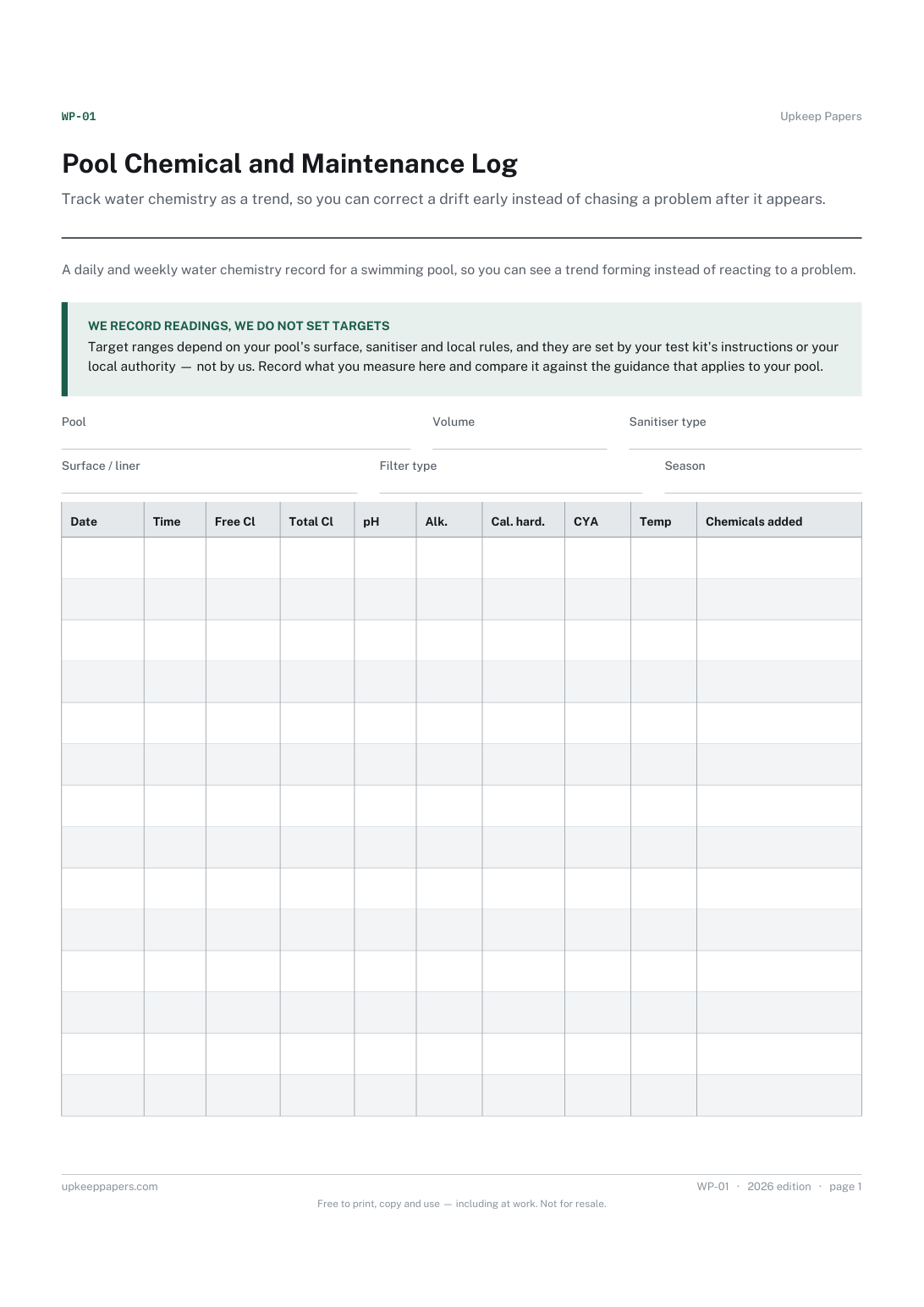
Track water chemistry as a trend, so you can correct a drift early instead of chasing a problem after it appears.
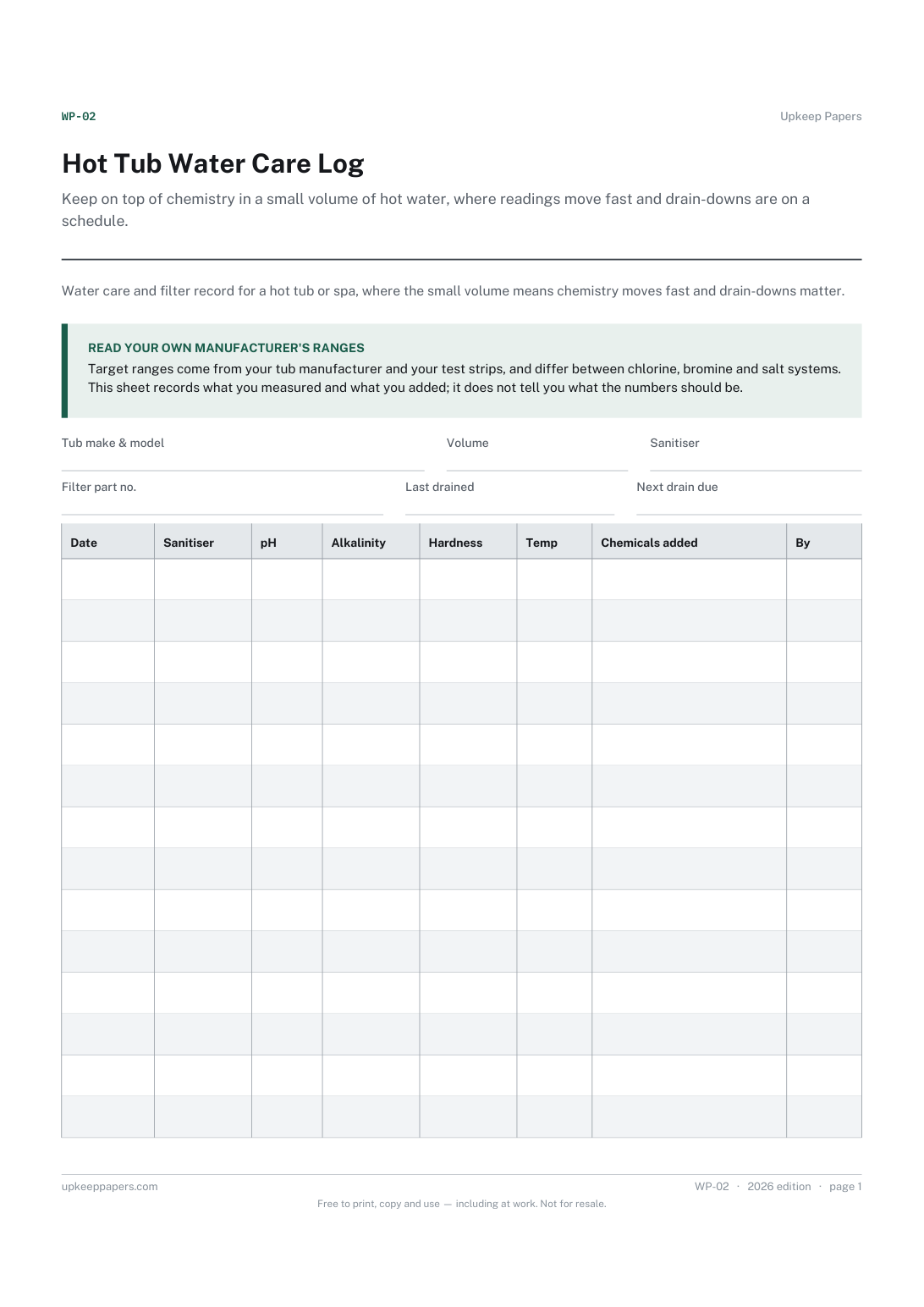
Keep on top of chemistry in a small volume of hot water, where readings move fast and drain-downs are on a schedule.
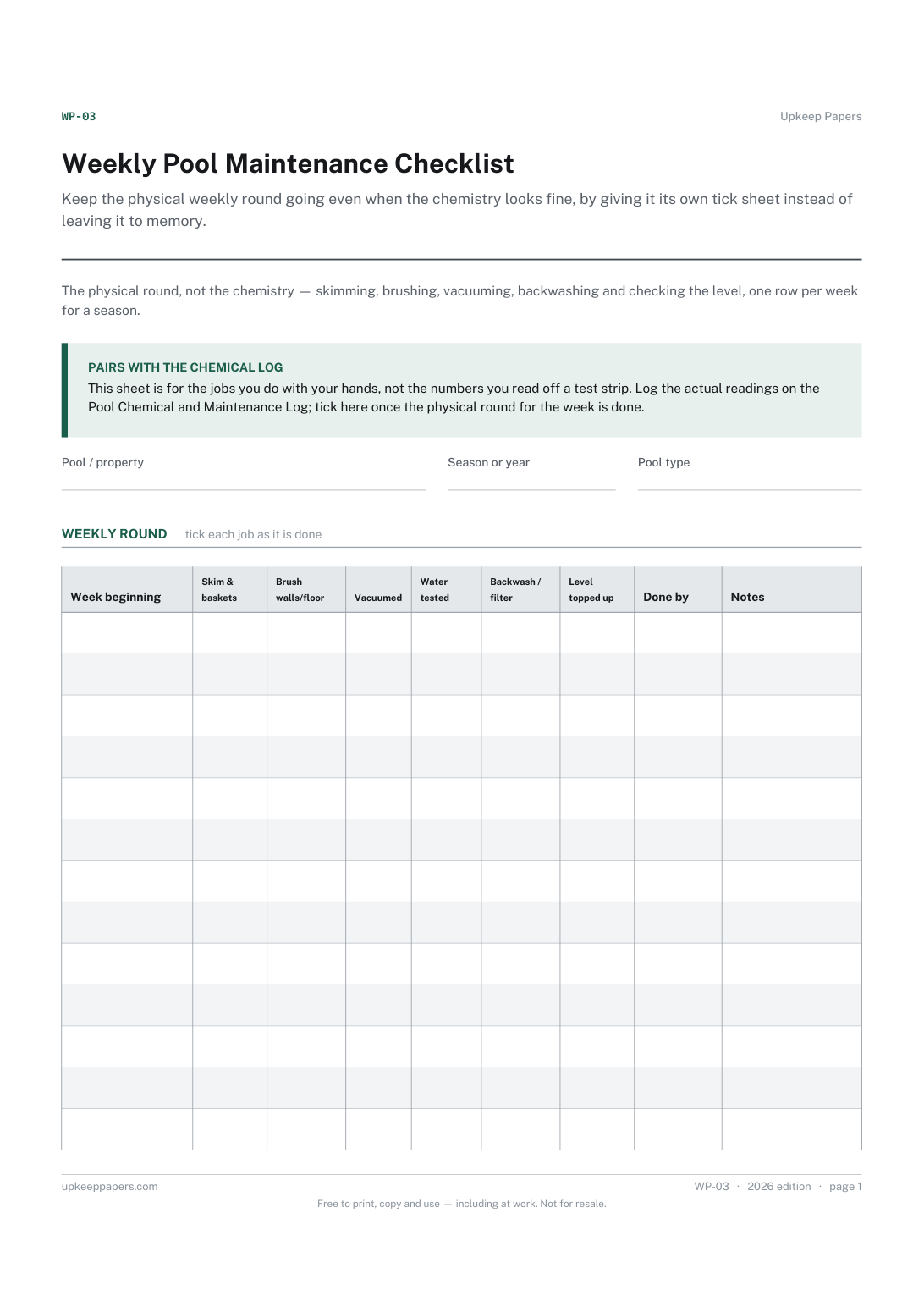
Keep the physical weekly round going even when the chemistry looks fine, by giving it its own tick sheet instead of leaving it to memory.
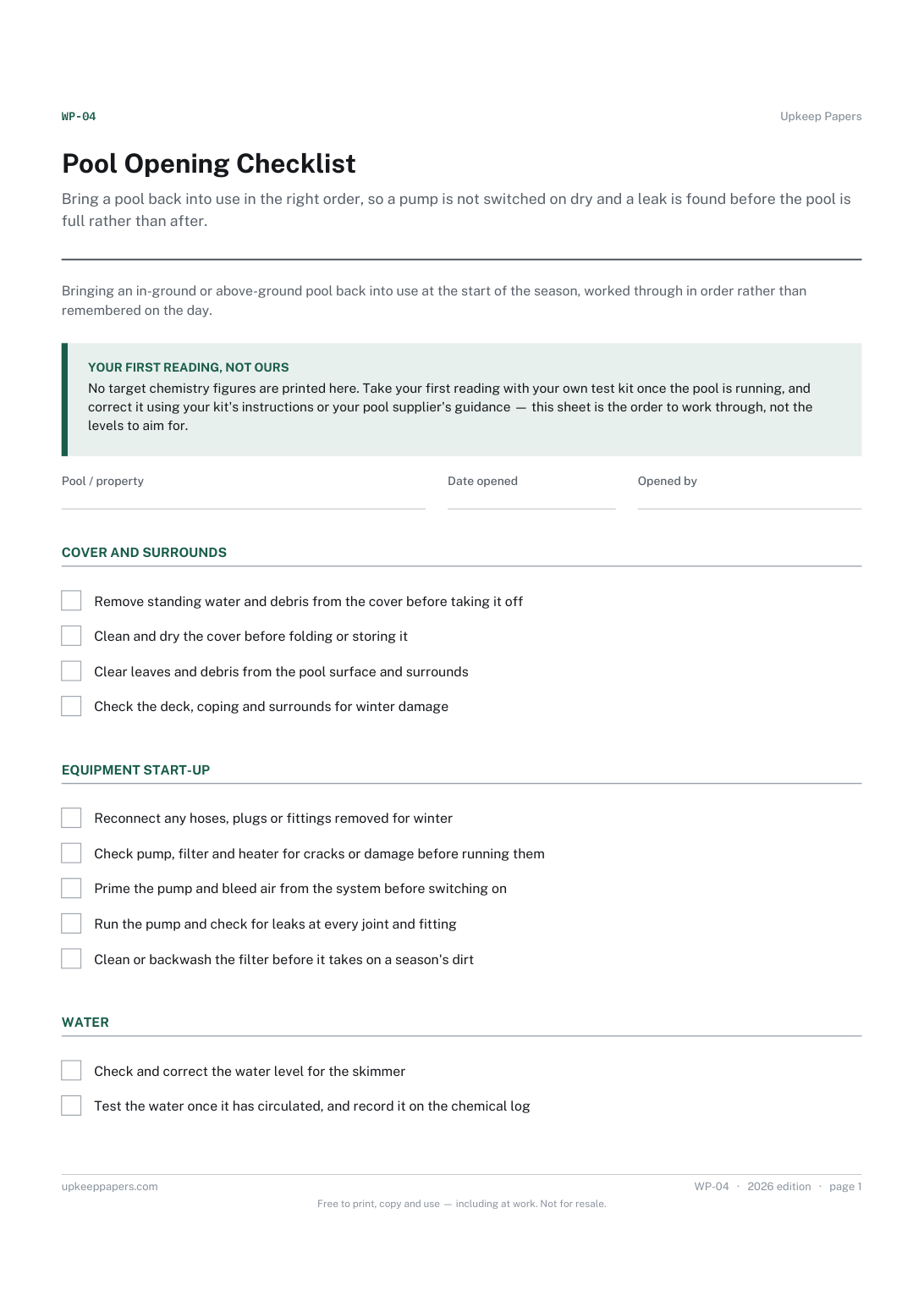
Bring a pool back into use in the right order, so a pump is not switched on dry and a leak is found before the pool is full rather than after.
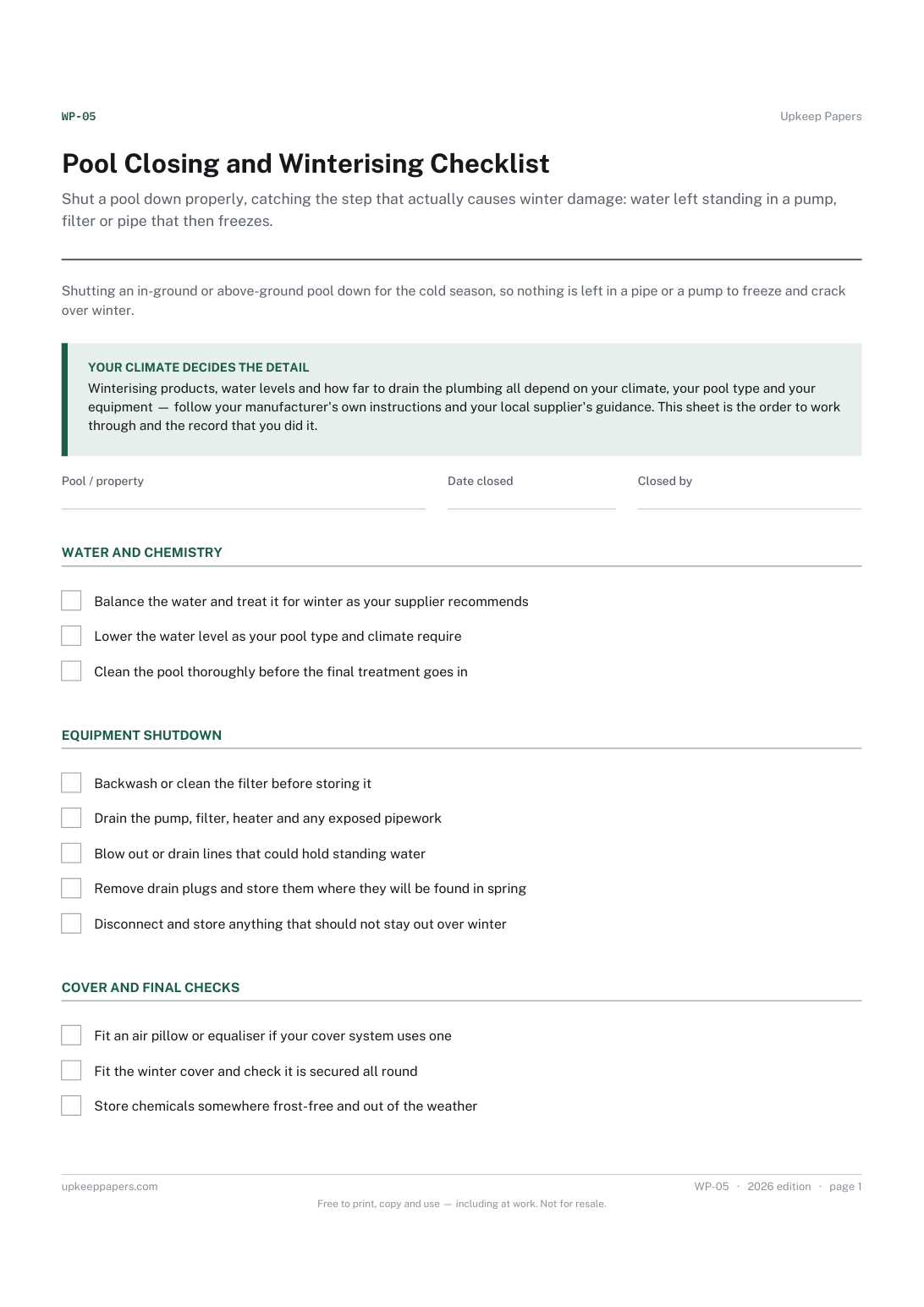
Shut a pool down properly, catching the step that actually causes winter damage: water left standing in a pump, filter or pipe that then freezes.
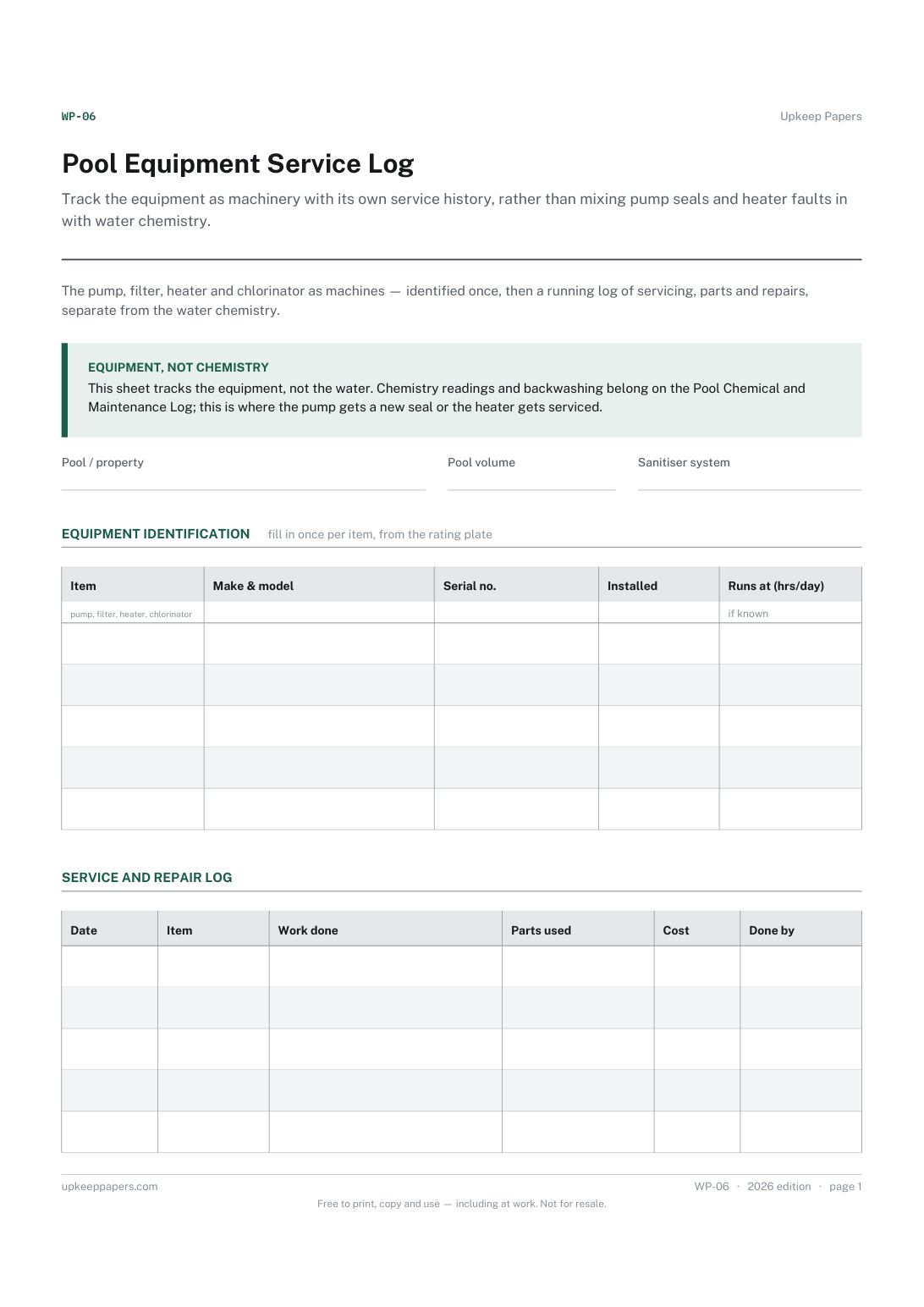
Track the equipment as machinery with its own service history, rather than mixing pump seals and heater faults in with water chemistry.
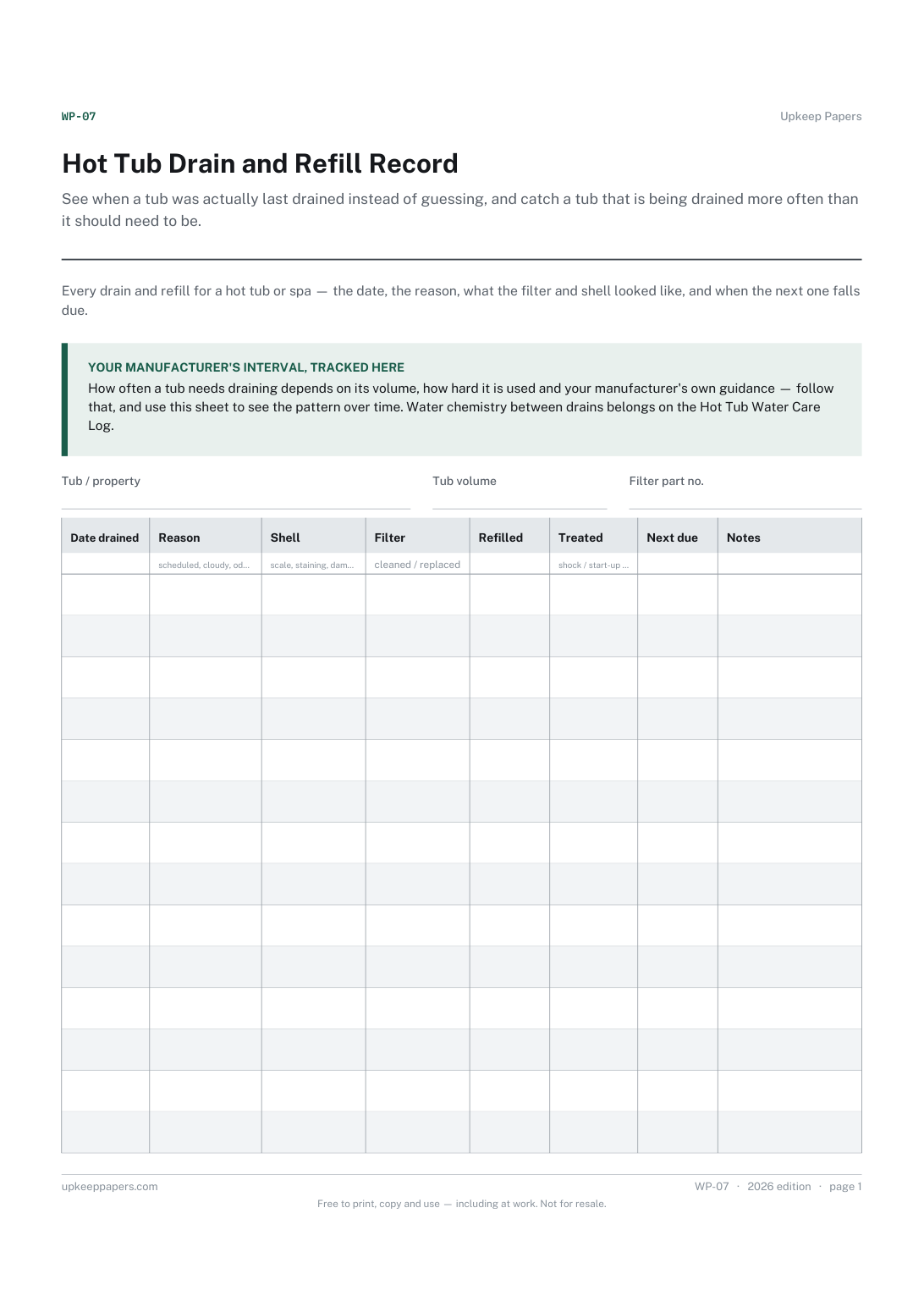
See when a tub was actually last drained instead of guessing, and catch a tub that is being drained more often than it should need to be.
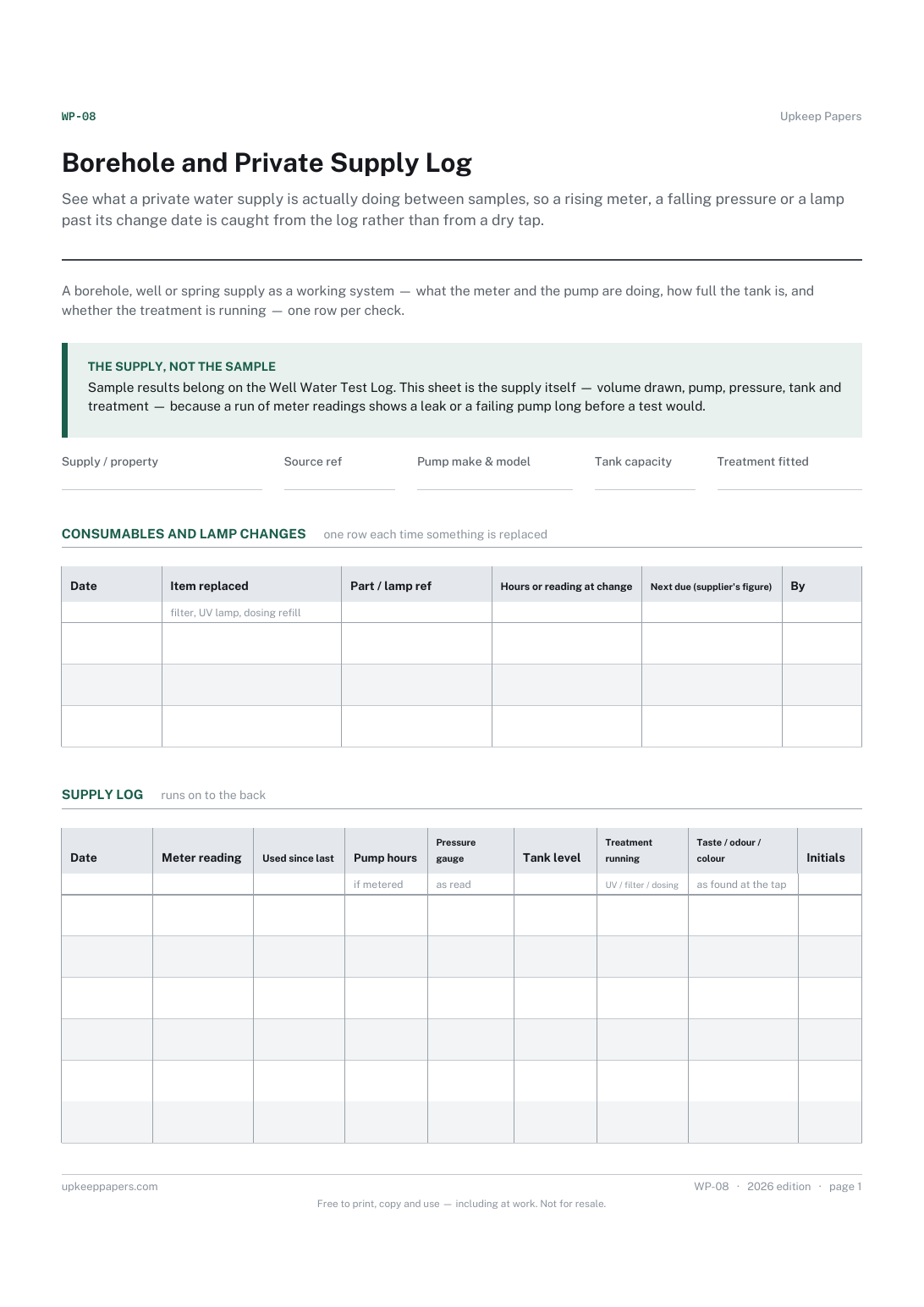
See what a private water supply is actually doing between samples, so a rising meter, a falling pressure or a lamp past its change date is caught from the log rather than from a dry tap.
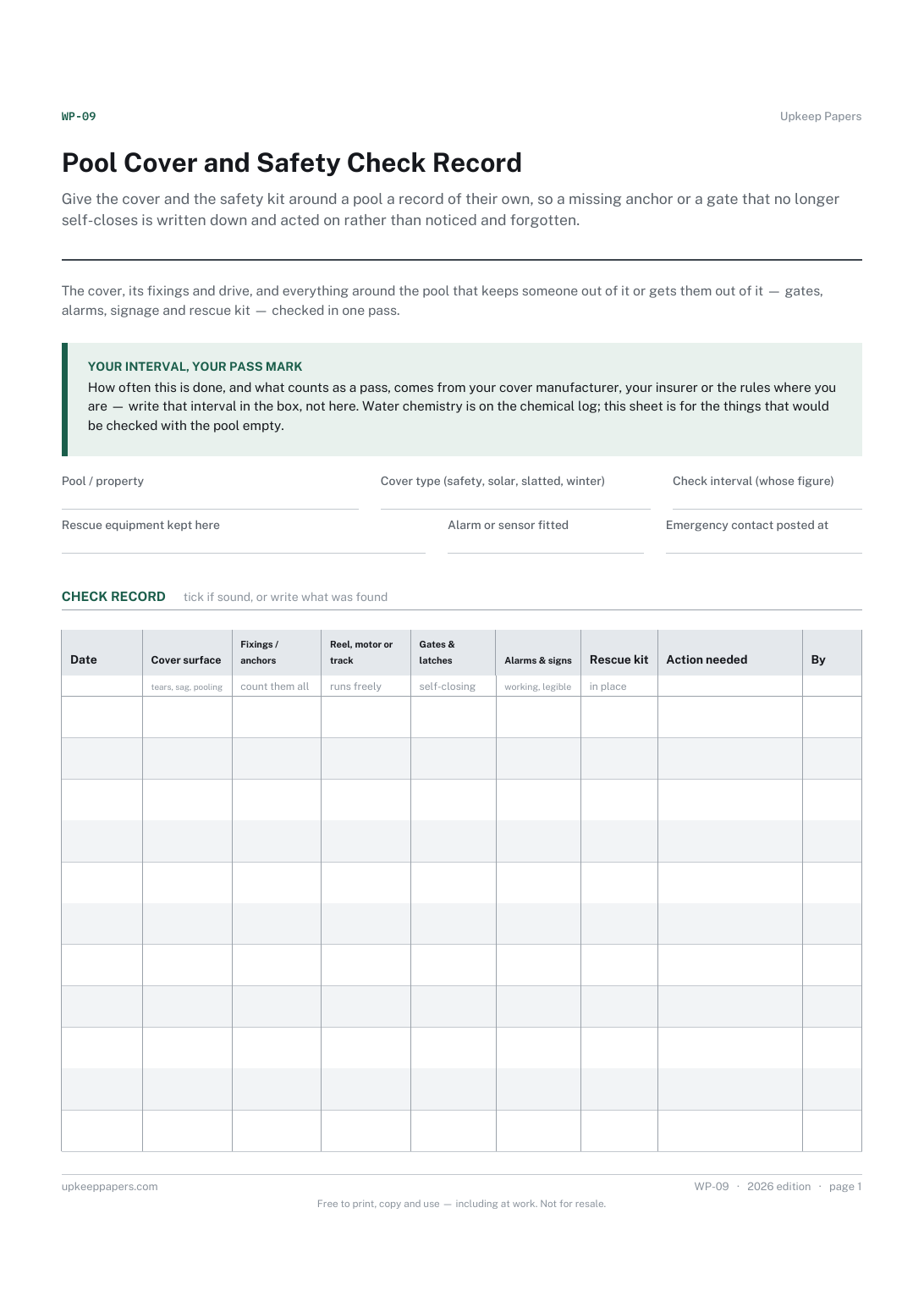
Give the cover and the safety kit around a pool a record of their own, so a missing anchor or a gate that no longer self-closes is written down and acted on rather than noticed and forgotten.
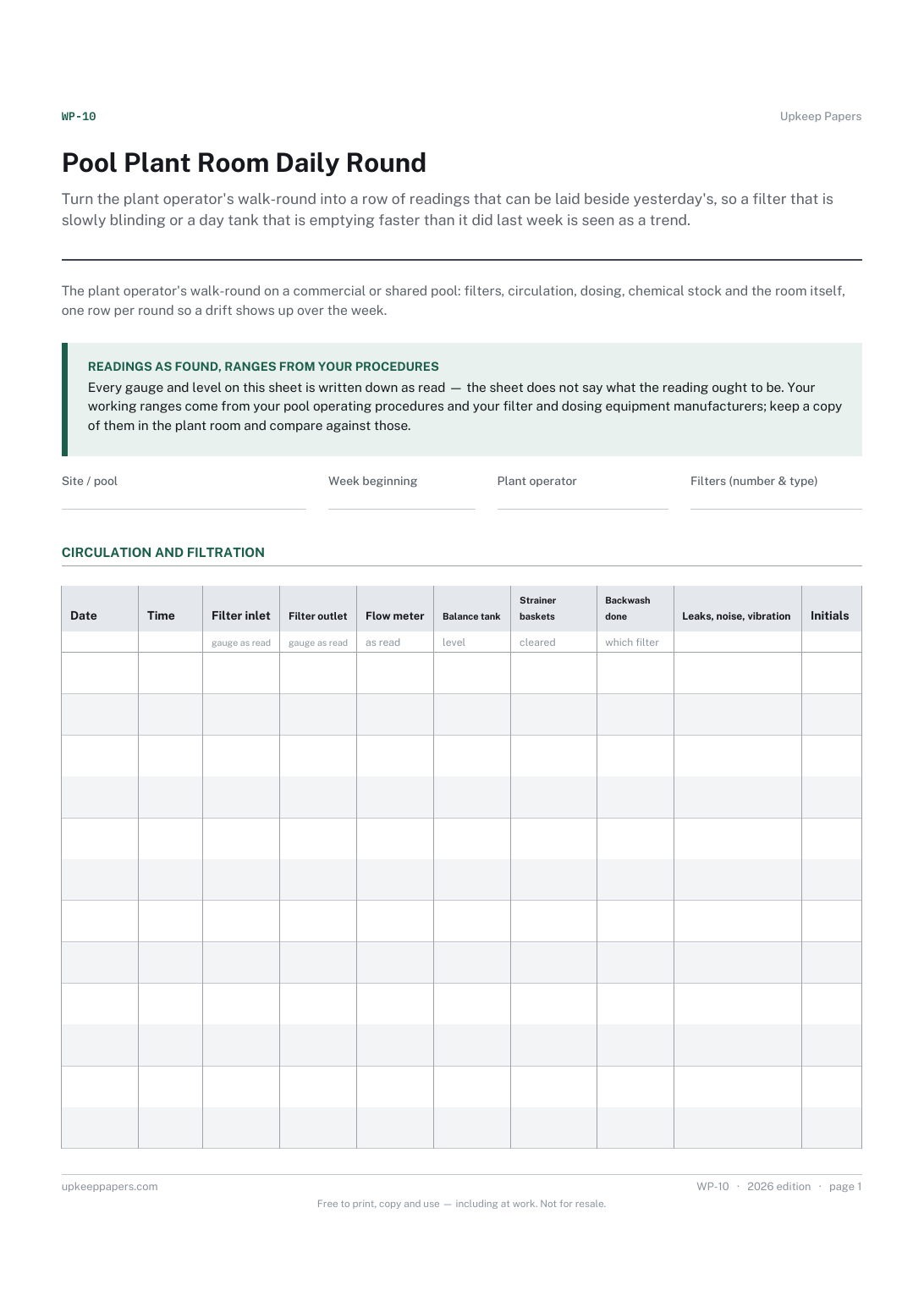
Turn the plant operator's walk-round into a row of readings that can be laid beside yesterday's, so a filter that is slowly blinding or a day tank that is emptying faster than it did last week is seen as a trend.
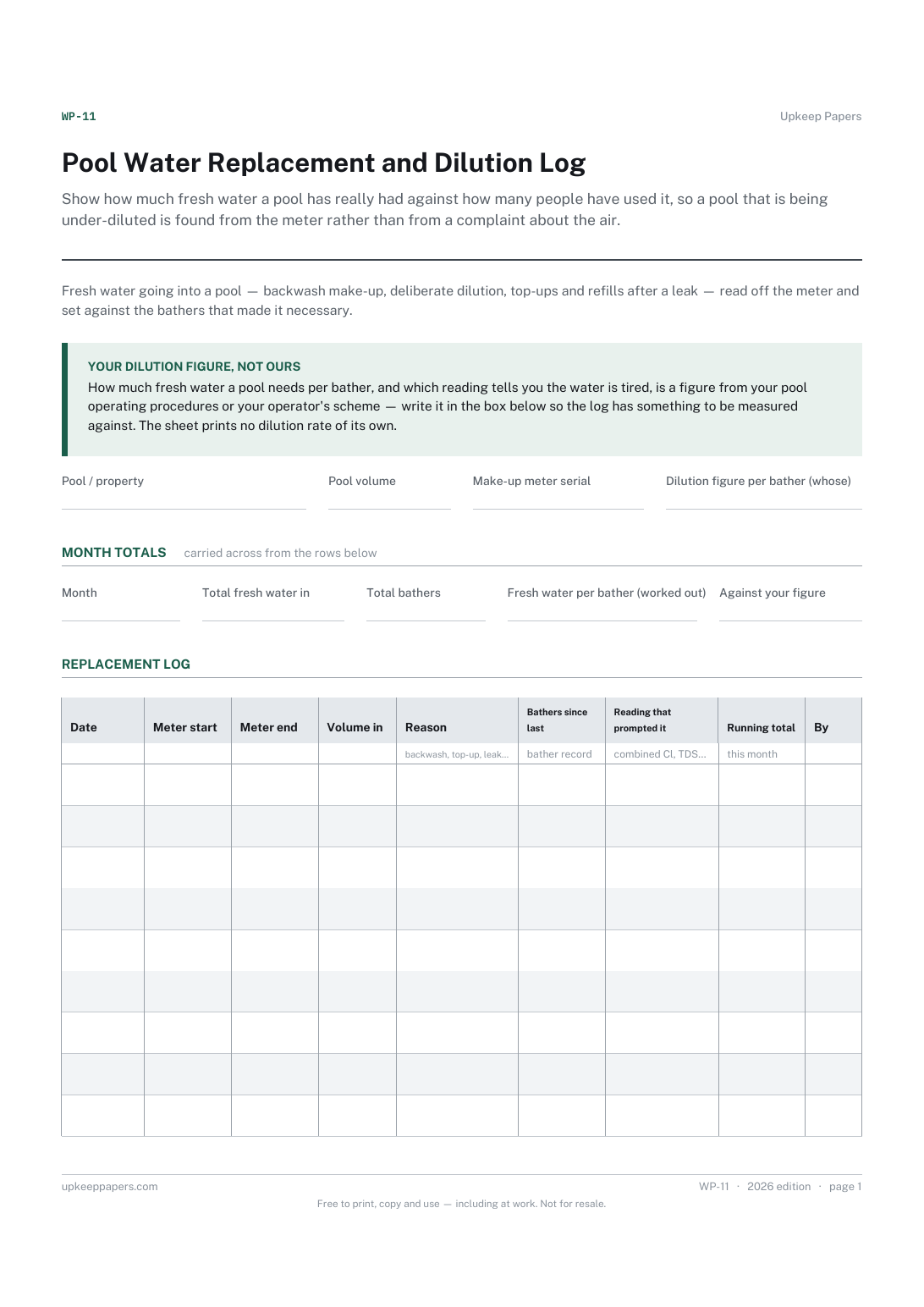
Show how much fresh water a pool has really had against how many people have used it, so a pool that is being under-diluted is found from the meter rather than from a complaint about the air.
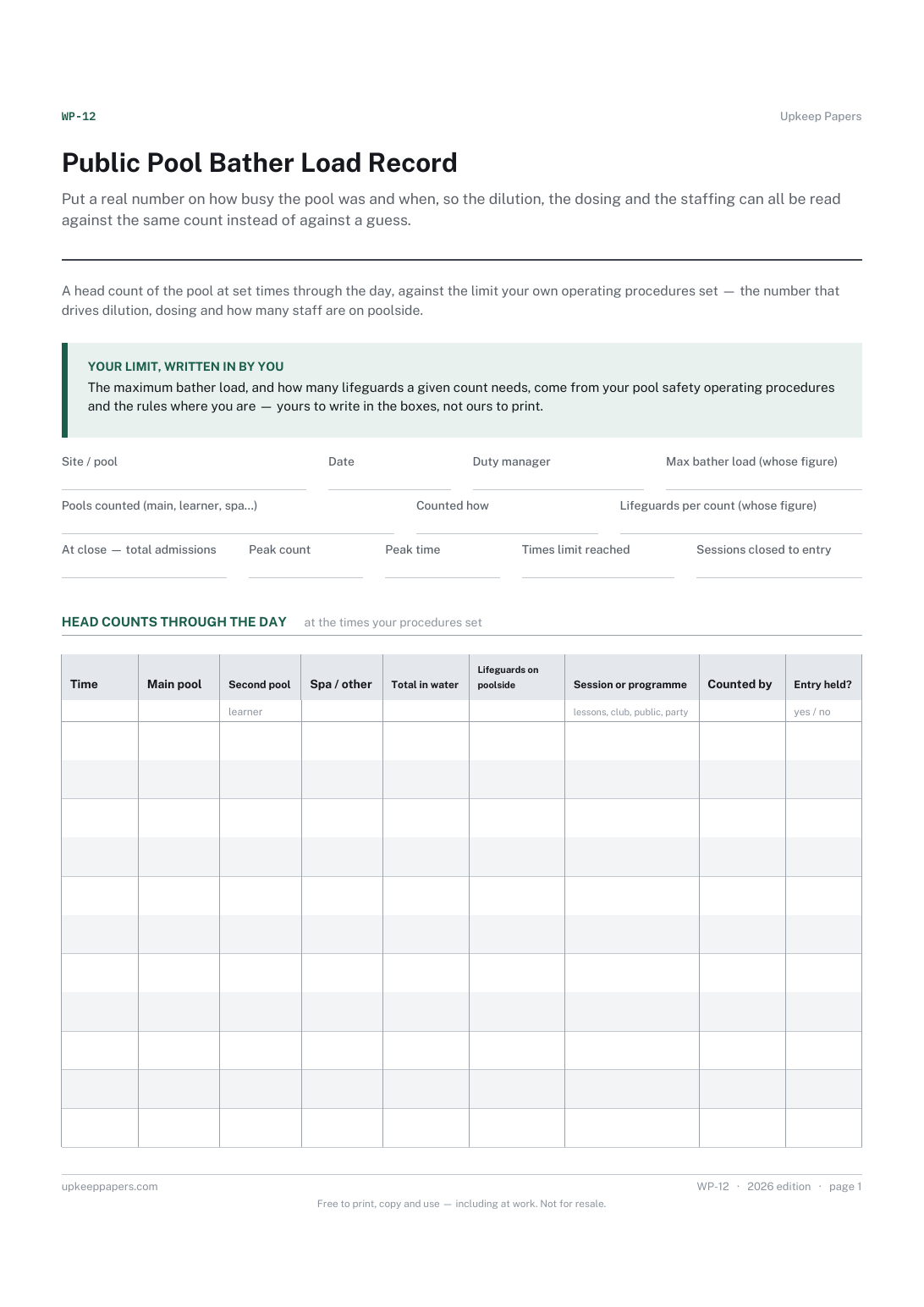
Put a real number on how busy the pool was and when, so the dilution, the dosing and the staffing can all be read against the same count instead of against a guess.
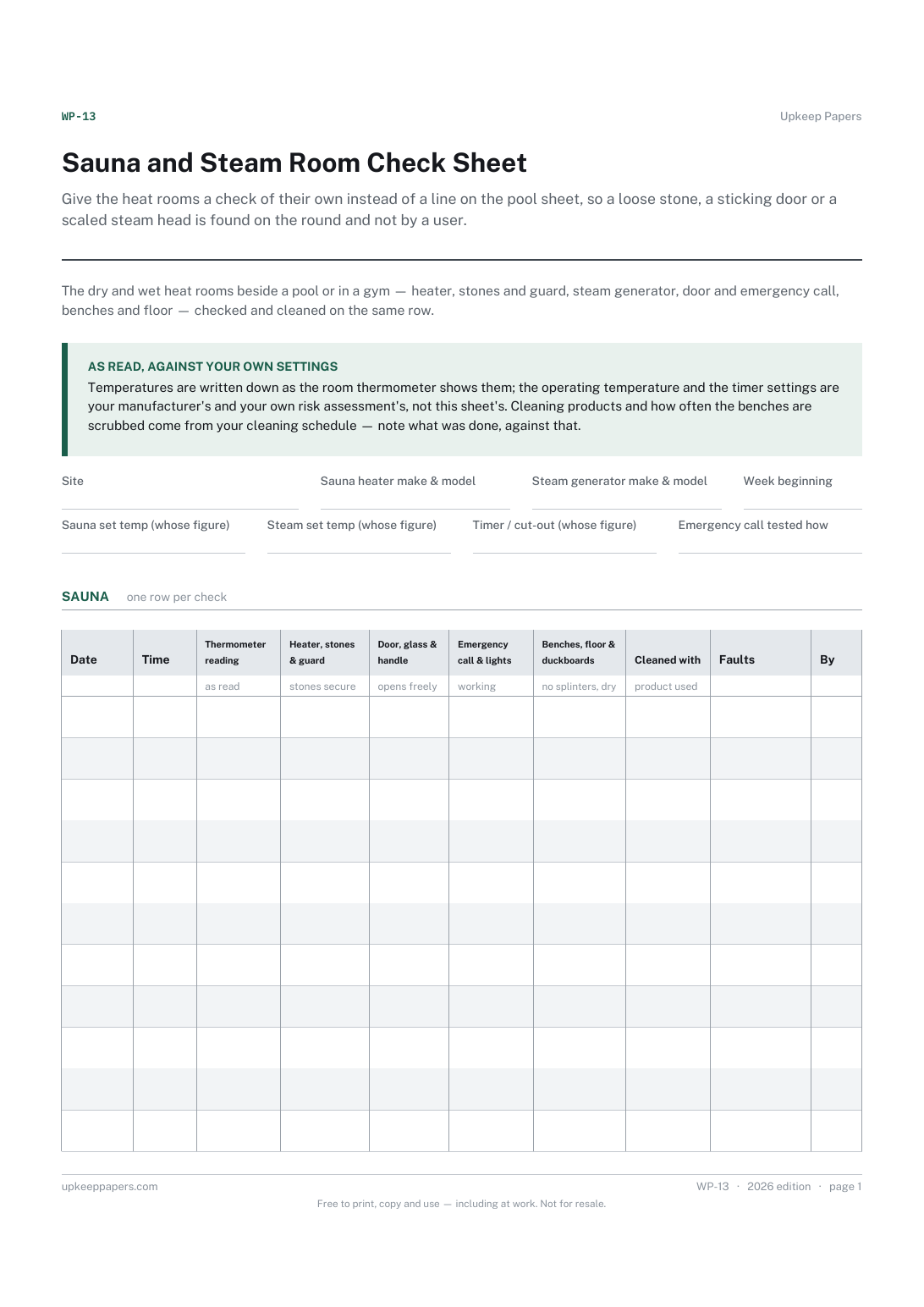
Give the heat rooms a check of their own instead of a line on the pool sheet, so a loose stone, a sticking door or a scaled steam head is found on the round and not by a user.
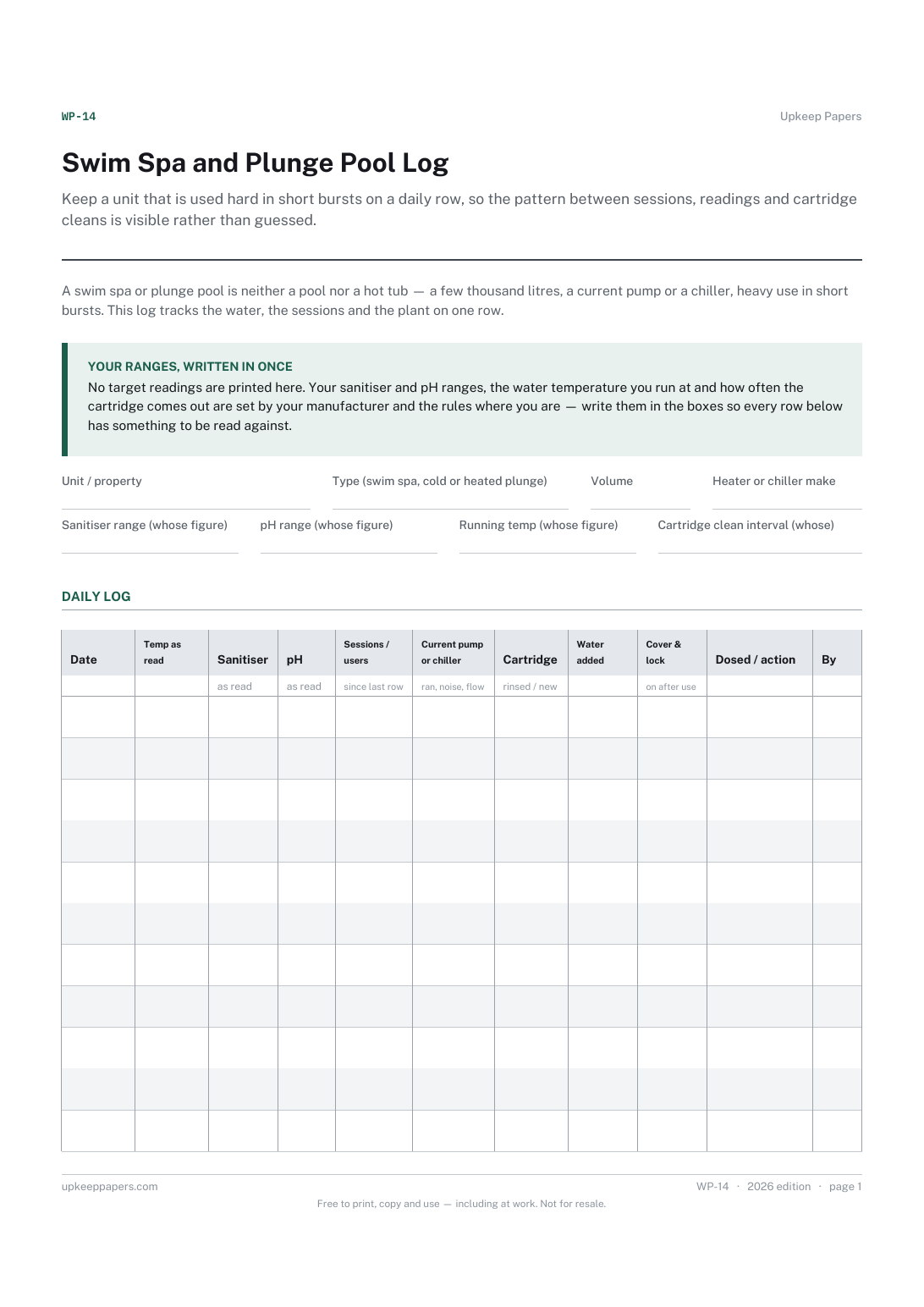
Keep a unit that is used hard in short bursts on a daily row, so the pattern between sessions, readings and cartridge cleans is visible rather than guessed.
Maintenance logs, periodic inspections and changeover checklists for let property.
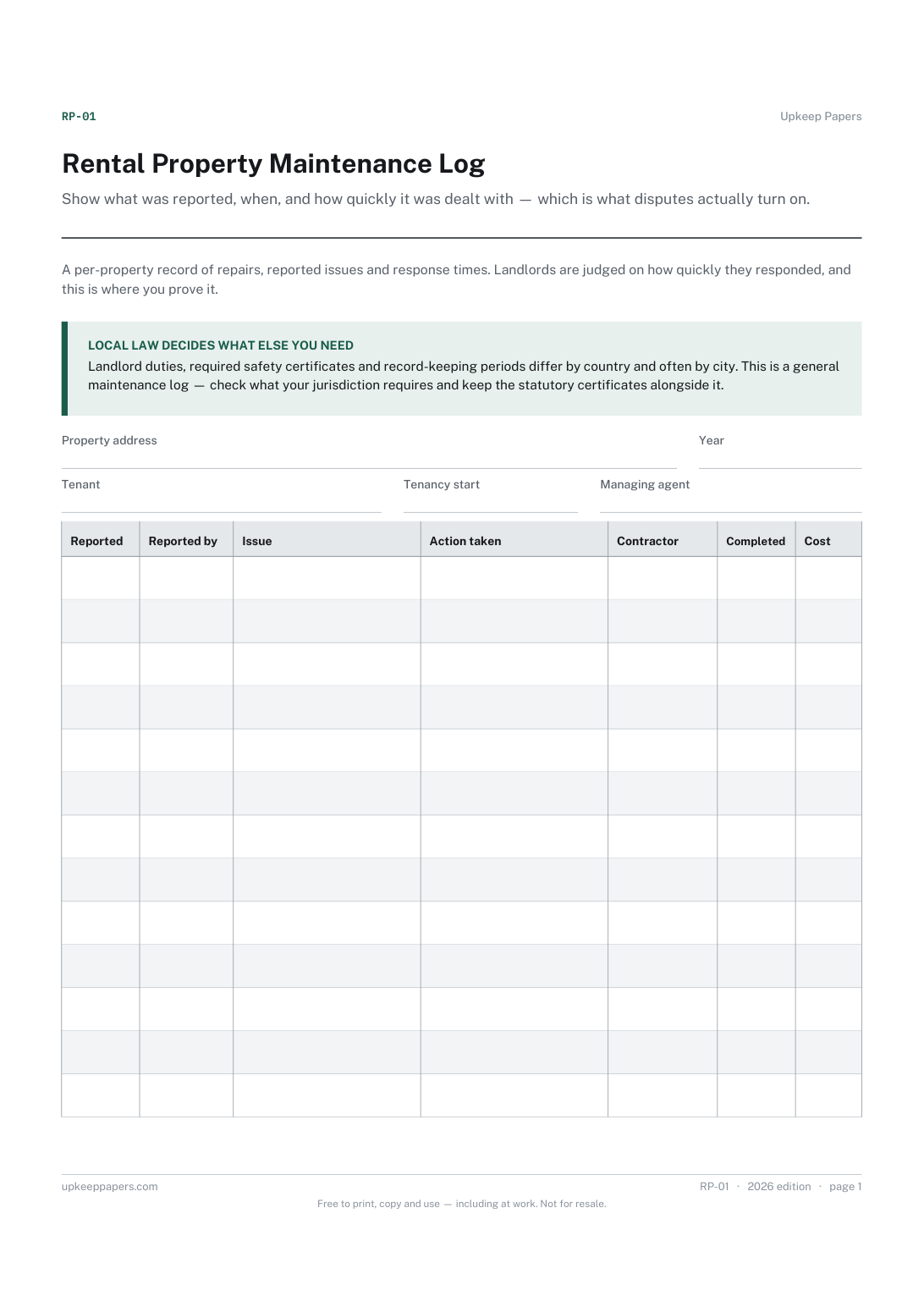
Show what was reported, when, and how quickly it was dealt with — which is what disputes actually turn on.
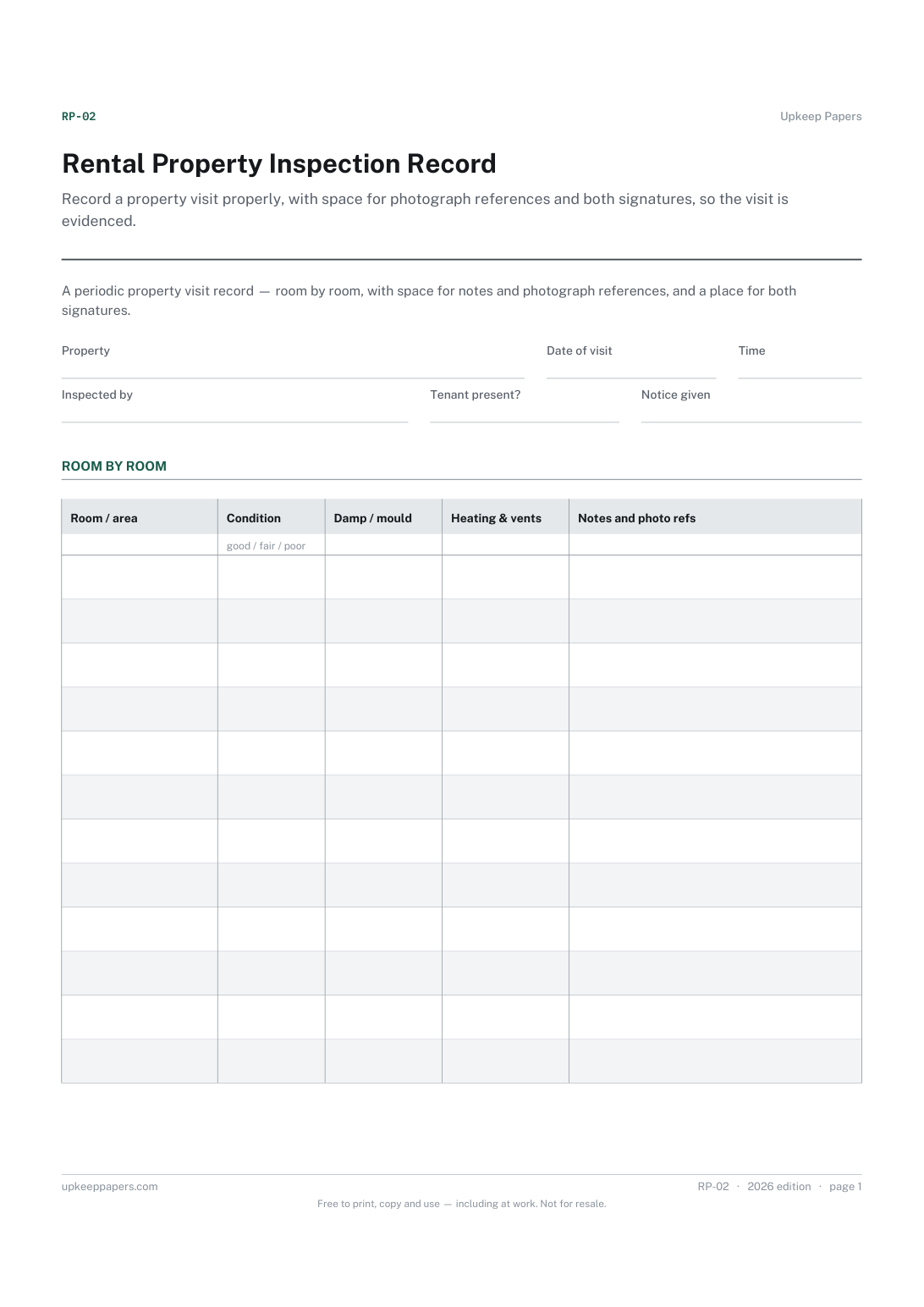
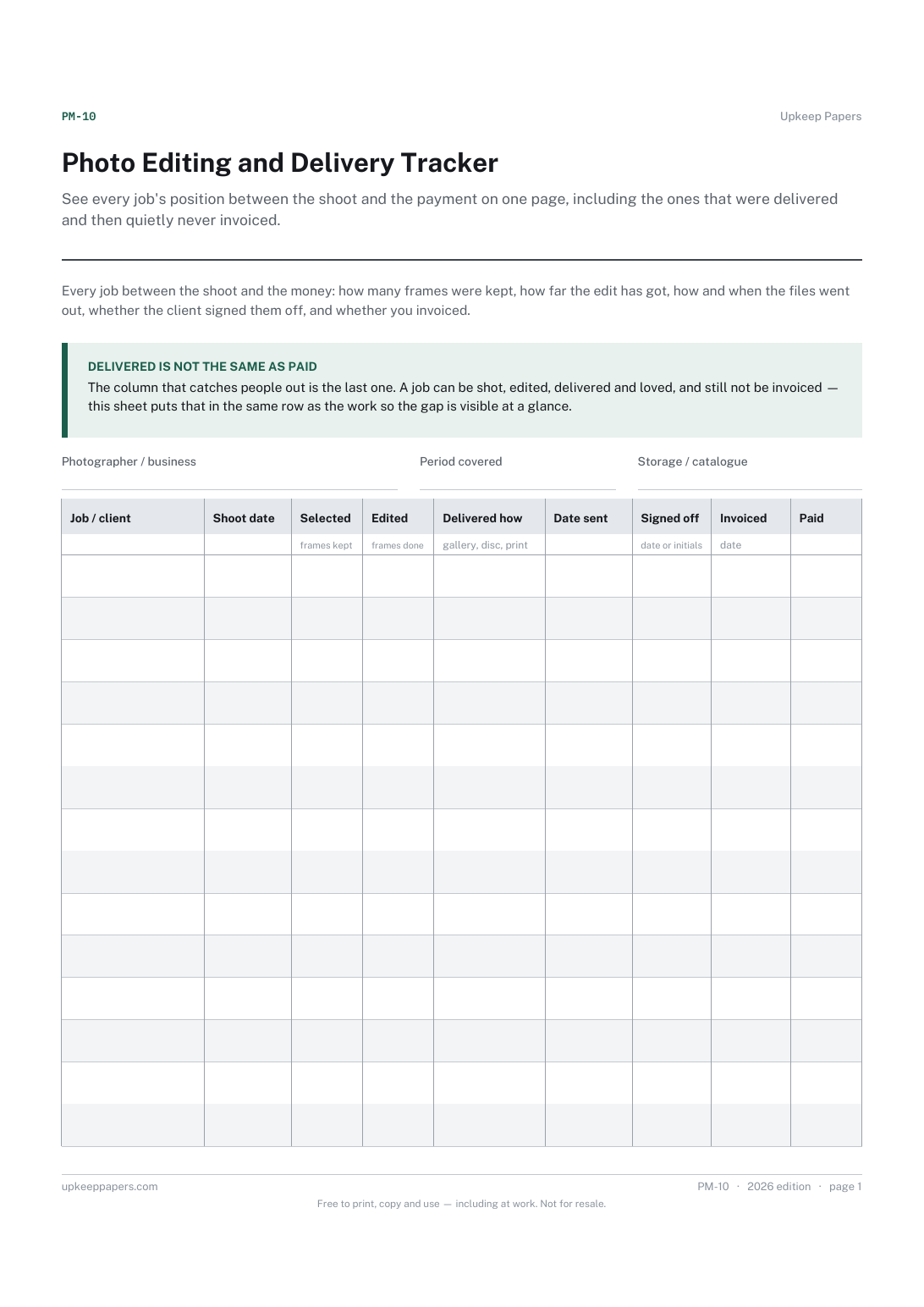
Record a property visit properly, with space for photograph references and both signatures, so the visit is evidenced.
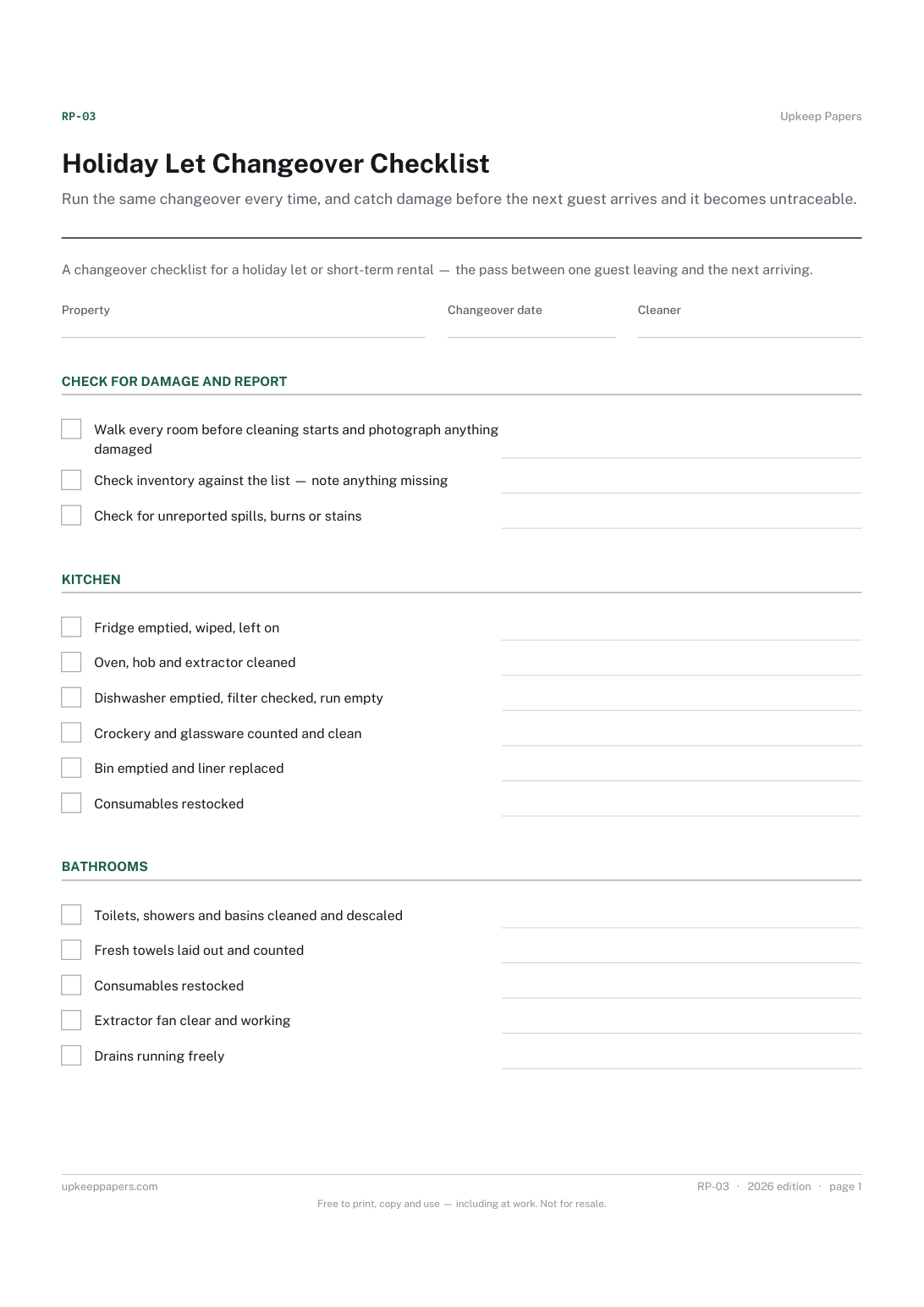
Run the same changeover every time, and catch damage before the next guest arrives and it becomes untraceable.
Record a mid-tenancy inspection properly, separating what you need to repair from what the tenant needs to address, with the notice you gave written at the top.
Keep a simple register of who stayed and when, in a form you can produce if somebody asks for it.
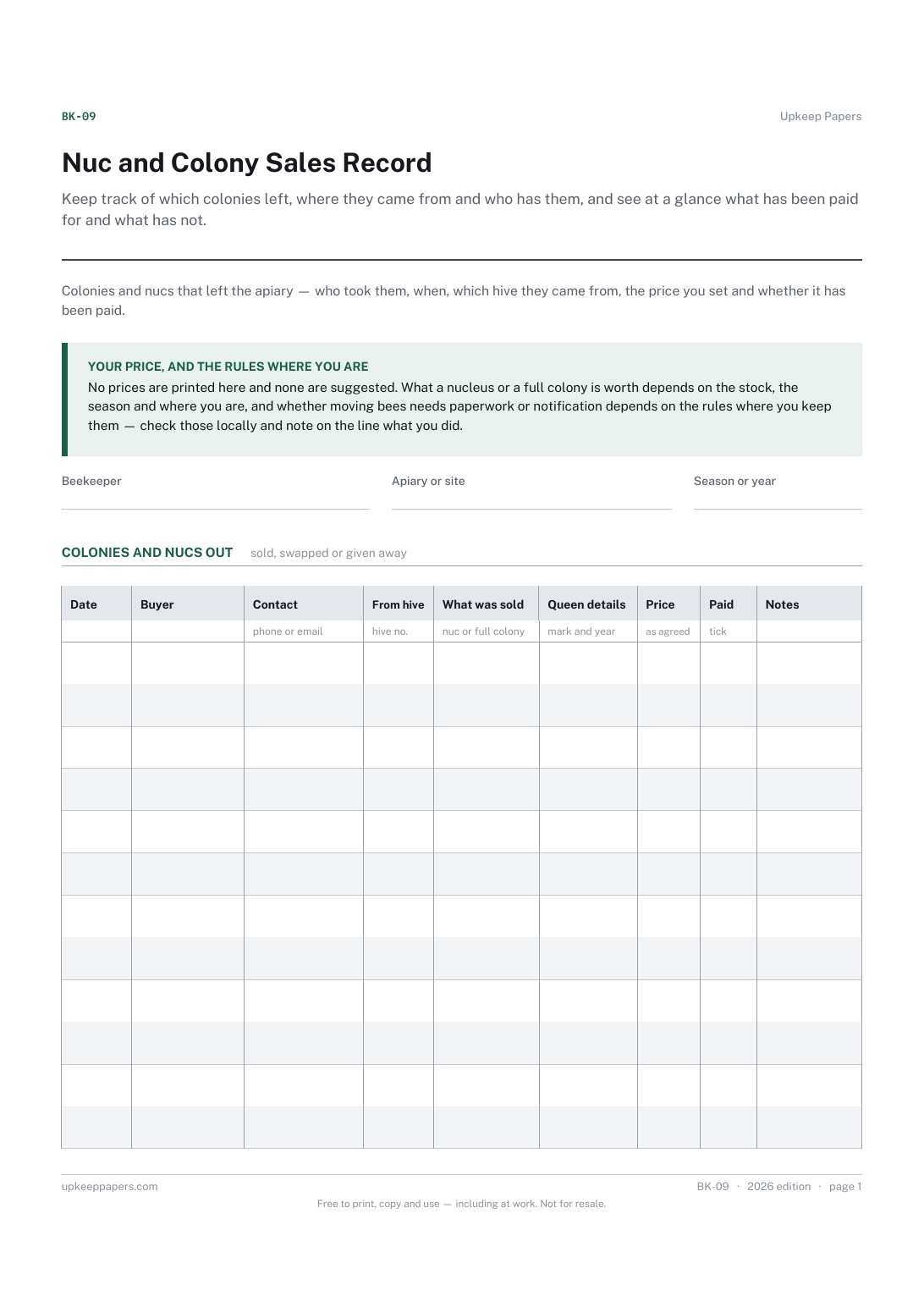
Settle an arrears question with a document rather than a memory, and hand an accountant something that already adds up.
Give a tenant paying in cash the proof they have no other way of holding, and keep a matching record yourself.
Have the details you need in an emergency, rather than discovering the only phone number you hold is the one that is not answering.
Make each deduction defensible by writing down the reason, the amount and where the photograph or invoice is at the time you make it.
Establish what the property was like on day one, in a document both sides signed, so the end of the tenancy is not an argument from memory.
Compare like with like at the end of a tenancy, so any deduction rests on a documented difference rather than an impression.
Know how many keys exist and where they are, so you can tell whether a lock actually needs changing.
Record the date something was reported as well as the date it was fixed, which is the pair of dates that actually matters.
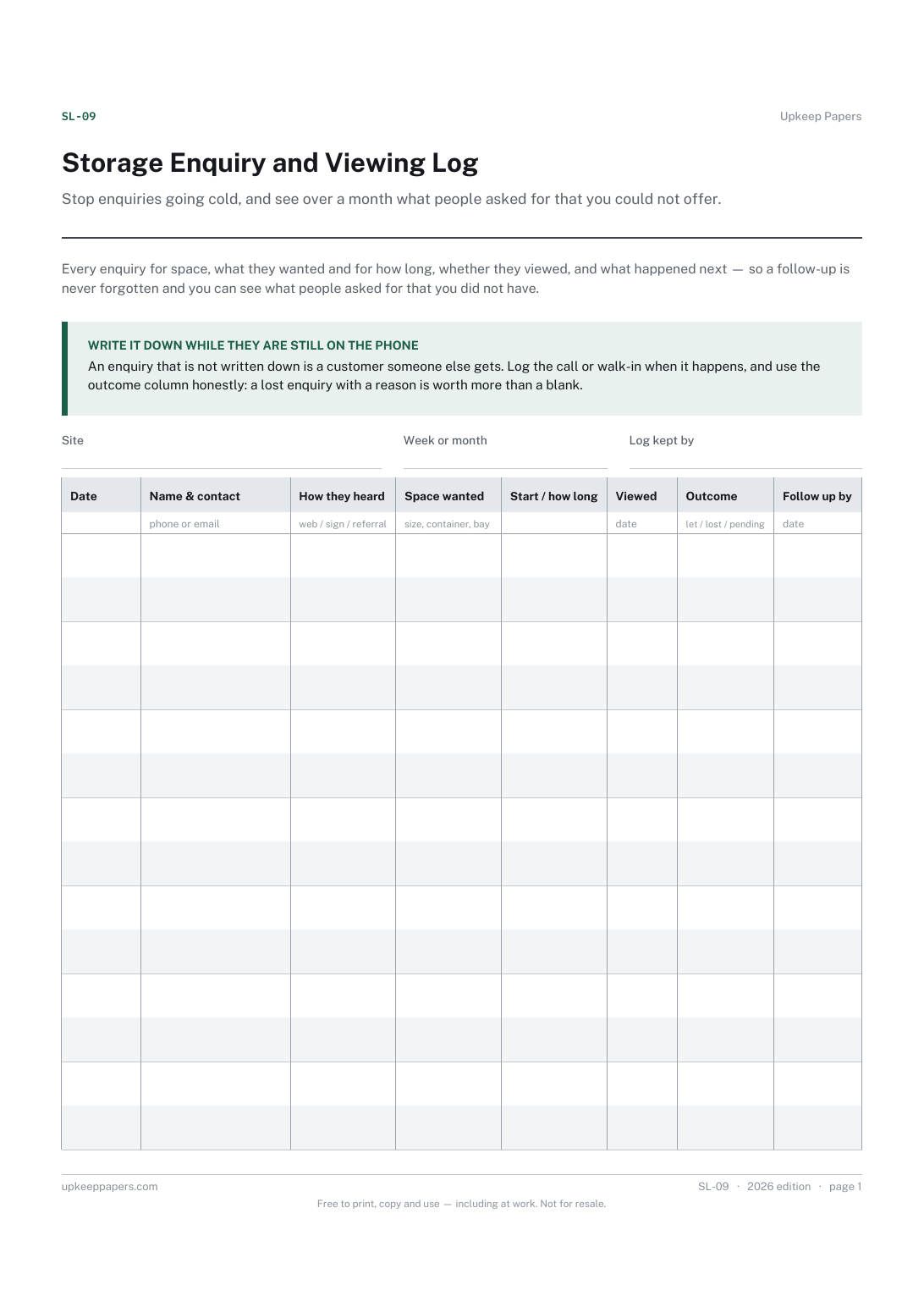
Keep every enquiry for a property in one place, so nobody promising gets forgotten and nobody gets chased twice.
Keep the front page of a property file, so somebody taking it over tomorrow would know what they had.
Arrive at the year end with a total and a filed set of receipts instead of a shoebox and an afternoon.
Stop the dates that matter arriving unannounced, by writing them down in one place with the interval you have decided on.
Vaccination and health records, sitter instructions and the emergency details somebody else would need if you were not there.
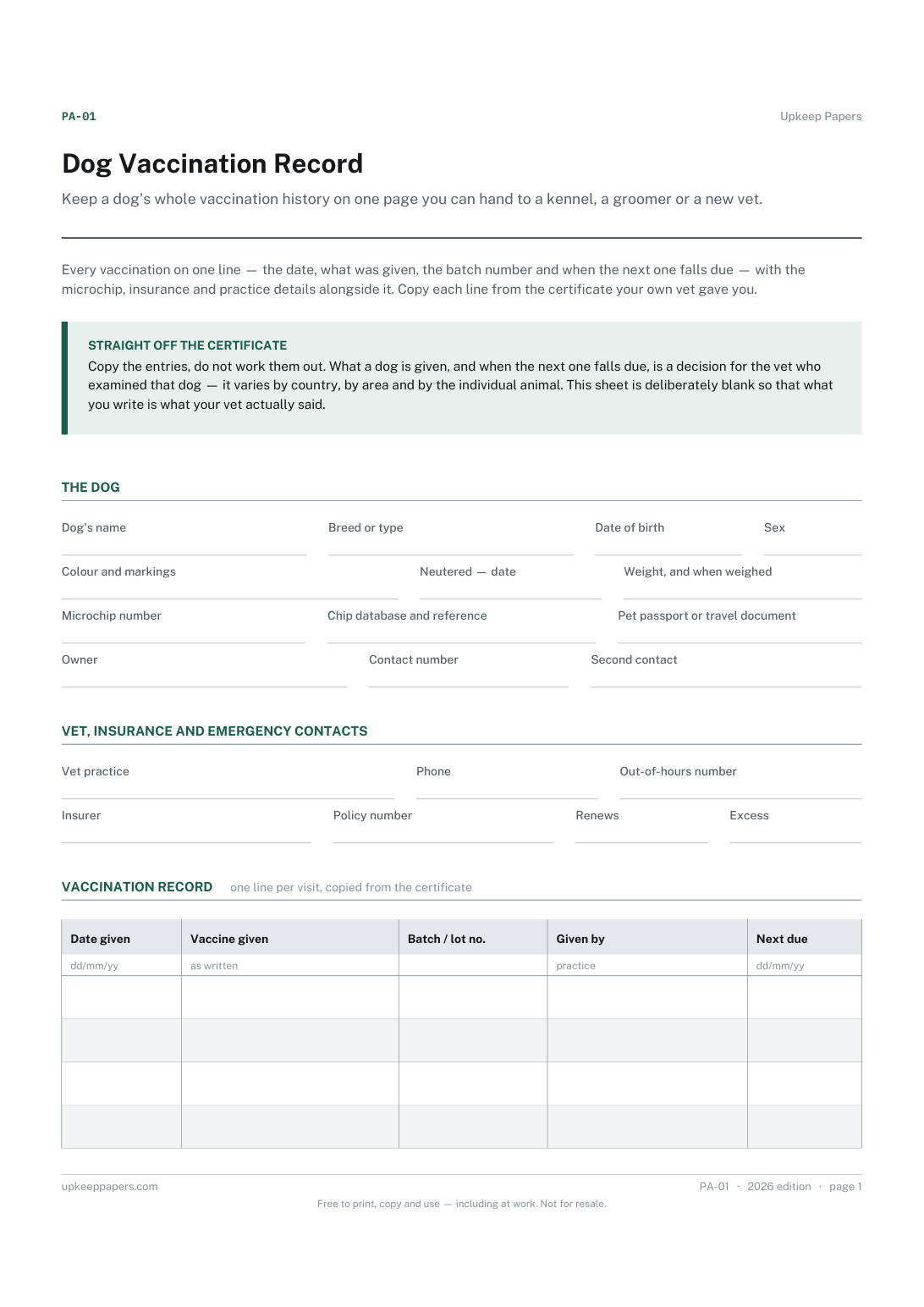
Keep a dog's whole vaccination history on one page you can hand to a kennel, a groomer or a new vet. It carries the microchip and insurance details you are always asked for at the same moment.
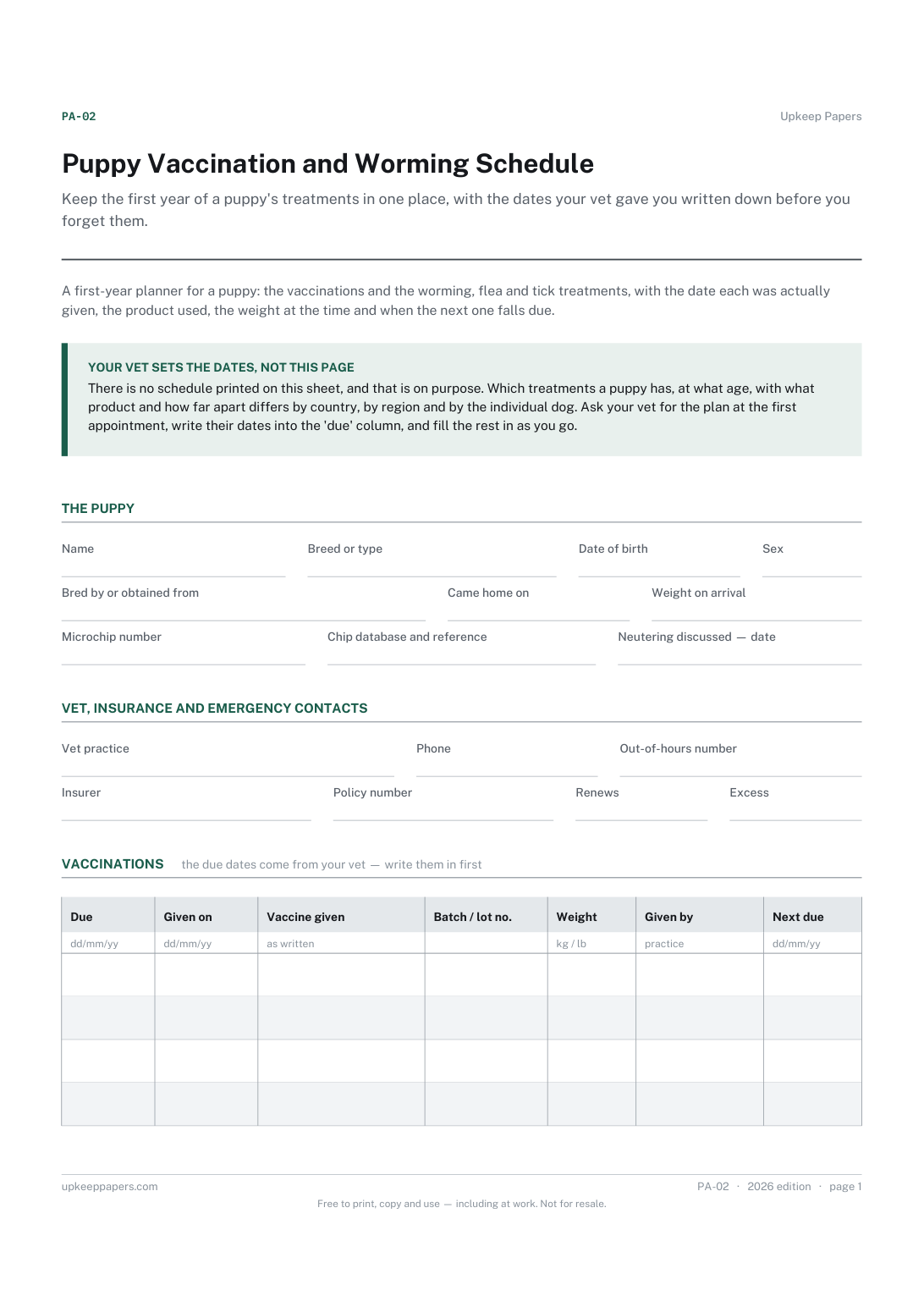
Keep the first year of a puppy's treatments in one place, with the dates your vet gave you written down before you forget them. The weight at each treatment is worth recording too, because a puppy's changes week to week and nobody remembers it afterwards.
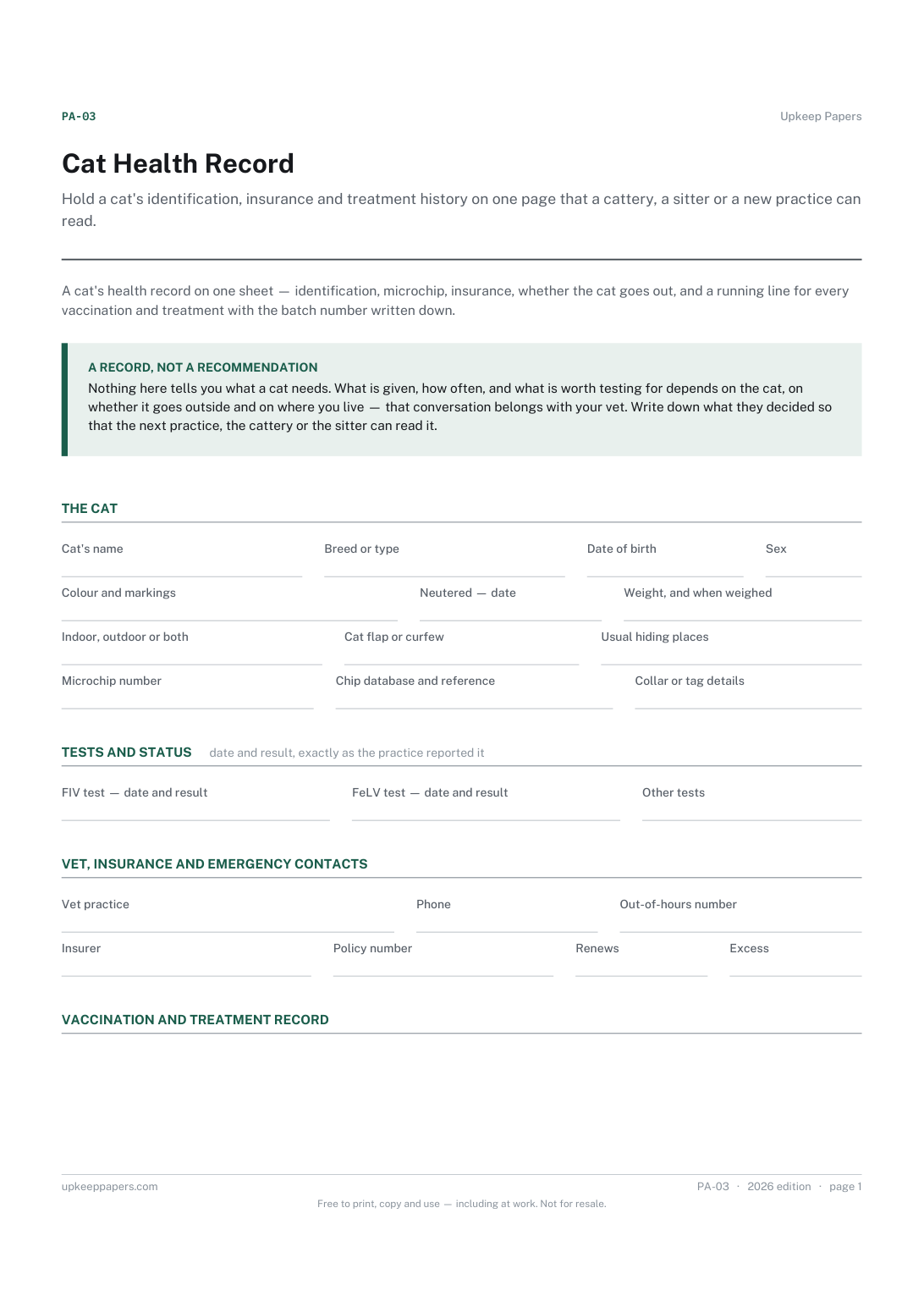
Hold a cat's identification, insurance and treatment history on one page that a cattery, a sitter or a new practice can read. It has room for the things that are specific to cats and get left off general pet forms.
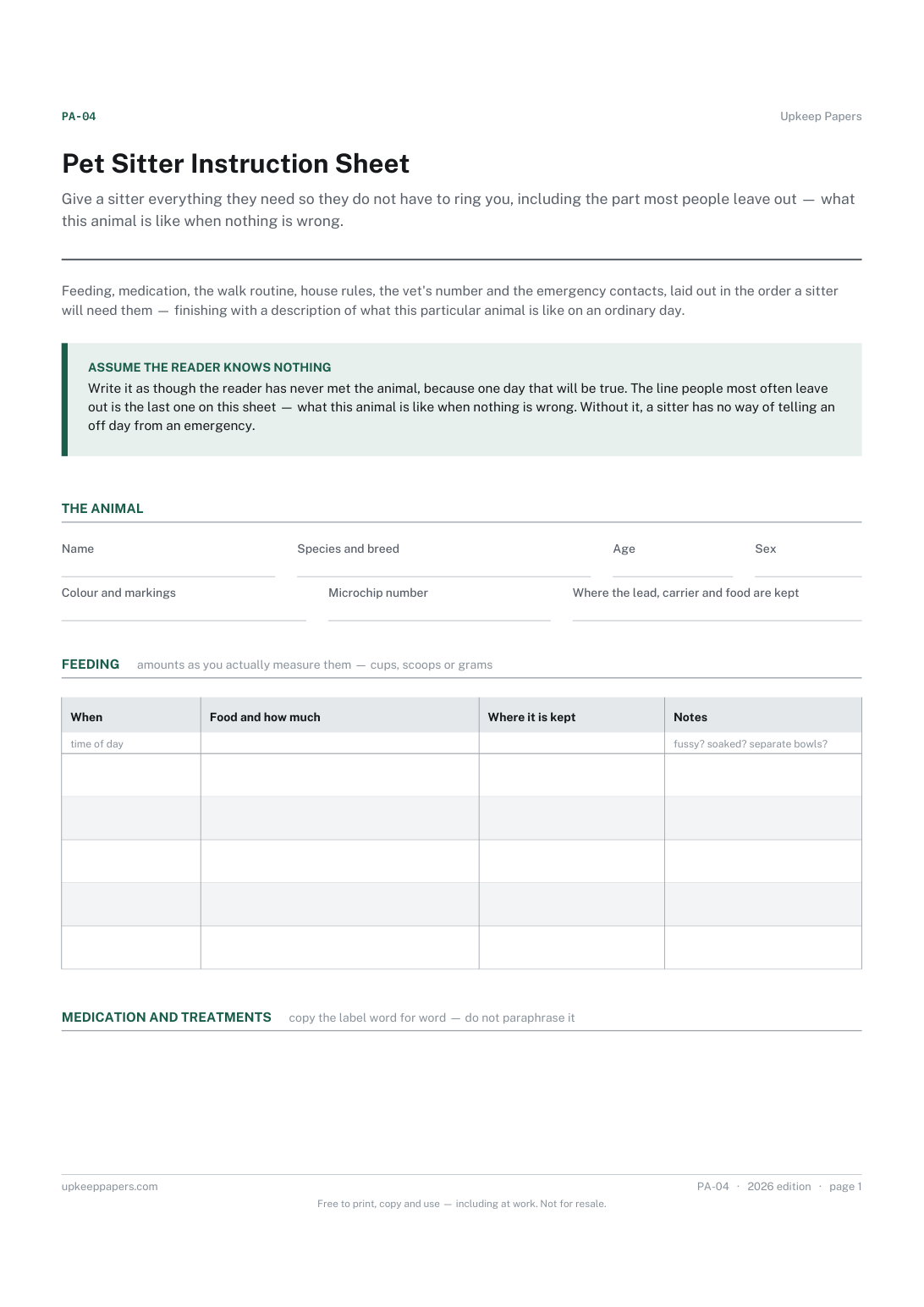
Give a sitter everything they need so they do not have to ring you, including the part most people leave out — what this animal is like when nothing is wrong.
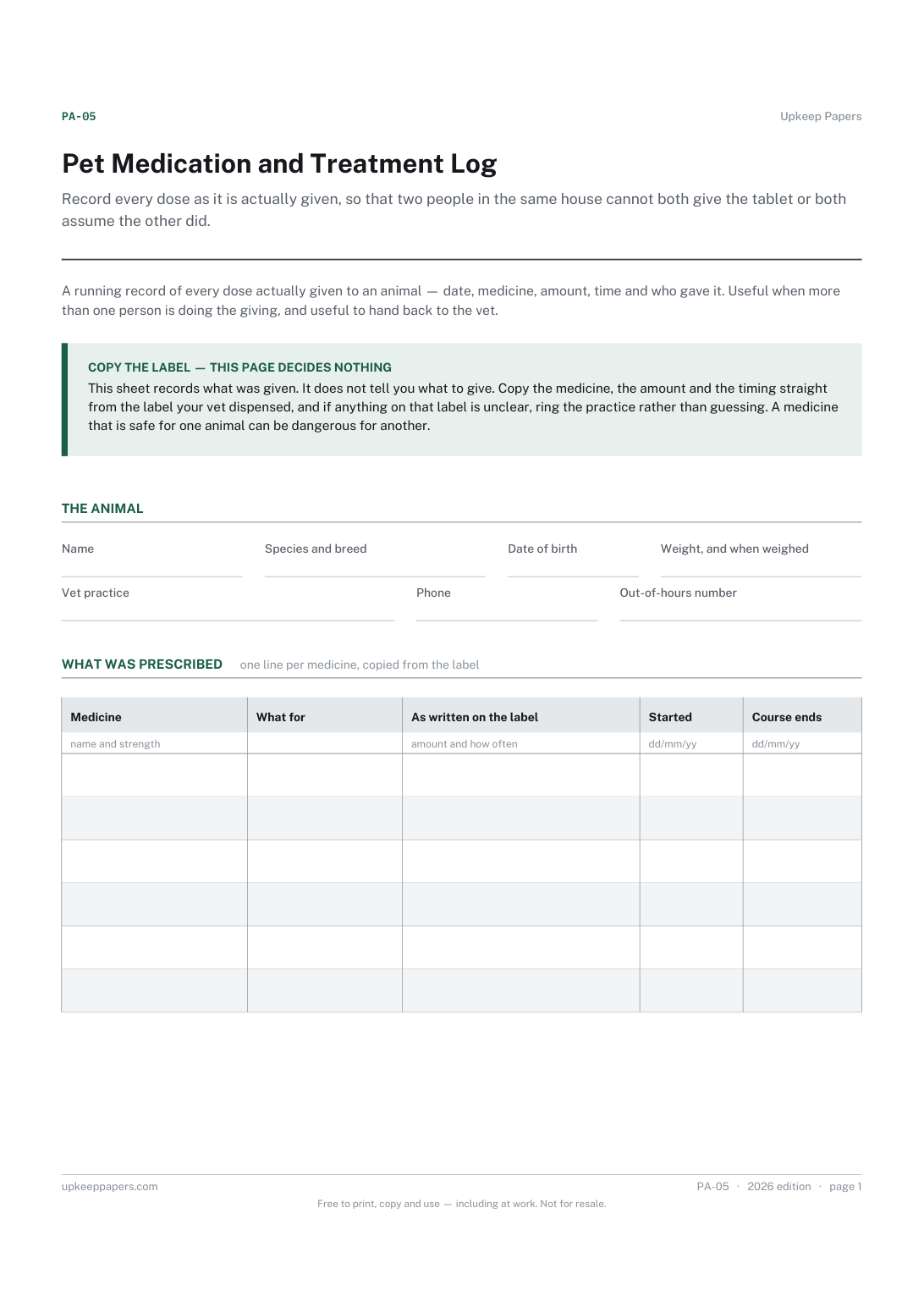
Record every dose as it is actually given, so that two people in the same house cannot both give the tablet or both assume the other did. It also gives your vet something factual to read at the follow-up.
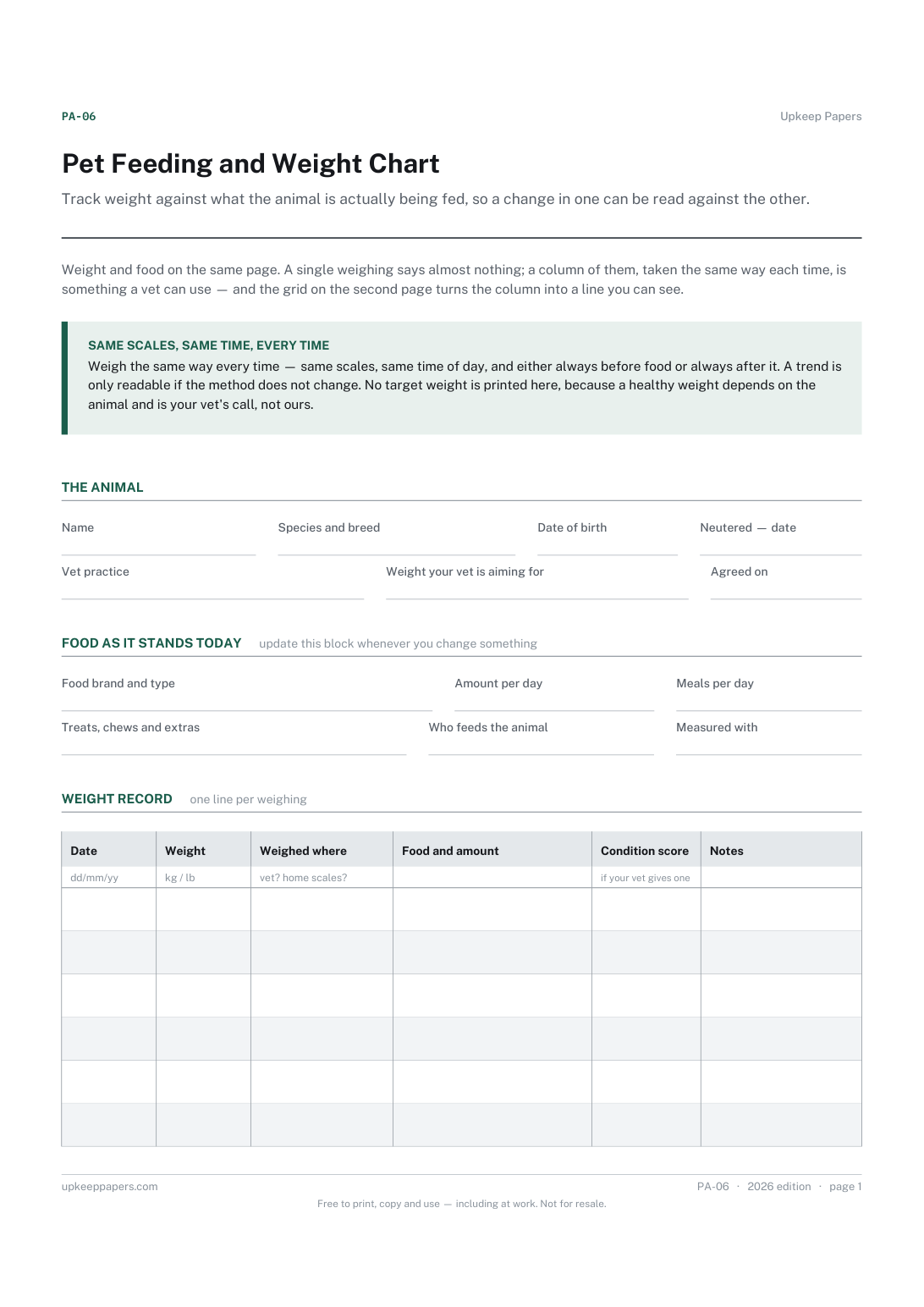
Track weight against what the animal is actually being fed, so a change in one can be read against the other. A single weighing tells you very little; a column of them taken the same way each time is something a vet can use.
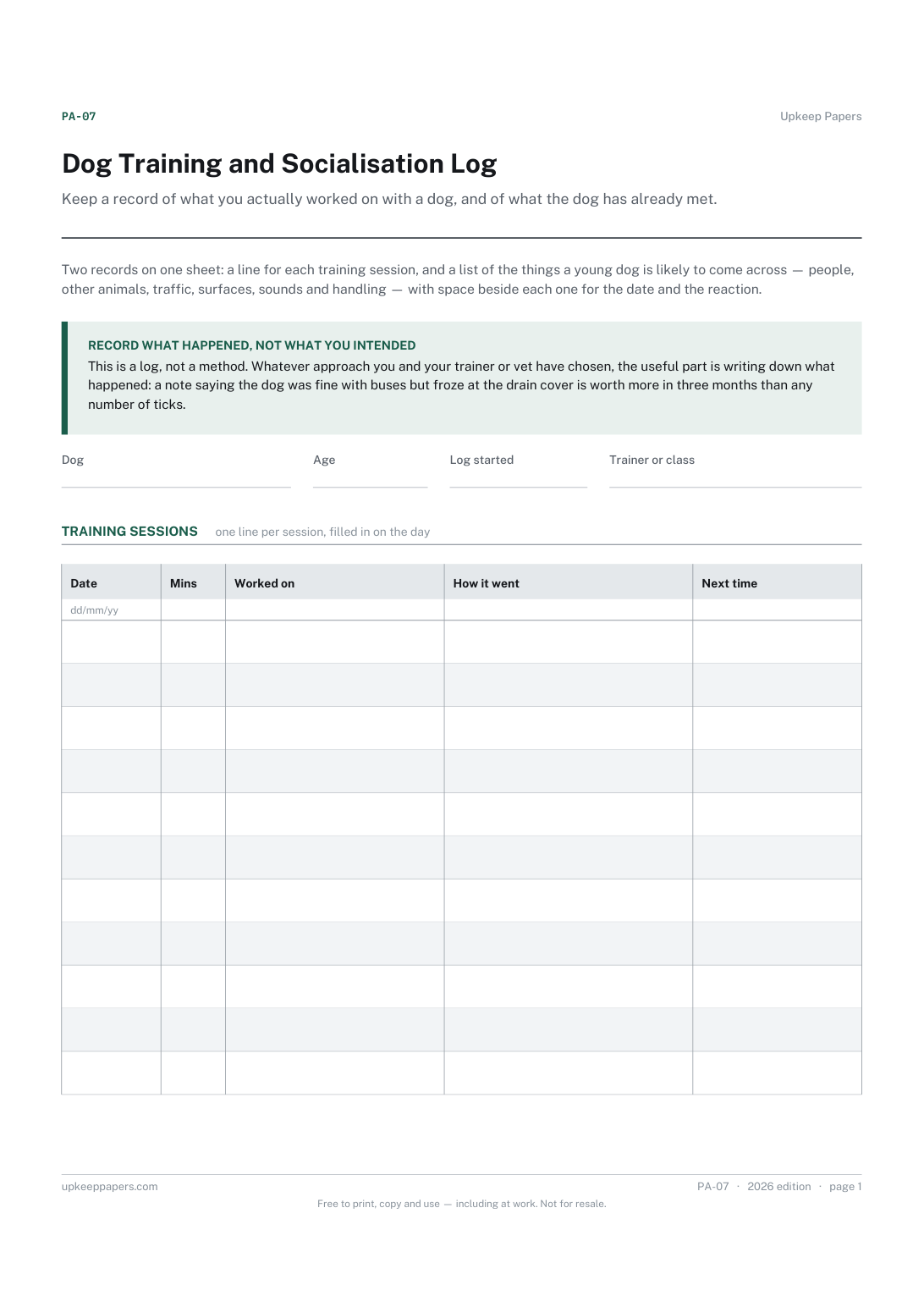
Keep a record of what you actually worked on with a dog, and of what the dog has already met. The notes column is the point — a reaction written down at the time is worth more later than a tick.
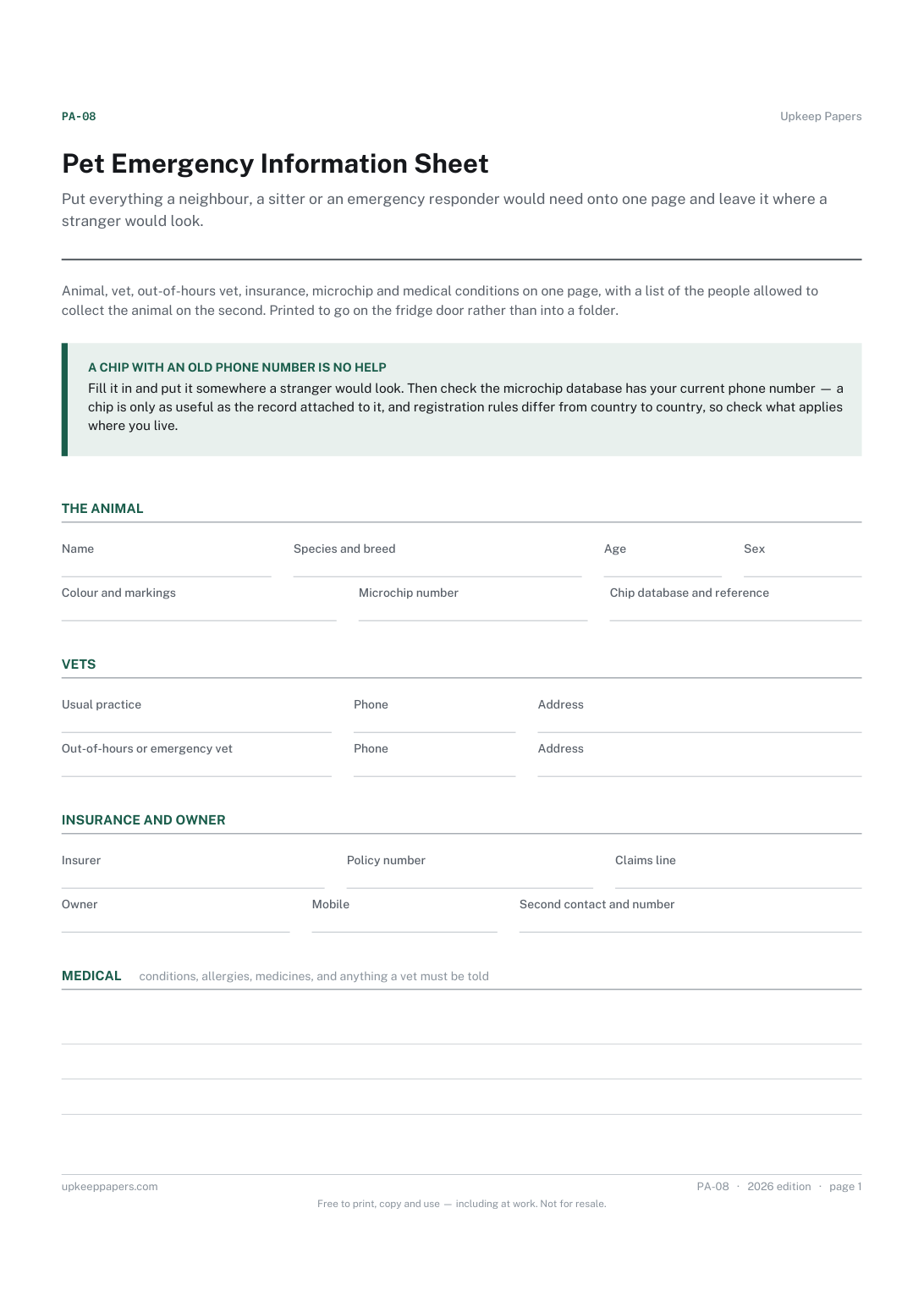
Put everything a neighbour, a sitter or an emergency responder would need onto one page and leave it where a stranger would look. It answers the questions that get asked when you are not there to be asked.
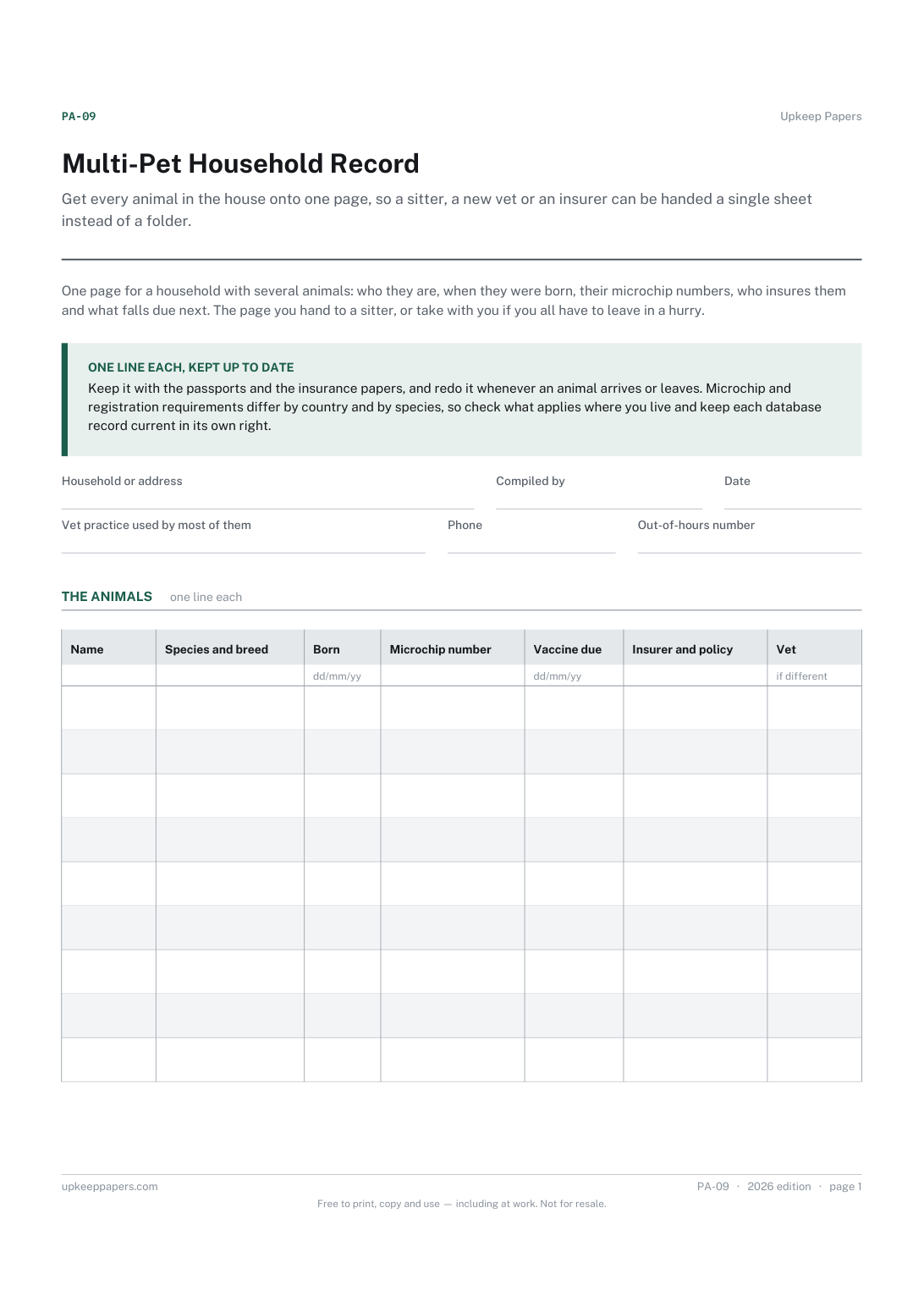
Get every animal in the house onto one page, so a sitter, a new vet or an insurer can be handed a single sheet instead of a folder. It also carries the feeding and medication detail that stops the wrong bowl going to the wrong animal.
Know exactly which animal is with which carer, on what conditions, with what kit, and what has happened to it since — on a sheet that goes with the animal and comes back with it.
Catch a cat that has gone off its food or its tray on the second day rather than at collection, and show the owner exactly what happened while they were away.
Do the same groom the owner liked last time without asking them to describe it, and have a written note of what you saw and told them about skin, ears or nails.
Account for every dog, every key and every incident on the round, and hand a regular dog to a different walker without anything being lost.
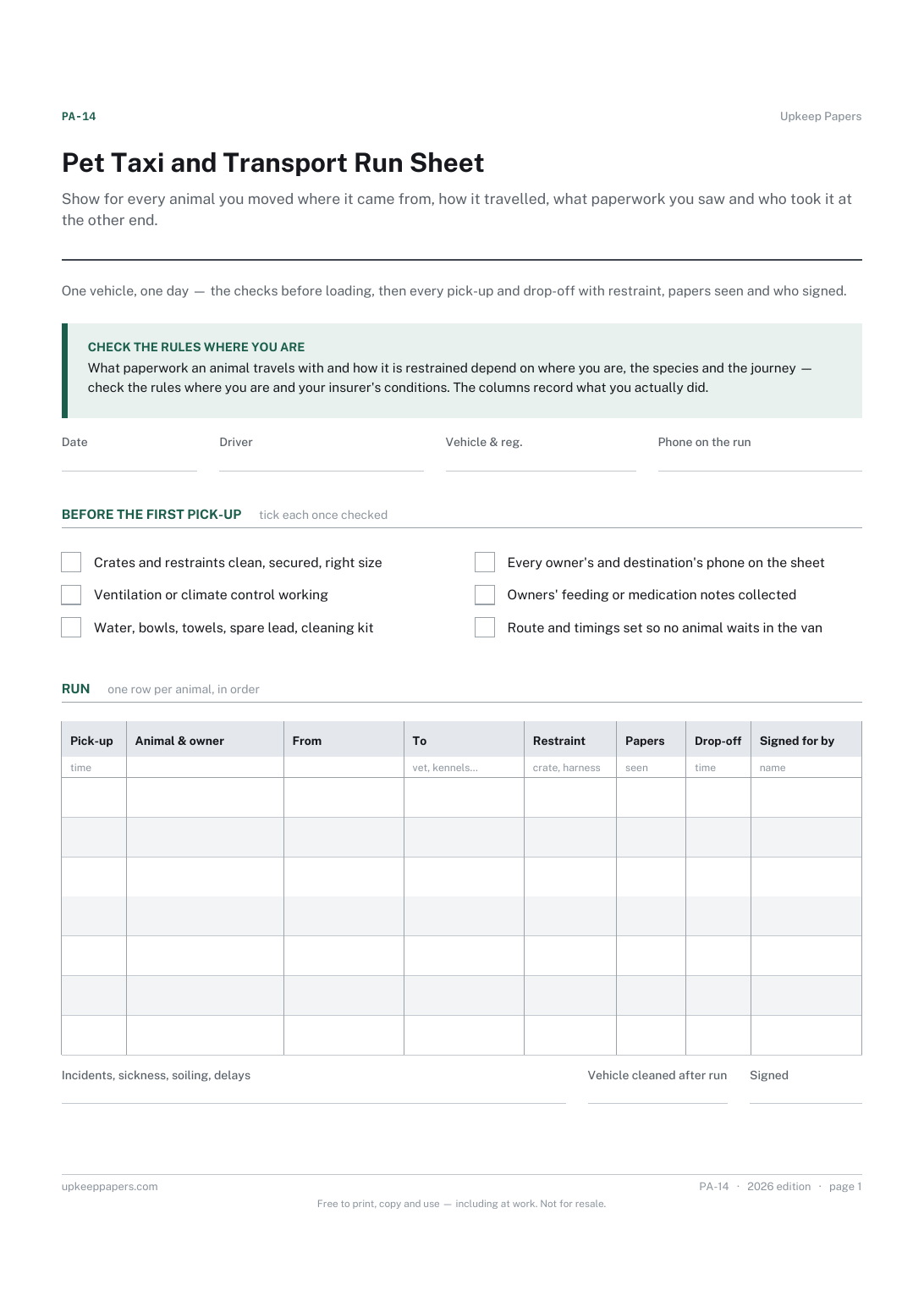
Show for every animal you moved where it came from, how it travelled, what paperwork you saw and who took it at the other end.
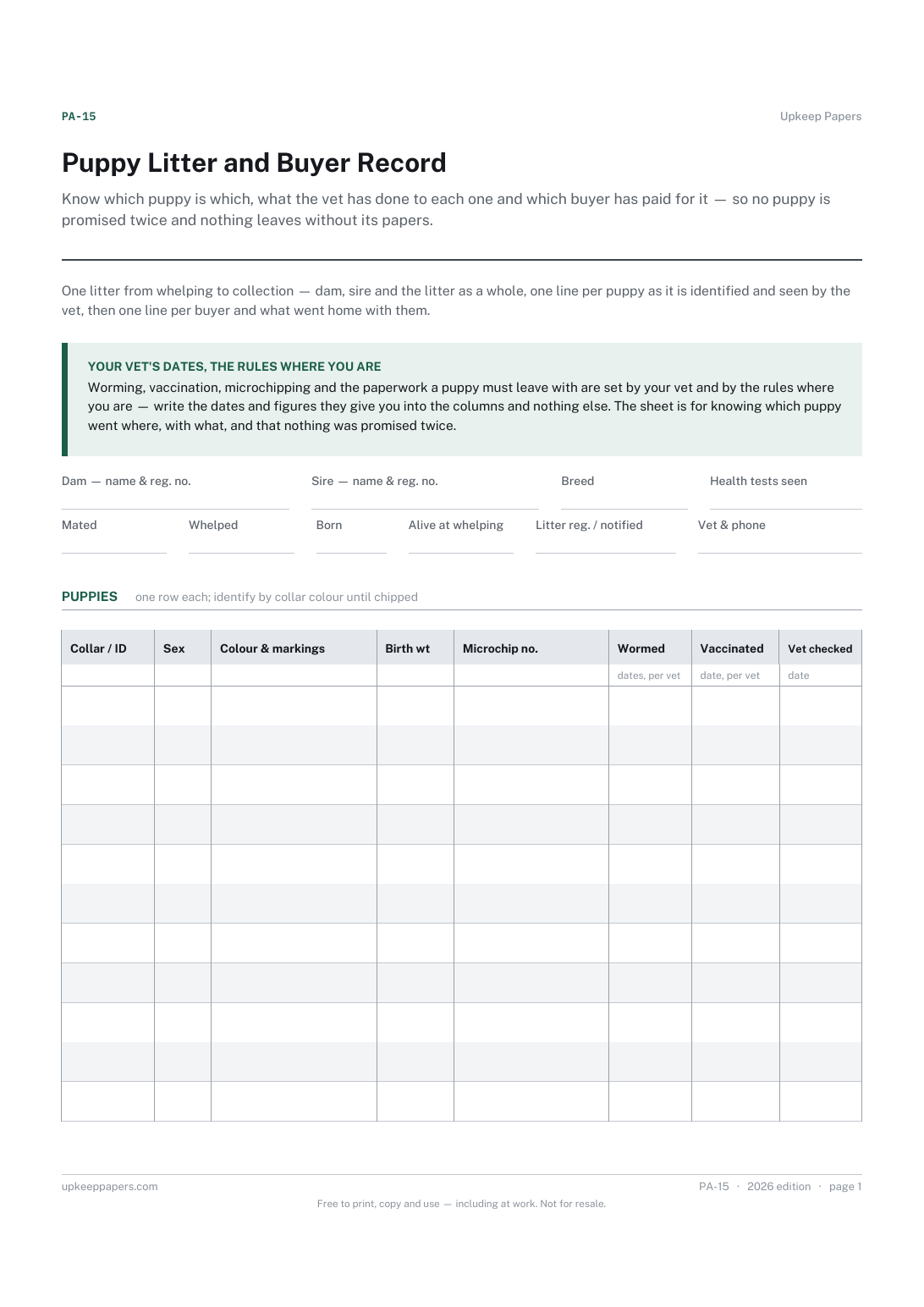
Know which puppy is which, what the vet has done to each one and which buyer has paid for it — so no puppy is promised twice and nothing leaves without its papers.
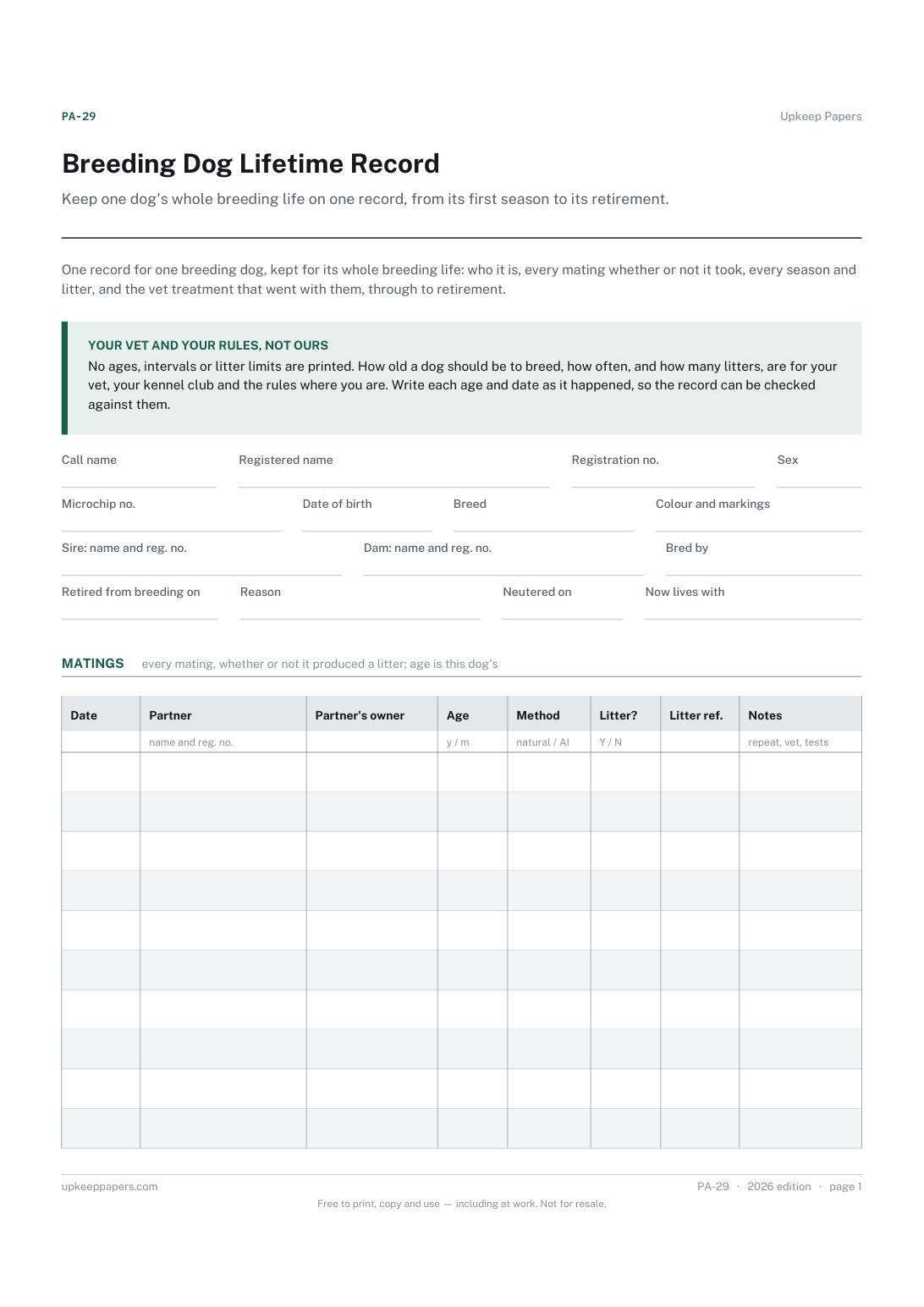
Keep one dog's whole breeding life on one record, from its first season to its retirement. Ages at mating, litters and caesareans are then there to check, not pieced together from memory.
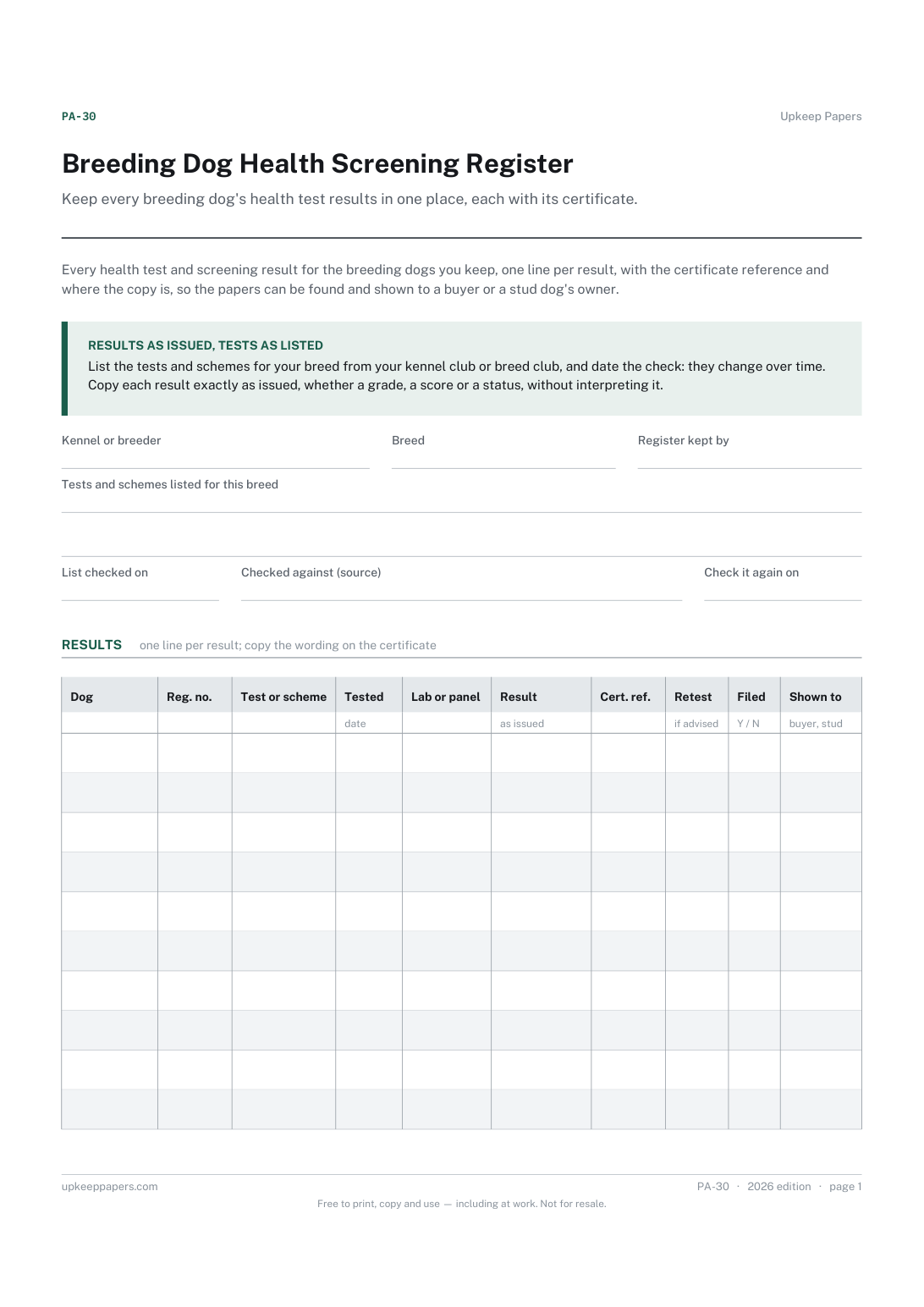
Keep every breeding dog's health test results in one place, each with its certificate. When a buyer or a stud dog's owner asks, the answer is one line away.
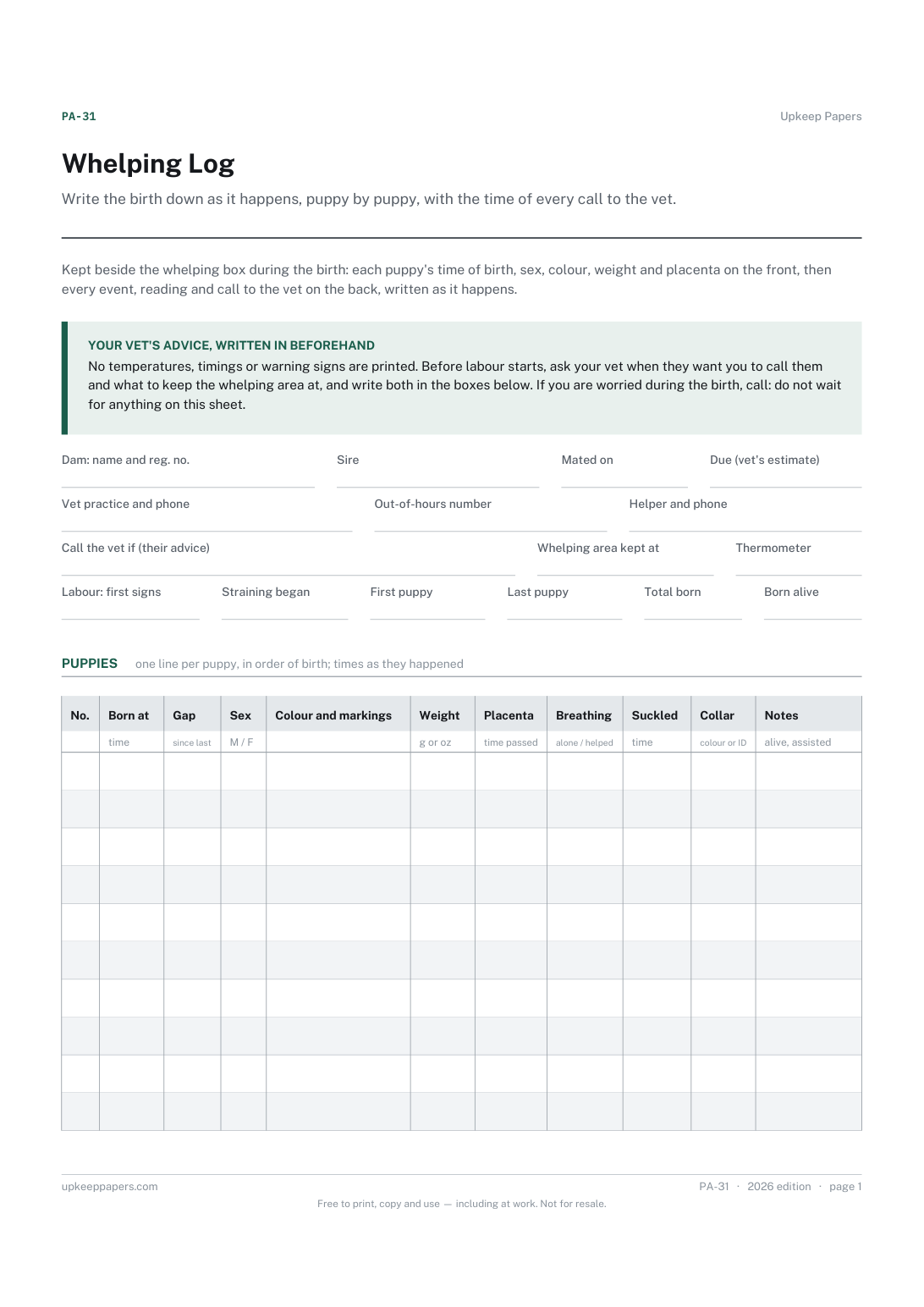
Write the birth down as it happens, puppy by puppy, with the time of every call to the vet. Nothing then has to be remembered later in a tired blur.
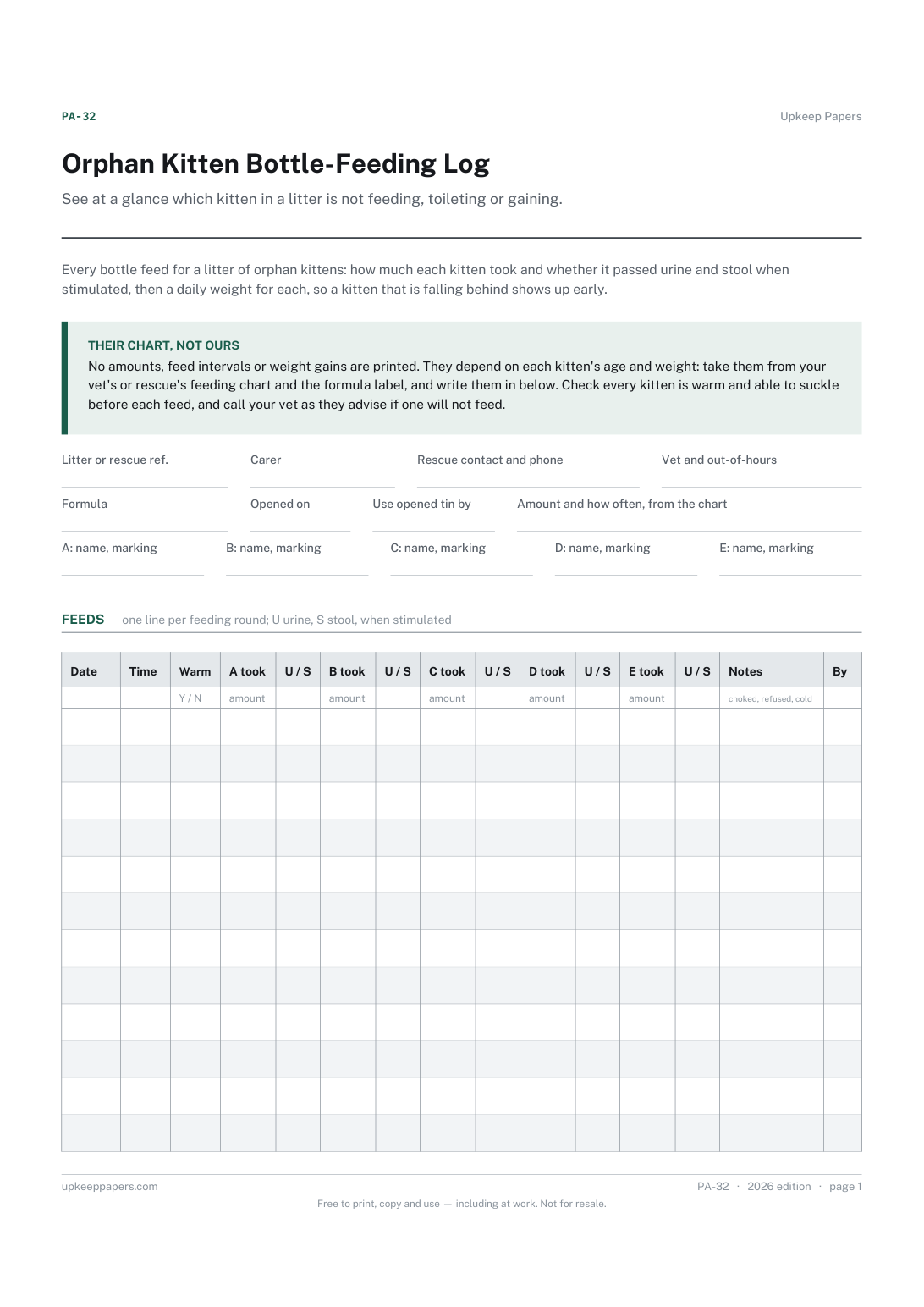
See at a glance which kitten in a litter is not feeding, toileting or gaining. In the first weeks a slow kitten can go downhill quickly.
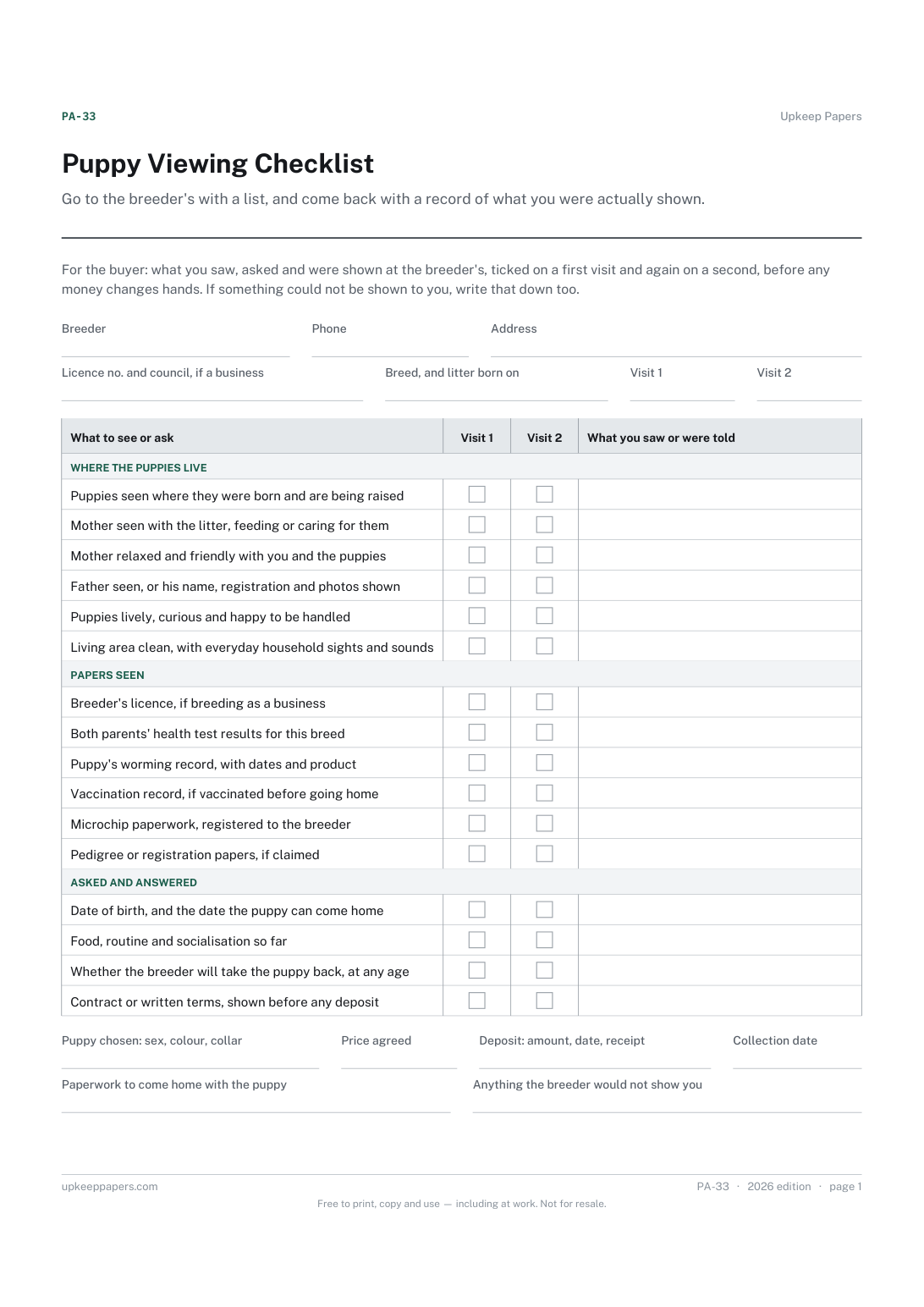
Go to the breeder's with a list, and come back with a record of what you were actually shown. A second visit with the same list shows what changed.
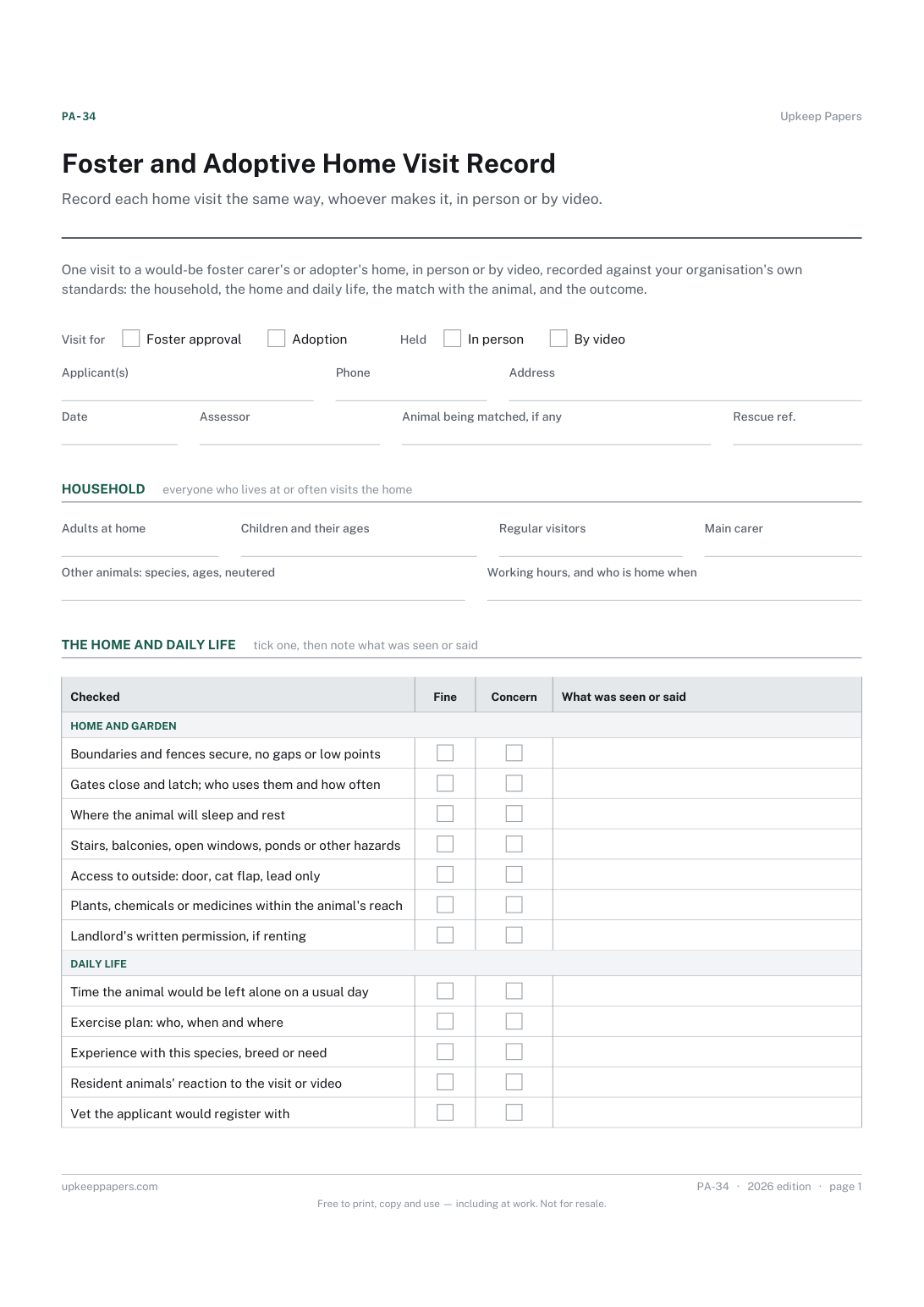
Record each home visit the same way, whoever makes it, in person or by video. The approval then rests on what was seen, written down.
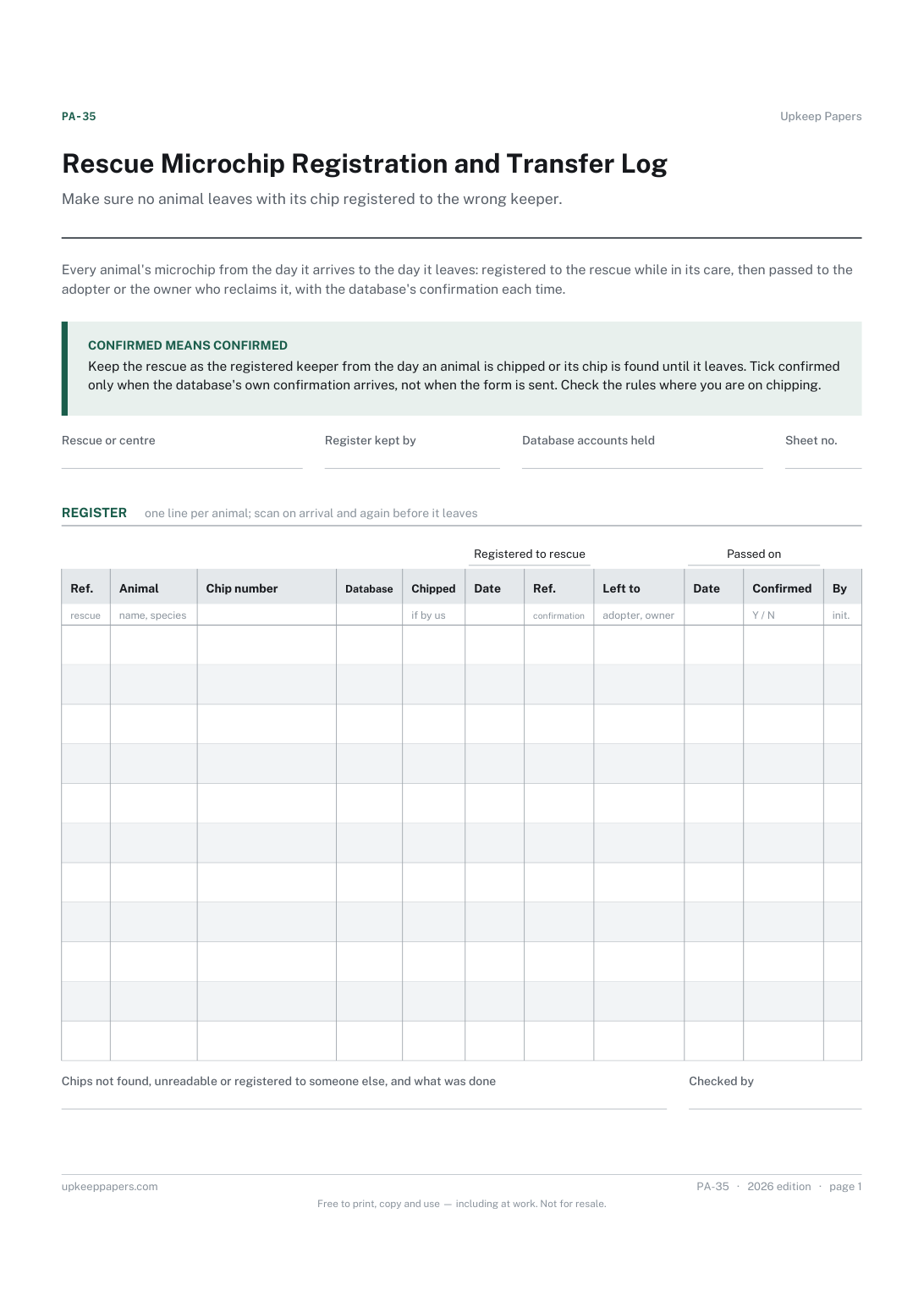
Make sure no animal leaves with its chip registered to the wrong keeper. Every change is dated and confirmed by the database.
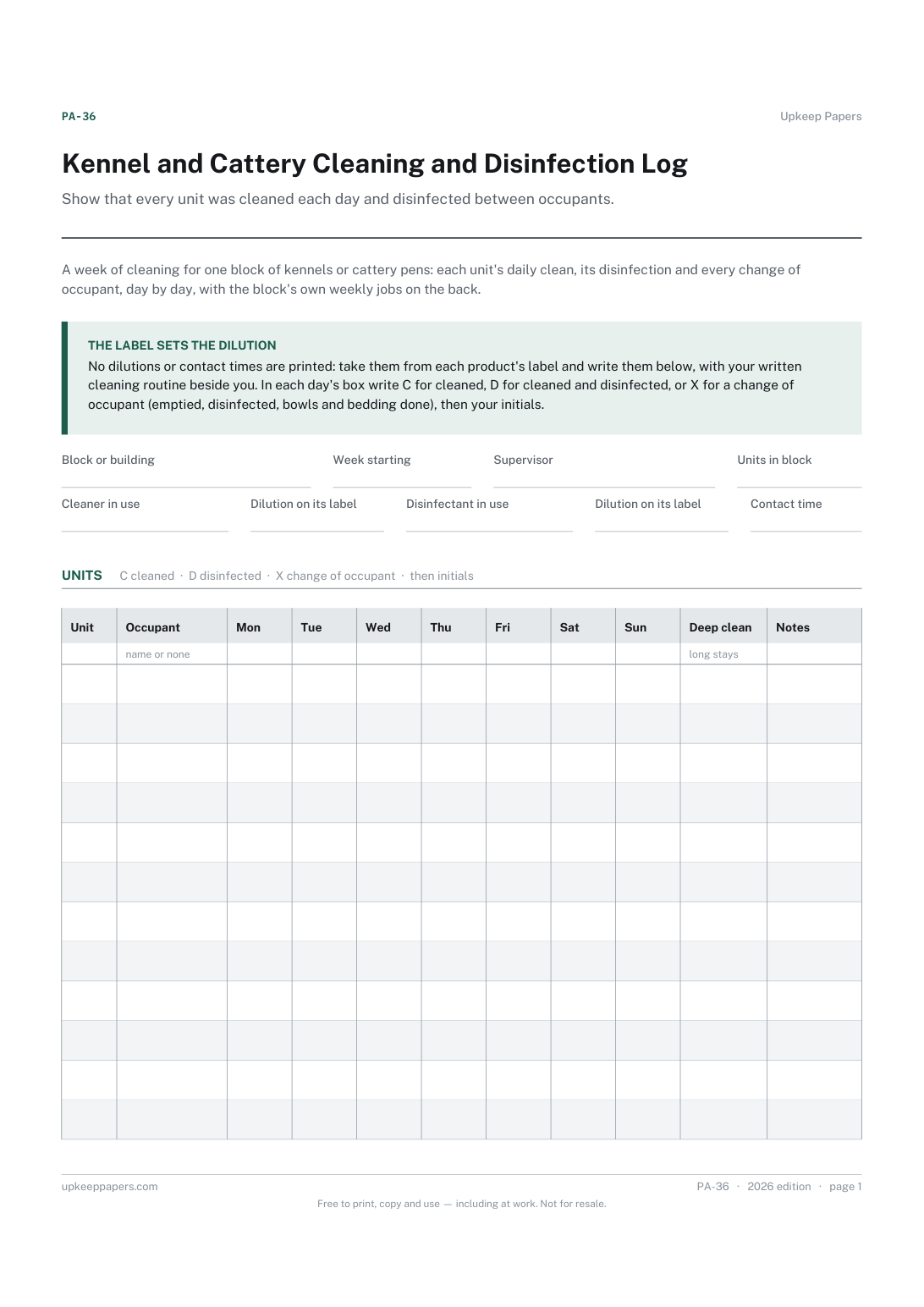
Show that every unit was cleaned each day and disinfected between occupants. The week is on one grid, unit by unit, with the products and their label dilutions.
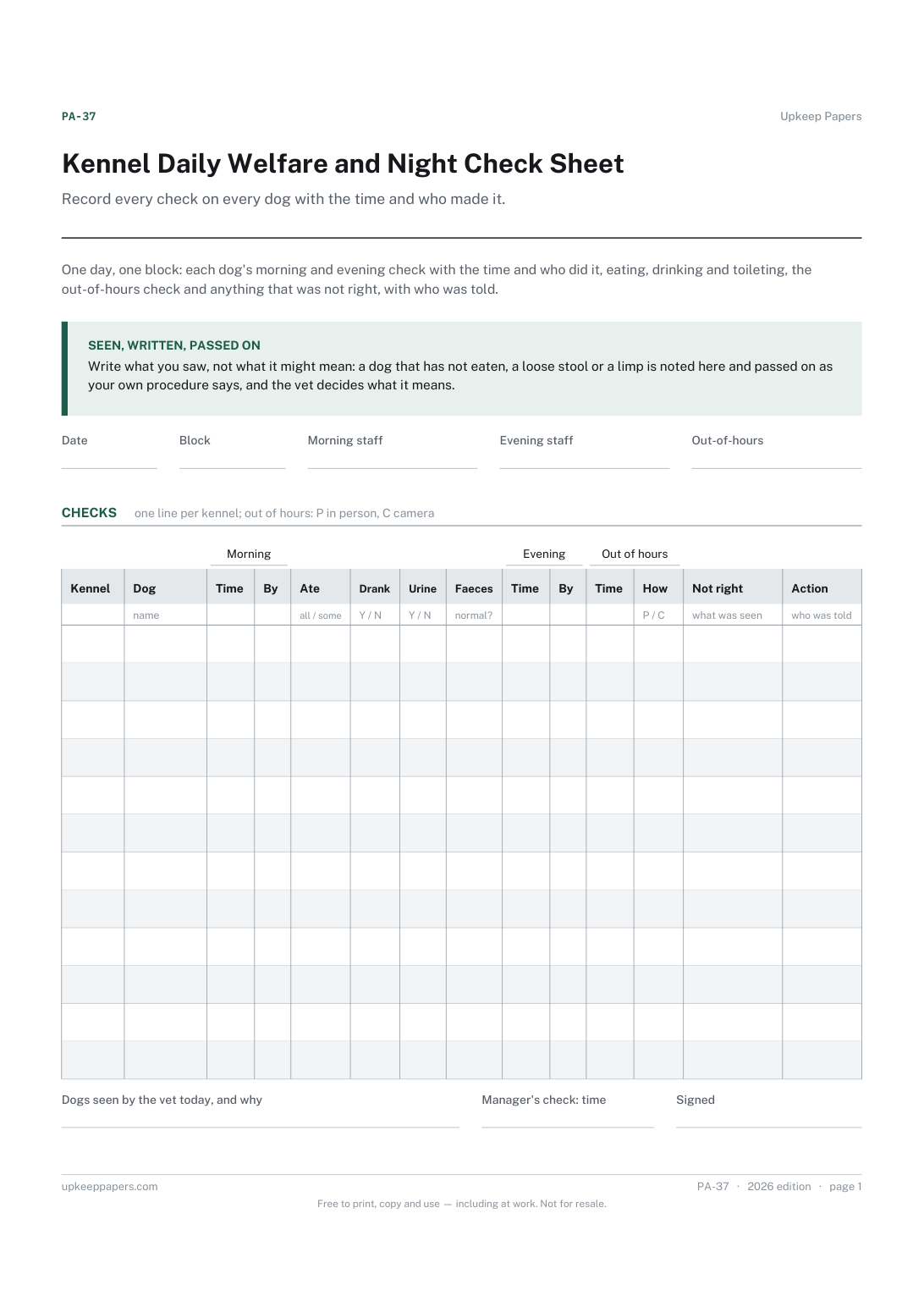
Record every check on every dog with the time and who made it. A dog that has not eaten or has a loose stool is then passed on the same day.
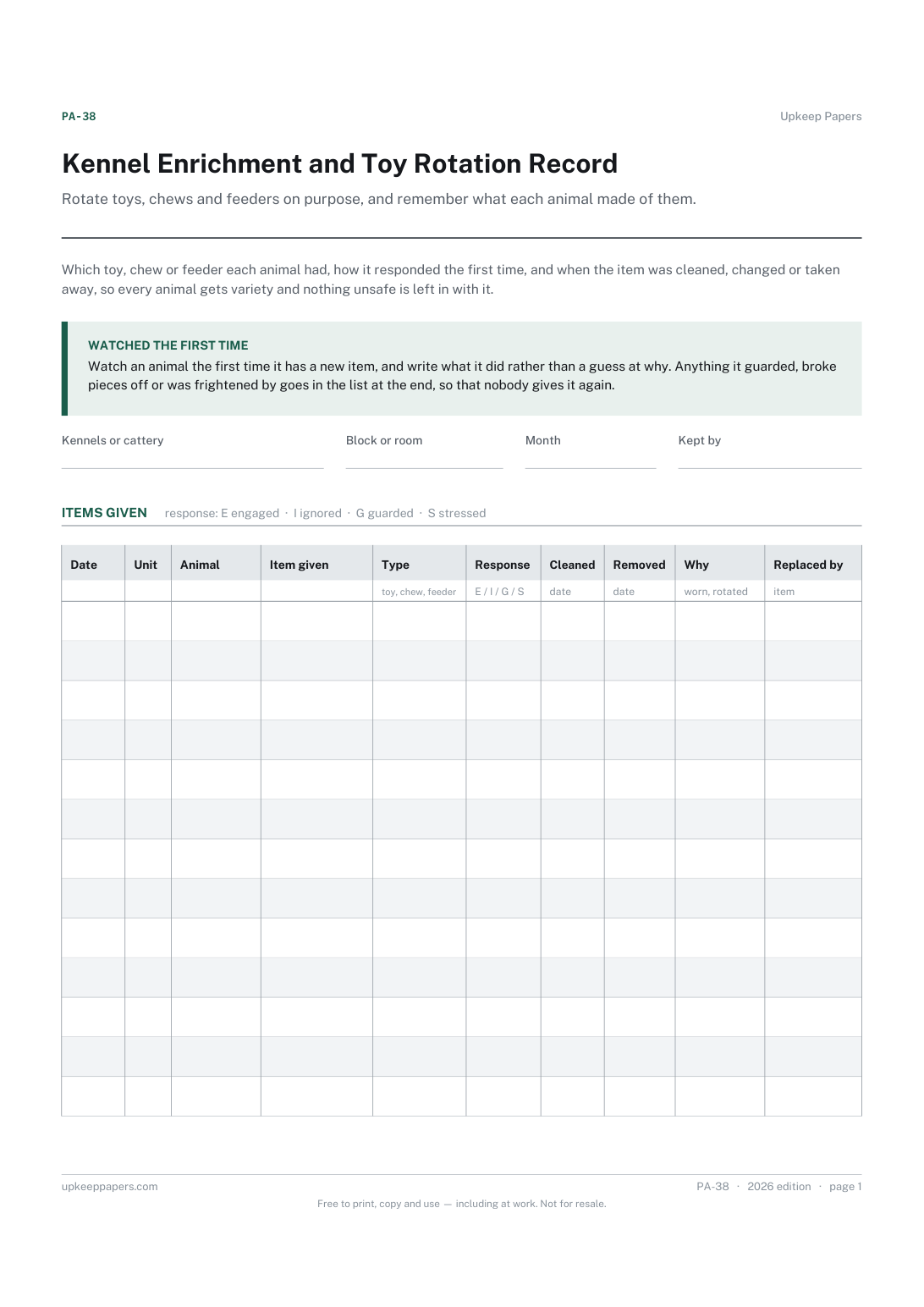
Rotate toys, chews and feeders on purpose, and remember what each animal made of them. Items it guarded or broke are listed so nobody gives them again.
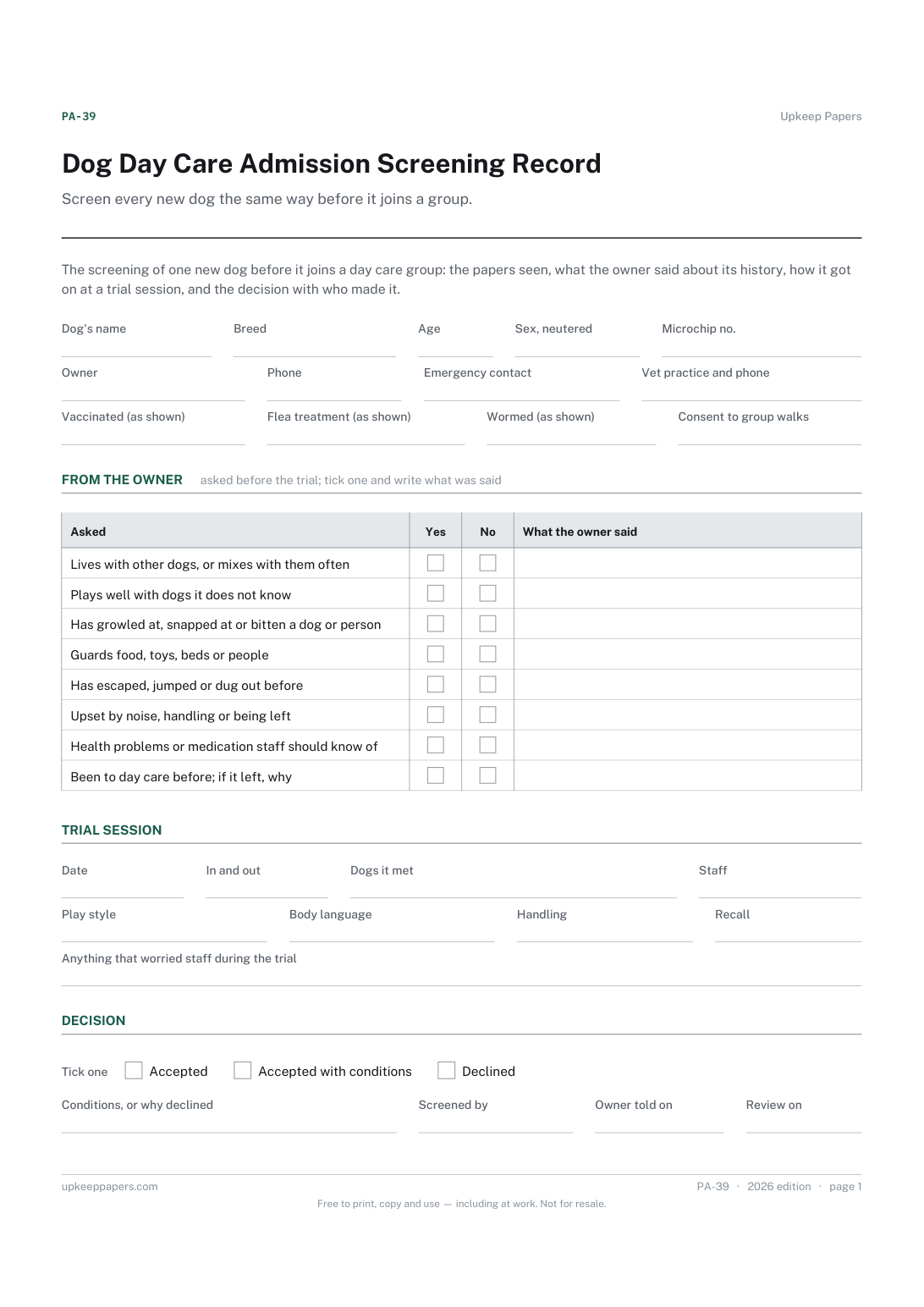
Screen every new dog the same way before it joins a group. The decision and who made it are written down with what it was based on.
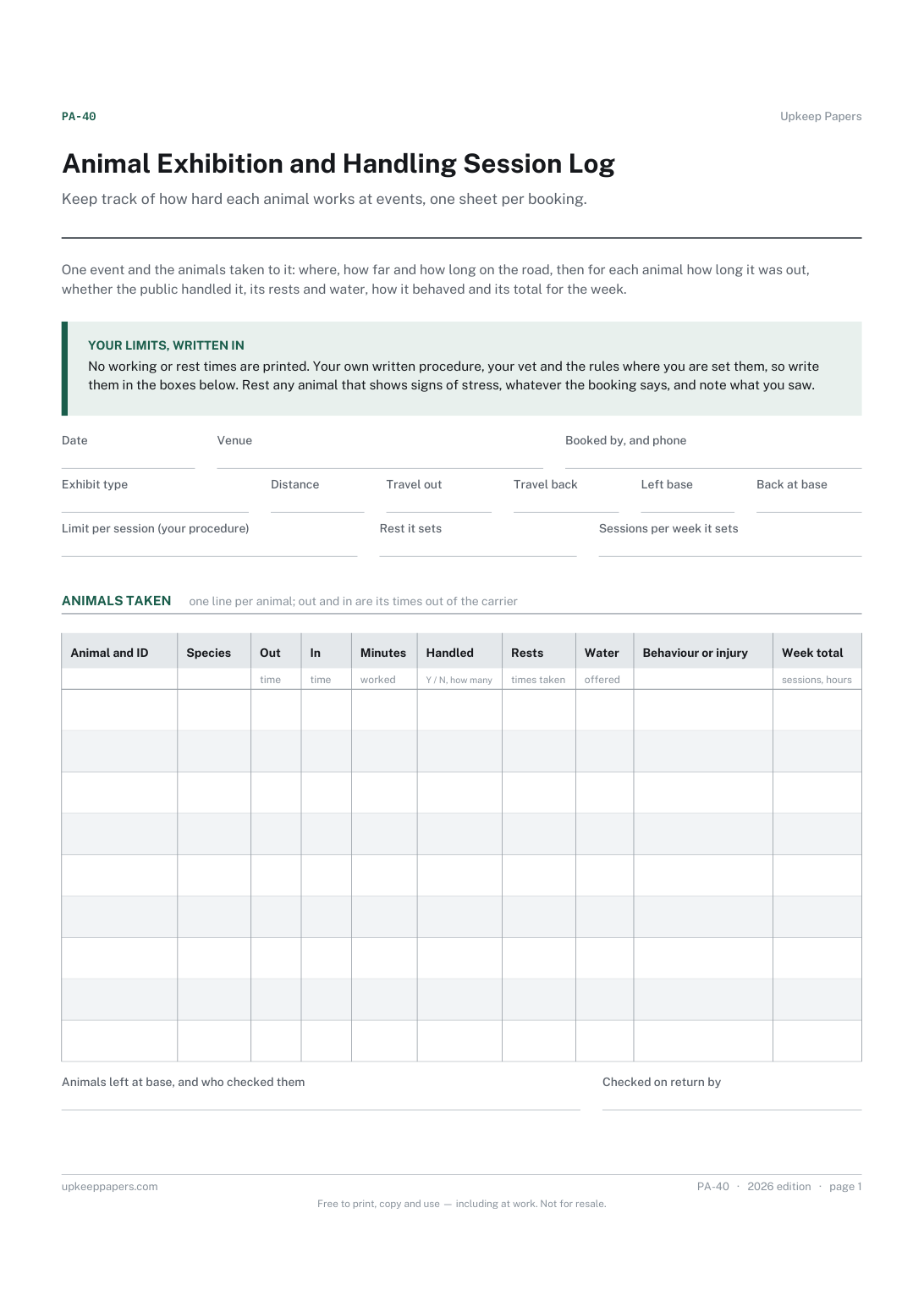
Keep track of how hard each animal works at events, one sheet per booking. A weekly total shows when one is being used more than the rest.
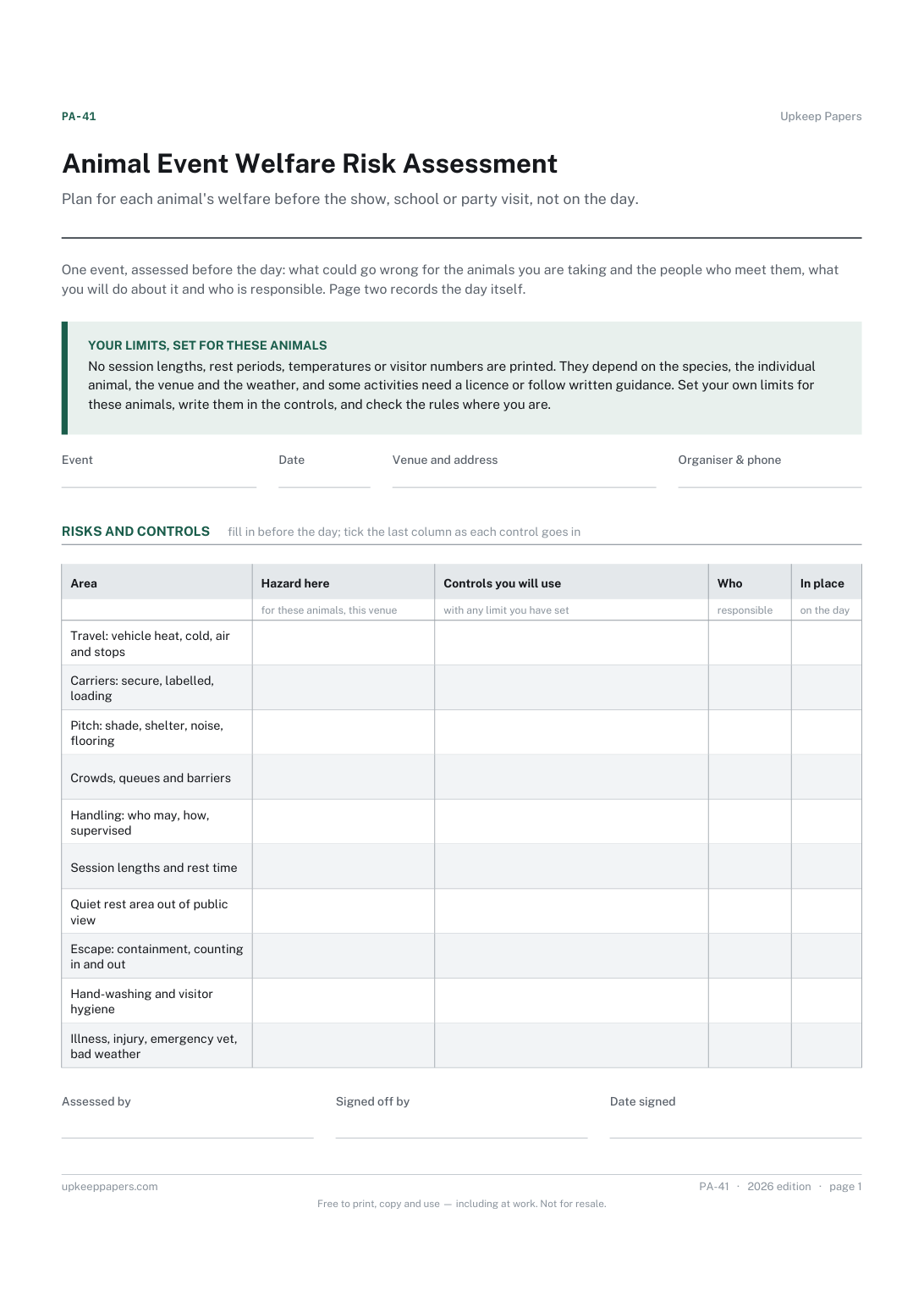
Plan for each animal's welfare before the show, school or party visit, not on the day. The second page records working and rest time, and what to change next time.
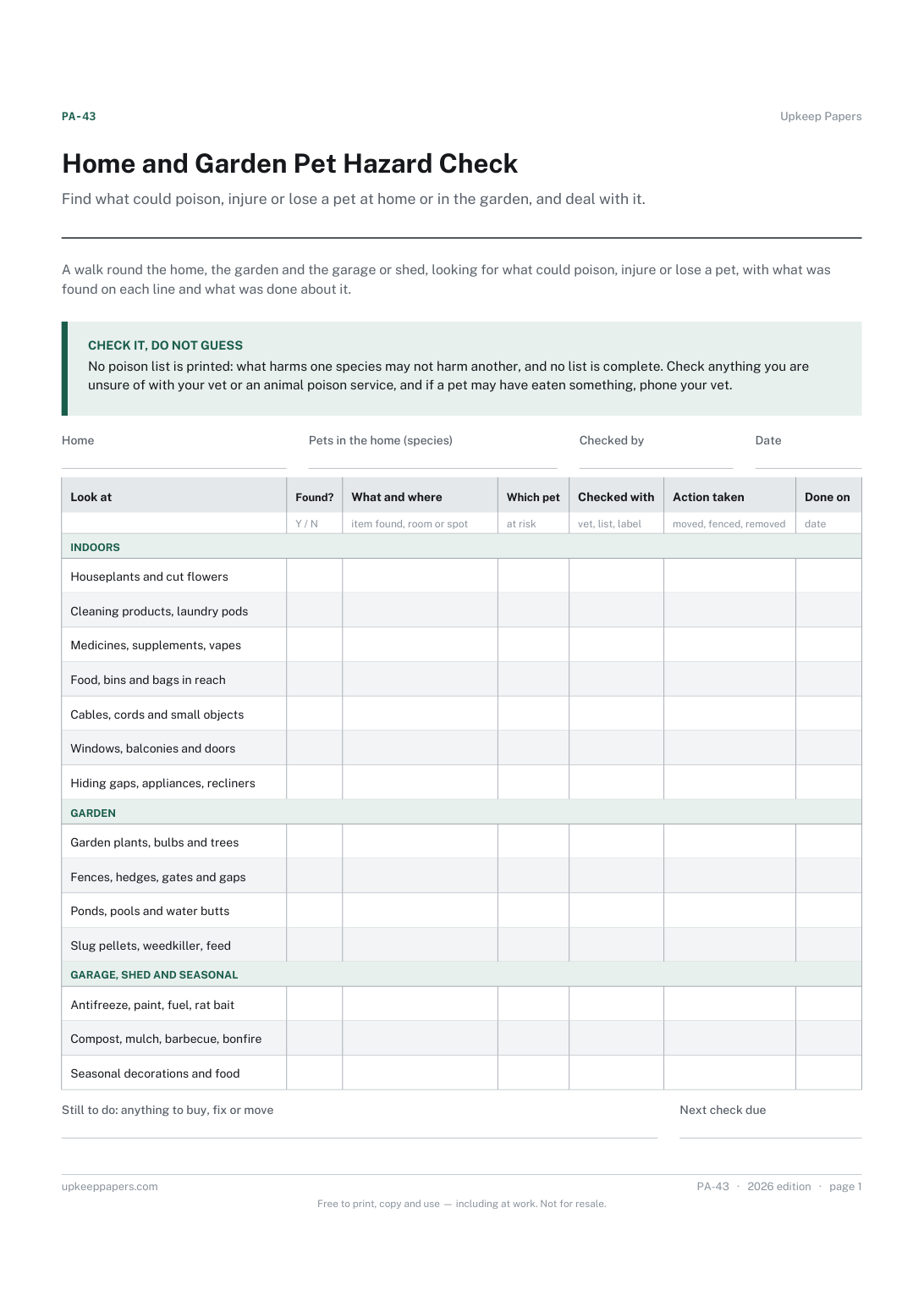
Find what could poison, injure or lose a pet at home or in the garden, and deal with it. Each find gets an action and a date, so the walk-round leads somewhere.
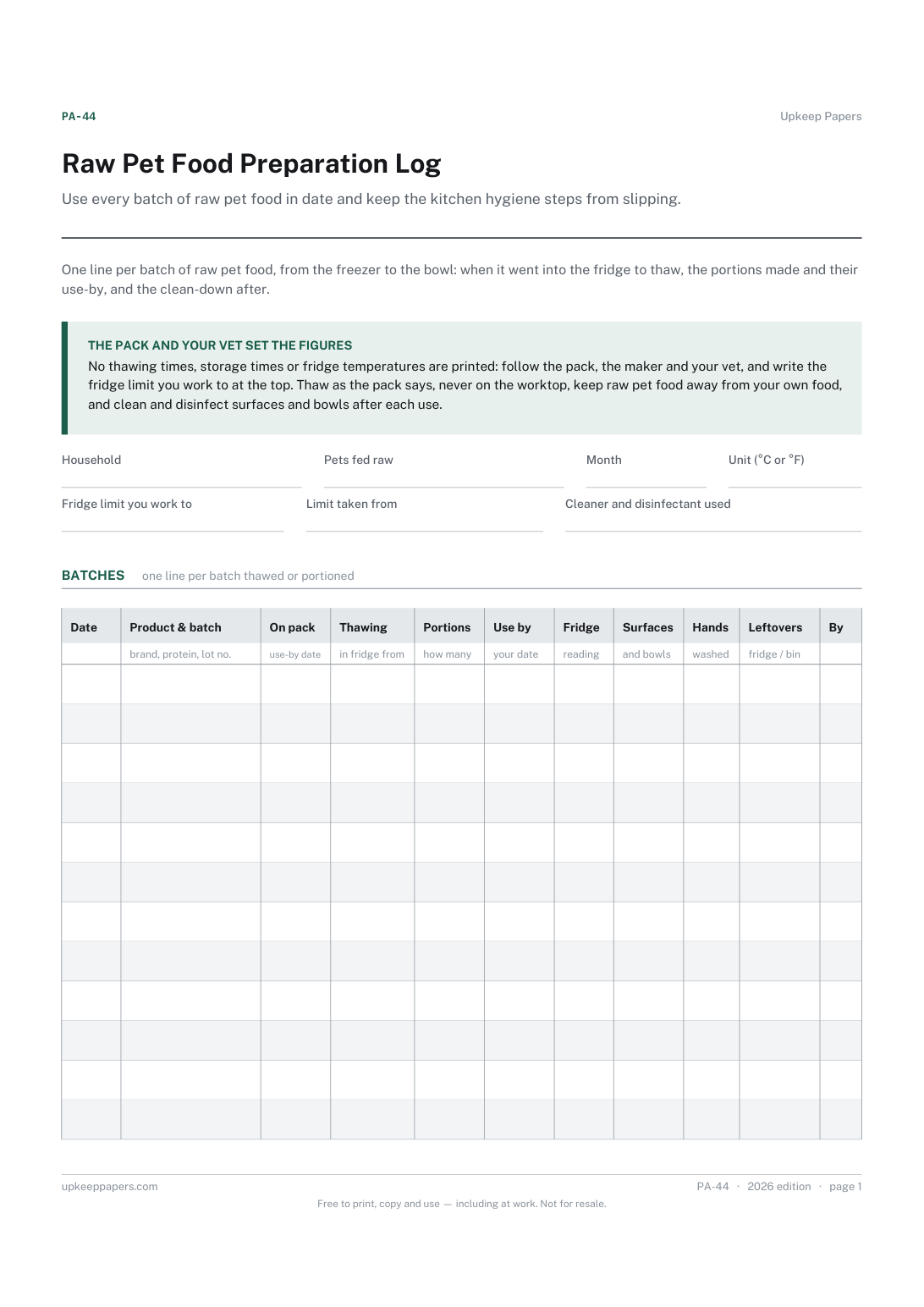
Use every batch of raw pet food in date and keep the kitchen hygiene steps from slipping. One line per batch shows what was thawed, when, and who cleaned down after.
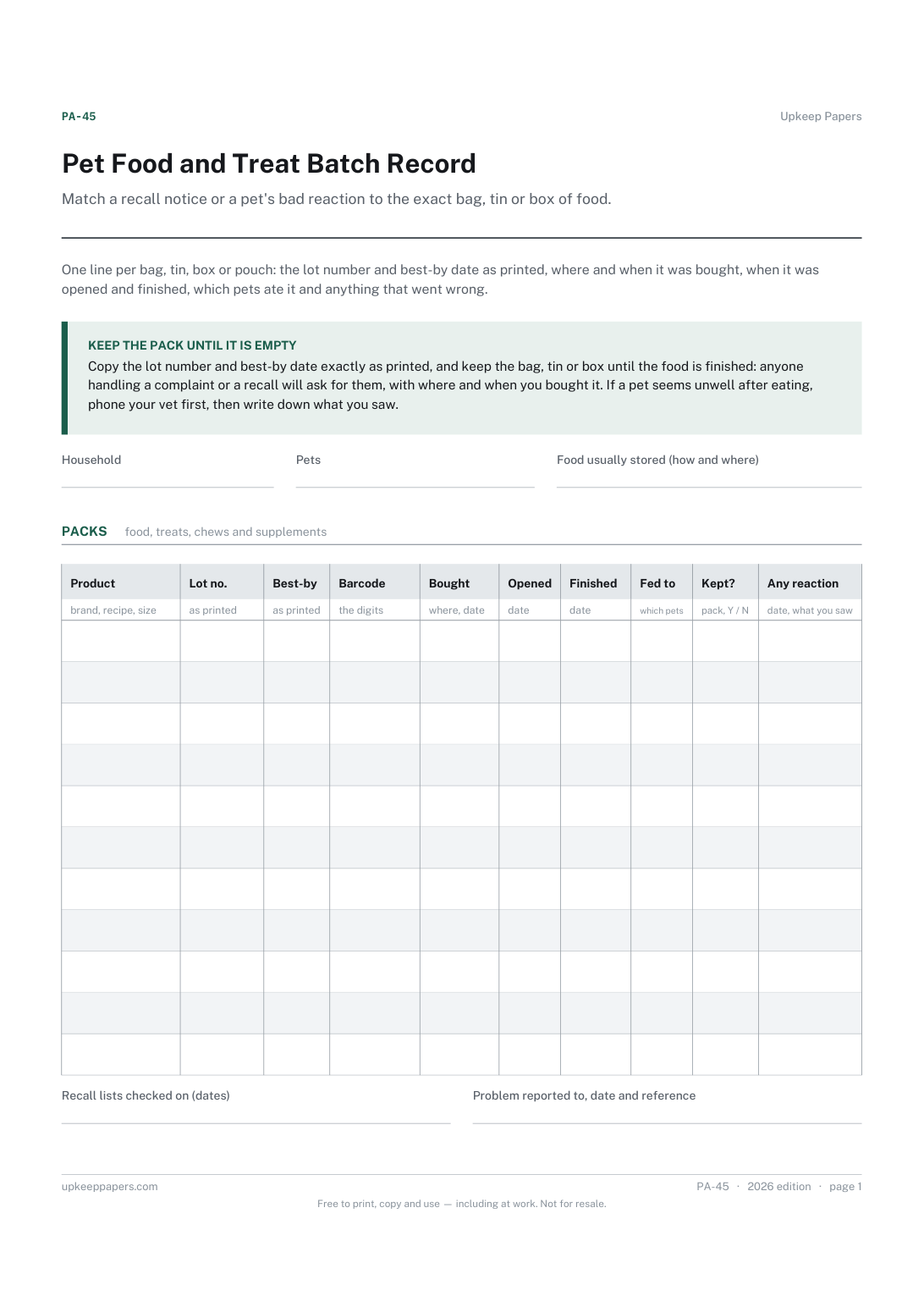
Match a recall notice or a pet's bad reaction to the exact bag, tin or box of food. The details a maker asks for are written down before the pack goes in the bin.
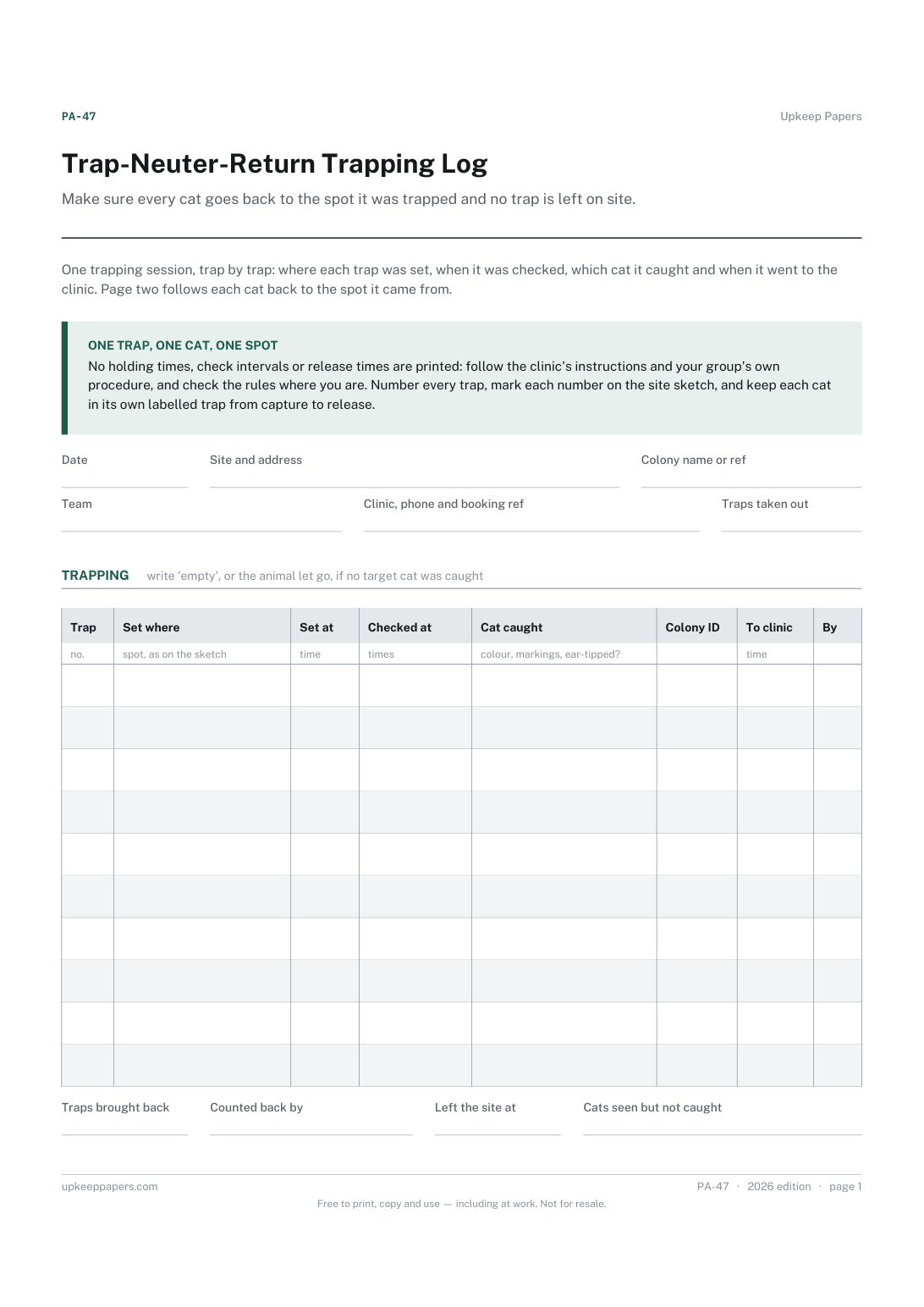
Make sure every cat goes back to the spot it was trapped and no trap is left on site. Trap numbers link the trapping, the clinic notes and the release.
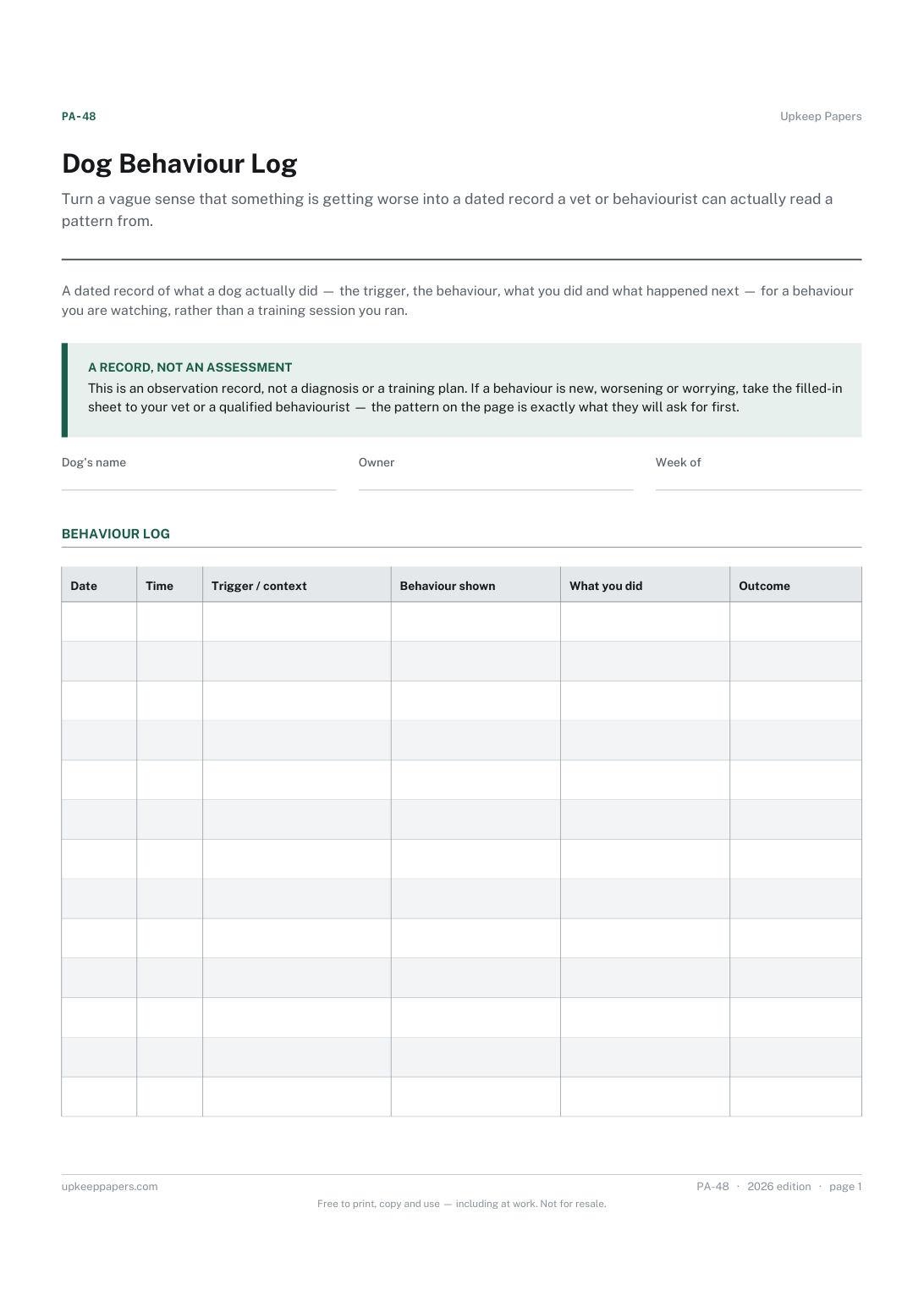
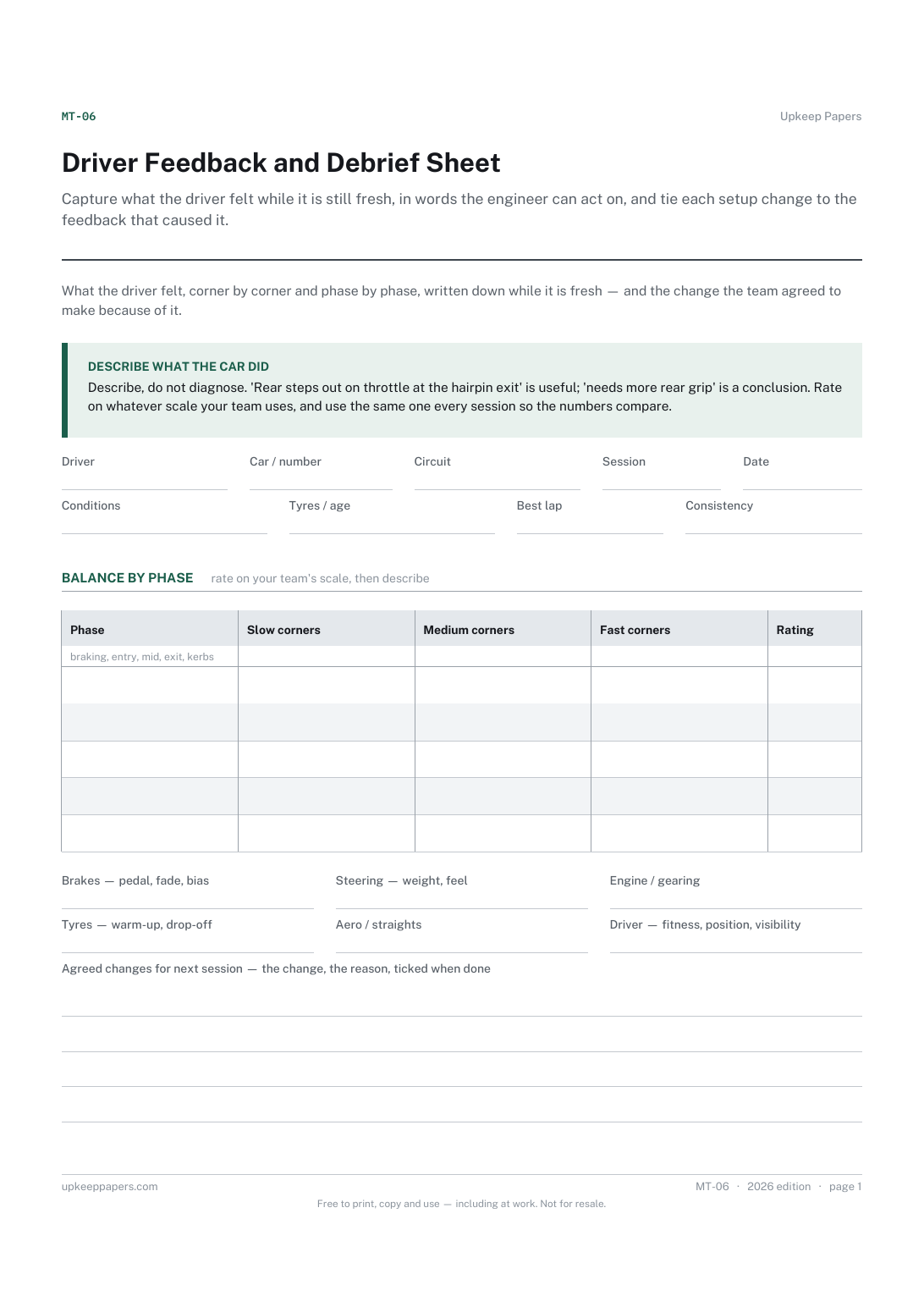
Turn a vague sense that something is getting worse into a dated record a vet or behaviourist can actually read a pattern from.
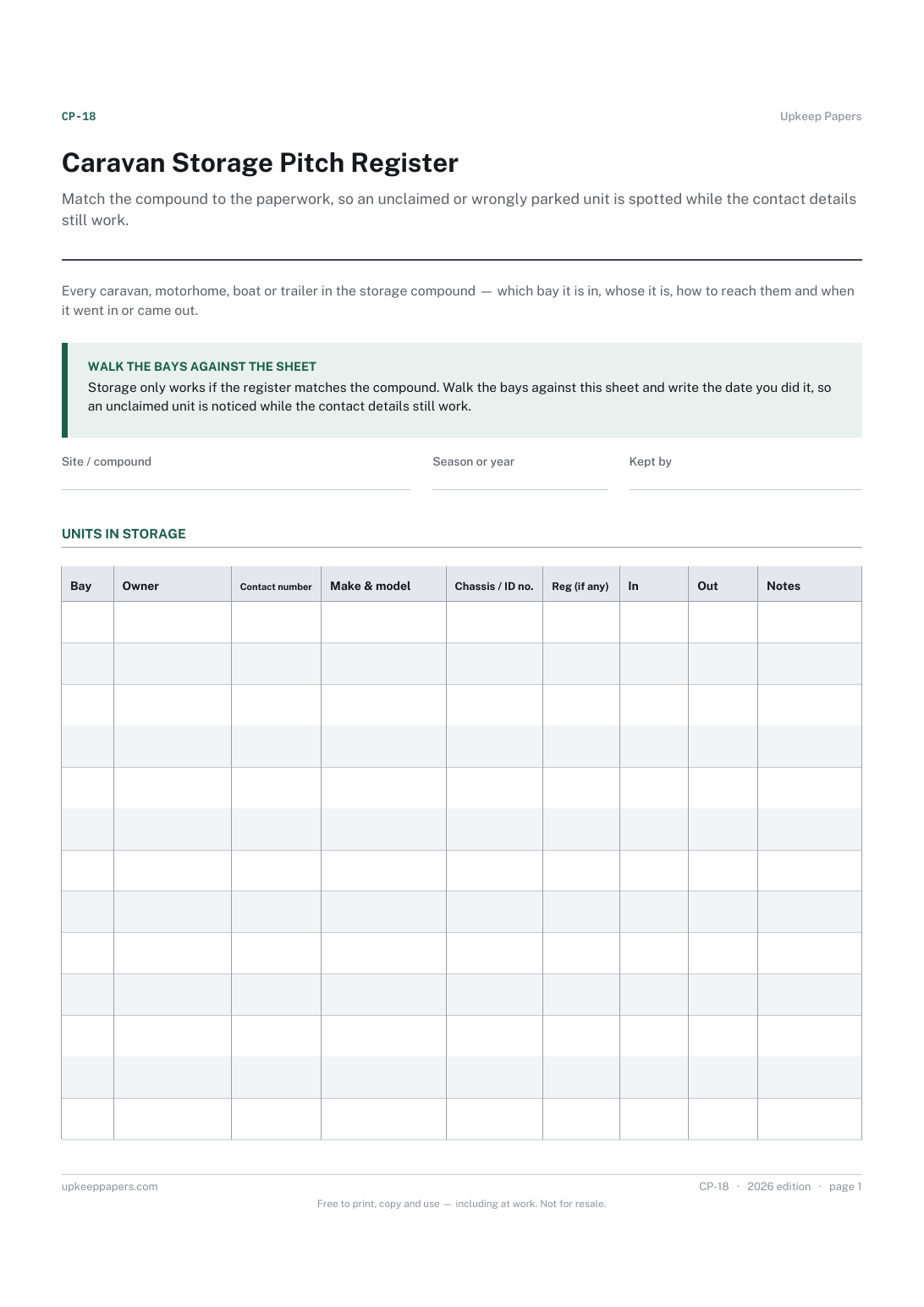
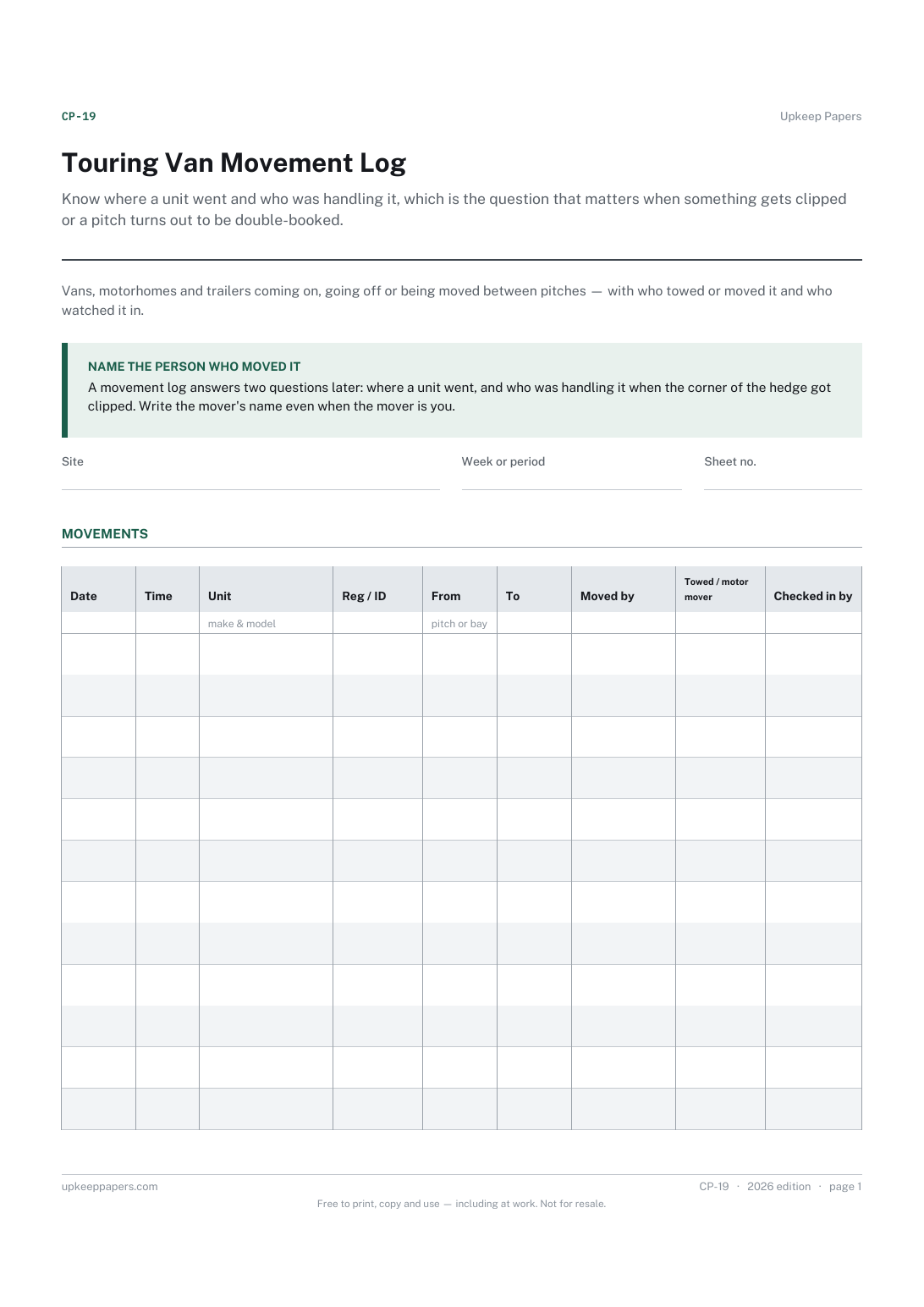
Trailers, horseboxes, caravans and boats — annual service records, pre-use inspections and the towing figures you should never be guessing at.
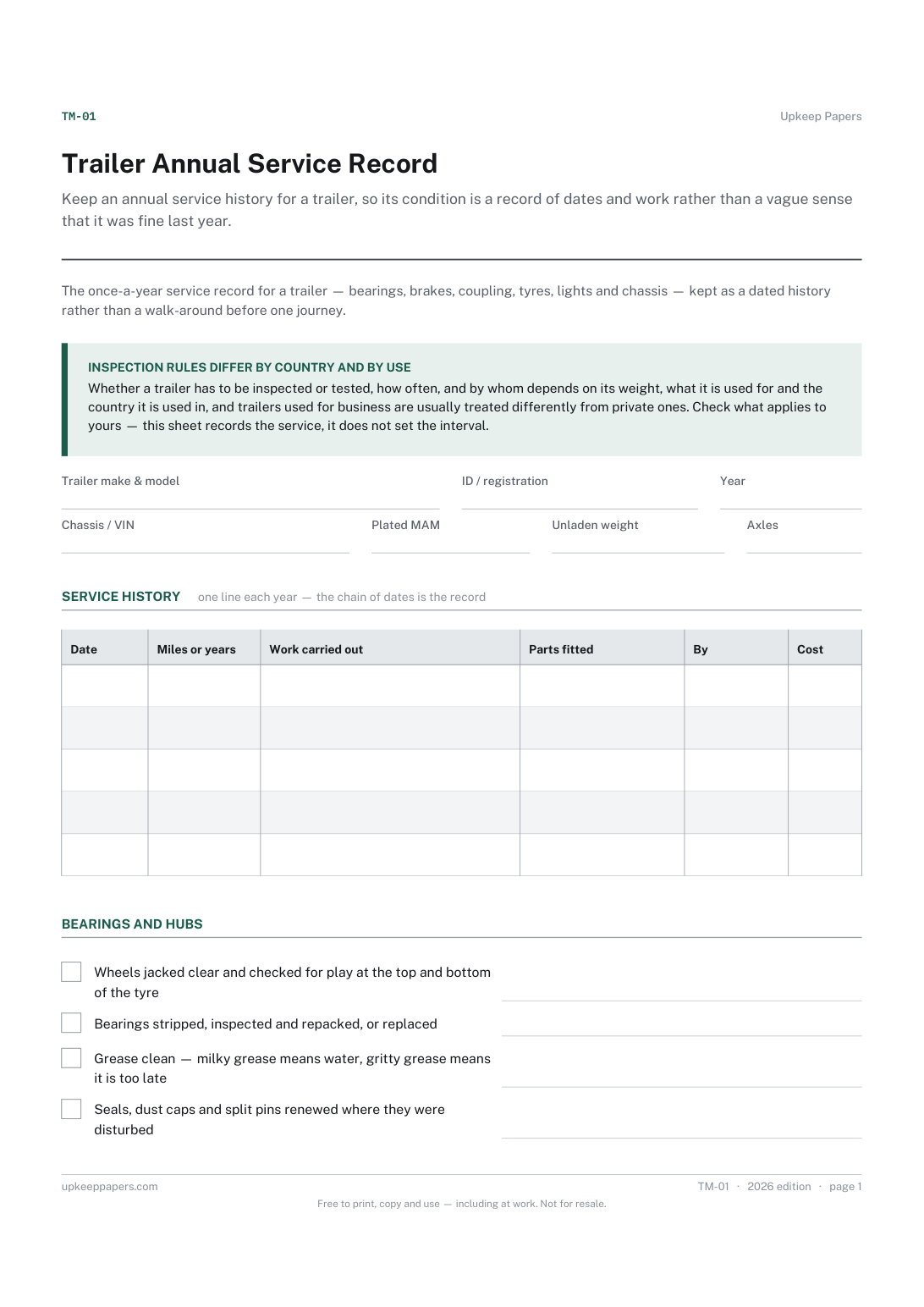
Keep an annual service history for a trailer, so its condition is a record of dates and work rather than a vague sense that it was fine last year.
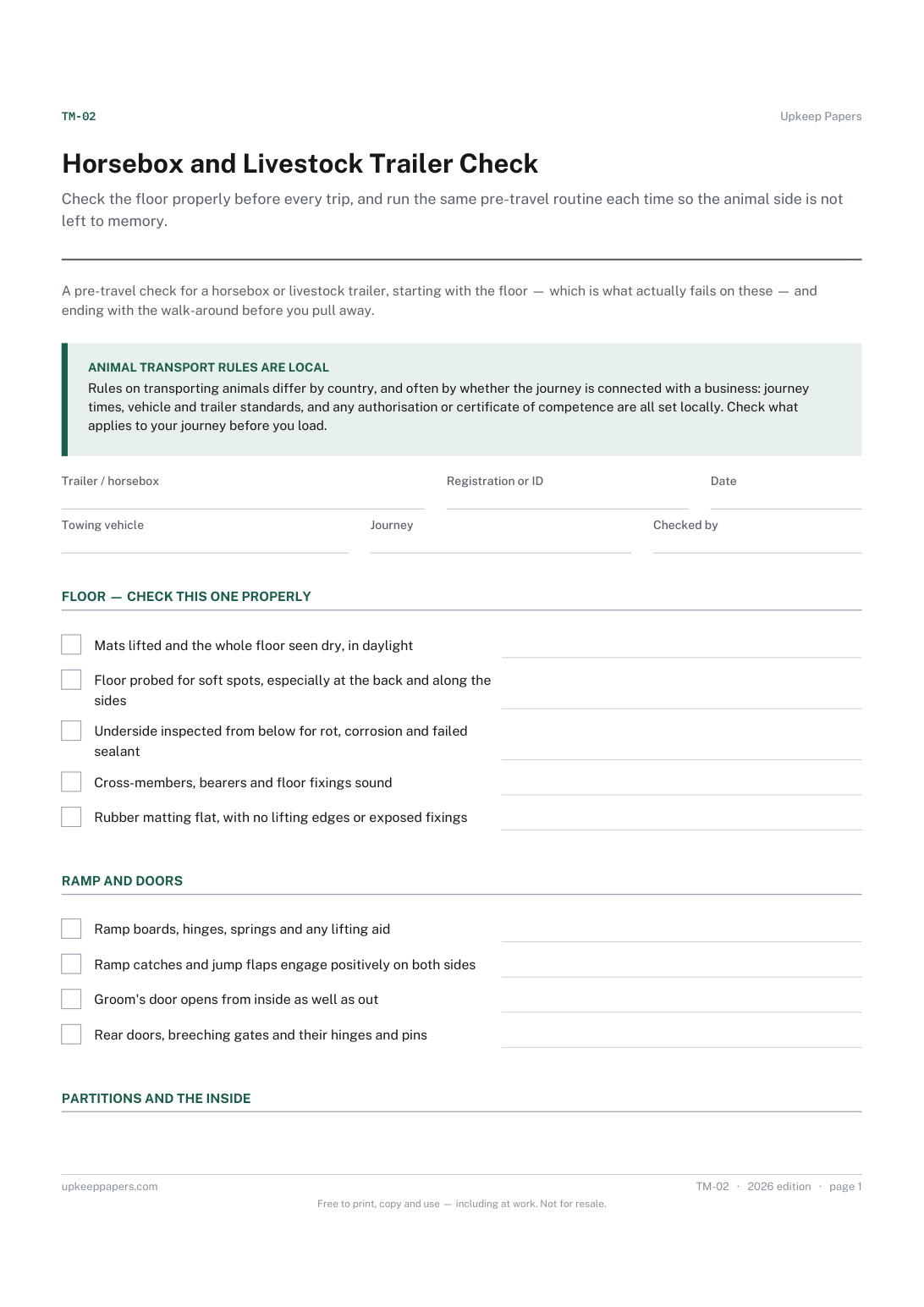
Check the floor properly before every trip, and run the same pre-travel routine each time so the animal side is not left to memory.
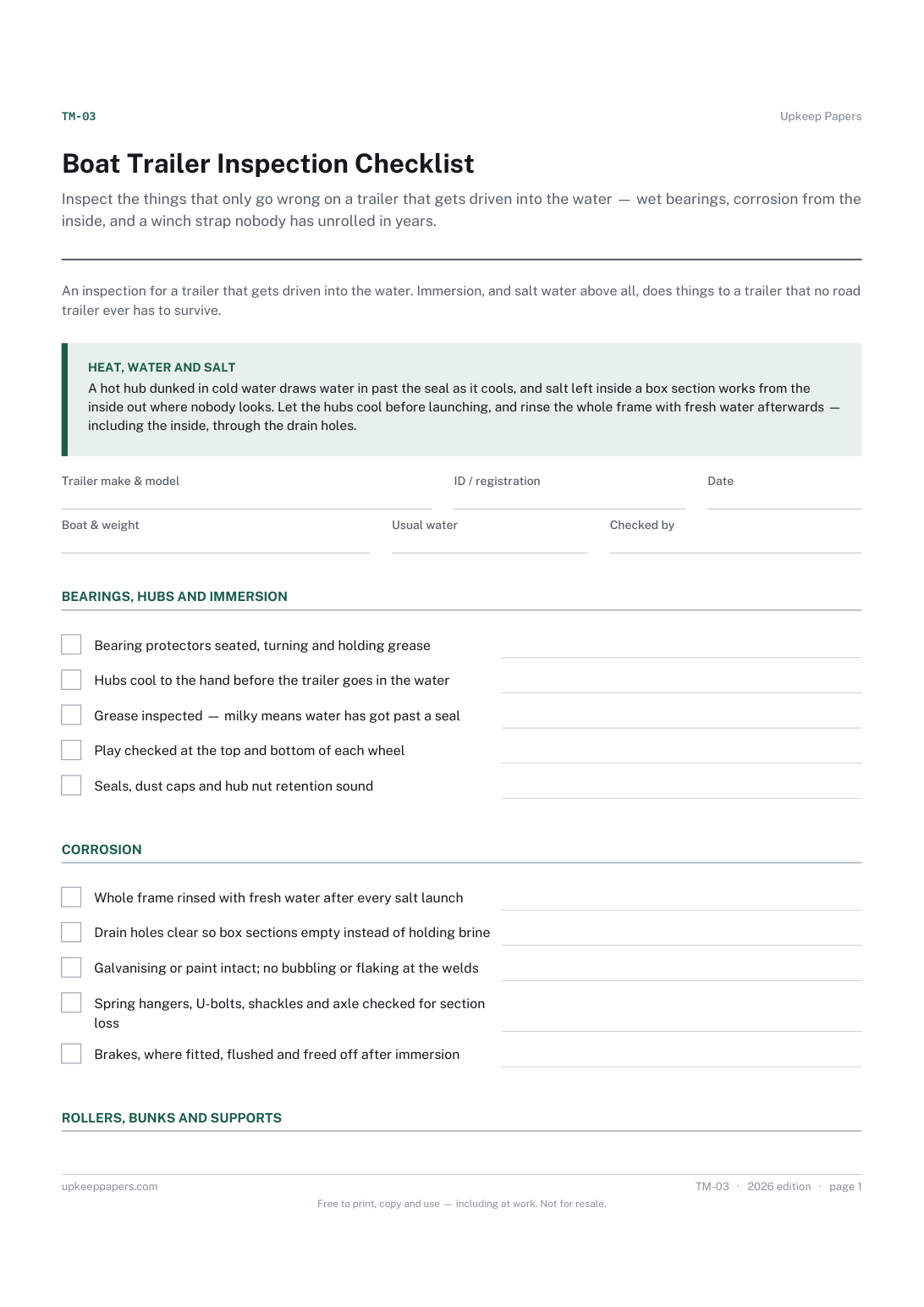
Inspect the things that only go wrong on a trailer that gets driven into the water — wet bearings, corrosion from the inside, and a winch strap nobody has unrolled in years.
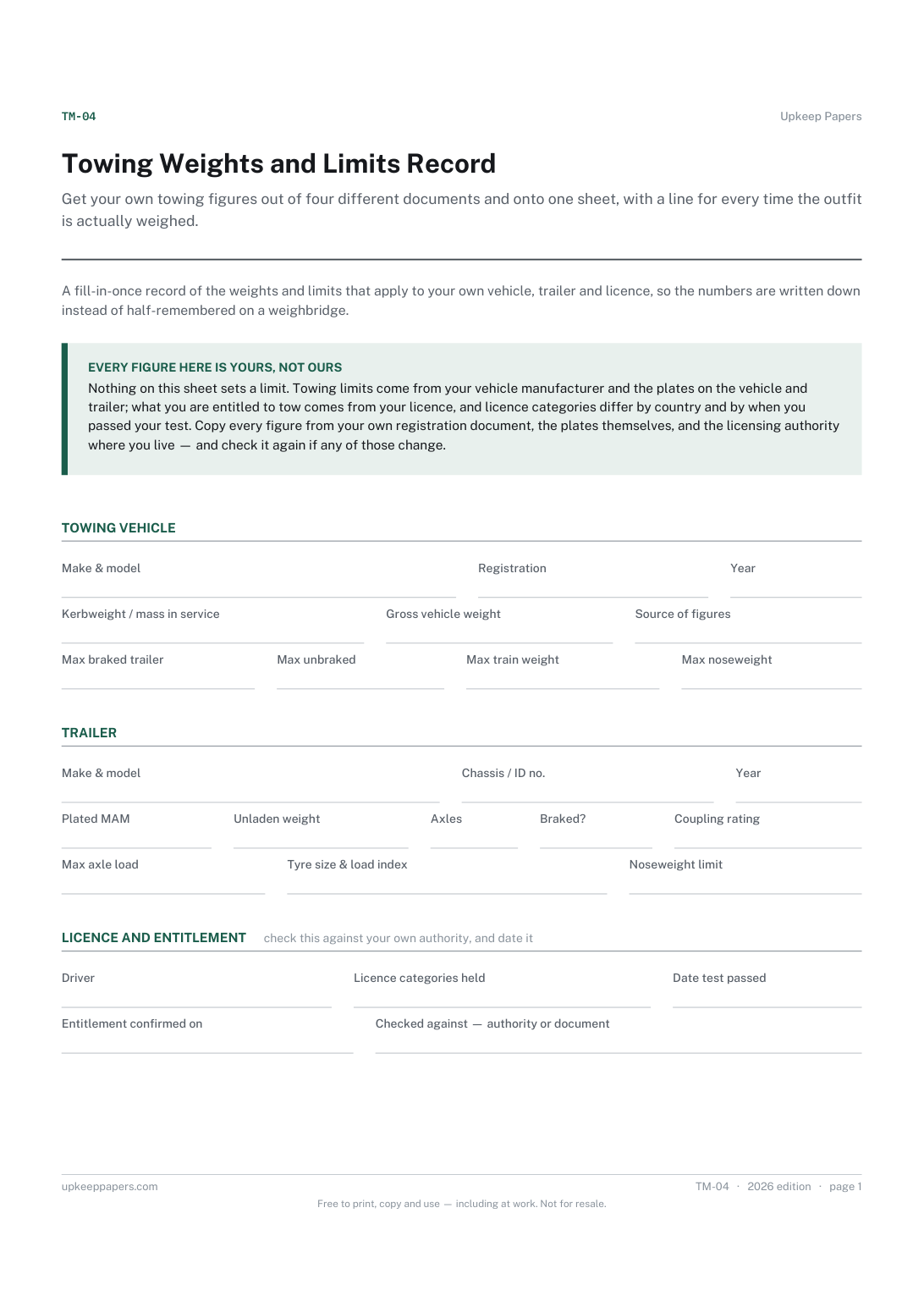
Get your own towing figures out of four different documents and onto one sheet, with a line for every time the outfit is actually weighed.
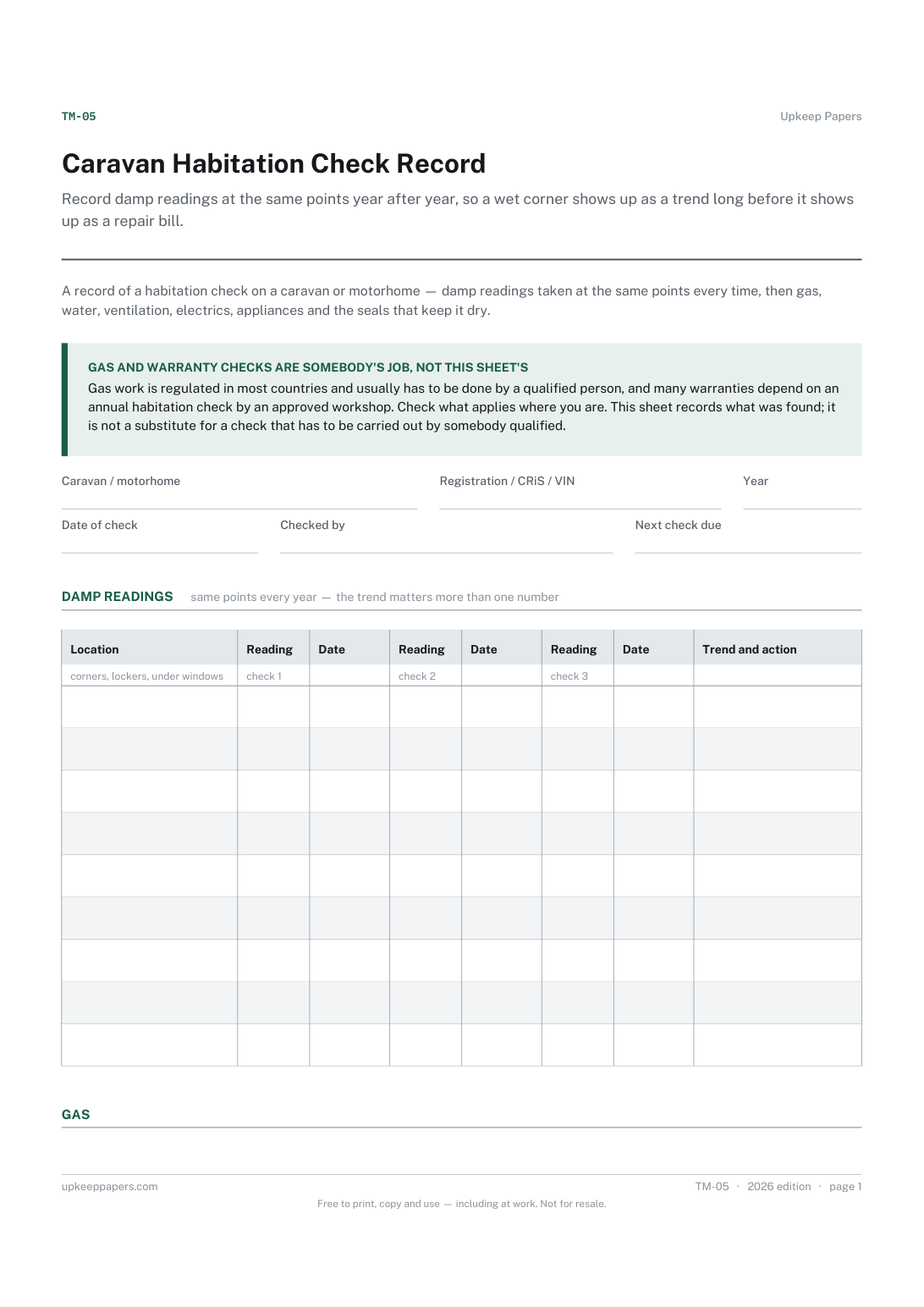
Record damp readings at the same points year after year, so a wet corner shows up as a trend long before it shows up as a repair bill.
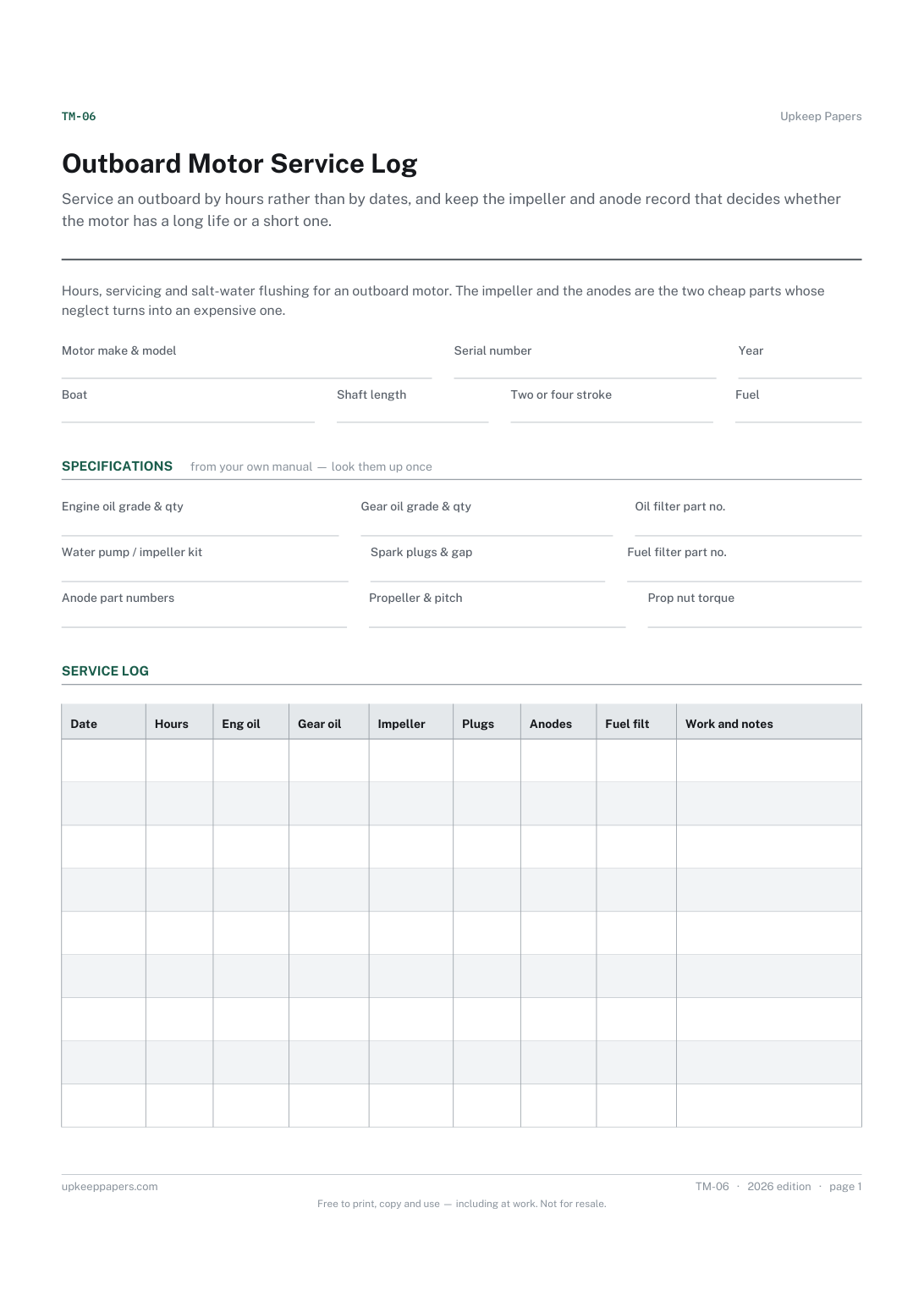
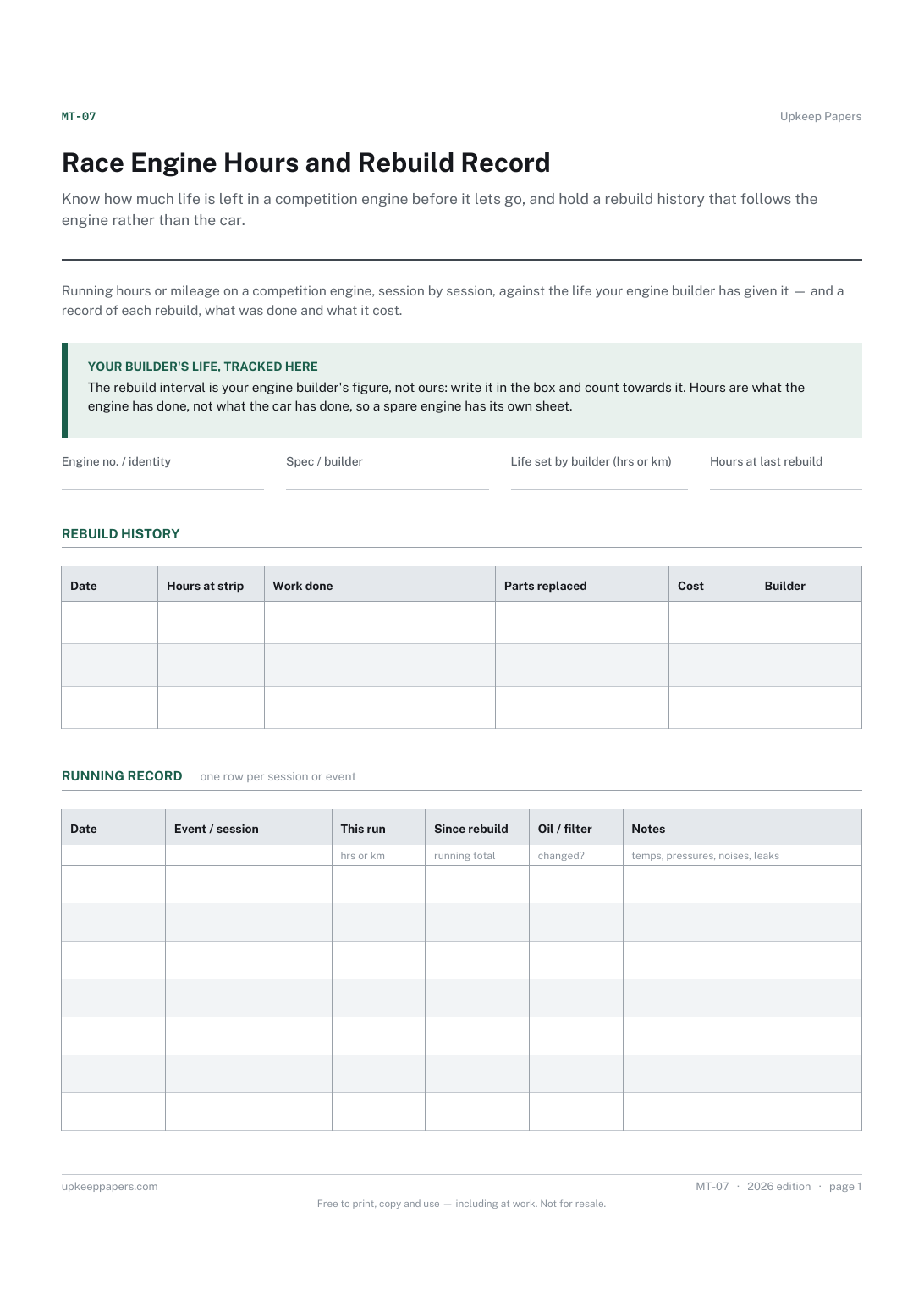
Service an outboard by hours rather than by dates, and keep the impeller and anode record that decides whether the motor has a long life or a short one.
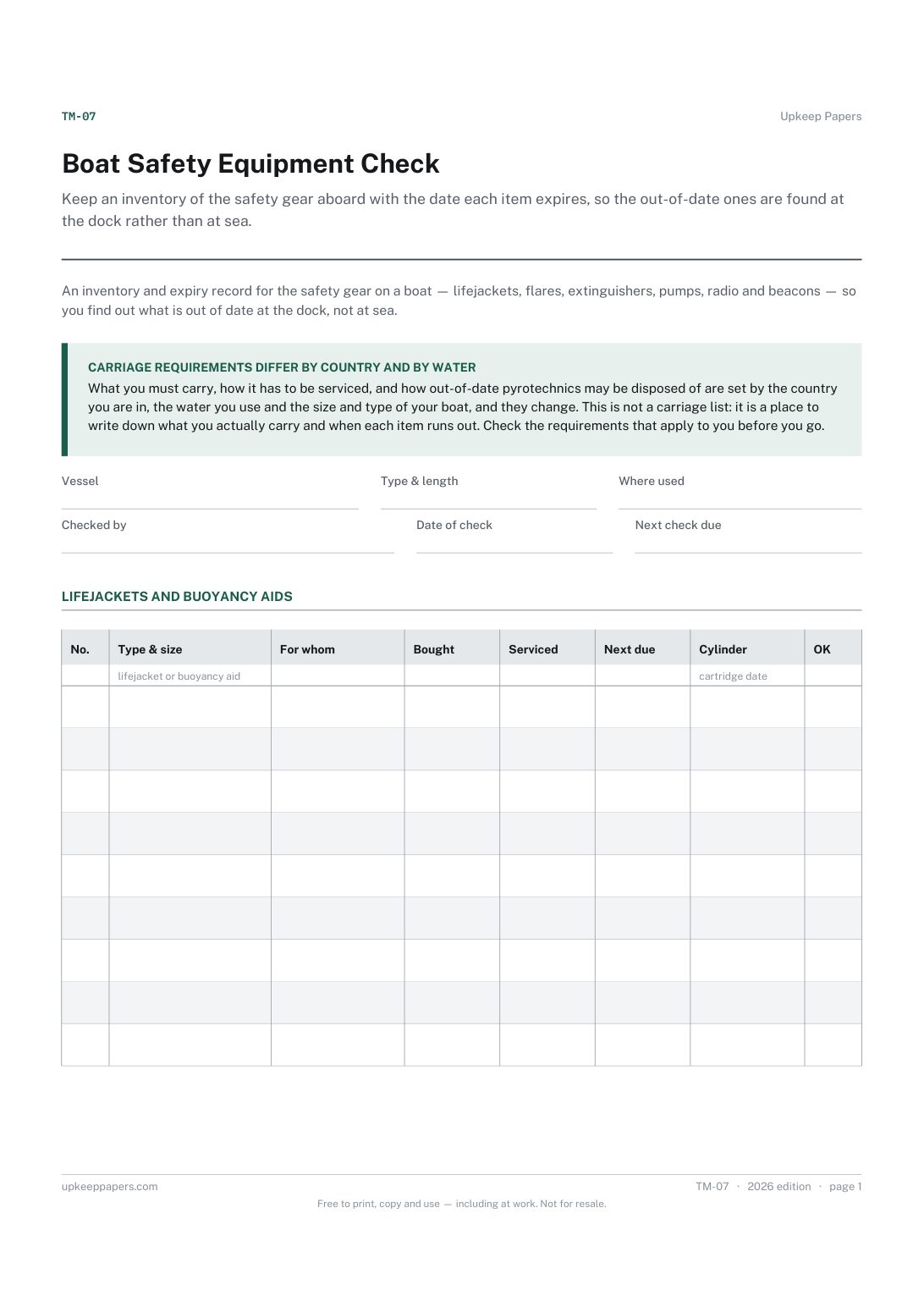
Keep an inventory of the safety gear aboard with the date each item expires, so the out-of-date ones are found at the dock rather than at sea.
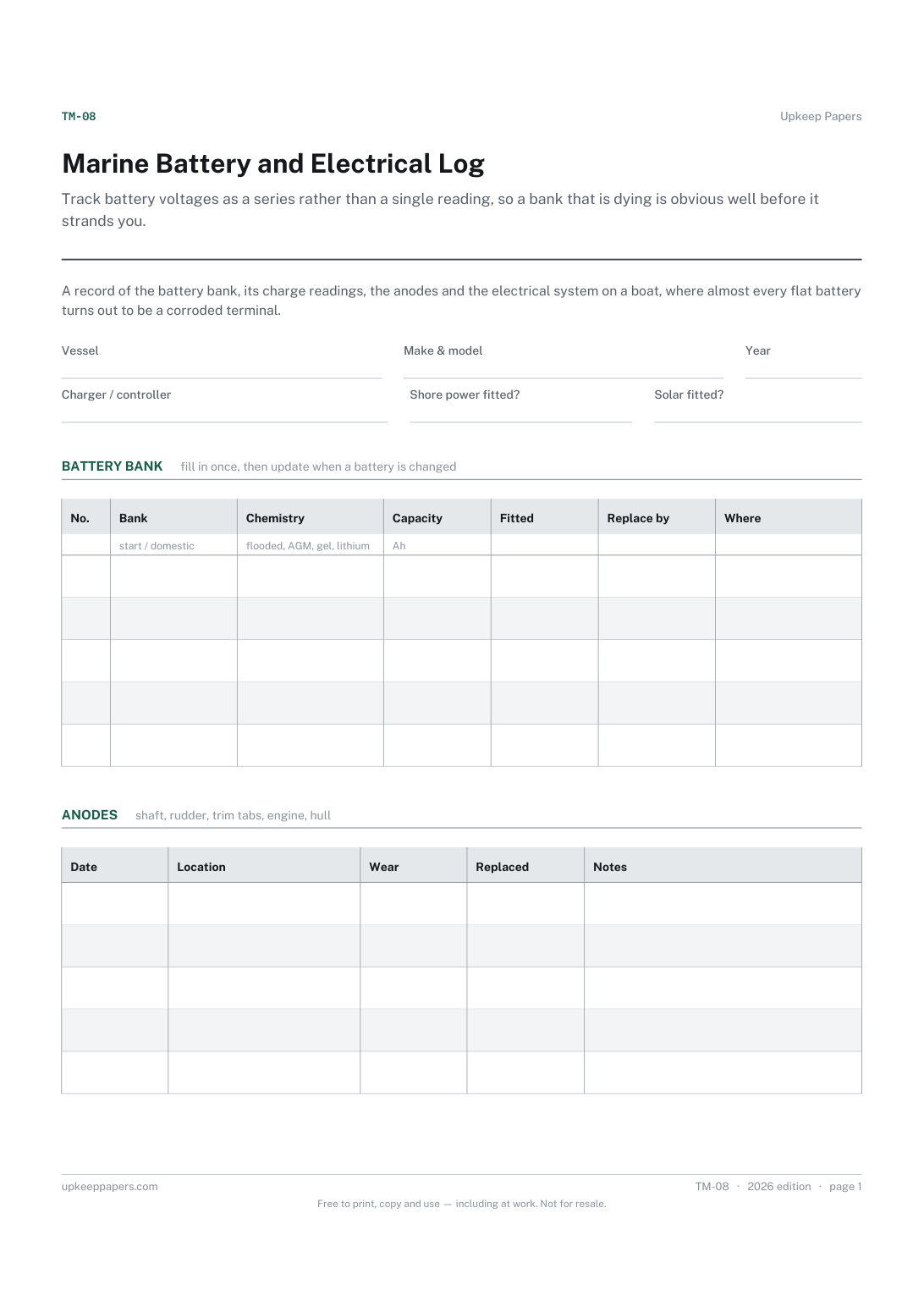
Track battery voltages as a series rather than a single reading, so a bank that is dying is obvious well before it strands you.
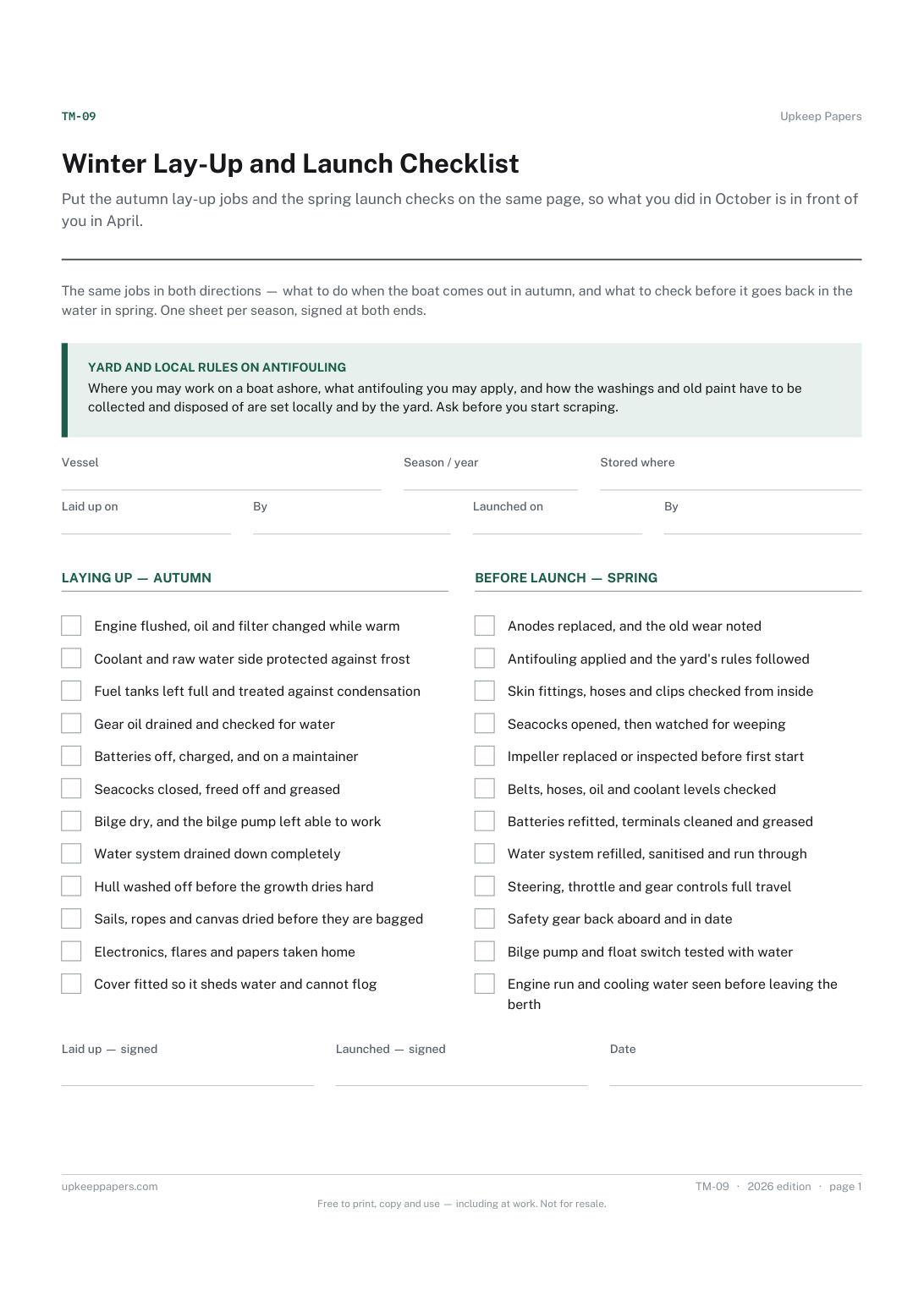
Put the autumn lay-up jobs and the spring launch checks on the same page, so what you did in October is in front of you in April.
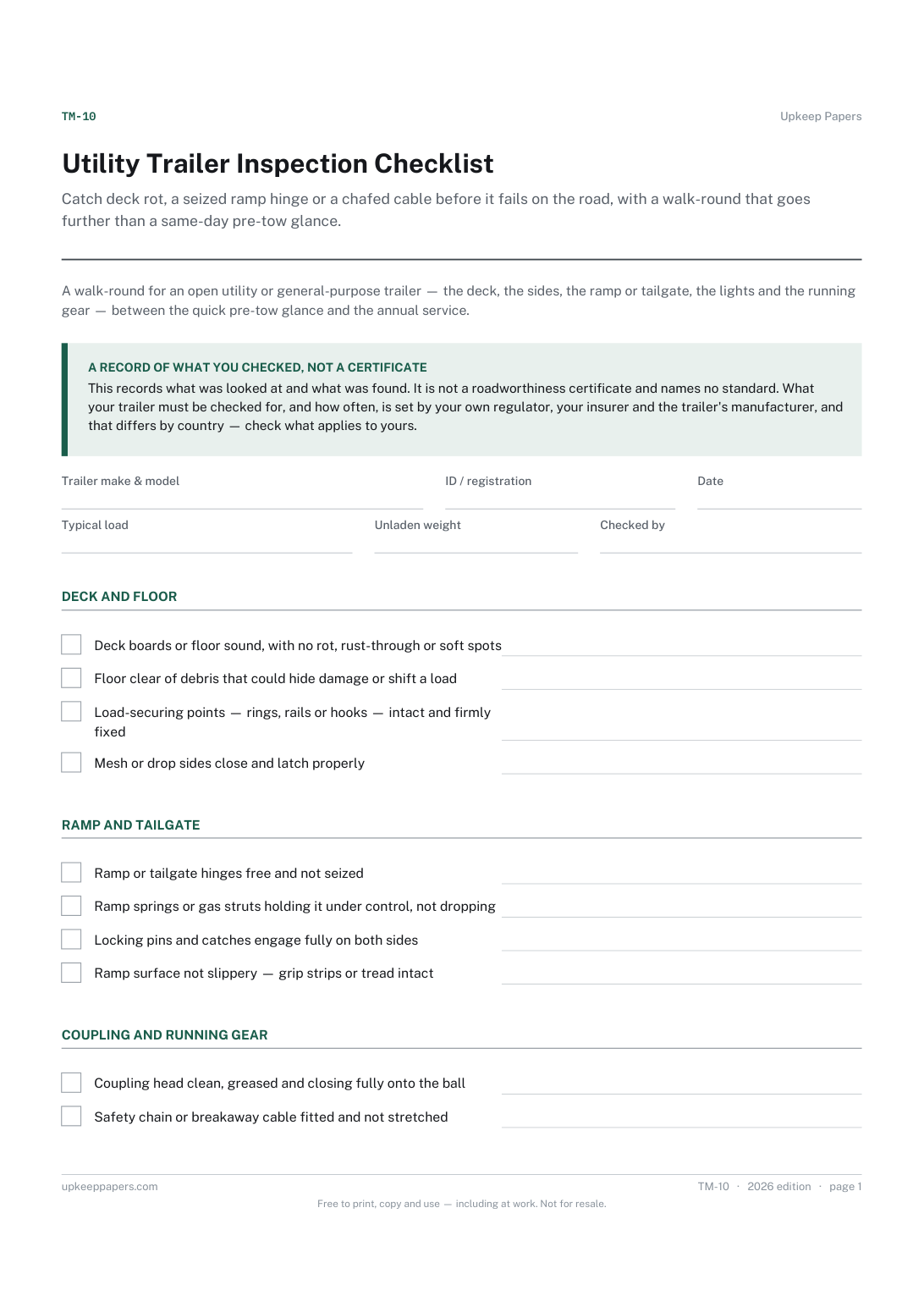
Catch deck rot, a seized ramp hinge or a chafed cable before it fails on the road, with a walk-round that goes further than a same-day pre-tow glance.
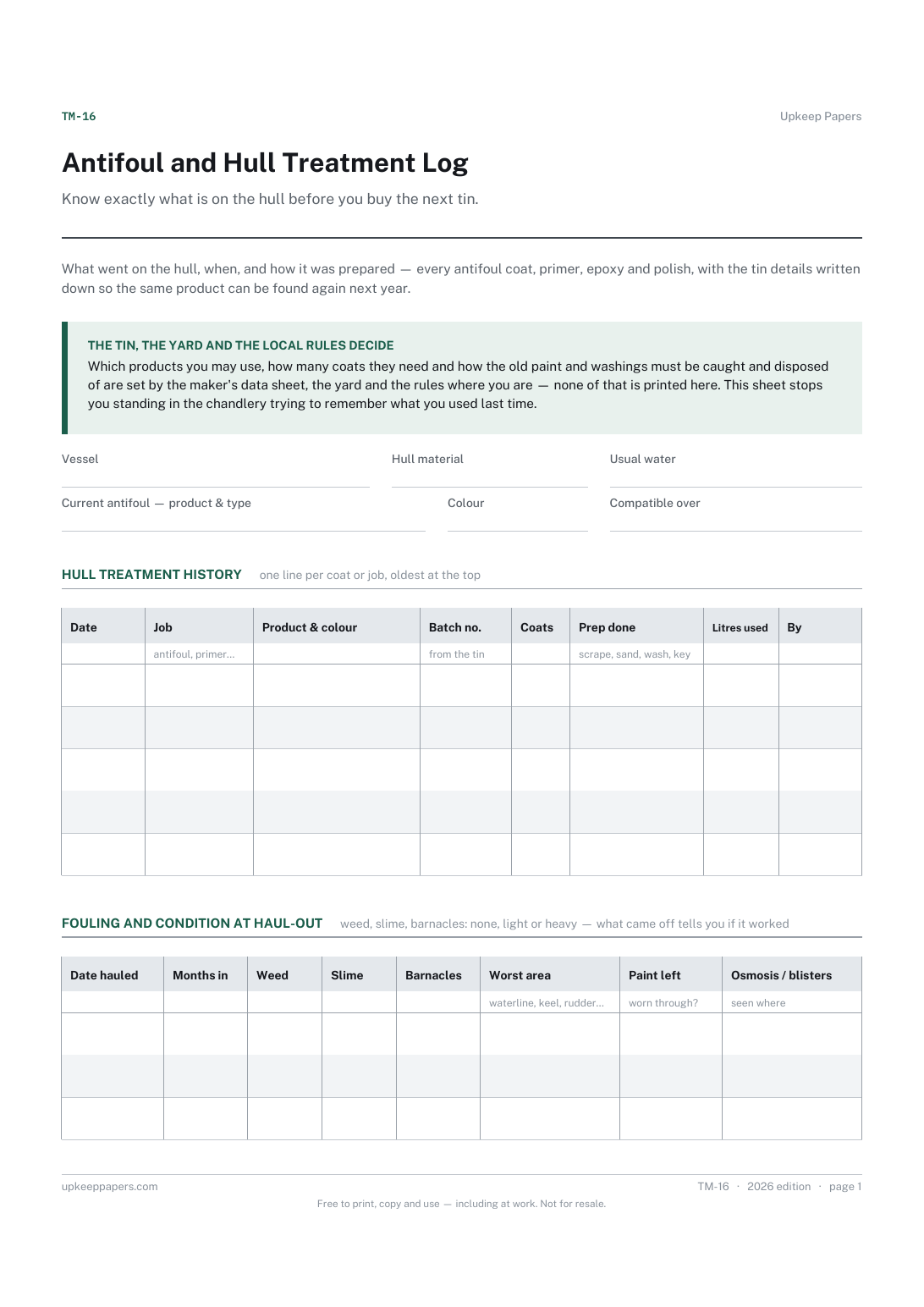
Know exactly what is on the hull before you buy the next tin. The haul-out lines then show whether the paint you chose actually kept the growth off.
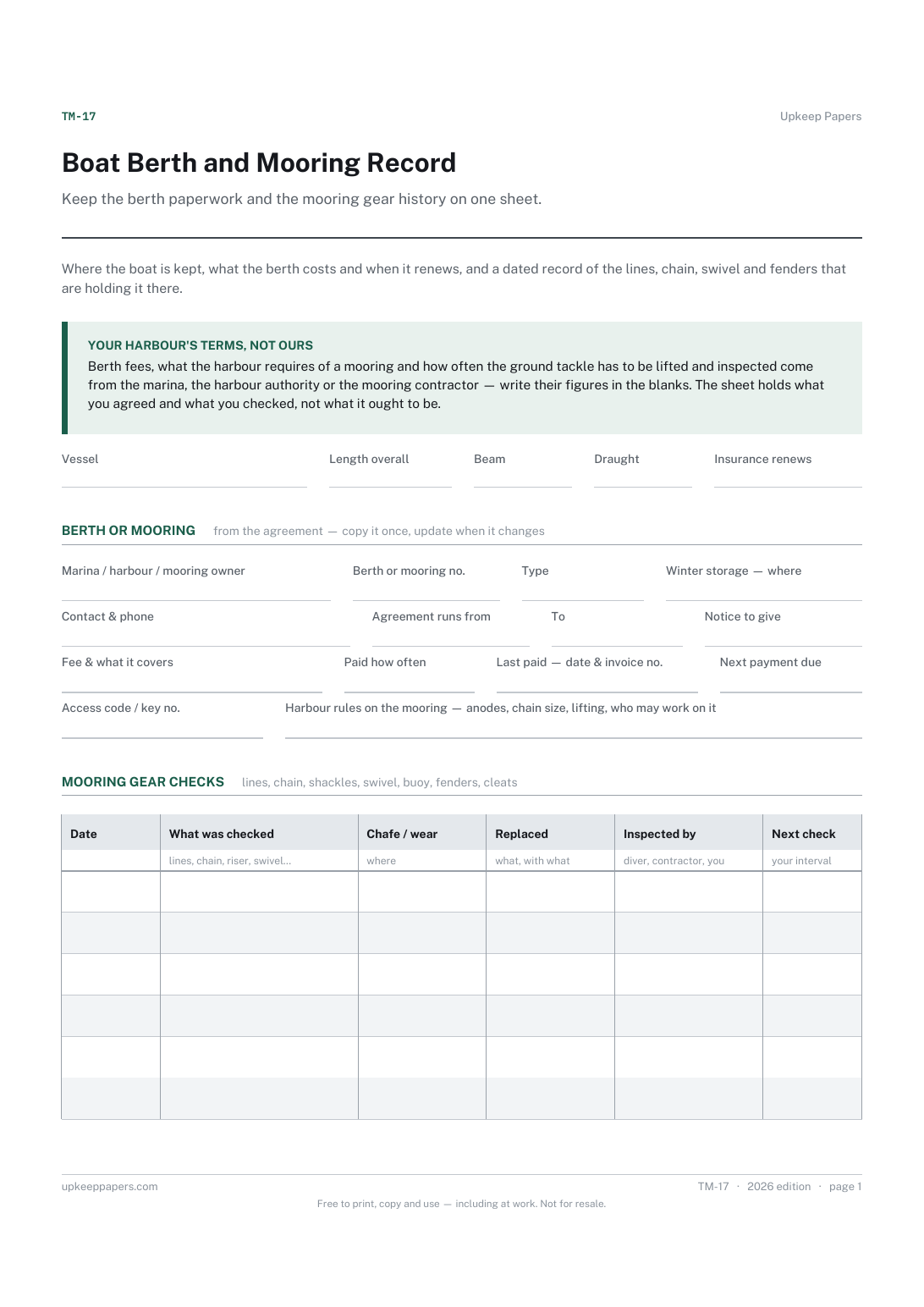
Keep the berth paperwork and the mooring gear history on one sheet. A renewal is not missed, and a chafed line is caught on a check rather than in a gale.
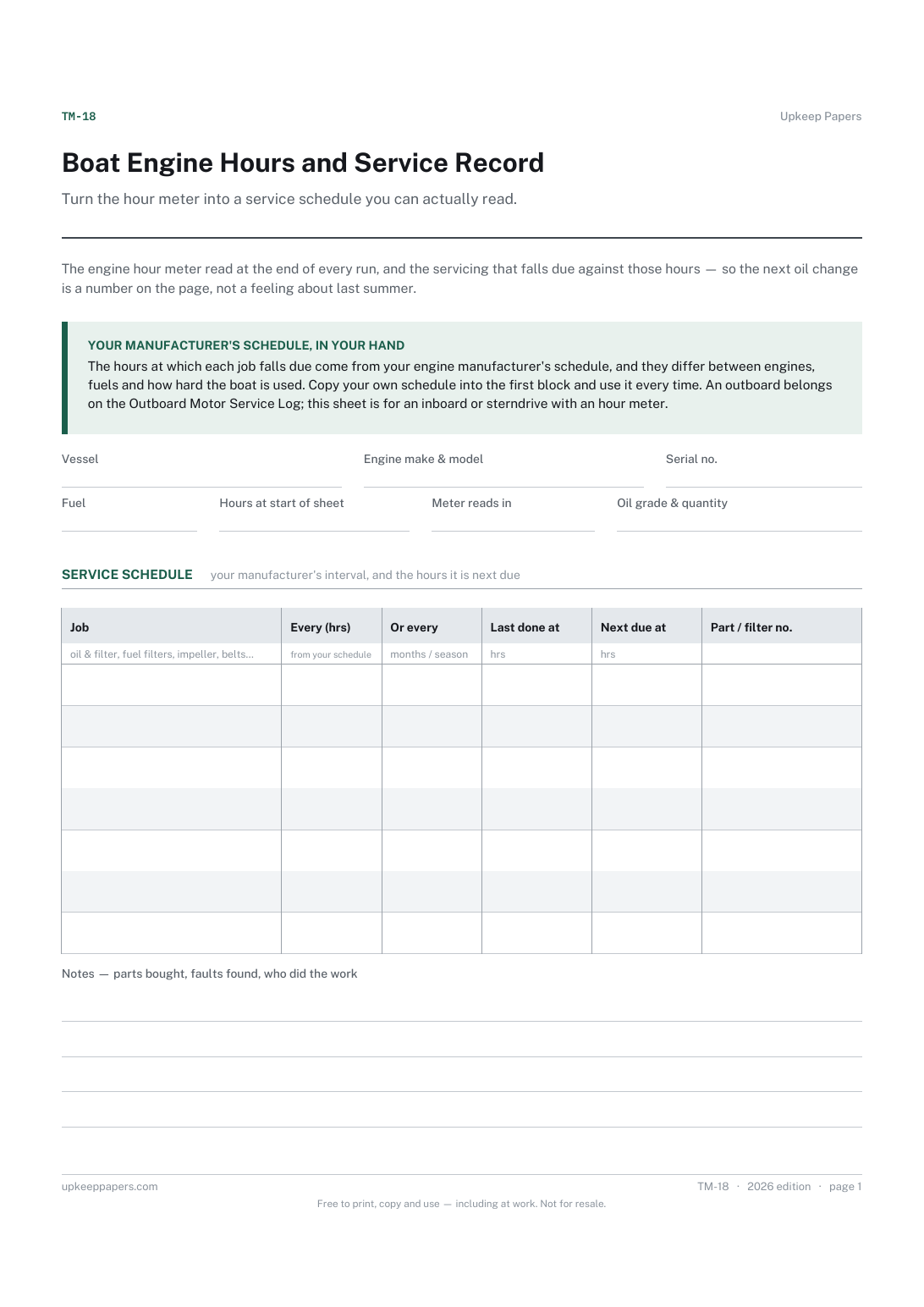
Turn the hour meter into a service schedule you can actually read. An oil change is then due at a number on the page, not at some point this season.
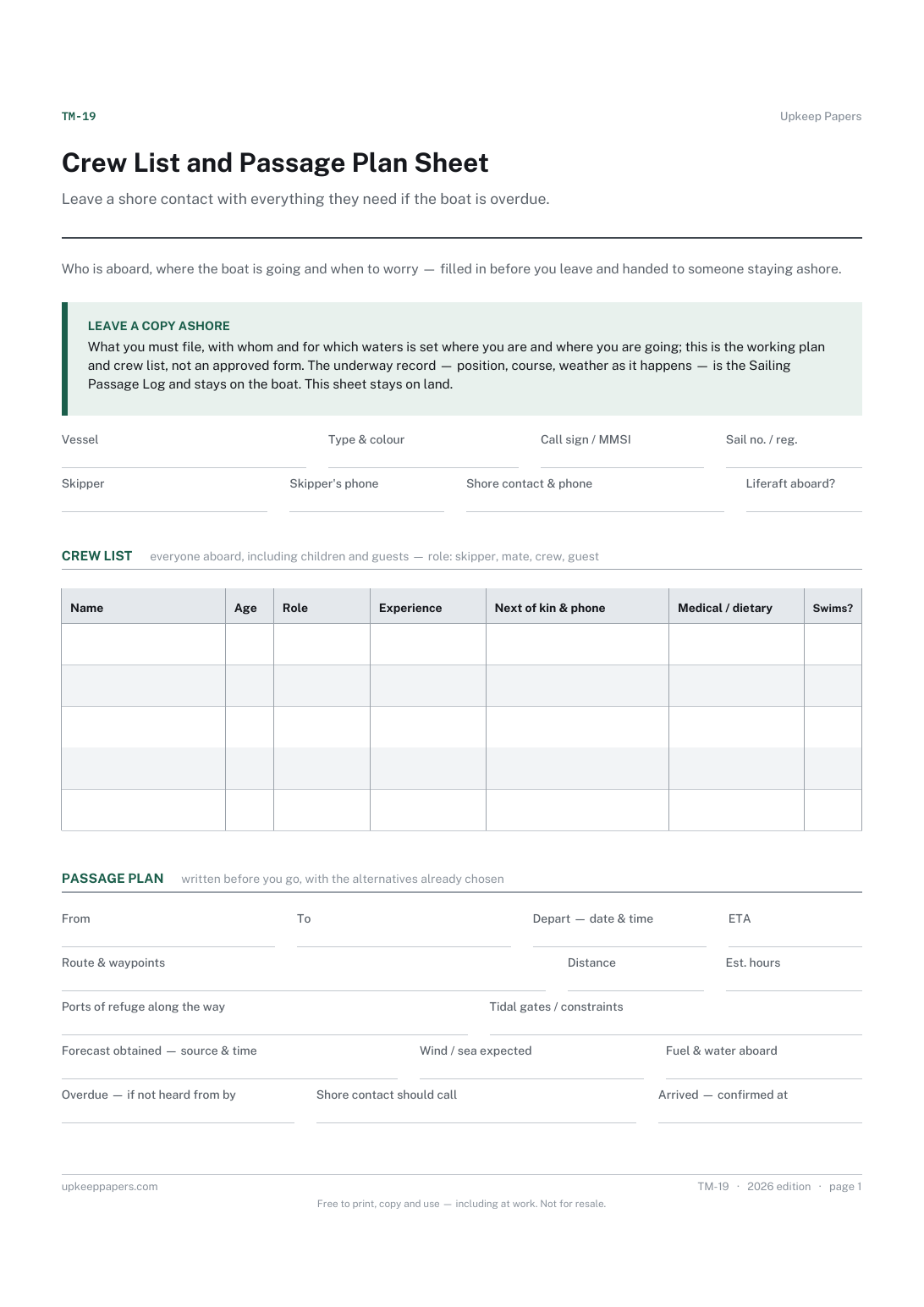
Leave a shore contact with everything they need if the boat is overdue. It also makes you write the passage plan down before you cast off.
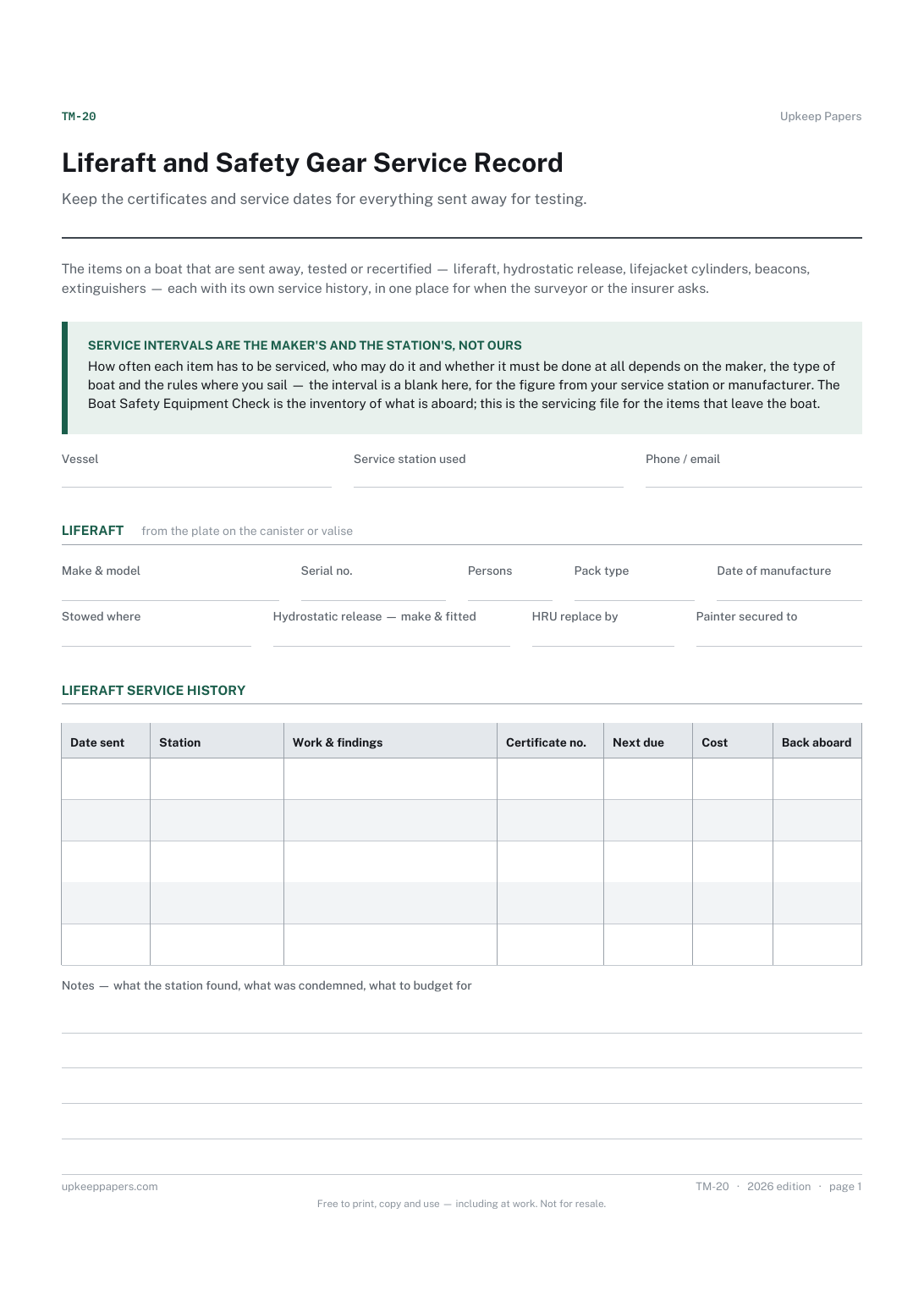
Keep the certificates and service dates for everything sent away for testing. They are then in one file for the surveyor, the insurer or a charter check.
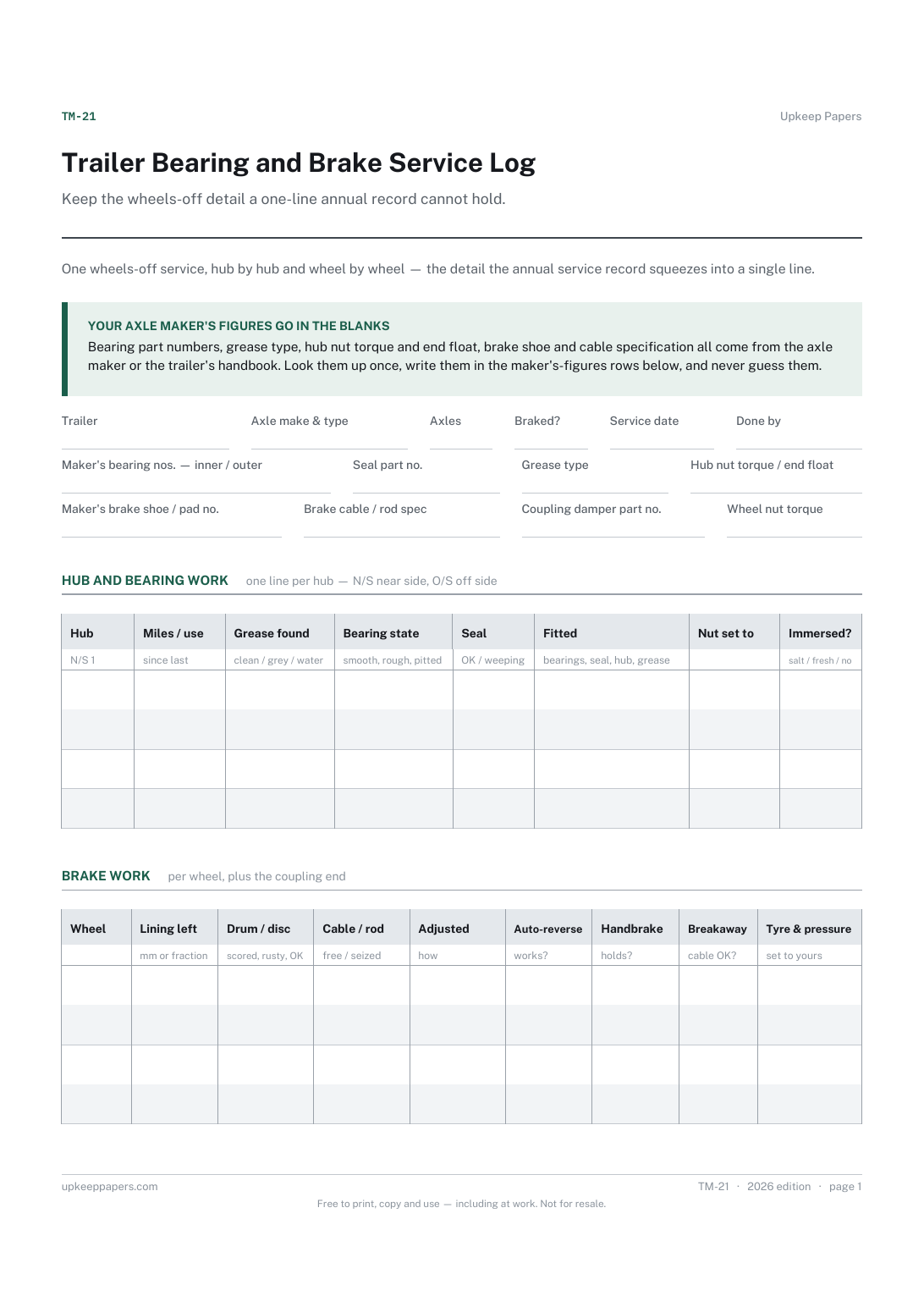
Keep the wheels-off detail a one-line annual record cannot hold. A hub that keeps letting water in then shows up as a pattern.
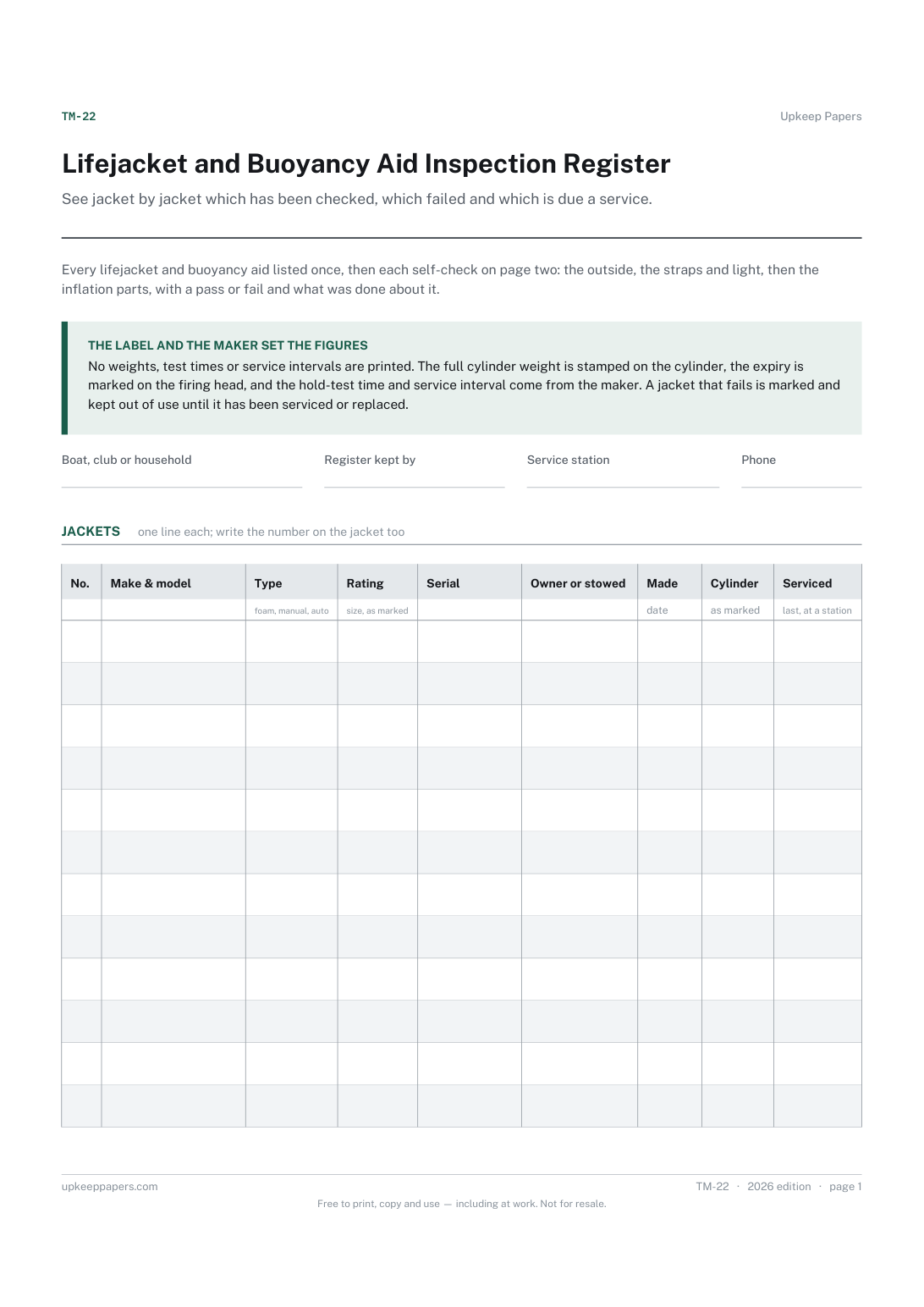
See jacket by jacket which has been checked, which failed and which is due a service. A jacket that fails is withdrawn by number instead of going back in the locker.
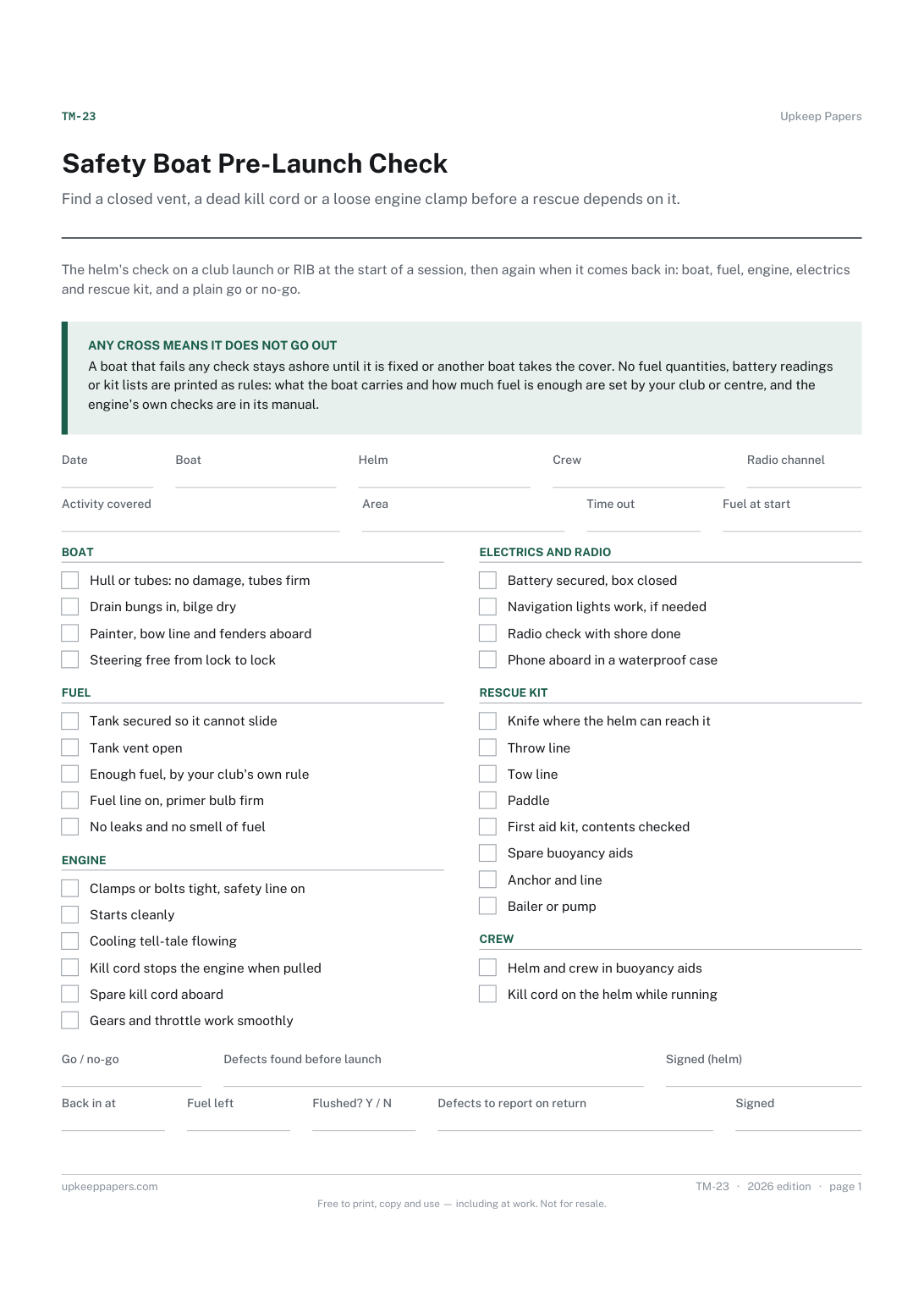
Find a closed vent, a dead kill cord or a loose engine clamp before a rescue depends on it. The go or no-go is written down and signed.
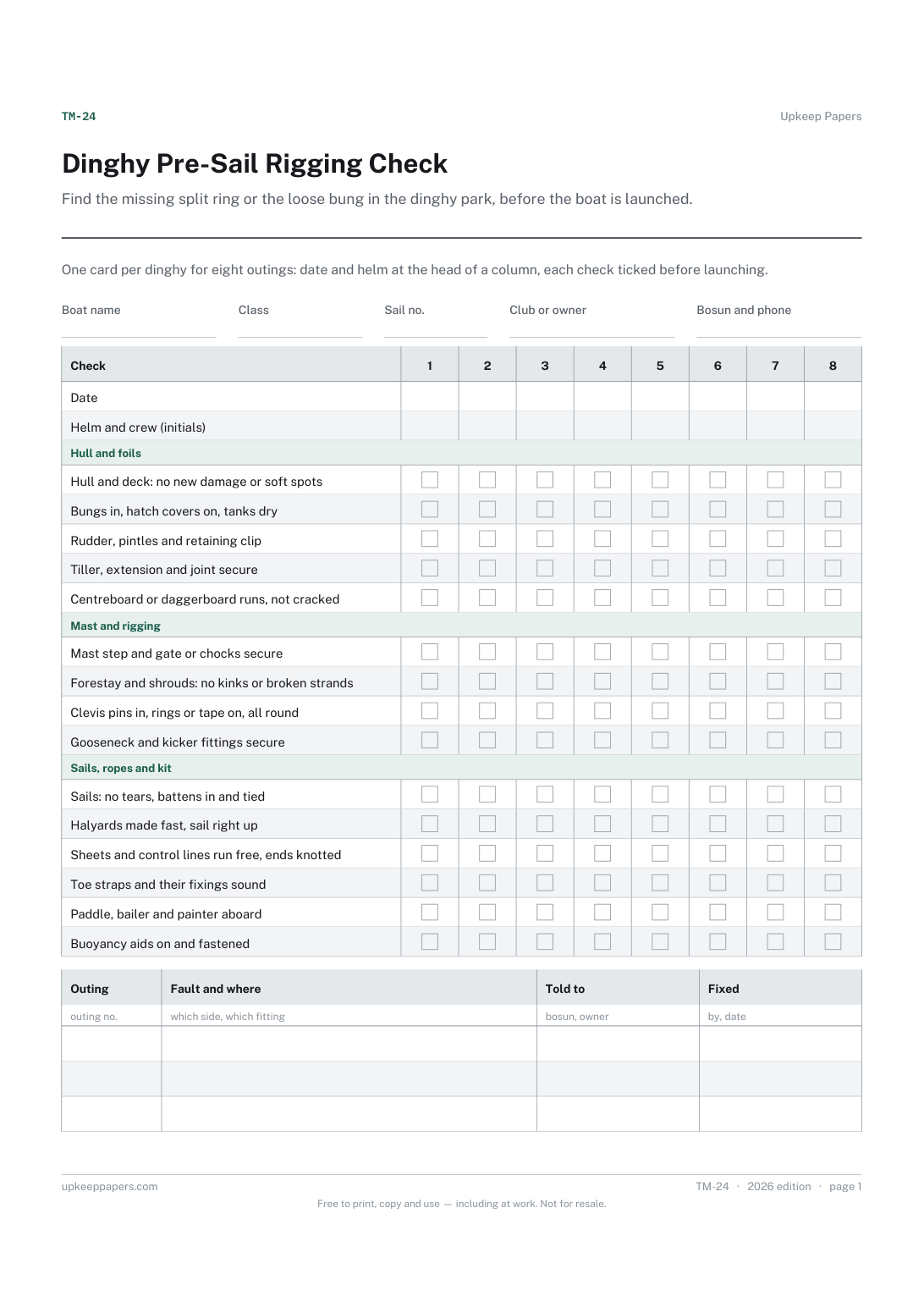
Find the missing split ring or the loose bung in the dinghy park, before the boat is launched. One card per boat builds a record over a season.
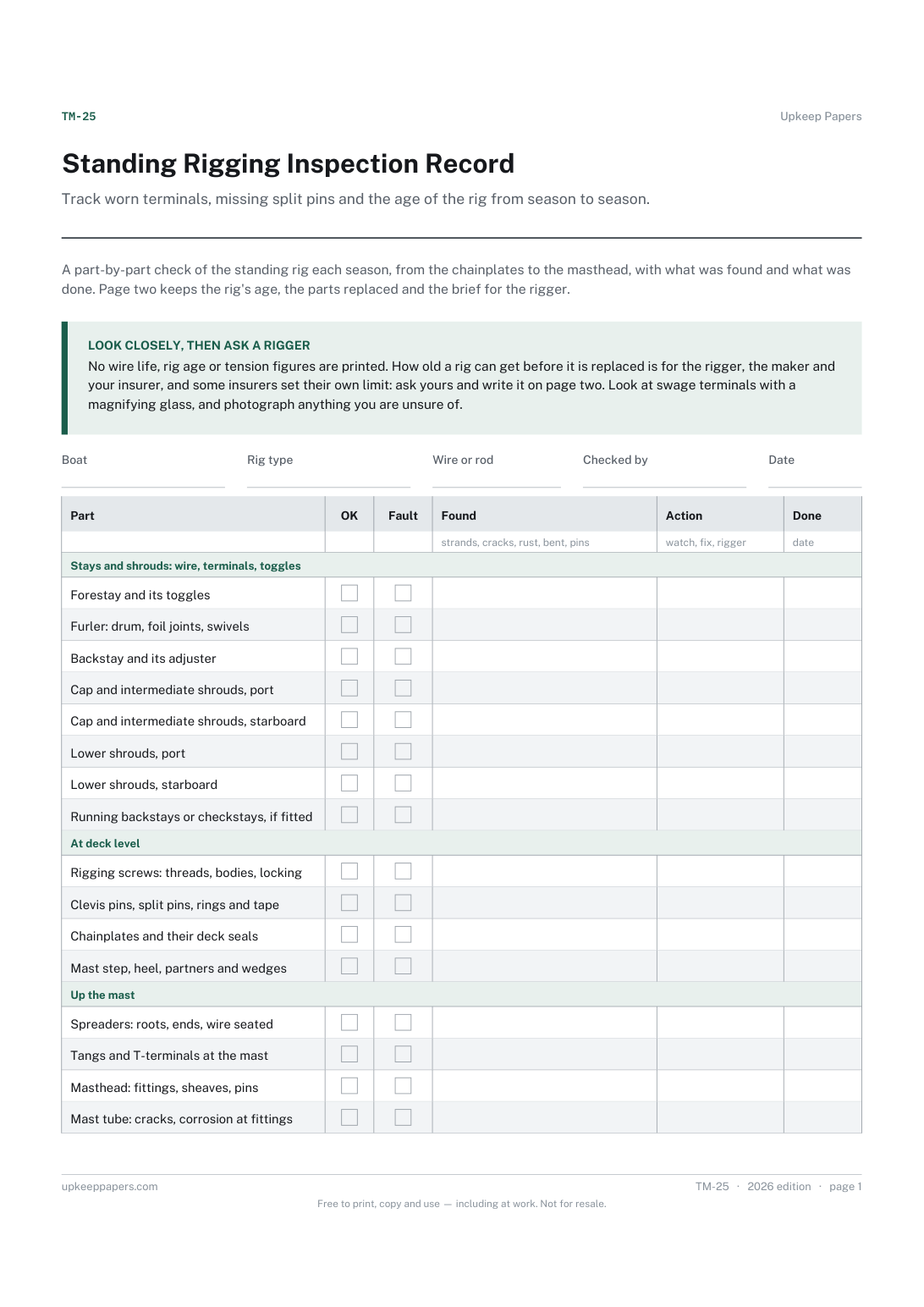
Track worn terminals, missing split pins and the age of the rig from season to season. Page two goes to the rigger with the photographs and the quote.
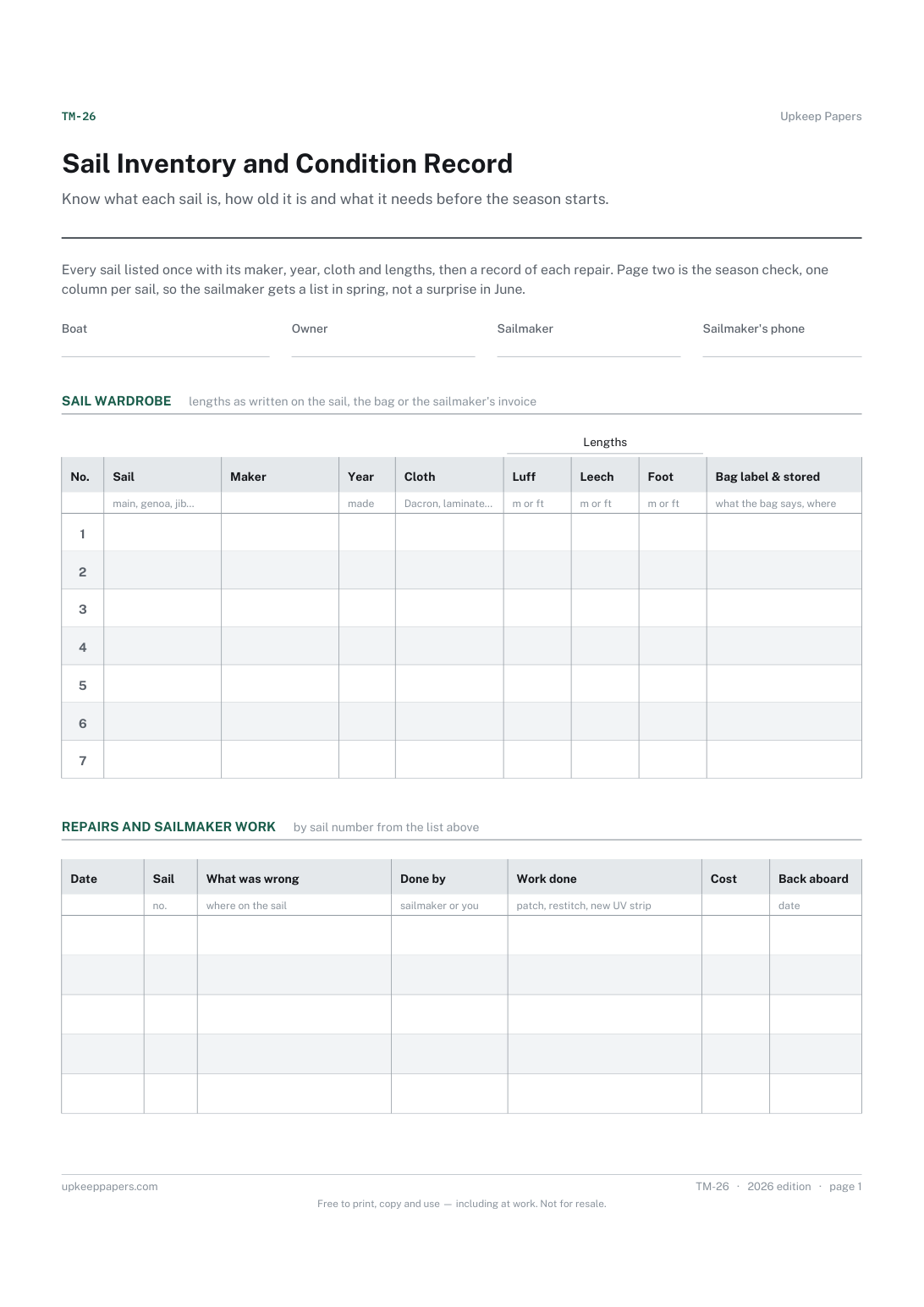
Know what each sail is, how old it is and what it needs before the season starts. The season check turns into the sailmaker's job list, and the repair log shows what each sail has already had done.
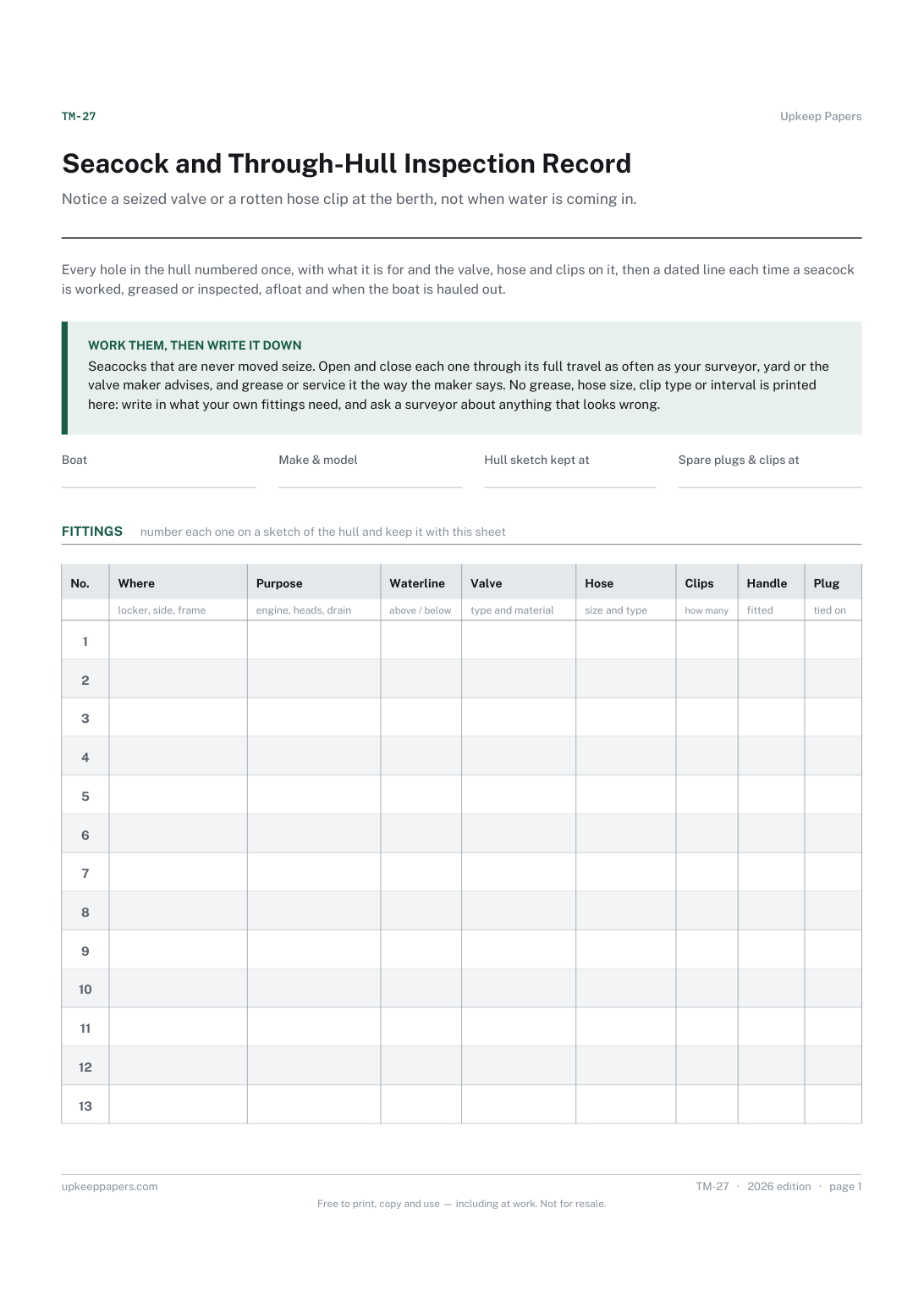
Notice a seized valve or a rotten hose clip at the berth, not when water is coming in. Every fitting gets a number, and every check gets a dated line.
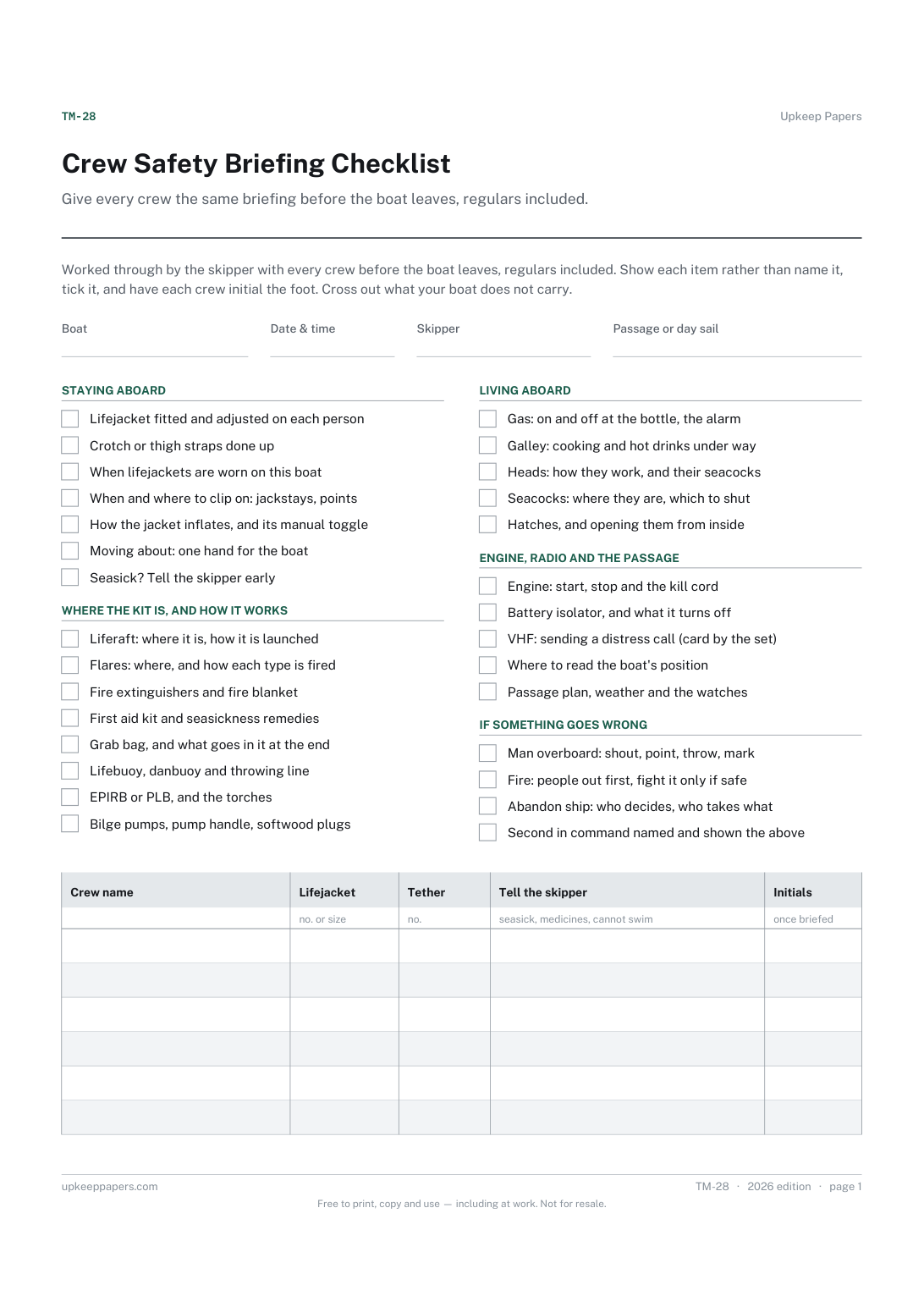
Give every crew the same briefing before the boat leaves, regulars included. Each topic is shown and ticked, and the crew initial the foot.
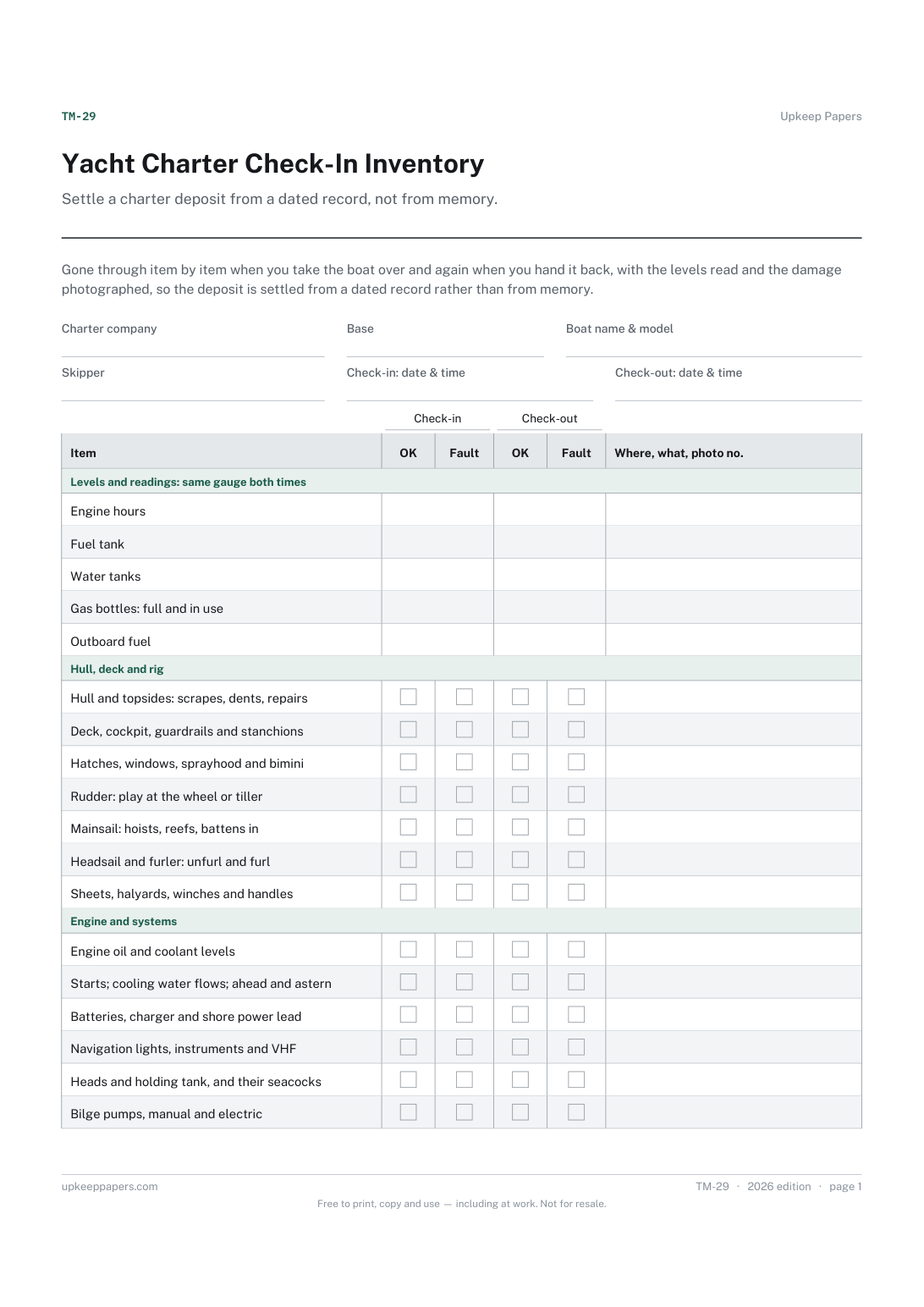
Settle a charter deposit from a dated record, not from memory. Every item is checked at handover and again at return, with the levels read and photos numbered.
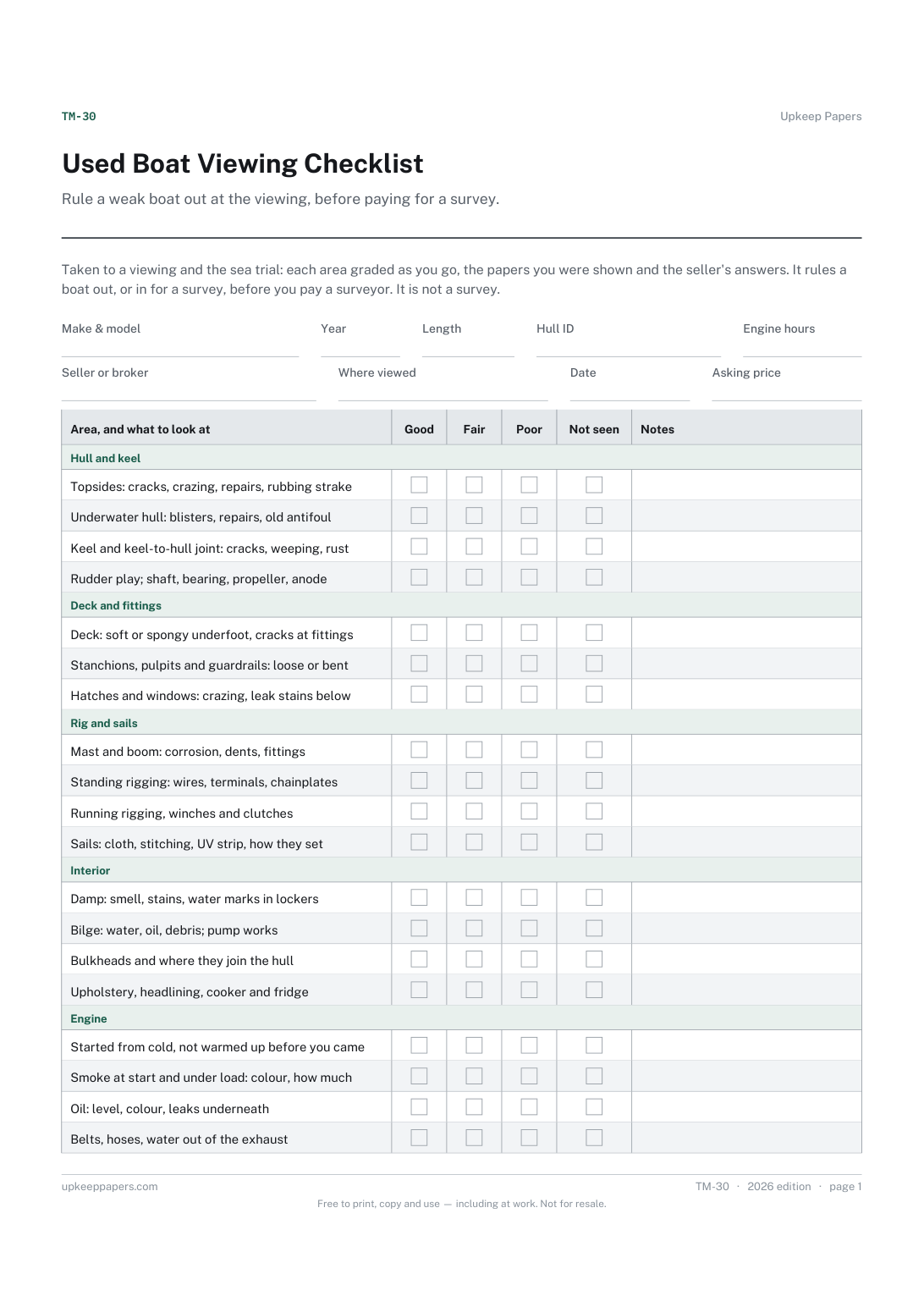
Rule a weak boat out at the viewing, before paying for a survey. Each area is graded good, fair or poor with notes, and the papers and answers sit beside it.
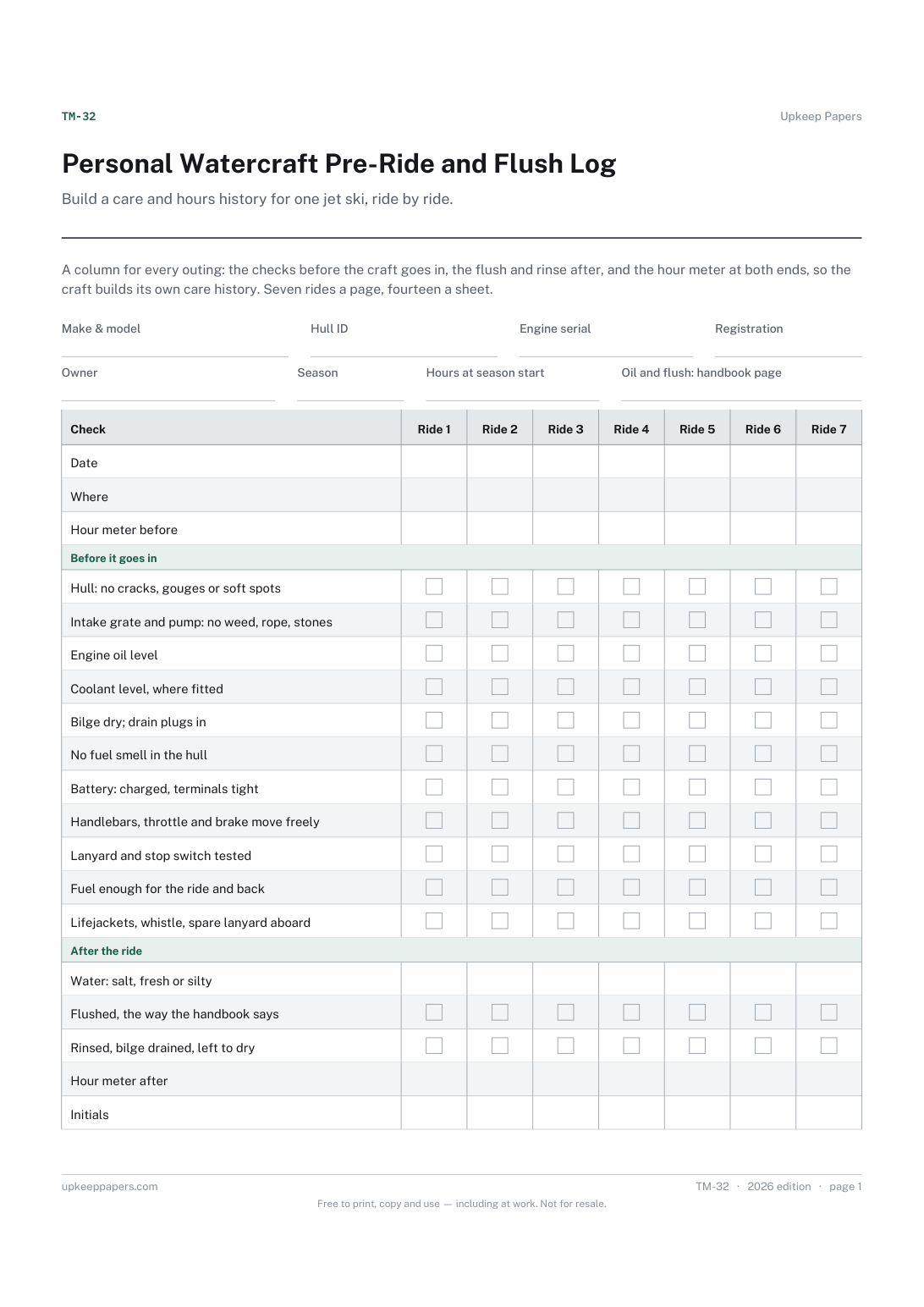
Build a care and hours history for one jet ski, ride by ride. Each outing gets its pre-ride checks, the flush after and the hour meter at both ends.
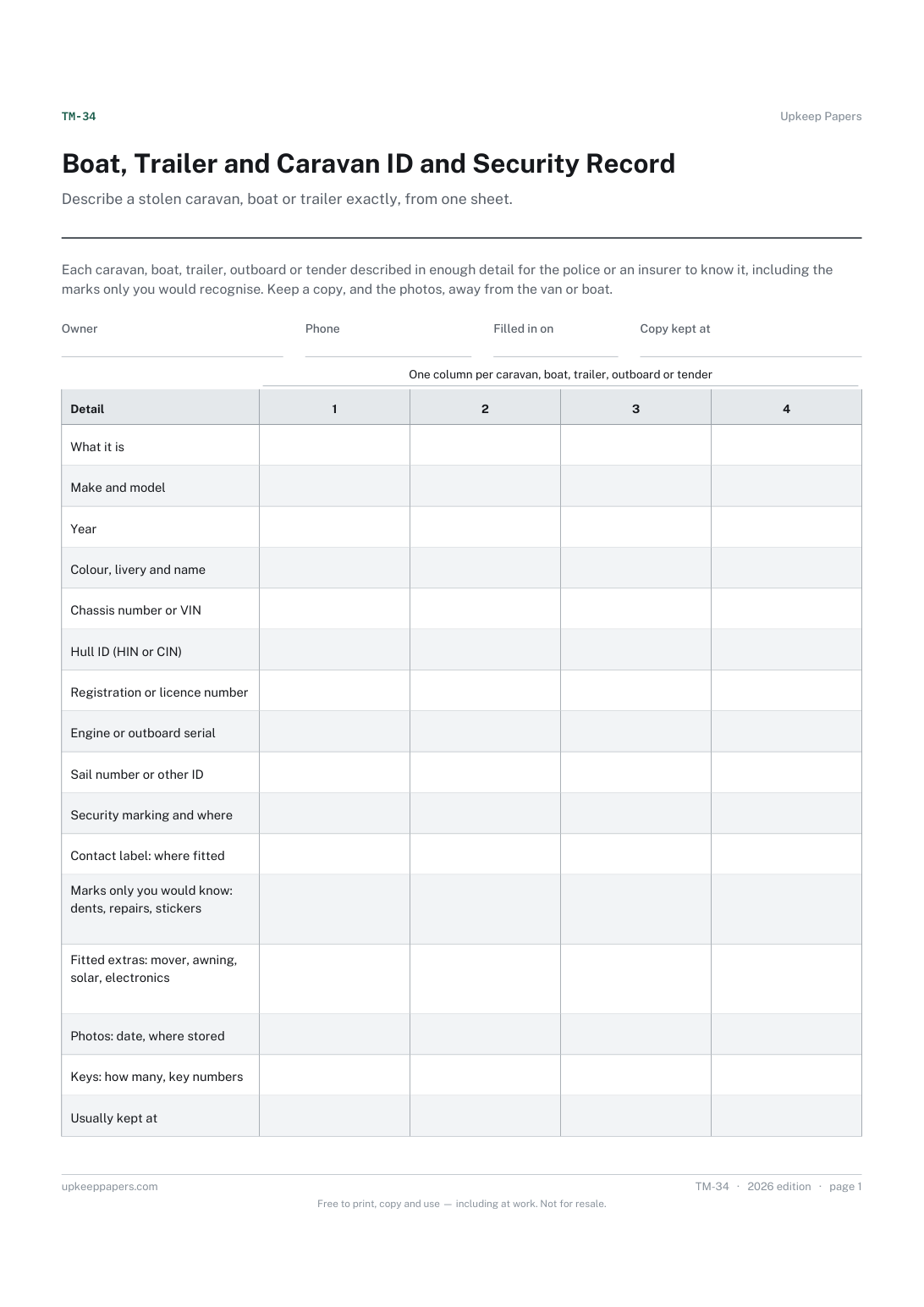
Describe a stolen caravan, boat or trailer exactly, from one sheet. The numbers, marks and photos are written down now, while it is in front of you.
Inventories, service logs and the working paperwork a small workshop, a trade or a van actually runs on.
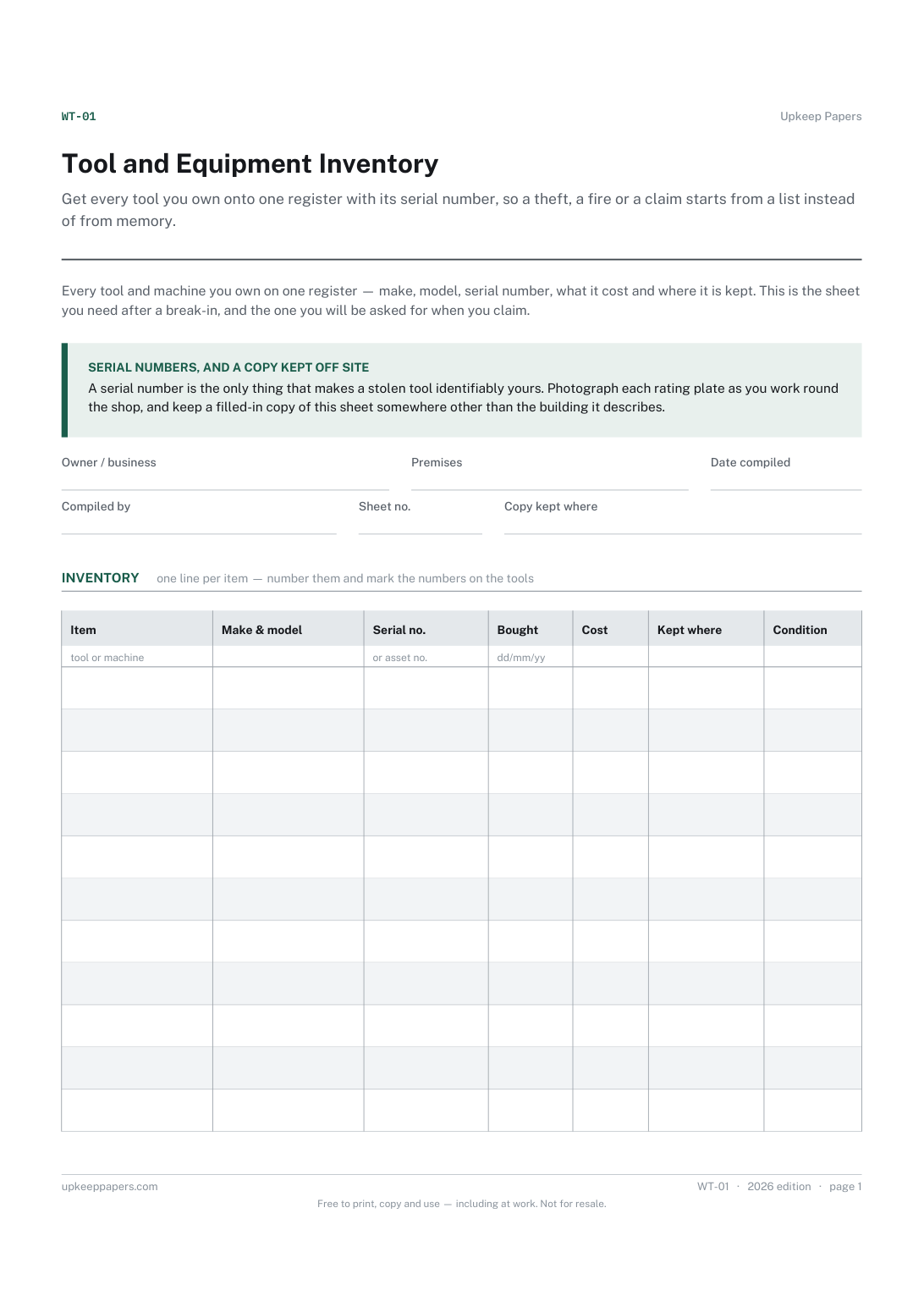
Get every tool you own onto one register with its serial number, so a theft, a fire or a claim starts from a list instead of from memory.
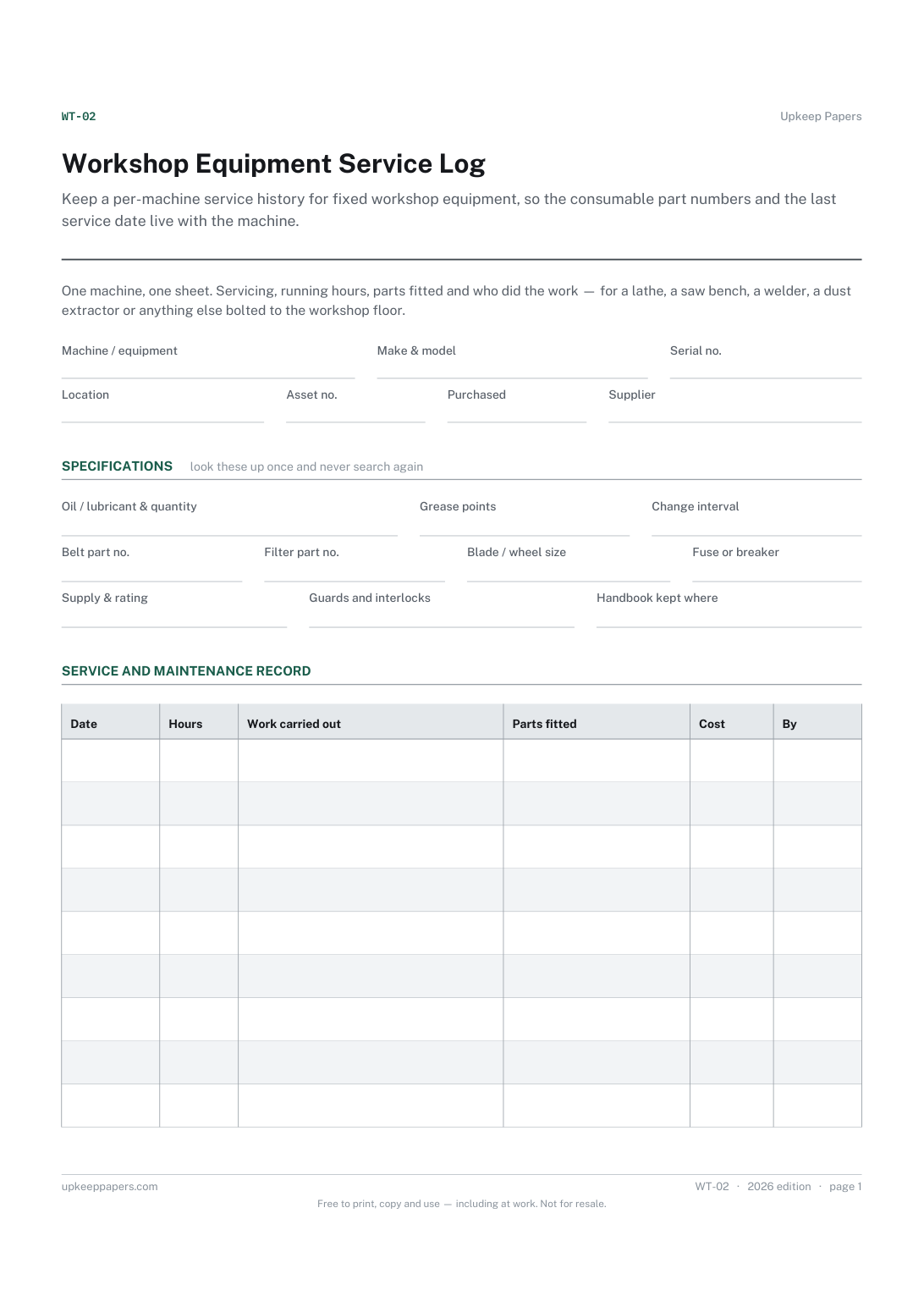
Keep a per-machine service history for fixed workshop equipment, so the consumable part numbers and the last service date live with the machine.
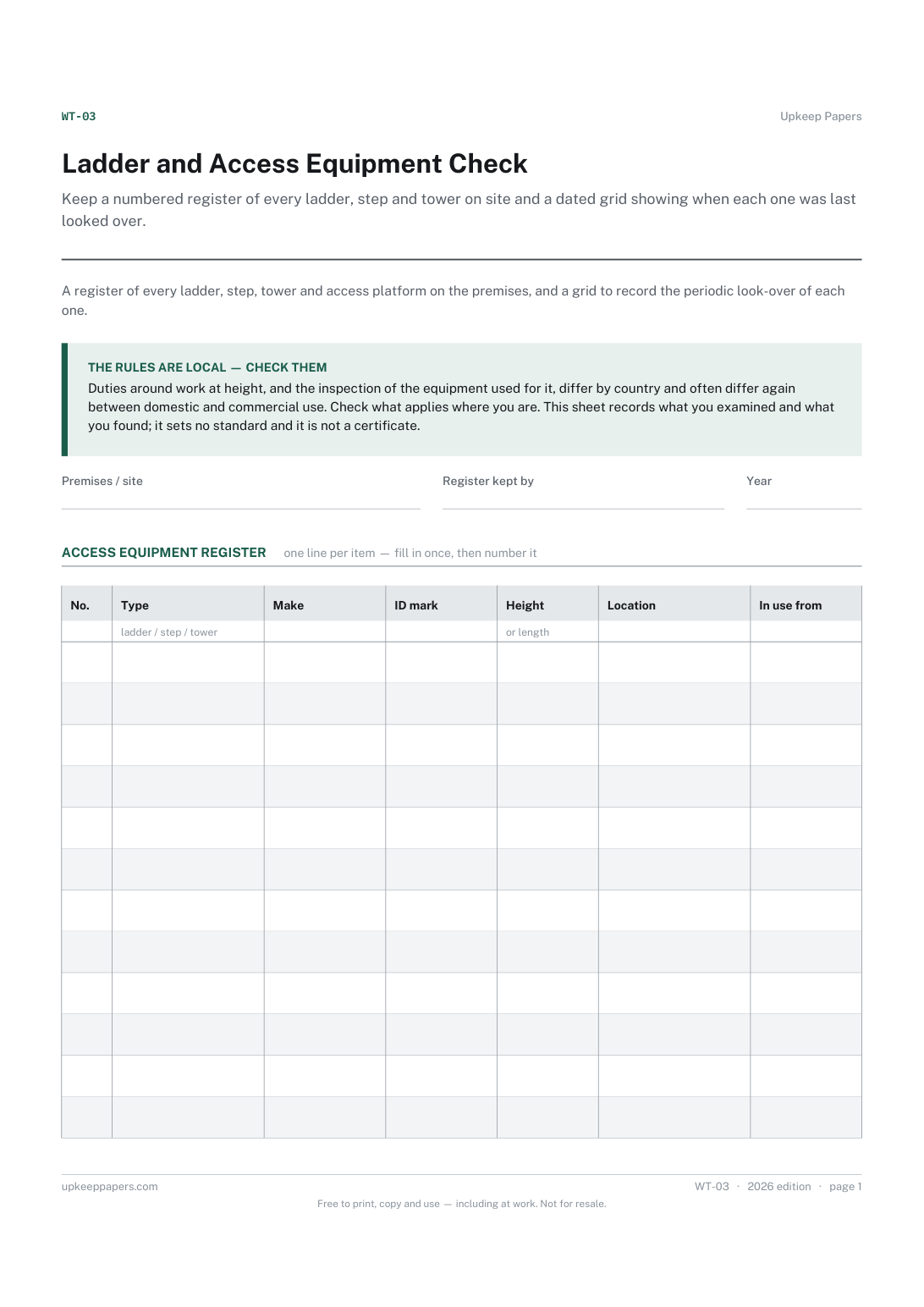
Keep a numbered register of every ladder, step and tower on site and a dated grid showing when each one was last looked over.
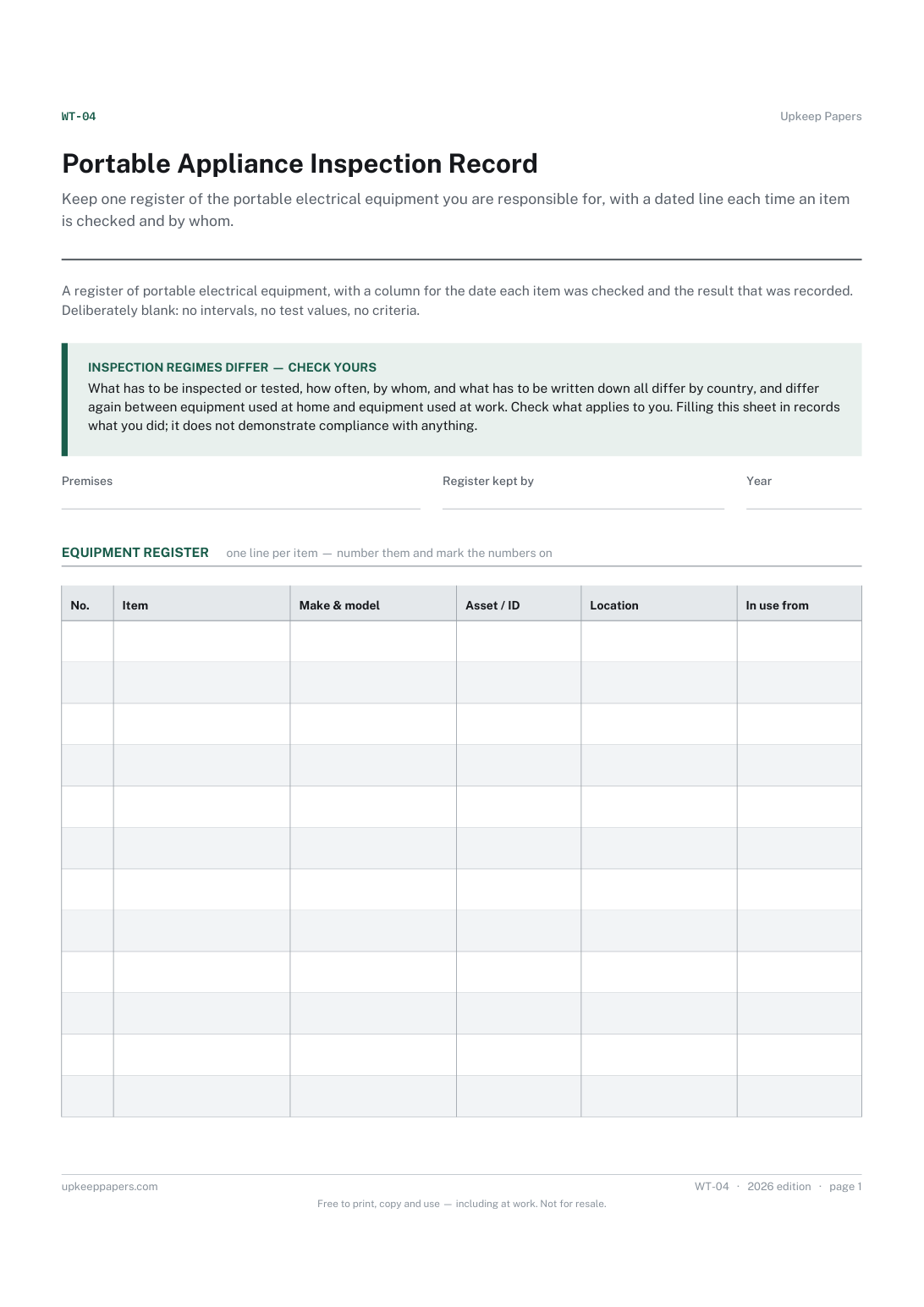
Keep one register of the portable electrical equipment you are responsible for, with a dated line each time an item is checked and by whom.
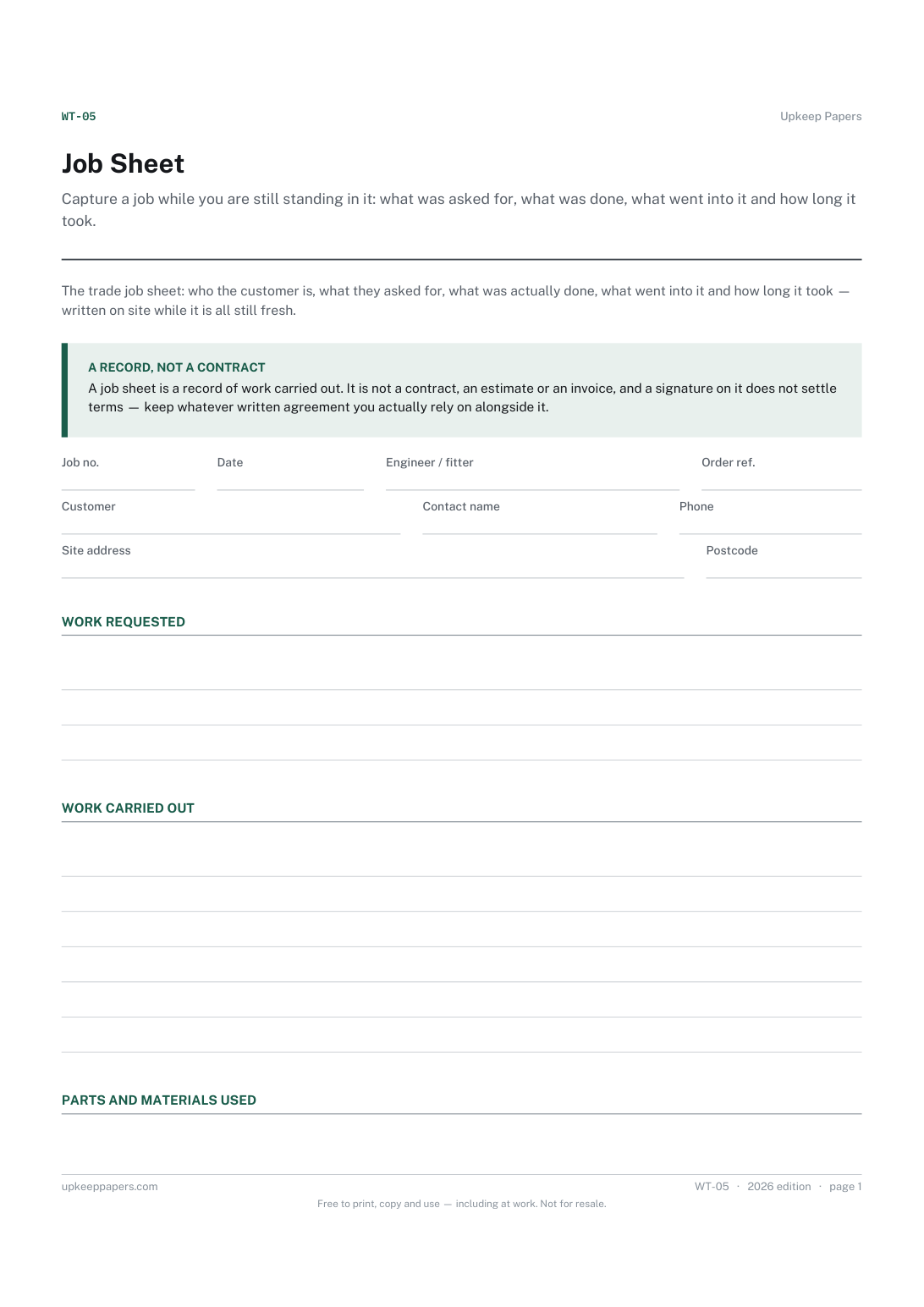
Capture a job while you are still standing in it: what was asked for, what was done, what went into it and how long it took.
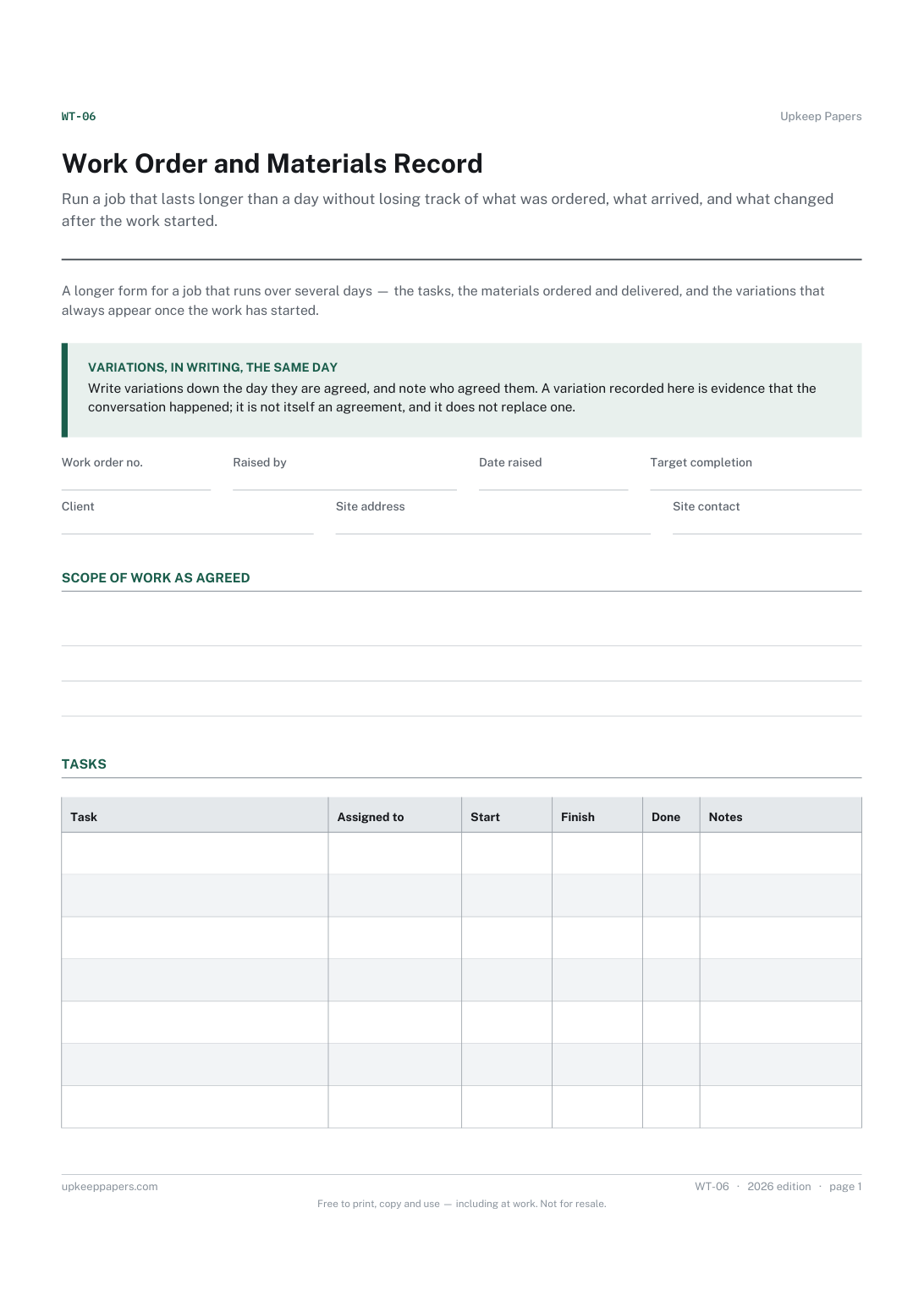
Run a job that lasts longer than a day without losing track of what was ordered, what arrived, and what changed after the work started.
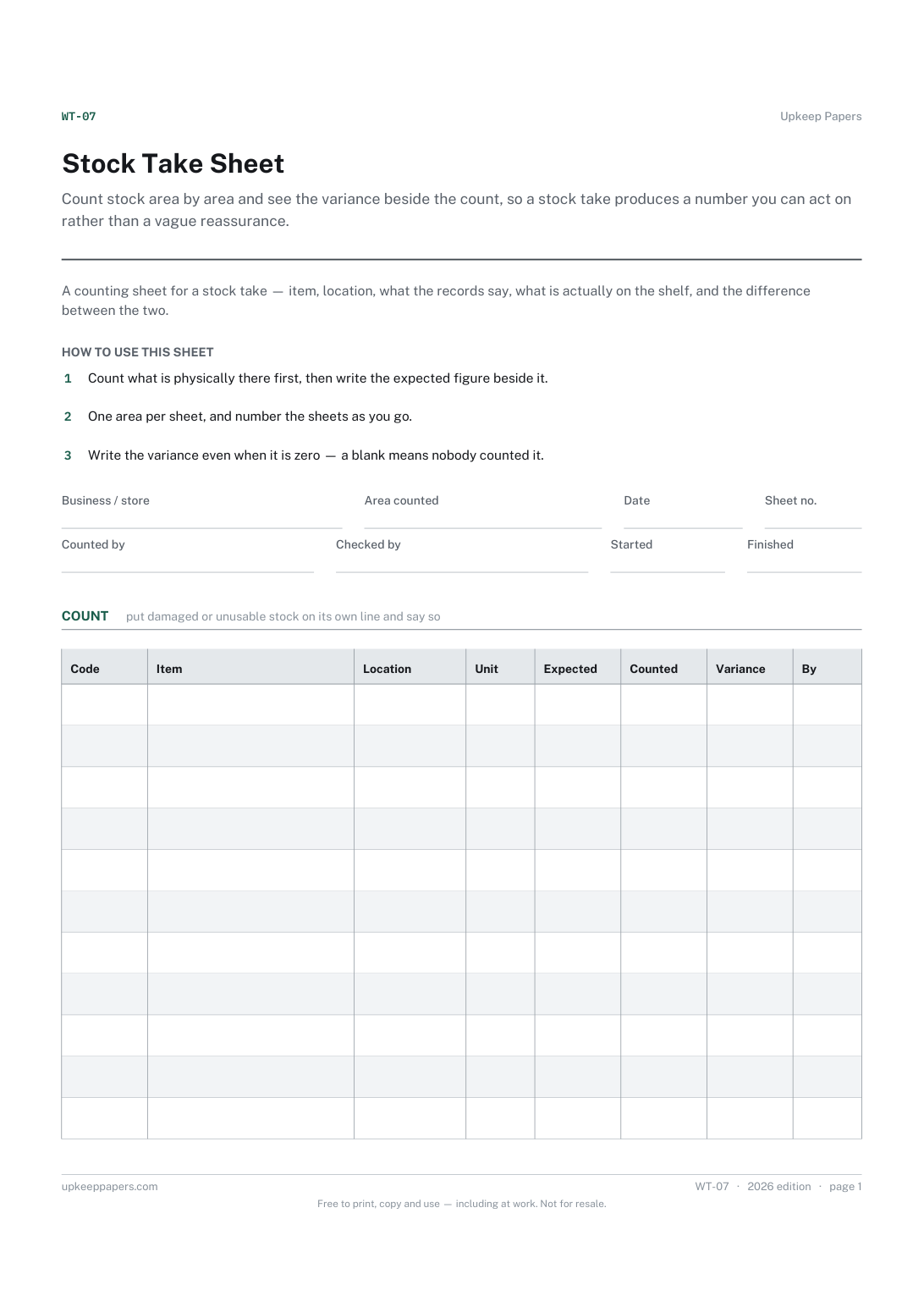
Count stock area by area and see the variance beside the count, so a stock take produces a number you can act on rather than a vague reassurance.
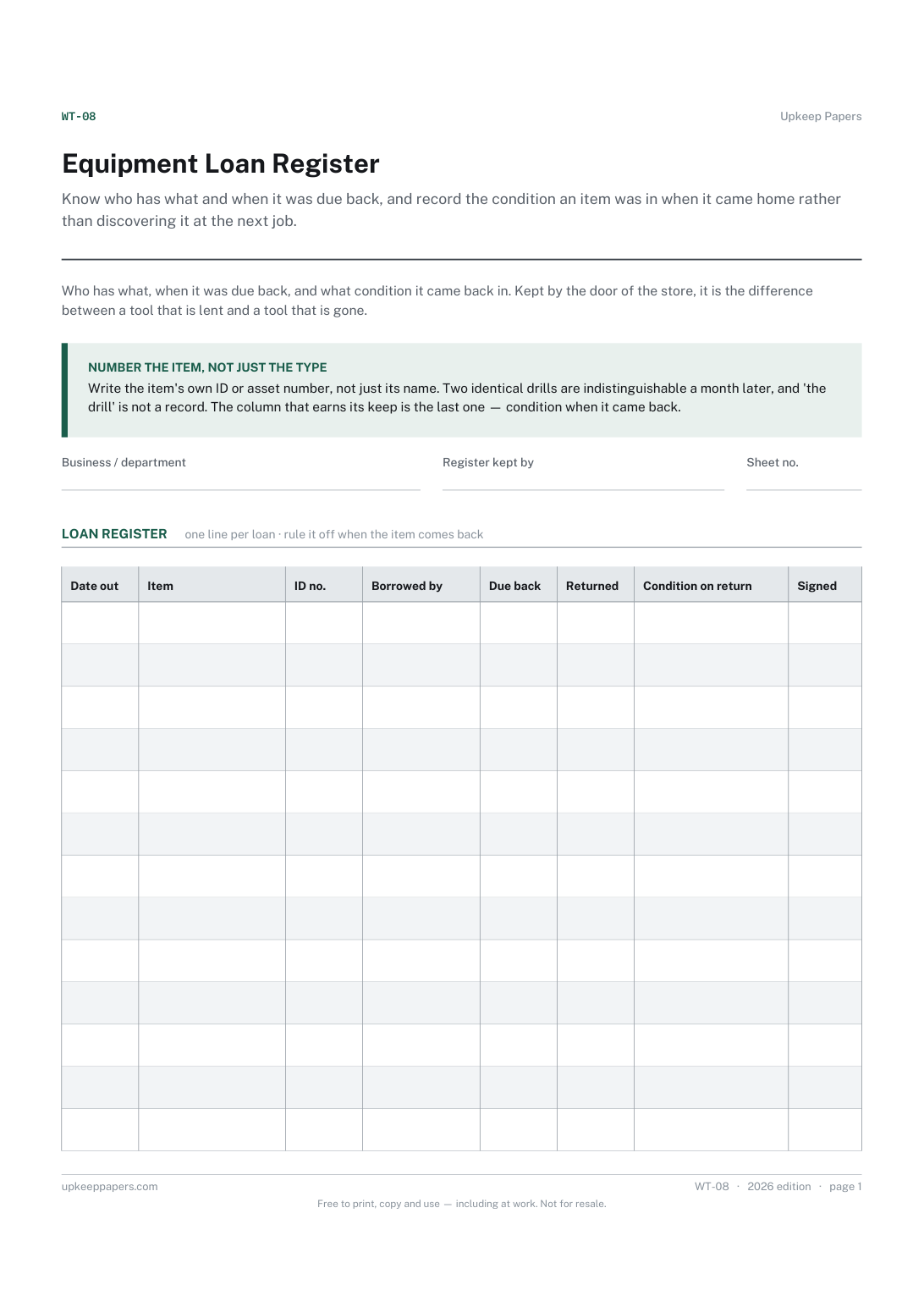
Know who has what and when it was due back, and record the condition an item was in when it came home rather than discovering it at the next job.
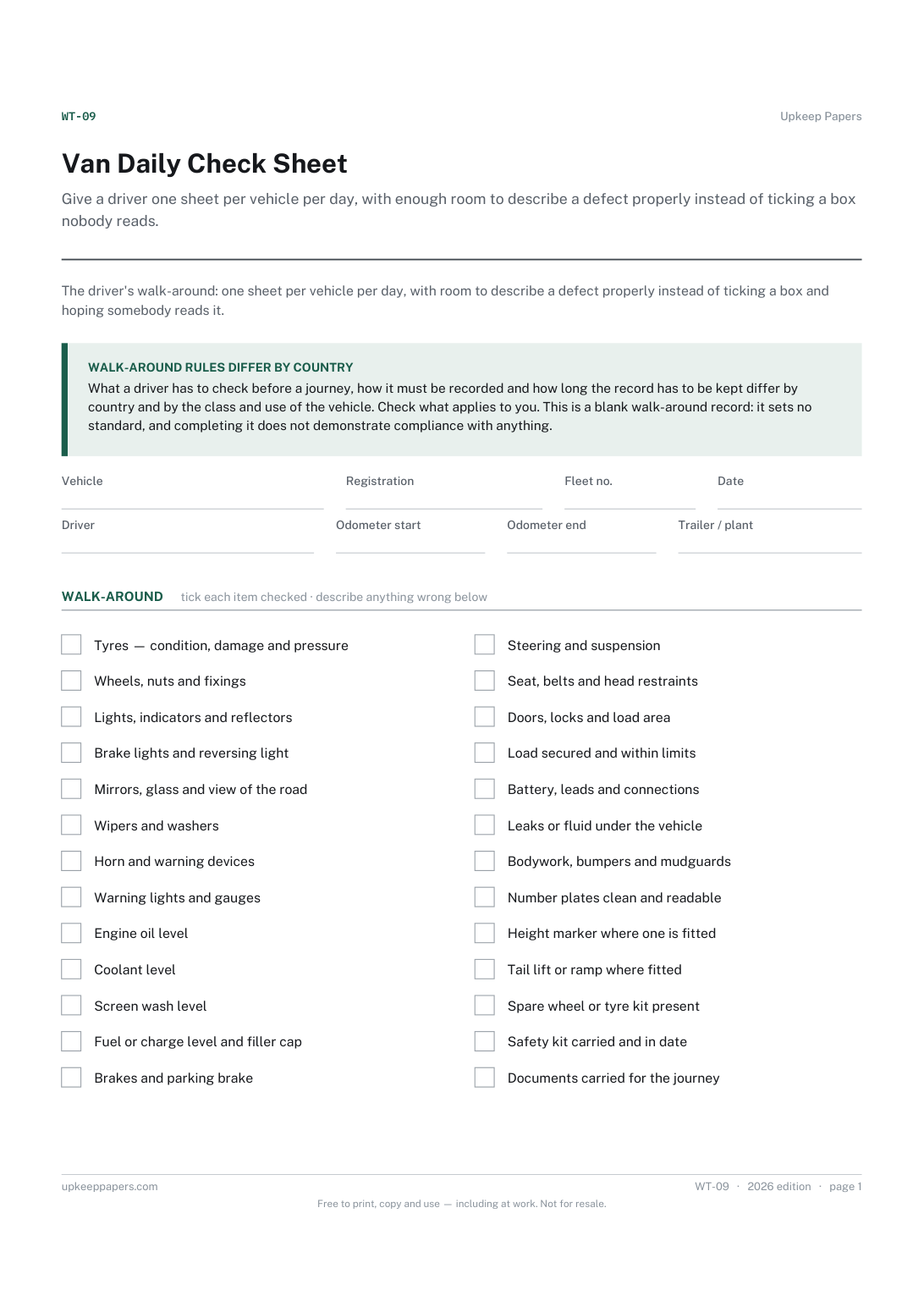
Give a driver one sheet per vehicle per day, with enough room to describe a defect properly instead of ticking a box nobody reads.
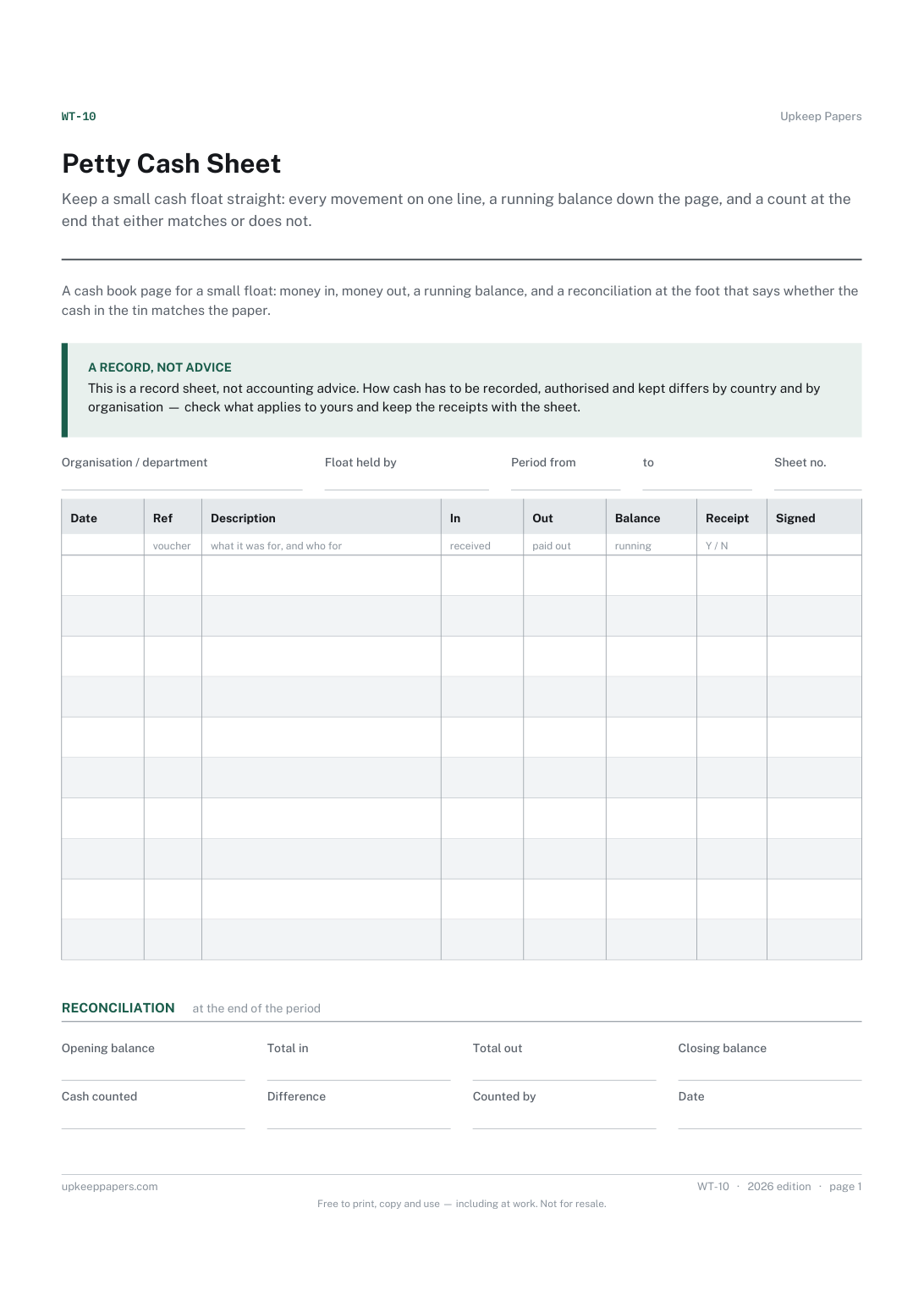
Keep a small cash float straight: every movement on one line, a running balance down the page, and a count at the end that either matches or does not.
Keep a week of daily walk-around checks on a single sheet that lives with the machine, so the record is made where the machine is rather than in an office.
Turn reordering from a guess into a decision, by recording the level you have chosen to hold against what is actually on the shelf.
Record what the business owns rather than what is in the shed: a numbered list with cost and disposal, which is what an insurer or an accountant asks for.
Send goods with a note, or check a delivery in properly, with the discrepancy line that settles arguments weeks later.
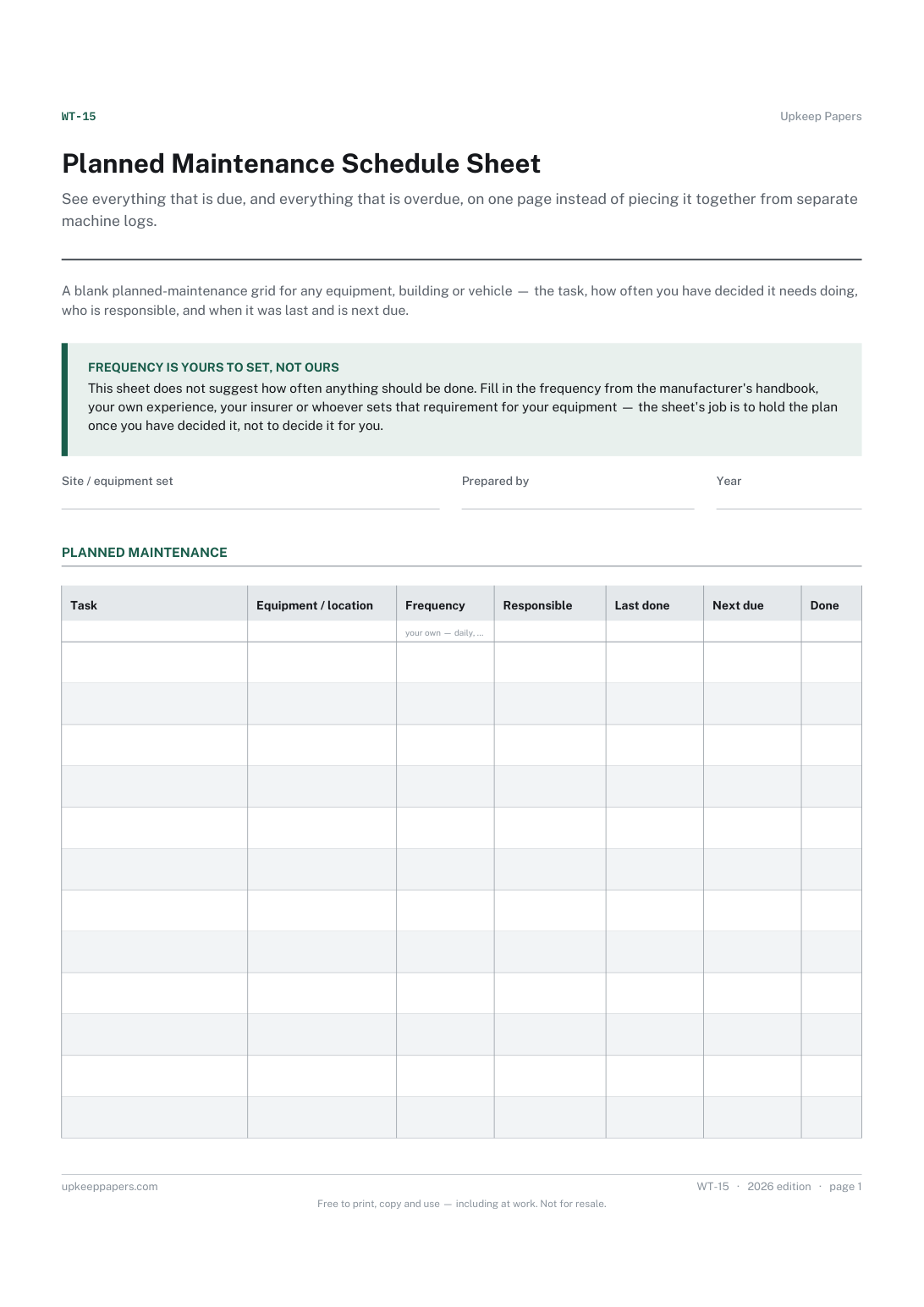
See everything that is due, and everything that is overdue, on one page instead of piecing it together from separate machine logs.
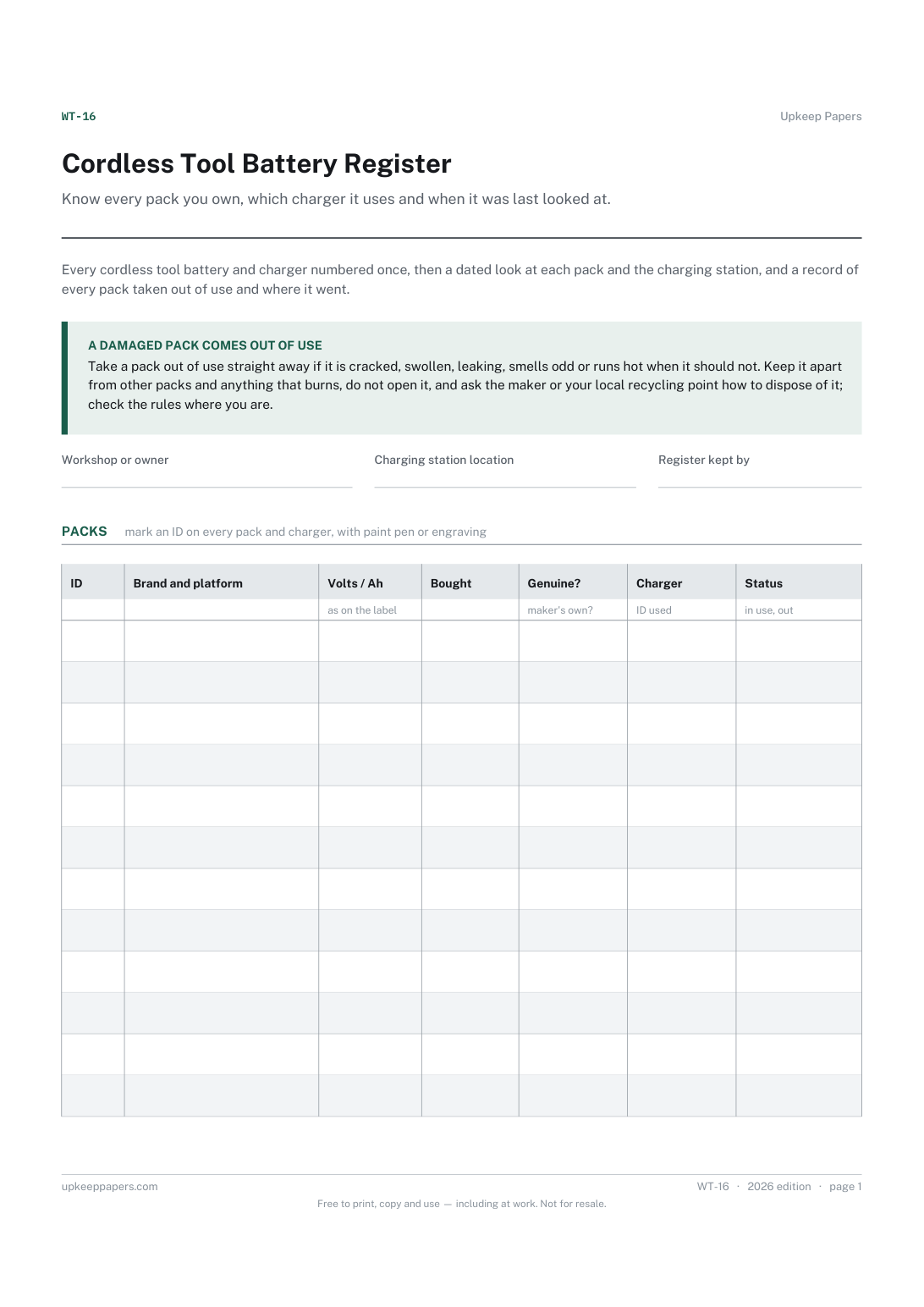
Know every pack you own, which charger it uses and when it was last looked at. A swollen or cracked pack is written out of use, not put back on charge.
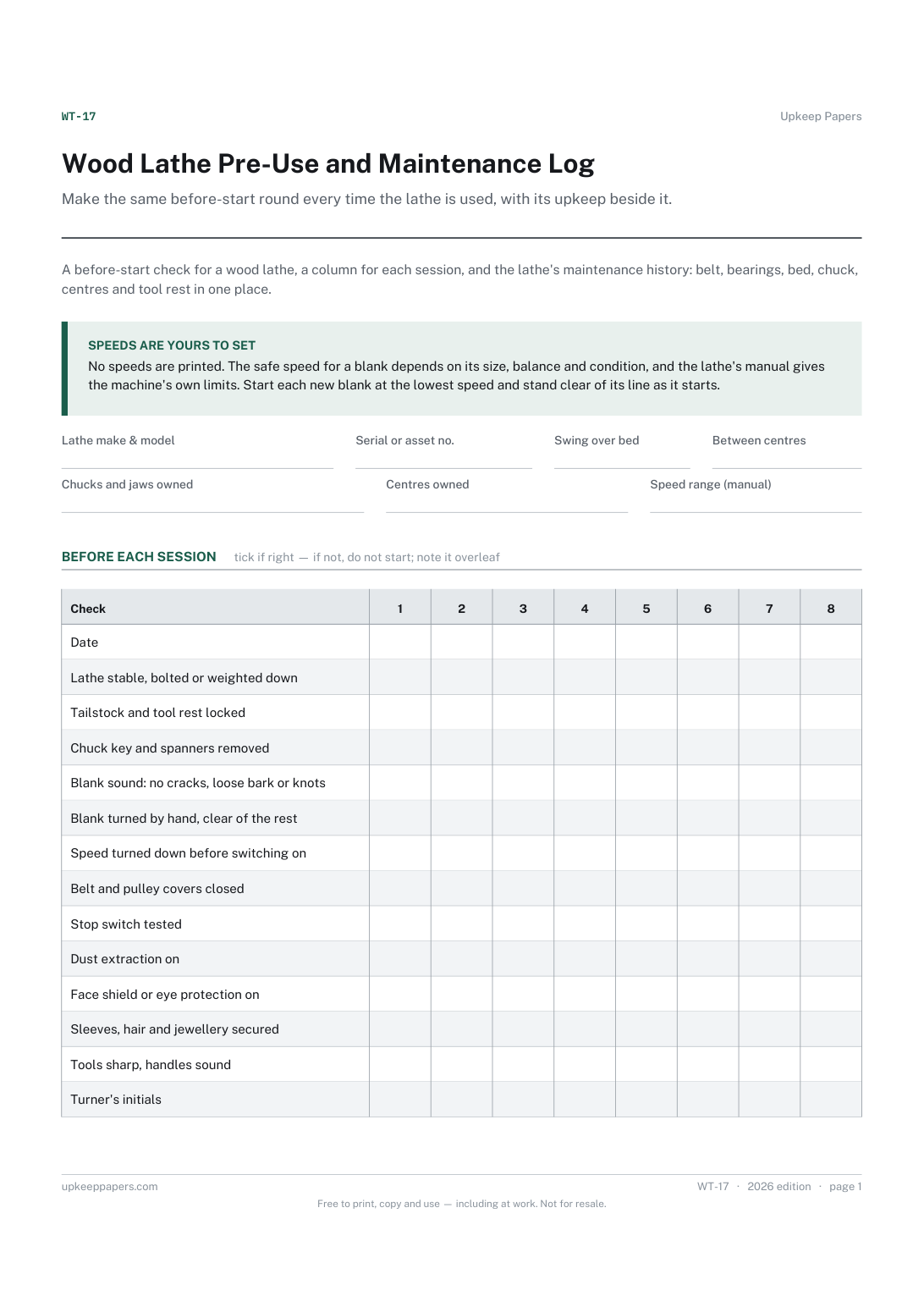
Make the same before-start round every time the lathe is used, with its upkeep beside it.
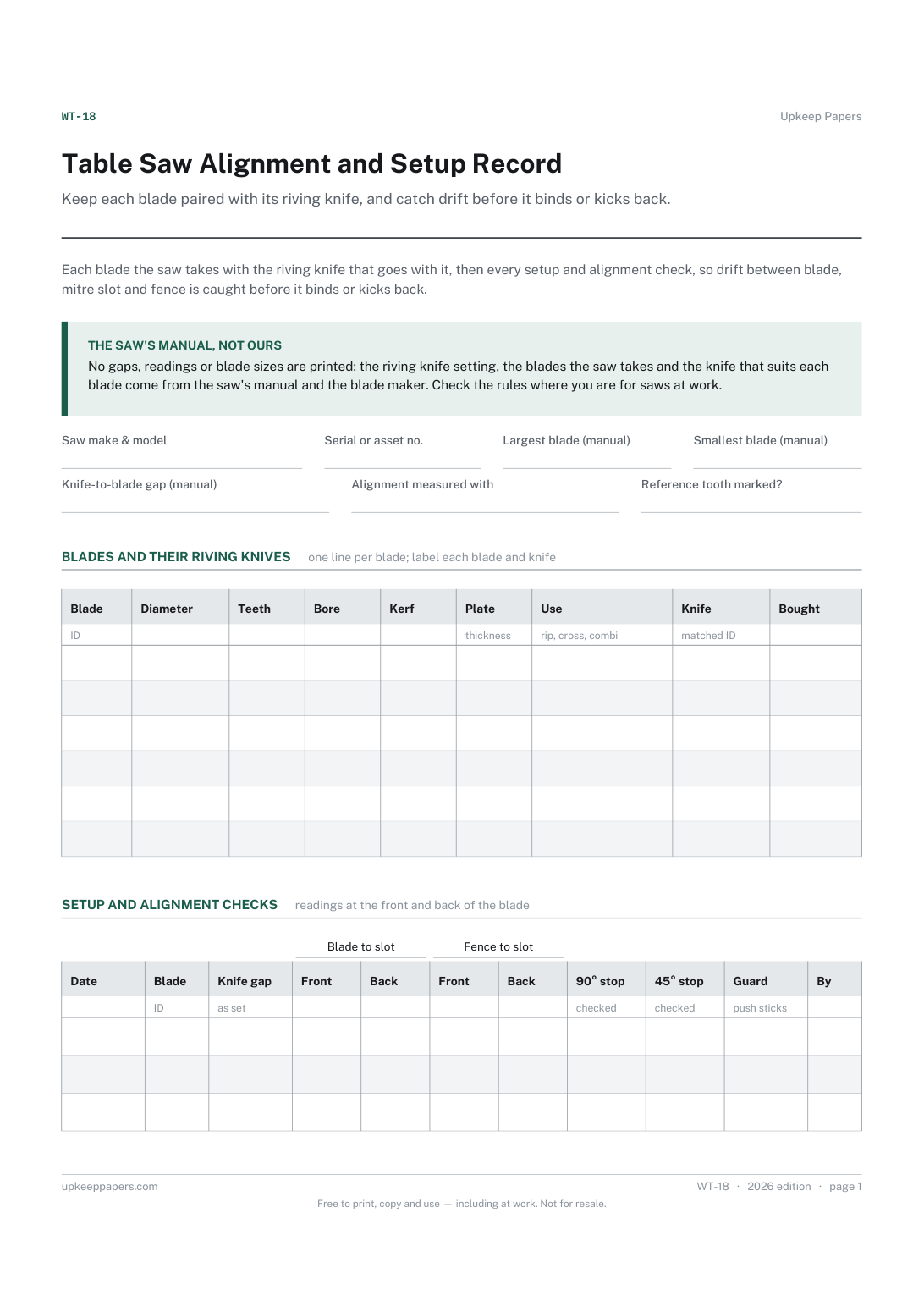
Keep each blade paired with its riving knife, and catch drift before it binds or kicks back.
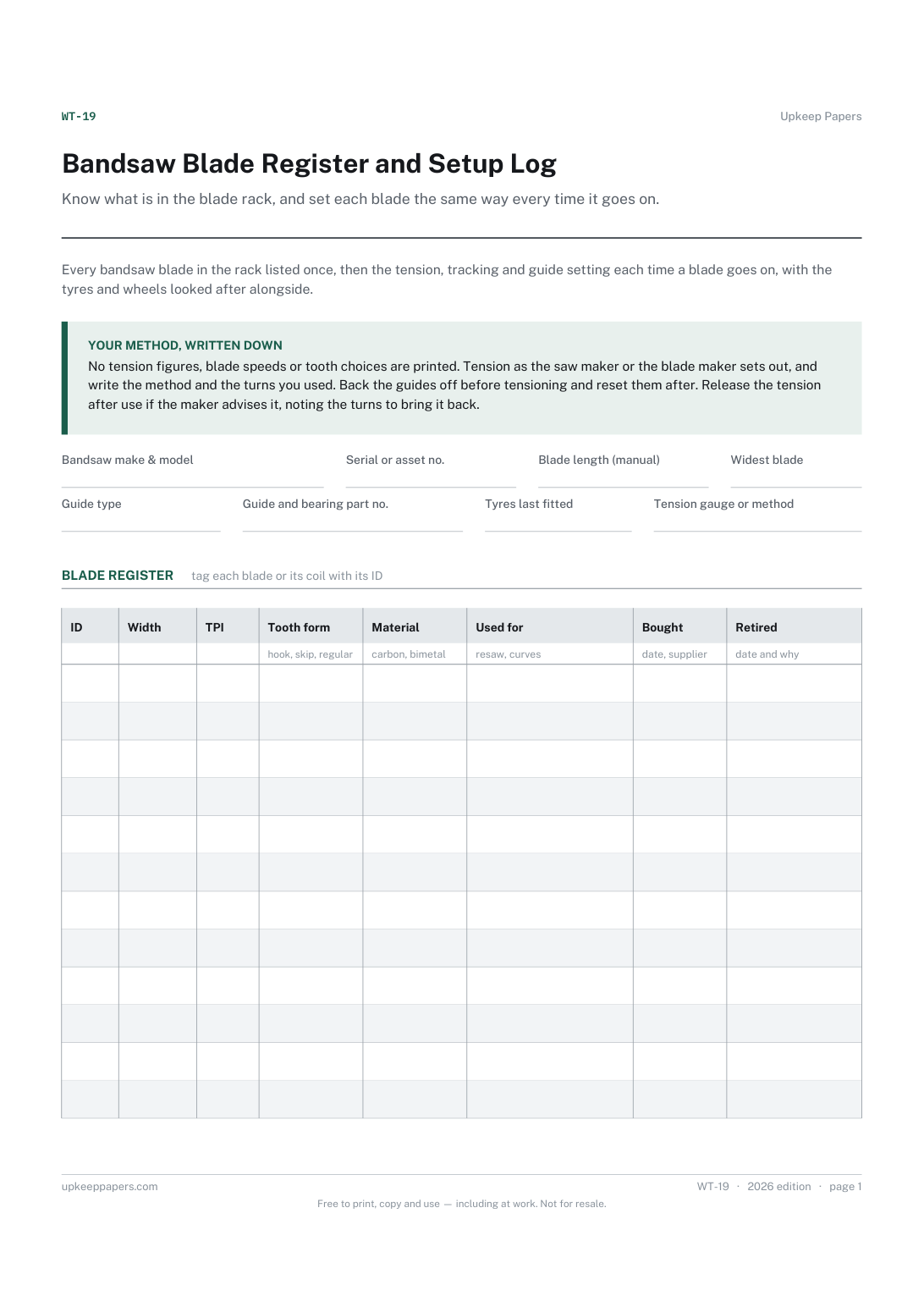
Know what is in the blade rack, and set each blade the same way every time it goes on.
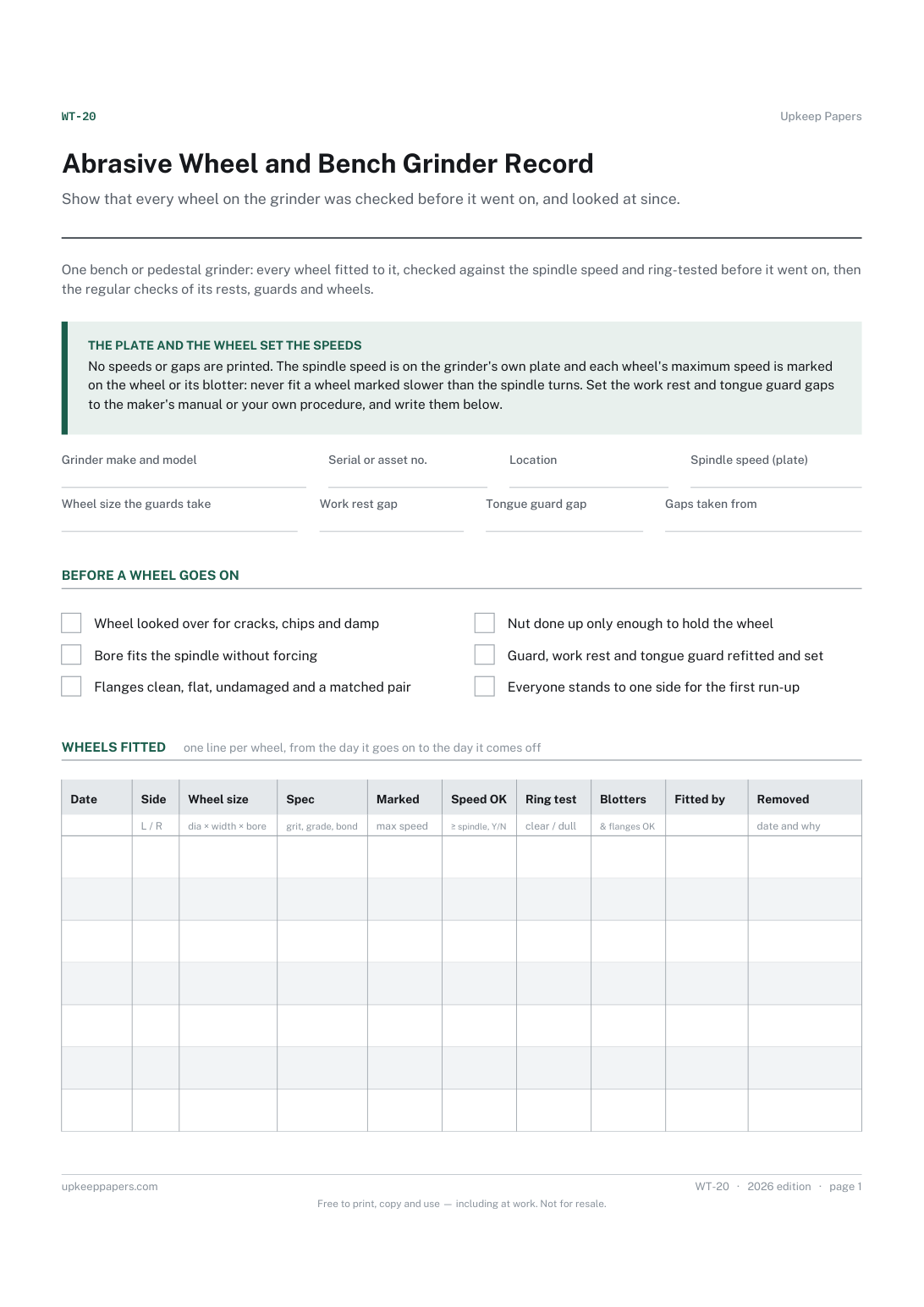
Show that every wheel on the grinder was checked before it went on, and looked at since. The rest and tongue guard gaps open up as a wheel wears, and the regular checks catch them.
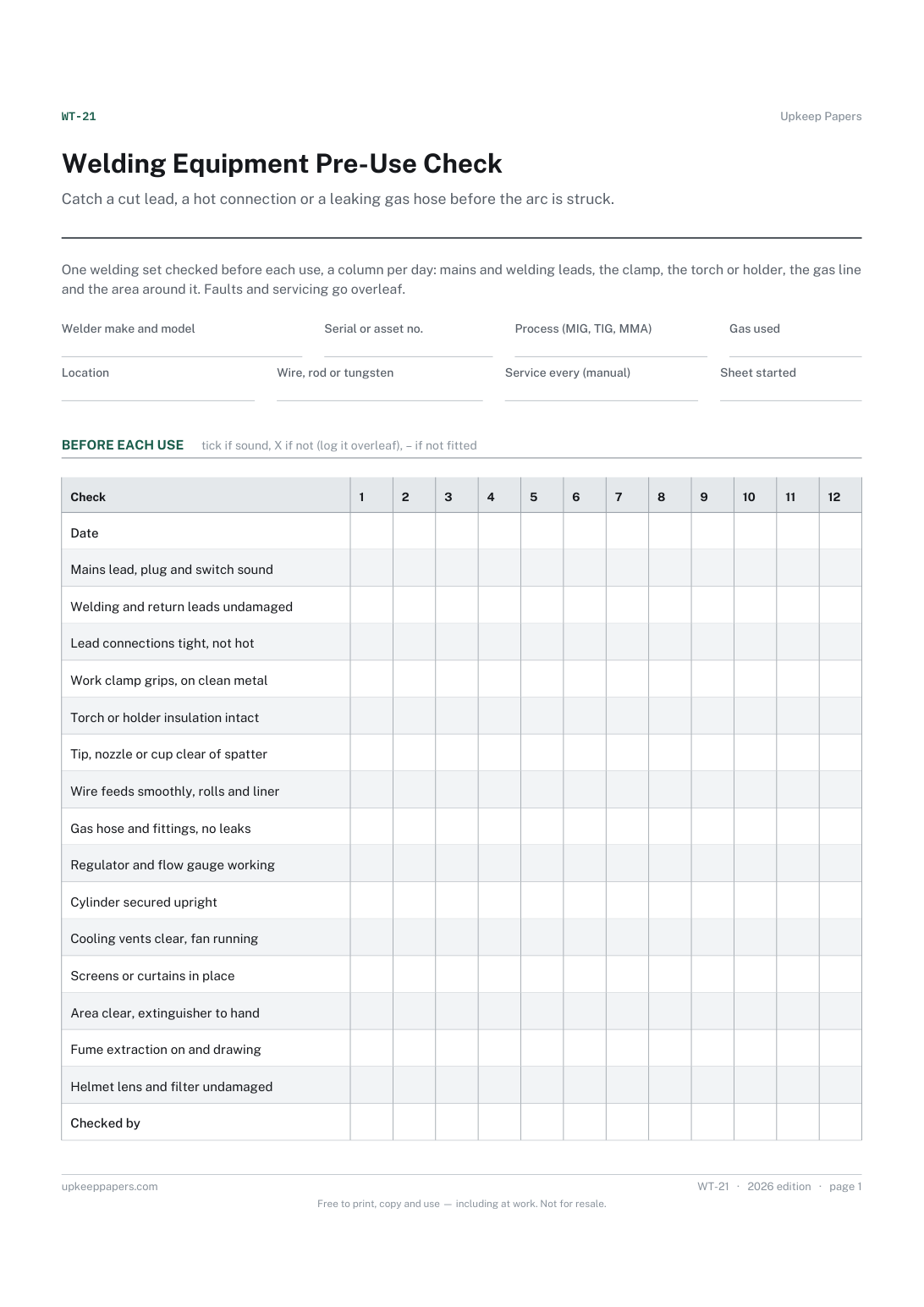
Catch a cut lead, a hot connection or a leaking gas hose before the arc is struck. Faults and servicing go on the back, so the set's history stays with it.
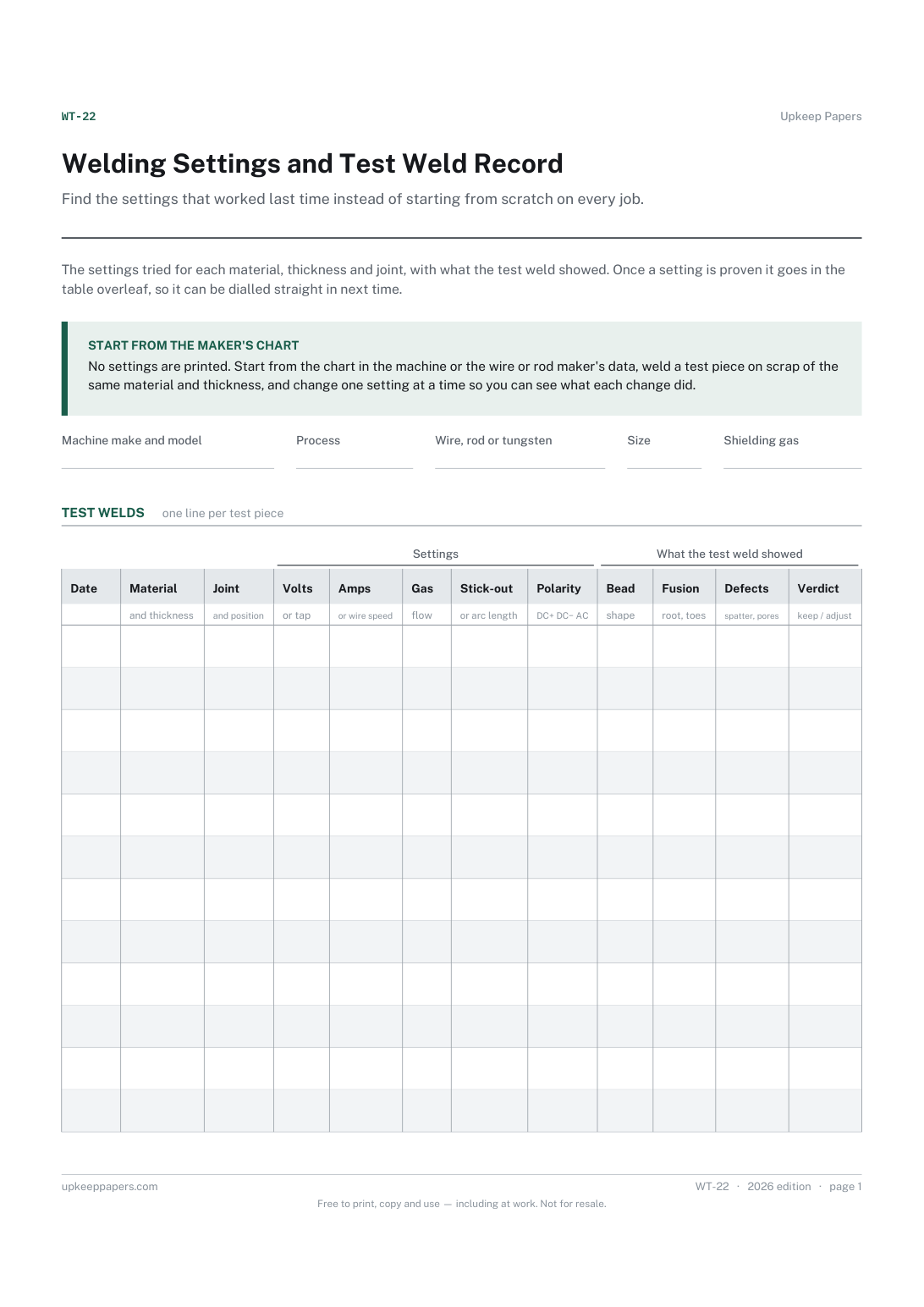
Find the settings that worked last time instead of starting from scratch on every job. Each test weld is written down with what it showed, and the good ones are copied to a table of proven settings overleaf.
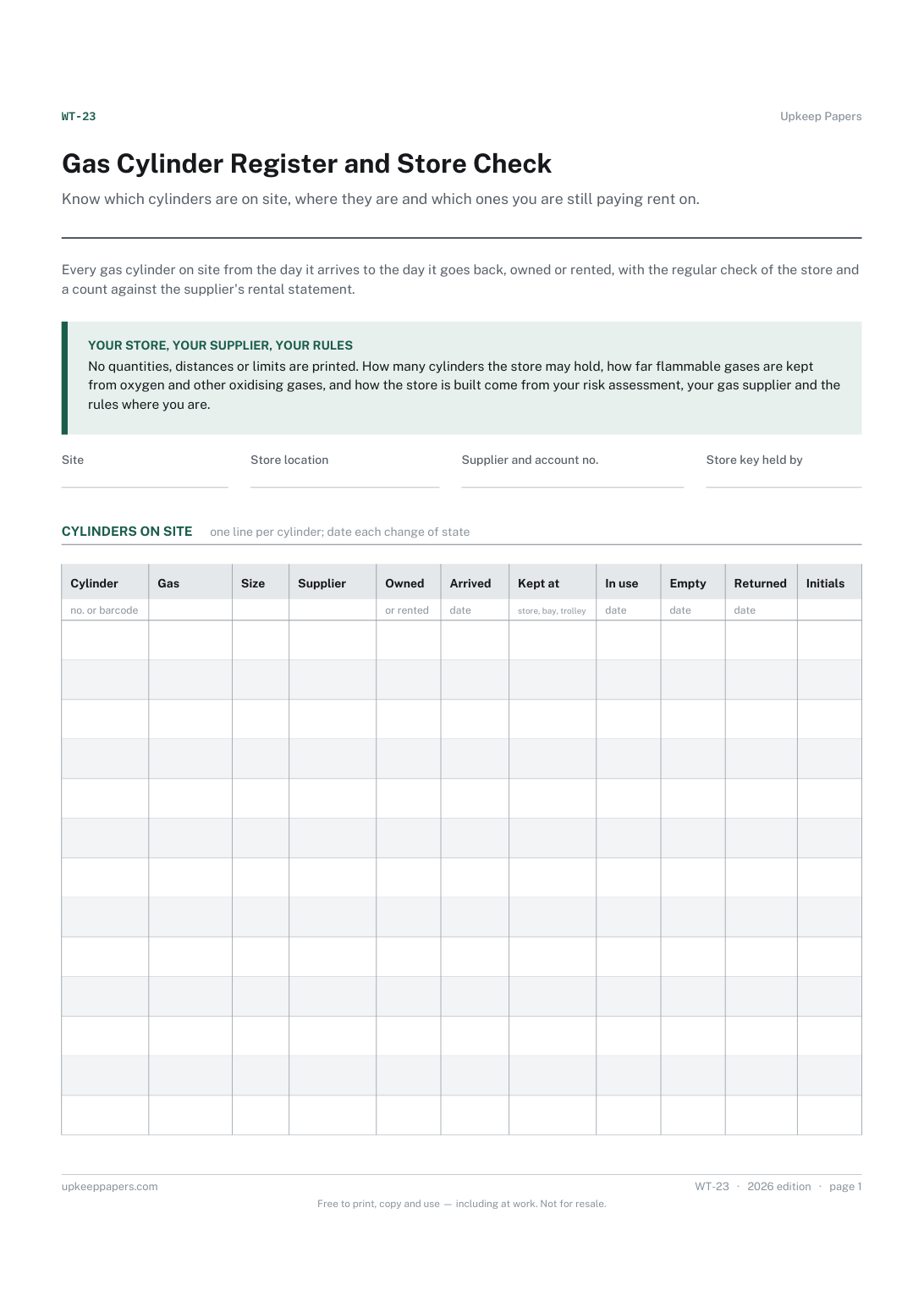
Know which cylinders are on site, where they are and which ones you are still paying rent on. The store checks sit behind the register, so the two are kept together.
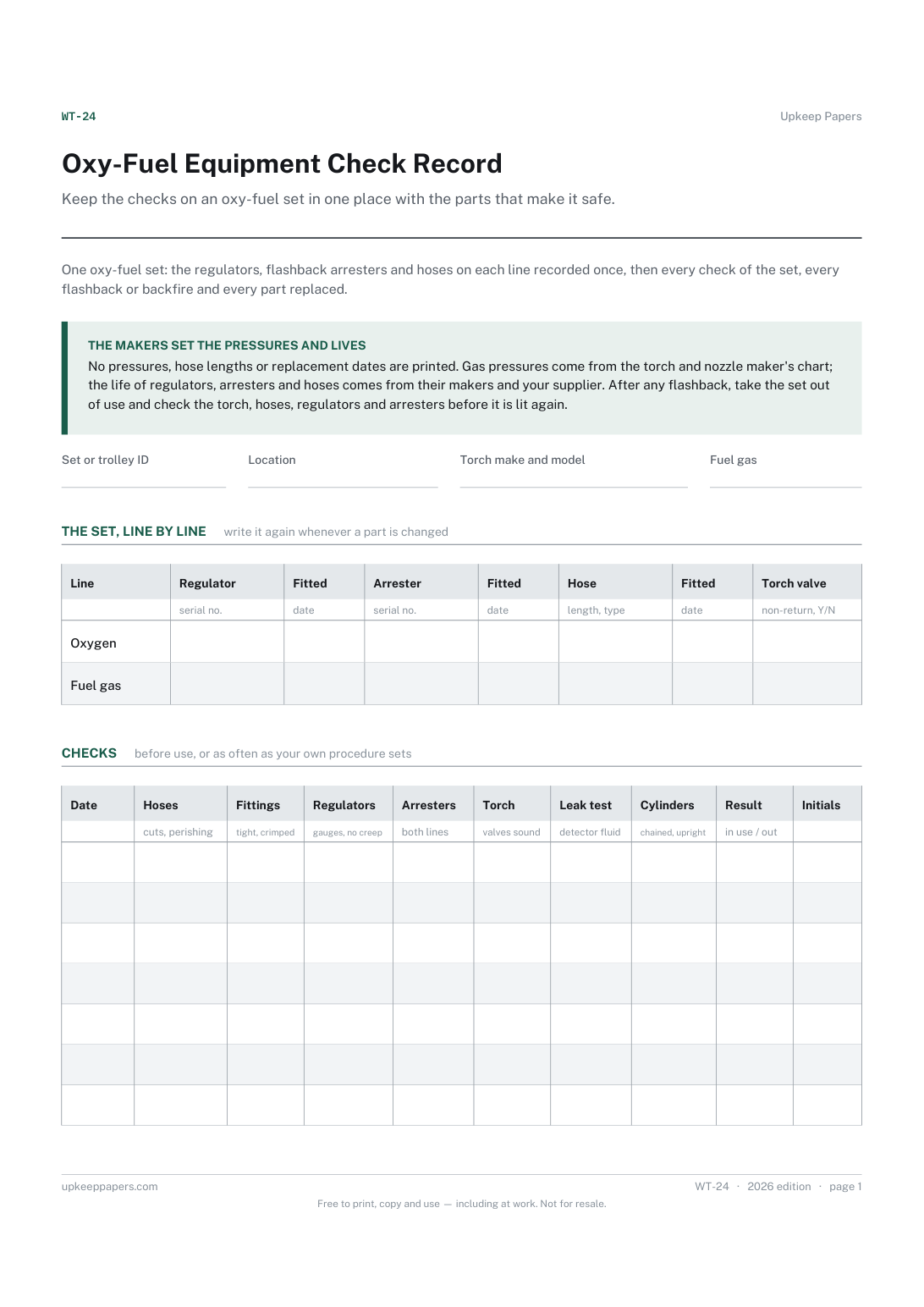
Keep the checks on an oxy-fuel set in one place with the parts that make it safe. After a flashback, the sheet shows what was checked and replaced before it was lit again.
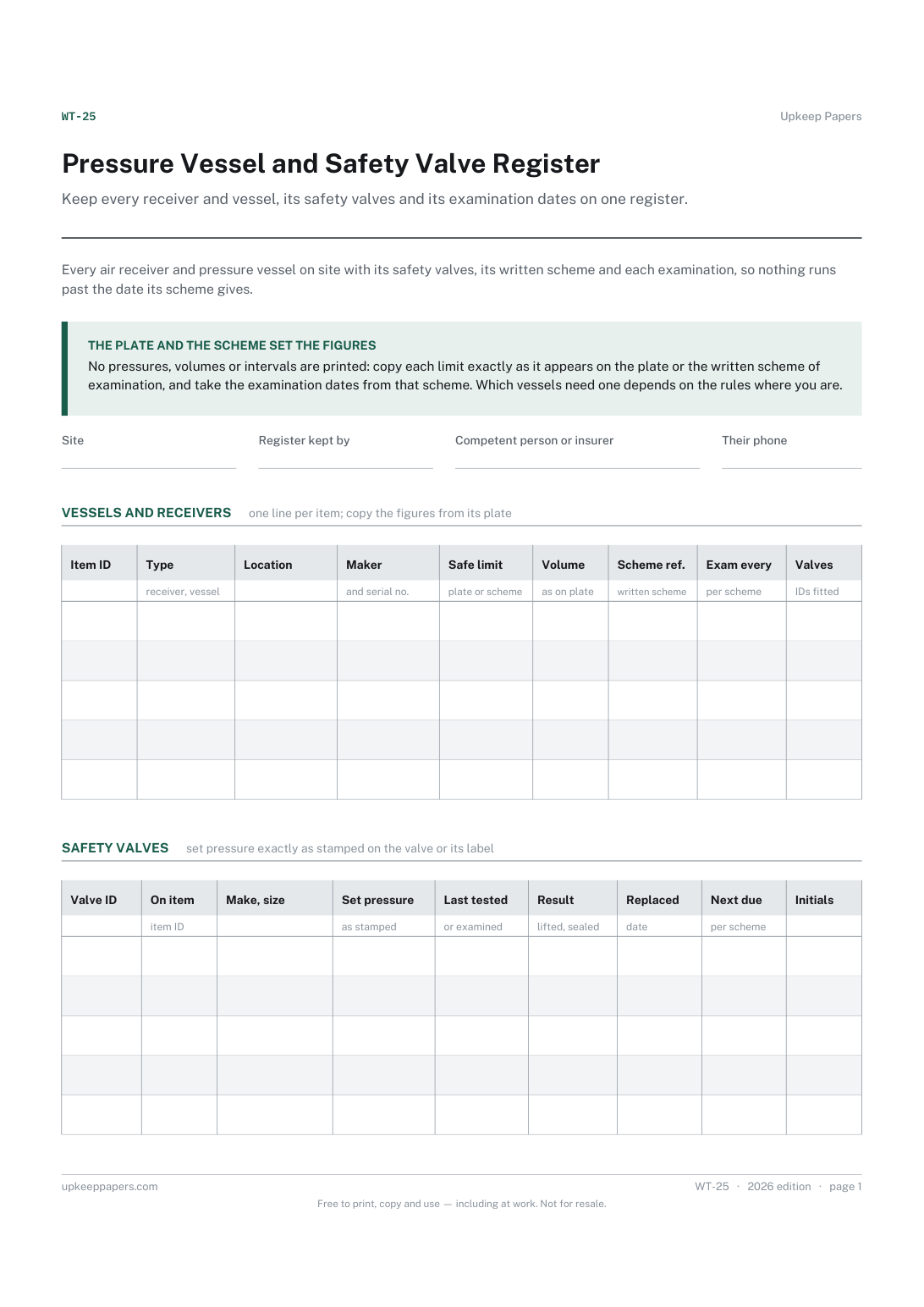
Keep every receiver and vessel, its safety valves and its examination dates on one register. Nothing then runs past the date its written scheme gives without someone seeing it.
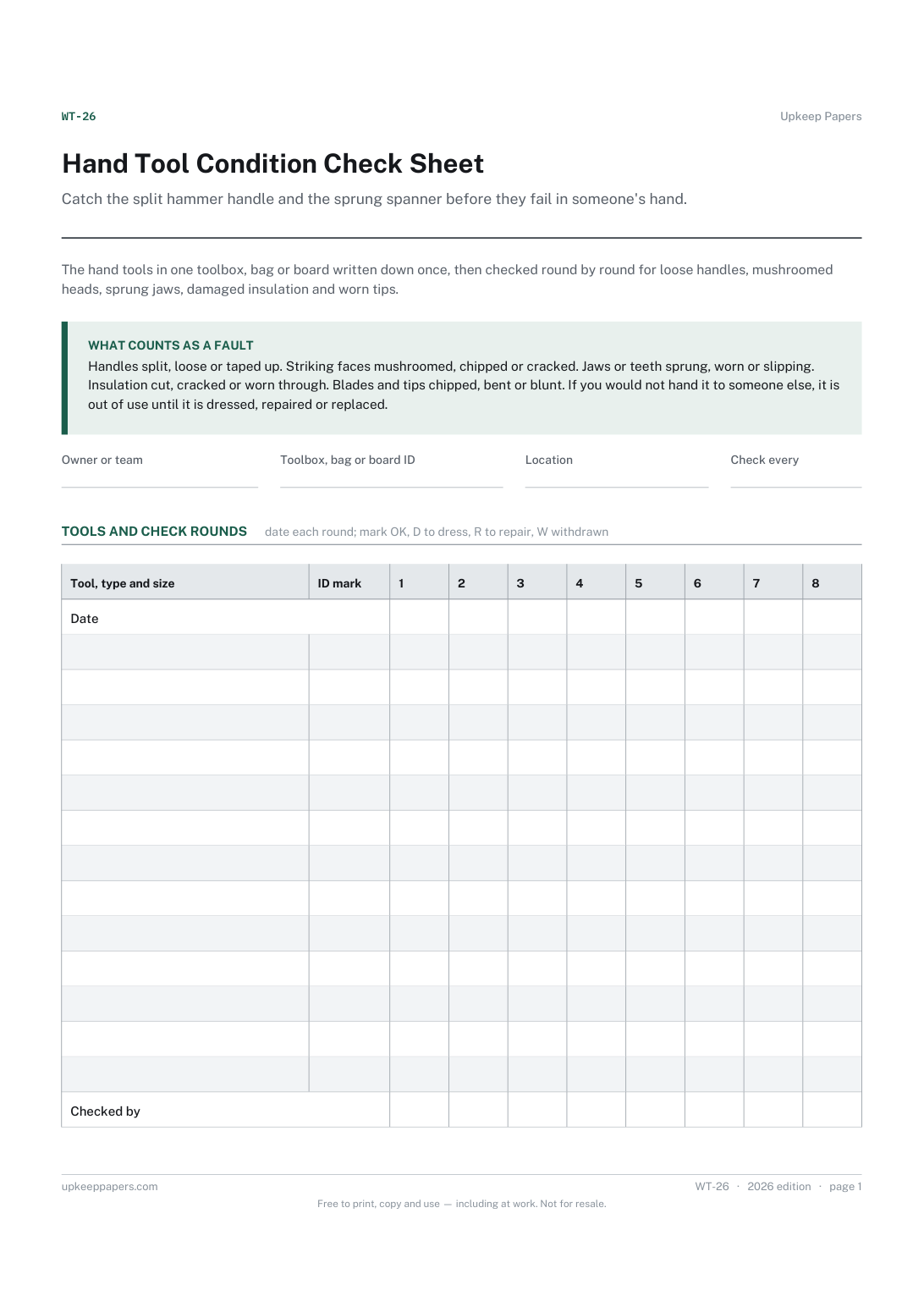
Catch the split hammer handle and the sprung spanner before they fail in someone's hand. Every tool withdrawn, dressed or repaired is logged with what was done.
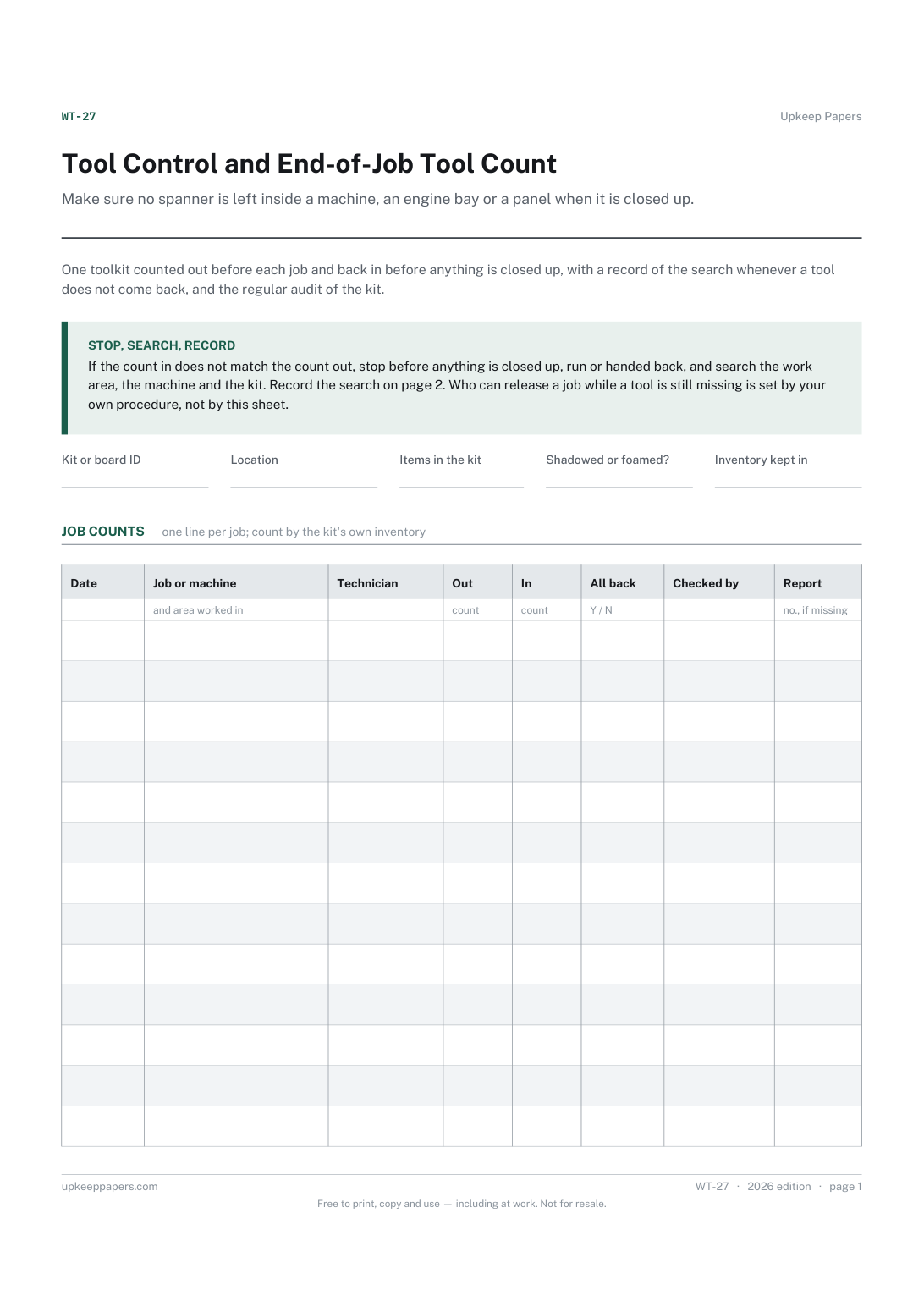
Make sure no spanner is left inside a machine, an engine bay or a panel when it is closed up. Every count is signed, and every missing tool has a recorded search.
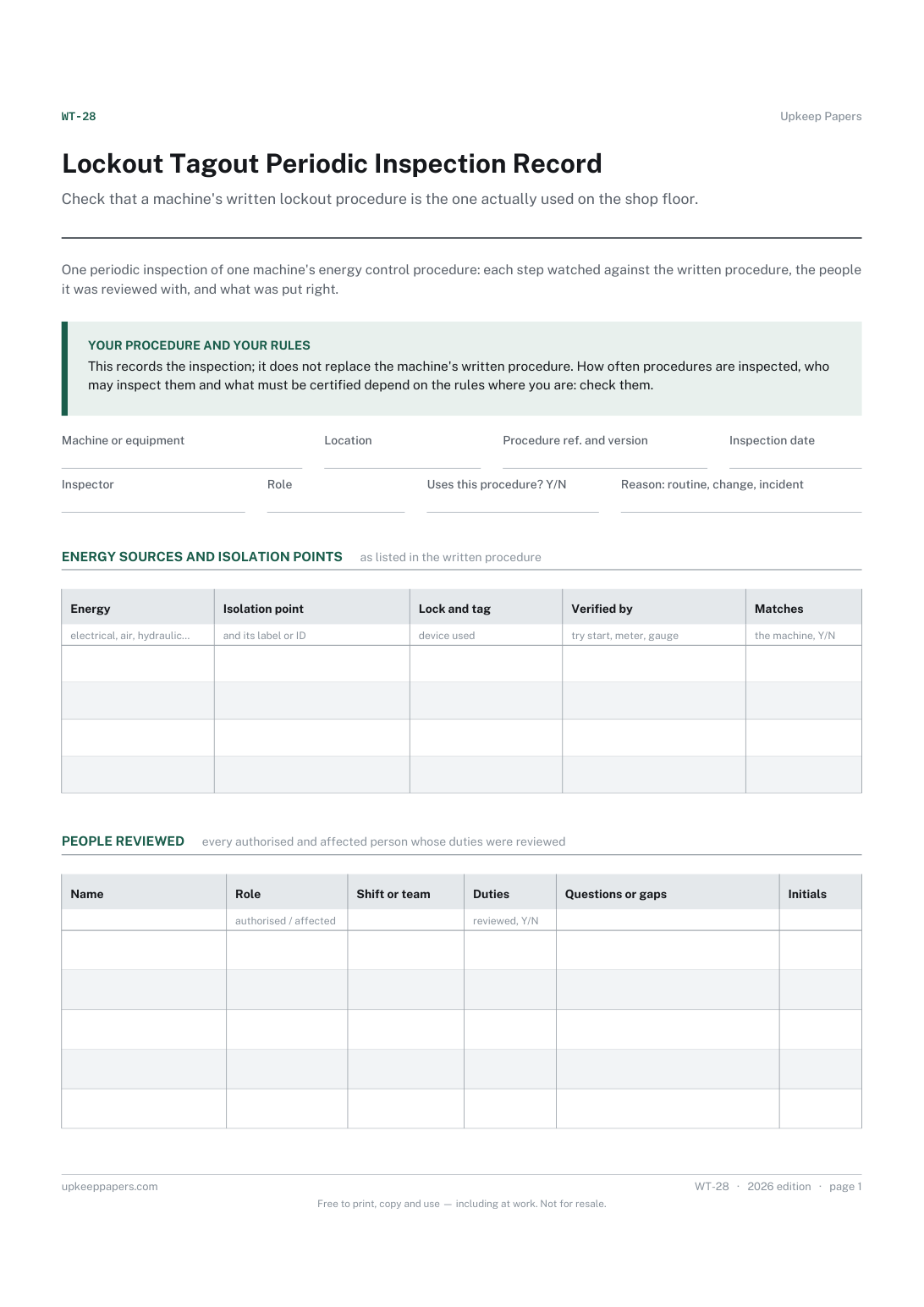
Check that a machine's written lockout procedure is the one actually used on the shop floor. Each deviation found is written down with what was done about it.
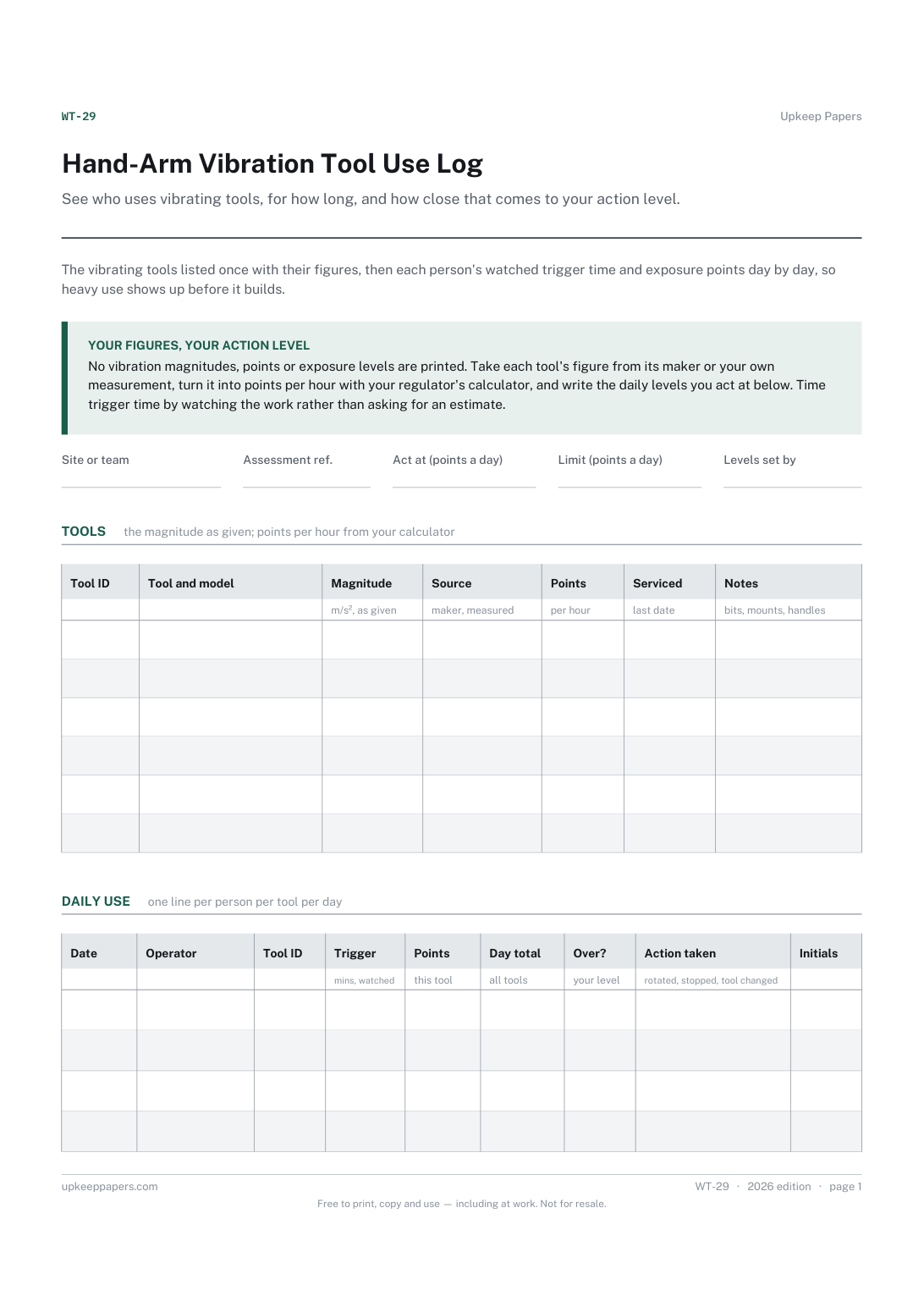
See who uses vibrating tools, for how long, and how close that comes to your action level. A day over the level shows up on the sheet, with what was done about it.
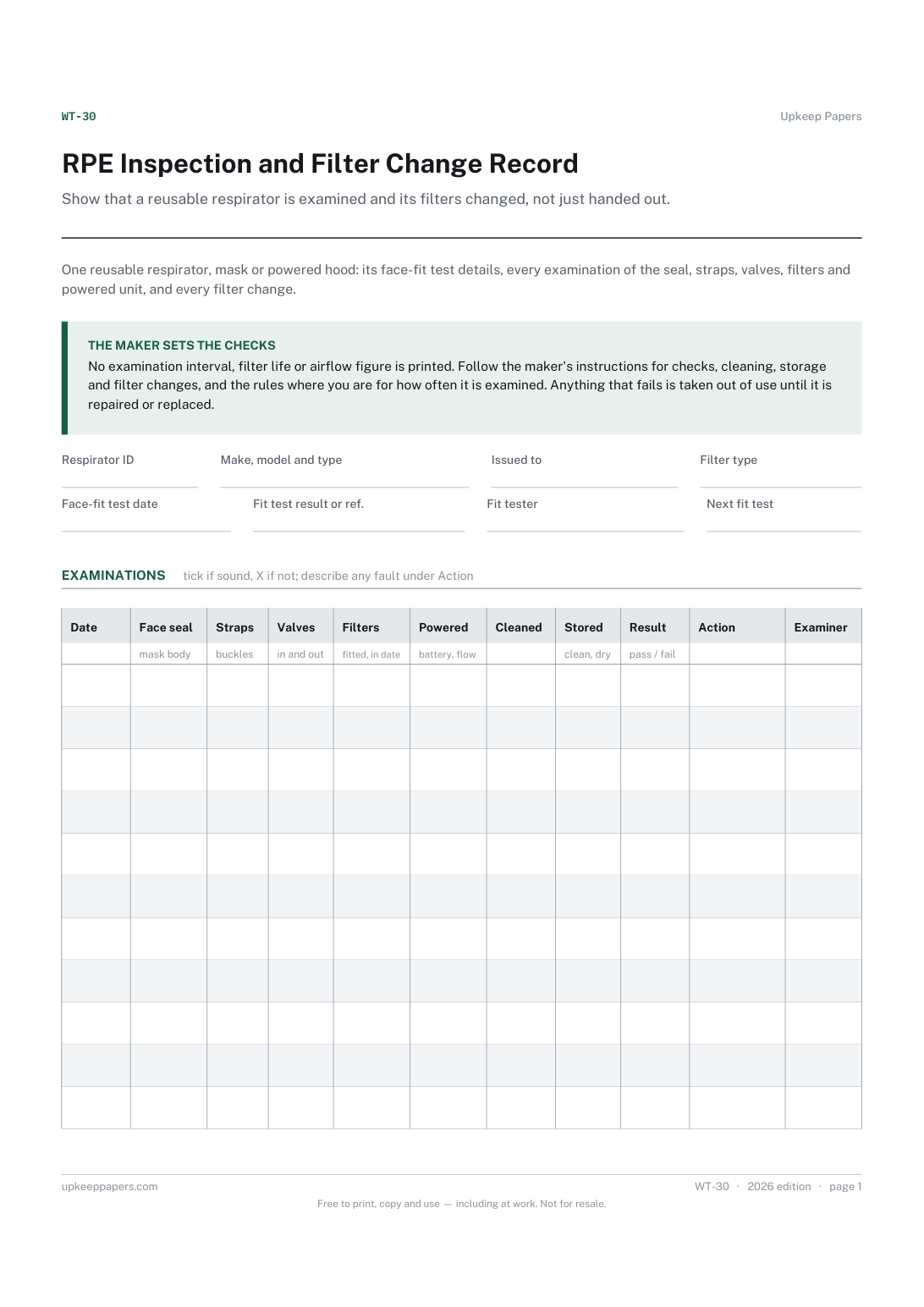
Show that a reusable respirator is examined and its filters changed, not just handed out. A failed check takes it out of use until it is repaired or replaced.
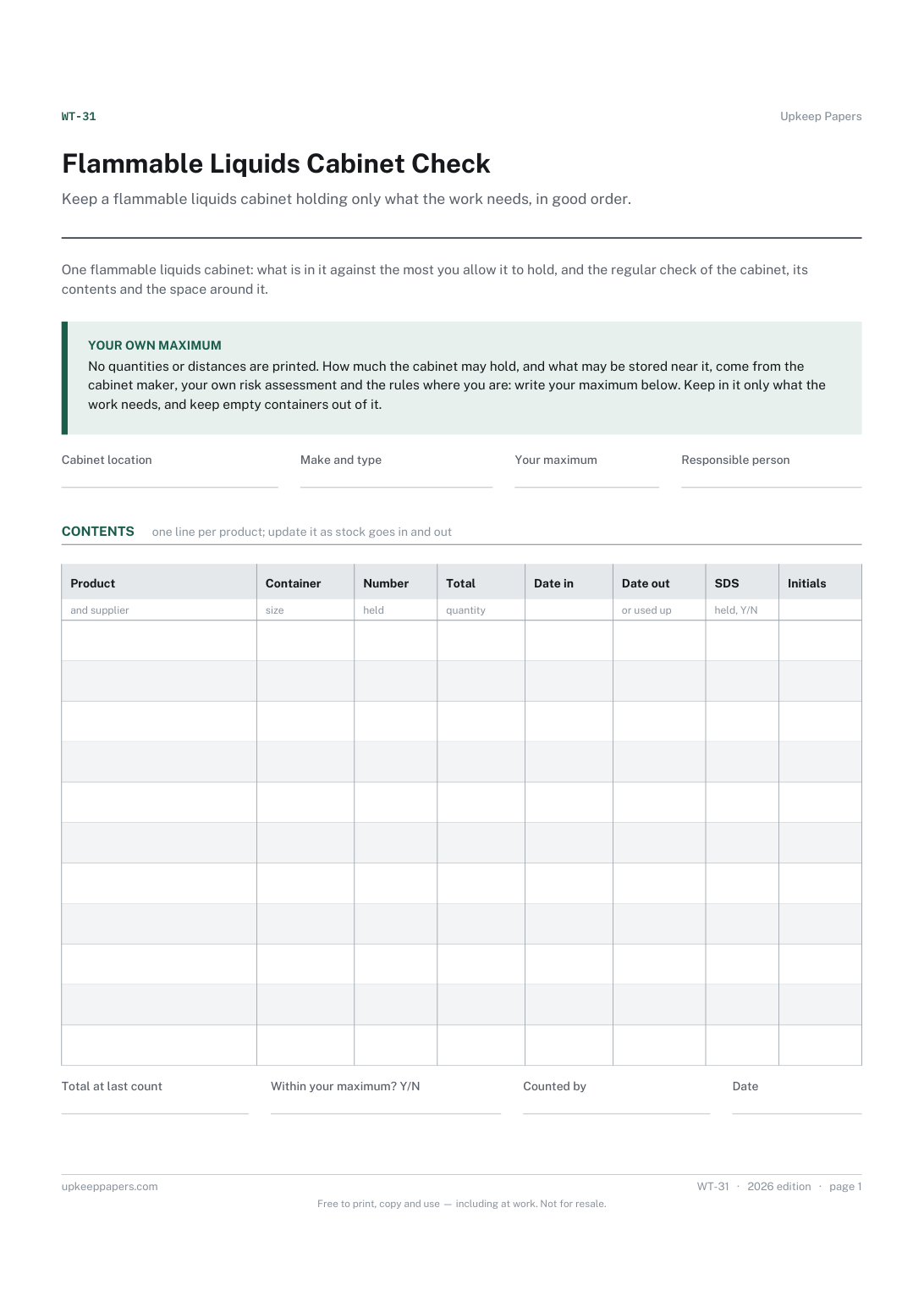
Keep a flammable liquids cabinet holding only what the work needs, in good order. The contents list shows what is in it, and the checks show how it is kept.
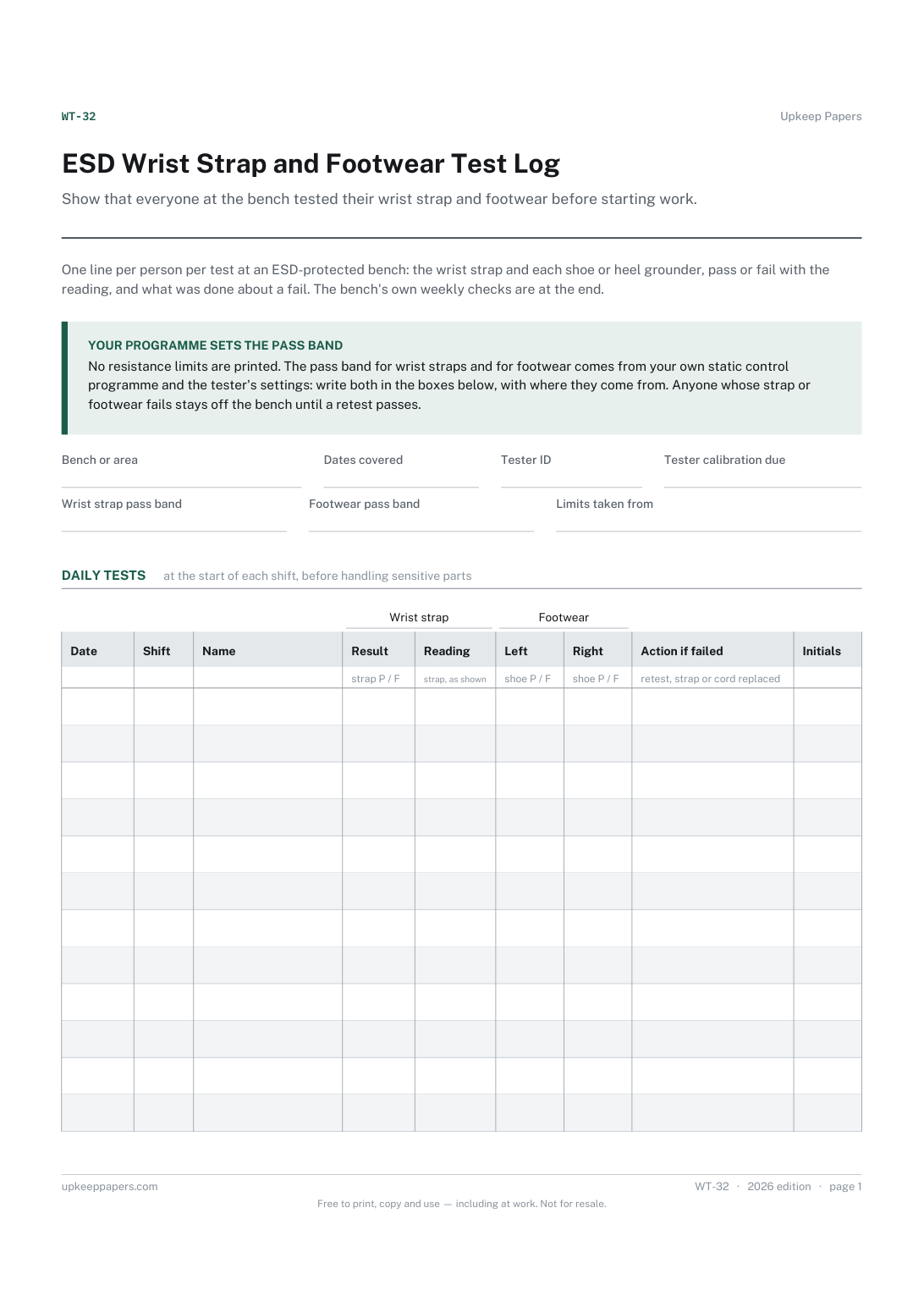
Show that everyone at the bench tested their wrist strap and footwear before starting work. A failed strap only does harm if nobody notices and someone works on with it.
Cleaning schedules, rotas, deep-clean checklists and the dated records a cleaning routine is supposed to leave behind.
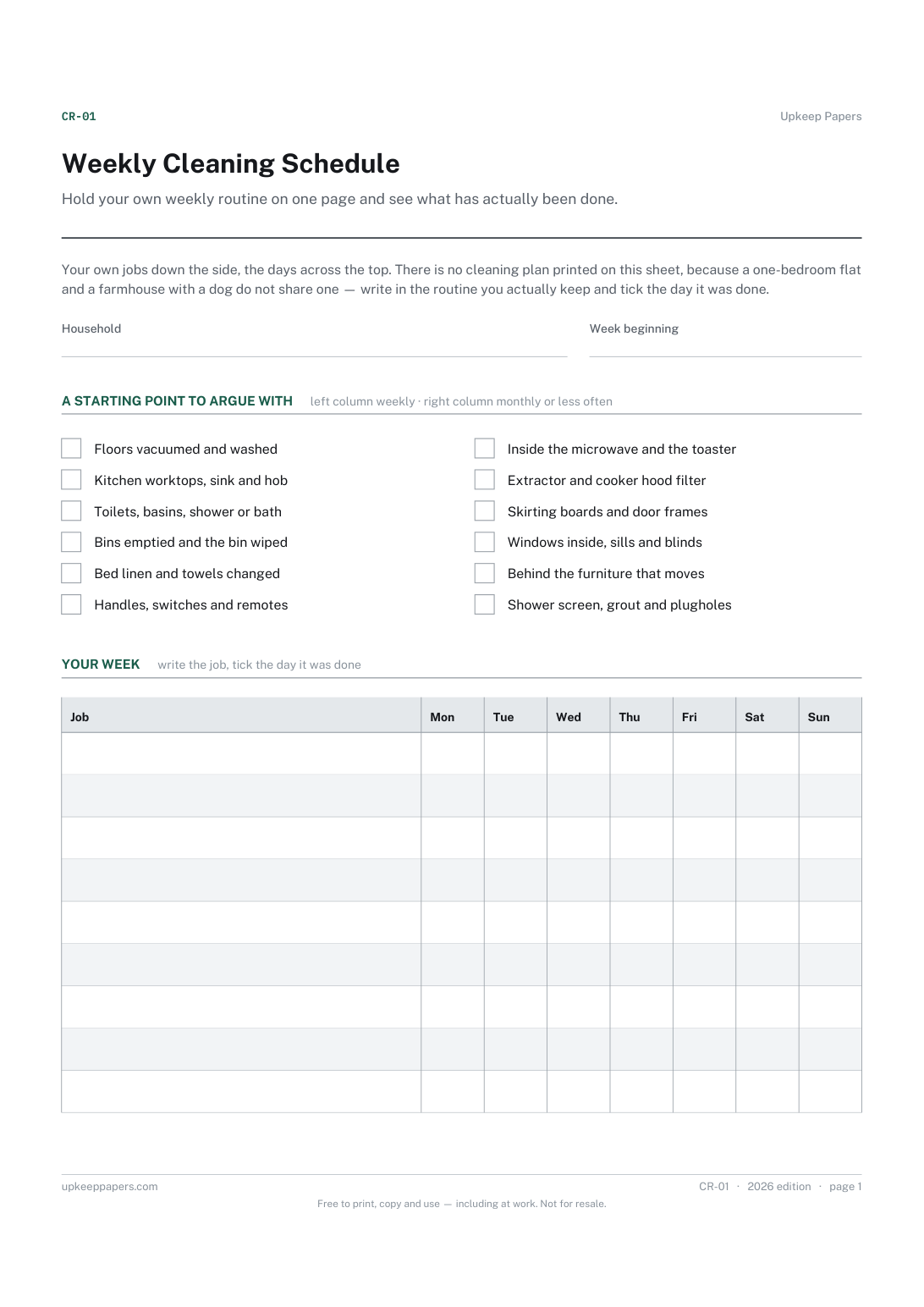
Hold your own weekly routine on one page and see what has actually been done. The jobs are yours to write in; the grid is the part worth printing.
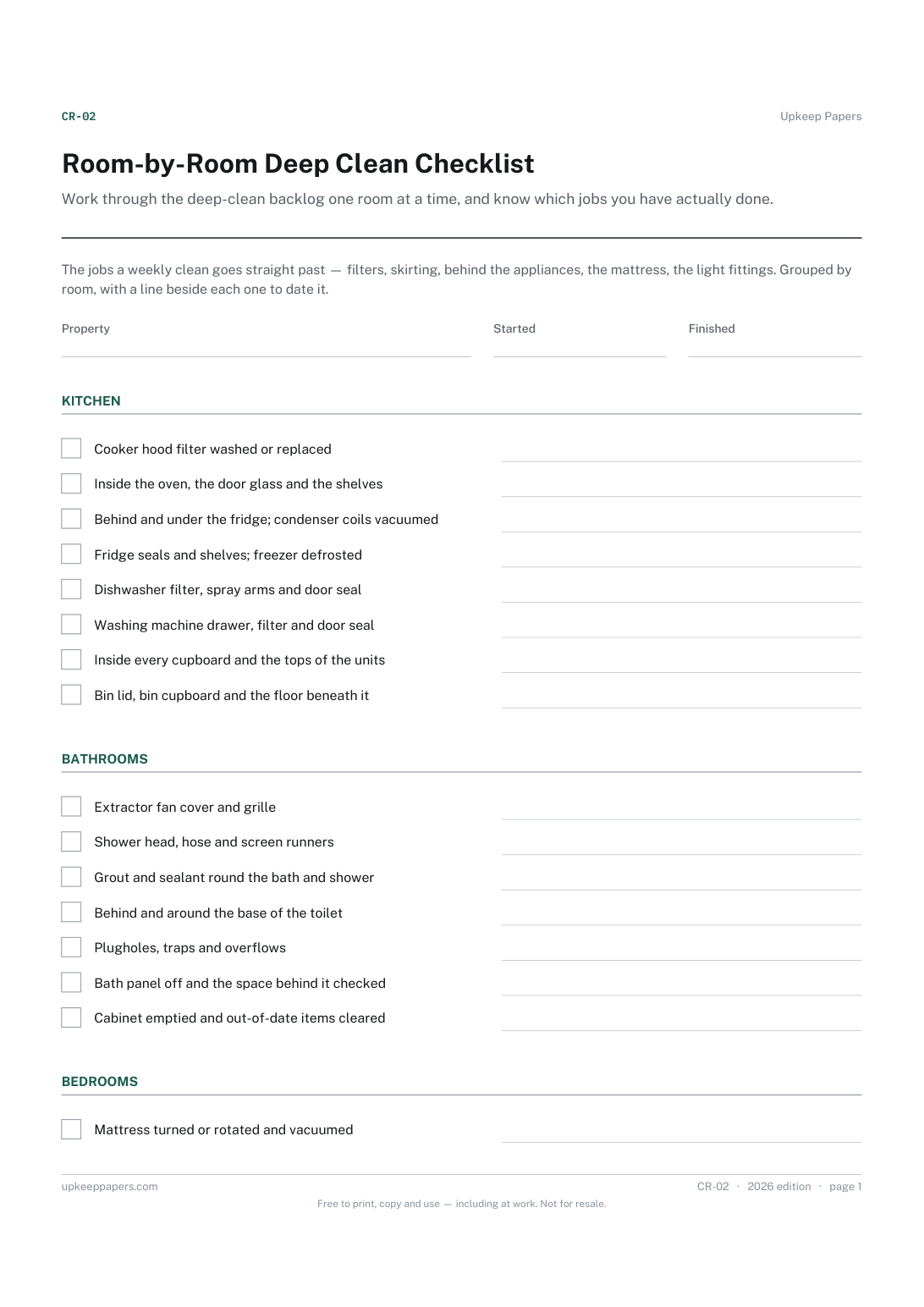
Work through the deep-clean backlog one room at a time, and know which jobs you have actually done. Nobody remembers the extractor filter without a list.
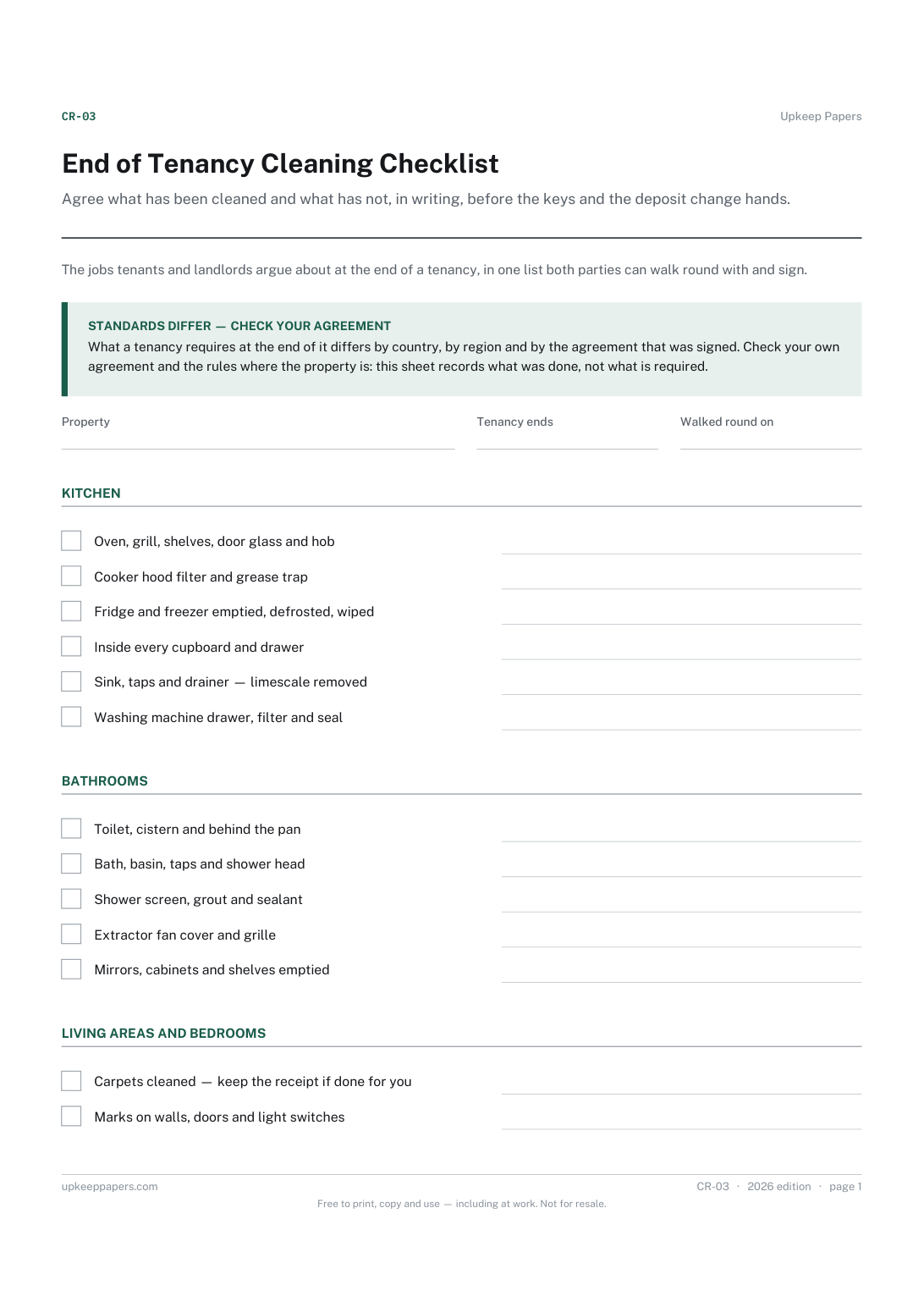
Agree what has been cleaned and what has not, in writing, before the keys and the deposit change hands. Both parties sign the same piece of paper.
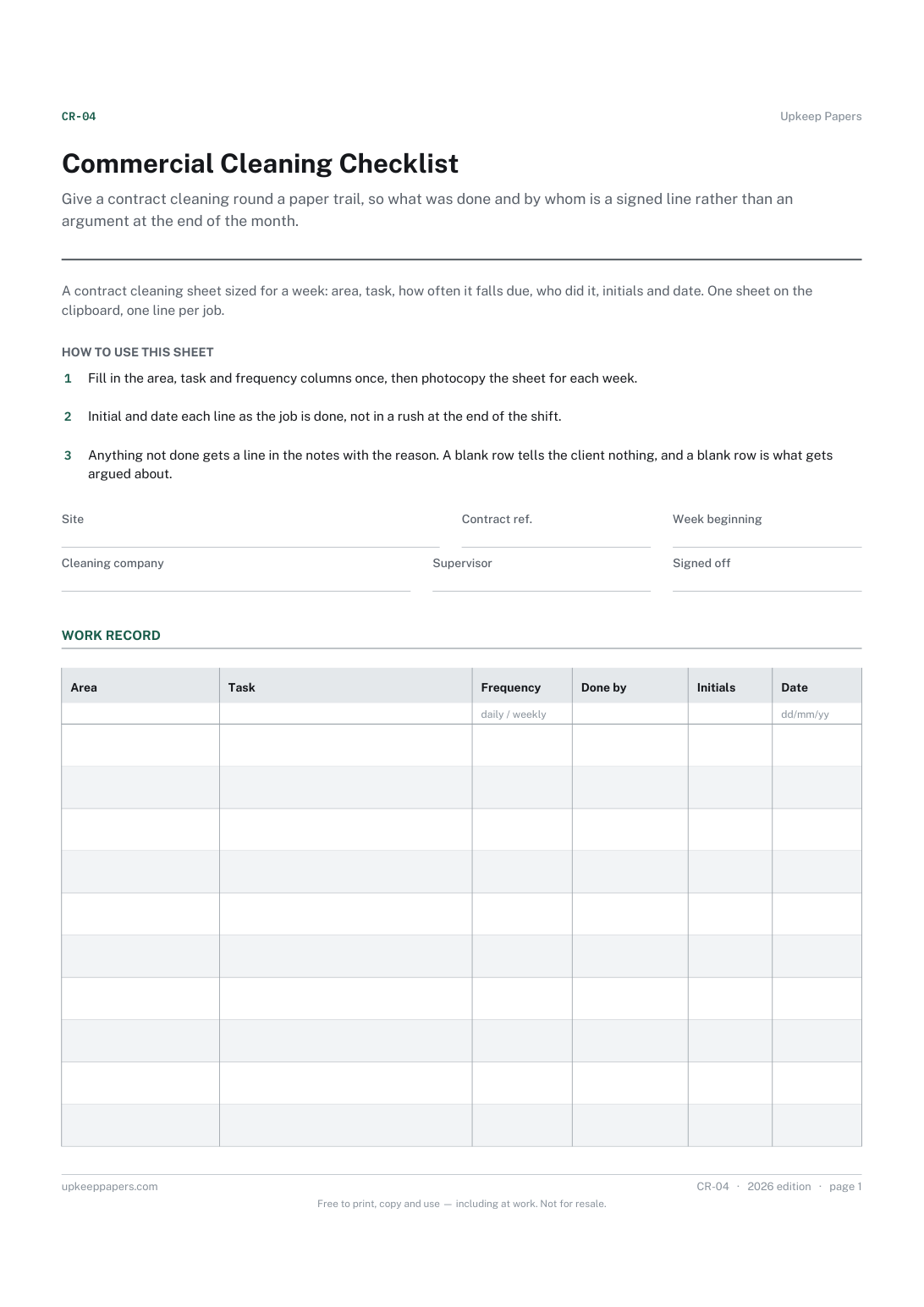
Give a contract cleaning round a paper trail, so what was done and by whom is a signed line rather than an argument at the end of the month.
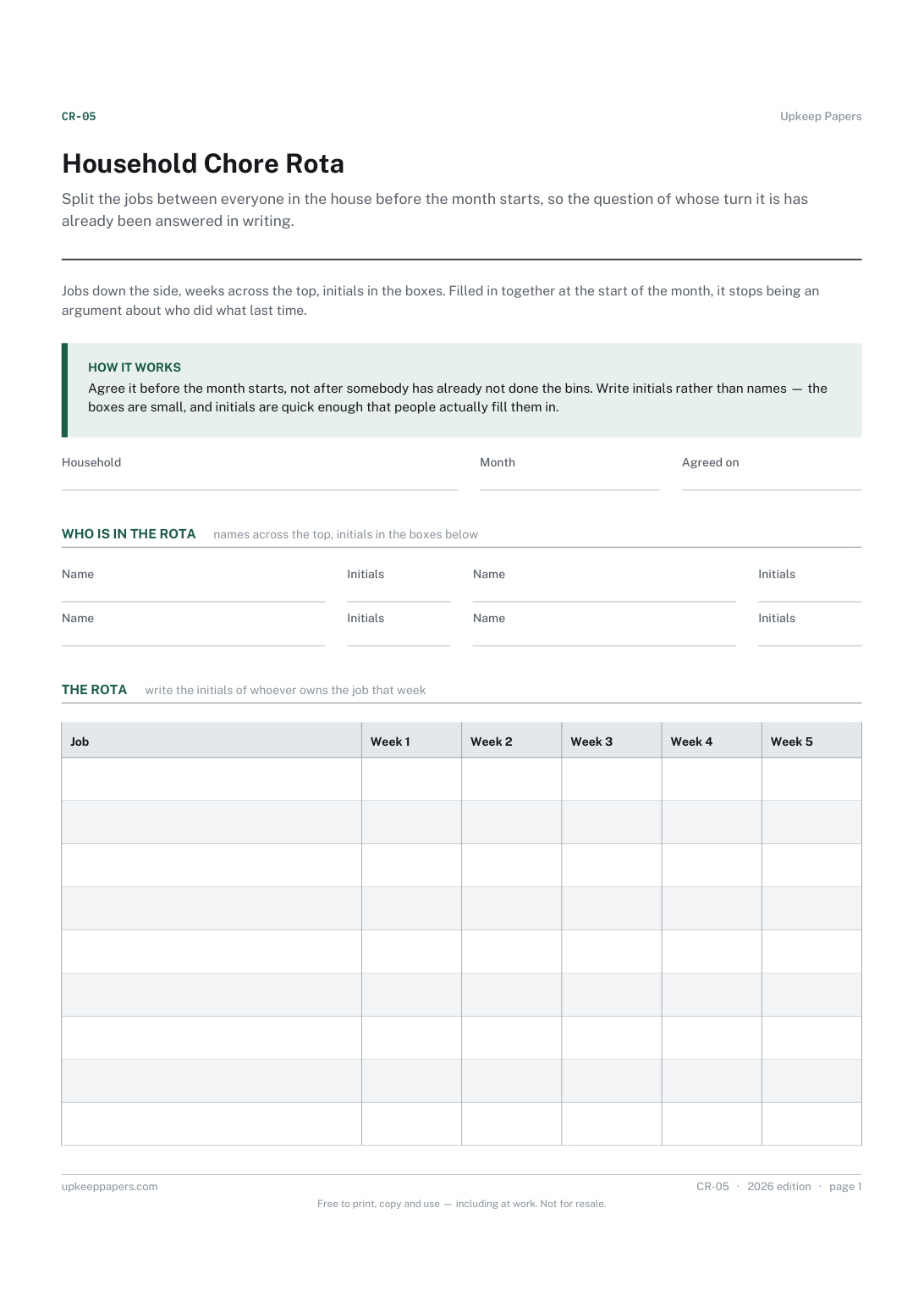
Split the jobs between everyone in the house before the month starts, so the question of whose turn it is has already been answered in writing.
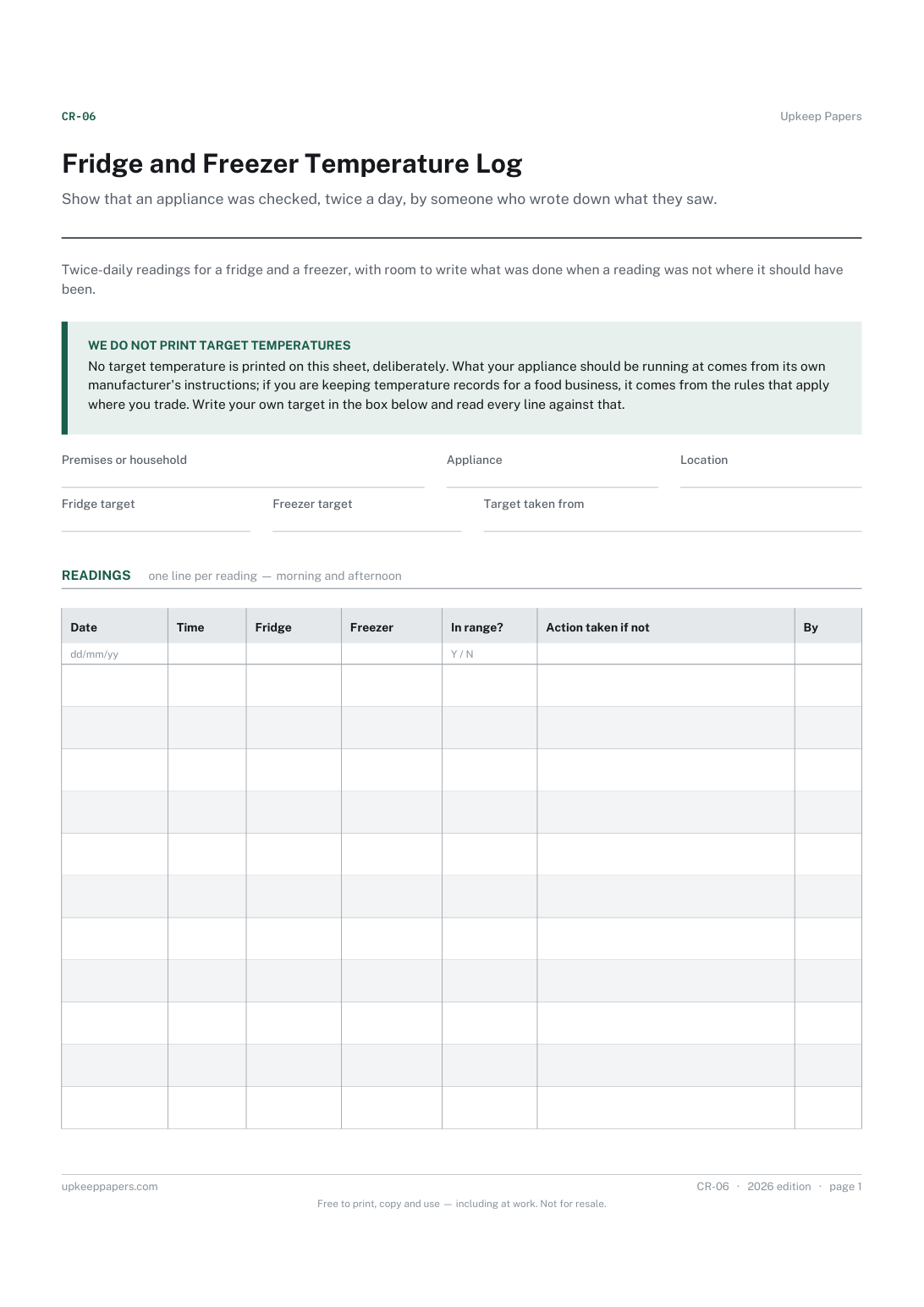
Show that an appliance was checked, twice a day, by someone who wrote down what they saw. A run of readings shows drift long before one reading shows a failure.
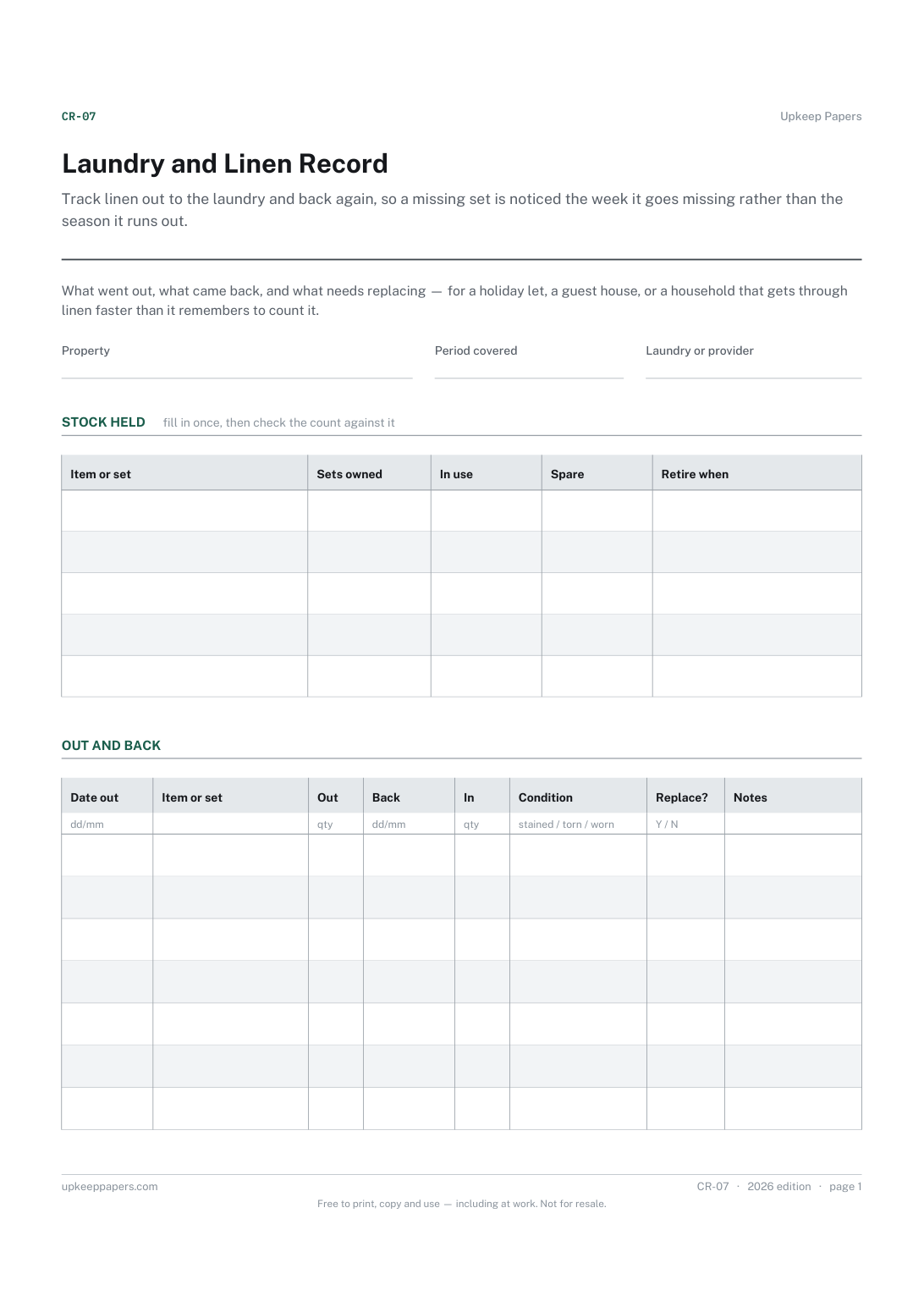
Track linen out to the laundry and back again, so a missing set is noticed the week it goes missing rather than the season it runs out.
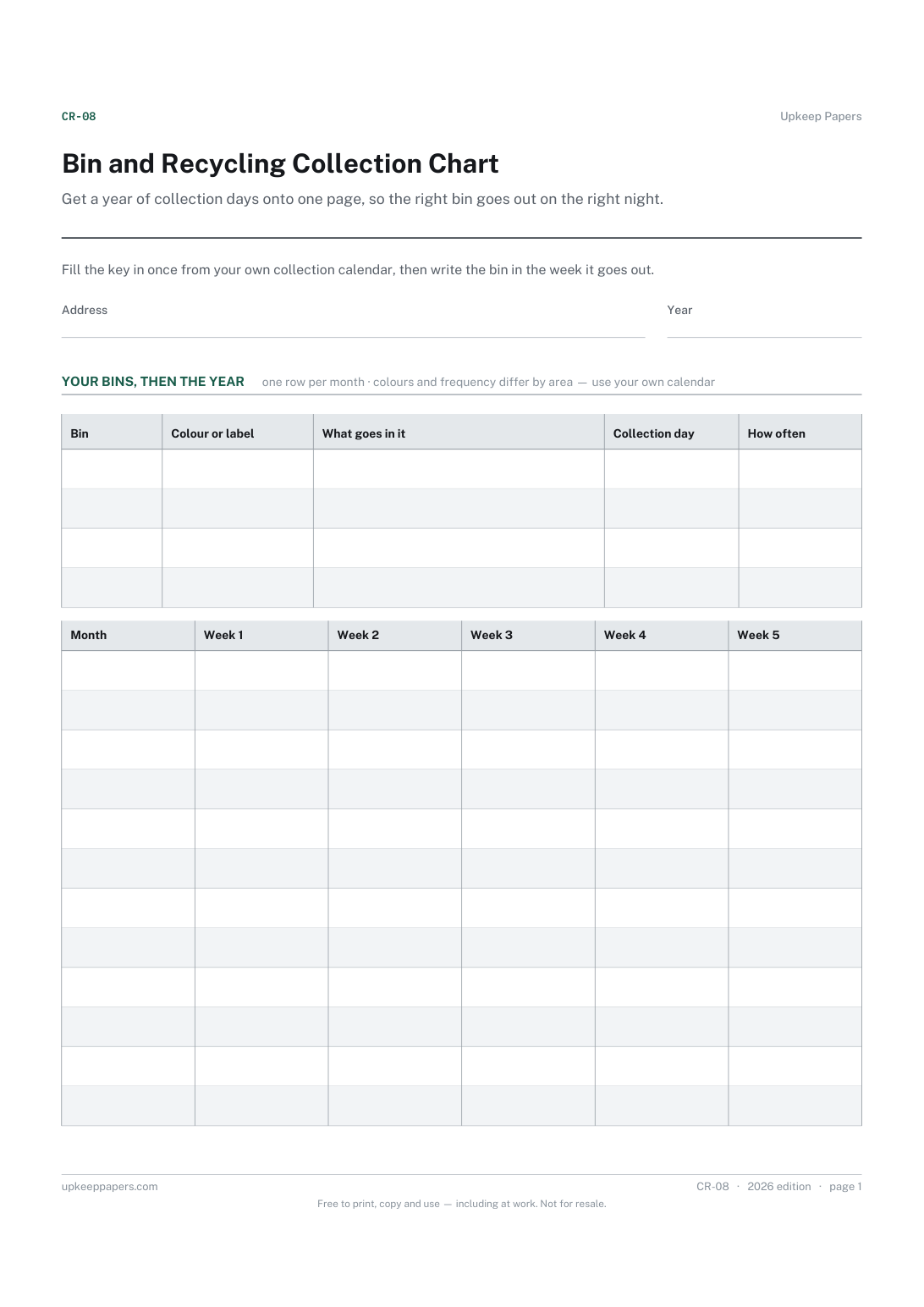
Get a year of collection days onto one page, so the right bin goes out on the right night. Nobody should have to check a website in the dark in a dressing gown.
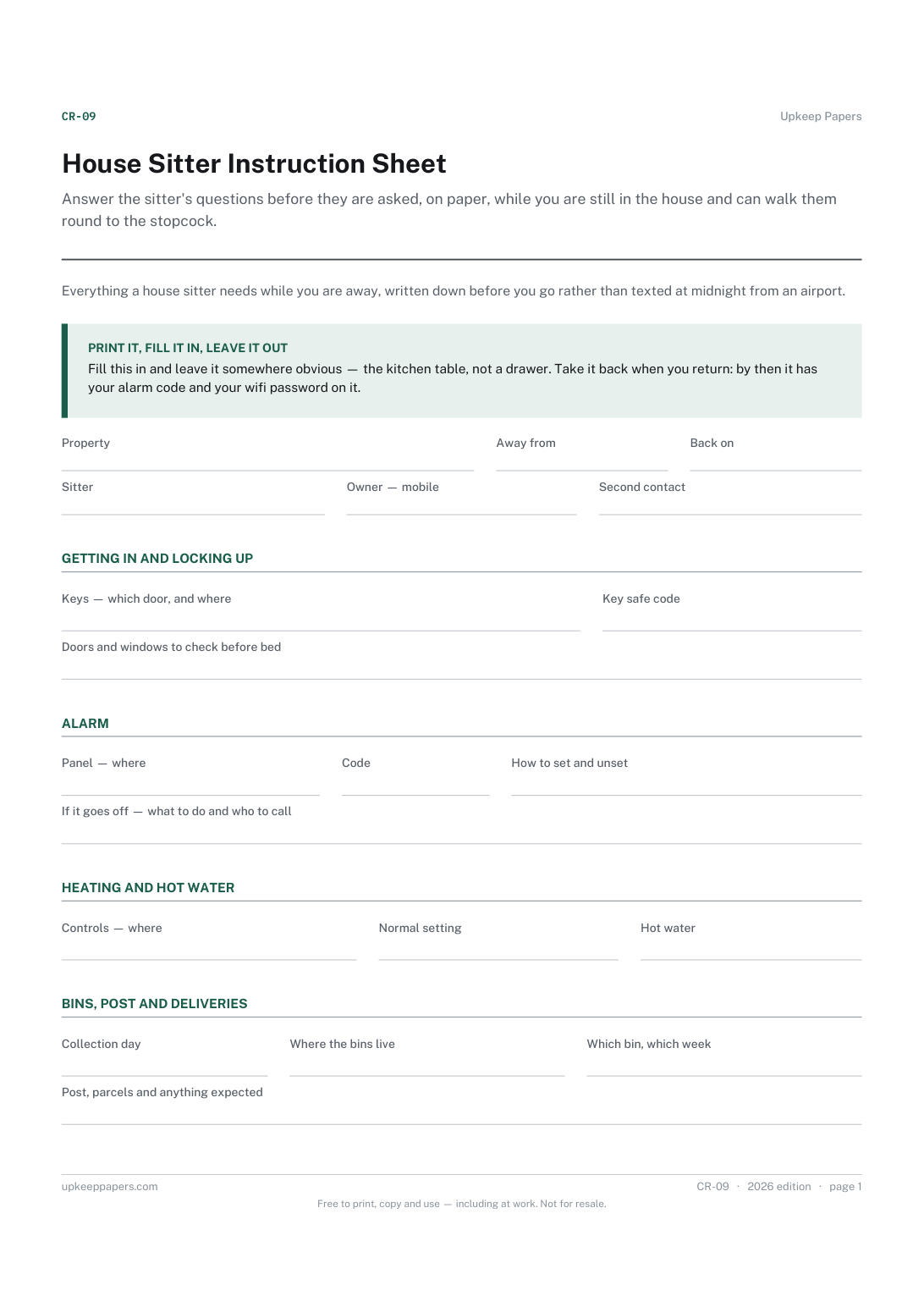
Answer the sitter's questions before they are asked, on paper, while you are still in the house and can walk them round to the stopcock.
Get the decision written down and dated, which is where decluttering actually fails — not in the sorting but in the pile that migrates to the garage.
The paperwork of changing address — moving, viewing, snagging, renovating and switching the supplies over.
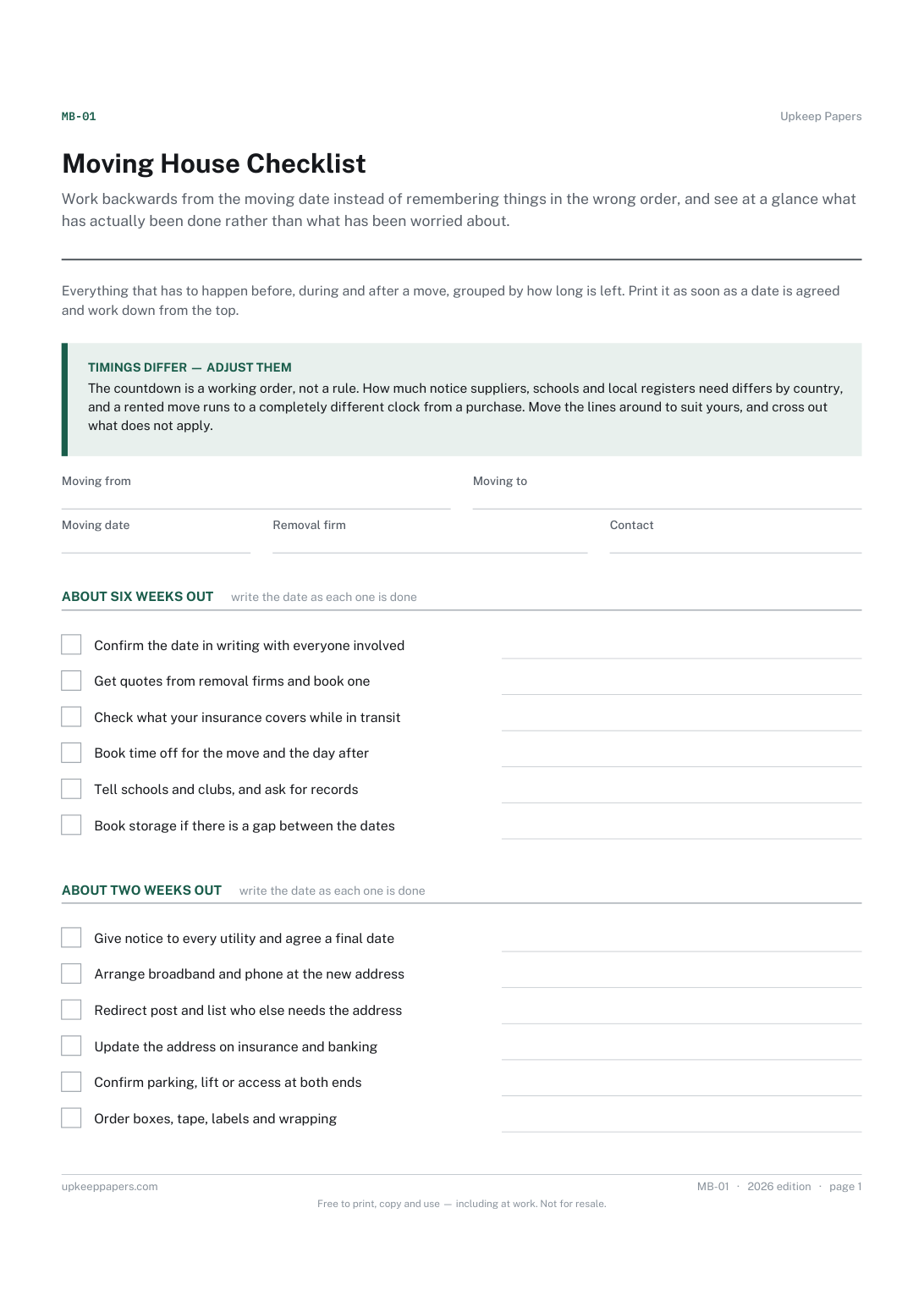
Work backwards from the moving date instead of remembering things in the wrong order, and see at a glance what has actually been done rather than what has been worried about.
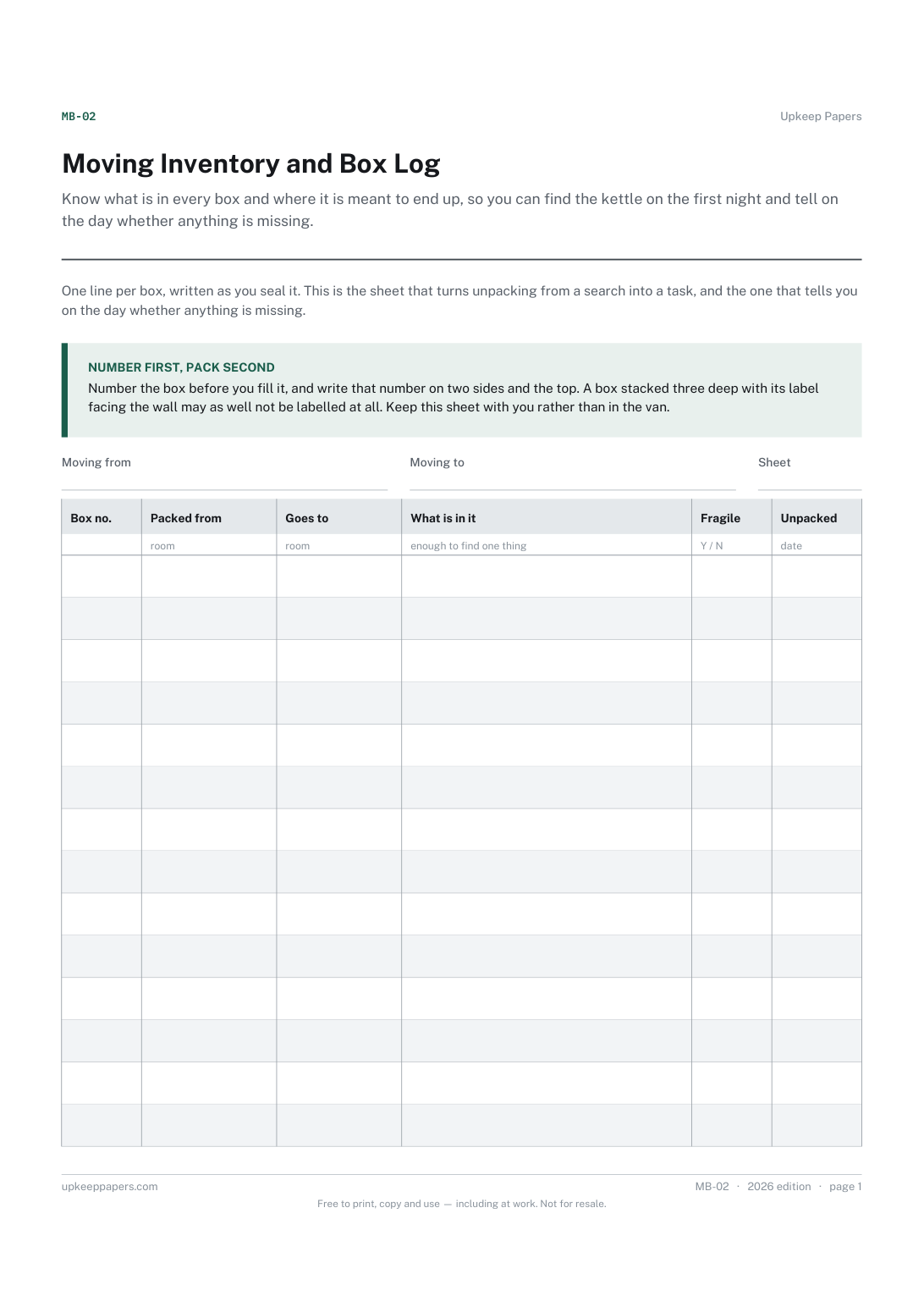
Know what is in every box and where it is meant to end up, so you can find the kettle on the first night and tell on the day whether anything is missing.
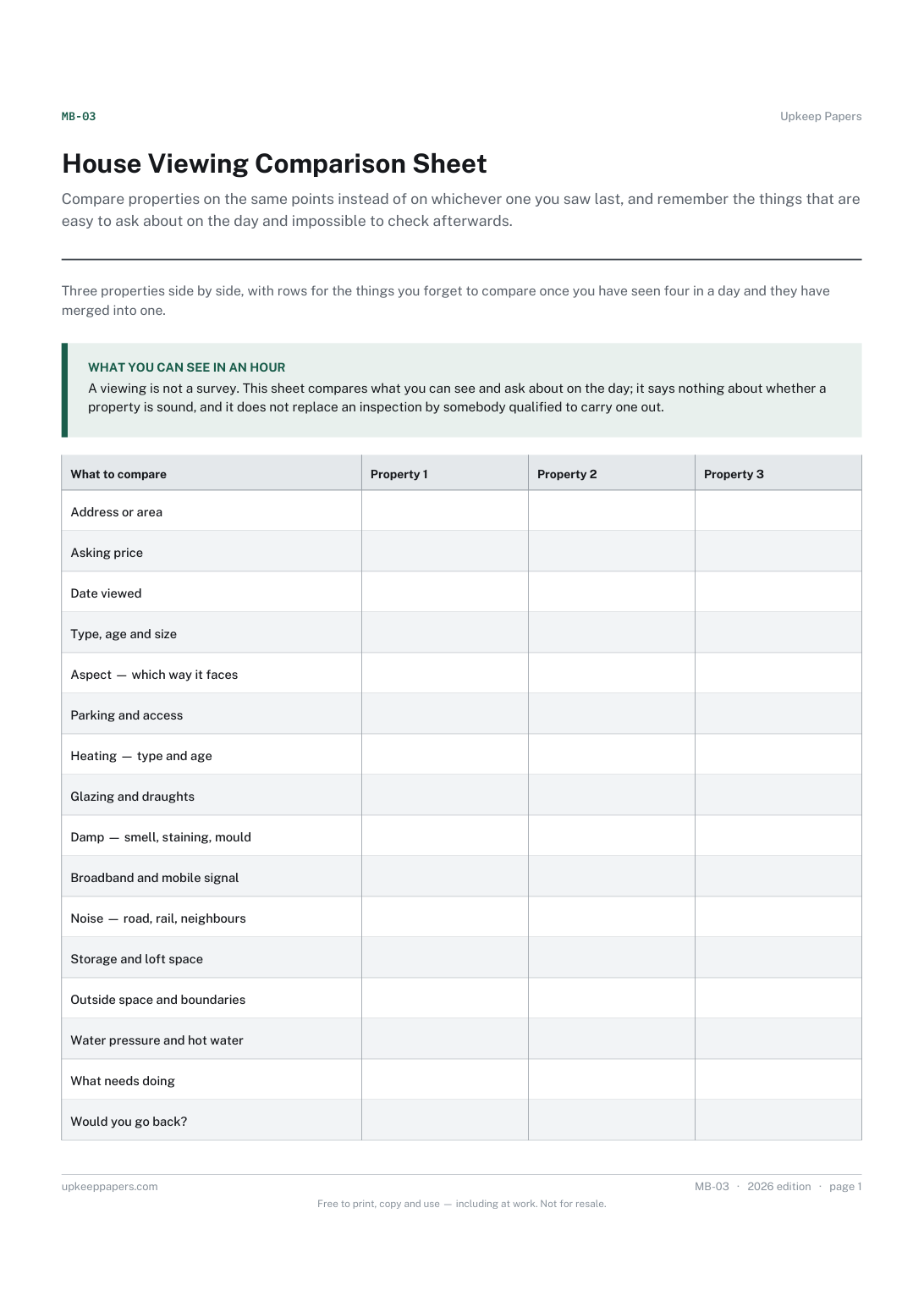
Compare properties on the same points instead of on whichever one you saw last, and remember the things that are easy to ask about on the day and impossible to check afterwards.
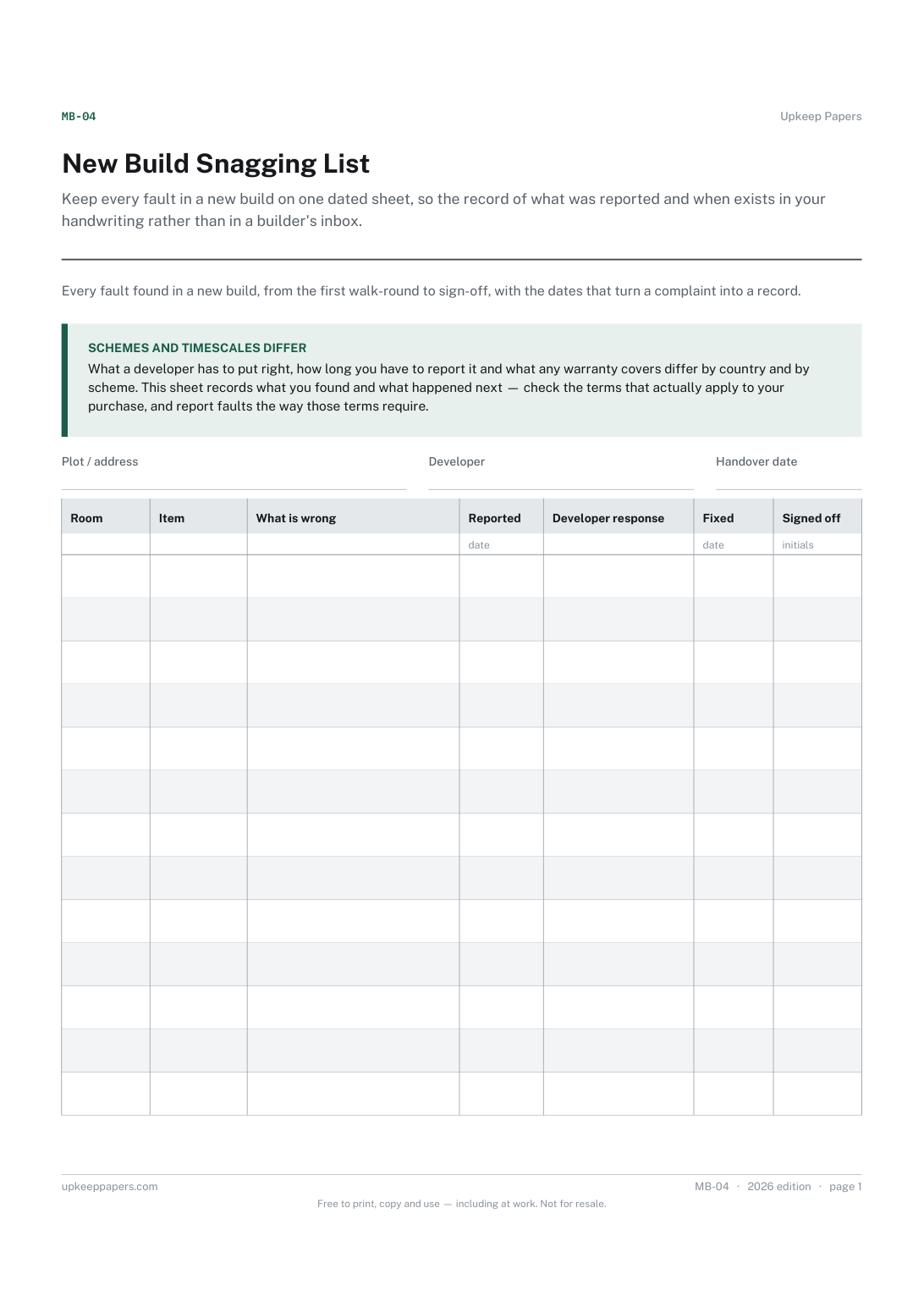
Keep every fault in a new build on one dated sheet, so the record of what was reported and when exists in your handwriting rather than in a builder's inbox.
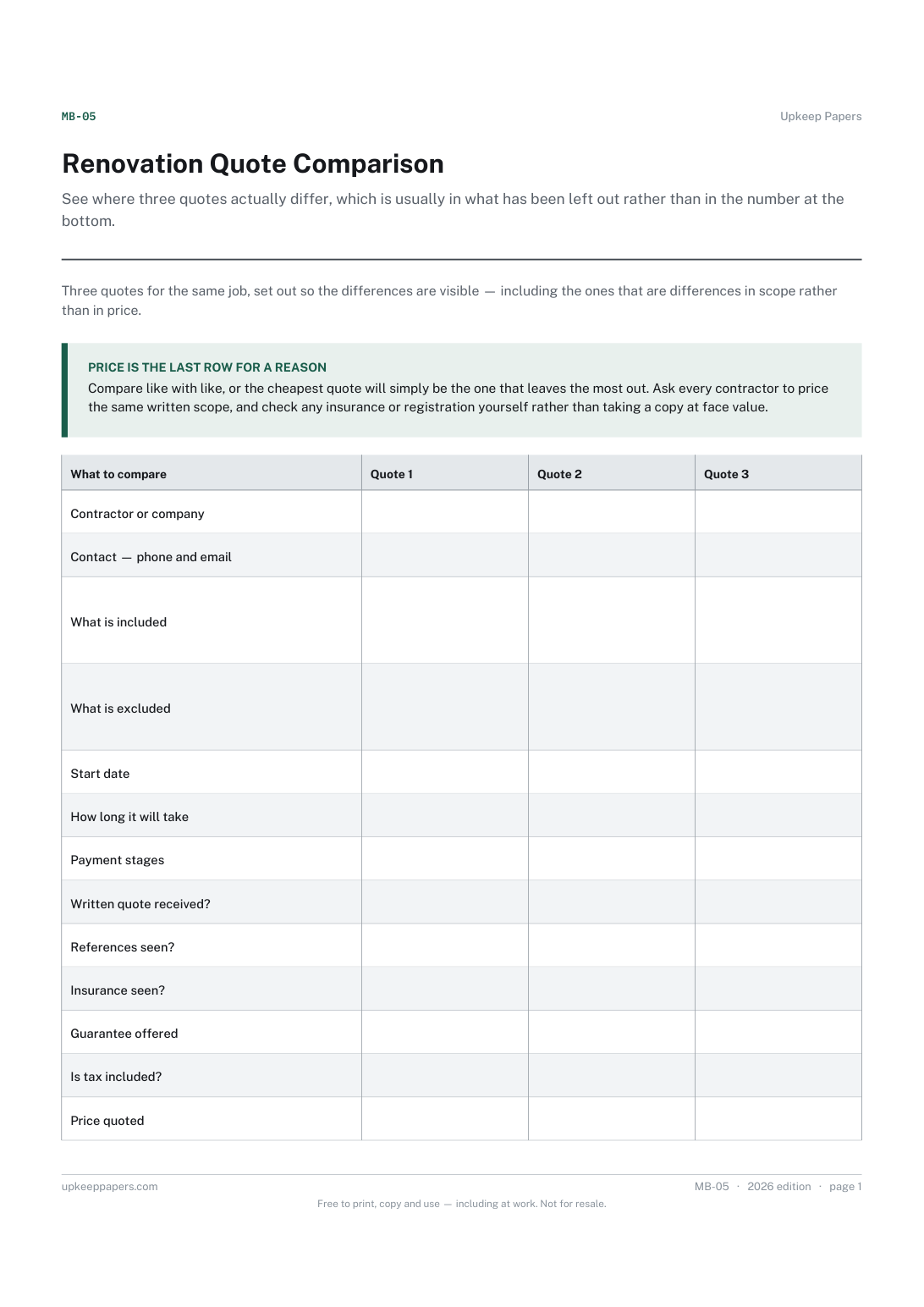
See where three quotes actually differ, which is usually in what has been left out rather than in the number at the bottom.
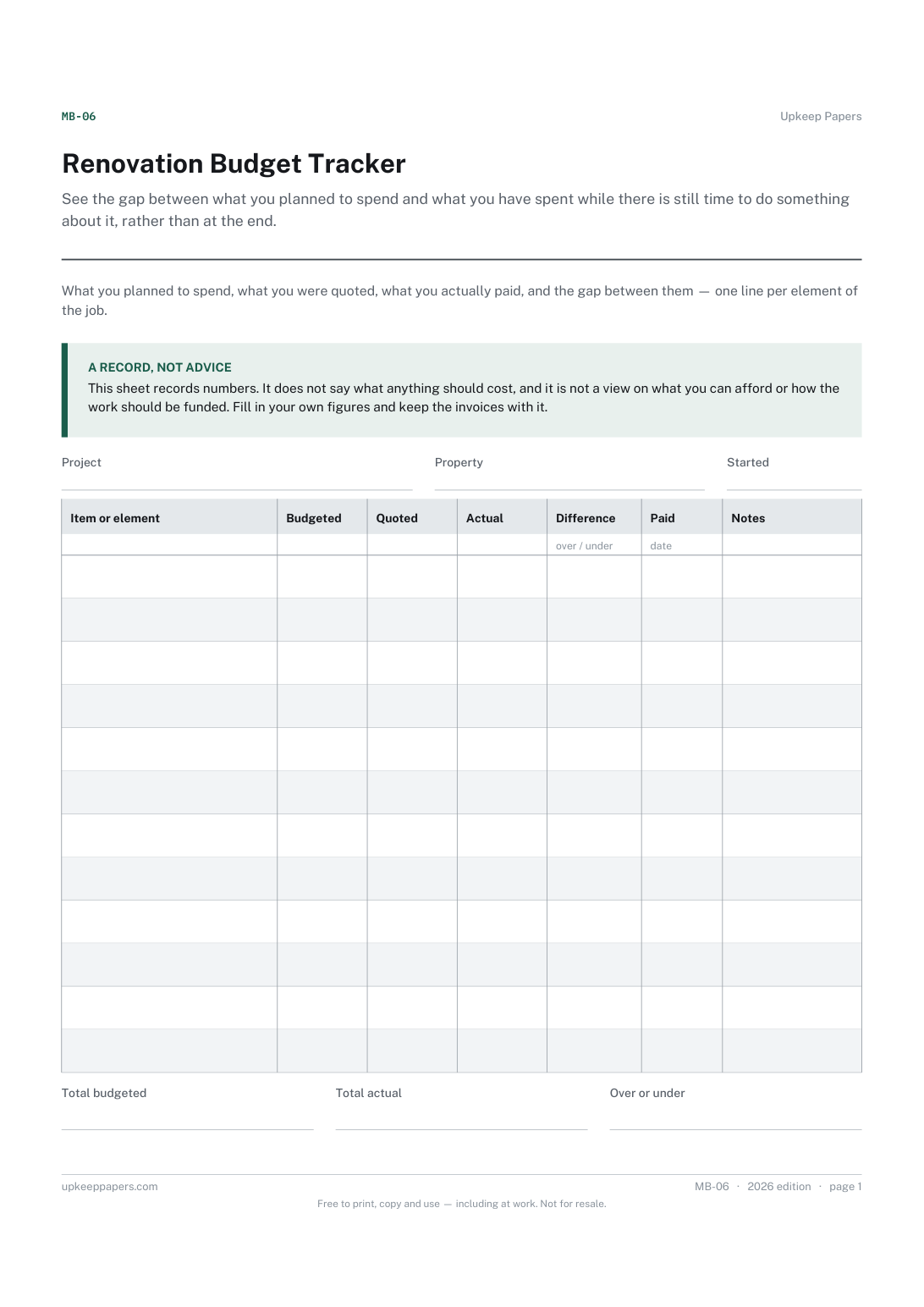
See the gap between what you planned to spend and what you have spent while there is still time to do something about it, rather than at the end.
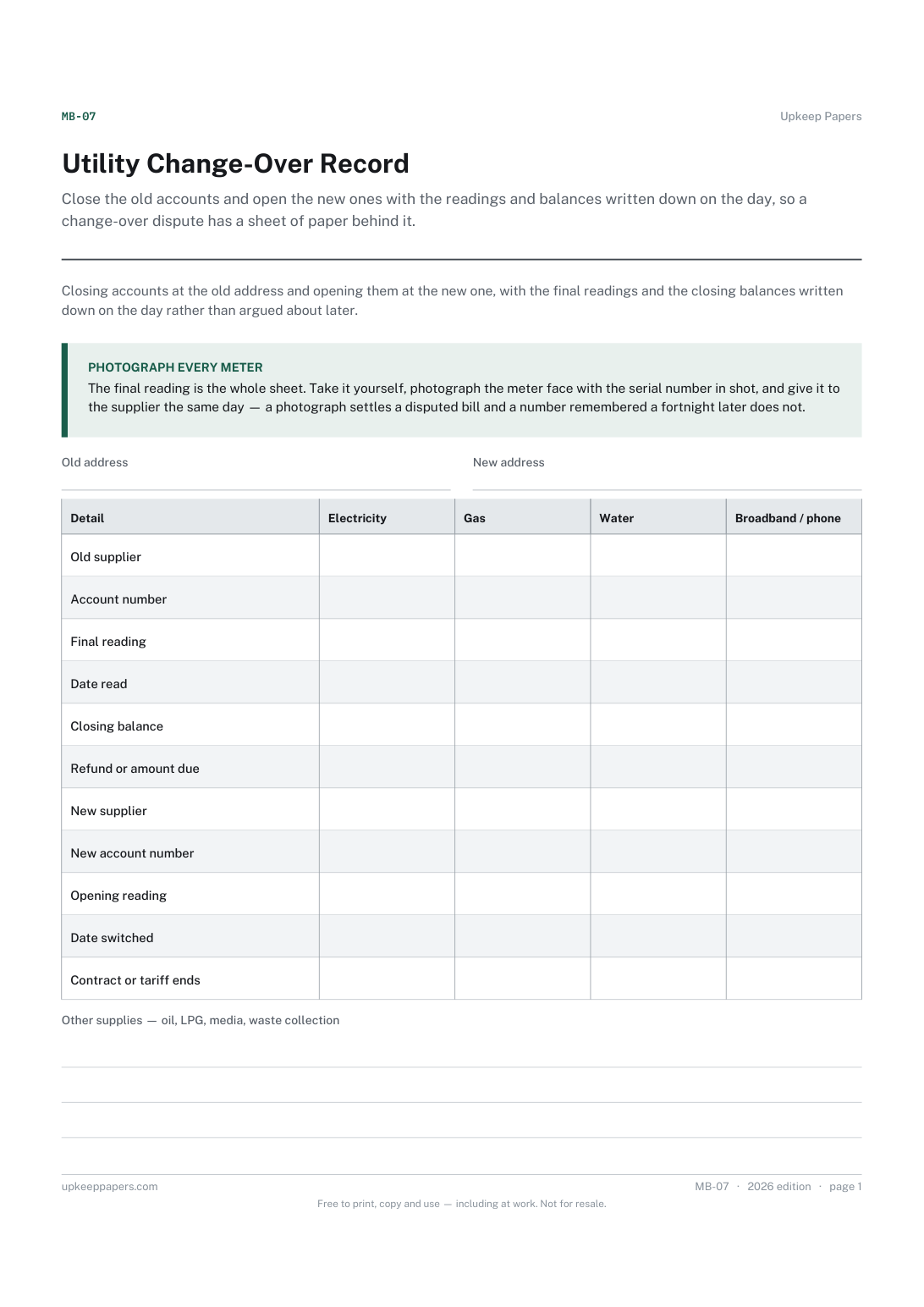
Close the old accounts and open the new ones with the readings and balances written down on the day, so a change-over dispute has a sheet of paper behind it.
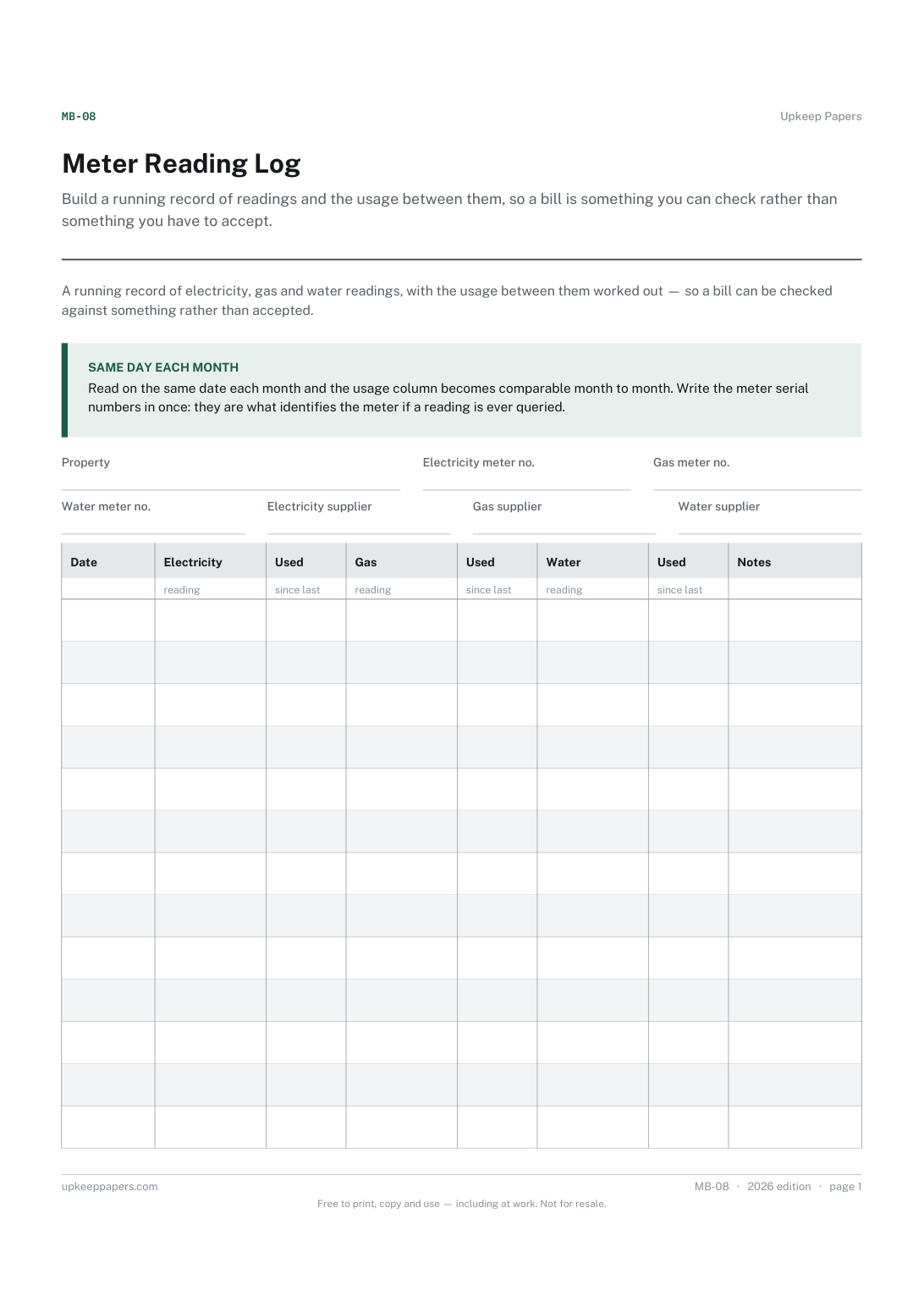
Build a running record of readings and the usage between them, so a bill is something you can check rather than something you have to accept.
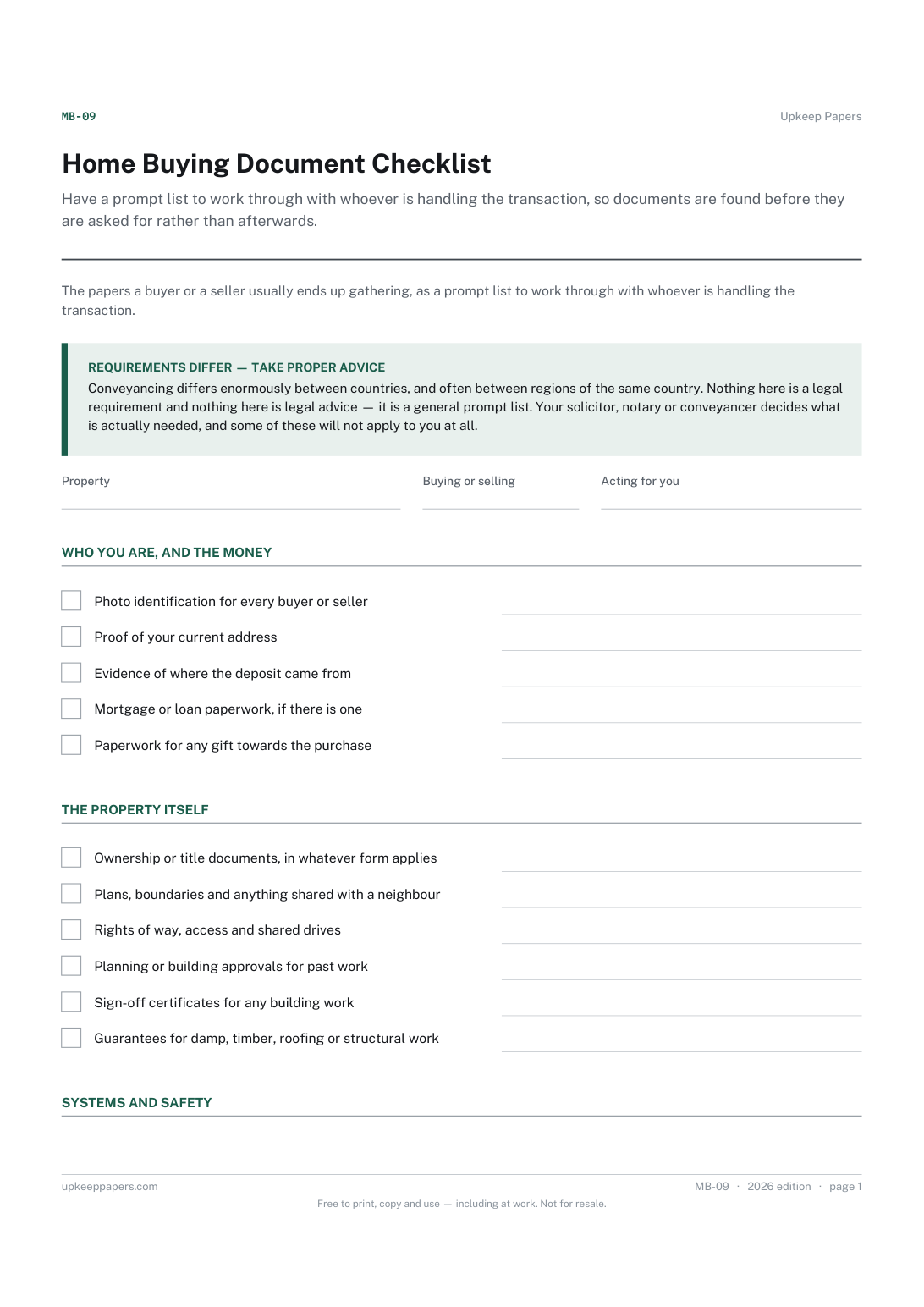
Have a prompt list to work through with whoever is handling the transaction, so documents are found before they are asked for rather than afterwards.
Look at a property properly on a second viewing, so the questions you put to a surveyor or a seller are the right ones.
Work through everybody who holds your address, and track the gap between telling them and them acting on it.
Set your limit in writing before bidding starts, with the premium and fees included, so the number you bid to is one you decided calmly.
Sowing plans, plot layouts, greenhouse logs, compost records and fruit tree histories — blank wherever the answer depends on where you garden.
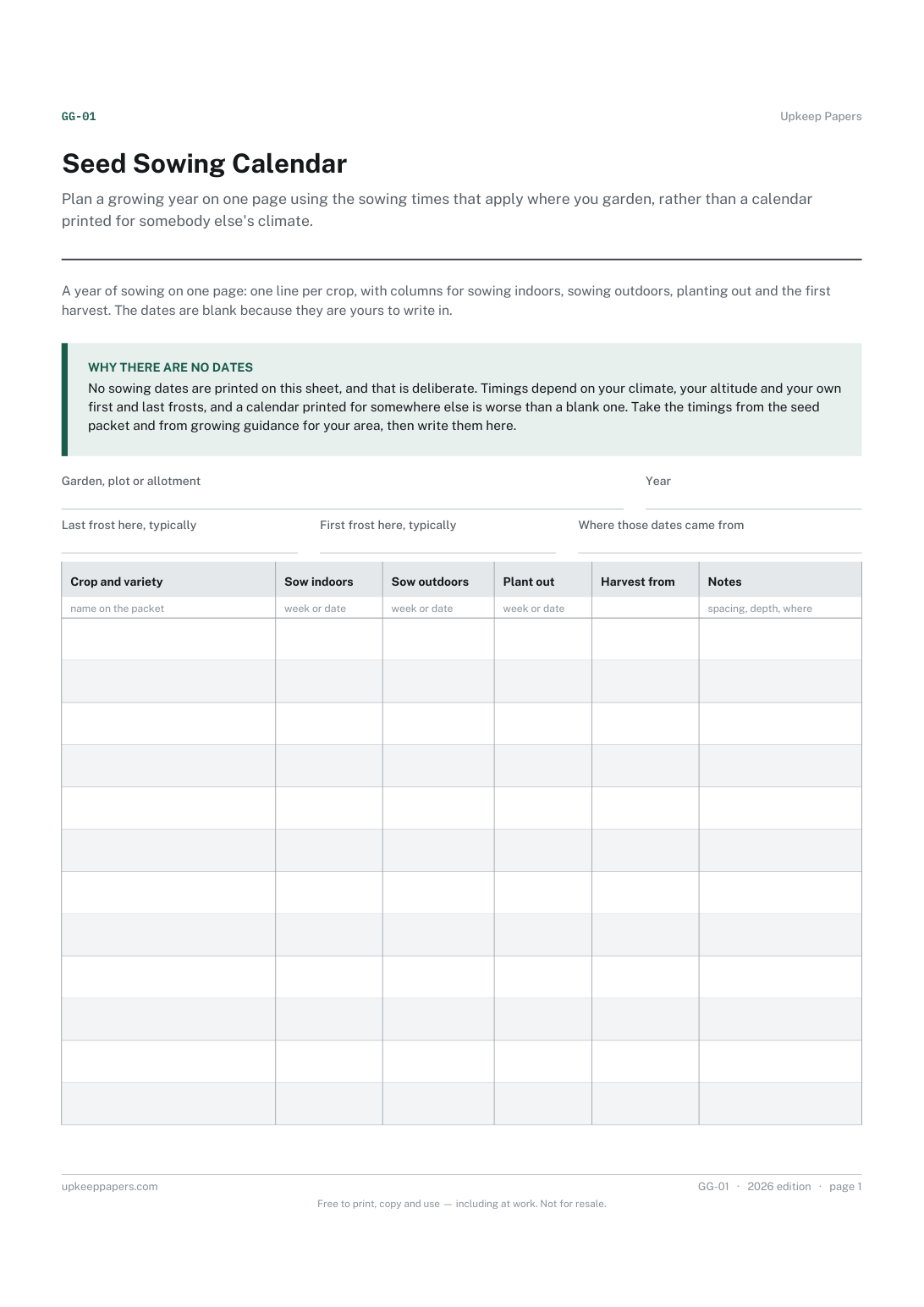
Plan a growing year on one page using the sowing times that apply where you garden, rather than a calendar printed for somebody else's climate.
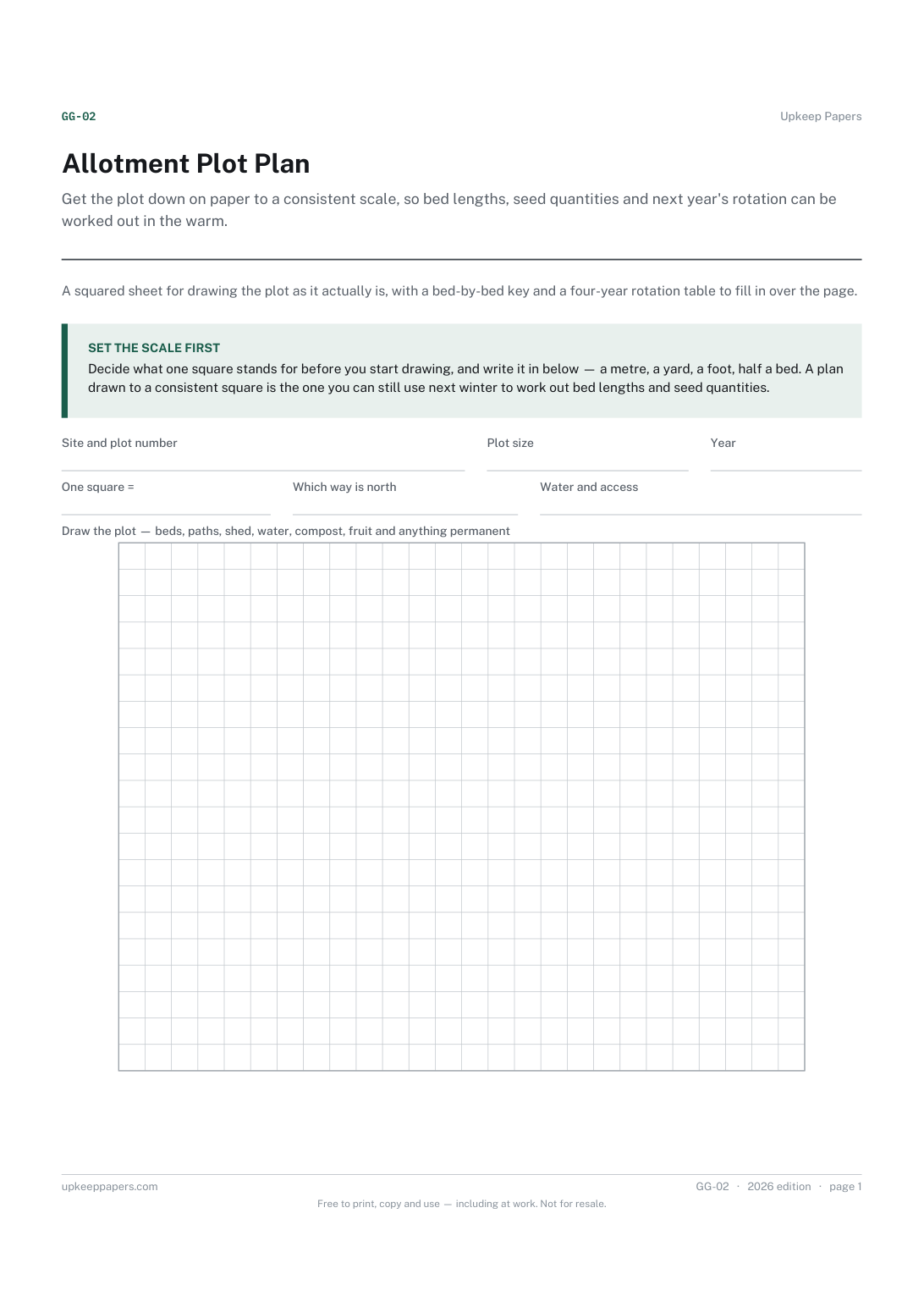
Get the plot down on paper to a consistent scale, so bed lengths, seed quantities and next year's rotation can be worked out in the warm.
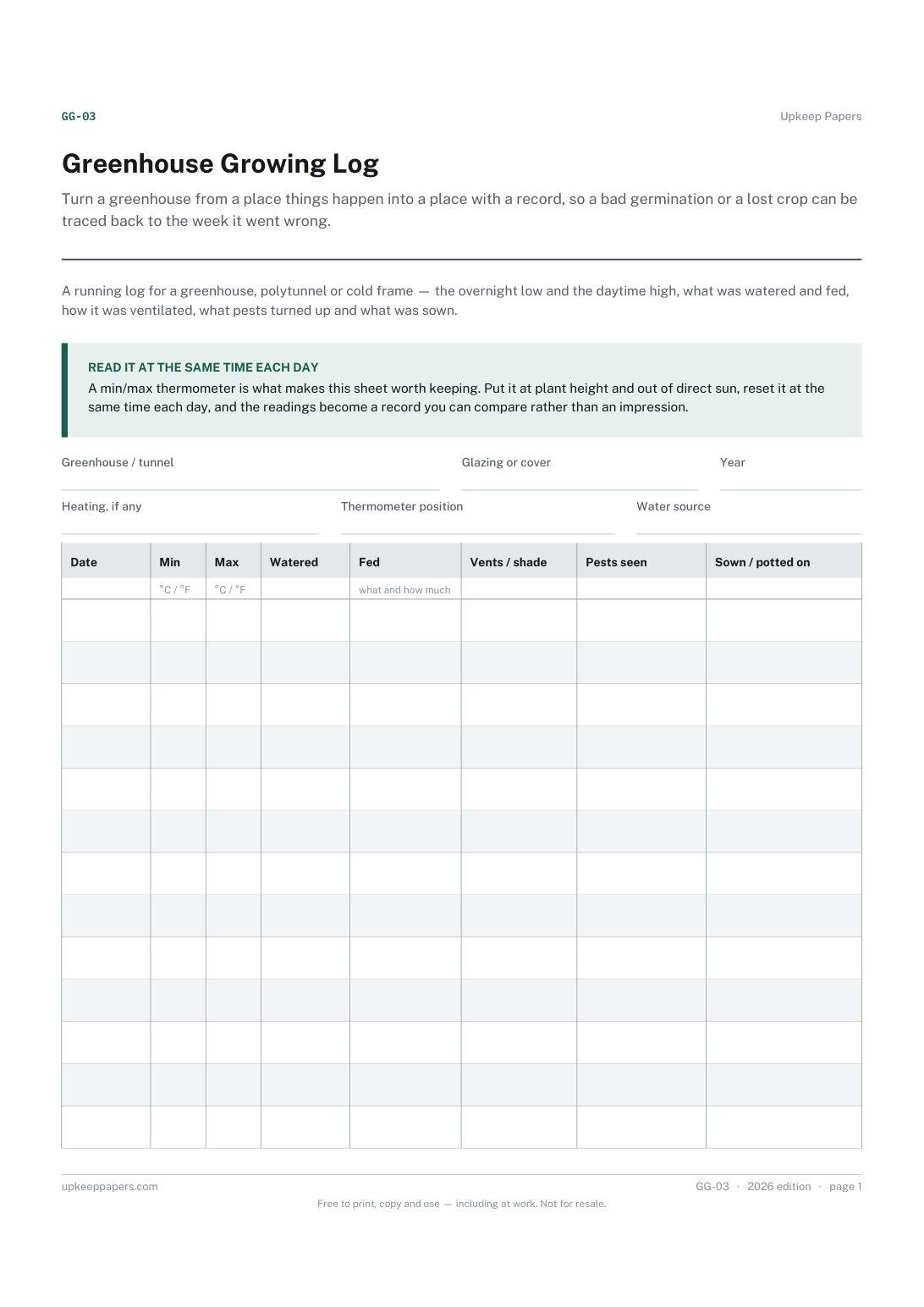
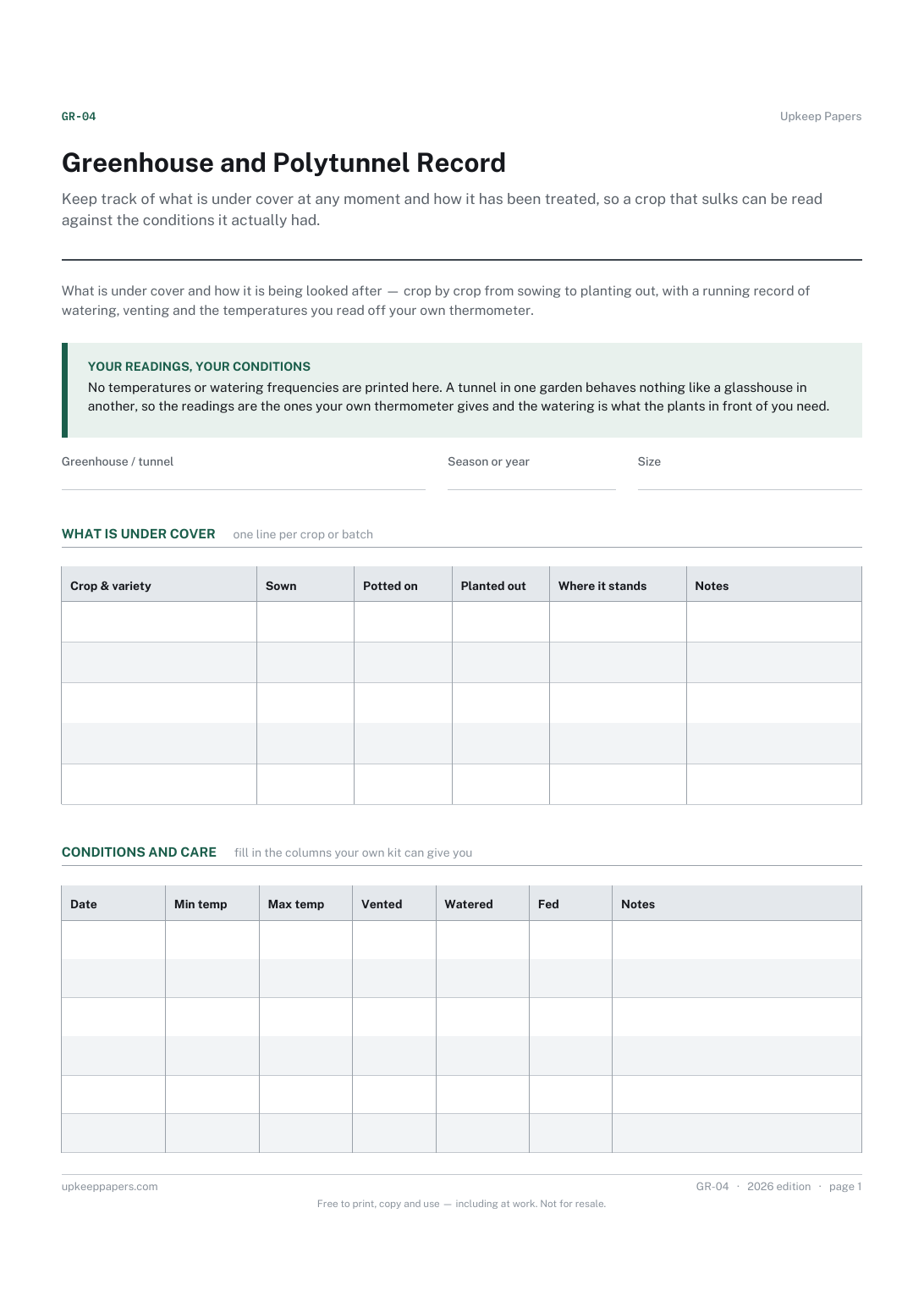
Turn a greenhouse from a place things happen into a place with a record, so a bad germination or a lost crop can be traced back to the week it went wrong.
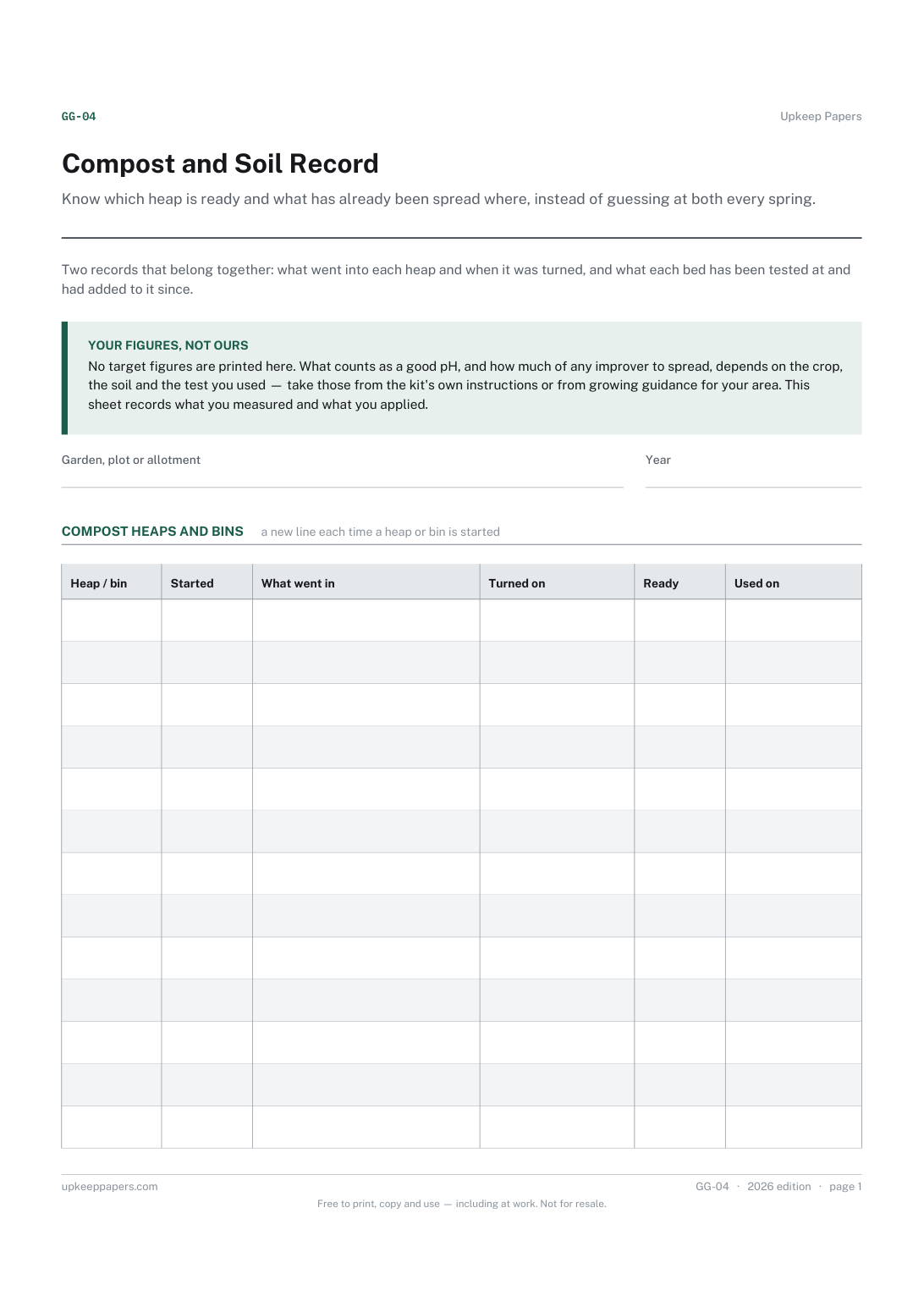
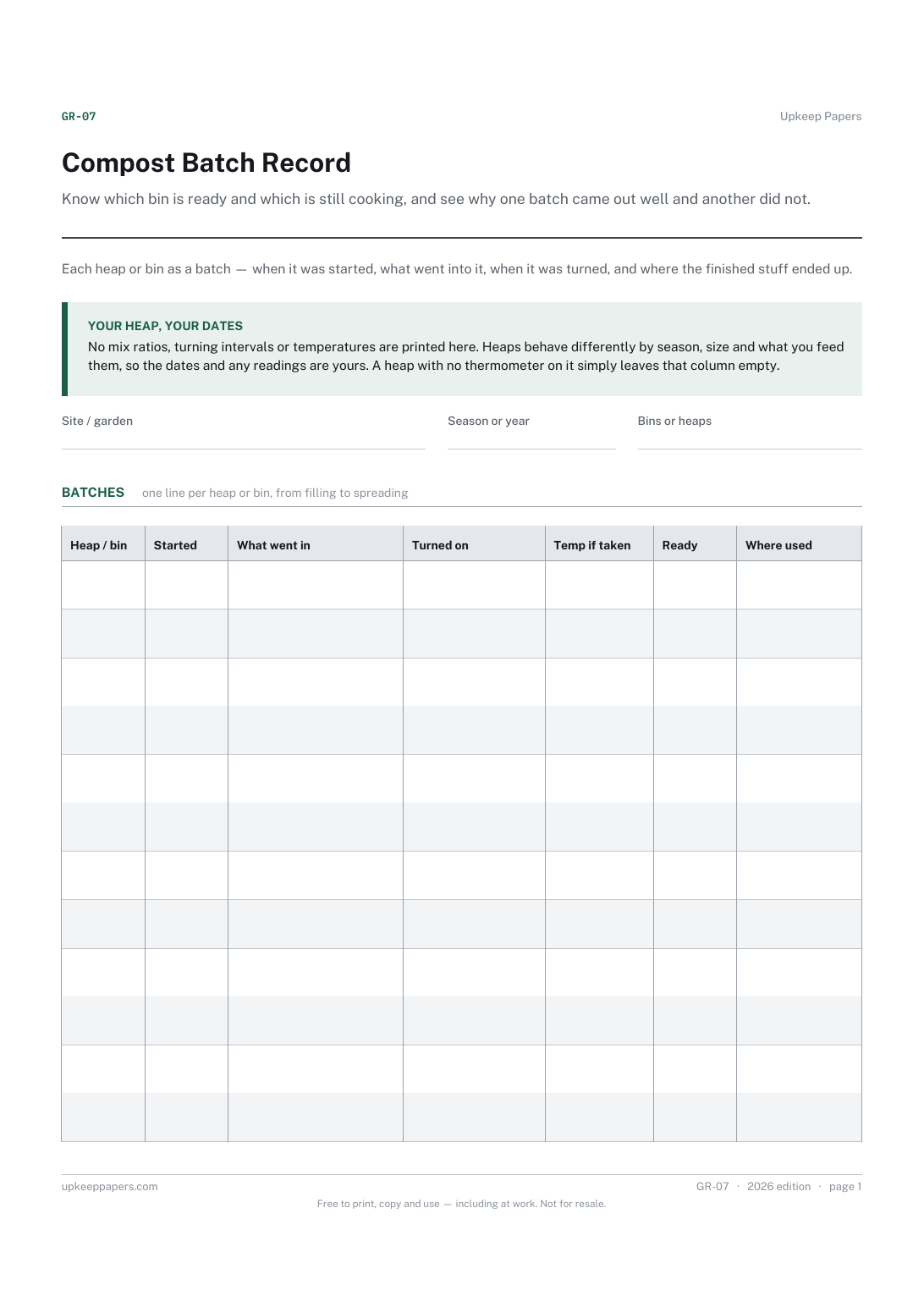
Know which heap is ready and what has already been spread where, instead of guessing at both every spring.
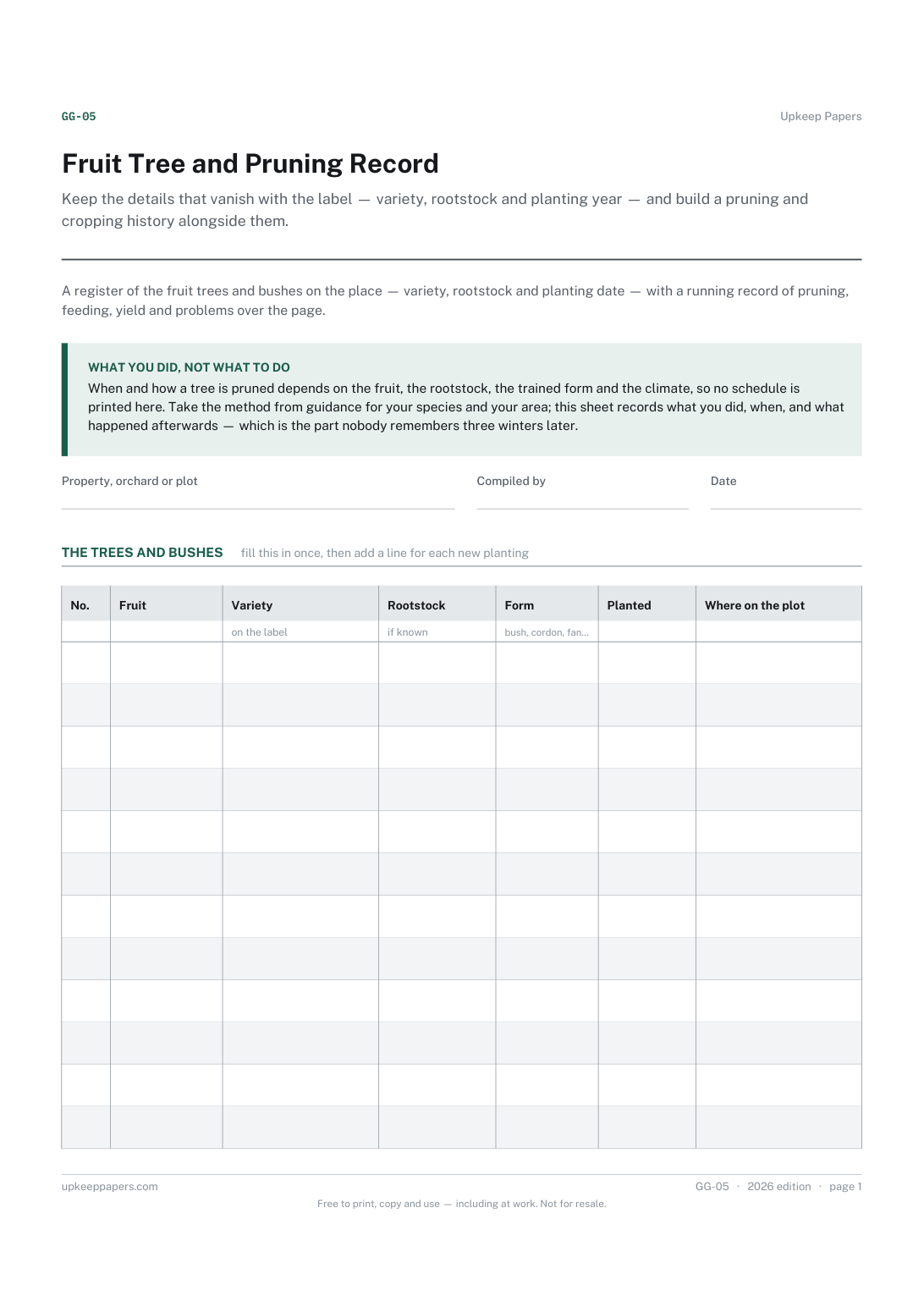
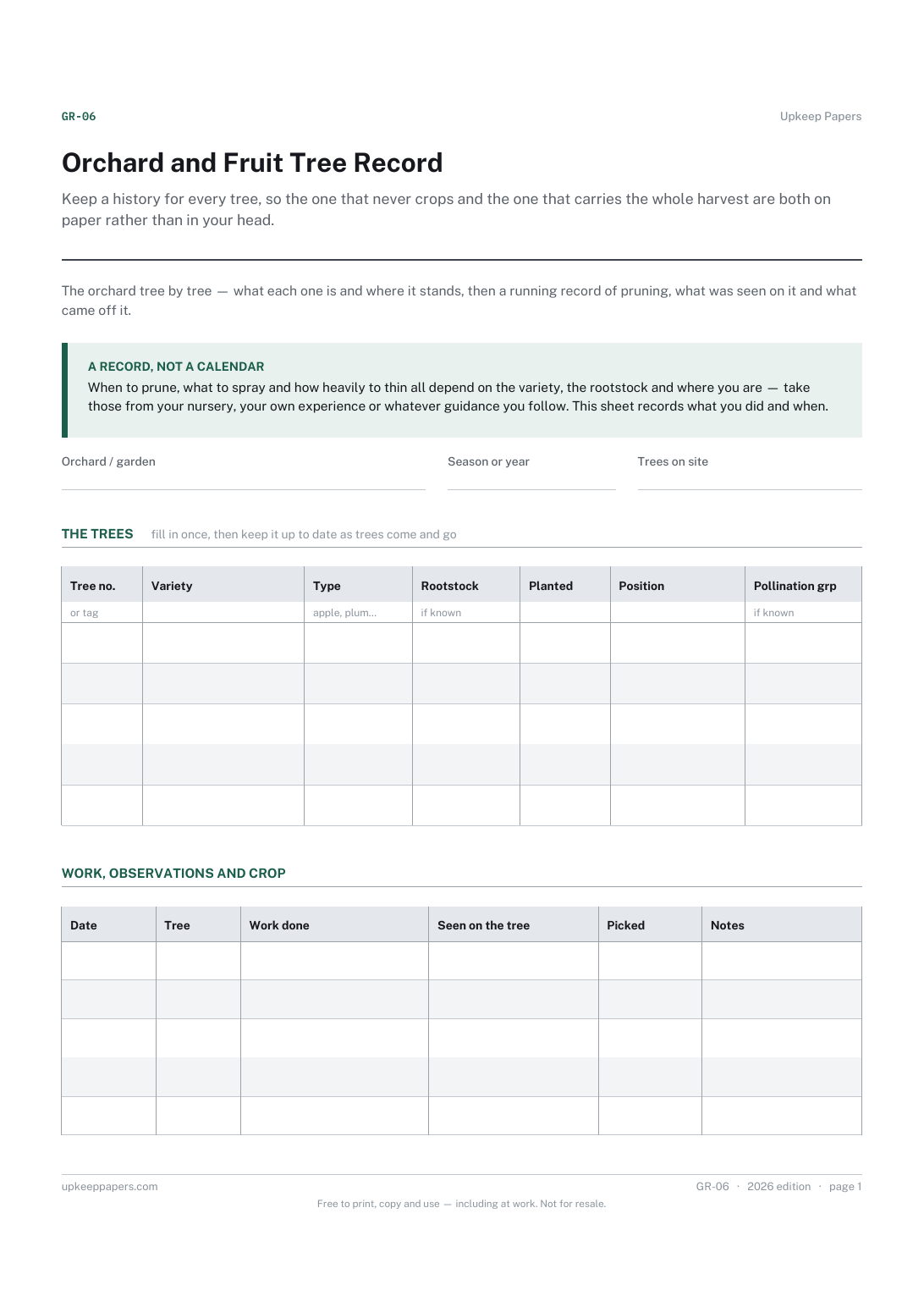
Keep the details that vanish with the label — variety, rootstock and planting year — and build a pruning and cropping history alongside them.
Set out what waters what, how, and how often, then keep a dated record through the season alongside the system checks that stop a blocked emitter going unnoticed.
Capture what you planned, what you actually did and what happened, which is the comparison that makes next season better and the one nobody writes down.
Plan the season with last year's beds in front of you, which is the only way rotation decisions get made from fact rather than memory.
Record what struck and what did not, so your own conditions become the reference instead of a general table.
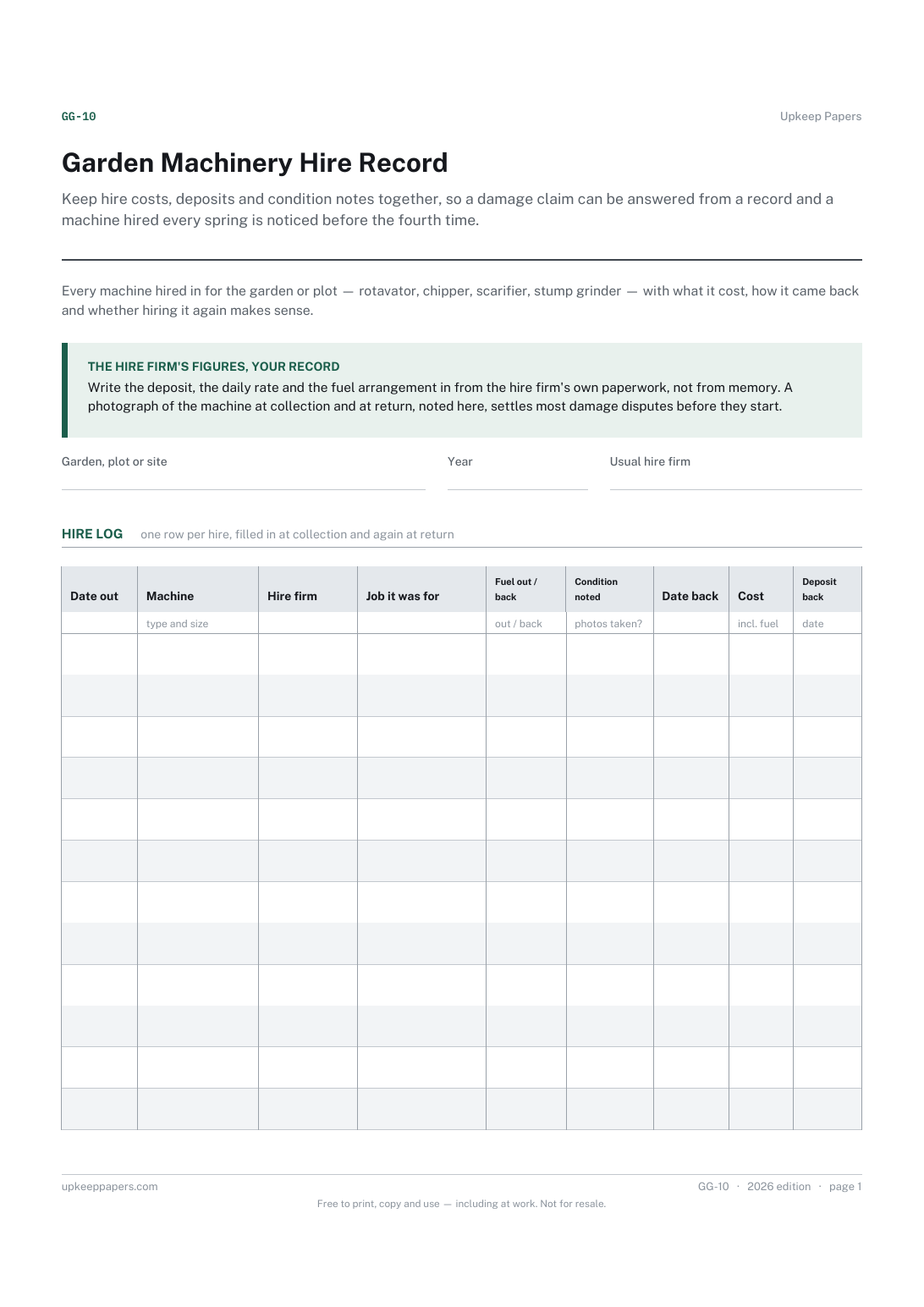
Keep hire costs, deposits and condition notes together, so a damage claim can be answered from a record and a machine hired every spring is noticed before the fourth time.
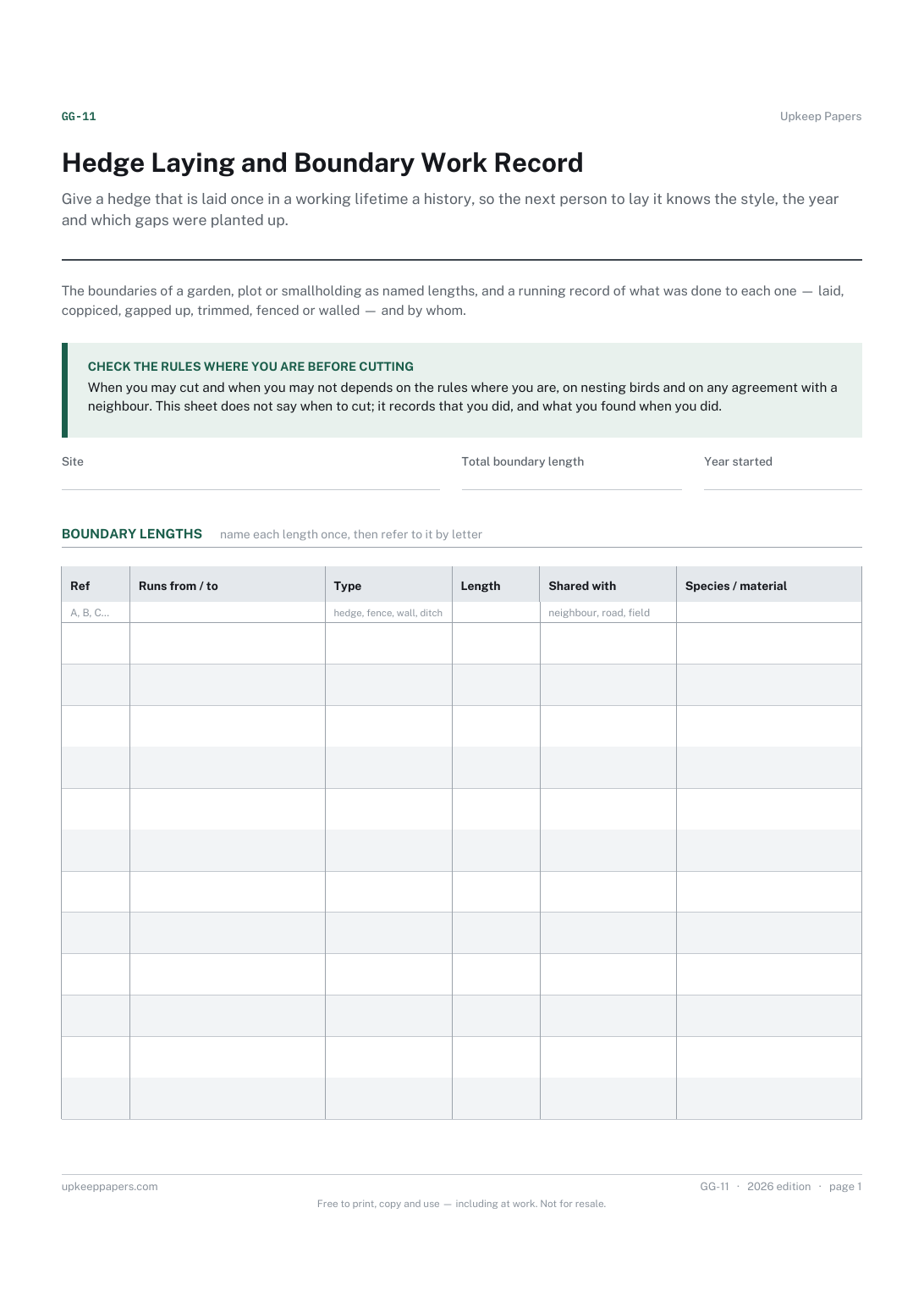
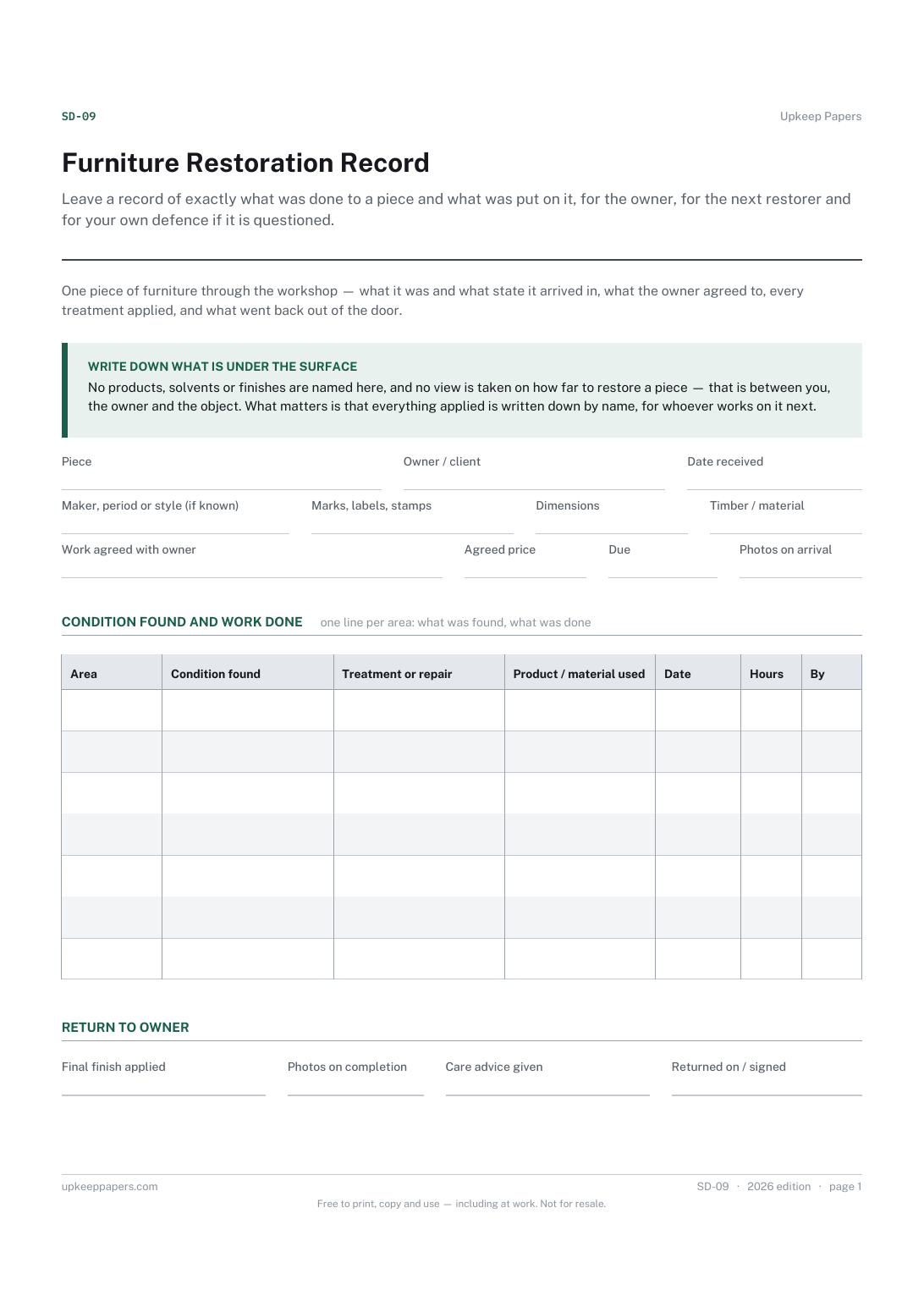
Give a hedge that is laid once in a working lifetime a history, so the next person to lay it knows the style, the year and which gaps were planted up.
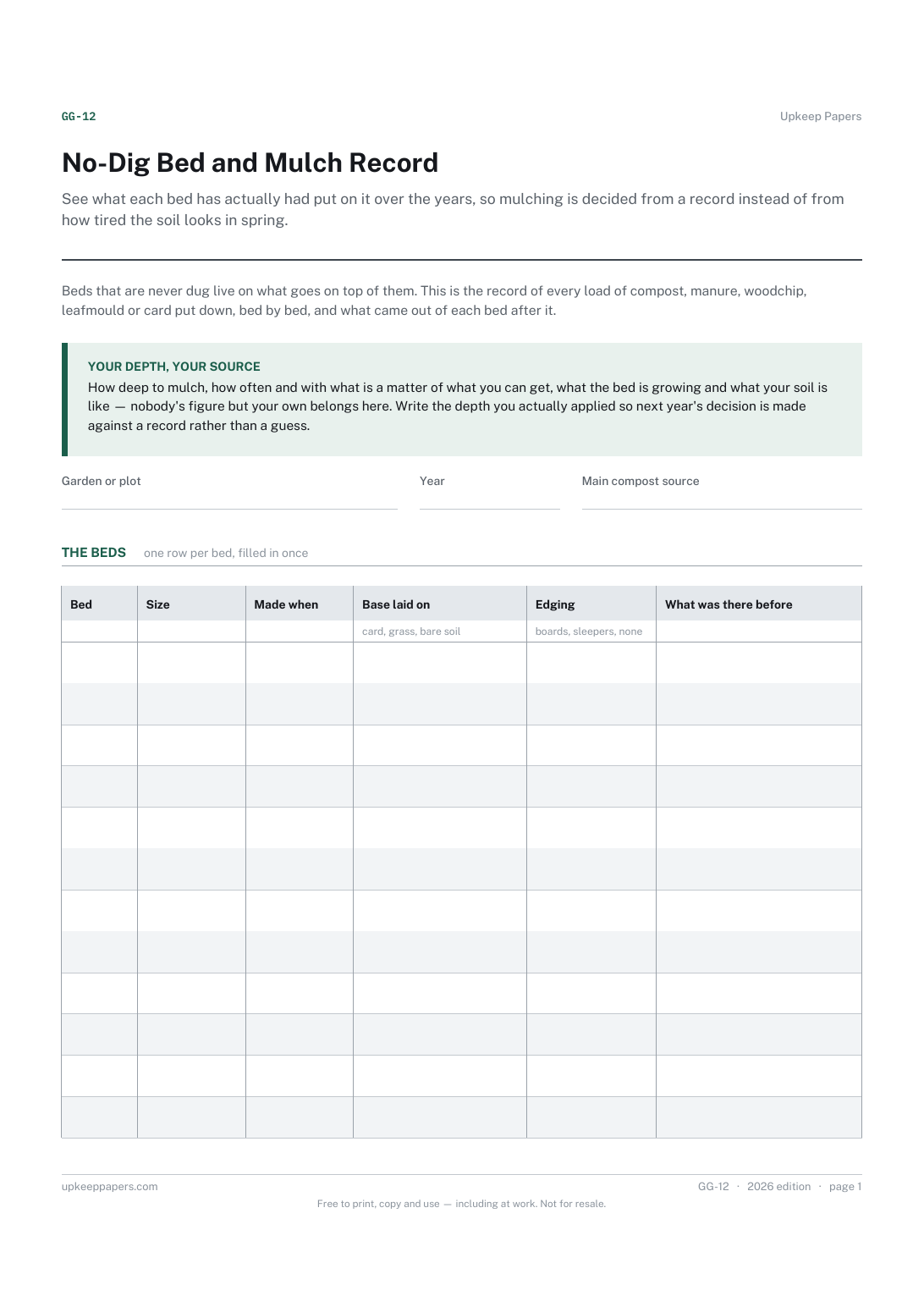
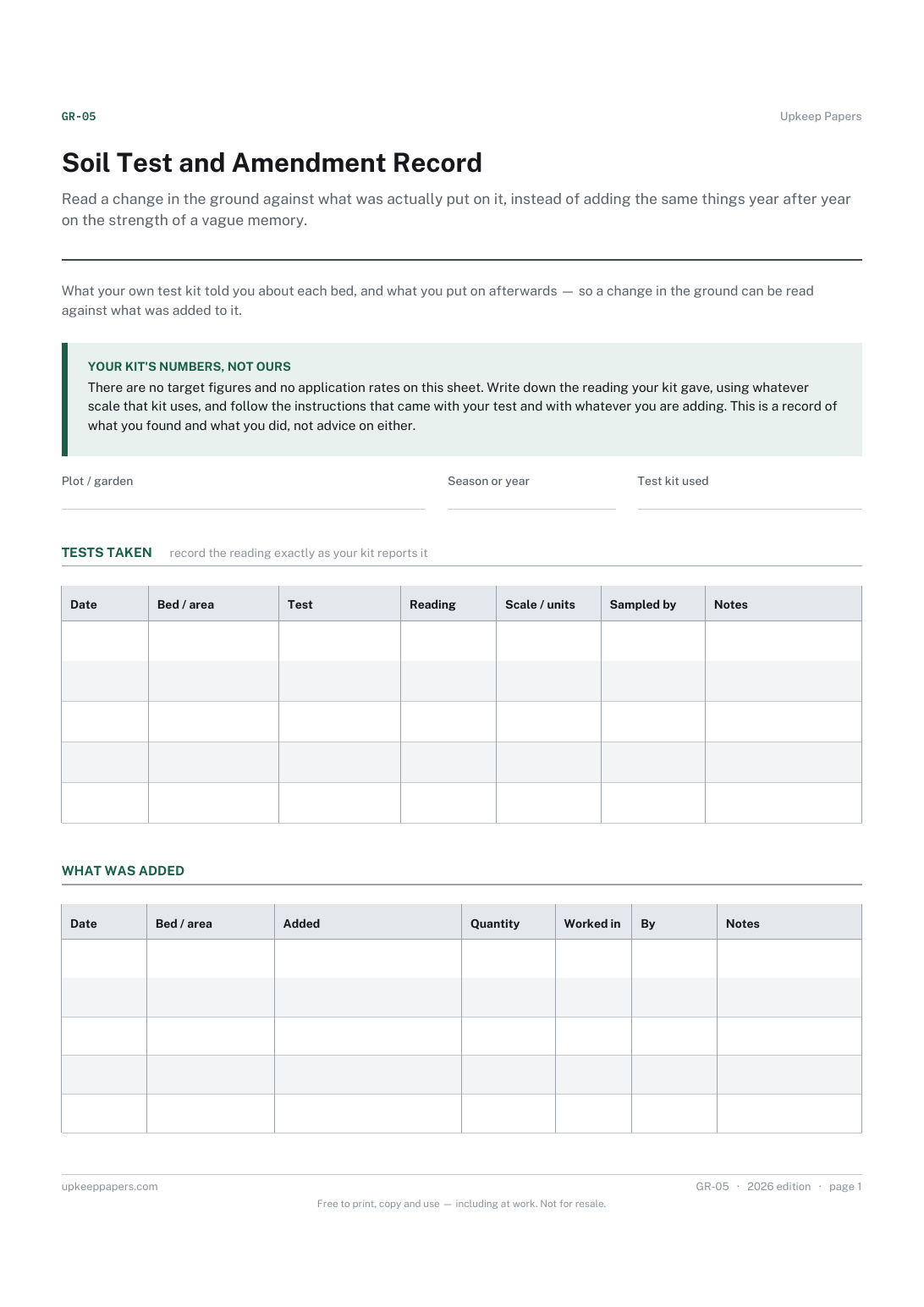
See what each bed has actually had put on it over the years, so mulching is decided from a record instead of from how tired the soil looks in spring.
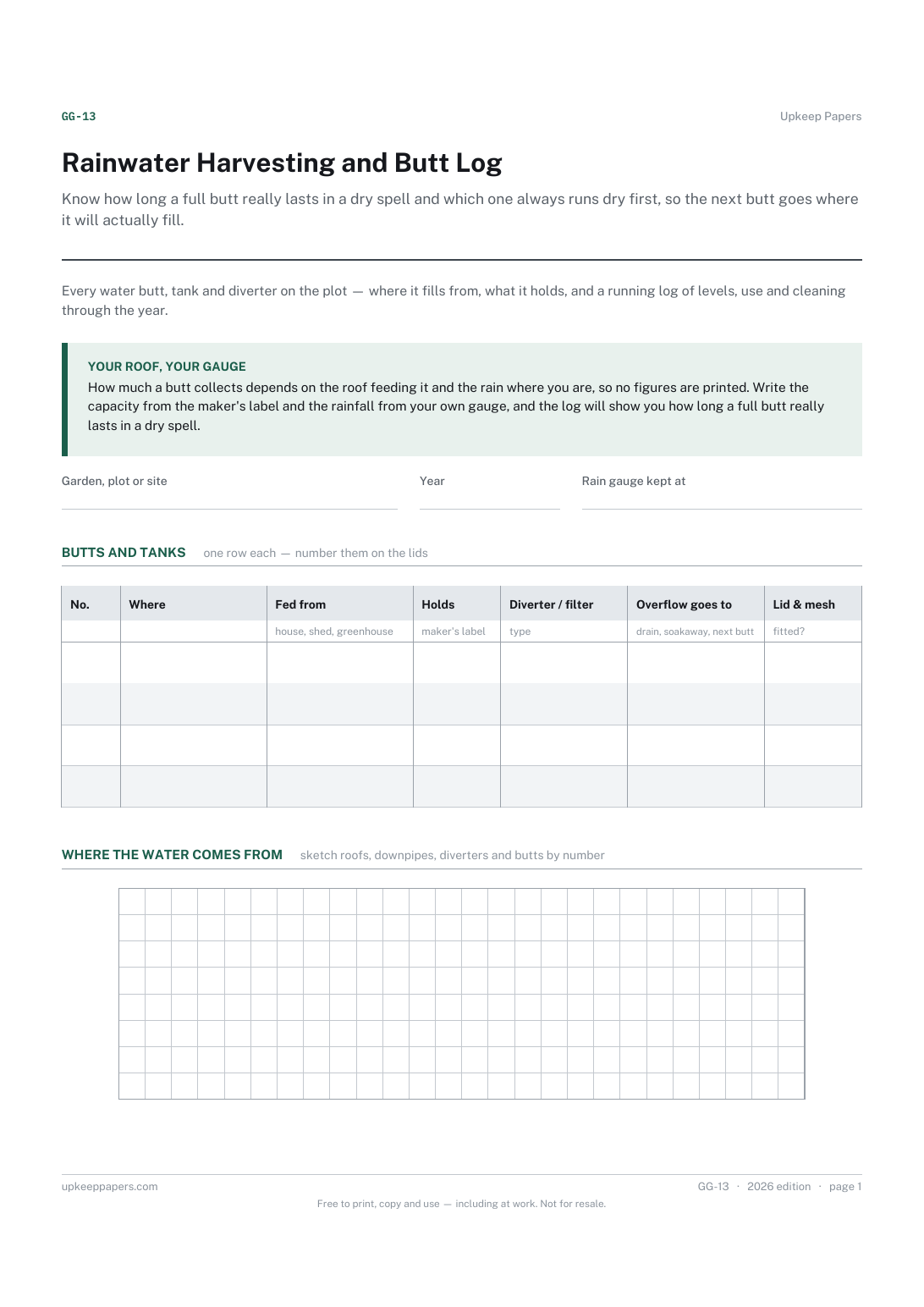
Know how long a full butt really lasts in a dry spell and which one always runs dry first, so the next butt goes where it will actually fill.
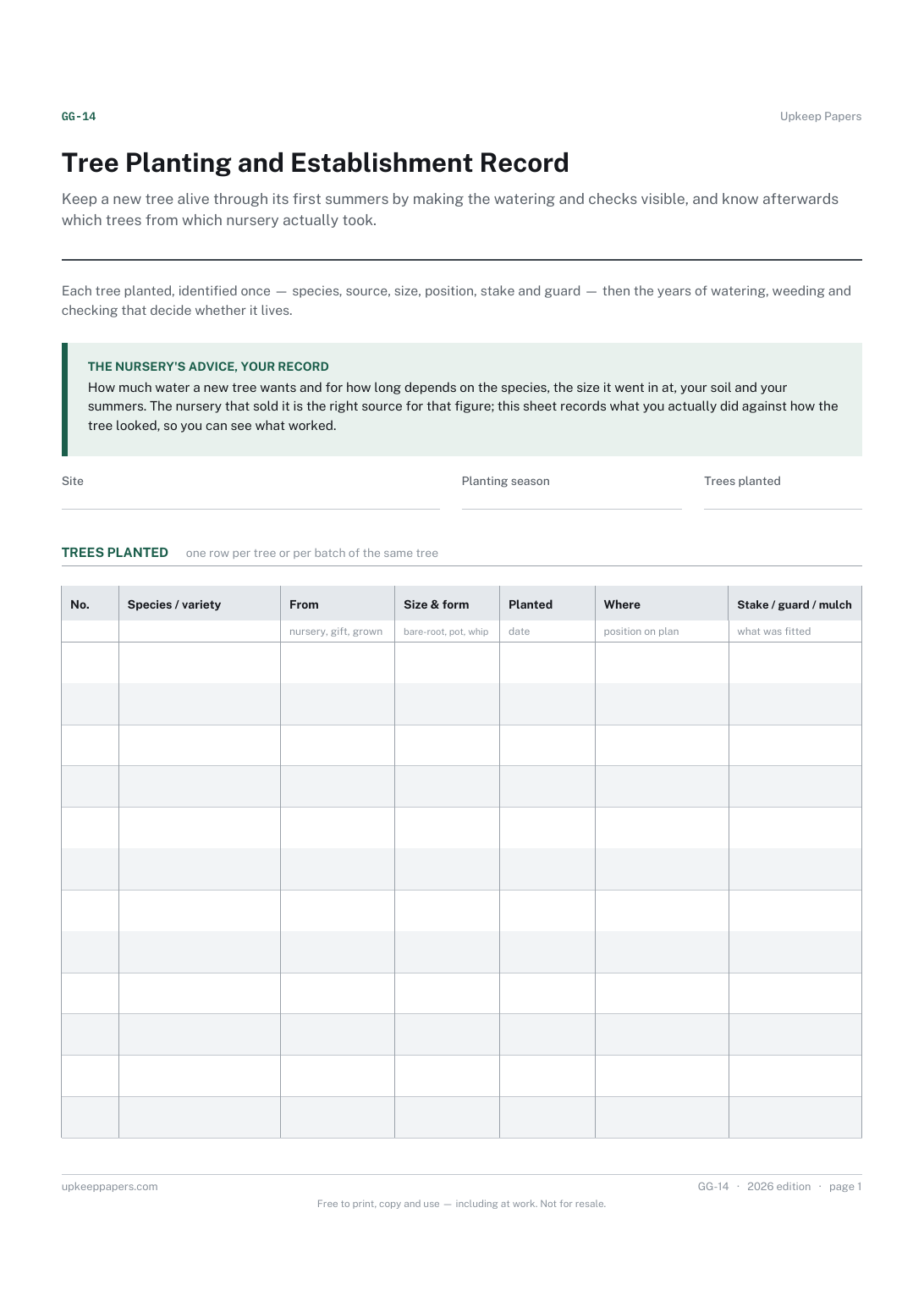
Keep a new tree alive through its first summers by making the watering and checks visible, and know afterwards which trees from which nursery actually took.
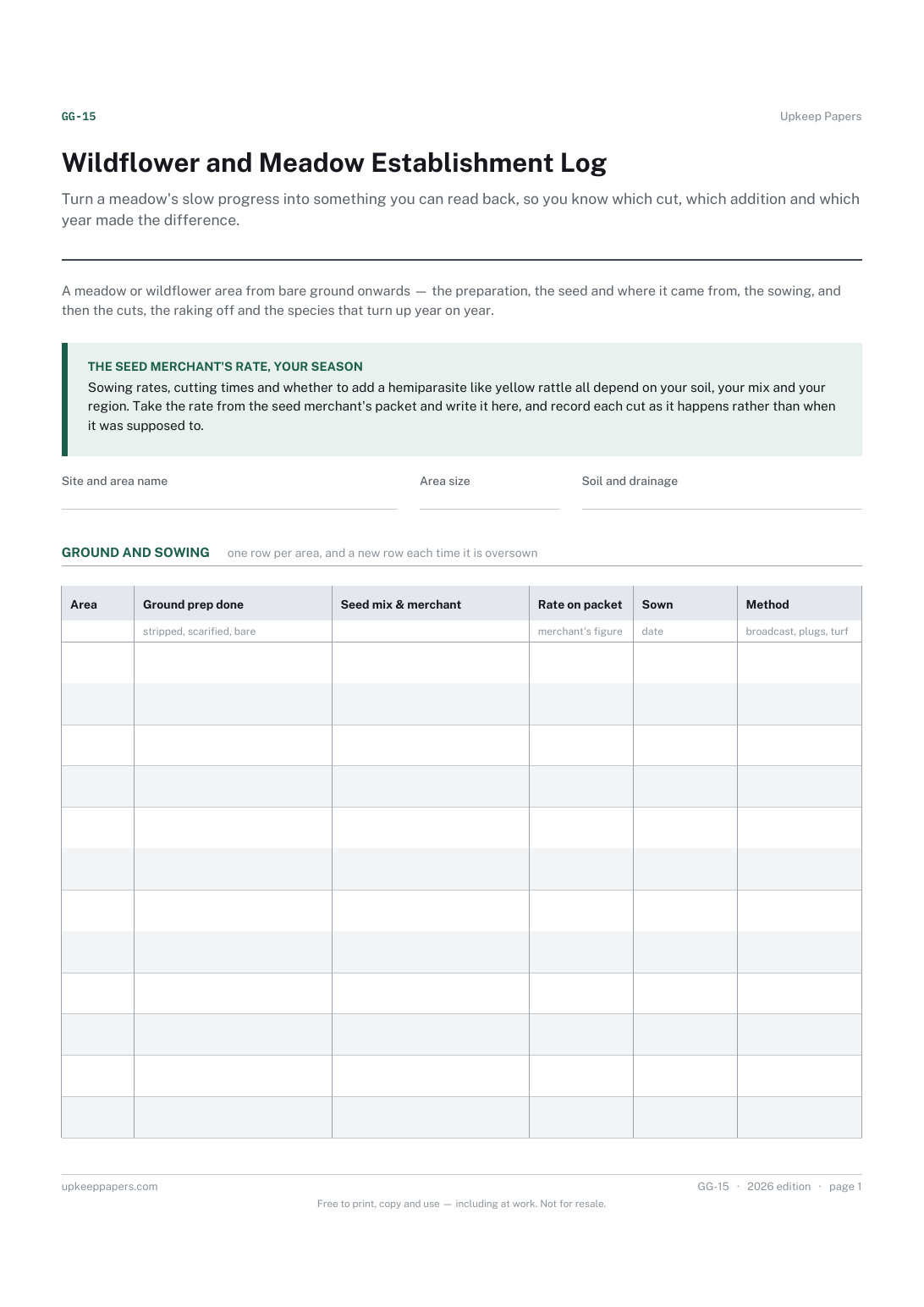
Turn a meadow's slow progress into something you can read back, so you know which cut, which addition and which year made the difference.
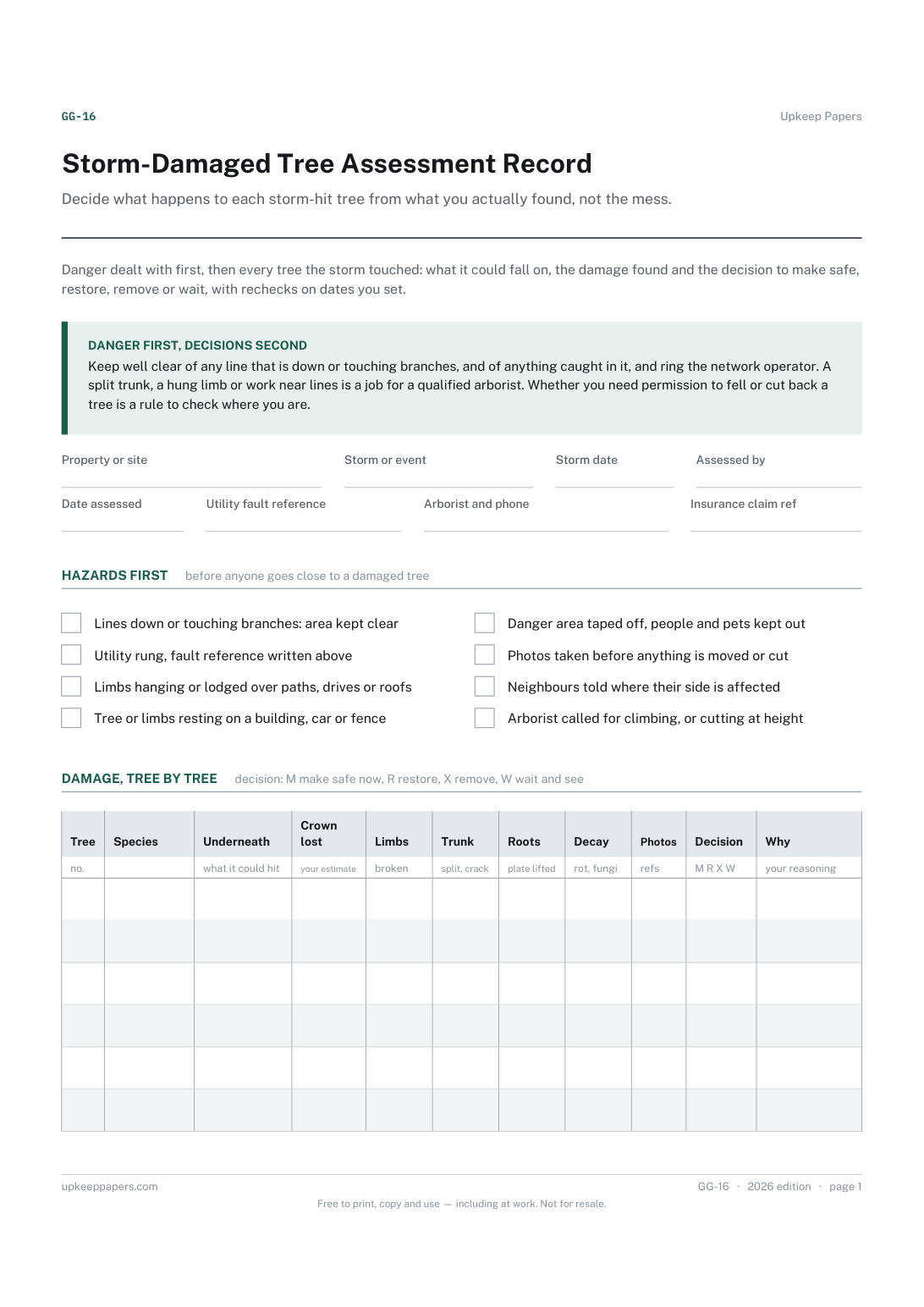
Decide what happens to each storm-hit tree from what you actually found, not the mess. The recheck table catches the trees that looked fine and then declined months later.
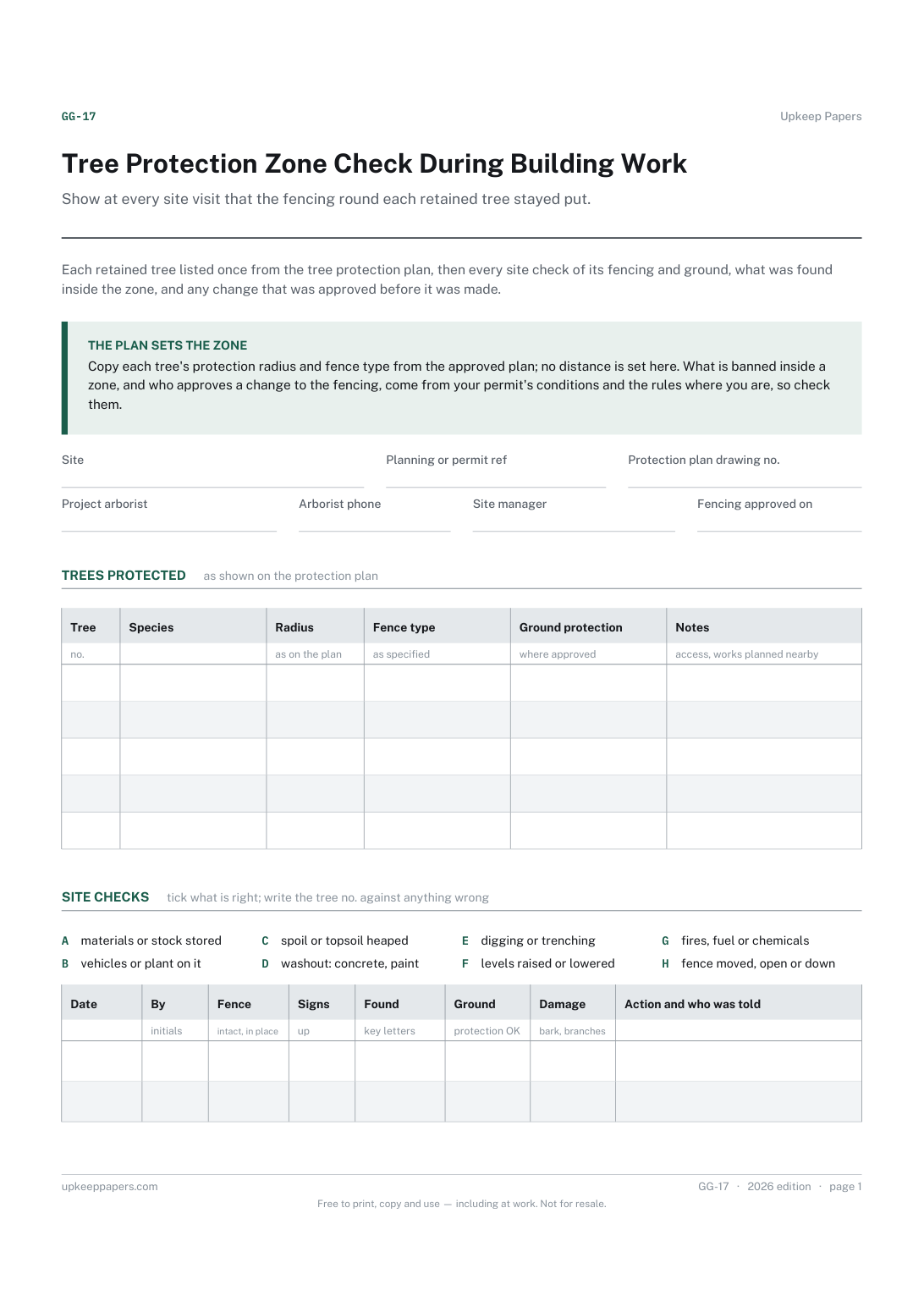
Show at every site visit that the fencing round each retained tree stayed put. A lettered key makes it quick to note exactly what was found inside a zone and who was told.
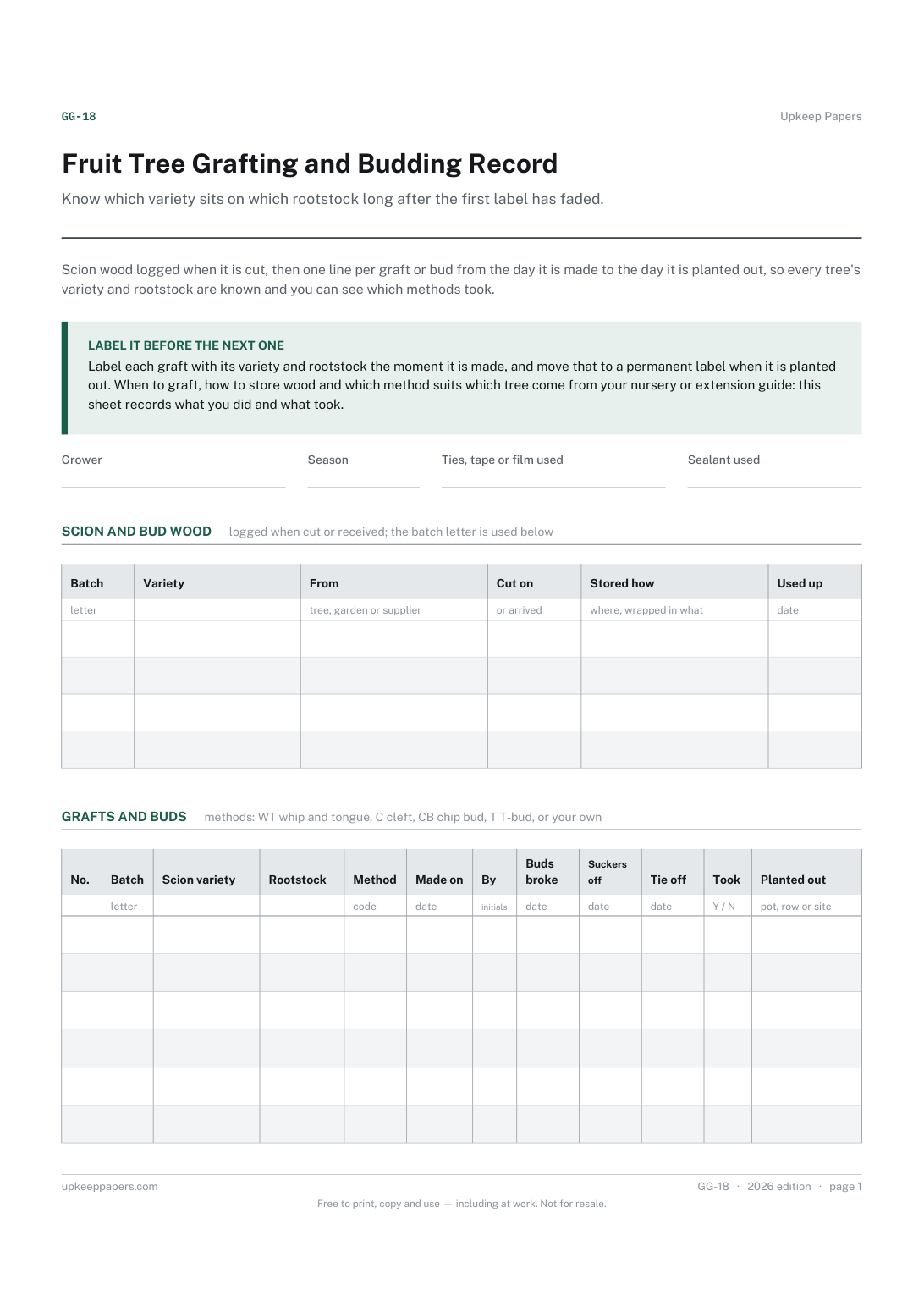
Know which variety sits on which rootstock long after the first label has faded. A season's grafts, counted by method and by grafter, show what actually works for you.
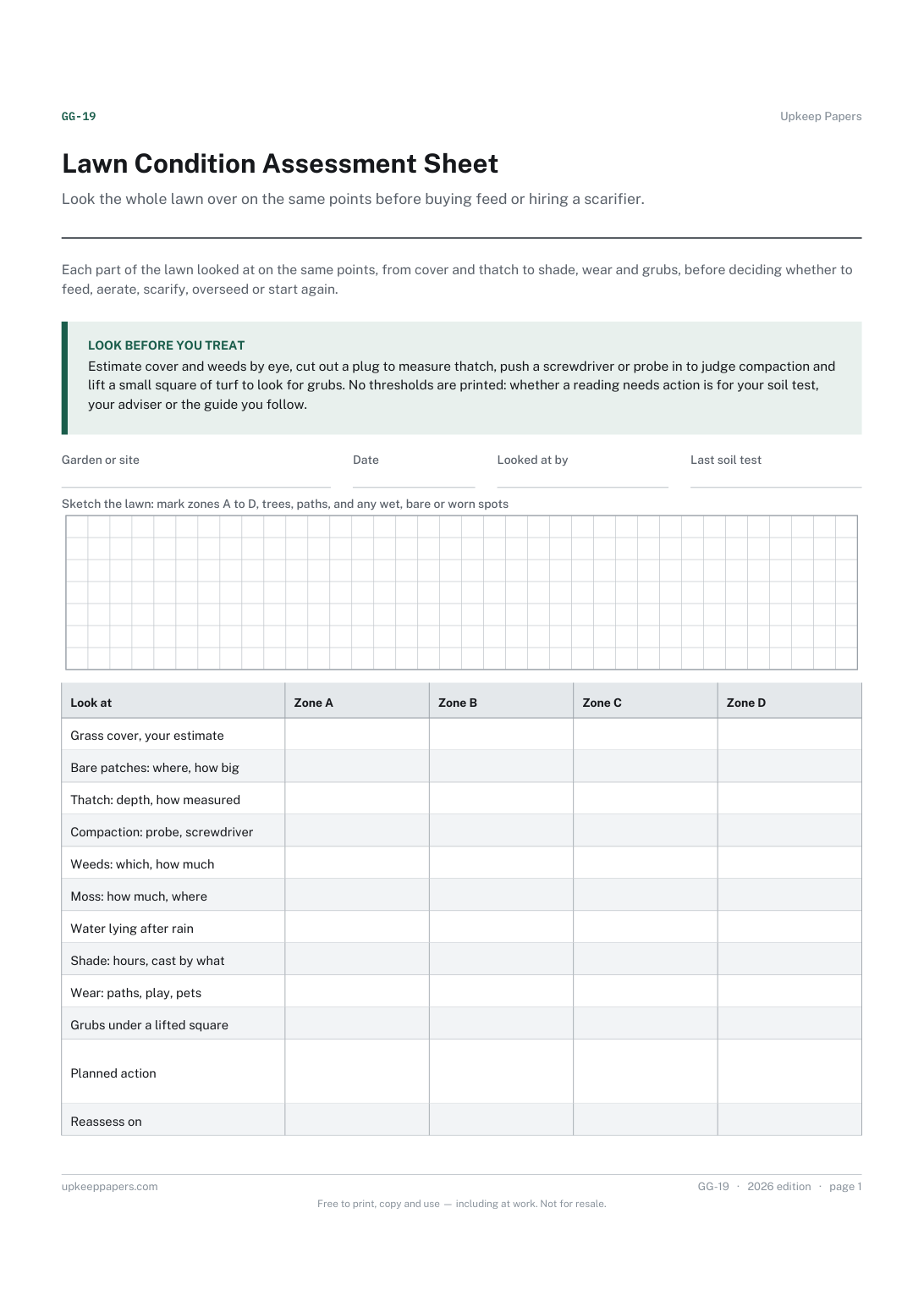
Look the whole lawn over on the same points before buying feed or hiring a scarifier. Writing down what each zone shows makes it clear which problem to tackle first.
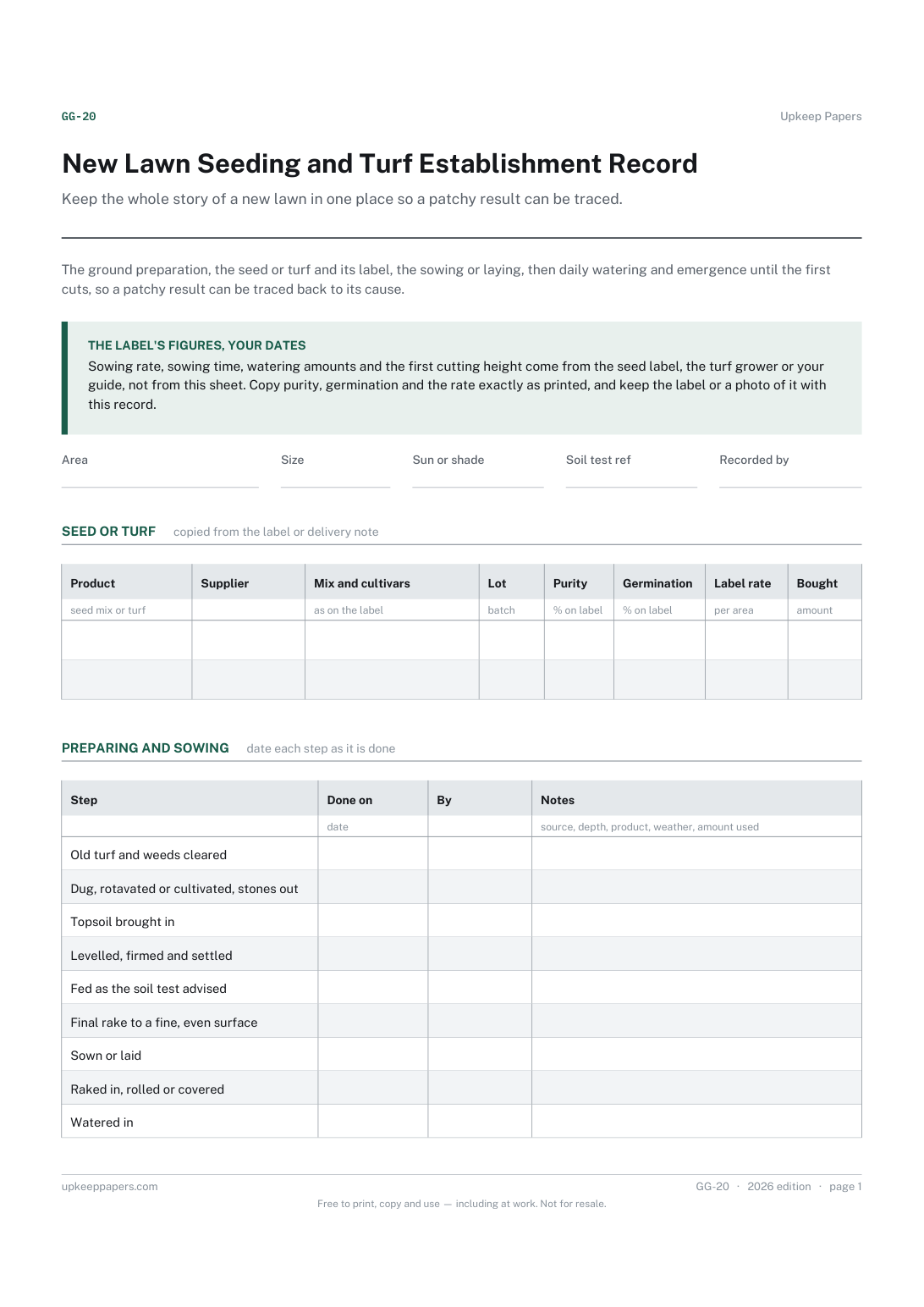
Keep the whole story of a new lawn in one place so a patchy result can be traced. The label figures, the preparation and the first weeks sit on the same two pages.
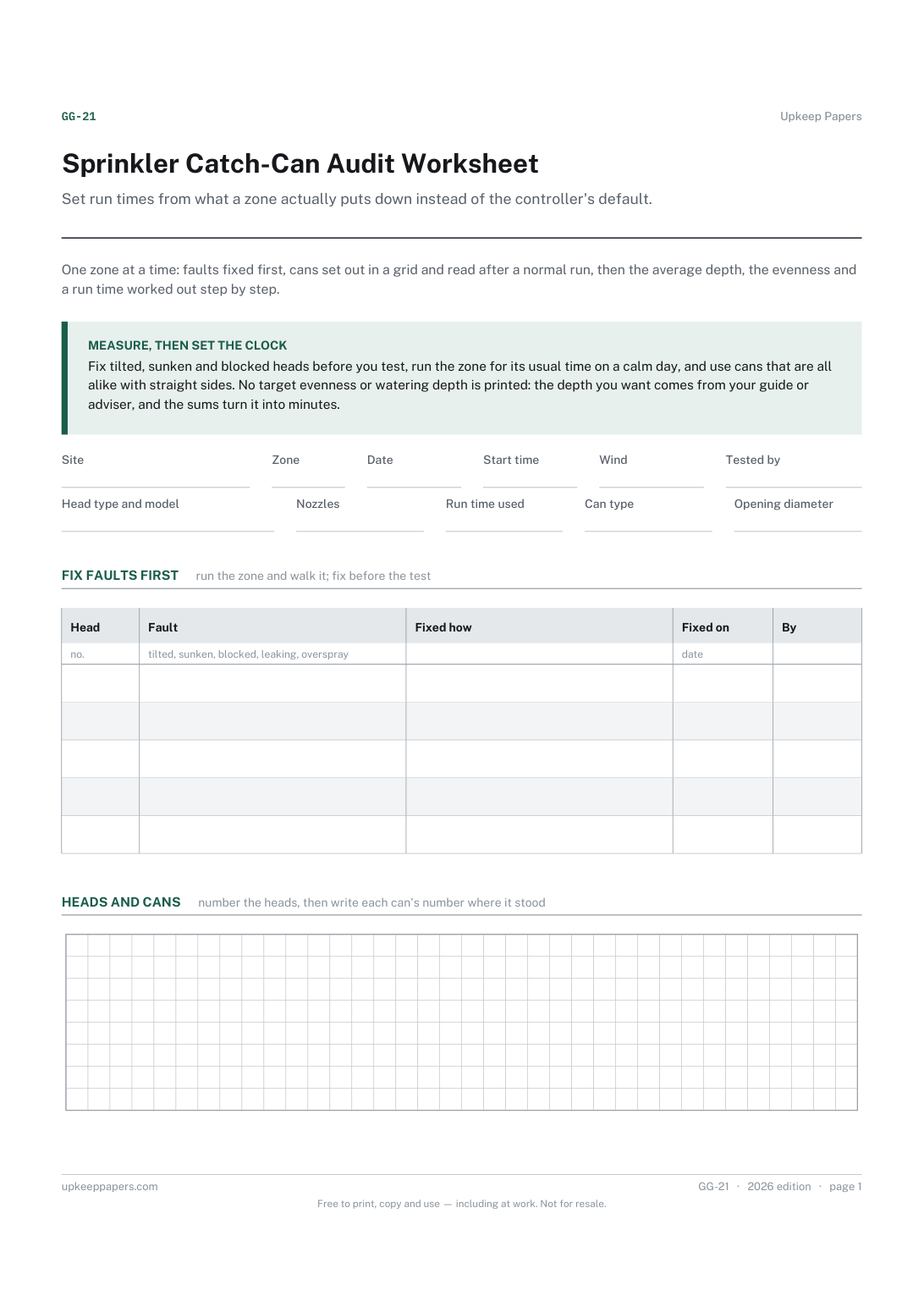
Set run times from what a zone actually puts down instead of the controller's default. The same test shows up dry corners and heads that need moving.
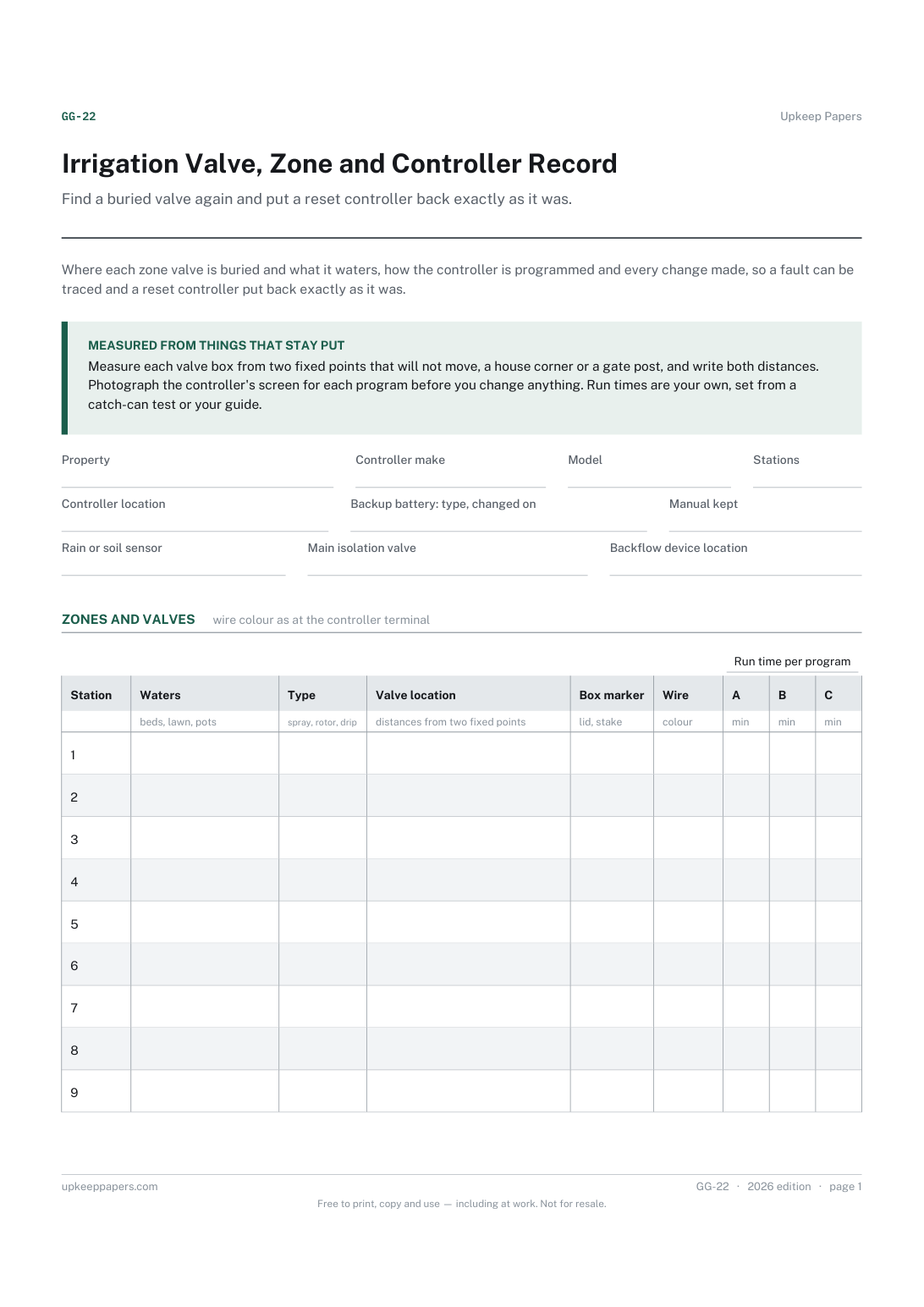
Find a buried valve again and put a reset controller back exactly as it was. Every program, start time and run time is written down before anything is changed.
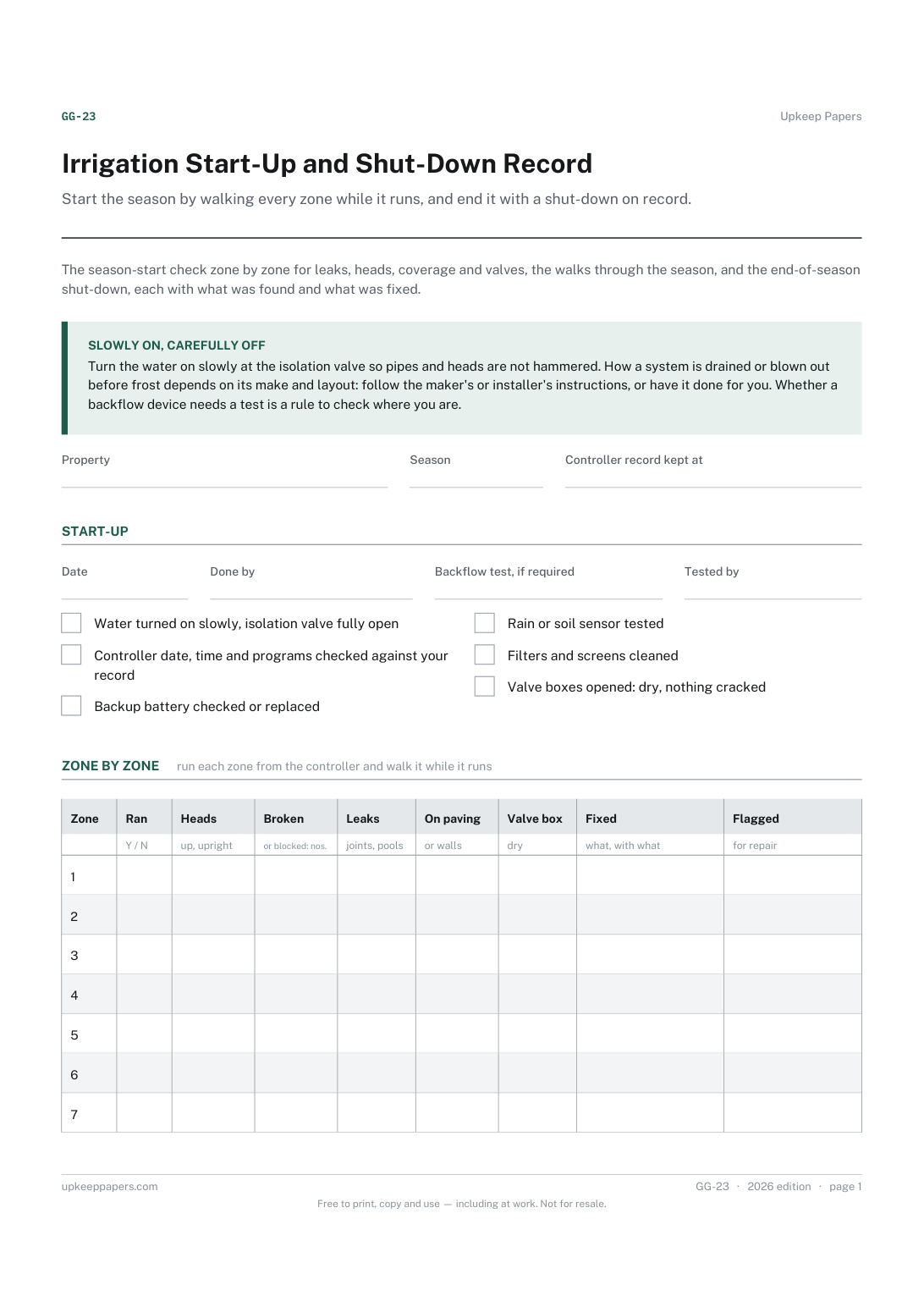
Start the season by walking every zone while it runs, and end it with a shut-down on record. Faults are written against their zone, so nothing is forgotten by spring.
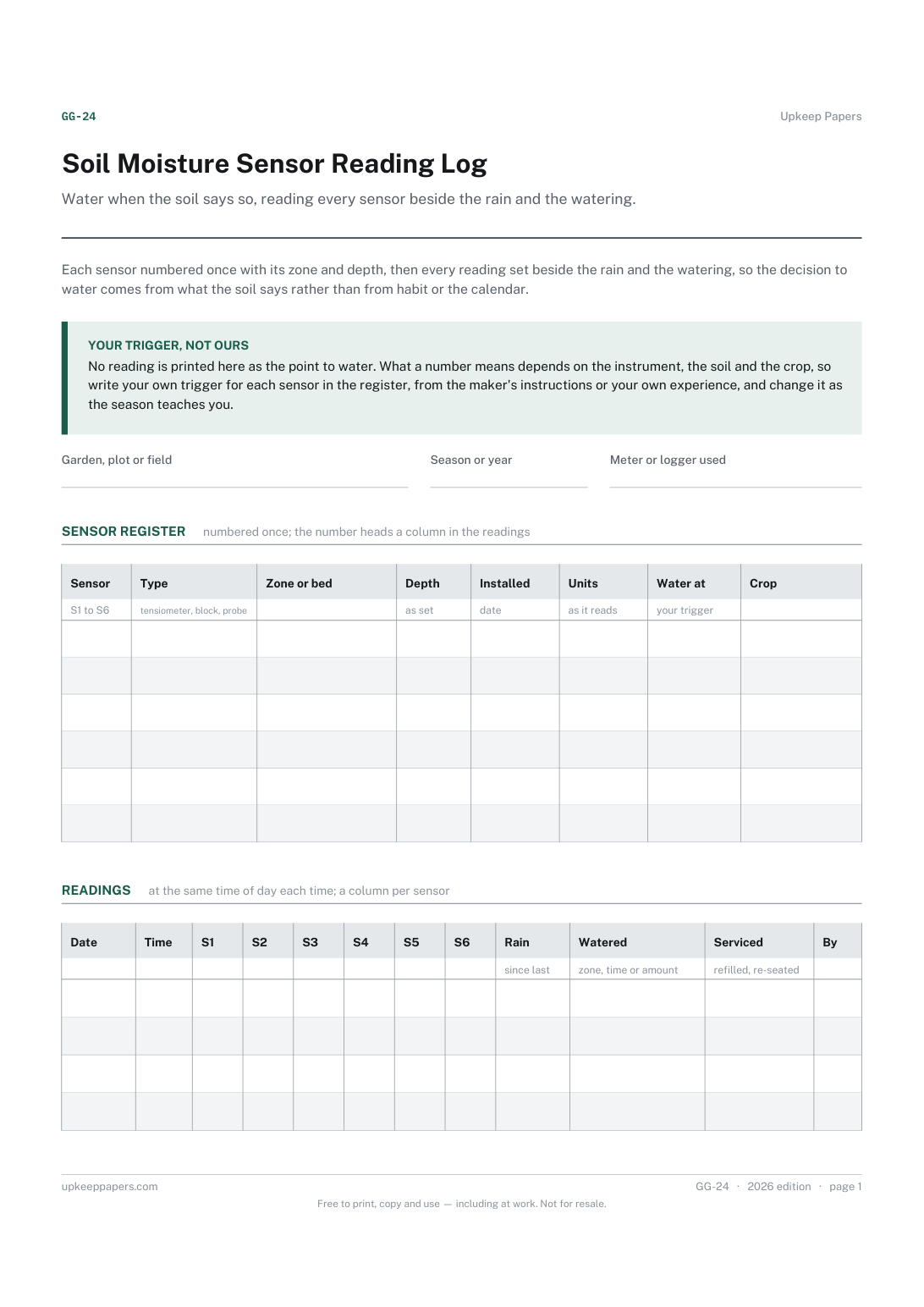
Water when the soil says so, reading every sensor beside the rain and the watering. Over a season the log also shows how each zone dries out, and whether your trigger needs moving.
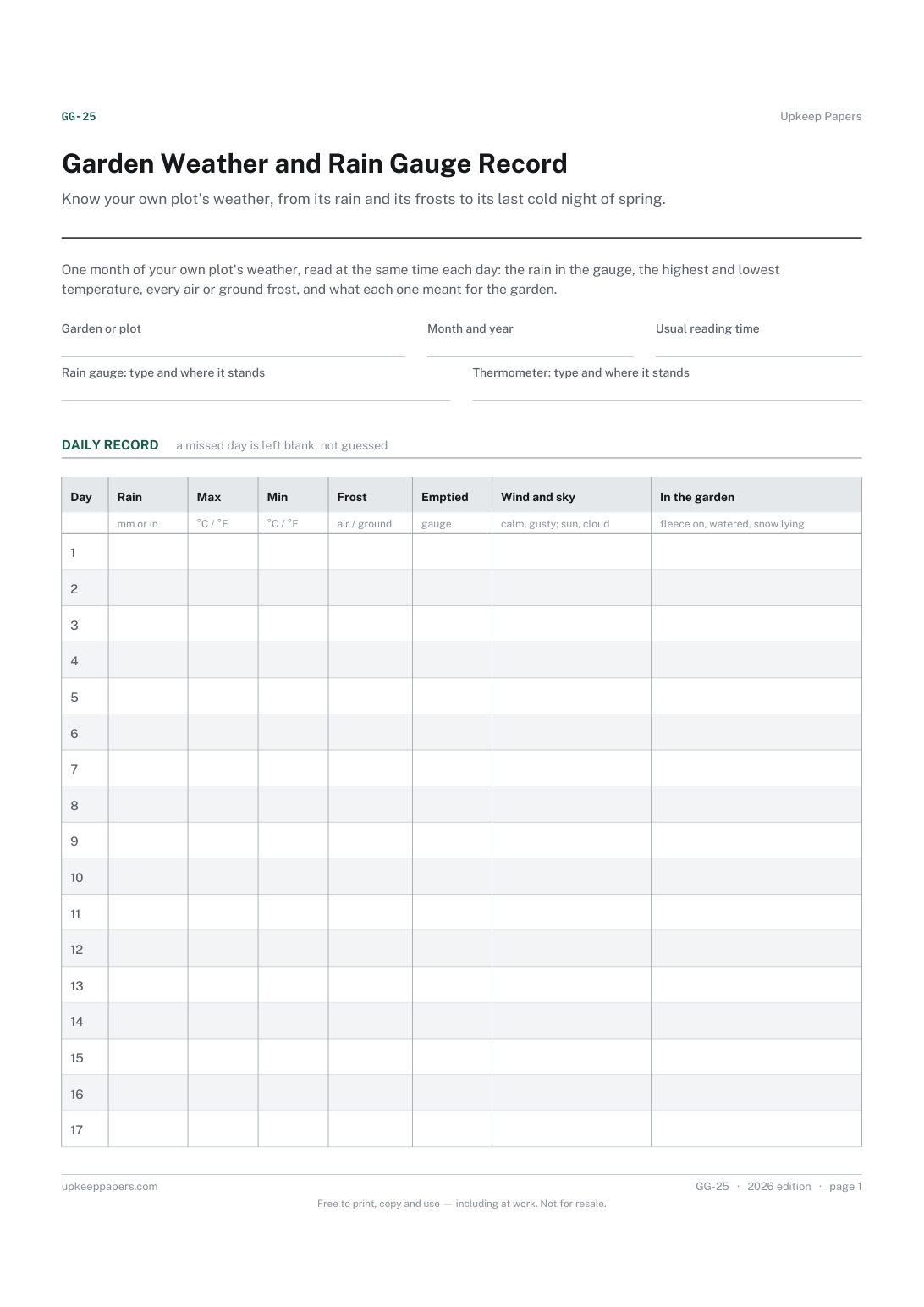
Know your own plot's weather, from its rain and its frosts to its last cold night of spring. A few years of these sheets tell you more about when to sow and plant out than any regional average.
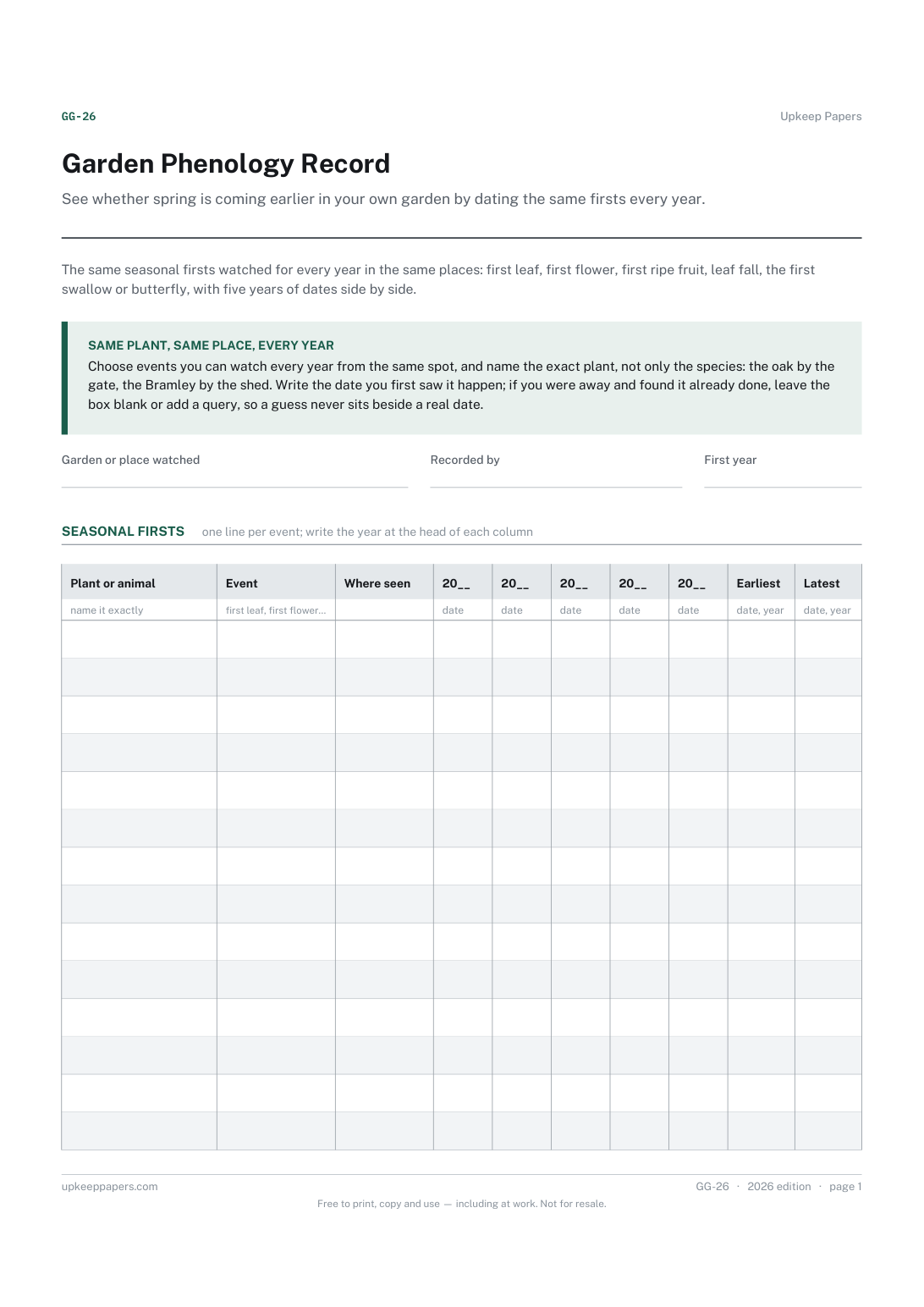
See whether spring is coming earlier in your own garden by dating the same firsts every year. Five years of dates side by side show shifts in timing that no single year can.
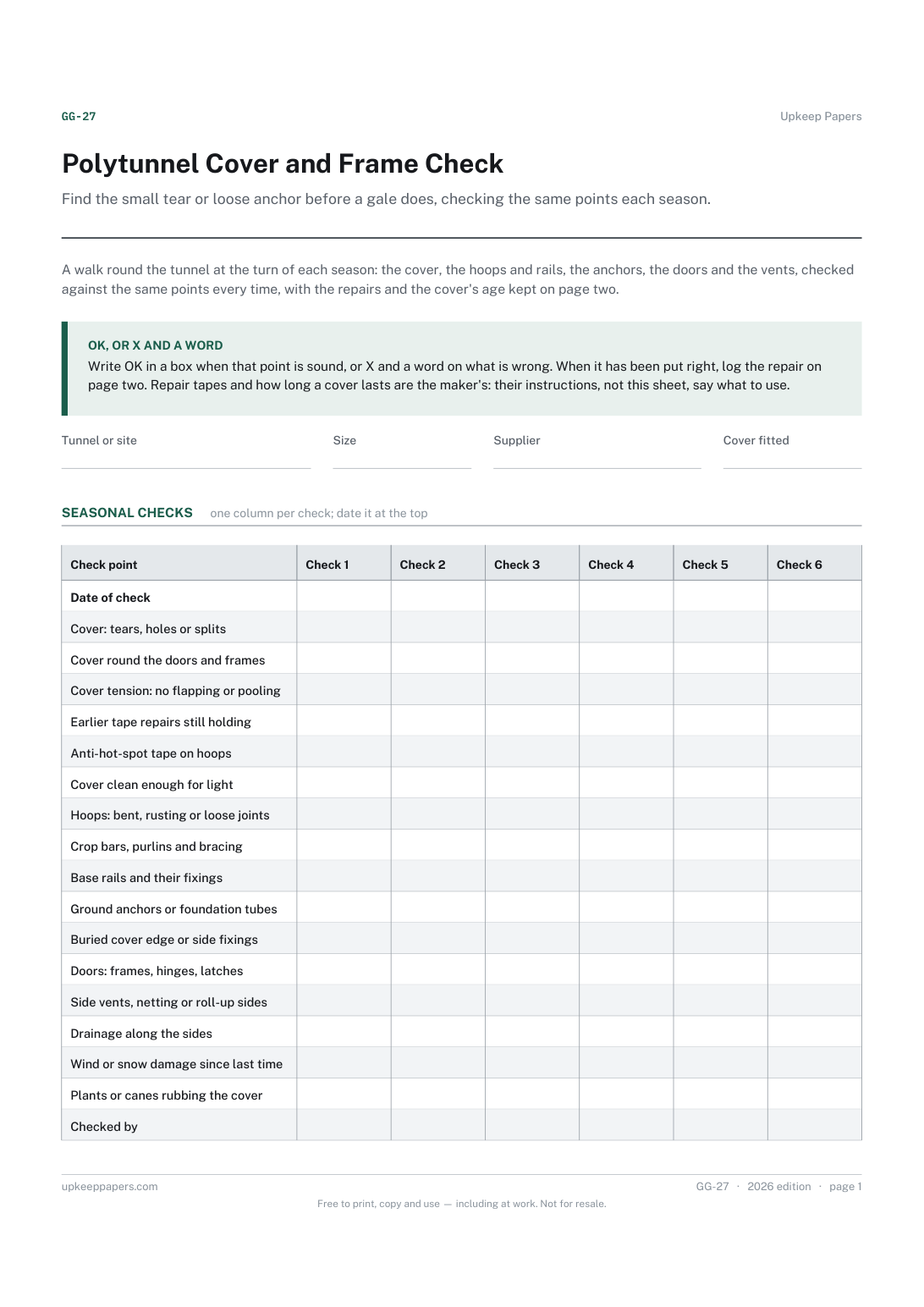
Find the small tear or loose anchor before a gale does, checking the same points each season. Page two keeps the repairs and the cover's age, so a replacement is planned, not forced.
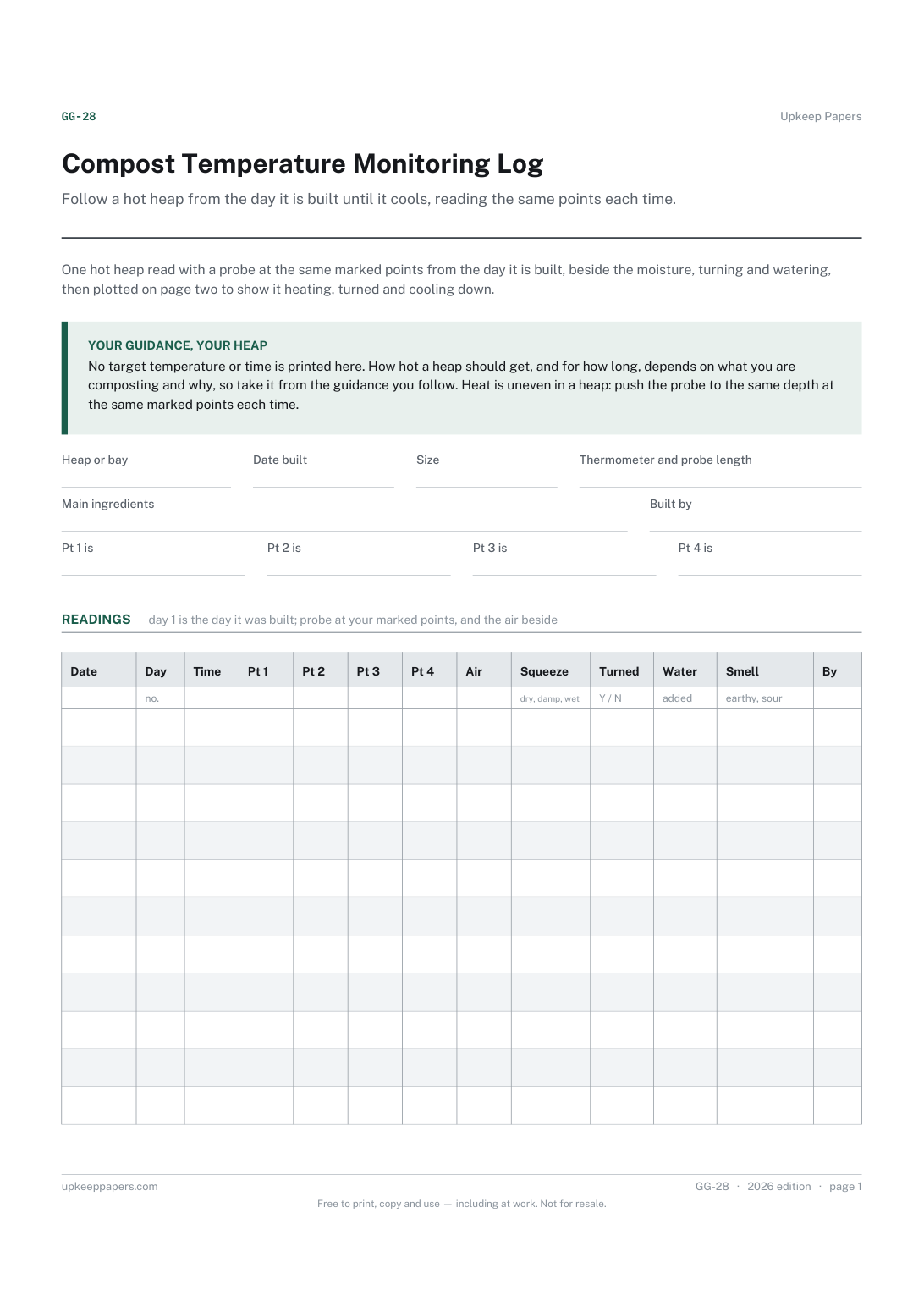
Follow a hot heap from the day it is built until it cools, reading the same points each time. Plotting the readings shows when it heated, how turning revived it and when it settled.
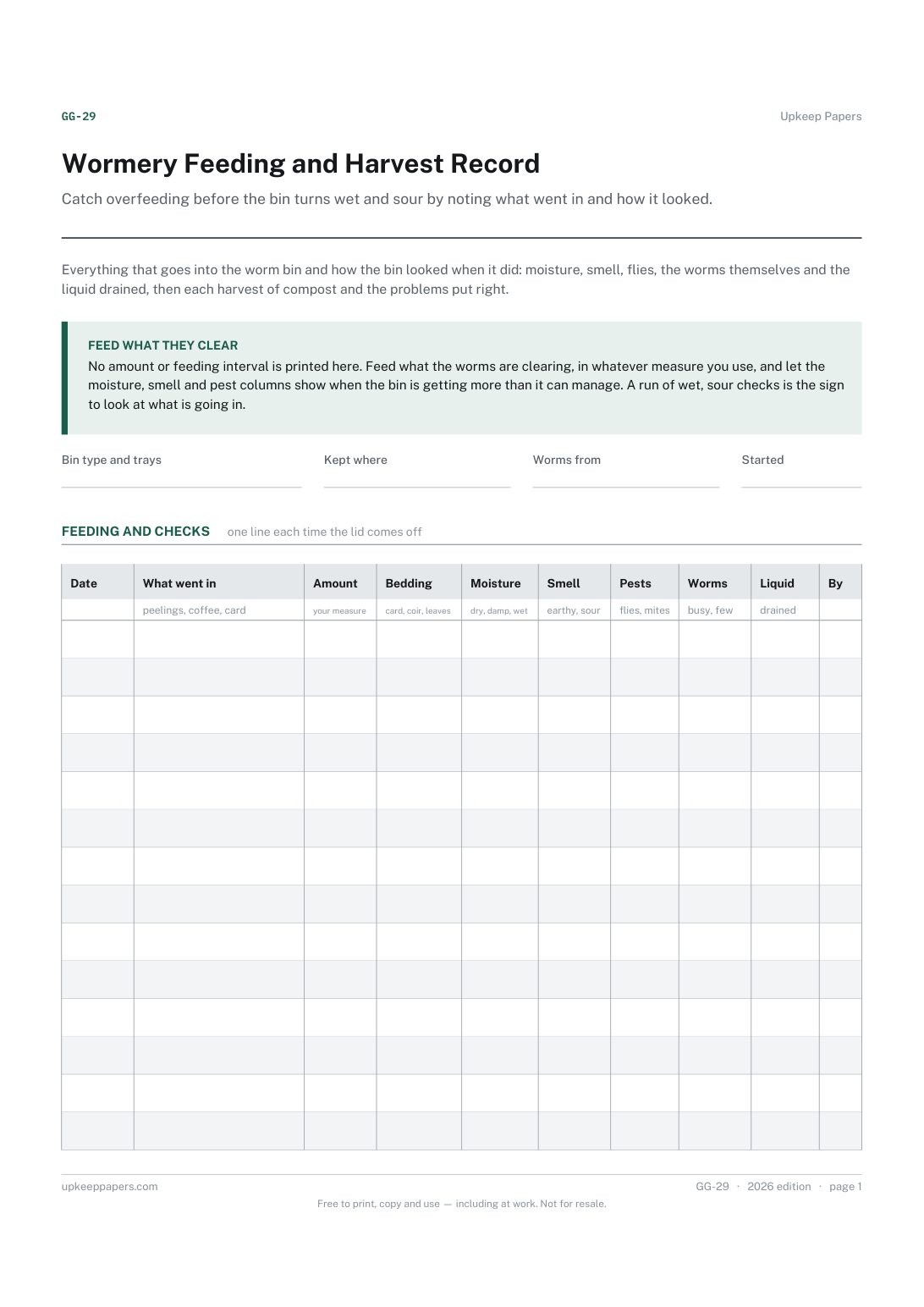
Catch overfeeding before the bin turns wet and sour by noting what went in and how it looked. Harvests and fixes are kept alongside, so you learn what your worms will manage.
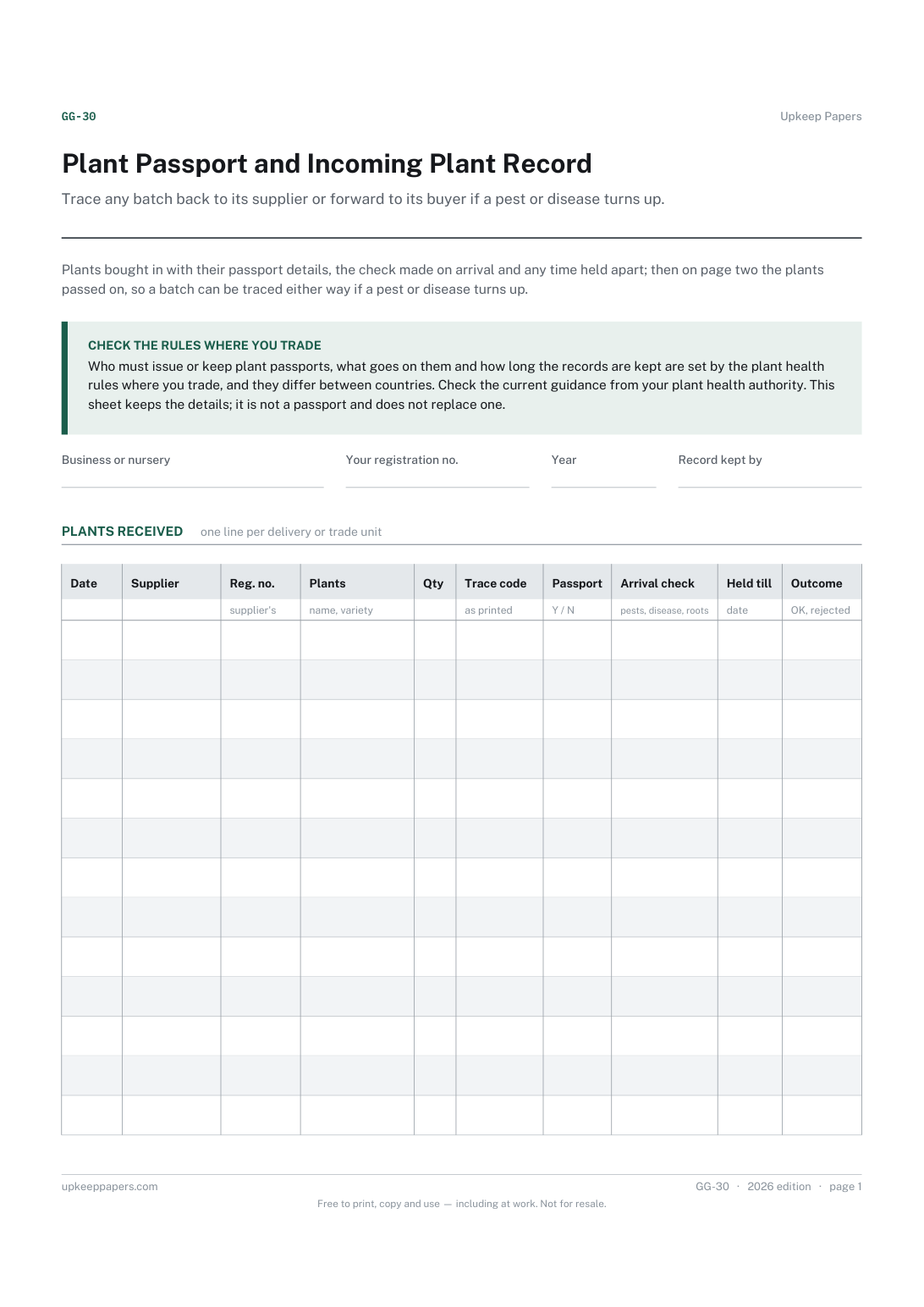
Trace any batch back to its supplier or forward to its buyer if a pest or disease turns up. Keeping the passport details and the arrival check together makes the record quick to search.
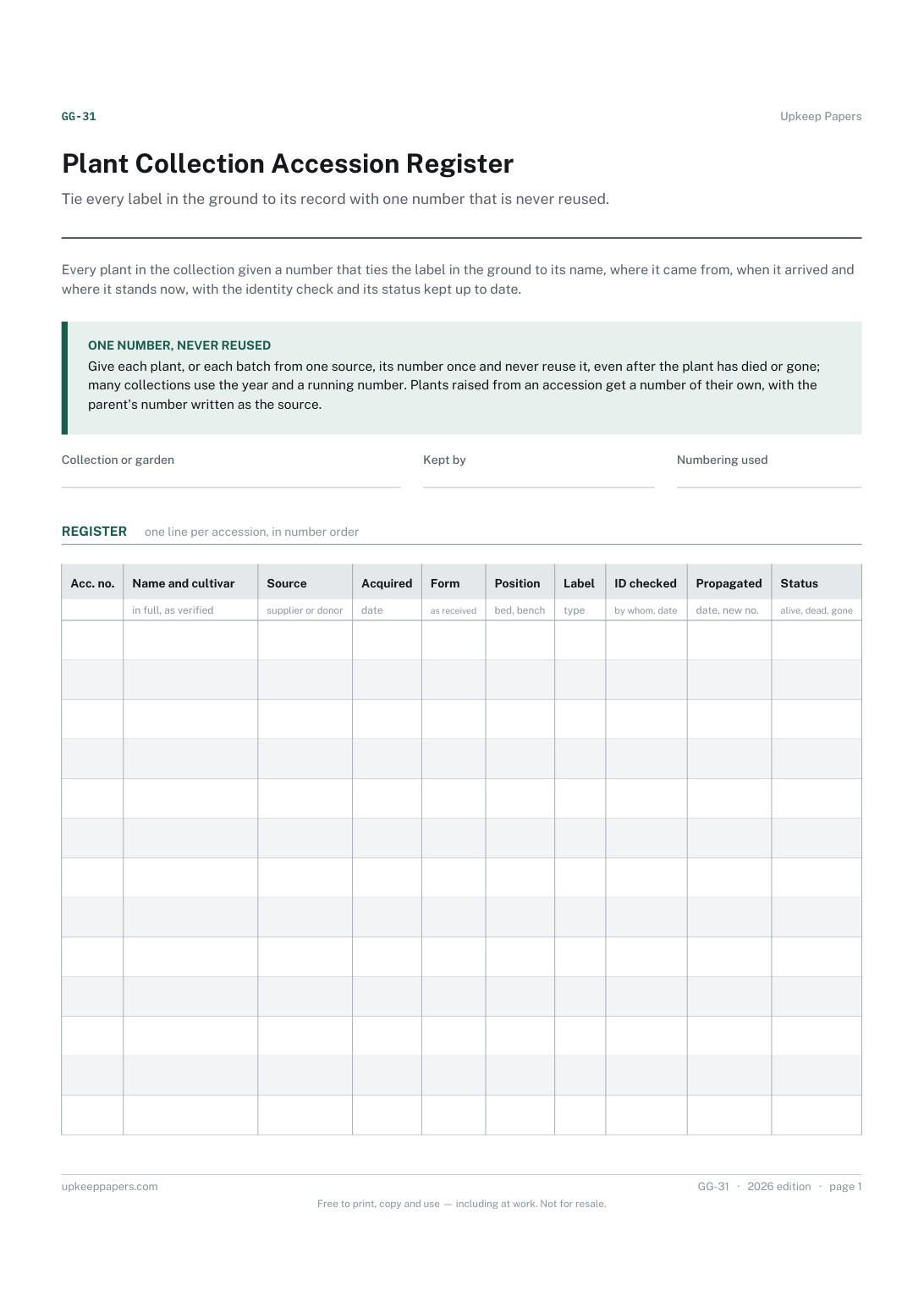
Tie every label in the ground to its record with one number that is never reused. The register keeps each plant's name, source, position and status, and page two logs every move and relabelling.
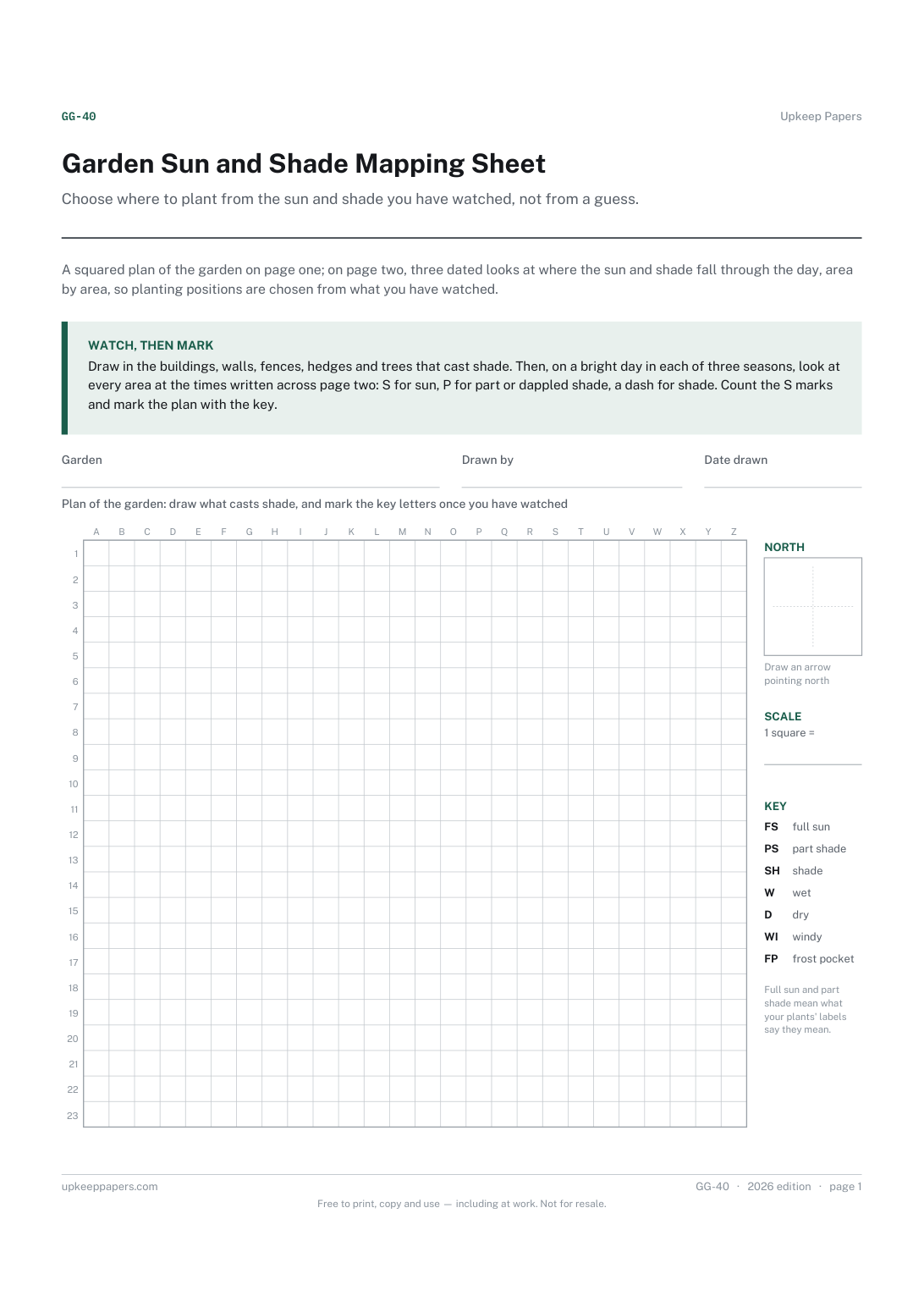
Choose where to plant from the sun and shade you have watched, not from a guess. Looks in three seasons show how far the shade moves through the year.
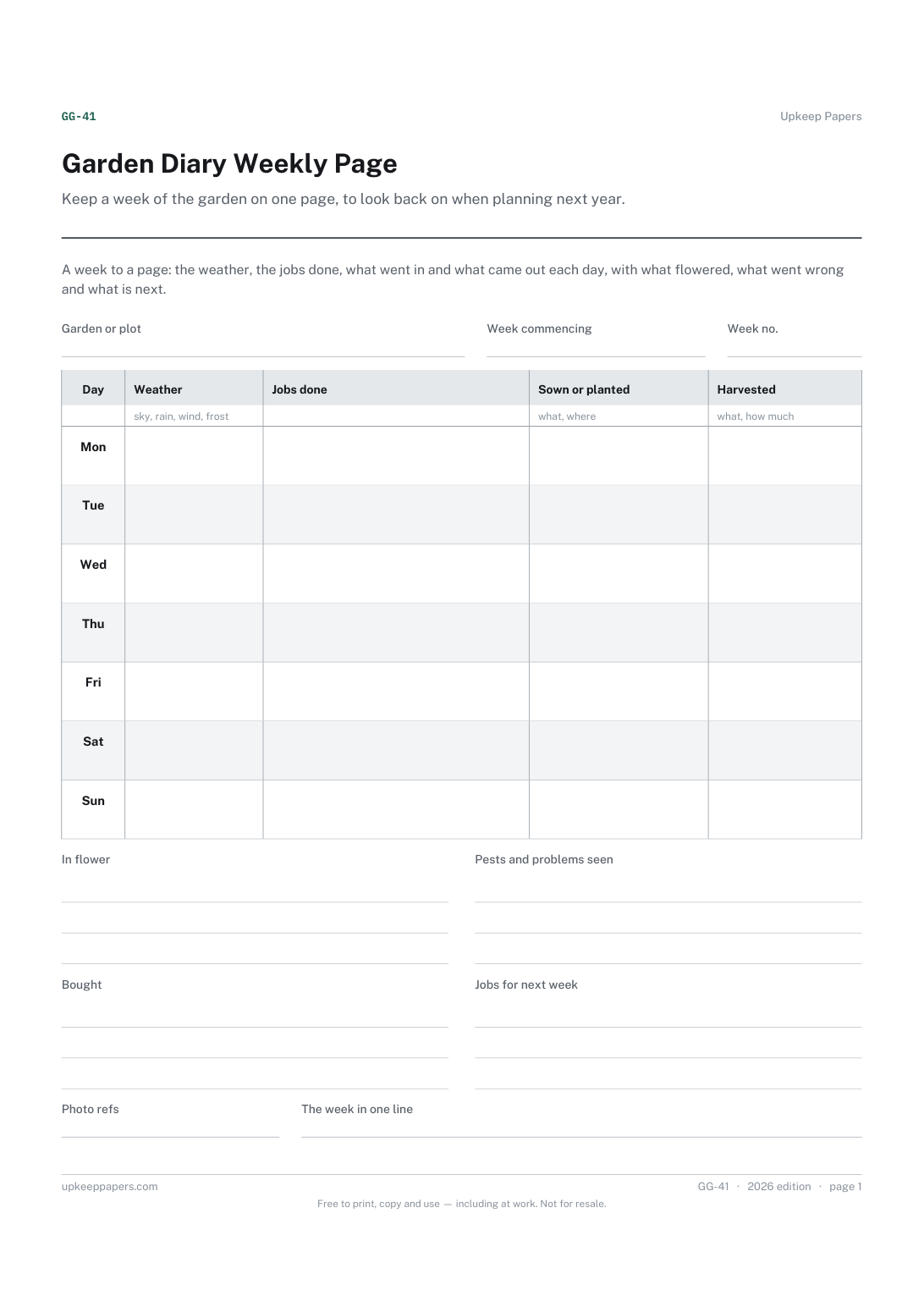
Keep a week of the garden on one page, to look back on when planning next year. It is the running record that ties the specialist logs together.
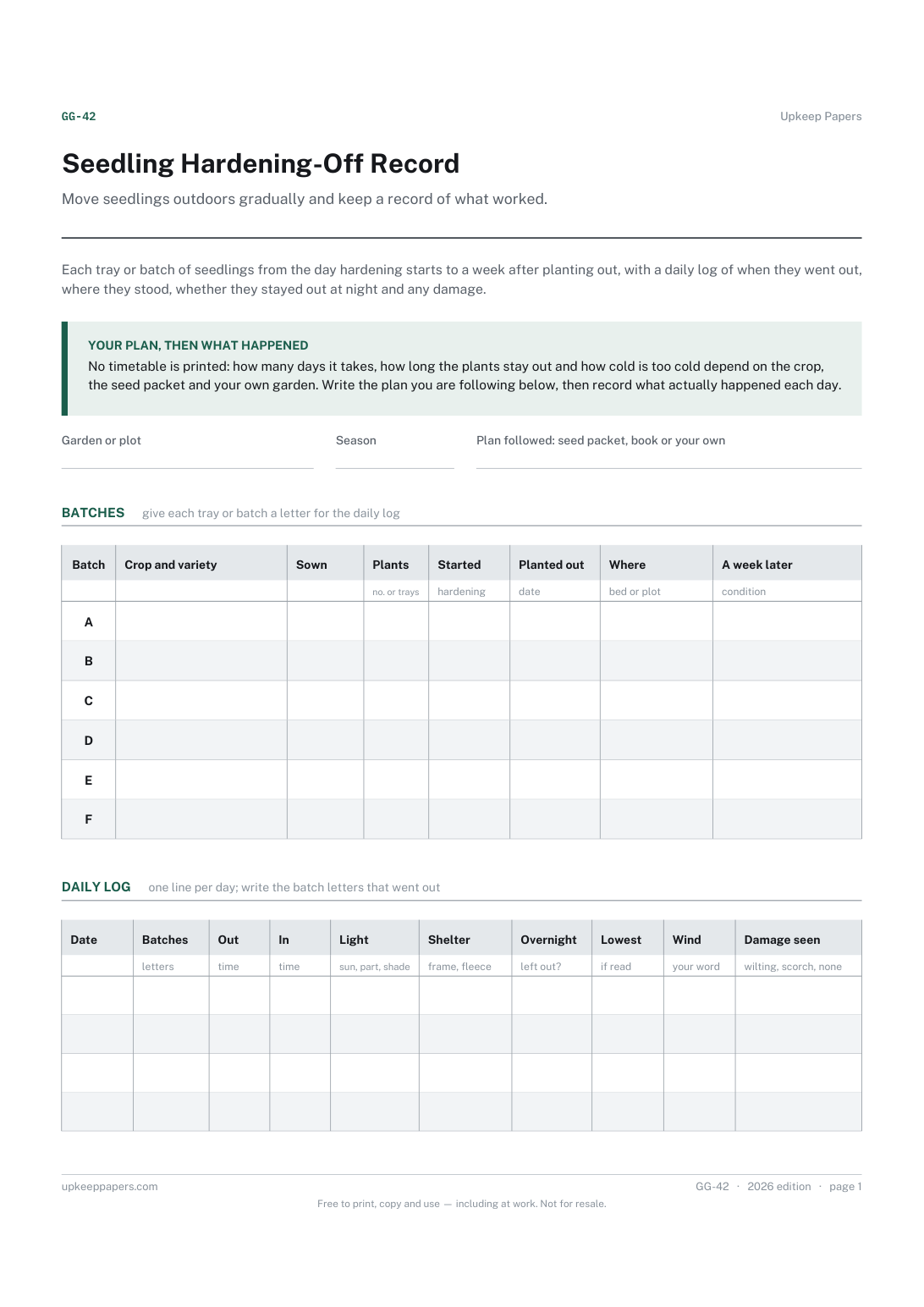
Move seedlings outdoors gradually and keep a record of what worked. The routine that got this year's plants out unharmed is the one to repeat next spring.
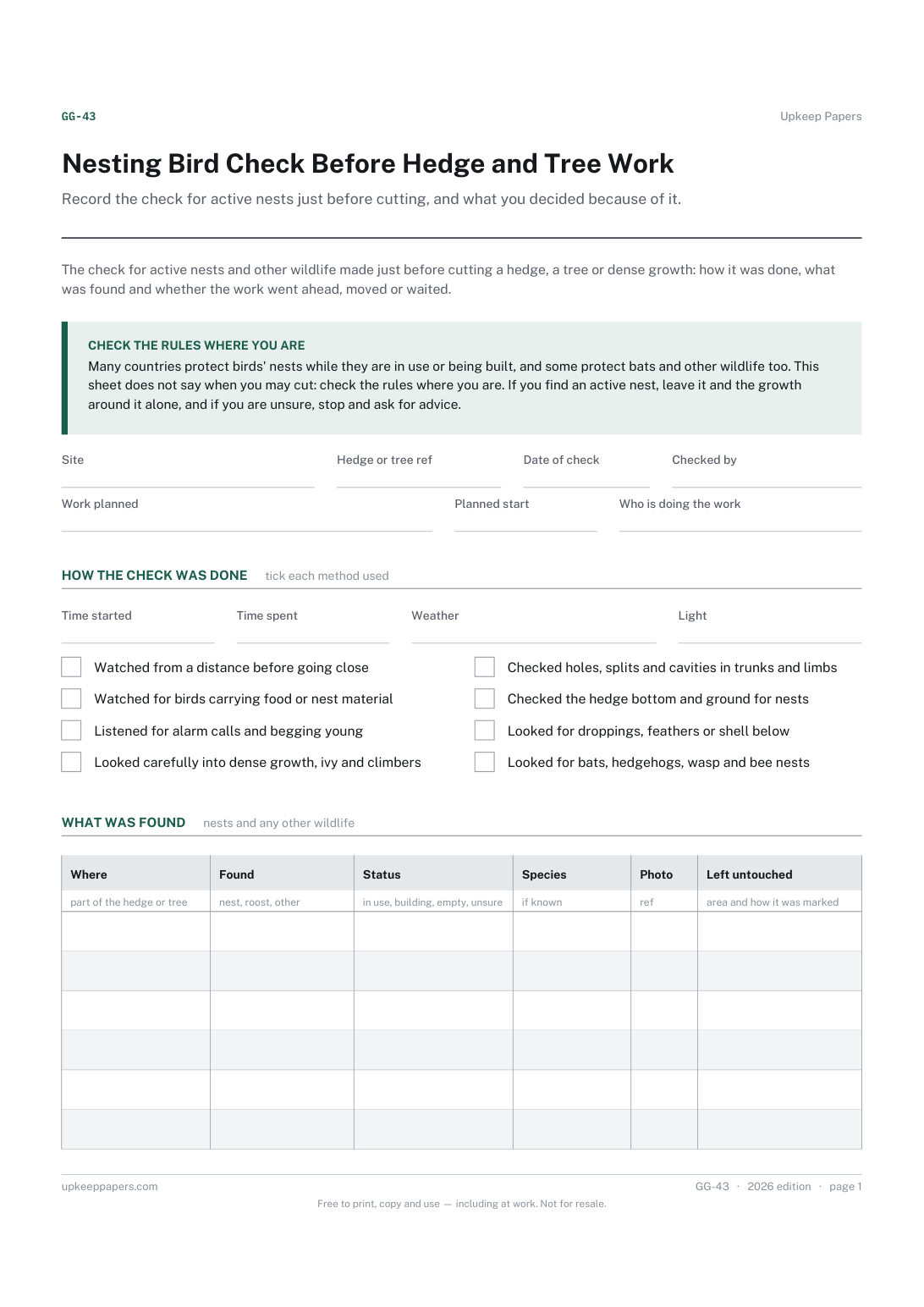
Record the check for active nests just before cutting, and what you decided because of it. If work waits for a nest, the re-check log shows when it carried on.
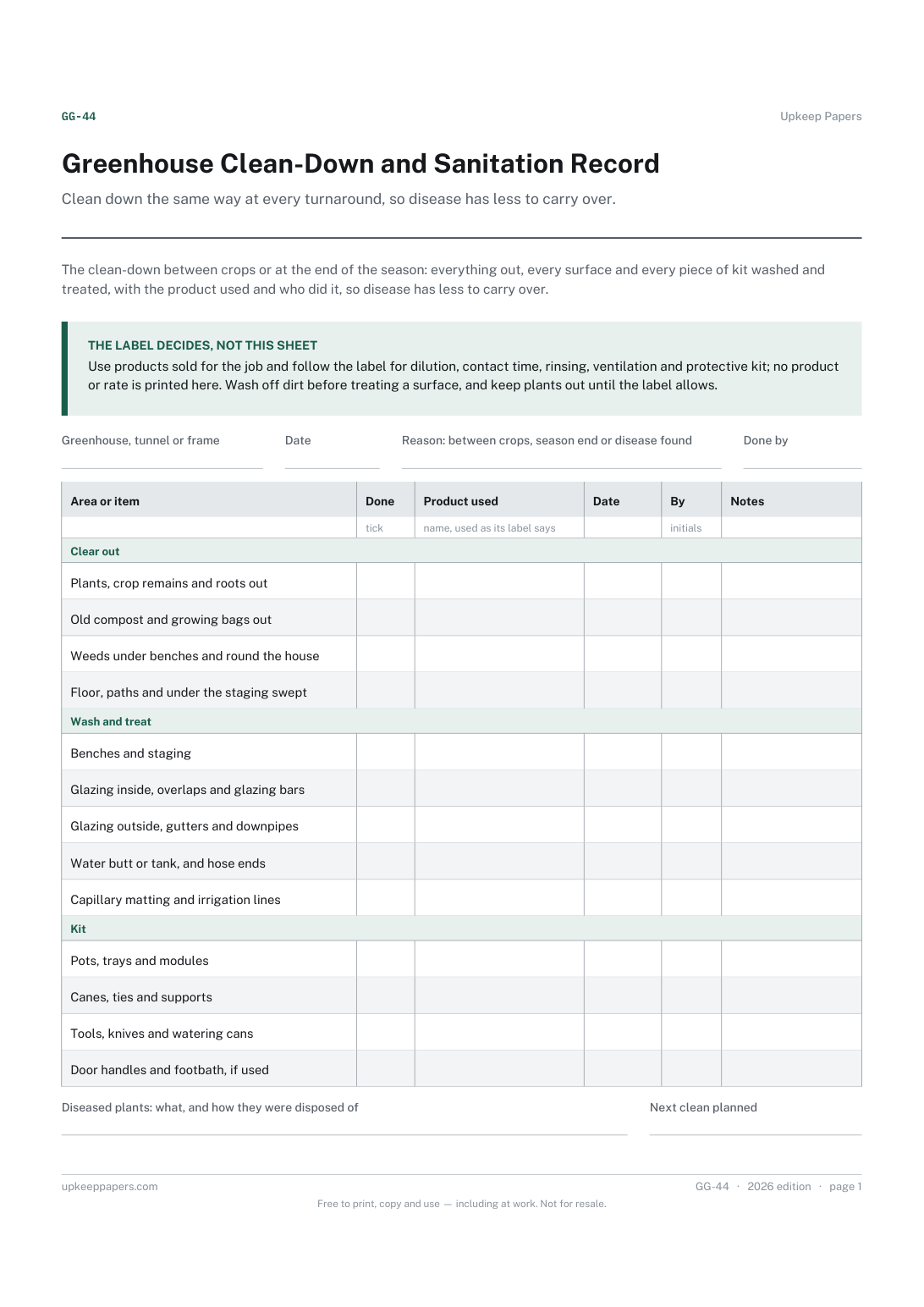
Clean down the same way at every turnaround, so disease has less to carry over. The record shows what was cleaned, with what, and when the next clean is due.
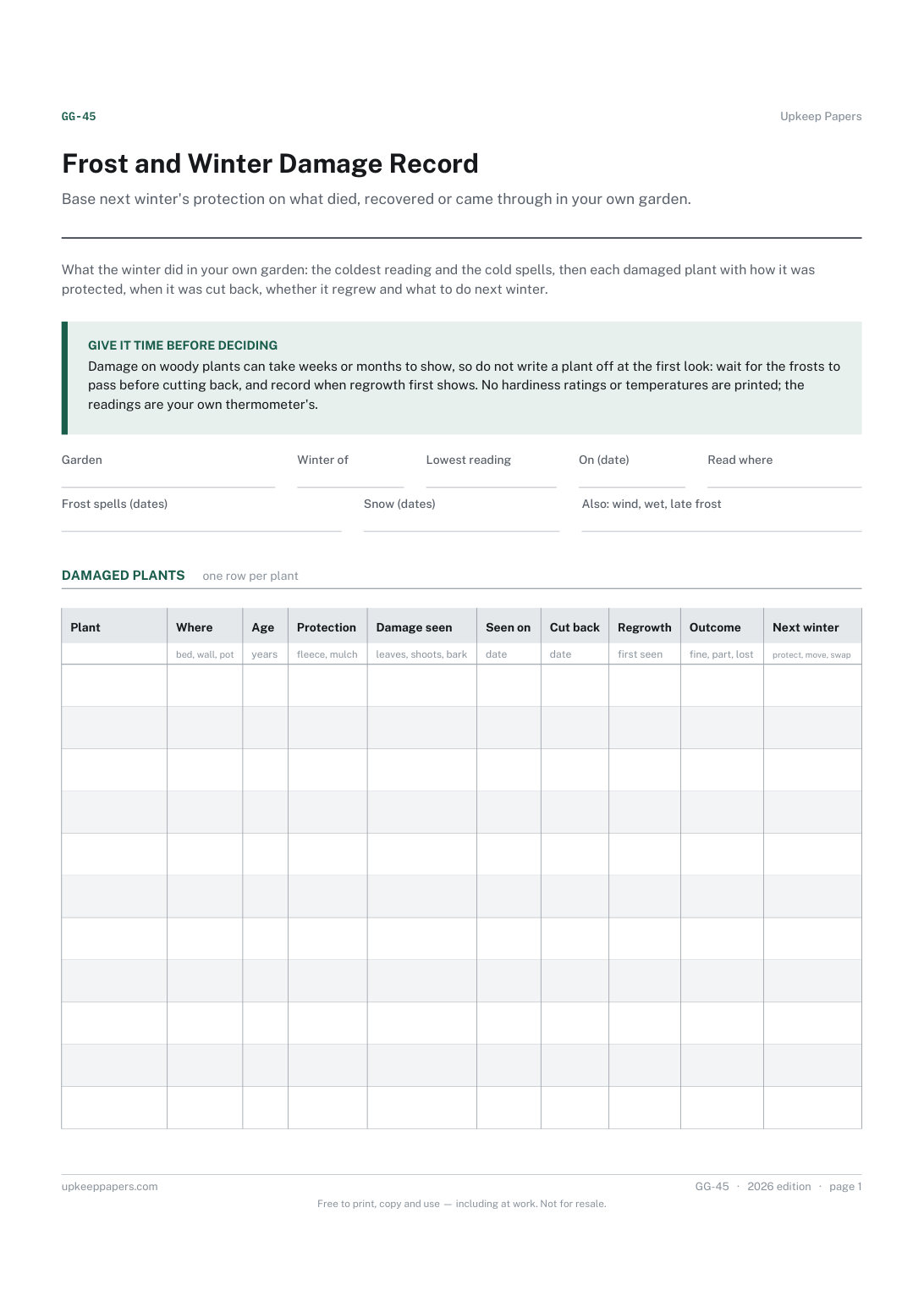
Base next winter's protection on what died, recovered or came through in your own garden. A hardiness label is a guide; this sheet is the record of your plot.
Husbandry records for reptiles, amphibians, fish, small mammals and birds — the readings, feeds and weights that keep an animal well.
Record the parameters you are actually achieving against the ones you are aiming for, which is the difference between keeping a reptile and hoping.
Track feeding and shedding together with weight, so a refusal can be read against temperature and the shed cycle instead of worried about blindly.
Build a record of what the enclosure is actually doing across a day and a season, rather than the one reading you happened to glance at.
Keep the daily record for a species where the commonest serious illness comes directly from husbandry figures being wrong.
Track weight through the year and record a hibernation properly, which is the point at which tortoise keeping most often goes wrong.
See water parameters as a trend rather than a single reading, which is the only way to spot a cycle crashing before the stock does.
Keep the maintenance round on a record, including the filter media detail that decides whether a tank stays stable.
Keep a record of what went into the tank and when, with the adult size that should have been checked before buying.
Record what actually went into a bioactive build, so that a problem months later can be traced to a decision rather than guessed at.
Track water quality and temperature for animals that are unusually sensitive to both, with the physical signs recorded alongside.
Record feeding and moult cycles so that a long fast can be recognised as normal for your animal rather than worried about.
Track a colony from founding through to establishment, which is the period where most of them are lost.
Run a quarantine properly with a written baseline, so a change is noticed rather than assumed and the period is not shortened out of impatience.
Keep a weekly record for animals whose decline is easy to miss and quick once it starts.
Track the four things guinea pigs most often go wrong on, with a weight column that catches trouble early.
Record the temperature and dental observations that matter most for a species which overheats easily and hides illness well.
Track the large seasonal weight and coat changes that are normal in ferrets, so an abnormal change is recognisable.
Keep a baseline for animals where respiratory illness is common and moves quickly.
Keep a register of the birds and a record of the round, with the ring numbers that matter for breeding and for any licensing.
Track weight in grams and enrichment rotation, the two things that most affect a parrot's physical and mental health.
Keep the loft's breeding and racing history in one place, with the ring numbers that everything else refers to.
Keep track of livefood stock and cultures so a feeding day does not arrive with an empty tub.
Keep a treatment history with the weight beside it, which matters more for exotics than for most species.
Run the cleaning and equipment round across several enclosures without losing track of which was done when.
Give a sitter the numbers and the failure procedures, so they are not guessing about a species they have never kept.
Give any small pet a weekly weight record, which is the earliest warning available for animals that hide illness by instinct.
The sheet that goes out in the van: what was quoted, what was fitted, what it took and what the customer signed.
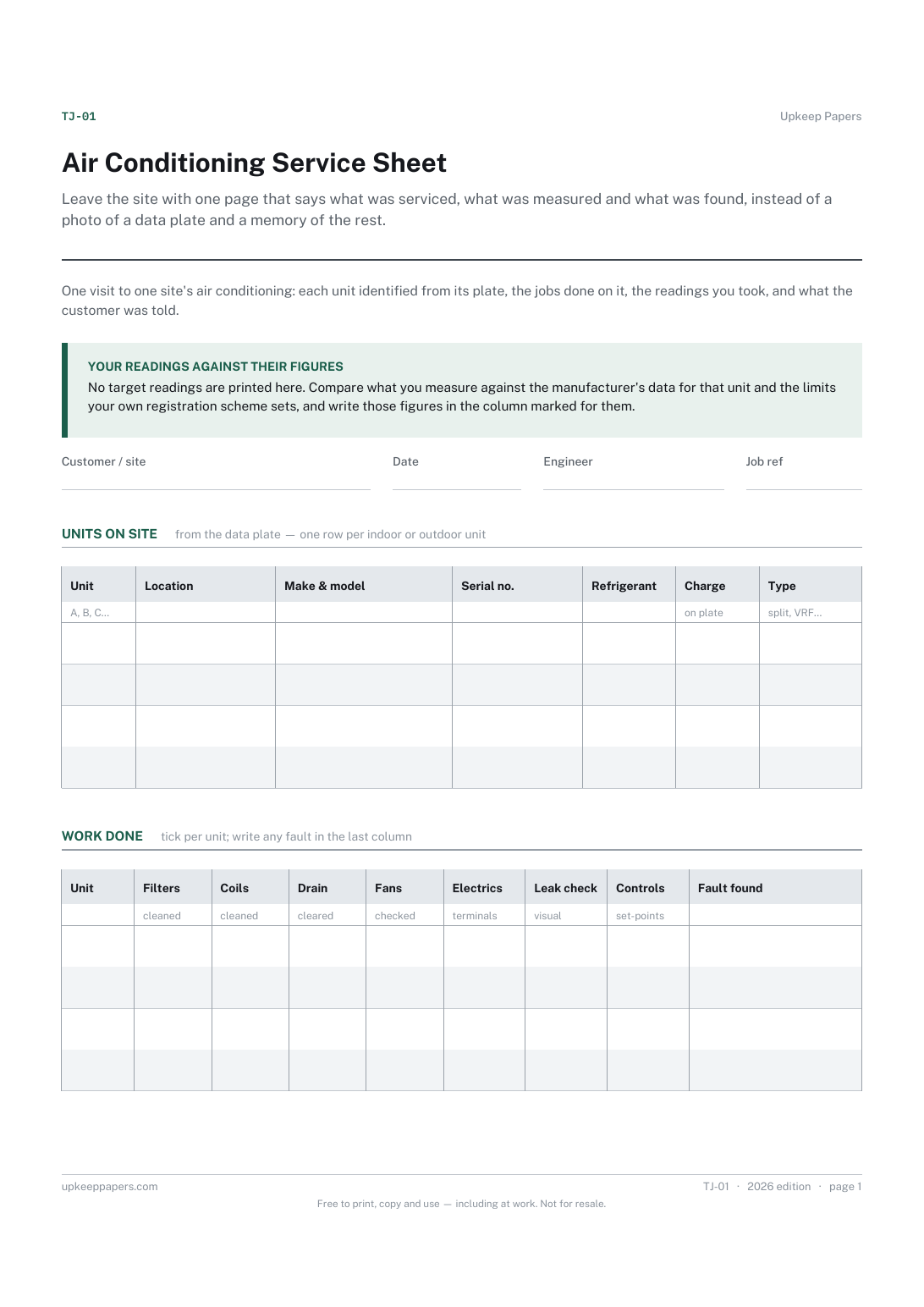
Leave the site with one page that says what was serviced, what was measured and what was found, instead of a photo of a data plate and a memory of the rest.
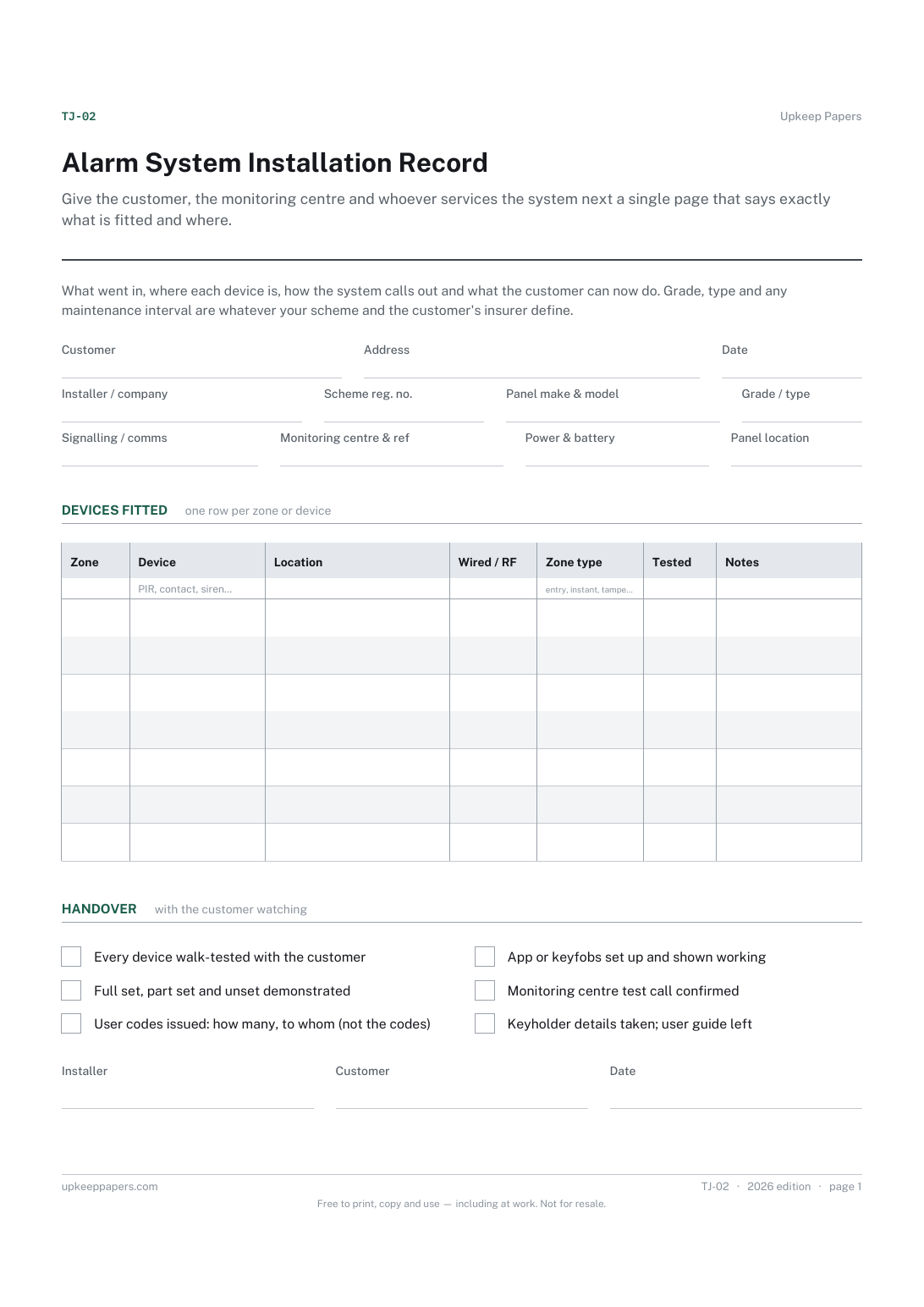
Give the customer, the monitoring centre and whoever services the system next a single page that says exactly what is fitted and where.
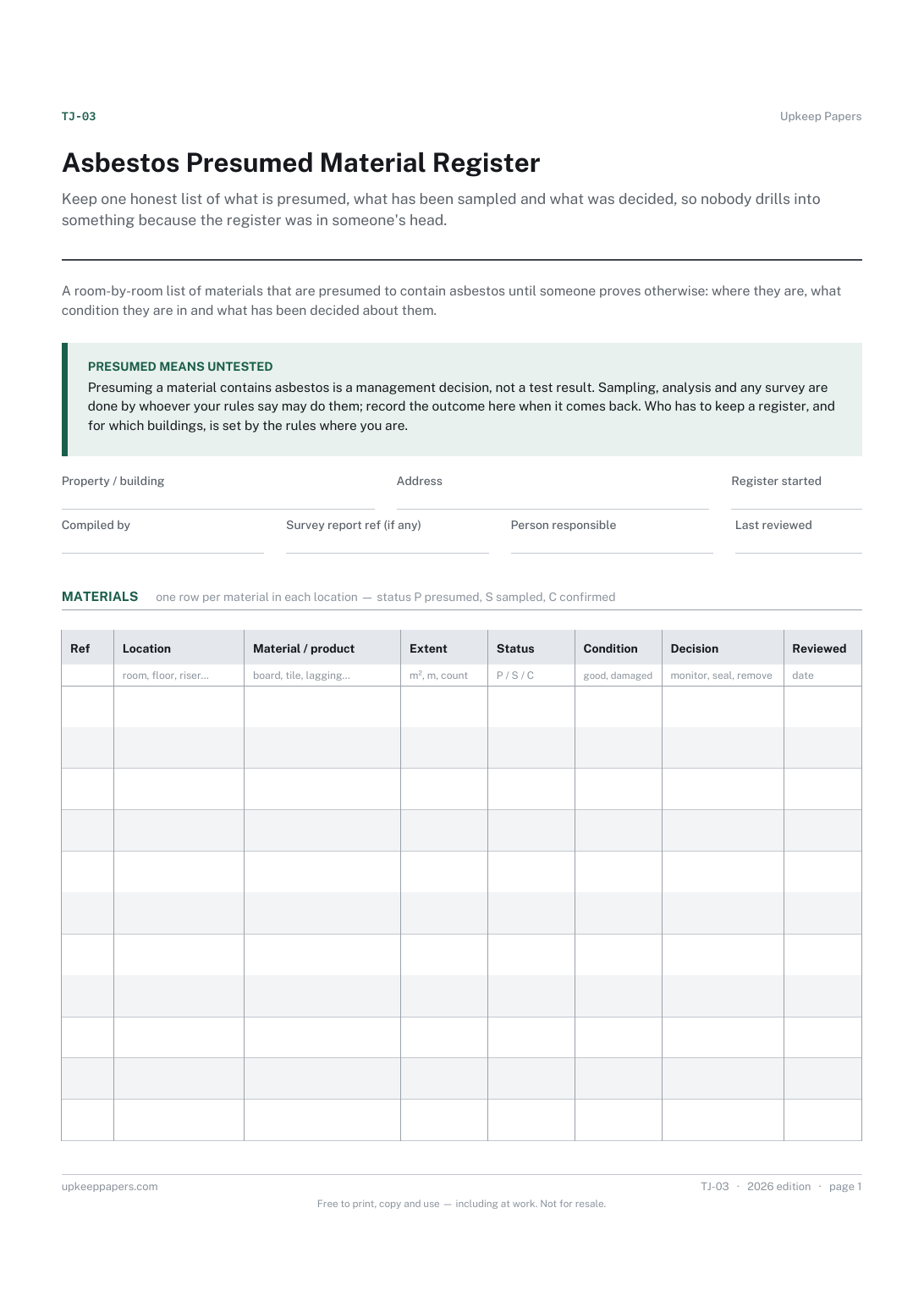
Keep one honest list of what is presumed, what has been sampled and what was decided, so nobody drills into something because the register was in someone's head.
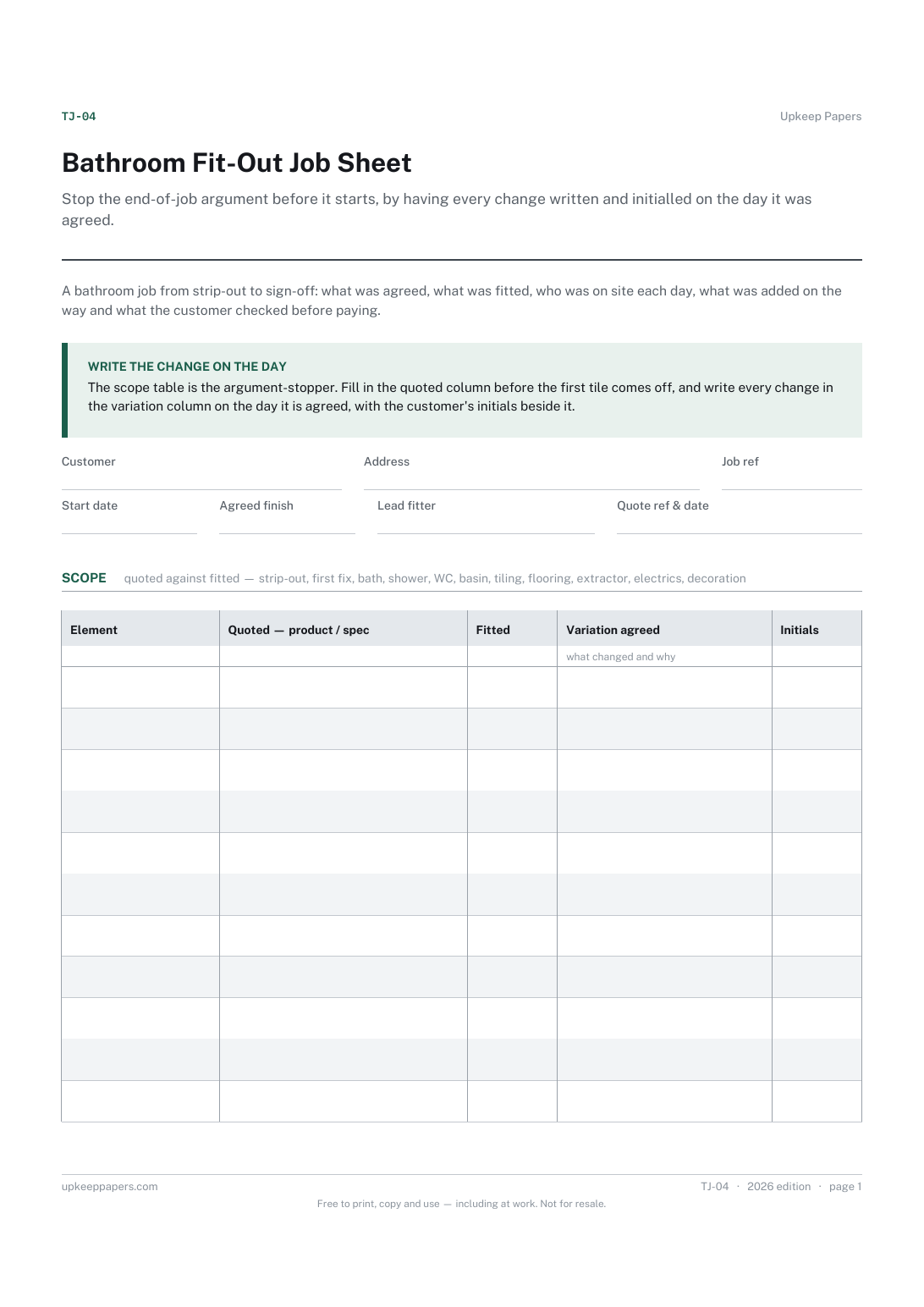
Stop the end-of-job argument before it starts, by having every change written and initialled on the day it was agreed.
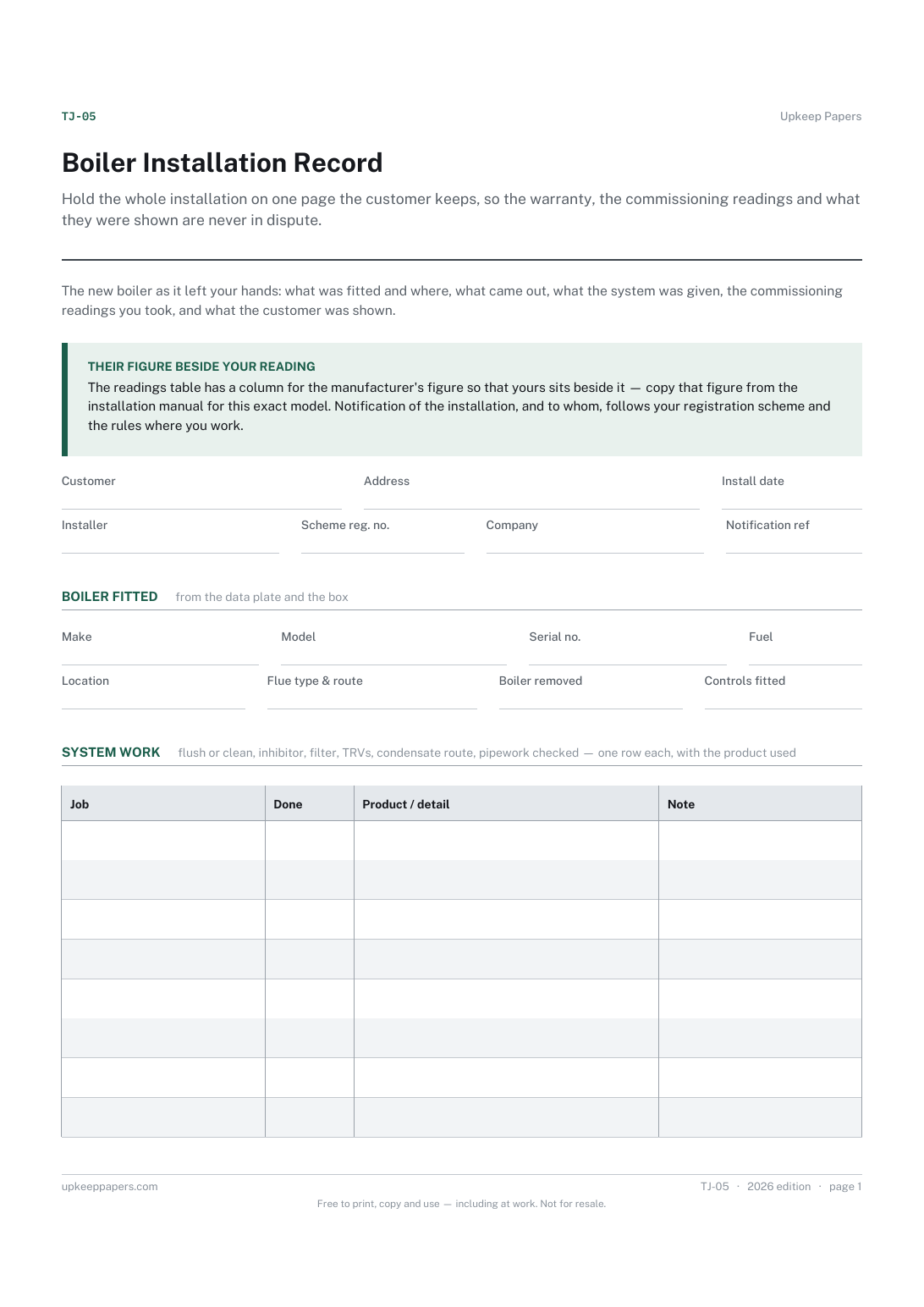
Hold the whole installation on one page the customer keeps, so the warranty, the commissioning readings and what they were shown are never in dispute.
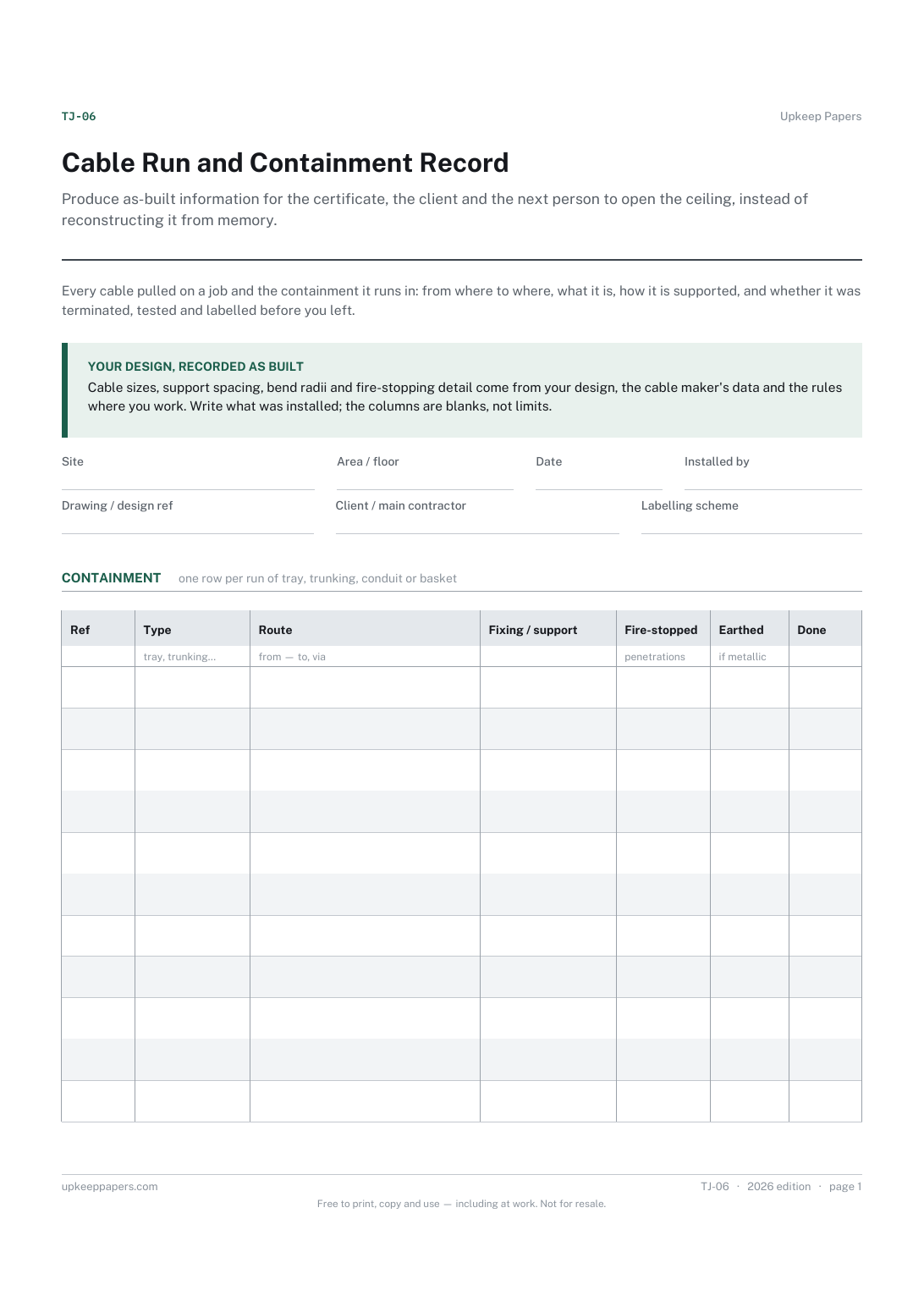
Produce as-built information for the certificate, the client and the next person to open the ceiling, instead of reconstructing it from memory.
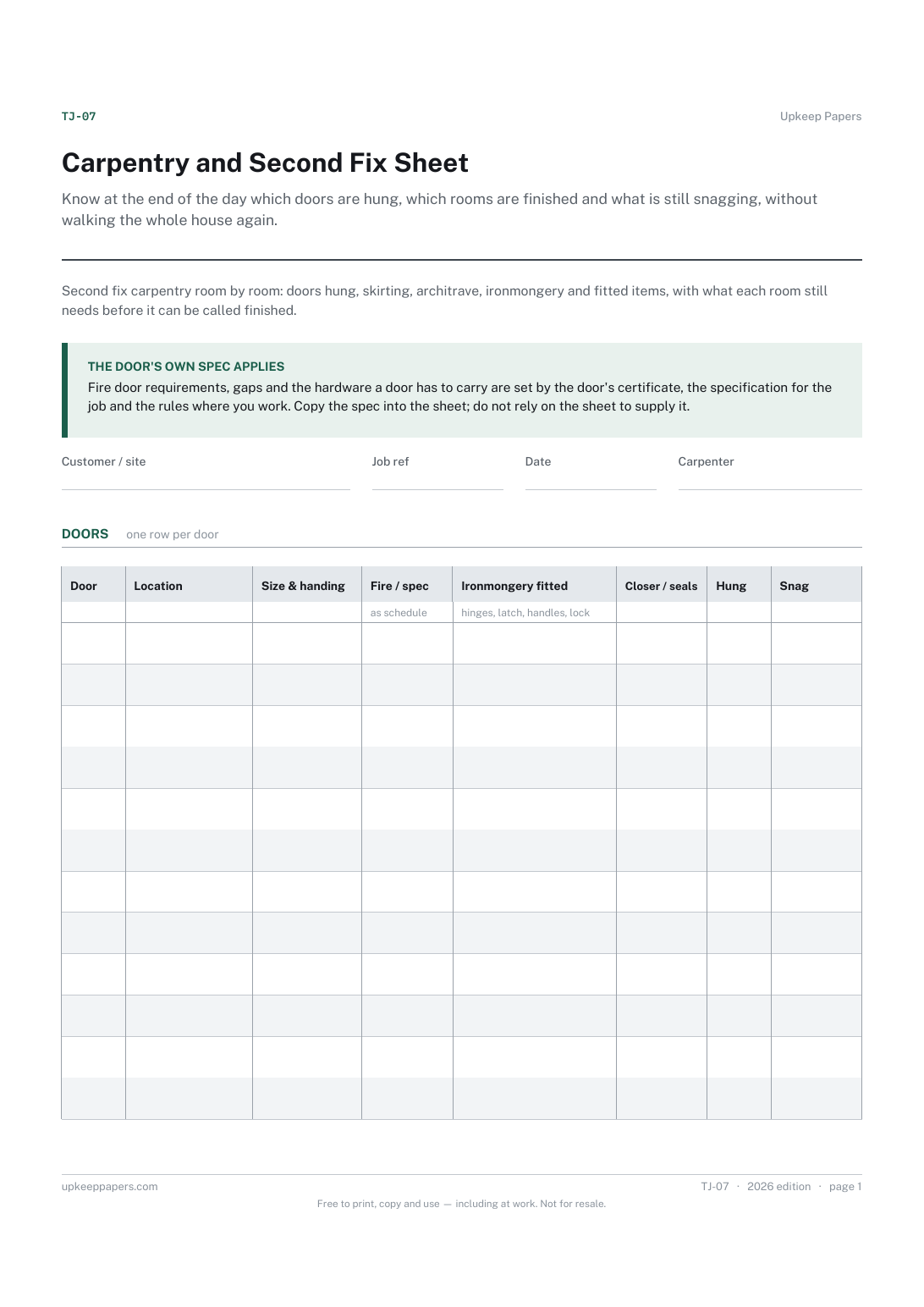
Know at the end of the day which doors are hung, which rooms are finished and what is still snagging, without walking the whole house again.
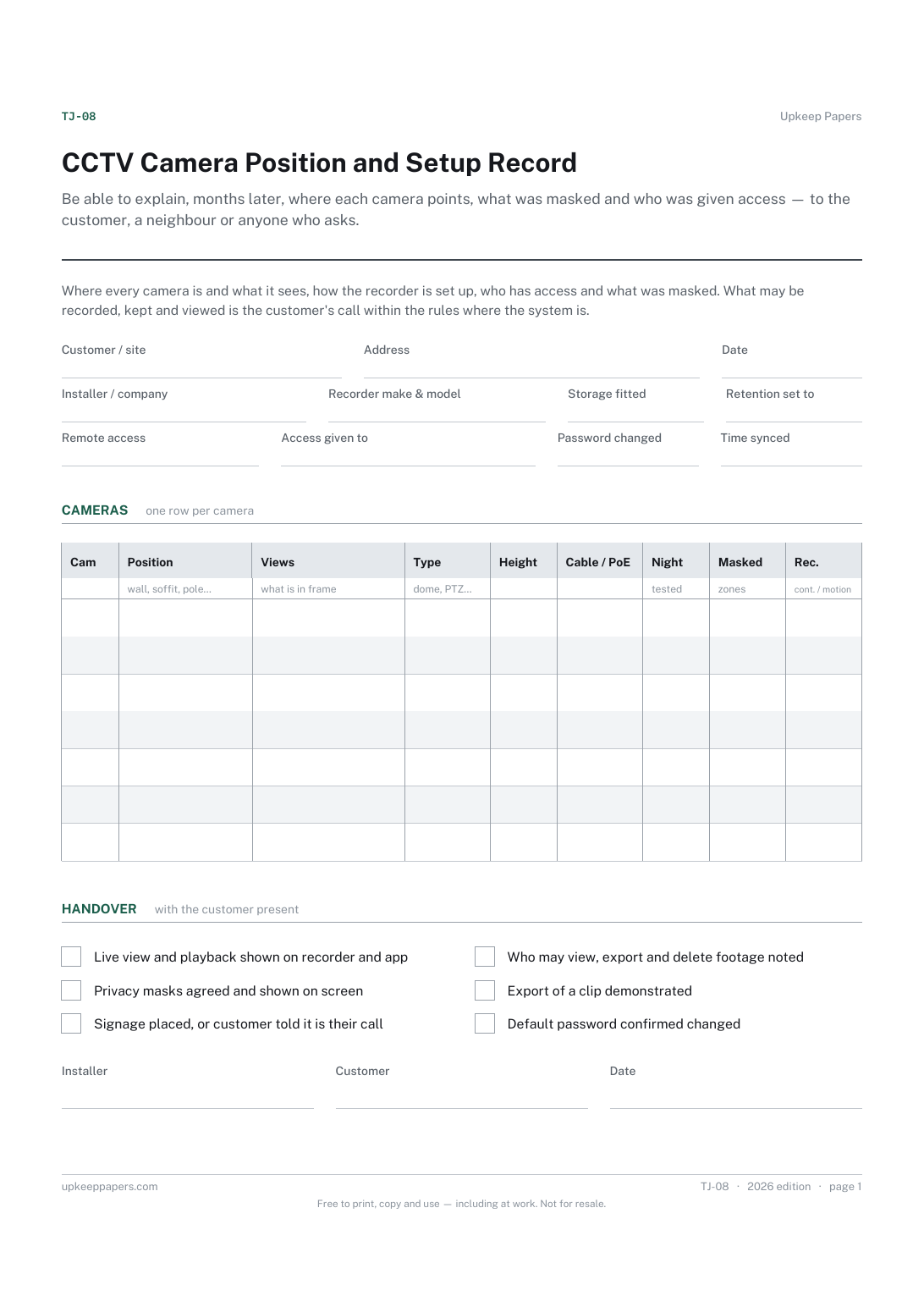
Be able to explain, months later, where each camera points, what was masked and who was given access — to the customer, a neighbour or anyone who asks.
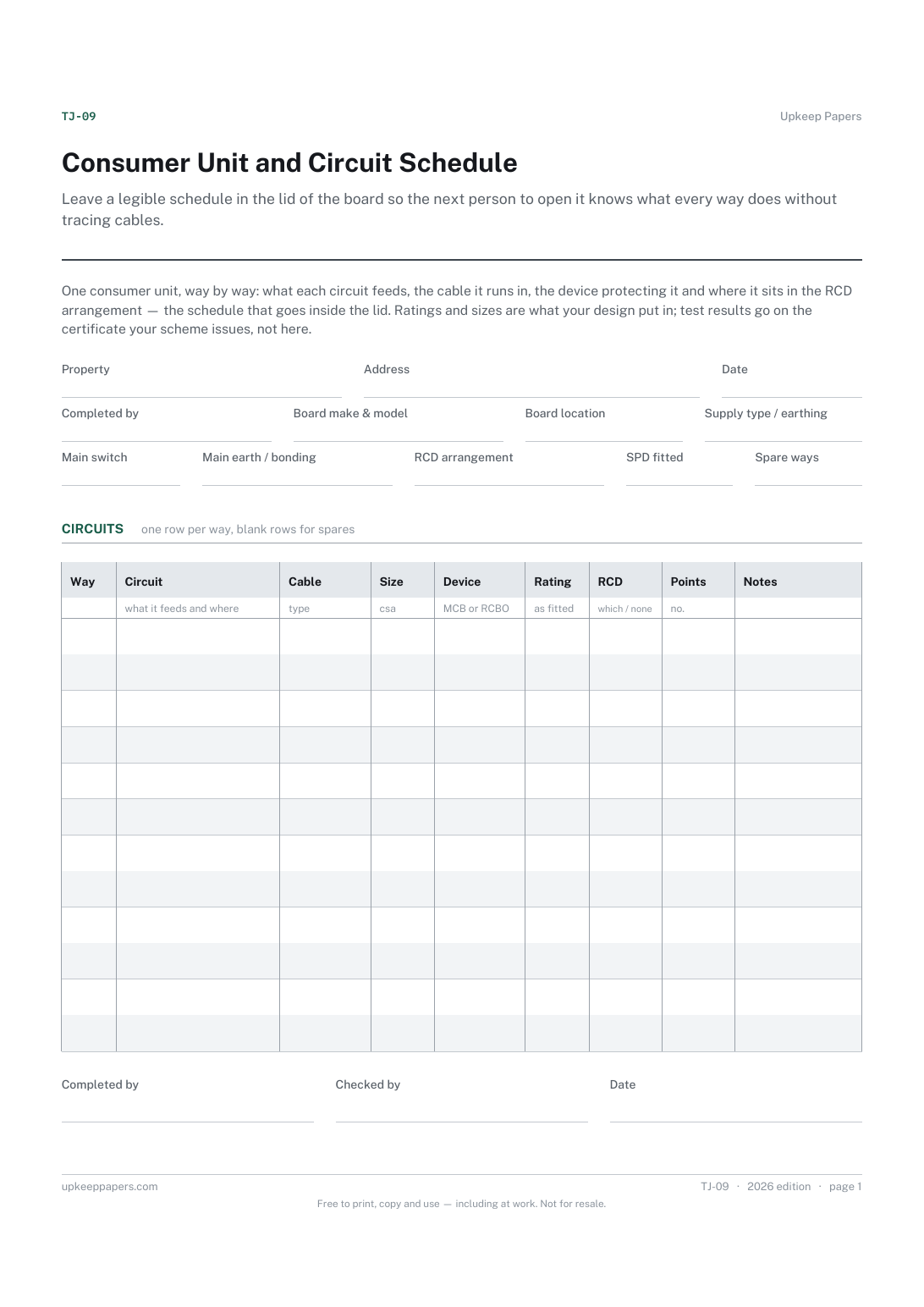
Leave a legible schedule in the lid of the board so the next person to open it knows what every way does without tracing cables.
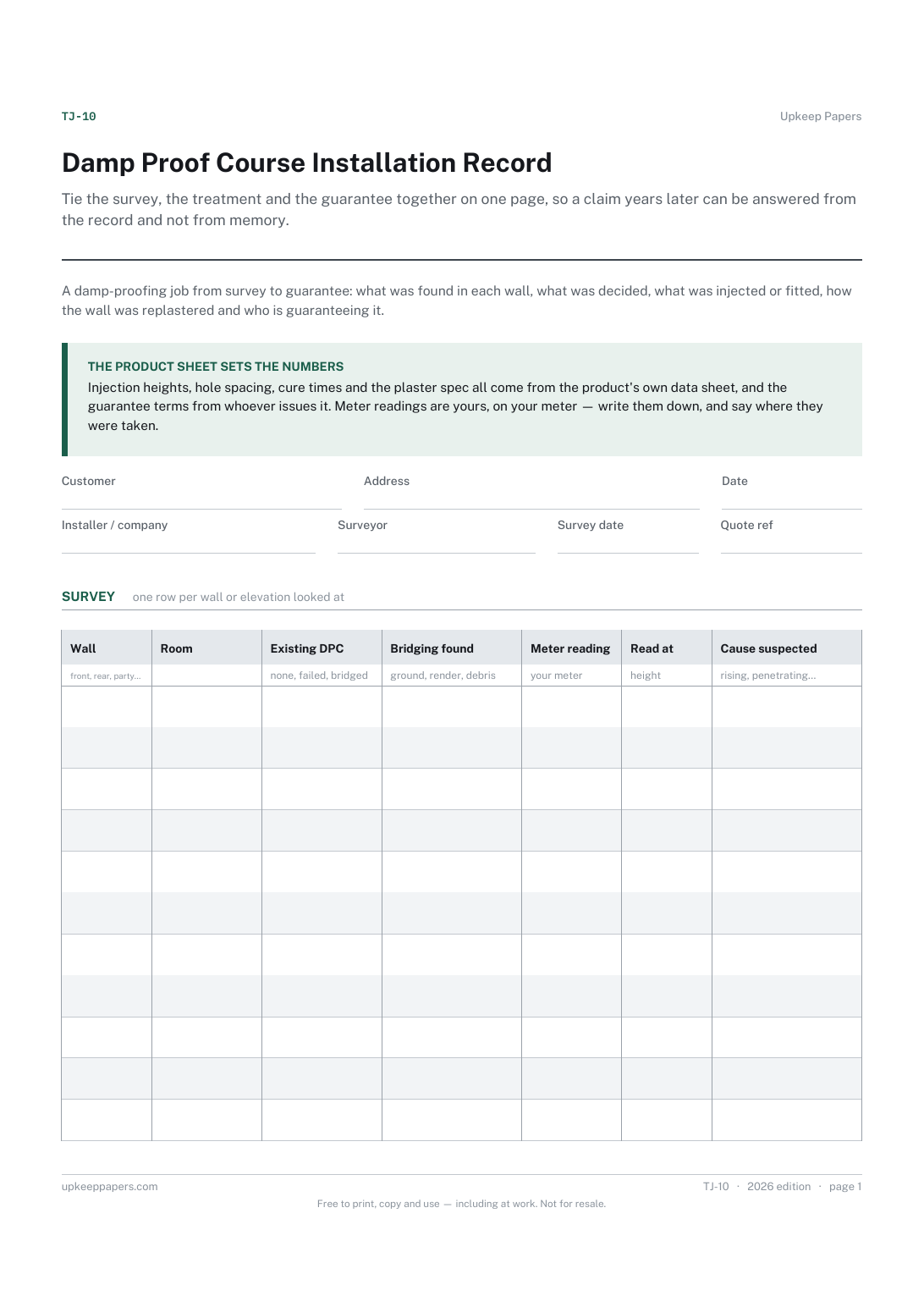
Tie the survey, the treatment and the guarantee together on one page, so a claim years later can be answered from the record and not from memory.
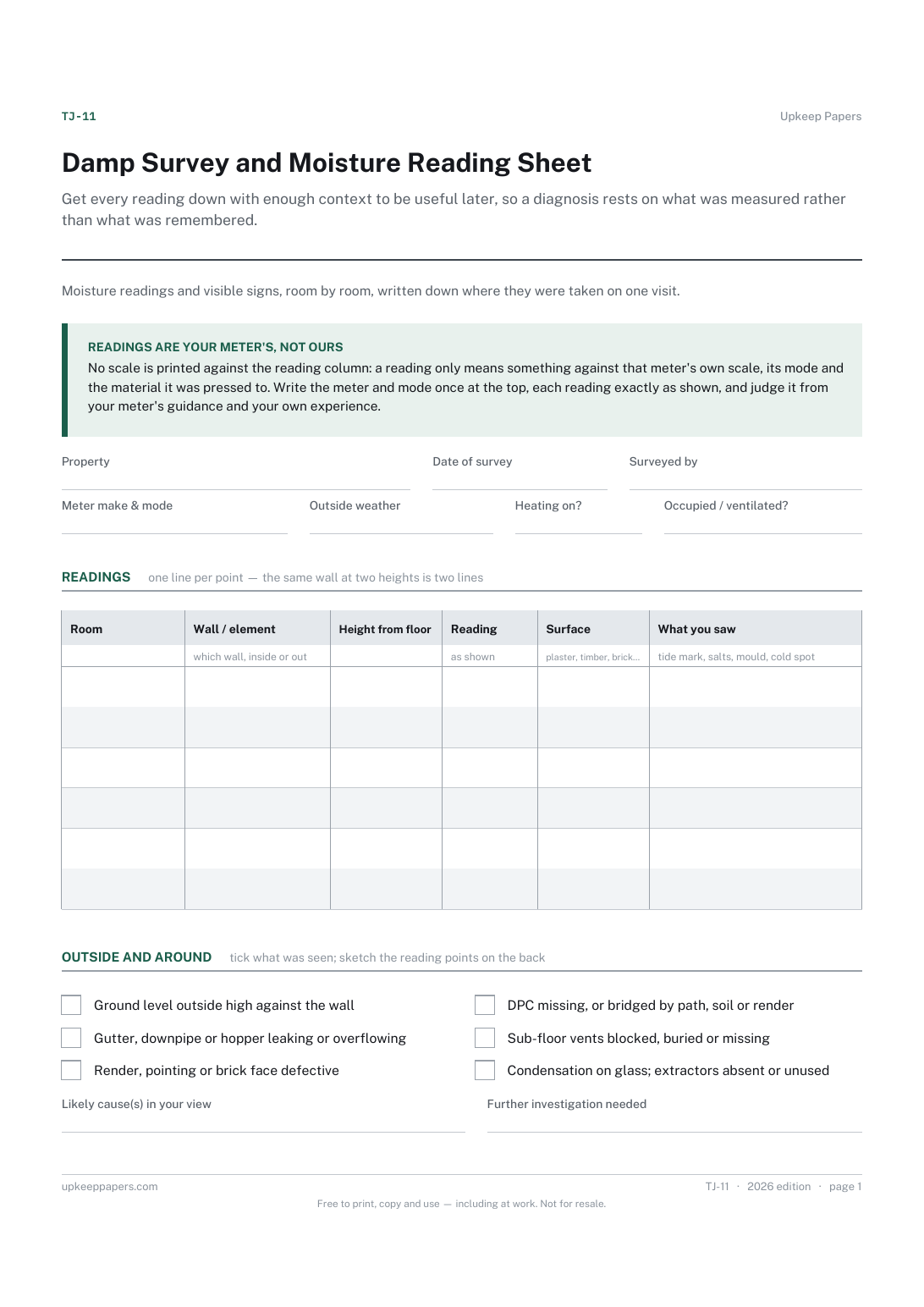
Get every reading down with enough context to be useful later, so a diagnosis rests on what was measured rather than what was remembered.
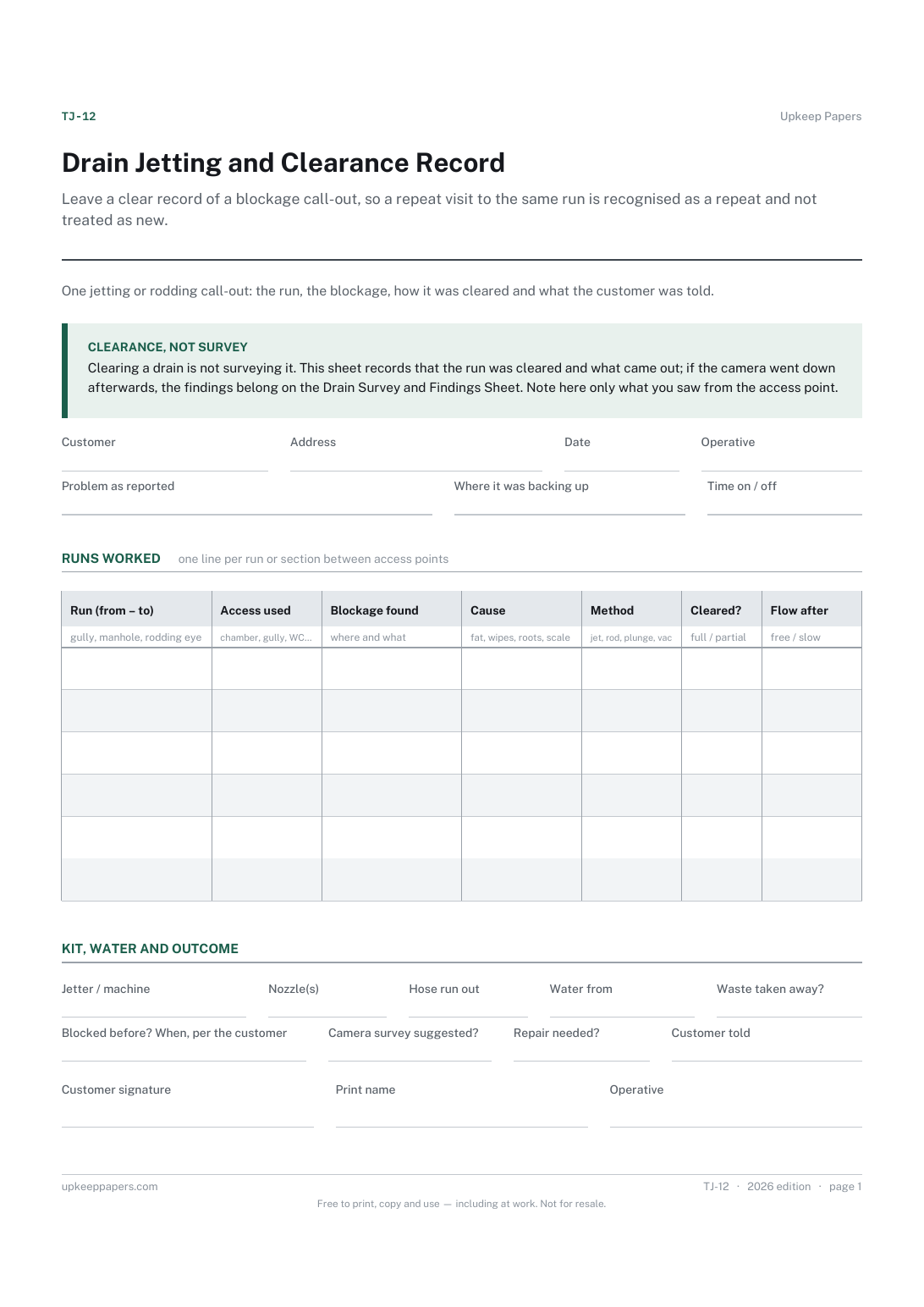
Leave a clear record of a blockage call-out, so a repeat visit to the same run is recognised as a repeat and not treated as new.
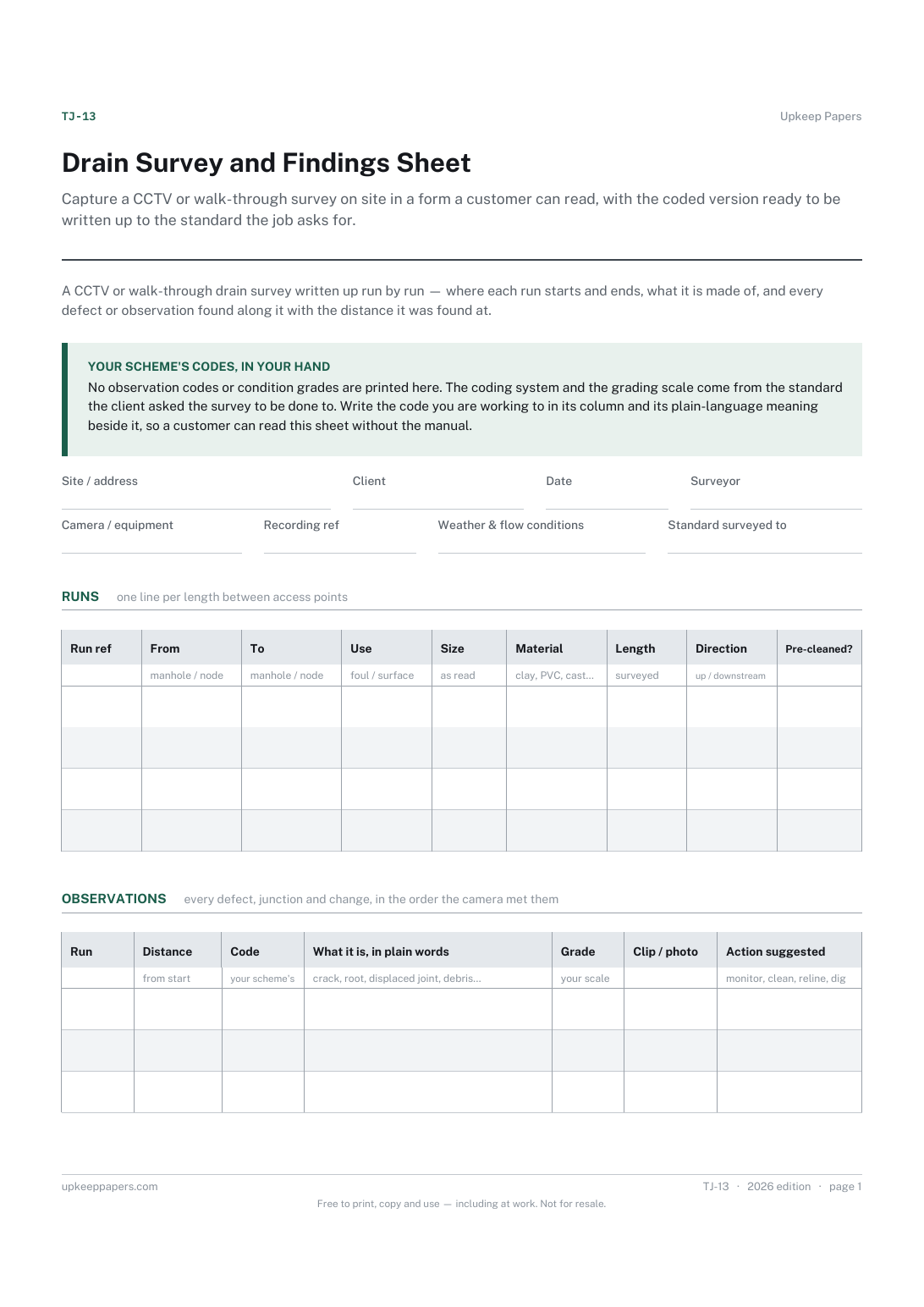
Capture a CCTV or walk-through survey on site in a form a customer can read, with the coded version ready to be written up to the standard the job asks for.
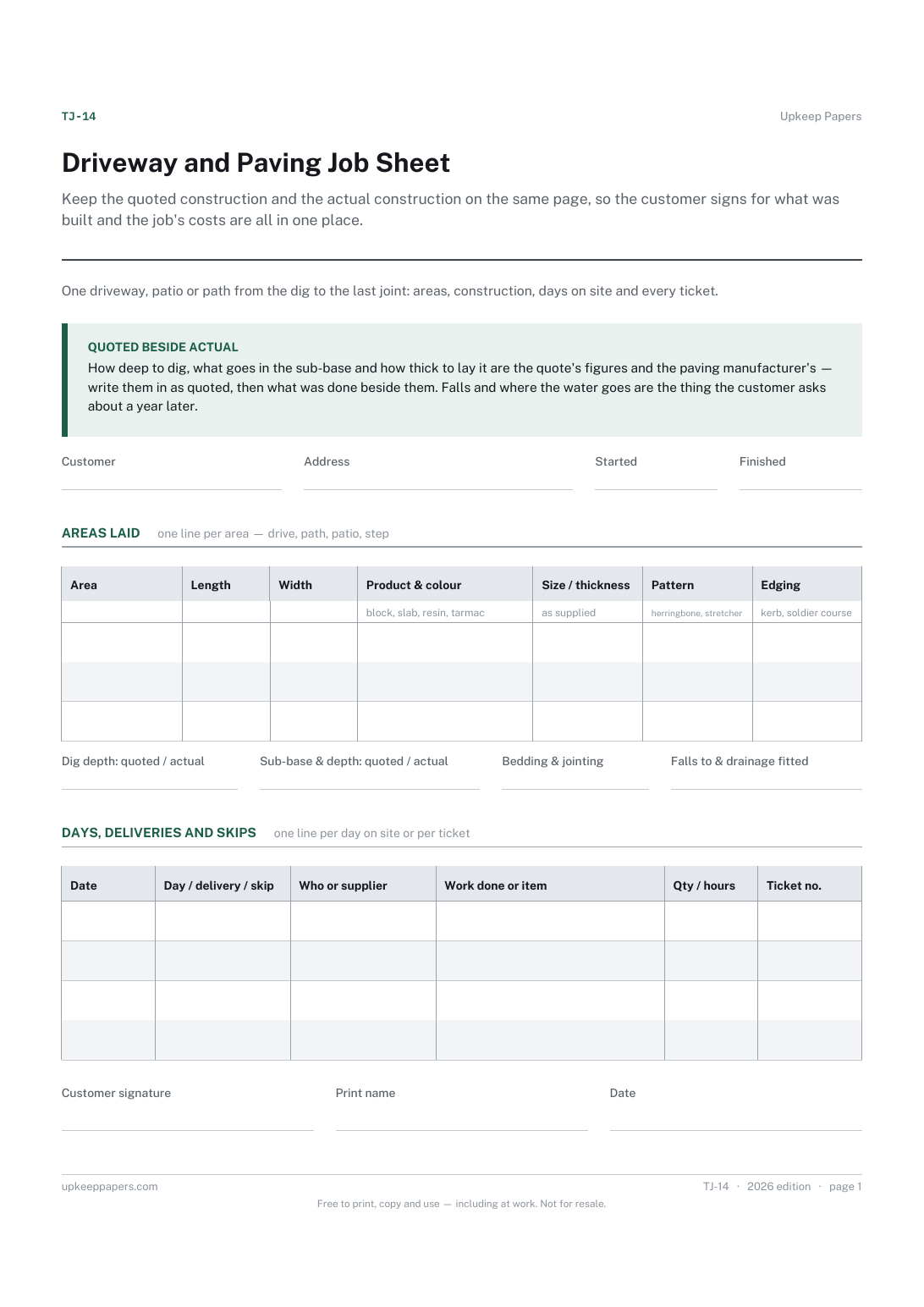
Keep the quoted construction and the actual construction on the same page, so the customer signs for what was built and the job's costs are all in one place.
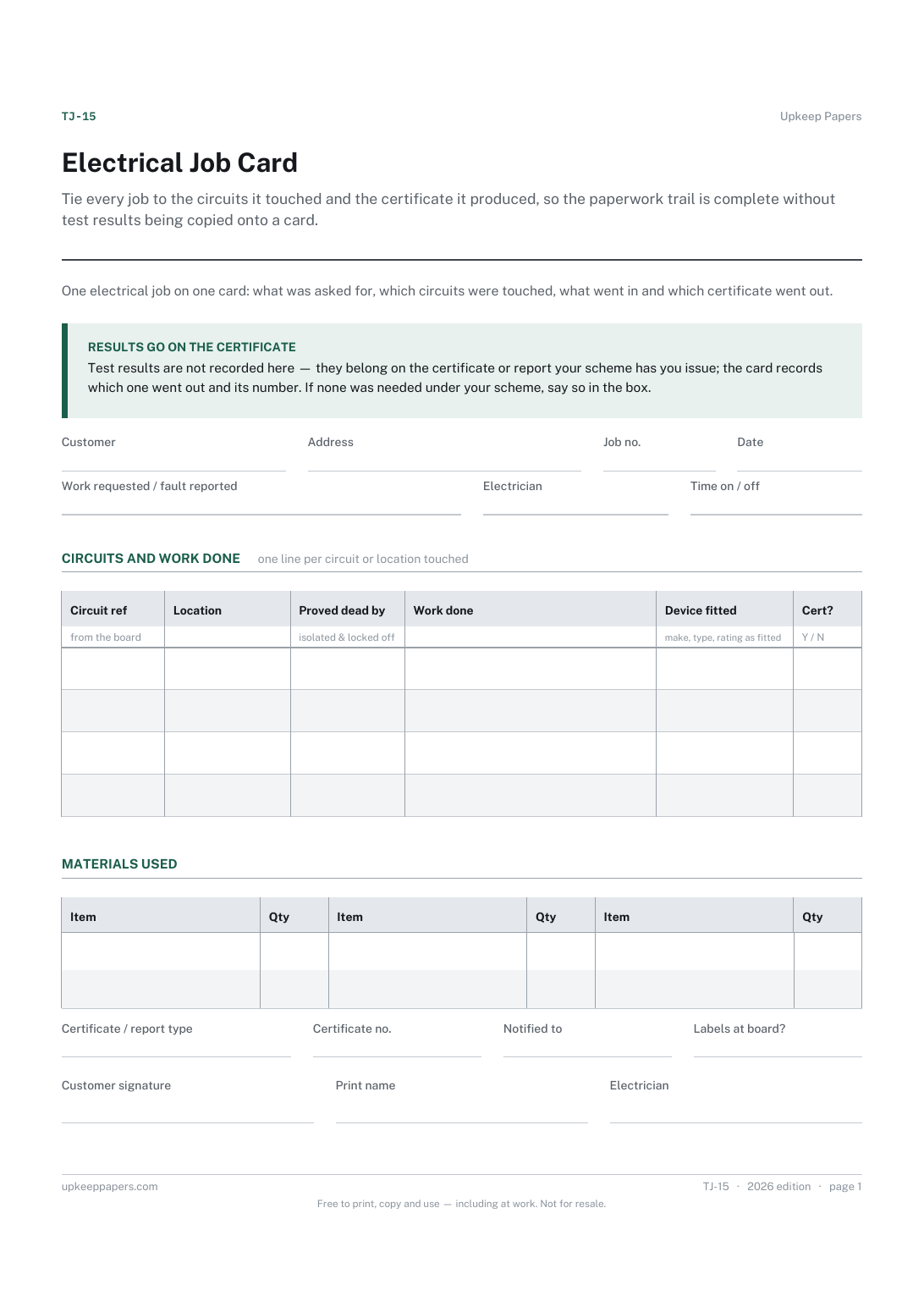
Tie every job to the circuits it touched and the certificate it produced, so the paperwork trail is complete without test results being copied onto a card.
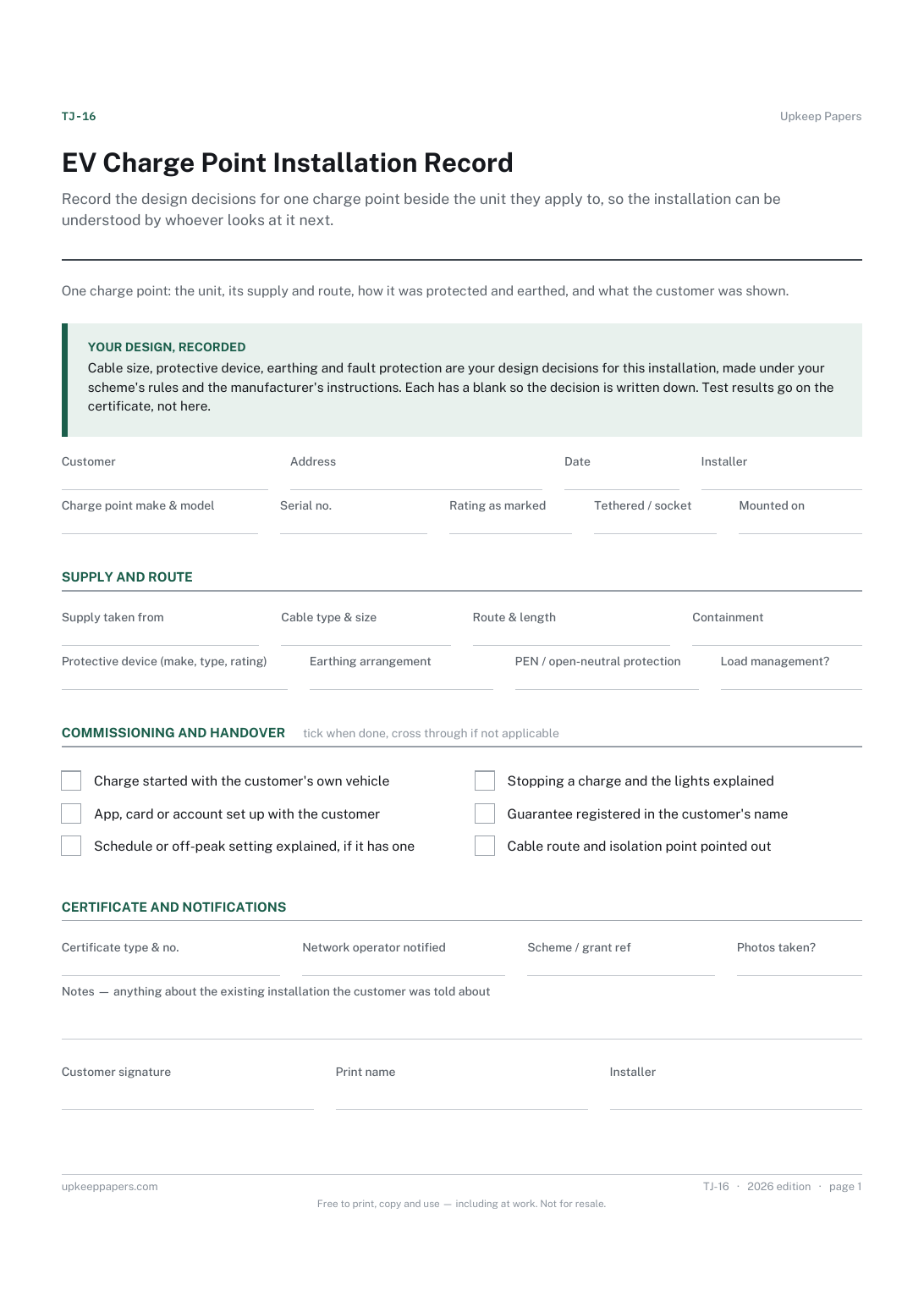
Record the design decisions for one charge point beside the unit they apply to, so the installation can be understood by whoever looks at it next.
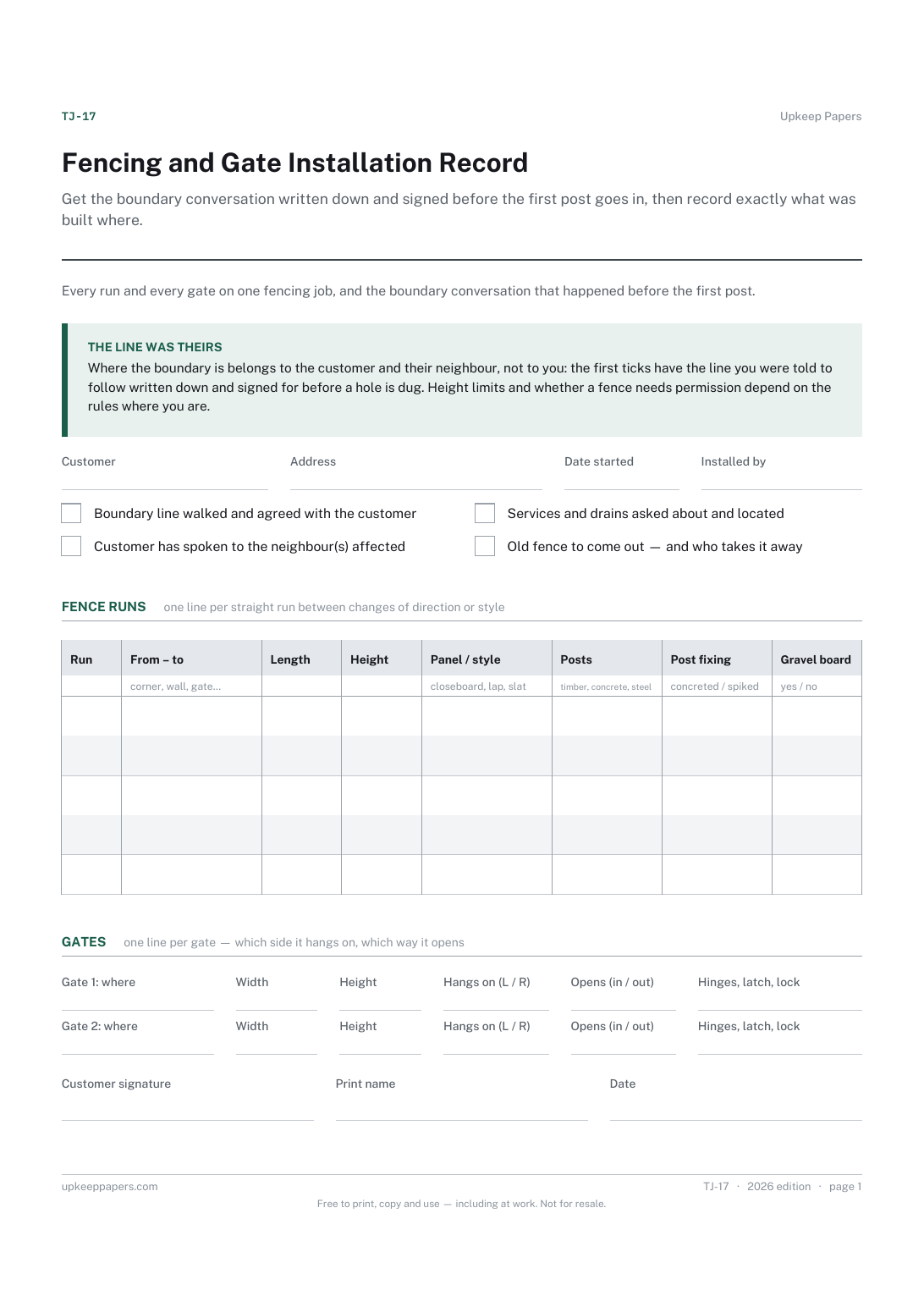
Get the boundary conversation written down and signed before the first post goes in, then record exactly what was built where.
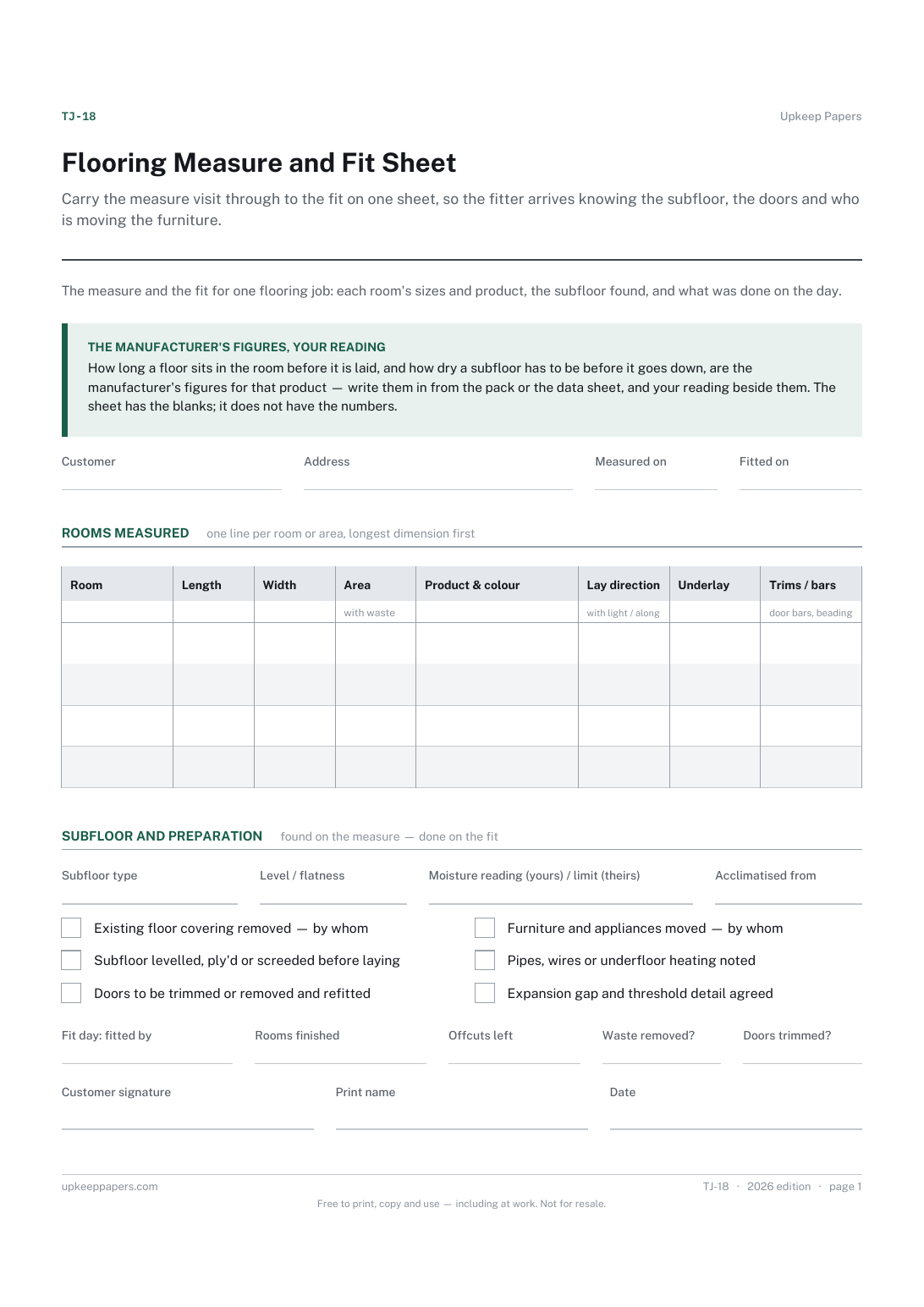
Carry the measure visit through to the fit on one sheet, so the fitter arrives knowing the subfloor, the doors and who is moving the furniture.
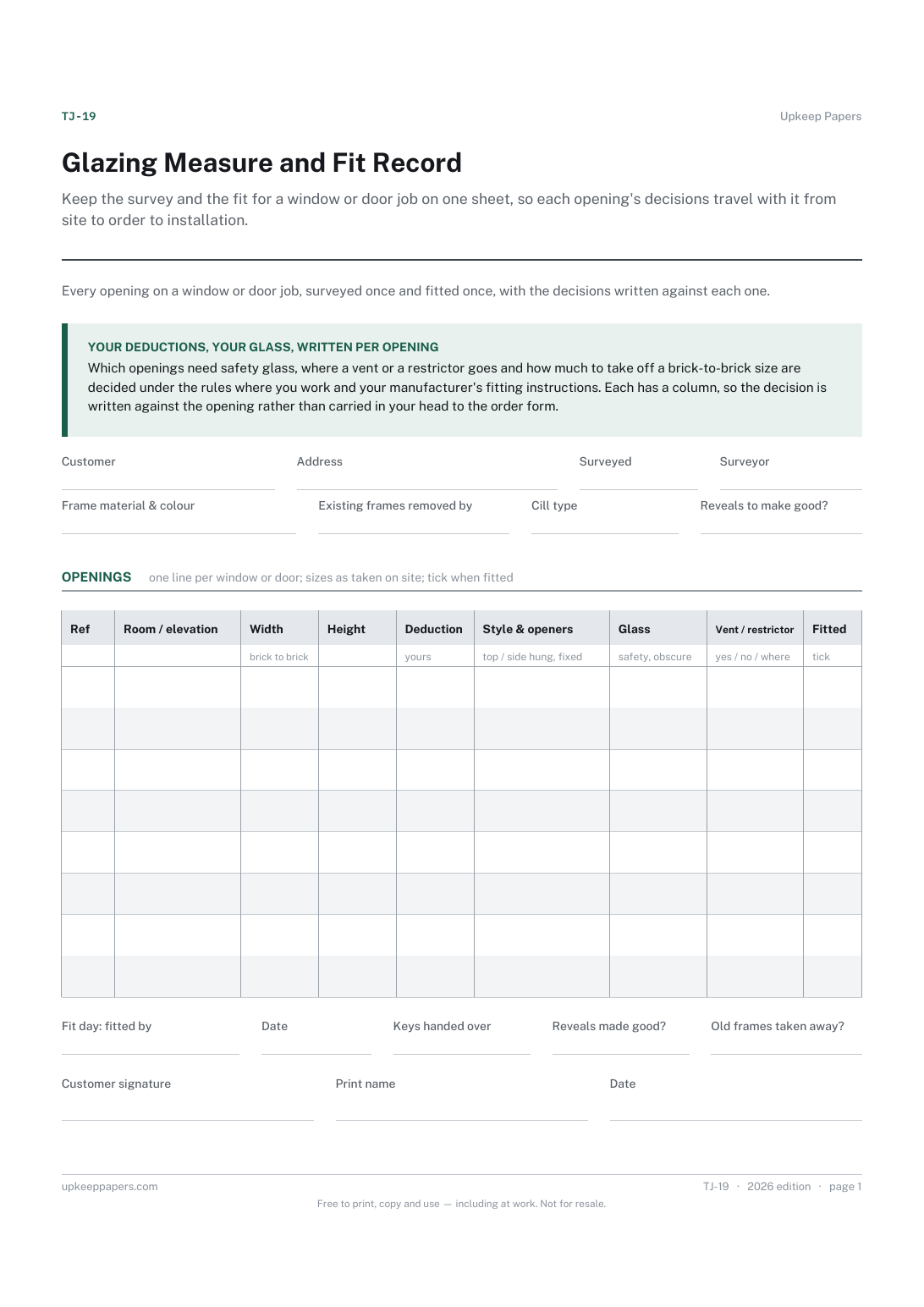
Keep the survey and the fit for a window or door job on one sheet, so each opening's decisions travel with it from site to order to installation.
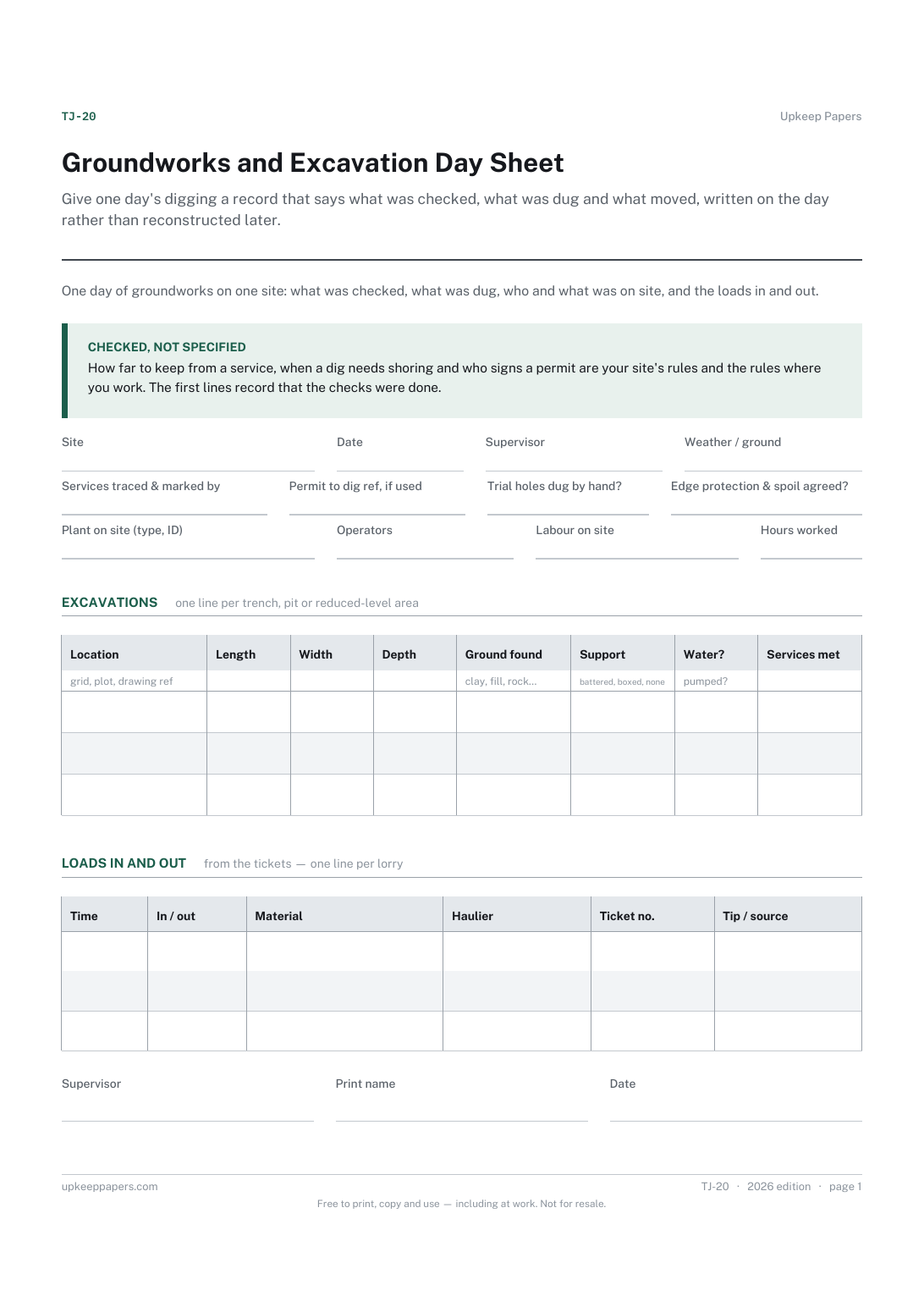
Give one day's digging a record that says what was checked, what was dug and what moved, written on the day rather than reconstructed later.
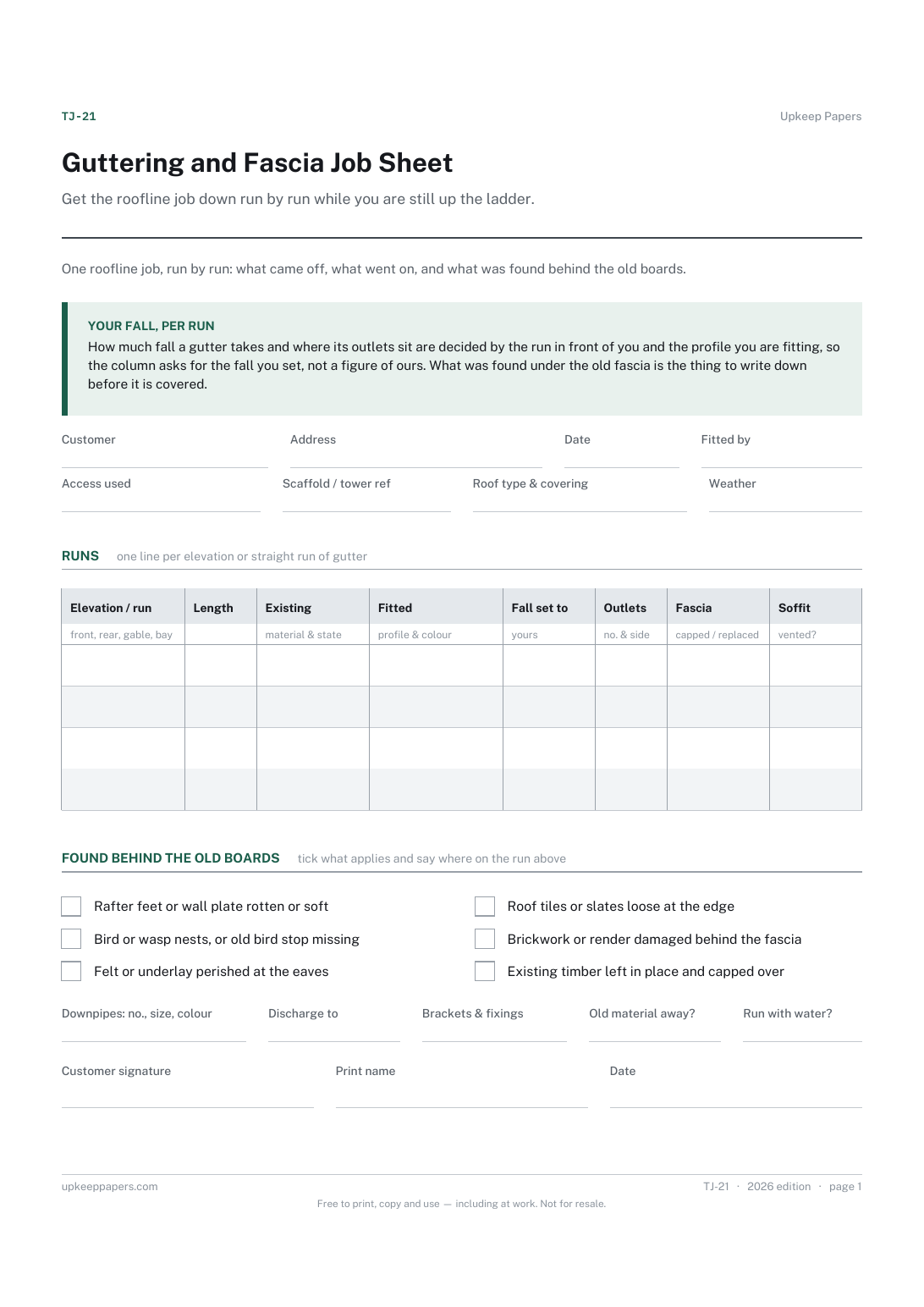
Get the roofline job down run by run while you are still up the ladder. The rot and the nests are covered over an hour later and argued about a year on; this is where they are written down first.
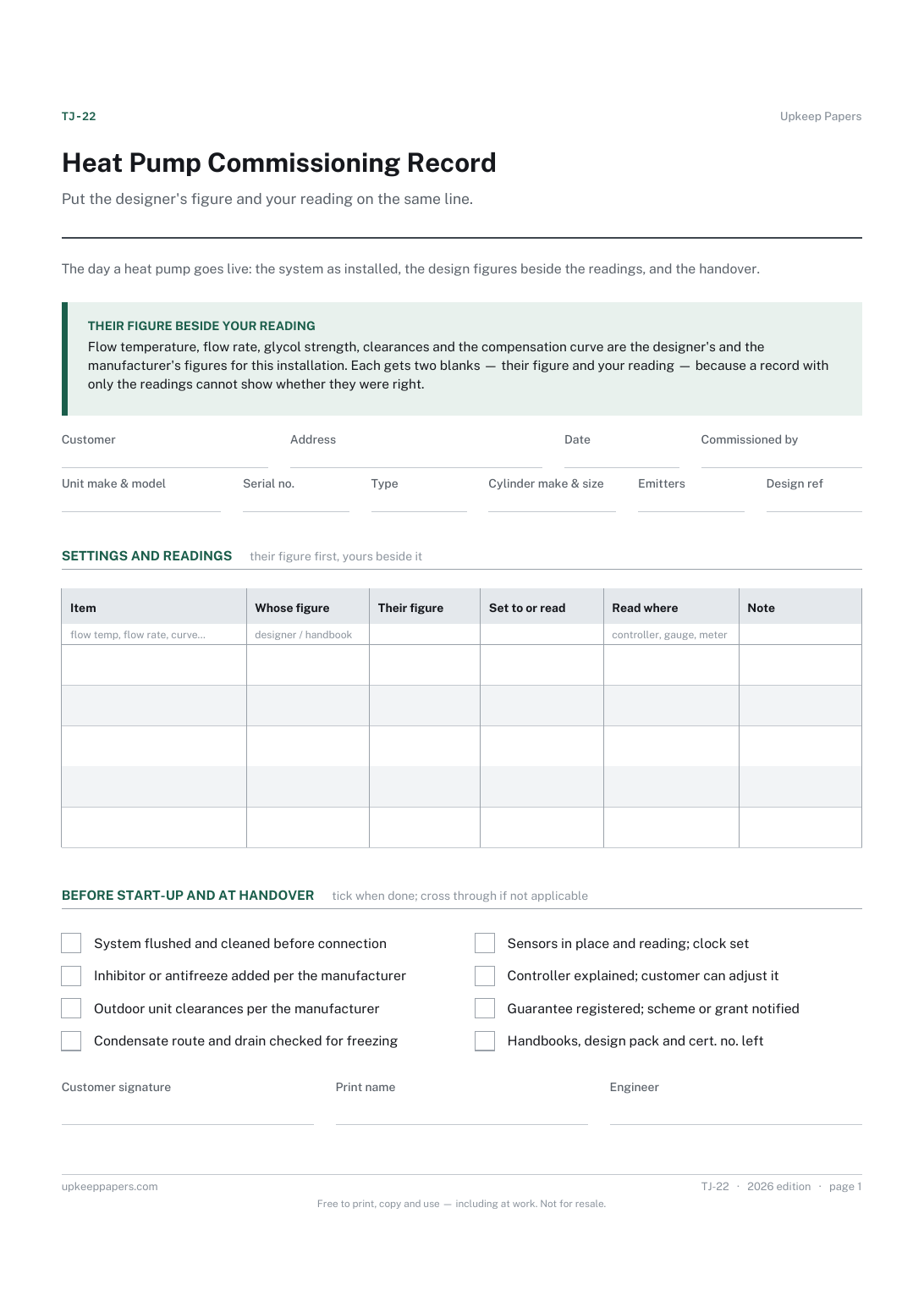
Put the designer's figure and your reading on the same line. The record then shows not just what the system was set to but whether that was what it was meant to be.
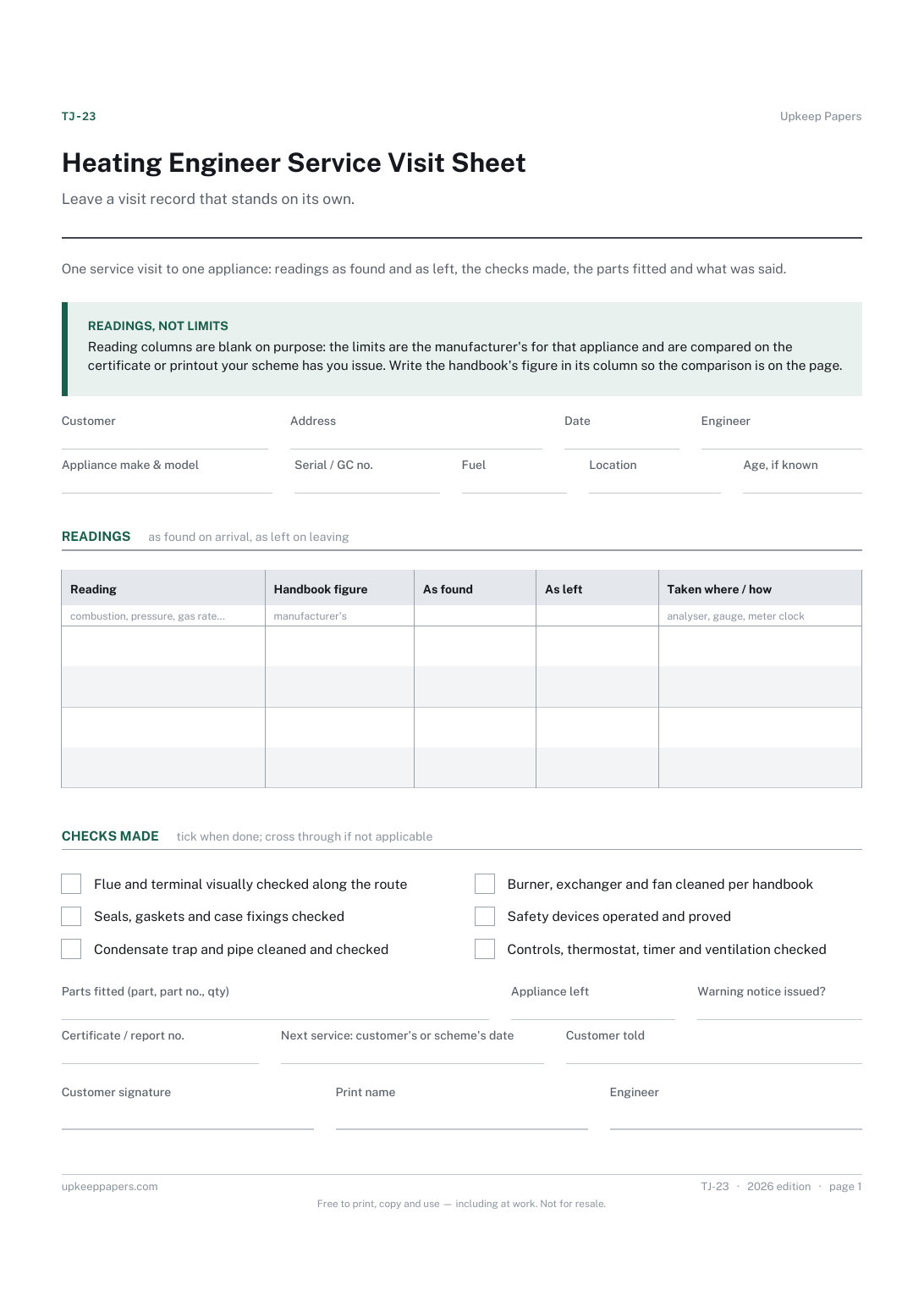
Leave a visit record that stands on its own. It shows what was read, what was done about it, and what the customer was told before the van pulled away.
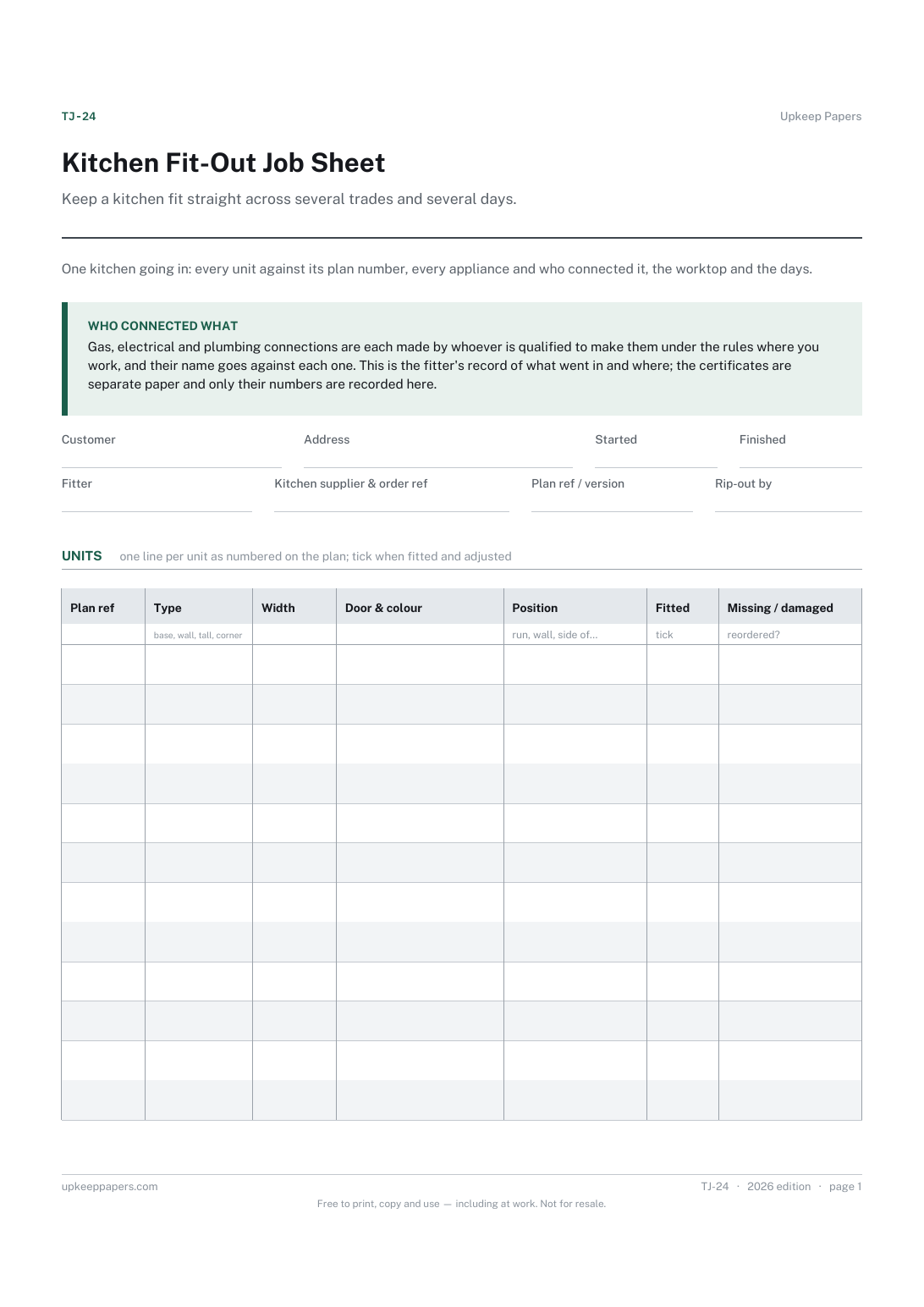
Keep a kitchen fit straight across several trades and several days. A missing door, a damaged panel or an unconnected appliance is on paper the day it is noticed.
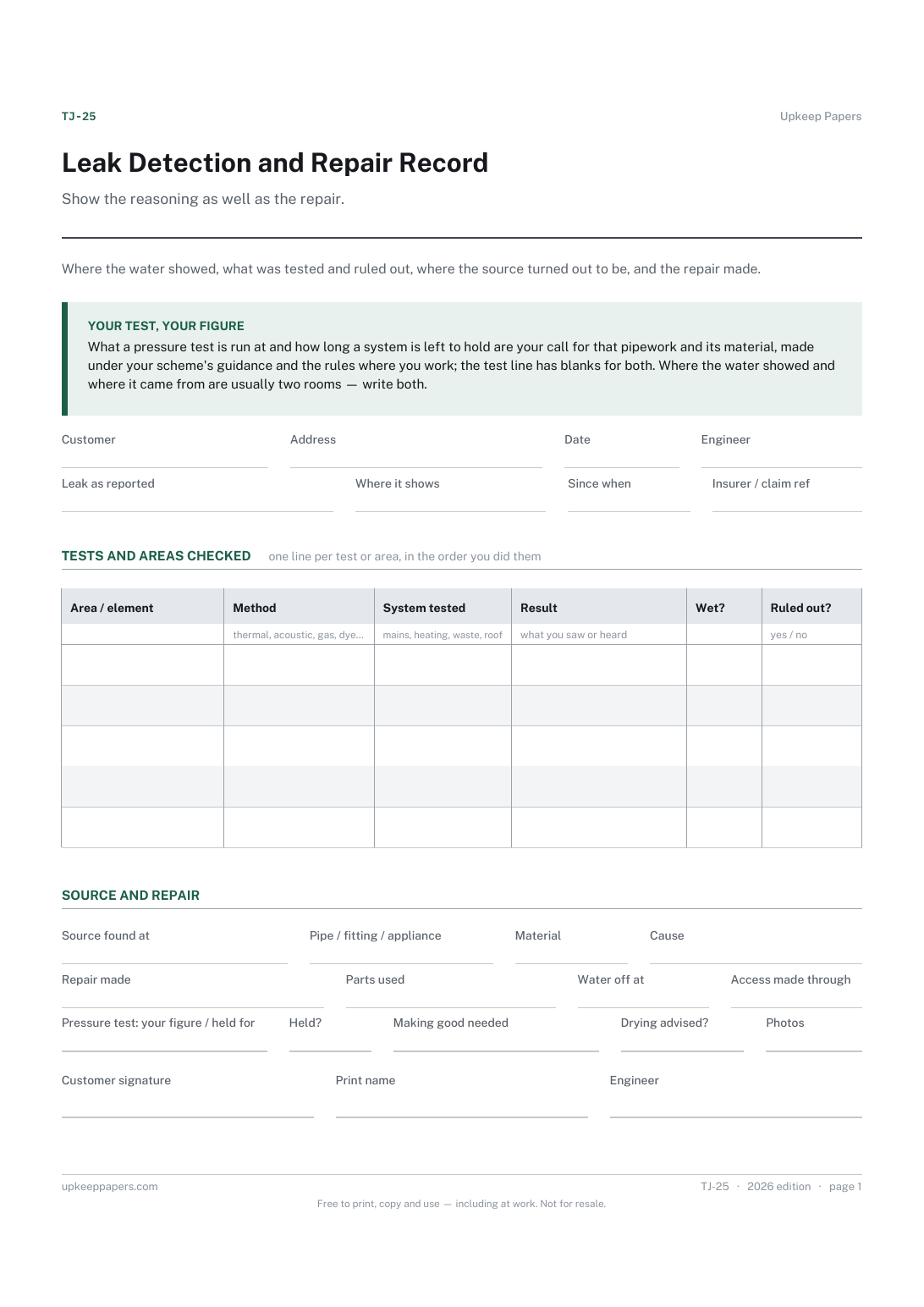
Show the reasoning as well as the repair. An insurer, a landlord or the next engineer can then see what was checked and what was ruled out.
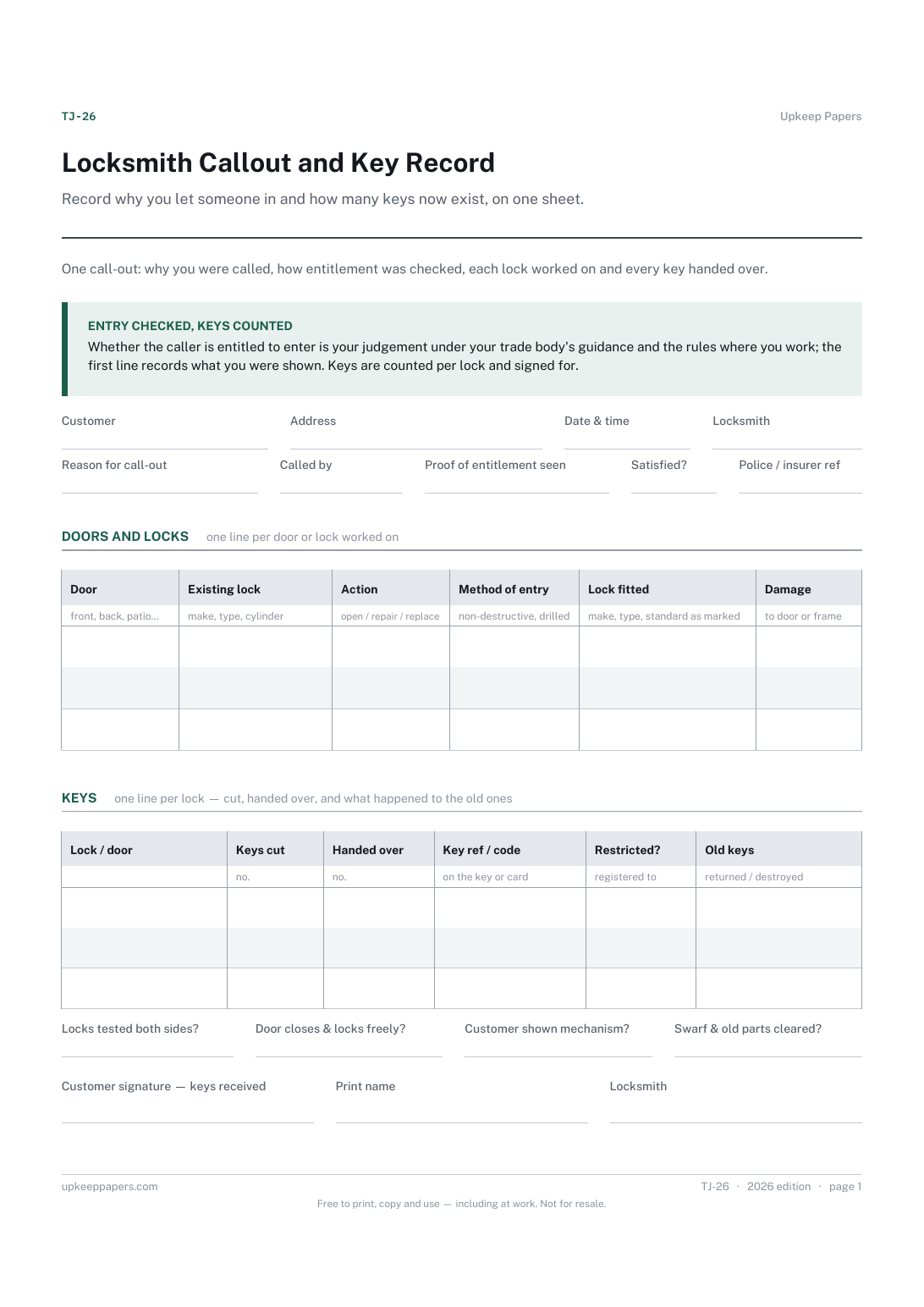
Record why you let someone in and how many keys now exist, on one sheet. Those are the two things a locksmith is asked about later, and the customer signs for both.
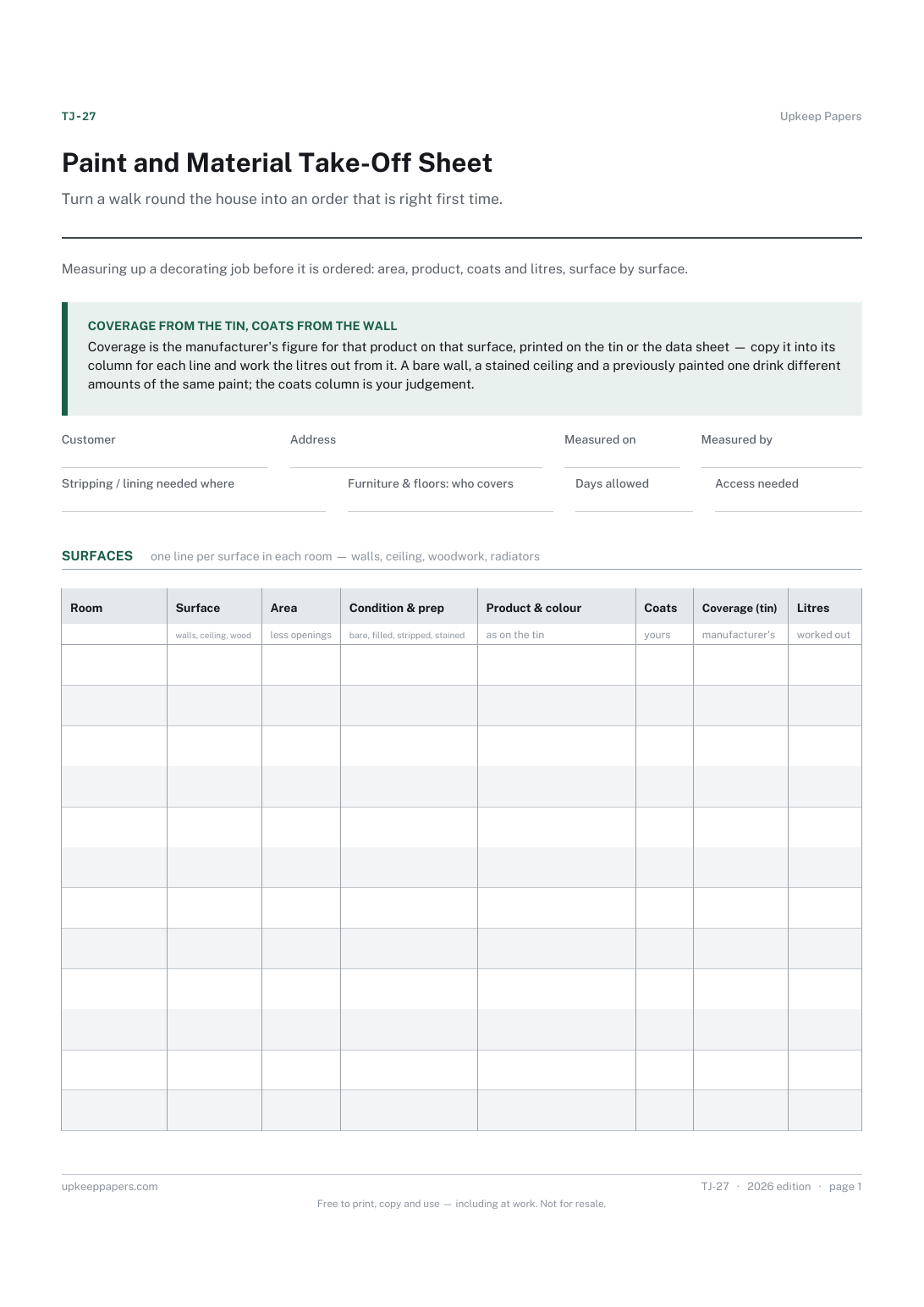
Turn a walk round the house into an order that is right first time. The working is shown, so a short tin can be traced back to the wall that caused it.
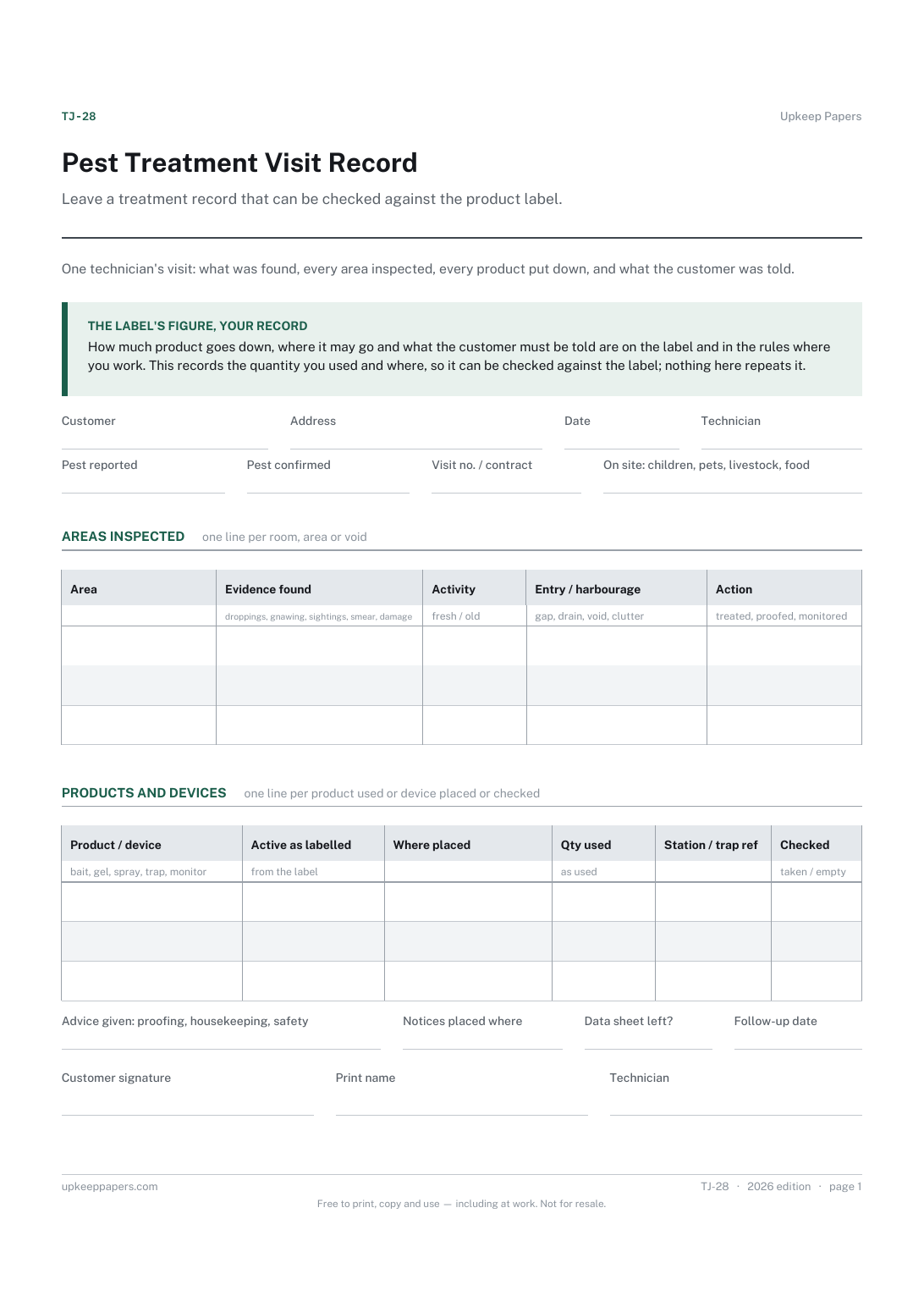
Leave a treatment record that can be checked against the product label. The next technician, or a customer asking what was put down and where, can read it without you.
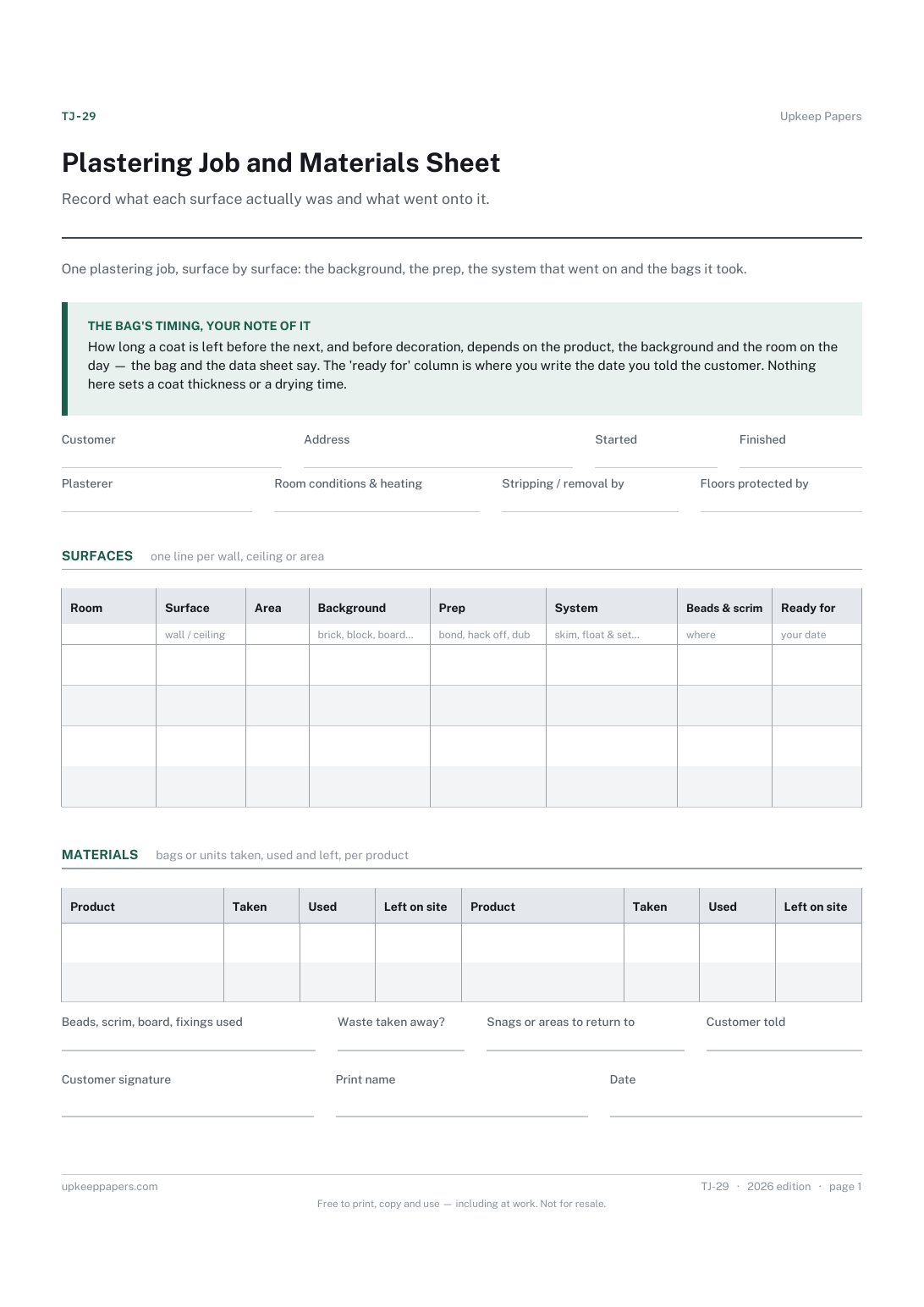
Record what each surface actually was and what went onto it. A later crack, a blown patch or a paint failure can then be traced to the background rather than guessed at.
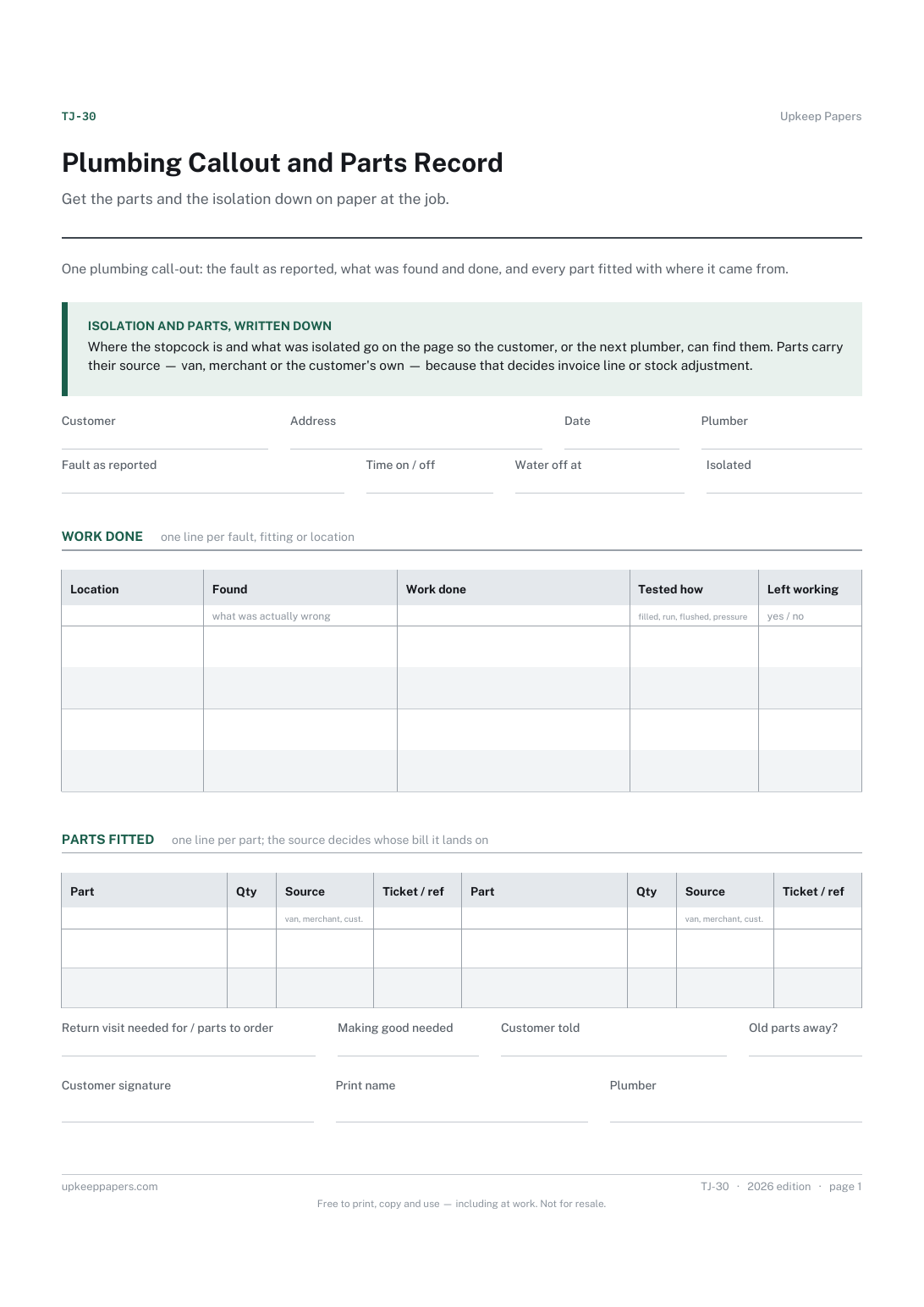
Get the parts and the isolation down on paper at the job. The invoice is then right, the van stock is right and the next plumber can find the stopcock.
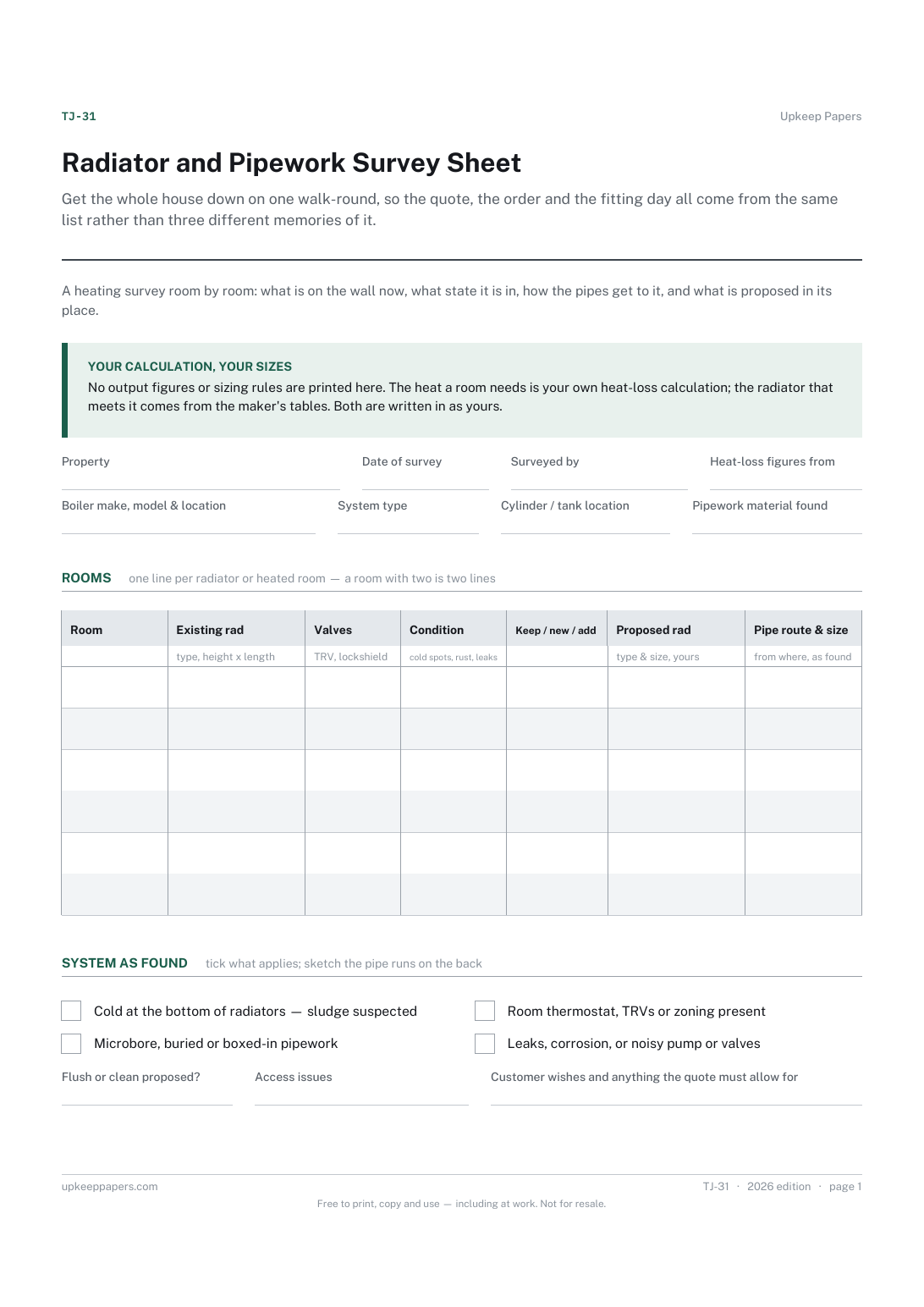
Get the whole house down on one walk-round, so the quote, the order and the fitting day all come from the same list rather than three different memories of it.
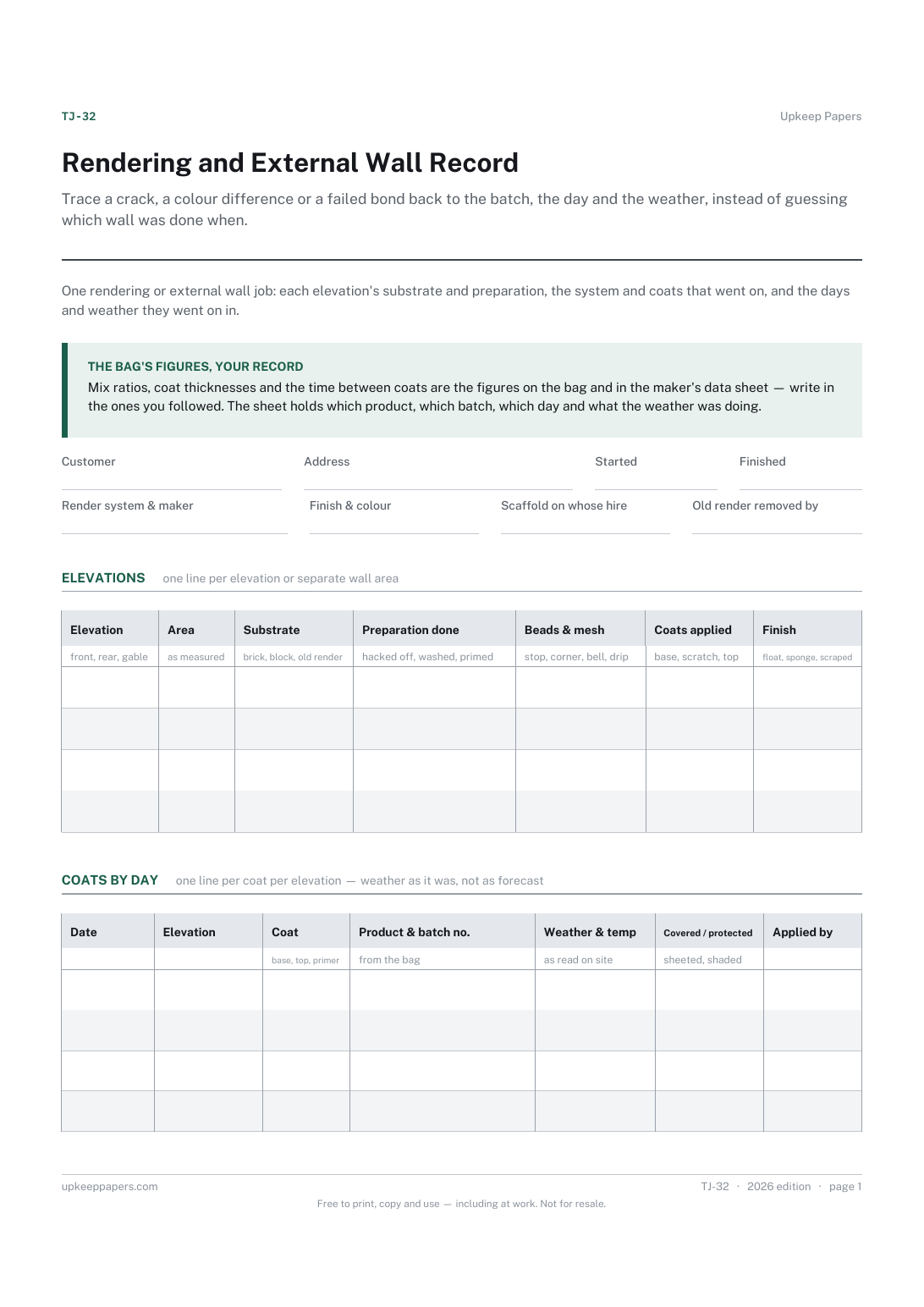
Trace a crack, a colour difference or a failed bond back to the batch, the day and the weather, instead of guessing which wall was done when.
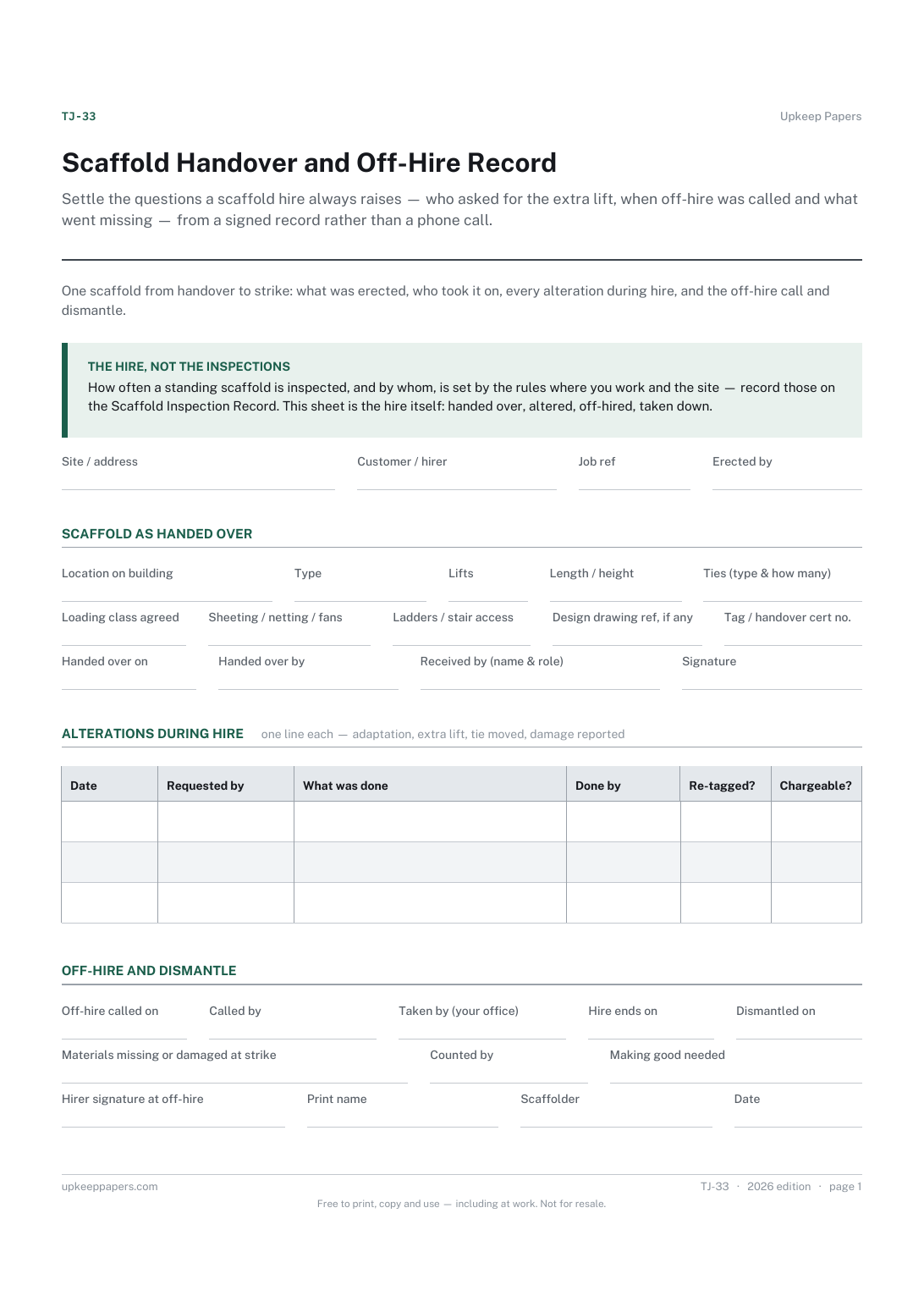
Settle the questions a scaffold hire always raises — who asked for the extra lift, when off-hire was called and what went missing — from a signed record rather than a phone call.
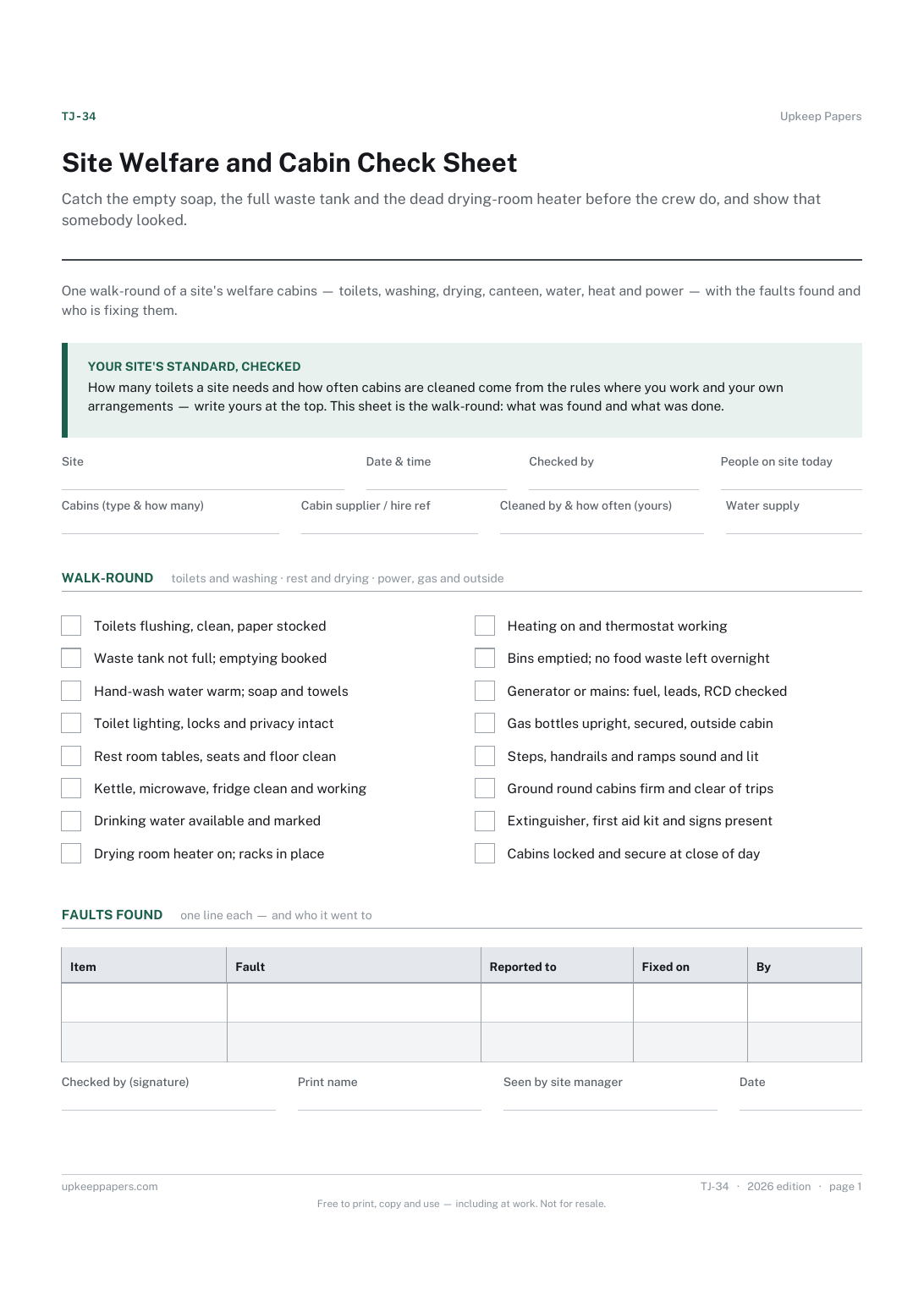
Catch the empty soap, the full waste tank and the dead drying-room heater before the crew do, and show that somebody looked.
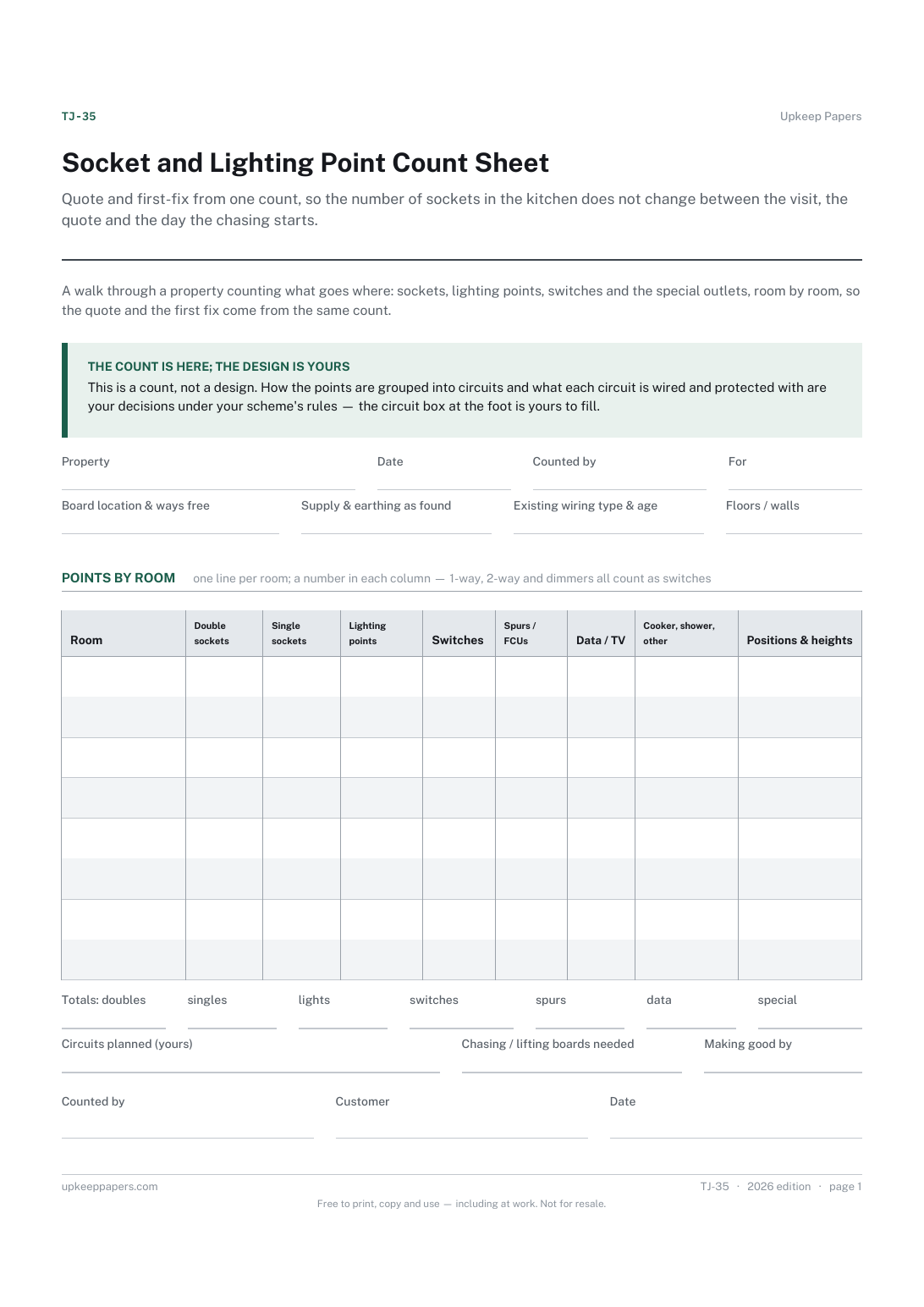
Quote and first-fix from one count, so the number of sockets in the kitchen does not change between the visit, the quote and the day the chasing starts.
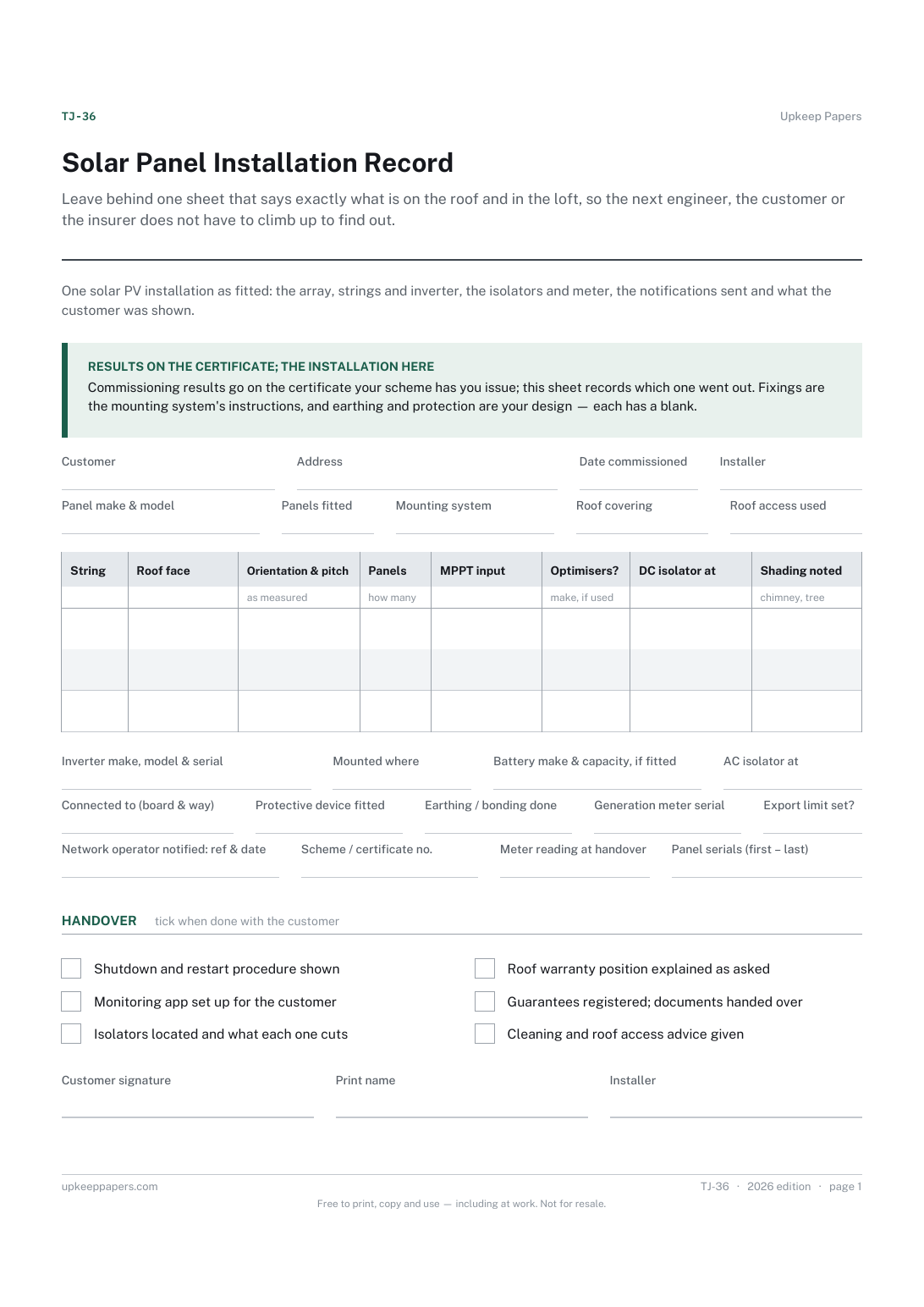
Leave behind one sheet that says exactly what is on the roof and in the loft, so the next engineer, the customer or the insurer does not have to climb up to find out.
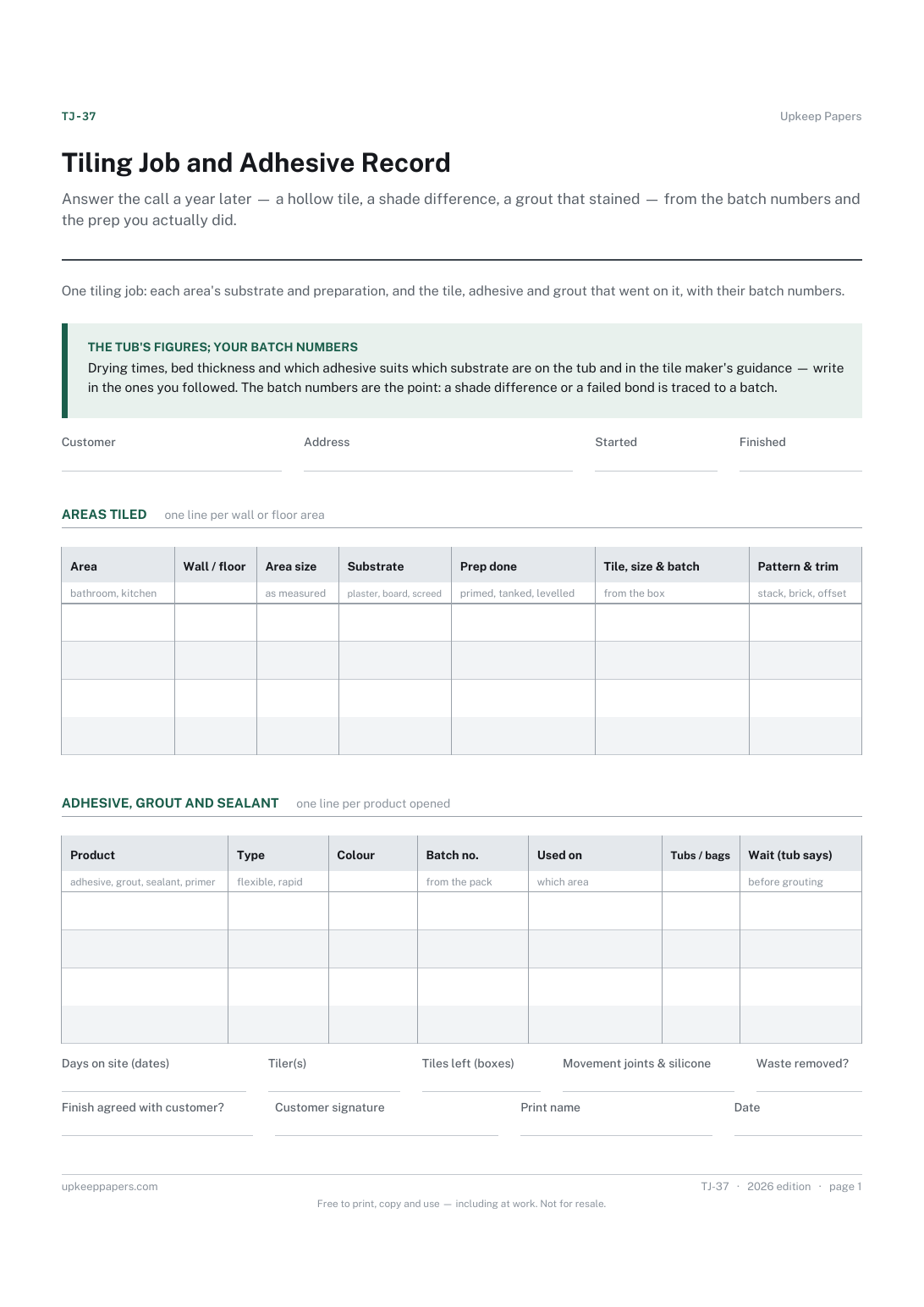
Answer the call a year later — a hollow tile, a shade difference, a grout that stained — from the batch numbers and the prep you actually did.
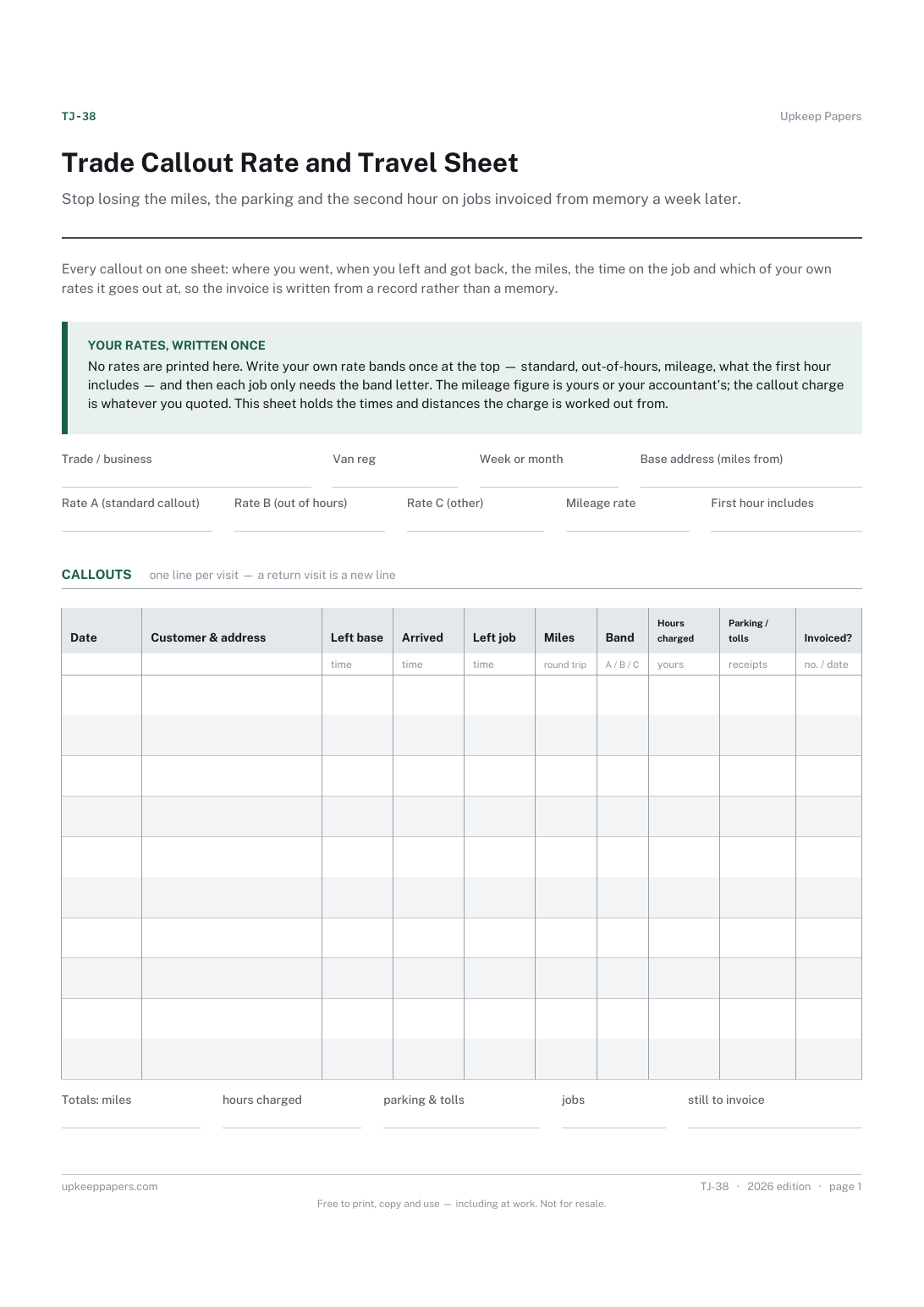
Stop losing the miles, the parking and the second hour on jobs invoiced from memory a week later.
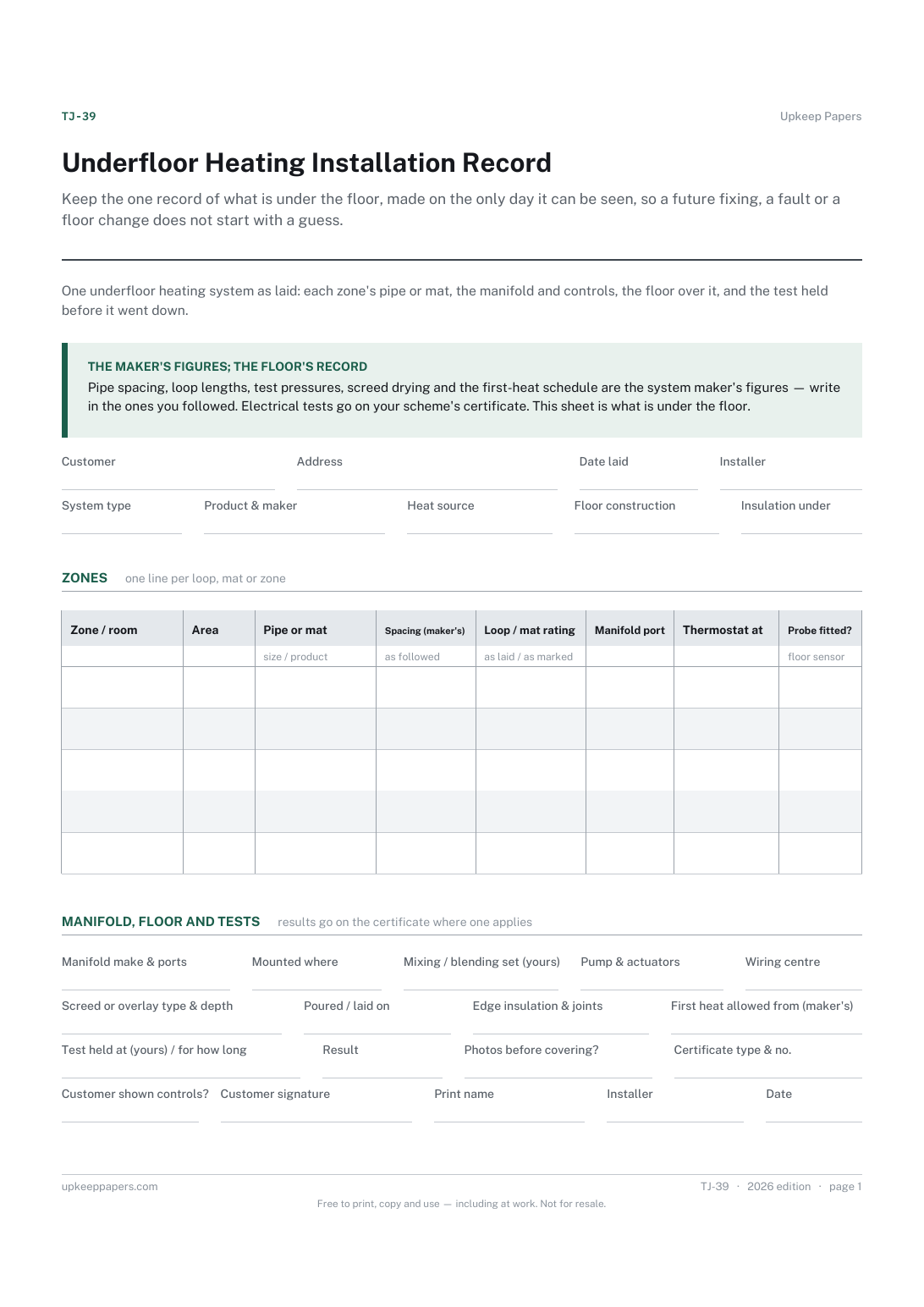
Keep the one record of what is under the floor, made on the only day it can be seen, so a future fixing, a fault or a floor change does not start with a guess.
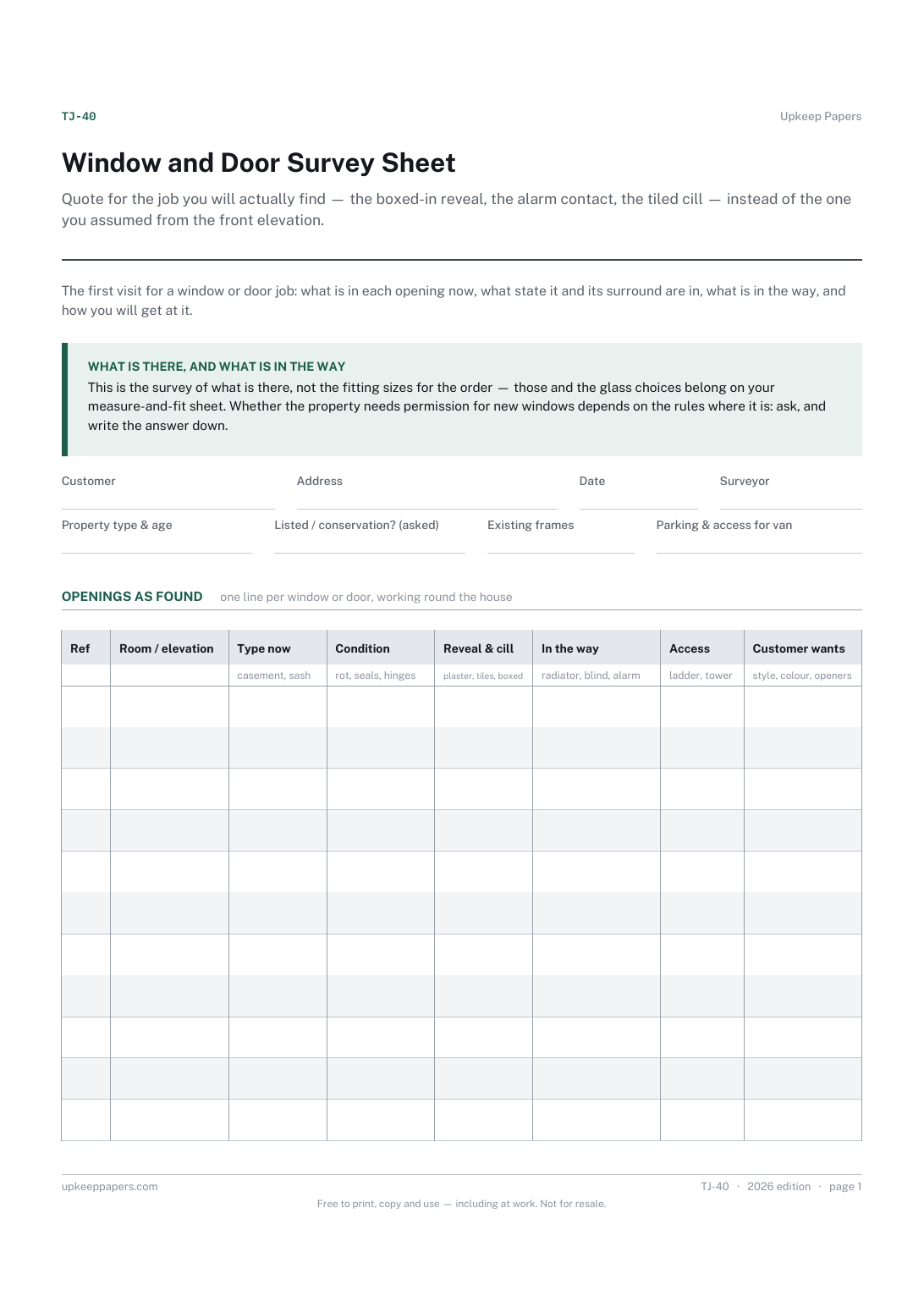
Quote for the job you will actually find — the boxed-in reveal, the alarm contact, the tiled cill — instead of the one you assumed from the front elevation.
Job cards, parts, road tests and the paperwork that follows a car through a workshop from booking in to handing back.
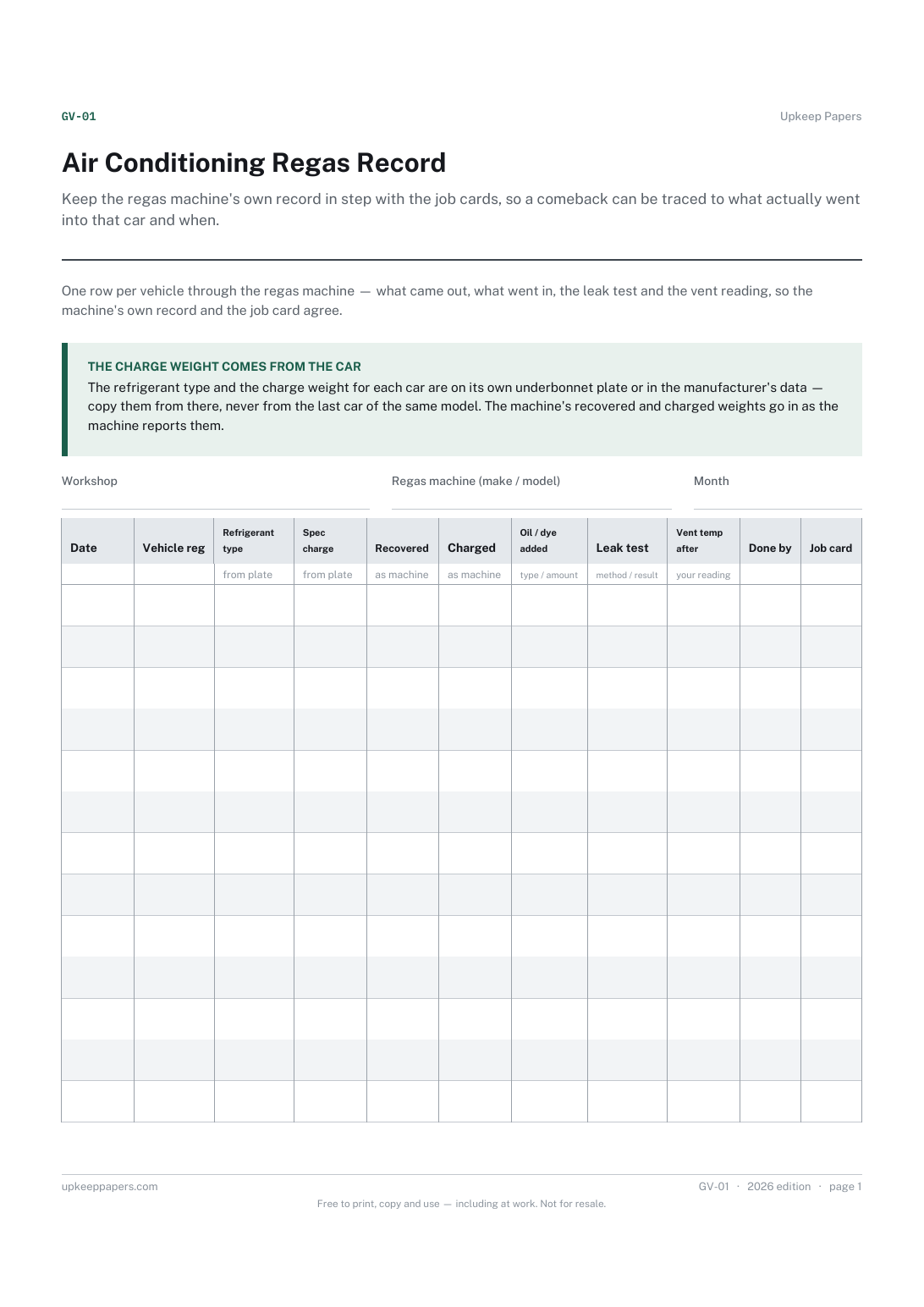
Keep the regas machine's own record in step with the job cards, so a comeback can be traced to what actually went into that car and when.
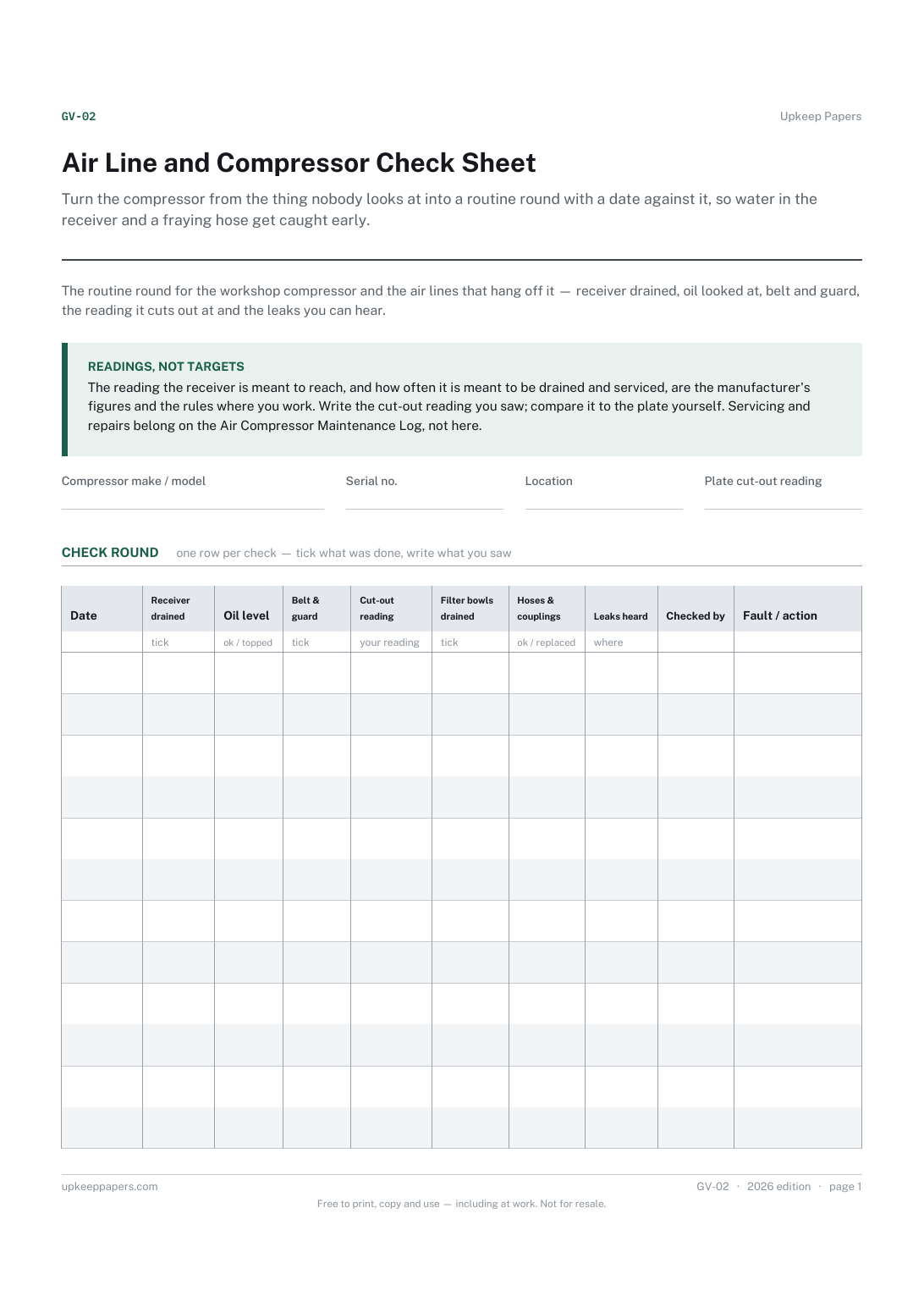
Turn the compressor from the thing nobody looks at into a routine round with a date against it, so water in the receiver and a fraying hose get caught early.
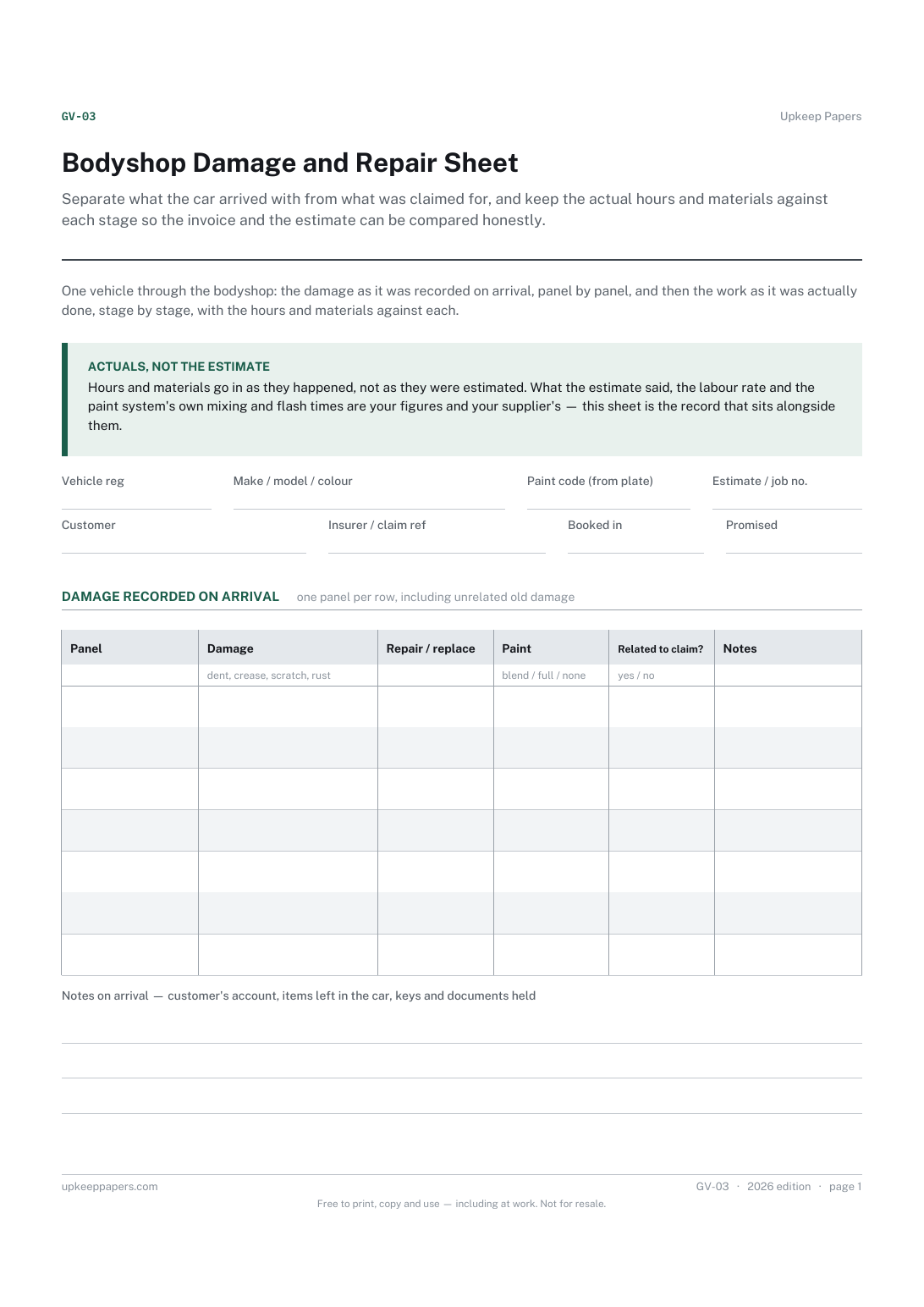
Separate what the car arrived with from what was claimed for, and keep the actual hours and materials against each stage so the invoice and the estimate can be compared honestly.
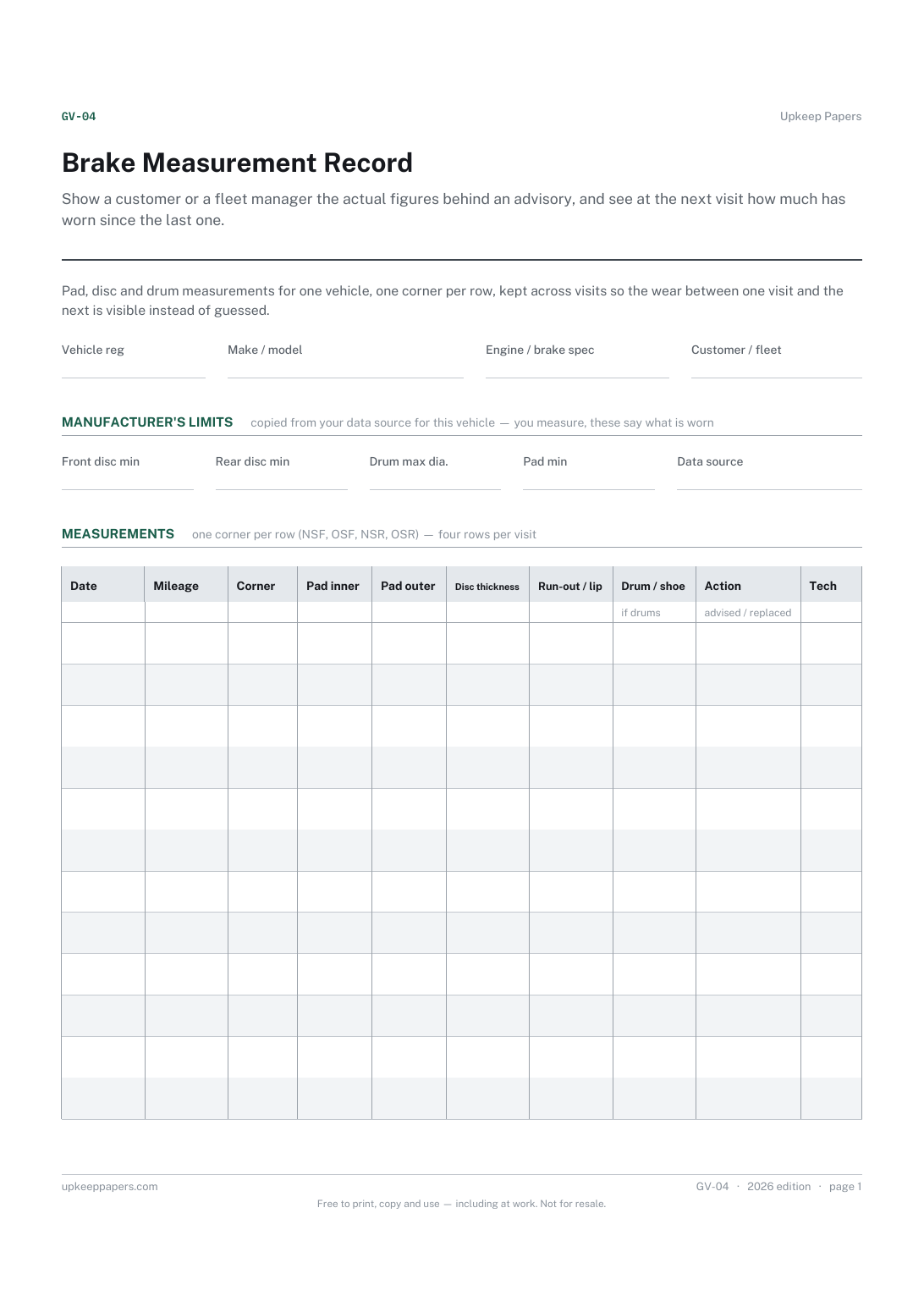
Show a customer or a fleet manager the actual figures behind an advisory, and see at the next visit how much has worn since the last one.
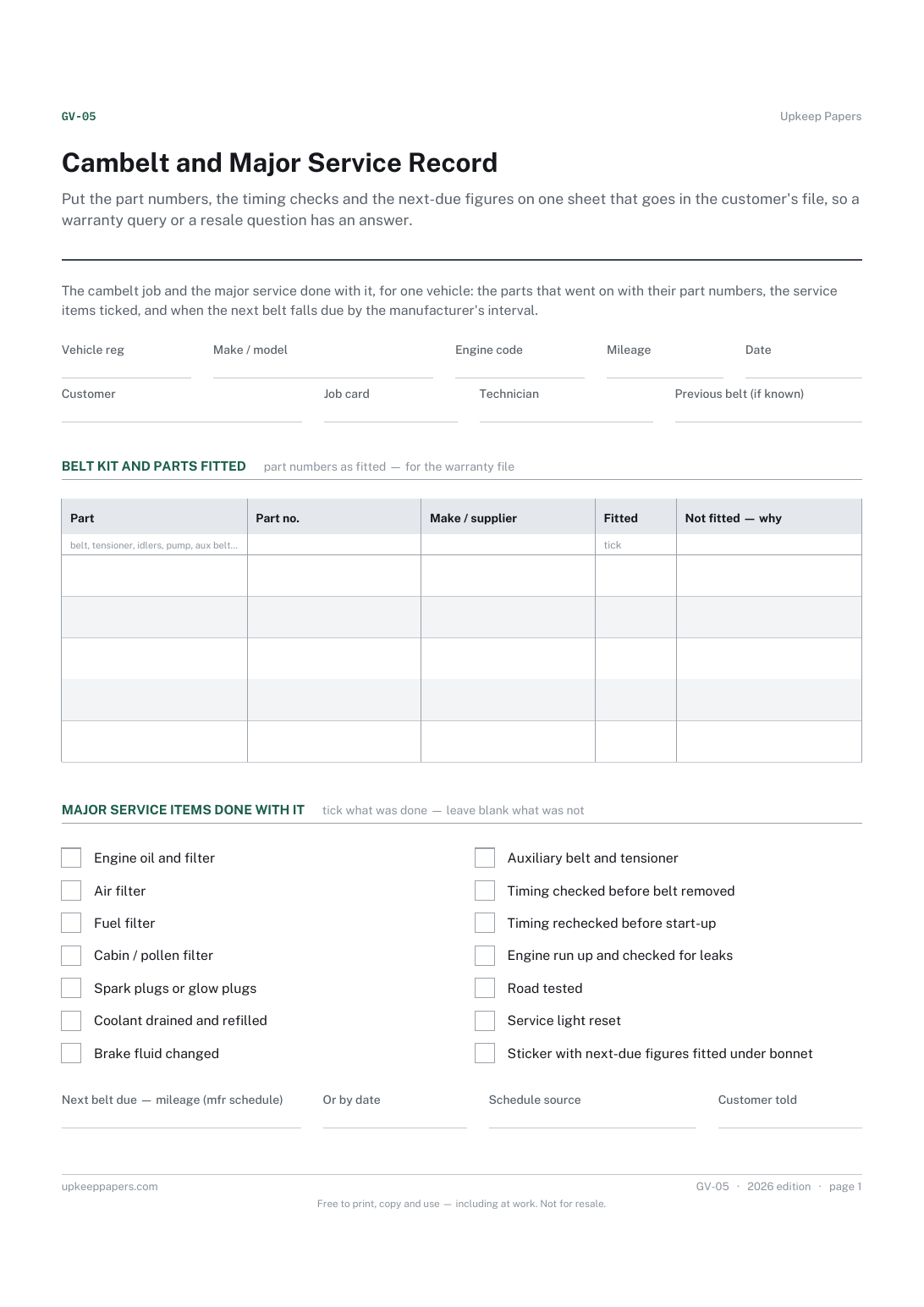
Put the part numbers, the timing checks and the next-due figures on one sheet that goes in the customer's file, so a warranty query or a resale question has an answer.
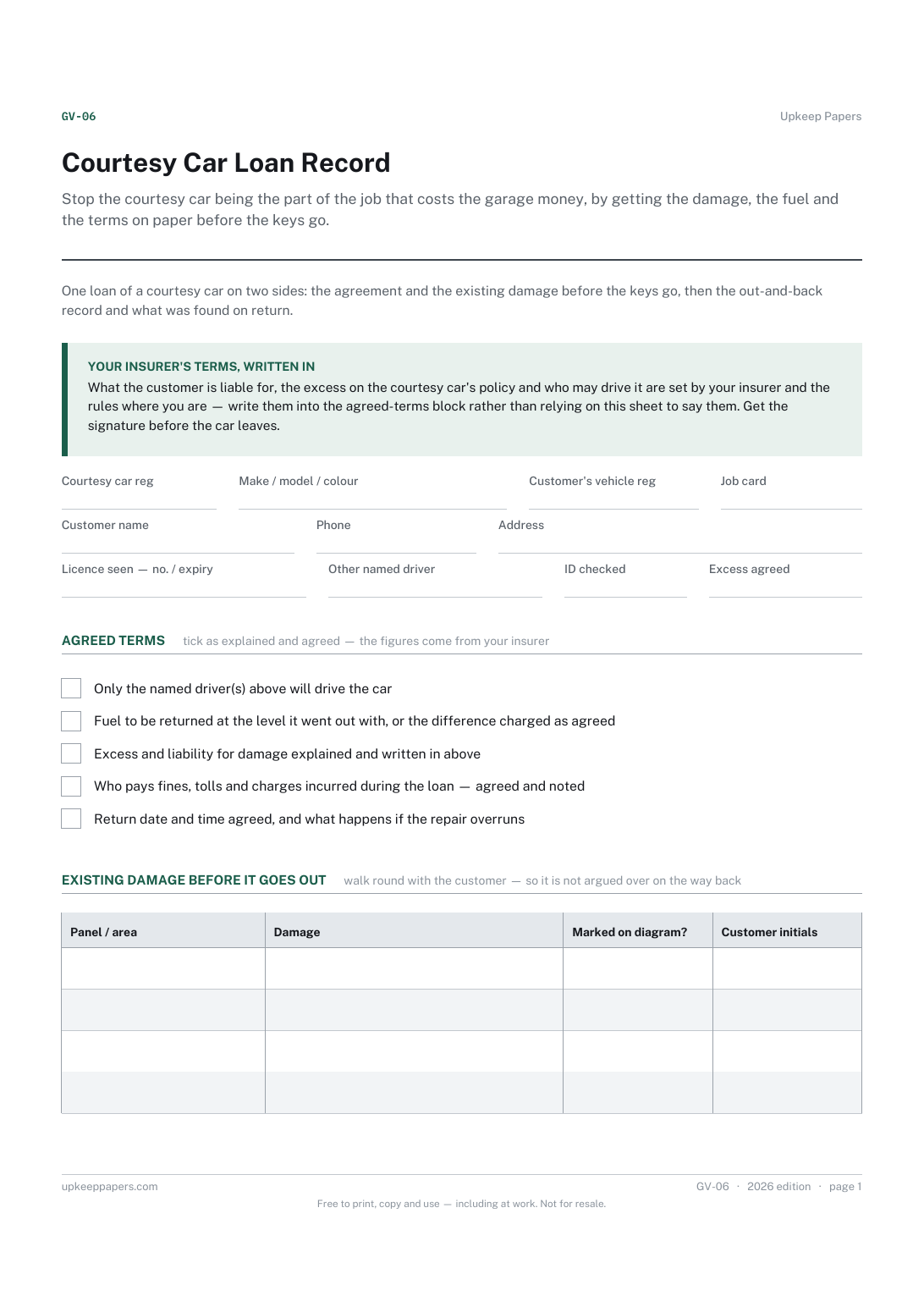
Stop the courtesy car being the part of the job that costs the garage money, by getting the damage, the fuel and the terms on paper before the keys go.
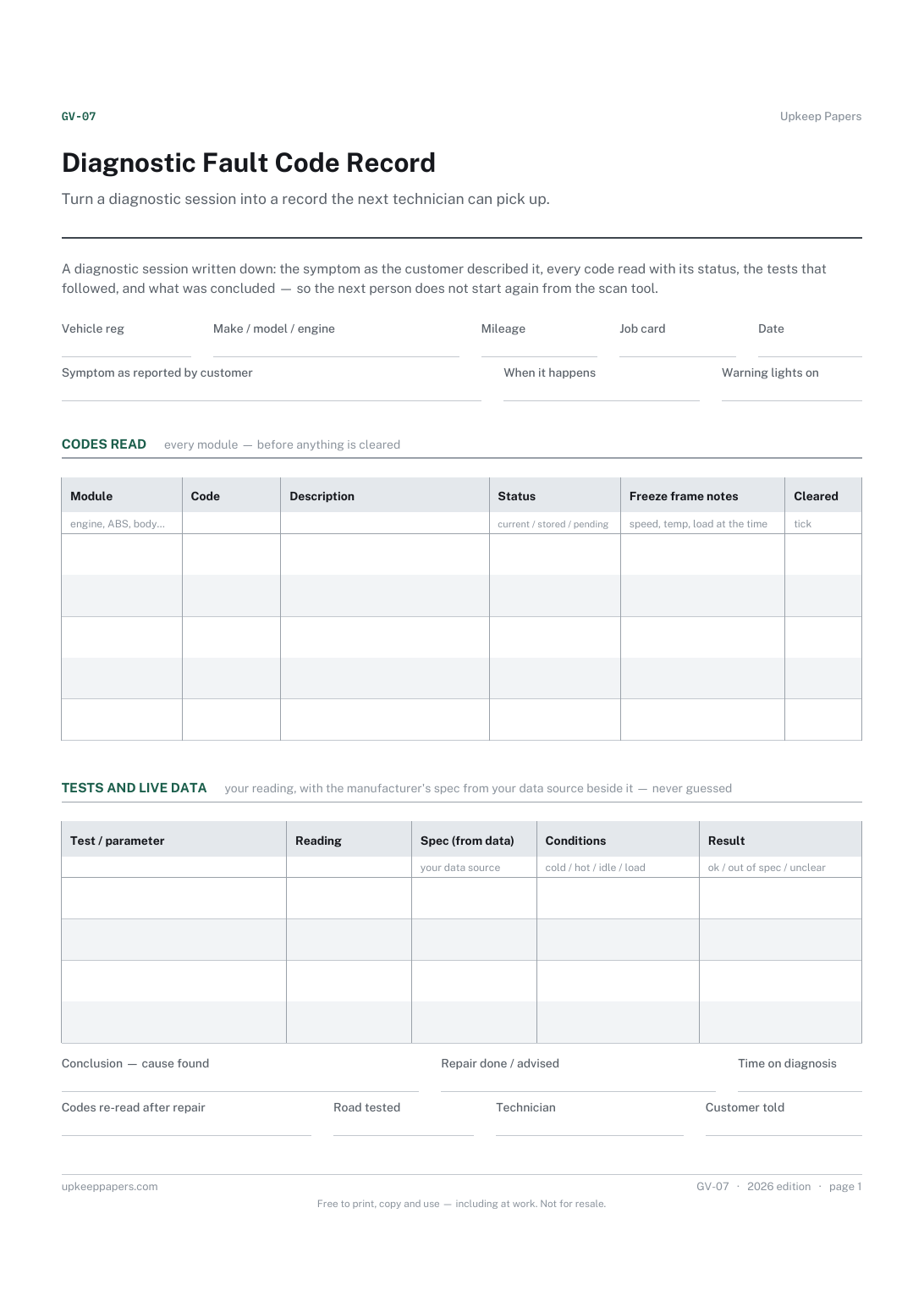
Turn a diagnostic session into a record the next technician can pick up. It also gives the customer something better than 'it had a code'.
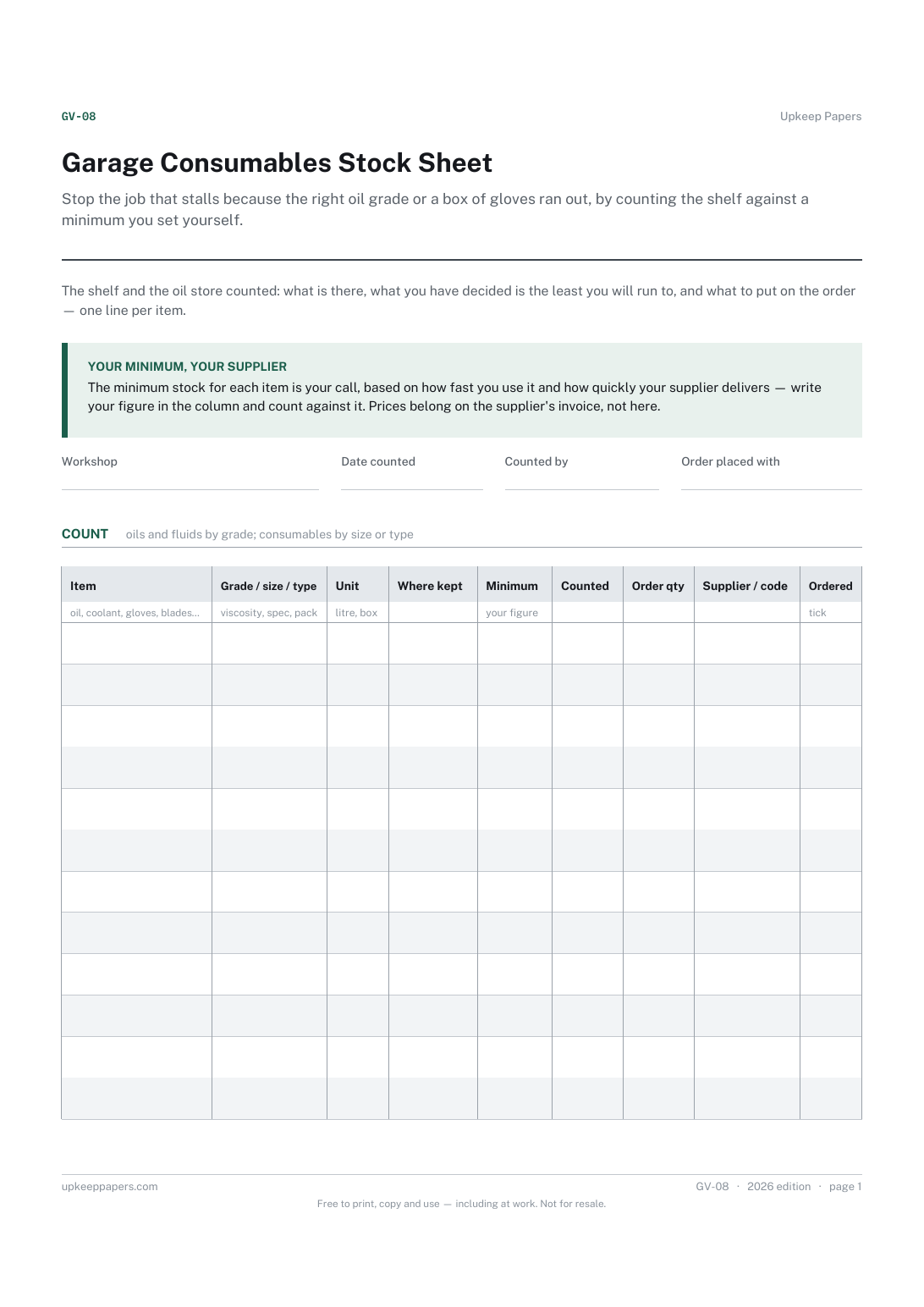
Stop the job that stalls because the right oil grade or a box of gloves ran out, by counting the shelf against a minimum you set yourself.
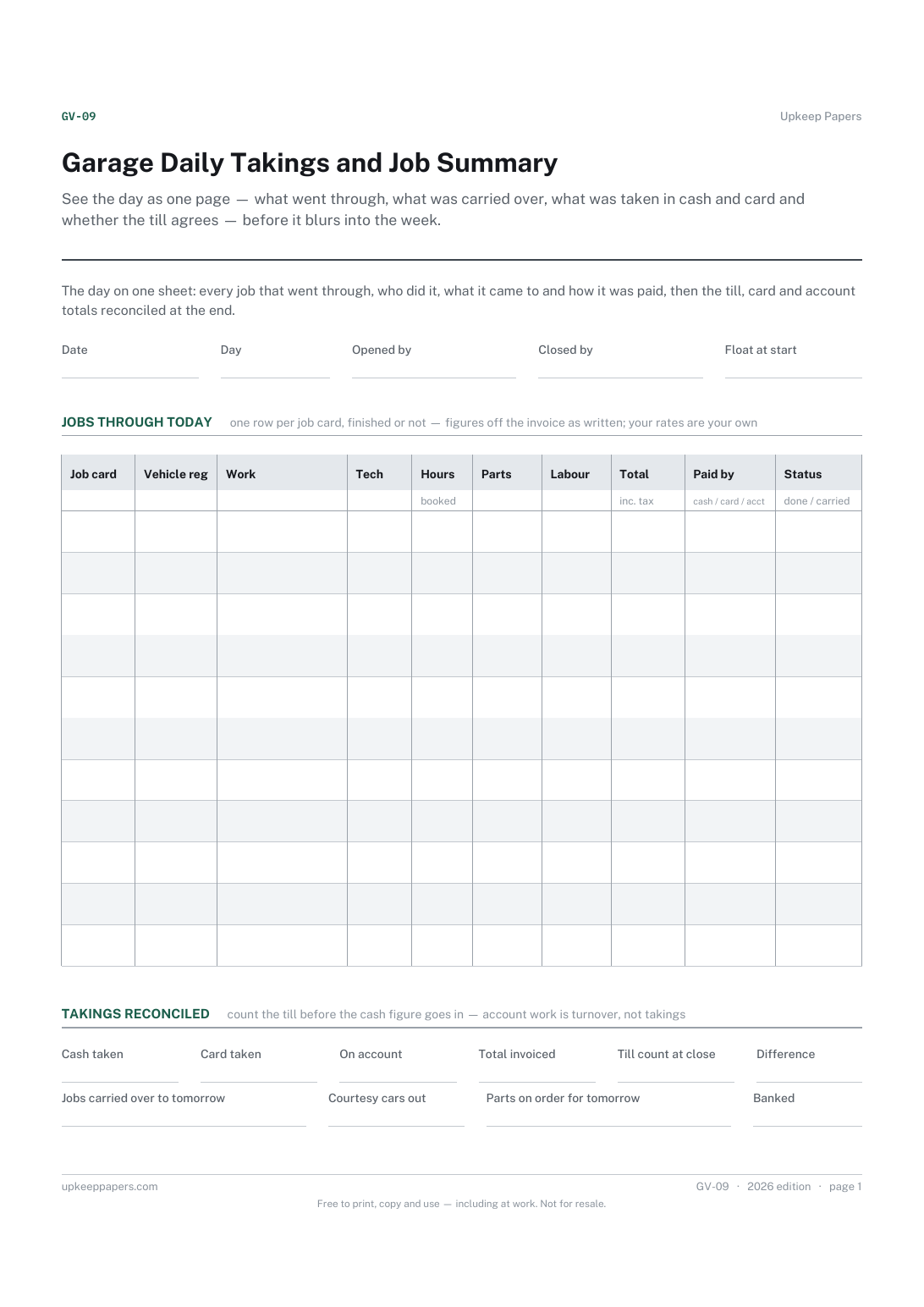
See the day as one page — what went through, what was carried over, what was taken in cash and card and whether the till agrees — before it blurs into the week.
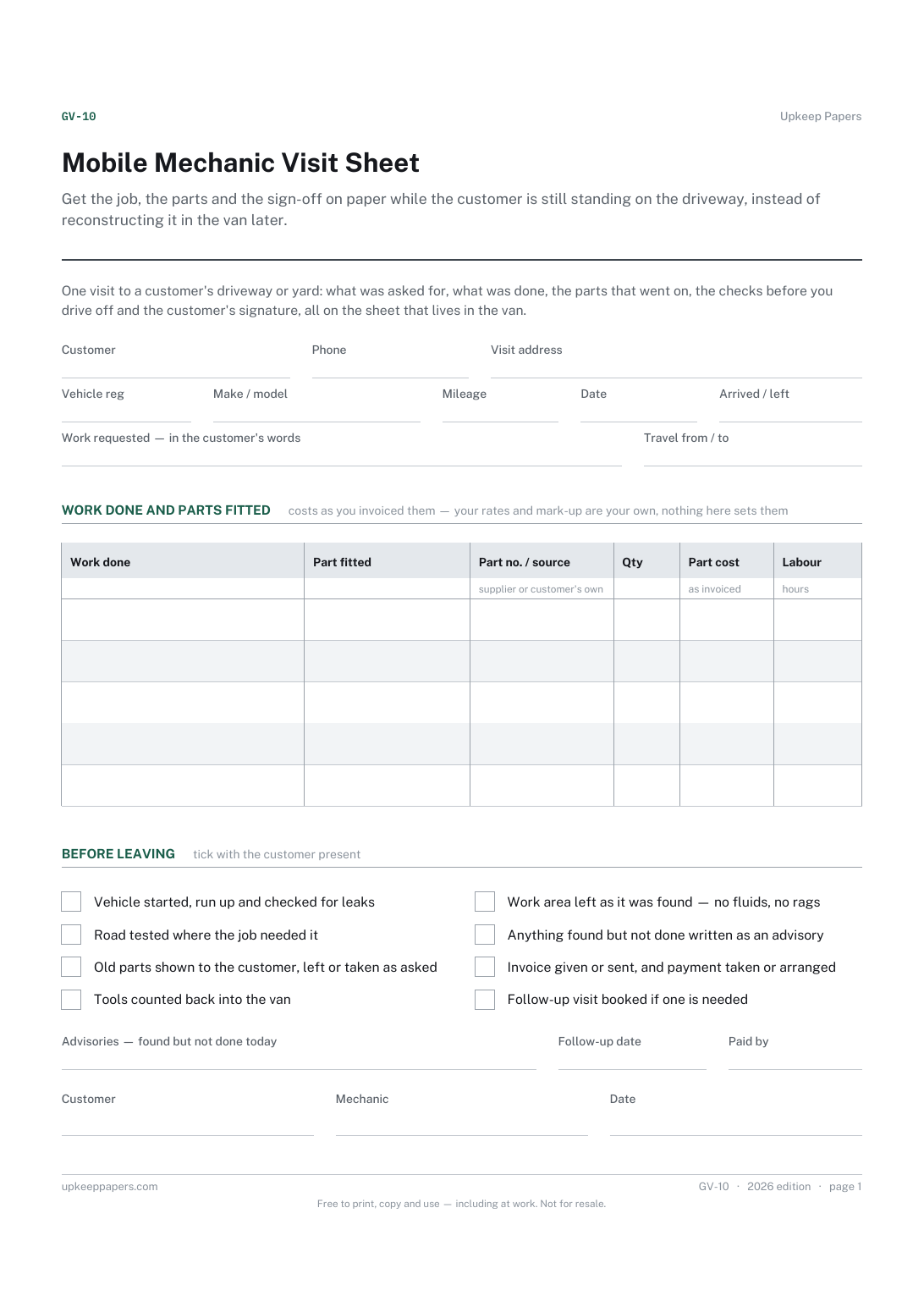
Get the job, the parts and the sign-off on paper while the customer is still standing on the driveway, instead of reconstructing it in the van later.
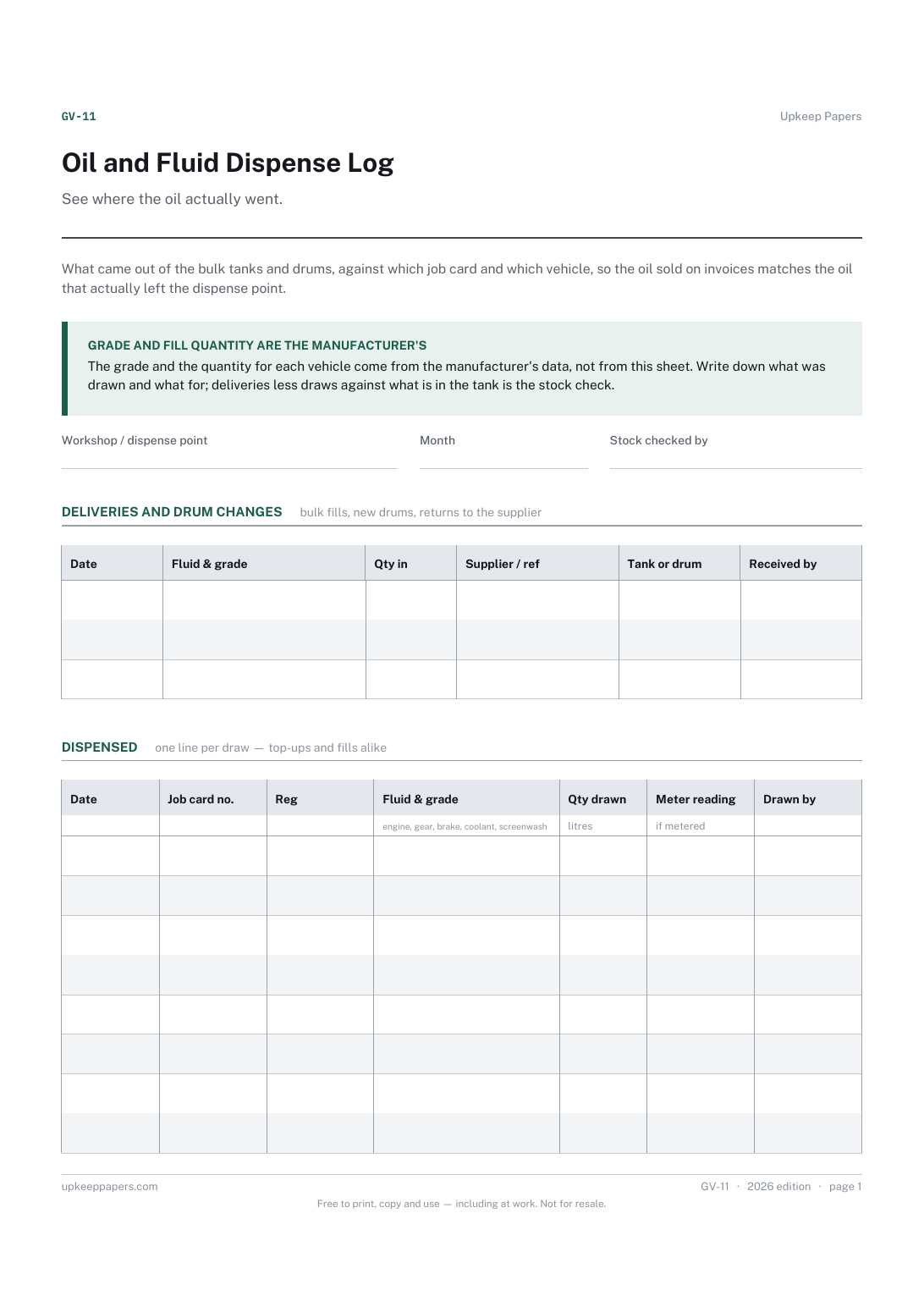
See where the oil actually went. Reconcile what was sold on invoices against what left the dispense point.
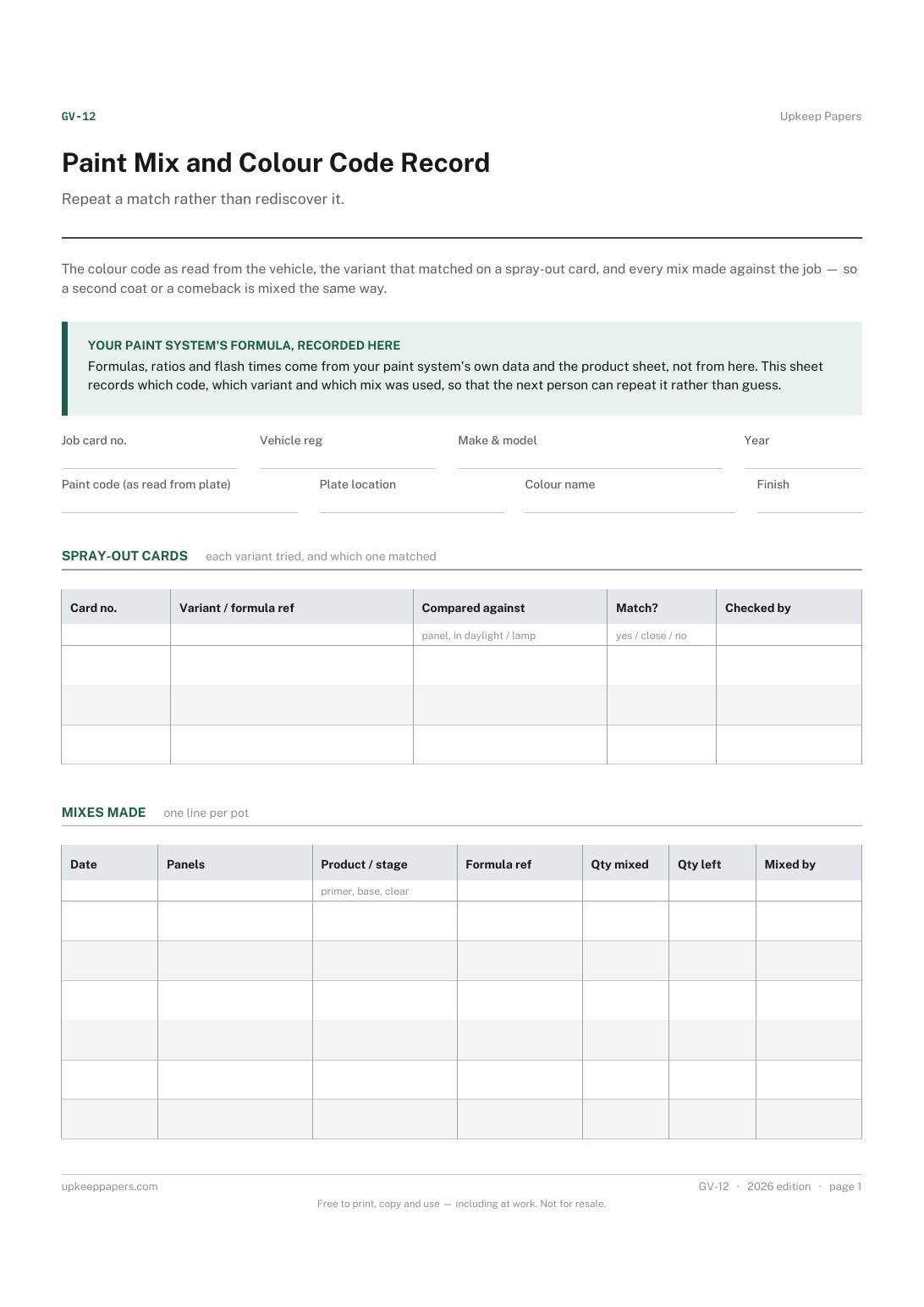
Repeat a match rather than rediscover it. A comeback can be answered with the exact variant and formula reference that went on the car.
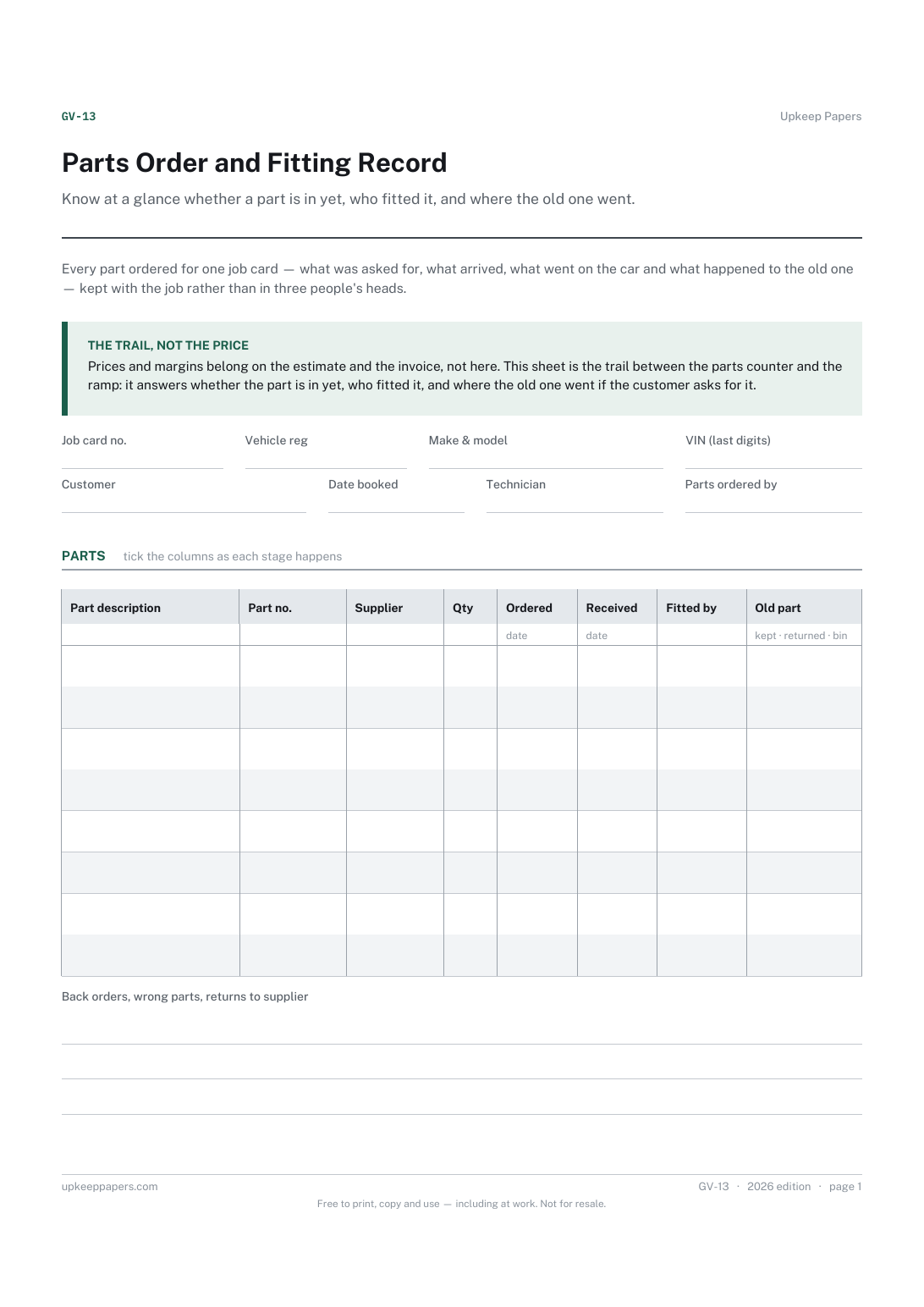
Know at a glance whether a part is in yet, who fitted it, and where the old one went. The customer who asks for it back gets an answer.
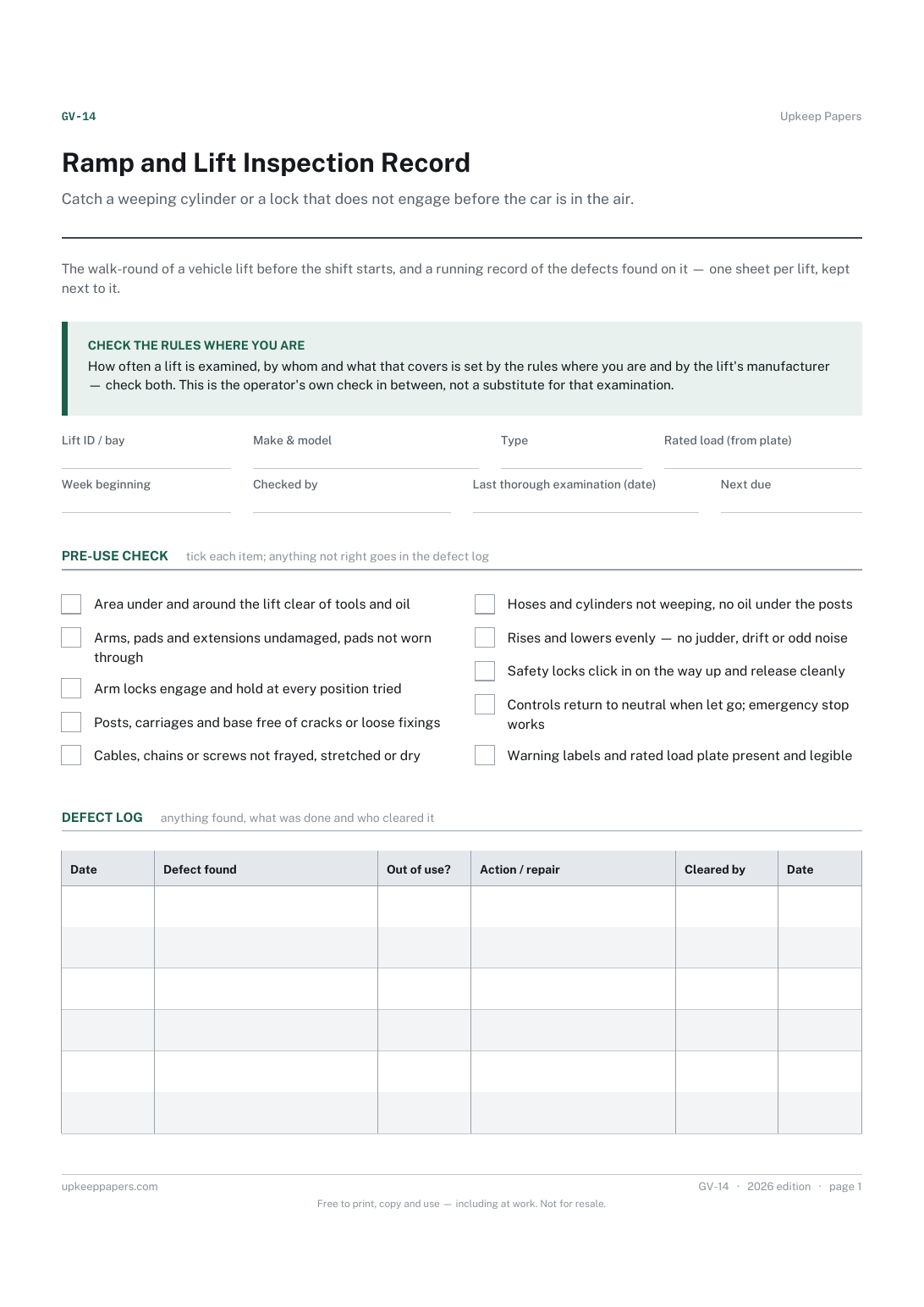
Catch a weeping cylinder or a lock that does not engage before the car is in the air. Keep a trail of what was found and who cleared it.
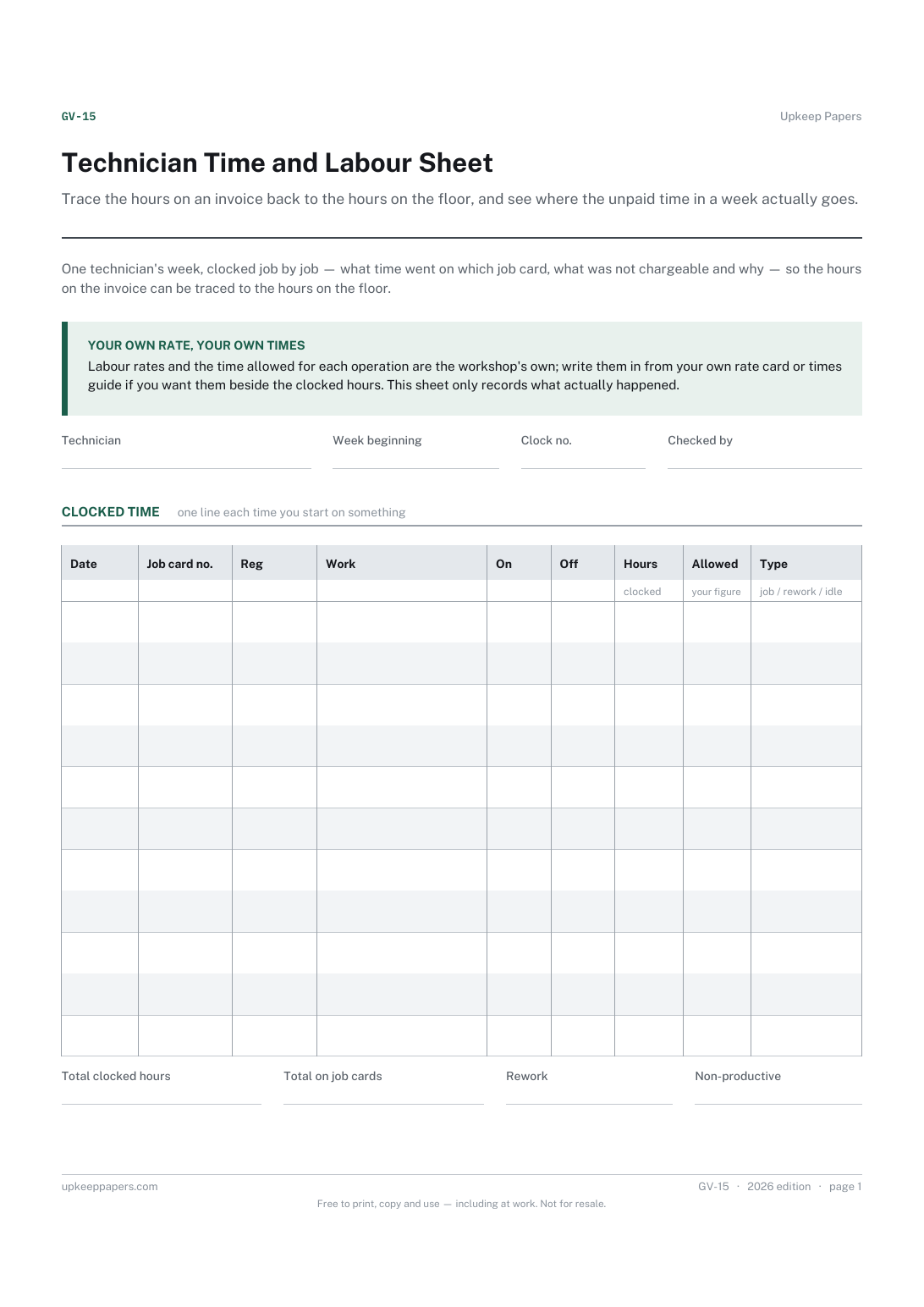
Trace the hours on an invoice back to the hours on the floor, and see where the unpaid time in a week actually goes.
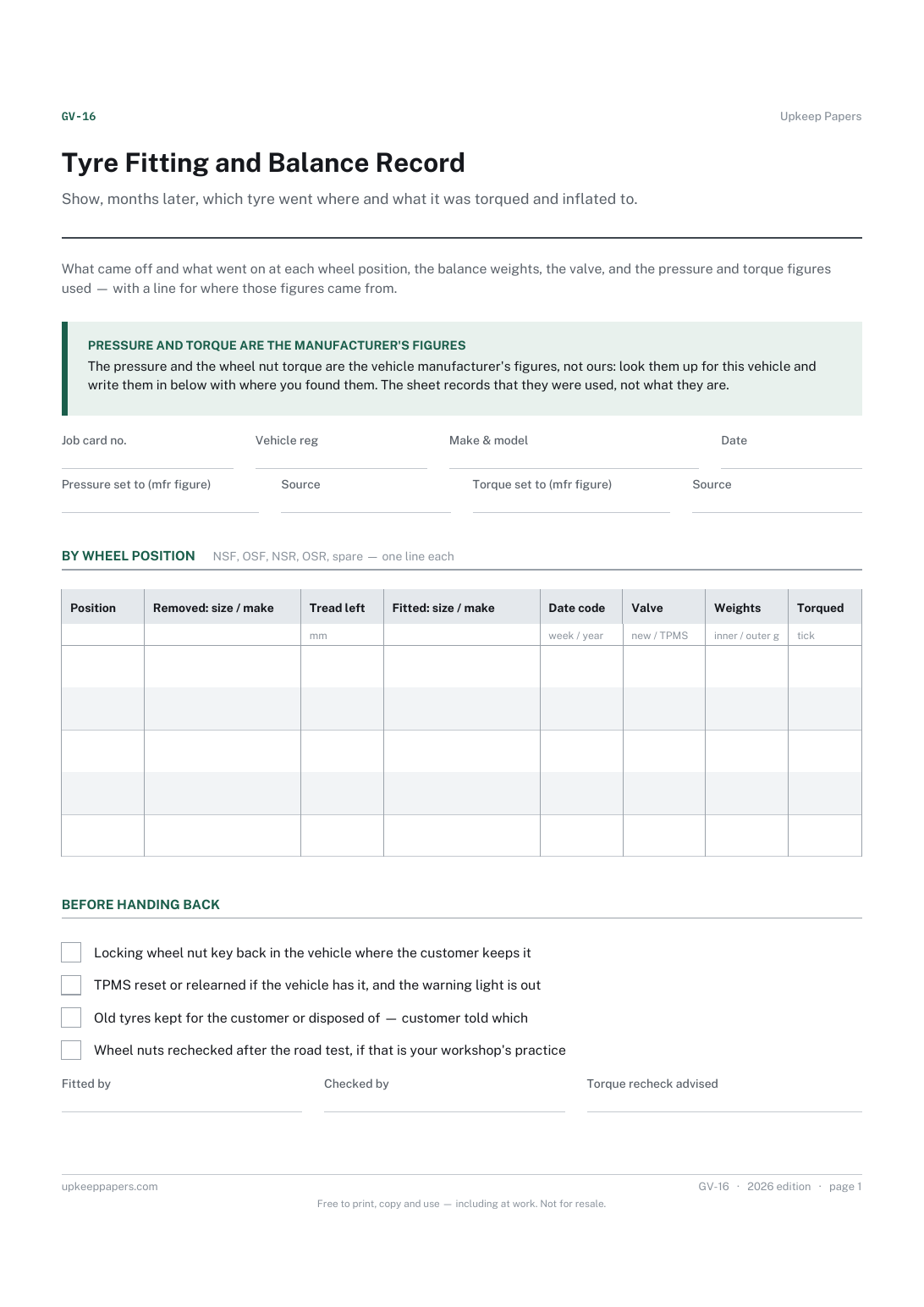
Show, months later, which tyre went where and what it was torqued and inflated to. The source of those figures is on the sheet too.
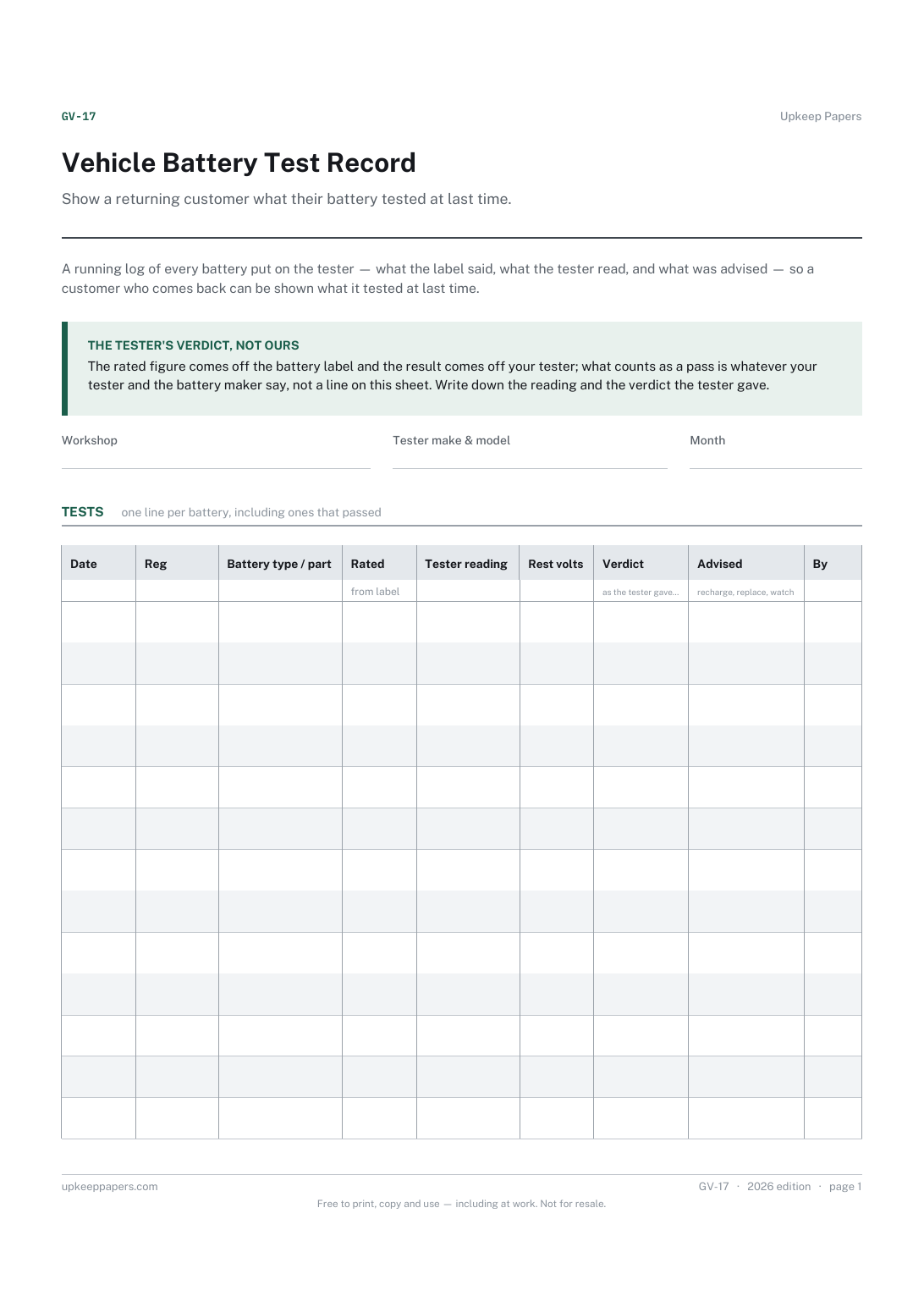
Show a returning customer what their battery tested at last time. Keep a record of the advice given whether or not they took it.
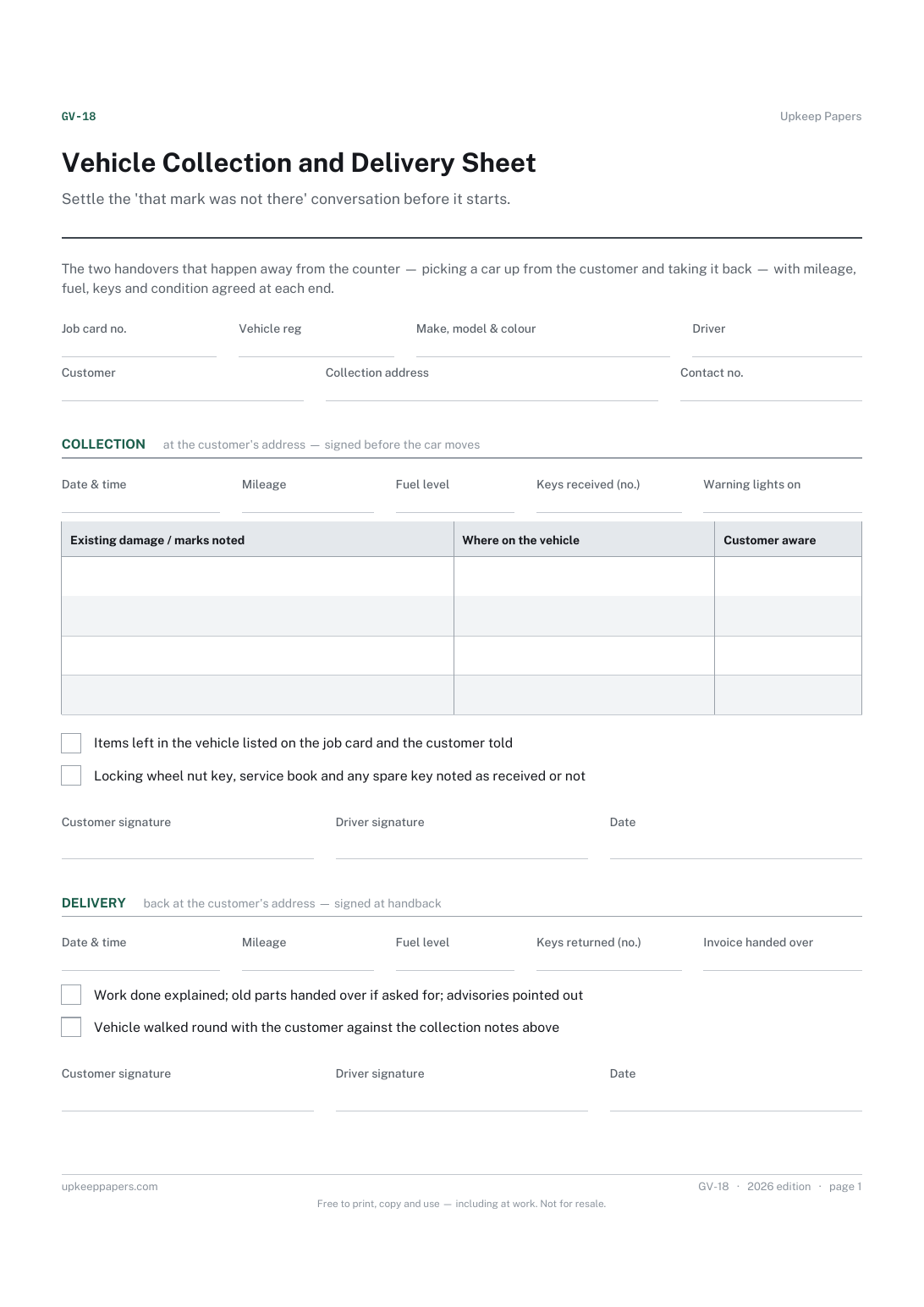
Settle the 'that mark was not there' conversation before it starts. Mileage and fuel level are proved at both ends of a collection.
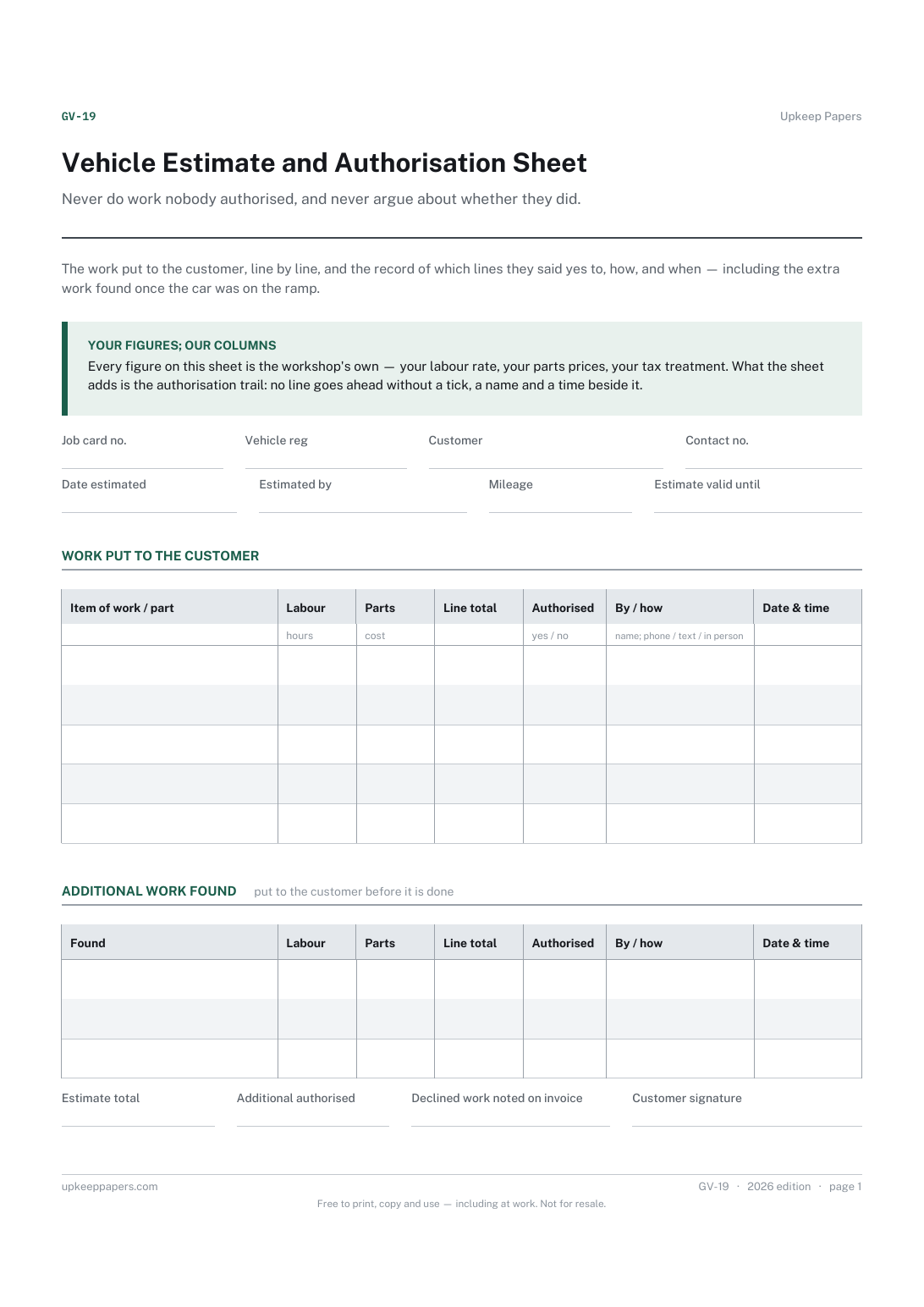
Never do work nobody authorised, and never argue about whether they did. Every line carries a tick, a name and a time.
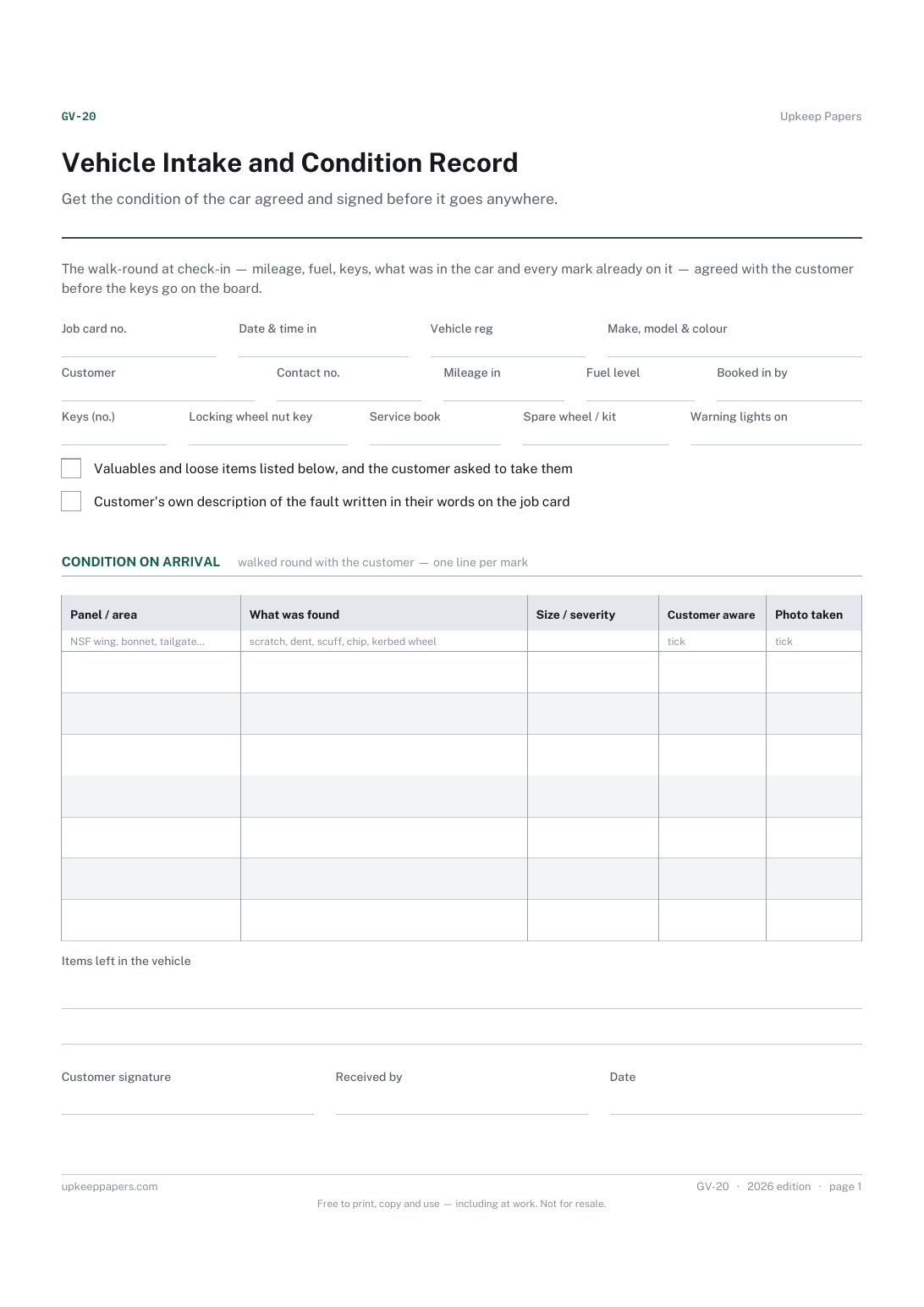
Get the condition of the car agreed and signed before it goes anywhere. A scratch found at handback then has a record to be checked against.
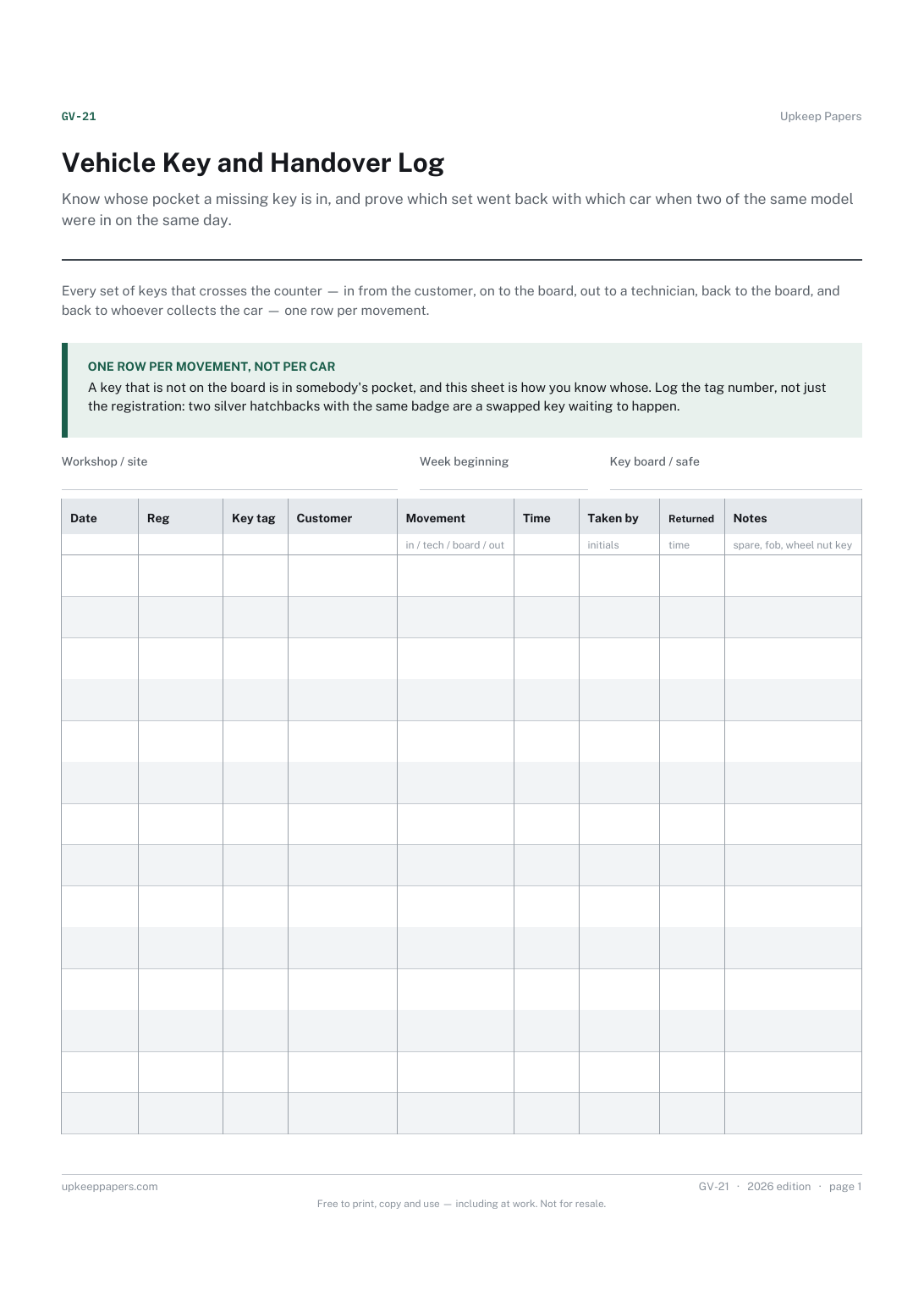
Know whose pocket a missing key is in, and prove which set went back with which car when two of the same model were in on the same day.
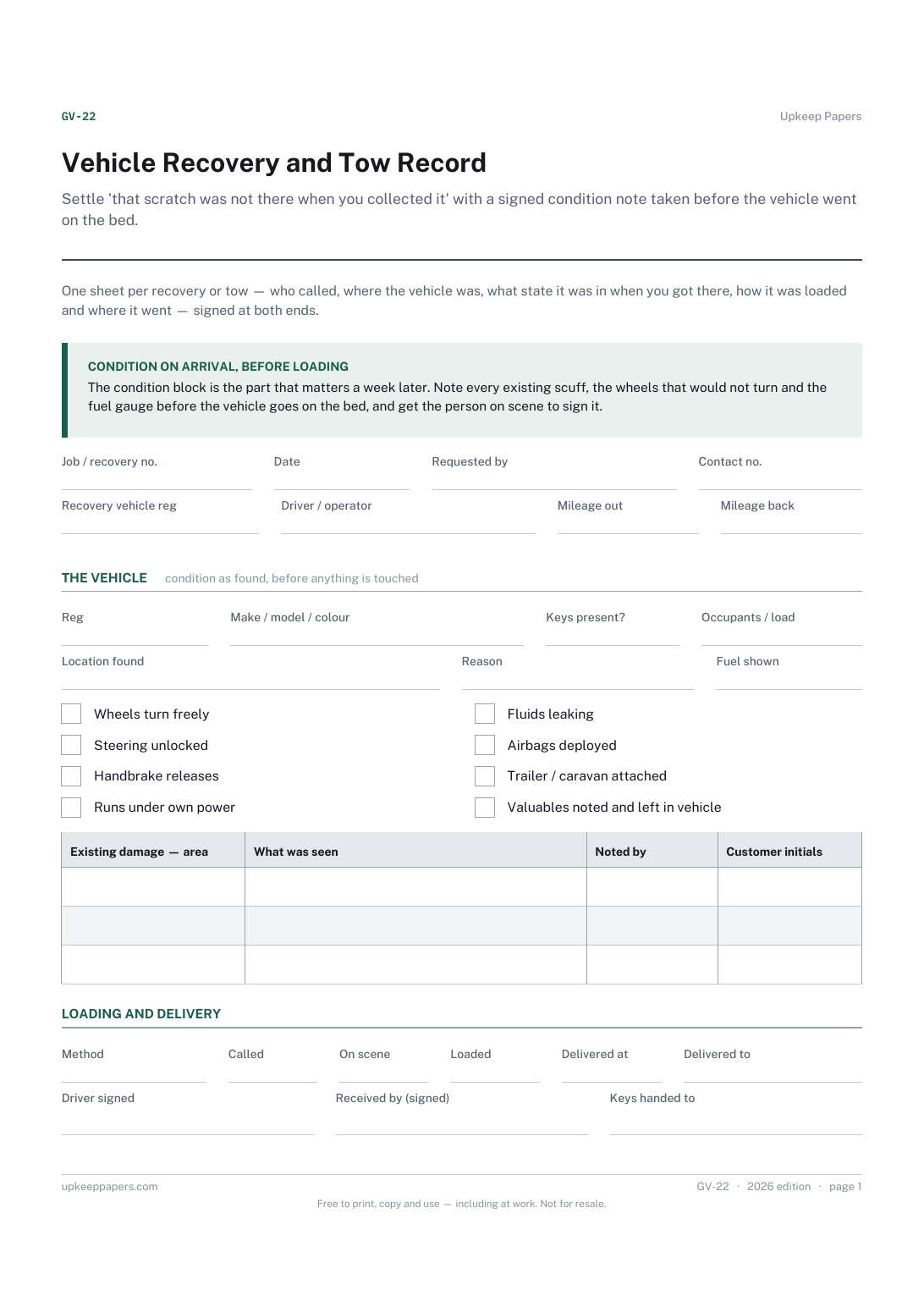
Settle 'that scratch was not there when you collected it' with a signed condition note taken before the vehicle went on the bed.
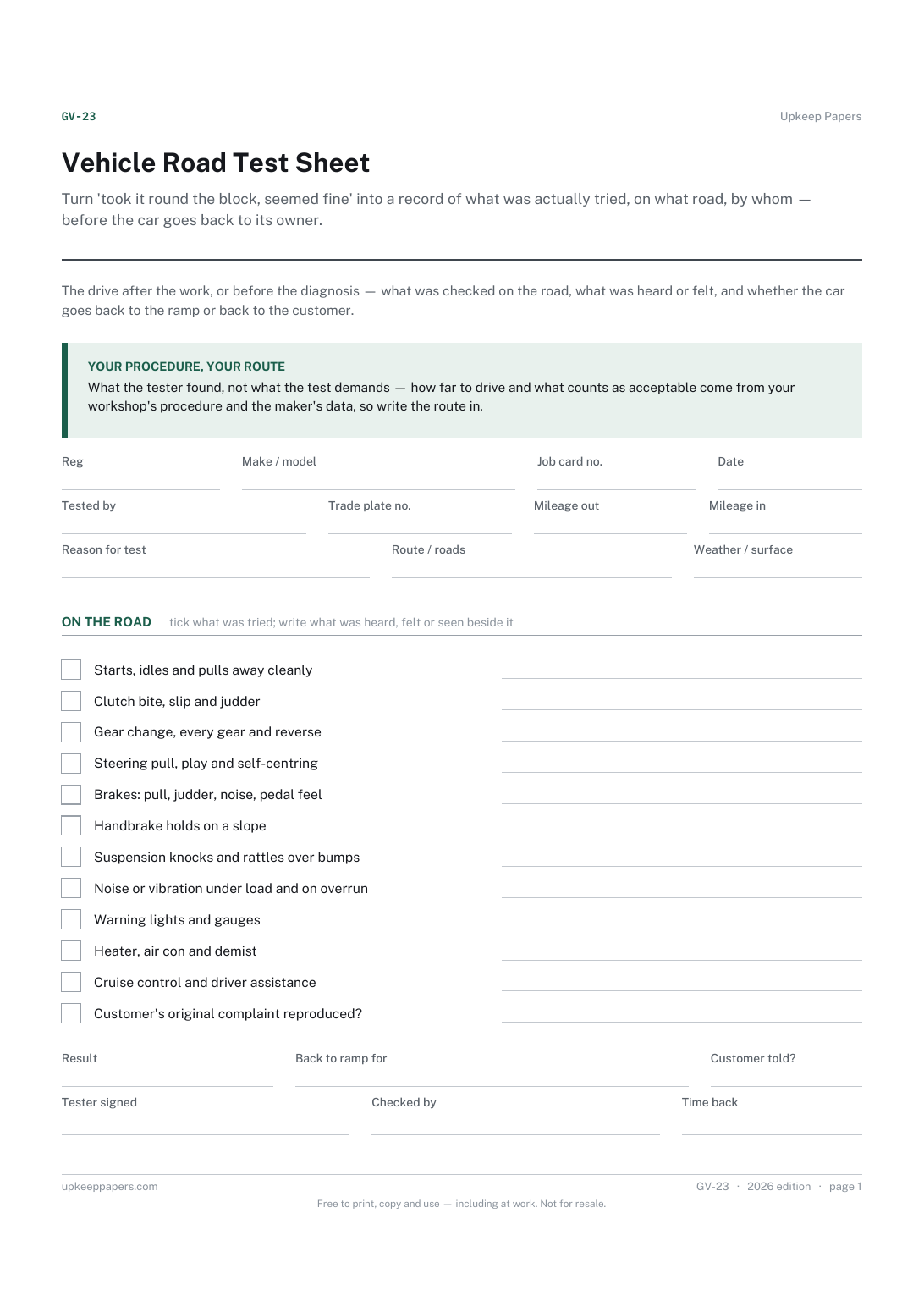
Turn 'took it round the block, seemed fine' into a record of what was actually tried, on what road, by whom — before the car goes back to its owner.
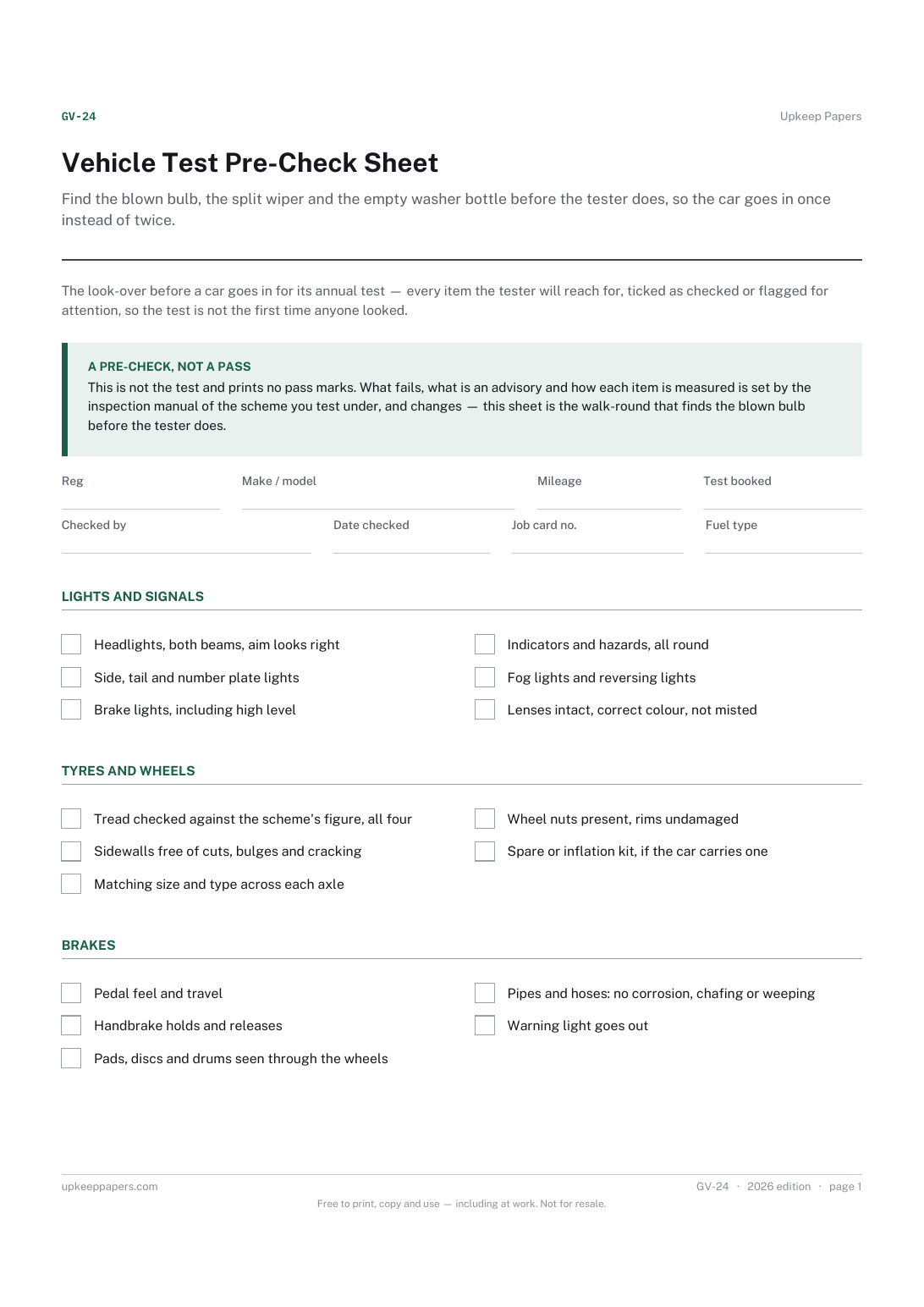
Find the blown bulb, the split wiper and the empty washer bottle before the tester does, so the car goes in once instead of twice.
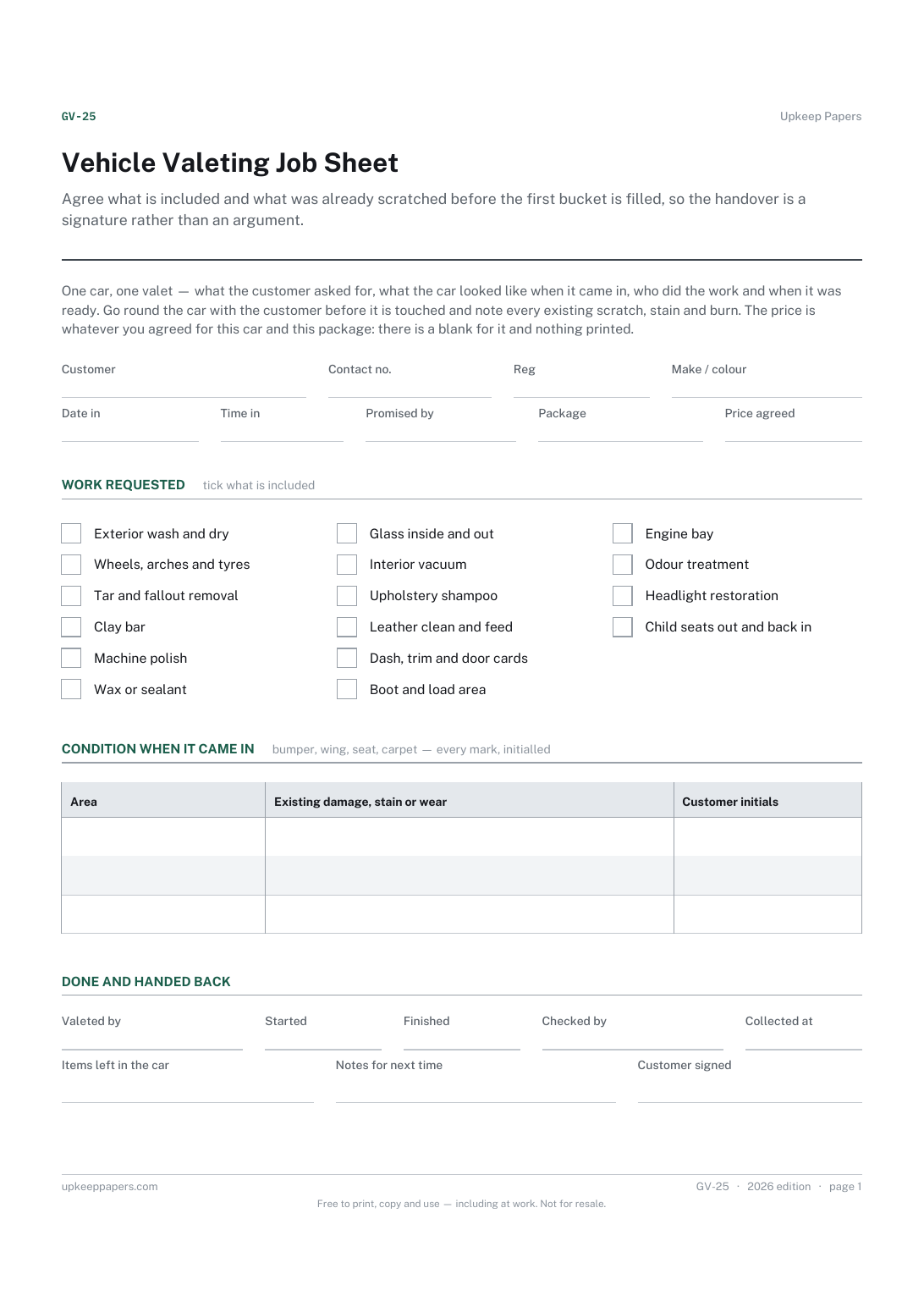
Agree what is included and what was already scratched before the first bucket is filled, so the handover is a signature rather than an argument.
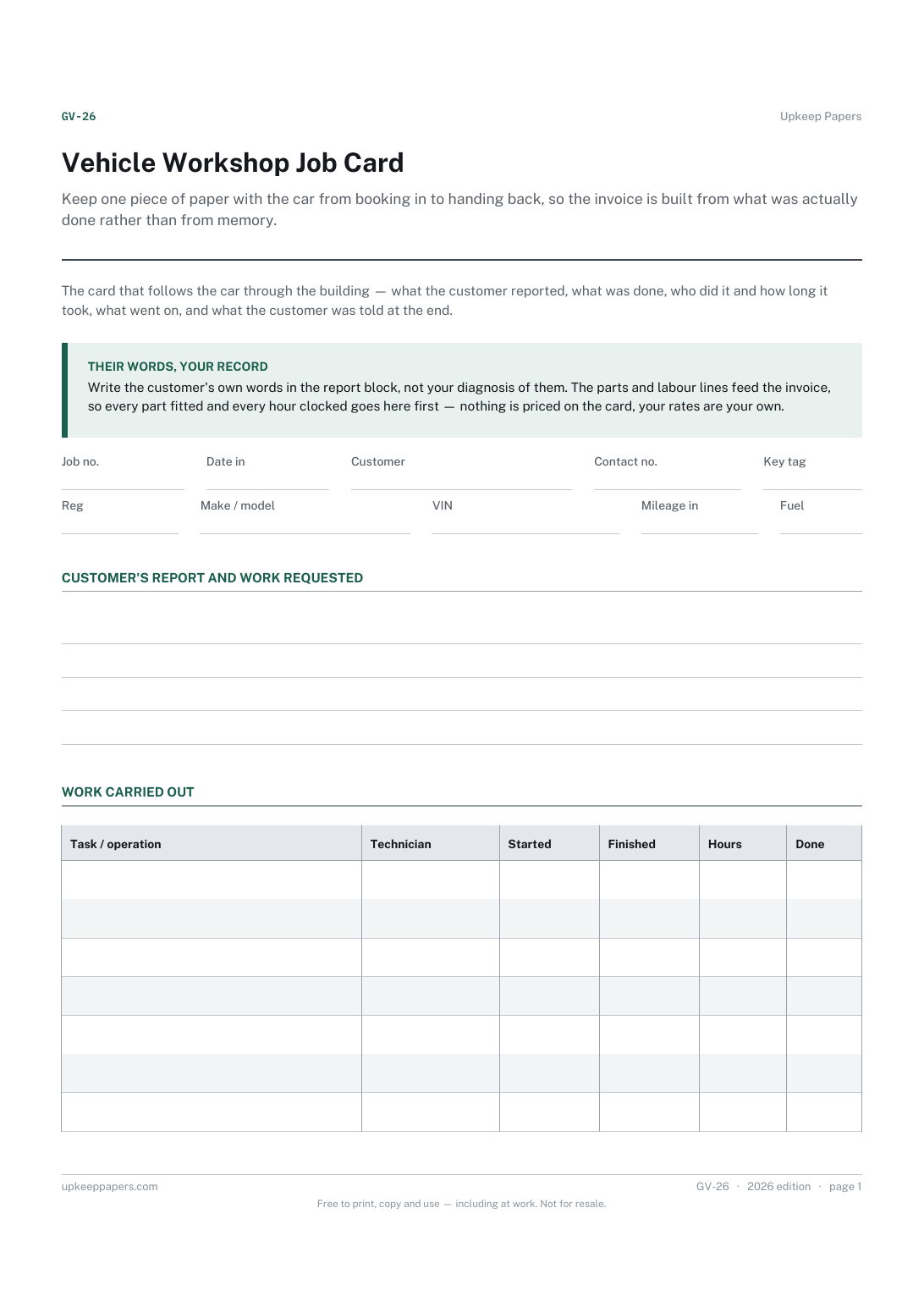
Keep one piece of paper with the car from booking in to handing back, so the invoice is built from what was actually done rather than from memory.
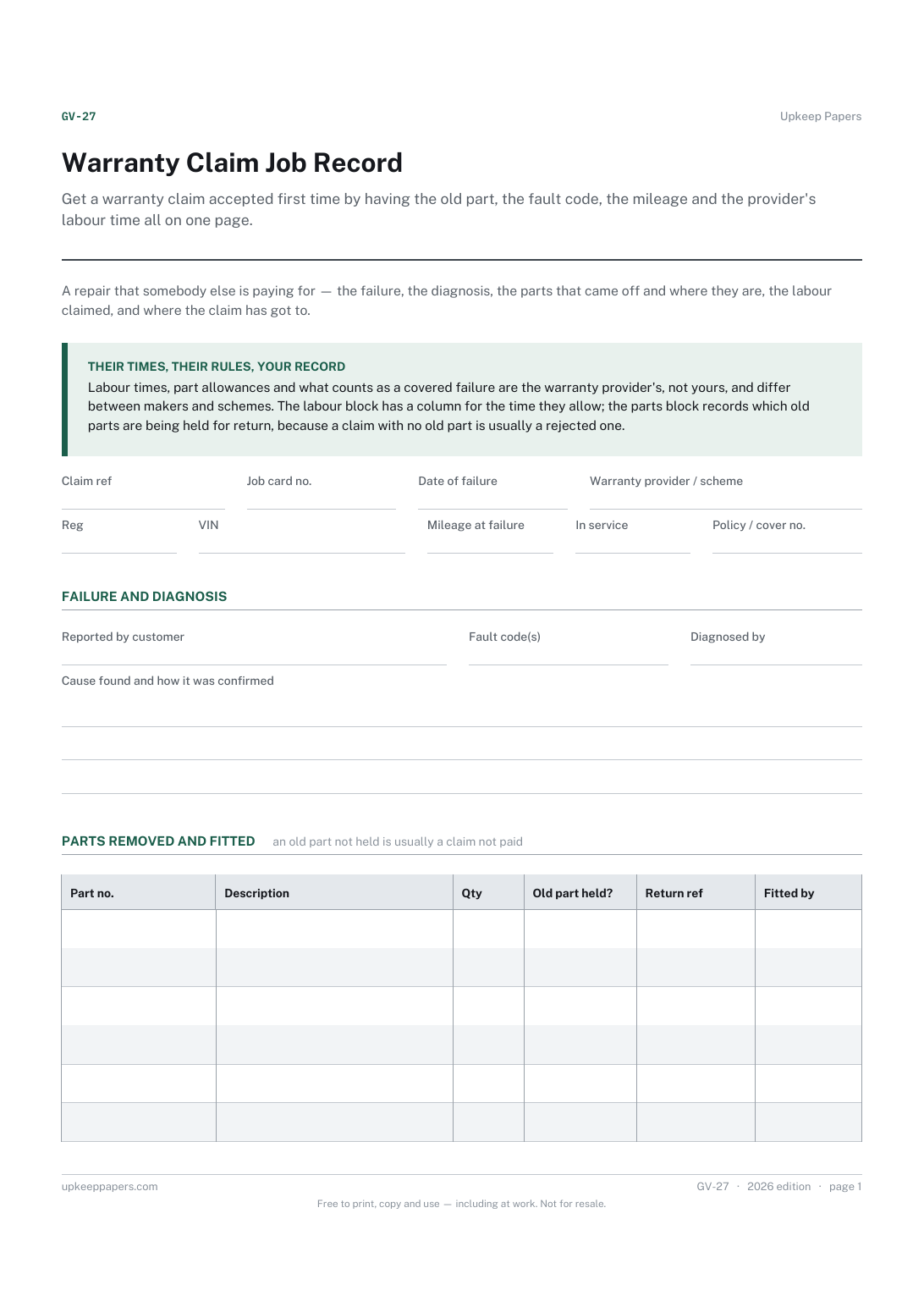
Get a warranty claim accepted first time by having the old part, the fault code, the mileage and the provider's labour time all on one page.
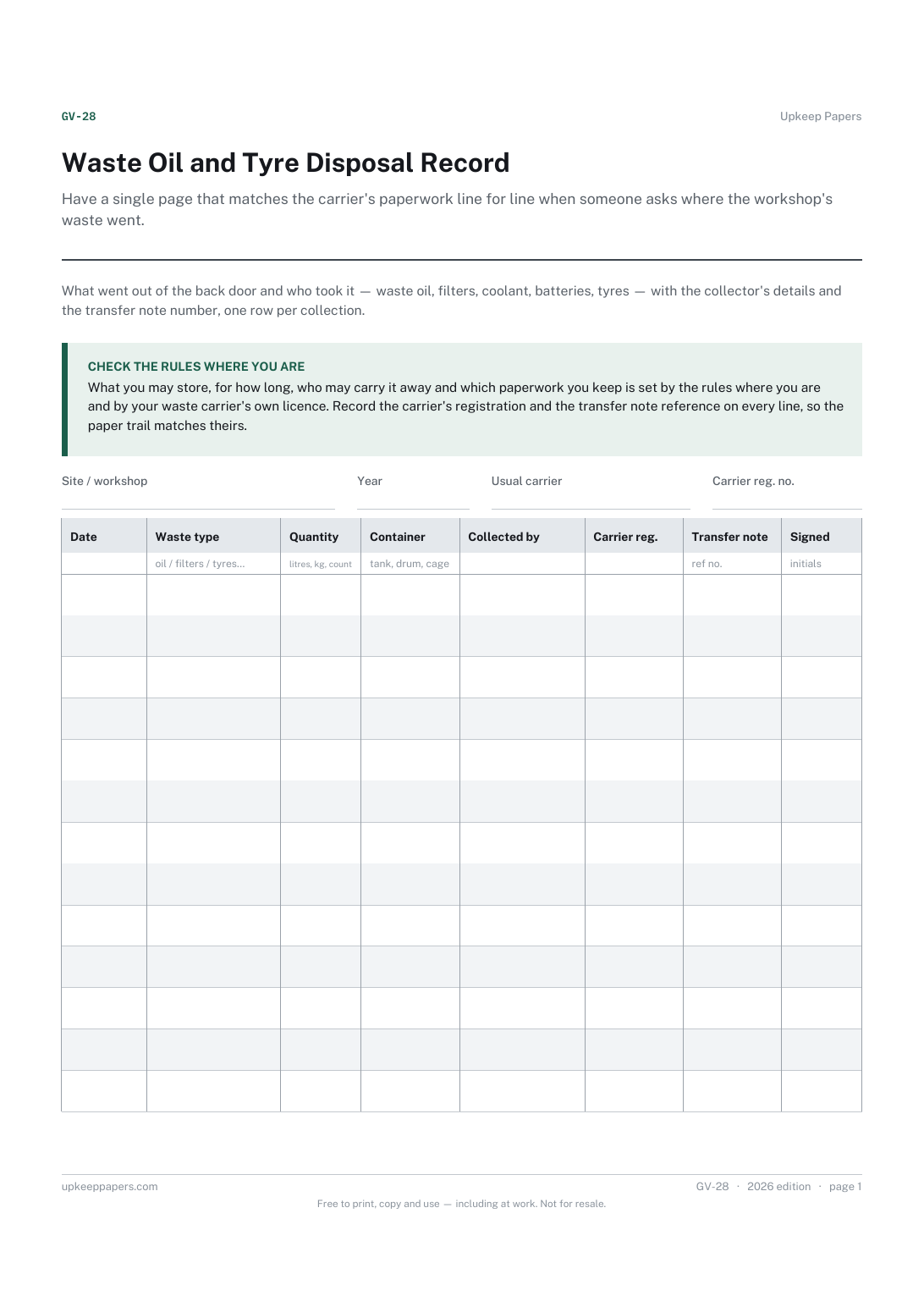
Have a single page that matches the carrier's paperwork line for line when someone asks where the workshop's waste went.
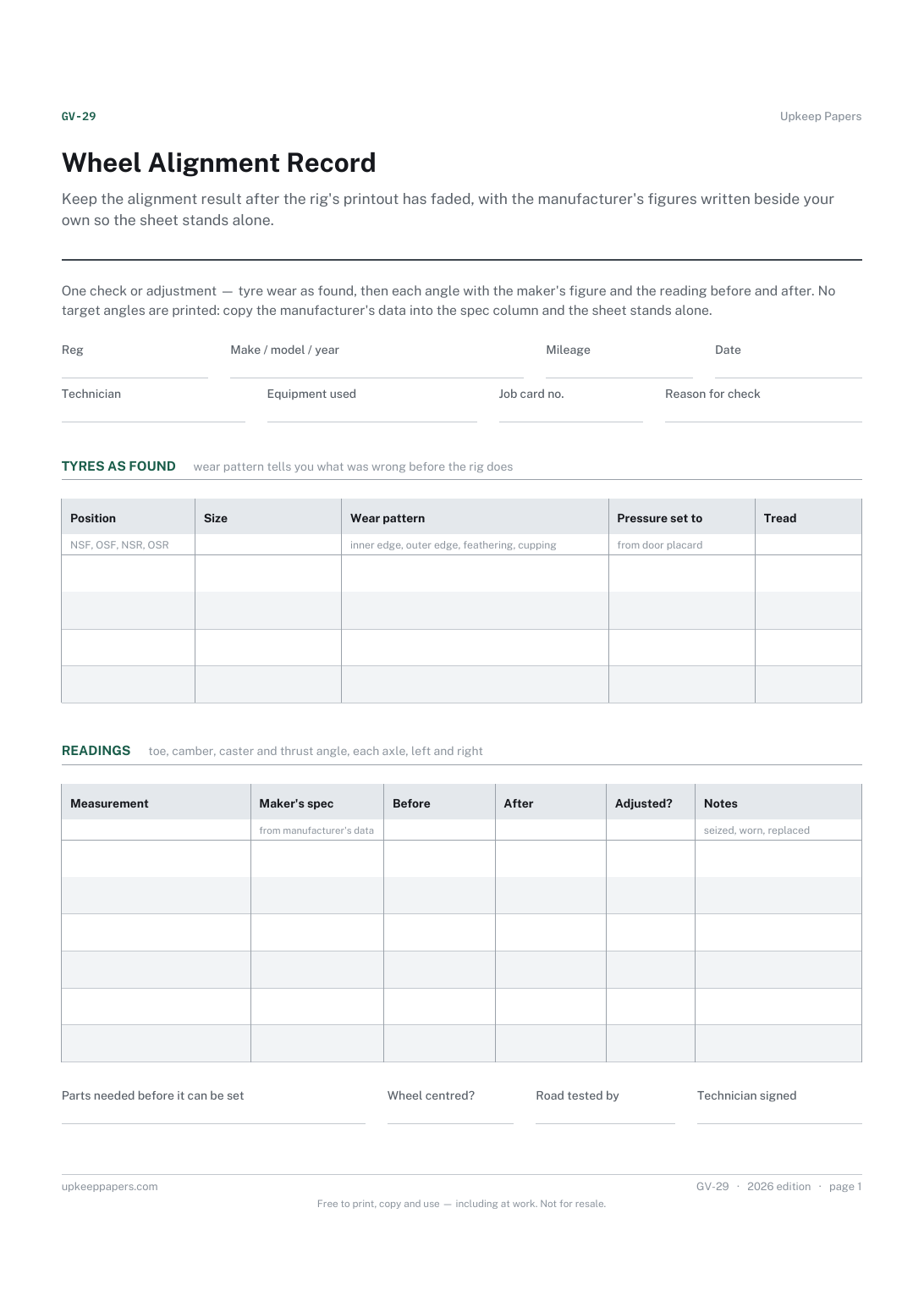
Keep the alignment result after the rig's printout has faded, with the manufacturer's figures written beside your own so the sheet stands alone.
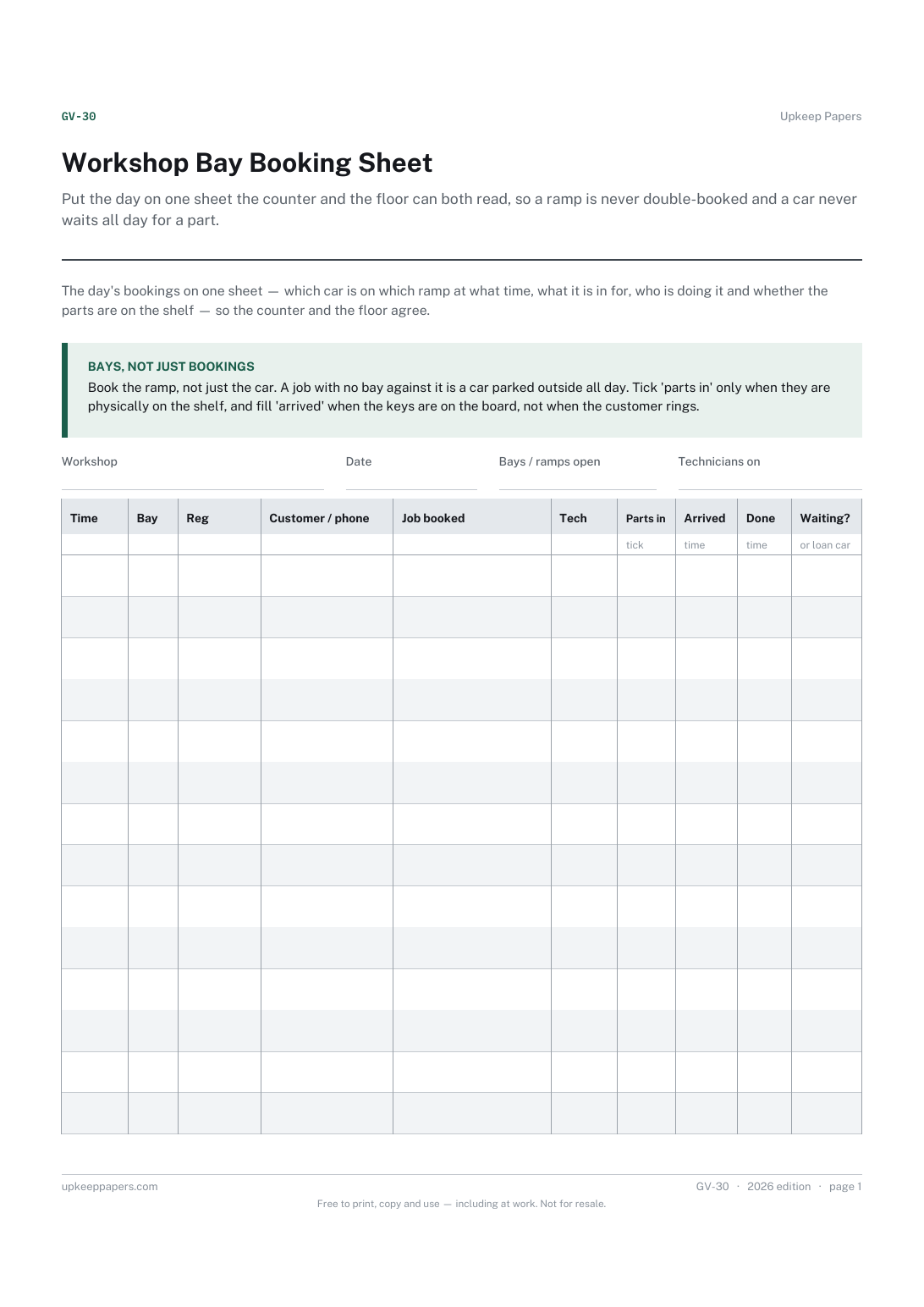
Put the day on one sheet the counter and the floor can both read, so a ramp is never double-booked and a car never waits all day for a part.
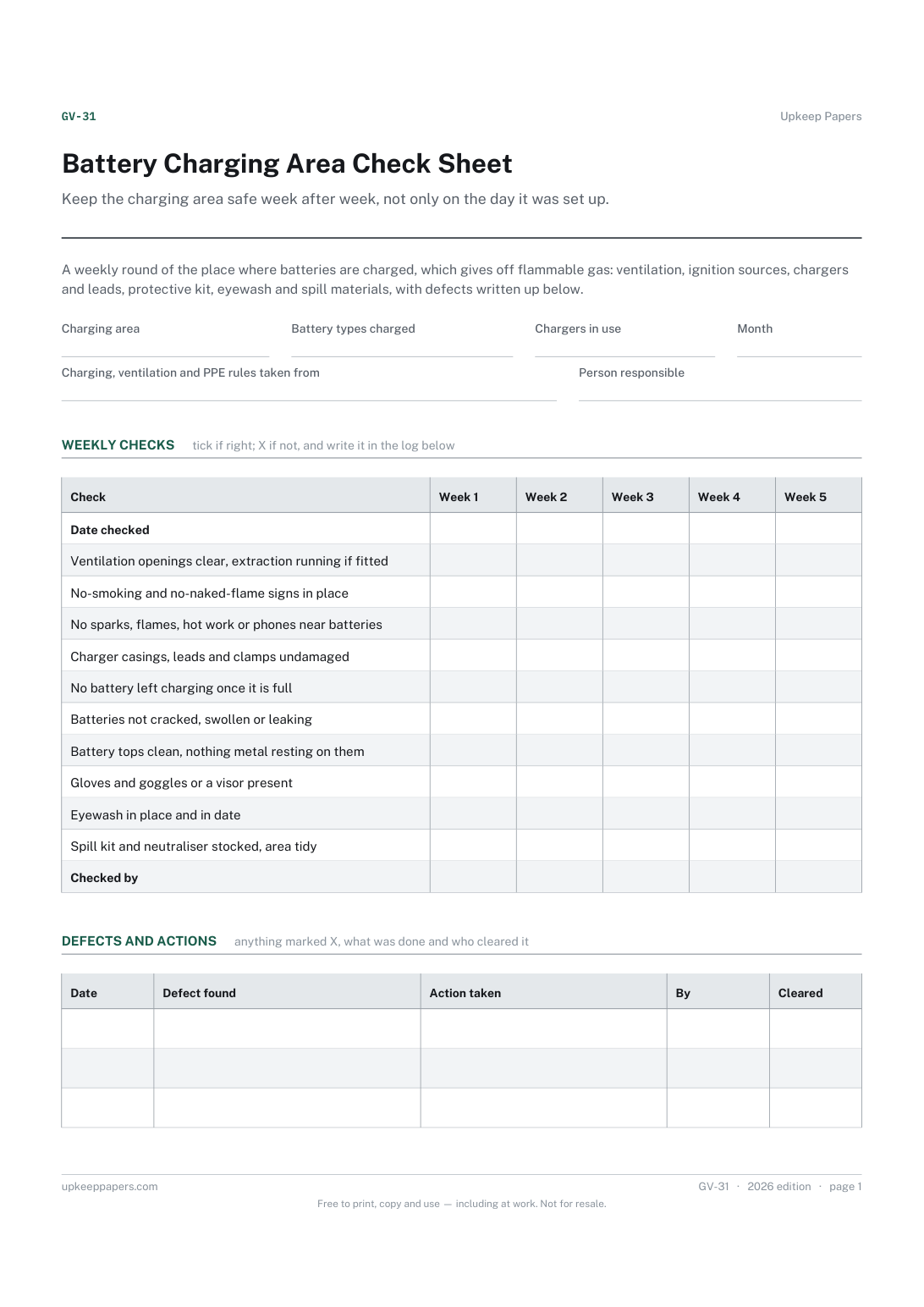
Keep the charging area safe week after week, not only on the day it was set up. Charging gives off a flammable gas, so ventilation and ignition sources come first.
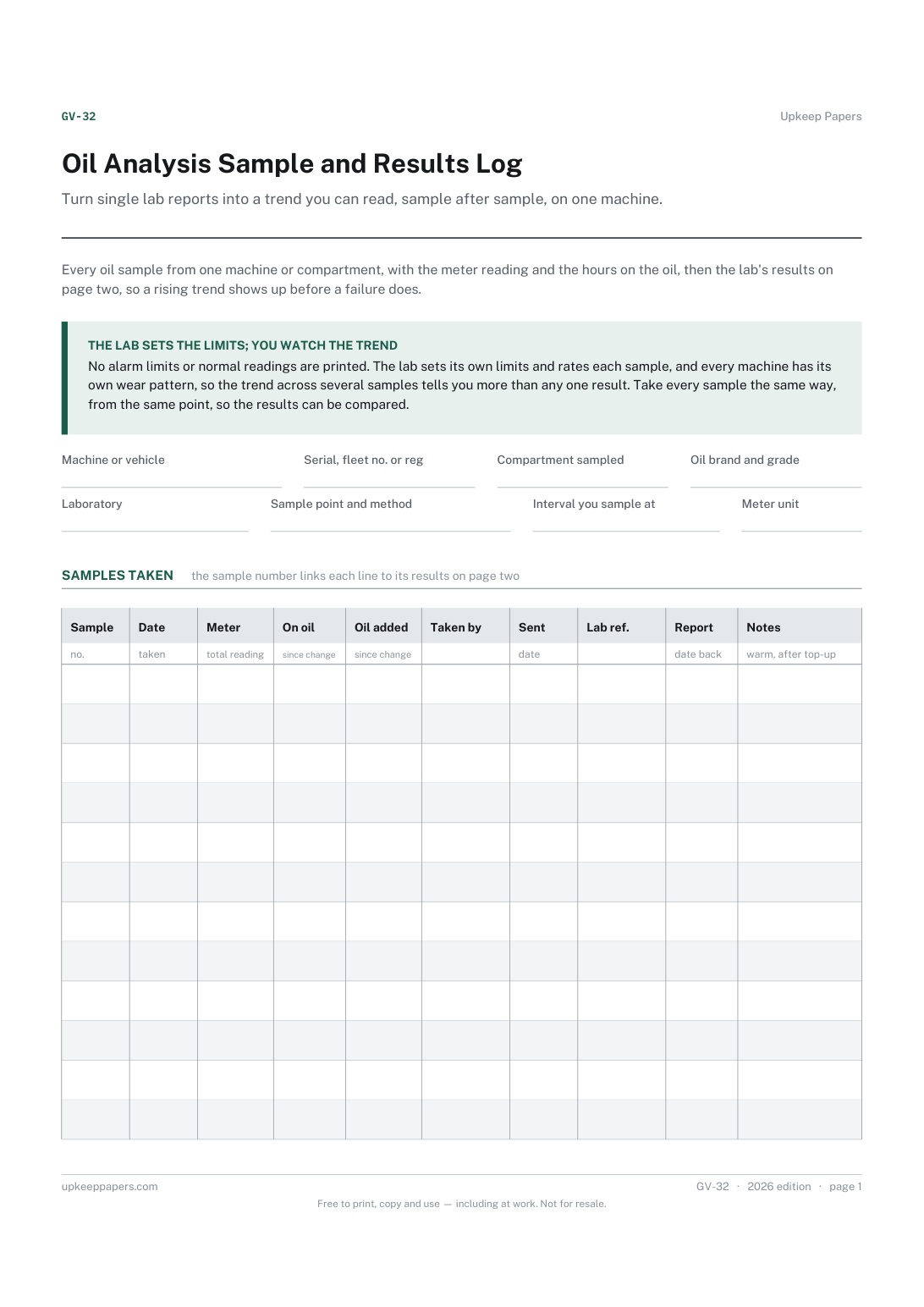
Turn single lab reports into a trend you can read, sample after sample, on one machine. A rising wear metal or a trace of coolant is far easier to spot against its own history.
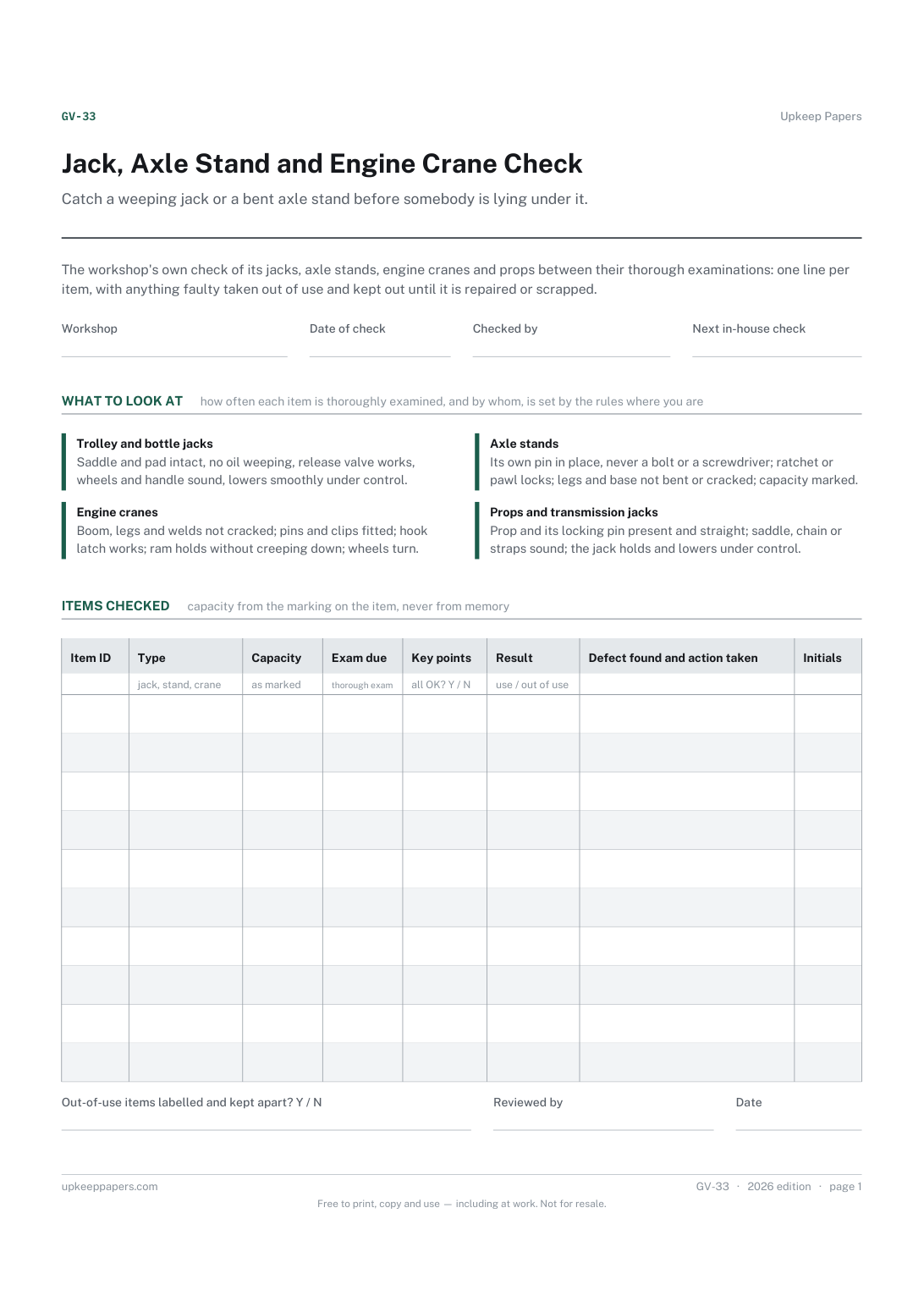
Catch a weeping jack or a bent axle stand before somebody is lying under it. Each item gets a line, so anything taken out of use is on record and stays out of use.
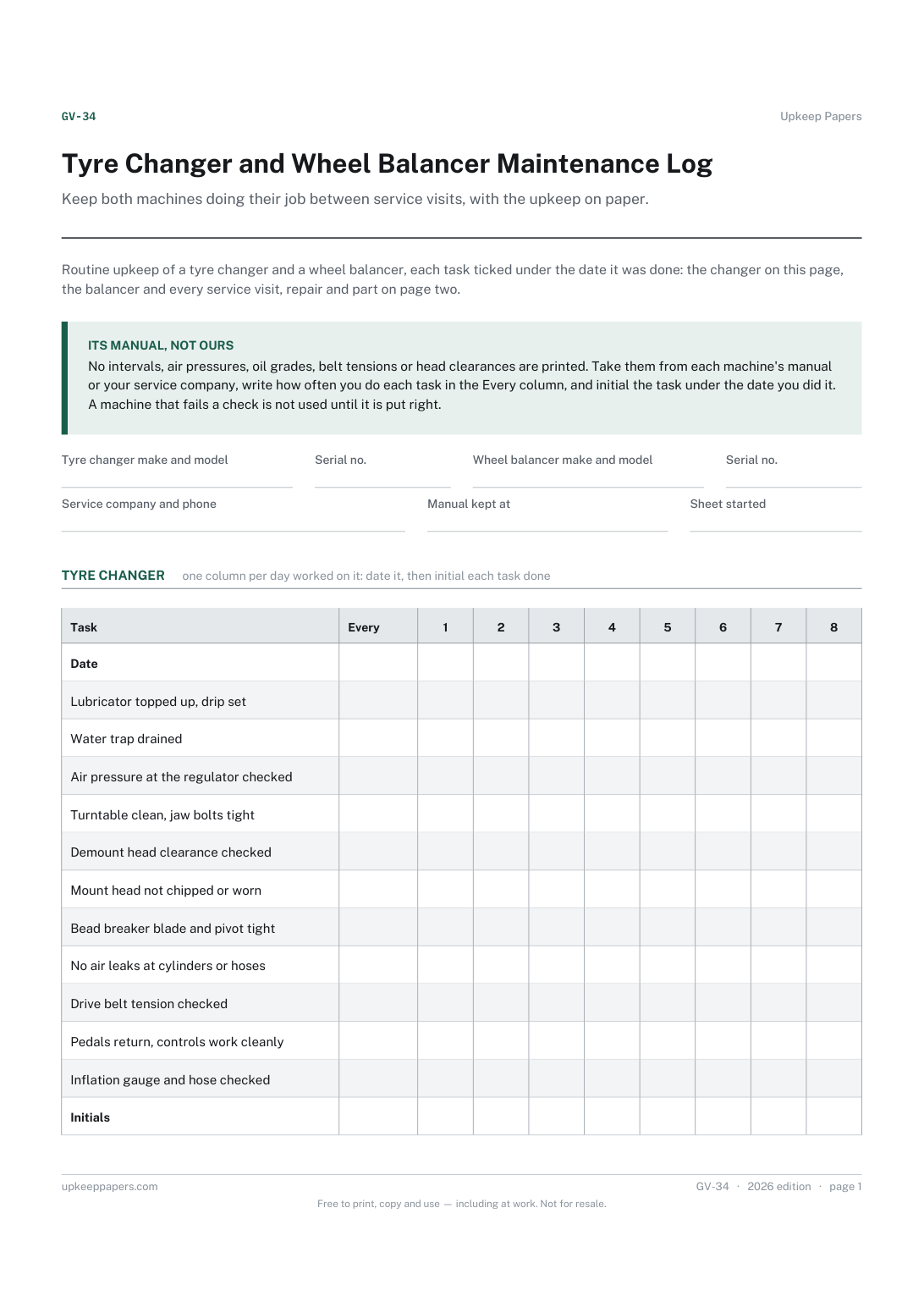
Keep both machines doing their job between service visits, with the upkeep on paper. A dry lubricator or a balancer out of calibration shows in the work long before anyone checks the machine.
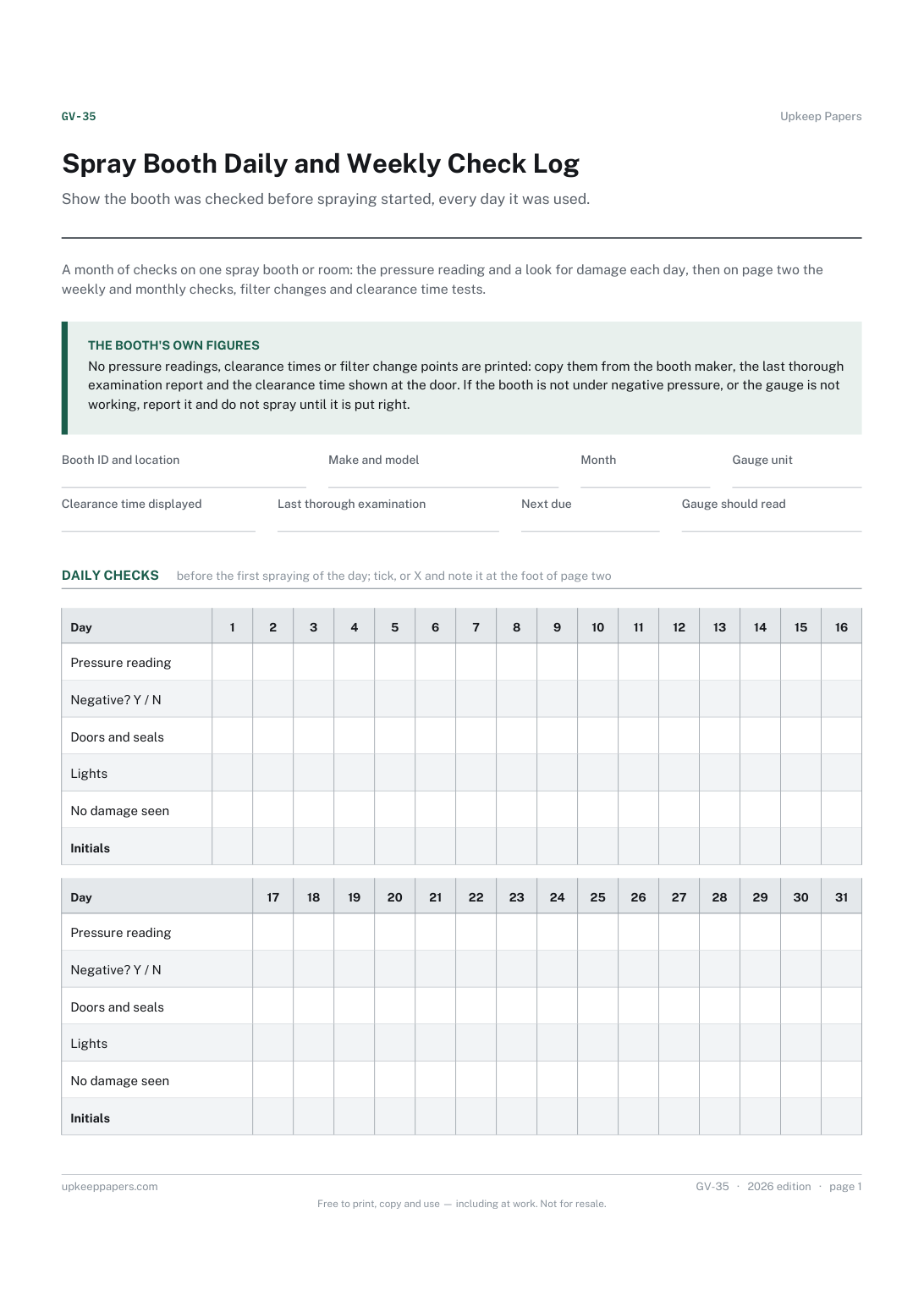
Show the booth was checked before spraying started, every day it was used. Negative pressure and clean filters are what keep the overspray inside the booth.
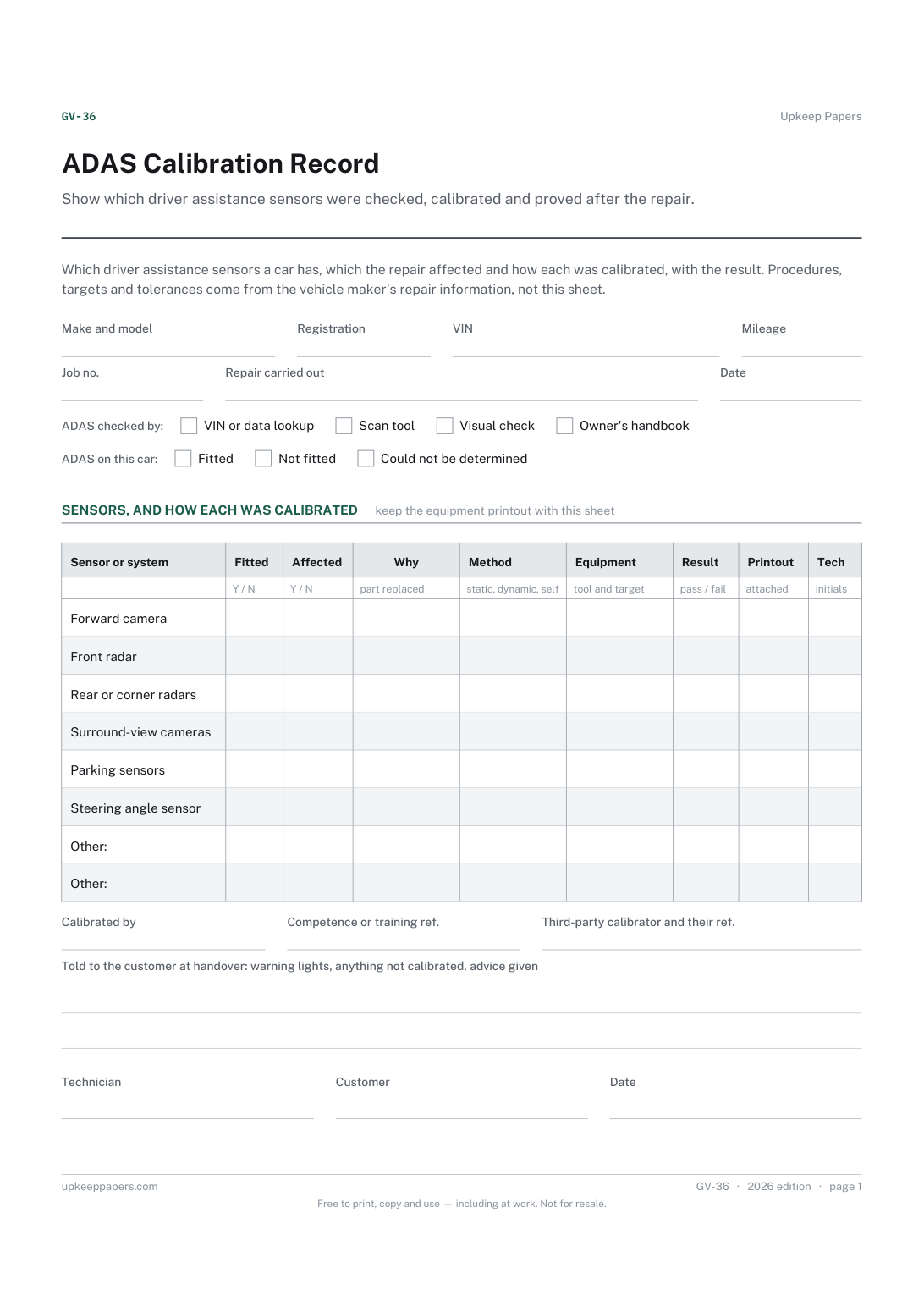
Show which driver assistance sensors were checked, calibrated and proved after the repair. The sheet stays with the job, with the equipment printout attached.
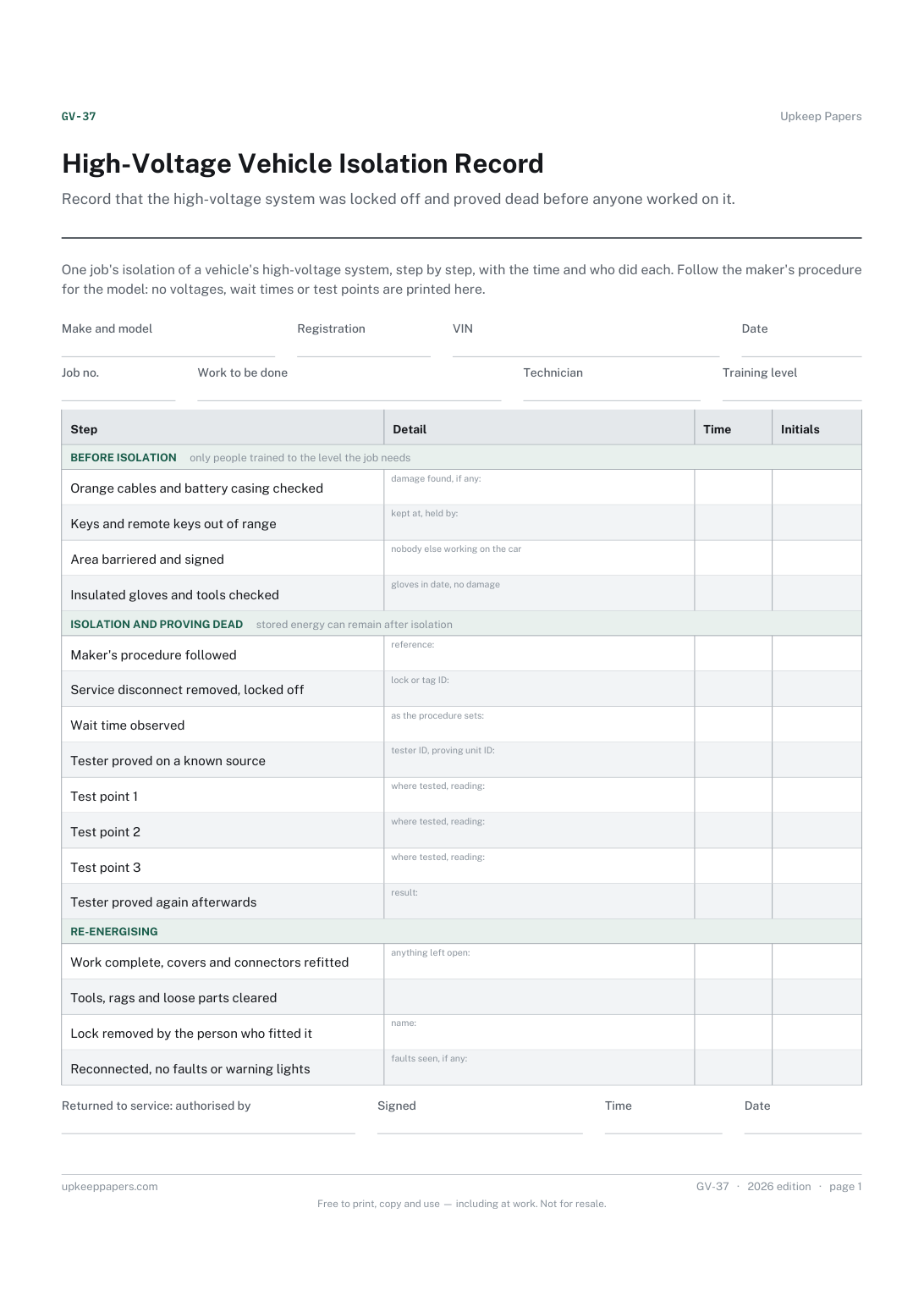
Record that the high-voltage system was locked off and proved dead before anyone worked on it. It also records that the system was put back safely, by whom and when.
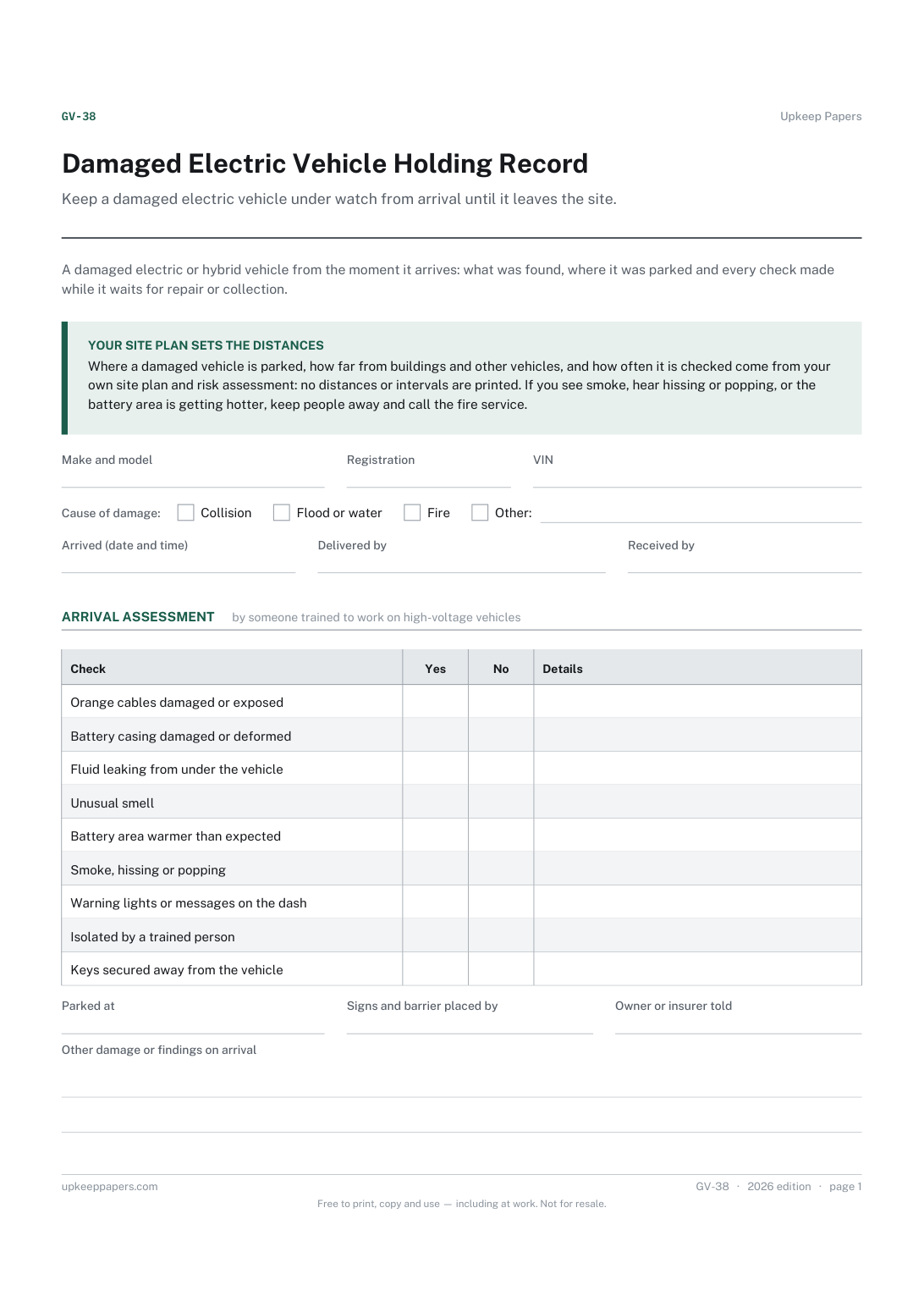
Keep a damaged electric vehicle under watch from arrival until it leaves the site. A damaged battery can get worse after the event, so every check is written down.
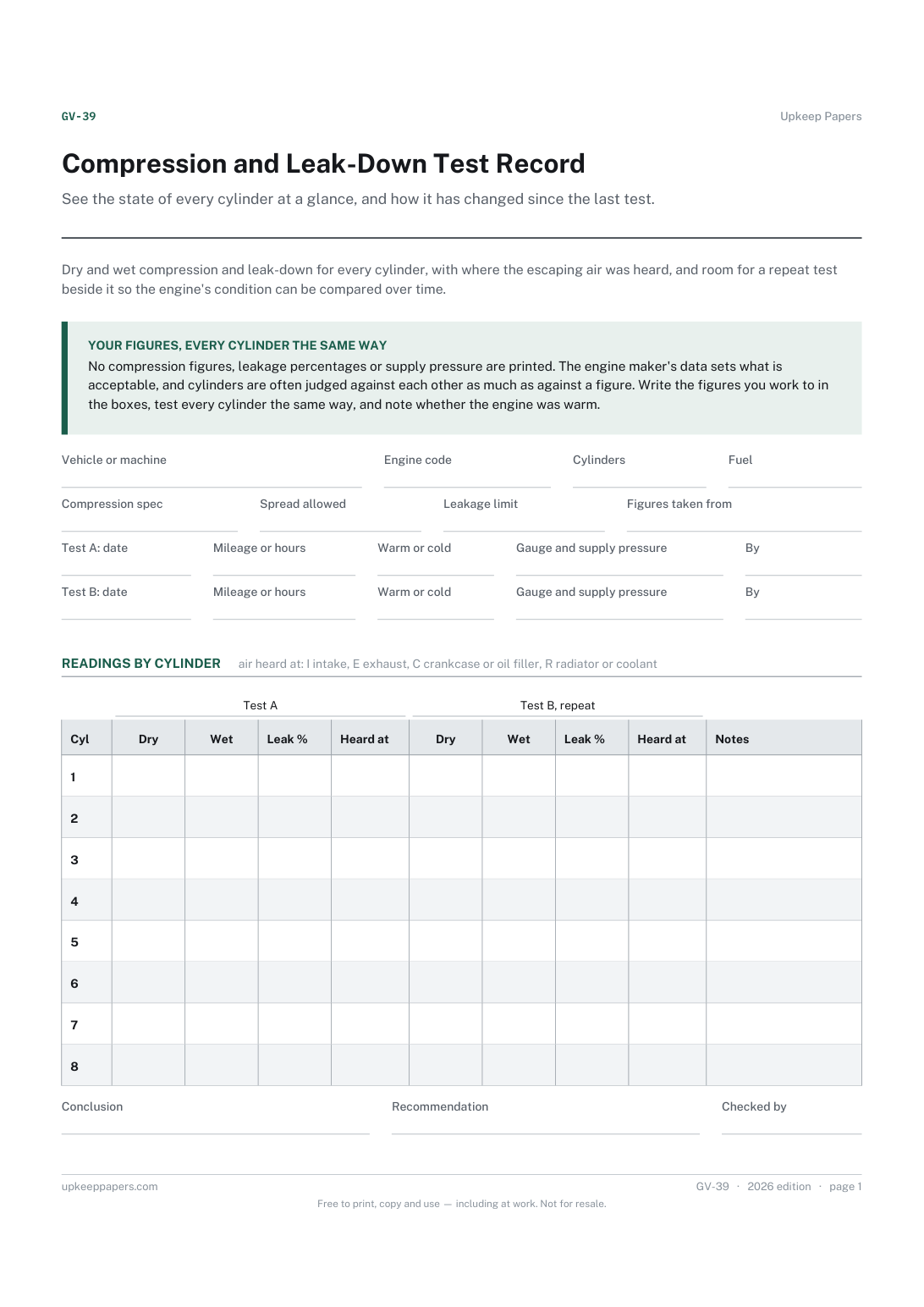
See the state of every cylinder at a glance, and how it has changed since the last test. A low reading means more once you know where the air is escaping.
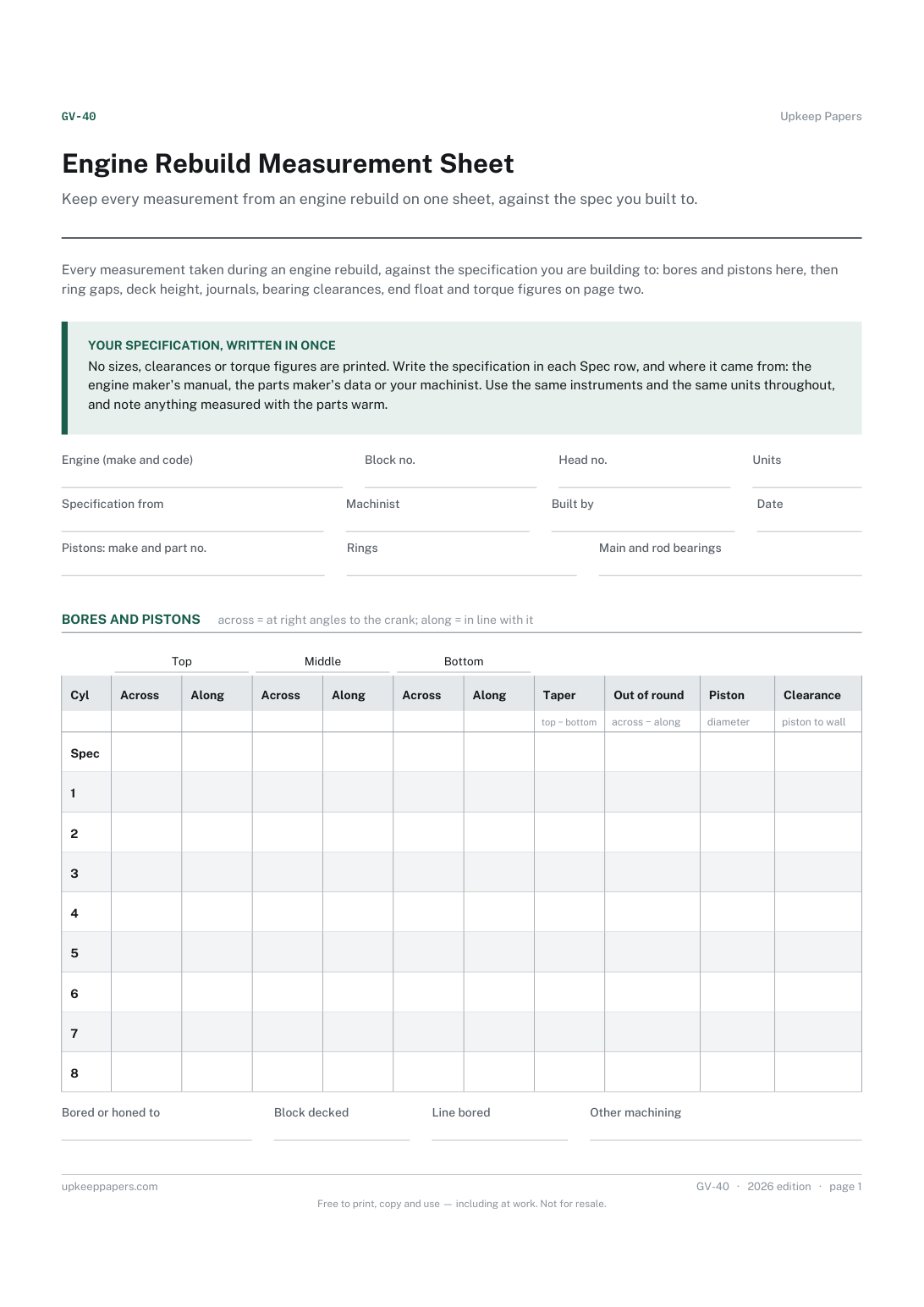
Keep every measurement from an engine rebuild on one sheet, against the spec you built to. The figures are the proof the engine was built right, and the starting point if it ever comes apart again.
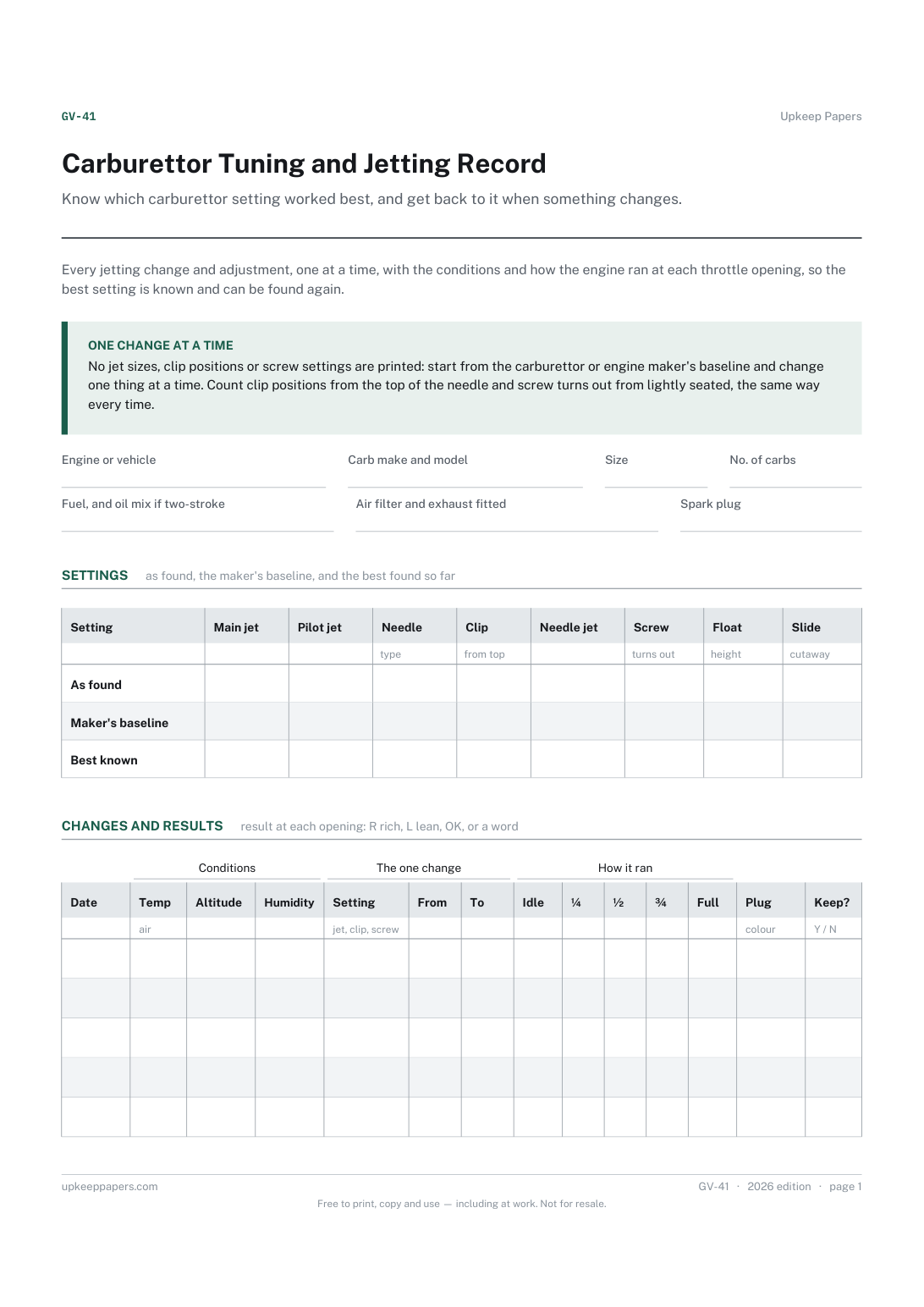
Know which carburettor setting worked best, and get back to it when something changes. One change per line, with the conditions, shows what each change actually did.
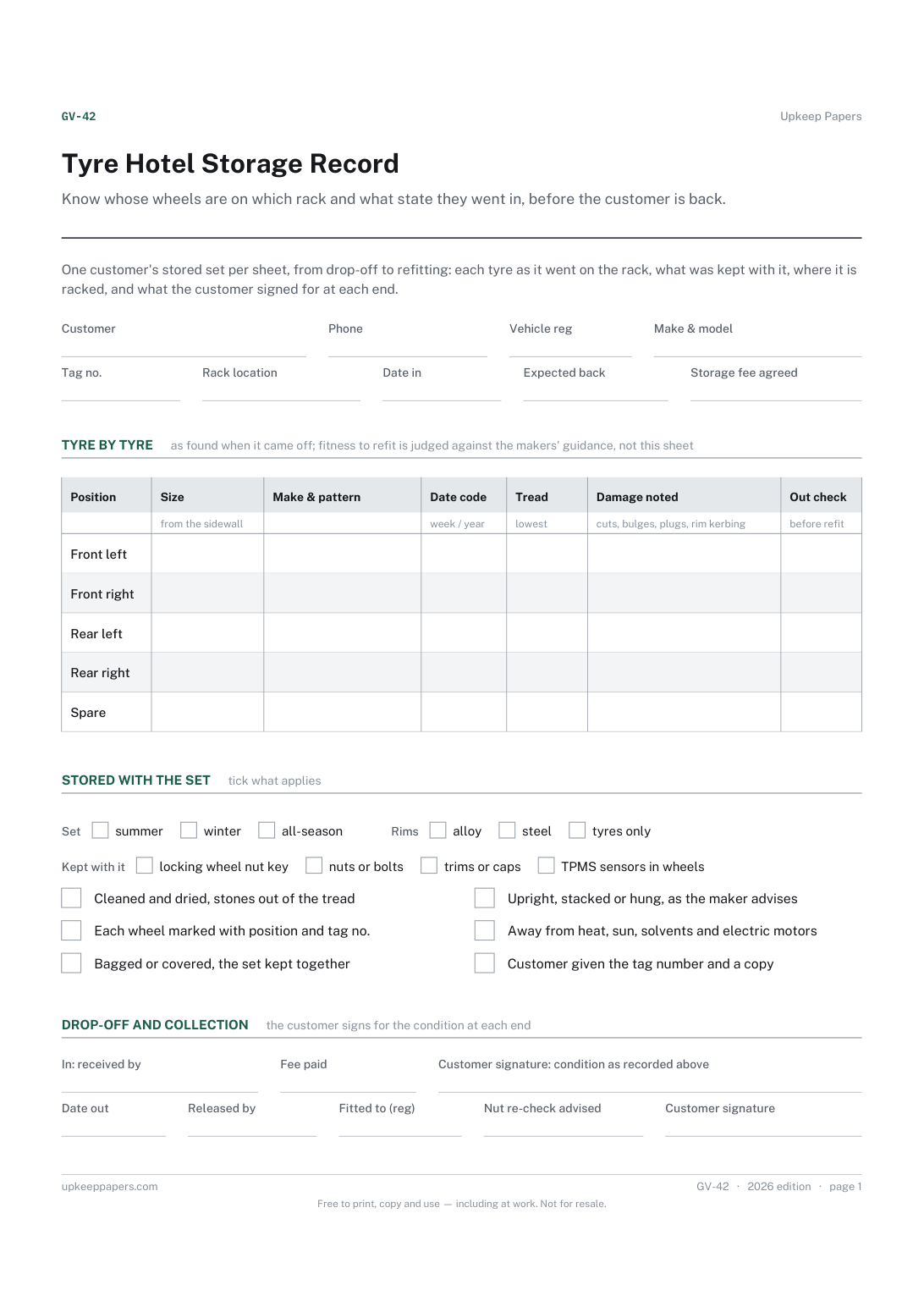
Know whose wheels are on which rack and what state they went in, before the customer is back. A condition signed for at drop-off is what answers a question about a kerbed rim six months later.
Shifts, runs, checks and hours — for the people whose office is a vehicle.
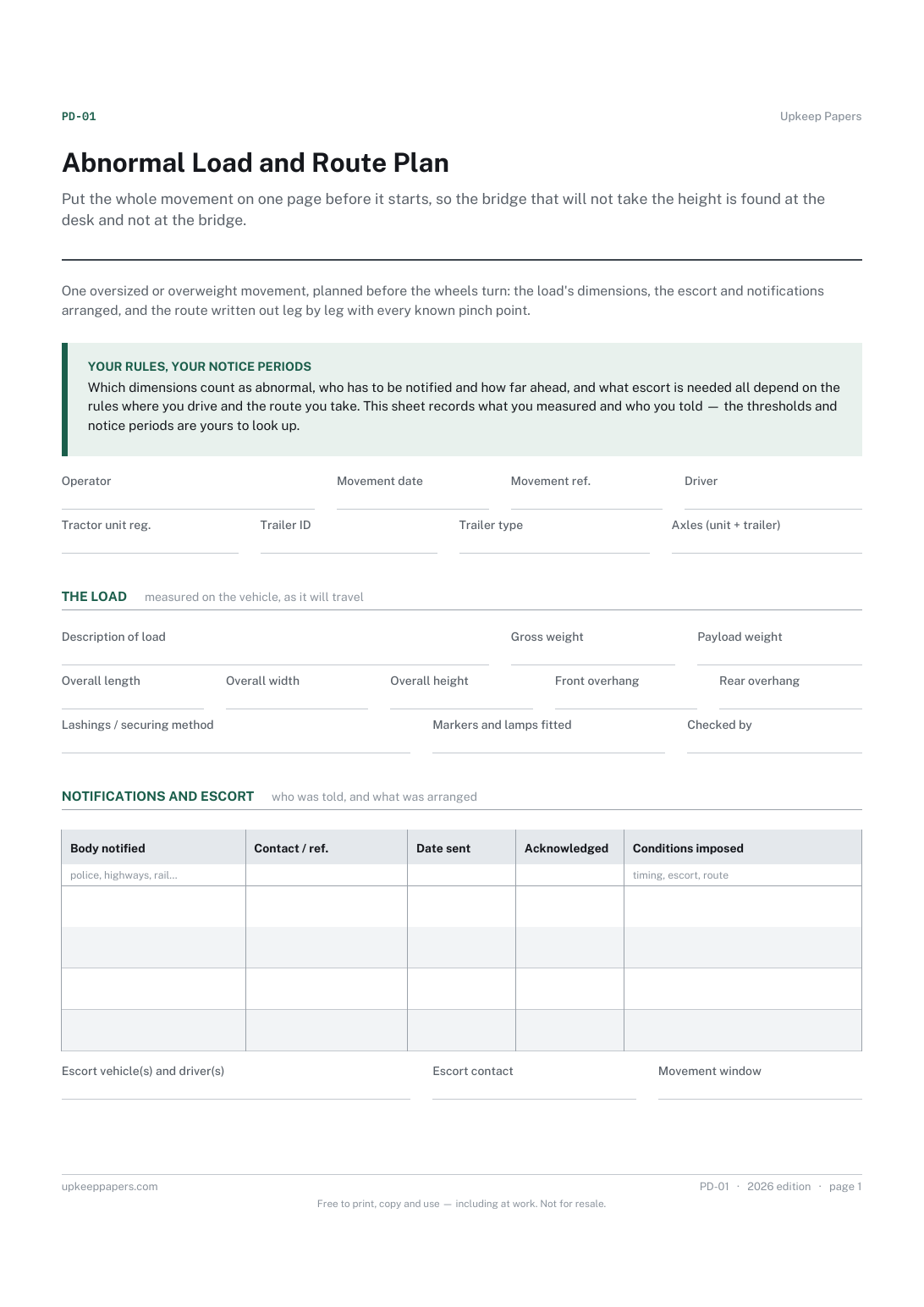
Put the whole movement on one page before it starts, so the bridge that will not take the height is found at the desk and not at the bridge.
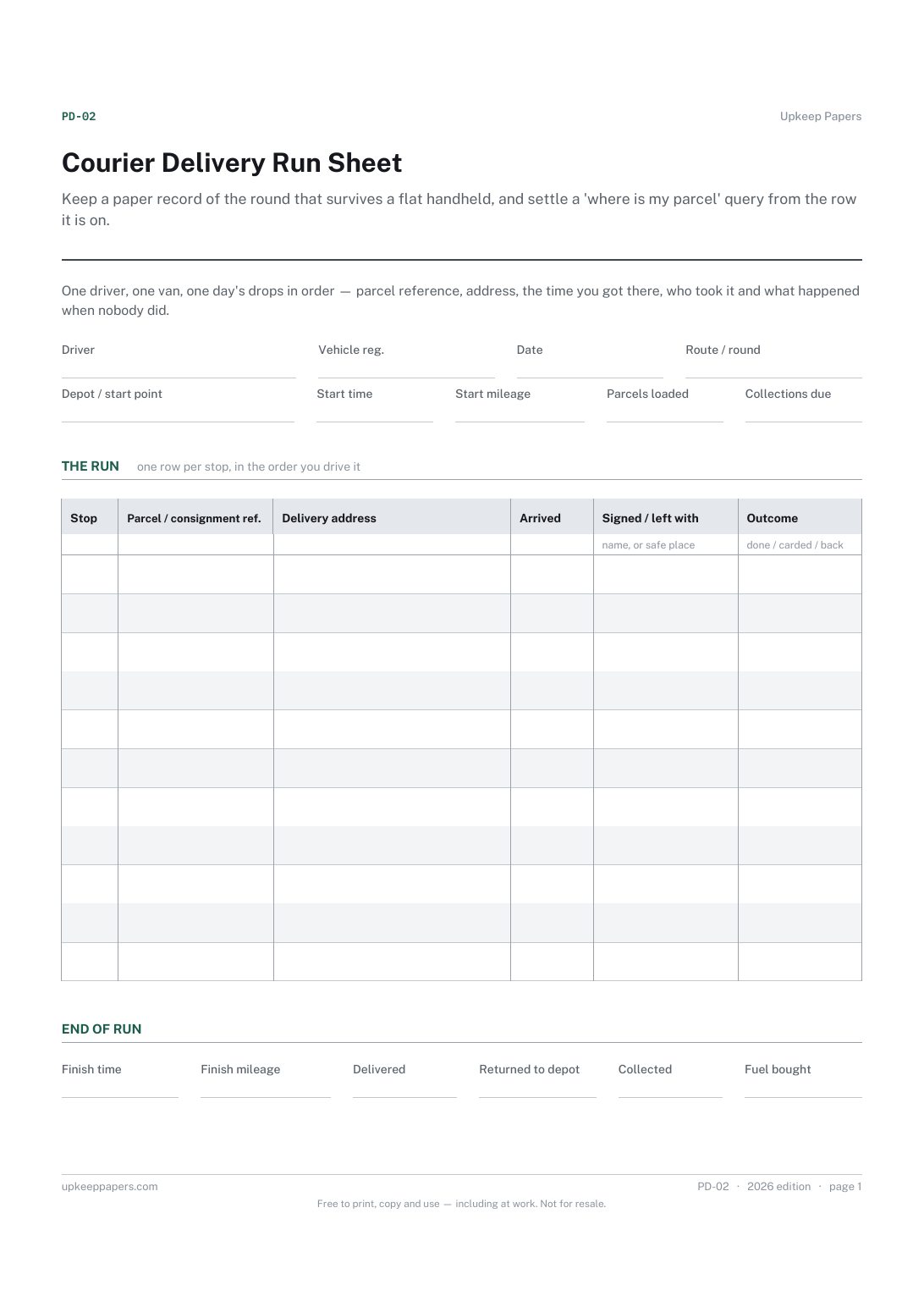
Keep a paper record of the round that survives a flat handheld, and settle a 'where is my parcel' query from the row it is on.
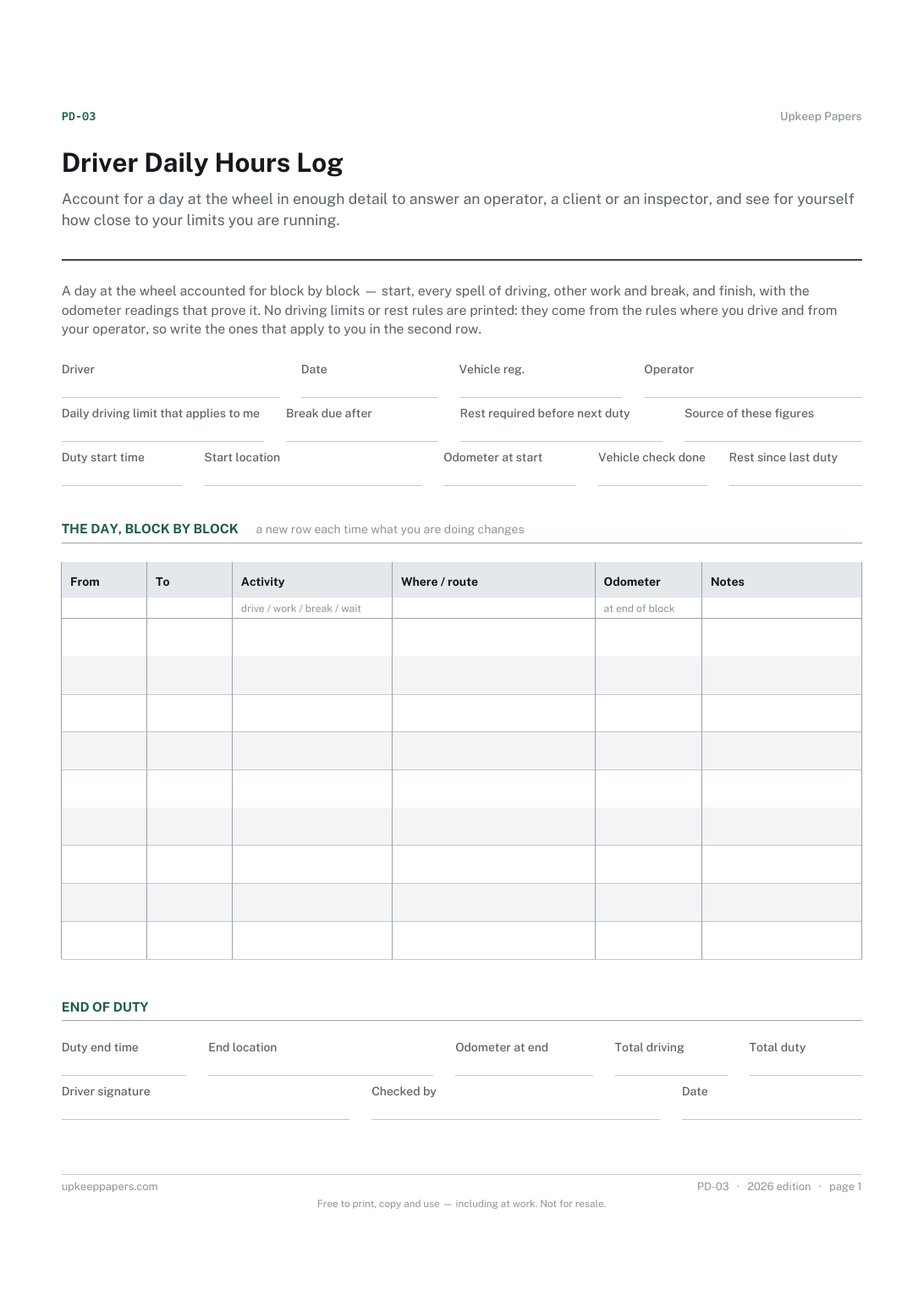
Account for a day at the wheel in enough detail to answer an operator, a client or an inspector, and see for yourself how close to your limits you are running.
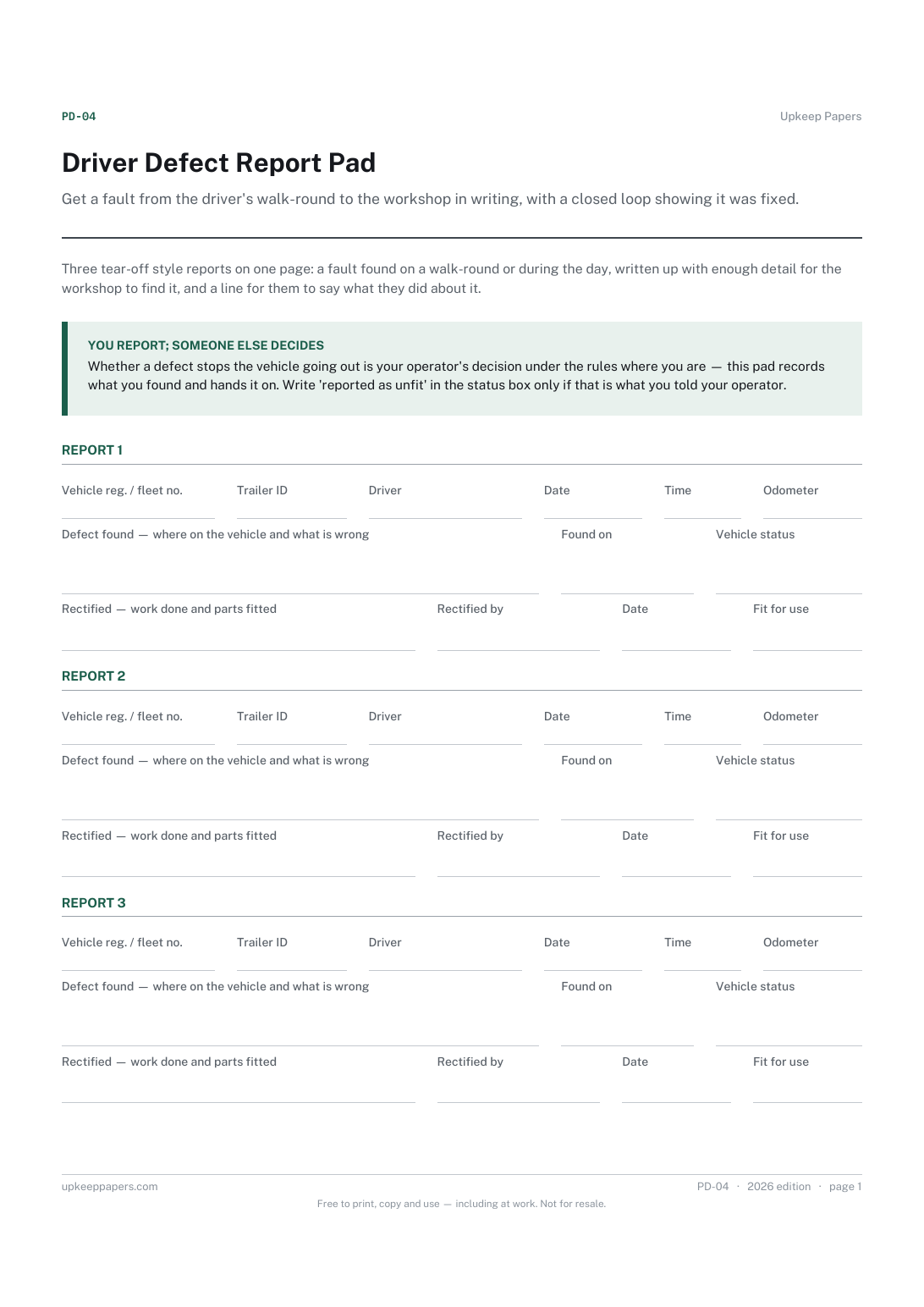
Get a fault from the driver's walk-round to the workshop in writing, with a closed loop showing it was fixed.
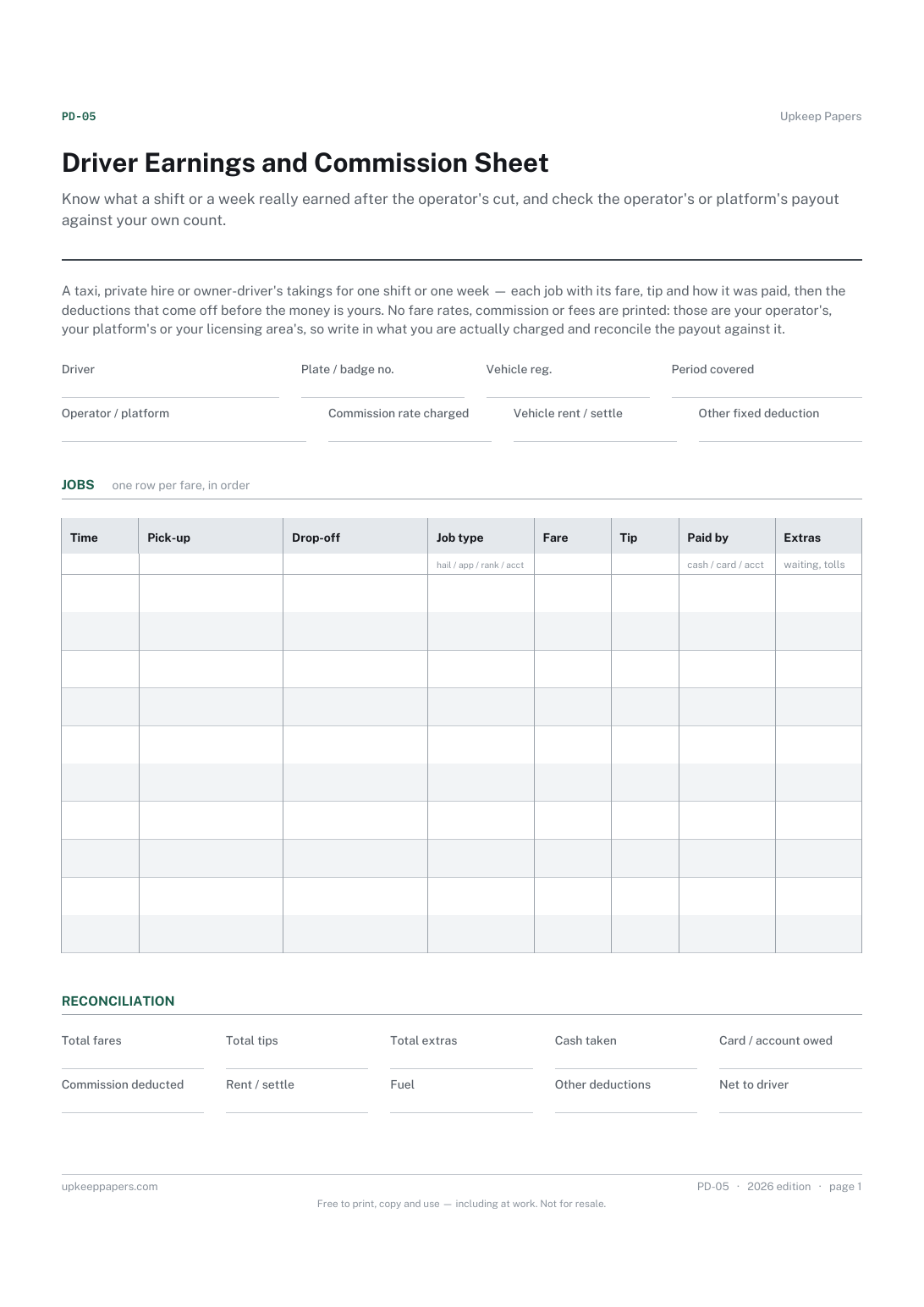
Know what a shift or a week really earned after the operator's cut, and check the operator's or platform's payout against your own count.
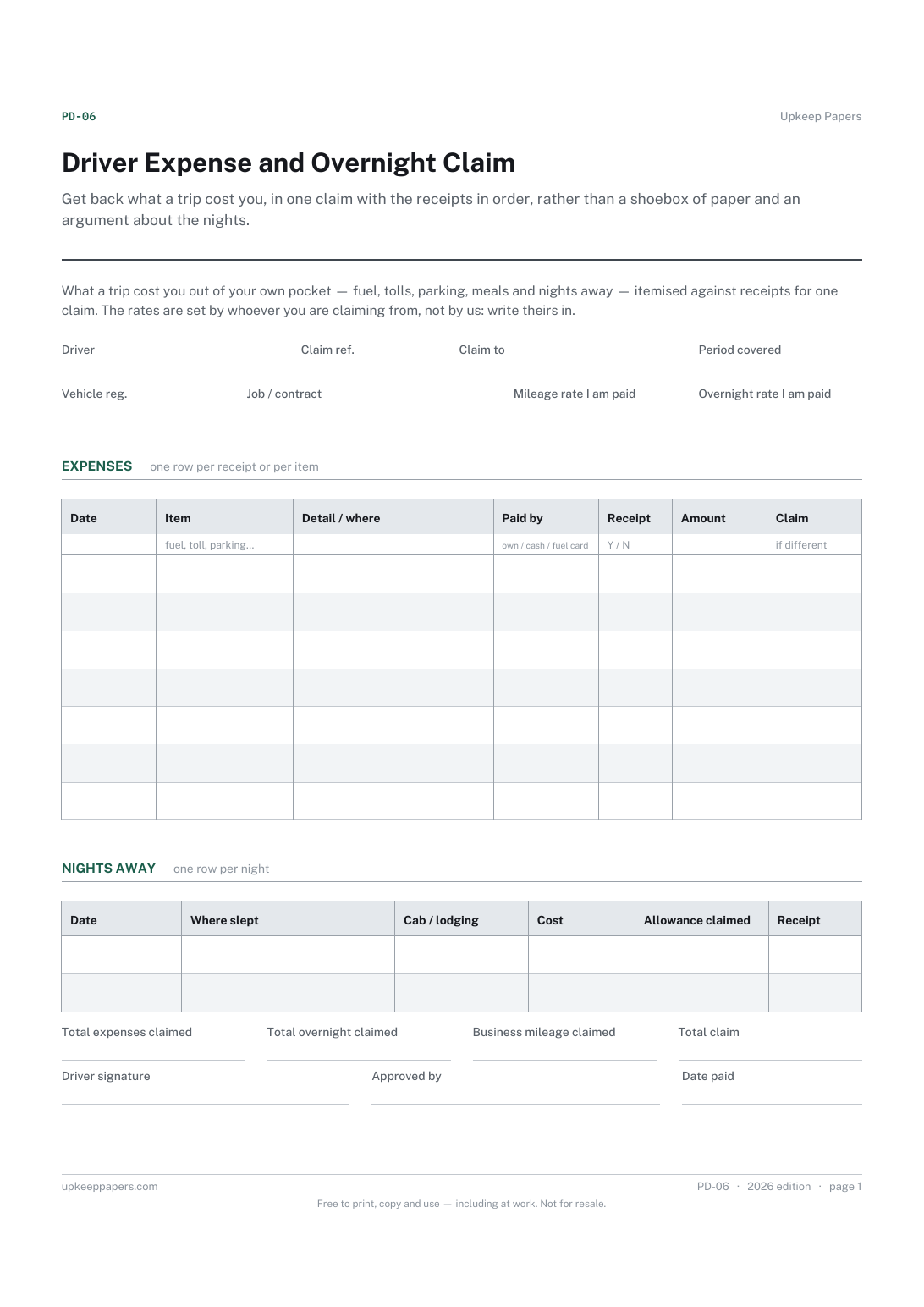
Get back what a trip cost you, in one claim with the receipts in order, rather than a shoebox of paper and an argument about the nights.
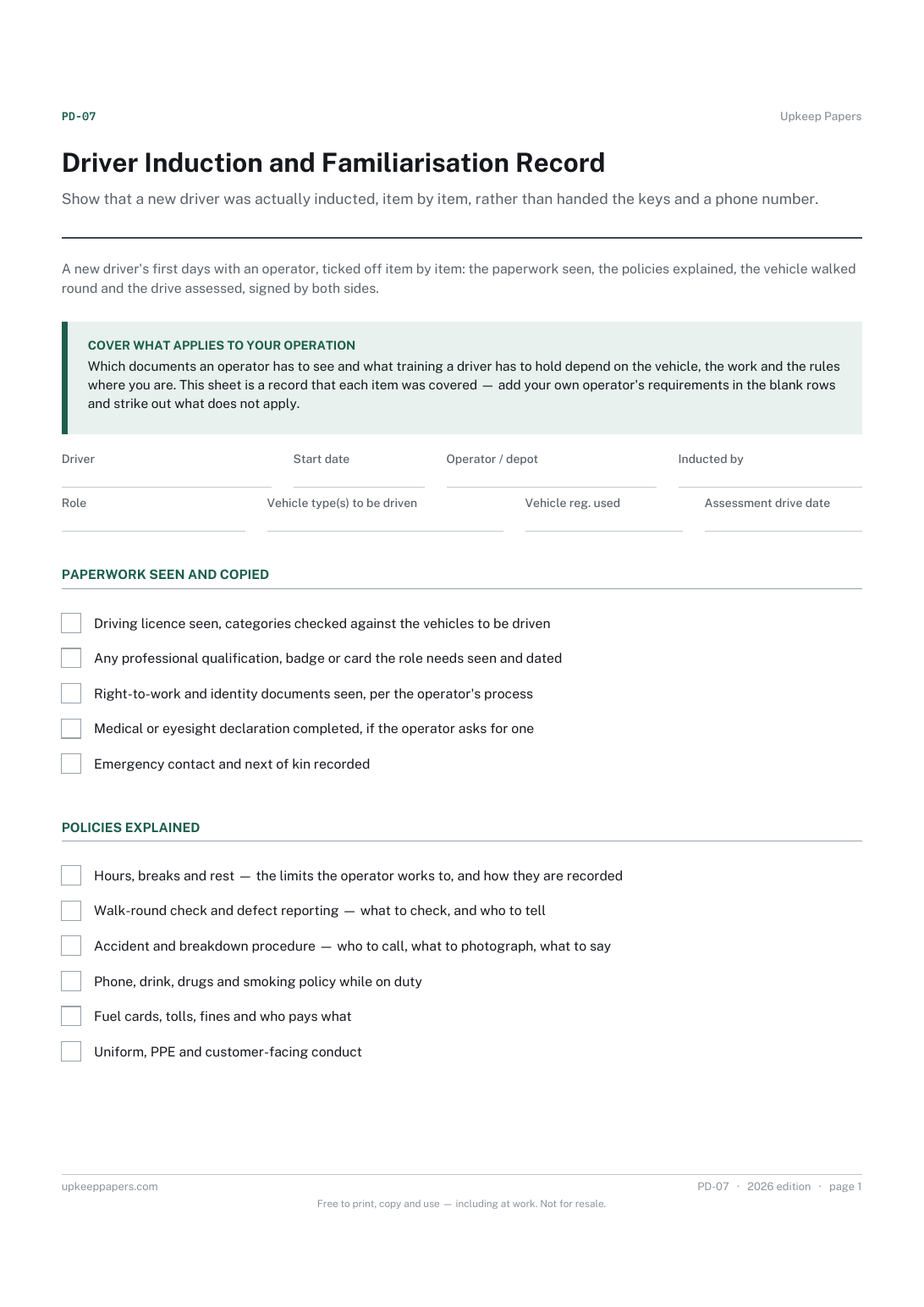
Show that a new driver was actually inducted, item by item, rather than handed the keys and a phone number.
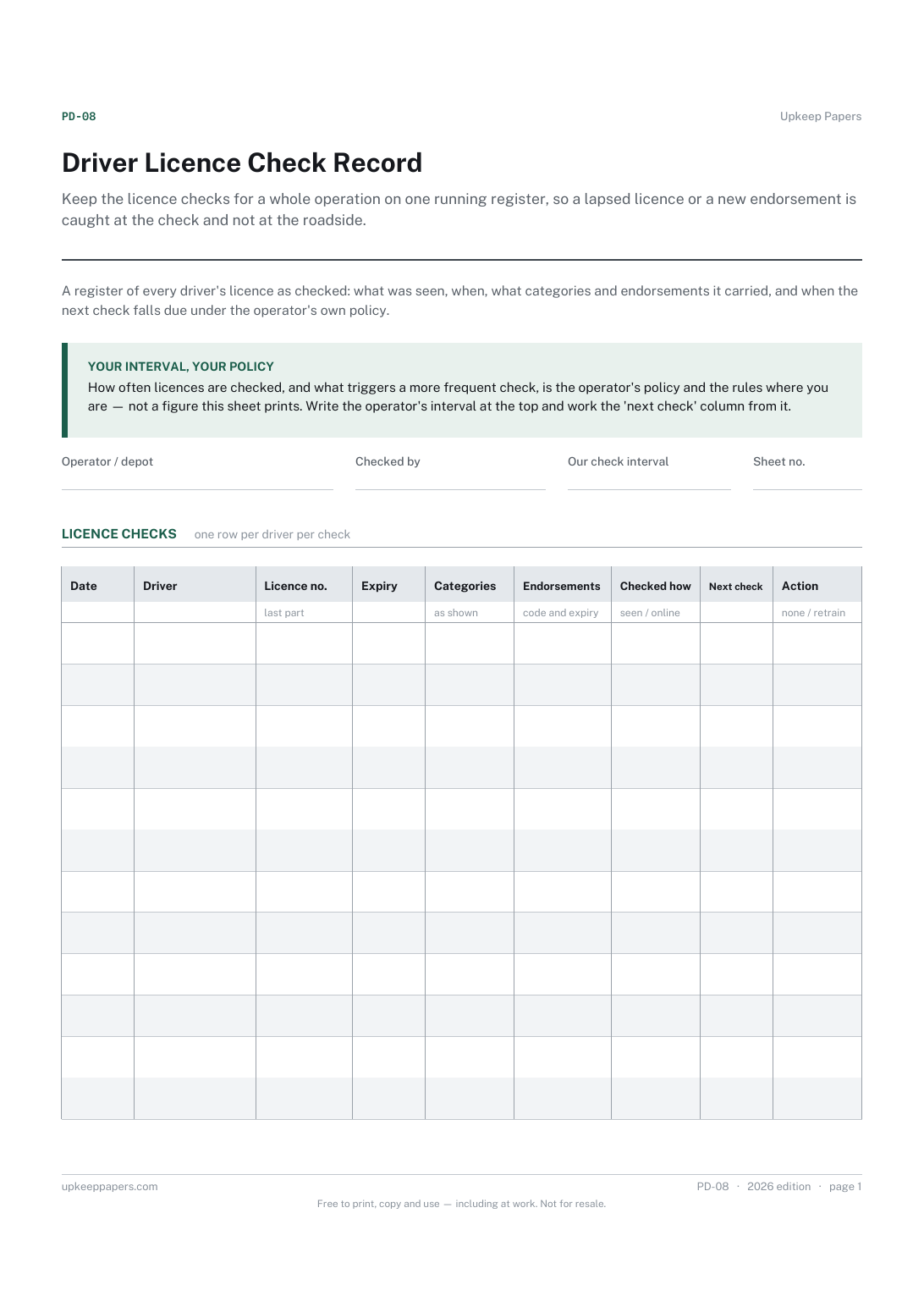
Keep the licence checks for a whole operation on one running register, so a lapsed licence or a new endorsement is caught at the check and not at the roadside.
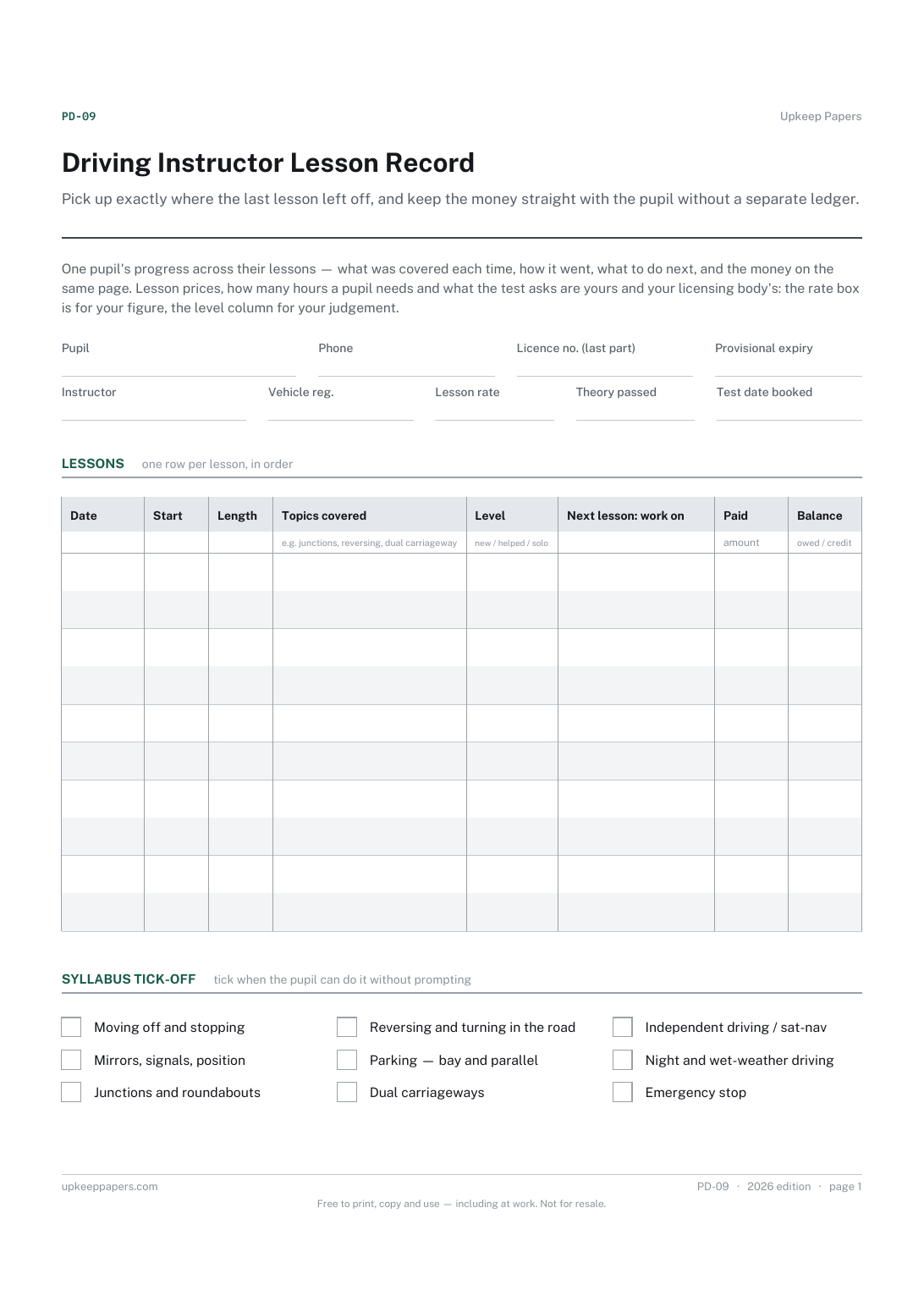
Pick up exactly where the last lesson left off, and keep the money straight with the pupil without a separate ledger.
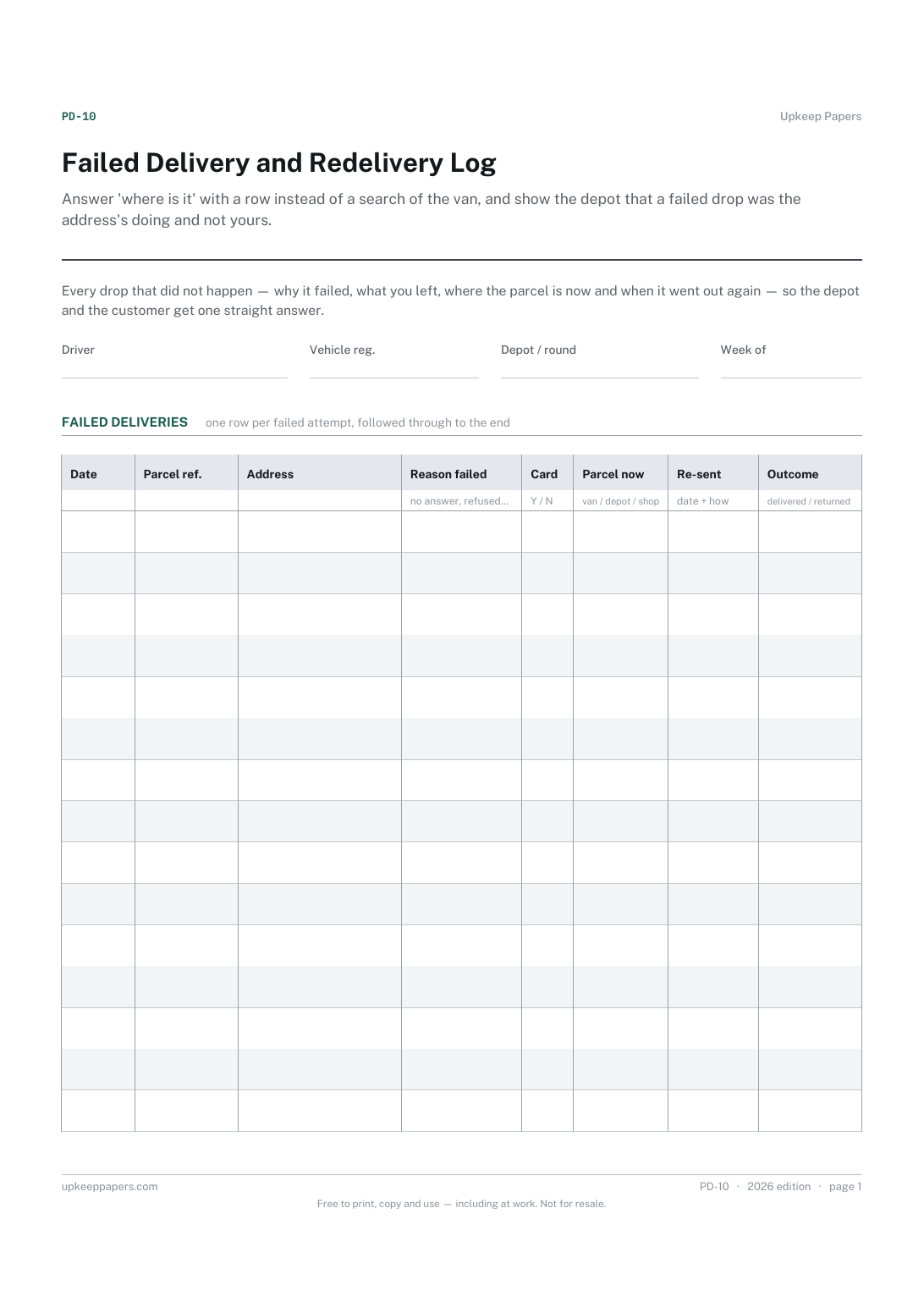
Answer 'where is it' with a row instead of a search of the van, and show the depot that a failed drop was the address's doing and not yours.
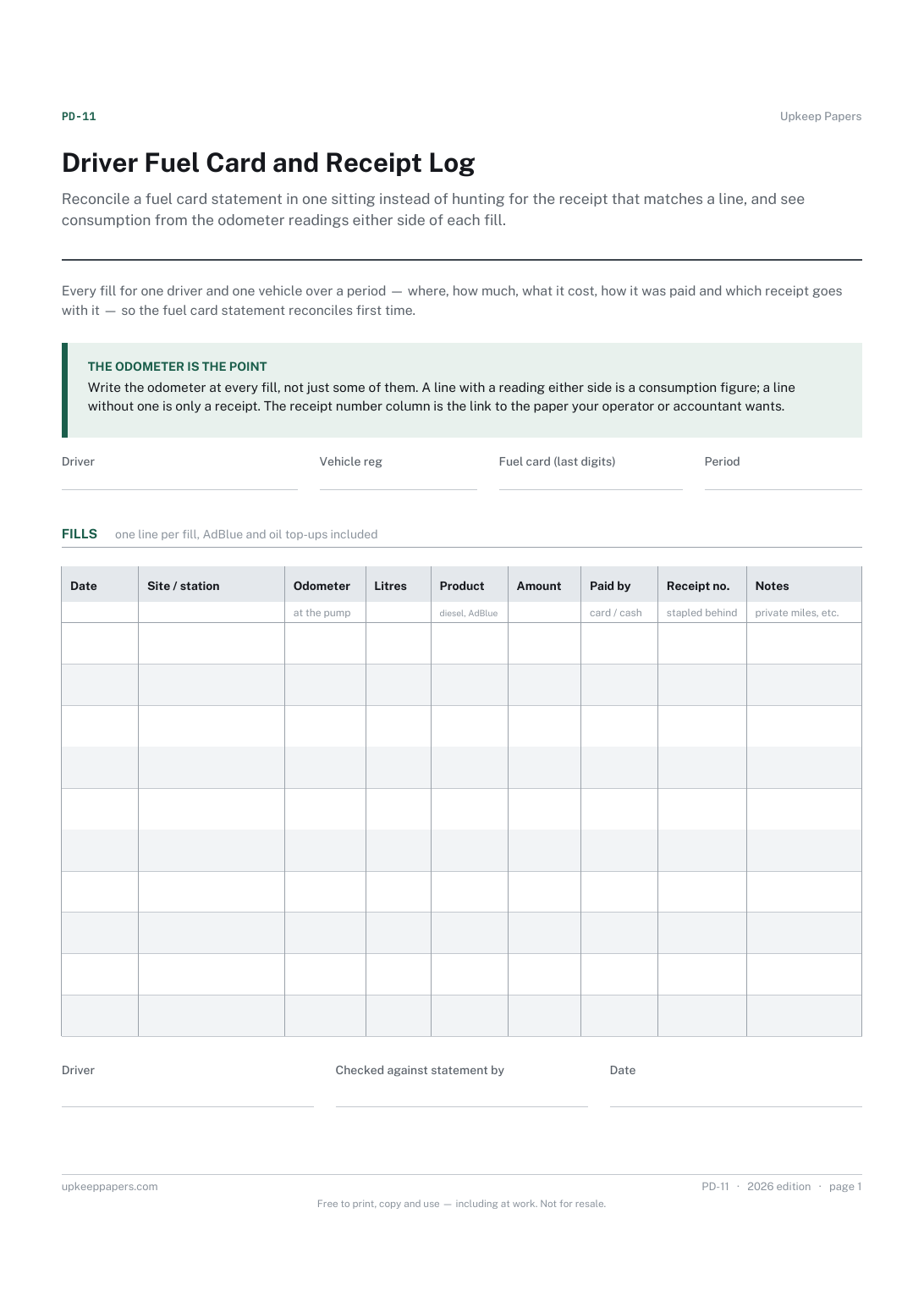
Reconcile a fuel card statement in one sitting instead of hunting for the receipt that matches a line, and see consumption from the odometer readings either side of each fill.
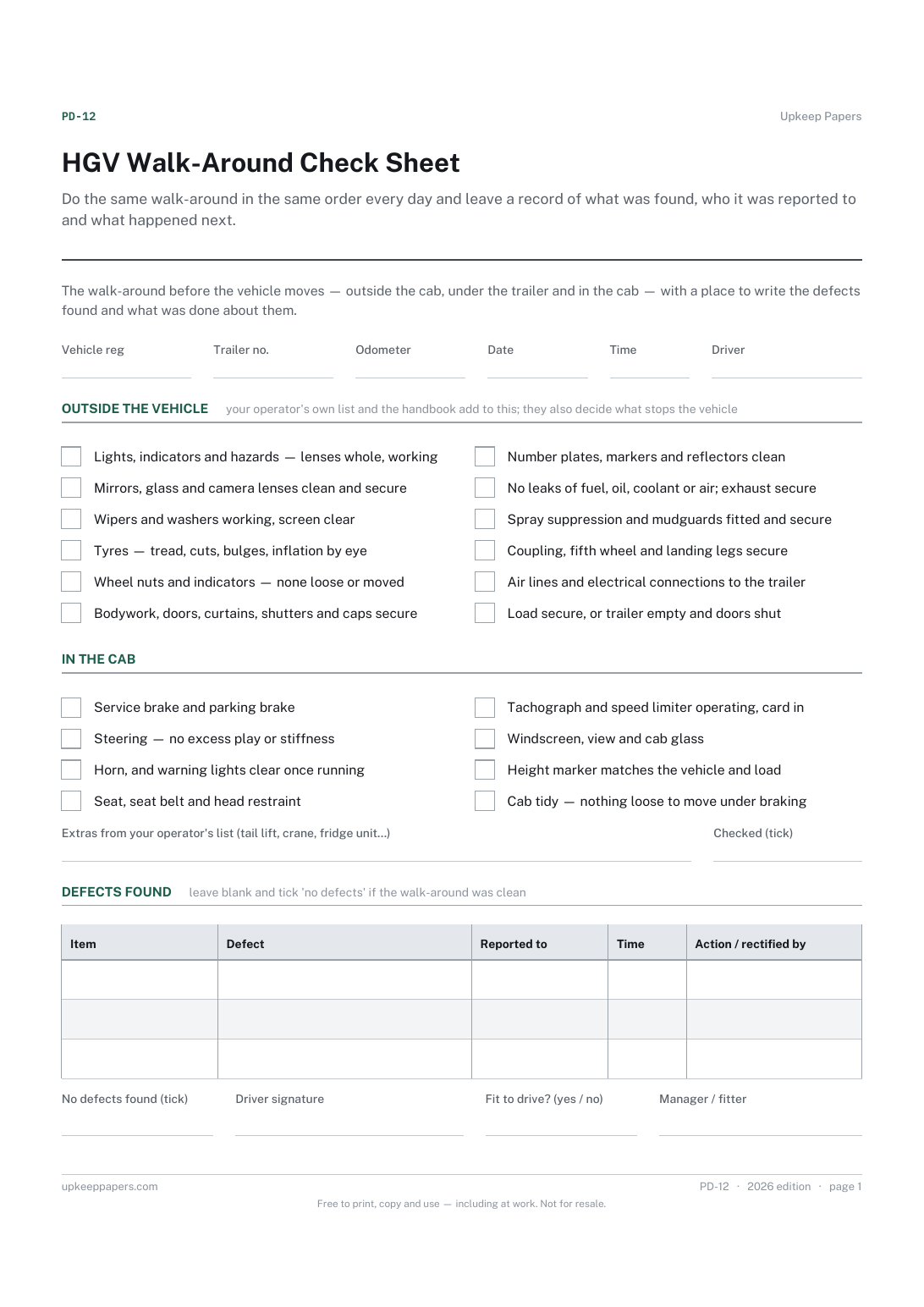
Do the same walk-around in the same order every day and leave a record of what was found, who it was reported to and what happened next.
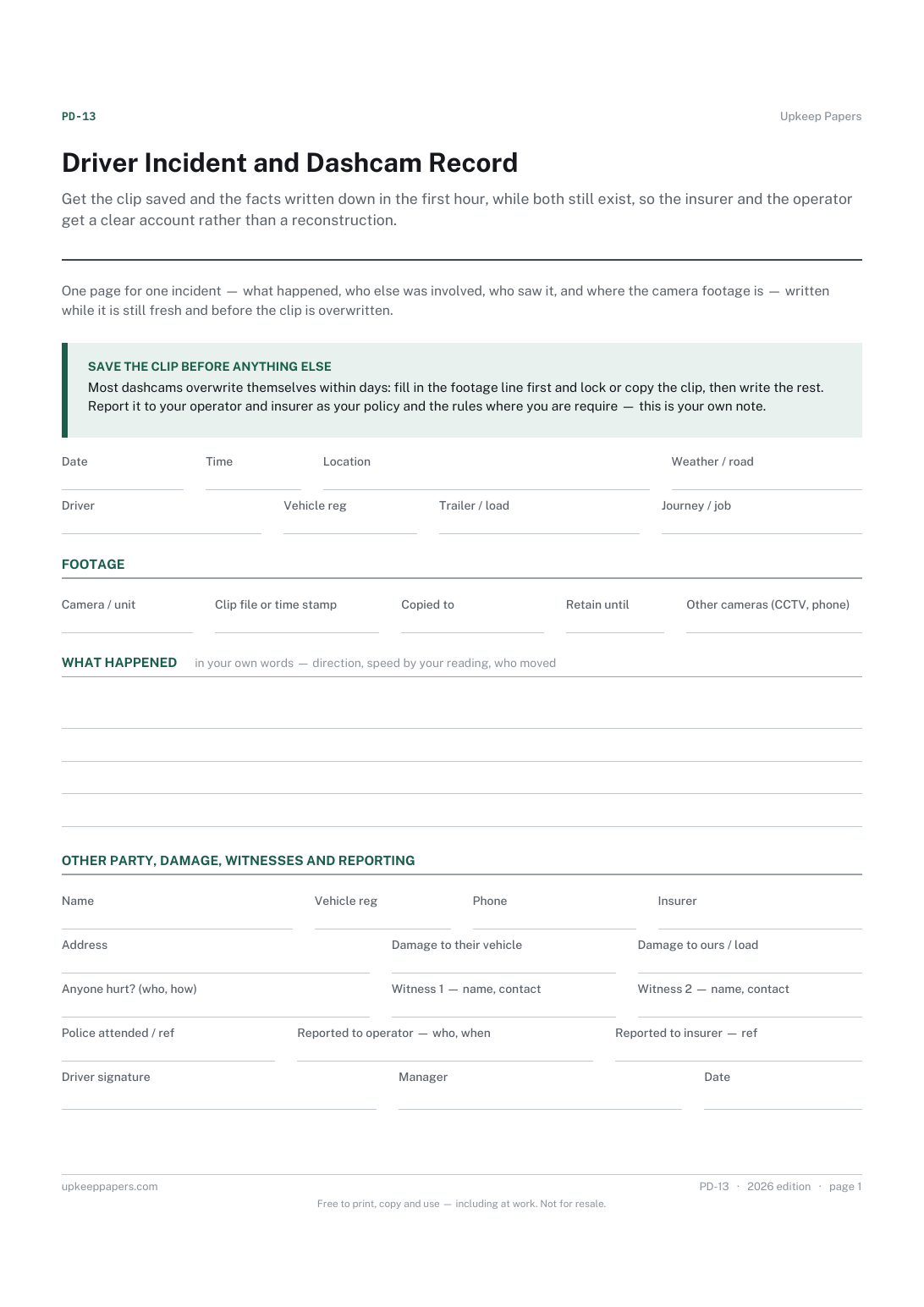
Get the clip saved and the facts written down in the first hour, while both still exist, so the insurer and the operator get a clear account rather than a reconstruction.
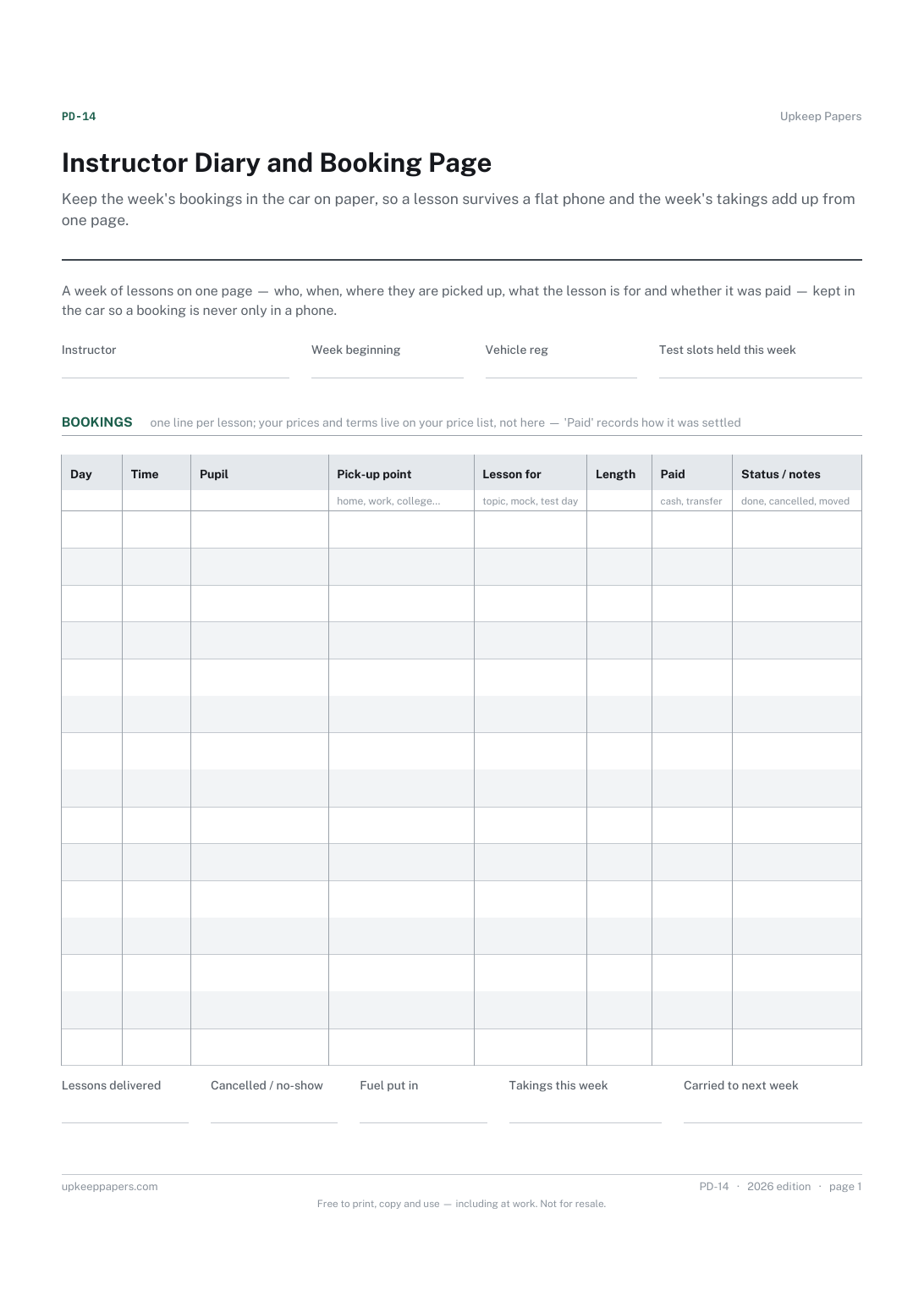
Keep the week's bookings in the car on paper, so a lesson survives a flat phone and the week's takings add up from one page.
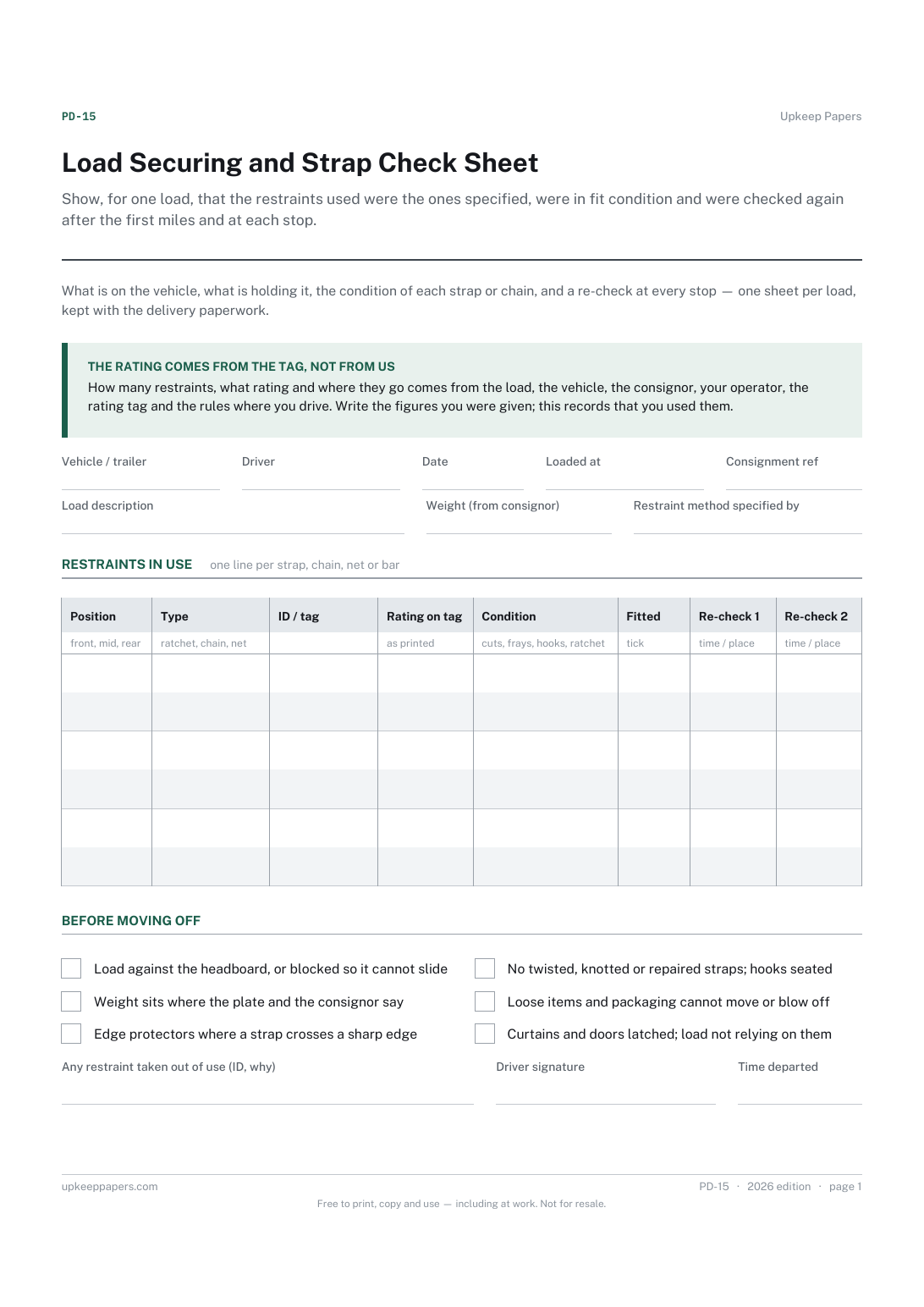
Show, for one load, that the restraints used were the ones specified, were in fit condition and were checked again after the first miles and at each stop.
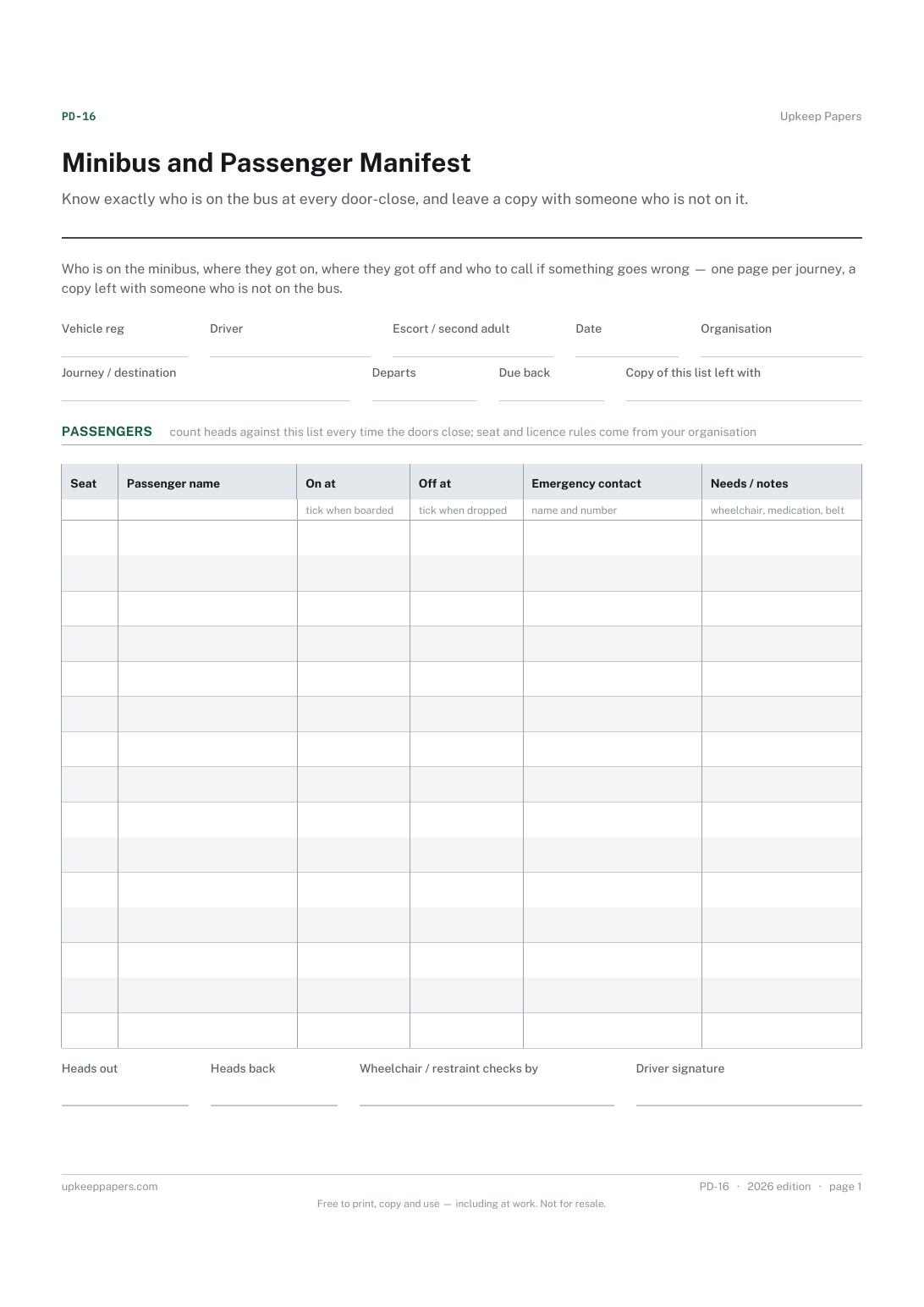
Know exactly who is on the bus at every door-close, and leave a copy with someone who is not on it.
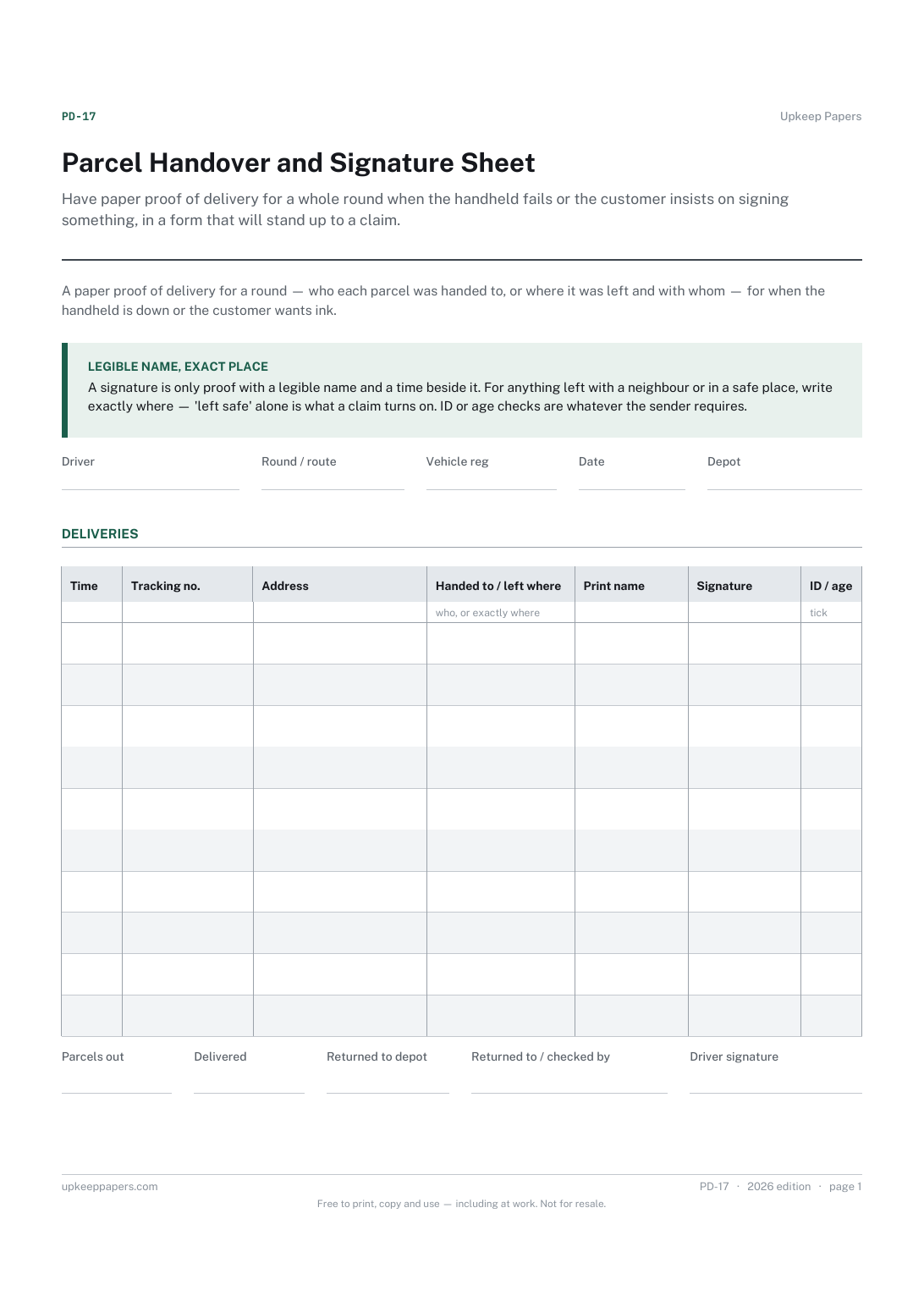
Have paper proof of delivery for a whole round when the handheld fails or the customer insists on signing something, in a form that will stand up to a claim.
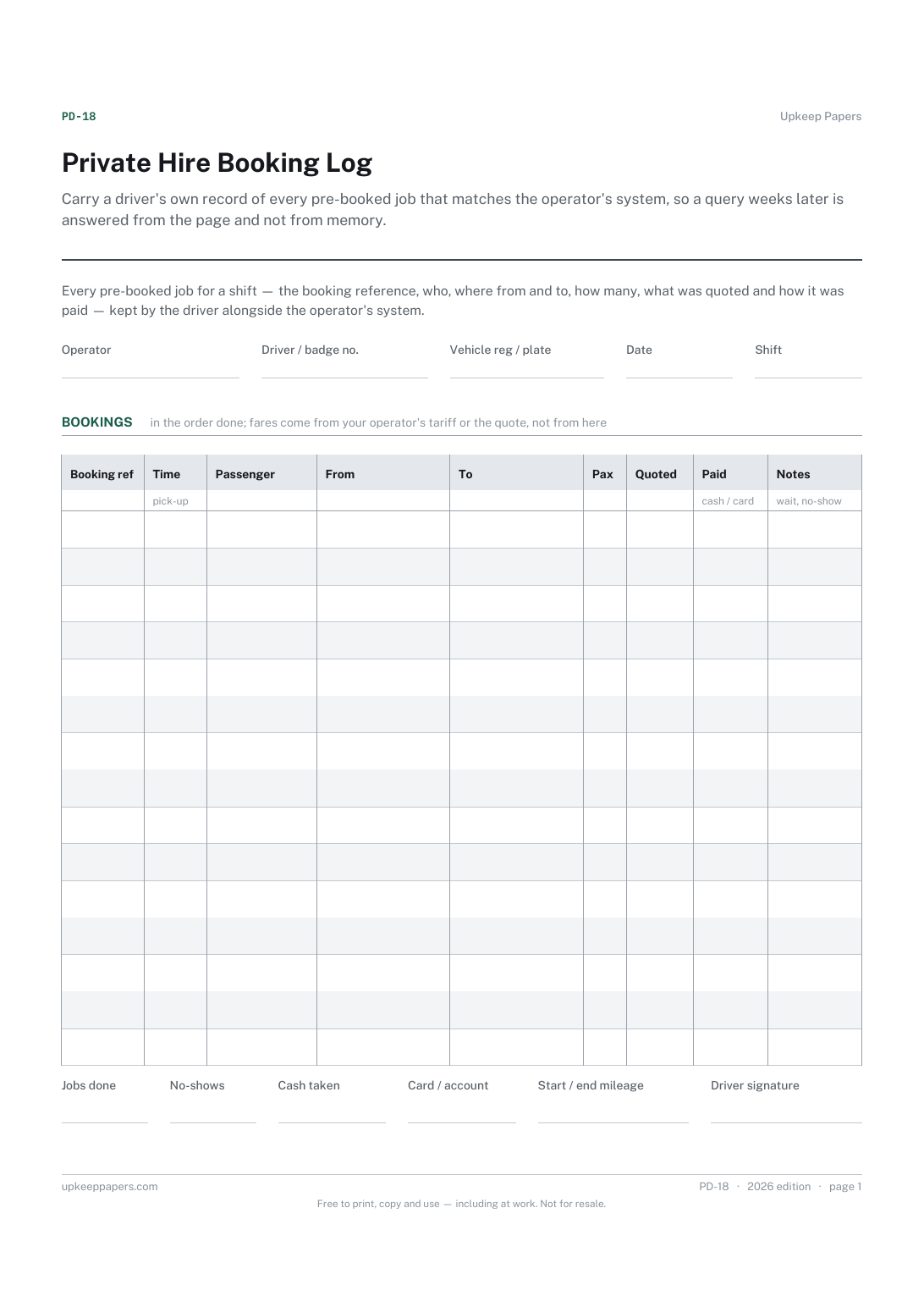
Carry a driver's own record of every pre-booked job that matches the operator's system, so a query weeks later is answered from the page and not from memory.
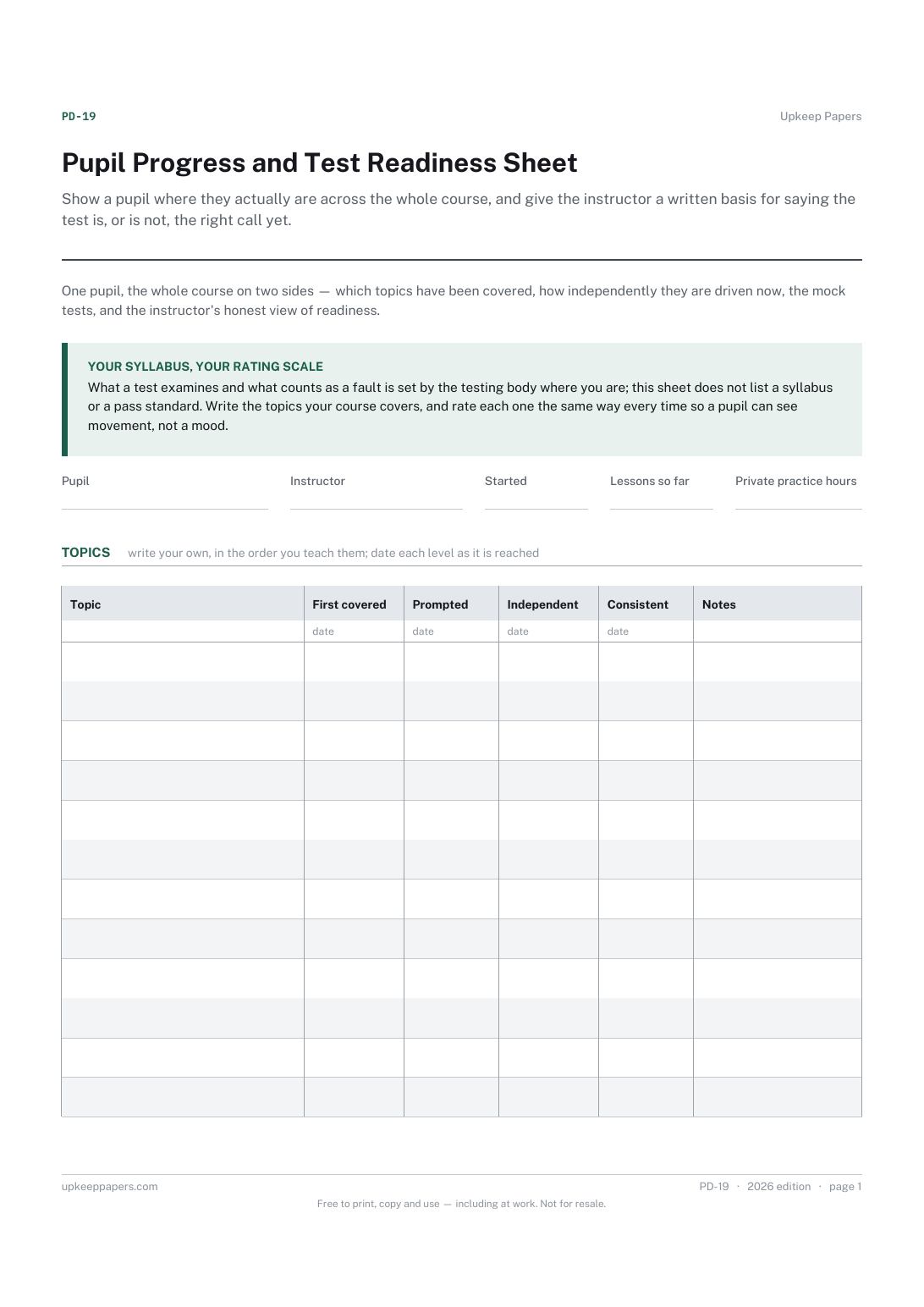
Show a pupil where they actually are across the whole course, and give the instructor a written basis for saying the test is, or is not, the right call yet.
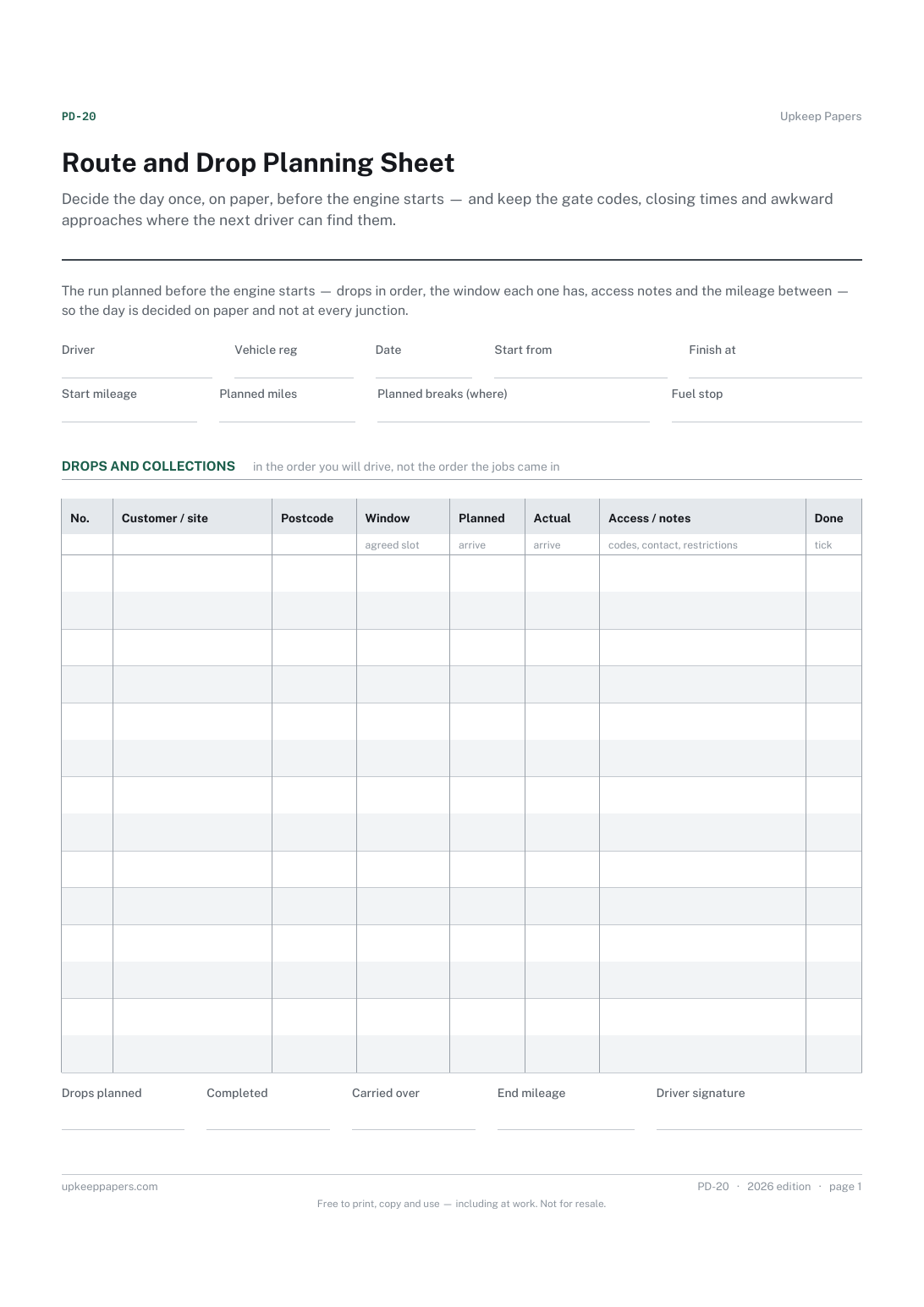
Decide the day once, on paper, before the engine starts — and keep the gate codes, closing times and awkward approaches where the next driver can find them.
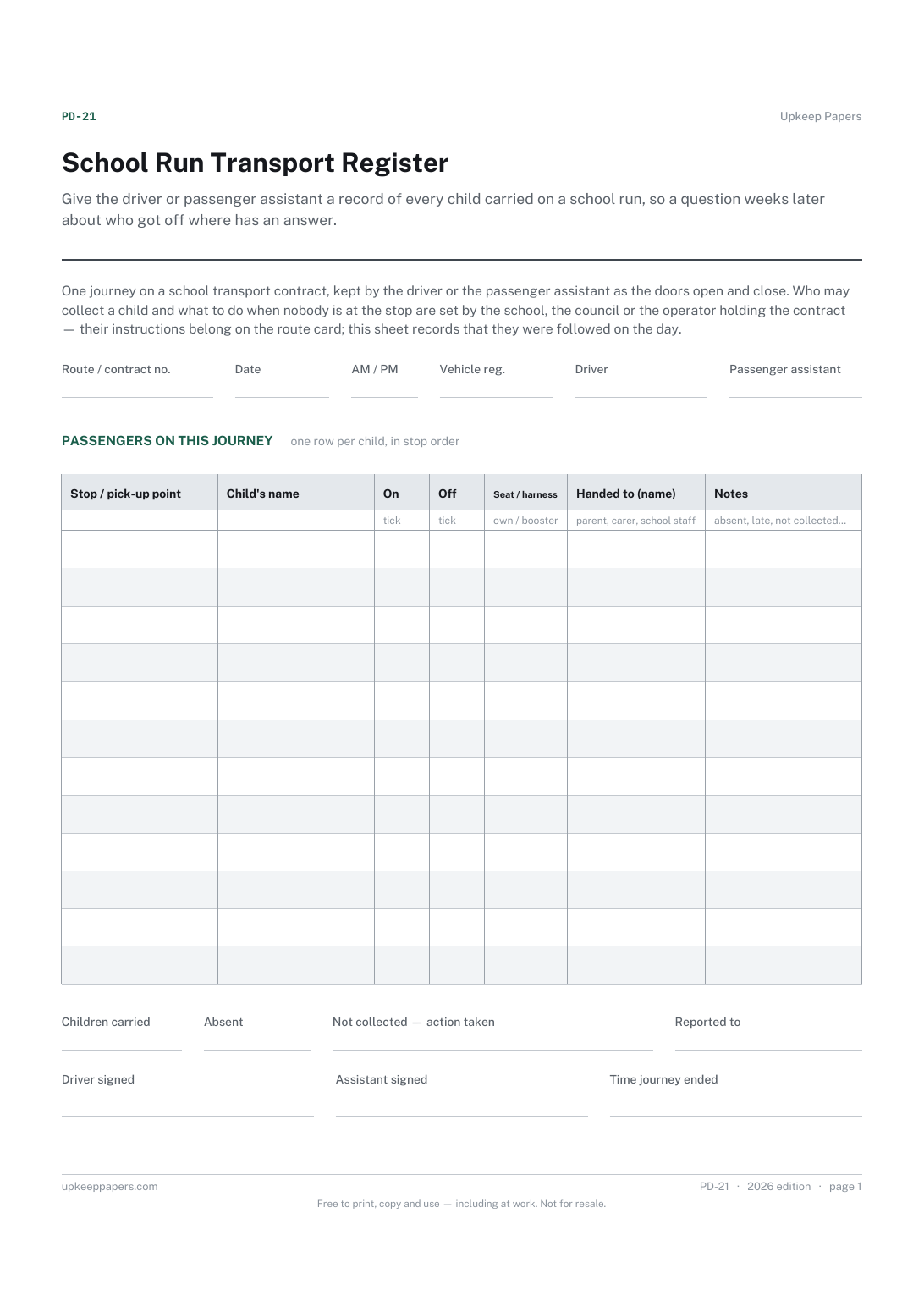
Give the driver or passenger assistant a record of every child carried on a school run, so a question weeks later about who got off where has an answer.
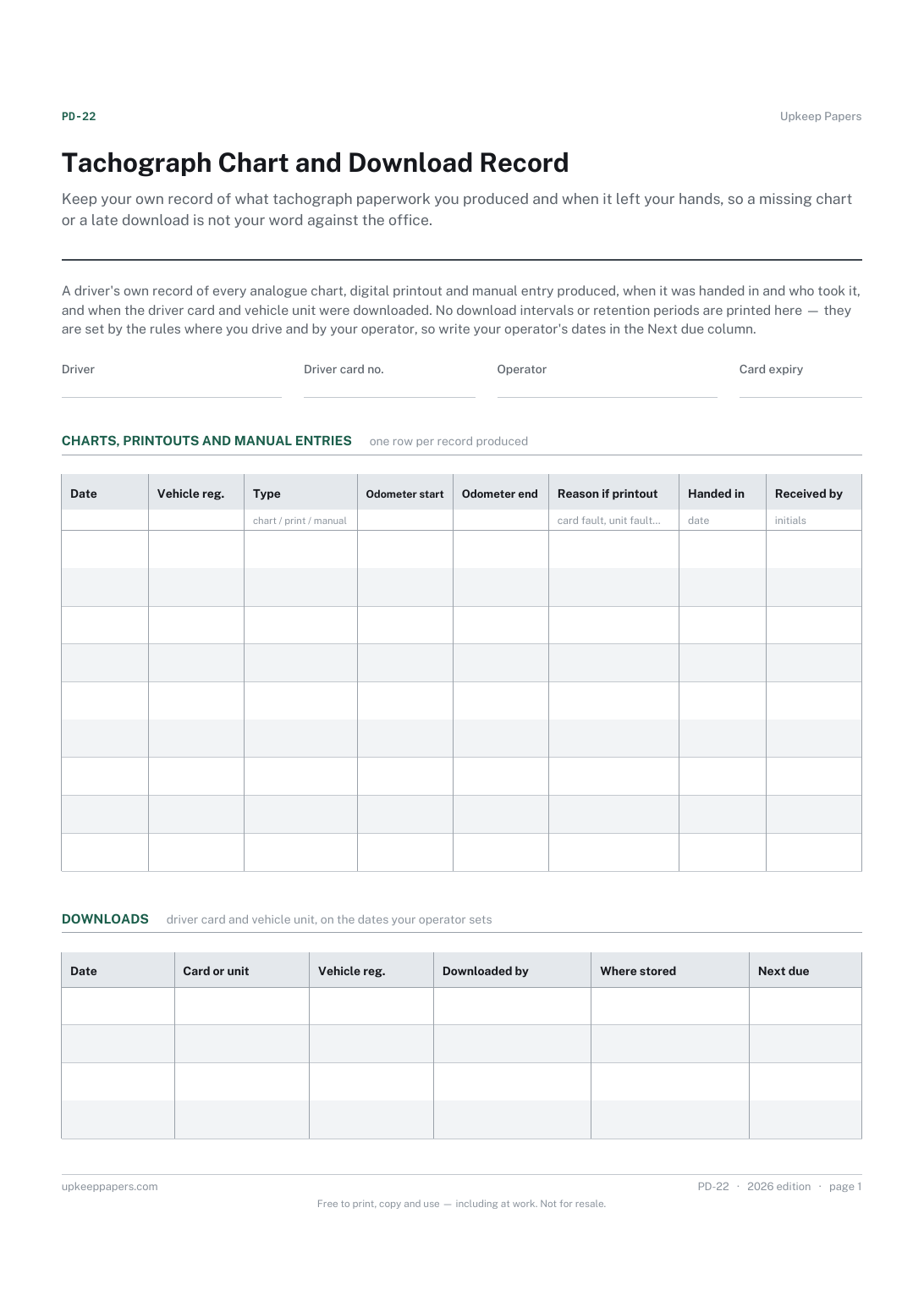
Keep your own record of what tachograph paperwork you produced and when it left your hands, so a missing chart or a late download is not your word against the office.
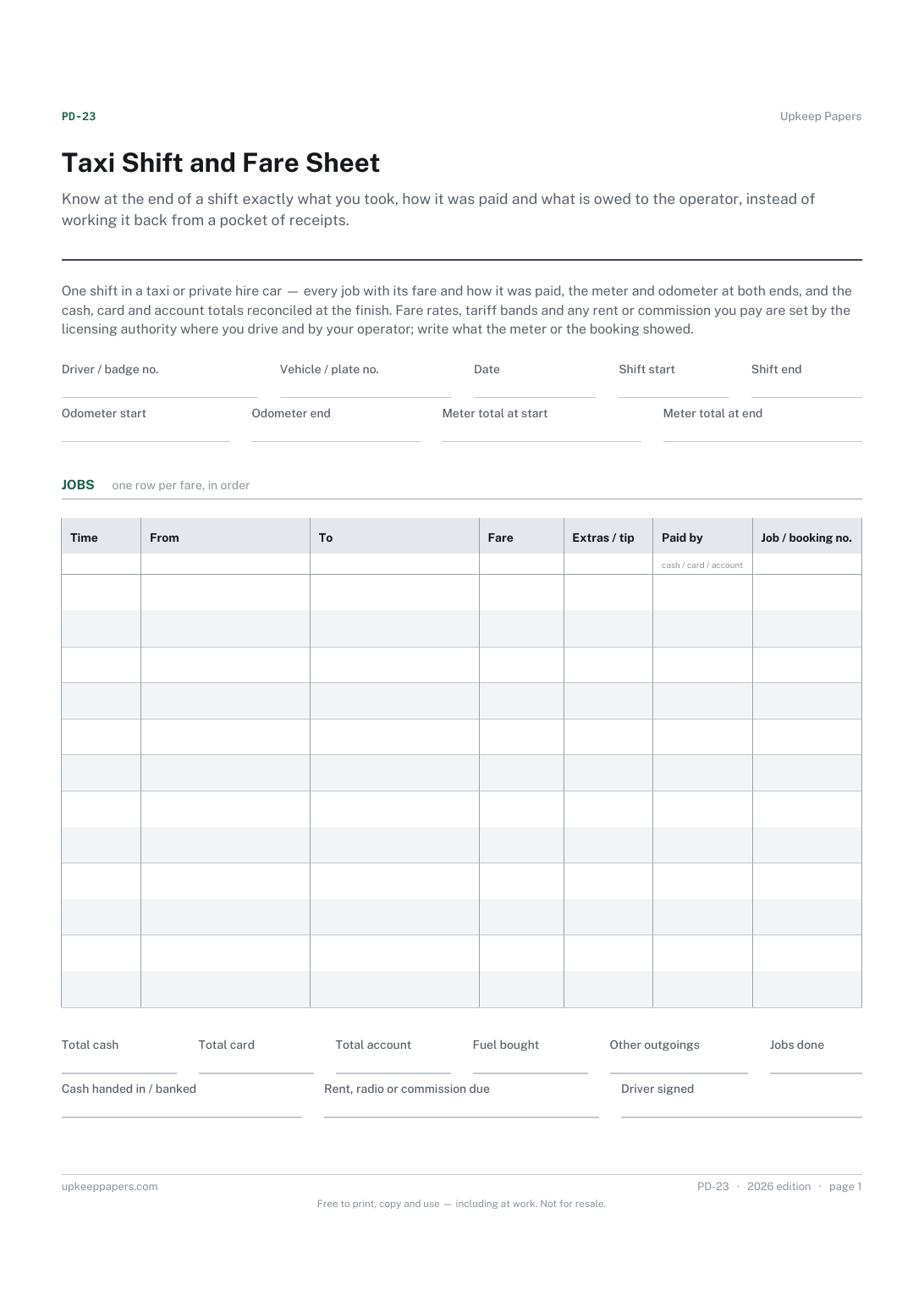
Know at the end of a shift exactly what you took, how it was paid and what is owed to the operator, instead of working it back from a pocket of receipts.
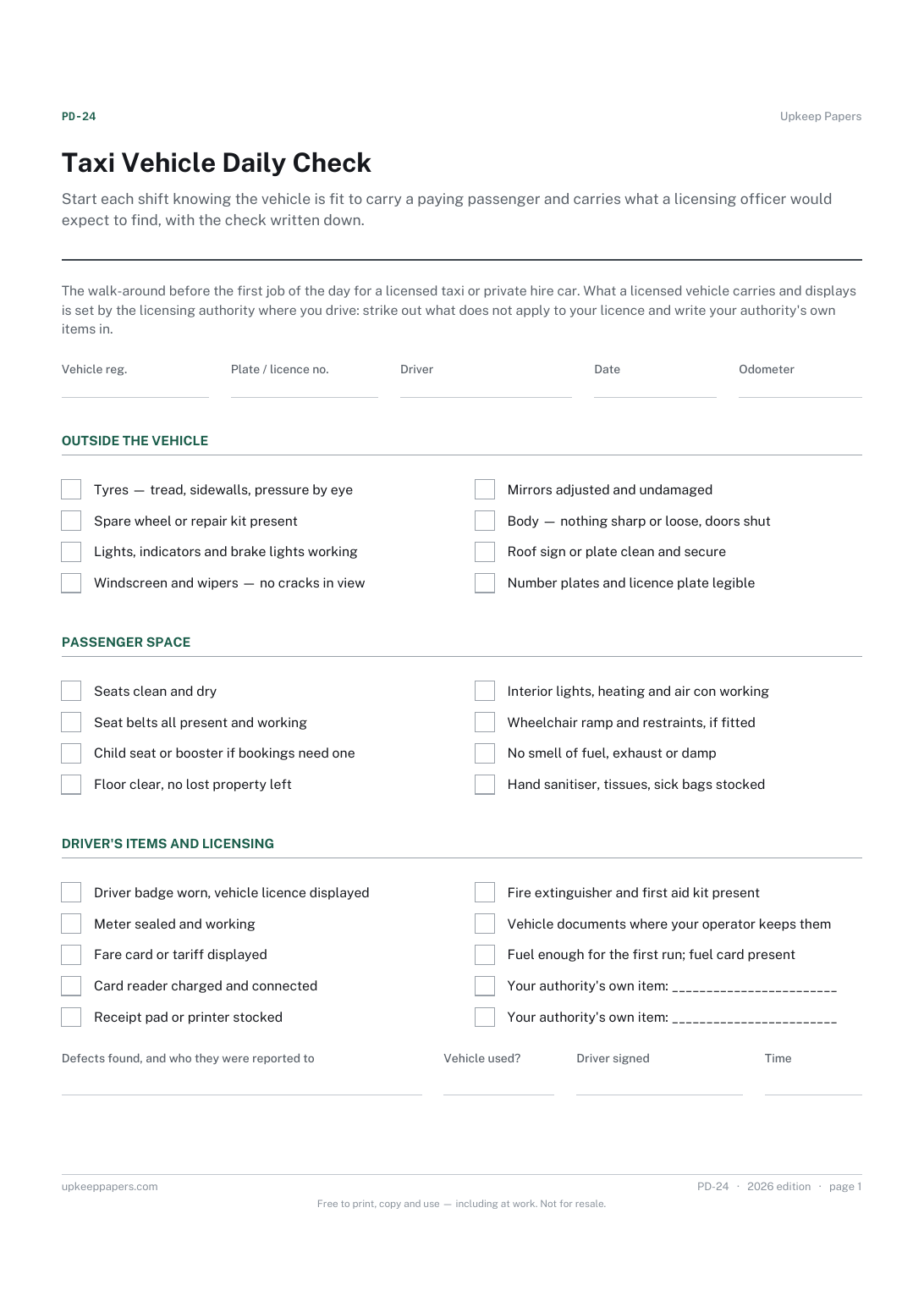
Start each shift knowing the vehicle is fit to carry a paying passenger and carries what a licensing officer would expect to find, with the check written down.
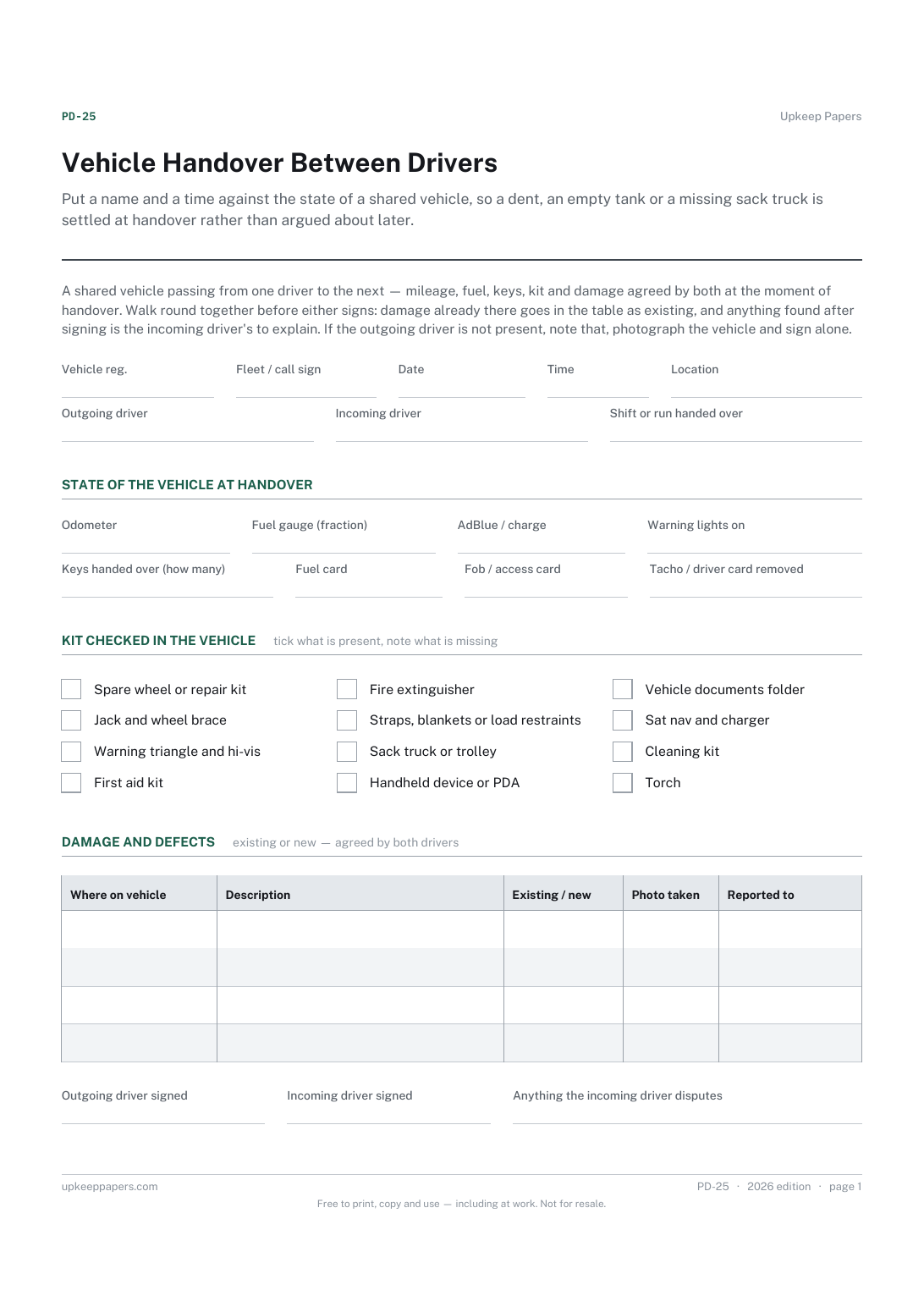
Put a name and a time against the state of a shared vehicle, so a dent, an empty tank or a missing sack truck is settled at handover rather than argued about later.
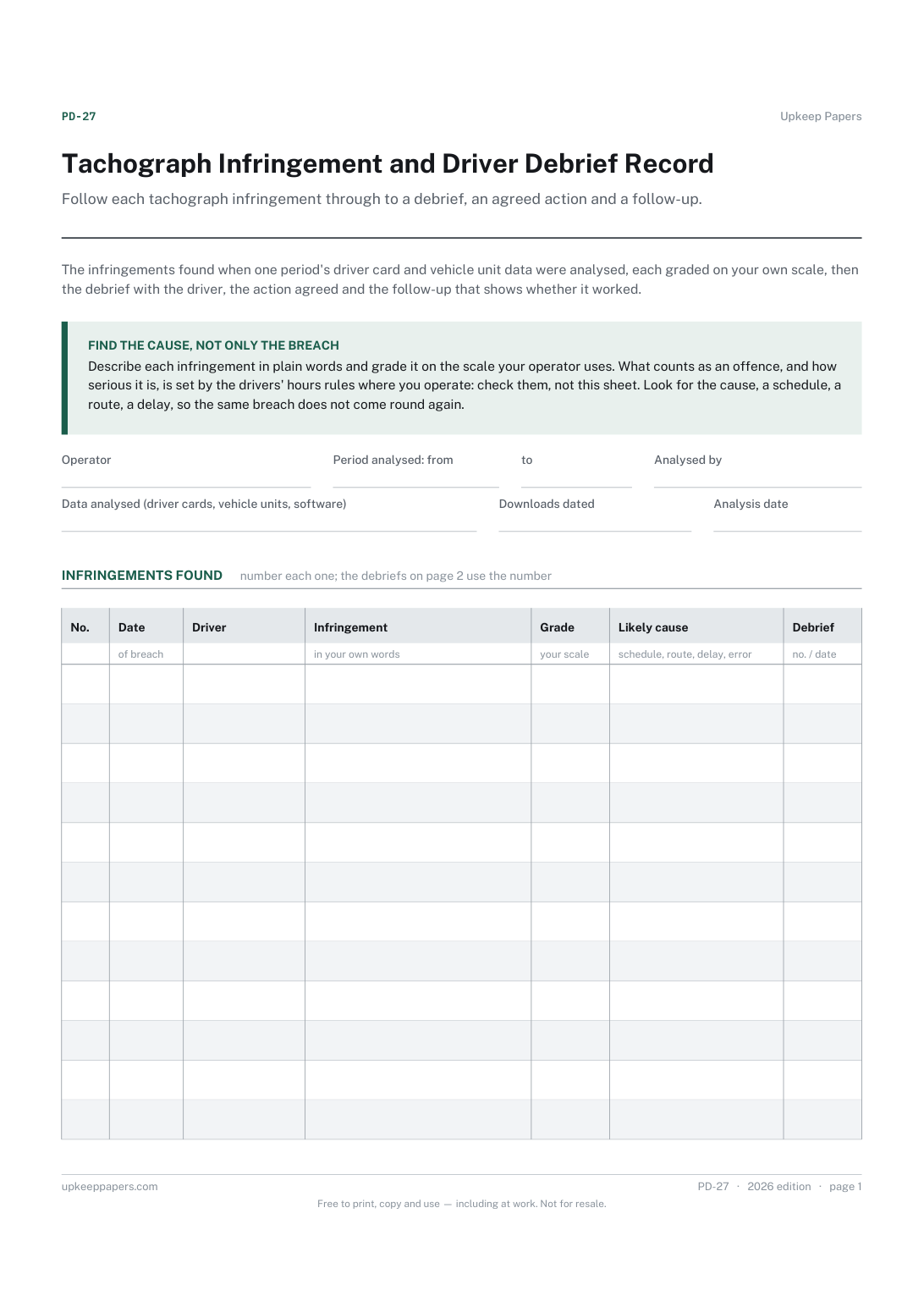
Follow each tachograph infringement through to a debrief, an agreed action and a follow-up. The record shows the cause was looked for, not only the breach.
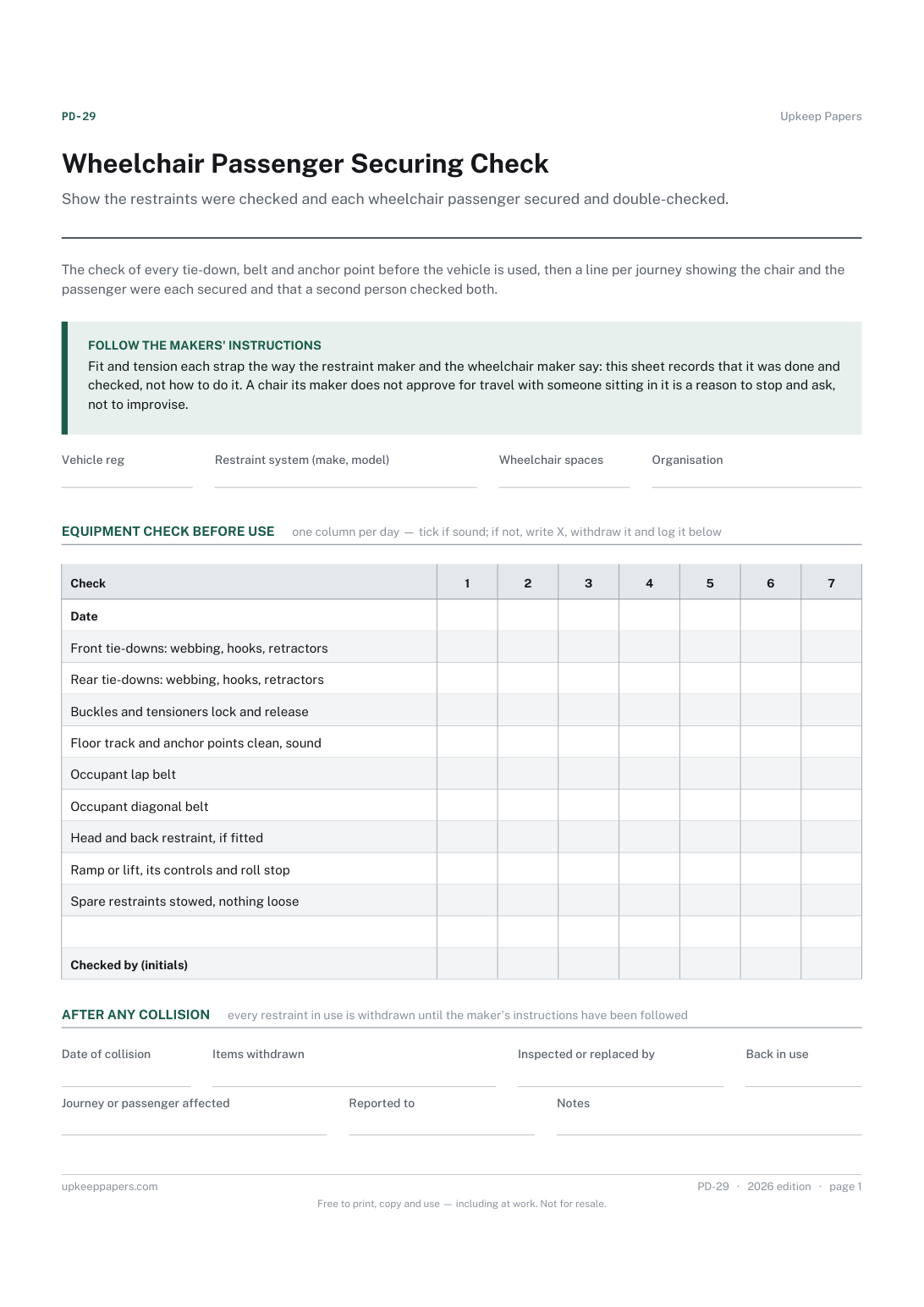
Show the restraints were checked and each wheelchair passenger secured and double-checked. Withdrawn equipment, and anything in use during a collision, is logged as well.
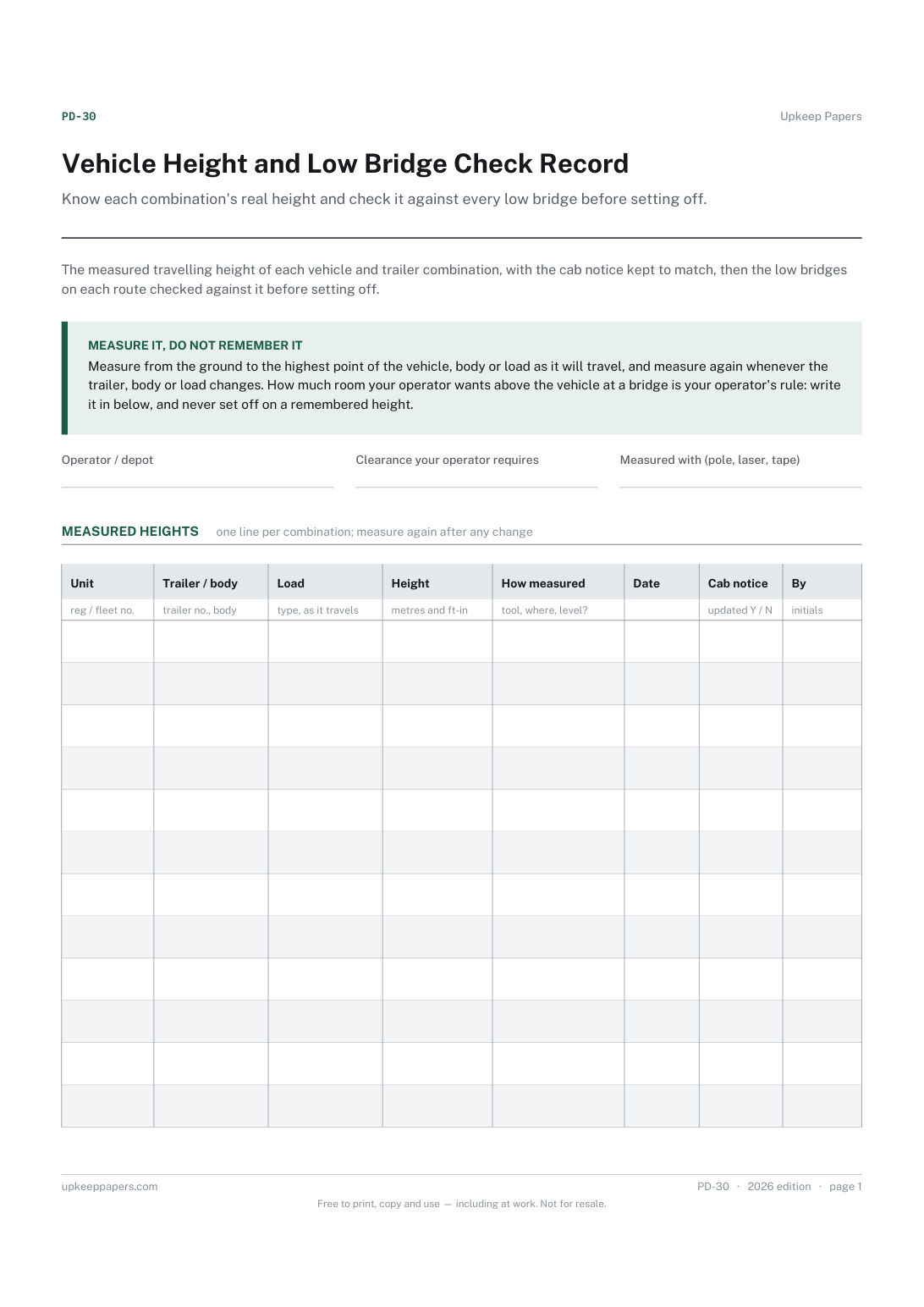
Know each combination's real height and check it against every low bridge before setting off. The cab notice is updated whenever the trailer, body or load changes.
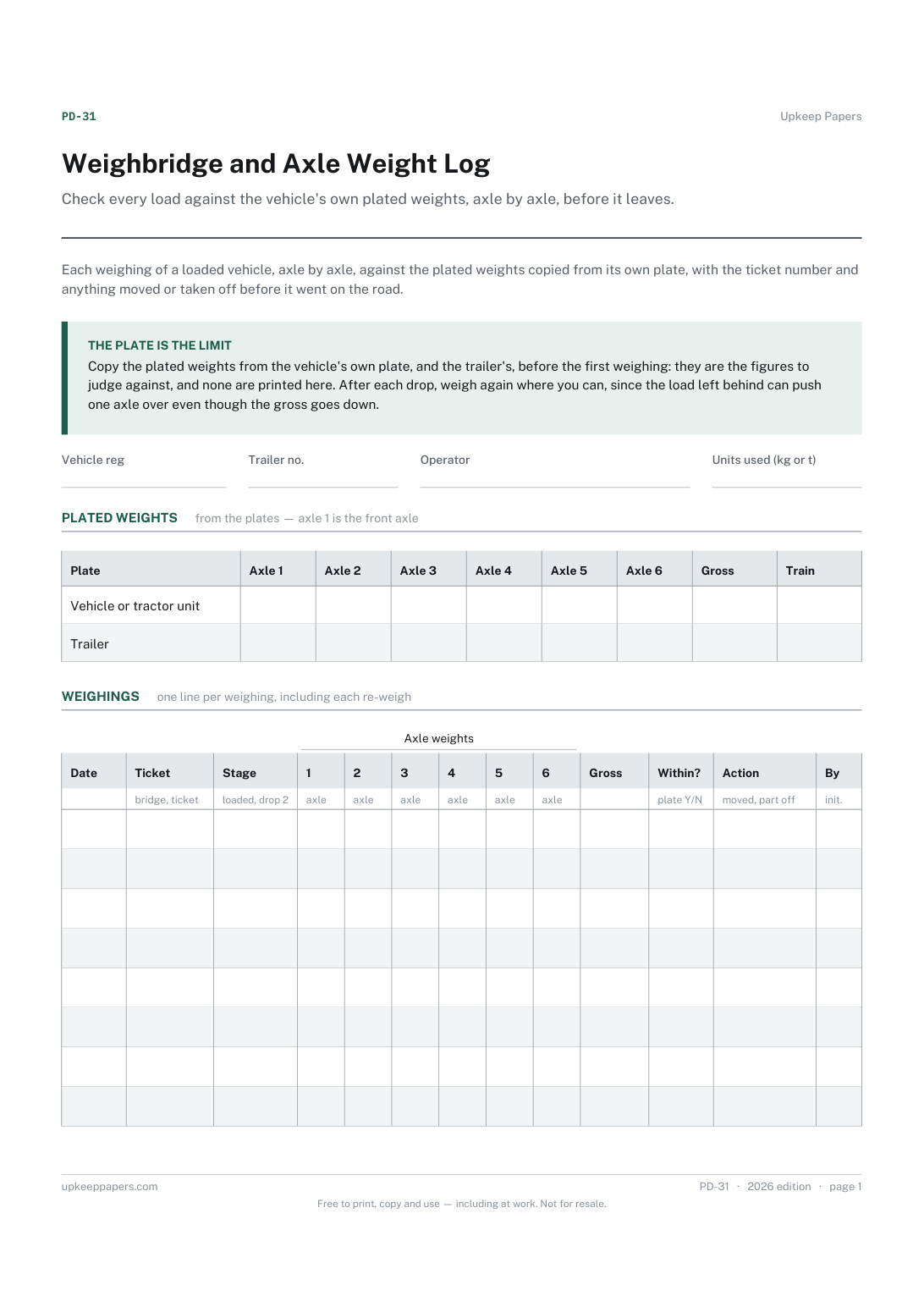
Check every load against the vehicle's own plated weights, axle by axle, before it leaves. Re-weighs after a drop or a load shift go on the same sheet.
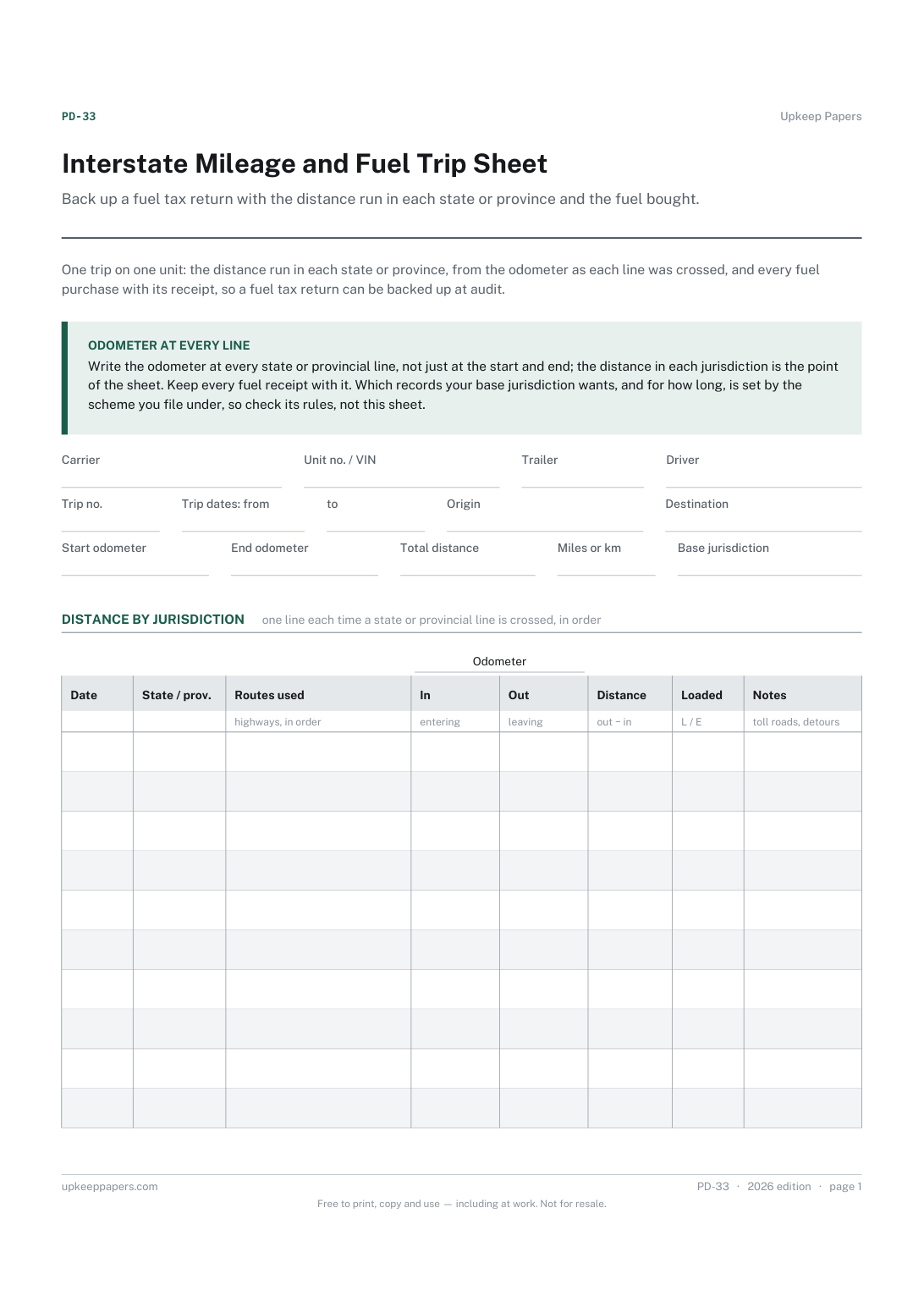
Back up a fuel tax return with the distance run in each state or province and the fuel bought. One sheet per trip, with the receipts stapled behind.
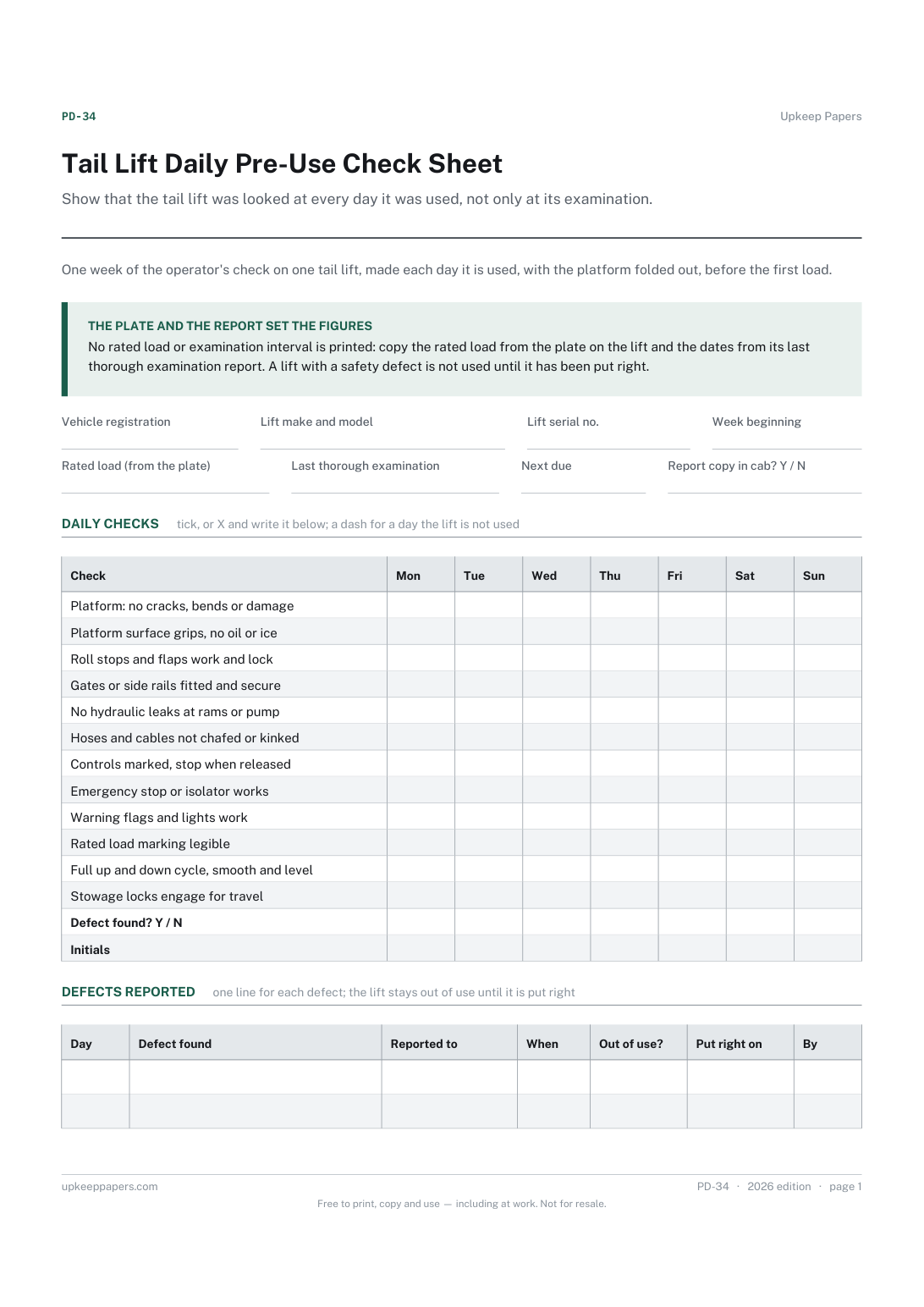
Show that the tail lift was looked at every day it was used, not only at its examination. A worn roll stop or a weeping ram is found at the depot, before a cage goes over the edge.
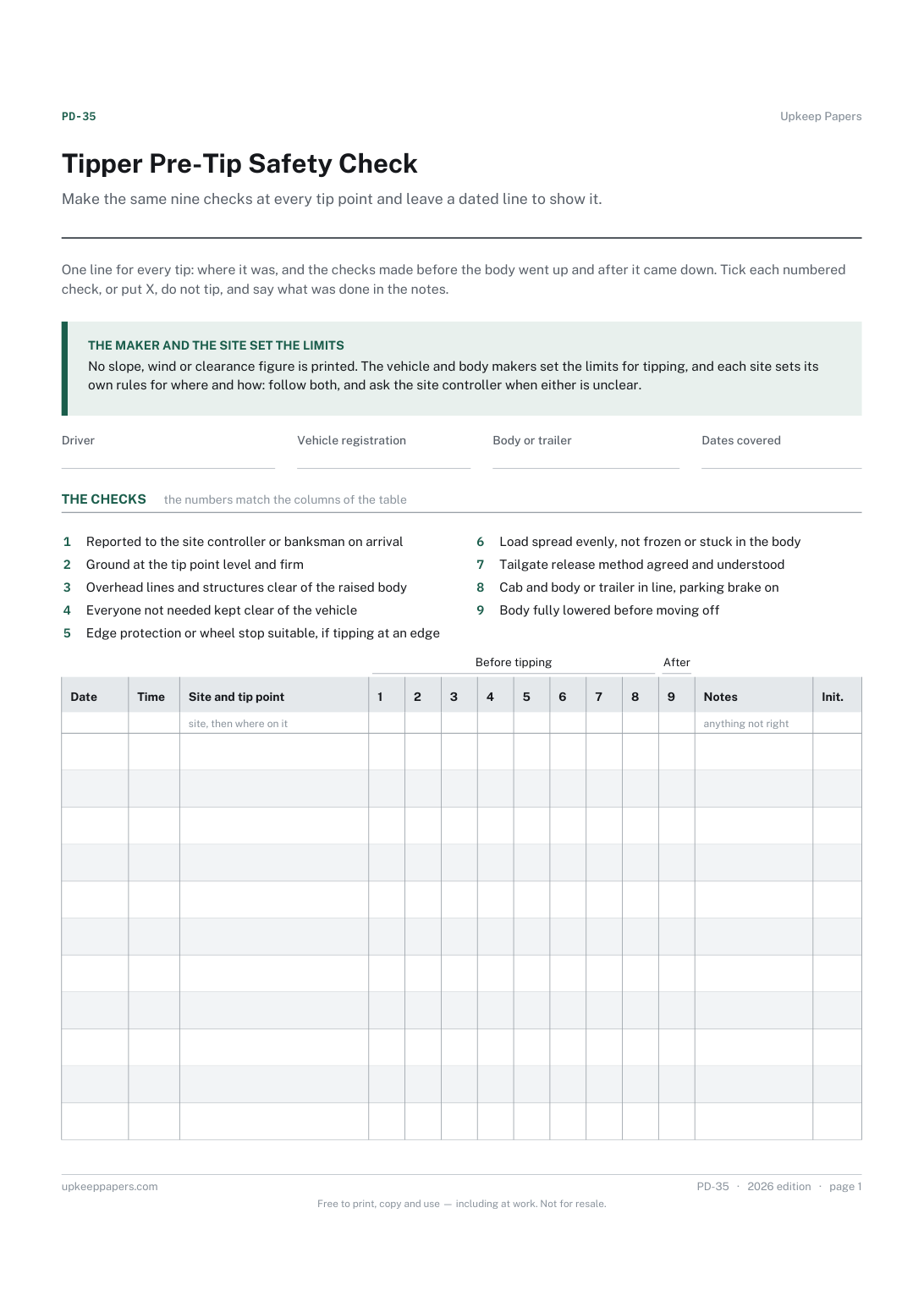
Make the same nine checks at every tip point and leave a dated line to show it. The near misses on page two are the ones worth talking about before the next job.
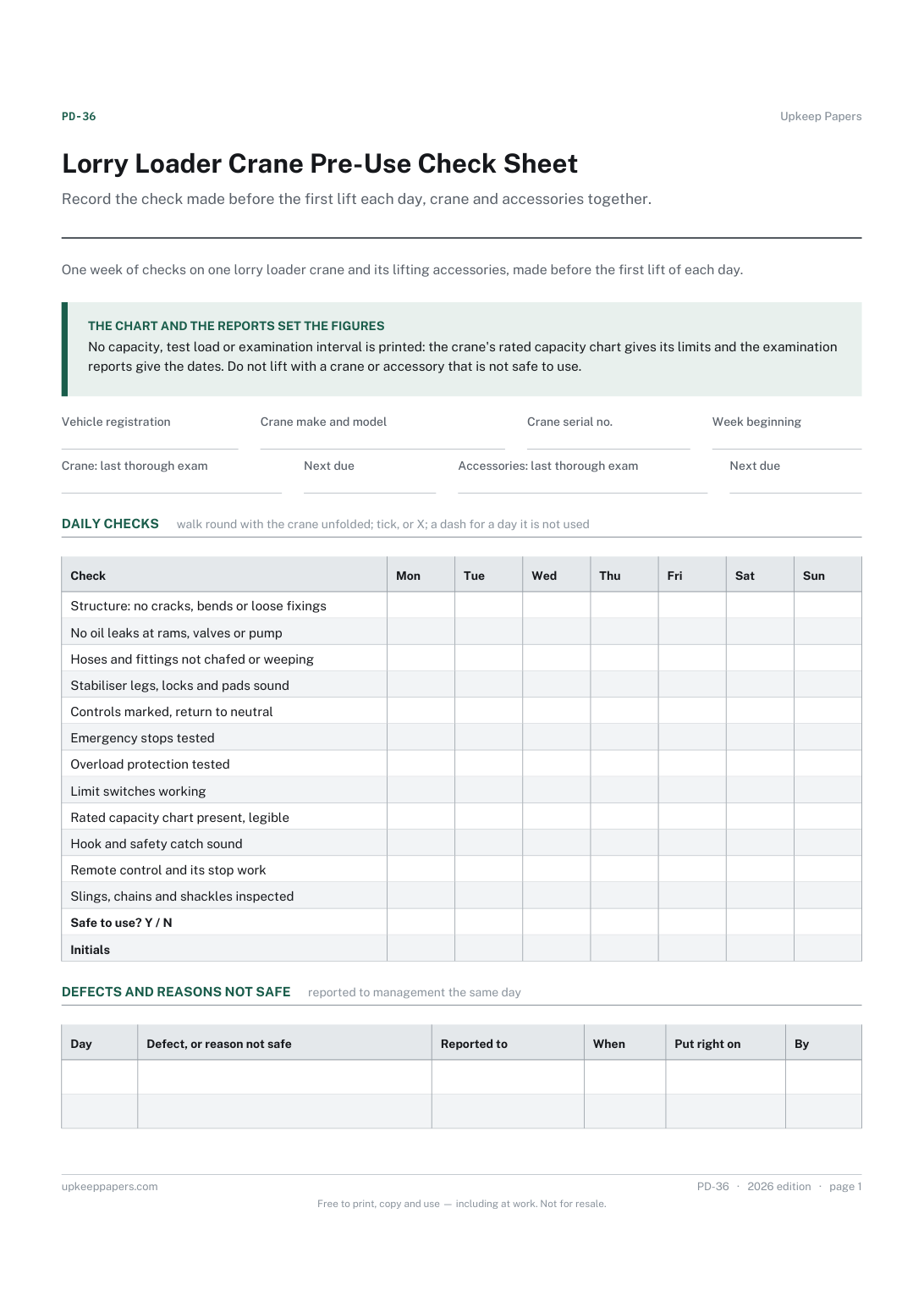
Record the check made before the first lift each day, crane and accessories together. A day ends in a plain safe or not safe, so nobody has to guess from a row of ticks.
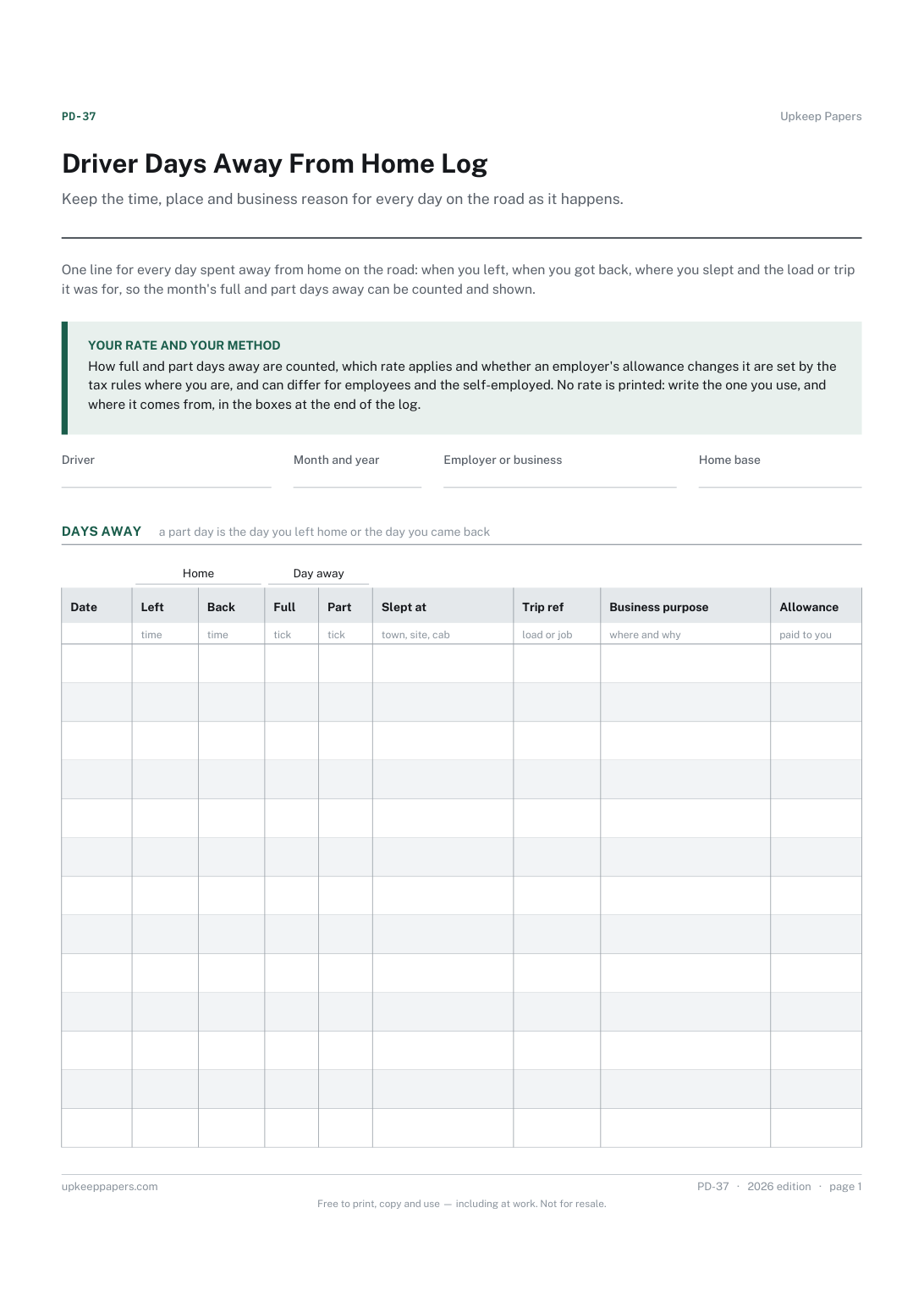
Keep the time, place and business reason for every day on the road as it happens. At month end the full and part days are counted for your tax or expenses claim, at the rate you use.
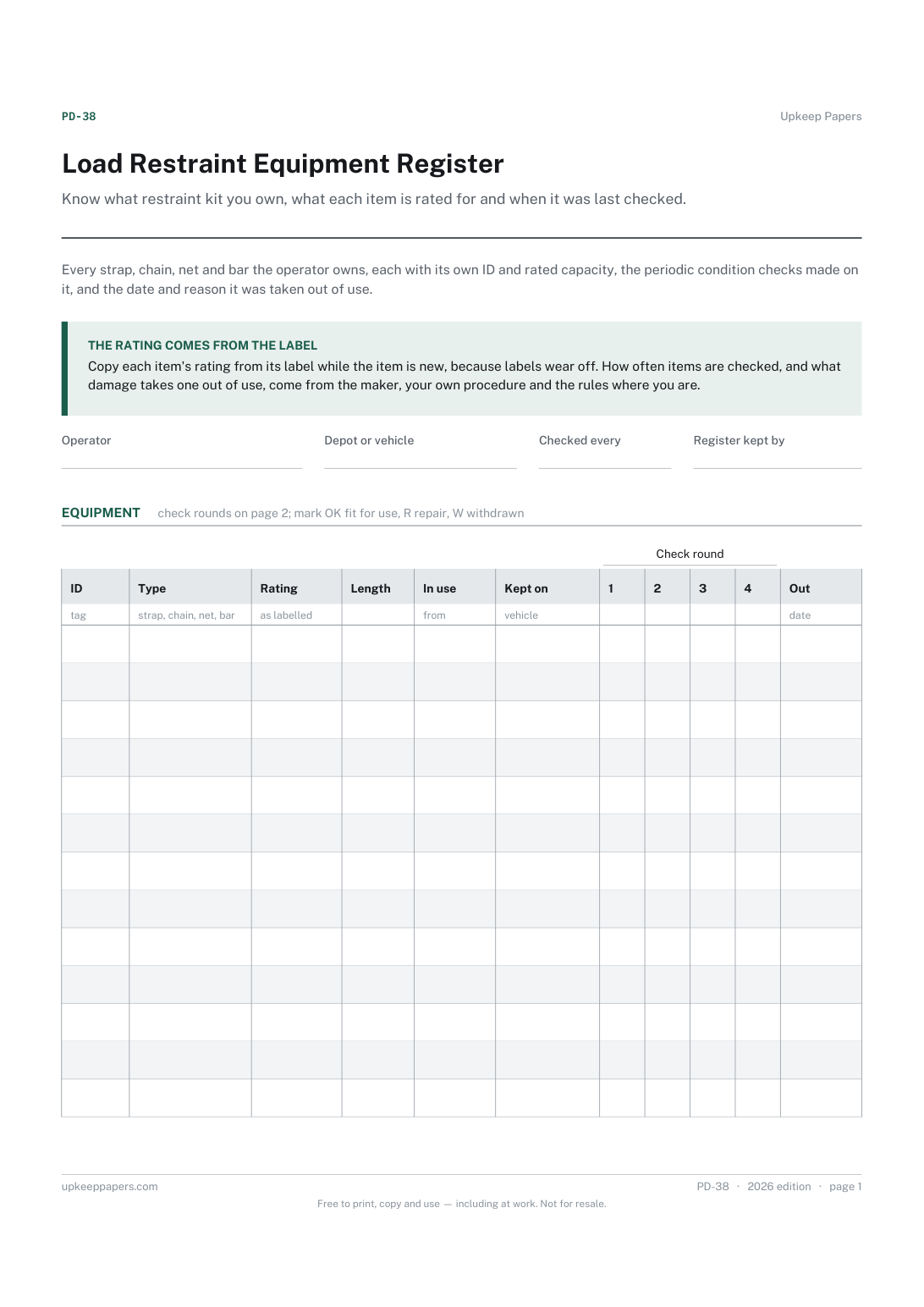
Know what restraint kit you own, what each item is rated for and when it was last checked. Faults and withdrawals sit on page two, so a damaged strap is traced to the day it went out of use.
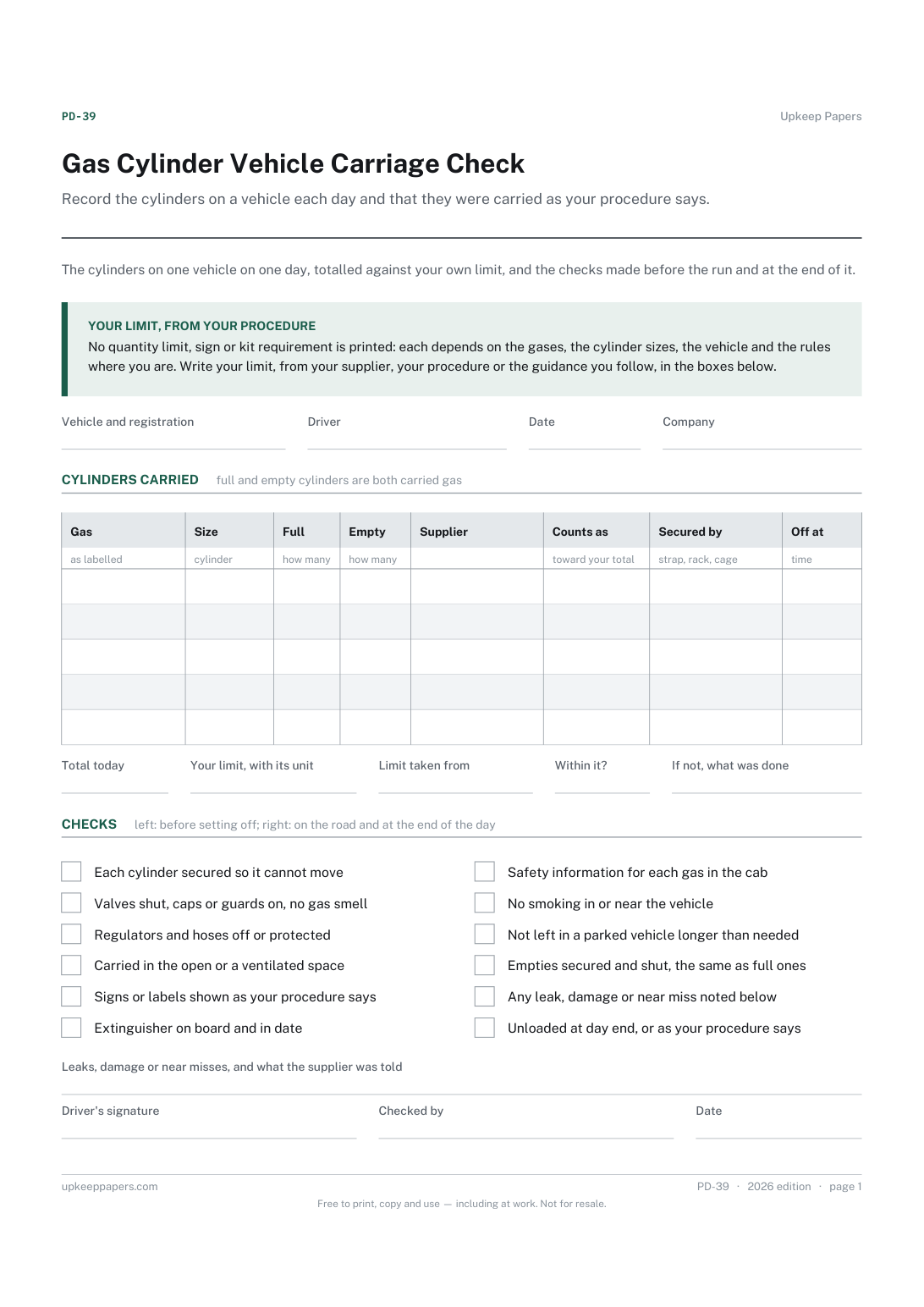
Record the cylinders on a vehicle each day and that they were carried as your procedure says. The total is checked against the limit you write in, not one printed for you.
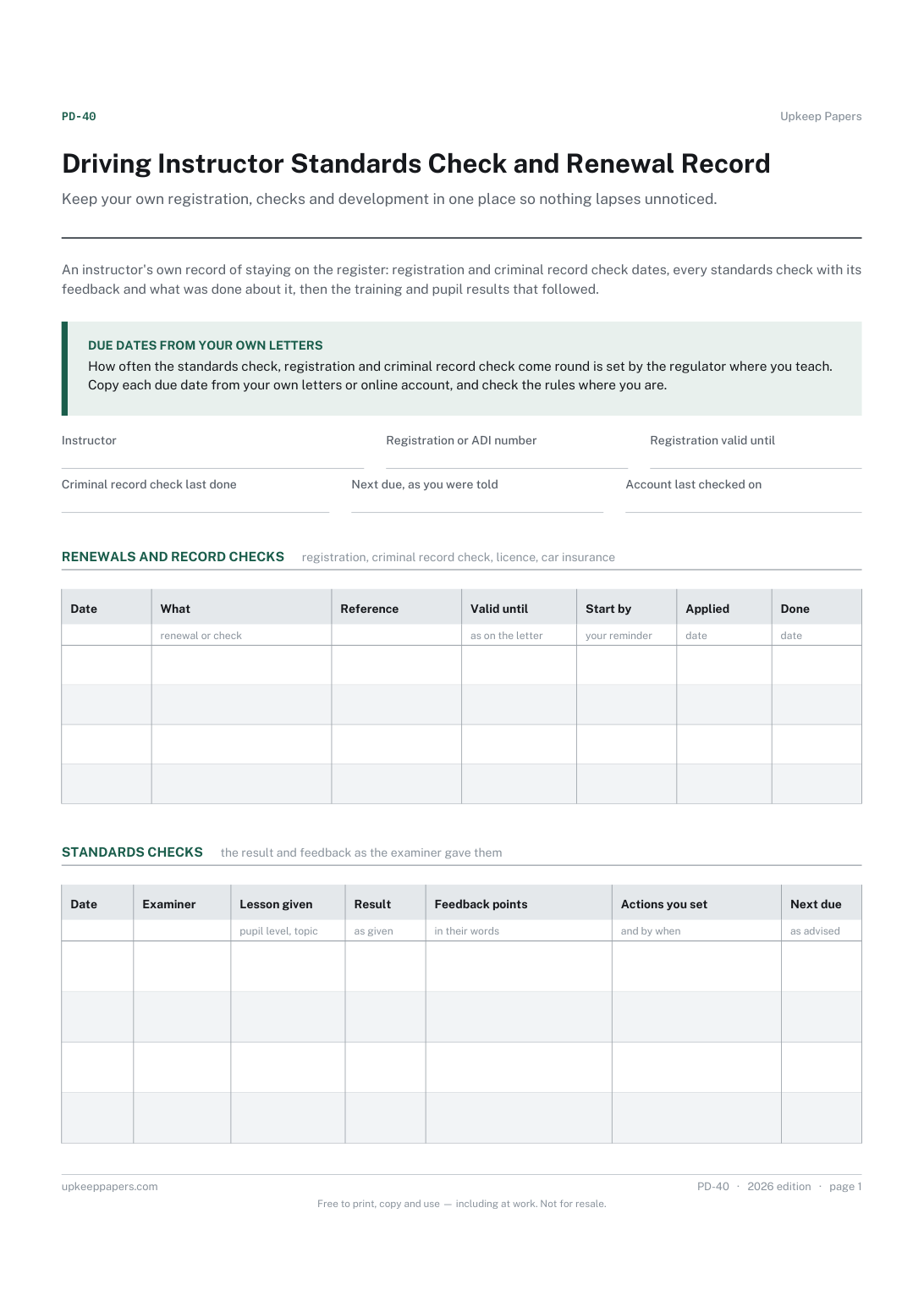
Keep your own registration, checks and development in one place so nothing lapses unnoticed. Feedback from each standards check becomes actions, and the development log shows what changed.
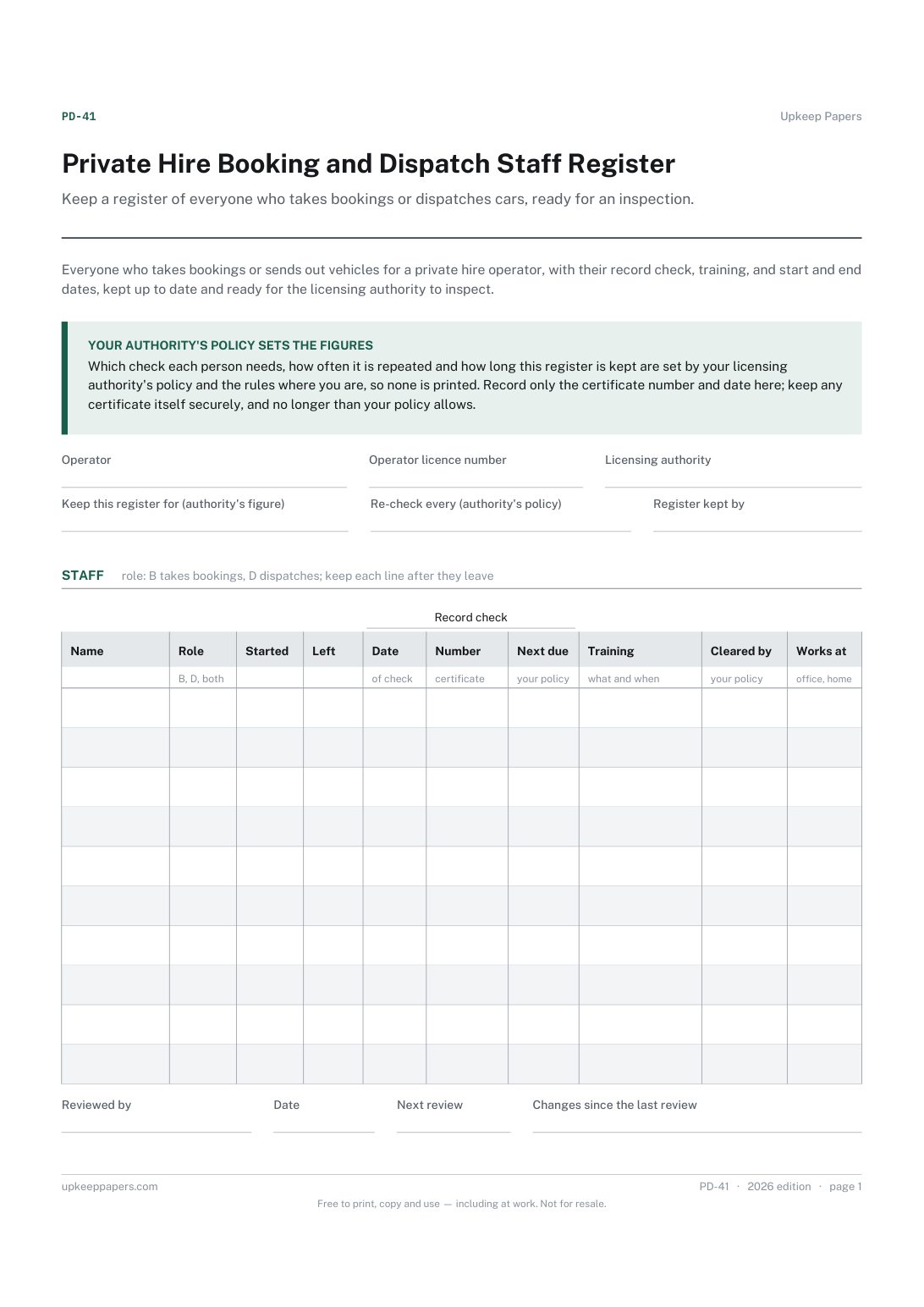
Keep a register of everyone who takes bookings or dispatches cars, ready for an inspection. Each person's record check, its next due date and their training sit on one line.
Goods in, picked, packed, counted and despatched — the paper trail down the aisle.
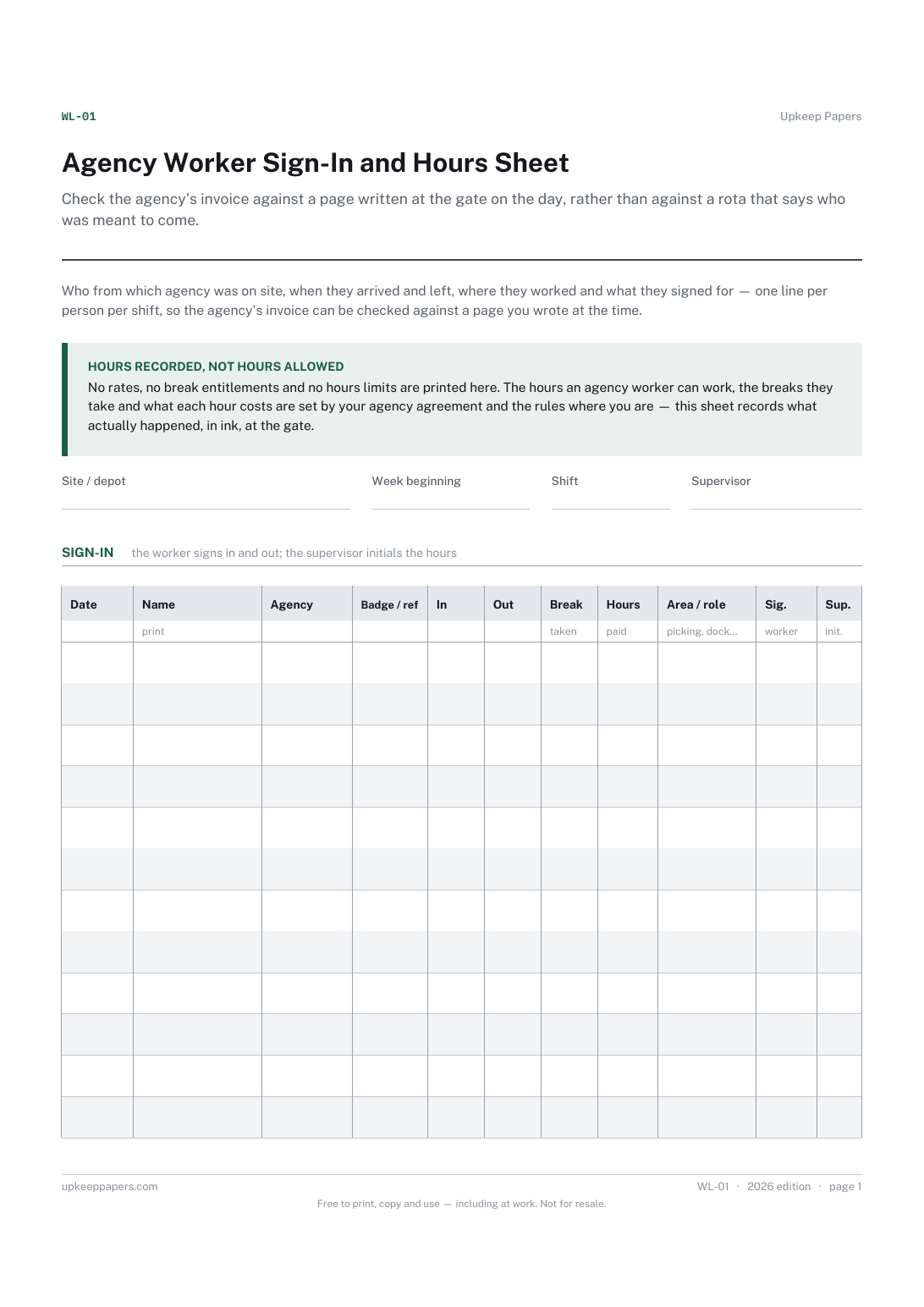
Check the agency's invoice against a page written at the gate on the day, rather than against a rota that says who was meant to come.
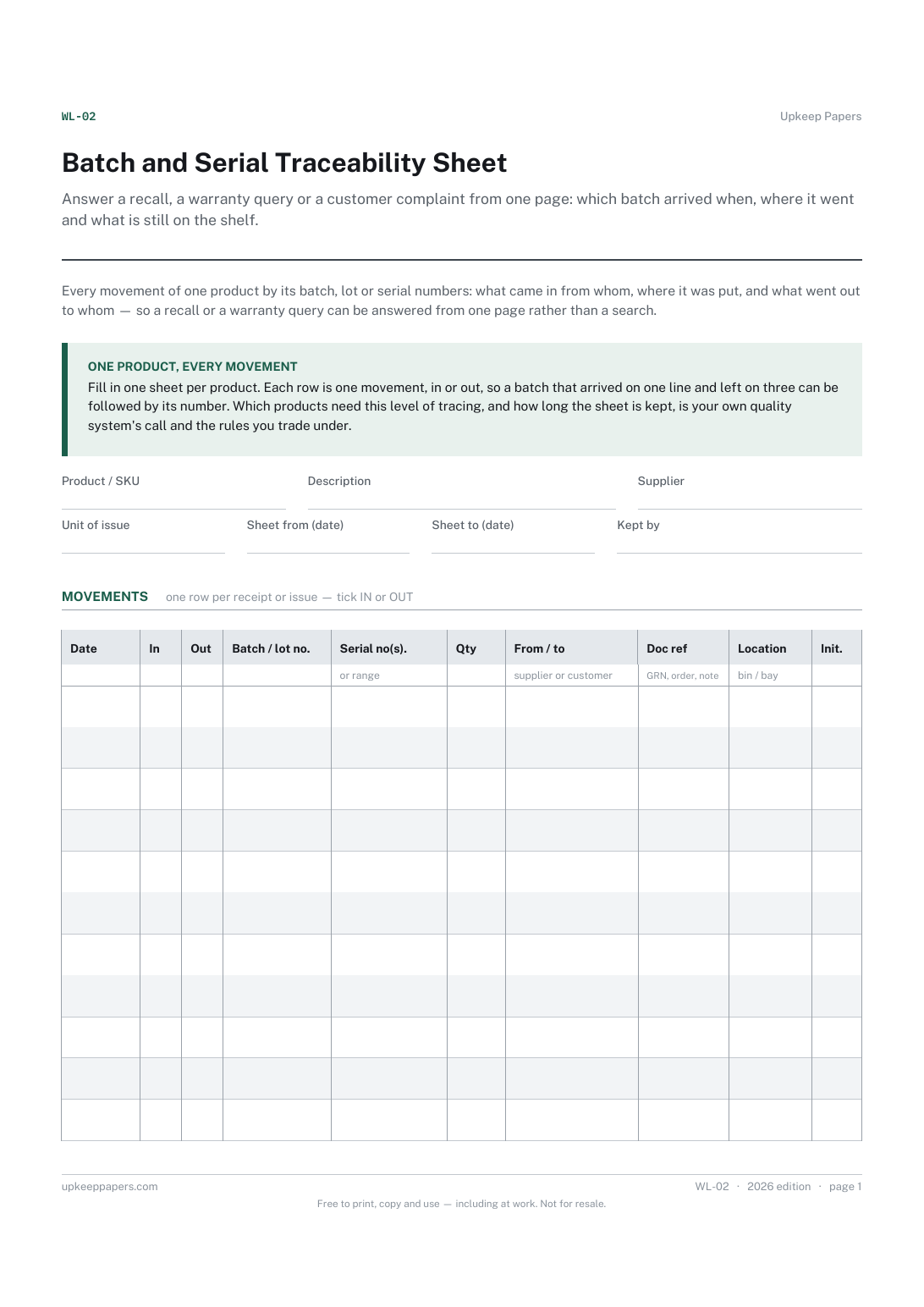
Answer a recall, a warranty query or a customer complaint from one page: which batch arrived when, where it went and what is still on the shelf.
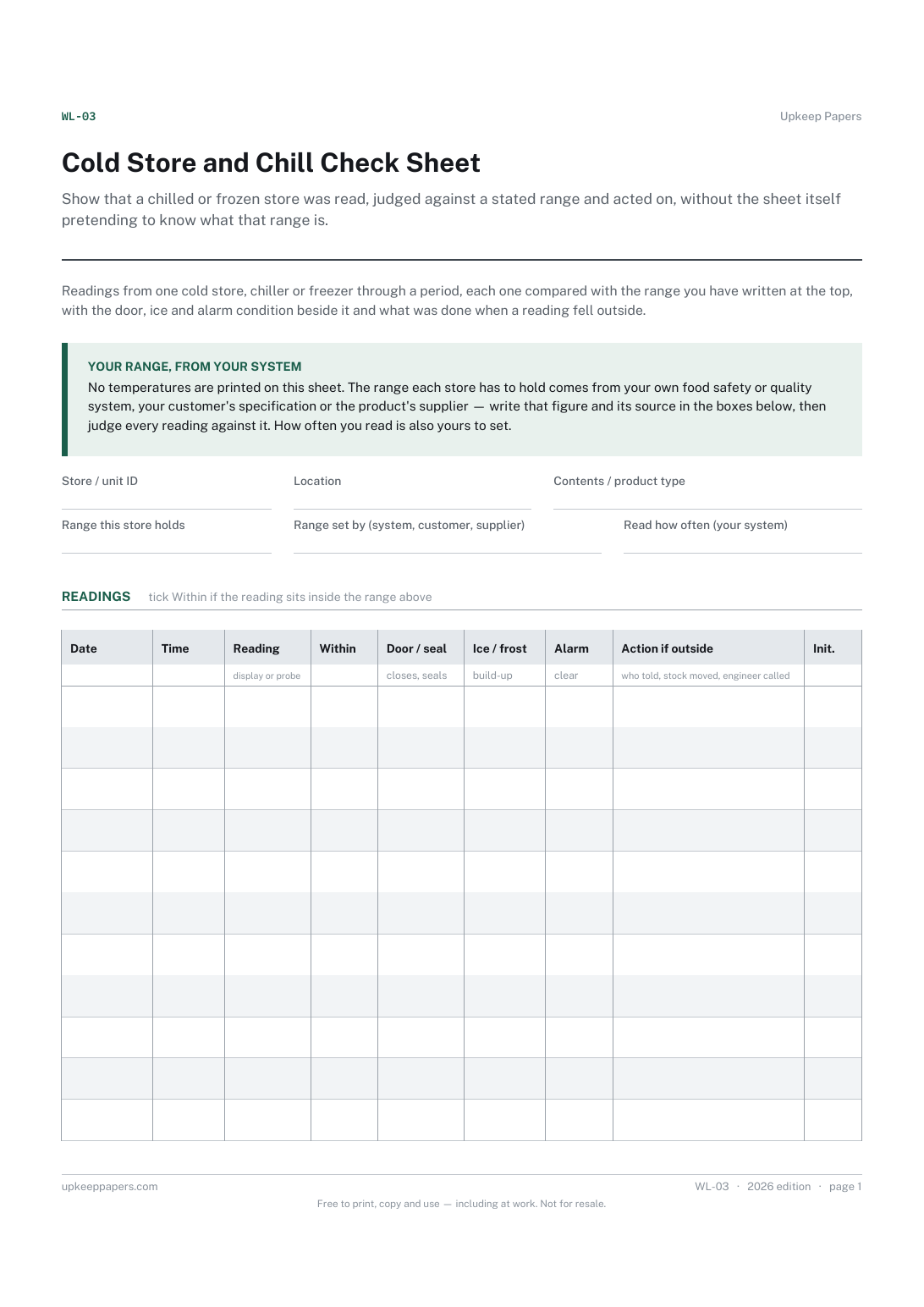
Show that a chilled or frozen store was read, judged against a stated range and acted on, without the sheet itself pretending to know what that range is.
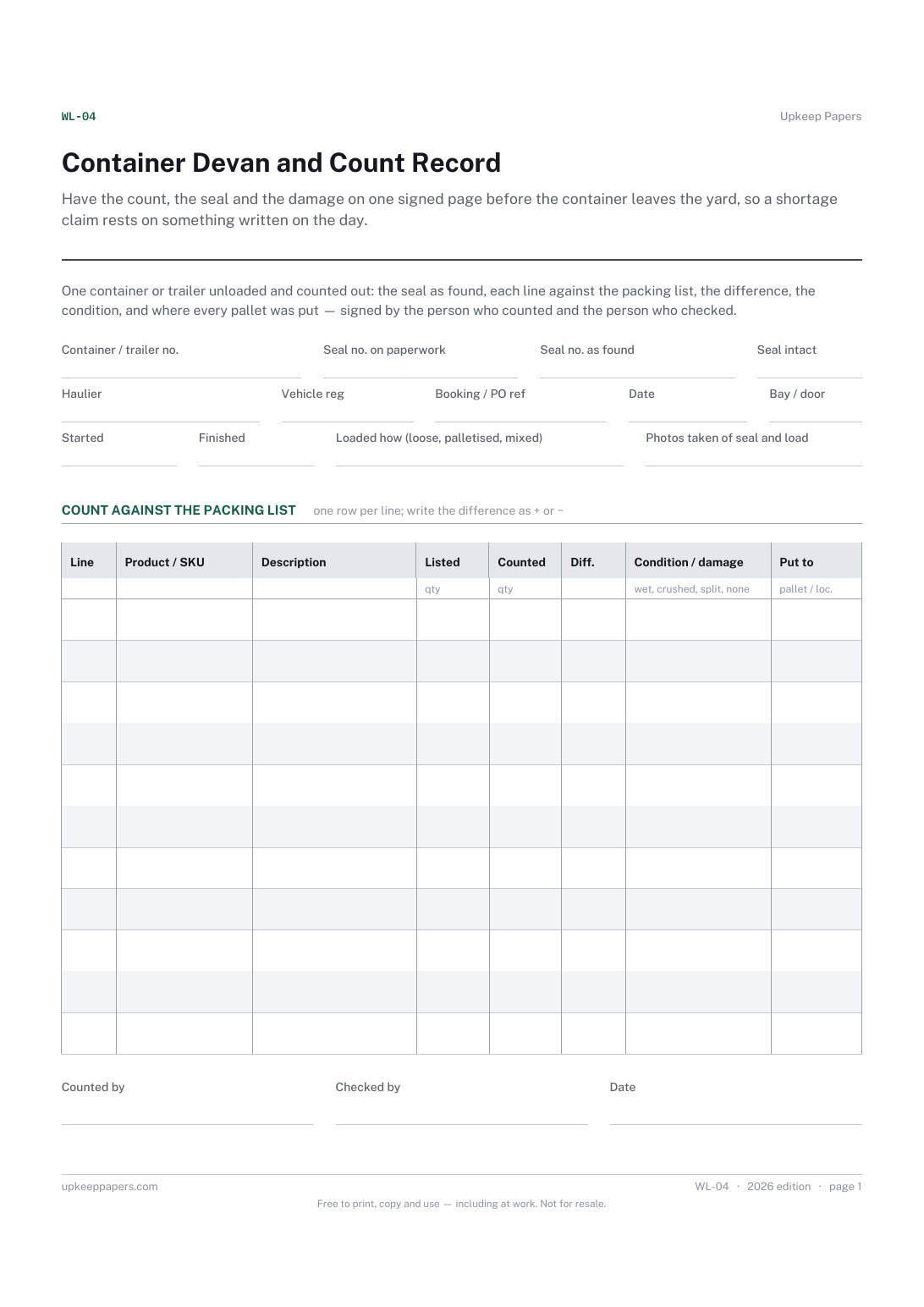
Have the count, the seal and the damage on one signed page before the container leaves the yard, so a shortage claim rests on something written on the day.
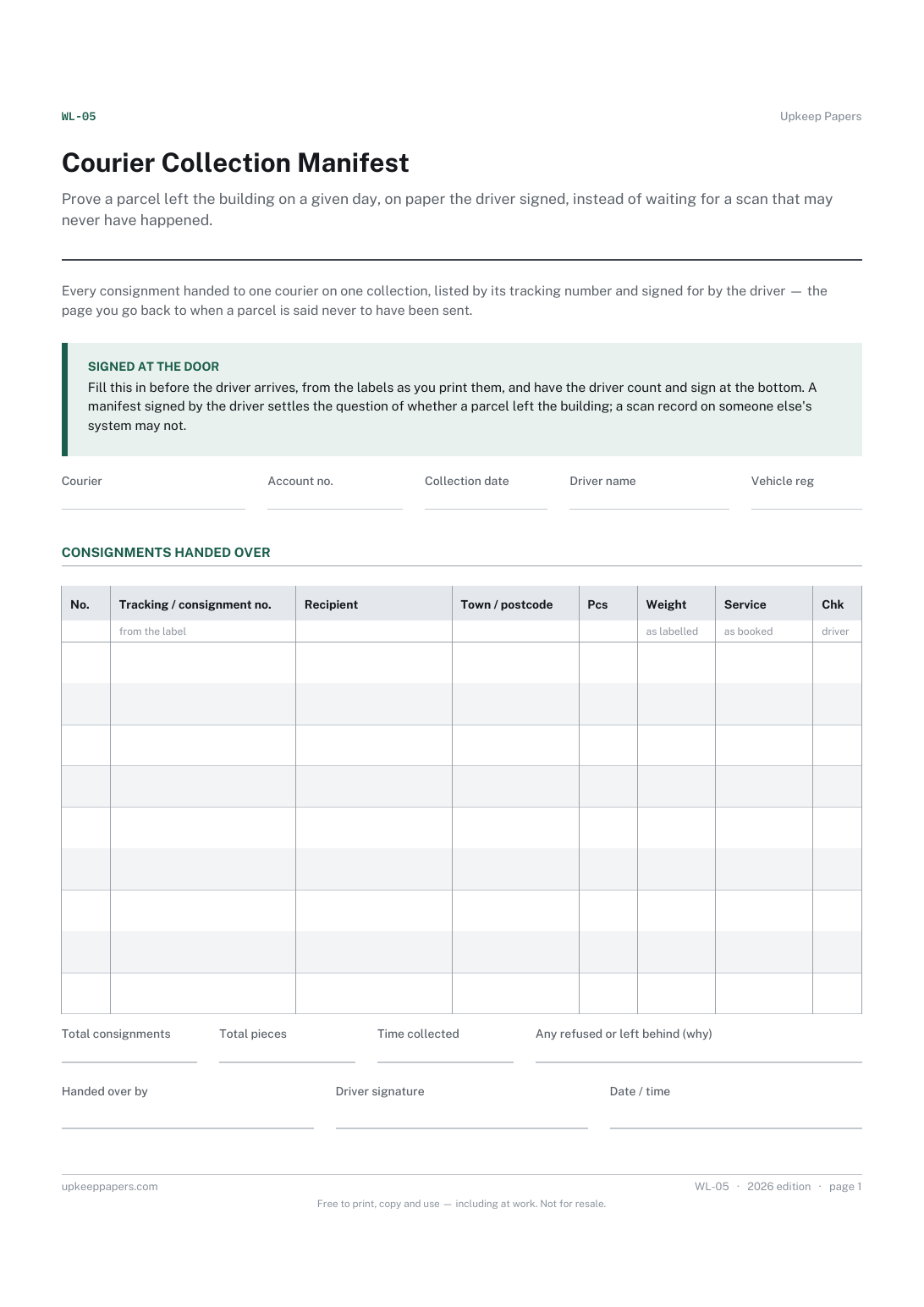
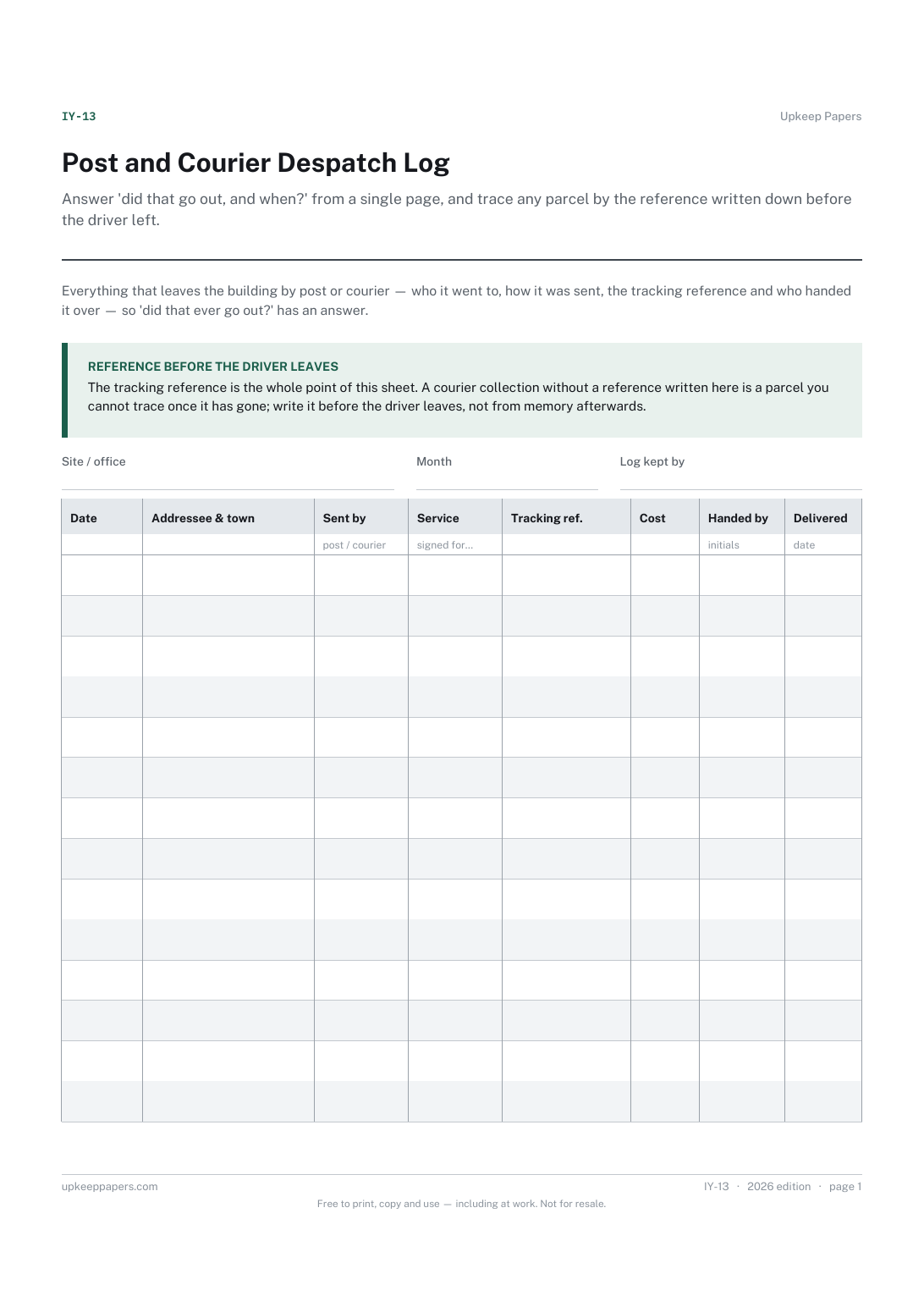
Prove a parcel left the building on a given day, on paper the driver signed, instead of waiting for a scan that may never have happened.
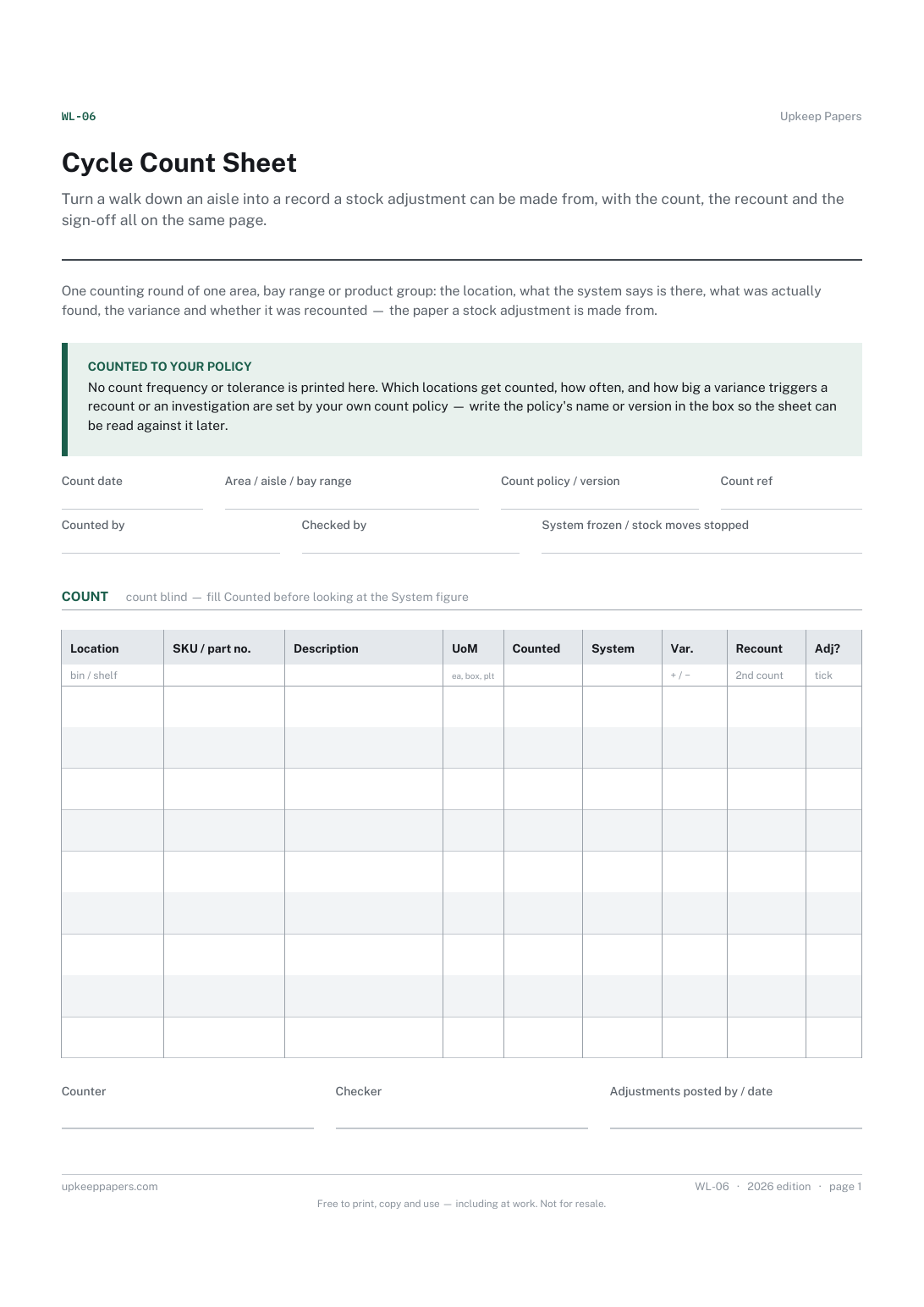
Turn a walk down an aisle into a record a stock adjustment can be made from, with the count, the recount and the sign-off all on the same page.
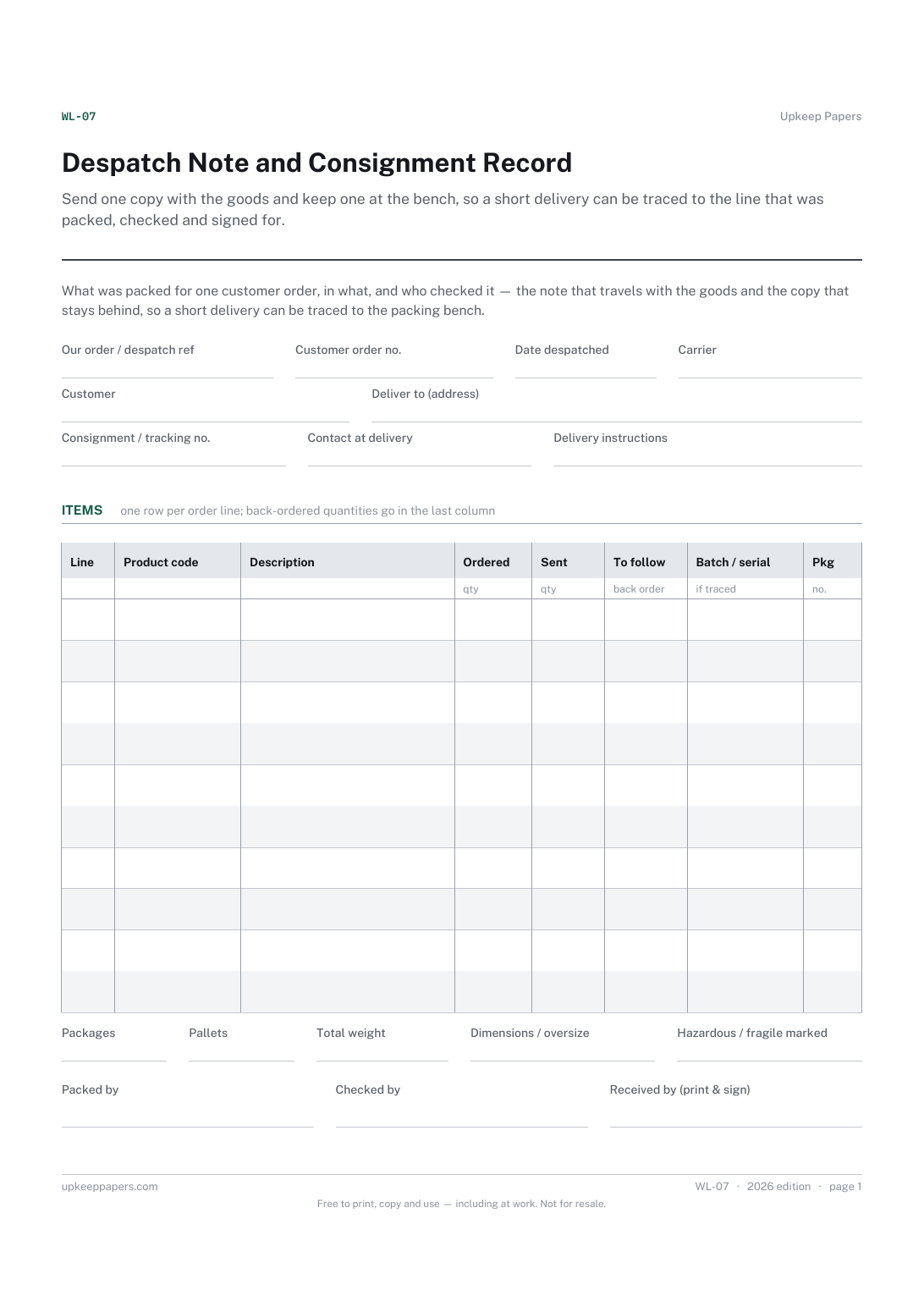
Send one copy with the goods and keep one at the bench, so a short delivery can be traced to the line that was packed, checked and signed for.
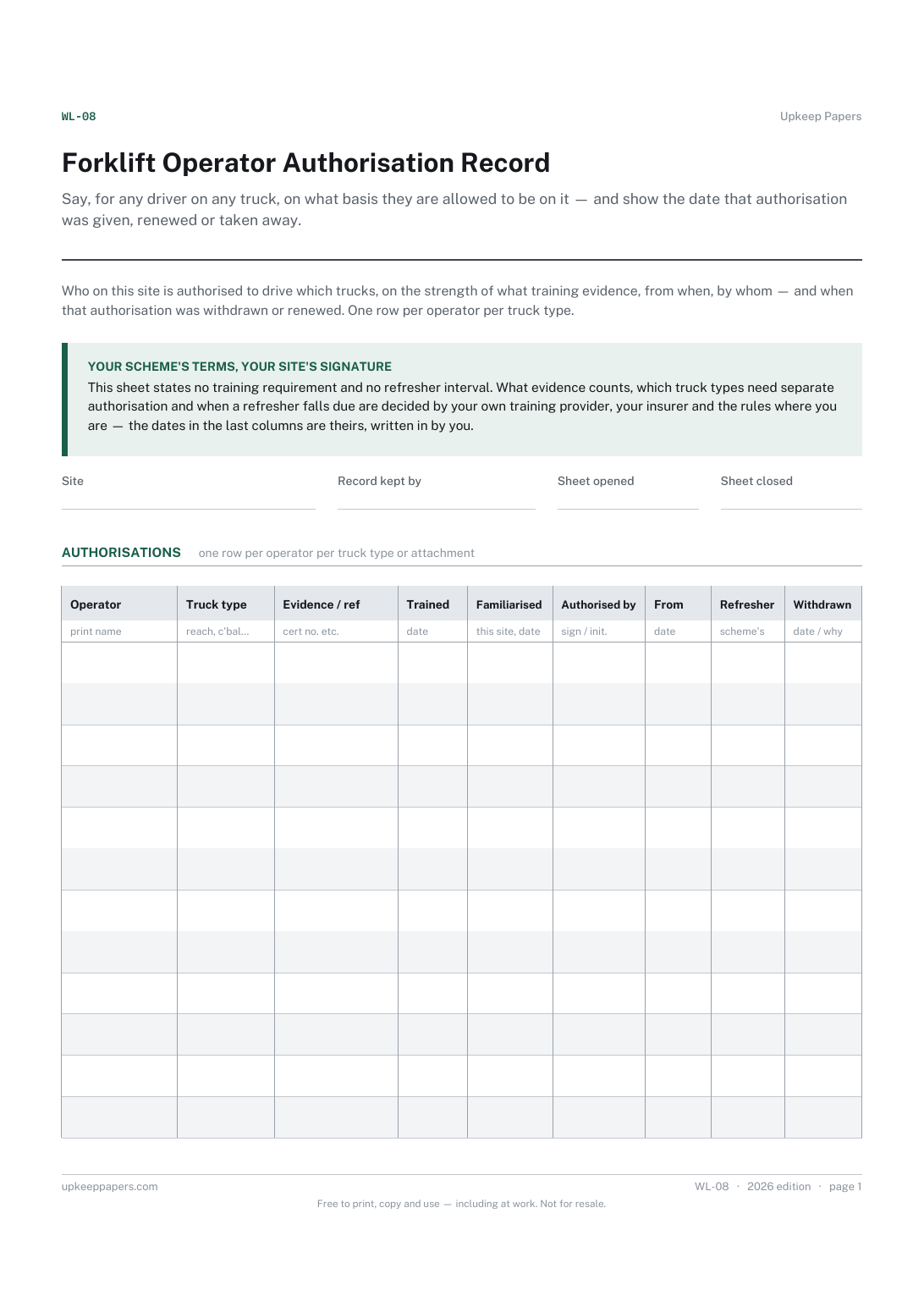
Say, for any driver on any truck, on what basis they are allowed to be on it — and show the date that authorisation was given, renewed or taken away.
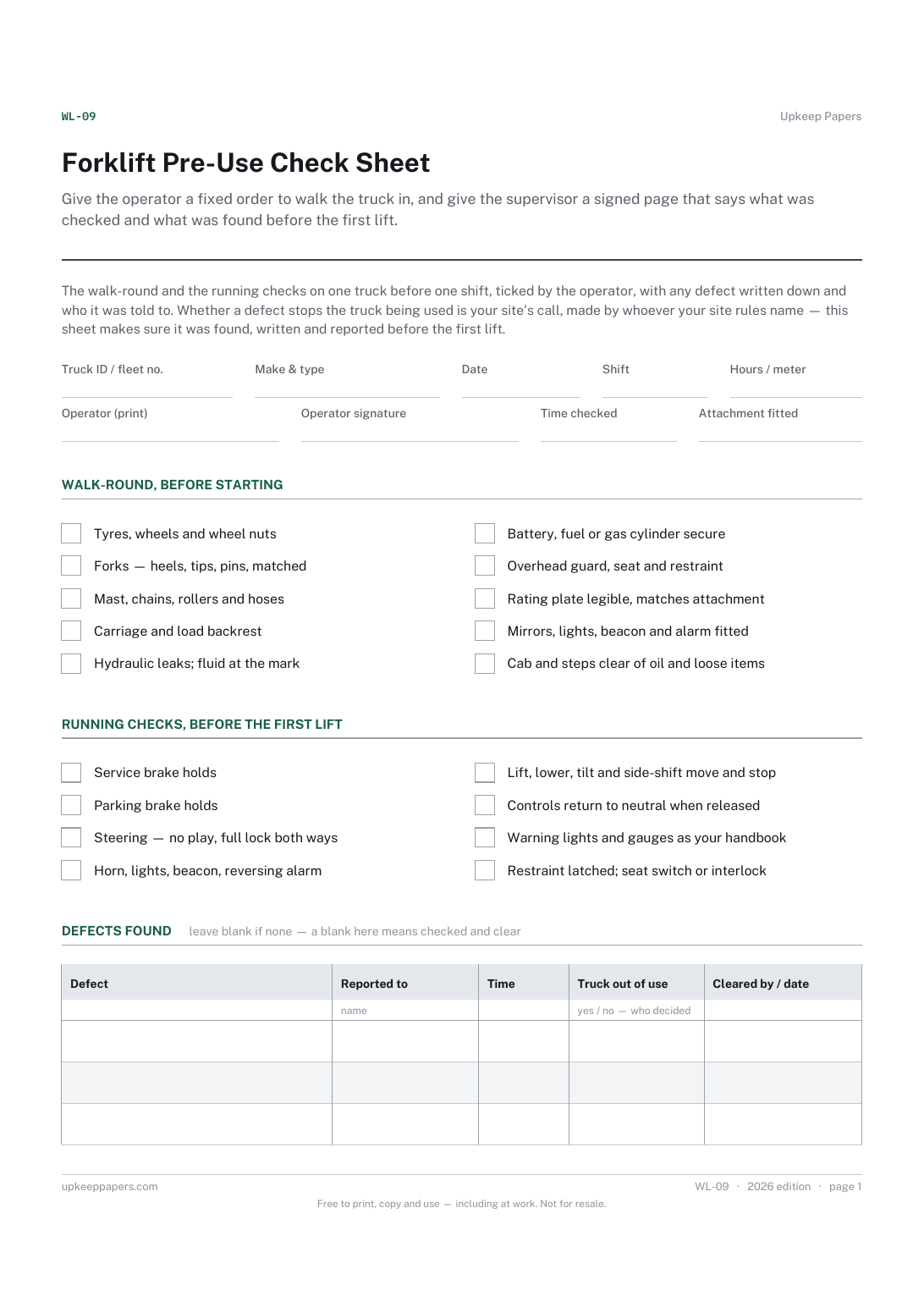
Give the operator a fixed order to walk the truck in, and give the supervisor a signed page that says what was checked and what was found before the first lift.
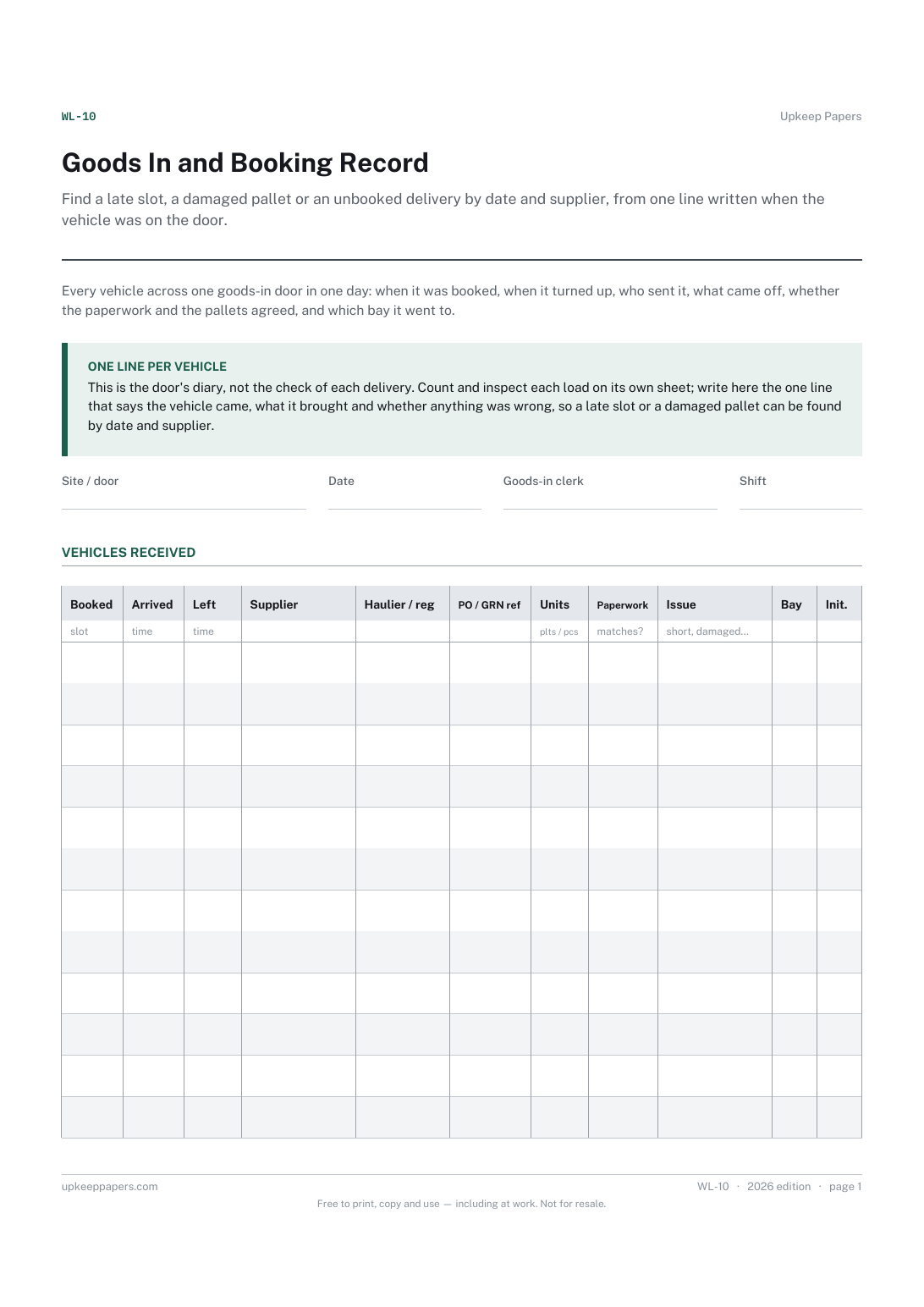
Find a late slot, a damaged pallet or an unbooked delivery by date and supplier, from one line written when the vehicle was on the door.
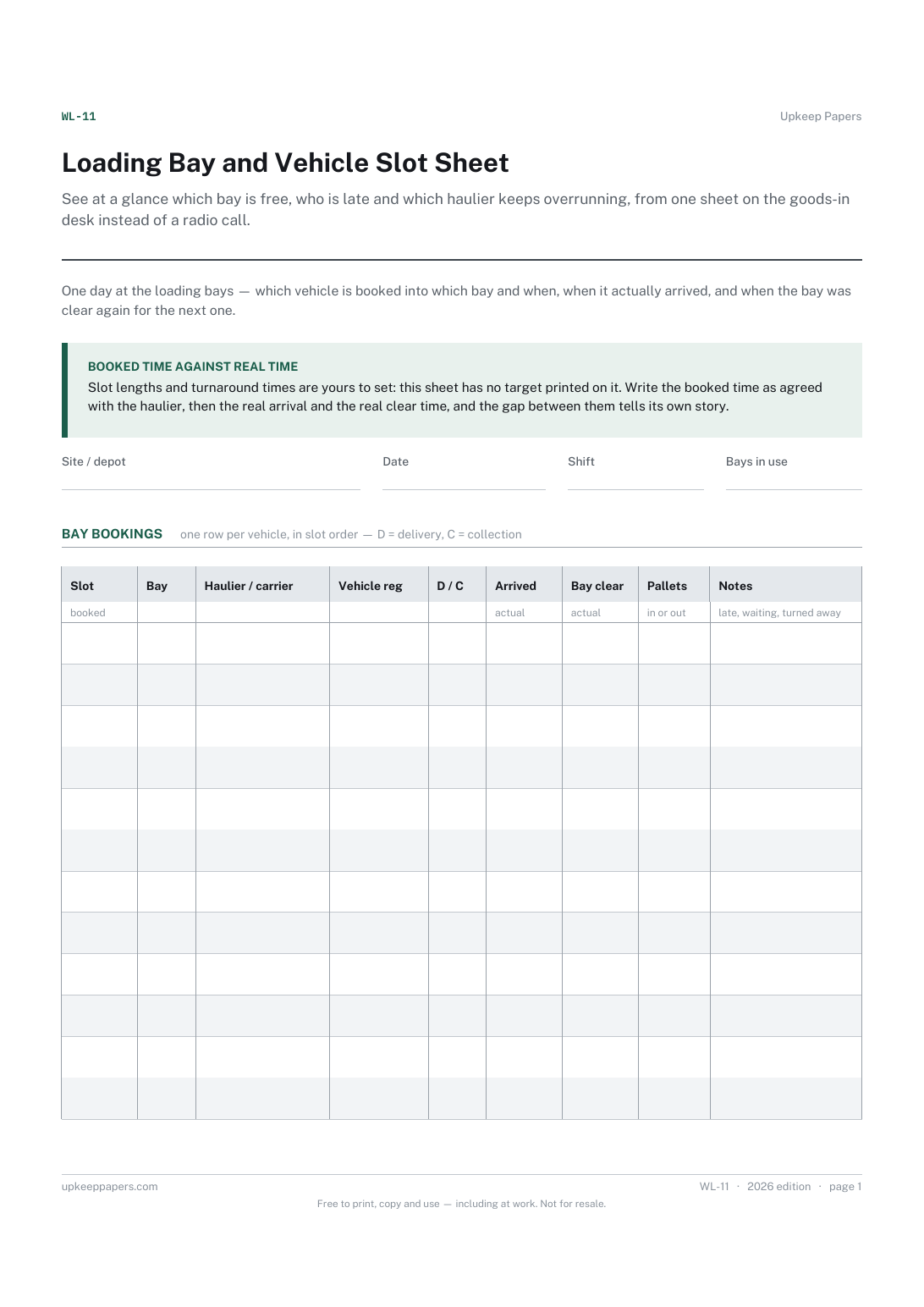
See at a glance which bay is free, who is late and which haulier keeps overrunning, from one sheet on the goods-in desk instead of a radio call.
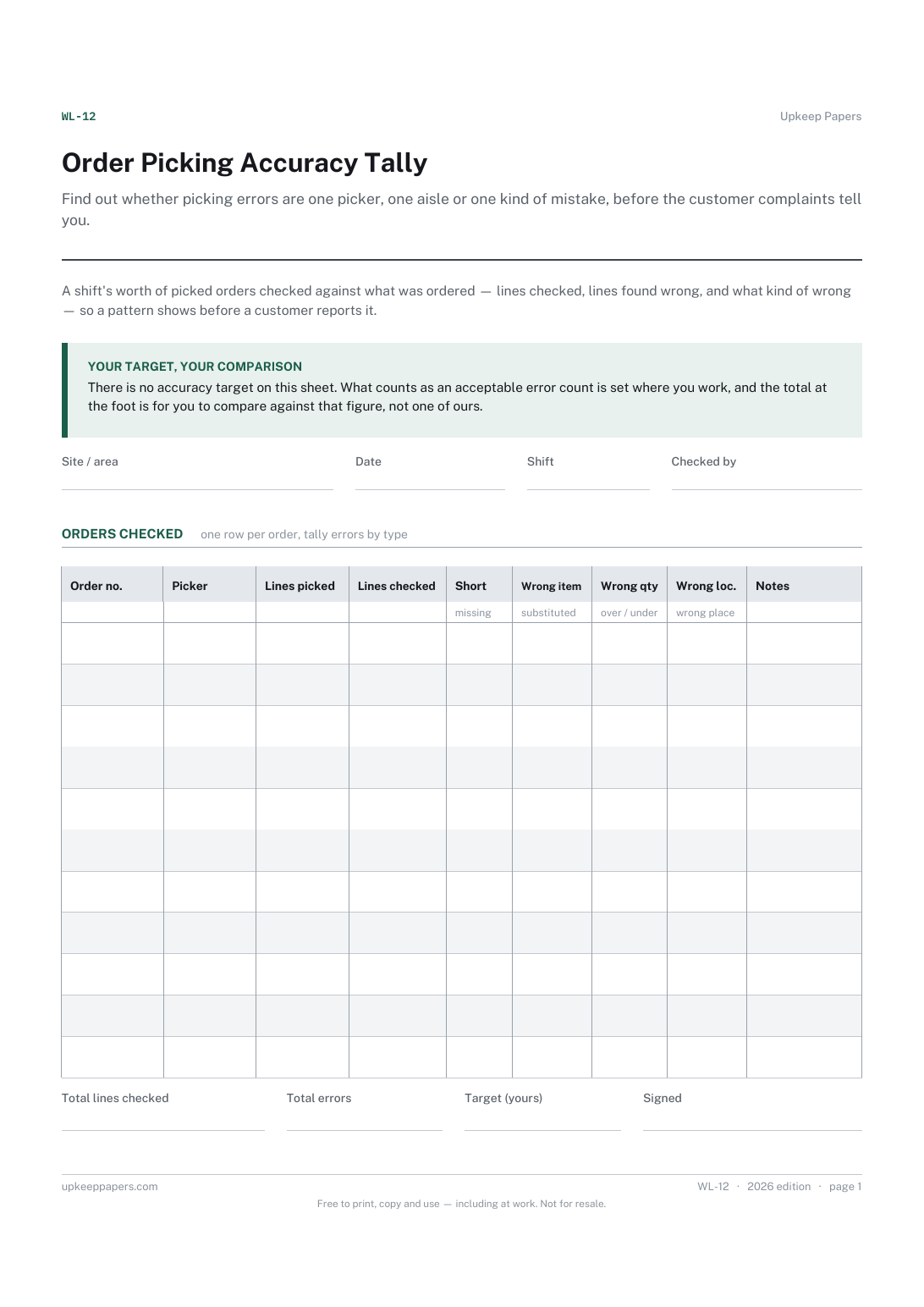
Find out whether picking errors are one picker, one aisle or one kind of mistake, before the customer complaints tell you.
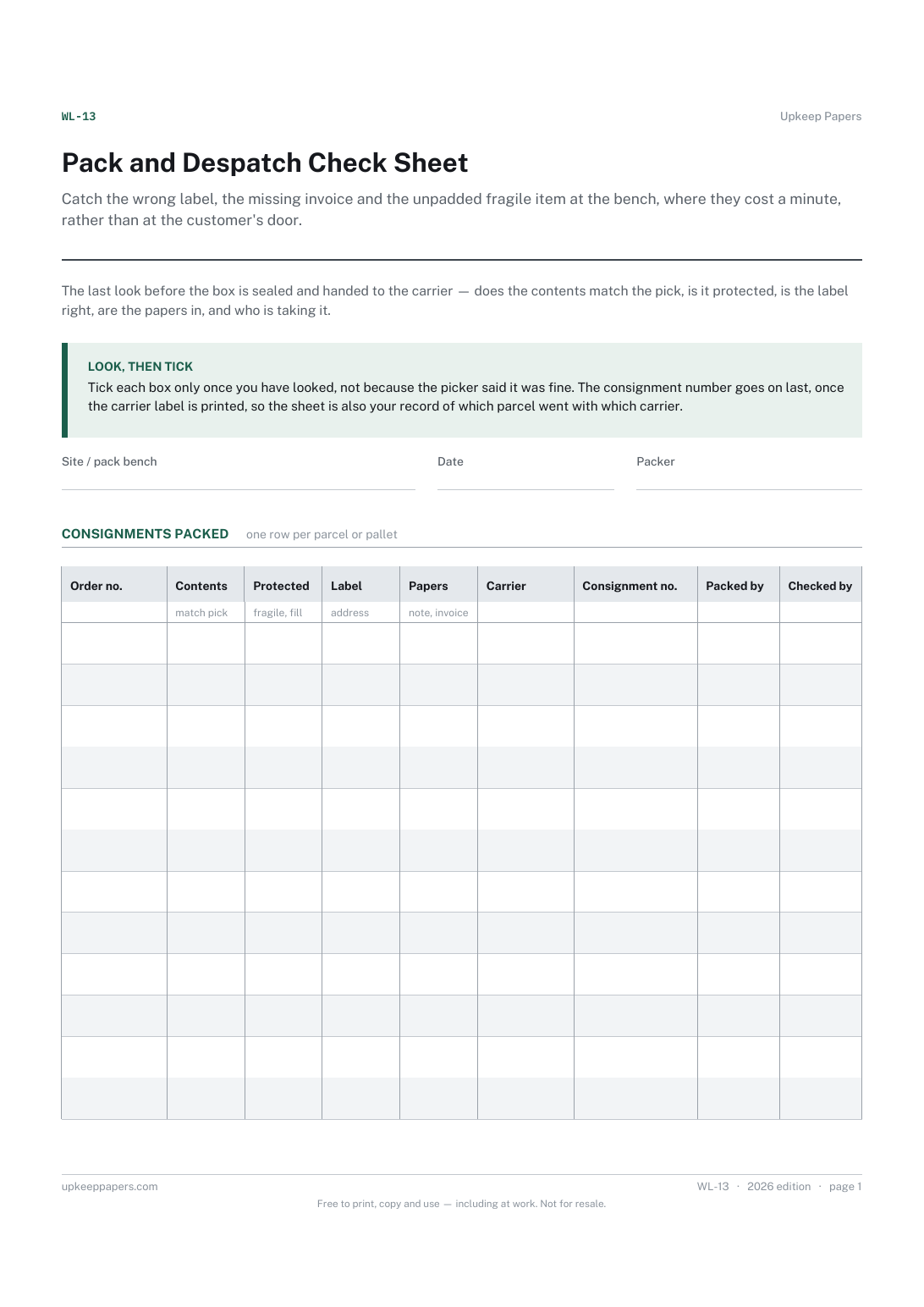
Catch the wrong label, the missing invoice and the unpadded fragile item at the bench, where they cost a minute, rather than at the customer's door.
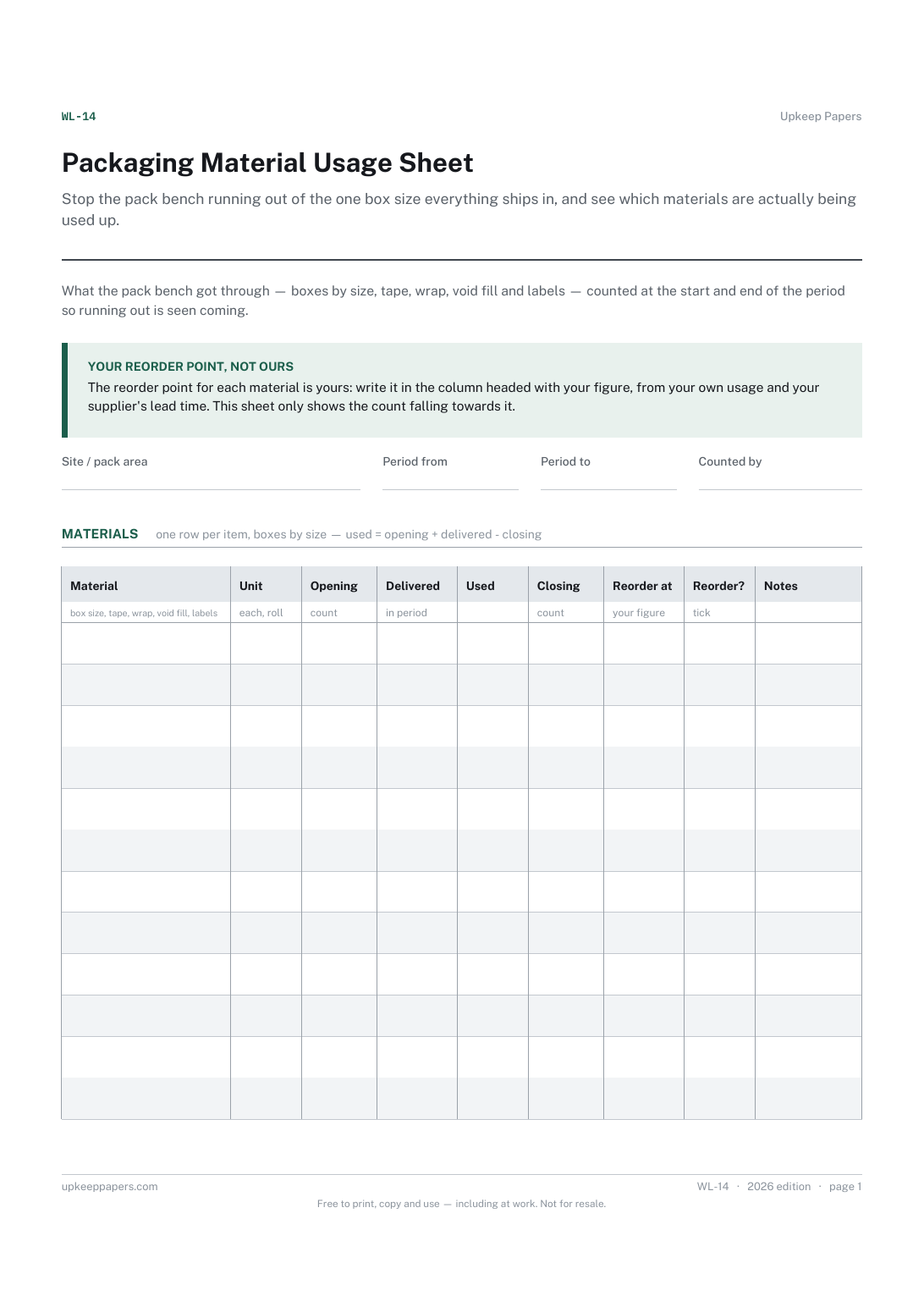
Stop the pack bench running out of the one box size everything ships in, and see which materials are actually being used up.
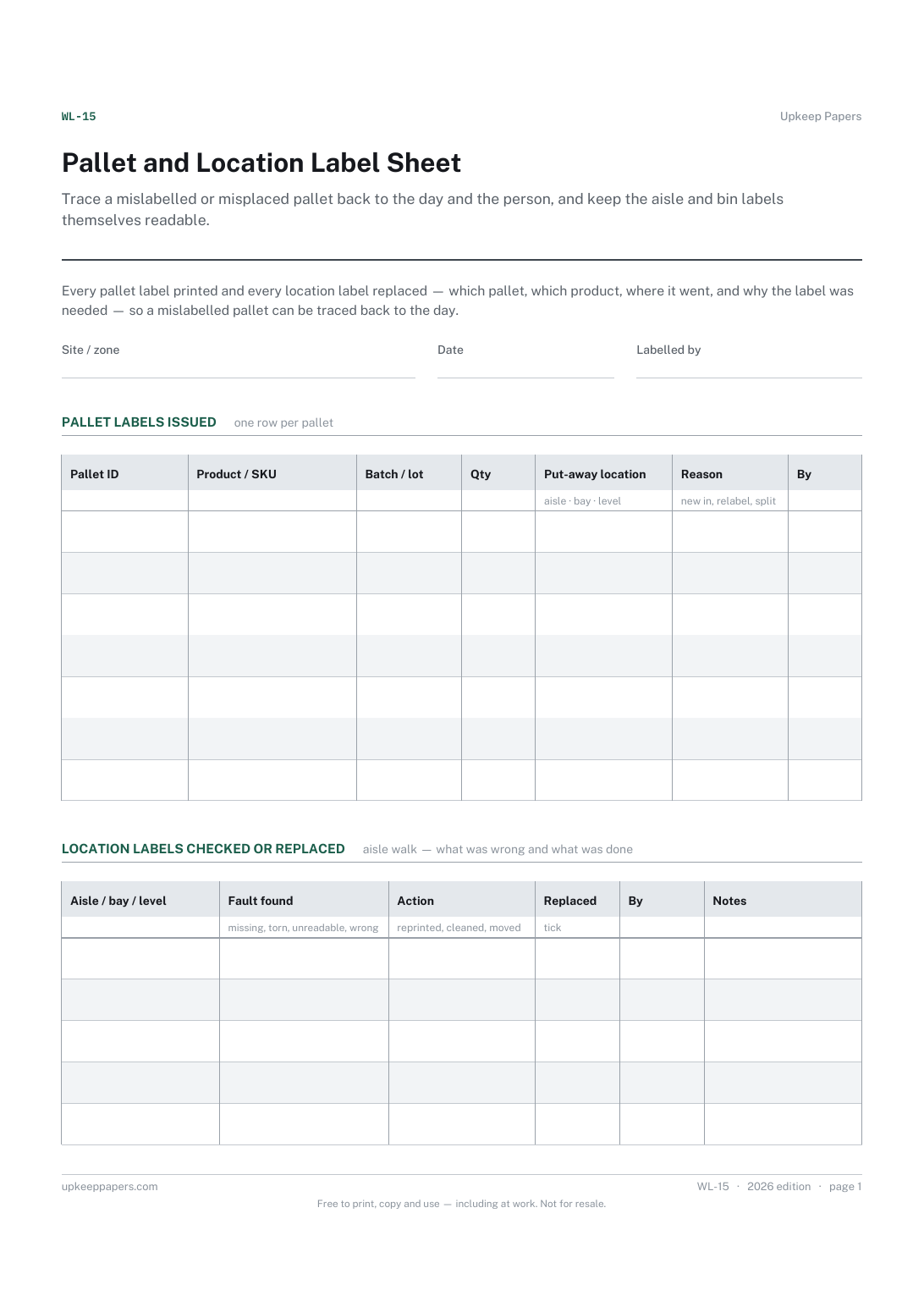
Trace a mislabelled or misplaced pallet back to the day and the person, and keep the aisle and bin labels themselves readable.
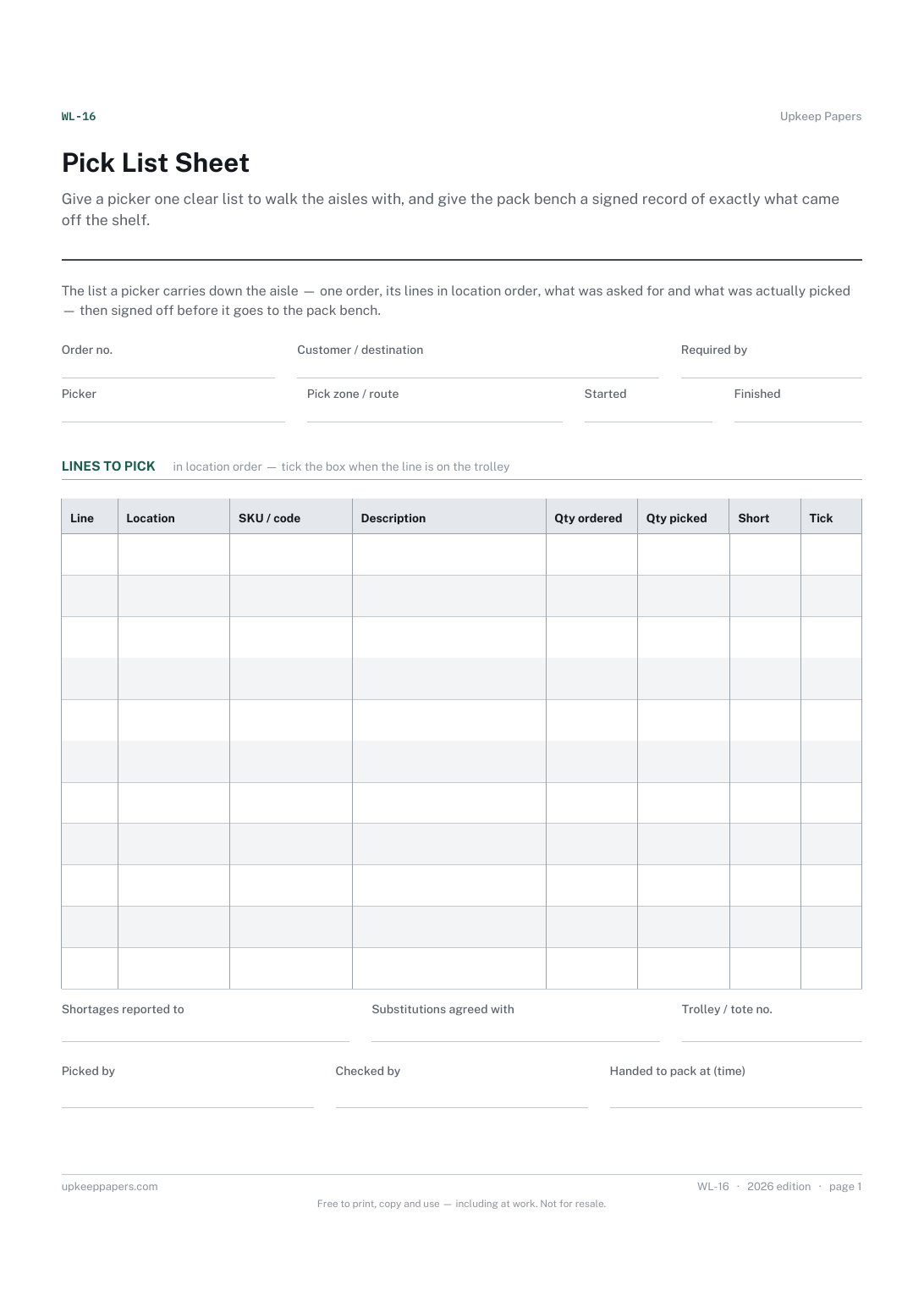
Give a picker one clear list to walk the aisles with, and give the pack bench a signed record of exactly what came off the shelf.
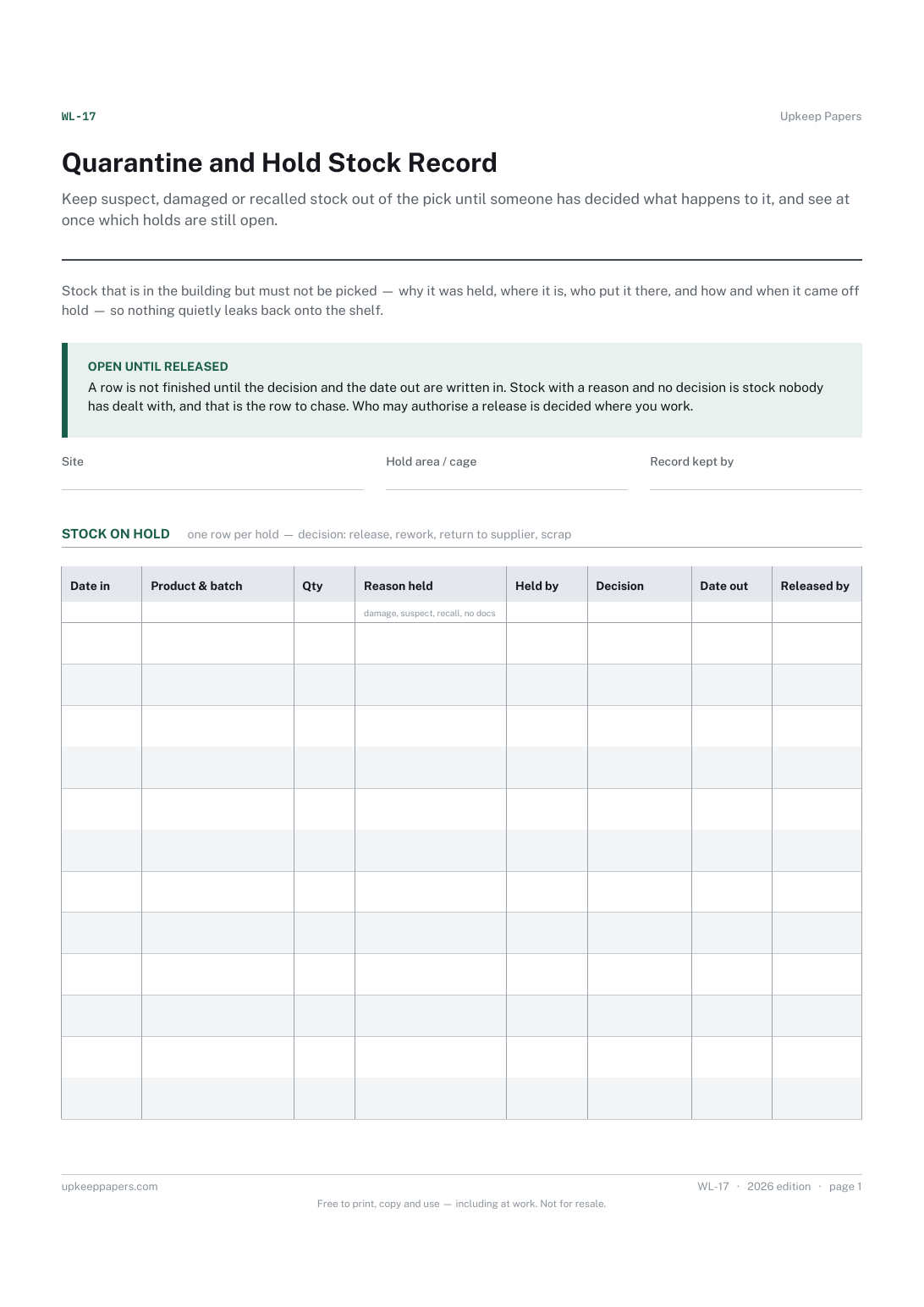
Keep suspect, damaged or recalled stock out of the pick until someone has decided what happens to it, and see at once which holds are still open.
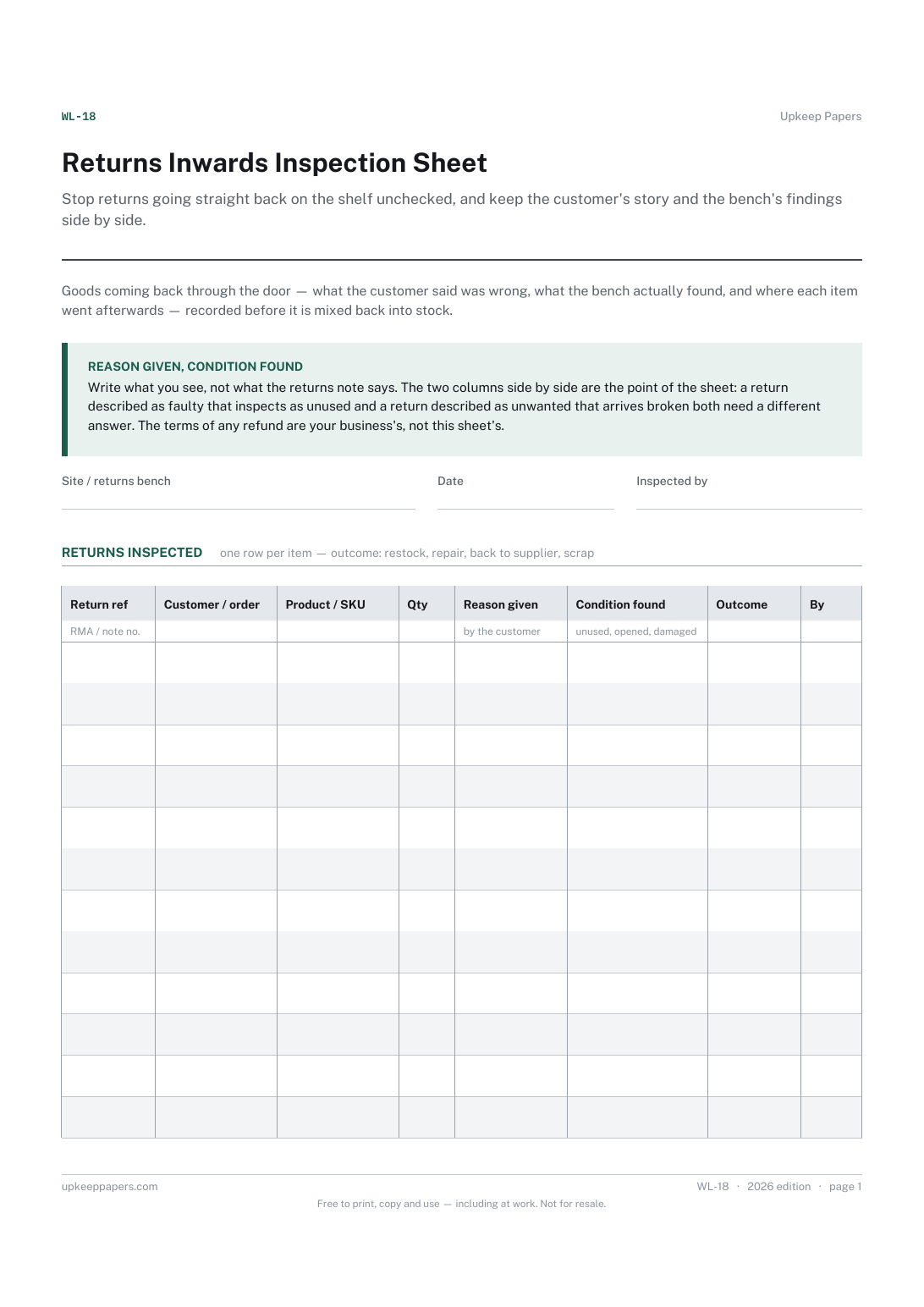
Stop returns going straight back on the shelf unchecked, and keep the customer's story and the bench's findings side by side.
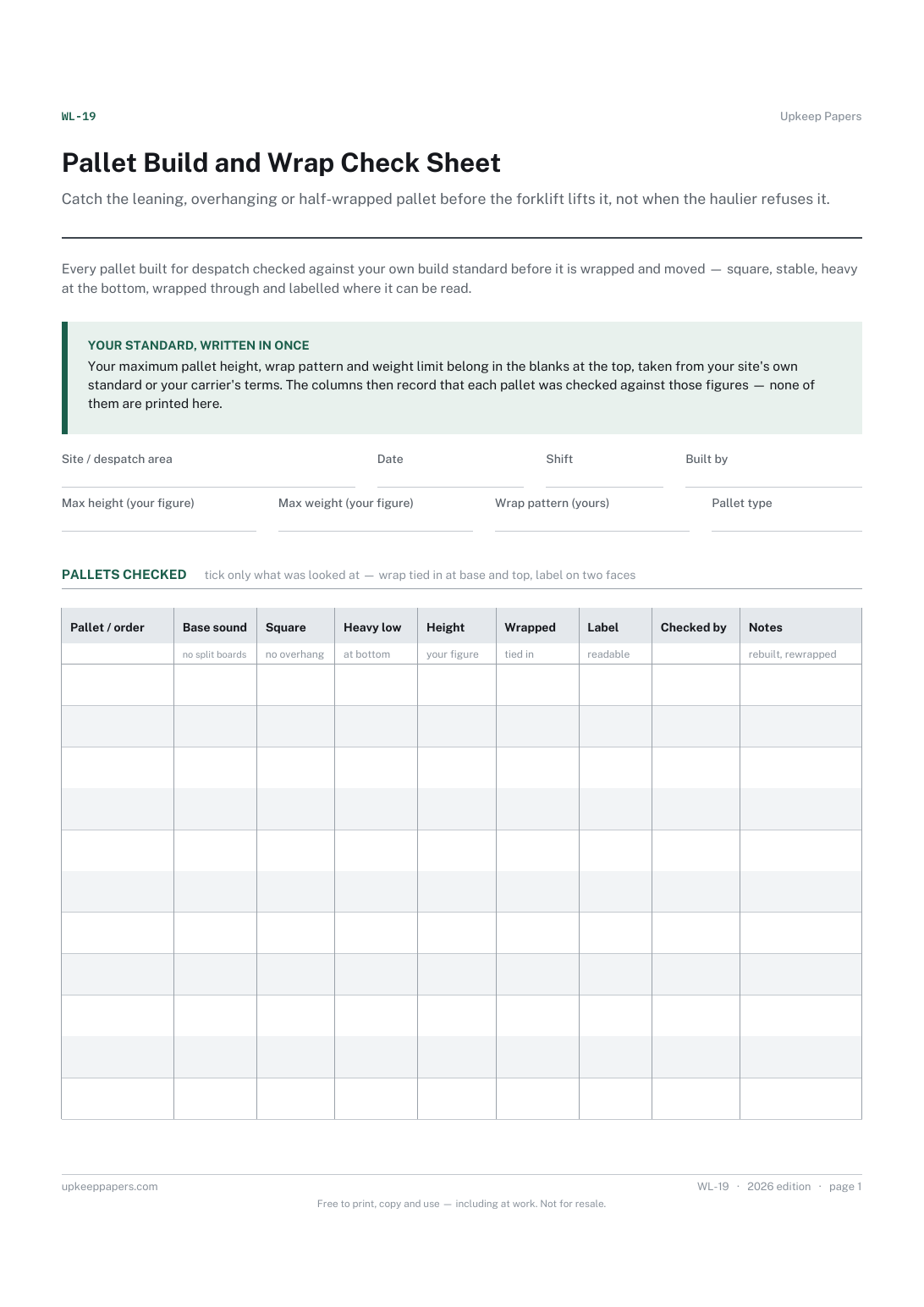
Catch the leaning, overhanging or half-wrapped pallet before the forklift lifts it, not when the haulier refuses it.
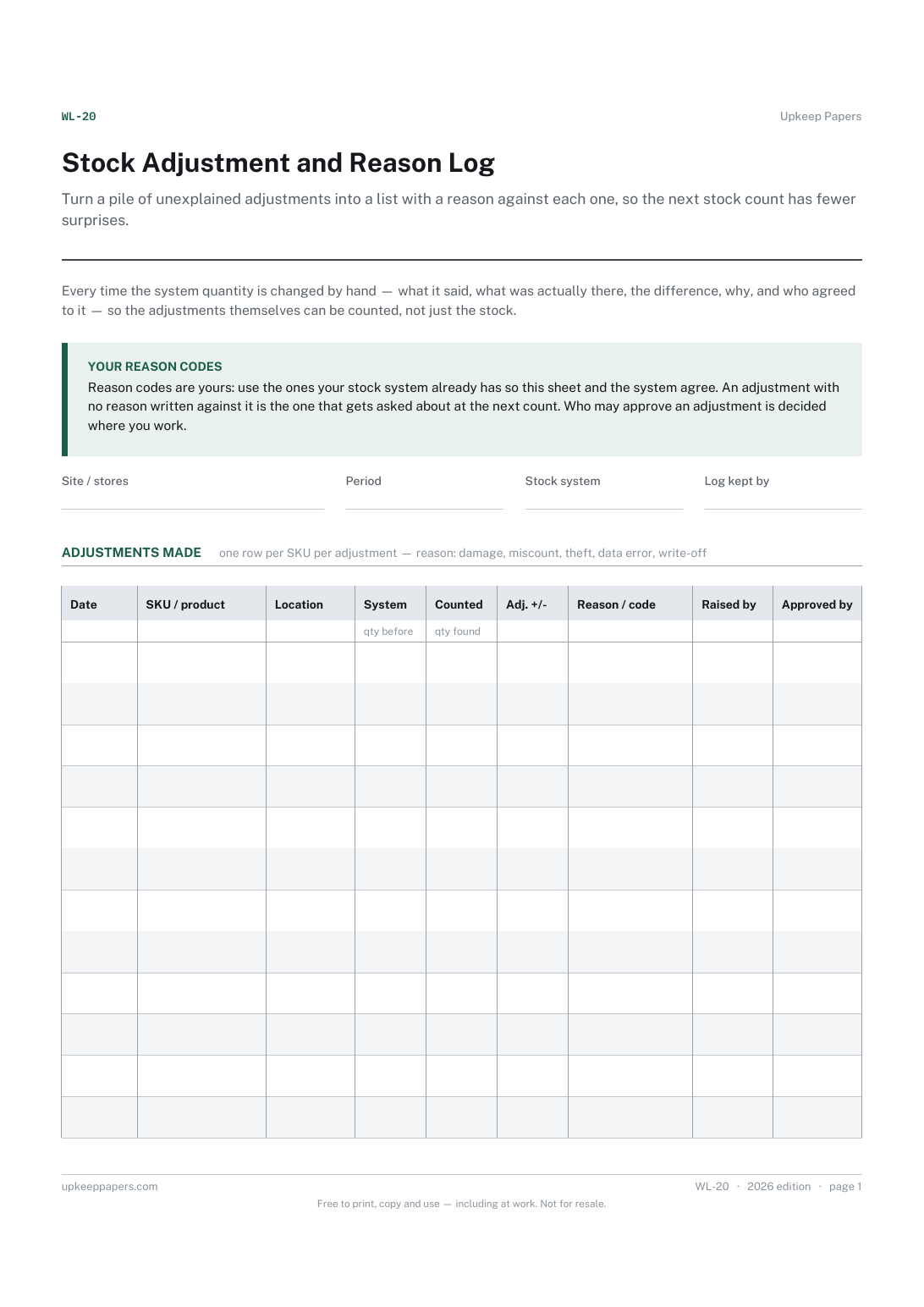
Turn a pile of unexplained adjustments into a list with a reason against each one, so the next stock count has fewer surprises.
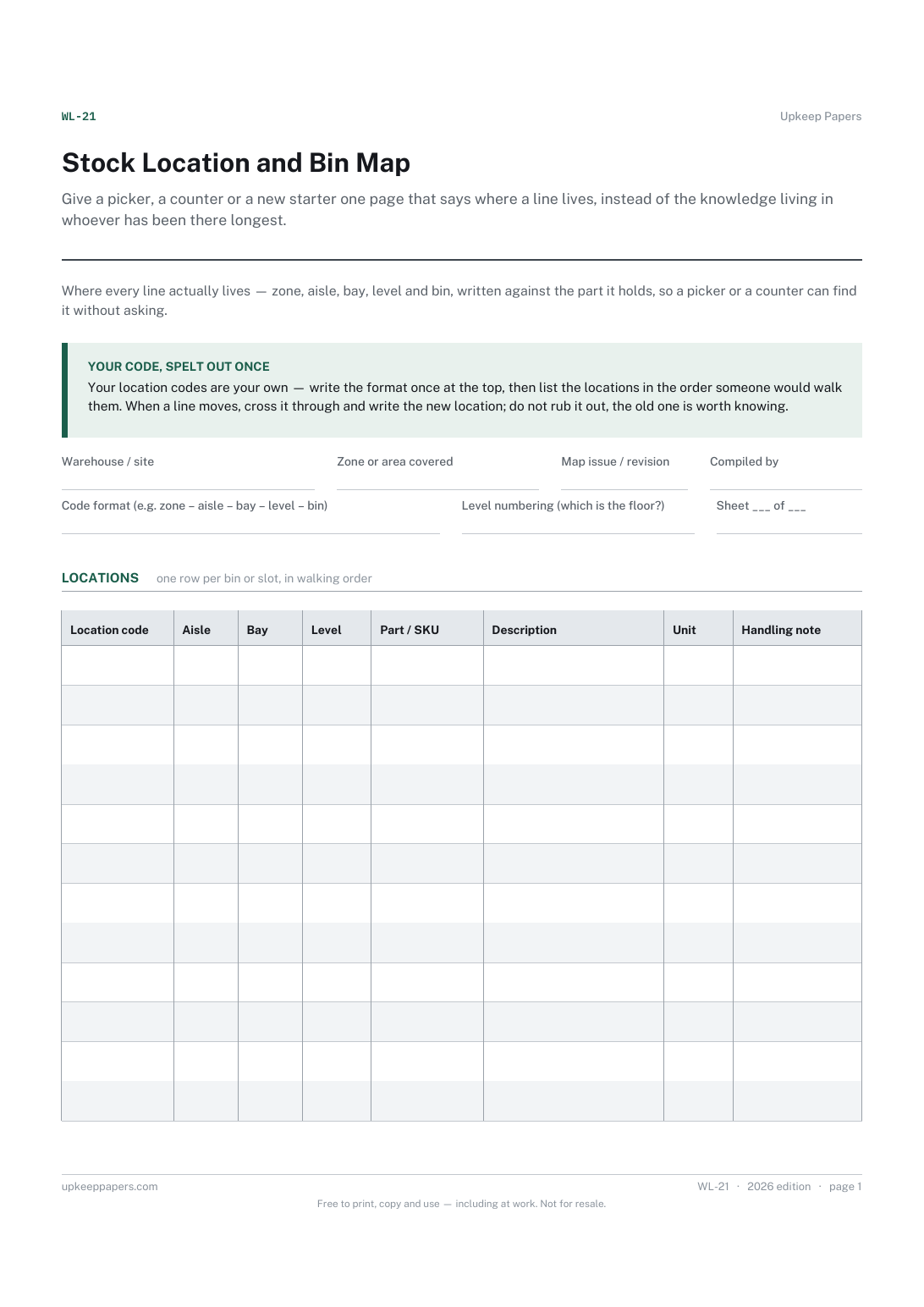
Give a picker, a counter or a new starter one page that says where a line lives, instead of the knowledge living in whoever has been there longest.
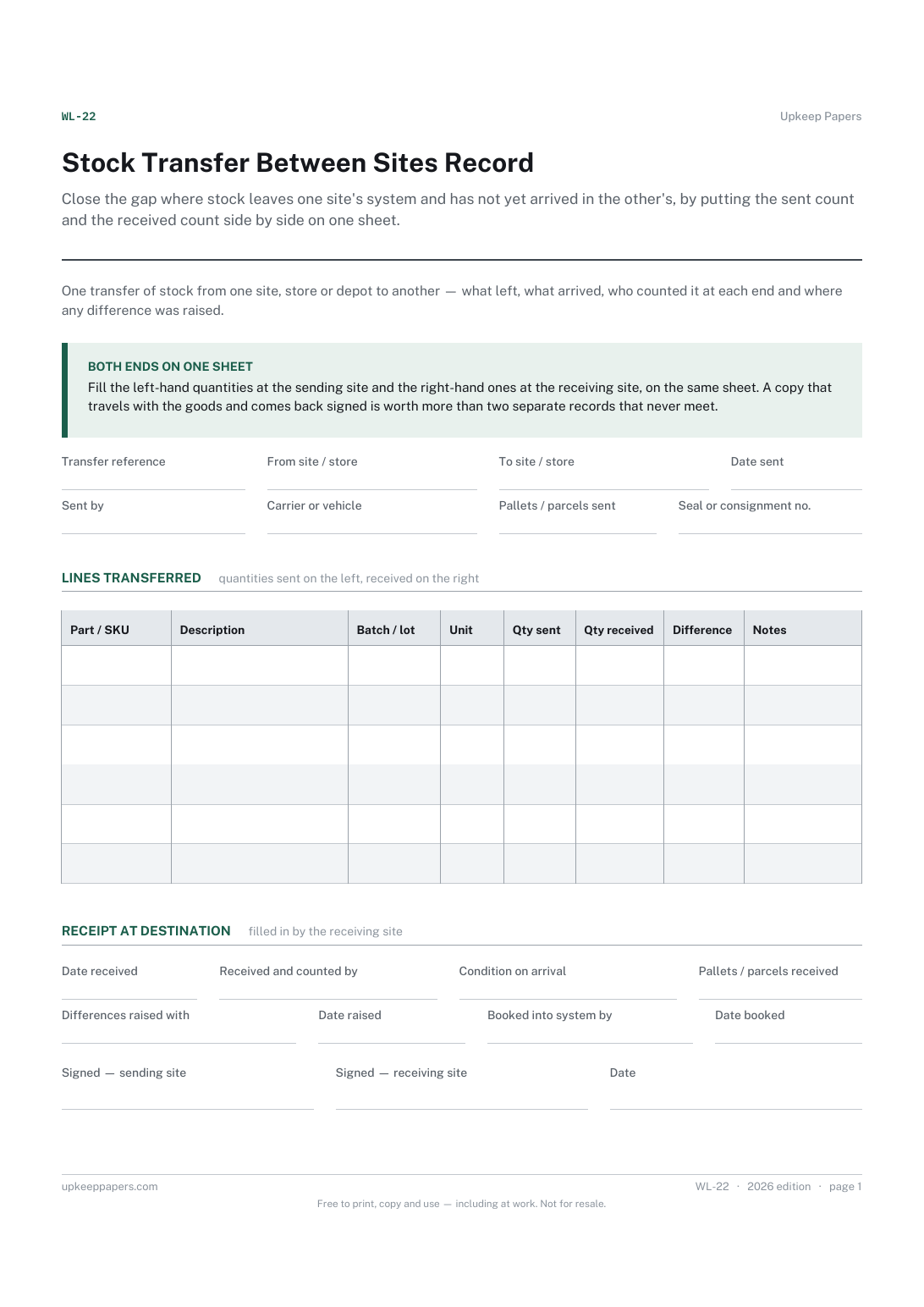
Close the gap where stock leaves one site's system and has not yet arrived in the other's, by putting the sent count and the received count side by side on one sheet.
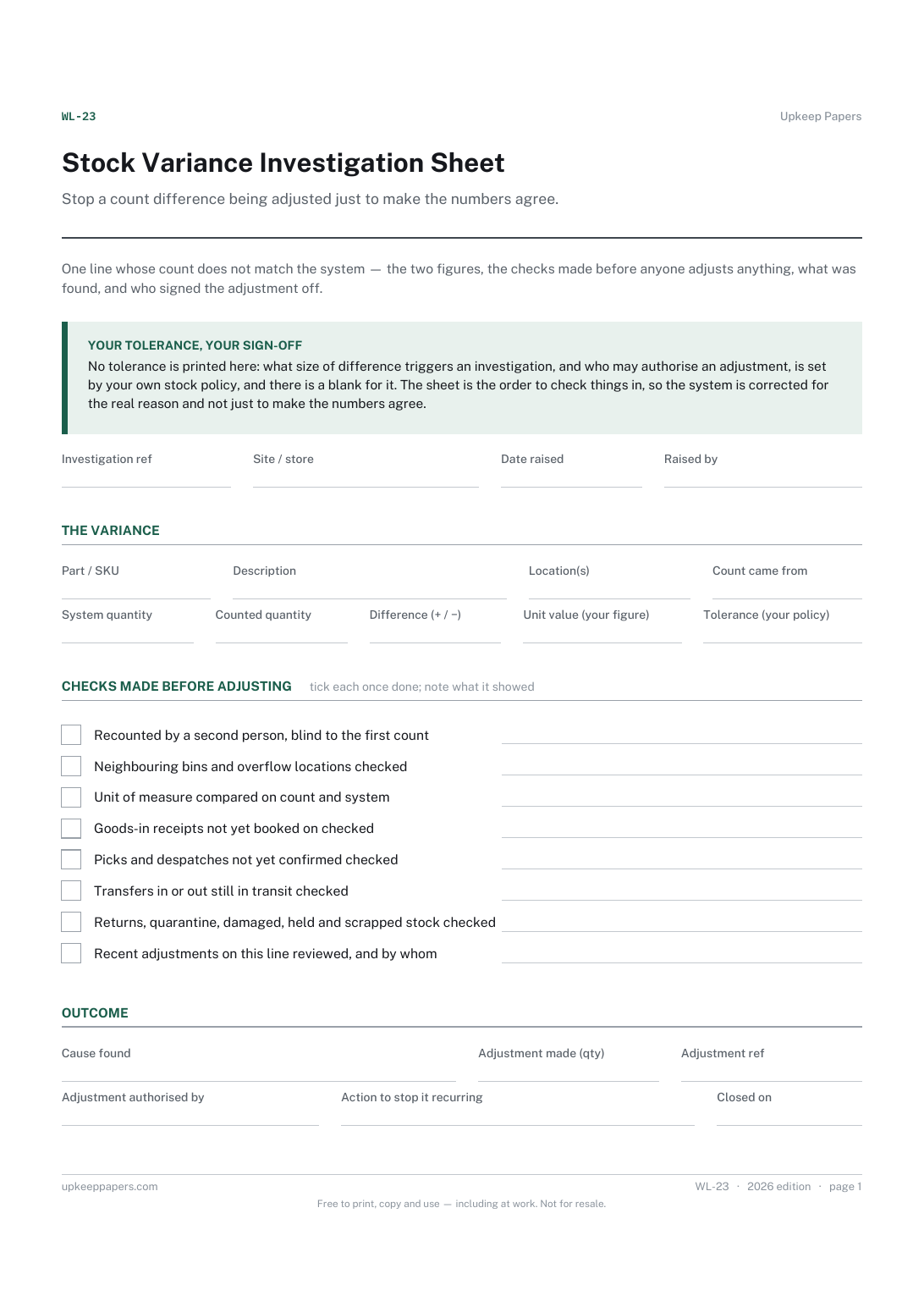
Stop a count difference being adjusted just to make the numbers agree. The same checks are walked every time and the cause written down before anyone touches the system.
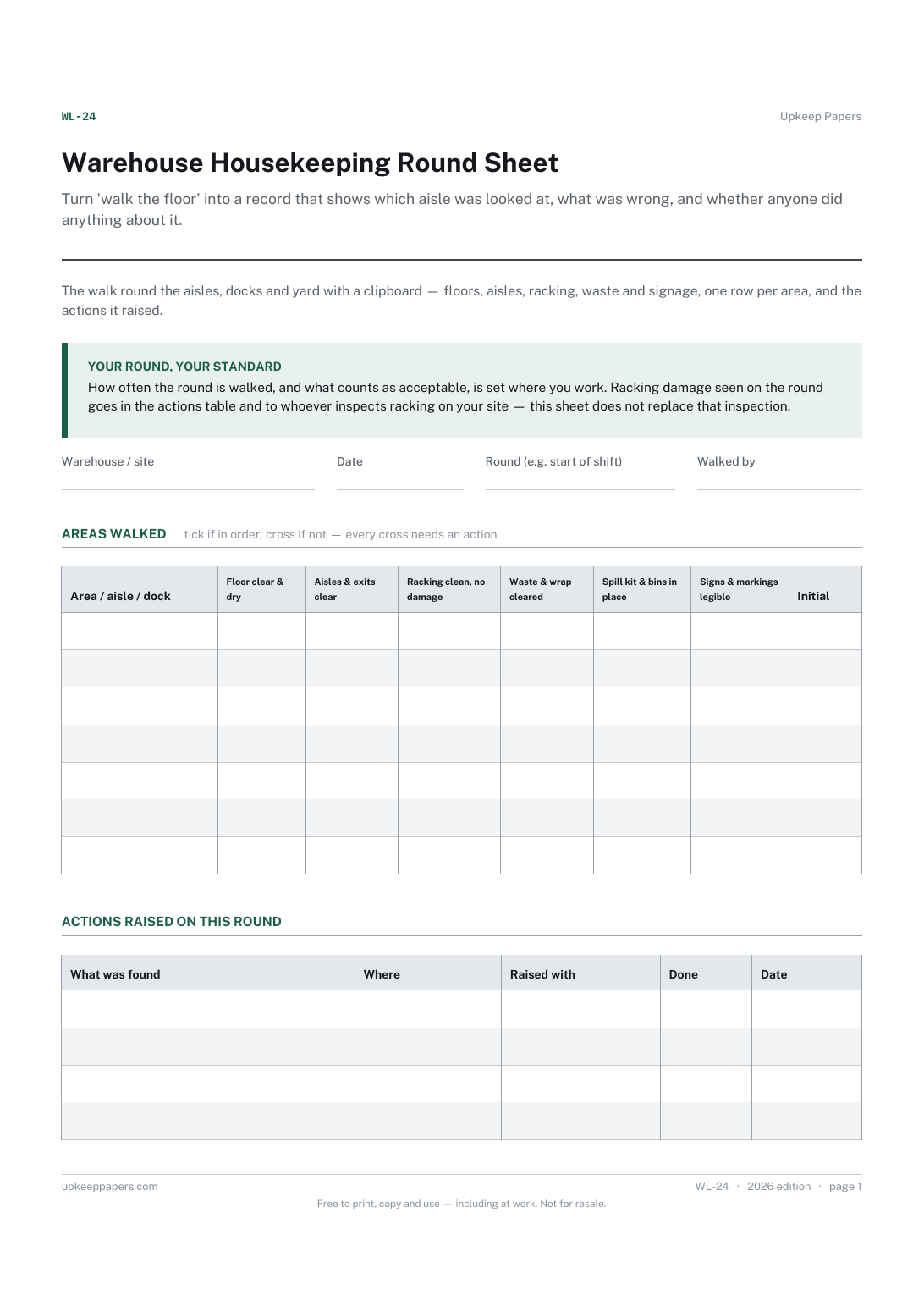
Turn 'walk the floor' into a record that shows which aisle was looked at, what was wrong, and whether anyone did anything about it.
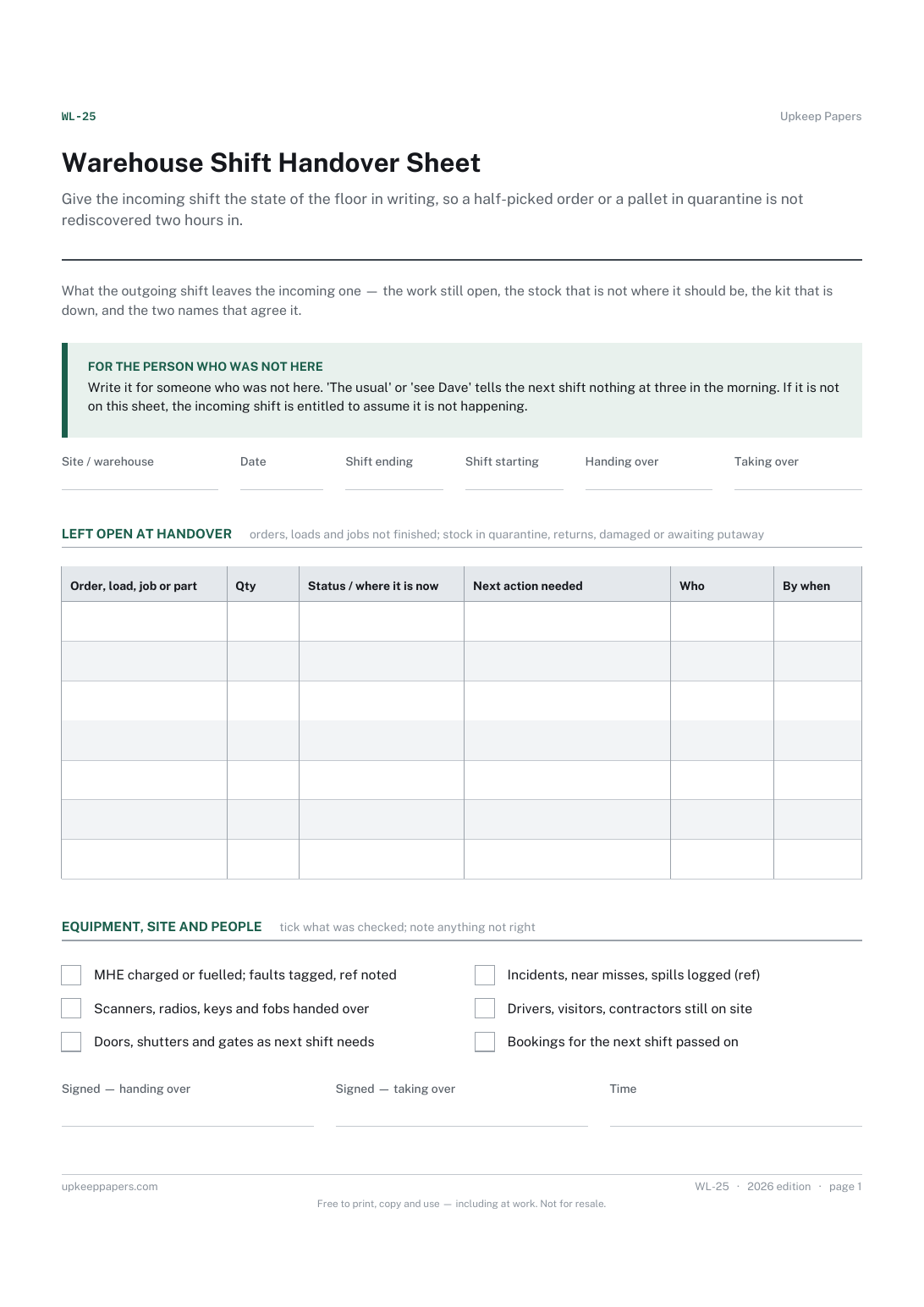
Give the incoming shift the state of the floor in writing, so a half-picked order or a pallet in quarantine is not rediscovered two hours in.
Rooms turned round, guests arrived, faults reported and the shift handed over.
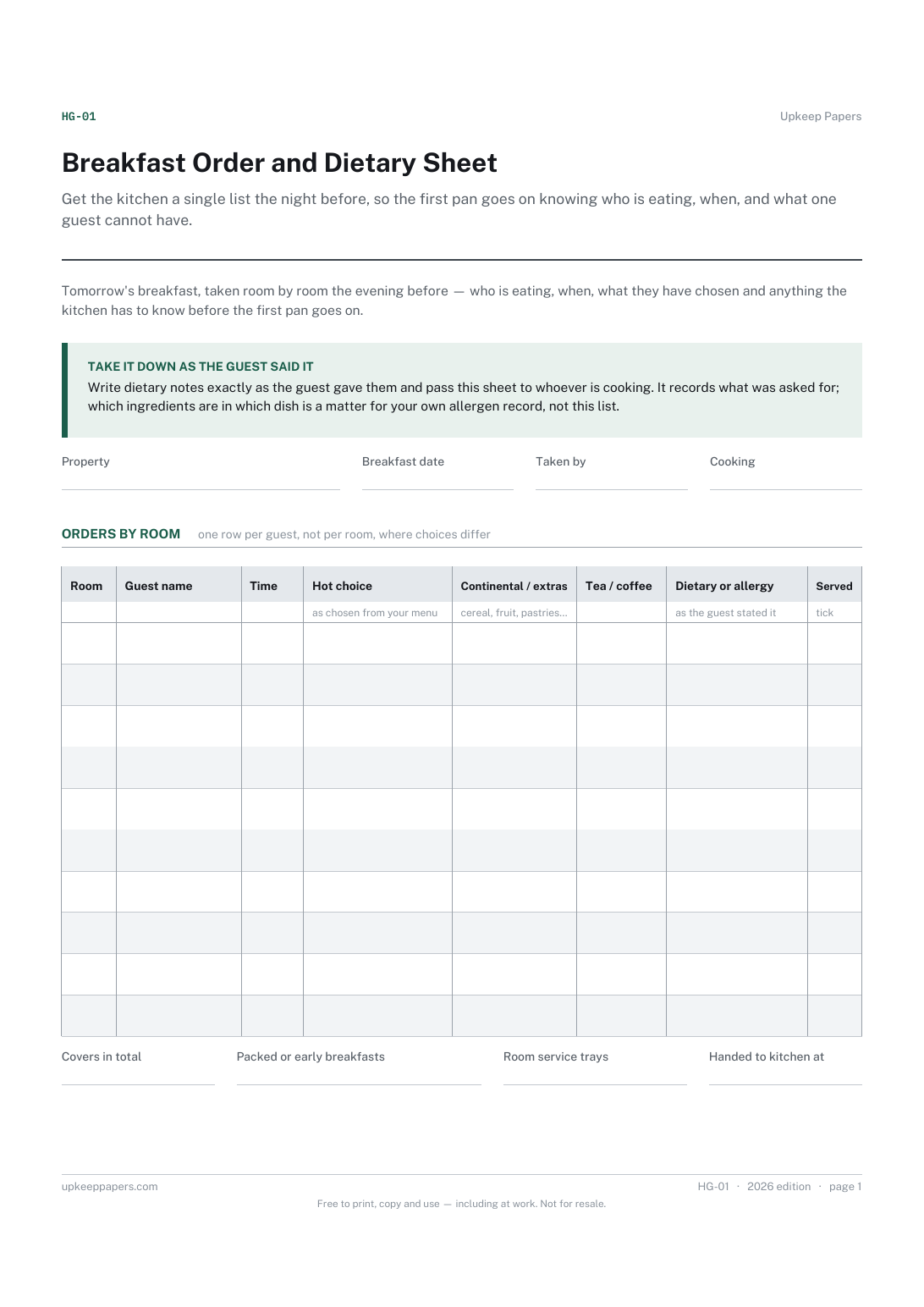
Get the kitchen a single list the night before, so the first pan goes on knowing who is eating, when, and what one guest cannot have.
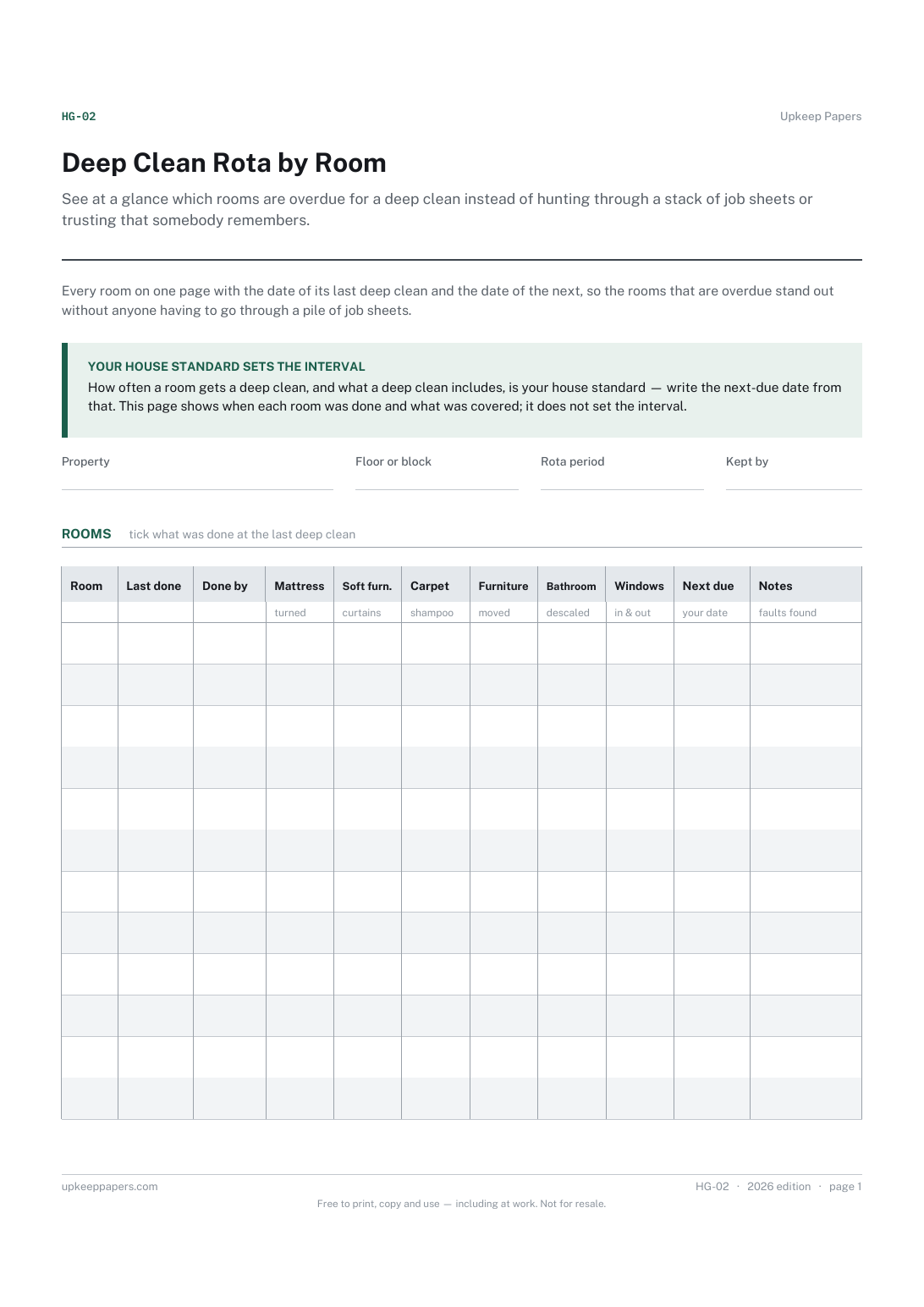
See at a glance which rooms are overdue for a deep clean instead of hunting through a stack of job sheets or trusting that somebody remembers.
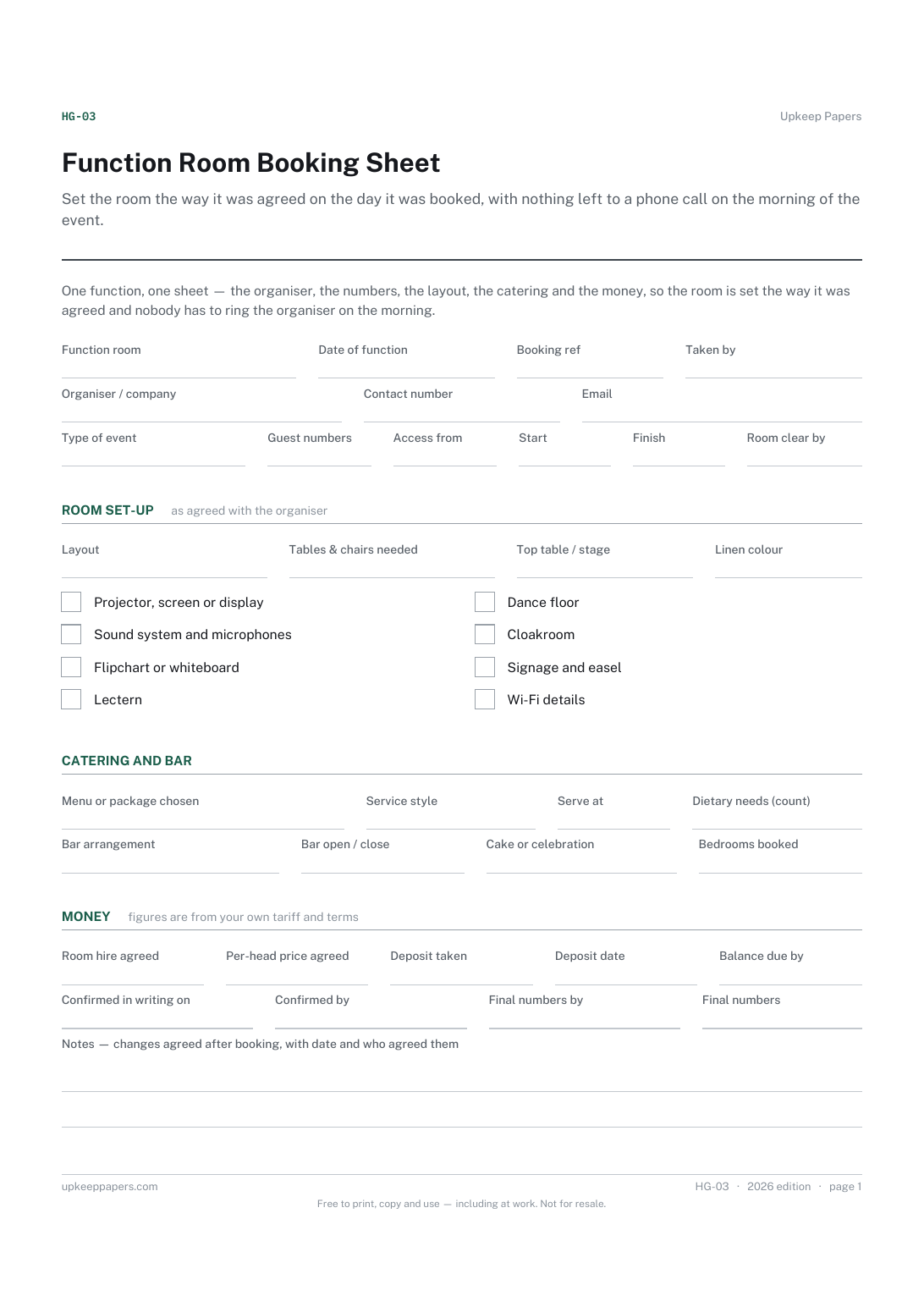
Set the room the way it was agreed on the day it was booked, with nothing left to a phone call on the morning of the event.
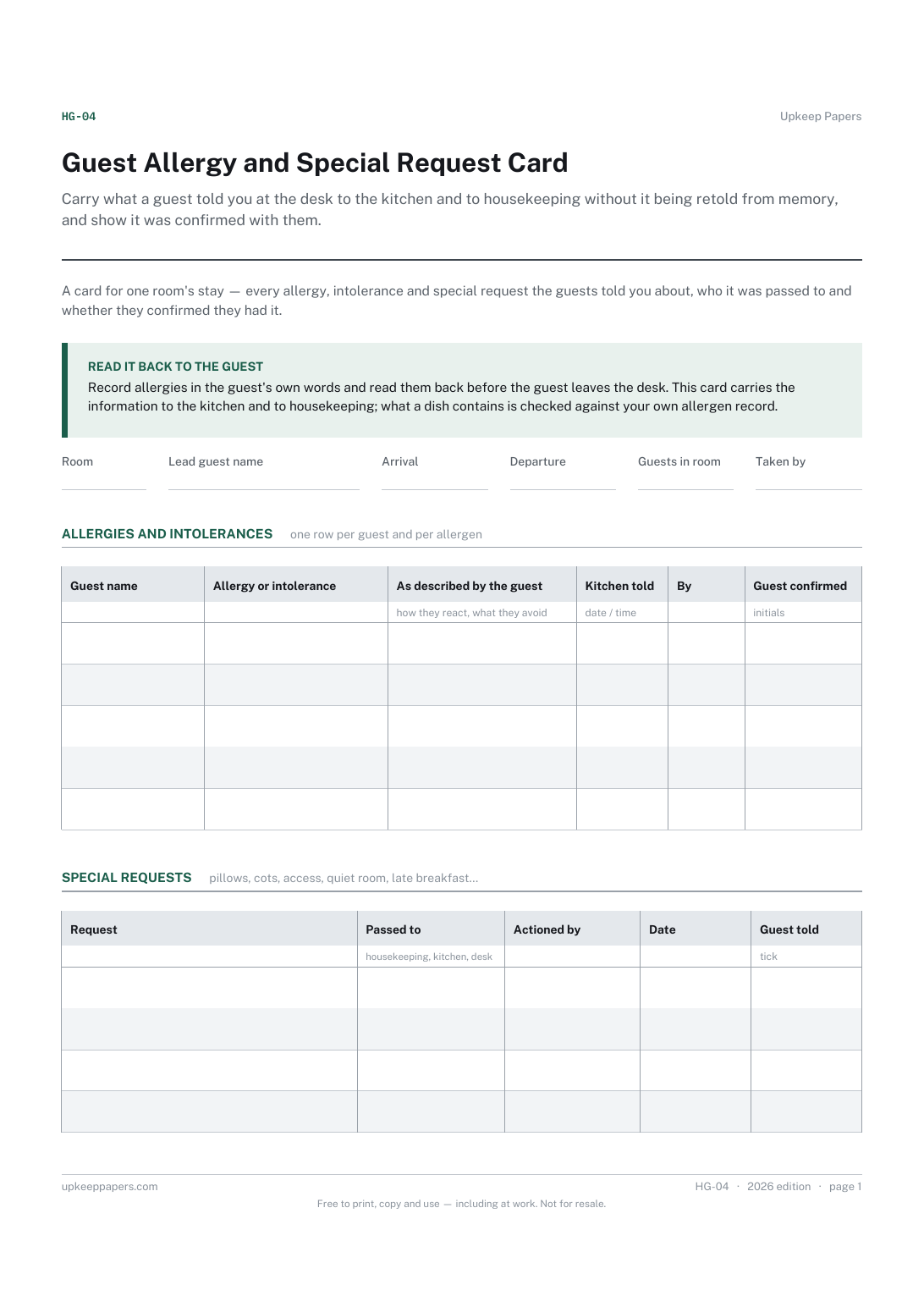
Carry what a guest told you at the desk to the kitchen and to housekeeping without it being retold from memory, and show it was confirmed with them.
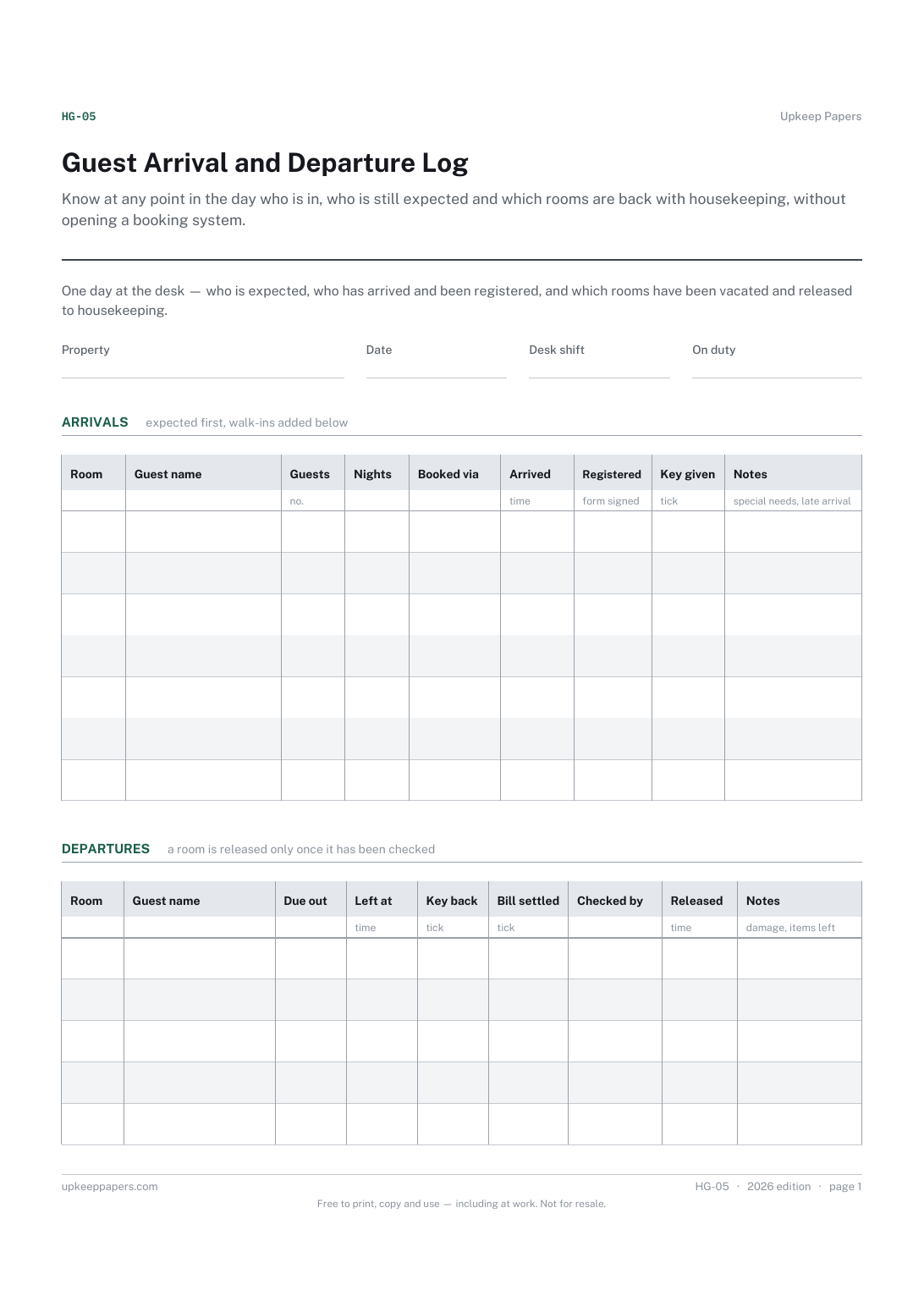
Know at any point in the day who is in, who is still expected and which rooms are back with housekeeping, without opening a booking system.
Build a clear evidence trail for a damage charge, so a dispute is answered with dates, names and photographs rather than a memory of the room.
Turn a comment card or a review into things that get done, and make sure the guest hears back — praise included, so it reaches the person who earned it.
Keep a paper diary that shows every booking, deposit and cancellation for the week, so a double booking or an unpaid deposit is seen before the guest arrives.
Know which keys are out at the end of every shift, and have a line to point to when a key or card goes missing.
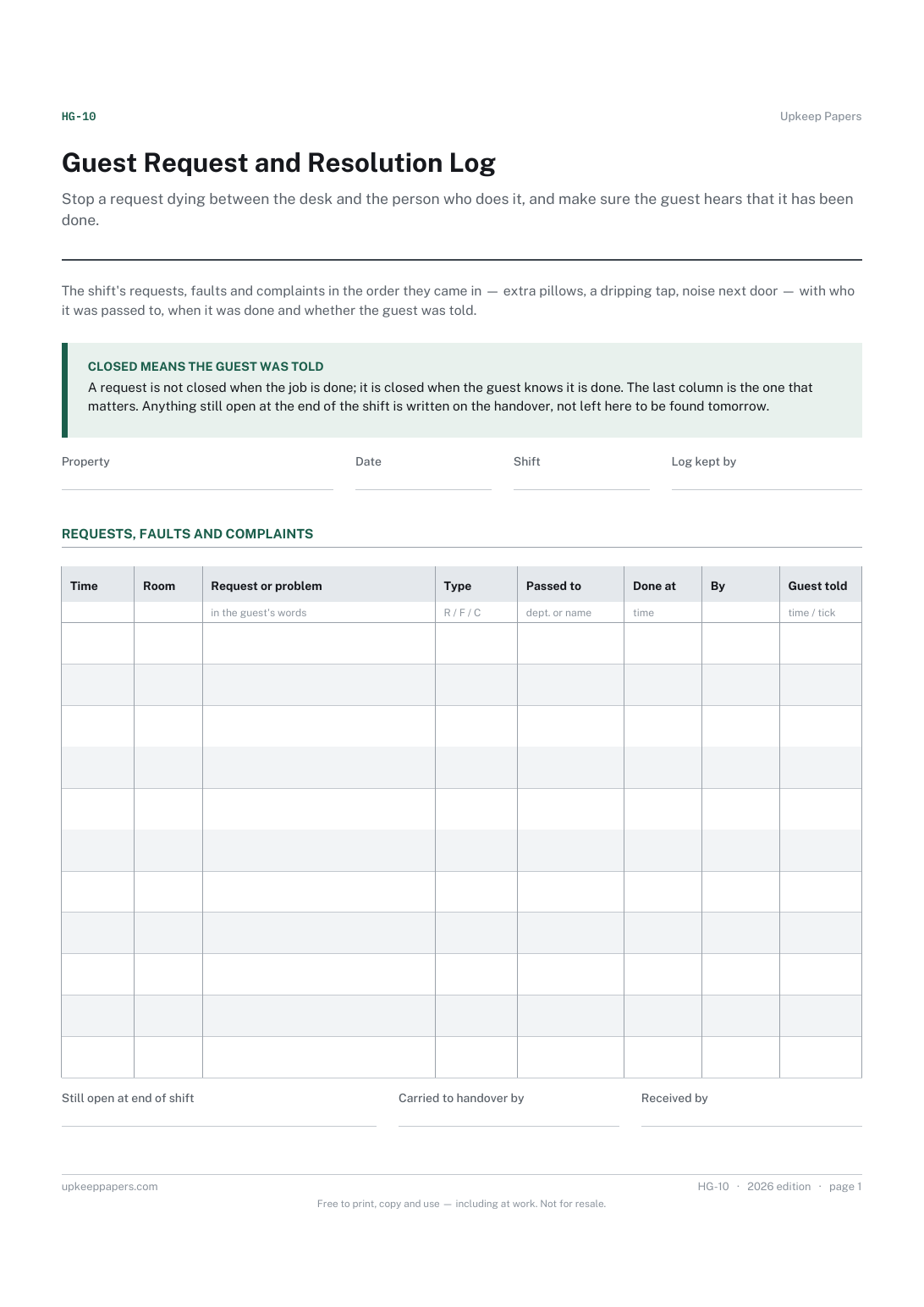
Stop a request dying between the desk and the person who does it, and make sure the guest hears that it has been done.
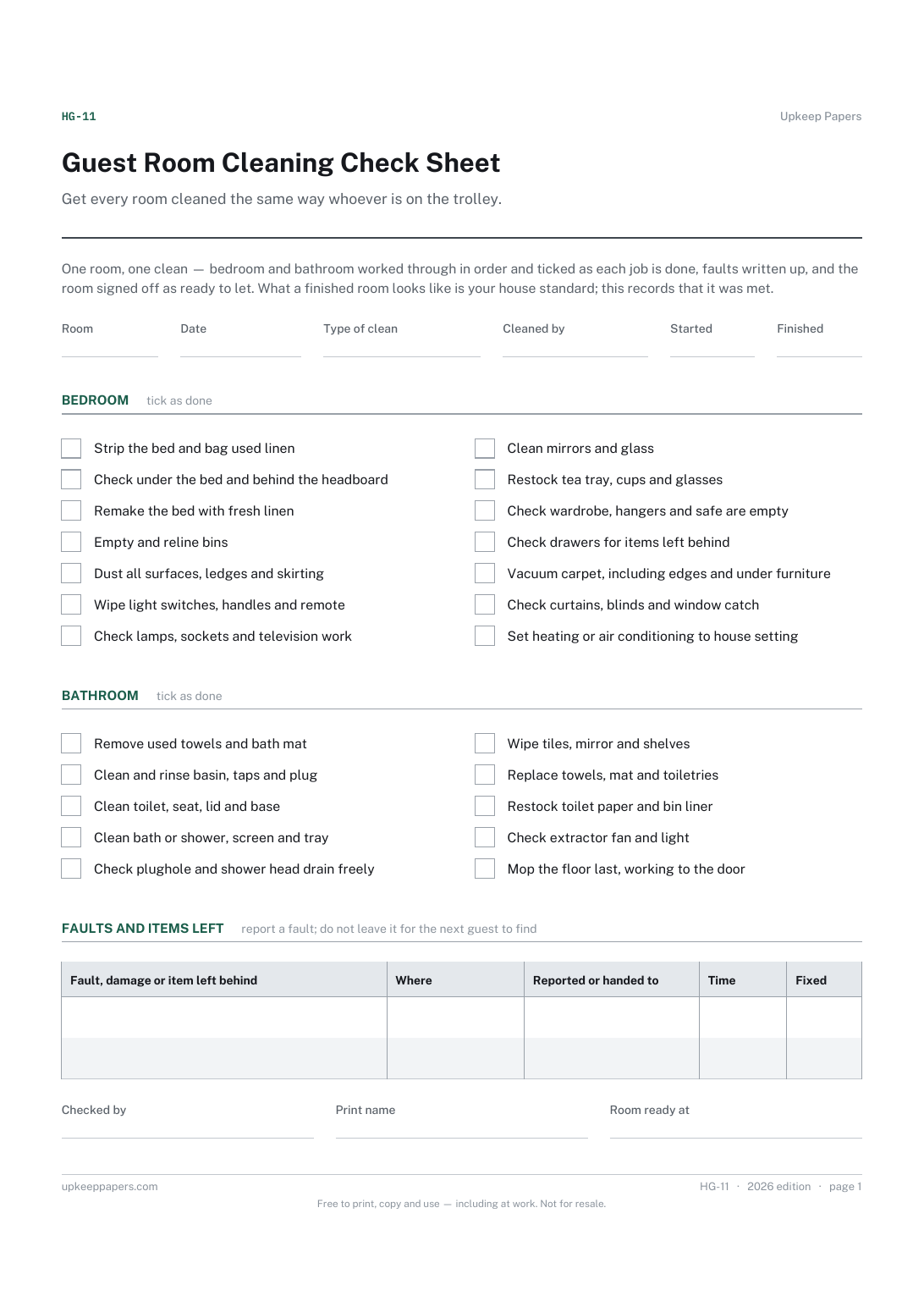
Get every room cleaned the same way whoever is on the trolley. A fault is caught by the checker rather than by the guest.
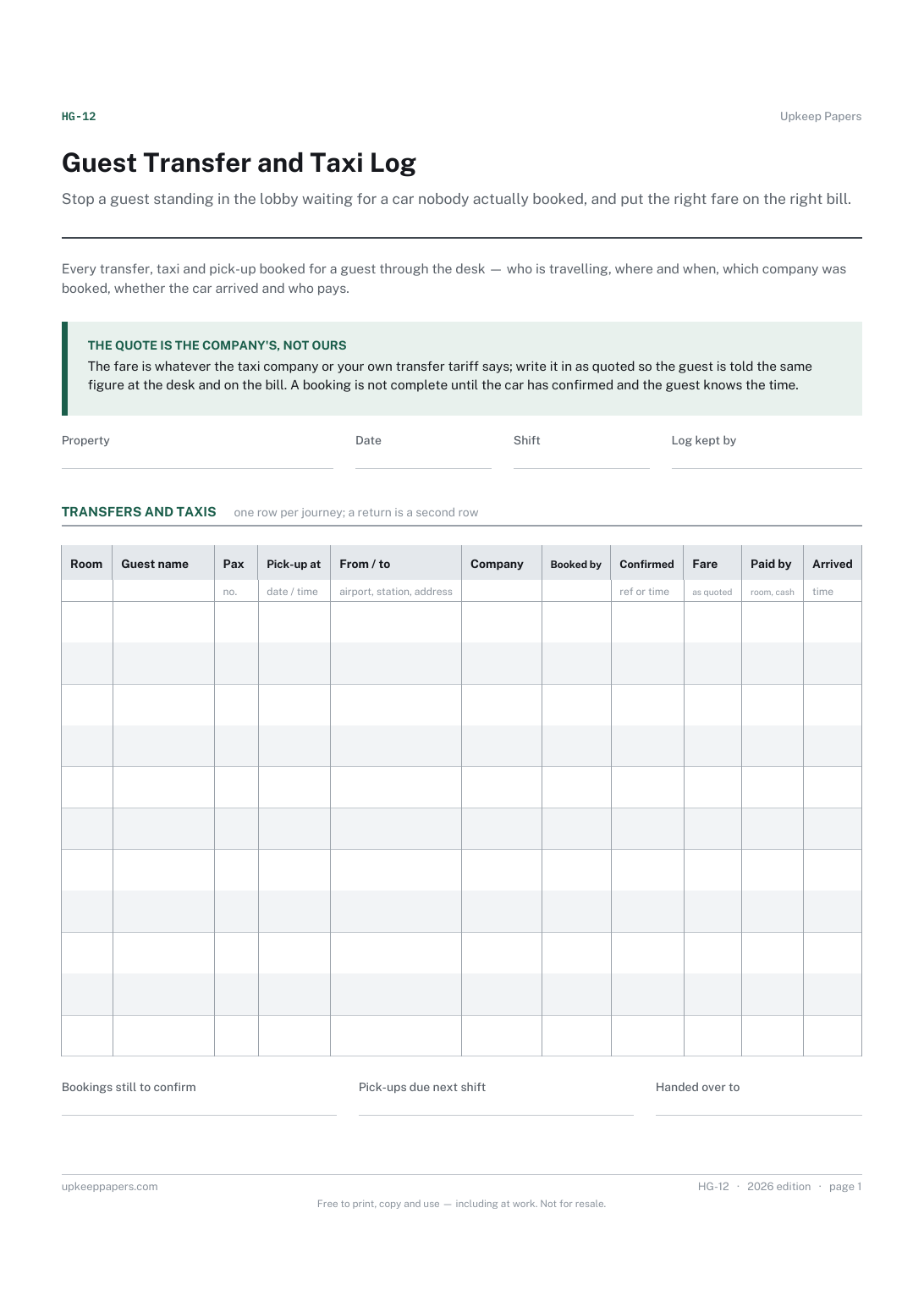
Stop a guest standing in the lobby waiting for a car nobody actually booked, and put the right fare on the right bill.
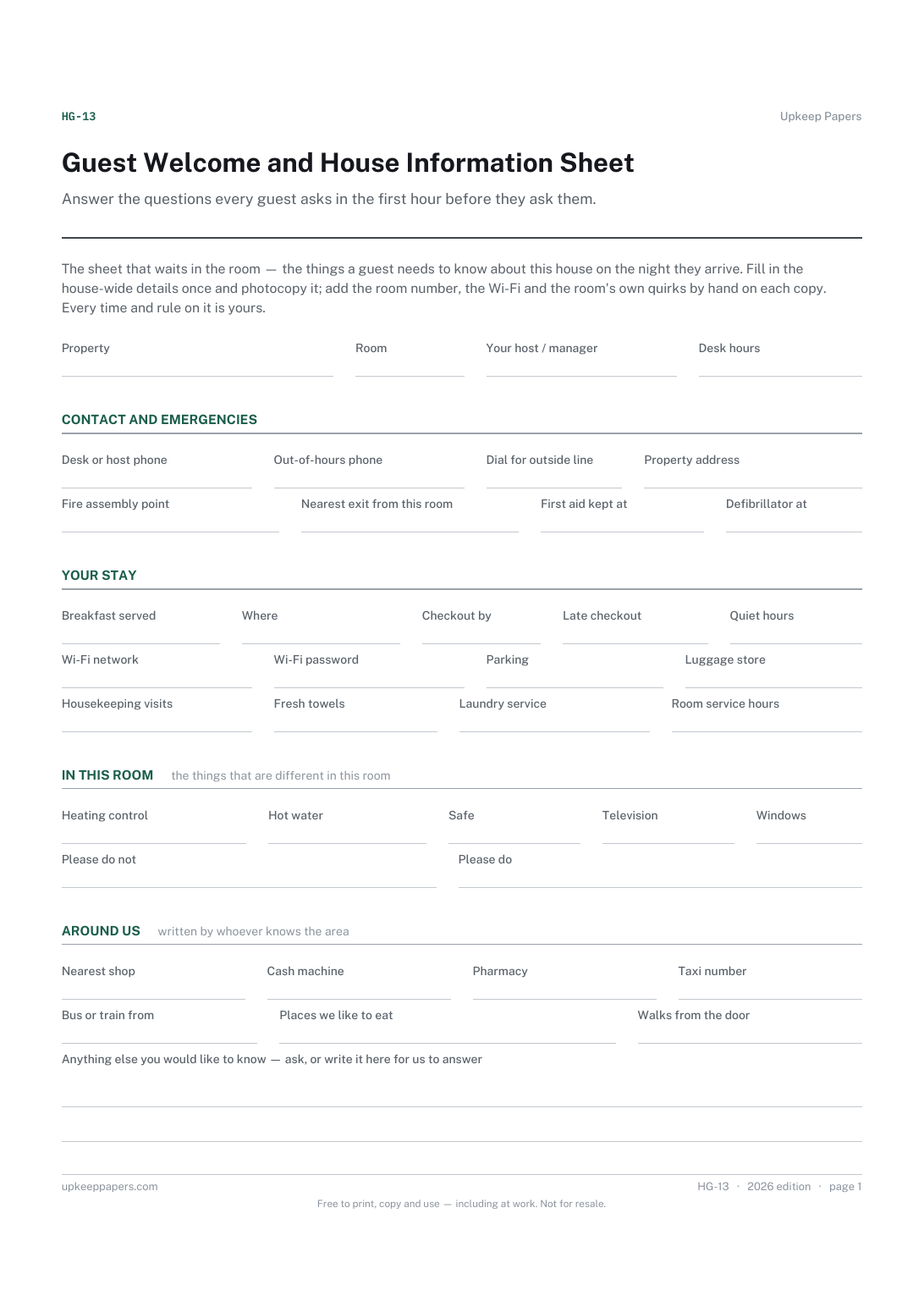
Answer the questions every guest asks in the first hour before they ask them. One page, on the desk in the room.
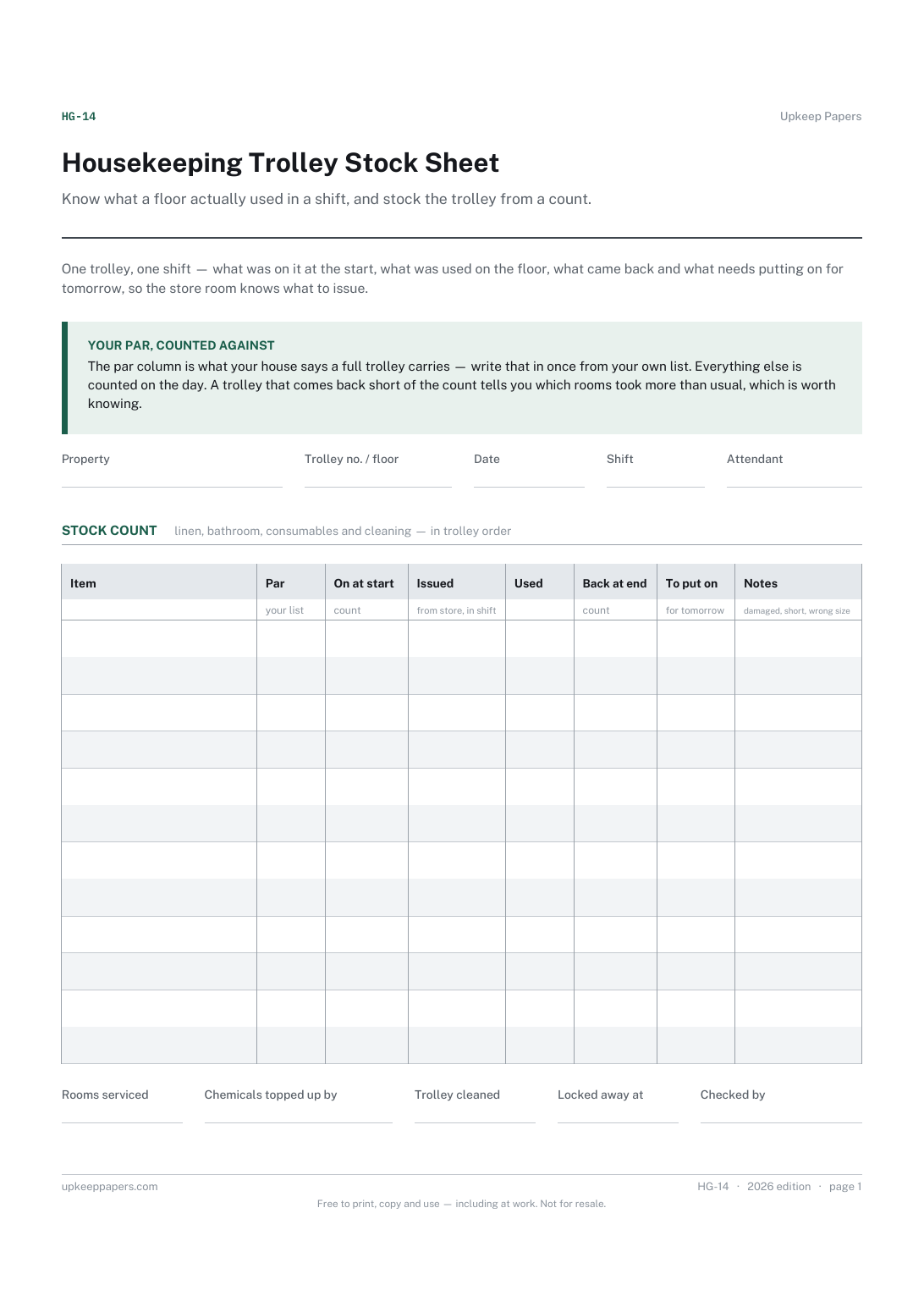
Know what a floor actually used in a shift, and stock the trolley from a count. Linen that goes missing shows up in the numbers.
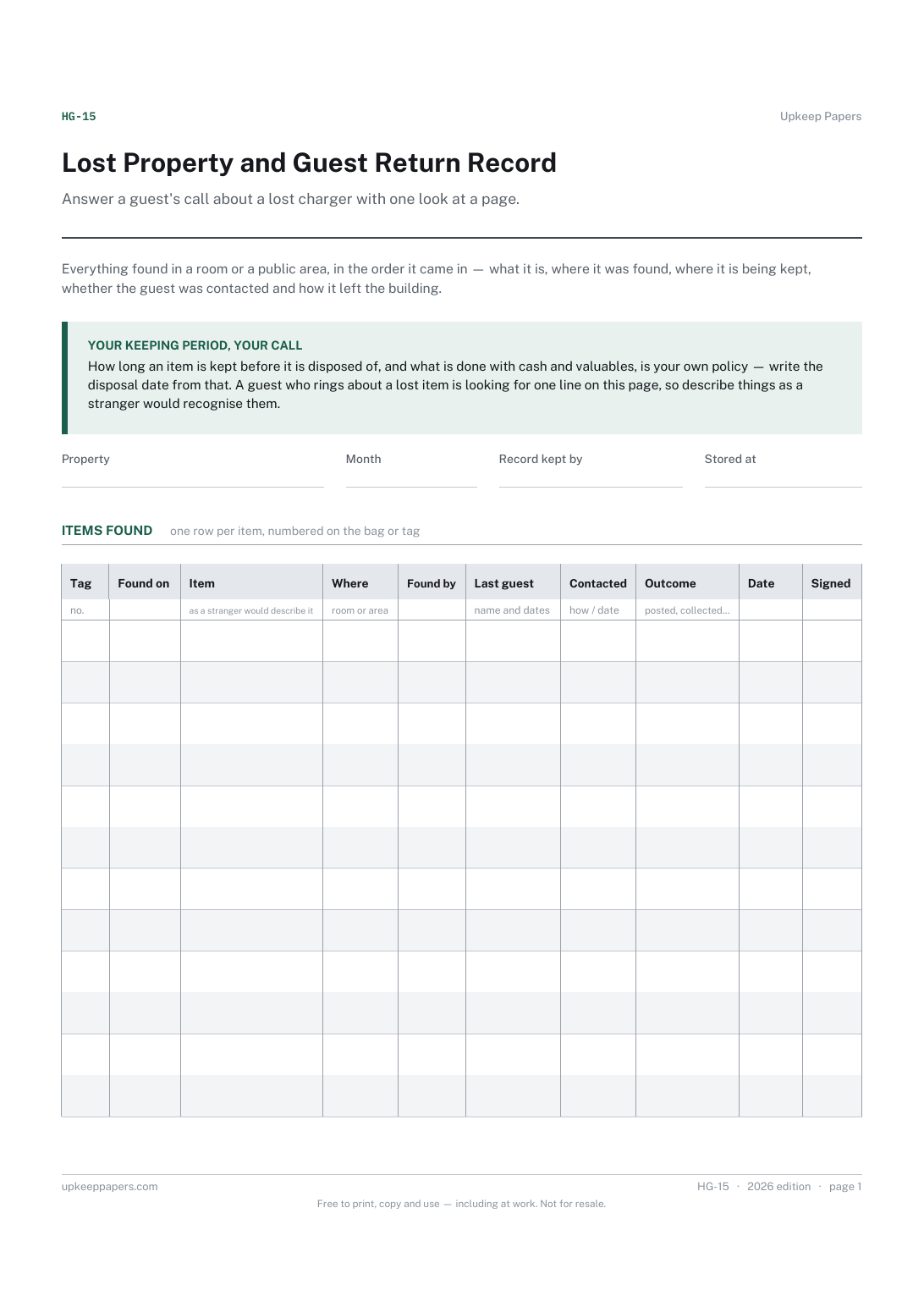
Answer a guest's call about a lost charger with one look at a page. Everything found has a line showing what happened to it.
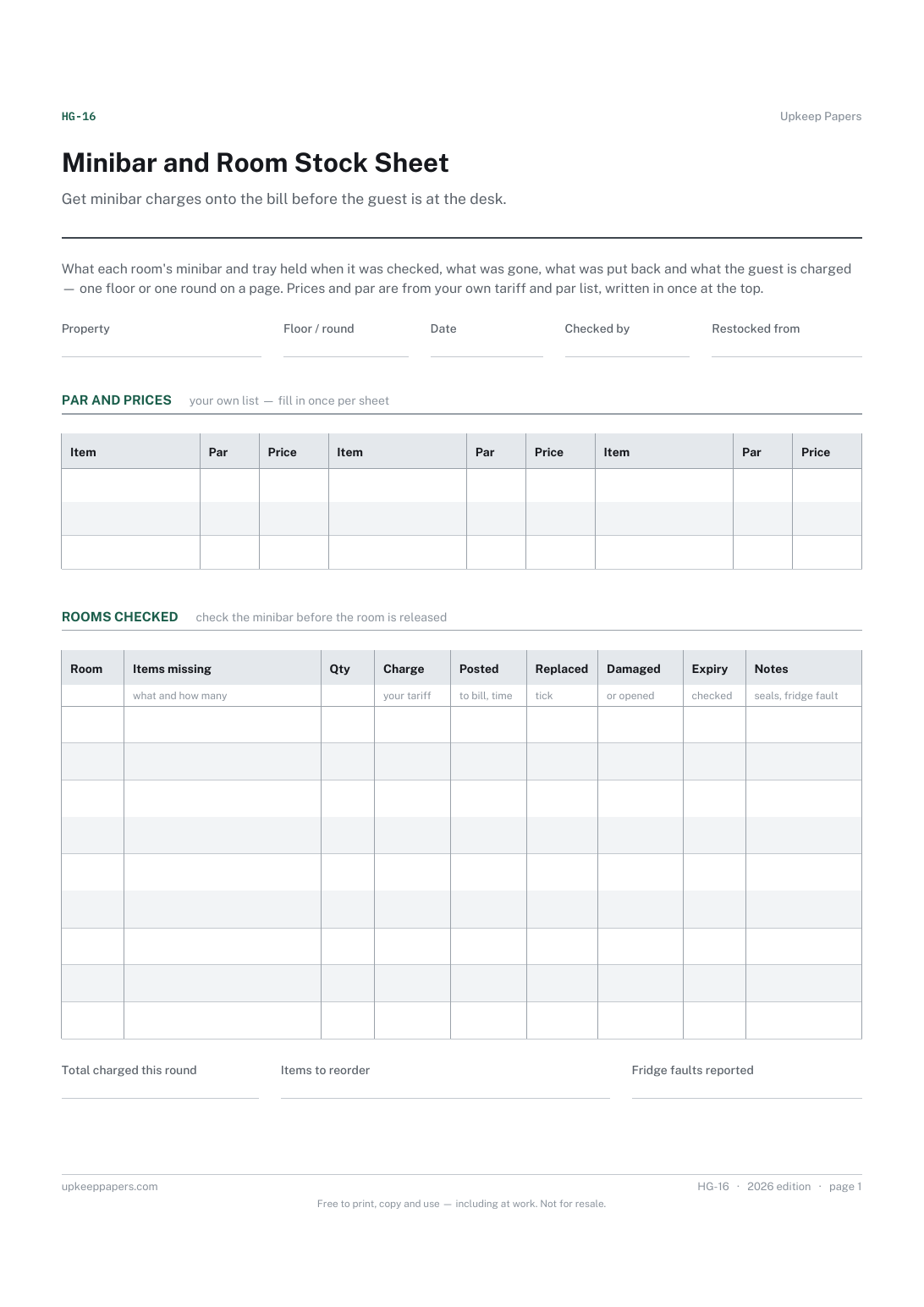
Get minibar charges onto the bill before the guest is at the desk. The fridges stay stocked and in date without a second visit.
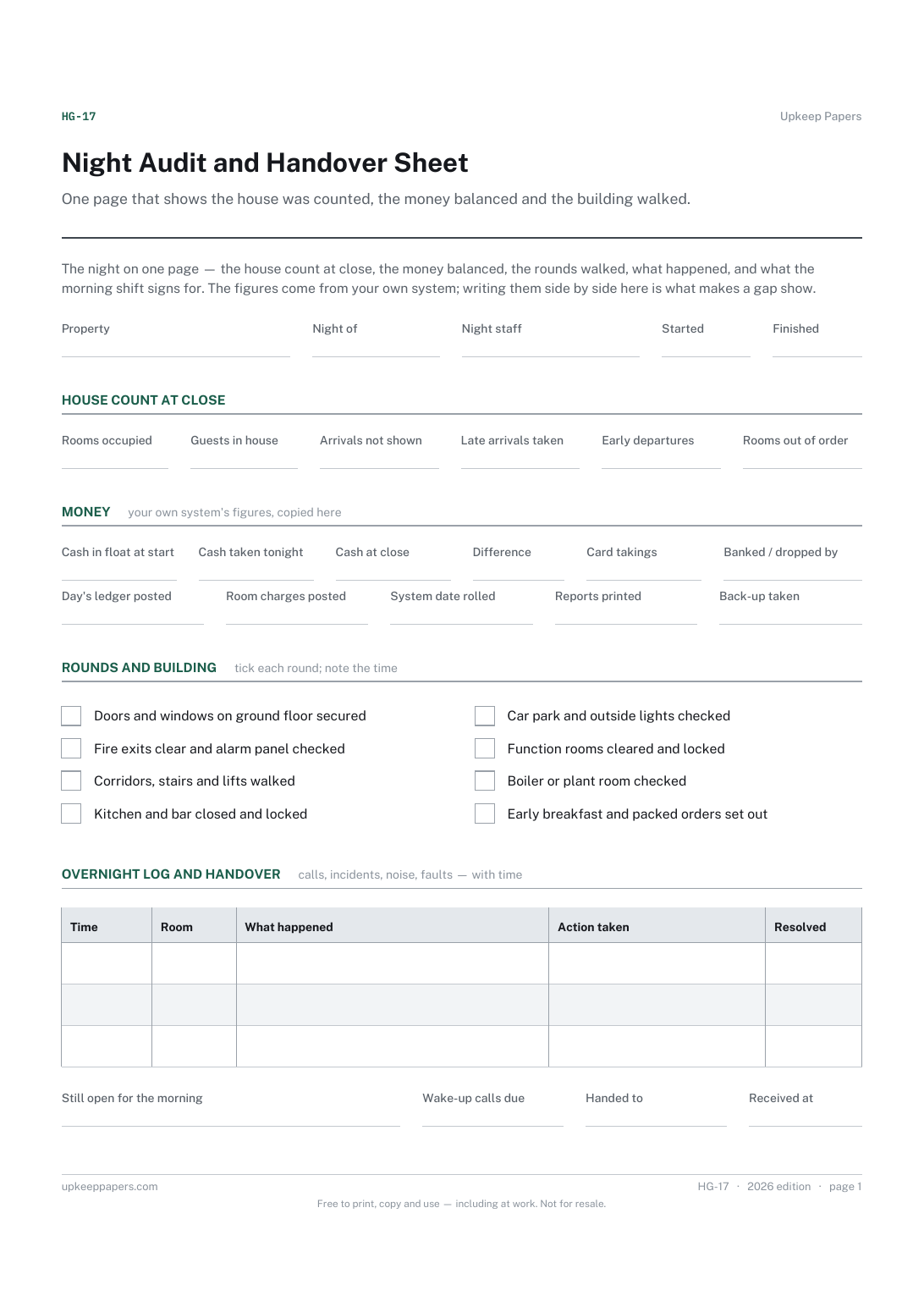
One page that shows the house was counted, the money balanced and the building walked. The morning shift gets what it needs on the same sheet.
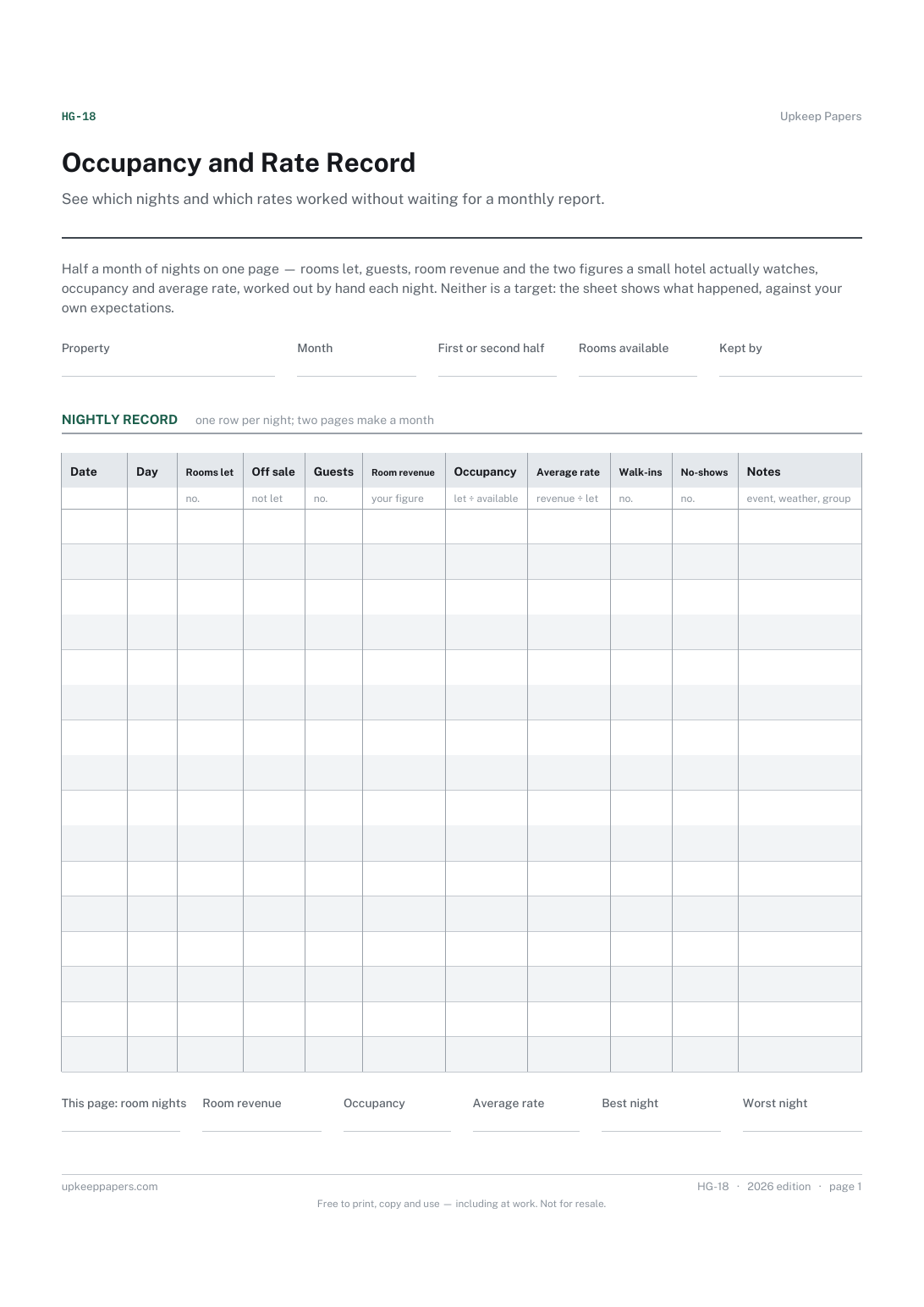
See which nights and which rates worked without waiting for a monthly report. The figures sit side by side where you can read them.
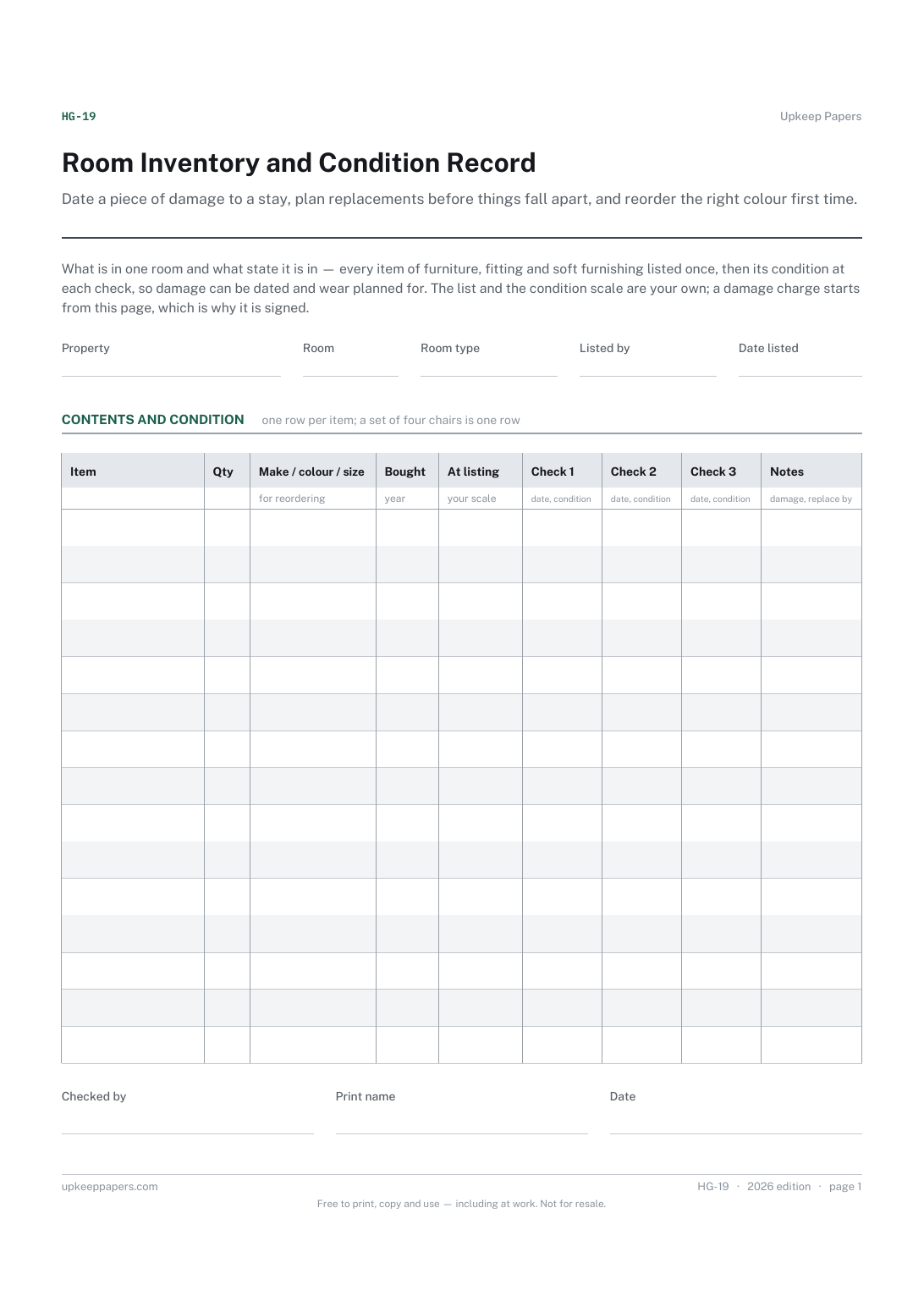
Date a piece of damage to a stay, plan replacements before things fall apart, and reorder the right colour first time.
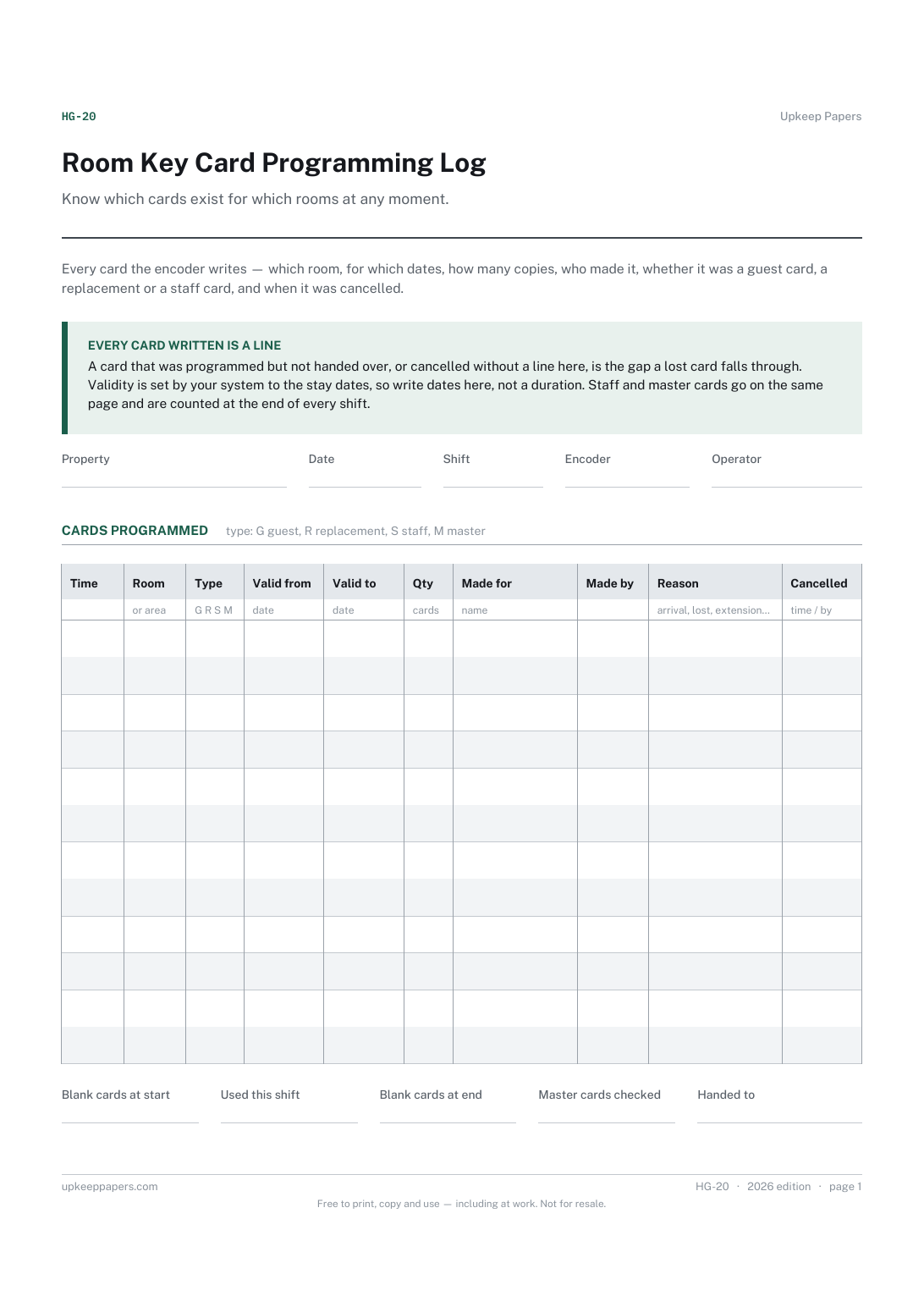
Know which cards exist for which rooms at any moment. When a card is lost there is a line to point to.
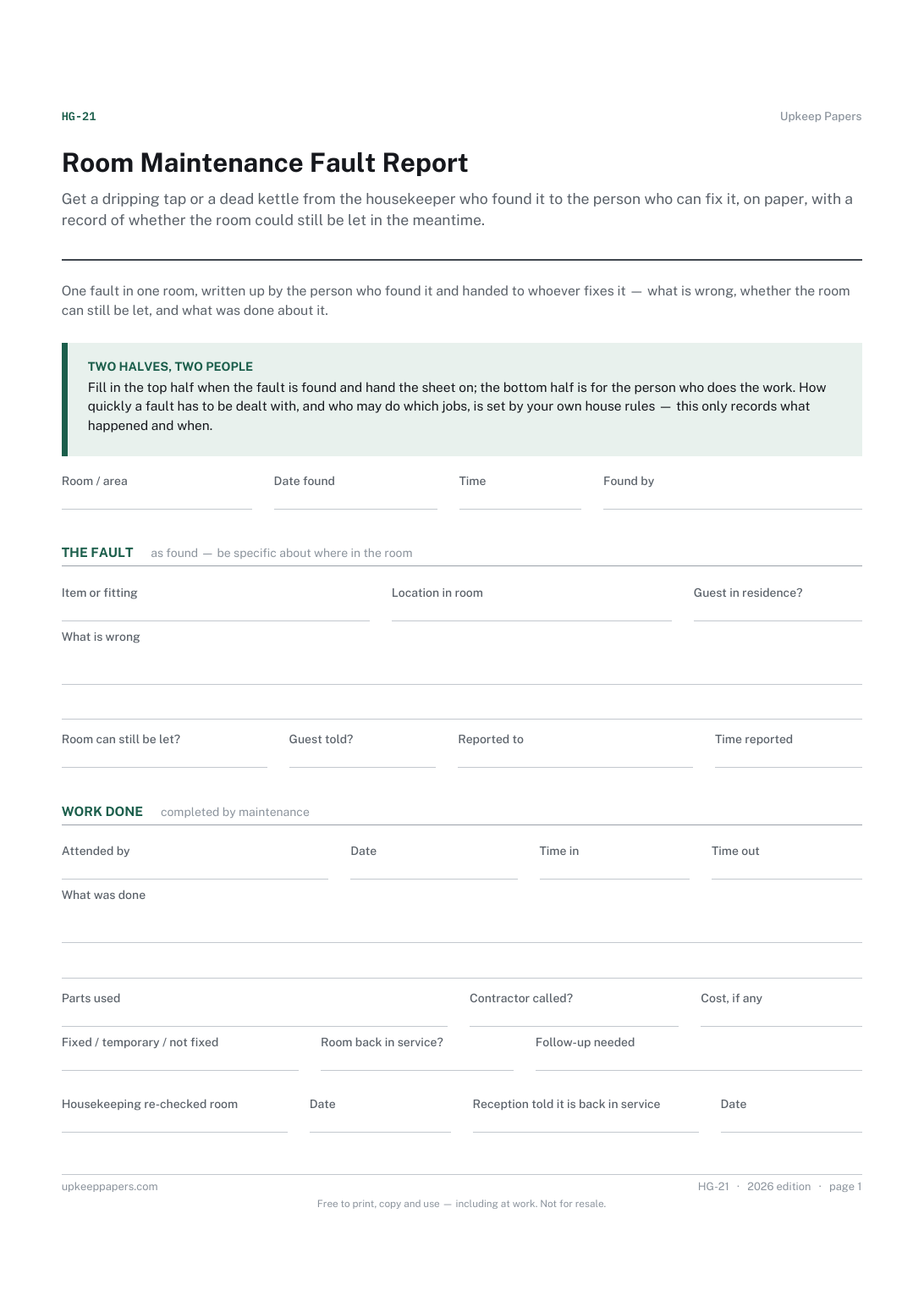
Get a dripping tap or a dead kettle from the housekeeper who found it to the person who can fix it, on paper, with a record of whether the room could still be let in the meantime.
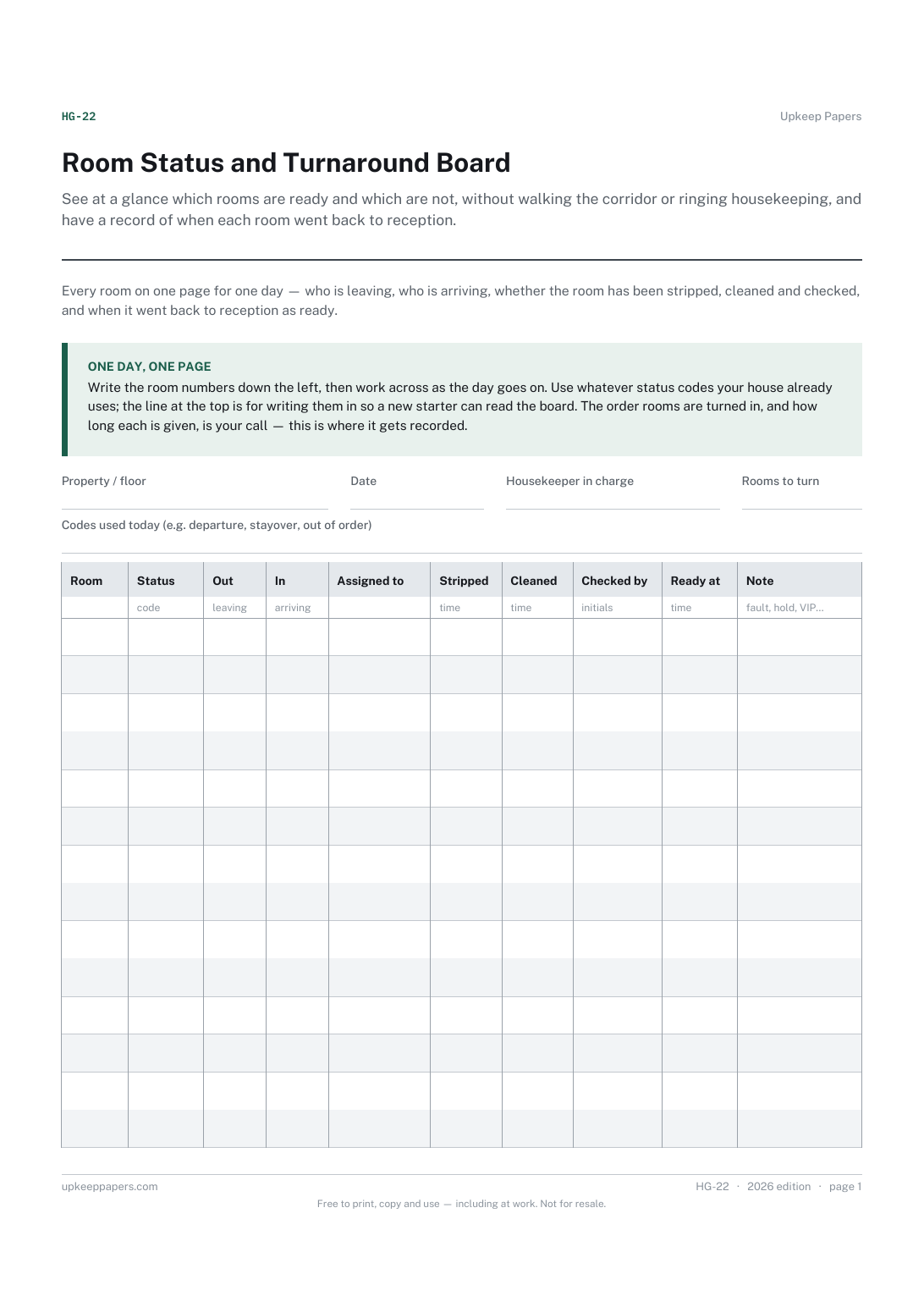
See at a glance which rooms are ready and which are not, without walking the corridor or ringing housekeeping, and have a record of when each room went back to reception.
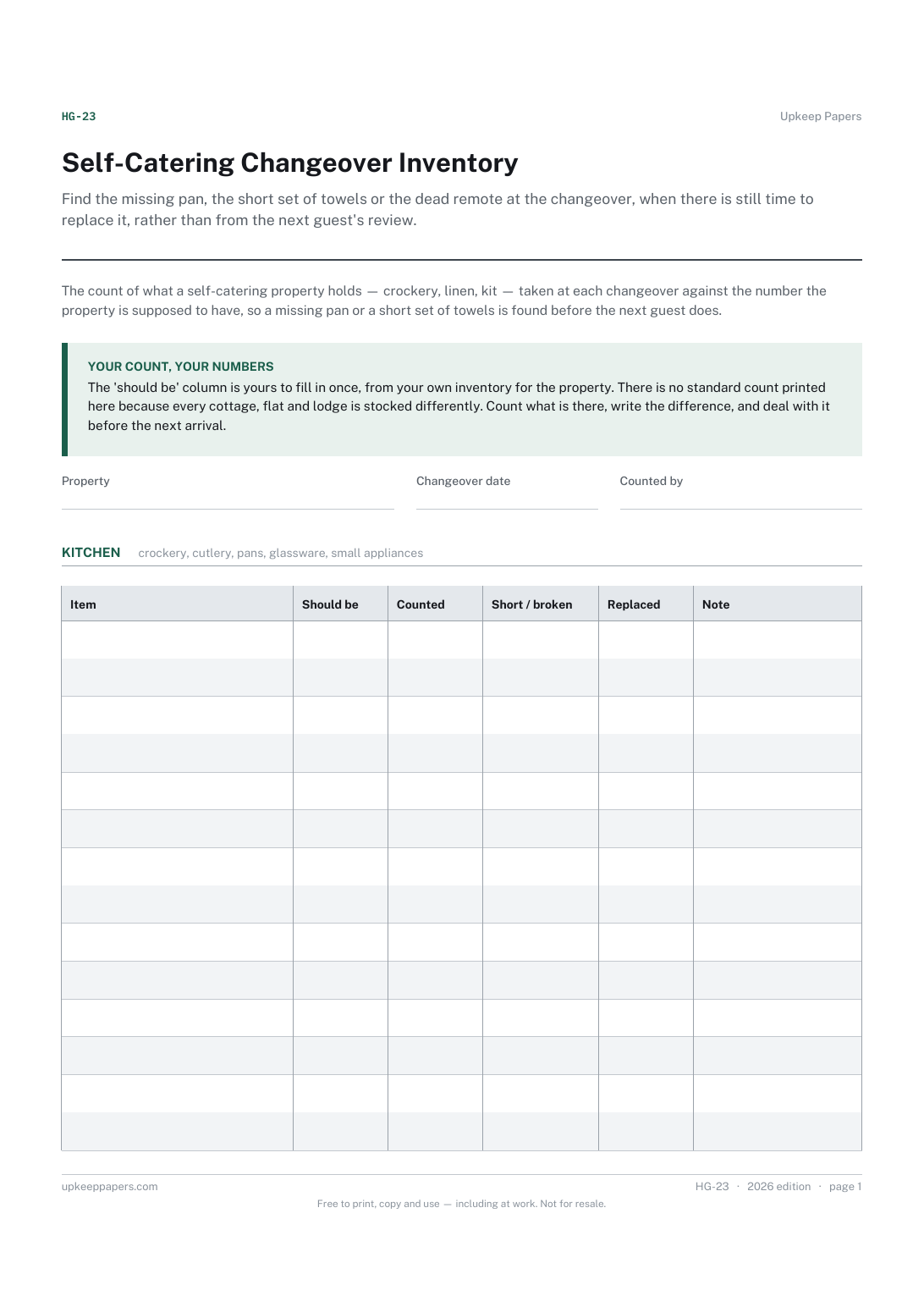
Find the missing pan, the short set of towels or the dead remote at the changeover, when there is still time to replace it, rather than from the next guest's review.
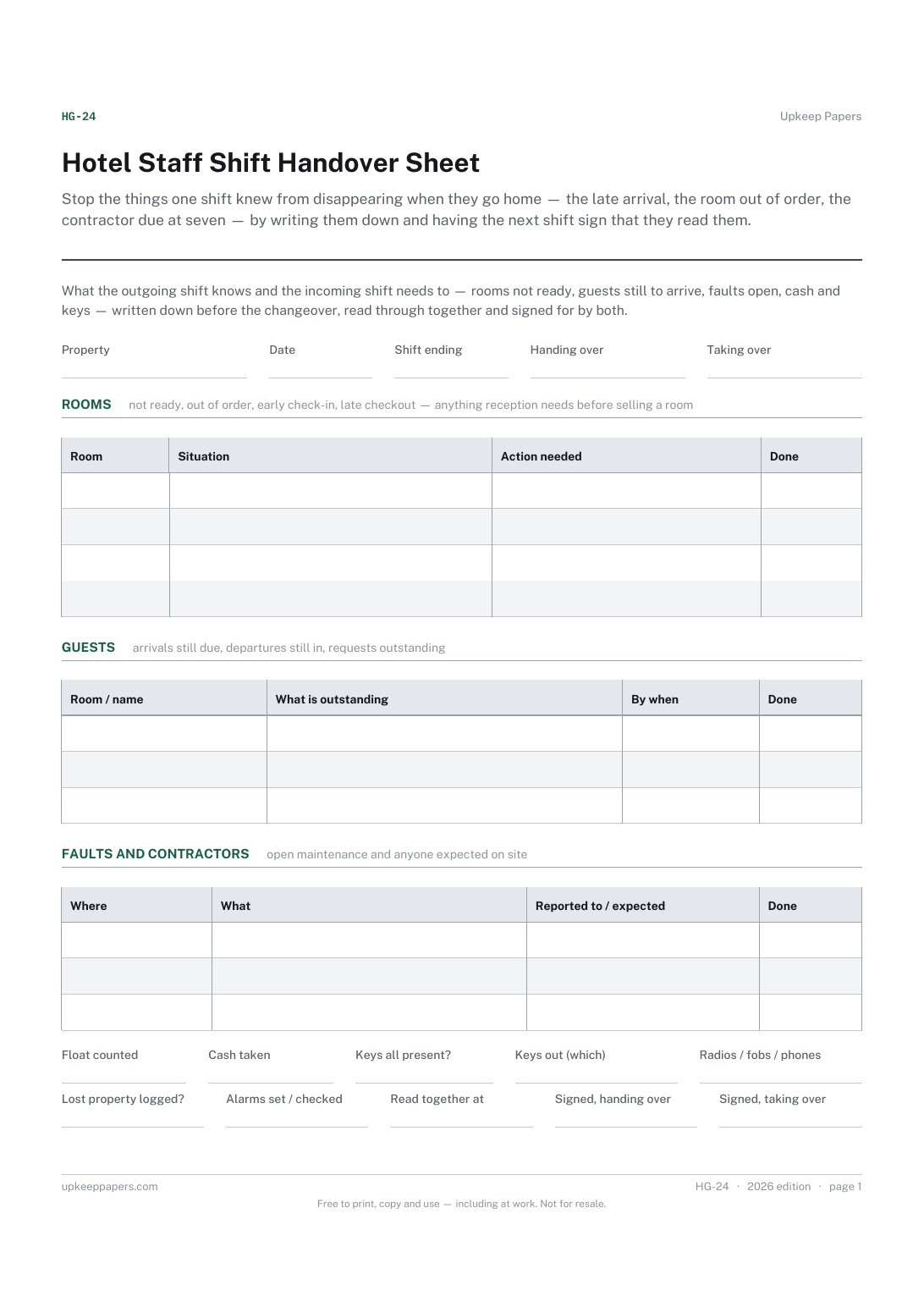
Stop the things one shift knew from disappearing when they go home — the late arrival, the room out of order, the contractor due at seven — by writing them down and having the next shift sign that they read them.
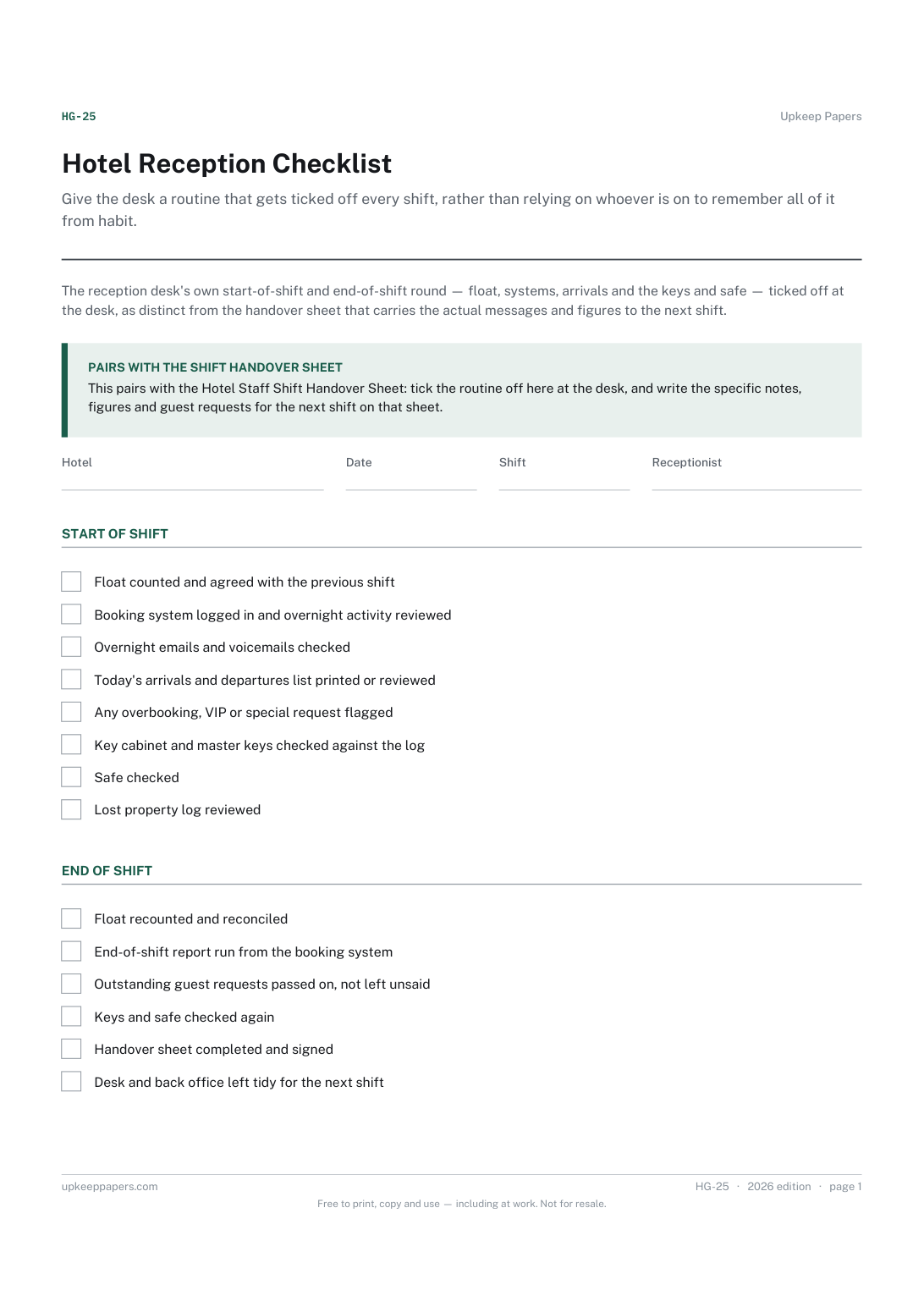
Give the desk a routine that gets ticked off every shift, rather than relying on whoever is on to remember all of it from habit.
Prep done, tables planned, lines cleaned, waste counted and the till cashed up.
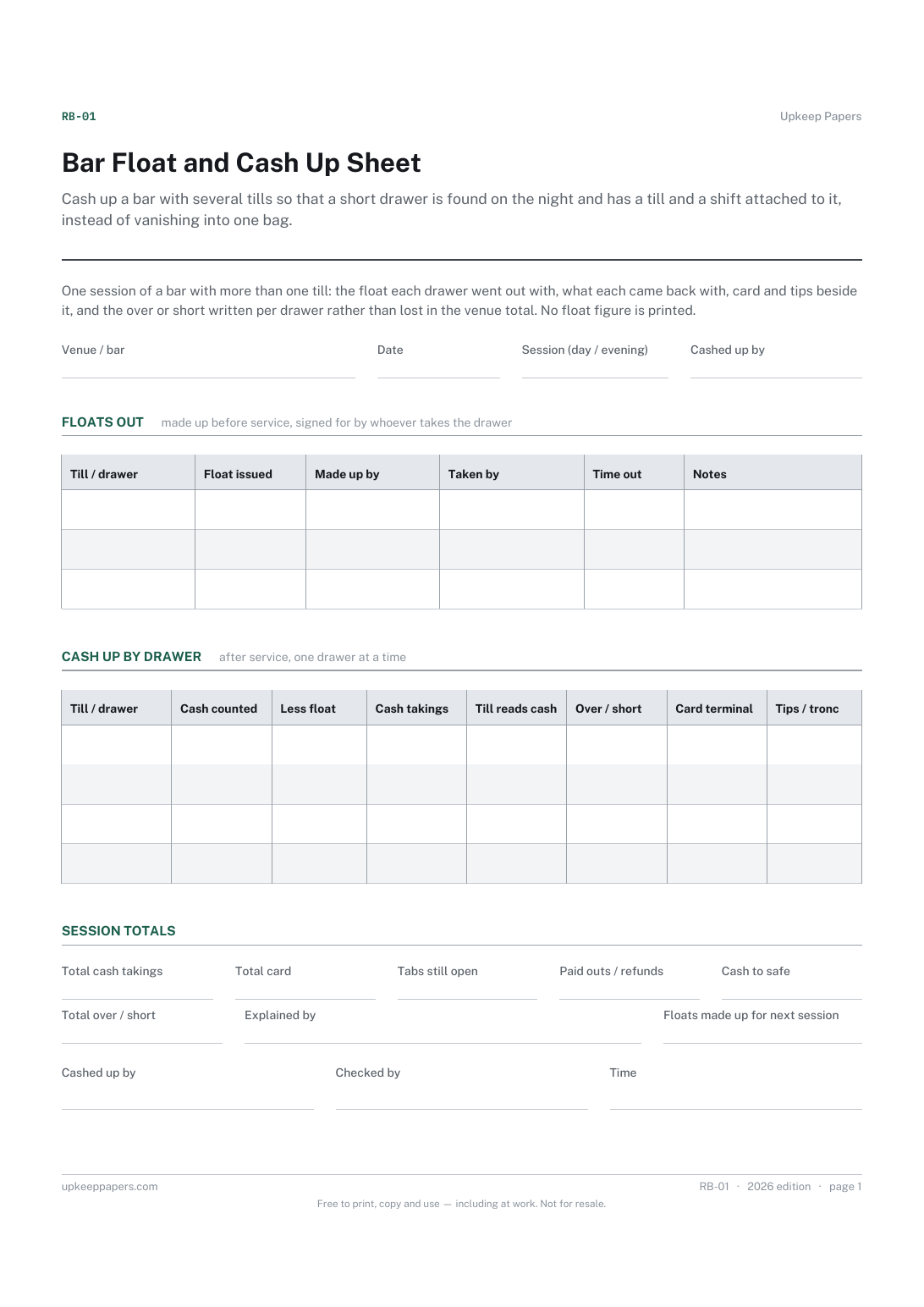
Cash up a bar with several tills so that a short drawer is found on the night and has a till and a shift attached to it, instead of vanishing into one bag.
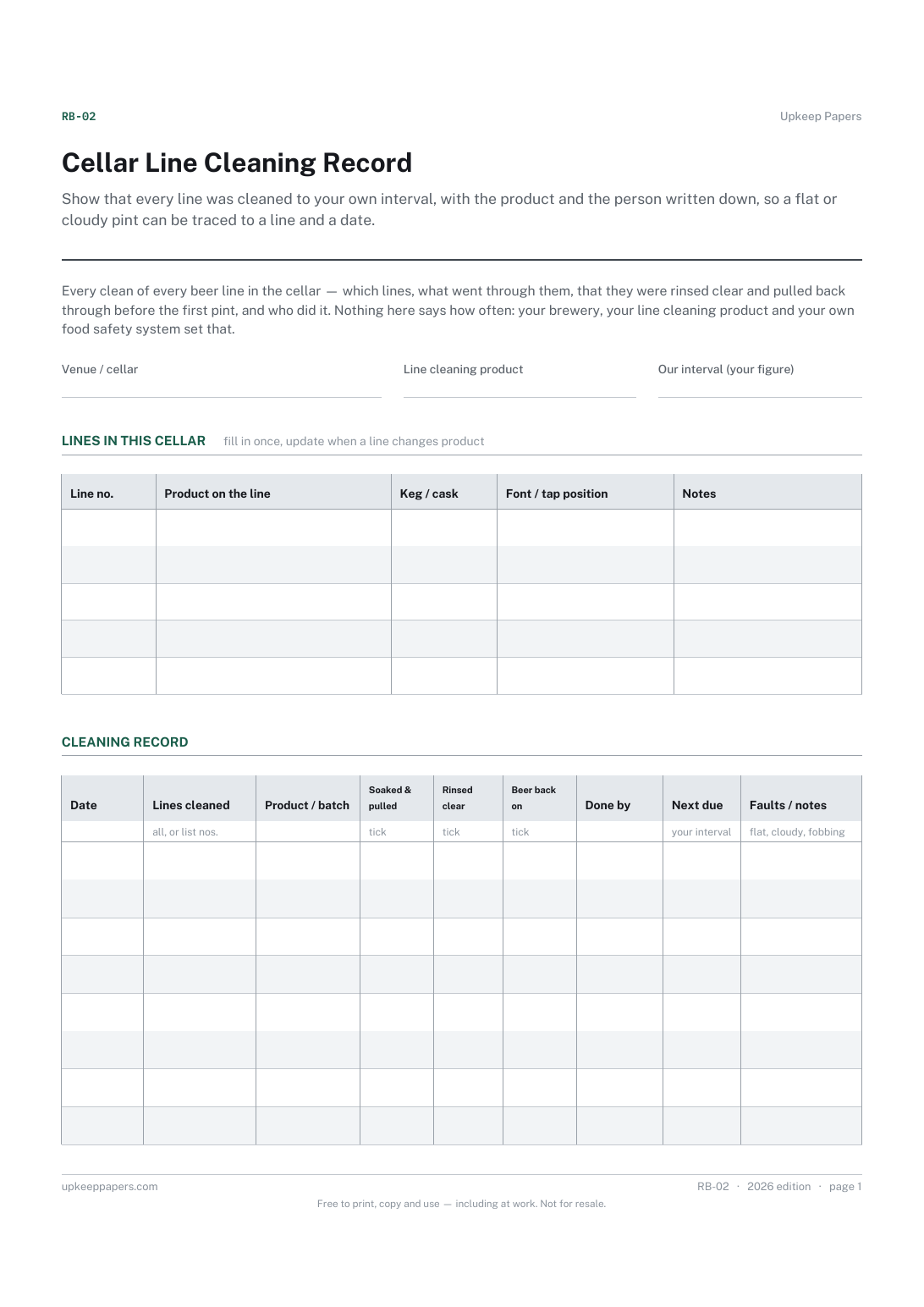
Show that every line was cleaned to your own interval, with the product and the person written down, so a flat or cloudy pint can be traced to a line and a date.
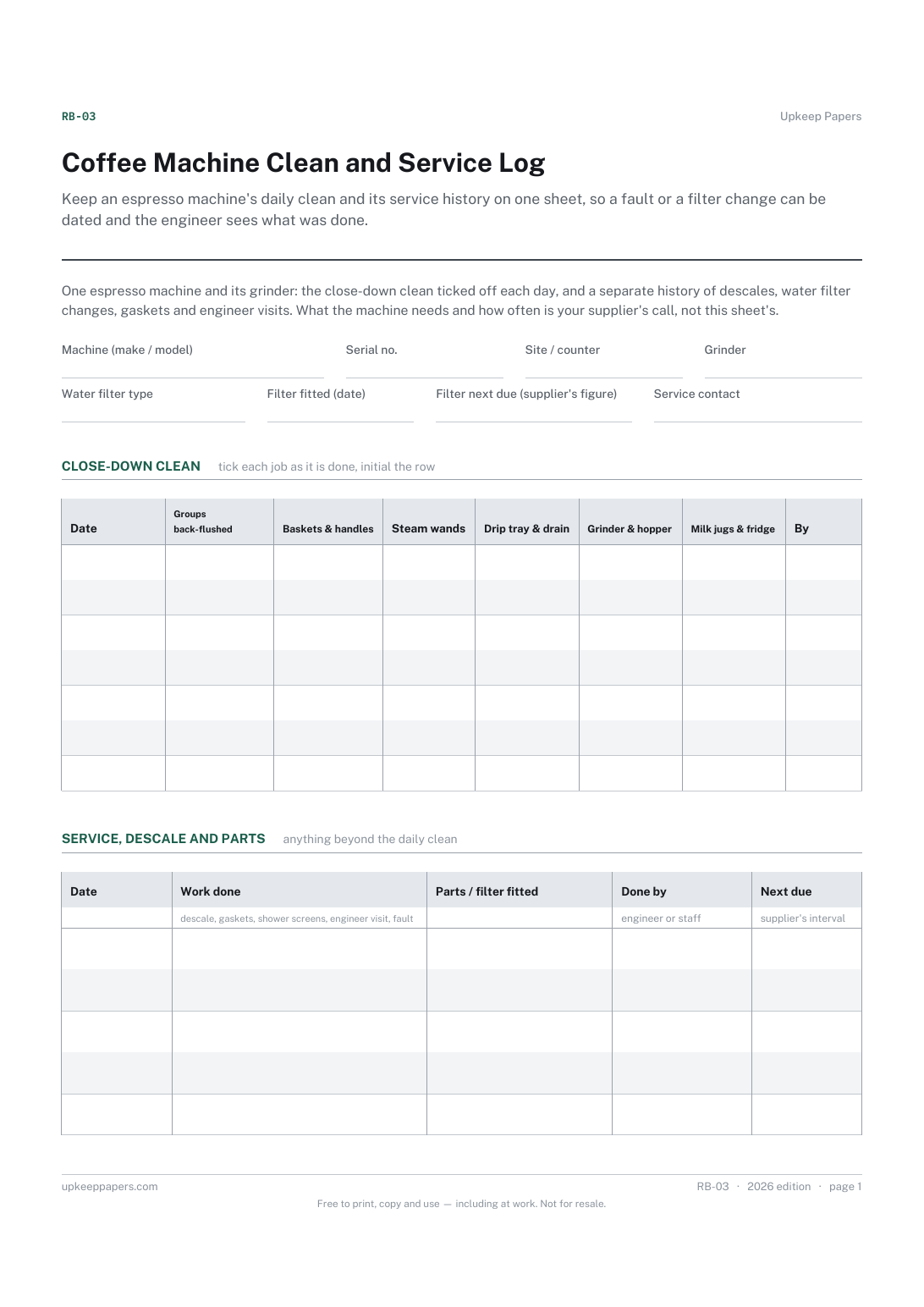
Keep an espresso machine's daily clean and its service history on one sheet, so a fault or a filter change can be dated and the engineer sees what was done.
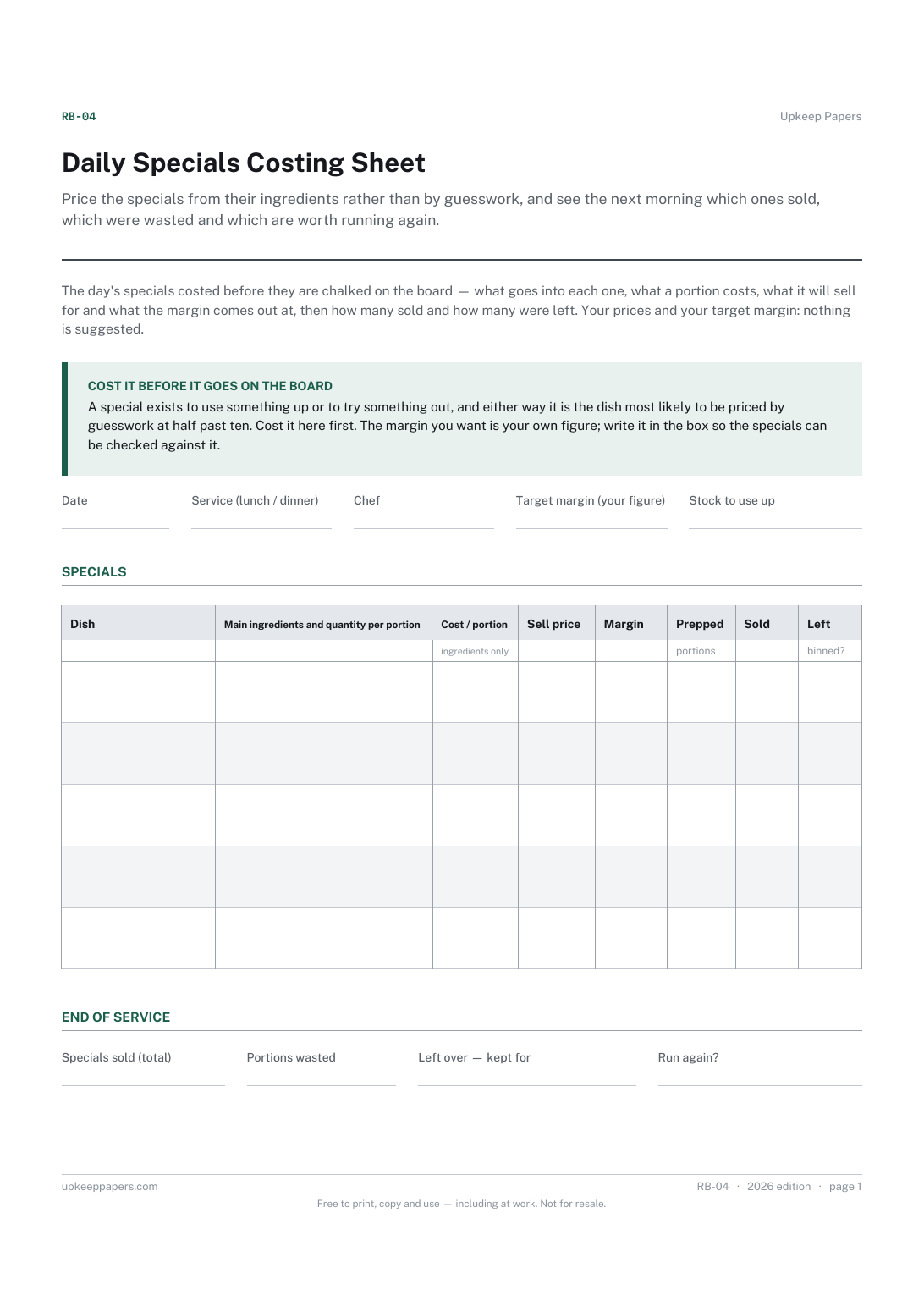
Price the specials from their ingredients rather than by guesswork, and see the next morning which ones sold, which were wasted and which are worth running again.
Check that what the delivery platforms paid matches what they took, order by order, so a missing payout or an unexplained refund is caught in the period it happened.
Put a whole service's floor on one sheet before the doors open, so the host, the servers and the pass all work from the same plan and change it in the same pen.
Get a function's food, drink, room and money agreed on one sheet the kitchen and the organiser both hold, so the numbers on the night match what was ordered.
Make the opening cook look at every fryer and gas appliance before it is lit, and leave a record of who looked, what was wrong and who it was reported to.
Turn breakages from a vague cost into a count by item, place and cause, so the reorder is right and the dishwasher rack or the station doing the damage is found.
Keep the oldest container next on and nothing sold past the brewery's date, with a week-end count of full stock, empties and returns that a stock take can use.
Give every fault on a fridge, fryer, oven or glass washer one line, so nothing is reported twice or forgotten once, and the manager can see what is still open.
Turn 'prep the section' into a list that can be worked down in order and handed over half done, with the par and the on-hand count on the same line.
See where a slow service actually slowed — which course, which section, which table — from the times themselves rather than the argument afterwards.
Catch the missing garnish, the unlabelled tub and the empty backup before service starts, when there is still time to fix it.
Hand over a bar that is actually set, and know at a glance who closed last night and what they left undone.
Keep every booking for a service in one place the host stand can read at a glance, with the total covers against what the room can take.
Settle who has what before the briefing and pin it where everyone can see it, so nobody asks mid-service and no table is left without a server.
Give the floor one page that says what the kitchen is doing today, so the specials are described the same way at every table.
Find the optic that is short-pouring and the rail that is over-pouring before the stocktake finds them for you.
Make staff meals and discounted sales add up at the cash-up and at the stocktake, instead of turning up as an unexplained gap in both.
Order from a count rather than a guess, and check the delivery against the order you actually placed instead of the invoice the supplier sent.
Give the service a number: how many covers actually sat, how many tables turned, how many walked away, and where the room stalled.
Keep phone and counter orders in one numbered list so the bag matches the customer, the promised time is written down and nothing is left under the lamp.
Give the stocktaker a line for every loss, so a gap between stock and sales can be explained rather than argued about.
Keep one master sheet behind the printed list, the cellar shelves and the till, so a bin number means the same wine in all three places.
Run the same opening round every time, across the whole restaurant rather than one station, so nothing gets skipped because someone was in a hurry before service.
Know what is actually on the shelf before placing an order, instead of reordering from memory or running out mid-morning.
Catch a shortfall at the count, where it is a number on a sheet, rather than weeks later when the margin has already gone.
The till, the stockroom, the shelf edge and the routines that open and close the door.
Know exactly which parcels are on the shelf, which have gone and what was checked before each one left, so an order that goes missing can be traced.
Trace a fixture change, a stock movement or a missing line back to the trade visit that caused it, instead of finding it at stocktake with no explanation.
Stop special orders and reserves living on scraps of paper behind the till, so a customer is told when their item lands and a reserve is released on the day you said it would be.
See at a glance which departments carried the day and which did not, in a form you can lay side by side week after week.
Close the loop on every return so a credit note that never arrives is noticed, and the stock you wrote off is the stock you were actually credited for.
Have a carton count in your own hand next to every signature, so a short delivery is a claim and not an argument.
Turn the fitting rooms from the shop's biggest blind spot into a counted area, with the count made at the moment it can still be checked.
Learn when the shop is actually busy and when it is only being browsed, so rotas and staffing follow the pattern rather than a guess.
Know what has been sold and what is still out there to be spent, so a card presented at the till can be checked against the record of its sale.
See whether a quiet week for sign-ups is because nobody joined or because nobody was asked, which are different problems with different fixes.
Turn a mystery shop report into a short list of things that actually got done, rather than a score that was read out once and filed.
Find the gaps between the plan and the bay while you are standing in front of it, and leave a record head office or the next shift can act on.
Keep the shelf label and the till telling the same story, and leave a trail showing why a line was reduced and how much of it was left when it was.
Launch an offer complete and take it down complete, with no promotional price left on the till and no point-of-sale still up a week after the end date.
See refunds as a pattern rather than a series of one-offs, and match the till's refund total to a named reason and an authorising initial every time.
Change the floor over in one planned push rather than a fortnight of half-cleared bays, with every outgoing line given a destination before it comes off.
Catch the missing label, the label under the wrong product and the price that does not match the till before a customer does, and fix the cause not the symptom.
Know at a glance who can open the shop tonight, and make sure a leaver's keys come back and the alarm code is changed and everyone told.
Open the same shop the same way whoever has the keys, and close it with nothing left on, unlocked or uncounted.
Stop the counter being left because a break was assumed rather than covered, and keep the week's hours in one place for whoever does the pay.
Count the shop the way it is laid out rather than the way the stock list is sorted, so every bay gets counted once and the gaps to a full shelf are visible on the same line as the count.
Give stocktake variance a story. Losses written down when they are found show which cause is costing the shop, instead of one unexplained figure at the end of the period.
Stop overstock going missing in the back. A drawn plan with coded racks, and a list that matches the labels on the shelves, means a new starter can find the stock and a delivery goes to the right bay first time.
See the whole week's floats across every till on one page, and spot the drawer or the shift that is repeatedly over or short before it turns into a stocktake surprise.
Know how long each window has stood and which stock is tied up in it, so items come back into stock, get marked down or go back to the prop box instead of being forgotten behind the glass.
Batches made, yields counted and where every ingredient came from.
Show afterwards that the bench was cleaned down between the nut batch and the nut-free one, and that somebody other than the person who cleaned it said so.
Answer 'what is in this and how do you know' with a sheet rather than a memory, and notice when a supplier's change should change your label.
Turn the orders book and the shop's usual sales into a list the night shift can work from, and see the next morning where the plan and the bake disagreed.
Tie a batch code on a shelf back to a tank, a label version and a box of closures, and catch a run where the bottles and the labels do not add up.
Know which line is losing you money — the one that is over-baked every day, or the one that never sells out — from counts rather than the feeling at closing.
Brew the same beer again, and say which bag of malt and which hop lot went into the gyle a customer is asking about.
Put a number on the yield of every carcass you break down, and see which supplier, breed or cutting spec is giving you the most saleable meat.
Make the cake the customer described rather than the one you remember, and have the spelling of the inscription and the deposit in writing.
Trace any pack on the counter back to the animal it came from, and forward from a supplier's notice to every pack you need to pull.
Say which cask went where with what in it, and show that the beer that left the tank is the beer that went into the containers.
Keep the affinage of each batch on paper. A wheel that turned out well was handled a particular way, and this is how you repeat it.
Trace any wheel back to the milk and cultures it was made from. When a make comes out differently, the stage that drifted is on the page.
Know which couverture, cream or nuts went into a batch of bars or bonbons. The thermometer reading is on the same page as the lot number.
Keep the press day on paper, from which orchard's fruit to which vessel. The juice yield per load and the readings taken are all on one sheet.
See what a dough actually did on the day, stage by stage. A flat batch can then be explained from the record rather than guessed at.
Show what happened to every egg between the nest box and the customer. That is the question a scheme inspector or a complaint will ask.
Know what is on the shelf, what it cost and what it sells at. Sale-or-return producers get paid on what really sold.
Stop the market day being remembered on the road. The float, the weights, the price cards and the organiser's paperwork are ticked before the engine starts.
Follow a fermentation on paper from pitch to package. A stuck batch or an off-note then has a dated history to look back through.
Turn the night-before prep and the morning load into one ticked sheet. What came back sets a better number next time.
Say which extraction and which bucket any jar came from, and which customers took the rest of that lot, without digging through receipts.
See over a season which markets pay their pitch fee back and which only look busy, on one page instead of a shoebox of till rolls.
Show for any cheese, yoghurt or ice cream batch which milk went into it, from whom, and that it was checked at the door against the limit you set.
Arrive with everything the pitch needs and leave knowing what sold, because the booking, the stock count and the checks are on one sheet in the cab.
Handle a bad batch in order and prove afterwards exactly what was pulled, from where and when, rather than reconstructing it from phone calls.
Lead any pack back to the meat, the supplier and the cure it came from, and show the batch was made the way your own recipe sets.
Show for any pack on any shelf why it carries the date it does and that someone checked the code against the batch before it left.
Keep every run of the smoker on one page so a good result can be repeated, a poor one explained, and any batch matched to the run that smoked it.
Know at the end of a day what each line sold and whether the cash matches, and load the right amount next time instead of the same amount.
Follow a tank of juice back to the block, the day and the pickers it came from, and see the yield of every press load without going back through the cellar book.
Pitches let, hook-ups metered, blocks cleaned and the site walked.
See what is coming on and going off today without opening a laptop, so whoever is covering the desk can answer the question at the gate.
Know who is still holding a fob from a party that left, and know when the code was last changed without asking three people.
Settle the argument about a torn flysheet before it starts, by writing the condition down in both directions while the guest is standing there.
Match a loose dog to a pitch in the dark, and have a signed record that the owner read your own site rules for pets.
Bill metered electricity from two readings both sides watched, instead of from a number somebody wrote on the back of an envelope.
Close a site down in an order that does not leave water in a pipe or stock in a cupboard, and leave a record of how it was left.
Walk the same round every time and see a missed point as a gap on the page rather than as nothing at all.
Turn a unit round without forgetting the jobs a housekeeping list never mentions: the stove, the water containers, the guy lines and the firepit.
Cut the grass around the people on it, by settling the order and the access once instead of working it out again every week.
Treat tokens like the cash they are, so a shortfall shows up on the day it happened rather than at the end of the season.
See at a glance what is let and what is free, so the answer to a phone call comes off the sheet instead of out of somebody's head.
Settle what a pitch looked like on the day it was handed back, rather than arguing about ruts and scorch marks a fortnight later.
Keep everything about a seasonal holder on one page, so the unit can be identified and the right person reached without going through three folders.
Show that the block was cleaned and restocked, and catch the dripping shower or broken lock while somebody is standing in front of it.
Build a plain, dated record of what happened on site, so a repeated problem is visible and a one-off is not remembered as one.
Know what is actually on the shelf and what the till took, so gas bottles and milk are reordered before they run out rather than after.
Walk the same route every time so the far corner gets looked at, and leave a written note of what needs doing rather than a memory of it.
Match the compound to the paperwork, so an unclaimed or wrongly parked unit is spotted while the contact details still work.
Know where a unit went and who was handling it, which is the question that matters when something gets clipped or a pitch turns out to be double-booked.
Catch a running tap, a backing-up drain or an unrinsed disposal point early, and keep a dated record that the shared points were looked at.
What was done to whom, with what, and what they said about it last time.
Keep one column readable at a glance when the online diary is down, the phone is ringing and a walk-in is standing at the desk.
Give a regular the same cut whoever is on the chair, and stop the 'same as last time' that nobody can remember.
Have the product, lot number and skin reaction from last time in front of you before you start this time, on one card per client.
See what the chair actually made after rent, stock and costs each week, and hold a receipt number for every rent payment.
Ask every question before the first cut or colour, write the answers down, and have the client sign what was agreed.
Turn 'I have not seen her for a while' into a list that gets worked through, and stop two people chasing the same client.
Match last time's colour exactly, or change it on purpose, because the formula and the time it was left are written down rather than remembered.
Order the shades you actually go through instead of the ones the rep suggests, and never find the shelf empty mid-application.
Know exactly which vouchers are out there, what they are worth and which have come back, so a voucher handed over at the desk can be checked in seconds.
Have the adhesive, tint shade, curl and timing from the last set in front of you before you start the next, with the patch test and reaction on the same page.
Start each session from what actually happened last time — the knot that was found, the pressure they asked for, the oil they liked — instead of asking again.
Get through a day of home visits without a forgotten towel, a missed turning or a client whose buzzer you had to guess at twice.
Find 'the pink one from last summer' in seconds, and see a client's nail condition change over months rather than noticing it too late.
Show, for any container, who put it into use, who sealed it and when it left the premises with whom — without hunting through a drawer of receipts.
Prove, for any client, that a test was done with the product actually used and that the result was known before the colour, lash or tint went on.
Reorder the exact piece that went in, and see the history of a site when a client comes back with a concern or for a downsize.
Know which products actually leave the shelf, which stylists sell and which clients bought what, so reordering and commission both come from a record rather than a guess.
See which columns are full and which are quiet, and how much time is lost to no-shows, before deciding on hours, staffing or a cancellation policy.
Have the make, model and serial to hand when something breaks, and a history that shows which items keep failing and which are due a check.
Show for any tool on any day that it went through a cycle, what the machine reported and who released the load.
Show that every chair, bed or booth was reset between people, and that the studio was properly closed down each night, without relying on anyone's memory of a busy Saturday.
Give a stylist and an owner one sheet they both sign, so the week's commission is worked out from figures they both saw rather than argued over afterwards.
Prove, months later, that a client left with the aftercare sheet in their hand and had it talked through, and know exactly which wording they were given.
Match a second sitting or a touch-up to the first, because the needle configuration, the ink brand and colour and the lot number are all written down against the date.
Build the evidence a training provider asks for as you go, and let a trainee see which skills they have practised and which they keep avoiding.
The gig booked, the stage plotted, the set played and the show reported.
Find out that the DI box is missing while you are still at the venue, not at the next rehearsal, and know whose it was.
Settle a gig's money the same night, on paper, before anyone has to ask about it.
Start the next rehearsal where the last one ended, not with half an hour of remembering.
See before the concert, not at it, that the tenors have been three for a month.
One page per booking, so you know what worked in that room and what you played that cleared the floor.
One page at stage door that answers the question every arriving act asks, and shows each room was cleared and locked afterwards.
One page shows who is entered, who has paid, who still needs an accompanist and what everyone got.
One number the venue, the promoter and the act all signed, instead of three and an argument.
Put the truck, the lift, the crew call and the curfew on one page so the get-out is planned before the show rather than improvised after it.
Take the agreement to the gig on one sheet, so whether food was included is settled by reading, not remembering.
Know what gauge is on the guitar, what the action was set to and when it was last touched, instead of rediscovering it every time something buzzes.
Have a written record of what an instrument looked like before you touched it, what the customer agreed to and what it went out with, for every job.
Give the operator and the caller the same list, written so a cue can be taken from the words on the page without the designer in the room.
Know exactly what sold and what the tin should hold at the end of the night, and see which sizes to reorder before the next run.
Keep every pupil's progress and payments in one place, so a term's work can be shown to a parent or written into an exam entry without hunting.
Run the night from one sheet: who is on next, what to plug in before they get there, and who takes the slot if someone does not show.
Know who is on which desk and which numbered copy they hold, so a hired set goes home complete and the seating survives a change of leader.
Know what you own, what went out in the van and what came back, and which cable failed so it is tested before it is packed again.
Run the props table and wardrobe from one list, and turn the get-out into a returns list instead of a hunt through boxes.
Send the pupil home knowing exactly what to work on and why, and come back with a record of what they actually did.
Open a session file months later and know what every track is, how it was recorded and which take was the keeper, without soloing them one by one.
Get through a set without the pause where someone asks what key it is in or whether the capo goes on, and keep a record of what was actually played.
Stop a library shrinking one copy at a time, by making the count out and the count in part of every loan rather than something done at the end of the year.
Give the director, the producer and tomorrow's crew one honest page about what happened tonight, written while it is still clear, instead of a chain of messages the next morning.
Find and finish the idea from last spring instead of losing it on a phone, and have the writing credits written down from the day they were agreed.
Put the mix that was right at sound check back at show time, and start the next gig from what worked rather than from nothing.
Let a venue engineer patch the stage before you arrive, and save the twenty minutes of pointing and shouting that a gig without one costs.
Know at any point how many hours a project has used and what is still owed, and have the record that settles the conversation when a client remembers it differently.
Have the right people in the right room with the right props at the right time, and let everyone not on the sheet know they have the day.
Answer every question the band and crew will ask today before they ask it, on one page that can be photographed and passed round the bus.
See what practice actually happened across a week, not what was intended, and carry a note about where to pick up next time rather than starting cold.
Give every instrument you own the same routine care record, instead of remembering by feel when each one was last wiped down, oiled or checked.
Give everyone in a production the same list of who is playing whom and who covers them, instead of a scatter of messages.
Tell every department what was covered today and what they need to act on, while it is still fresh rather than relayed secondhand the next morning.
Firings, cuts, pours and settings — written down so the good one can be repeated.
Turn a piece that came out right into one you can make again, by having the steel, the sequence of heats and the quench written down against it.
Know what is in the stores before the order goes in, and keep the batch number of every bag and tub so a glaze that changes can be traced to a material that changed.
Run a repeat job on the first attempt, because the tool list and the numbers that worked last time are on one sheet with the program name.
Keep a router, mill or laser running as a maintained machine rather than a machine that is fixed when it stops, with the hours and the parts written down.
Make sure maker and client are picturing the same object before work starts, and have a record of who approved what if the finished piece is questioned.
Know what actually sold at a fair and whether the day paid, instead of guessing from an emptier box and a fuller cash tin.
Show that the extractor was actually checked and not just switched on, and catch the blocked filter or split hose before the workshop fills with dust.
Repeat a job exactly, months later, from a sheet that holds the combination of thread, backing and settings that worked, rather than testing it again.
Leave a record of exactly what was done to a piece and what was put on it, for the owner, for the next restorer and for your own defence if it is questioned.
Repeat a firing that worked and trace one that did not, because the schedule you ran and what came out are on the same sheet.
Trace the tile you like back to exactly what went into the bucket and which firing it went through, so it can be mixed and fired again on purpose.
Answer a question about any hallmarked piece — when it went, what was declared, what came back — from one page instead of a drawer of packet slips.
Stop re-testing the same shirt and vinyl every time, and find out why a batch failed by reading back what the press was actually set to.
Know what leather is really on the shelf and how much of each hide is left, before quoting a job or ordering more.
Work out a price, a repeat or a repair from what the piece actually took in metal, stones and hours, instead of from memory.
Get a piece of furniture or joinery from idea to cut list on one page, so nothing is cut twice and the drawing is with the list when you are at the saw.
Give every firing a number and a record, so a good result can be repeated and a bad one explained instead of guessed at.
Test a new material once, properly, and keep the answer where the next job can find it — instead of guessing on the job and scrapping the sheet.
Keep the machine's own day book, so a bad cut can be traced to a dirty lens or a changed setting, and a good one can be run again.
Make the same bag, belt or wallet again — or fix the one that came back — from a record of exactly what was cut, stitched and fitted.
Know at a glance who is cleared on which machine, and stop the argument about whether somebody was ever shown the bandsaw.
Know how many pulls a mould has taken and which mix gave a clean cast, so a tired mould is retired before it ruins a job rather than after.
See which weight and which body gave the pots that made it to the kiln, and which batch lost half its mugs to S-cracks.
Know what silver and gold you actually hold, what a job consumed, and what it cost you at the time — so pricing and insurance rest on a record rather than a guess.
Find out why last month's pour was flawless and this week's is tacky, by having both written down side by side.
Deliver the count you promised and know exactly why the rejects happened, with the settings written down so the reprint matches.
Match a broken piece years later, and quote the next panel from the hours and glass the last one really took.
Stop running out of the one thing that halts the studio, by counting it against a reorder point you set instead of noticing when the box is empty.
Know what timber you have before you buy more, and price a piece from the board it actually came out of.
Hit the same angle every time, and see which blade is going out for regrinding more often than the work it does explains.
Know exactly what went into a piece, what it cost in materials and hours, and how to do the matching chair the same way a year later.
Stop re-finding the right cut and press settings for every material by writing down the ones that worked on the job where they worked.
Match a finish you got right, and trace one that went wrong to the coat, the batch or the damp afternoon that caused it.
Cut every part once, at the right size, from the right board — and know which off-cuts are worth keeping.
Show that the guards on a saw, planer, lathe or press were actually looked at, and that a machine with a missing guard was taken out of use rather than run.
Setup, times, tyres and fuel — the numbers that make the next session faster.
Know exactly what the car went out on, so a faster or slower session can be traced to a change rather than a feeling.
Turn 'I believe it is matching numbers' into a component-by-component record with the evidence behind it, ready for a buyer, a concours judge or an insurer.
Give a multi-year restoration a written history and an honest running cost, instead of a box of receipts and a memory of roughly how long the engine took.
Stop a season being derailed by a lapsed licence or a missed entry deadline, by keeping the paperwork and the calendar on one page.
Keep a competition car's crash and repair history traceable, so a part that was replaced can be tied to the reason and nothing damaged goes out unchecked.
Capture what the driver felt while it is still fresh, in words the engineer can act on, and tie each setup change to the feedback that caused it.
Know how much life is left in a competition engine before it lets go, and hold a rebuild history that follows the engine rather than the car.
Replace a guessed fuel load with a measured one, so the car neither runs dry on the last lap nor carries weight it does not need.
Put a race car, classic or summer car away so it comes out in the spring in the state it went in, and remember what was blocked, disconnected or deferred.
Tie every kart setup change to the lap time it produced, so a day at the track ends with a known best setup rather than a feeling about one.
See which change actually made the car faster, because the time and the change that preceded it are written on the same page.
Give every member of the crew one page that says their job, their position and their cue, and keep the stop plan where the whole team can see it change.
Stop a weekend running on three different timetables in three different pockets, and catch the session that moved before it is missed.
Give a crew a clean, consistent page for pace notes and road book additions, so a note taken at speed on the recce can be read at speed on the stage.
Turn up at scrutineering with everything checked against your own regulations, and keep a note of what was queried so it does not come up twice.
Prepare a car area by area rather than in a panic the night before, and keep what the judges said so the next entry starts from it.
Stop the weekend being decided by the one part left on the workshop bench, and know what is in the trailer without unloading it to find out.
Arrive with the car checked, the kit packed and the paperwork done, so the day is spent on track rather than in the paddock.
Keep a written record of what cover was in place on each day on track, and who told you so, instead of relying on a phone call you half remember.
Turn tyre pressure guesses into a pattern you can read across a day, and see how the spread across the tread answers each change.
Team sheets, scorebooks, training plans and the club admin behind a fixture.
See at a glance what an athlete's best is in each event and where it was set, and check a claimed PB against the actual results rather than memory.
Stop two pairs turning up for the same rink at the same time, and keep the day's results in one place for the competition secretary.
Read back exactly what a boxer did in a camp — bag, pads, sparring or roadwork, and with whom — instead of guessing from a diary.
Know who has which shirt number and what came back at the end of the season, so replacement orders are for what is actually missing.
Give the treasurer one page that answers who has paid their subs and whether every fixture's match fees actually reached the bank.
Get one signed count for every match day and function, so the treasurer can match the safe and the bank statement to a piece of paper.
Answer the welfare officer's question — who is checked, who is qualified and whose paperwork runs out next — from one page instead of a filing box.
Give the scorer the bowling analysis on its own page, so figures can be totalled at the end of a spell without turning the scorebook round.
Score an innings in the layout every club scorer already knows, on a page that can be printed when the scorebook is left in the pavilion.
Keep the groundsman's knowledge on paper: which strips have been used, what preparation produced a good pitch, and what needs resting or repairing.
Know who went out and that everyone came back. The puncture, the crash or the rider who turned for home gets a written note rather than a memory.
Send the league a card both captains agreed on the night. The 180s and high breaks are recorded where the league can find them.
Arrange every away day once, on one page. No round of messages the night before each match about who is driving and where to meet.
Hand the referee a complete team sheet before kick-off. Come away with the goals, cards and substitutions marked on the same page for the match report.
See the whole squad's availability for a block of fixtures on one page. A short week is spotted while there is still time to find a player.
Turn up with the session already planned. Leave with a note of what worked, so the next one builds on it rather than starting again.
Plan a week's ground work around the fixtures it has to be ready for. Keep a record of who inspected each pitch and called it fit or off.
Send the league a card record both captains and the umpires agreed at the pitch. Nothing is reconstructed from memory on Monday.
Keep a student's grading history in one place. A lost certificate or a lapsed licence is found before the next grading day, not on it.
Give the bench scorer one sheet that keeps score, players and sanctions straight. Both captains can sign it at the end.
Show the referee and the league what the pitch was like when it was checked, and know how much paint the season actually uses before you reorder.
Have one page the team manager, the opposition and the referee can all sign, with the substitutions and cards on it that the match report will ask for.
Know exactly who went out on the route and confirm every one of them came back, with a record of guests and first-timers the club can chase for membership.
Keep one record per injury that shows the club did the right thing at the time and did not let a player back before someone qualified said so.
Send one clean list of entries and fees to the promoter, then carry the same sheet to poolside and have the results next to the times you entered.
Write the session once, read it off the board at poolside, and keep it so a block of training can be looked back over rather than remembered.
Get a team to an away fixture with nobody left at the ground and nobody in a car their parent did not know about.
Run the courts from one sheet on the clubhouse board, with guests, lights and the court with the net down all visible to the next duty member.
Run a club ladder that people actually play on, because the rules, the order and the results are on one sheet on the board instead of three.
Take entries in one place, know who has paid and who has withdrawn, and have the seeding decided and recorded before anyone fills in the draw.
Rotas filled, halls booked, collections counted and volunteers looked after.
Keep a tower's own history of what was rung and who rang it, so a year of practices is something you can look back through rather than guess at.
Hold everything about one hire in a single place, so the person who took the booking is not the only person who knows what was agreed.
Get a young person to the campsite with what they need and home again with what they took, by putting the packing in their hands with an adult checking it.
Show a month of trading on one page with the counting and the checking done by two different people, so a query has a line to point at.
See how much donated stock has to be handled to produce a day's sales, and hold the merchant's collection dockets in the same place as the sorting they came from.
Fill the jobs before the day rather than on it, and finish with a record of what worked that the next person to run it can read.
Put one collection on one page, counted and signed by two people, so the figure that reaches the accounts can be traced back to the table it was counted on.
Carry the thread between meetings, so nothing is agreed twice and nothing quietly disappears between one set of minutes and the next.
Keep one visible diary by the phone, so a double booking is spotted while the caller is still on the line rather than on the morning itself.
Get an issue out on time by fixing the deadlines first and knowing, at any point, which page is still missing and which street is still undelivered.
Keep gifts of goods visible in the accounts and in the thank-you list, instead of letting them disappear into a store cupboard unrecorded.
See what is actually on the shelves without counting the whole store, and spot the item that is about to run out before the next session opens.
Send out a parcel that has been checked twice against what the household said they can eat, and keep a record of what they were actually given.
Close an event with a single page the treasurer can bank from, instead of a biscuit tin and four people's recollections.
Stop a deadline or a reporting date slipping past unnoticed, and see at a glance how much of the year's funding is still undecided.
Answer a family's question from a page rather than from memory, and keep the condition of each memorial written down between inspections.
Leave the doorway with both sides agreeing on the times, the rooms and who locks up. It is the booking nobody wrote down that goes wrong.
Make sure nobody is quietly missed for months, and let a visiting team hand over without anyone repeating the same conversation.
Keep a term's worth of half-finished badges in one place, so nothing is signed off twice and nothing is forgotten at presentation night.
See the gaps in the rota while there is still time to fill them, rather than at nine o'clock on a Sunday morning.
Gives every volunteer the same start and leaves one sheet you can find later, instead of a role that was agreed in a doorway and an induction nobody recorded.
Stops the rota being built from guesswork, because the dates people cannot do are written down before any name is put against a duty.
Puts everyone taking part on the same page before the day, so the person on sound knows what is coming and nobody discovers a missing microphone mid-item.
Means the person on the door can see at a glance who is expected, who to ring and whose form is still outstanding, without going back to a folder in an office.
Turns a session that was half-planned in your head into something a helper can pick up and run, and leaves a record of what was planned for the next time round.
What kit exists, who has it, whether the backup ran and when the licence expires.
Find a file years later without opening every box, and know who to ask before anything in the box is thrown away.
Know that the backup ran, and prove a file can come back from it. Assumed backups are the ones that fail on the day they are needed.
Change a live system deliberately, with a written way back and a record of what was done. Agreed beforehand, verified afterwards, by name.
Account for every bag of confidential paper from the moment it is sealed to the certificate that says it was destroyed.
Know who has which laptop, tablet or handset right now, and have a signature for the moment they took it and the moment they gave it back.
Look properly at one person's desk with them, write down what is wrong, and give each fix a name and a date.
Stop the same fault being solved from scratch each time, and see which device or person is generating most of the calls.
Settle who has the room at a glance from the corridor. One sheet on one door is what stops two meetings arriving at once.
Have the IMEI and SIM number to hand the day a phone is lost, and know whose pocket each company number is in.
Trace a dead socket to its port without pulling every lead, and hand the cabinet to a new contractor without a guided tour.
Know who sits where and which monitor, dock and phone belong to which desk, so a vacant desk with kit on it is on record rather than quietly stripped.
Get everyone and their kit from the old desk to the right new one, with a record of whose crate is whose and who is actually up and running afterwards.
Answer 'did that go out, and when?' from a single page, and trace any parcel by the reference written down before the driver left.
Know what a printer really costs per page, which consumable keeps running out, and the exact part number to reorder without opening the machine.
Turn the cupboard full of blinking boxes into a list that says what each one is for and what stops working if it is switched off.
See every renewal coming and every seat you pay for but do not use, on one page, without a single licence key written down.
Give a new starter everything on day one and take it all back on the last day, with the leaver half checked against what the starter half says went out.
Keep the cupboard stocked before it runs dry, and stop two people ordering the same box of toner in the same week.
Know who was on your guest network or a temporary login and when it ended, which is the first question asked if something odd turns up in the logs.
Stop a website vanishing because a domain was registered in a former employee's name and paid on a card that has since been cancelled.
Units let, keys issued, payments tracked and loads moved.
See at a glance which spaces are let, which are empty and who is behind on payment, without opening a single customer file.
Settle what was stored and what state it was in before there is anything to argue about, with one signed page per drop-off.
Bring the whole day back to the office on one page, so invoicing, fuel and cash reconcile without a phone call to the driver.
Know at the door of the new address whether every carton that was packed has come off the van, instead of finding out a week later.
Answer the two questions that matter when a key goes missing or a customer leaves: who has access to that unit, and when was it last changed.
Keep everything about one let bay on one page, so a stranger's trailer, an unpaid month or an emergency contact can be found in seconds.
Put the survey, the load and the sign-off on one sheet the crew carries, so what was agreed, what was loaded and what was delivered all sit side by side.
Show that the site was walked and every unit door looked at, and give anything found a time, an action and a name.
Stop enquiries going cold, and see over a month what people asked for that you could not offer.
Have a dated record of what each customer told you about cover, in their words, before it is ever needed.
Know exactly where one customer's account stands, and show what was said and when if it ever has to be argued.
Keep the units themselves on record, so a damp corner, a sticking door or a unit out of use is written against its number rather than remembered.
Settle what a unit looked like when a customer left, and what became of anything they left in it, on one signed page instead of a string of texts.
Start every let the same way, with the unit shown empty, the access explained and the lock number written down before the first box goes in.
Keep a workshop or studio let on one page from the first meter reading to the last, so the end of the let is a comparison rather than an argument.
Flock and herd records, medicine and movement books, and the application records that have to be produced when somebody asks.
Keep the flock on paper, so that a ewe's history is something you can read at the handling pens rather than something you half remember.
Hold the herd's detail in one legible place, so tags, parentage and movements can be read off a page instead of assembled from memory and text messages.
Record each birth while the detail is still exact, including the assistance and the losses, so next season is planned from what happened rather than what you recall.
Keep a medicines book that answers the two questions that actually get asked: what went into which animals, and when they are clear.
Keep your own copy of every movement on and off, with the reference numbers that make it possible to answer a question about a load six months afterwards.
Record applications properly at the time, including the conditions, so the record stands up when a buyer, an inspector or a neighbour asks about it.
Keep each sow's breeding history on one page, so decisions about which sows to keep are made from records rather than impressions.
Track weight gain against feed, so you know what a finished pig actually costs you and whether a batch is doing what it should.
Record condition scores consistently over a year, so changes are visible at the points in the cycle where they matter.
Record each kidding on the day, including the assistance and the losses, so next season is planned from what happened.
Keep a medicines record that answers what went into which goat and when the milk or meat is clear.
See which does actually milk well across a whole lactation rather than on the days you happened to notice.
Record yields per animal daily, with the notes that turn an unexplained drop into an early warning.
Track lay across a month so a drop shows up as a pattern, with the conditions that usually explain it recorded alongside.
Record one incubation properly so that a poor hatch can be diagnosed rather than shrugged at.
Record the brooder weeks, where most losses happen and where nobody keeps notes.
Keep a register of birds on the holding, with the movements that anyone asking about disease or provenance will want to see.
Keep the cleaning round on a dated record, with the red mite check that is easy to skip and expensive to skip twice.
Record treatments with the two withdrawal dates that matter, so eggs and meat are not used before they are clear.
Turn a run of losses into a visible pattern, because predation almost always repeats at the same hour and the same weak point.
Keep each doe's breeding history in one place so that decisions about which to keep are made on evidence.
Catch a problem early by writing the weight down weekly, because rabbits hide illness until it is advanced.
Record treatments with the wormer class written down, which is what makes any resistance plan possible a year later.
Record foot problems by animal so that the repeat offenders become obvious, which is the single most useful thing a lameness record does.
Record what came off and what it was worth, which is the only way to know whether wool covers the cost of shearing.
Record which ram covered which group and when, so scanning results and lambing dates can be worked out rather than guessed.
Record what each group is fed and what feed actually costs across a year, which is usually the largest bill on a smallholding.
Track rest as well as grazing, because the rest period is the part of rotational grazing that actually does the work and the part nobody records.
Know in October whether the forage will last until spring, instead of finding out in February when everyone else has sold theirs.
Keep track of which tag is on which animal, including the replacements that otherwise break the chain between an animal and its records.
Hold a pedigree on paper so breeding decisions and registrations can be made without reconstructing three years of matings from memory.
Record weaning properly, because the age and weight it happened at explains a lot of what the group does afterwards.
Record deaths and their disposal, which is both a legal requirement in many places and the record that reveals a pattern nobody had noticed.
Keep the visitor record that matters when disease is traced, and make the boot dip a thing that is recorded rather than assumed.
Turn an assessment into a walk to a folder, by writing down in advance where every required record actually lives.
Record the water round, which is the one daily job where a missed fault becomes an emergency within hours.
Record the fence walk and the faults, including who is responsible for each boundary before money is spent on it.
Record cleaning and disinfection properly, with the contact time and rest period that decide whether it achieved anything.
Record the all-in all-out cycle, including the rest period, which is the part that actually breaks a disease cycle.
Get the daily round out of your head and onto a page, so a neighbour, a relative or a sitter can keep the holding running while you are away.
Record the harvest hive by hive with a batch code, which is what makes traceability possible if a jar is ever queried.
Keep track of queen age and origin across an apiary, which explains most of what a colony does and is almost never written down.
Record the daily round for ducks and geese, whose water needs and predator risk are both different from chickens.
Record weights and condition regularly, because a fleece hides both loss and gain until it is serious.
Measure growth to weaning against the ewe that reared it, which is the fairest test of a breeding ewe there is.
Find out what the holding actually costs against what it produces, which is a question most smallholdings avoid asking.
See the true level of mastitis in the herd, mild and untreated cases included. Repeat cows and problem quarters then show up on paper instead of being half remembered.
Show the milk was cooled after every milking, with the time and initials of whoever read it. Anything outside the buyer's limits is written up with its cause and fix.
Change liners when your own herd's numbers say they are due, not when milking starts to slow. The rest of the rubberware and every machine test get their own record.
Keep every heat, serve and scan for each cow on one line, so returns and due dates are clear. Serves written on the day can then be entered on the herd database accurately.
See which calves got good colostrum soon enough, and which were fed late, short or by tube. A gap in first feeding then shows up while there is still time to change it.
Know what is in the colostrum fridge and freezer, how good each bag is and when it must be used. Nothing is fed past its date or thrown out without a reason.
Turn a scoring walk into a list of cows that were examined, treated and re-scored. The monthly trend then shows whether lameness in the herd is going up or down.
Find the broken latch or loose race sheet before the cattle are in the race, not while they are. Each fault is written down with its repair and a sign-off.
Keep everything about one bull's handling in one place, from his first day on the farm. A change in his behaviour is then on paper rather than in one person's head.
Decide on purpose which stock go in fields with a public path, and show what was checked. Incidents and complaints are written down the day they happen.
Find the ram with bad feet, poor teeth or a testicle fault while there is time to replace him. Every ram's result sits in its own column, side by side.
Cull on what each ewe actually did this year, written down on the day, rather than on memory. The pre-breeding exam then sorts the flock into batches with a reason for each.
Find out in the run-up to lambing, not at two in the morning, what the kit is short of. Each item is counted against your own number, dated and placed, then recounted mid-season.
Keep every flystrike check of the season on one log, so a struck group or missed week shows up. It also shows when preventive cover ran out and which groups need dagging first.
Keep worm egg counts as tests in their own right, including the ones that led to no treatment. A follow-up count beside each treatment shows whether it worked.
Account for every medicine from the day it arrives to the day it is used up or thrown away. Batch and supplier stay on file, and opened bottles are not kept past their date.
Show for every load when the trailer or lorry was cleansed and disinfected, where and with what. It also records who checked it before the next animals went on.
Follow a batch of bought-in or returning animals through isolation until they join the rest. The tests, the daily checks and the vet's agreement are all on one record.
Turn the weekly farm walk into figures you can plan grazing from, paddock by paddock. A hand-drawn wedge shows the surpluses and deficits at a glance.
Keep each forage analysis beside the batch it came from, so the ration matches what is fed. Five batches sit side by side for comparison.
Record one animal from the processor's booking to the freezer shelf, cut by cut. The carcass weight and the packed weight sit side by side.
Spot a change in deaths, feed, water or eggs early, one house and one day at a time. A month fits on one record, with movements in and out at the end.
Walk the same biosecurity round each week, so a habit that has slipped shows up in the grid. Eight weeks fit on one sheet, with a table for faults and the action taken.
Check each pen's enrichment and the pigs' tails and ears on a routine. The action taken and whether it worked are recorded beside what was found.
Show that every handwash station worked at every round of an open day, not only the first. A station with no soap or towels by the afternoon is one visitors walk past.
Project planners, stash inventories and machine logs — for quilting, sewing, printing, modelling and selling what you make.
Hold one quilt's plan, fabric and progress on a single page, so the piecing maths and the yardage are not on the back of an envelope that gets thrown out.
Record the alterations you made to a pattern, so the next garment from it starts from a fitted version instead of the envelope.
Get the ball band's detail onto paper before the band is lost, especially the dye lot, which exists nowhere else once it is gone.
Record the settings that produced each print, so a good result can be repeated and a failed one diagnosed instead of guessed at.
List sets by number, which is the only thing anyone can actually search on, and record whether the box and instructions are still with them.
Keep a catalogue of finished work and where it went, which is the record galleries, insurers and tax authorities ask for and working artists rarely have.
Record the things a finished object cannot tell you later: which dye lot, which hook you really used, and how much was left over.
Make a batch traceable, so a good one can be repeated and a bad one can be traced back to what went into it.
Know which designs actually sell and what each one takes to make, instead of rebuilding both from memory the night before the next craft fair.
Stop buying a third bottle of the same glue while the project that needed a particular blade sits waiting, by counting the cupboard once and keeping it current.
Finish a project the size it was meant to be, and be able to repeat it, because the hook that met tension and every change you made are written down rather than remembered.
Pick a long piece back up without re-counting from the centre, and know how many skeins a colour actually took before you run out of the dye lot.
Get a garment that fits the person it was knitted for, and be able to knit the same thing again, because the needles and the alterations are on paper.
Repeat a paint scheme across a unit or a second model months later, without guessing which brown it was or how the metal was shaded.
See the whole album before anything is glued down, so the gaps and the repetitions show up while they can still be fixed.
Shot lists, kit inventories and job records — for getting the shot, insuring the kit and finding out what the work actually pays.
Write the shot list before the shoot rather than in the car afterwards, and tick shots as captured so nothing is assumed.
Get the serial numbers written down before they are needed, and keep track of what has been lent out and not come back.
Show what the work actually pays, by recording editing time and travel alongside the fee instead of remembering only the fee.
Keep one signed record of what each person actually agreed to, so a picture is not used somewhere nobody discussed.
Get through the day without missing the shots that cannot be taken again. The family groups run quickly because the names are already written down.
Put the whole shoot day on one page everyone is holding. Nobody arrives at the wrong place, and nobody waits for a number nobody has.
Stop a card being wiped before the files are safely in two places, by making the formatting column the last one you are allowed to tick.
Rebuild a setup you liked months later, instead of moving stands around until it looks roughly like the picture you remember.
Arrive on the shoot day knowing where to park, where the power is and that someone in authority has actually said yes.
See every job's position between the shoot and the payment on one page, including the ones that were delivered and then quietly never invoiced.
Logbooks and trip plans for time spent outdoors — dives made, water paddled, rounds played.
Keep your own record of dives made, in a layout that holds the detail an instructor or operator will ask about, including weight and conditions.
Put the trip on paper before you launch and leave a copy behind, so somebody knows where you went and when to worry.
Record why a round finished where it did, not just the number, by tracking the three statistics that explain almost all of it.
Turn the fire into somebody's named responsibility, with the before-and-after checks recorded — particularly where a group or other people's children are involved.
Turn a walk you have in your head into a page somebody else can hand over if you do not come back, and make yourself think about escape routes before you are standing on the hill.
Build a record of what you have actually climbed and how, so progress shows up as routes on paper rather than as a feeling about how the year went.
Keep a written position you can fall back on if the instruments or the power go, and leave a record of the passage that stands up afterwards.
Keep an orderly account of each day on the ground, so what was taken and who was out can be shown to the permission holder without relying on memory.
See which swim, method and bait actually produce for you over a season, rather than remembering the good days and forgetting the blanks.
Tie how a ride felt to what the bike was actually set to, and build a picture of which parts wear out on which trails.
Find the leak, the loose fitting and the frayed deck line ashore, not out on the water. Each part gets a tick and a note of where the damage is, so the list of repairs writes itself.
Trace a slow leak to a valve, a seam or a chamber, with the readings to show it. The condition checks catch a cracked fin box or a frayed leash at the same time.
Catch a worn bridle, a leaking bladder or a sticky quick release on the beach, before launching. Repairs go on page two, so each kite's history stays with it.
Rig the same way when the same sail and wind come round again, without starting from scratch. The notes on how each set-up felt show what to change next time.
Know at any moment which boats are still afloat, and which one is late. The day's header records who was on duty and the conditions they saw.
Keep a damaged boat off the water until it is repaired, with who found it and who fixed it. The numbered tag ties the boat to its line on the sheet.
Find a missing bow ball, a loose rigger or a broken heel restraint at the rack, not afloat. Faults go to the boat captain before the crew boats.
Put a boat back to a known rig after transport, derigging or a crew change. The change log shows what was moved, from what to what, and why.
Retire a rope on its history, not on how it looks. Every day out, every fall held and every inspection is written against the one rope.
Retire ageing or damaged climbing gear on time, not when somebody notices. Each item has its mark, its dates and the life its maker states.
Take an auto belay with worn webbing or an expired label off the wall the day it is found. Every unit's checks are on one dated record.
Open the wall only once the floor, holds, anchors and hire kit have been looked at. A week sits on one sheet, so a hold that keeps spinning or a mat that keeps parting shows up as a pattern.
Track the wall panel by panel, so a spinning t-nut stays on the list until it is fixed. The routes table shows what each panel holds and how long it has been up.
Walk the whole course before the first group and leave a signed record of what was found. Anything taken out of service is listed with who was told.
Inspect element by element, and follow every finding through to the day it is closed. It is the detailed record kept between annual external inspections.
Bring every tent home dry and counted, with damage written down while people still remember it. The quartermaster signs it off, so next camp's kit is known to be ready.
Know the state of a tent before the next trip, not when it is half pitched in the rain. Every reproof, patch and new pole section is on one record.
See where the weight in a pack really is, system by system, instead of guessing. The same list works as the packing checklist and, after the trip, as the record of what was never used.
Check that every transceiver in the group is on and working before anyone sets off. Battery readings, the day's forecast and the plan sit on the same sheet.
Wax, sharpen and repair when the skis or board actually need it, counted in days on snow. Your own work and the shop's sit on one list.
Put the bow back together exactly as it was when it shot well. The sight marks for each distance sit beside the setup they were found with, so they can be trusted again.
Keep one diver's kit and its service history together, with serial numbers. It is ready to show a dive centre or a club, or to back a warranty claim.
Look over the winch rope and kit before and after every use, and record what you find. Anything worn out is retired with a date and a reason.
Sheets for the hour you spend standing in front of a car you are thinking of buying, and for comparing it afterwards with the others you saw.
Carry out the same inspection on every car you view, so a decision made in somebody's driveway is based on what you saw rather than what you remember.
Compare the cars you have seen on what you wrote at the kerb rather than on what you can still remember a week later.
Leave both sides holding the same written account of a private sale, including the odometer reading and exactly what changed hands.
Answer every question a buyer asks once, on paper, instead of going back out to the car each time the phone rings.
Tell the highest offer and the best offer apart by writing down what each one actually includes, not just the number quoted.
Come back from a test drive with notes on what you heard and where, instead of a general feeling that it seemed fine.
Keep a dated account of which documents you actually saw and what each one said, rather than a memory of being shown a folder.
Walk round a used bike in an order that catches crash damage, chain and sprocket wear and weeping fork seals before the money moves.
Look at the habitation side of a caravan or motorhome in the same order every time, and leave with the damp readings written down rather than a feeling that it seemed dry.
Compare a car in boxes with one that runs on the same footing, by writing down what is there, what is not, and what each gap will cost you to close.
Keep track of a stack of paperwork moving between customs, test stations and the registration office, so a missing original is found before the appointment rather than at it.
Give every part-exchange the same walk-round and leave a record on file that shows how the offer was arrived at, whoever did the appraisal.
Inspect a working vehicle for the wear a working life leaves, in the places a car checklist never looks, and leave with the plated weights written down.
Turn the excited, slightly rushed hour of collecting a vehicle into a list, so the second key, the locking wheel nut and the cover start time are all dealt with before you drive off.
Judge a used electric car's battery on evidence you saw, not on what the seller says. The warranty wording and the range test go on the same page.
Hand the car over without your phone, your addresses or your apps still linked to it. A factory reset alone can leave some of them behind.
Find the marks a collection inspection will find while there is time to act on each one. Every mark is measured against your own lessor's guide.
Show how often a fault came back and how long the car was off the road, from the paperwork. A pile of repair orders becomes one dated record.
Keep track of every buyer for a car you are selling yourself, and spot the scams early. The handover checks on page two make sure the money has really cleared before the keys go.
Inspection records for hives and colonies, built so this week's visit can be read against the last three.
Build a run of comparable inspections for one colony, so a failing hive can be told apart from a normal one by looking at the page rather than by memory.
Give every hive a number and a description that stays fixed, so inspection cards, treatment records and feeding logs all point at the same thing.
Keep track of which queen is in which hive and how long she has been there, so temperament and laying can be read against her age and her origin.
Build a run of comparable counts for an apiary, so a rising figure is visible early and every application has a dated record beside the count that prompted it.
Know what a colony has already been given instead of guessing, and see which hives are repeatedly needing feed when the others are not.
Keep a season's swarming history in one place, so a colony that throws cells every year is visible as a pattern rather than remembered as a bad week.
Know what woodwork and kit you actually own before the season starts, and see how old the comb in each box is without pulling frames to look.
Keep the thread of visits unbroken, including the short ones, so the dates on the inspection cards sit inside a record of what the season was actually like.
Keep track of which colonies left, where they came from and who has them, and see at a glance what has been paid for and what has not.
Keep an out-apiary arrangement on paper rather than in two people's memories, so it still makes sense when the farm changes hands or you send someone else to do the visit.
Hold your own account of a visit, so the advice you were given is still legible months later and a second visit can be read against the first.
See where a season's honey actually went and what is still owed, with every sale tied back to the batch it came out of.
Trace a finished block or candle back to the comb it came from, and see which rendering method is actually giving you the cleaner wax.
Turn a series of guesses about whether a hive feels heavy into a column you can read down, so a colony losing weight quickly is visible before it is in trouble.
Track every hive through its autumn jobs so none goes into winter with a gap. One column per hive shows at a glance which still needs a mouse guard or a strap.
Keep every hornet check and sighting with its photo and report, so none goes unreported. A sighting scribbled on a seed packet is one that never reaches the people tracking down nests.
Keep every swarm call in one place, including the ones that turn out to be bumblebees. The log shows which calls were worth the trip, where each swarm went, and who the rest were passed to.
Compare candidate apiary sites on the same points before agreeing to put hives on any of them. A site that looked ideal in February can turn out to sit beside a bridleway, a washing line or a frost hollow.
Count the winter's losses honestly and keep what you saw beside each one. Next autumn's plan then rests on the hives that died, not on a vague memory of a bad winter.
Keep spray warnings, what you did about them and the facts of a suspected poisoning in order. When something goes wrong, the dates, photos and samples are what anyone looking into it will ask for.
Follow one pollination placement from delivery to removal against what the agreement set. If a grower questions a hive's strength or a payment, the counts and dates are on the record.
Due-date charts and care records for horses and ponies, with the intervals left blank for the ones your own farrier, vet and dentist give you.
Keep four kinds of routine care running on four different intervals visible on one page, so the next due date is read rather than guessed.
Record worming with the active ingredient written down, which is what makes a resistance-aware plan possible instead of dosing out of habit.
Keep a vaccination history with batch numbers, which is the record a competition venue, a livery yard or an insurer will ask to see.
Make the shoeing cycle visible, which is what stops a horse going three weeks over and losing a shoe in the mud.
Keep a dental history so that changes in a horse's mouth are tracked rather than rediscovered every couple of years.
Track weight and condition across a year so seasonal gain is caught in spring rather than discovered in summer.
Put the feeding instructions where the feeding happens, written so that somebody who has never done it can do it correctly.
Give whoever is standing in for you one page with everything they need, on the stable door rather than in a folder at home.
Keep a record of work done so that progress over a block is visible and a pattern of stiffness is noticed early.
Follow a prescribed rehabilitation programme exactly and record the response, so the vet's review is based on evidence rather than recollection.
Keep the veterinary history and the insurance position in one place, which matters when a claim depends on showing continuity.
Settle who was supposed to do what, and show quickly when one person is carrying more than their share.
Take the information a yard needs at the point a horse arrives, rather than trying to find it during an emergency at eleven at night.
Find out whether a yard covers itself, by putting the fees and the costs on the same pair of pages.
Record whose property is on the yard at the point it arrives, which prevents almost every argument about a missing rug.
Make a share or loan arrangement survive its first busy fortnight, by writing down who does what and having it ticked at the time.
Track field rest and poo-picking, the two things that do most for horse grazing and that nobody records.
Notice the slow changes in an older horse, which the person who sees it every day is always the last to spot.
Keep a season's results and costs in one place, so qualifications are tracked and the true cost of competing is visible.
Record tack checks so that worn stitching is found in the tack room rather than discovered at a canter.
Record journeys and the pre-loading checks, which is both good practice and, for longer or commercial journeys, often a requirement.
Keep the kit complete, because the time you discover the bandages were used in February is the night you need them.
Work out what a horse actually costs in a year, which is a figure most owners have never added up.
Check the yard's fire risks every month and know the horses can be got out in a hurry. A plan nobody has walked through is only a piece of paper.
Find the loose bolt, the bare wire and the cracked window before a horse does. Each fault stays on the log until someone has repaired it and checked the repair.
Walk the fields with a list and leave a record of what was found and what was done about it. A plant pulled and logged this year tells you where to look next year.
Spot a horse running above its own normal while there is still time to keep it apart. It suits new arrivals in isolation and in-contact horses during an outbreak.
Introduce a new horse step by step and keep a daily record of how the herd responds. A horse kept off the hay shows up on paper before it shows in its weight.
Keep every horse's daily work and rest days on one weekly page, ready for an inspection. An uneven week across the string is easier to see when it is all in one place.
Know which hat has been dropped or fallen in, and when it was taken out of use. Shared hats get passed round, and the register keeps track of each one.
Get the facts of a road or bridleway incident down on paper the same day. A clear account with a registration and footage is what any report will need.
Make each agreed visit to a loaned horse a checked record that owner and loanee both initial. Concerns are written down with an action and a date, not left as a feeling.
Get the yard ready for frost, mud and short days before the first hard freeze. Each job is dated and initialled, so it is clear what is done and by whom.
Visitor sign-in pages and key registers — who is in the building, who let them in, and what has not come back.
Know who is on the premises at any moment, and be able to take that answer to the assembly point as a single sheet of paper.
Know at a glance which keys are out and with whom, and be able to say honestly how many copies of any of them exist.
Know who is in the building on an ordinary day, and be able to say so on a bad one.
Record who was actually on site and for how long, which is not always the same thing as what a timesheet says.
Record not just that a contractor arrived but what they were told about your building before they started work.
Know how many keys exist and where they are, so you can tell whether a lock genuinely needs changing.
Know who came, and have something to work from afterwards, without collecting more about people than the event actually needs.
Keep a contemporaneous record of a shift, written as things happen rather than reconstructed at the end of it.
Know which cards are live and who is holding them, so a card that never comes back is a line you can see rather than a door nobody has thought about.
Tie each contractor on site to the permit they are working under, so an open permit at lock-up is something you notice rather than something you find out about the next morning.
Account for the vehicles and drivers that come onto a site without ever reaching reception, and know which of them is still inside the fence.
Make an escorted visit something you can check afterwards, by naming the person responsible for the visitor at every point of the visit rather than only at the door.
Turn a barrier that keeps sticking into a written history you can put in front of whoever maintains it, and make the state a gate was left in a matter of record rather than of memory.
Know who is in an otherwise empty building, and give yourself a time against each name that makes it obvious when somebody has not come out.
Per-fill fuel and cost records, kept unit-neutral so the same sheet works wherever you buy fuel and whatever your odometer reads in.
See what a vehicle actually costs to run and spot a change in fuel consumption early, which is often the first sign that something mechanical is wrong.
Keep a contemporaneous mileage record in the vehicle, which is the kind that stands up, rather than one reconstructed at the year end.
Give a driver one sheet showing the whole run, with a signature line per drop and a place to record refusals and returns.
See the whole fleet on one page, so a vehicle nobody has looked at for a year stops being invisible and every renewal date sits where you can find it.
Show what a vehicle actually costs in lost availability, not just in invoices, and make a vehicle that keeps going off the road obvious in writing.
Keep a plain written record of when a driver started, stopped and rested, so the week can be checked against whatever limits apply to you.
See every renewal for every vehicle at once, so nothing is discovered the week after it lapsed or the morning a vehicle is needed.
Capture the road costs that never reach the fuel log, so an expense claim can be assembled from a record rather than from a pocketful of tickets.
Build a real picture of what an electric vehicle costs to run, and show the gap between home and public charging in your own figures.
Settle the awkward conversation before it happens, by recording the odometer, the fuel and the condition with both people present at handover and return.
Prove every refitted wheel was checked again once it had settled, and say who checked it. The wrench, its calibration and your own torque figures sit at the top, so every check is made against the right numbers.
Keep every reported defect open on one register until it is repaired and signed roadworthy. A count of the open lines at each review shows what is still waiting.
Record each inspection's brake result axle by axle, with the method and the load at test. The required efficiencies are written in from your own standard, so the result can be checked later.
Find old tyres before they reach a steered axle or pass your own age limit. One sheet per vehicle, read position by position from the sidewall date codes.
Show when each vehicle and item was checked for recalls, and how every open one was put right. The checks that found nothing are on it too.
Answer every notice for a company vehicle before its deadline, with proof of who was driving. One line per notice shows what is still open and who has been told.
See that every own car used for work has been checked against your policy before it is used. The register shows at a glance who is approved and whose insurance or test runs out next.
See which vehicles a clean air or low emission zone would charge before they are sent in. The plan on page two turns each charged vehicle into a decision: replace, retrofit, re-route or pay.
See a change in a vehicle's exhaust fluid use early, while it is still a number on a page. Every warning lamp sits on the same sheet, so a fault and a fall in use can be read together.
Find out whether daily walkaround checks are catching what they should. A defect a driver could have seen but nobody reported points at the check, not the vehicle.
Keep every test result and roadside outcome in one history, not a drawer of certificates. Counted together, first-time passes and prohibitions show how well the maintenance is working.
Kit checks, expiry dates and restocking — dated on paper and signed by whoever actually did them.
Check a kit against the contents list that applies to it and leave a dated record of what was missing, what had expired and what was put back.
Record a risk assessment you have carried out yourself, in a layout that captures the part people forget: who is doing the further action, by when, and when it gets reviewed.
Capture an incident properly on the day, in the affected person's own words, with the witness details and equipment notes that become impossible to gather later.
Record one accident on one page, so the completed record can be filed securely rather than left in a book for the next person to read.
Keep a running record of first aid given so that supplies used and patterns of injury are both visible in one place.
Give a wall-mounted unit a written history, so the pad and battery dates are known without unbolting anything and a reported fault can be traced.
Turn a flush that everybody assumes is happening into a dated line somebody has put their name against, and catch a blocked or obstructed station early.
See at a glance who is currently qualified and whose certificate runs out next, instead of finding out when somebody needs one.
Get the plan out of one person's head and onto a page everyone can read, so it still works on a day that person is not there.
Keep a written trail of spills so a recurring one is visible as a pattern rather than forgotten as a bad afternoon.
Logbooks for the things people do for the love of it, built to hold hours, conditions and the incident nobody wants to reconstruct from memory.
Keep your own continuous record of flights, hours and battery cycles, and capture an anomaly on the day it happened rather than reconstructing it months later.
Keep the detail of a build where you can find it again — which paint, which aftermarket part, which step went wrong — instead of relying on remembering a kit you finished two winters ago.
Keep a continuous paper log of contacts that does not depend on a laptop being on the desk, and see at a glance which cards are still outstanding.
Keep the context of a find attached to the find, so a piece in a drawer years later still has a site, a depth and a position against it.
Build your own record of a patch over the seasons, so what is usual there comes out of your own notes rather than out of memory.
Turn a night at the eyepiece into a record you can compare with the next one, with the sketch on the same sheet as the conditions it was made under.
Keep the record a group argues about later: who actually won, how long a game really takes with your group, and which house rules you were playing.
See the flights and the work on one page, so a pack that keeps coming back short or a model that keeps needing the same repair stops being a vague impression.
Keep your own record of finds and did-not-finds, with the trackables you moved written down where you can check them against the ones still in your bag.
Know what is on the layout and what each locomotive has actually done, so cleaning and repairs follow the running hours rather than a guess.
What is on the shelf, how much of it you want there, and what needs reordering before the recipe stops.
See at a glance what has fallen below the level you want to keep, so staples get reordered before a recipe stops and duplicates stop accumulating behind them.
Index a freezer or a store cupboard so that stock rotates properly and things are found before they are forgotten.
Shop from a list rather than a guess, and stop finding the same jar three times.
Build your own run-time and yield figures, which after twenty batches beat anybody else's.
Trace any jar on the shelf back to the day it was filled, the produce that went into it and the recipe you worked from.
Compare one year's batch against the last, so you can see which fruit, which weights and which recipe actually gave you the set you wanted.
Learn what your own kitchen does to a ferment, by keeping the day-by-day observations that tell you why one batch worked and the next one did not.
Build up a picture of what your own machine actually does, so you stop guessing at loads and times you have already worked out once.
Keep one brew's whole history on a single page, so the next batch can be changed deliberately instead of by memory.
See whether the larger pack is genuinely cheaper, by putting the shelf prices side by side in the same unit instead of trusting the sticker.
What seed you actually have, whether it still germinates, and what the plot really produced.
Know what is already in the seed box, and whether it still comes up, before you spend January ordering another copy of it.
Turn a season of odd handfuls and full trugs into one running total per crop, so next year's planting is decided by what the plot produced rather than by memory.
See what every bed has carried without trying to remember it, so next season is planned against the real history of the plot.
Keep track of what is under cover at any moment and how it has been treated, so a crop that sulks can be read against the conditions it actually had.
Read a change in the ground against what was actually put on it, instead of adding the same things year after year on the strength of a vague memory.
Keep a history for every tree, so the one that never crops and the one that carries the whole harvest are both on paper rather than in your head.
Know which bin is ready and which is still cooking, and see why one batch came out well and another did not.
Build a picture of what turns up on your plot and when, and see whether what you tried last time actually made any difference.
Turn a vague sense that one variety did better into something you can read back in January when the seed order is due.
Put the plan and the honest verdict on the same page, so the lesson from one season is in front of you when you plan the next.
Read the start of a pest flight off your own counts instead of guessing it. Empty checks are written down too, because a run of zeros is what dates the first catch.
Judge frost risk and losses on your own trees, at the stage they have actually reached. Each cold night and the damage check after it sit on the same page.
See whether a vine is growing too hard or too weakly from weights and counts. The same flagged vines, weighed every year, show what a change in pruning did.
Keep track of every taphole so next year's go into fresh wood, and see what each season made. The daily log ties each run of sap to the readings on your own thermometer.
Know what worked against which pest by logging each delivery, release and follow-up check. The sprays column shows when something nearby may have spoiled a release.
Spot pH and EC drift in a reservoir before the plants show it, with every reading on one log. Clean-outs and meter calibrations are kept with the readings they affect.
See which green manures earn their place by following each from sowing to the crop after it. The family column keeps mustards and clovers in the right place in your rotation.
Keep every class, placing and judge's comment from a show on one sheet. Read back next year, it shows which varieties and which staging did well, and which classes to leave alone.
Find out which varieties and cutting stages last longest in a vase in your own conditions. Sell and give the good keepers, and stop growing the ones that do not last.
Judge picking dates on what the fruit shows rather than the calendar. Five varieties, several test dates each, with the picking dates and how the fruit kept written underneath.
The dated, initialled rounds that show a space was actually attended to rather than merely meant to be.
Show that a round actually happened, at what time and by whom, and get a reported fault in front of somebody who can fix it.
Keep a dated record of outlet temperatures and flushing so a trend is visible, rather than a single reading taken on the day somebody asked.
Keep a dated history of emergency lighting tests with the failures and repairs recorded beside them, not just a note that a test happened.
Record routine alarm tests including which call point was used, so one faulty device does not sit untested for a year.
Keep sightings, monitoring points and contractor visits in one dated place so a pattern shows up before an infestation does.
Keep a running index of waste leaving the premises and of the documents that came back with it, so a request for records is a filing question.
Turn the first and last twenty minutes of the day into two short lists that get initialled, instead of a routine somebody remembers most of the time.
Get a defect reported in writing with a date on the report, the response and the completion, so it can be chased rather than remembered.
Run an audit against your own questions, with evidence and actions recorded beside each one rather than in a separate note.
Keep track of the instruments you rely on and when each was last checked, so you know which numbers you can trust.
Keep a dated record of routine checks against the figures your own system's documentation specifies, with defects and actions on the same page.
Session logs and equipment records for training — what you did, and what your kit has done.
Record what you actually did in each session, so progress over a block is something you can look at rather than something you try to remember.
Track the usage measure that actually decides when something is replaced, instead of guessing from how old it looks.
Hold a training block on one page with planned and actual side by side, which is the comparison that tells you whether the plan survived contact with your life.
See what you actually lifted set by set, so the next session is decided by what happened rather than by what you think you remember.
Keep a season of swimming in one place, including the open-water days, so you can see what the block actually contained rather than what you meant it to contain.
Build a written record of what you rode and on which bike, which is also what tells you how far a chain, a set of tyres or a pair of pads has really gone.
Know who is in the building and when they left, which matters on a normal day for class numbers and matters a great deal on the day of an evacuation.
Keep a season of entries in one place, so nothing is entered twice, nothing is forgotten and the real cost of a year of racing is visible at the foot.
Hold one client's history on one sheet, so you start each session knowing what you did last time and both of you know where the paid block has got to.
See what you actually own and what a year of kit costs, including the shoes and consumables that quietly go through faster than anything else.
Itemised records for collections and valuables — what you own, what it cost, and what can be evidenced about it.
Itemise a collection properly, so that identification, acquisition and any valuation exist somewhere other than in your head.
Record the history of a single item and where its paperwork lives, including the gaps, so the chain is not reconstructed from memory by somebody else later.
Record identifying detail and paperwork for each piece before it is needed, which is invariably after something has gone.
Keep a coin collection itemised in the terms coins are actually described in, so a coin can be identified from the paper alone rather than from memory.
Tie every stamp to a catalogue reference and a physical location, so the collection can be worked through without lifting each stamp to identify it.
Know which pressing you actually own and what condition it is in, without pulling every record off the shelf to check the label.
Hold a personal library as a list rather than a wall of spines, and see at a glance which books are out on loan and with whom.
Keep track of what you hold across sets and duplicates, and tie a graded card to its certificate number so card and paperwork stay matched.
List pictures with the details that identify them — medium, size, edition number — and record where each one hangs or is stored.
See what is in the cellar and where each bottle sits, so stock can be counted and a particular wine found without disturbing the rest of the rack.
Know what you actually own, what condition it is in and whether all the pieces are still in the box, without a shelf full of lids to check.
The paperwork a committee, a small office or a one-person project runs on — minutes, agendas, actions, decisions, risks and issues.
Take minutes that stay useful, by giving most of the page to the two things anyone actually reads them for later: what was decided and who agreed to do what.
Circulate an agenda that keeps a meeting to time, by putting a named lead and a number of minutes against every item before anyone sits down.
Keep every agreed action in one place with a name and a date against it, so the next meeting starts from what happened rather than from memory.
Record why a decision was taken and what else was on the table, which is the question people actually ask months later.
Hold the risks a group has identified in one place, with the controls that already exist recorded alongside them rather than assumed.
Track the things that have already happened separately from the things that might, so today's problems do not crowd out next month's risks.
Plan a project small enough to hold in your head — a refit, an event, a move, a small build — on one page, including the dependencies people forget.
Report a period honestly on one page, with real space for the two sections people skip: what slipped, and what you need from somebody else.
Keep every booking for a shared space in one visible place, which is the only reliable cure for double bookings.
Keep a document's history with the document, so the copy in somebody's drawer says which version it is and who approved it.
Capture what to do differently while it is still fresh and specific enough to act on, instead of a vague note that helps nobody.
Hand a shift, a job or a role over properly, on the assumption that the person taking it does not yet know what they do not know.
Record volunteering as it happens, with a signature against each line, so the hours can be proved months later to somebody who was not there.
The money paperwork a one-person business runs on — invoices, estimates, receipts, orders, price lists and the sheets that show what a job really cost.
Write an invoice by hand when you need one, in a layout that leaves room for whatever your country requires rather than assuming a set of fields.
Price a job in writing, with the exclusions written down, so both sides know what was and was not covered before the work starts.
Give a receipt for money taken and keep an identical copy, with the balance still owed written on both halves.
Publish your prices with the inclusions spelled out beside them, which is what stops the conversation about what was and was not covered.
Put an order in writing so the delivery note and the invoice can both be checked against what was actually agreed.
Keep one line per sale as it happens, with the payment recorded beside it, so the month adds up from something written on the day.
See at a glance which invoices are out, which are late and when each was last chased, which is the information that actually gets invoices paid.
Cash up consistently and record the difference every day, which is how a problem gets noticed in a week rather than in an audit.
Claim money spent on somebody else's behalf in a form that ties each line to a numbered receipt and gets signed off.
Set a budget out on paper and record what actually happened next to it, so the gap is visible line by line rather than only at the bottom.
Work out what one job actually cost, so the next quote is based on a figure rather than on a feeling about the last one.
Keep one card per customer so the history of what was done, what it cost and when the next visit is due lives in one place.
Count a drawer properly and record the variance, so a pattern of small differences becomes visible instead of being quietly absorbed.
Get the customer's signature that the work is done while you are still standing there, with anything outstanding written down rather than remembered differently.
Get every debt onto one page with the real figures from the statements, and keep a record of what has actually been paid off.
Keep a plain, readable record of one account that you can follow down the page and total at the foot.
Know what the account balance really is, including the payments that have not reached the bank yet.
Find the reason your records and the bank disagree, instead of assuming one of them is wrong.
Keep the ordering knowledge out of one person's head and on a page anybody could pick up.
Collect business costs as they happen so the year end is a total and a folder rather than a shoebox and a lost afternoon.
Keep your own record of tips received, which is worth having whether or not anyone else is keeping one.
Keep a clean record of what came in or went out, and of whether the thank-you was actually sent.
Run a week of appointments and the money that goes with them from one page.
See at one glance what has been paid this year and what has not, instead of working it out from a pile of statements.
The records a small employer actually needs: hours, leave, rotas, reviews, training and the two checklists that make starting and leaving orderly.
Record a week's hours on one page, including what the time was spent on, so hours can be approved and costed from the same sheet.
Keep track of time off in lieu that has been earned but not yet taken, which is the part that gets forgotten and then argued about.
Keep one page per person showing what leave was requested, approved and actually taken, with the balance visible to both sides.
Get a week's cover onto one page where the whole team can see it, so the gaps show up before the week starts.
Record days missed and time lost the same way for everybody, factually, without the sheet reaching any conclusion about it.
Get somebody started properly, with the checks, paperwork, safety induction and equipment handled as a list rather than remembered in pieces.
Close somebody's employment down tidily, so keys, kit, accounts and the handover are all dealt with rather than discovered months later.
Give a regular short conversation some continuity, by starting from what was agreed last time instead of from a blank page.
Record a supervision session so both people agree afterwards what was discussed and what was agreed.
Hold a yearly review that is about the work rather than about a score, with the employee's own comments recorded on the form.
See at a glance who has been trained in what and which squares are blank, across a whole team on a single page.
Record that somebody was actually watched doing the task, rather than that they attended a course about it.
Have somebody to telephone when something happens at work, before you need it.
Handle leave requests the same way every time, and keep a record of what was decided and why.
See a month of attendance for a whole team on one page instead of in thirty separate places.
Permits, method statements, diaries and inspection registers for building sites, yards and anywhere work is done under control.
Put a controlled job in writing: what is being done, what has to be true before it starts, who is covered and when it was handed back.
Control work that makes heat, flame or sparks, and record the after-check that catches the fire that starts once everyone has gone home.
Force the rescue arrangements to be written down and in place before anybody enters, alongside the isolation and testing for this specific space.
Set out how a job will actually be done in sequence, with the controls written against the step they belong to rather than in a block nobody reads.
Record a day on site while it is happening, because delay, weather and verbal instructions all become arguments later and are trivial to note now.
Record a short on-site briefing and, more usefully, what the people listening raised in response to it.
Keep a dated inspection history for one scaffold, with findings and the action taken recorded beside each inspection.
Give every piece of propping, shoring, falsework or edge protection an owner and four dated signatures, so nothing is loaded or struck on an assumption.
Keep track of what lifting gear you hold, what each item is marked at, and when each was last examined.
Capture the things that nearly went wrong, in a form that asks what happened rather than who was at fault.
Assess one lifting or carrying task properly, including the question people skip: whether it has to be moved by hand at all.
Record what protective equipment was issued to whom and when it was replaced, with the instruction and fit-check noted at the point of issue.
Tie an inspection record to a specific piece of equipment by serial number, and record what was found and what was done about it.
Record a change to a job at the moment it is agreed, priced and signed, instead of arguing about it at the end when nobody's account matches.
Track what a job finished at and, more importantly, when the money still being held falls due to come back.
Blank sheets for a classroom, a tutor, a club or an evening's babysitting — registers, marks, seating, reading and trips.
Take a month of attendance on one page, using whatever marking key your school or club already uses.
Draw the room you actually have and put names into it, so a cover teacher or a new colleague can see who sits where and why.
Keep marks for a group and a term on one page, against tasks you name yourself.
Keep a running record of what a child has read and how it went, without attaching a level or an age to any of it.
Give a spelling test on a sheet that already has the numbering, the marking column and the corrections space laid out.
Lay a week out as a grid using your own period times, for a class, a room or one person.
Plan one lesson on one page, with space for the two things people skip: the checking, and the plan for the students who have not got it.
Record contact with home factually, so what was said and agreed is on paper rather than in two different memories.
Plan a trip on paper and record that your own requirements were met, then use the second page on the day for groups and head counts.
Leave a sitter with the numbers, the address and the routine written down rather than explained in a hurry at the door.
Record who actually took each child home, which is the question a time column on its own never answers.
Keep fees and payments for one child on one page, so an awkward conversation starts from a document rather than a disagreement.
Hand the parent a written account of the day, so bedtime is not a guess about when the child last ate or slept.
Keep a running record of hours taught, in a form that can be handed over if anybody ever asks for it.
The paperwork a sports club, a society or a village hall committee runs on — members, subs, kit, duties, scores and fixtures.
Keep one page that answers who is a member, how to reach them and whether they have paid, instead of three lists that disagree.
Register a player with the contact details a club actually needs, and a place to add the declarations your own governing body requires.
Track subs and match fees per member so a treasurer chases the right people and knows the total outstanding.
Record a fixture properly on the day, including the injuries and incidents that have to be reported afterwards.
Score any game on paper, with the columns headed for whatever you happen to be playing.
Keep a league table up to date on paper, on a wall, where the people playing in it can see it.
Run a knockout competition on one sheet, with results written in as they come back rather than held on a phone.
Know who has what club equipment, so kit that goes missing can be asked after rather than written off.
Publish a volunteer rota far enough ahead that people can swap, with the swap recorded on the sheet.
Track playing kit by number through a season so what has not come back is a question with an answer.
Get the day out of one person's head and onto a page everybody can read, so the event does not stall when the organiser is dealing with something else.
Record a game move by move in a layout with room to write legibly under time pressure, then hand it in at the end of the round.
Run a silent auction where the bidding is legible and the close is unambiguous, which is where almost all the arguments come from.
Sheets with no subject at all — blank logs, blank checklists, tally sheets and report forms you head yourself.
Give you the log you actually needed, by leaving the column headings to the one person who knows what they should say.
Turn a note into a record, by giving it a title, a date, ruled space and somewhere to sign.
Write a routine down once so it can be photocopied and repeated, instead of being remembered slightly differently each time.
Record a day as it happens in enough detail that it can be reconstructed later by somebody who was not there.
Report a day in four short sections, including the one that shows the recurring problem: what held you up.
Summarise a week honestly on one page, with two or three numbers you have chosen to track sitting next to the narrative.
Count things by hand while doing something else, with the categories named and the totals worked out at the end of each row.
Keep observations and conclusions in separate columns, which is what makes a record useful when somebody else reads it back.
Have a list of what you actually hold online, without writing down a single credential.
Print ruled paper when the pad has run out, in a form that suits a folder as well as a desk.
Print squared paper for graphs, plans, layouts and working out, without hunting for a pad.
Get the guidance of squared paper without the ruled lines showing through whatever you draw on it.
Records for a working kitchen — what a dish costs, what was made from which batch, what was checked, cleaned and thrown away.
Work out what a dish actually costs to make as you make it, including the trimmings, so a price is set from a figure rather than a feeling.
Record the batch codes going in and the destinations going out, so a recall or a complaint can be traced to one day's production rather than all of it.
Record temperature checks through the day against the limits in your own documented process, with the corrective action recorded beside the failure.
Set out who cleans what and how often, with initials against each day so the rota is a record rather than an intention.
Record what gets thrown away and why, which is usually the fastest way to find where a kitchen's margin is going.
Keep one grid that anybody taking an order can read, instead of a set of recipe cards nobody has time to look through during service.
Record what was checked at the door while the driver is still there, so a short delivery or a warm box is a dated line rather than an argument a week later.
Plan the prep against the covers you are actually expecting, and settle who is doing what before service rather than during it.
Catch what is coming to the end of its date while there is still time to use it, and leave a dated record that the round was walked.
Hold everything agreed for one event on one document, so the kitchen, the staff and the invoice are all working from the same page.
Show that each batch of cooked food came down within your own cooling limits. A batch with no readings is a batch nobody can vouch for, and one that missed a limit needs the action written beside it.
Keep the discard time of every pan held on time, not temperature, in one place. Nothing then stays out past its time without somebody noticing.
Catch a probe that has drifted before anyone trusts its readings. The sheet is also the evidence that every probe in the kitchen was checked.
Make sure nothing goes into the oven still frozen in the middle. Each item gets a line, and the line is not finished until someone has checked it right through.
Know that each bucket, spray bottle and sink was at the strength its label asks for. A solution mixed by eye is a guess; a strip reading is a record.
Spot a dish or glass washer that has stopped reaching its own figures on the day it happens. One sheet, front and back, covers a month on one machine.
Keep grease out of the canopy and ductwork, with every filter wash and duct clean on one sheet. It is the record a fire officer or insurer will ask to see.
Trace a blocked drain back to the last clean-out, with every waste ticket to hand. It is also the record the water authority will ask to see.
Keep every fridge and freezer clean and checked to its own manual. A dated record of coil cleans and seal checks also backs up a warranty claim if a unit fails.
Track each fryer's oil from day to day against your own trigger for changing it. It also shows the colour checks that help keep acrylamide down.
Show that anyone unwell was kept away from food and only came back under your own policy. The sheet records what was reported and decided, and diagnoses nothing.
Catch a ring, an uncovered cut or a dirty apron before the shift starts, not mid-service.
Record an unpleasant incident properly while it is fresh. If questions come later, the sheet shows what was closed off, cleaned and thrown away.
Step back every four weeks to spot the problem that keeps coming back. It also confirms the food safety system still fits the menu, suppliers, staff and kit.
Look for the cause of a food complaint rather than just apologising for it. The changes made afterwards are written down where they can be found.
Make a clear decision for every item in a failed fridge or freezer and put it on record. The values column helps if you claim on insurance.
Turn an inspection report into a dated plan rather than a worry. The evidence column builds the case for a re-visit as each point is put right.
Keep every handwash basin reachable and stocked, so nobody has a reason not to wash.
Show that every sous vide batch followed its own written validation. Each reading is taken with a needle probe, not read off the bath's display.
Show that raw and ready-to-eat food stayed on separate machines and every seal was checked. Each label's shelf life is traced back to where it came from.
Two sheets for going somewhere: a packing list you write once and reuse, and a road trip planned day by day.
Write your own packing list once, for the way you actually travel, and reuse it for every trip after that.
Plan a driving trip by day, with the two things that decide how it feels: how long you are actually driving, and where you are sleeping.
See a whole trip on one page instead of in six confirmation emails, so the day you have double-booked shows up before you leave rather than on the morning.
Keep every booking reference somewhere you can read it without a signal, a battery or a password, and see at a glance what has been paid for and by whom.
Have the numbers to hand when a document is lost or a claim starts, instead of trying to remember a passport number from a photograph you cannot open.
See where a trip actually went over, category by category, while you can still do something about it — and have the real figures when you plan the next one.
Record the marks that were already on a hire car before you drive it away, so a charge at drop-off is a conversation about evidence rather than about memory.
Pack the same way every time without relying on memory, and find out on the drive home that something was left on a pitch rather than next season.
Carry the numbers that matter in an emergency on something that does not need a battery, a signal or a passcode, and leave the same card with someone at home.
Settle a shared trip once, in front of everybody, from a list that was written down at the time rather than reconstructed from four different memories.

Every sheet, binder, game and puzzle on Upkeep Papers is free to download, with no email and no account. Making them is not free: each one takes days of research, design and checking, and the site costs money to run. If something here saved you time, you can buy us a coffee. It is entirely optional: nothing is locked, and nothing changes if you don’t.
Buy us a coffee Opens PayPal in a new tab. Any amount, and nothing changes if you would rather not.