Manual Handling Assessment
Assess one lifting or carrying task properly, including the question people skip: whether it has to be moved by hand at all.
SI-11 1 page
Everything here is free. Making it takes time and money. Everything here is free.
 Buy us a coffee
Workshop and tools · WT-29
A free printable hand-arm vibration log: tools listed with their vibration figures, then each person's daily trigger time and points against your own action level.
2 pages. Choose your paper size — both versions are laid out identically, so neither one gets shrunk to fit.
Print it and write on it
Fill it in type and save
The fillable versions have real form fields — open them in any PDF reader, type into them and save. Printing help.
See who uses vibrating tools, for how long, and how close that comes to your action level. A day over the level shows up on the sheet, with what was done about it.
Supervisors and site managers whose teams use breakers, grinders, sanders, impact wrenches and other vibrating tools for long spells.
2 pages, in this order:
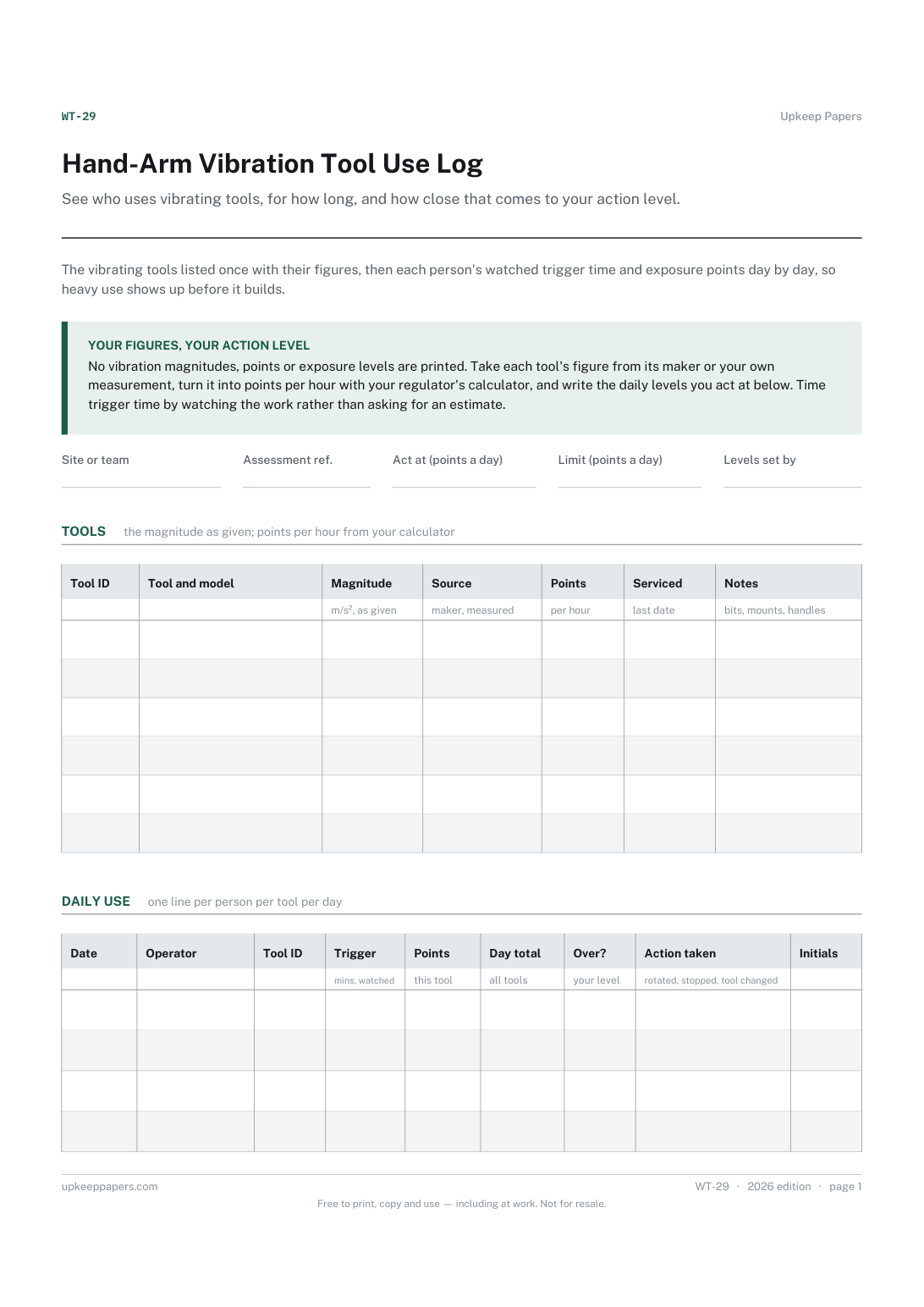
Printed under the title: The vibrating tools listed once with their figures, then each person's watched trigger time and exposure points day by day, so heavy use shows up before it builds.
Your figures, your action level. No vibration magnitudes, points or exposure levels are printed. Take each tool's figure from its maker or your own measurement, turn it into points per hour with your regulator's calculator, and write the daily levels you act at below. Time trigger time by watching the work rather than asking for an estimate.
Write-on lines: Site or team · Assessment ref. · Act at (points a day) · Limit (points a day) · Levels set by
Table, 6 rows: Tool ID · Tool and model · Magnitude · Source · Points · Serviced · Notes
Table, 18 rows: Date · Operator · Tool ID · Trigger · Points · Day total · Over? · Action taken · Initials
Table, 5 rows: Date · Tool ID · Work done · By · After
Because a tool's figure depends on the model, the bit or disc and how well it is kept, and the levels you act at come from your own assessment and the rules where you are. The sheet gives blanks for your figures and where they came from.
Because a figure given from memory rarely matches what was actually done. Watching or timing a typical task gives a trigger time you can work from.
Assess one lifting or carrying task properly, including the question people skip: whether it has to be moved by hand at all.
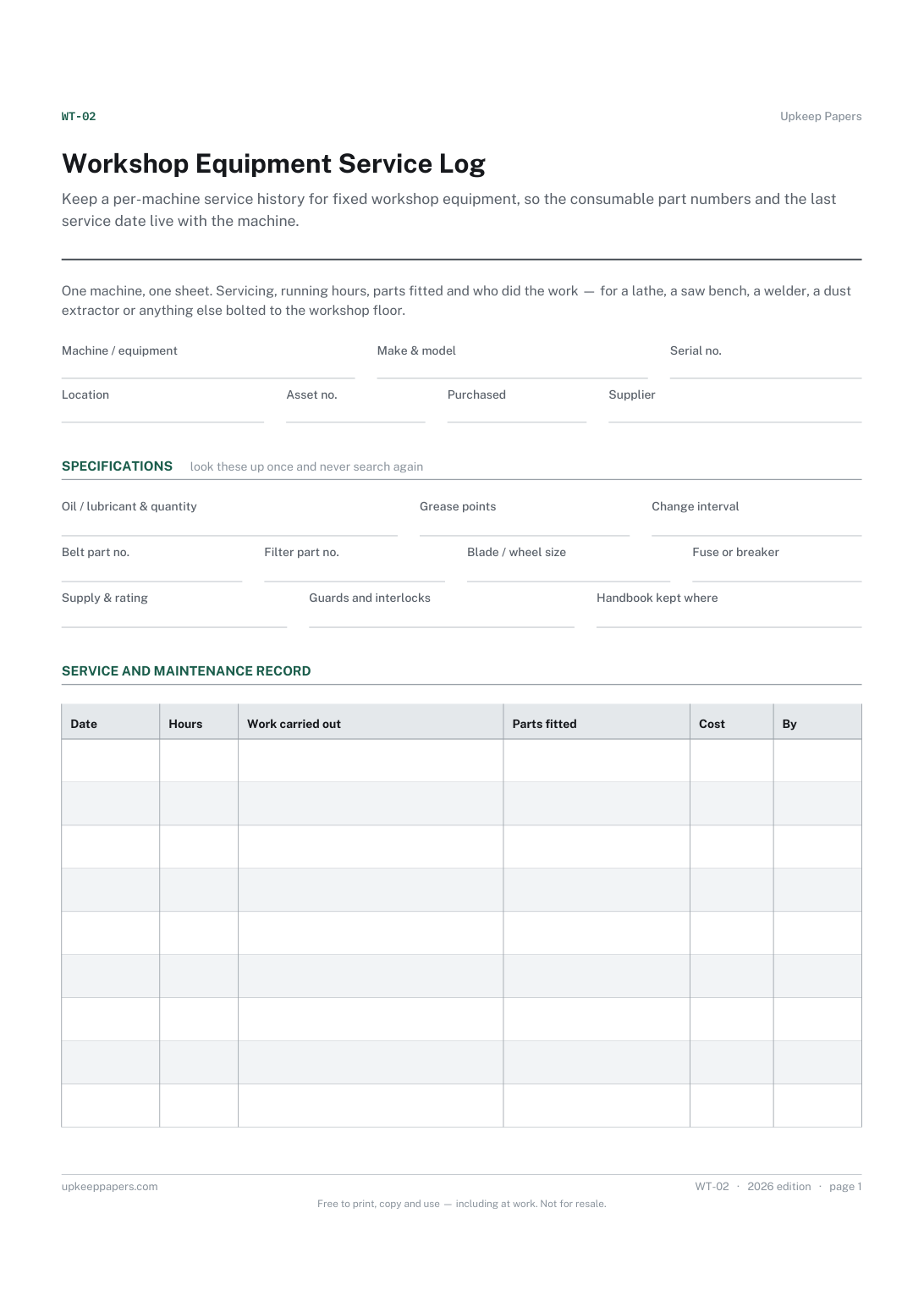
Keep a per-machine service history for fixed workshop equipment, so the consumable part numbers and the last service date live with the machine.
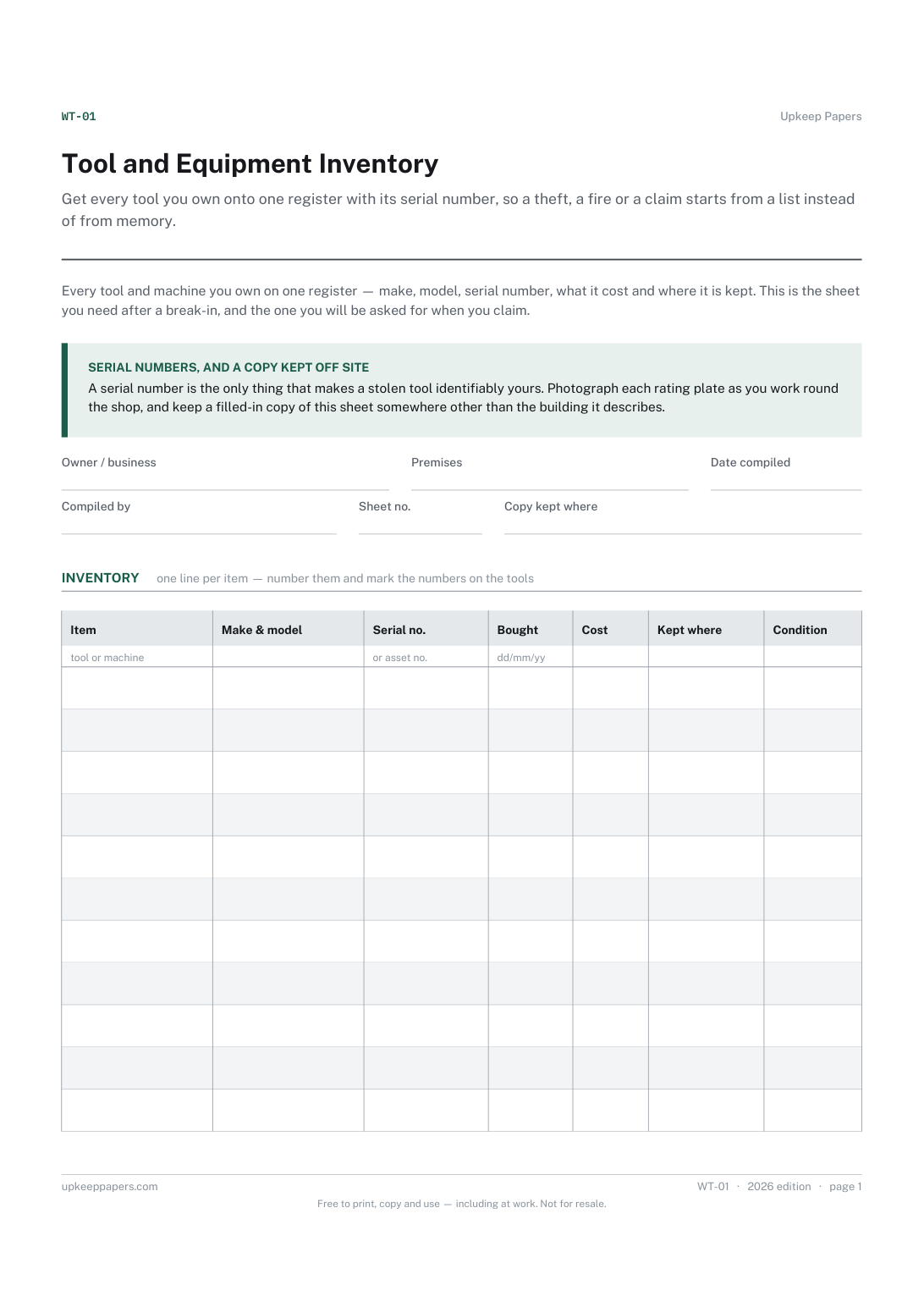
Get every tool you own onto one register with its serial number, so a theft, a fire or a claim starts from a list instead of from memory.
Record a short on-site briefing and, more usefully, what the people listening raised in response to it.

Every sheet, binder, game and puzzle on Upkeep Papers is free to download, with no email and no account. Making them is not free: each one takes days of research, design and checking, and the site costs money to run. If something here saved you time, you can buy us a coffee. It is entirely optional: nothing is locked, and nothing changes if you don’t.
Buy us a coffee Opens PayPal in a new tab. Any amount, and nothing changes if you would rather not.