Driver Defect Report Pad
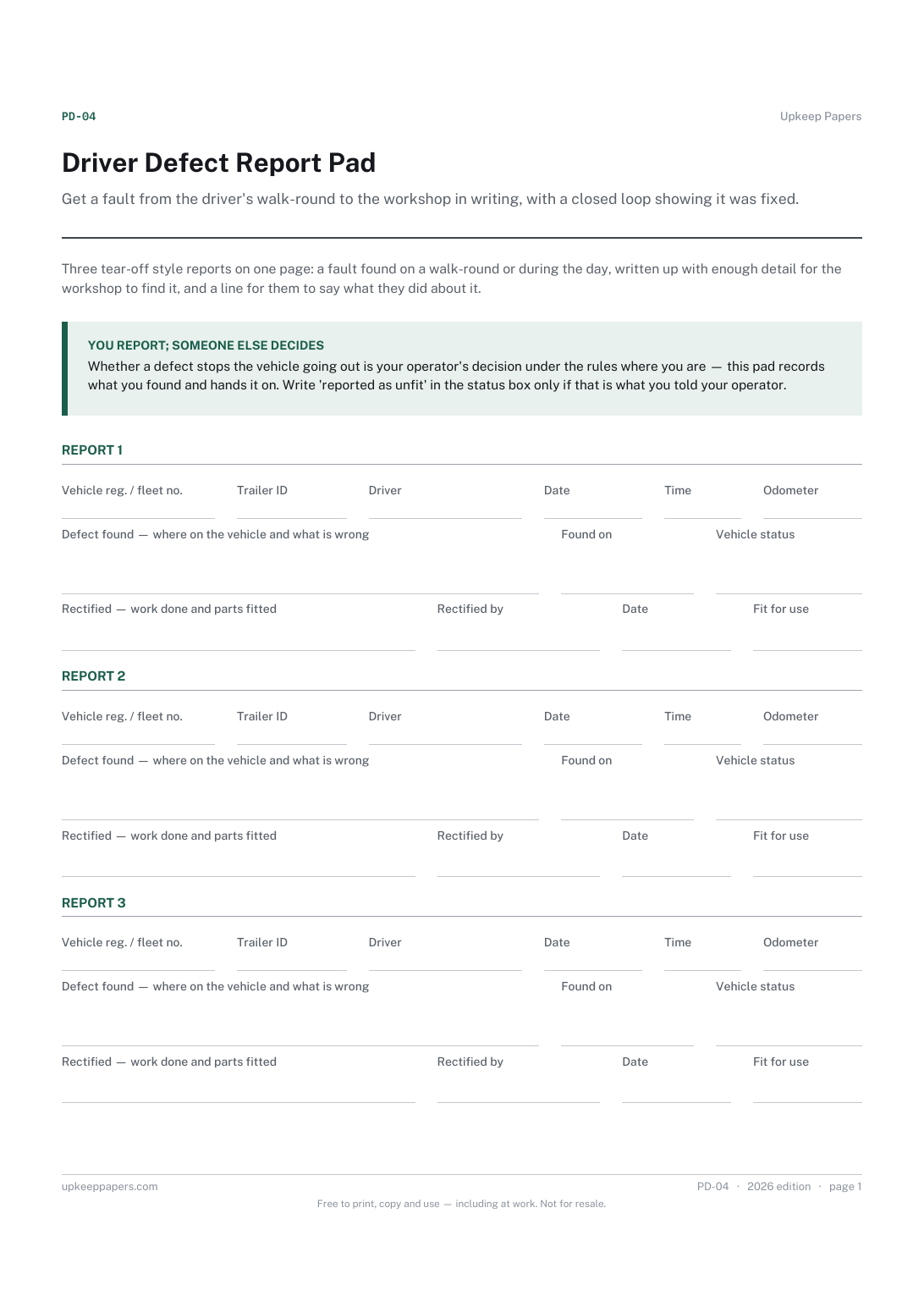
Get a fault from the driver's walk-round to the workshop in writing, with a closed loop showing it was fixed.
PD-04 1 page
Everything here is free. Making it takes time and money. Everything here is free.
 Buy us a coffee
Running costs and fleet · GF-20
A free printable walkaround check review: each safety inspection set against the defect reports before it, with missed defects and the drivers to brief.
2 pages. Choose your paper size — both versions are laid out identically, so neither one gets shrunk to fit.
Print it and write on it
Fill it in type and save
The fillable versions have real form fields — open them in any PDF reader, type into them and save. Printing help.
Find out whether daily walkaround checks are catching what they should. A defect a driver could have seen but nobody reported points at the check, not the vehicle.
Transport managers, fleet engineers and operators who run safety inspections and collect driver defect reports.
2 pages, in this order:
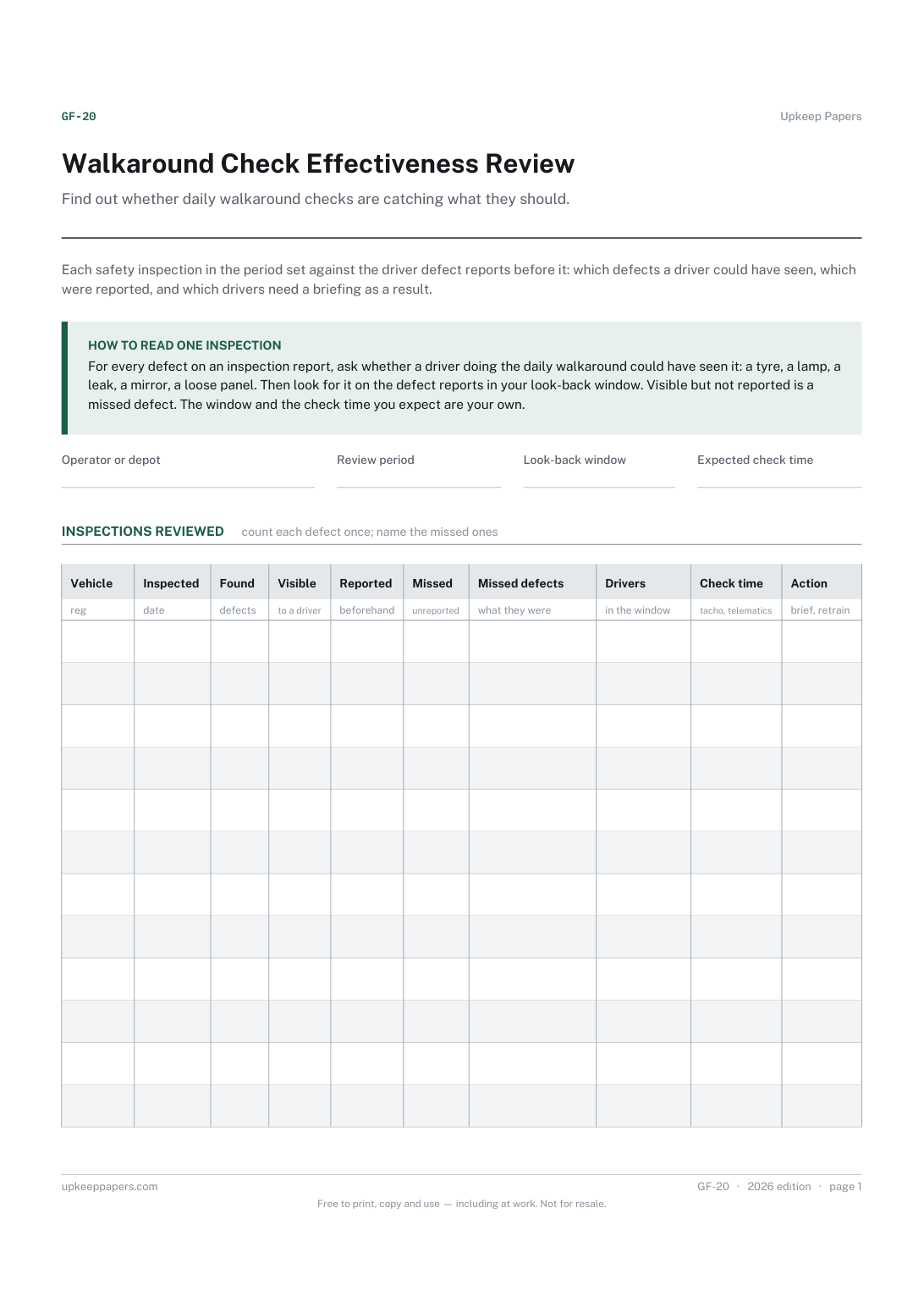
Printed under the title: Each safety inspection in the period set against the driver defect reports before it: which defects a driver could have seen, which were reported, and which drivers need a briefing as a result.
How to read one inspection. For every defect on an inspection report, ask whether a driver doing the daily walkaround could have seen it: a tyre, a lamp, a leak, a mirror, a loose panel. Then look for it on the defect reports in your look-back window. Visible but not reported is a missed defect. The window and the check time you expect are your own.
Write-on lines: Operator or depot · Review period · Look-back window · Expected check time
Table, 19 rows: Vehicle · Inspected · Found · Visible · Reported · Missed · Missed defects · Drivers · Check time · Action
Table, 7 rows: Driver · Missed on · Missed · Short checks · Action · Done · Follow-up · Outcome
Write-on lines: Inspections reviewed · Defects found · Visible to a driver · Reported beforehand · Missed · Drivers briefed · Drivers retrained · Next review · Reviewed by
The sheet does not say. It depends on the vehicle, any trailer and the check sheet you use. Time a thorough check on your own vehicles, write that at the top, and use it to spot checks recorded in far less time.
Anything a driver could reasonably find walking round and sitting in the cab, without tools or a pit: tyres, wheels, lamps, mirrors, wipers, leaks, bodywork, couplings and warning lamps. Defects found only with the vehicle raised or taken apart are left out of the count.
No. A run of missed defects often points to a vague check sheet, too little time allowed, or nobody shown what to look for. The action column is for whatever fixes the cause, which may be the process rather than the person.
Get a fault from the driver's walk-round to the workshop in writing, with a closed loop showing it was fixed.
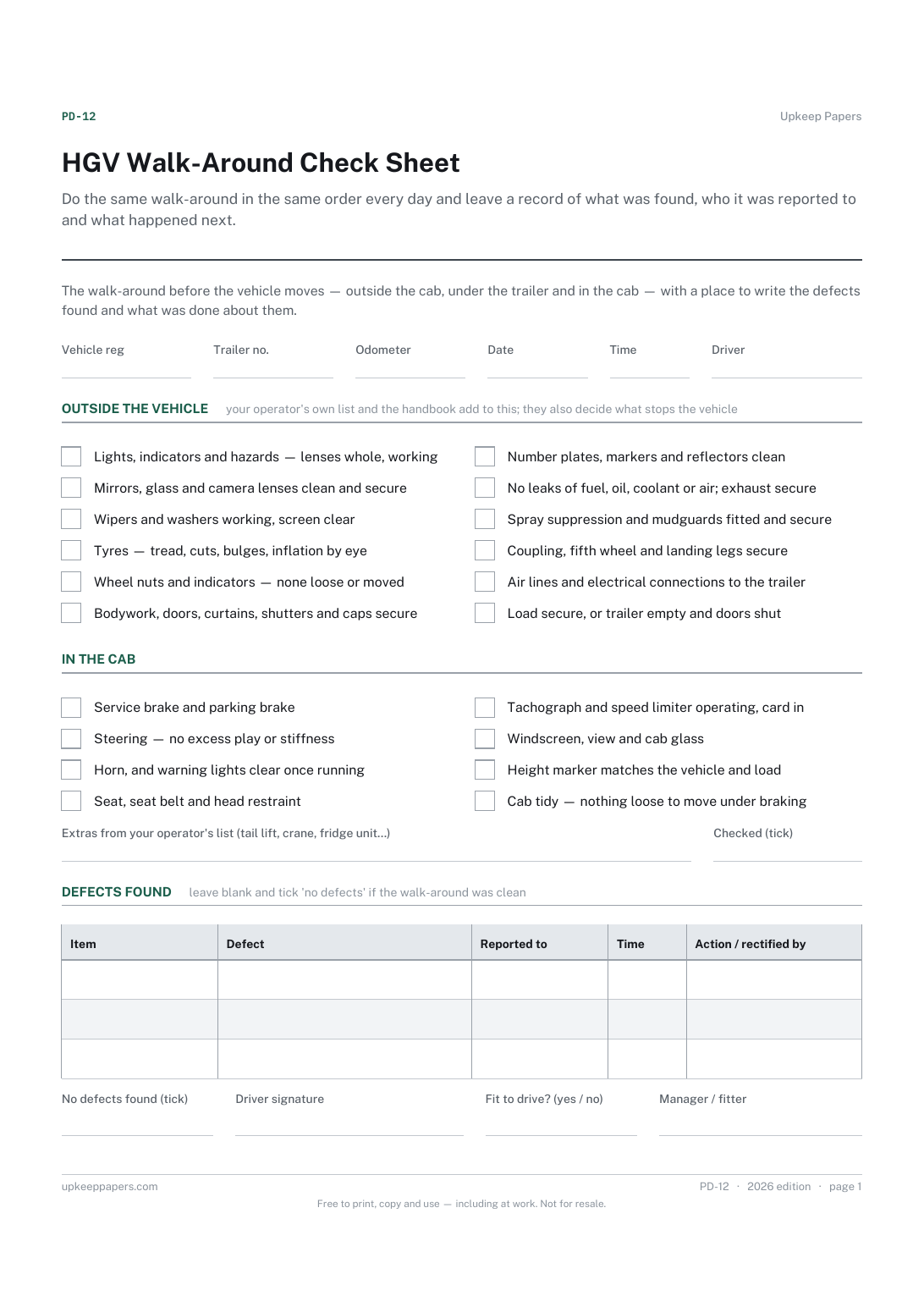
Do the same walk-around in the same order every day and leave a record of what was found, who it was reported to and what happened next.
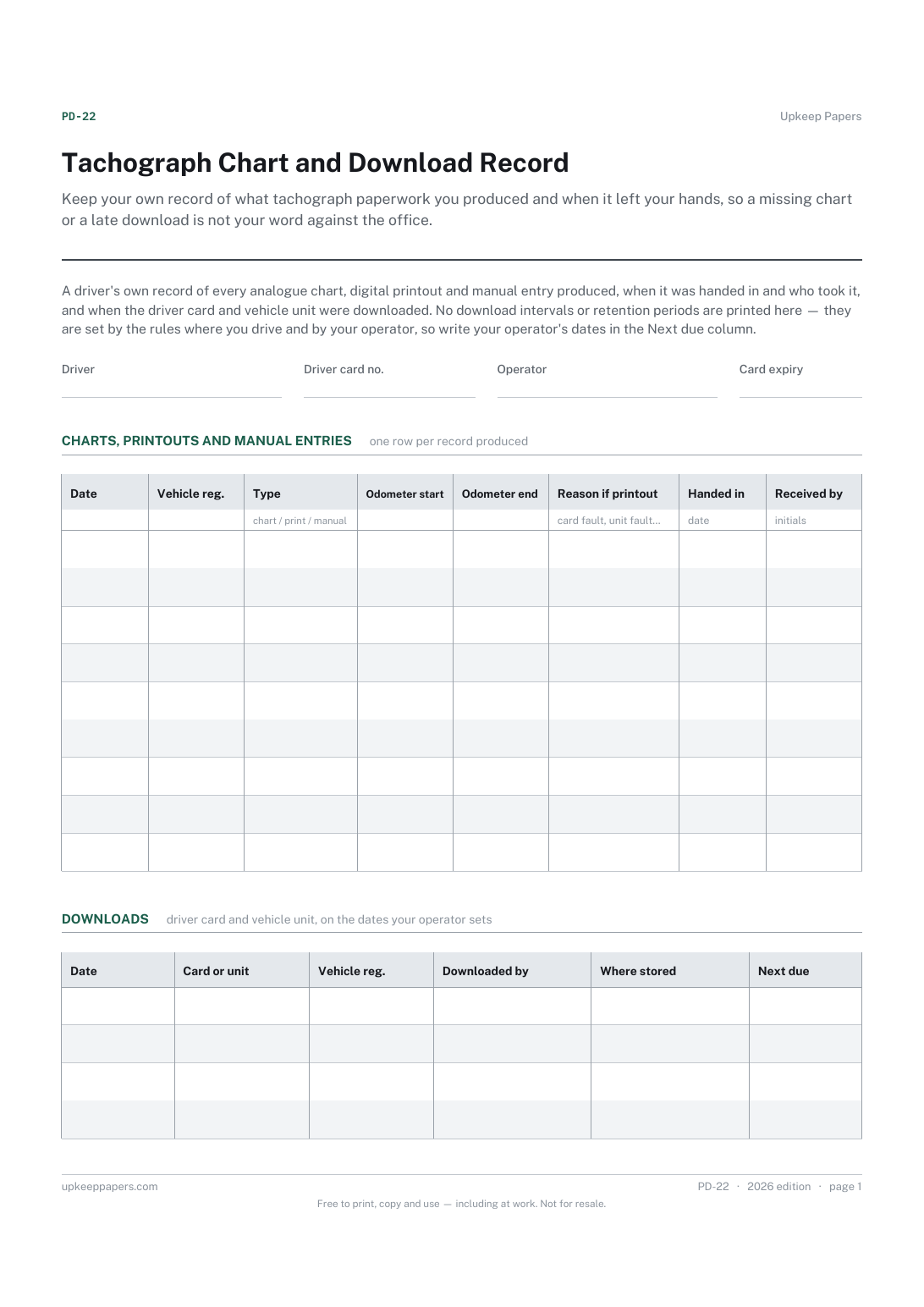
Keep your own record of what tachograph paperwork you produced and when it left your hands, so a missing chart or a late download is not your word against the office.
Record the check before driving and the journeys after it on one sheet per day.
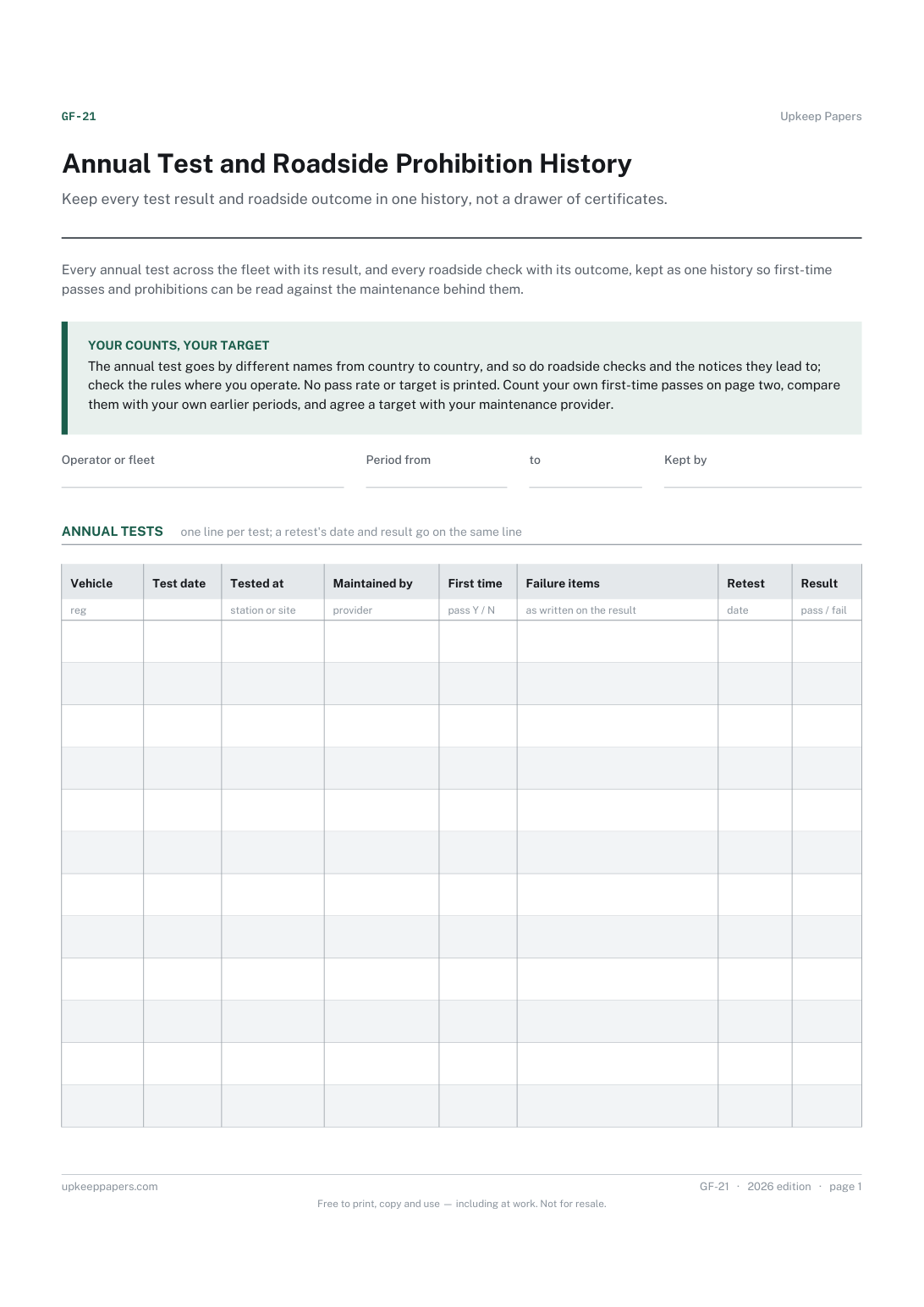
Keep every test result and roadside outcome in one history, not a drawer of certificates. Counted together, first-time passes and prohibitions show how well the maintenance is working.

Every sheet, binder, game and puzzle on Upkeep Papers is free to download, with no email and no account. Making them is not free: each one takes days of research, design and checking, and the site costs money to run. If something here saved you time, you can buy us a coffee. It is entirely optional: nothing is locked, and nothing changes if you don’t.
Buy us a coffee Opens PayPal in a new tab. Any amount, and nothing changes if you would rather not.