Screen Printing Run Record
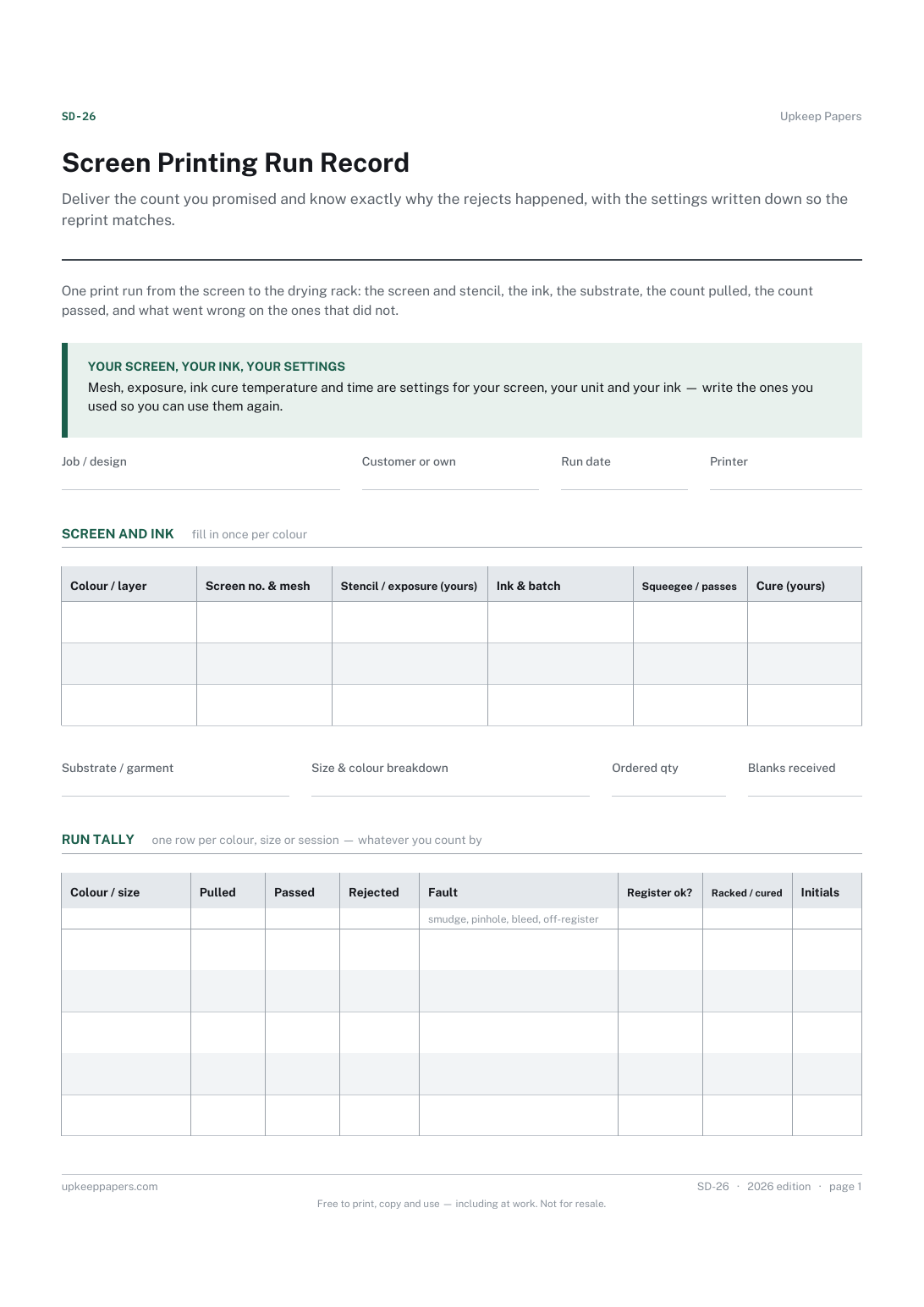
Deliver the count you promised and know exactly why the rejects happened, with the settings written down so the reprint matches.
SD-26 1 page
Everything here is free. Making it takes time and money. Everything here is free.
 Buy us a coffee
Studio crafts and making · SD-27
Stained glass project sheet — one panel from cartoon to hanging: method, size, every glass used with its maker and code, and the stages dated.
One page. Choose your paper size — both versions are laid out identically, so neither one gets shrunk to fit.
Print it and write on it
Fill it in type and save
The fillable versions have real form fields — open them in any PDF reader, type into them and save. Printing help.
Match a broken piece years later, and quote the next panel from the hours and glass the last one really took.
Stained glass artists and hobbyists working in lead came or copper foil, restoration workers and studios taking commissions.
One page, top to bottom:
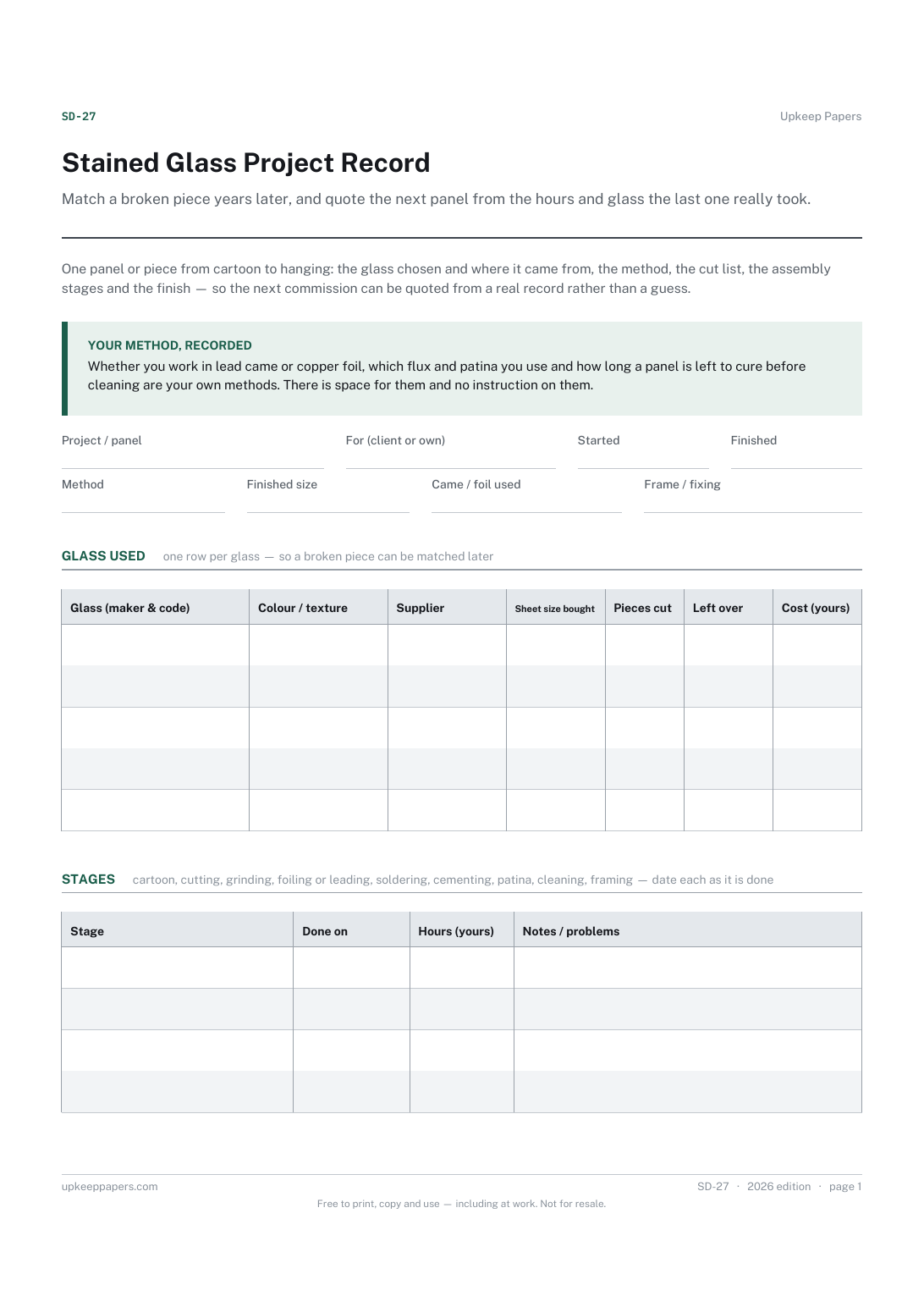
Printed under the title: One panel or piece from cartoon to hanging: the glass chosen and where it came from, the method, the cut list, the assembly stages and the finish — so the next commission can be quoted from a real record rather than a guess.
Your method, recorded. Whether you work in lead came or copper foil, which flux and patina you use and how long a panel is left to cure before cleaning are your own methods. There is space for them and no instruction on them.
Write-on lines: Project / panel · For (client or own) · Started · Finished · Method · Finished size · Came / foil used · Frame / fixing
Table, 5 rows: Glass (maker & code) · Colour / texture · Supplier · Sheet size bought · Pieces cut · Left over · Cost (yours)
Table, 4 rows: Stage · Done on · Hours (yours) · Notes / problems
Because a panel comes back with one broken piece and nobody remembers which amber it was. With the maker's code on the sheet it can be reordered, or the left-over found in the rack.
Those are your methods, learned from your training and your materials' own instructions. The sheet gives them a place to be written, not a recommendation.
Deliver the count you promised and know exactly why the rejects happened, with the settings written down so the reprint matches.
Record the things a finished object cannot tell you later: which dye lot, which hook you really used, and how much was left over.
Keep a catalogue of finished work and where it went, which is the record galleries, insurers and tax authorities ask for and working artists rarely have.
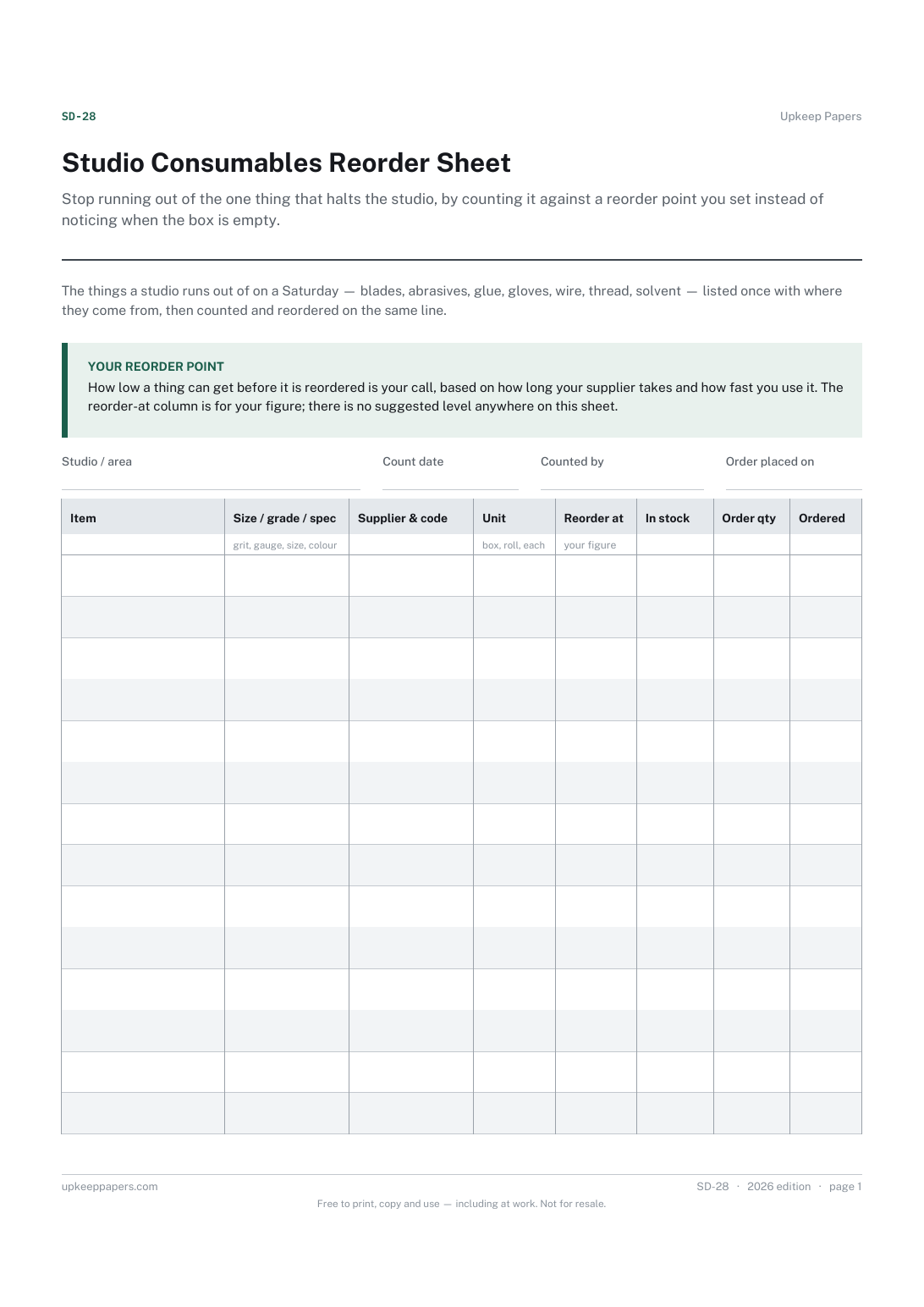
Stop running out of the one thing that halts the studio, by counting it against a reorder point you set instead of noticing when the box is empty.

Every sheet, binder, game and puzzle on Upkeep Papers is free to download, with no email and no account. Making them is not free: each one takes days of research, design and checking, and the site costs money to run. If something here saved you time, you can buy us a coffee. It is entirely optional: nothing is locked, and nothing changes if you don’t.
Buy us a coffee Opens PayPal in a new tab. Any amount, and nothing changes if you would rather not.