Fuel and MPG Log
See what a vehicle actually costs to run and spot a change in fuel consumption early, which is often the first sign that something mechanical is wrong.
GF-01 1 page
Everything here is free. Making it takes time and money. Everything here is free.
 Buy us a coffee
Running costs and fleet · GF-19
A free printable DEF and AdBlue log: each top-up with odometer, source and cost, use per 1,000 worked out, then every emission warning and fault code.
2 pages. Choose your paper size — both versions are laid out identically, so neither one gets shrunk to fit.
Print it and write on it
Fill it in type and save
The fillable versions have real form fields — open them in any PDF reader, type into them and save. Printing help.
See a change in a vehicle's exhaust fluid use early, while it is still a number on a page. Every warning lamp sits on the same sheet, so a fault and a fall in use can be read together.
Fleet and transport managers, owner-drivers and workshop staff looking after diesel vans, lorries, coaches or plant that take diesel exhaust fluid.
2 pages, in this order:
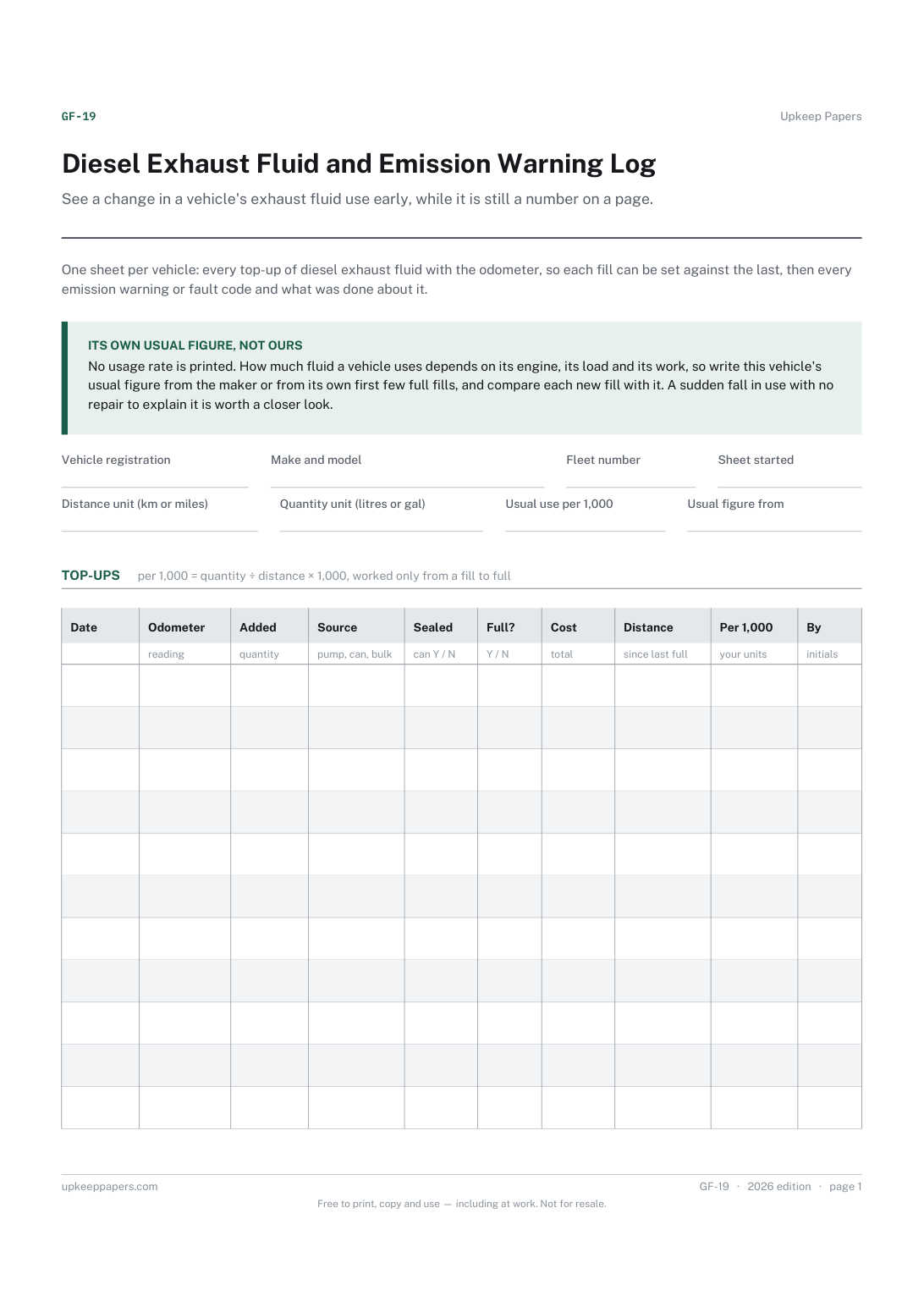
Printed under the title: One sheet per vehicle: every top-up of diesel exhaust fluid with the odometer, so each fill can be set against the last, then every emission warning or fault code and what was done about it.
Its own usual figure, not ours. No usage rate is printed. How much fluid a vehicle uses depends on its engine, its load and its work, so write this vehicle's usual figure from the maker or from its own first few full fills, and compare each new fill with it. A sudden fall in use with no repair to explain it is worth a closer look.
Write-on lines: Vehicle registration · Make and model · Fleet number · Sheet started · Distance unit (km or miles) · Quantity unit (litres or gal) · Usual use per 1,000 · Usual figure from
Table, 11 rows: Date · Odometer · Added · Source · Sealed · Full? · Cost · Distance · Per 1,000 · By
Table, 11 rows: Date · Odometer · Warning shown · Fault code · Read by · Action taken · Repaired · Cleared · By
Write-on lines: Reviewed by · Date · Passed to (workshop or manager)
Ruled lines: Notes — repairs booked, parts replaced, anything the workshop said
Because it varies with the engine, the emission system, the load and the kind of work, and one printed figure would be wrong for most vehicles. The useful comparison is with the same vehicle's own history, so the sheet asks you to write that at the top and judge each fill against it.
A vehicle that suddenly needs much less fluid than its own history, with no repair to explain it, may have a dosing fault, a blocked line or a device fitted to stop the system working. Any of those wants looking at by someone qualified. Rules on emission tampering differ; check the rules where you are.
Yes: write 'bulk' as the source on each top-up. This sheet follows one vehicle, so keep the tank's own deliveries and draws on a separate record, such as the workshop oil and fluid dispense log.
See what a vehicle actually costs to run and spot a change in fuel consumption early, which is often the first sign that something mechanical is wrong.
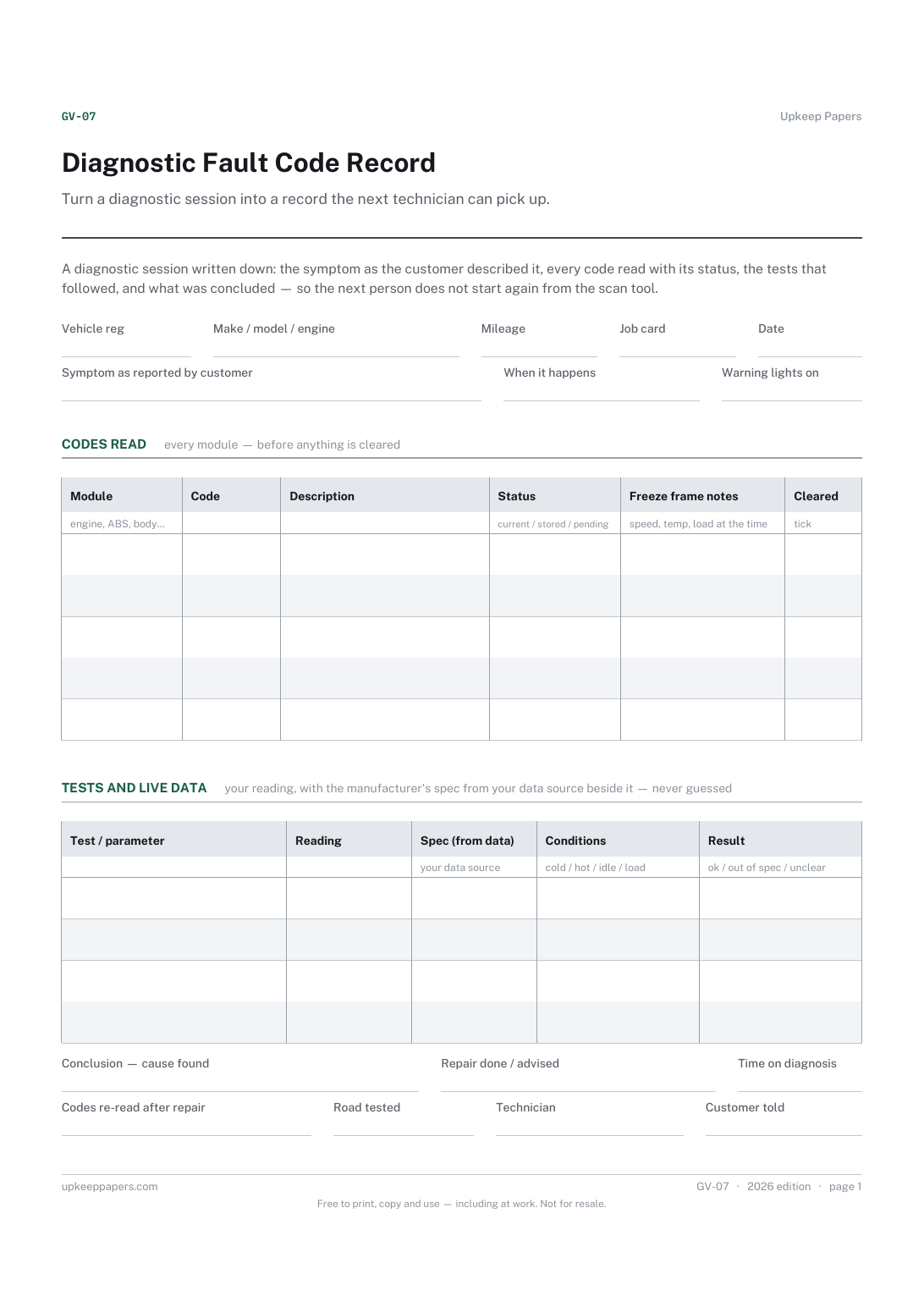
Turn a diagnostic session into a record the next technician can pick up. It also gives the customer something better than 'it had a code'.
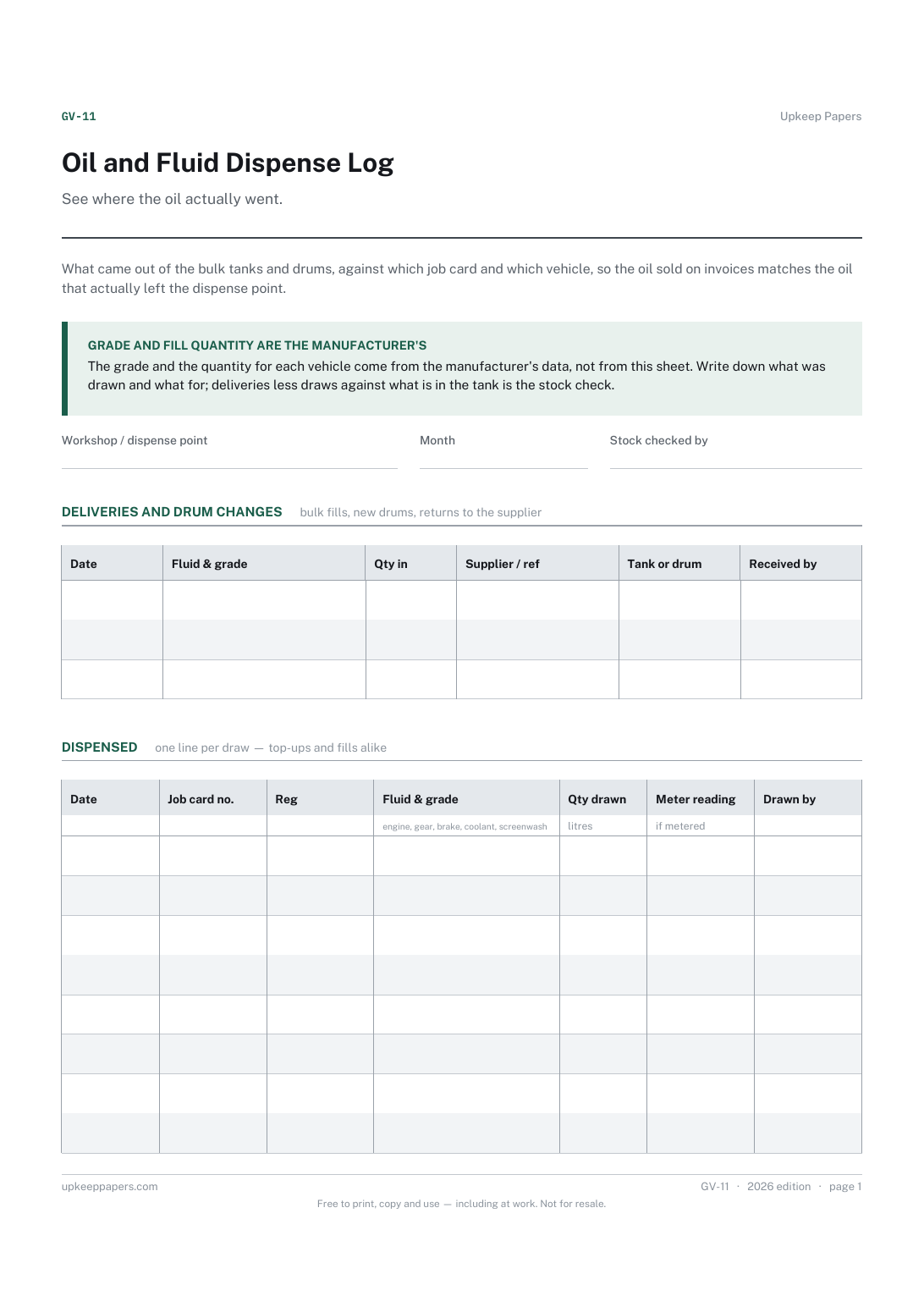
See where the oil actually went. Reconcile what was sold on invoices against what left the dispense point.
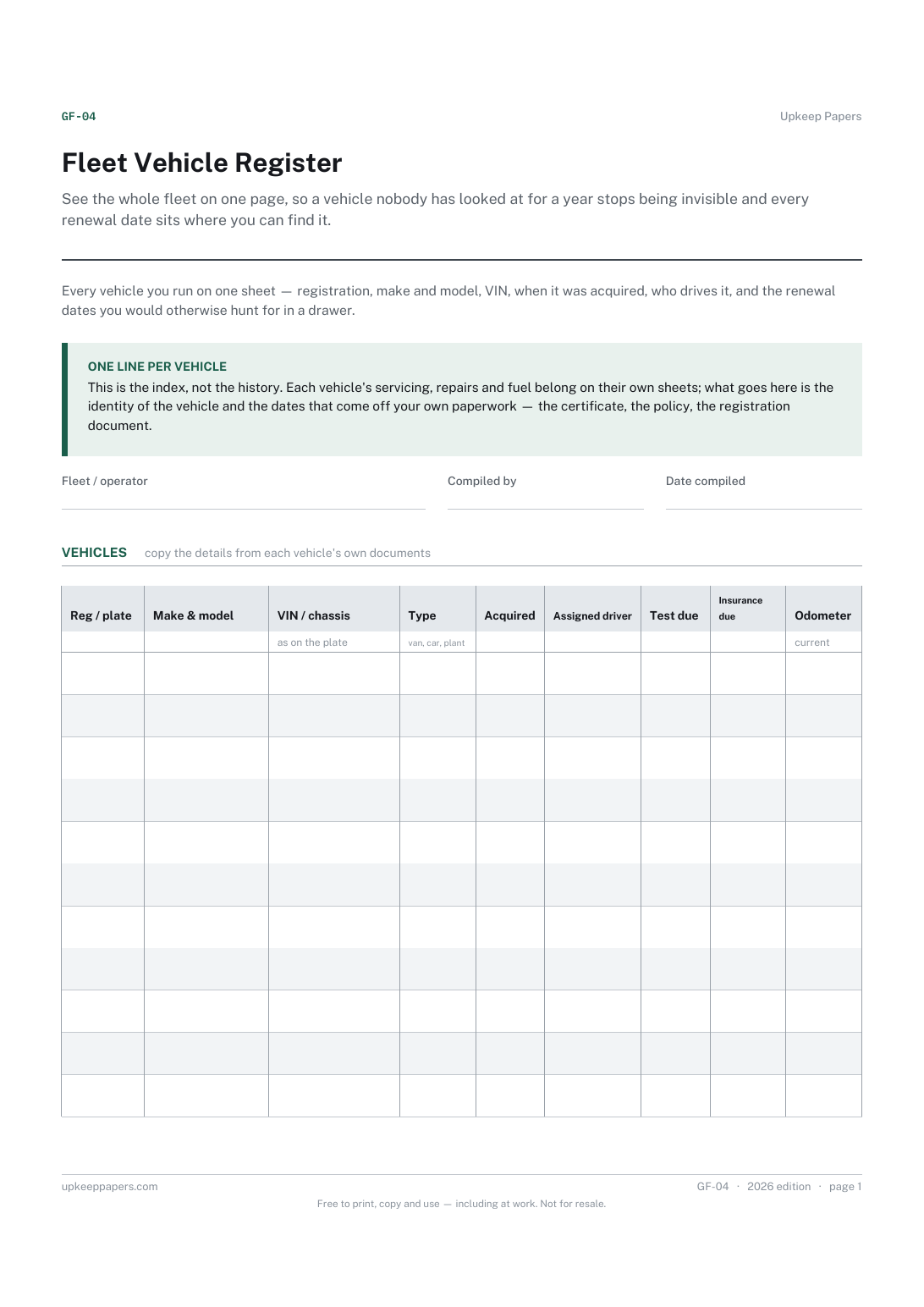
See the whole fleet on one page, so a vehicle nobody has looked at for a year stops being invisible and every renewal date sits where you can find it.
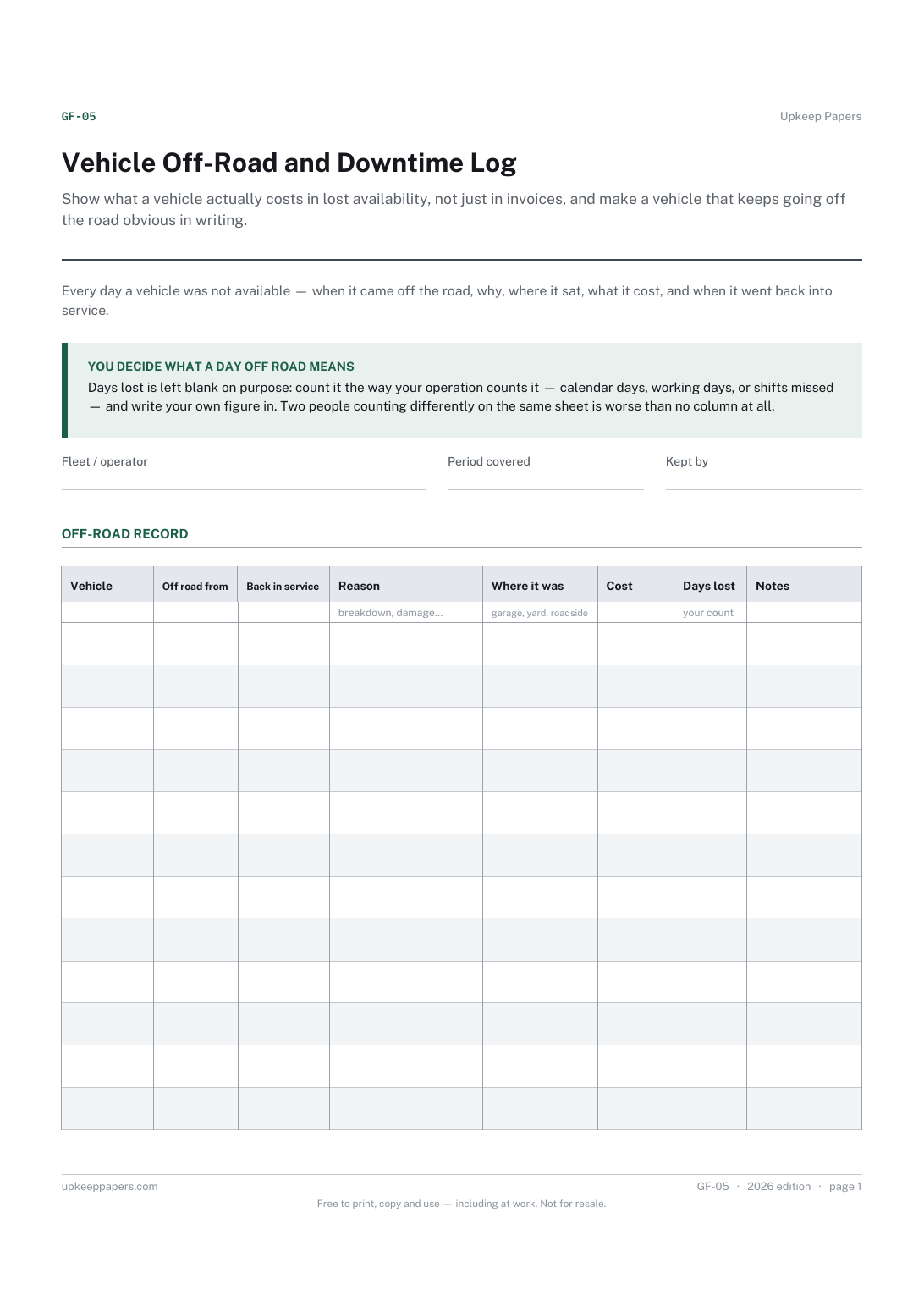
Show what a vehicle actually costs in lost availability, not just in invoices, and make a vehicle that keeps going off the road obvious in writing.

Every sheet, binder, game and puzzle on Upkeep Papers is free to download, with no email and no account. Making them is not free: each one takes days of research, design and checking, and the site costs money to run. If something here saved you time, you can buy us a coffee. It is entirely optional: nothing is locked, and nothing changes if you don’t.
Buy us a coffee Opens PayPal in a new tab. Any amount, and nothing changes if you would rather not.