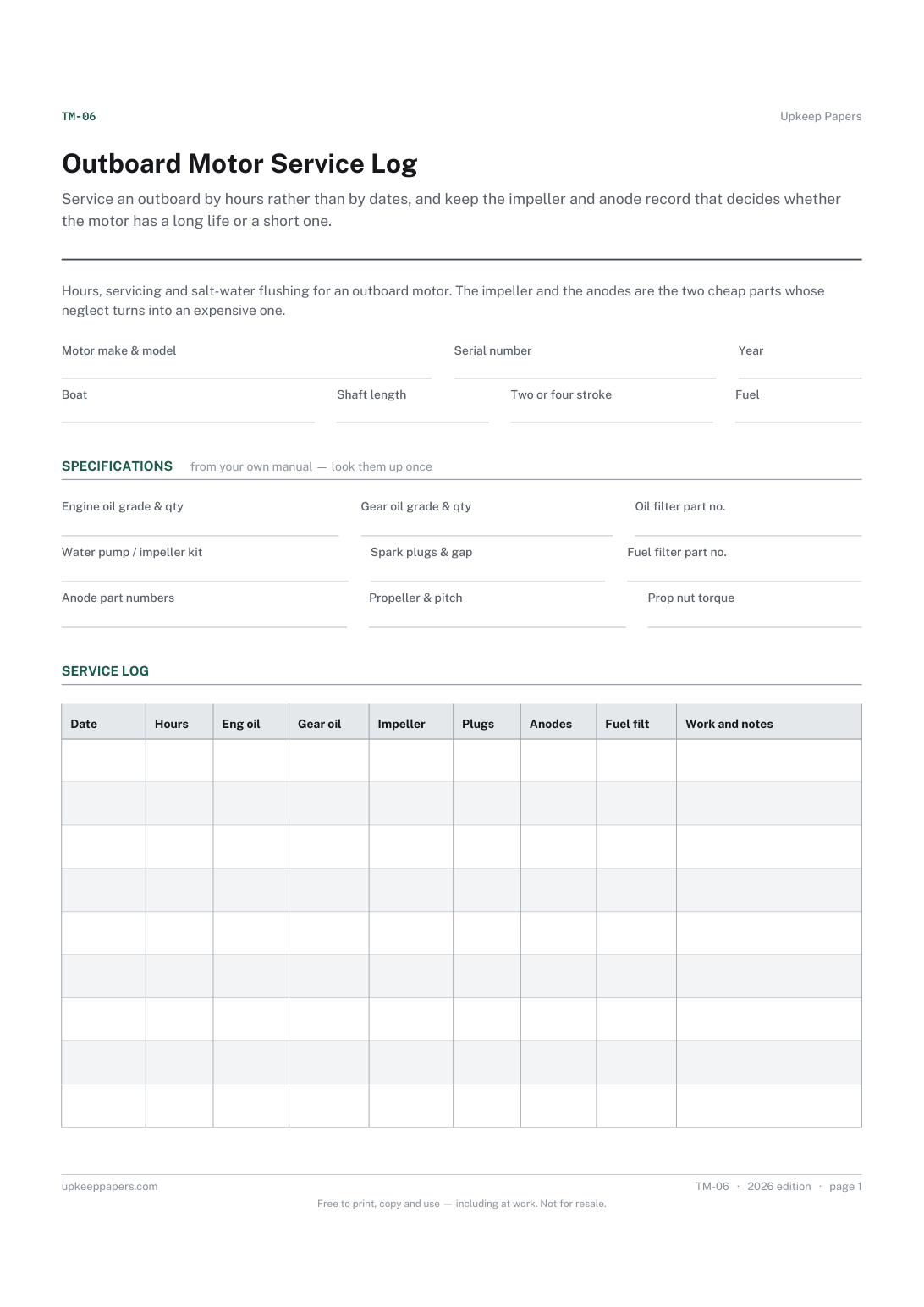
Outboard Motor Service Log
Service an outboard by hours rather than by dates, and keep the impeller and anode record that decides whether the motor has a long life or a short one.
TM-06 2 pages
Everything here is free. Making it takes time and money. Everything here is free.
 Buy us a coffee
Trailers and marine · TM-32
A free printable jet ski checklist and log: pre-ride checks, the flush and rinse after, and the hour meter for every outing, fourteen rides a sheet.
2 pages. Choose your paper size — both versions are laid out identically, so neither one gets shrunk to fit.
Print it and write on it
Fill it in type and save
The fillable versions have real form fields — open them in any PDF reader, type into them and save. Printing help.
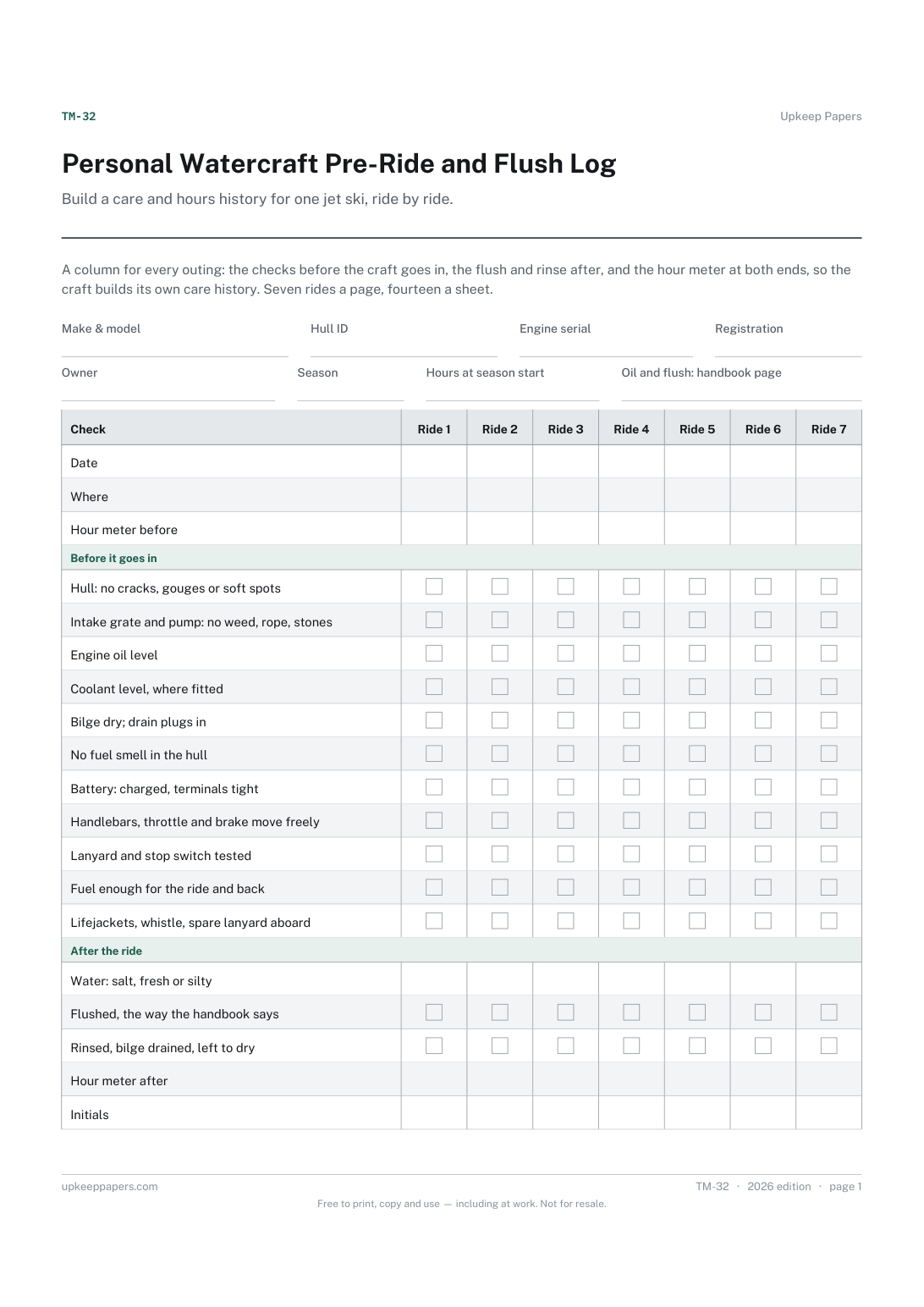
Build a care and hours history for one jet ski, ride by ride. Each outing gets its pre-ride checks, the flush after and the hour meter at both ends.
Owners of a jet ski or other personal watercraft, and clubs or hire operators with a few.
2 pages, in this order:
Printed under the title: A column for every outing: the checks before the craft goes in, the flush and rinse after, and the hour meter at both ends, so the craft builds its own care history. Seven rides a page, fourteen a sheet.
Write-on lines: Make & model · Hull ID · Engine serial · Registration · Owner · Season · Hours at season start · Oil and flush: handbook page
Also printed: Check · Ride 1 · Ride 2 · Ride 3 · Ride 4 · Ride 5 · Ride 6 · Ride 7 · Date · Where · Hour meter before · Before it goes in · Hull: no cracks, gouges or soft spots · Intake grate and pump: no weed, rope, stones · Engine oil level · Coolant level, where fitted · Bilge dry; drain plugs in · No fuel smell in the hull · Battery: charged, terminals tight · Handlebars, throttle and brake move freely · Lanyard and stop switch tested · Fuel enough for the ride and back · Lifejackets, whistle, spare lanyard aboard · After the ride · Water: salt, fresh or silty · Flushed, the way the handbook says · Rinsed, bilge drained, left to dry · Hour meter after · Initials
Also printed: Check · Ride 8 · Ride 9 · Ride 10 · Ride 11 · Ride 12 · Ride 13 · Ride 14 · Date · Where · Hour meter before · Before it goes in · Hull: no cracks, gouges or soft spots · Intake grate and pump: no weed, rope, stones · Engine oil level · Coolant level, where fitted · Bilge dry; drain plugs in · No fuel smell in the hull · Battery: charged, terminals tight · Handlebars, throttle and brake move freely · Lanyard and stop switch tested · Fuel enough for the ride and back · Lifejackets, whistle, spare lanyard aboard · After the ride · Water: salt, fresh or silty · Flushed, the way the handbook says · Rinsed, bilge drained, left to dry · Hour meter after · Initials
Table, 4 rows: Date · Ride · Hours · What was found · What was done · By
The way your handbook says. Makers differ on how the hose is connected and whether the engine runs while flushing, so the sheet records that it was done and leaves the method to the handbook.
Because salt and silt are what flushing is for, and a craft used mostly in the sea shows it sooner. The record shows what the craft has been through.
Service an outboard by hours rather than by dates, and keep the impeller and anode record that decides whether the motor has a long life or a short one.
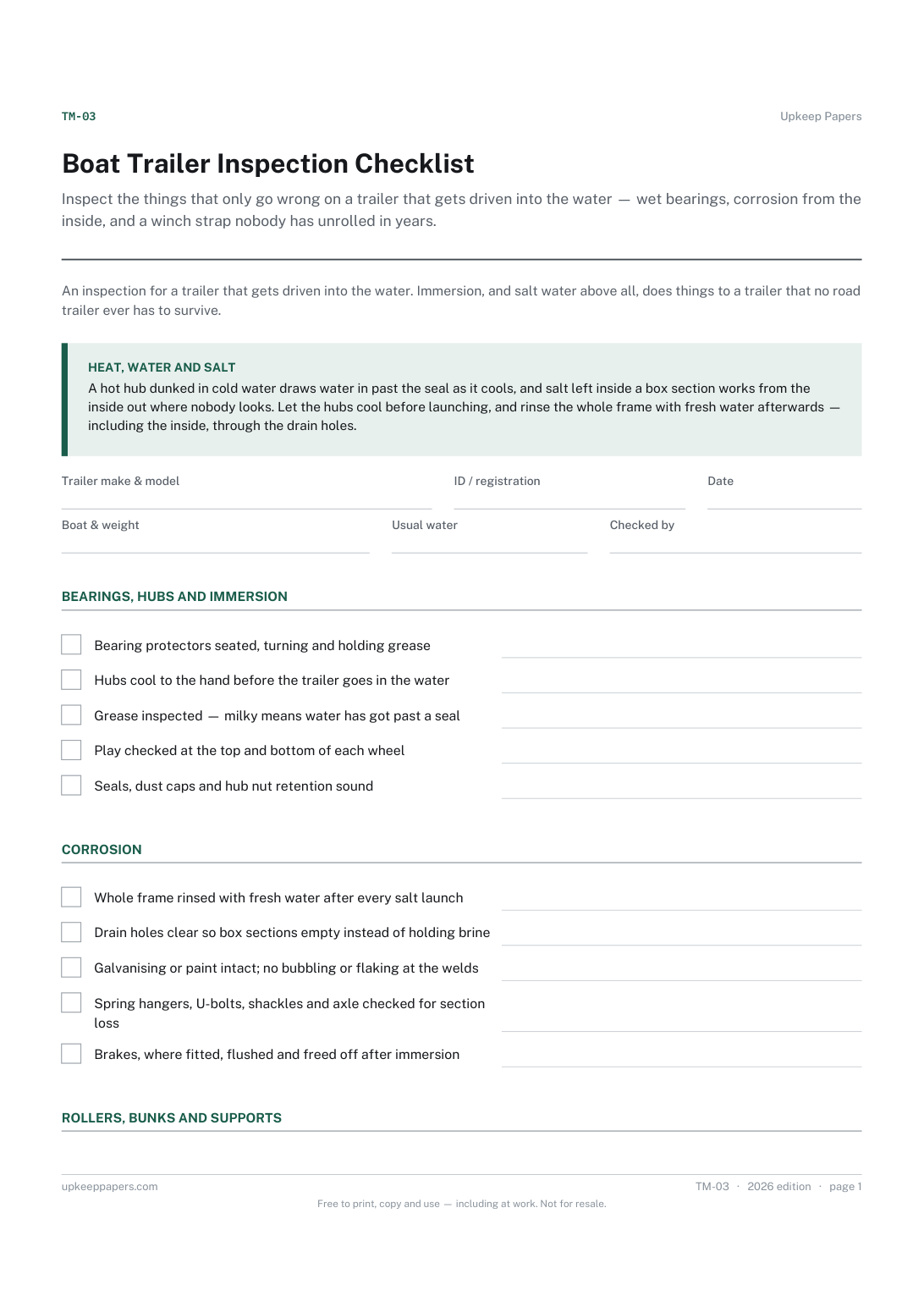
Inspect the things that only go wrong on a trailer that gets driven into the water — wet bearings, corrosion from the inside, and a winch strap nobody has unrolled in years.
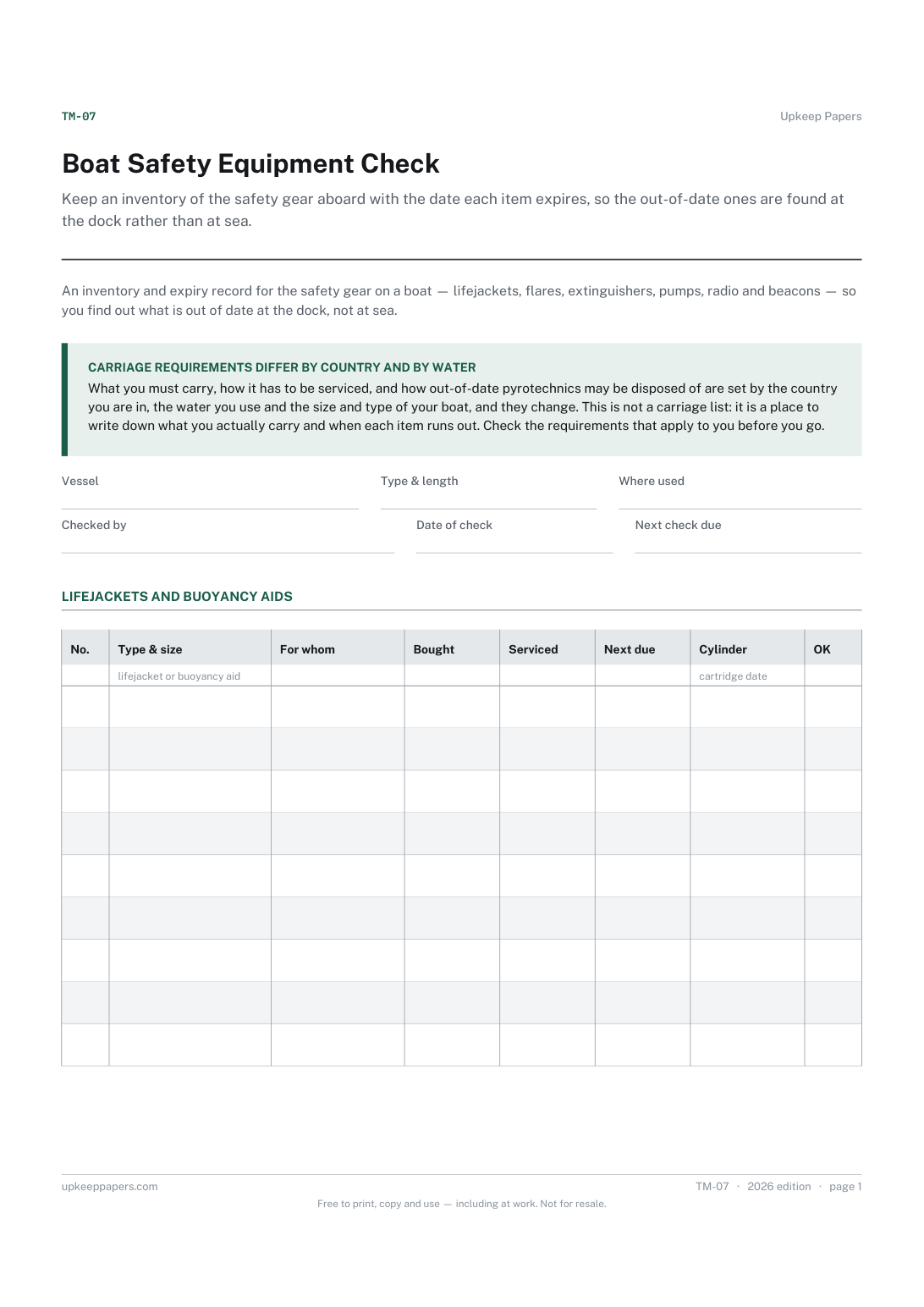
Keep an inventory of the safety gear aboard with the date each item expires, so the out-of-date ones are found at the dock rather than at sea.
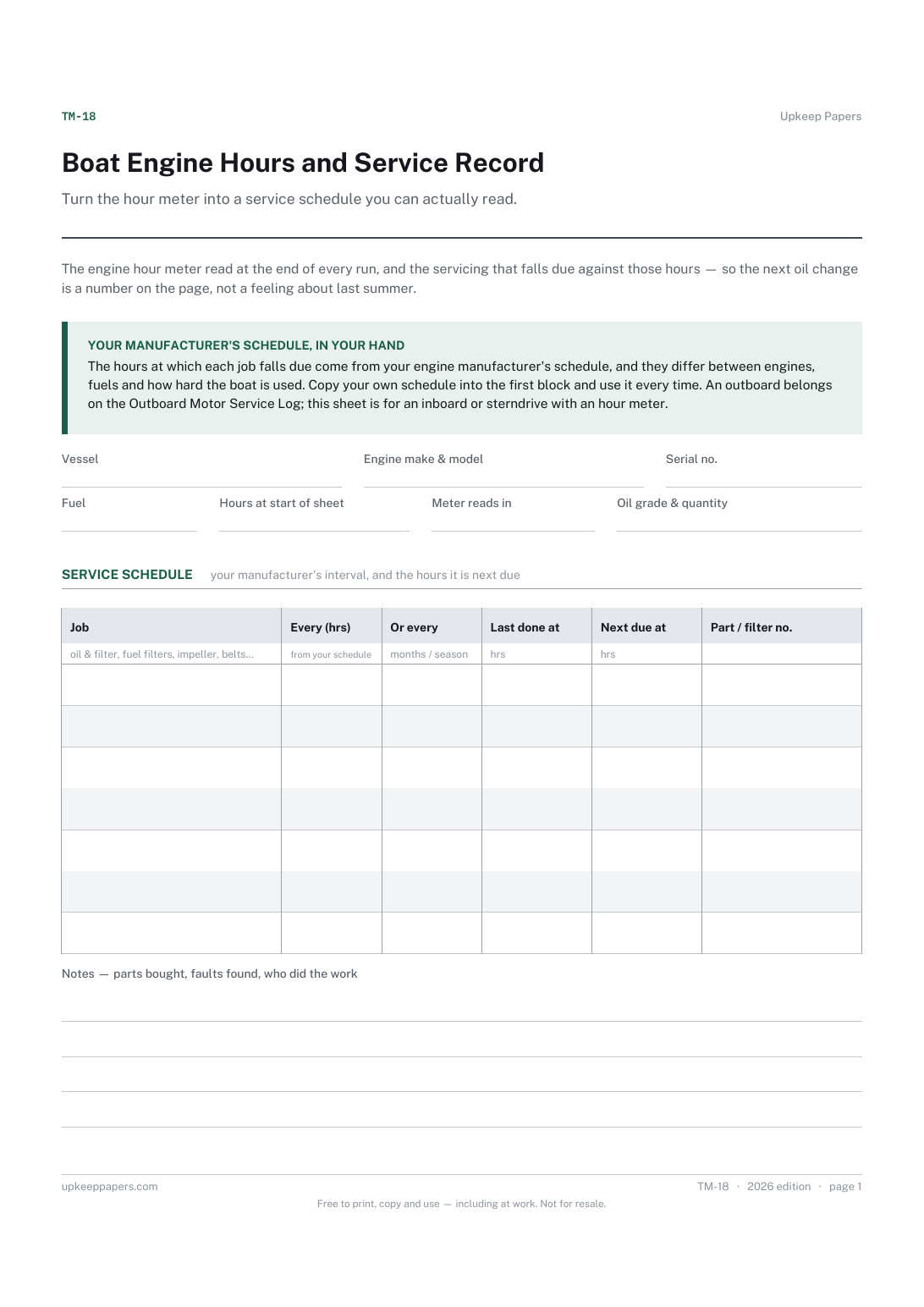
Turn the hour meter into a service schedule you can actually read. An oil change is then due at a number on the page, not at some point this season.

Every sheet, binder, game and puzzle on Upkeep Papers is free to download, with no email and no account. Making them is not free: each one takes days of research, design and checking, and the site costs money to run. If something here saved you time, you can buy us a coffee. It is entirely optional: nothing is locked, and nothing changes if you don’t.
Buy us a coffee Opens PayPal in a new tab. Any amount, and nothing changes if you would rather not.