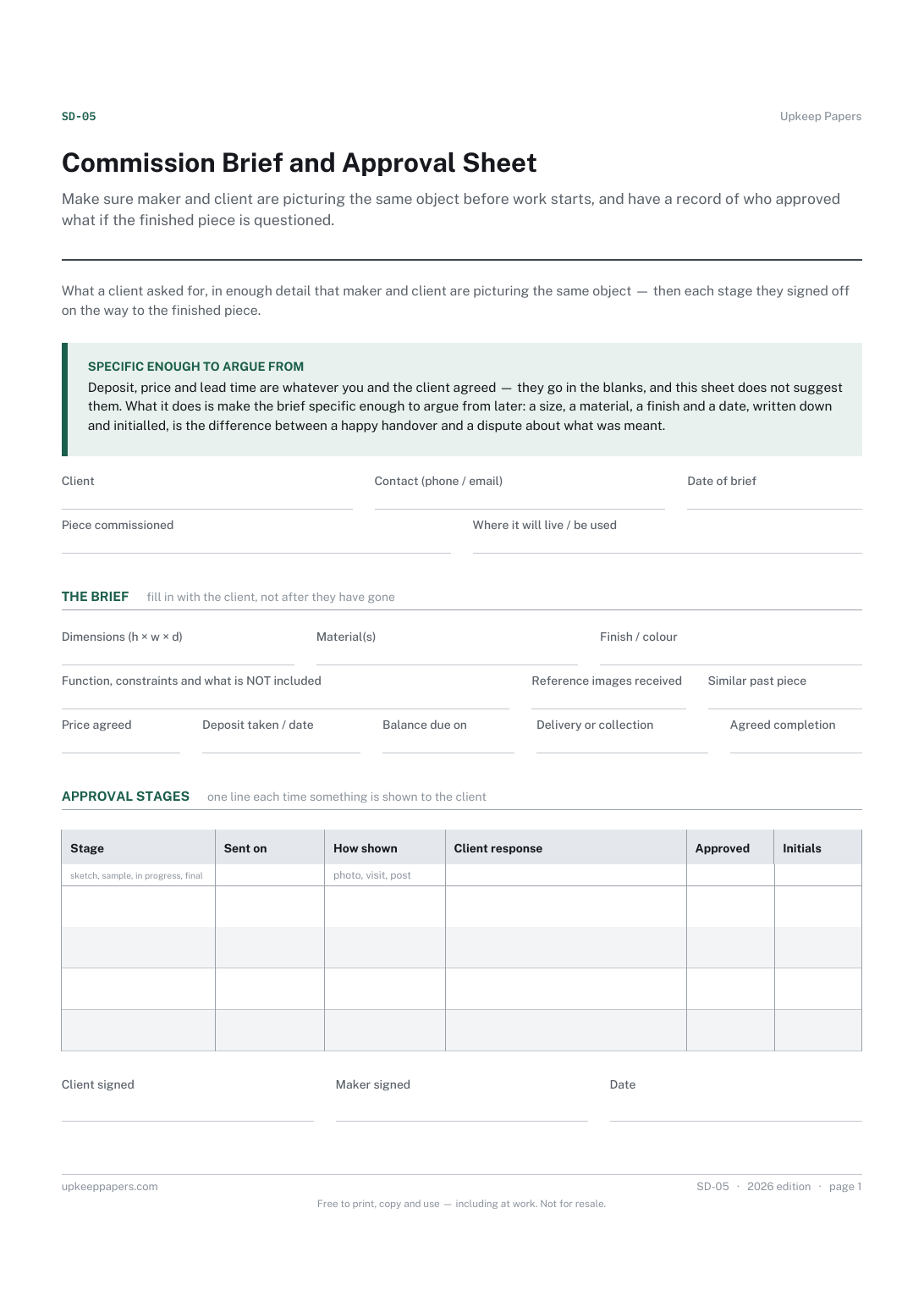
Commission Brief and Approval Sheet
Make sure maker and client are picturing the same object before work starts, and have a record of who approved what if the finished piece is questioned.
SD-05 1 page
Everything here is free. Making it takes time and money. Everything here is free.
 Buy us a coffee
Studio crafts and making · SD-09
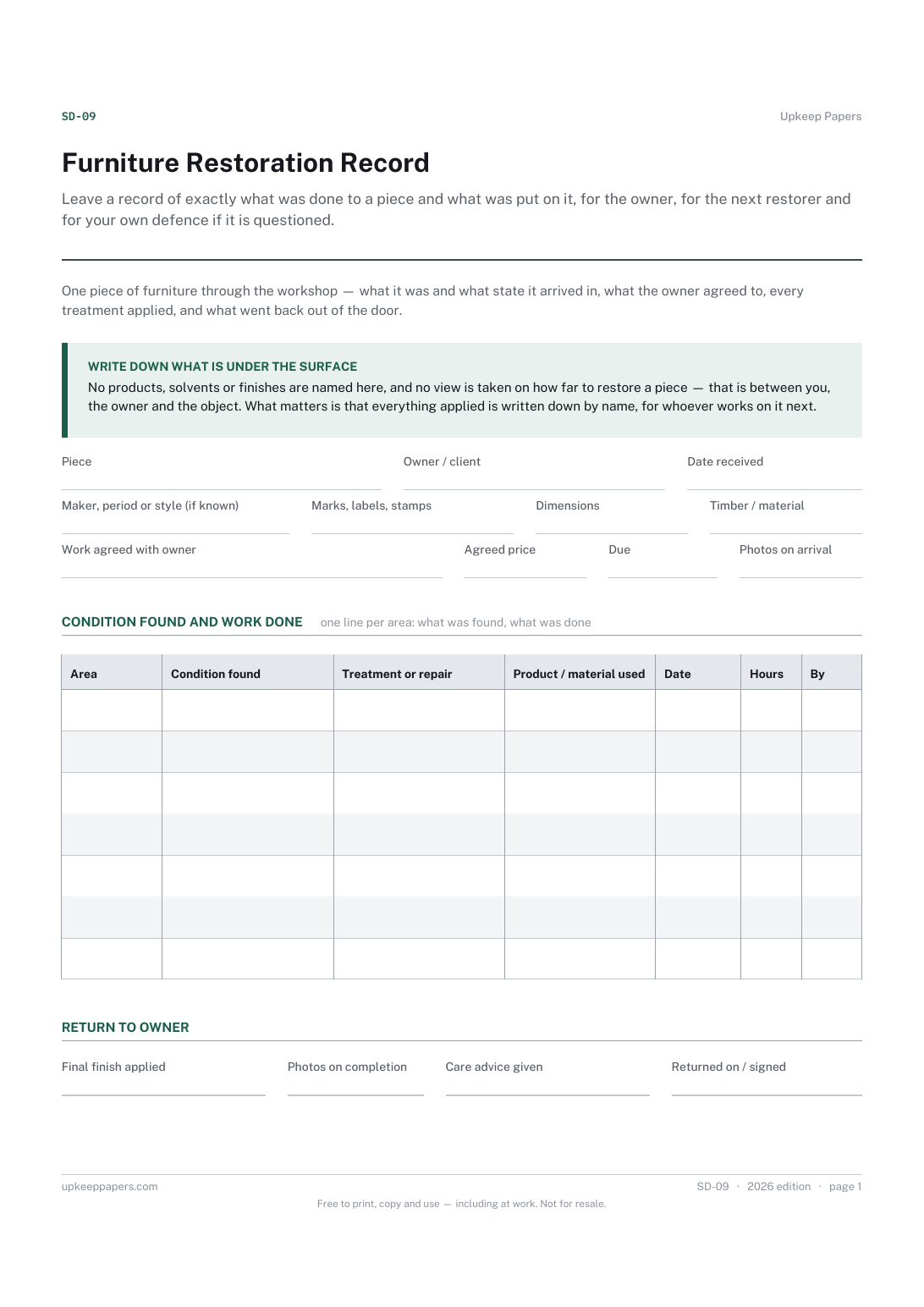
A free printable furniture restoration sheet — the piece and its condition on arrival, the work agreed, every treatment by product name, and the handback.
One page. Choose your paper size — both versions are laid out identically, so neither one gets shrunk to fit.
Print it and write on it
Fill it in type and save
The fillable versions have real form fields — open them in any PDF reader, type into them and save. Printing help.
Leave a record of exactly what was done to a piece and what was put on it, for the owner, for the next restorer and for your own defence if it is questioned.
Furniture restorers, upholsterers, French polishers, antique dealers who restore stock, and hobbyists working on family pieces.
One page, top to bottom:
Printed under the title: One piece of furniture through the workshop — what it was and what state it arrived in, what the owner agreed to, every treatment applied, and what went back out of the door.
Write down what is under the surface. No products, solvents or finishes are named here, and no view is taken on how far to restore a piece — that is between you, the owner and the object. What matters is that everything applied is written down by name, for whoever works on it next.
Write-on lines: Piece · Owner / client · Date received · Maker, period or style (if known) · Marks, labels, stamps · Dimensions · Timber / material · Work agreed with owner · Agreed price · Due · Photos on arrival
Table, 7 rows: Area · Condition found · Treatment or repair · Product / material used · Date · Hours · By
Write-on lines: Final finish applied · Photos on completion · Care advice given · Returned on / signed
Because how far to restore a piece, and with what, is a judgement about the object and the owner's wishes, not something a form can decide. What the sheet insists on is that whatever was used is written down by name.
Record the condition you found and the work actually agreed on the same line, so it is clear later what was left untouched and why.
Make sure maker and client are picturing the same object before work starts, and have a record of who approved what if the finished piece is questioned.
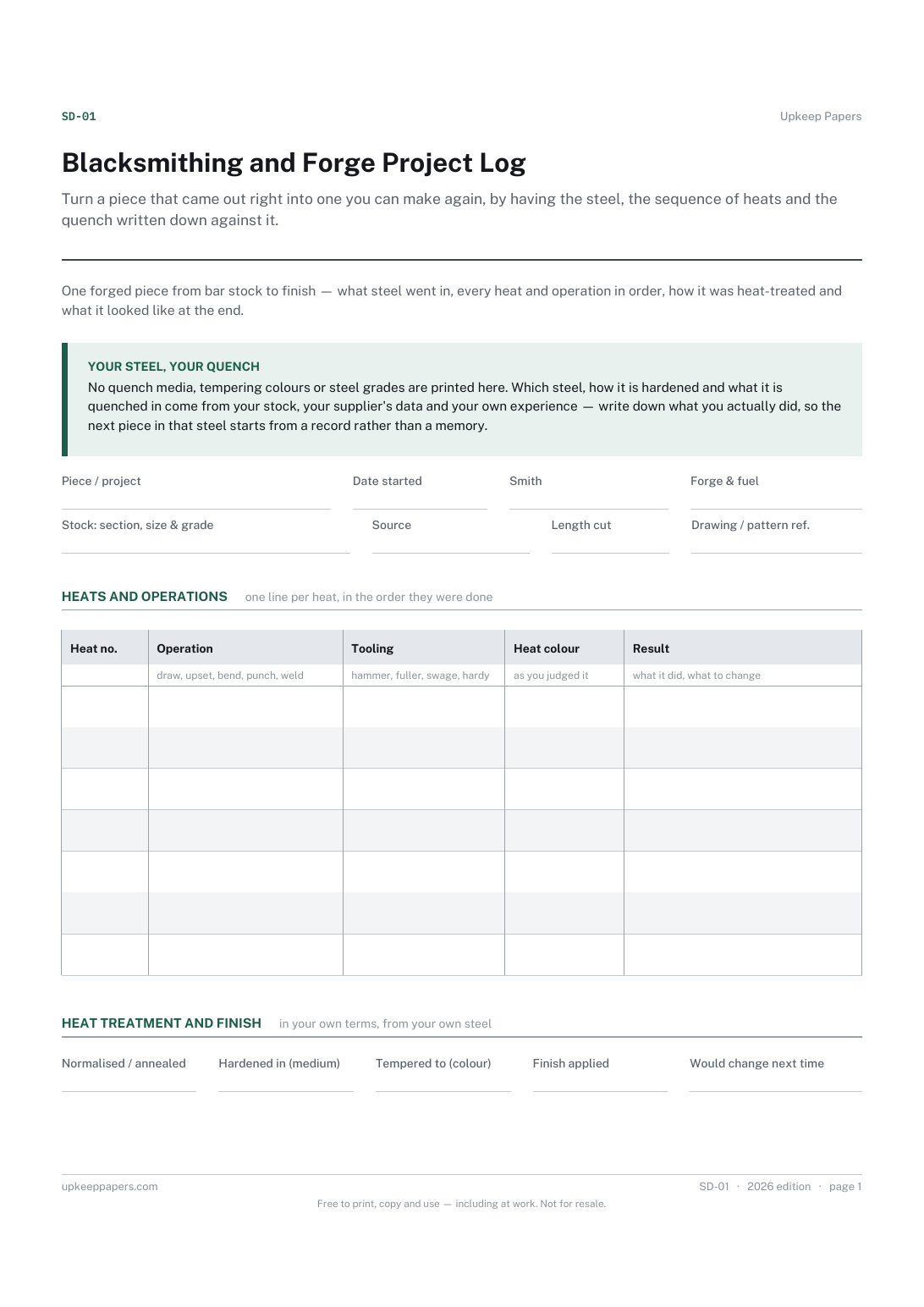
Turn a piece that came out right into one you can make again, by having the steel, the sequence of heats and the quench written down against it.
Record what went on which wall so a touch-up in three years is one trip to one shop instead of an afternoon of matching.
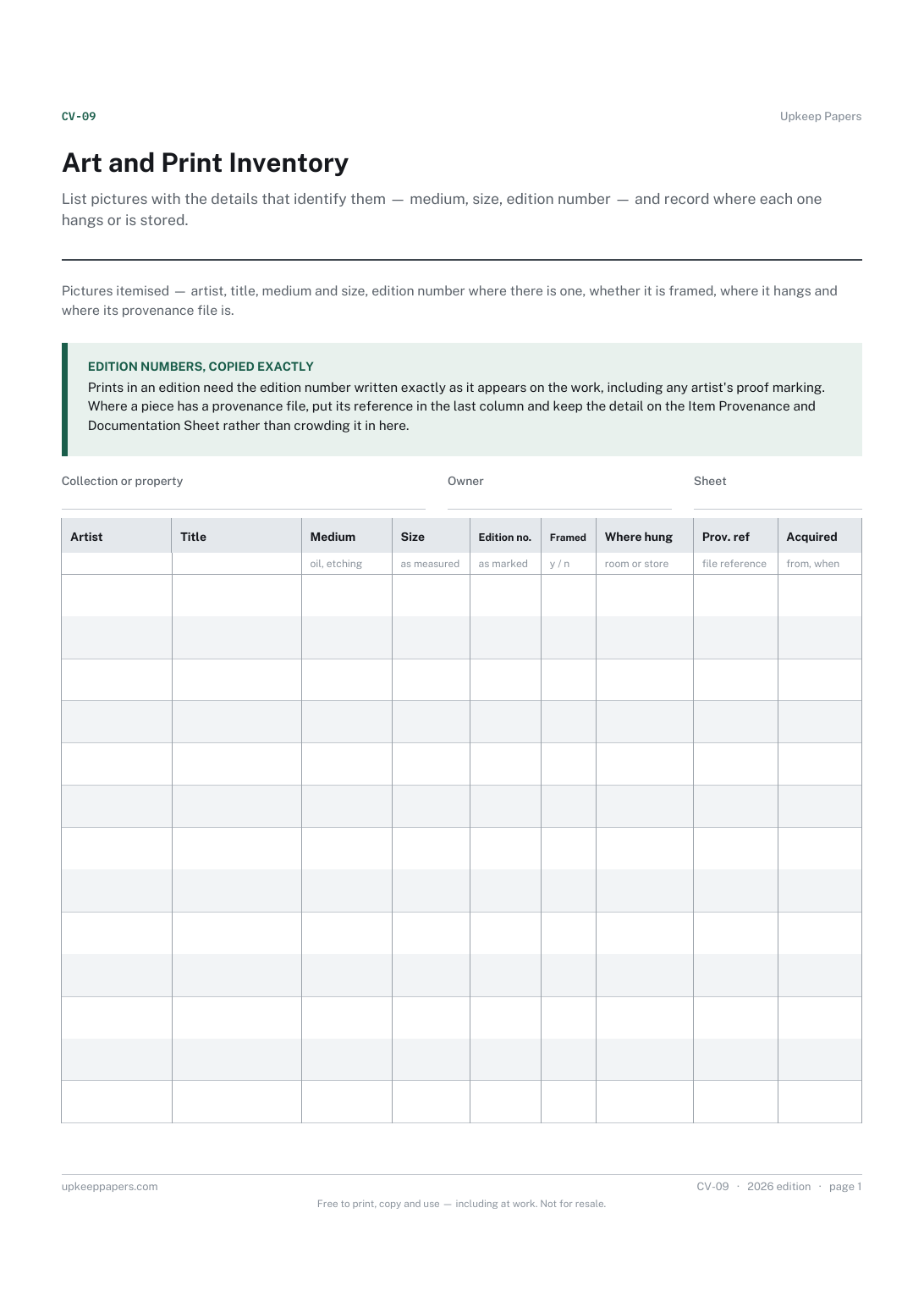
List pictures with the details that identify them — medium, size, edition number — and record where each one hangs or is stored.

Every sheet, binder, game and puzzle on Upkeep Papers is free to download, with no email and no account. Making them is not free: each one takes days of research, design and checking, and the site costs money to run. If something here saved you time, you can buy us a coffee. It is entirely optional: nothing is locked, and nothing changes if you don’t.
Buy us a coffee Opens PayPal in a new tab. Any amount, and nothing changes if you would rather not.