Collection Inventory and Valuation Record
Itemise a collection properly, so that identification, acquisition and any valuation exist somewhere other than in your head.
CV-01 1 page
Everything here is free. Making it takes time and money. Everything here is free.
 Buy us a coffee
Hobby and craft logbooks · HB-04
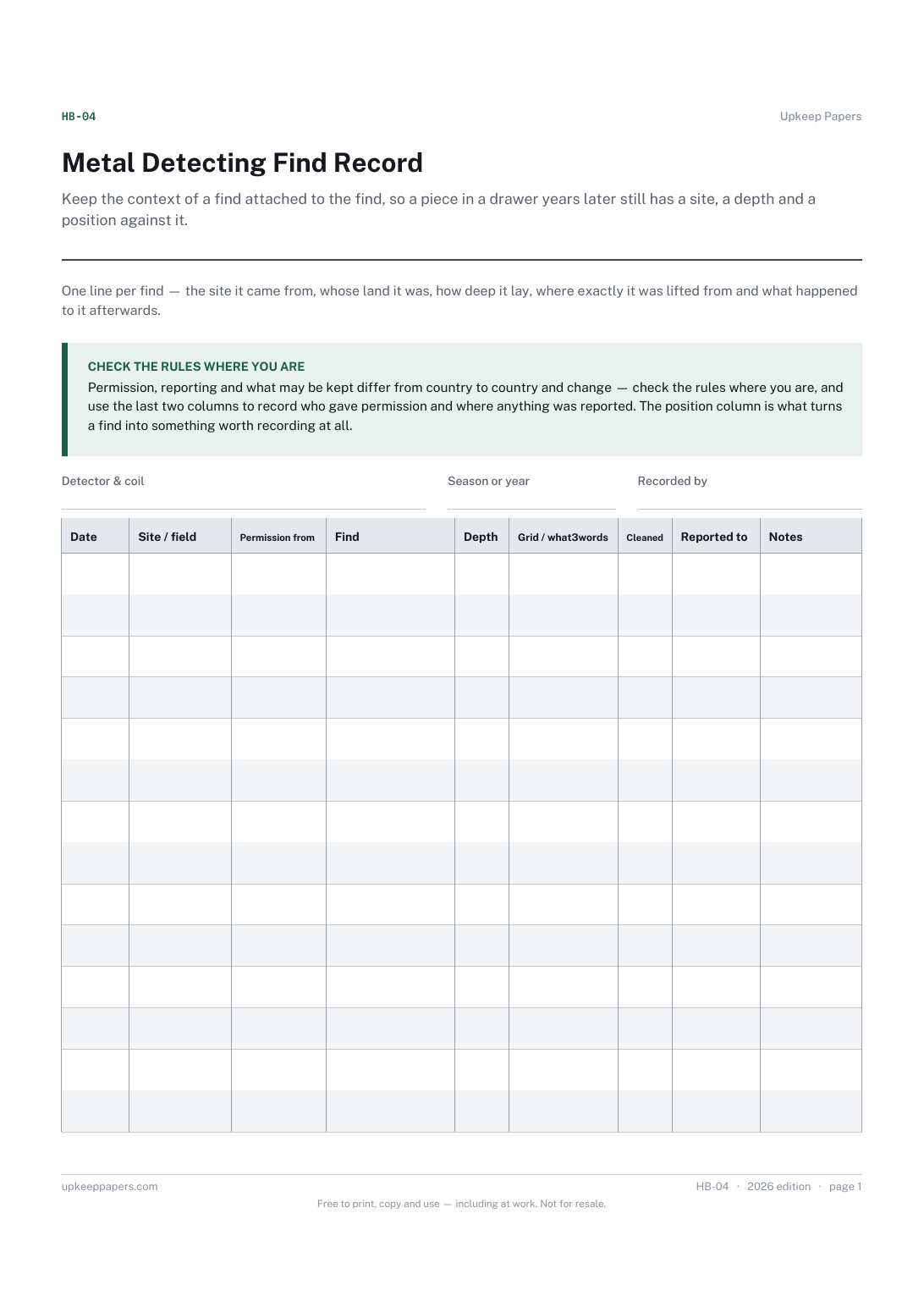
A free printable metal detecting log — date, site, permission holder, the find itself, depth, grid reference or what3words, whether it was cleaned and where it was reported.
One page. Choose your paper size — both versions are laid out identically, so neither one gets shrunk to fit.
Print it and write on it
Fill it in type and save
The fillable versions have real form fields — open them in any PDF reader, type into them and save. Printing help.
Keep the context of a find attached to the find, so a piece in a drawer years later still has a site, a depth and a position against it.
Detectorists working permissions, club members, and anyone who wants the paperwork behind a collection to exist from the start.
One page, top to bottom:
Printed under the title: One line per find — the site it came from, whose land it was, how deep it lay, where exactly it was lifted from and what happened to it afterwards.
Check the rules where you are. Permission, reporting and what may be kept differ from country to country and change — check the rules where you are, and use the last two columns to record who gave permission and where anything was reported. The position column is what turns a find into something worth recording at all.
Write-on lines: Detector & coil · Season or year · Recorded by
Table, 14 rows: Date · Site / field · Permission from · Find · Depth · Grid / what3words · Cleaned · Reported to · Notes
That depends entirely on where you are detecting. Reporting duties, what counts as treasure and what may be kept are set locally and change — check the rules where you are, and use this sheet to record what you did and who you told.
Because a scatter of ordinary finds across a field is information, and a single find in a tin is not. Recording the position costs a few seconds and is the difference between a collection and a record.
Itemise a collection properly, so that identification, acquisition and any valuation exist somewhere other than in your head.
Record the history of a single item and where its paperwork lives, including the gaps, so the chain is not reconstructed from memory by somebody else later.
Build your own record of a patch over the seasons, so what is usual there comes out of your own notes rather than out of memory.
Keep your own record of finds and did-not-finds, with the trackables you moved written down where you can check them against the ones still in your bag.

Every sheet, binder, game and puzzle on Upkeep Papers is free to download, with no email and no account. Making them is not free: each one takes days of research, design and checking, and the site costs money to run. If something here saved you time, you can buy us a coffee. It is entirely optional: nothing is locked, and nothing changes if you don’t.
Buy us a coffee Opens PayPal in a new tab. Any amount, and nothing changes if you would rather not.