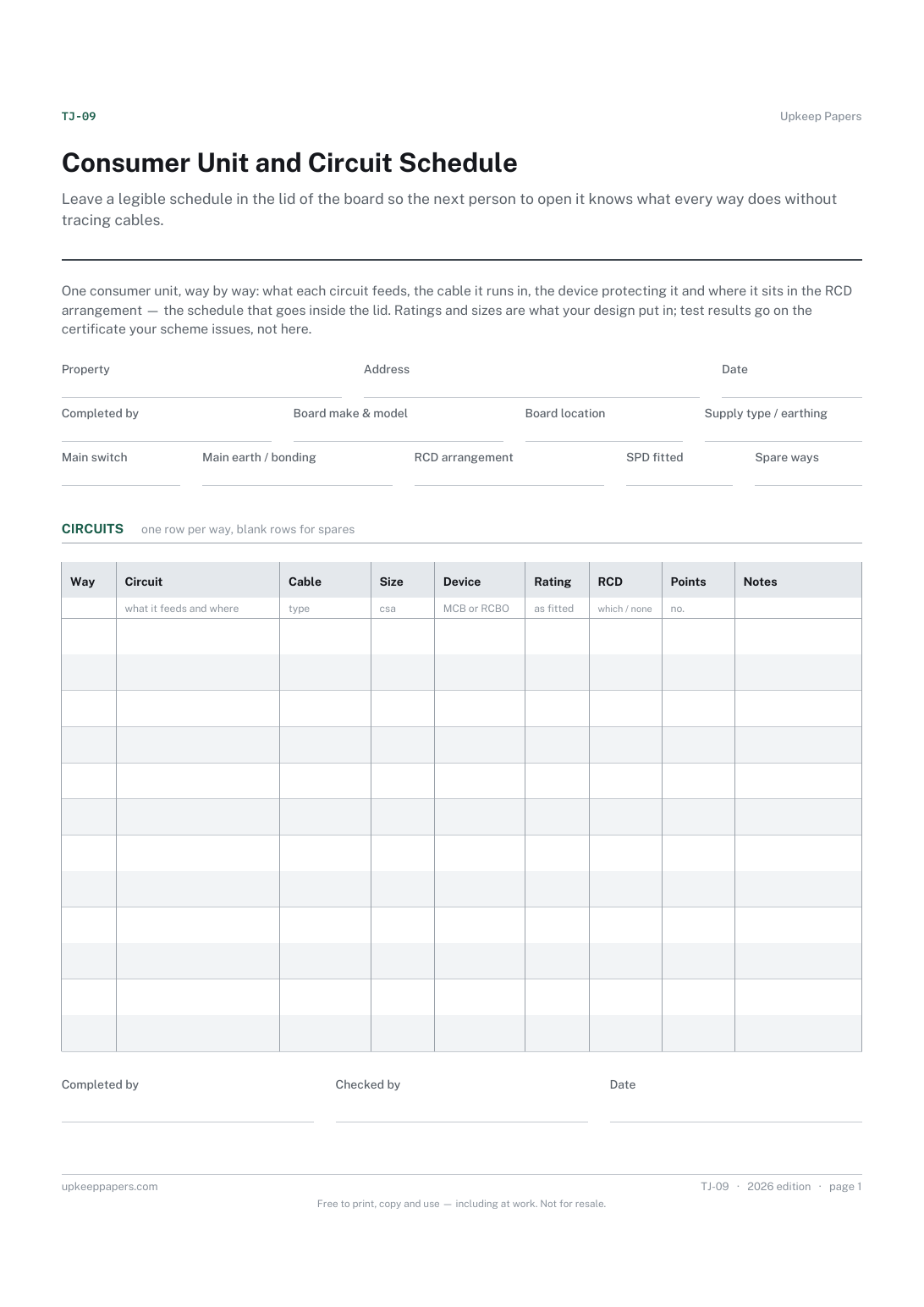
Consumer Unit and Circuit Schedule
Leave a legible schedule in the lid of the board so the next person to open it knows what every way does without tracing cables.
TJ-09 1 page
Everything here is free. Making it takes time and money. Everything here is free.
 Buy us a coffee
Safety checks · SC-17
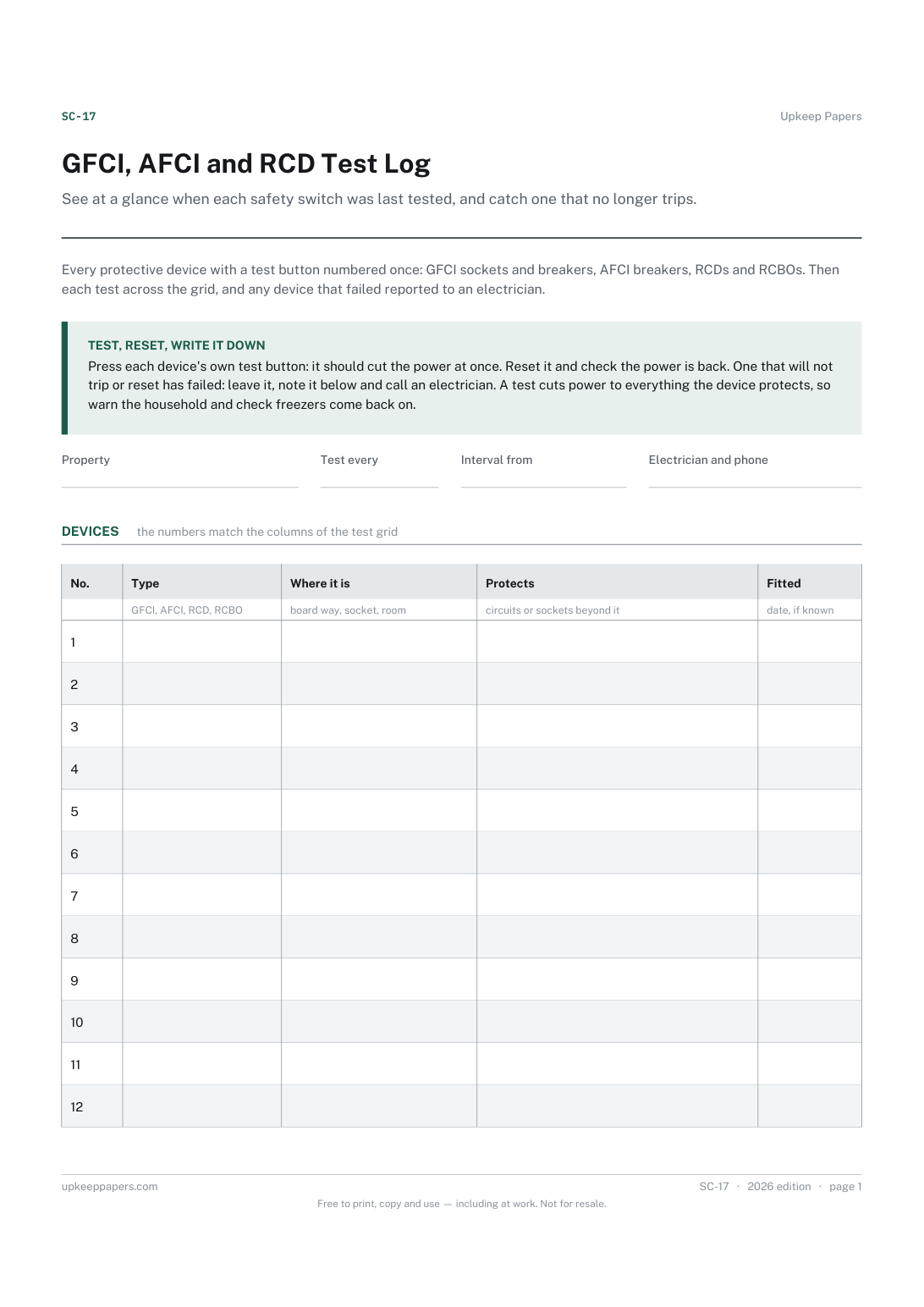
A free printable GFCI, AFCI and RCD test log: every safety switch with a test button numbered once, then a grid of test dates and a record of any that failed.
2 pages. Choose your paper size — both versions are laid out identically, so neither one gets shrunk to fit.
Print it and write on it
Fill it in type and save
The fillable versions have real form fields — open them in any PDF reader, type into them and save. Printing help.
See at a glance when each safety switch was last tested, and catch one that no longer trips. Every device with a test button is numbered once, then each test goes across the grid.
Homeowners, landlords and small workplaces with GFCI or AFCI sockets and breakers, or RCDs and RCBOs in the consumer unit.
2 pages, in this order:
Printed under the title: Every protective device with a test button numbered once: GFCI sockets and breakers, AFCI breakers, RCDs and RCBOs. Then each test across the grid, and any device that failed reported to an electrician.
Test, reset, write it down. Press each device's own test button: it should cut the power at once. Reset it and check the power is back. One that will not trip or reset has failed: leave it, note it below and call an electrician. A test cuts power to everything the device protects, so warn the household and check freezers come back on.
Write-on lines: Property · Test every · Interval from · Electrician and phone
Table, 12 rows: No. · Type · Where it is · Protects · Fitted
Table, 15 rows: Date · 1 · 2 · 3 · 4 · 5 · 6 · 7 · 8 · 9 · 10 · 11 · 12 · Initials
Table, 4 rows: Date · Device · What happened · Reported to · Outcome · Fixed on
As often as the label on the device or its maker says. The sheet leaves the interval as a blank at the top because it differs between devices and countries, and a printed figure would be wrong for some of them.
Treat the device as failed: it may no longer cut the power in a fault, which is the reason it is there. Do not keep resetting and retesting it; note it in the failures box and ask a qualified electrician to check it.
No. The test button only checks that the device's own mechanism trips. A periodic inspection by an electrician can test the installation with instruments, including how quickly each device trips. Keep both records.
Leave a legible schedule in the lid of the board so the next person to open it knows what every way does without tracing cables.
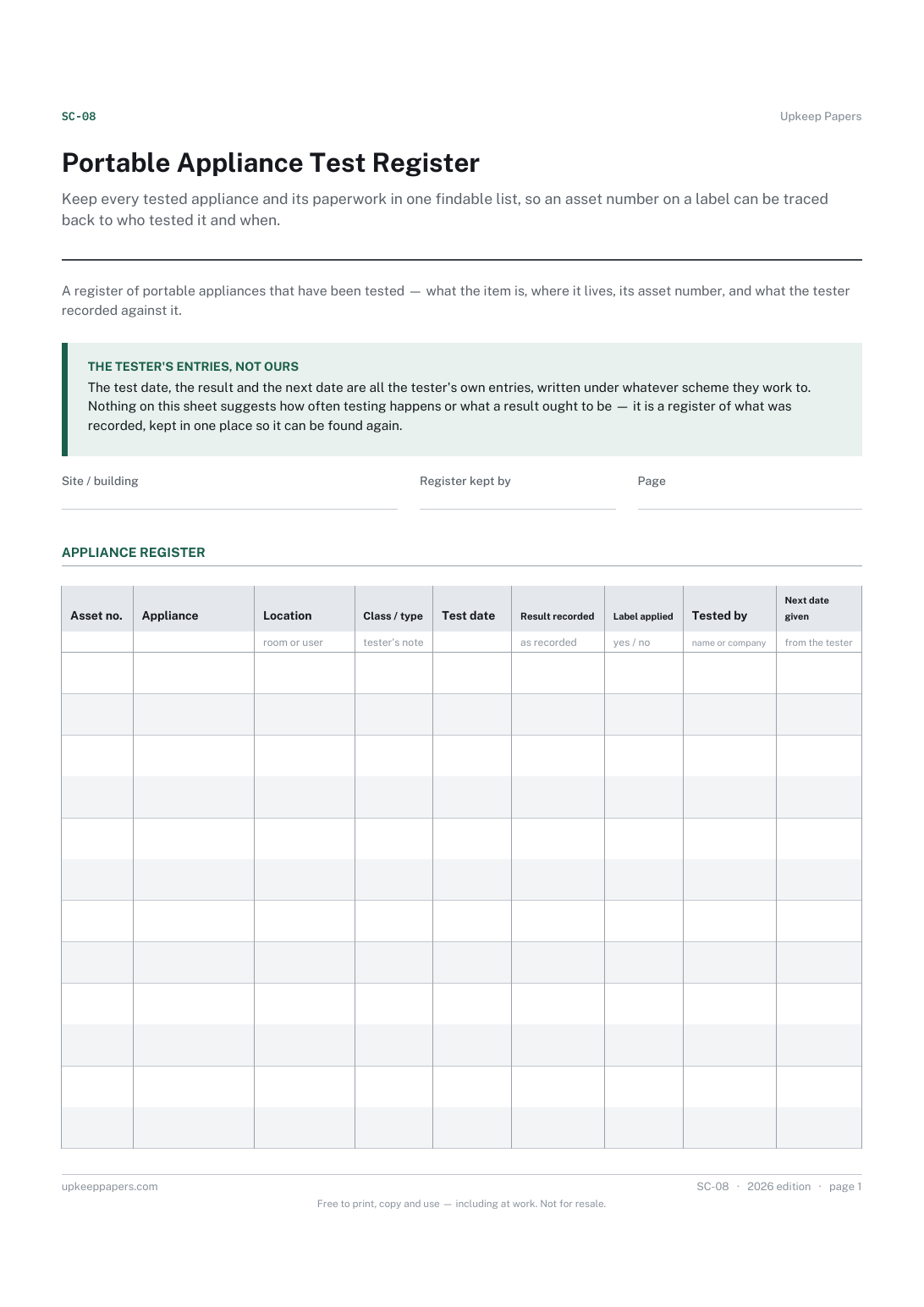
Keep every tested appliance and its paperwork in one findable list, so an asset number on a label can be traced back to who tested it and when.
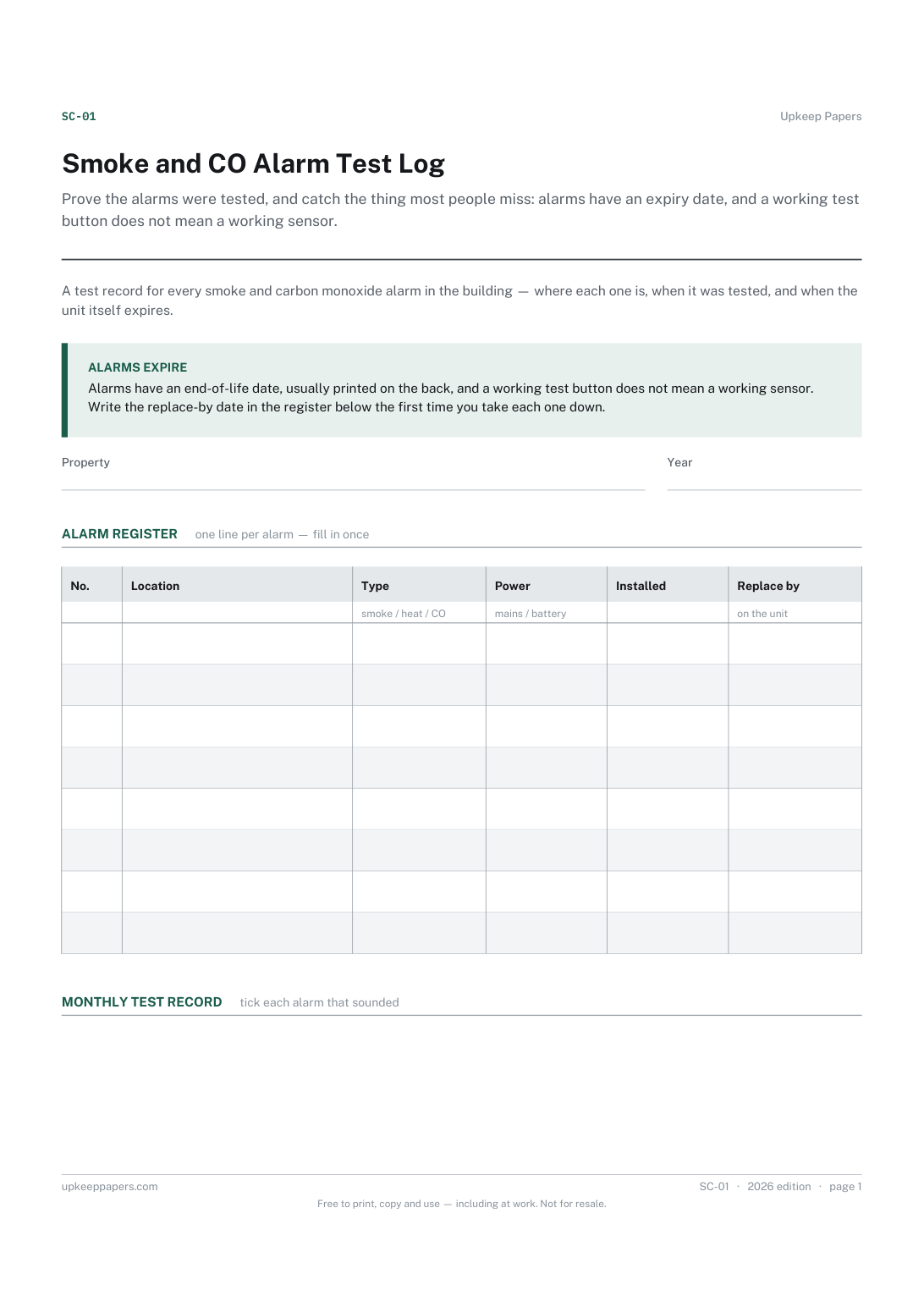
Prove the alarms were tested, and catch the thing most people miss: alarms have an expiry date, and a working test button does not mean a working sensor.
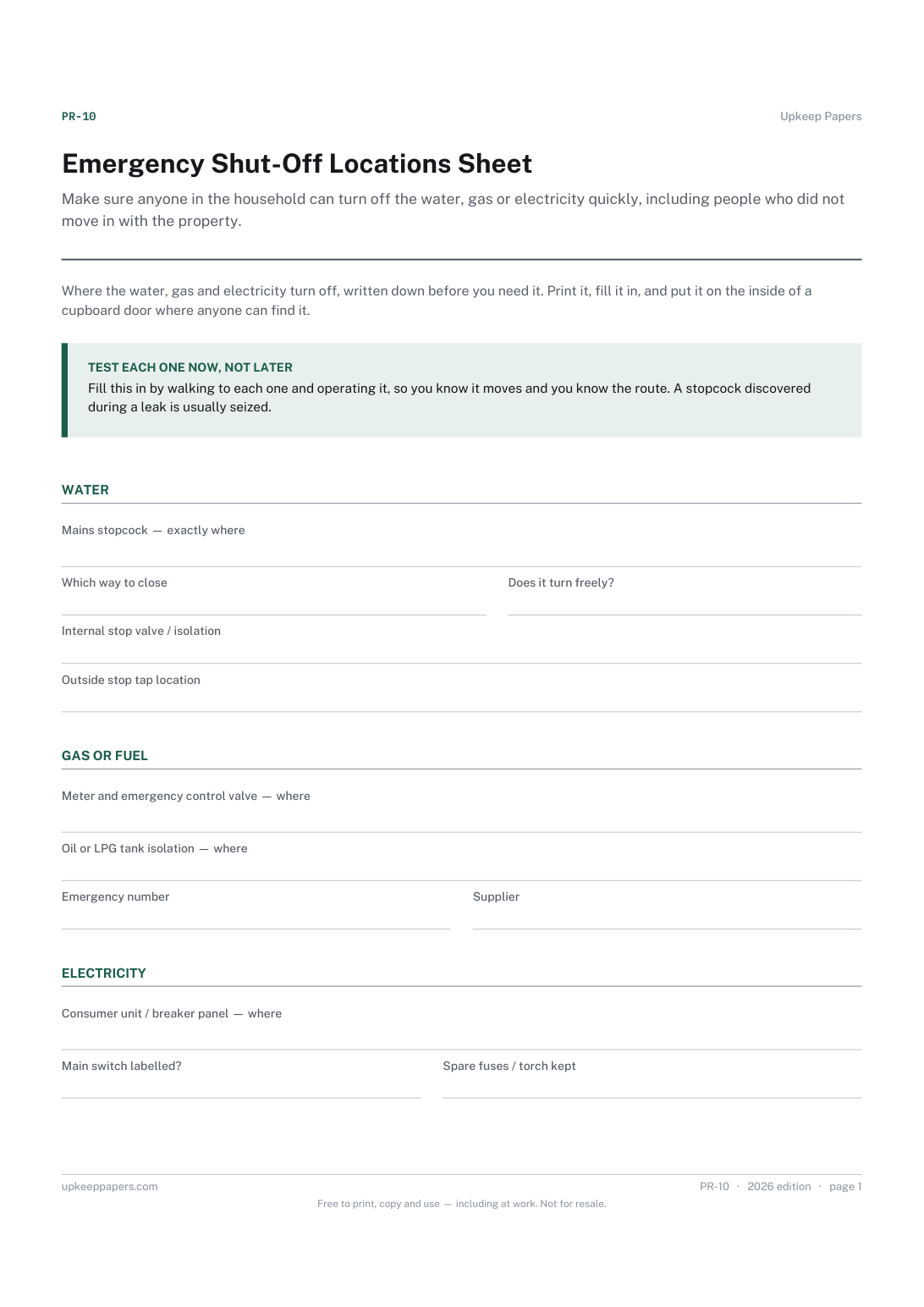
Make sure anyone in the household can turn off the water, gas or electricity quickly, including people who did not move in with the property.
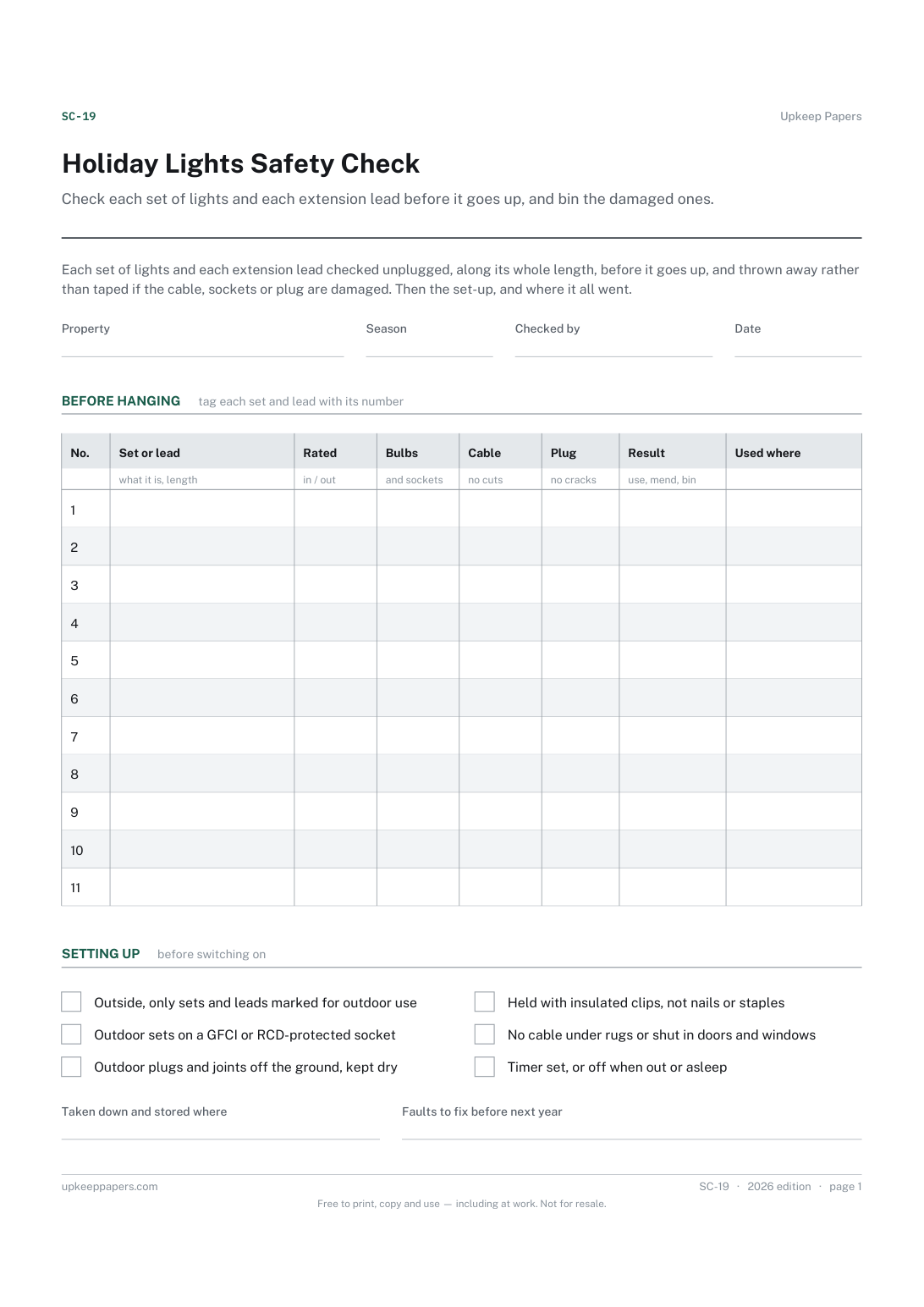
Check each set of lights and each extension lead before it goes up, and bin the damaged ones. Ratings, safety-switch protection and fixings are written down, with where it all went afterwards.

Every sheet, binder, game and puzzle on Upkeep Papers is free to download, with no email and no account. Making them is not free: each one takes days of research, design and checking, and the site costs money to run. If something here saved you time, you can buy us a coffee. It is entirely optional: nothing is locked, and nothing changes if you don’t.
Buy us a coffee Opens PayPal in a new tab. Any amount, and nothing changes if you would rather not.