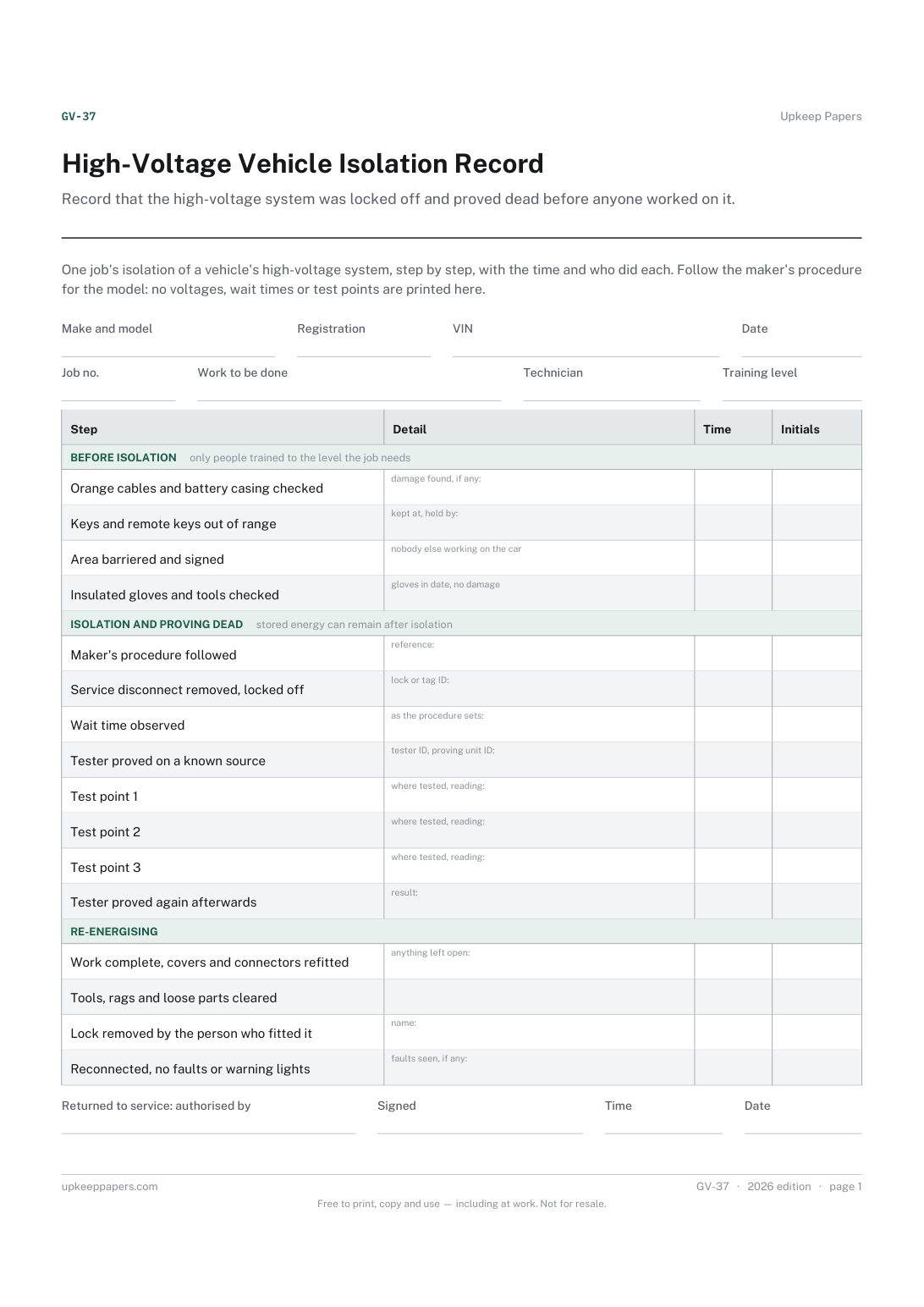
High-Voltage Vehicle Isolation Record
Record that the high-voltage system was locked off and proved dead before anyone worked on it. It also records that the system was put back safely, by whom and when.
GV-37 1 page
Everything here is free. Making it takes time and money. Everything here is free.
 Buy us a coffee
Garage and vehicle workshop · GV-38
A free printable damaged EV holding record: the arrival assessment, where the vehicle is parked, every check while it waits, and who it was released to.
2 pages. Choose your paper size — both versions are laid out identically, so neither one gets shrunk to fit.
Print it and write on it
Fill it in type and save
The fillable versions have real form fields — open them in any PDF reader, type into them and save. Printing help.
Keep a damaged electric vehicle under watch from arrival until it leaves the site. A damaged battery can get worse after the event, so every check is written down.
Bodyshops, recovery yards, salvage and storage sites and garages that take in electric or hybrid vehicles after a collision, flood or fire.
2 pages, in this order:
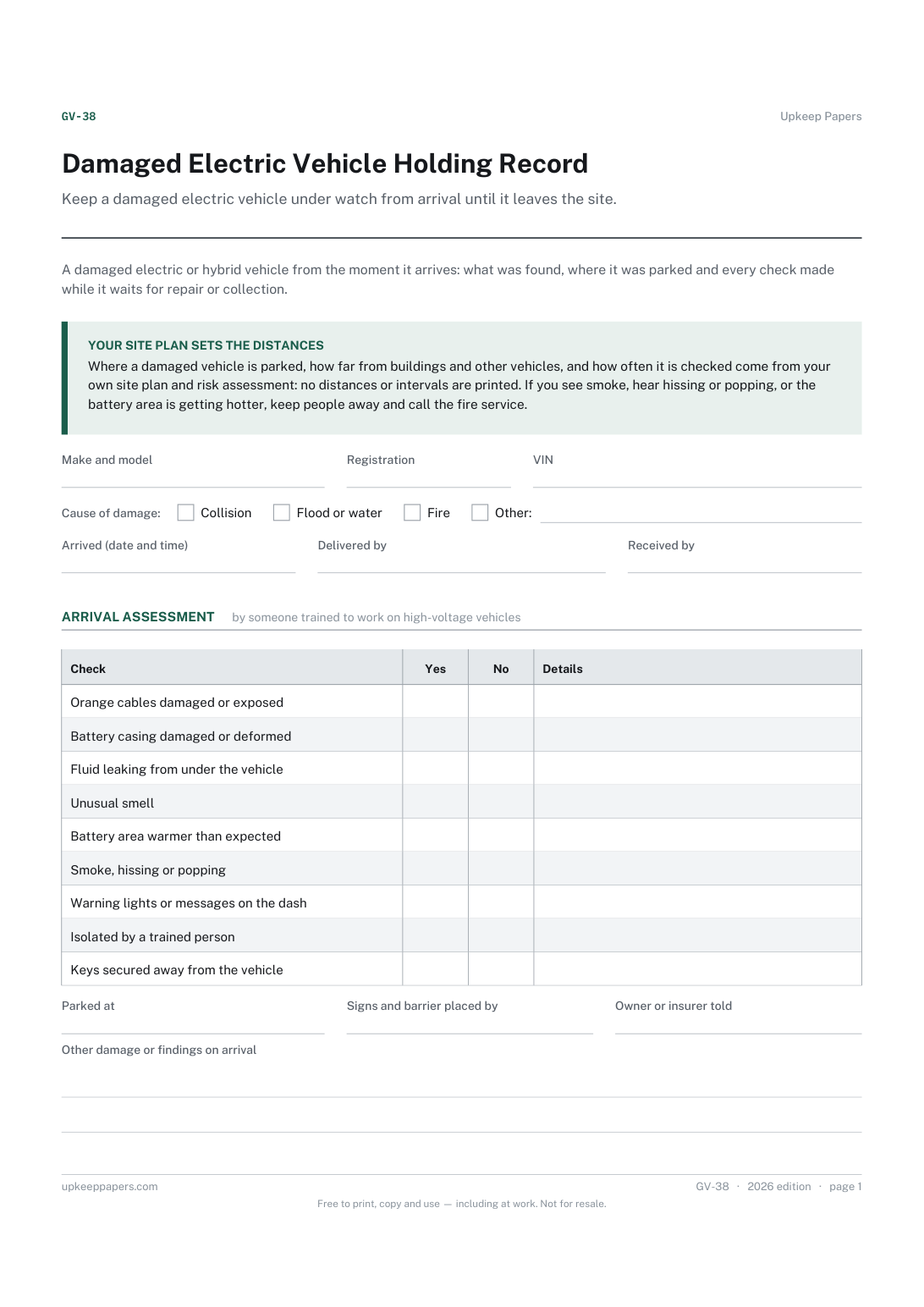
Printed under the title: A damaged electric or hybrid vehicle from the moment it arrives: what was found, where it was parked and every check made while it waits for repair or collection.
Your site plan sets the distances. Where a damaged vehicle is parked, how far from buildings and other vehicles, and how often it is checked come from your own site plan and risk assessment: no distances or intervals are printed. If you see smoke, hear hissing or popping, or the battery area is getting hotter, keep people away and call the fire service.
Write-on lines: Make and model · Registration · VIN
Also printed: Cause of damage: · Collision · Flood or water · Fire · Other:
Write-on lines: Arrived (date and time) · Delivered by · Received by
Also printed: Check · Yes · Details · Orange cables damaged or exposed · Battery casing damaged or deformed · Fluid leaking from under the vehicle · Unusual smell · Battery area warmer than expected · Smoke, hissing or popping · Warning lights or messages on the dash · Isolated by a trained person · Keys secured away from the vehicle
Write-on lines: Parked at · Signs and barrier placed by · Owner or insurer told
Ruled lines: Other damage or findings on arrival
Table, 17 rows: Date · Time · Smoke · Smell · Leaks · Heat check · Reading · Notes · Action · By
Write-on lines: Owner or insurer told (who, when) · Recovery or salvage booked · Fire service called, if so · Released to · Date and time · Condition on release
Signature strip: Released by · Signed · Date
Safe distances and check intervals depend on your site, the vehicle and the damage, and they belong in your own site plan and risk assessment. Write where it was parked and follow your plan.
Keep people away and call the fire service, then follow your emergency plan. Write what was seen and when on the sheet once everyone is safe.
Record that the high-voltage system was locked off and proved dead before anyone worked on it. It also records that the system was put back safely, by whom and when.
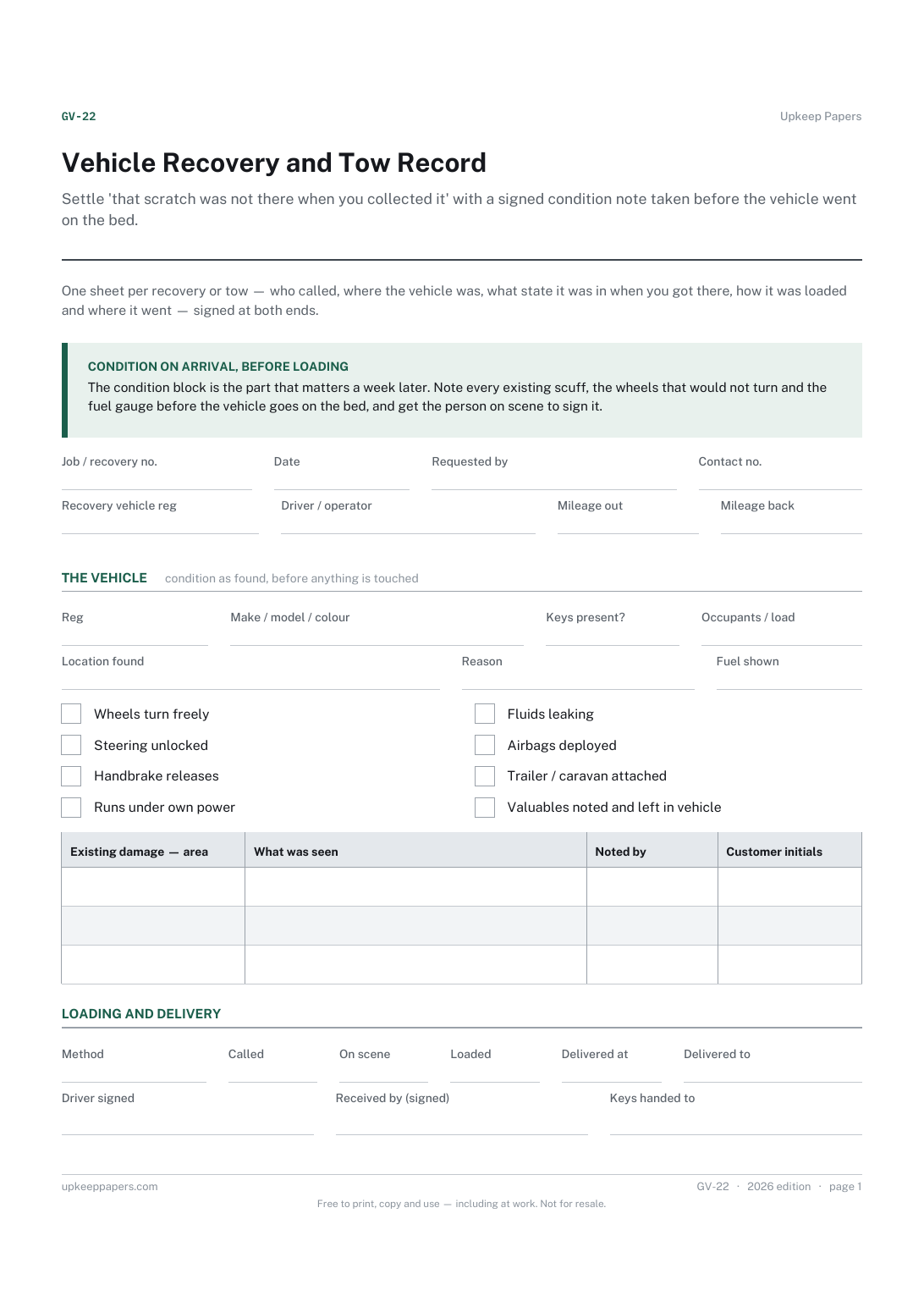
Settle 'that scratch was not there when you collected it' with a signed condition note taken before the vehicle went on the bed.
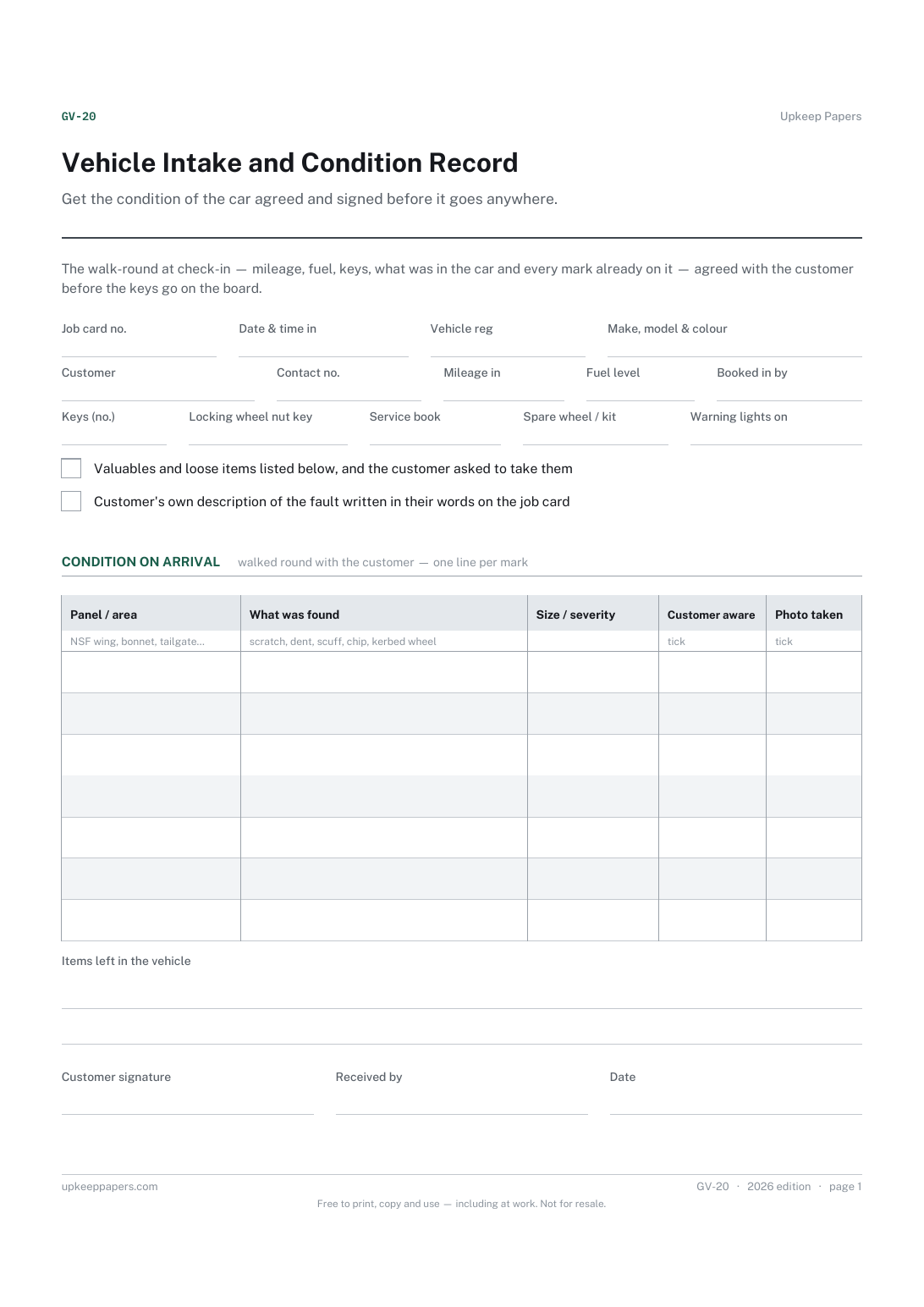
Get the condition of the car agreed and signed before it goes anywhere. A scratch found at handback then has a record to be checked against.
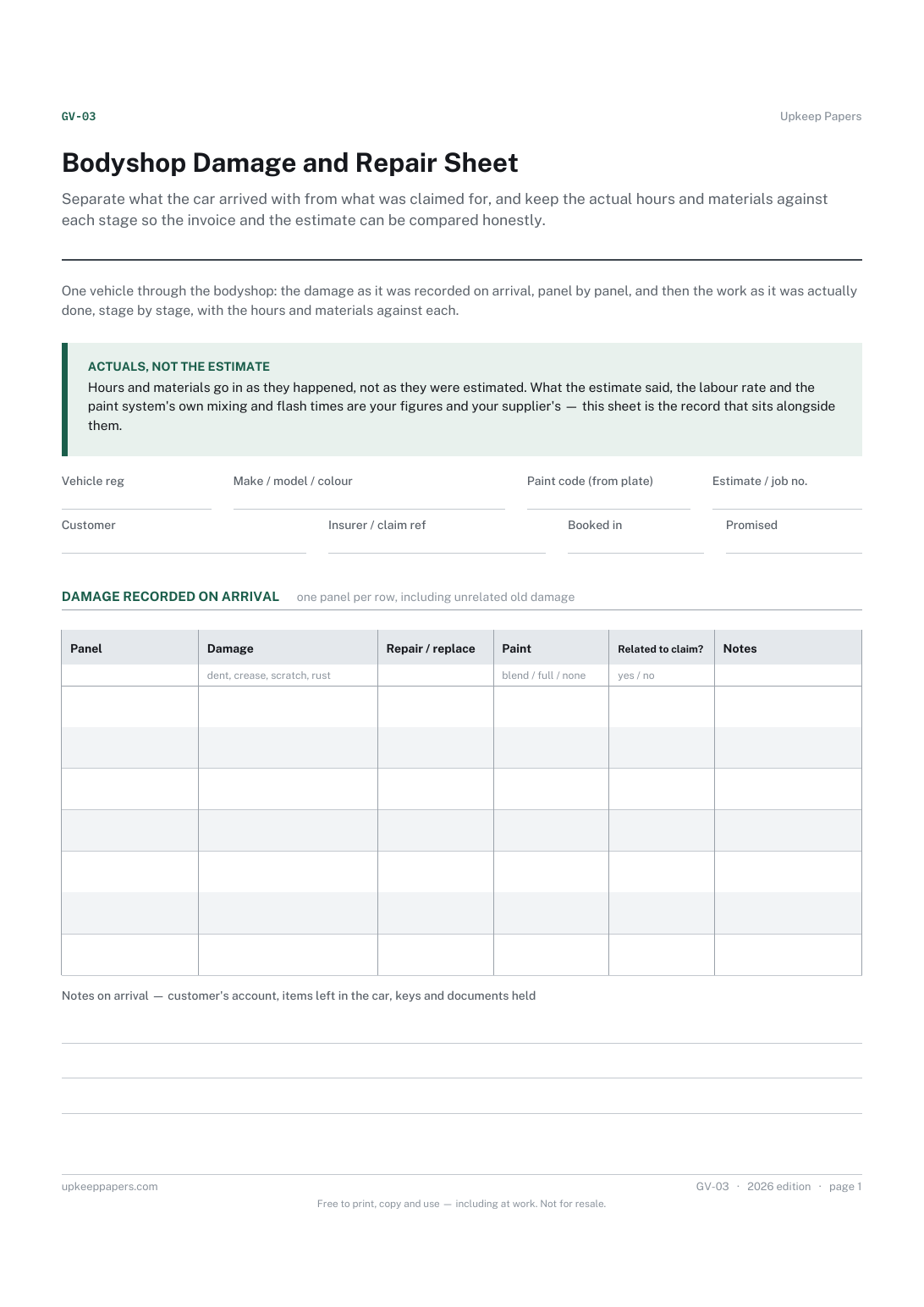
Separate what the car arrived with from what was claimed for, and keep the actual hours and materials against each stage so the invoice and the estimate can be compared honestly.

Every sheet, binder, game and puzzle on Upkeep Papers is free to download, with no email and no account. Making them is not free: each one takes days of research, design and checking, and the site costs money to run. If something here saved you time, you can buy us a coffee. It is entirely optional: nothing is locked, and nothing changes if you don’t.
Buy us a coffee Opens PayPal in a new tab. Any amount, and nothing changes if you would rather not.