Butchery Cutting and Yield Record
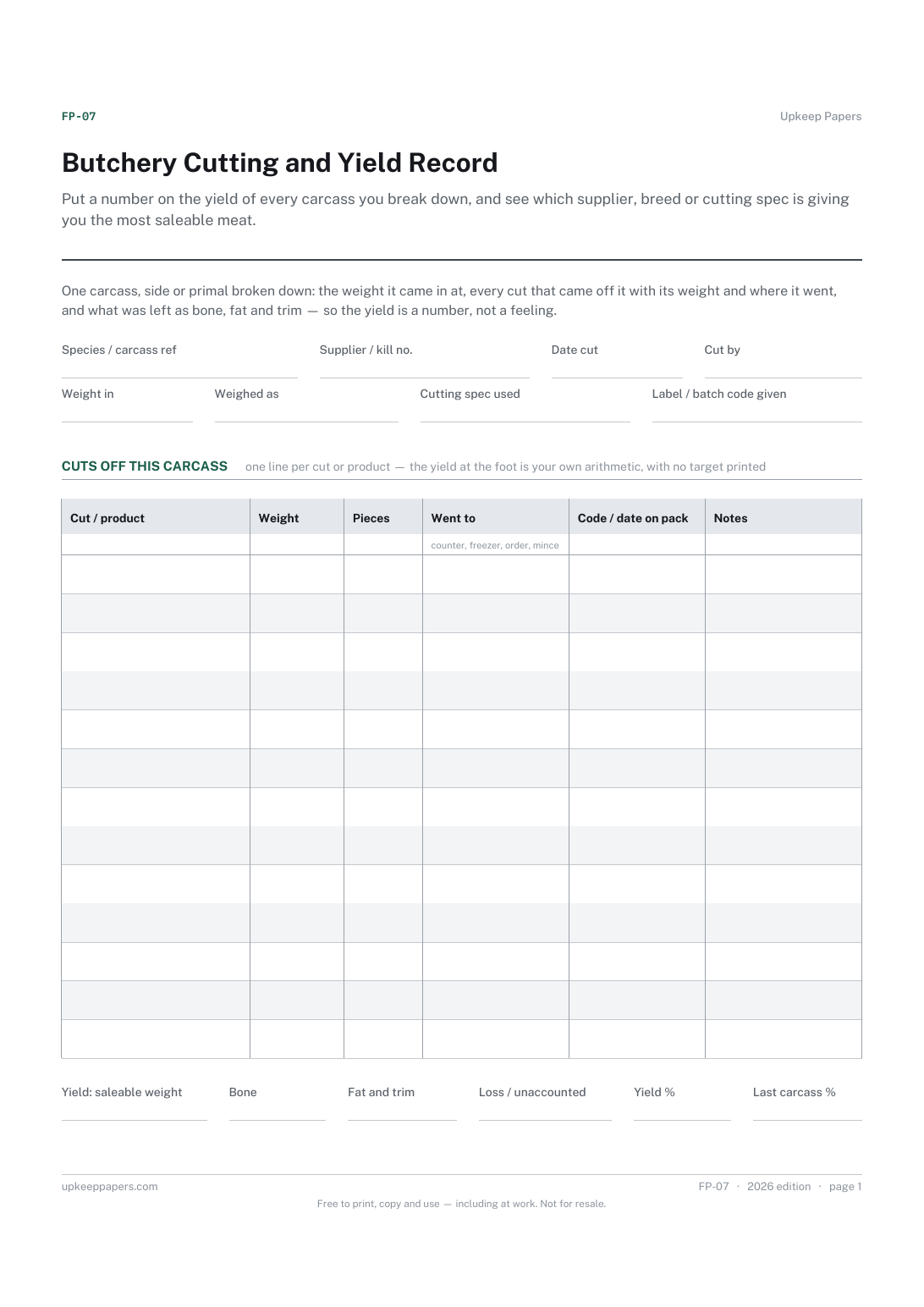
Put a number on the yield of every carcass you break down, and see which supplier, breed or cutting spec is giving you the most saleable meat.
FP-07 1 page
Everything here is free. Making it takes time and money. Everything here is free.
 Buy us a coffee
Food production and artisan makers · FP-09
A meat traceability sheet — every carcass, side or primal received with supplier, kill or lot number, health mark and weight, then the pack codes it became.
2 pages. Choose your paper size — both versions are laid out identically, so neither one gets shrunk to fit.
Print it and write on it
Fill it in type and save
The fillable versions have real form fields — open them in any PDF reader, type into them and save. Printing help.
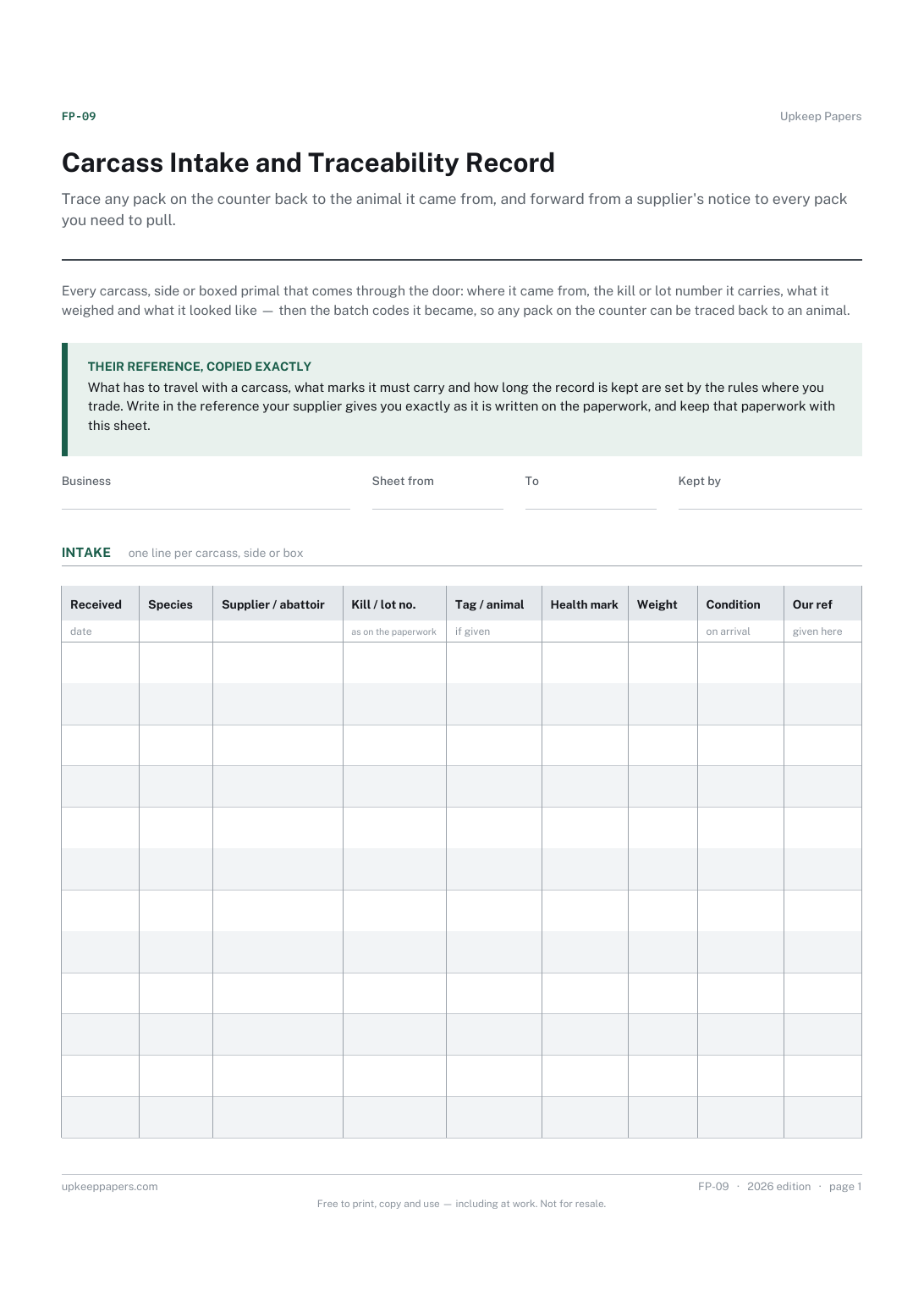
Trace any pack on the counter back to the animal it came from, and forward from a supplier's notice to every pack you need to pull.
Butchers, farm shops and meat processors receiving carcasses or primals from an abattoir, wholesaler or their own animals.
2 pages, in this order:
Printed under the title: Every carcass, side or boxed primal that comes through the door: where it came from, the kill or lot number it carries, what it weighed and what it looked like — then the batch codes it became, so any pack on the counter can be traced back to an animal.
Their reference, copied exactly. What has to travel with a carcass, what marks it must carry and how long the record is kept are set by the rules where you trade. Write in the reference your supplier gives you exactly as it is written on the paperwork, and keep that paperwork with this sheet.
Write-on lines: Business · Sheet from · To · Kept by
Table, 12 rows: Received · Species · Supplier / abattoir · Kill / lot no. · Tag / animal · Health mark · Weight · Condition · Our ref
Table, 16 rows: Our ref · Cut on · Cut by · Batch / pack codes given · Sold or sent to · Notes
Ruled lines: Notes — paperwork missing, supplier queries, anything withdrawn
Because that is set by the rules where you trade, and they differ. The sheet records what did arrive with it; keep that paperwork with the sheet.
Anything short and unique that you can write on a tag or a box — a date and a letter, a running number. It is the link between this table and the pack codes below.
Put a number on the yield of every carcass you break down, and see which supplier, breed or cutting spec is giving you the most saleable meat.
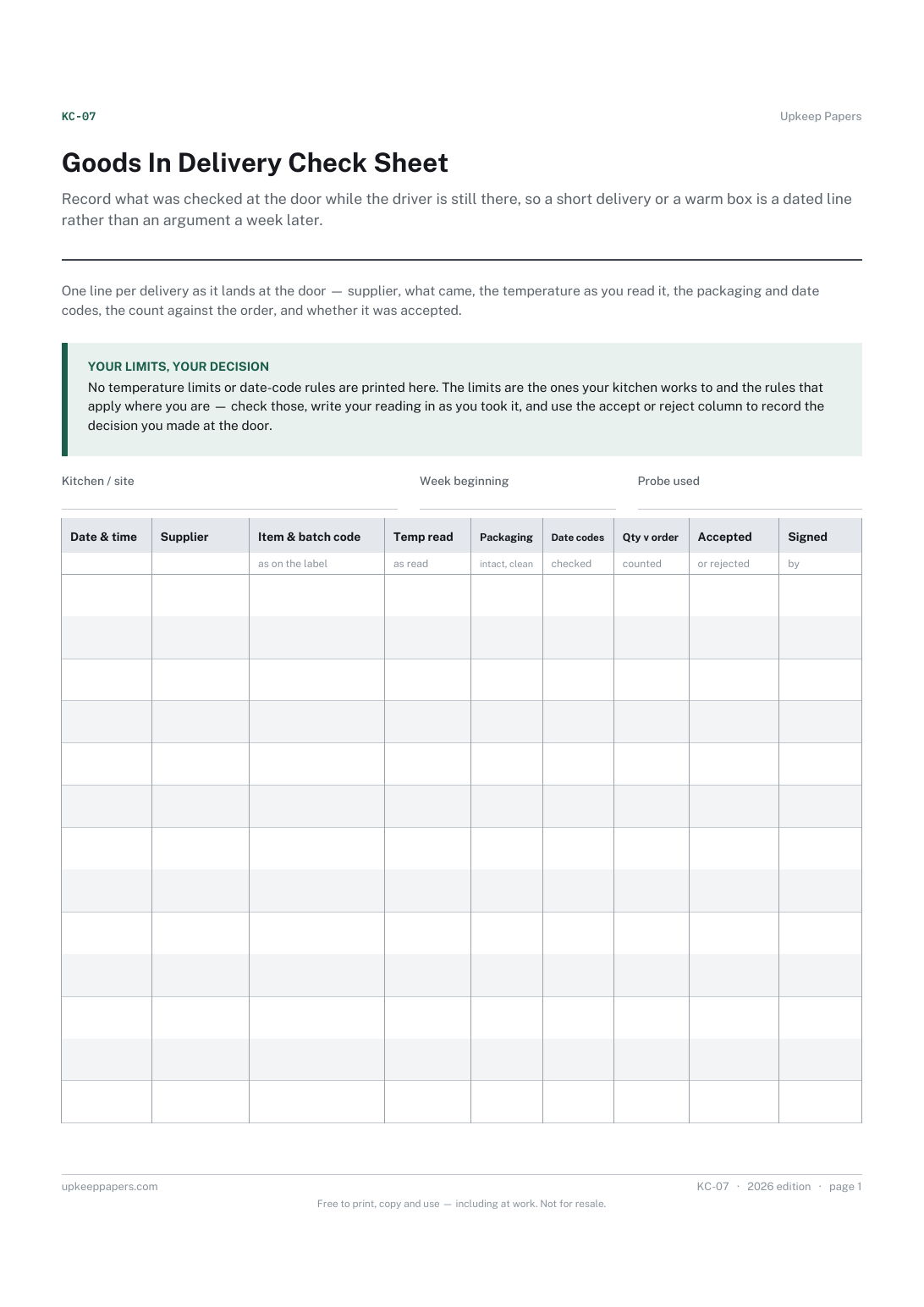
Record what was checked at the door while the driver is still there, so a short delivery or a warm box is a dated line rather than an argument a week later.
Keep your own copy of every movement on and off, with the reference numbers that make it possible to answer a question about a load six months afterwards.
Keep track of which tag is on which animal, including the replacements that otherwise break the chain between an animal and its records.

Every sheet, binder, game and puzzle on Upkeep Papers is free to download, with no email and no account. Making them is not free: each one takes days of research, design and checking, and the site costs money to run. If something here saved you time, you can buy us a coffee. It is entirely optional: nothing is locked, and nothing changes if you don’t.
Buy us a coffee Opens PayPal in a new tab. Any amount, and nothing changes if you would rather not.