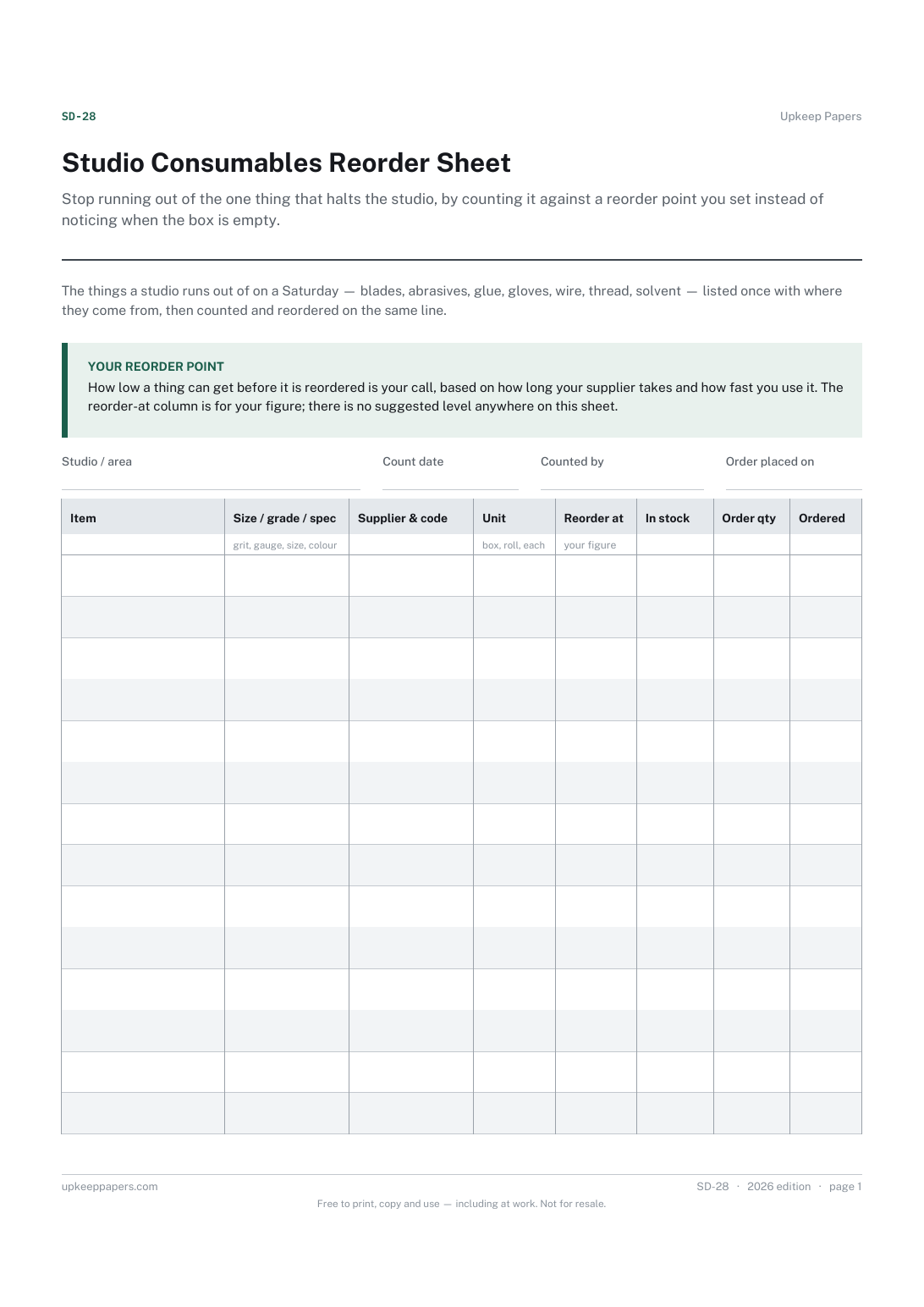
Studio Consumables Reorder Sheet
Stop running out of the one thing that halts the studio, by counting it against a reorder point you set instead of noticing when the box is empty.
SD-28 1 page
Everything here is free. Making it takes time and money. Everything here is free.
 Buy us a coffee
Studio crafts and making · SD-24
Silver and stone stock sheet for jewellery makers — metal in and out by weight with a running balance, and stones by the piece with cut and supplier.
One page. Choose your paper size — both versions are laid out identically, so neither one gets shrunk to fit.
Print it and write on it
Fill it in type and save
The fillable versions have real form fields — open them in any PDF reader, type into them and save. Printing help.
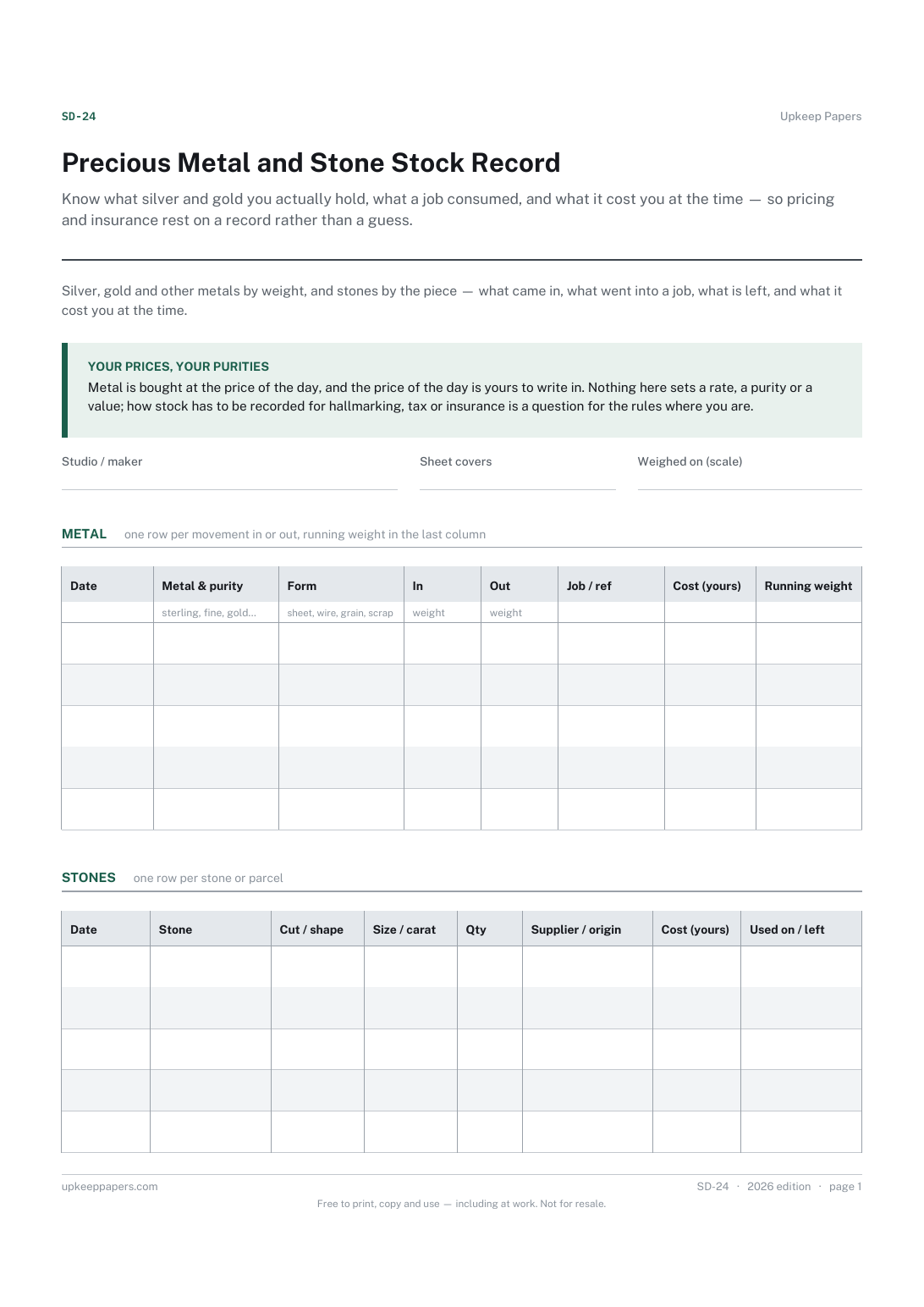
Know what silver and gold you actually hold, what a job consumed, and what it cost you at the time — so pricing and insurance rest on a record rather than a guess.
Jewellers, silversmiths, goldsmiths and stone setters working from a home bench or a small studio.
One page, top to bottom:
Printed under the title: Silver, gold and other metals by weight, and stones by the piece — what came in, what went into a job, what is left, and what it cost you at the time.
Your prices, your purities. Metal is bought at the price of the day, and the price of the day is yours to write in. Nothing here sets a rate, a purity or a value; how stock has to be recorded for hallmarking, tax or insurance is a question for the rules where you are.
Write-on lines: Studio / maker · Sheet covers · Weighed on (scale)
Table, 5 rows: Date · Metal & purity · Form · In · Out · Job / ref · Cost (yours) · Running weight
Table, 5 rows: Date · Stone · Cut / shape · Size / carat · Qty · Supplier / origin · Cost (yours) · Used on / left
Because the price is the price of the day you bought it and the purity is whatever you ordered. Both go in your own hand. Nothing here sets a value, and whether your records have to meet any hallmarking, tax or insurance requirement is a question for the rules where you are.
It is worth it. Scrap that goes back to a refiner or into a melt is still metal you paid for. Enter it as a movement out with the job it came from, and as a movement in if it comes back as grain or credit.
Stop running out of the one thing that halts the studio, by counting it against a reorder point you set instead of noticing when the box is empty.
Record identifying detail and paperwork for each piece before it is needed, which is invariably after something has gone.
Keep a catalogue of finished work and where it went, which is the record galleries, insurers and tax authorities ask for and working artists rarely have.
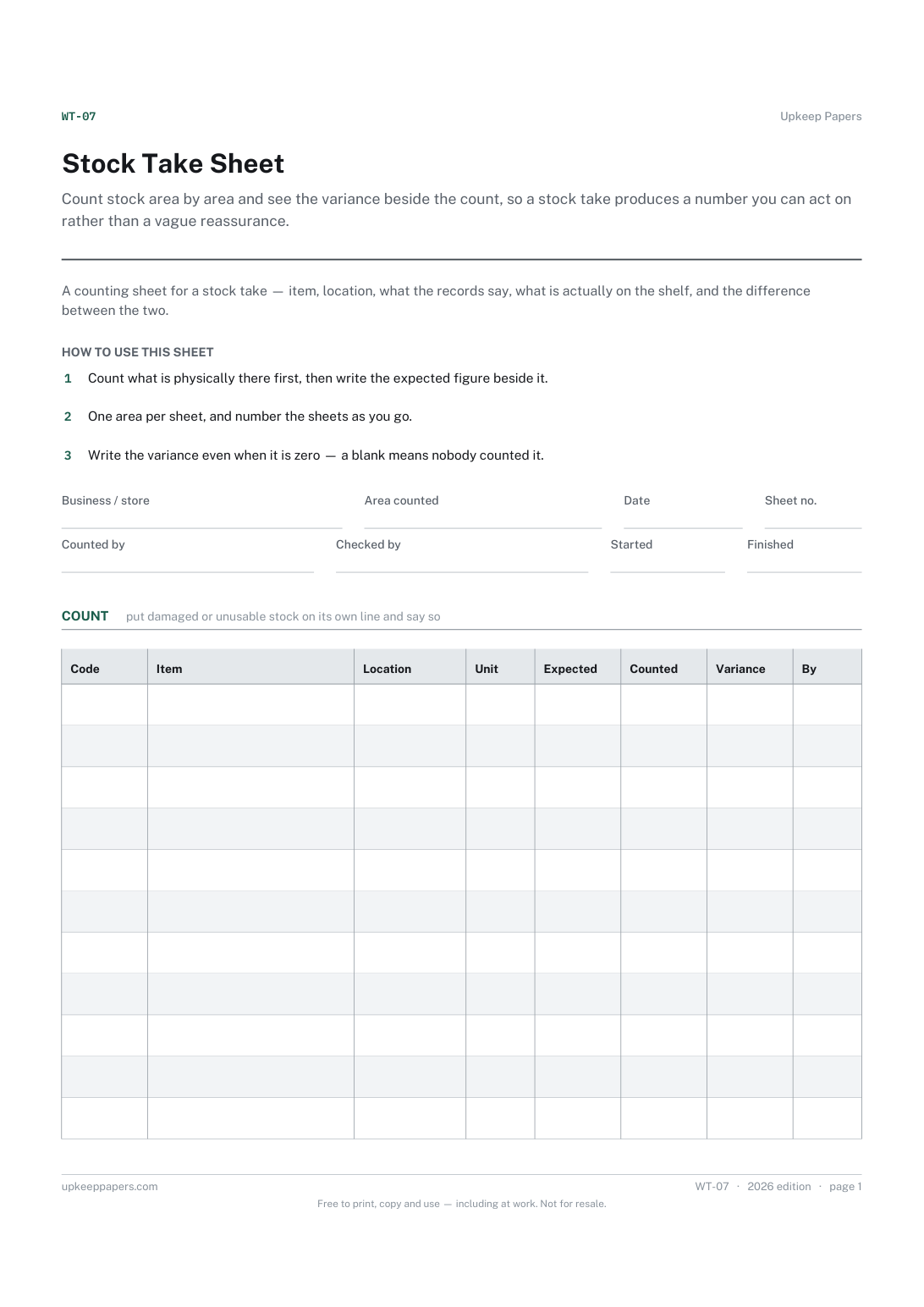
Count stock area by area and see the variance beside the count, so a stock take produces a number you can act on rather than a vague reassurance.
The same subject, with a version you can fill in on screen.
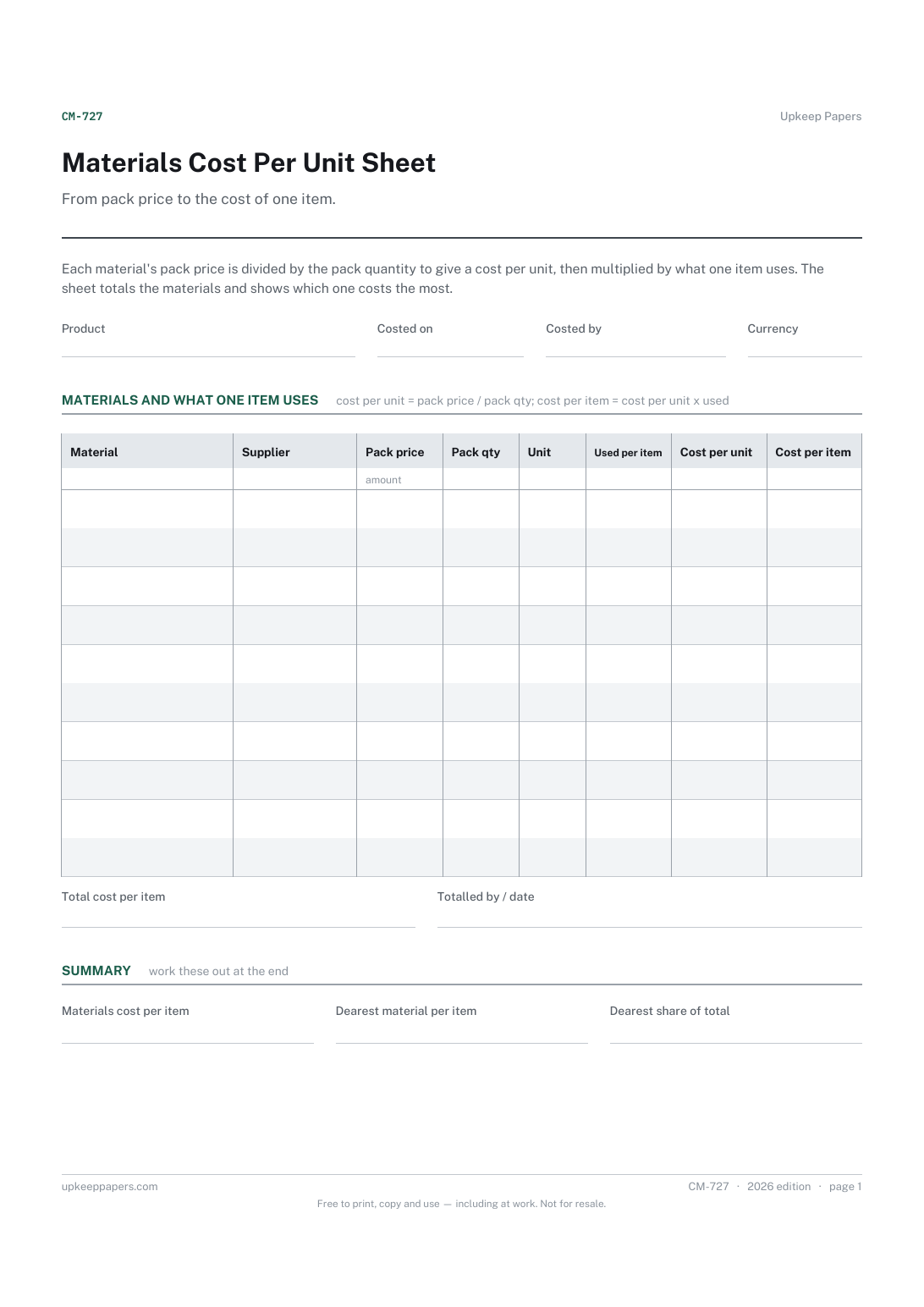
What each material costs per metre, gram, bead or sheet.

Every sheet, binder, game and puzzle on Upkeep Papers is free to download, with no email and no account. Making them is not free: each one takes days of research, design and checking, and the site costs money to run. If something here saved you time, you can buy us a coffee. It is entirely optional: nothing is locked, and nothing changes if you don’t.
Buy us a coffee Opens PayPal in a new tab. Any amount, and nothing changes if you would rather not.