Honey Harvest and Extraction Record
Record the harvest hive by hive with a batch code, which is what makes traceability possible if a jar is ever queried.
LK-41 1 page
Everything here is free. Making it takes time and money. Everything here is free.
 Buy us a coffee
Beekeeping · BK-13
A free printable beeswax batch record — source wax, rendering method, weight in and out, colour and grade, then what each batch was made into and where it went.
2 pages. Choose your paper size — both versions are laid out identically, so neither one gets shrunk to fit.
Print it and write on it
Fill it in type and save
The fillable versions have real form fields — open them in any PDF reader, type into them and save. Printing help.
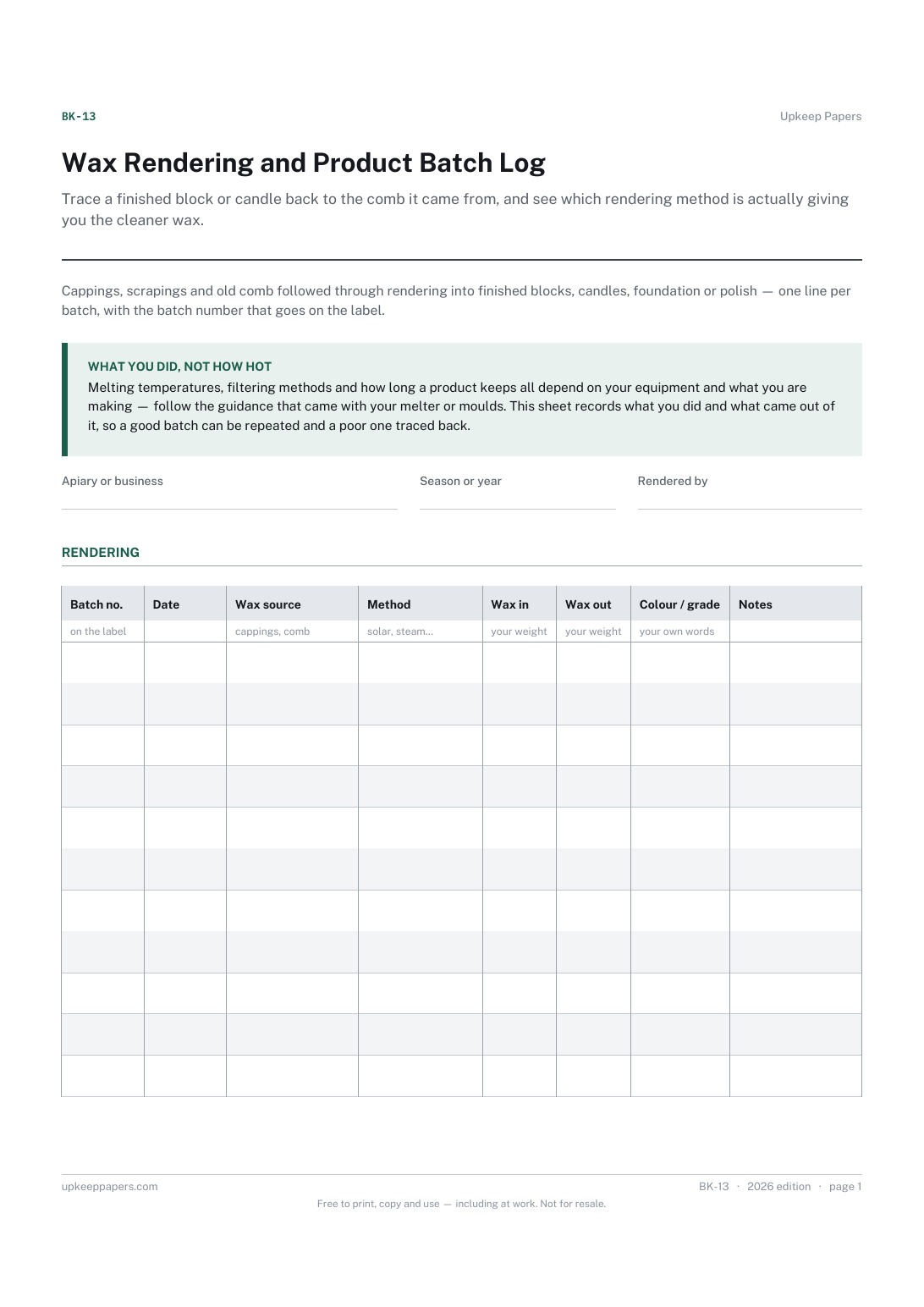
Trace a finished block or candle back to the comb it came from, and see which rendering method is actually giving you the cleaner wax.
Beekeepers rendering their own cappings and comb, and anyone selling blocks, candles, polish or foundation made from their own wax.
2 pages, in this order:
Printed under the title: Cappings, scrapings and old comb followed through rendering into finished blocks, candles, foundation or polish — one line per batch, with the batch number that goes on the label.
What you did, not how hot. Melting temperatures, filtering methods and how long a product keeps all depend on your equipment and what you are making — follow the guidance that came with your melter or moulds. This sheet records what you did and what came out of it, so a good batch can be repeated and a poor one traced back.
Write-on lines: Apiary or business · Season or year · Rendered by
Table, 11 rows: Batch no. · Date · Wax source · Method · Wax in · Wax out · Colour / grade · Notes
Table, 21 rows: Batch no. · Made into · Number made · Date finished · Stored or sold · Notes
Because it depends on your melter, your filter and what you are making, and beeswax is easy to spoil with heat. Follow the guidance that came with your equipment and write down what you actually did, which is what makes a good batch repeatable.
Because one rendering often becomes several things on several different days. Splitting them means the batch line stays as it was written, and each product carries the batch number back to it.
Record the harvest hive by hive with a batch code, which is what makes traceability possible if a jar is ever queried.
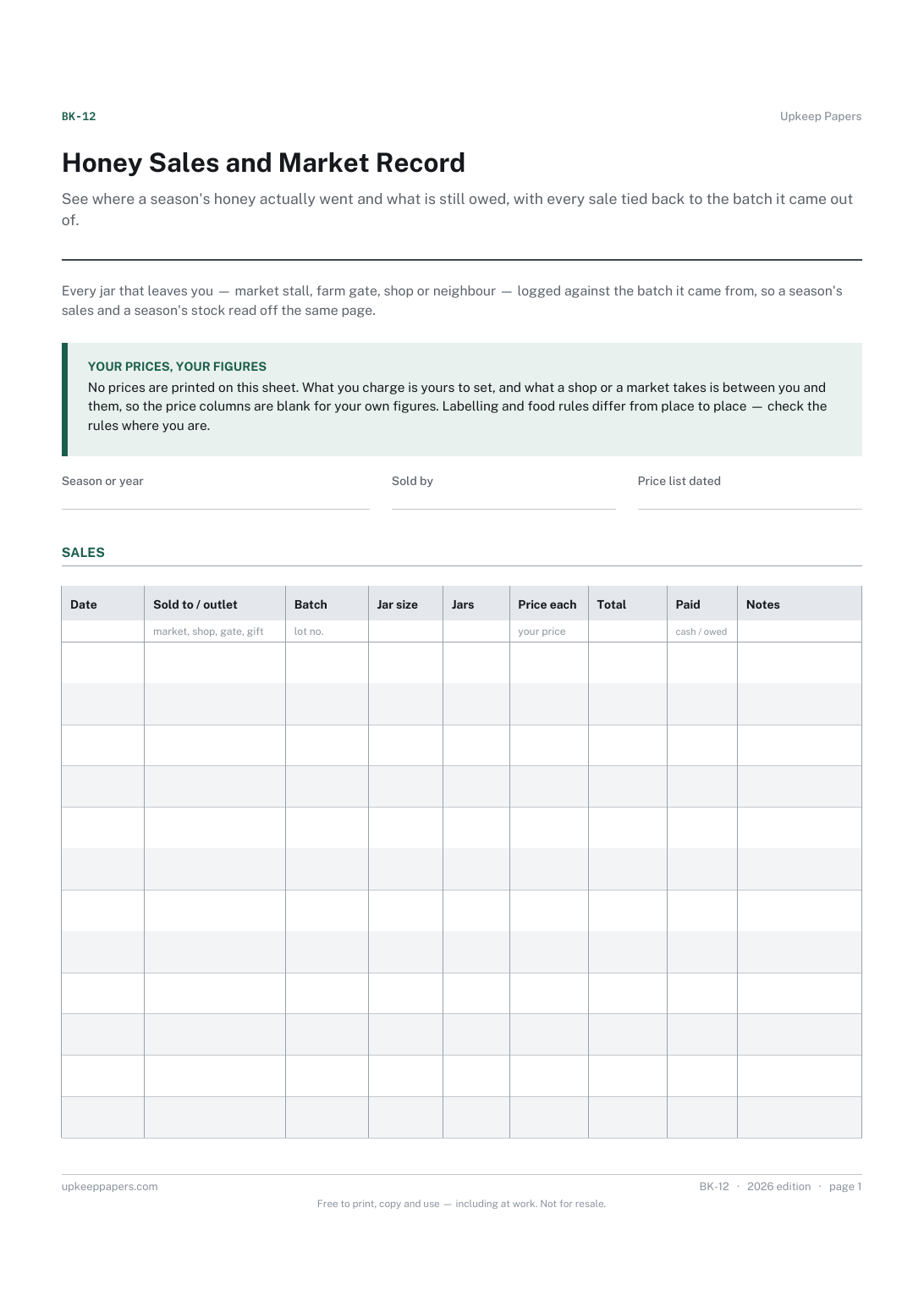
See where a season's honey actually went and what is still owed, with every sale tied back to the batch it came out of.
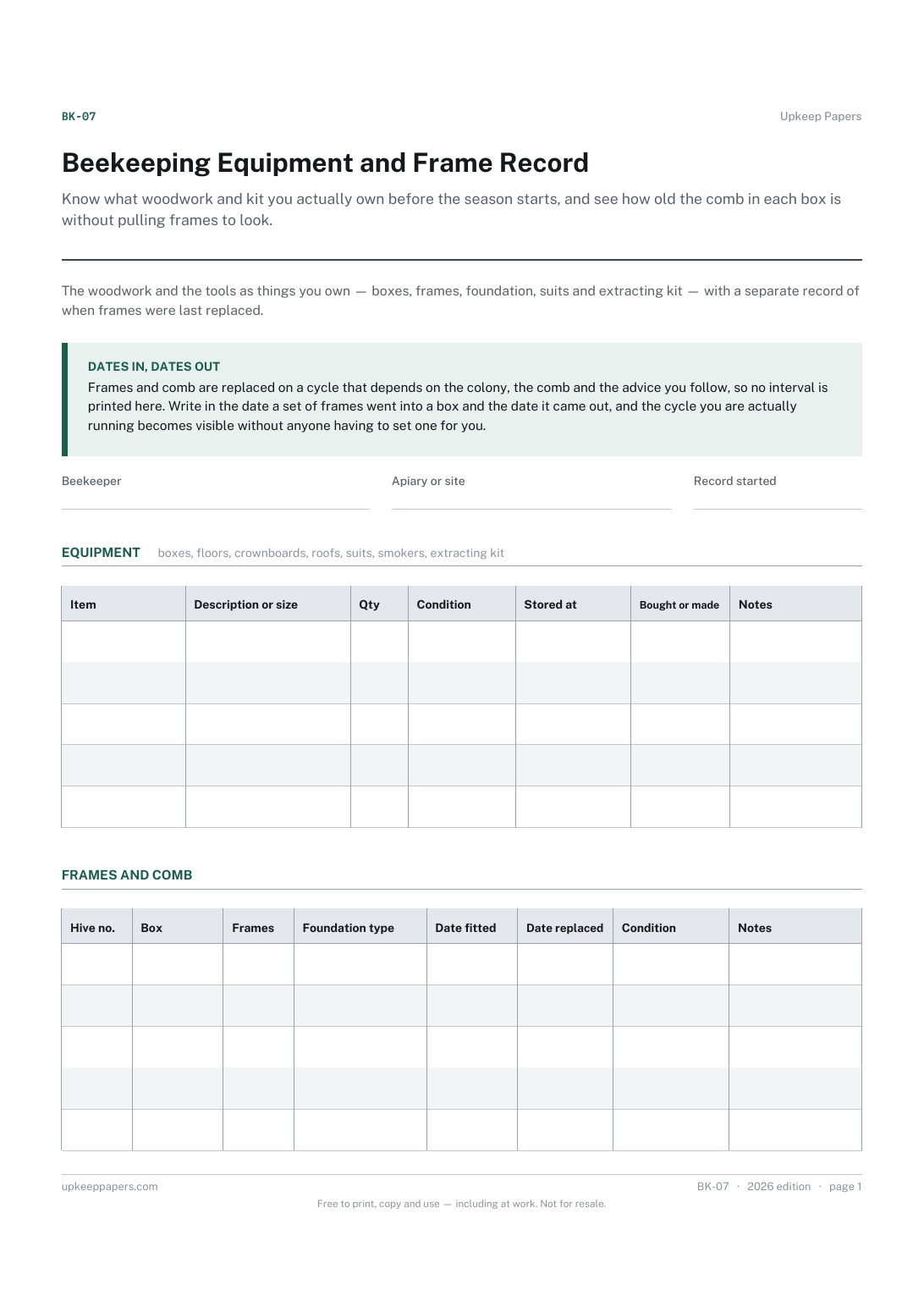
Know what woodwork and kit you actually own before the season starts, and see how old the comb in each box is without pulling frames to look.
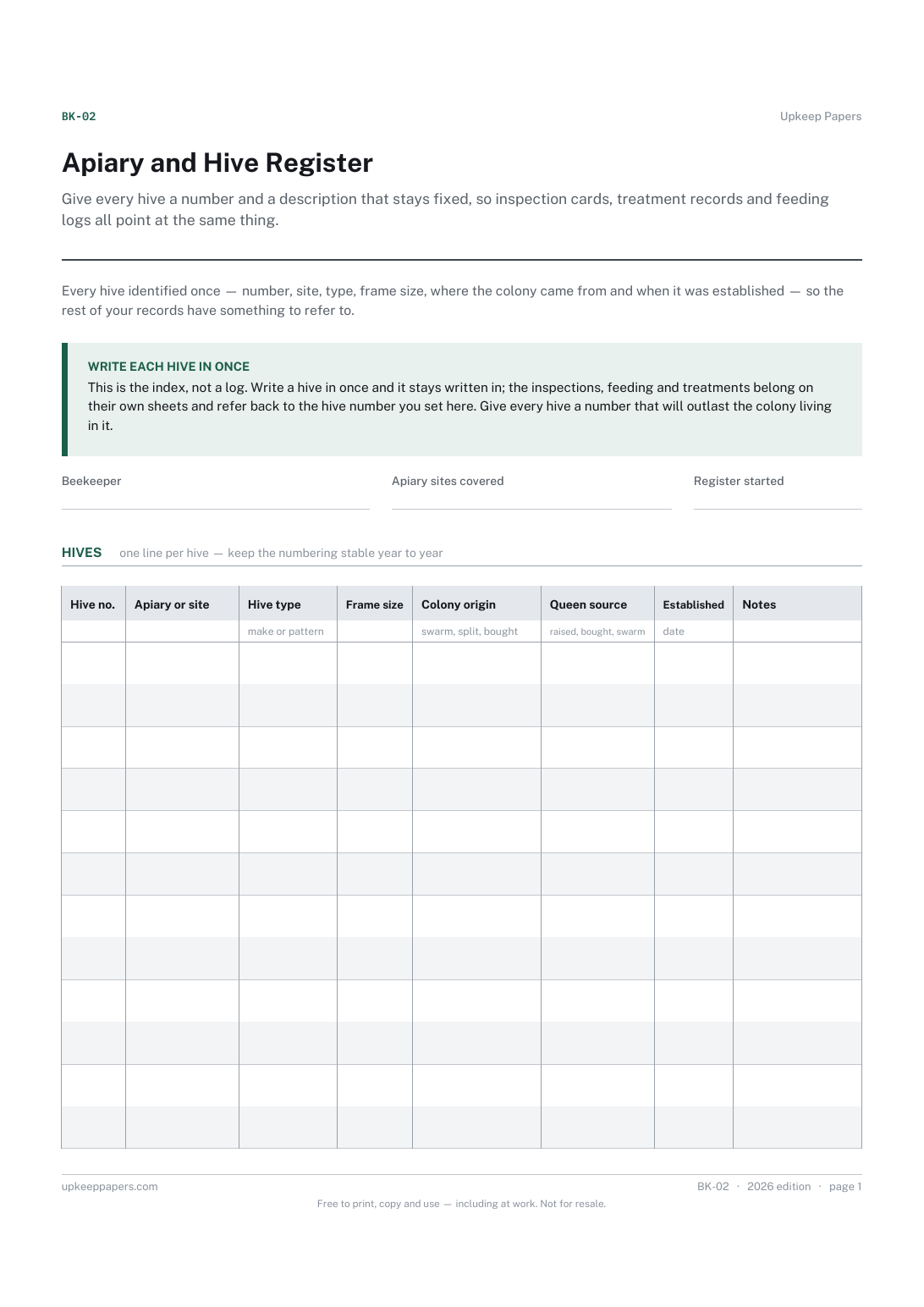
Give every hive a number and a description that stays fixed, so inspection cards, treatment records and feeding logs all point at the same thing.

Every sheet, binder, game and puzzle on Upkeep Papers is free to download, with no email and no account. Making them is not free: each one takes days of research, design and checking, and the site costs money to run. If something here saved you time, you can buy us a coffee. It is entirely optional: nothing is locked, and nothing changes if you don’t.
Buy us a coffee Opens PayPal in a new tab. Any amount, and nothing changes if you would rather not.