Swarm and Queen Cell Record
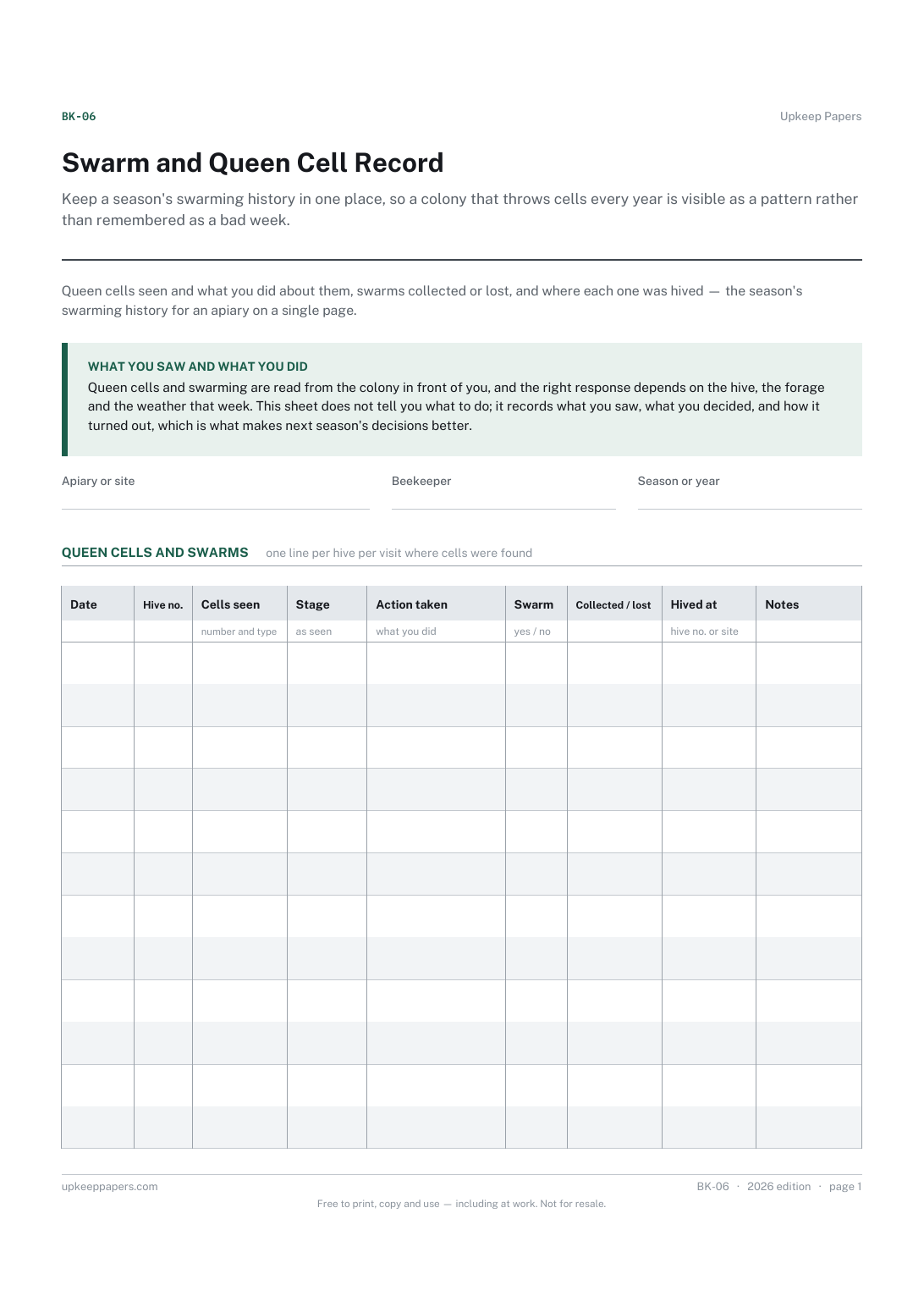
Keep a season's swarming history in one place, so a colony that throws cells every year is visible as a pattern rather than remembered as a bad week.
BK-06 1 page
Everything here is free. Making it takes time and money. Everything here is free.
 Buy us a coffee
Beekeeping · BK-17
A free printable swarm call log for collectors: every call from the public with the questions to ask, then each swarm collected, where it was hived and follow-up.
2 pages. Choose your paper size — both versions are laid out identically, so neither one gets shrunk to fit.
Print it and write on it
Fill it in type and save
The fillable versions have real form fields — open them in any PDF reader, type into them and save. Printing help.
Keep every swarm call in one place, including the ones that turn out to be bumblebees. The log shows which calls were worth the trip, where each swarm went, and who the rest were passed to.
Swarm collectors, association swarm coordinators and any beekeeper whose number is given out to the public in swarm season.
2 pages, in this order:
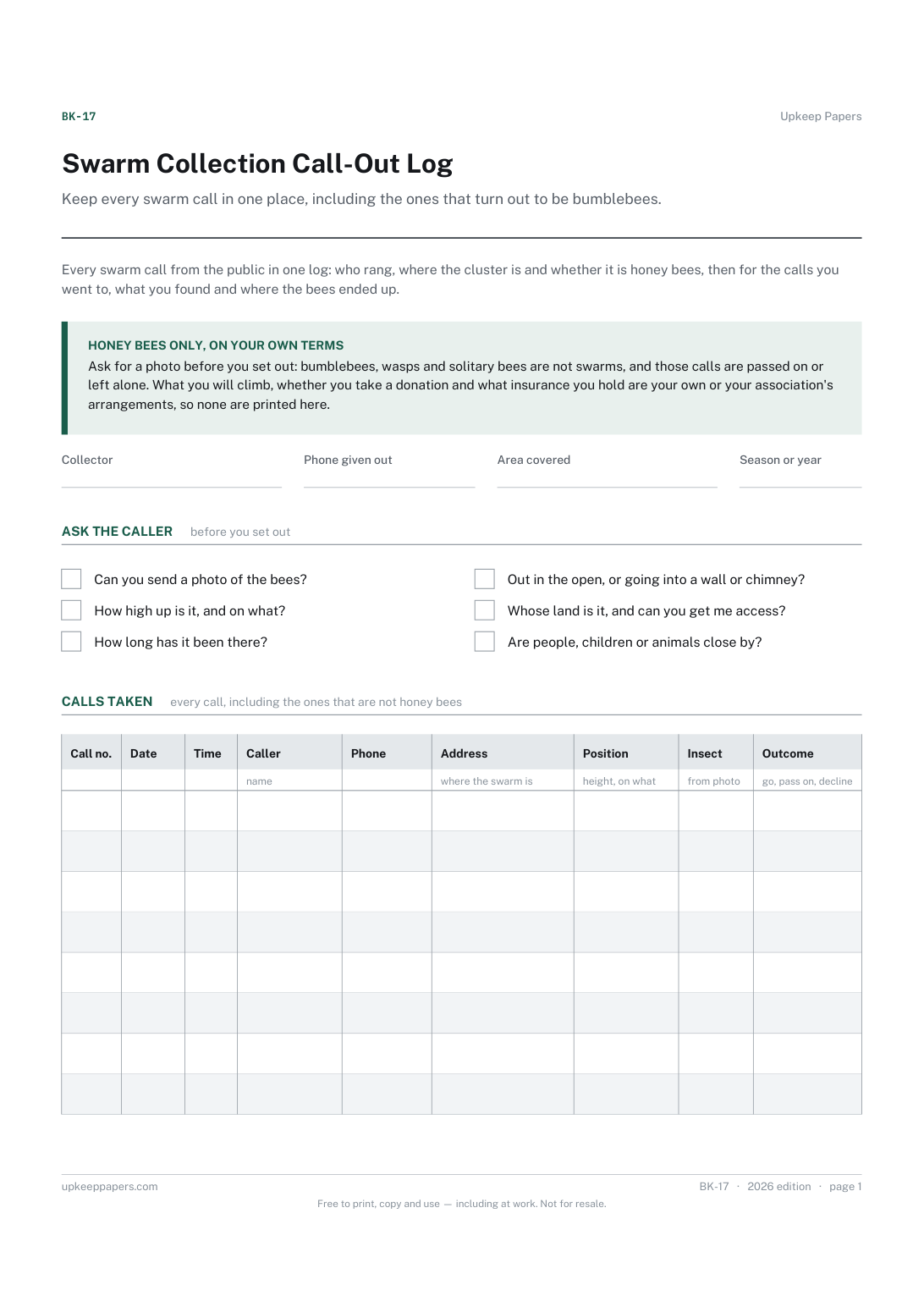
Printed under the title: Every swarm call from the public in one log: who rang, where the cluster is and whether it is honey bees, then for the calls you went to, what you found and where the bees ended up.
Honey bees only, on your own terms. Ask for a photo before you set out: bumblebees, wasps and solitary bees are not swarms, and those calls are passed on or left alone. What you will climb, whether you take a donation and what insurance you hold are your own or your association's arrangements, so none are printed here.
Write-on lines: Collector · Phone given out · Area covered · Season or year
Table, 13 rows: Call no. · Date · Time · Caller · Phone · Address · Position · Insect · Outcome
Table, 8 rows: Call no. · Arrived · Size · Collected · Hived at · Hive no. · Time & travel · Donation · Follow-up
Table, 3 rows: Name · Covers · Phone · Takes
Because many swarm calls turn out to be bumblebees, wasps or solitary bees, which a honey bee collector does not deal with. A photo usually settles it in a minute and saves a wasted trip, and the insect column keeps a record of what each call really was.
No. Whether you ask for a donation, charge for travel or take nothing at all is your own or your association's arrangement. The donation column records what was given, not what should be.
That sheet follows your own colonies: the queen cells you found and the swarms your hives sent out. This one is for swarms other people find and ring about, which come with a caller, an address and a trip.
Keep a season's swarming history in one place, so a colony that throws cells every year is visible as a pattern rather than remembered as a bad week.
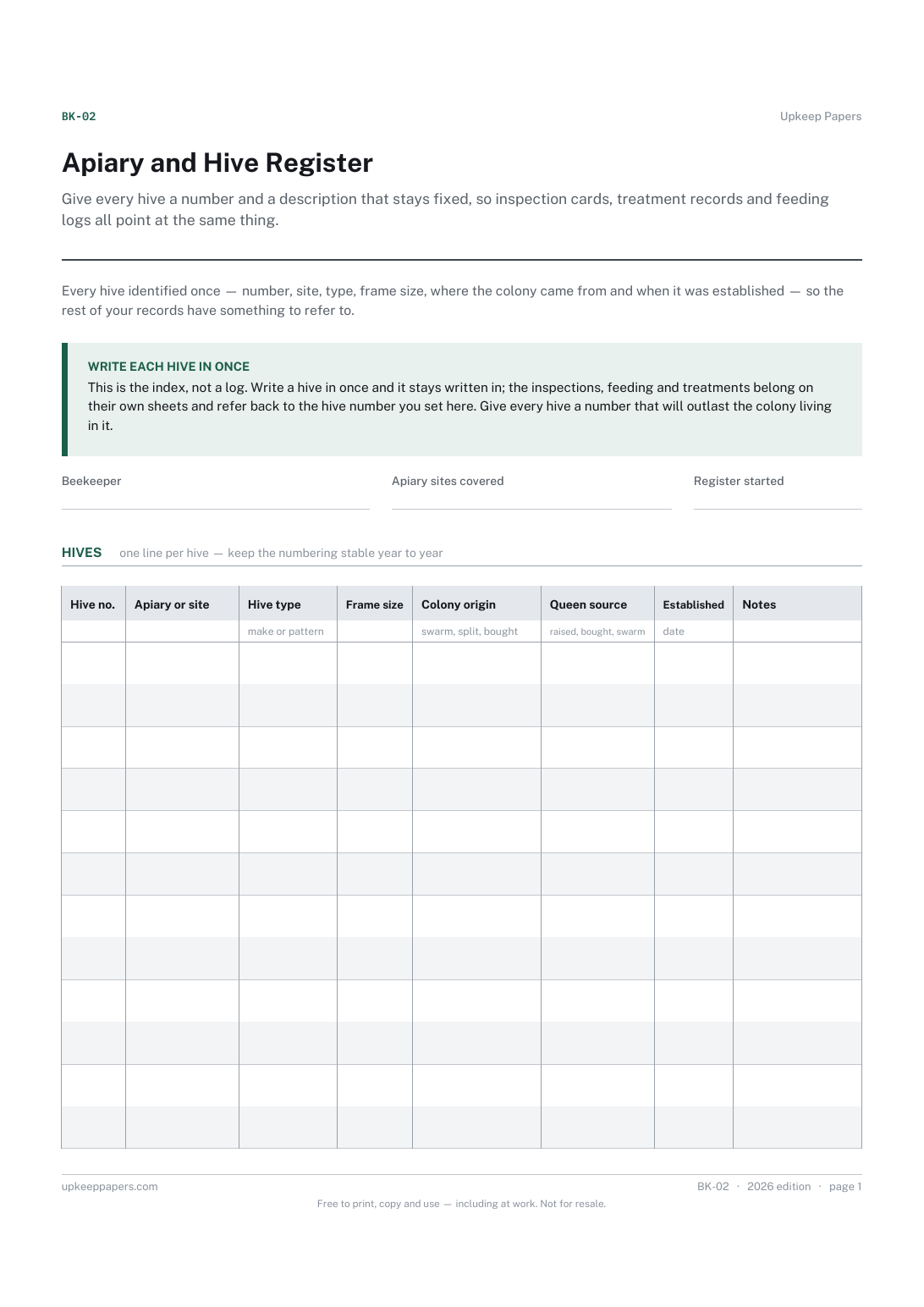
Give every hive a number and a description that stays fixed, so inspection cards, treatment records and feeding logs all point at the same thing.
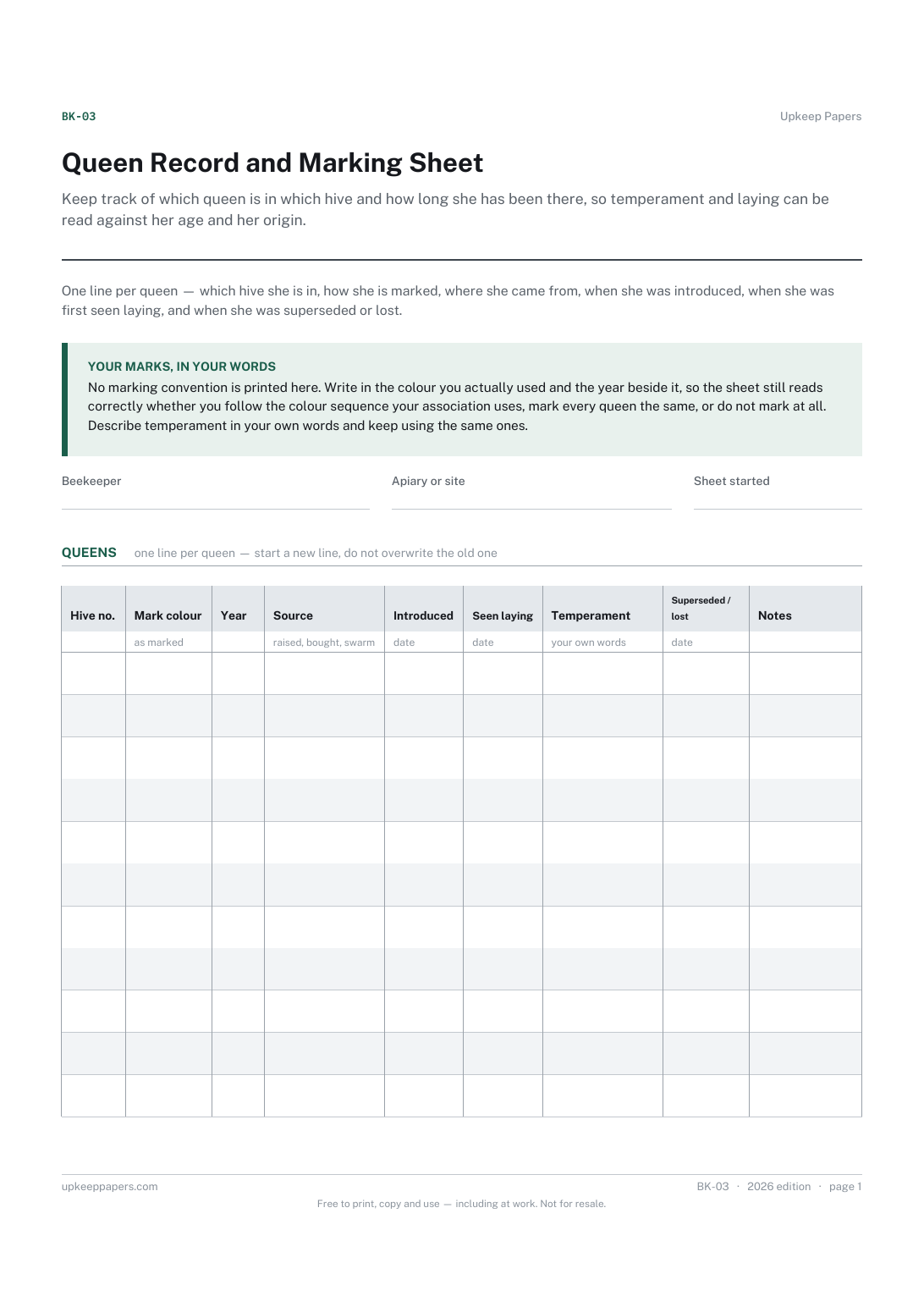
Keep track of which queen is in which hive and how long she has been there, so temperament and laying can be read against her age and her origin.
Build a run of comparable inspections for one colony, so a failing hive can be told apart from a normal one by looking at the page rather than by memory.

Every sheet, binder, game and puzzle on Upkeep Papers is free to download, with no email and no account. Making them is not free: each one takes days of research, design and checking, and the site costs money to run. If something here saved you time, you can buy us a coffee. It is entirely optional: nothing is locked, and nothing changes if you don’t.
Buy us a coffee Opens PayPal in a new tab. Any amount, and nothing changes if you would rather not.