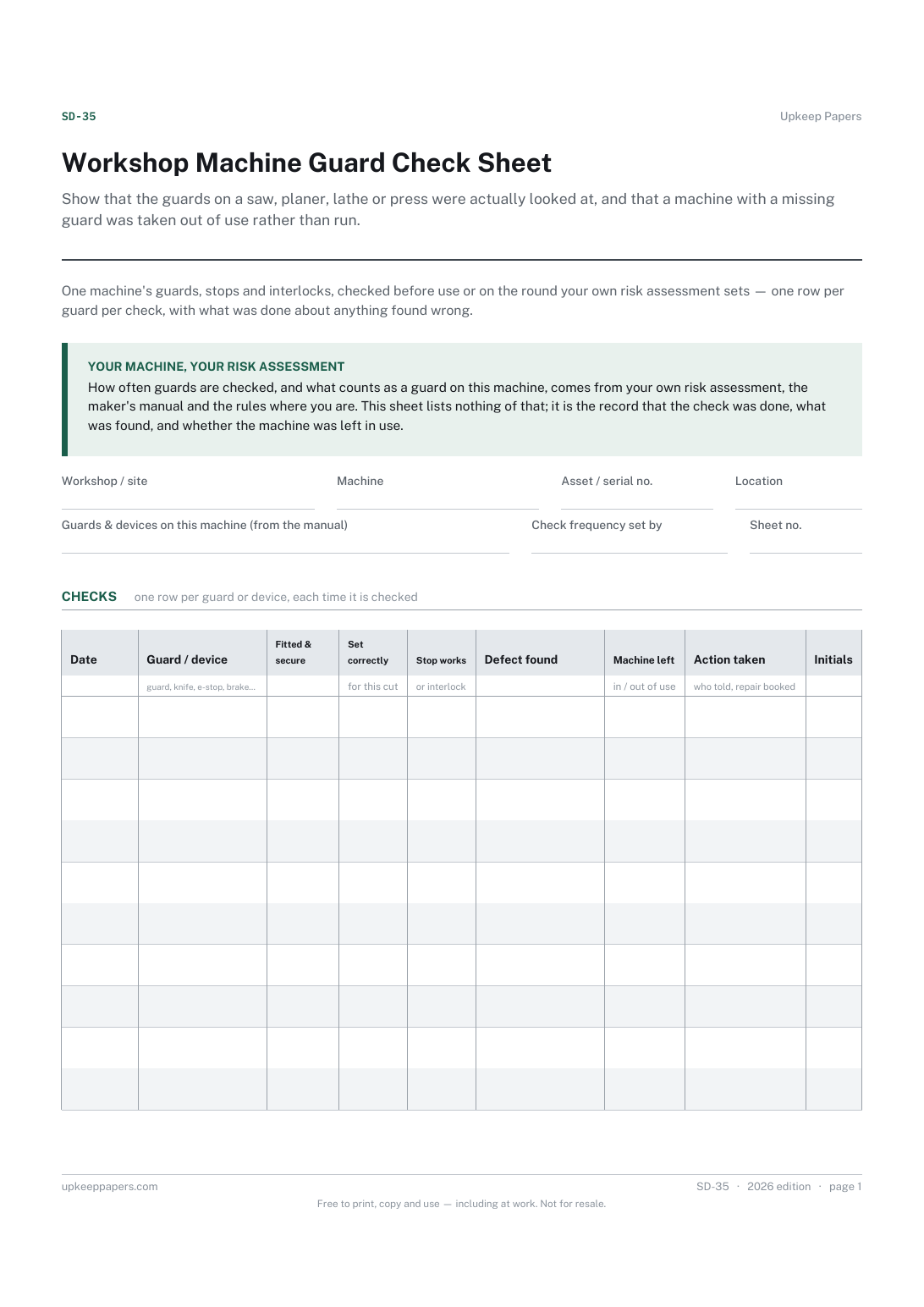
Workshop Machine Guard Check Sheet
Show that the guards on a saw, planer, lathe or press were actually looked at, and that a machine with a missing guard was taken out of use rather than run.
SD-35 1 page
Everything here is free. Making it takes time and money. Everything here is free.
 Buy us a coffee
Workshop and tools · WT-20
A free printable bench grinder record: each wheel fitted, its marked speed against the spindle, the ring test, then dated checks of rests, guards and wheels.
2 pages. Choose your paper size — both versions are laid out identically, so neither one gets shrunk to fit.
Print it and write on it
Fill it in type and save
The fillable versions have real form fields — open them in any PDF reader, type into them and save. Printing help.
Show that every wheel on the grinder was checked before it went on, and looked at since. The rest and tongue guard gaps open up as a wheel wears, and the regular checks catch them.
Workshop managers, maintenance fitters and anyone responsible for a bench or pedestal grinder in a fabrication shop, school or maintenance workshop.
2 pages, in this order:
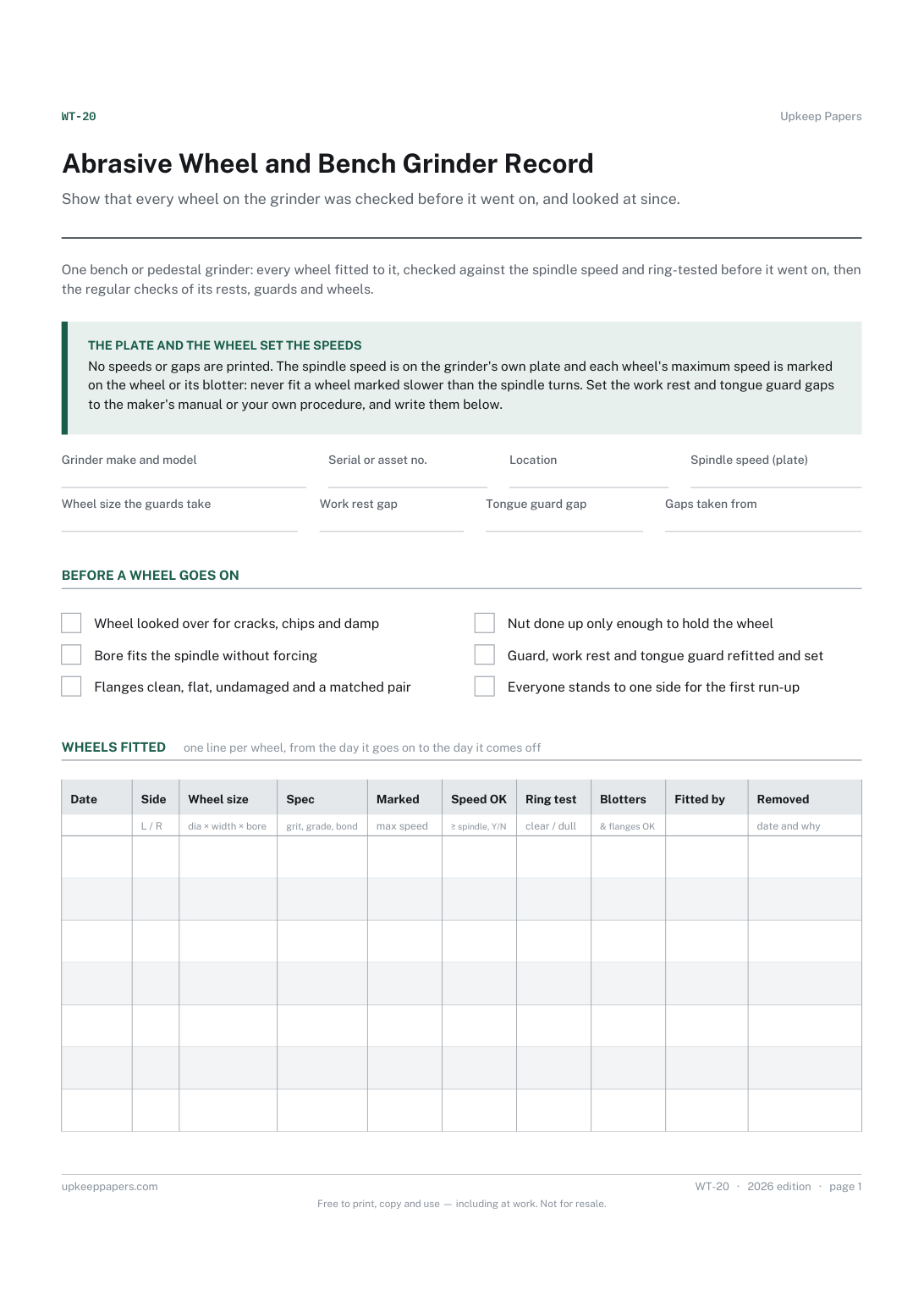
Printed under the title: One bench or pedestal grinder: every wheel fitted to it, checked against the spindle speed and ring-tested before it went on, then the regular checks of its rests, guards and wheels.
The plate and the wheel set the speeds. No speeds or gaps are printed. The spindle speed is on the grinder's own plate and each wheel's maximum speed is marked on the wheel or its blotter: never fit a wheel marked slower than the spindle turns. Set the work rest and tongue guard gaps to the maker's manual or your own procedure, and write them below.
Write-on lines: Grinder make and model · Serial or asset no. · Location · Spindle speed (plate) · Wheel size the guards take · Work rest gap · Tongue guard gap · Gaps taken from
Table, 7 rows: Date · Side · Wheel size · Spec · Marked · Speed OK · Ring test · Blotters · Fitted by · Removed
Table, 20 rows: Date · Rest · Tongue · Guards · Wheels · Dressed · Vibration · Result · Action taken · Initials
Write-on lines: Wheel or grinder taken out of use, and why · Reviewed by
Because they belong to your grinder and your wheels. The spindle speed is on the machine's plate, each wheel's maximum is marked on the wheel or its blotter, and the gaps come from the maker's manual or your own procedure. A printed number could be copied onto a machine it does not fit.
A check for hidden cracks before a wheel is fitted: the clean, dry wheel is hung free on a finger or pin and tapped lightly, and a sound vitrified wheel gives a clear ring where a cracked one sounds dull. Not every wheel can be tested this way, so follow the wheel maker's guidance.
Show that the guards on a saw, planer, lathe or press were actually looked at, and that a machine with a missing guard was taken out of use rather than run.
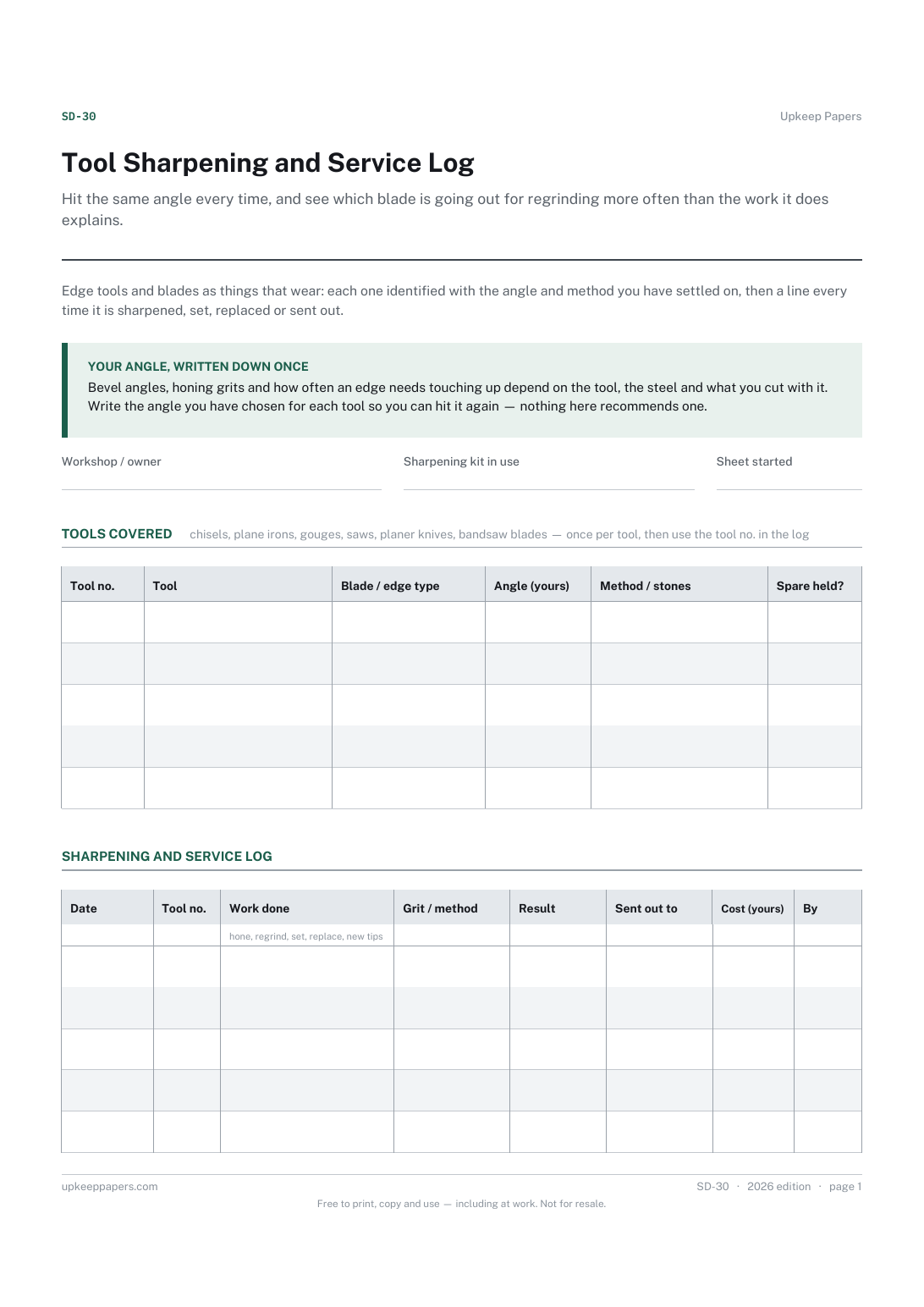
Hit the same angle every time, and see which blade is going out for regrinding more often than the work it does explains.
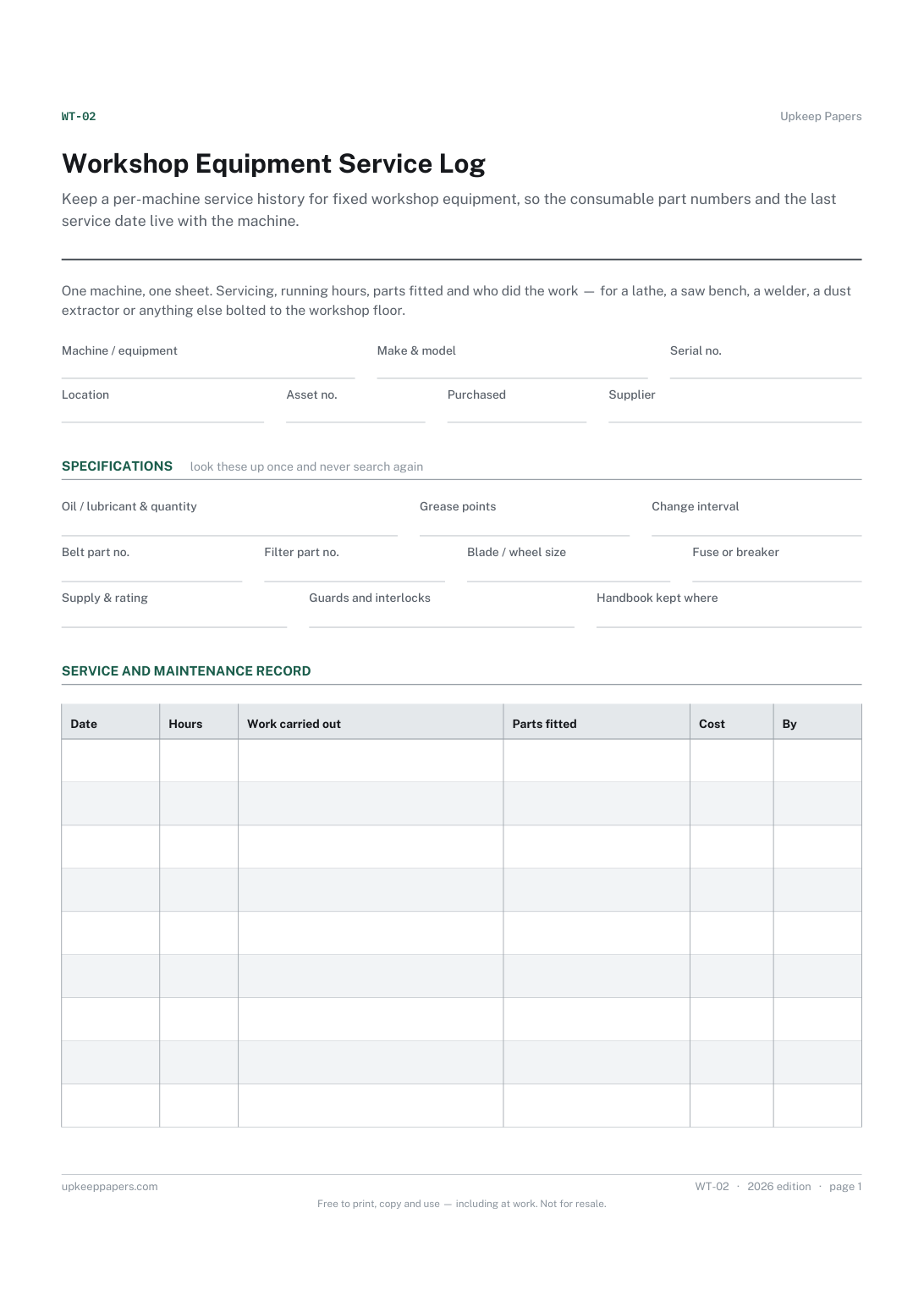
Keep a per-machine service history for fixed workshop equipment, so the consumable part numbers and the last service date live with the machine.
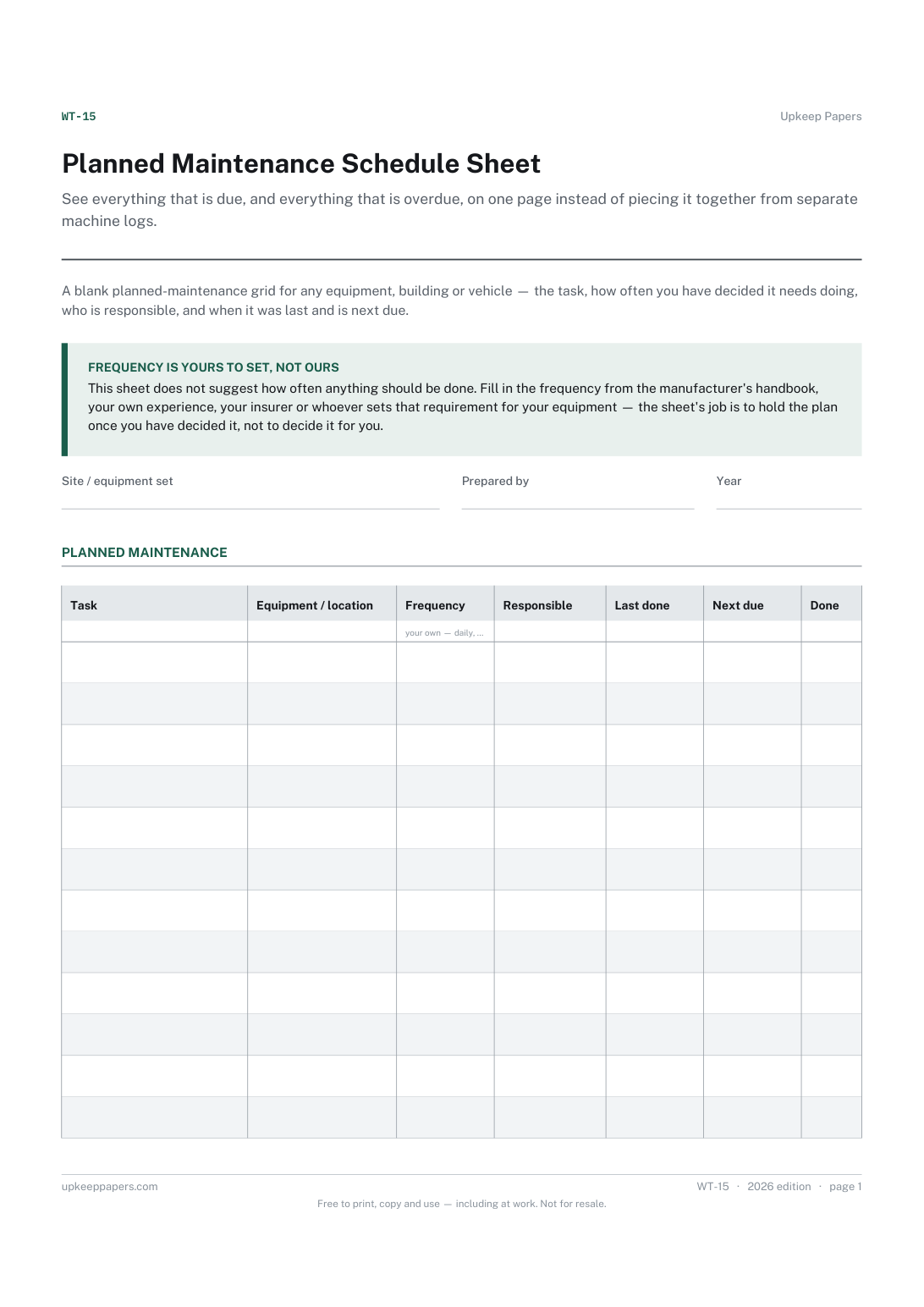
See everything that is due, and everything that is overdue, on one page instead of piecing it together from separate machine logs.

Every sheet, binder, game and puzzle on Upkeep Papers is free to download, with no email and no account. Making them is not free: each one takes days of research, design and checking, and the site costs money to run. If something here saved you time, you can buy us a coffee. It is entirely optional: nothing is locked, and nothing changes if you don’t.
Buy us a coffee Opens PayPal in a new tab. Any amount, and nothing changes if you would rather not.