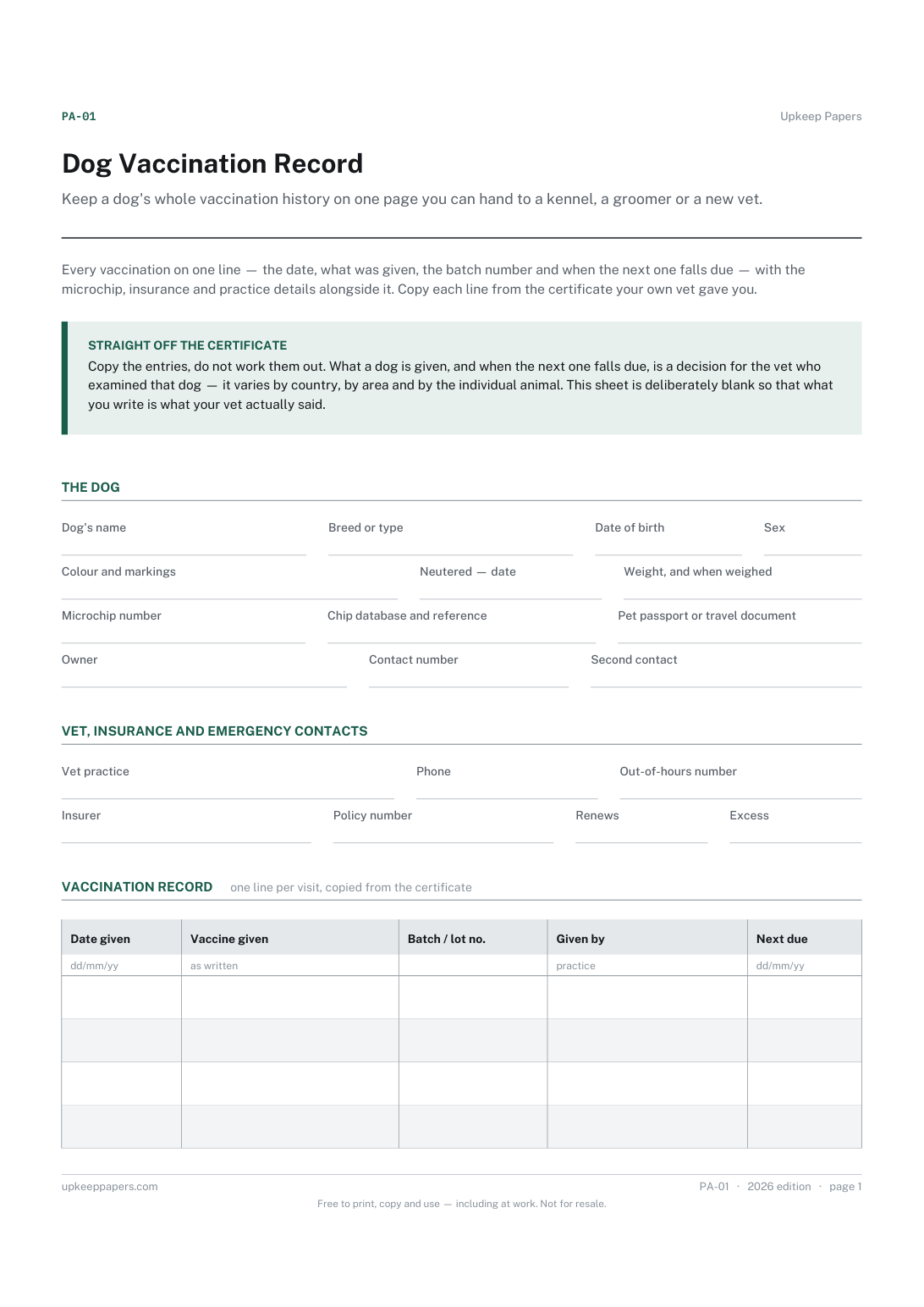
Dog Vaccination Record
Keep a dog's whole vaccination history on one page you can hand to a kennel, a groomer or a new vet. It carries the microchip and insurance details you are always asked for at the same moment.
PA-01 2 pages
Everything here is free. Making it takes time and money. Everything here is free.
 Buy us a coffee
Category
Vaccination and health records, sitter instructions and the emergency details somebody else would need if you were not there.
A vet's records live in the practice's computer, and most of what a sitter needs to know lives in somebody's head. These sheets put both on paper and leave them blank, because what a particular animal needs is a conversation with your own vet — this is somewhere to write down what they told you.
Keep a dog's whole vaccination history on one page you can hand to a kennel, a groomer or a new vet. It carries the microchip and insurance details you are always asked for at the same moment.
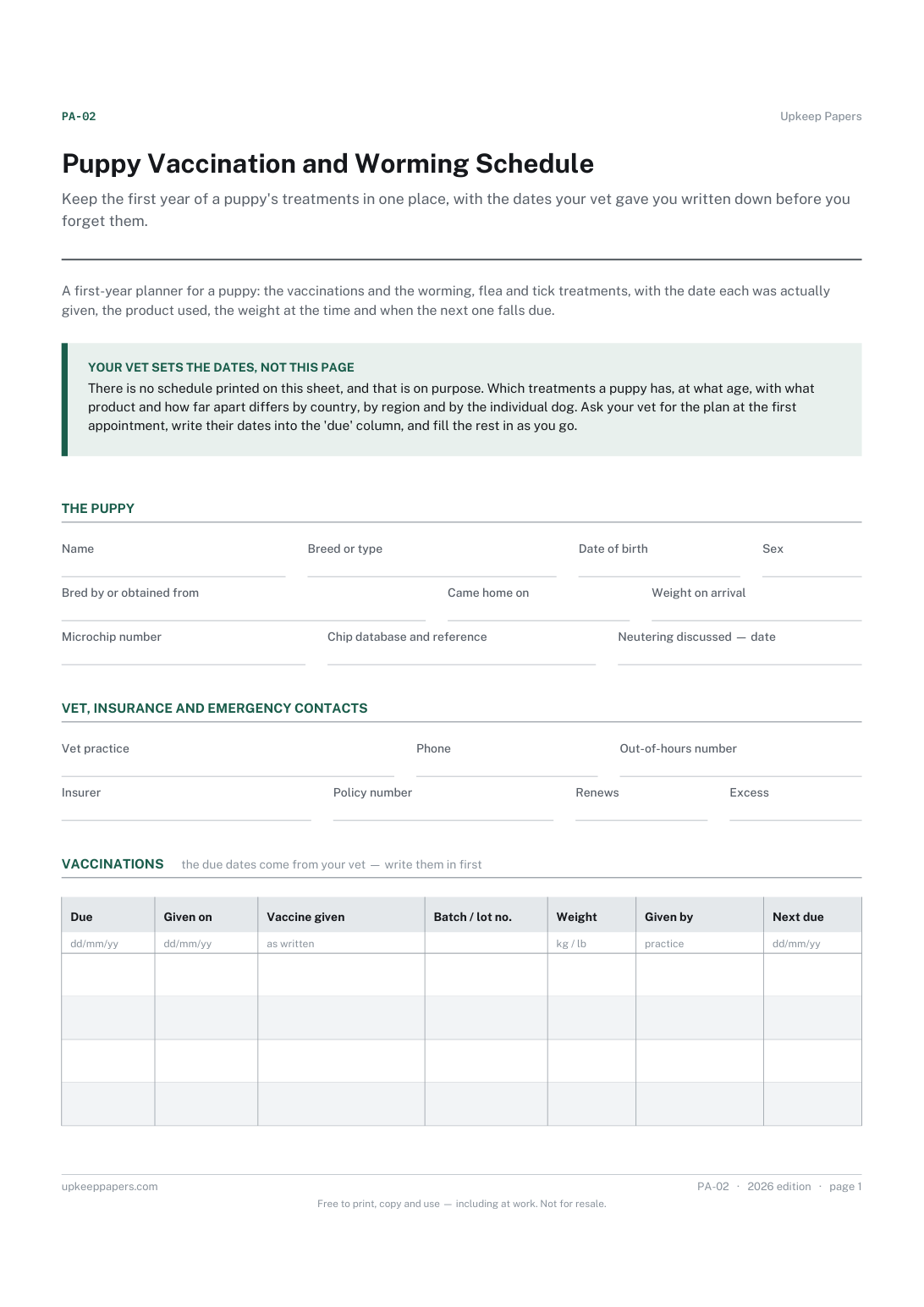
Keep the first year of a puppy's treatments in one place, with the dates your vet gave you written down before you forget them. The weight at each treatment is worth recording too, because a puppy's changes week to week and nobody remembers it afterwards.
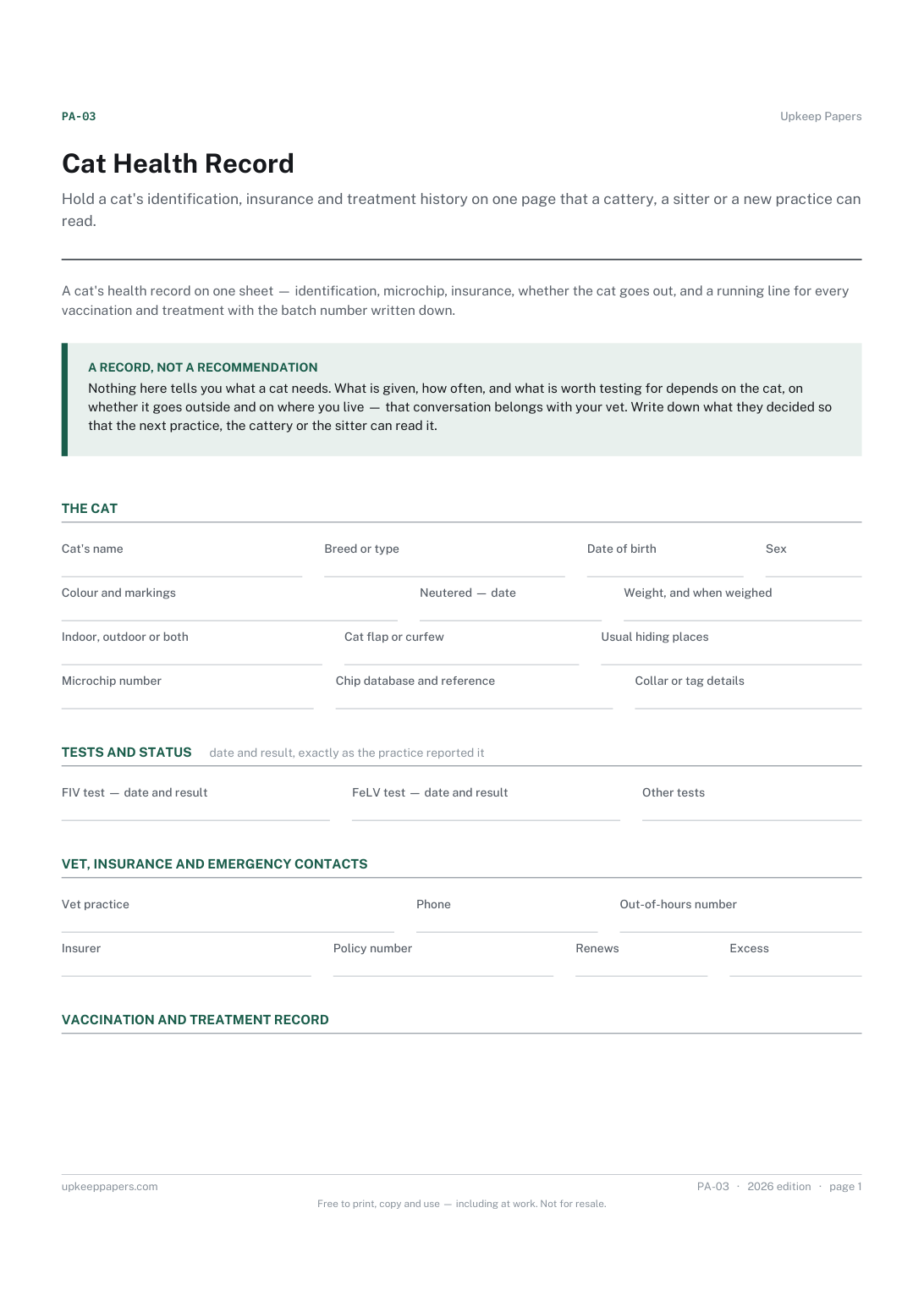
Hold a cat's identification, insurance and treatment history on one page that a cattery, a sitter or a new practice can read. It has room for the things that are specific to cats and get left off general pet forms.
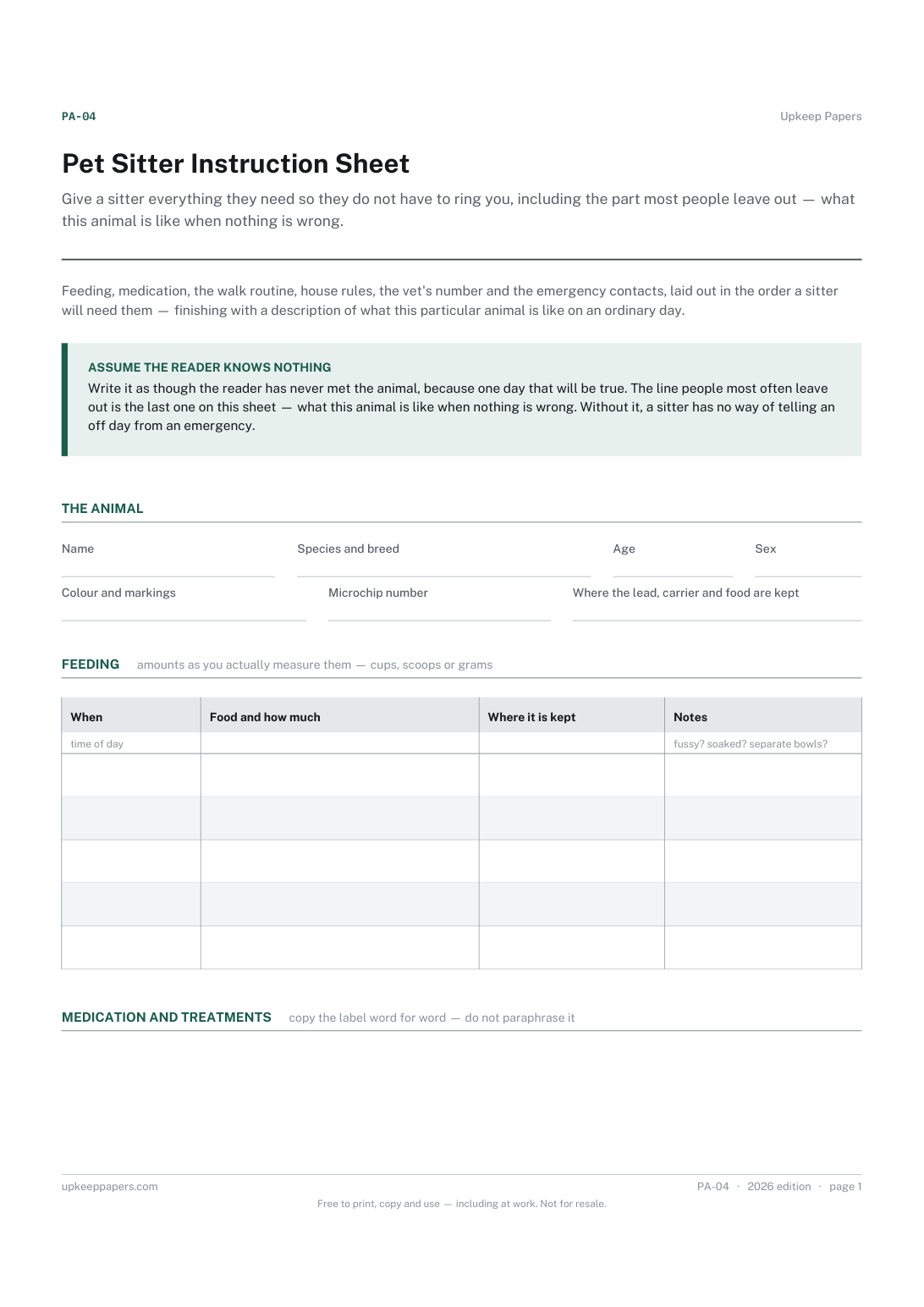
Give a sitter everything they need so they do not have to ring you, including the part most people leave out — what this animal is like when nothing is wrong.
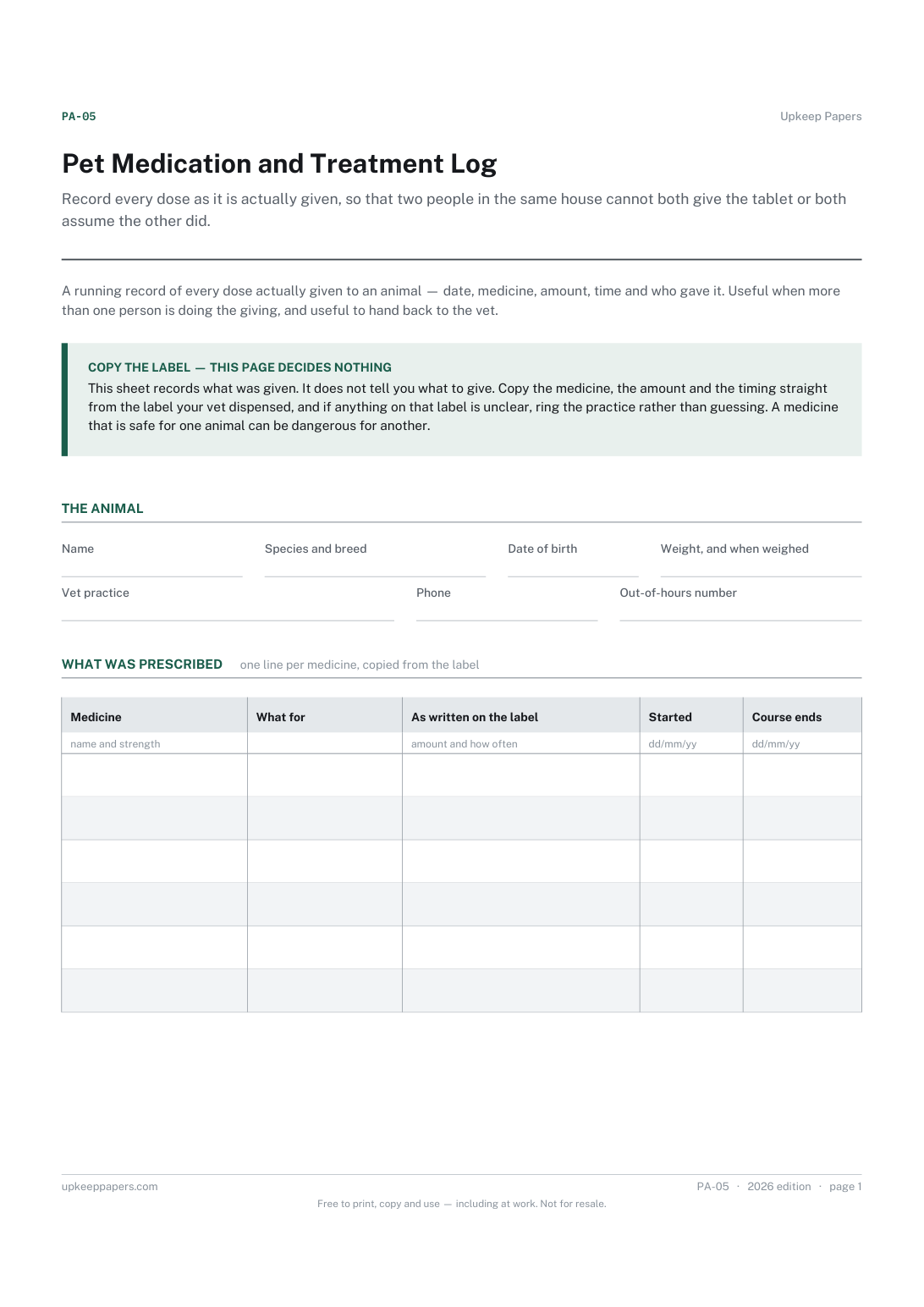
Record every dose as it is actually given, so that two people in the same house cannot both give the tablet or both assume the other did. It also gives your vet something factual to read at the follow-up.
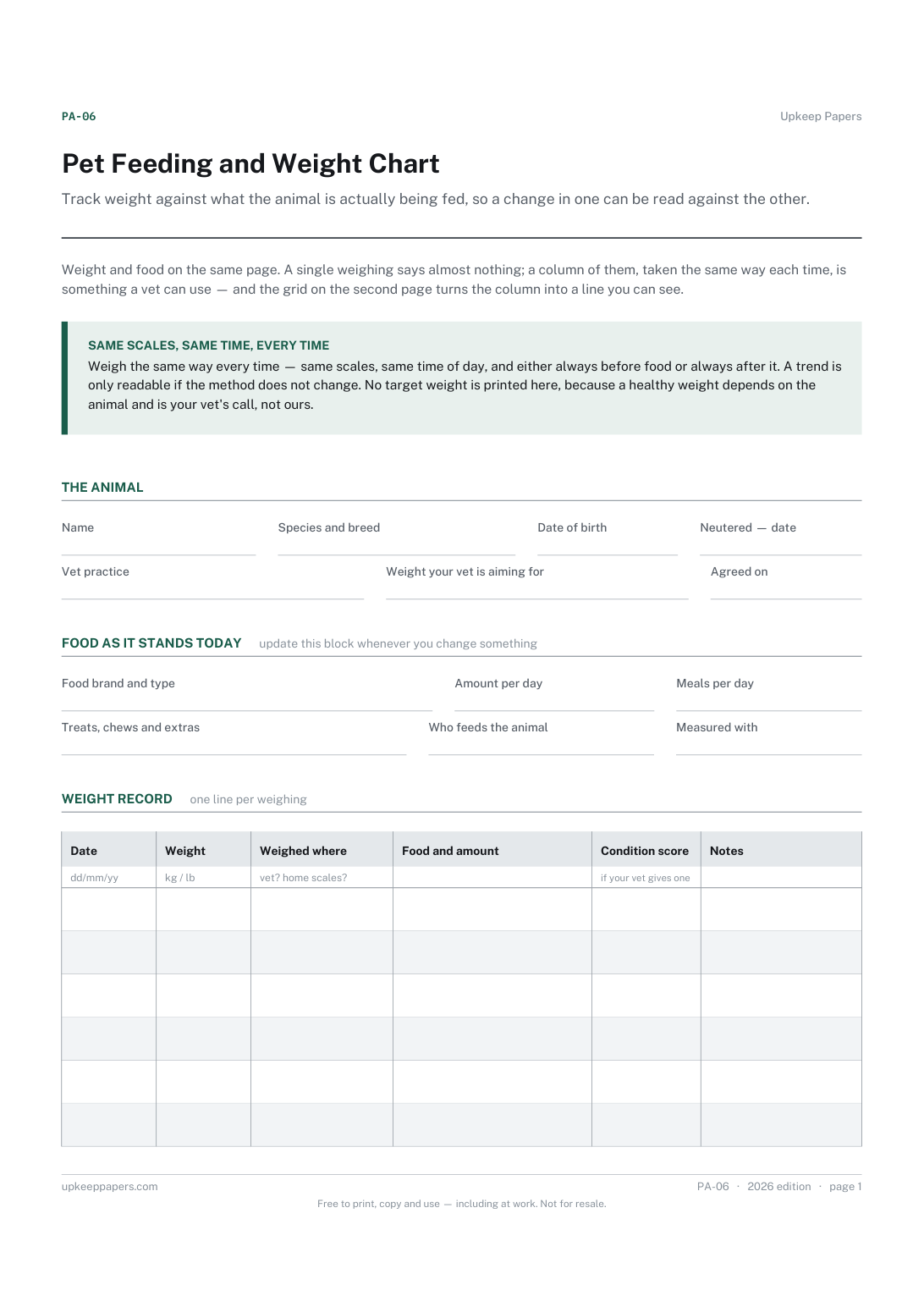
Track weight against what the animal is actually being fed, so a change in one can be read against the other. A single weighing tells you very little; a column of them taken the same way each time is something a vet can use.
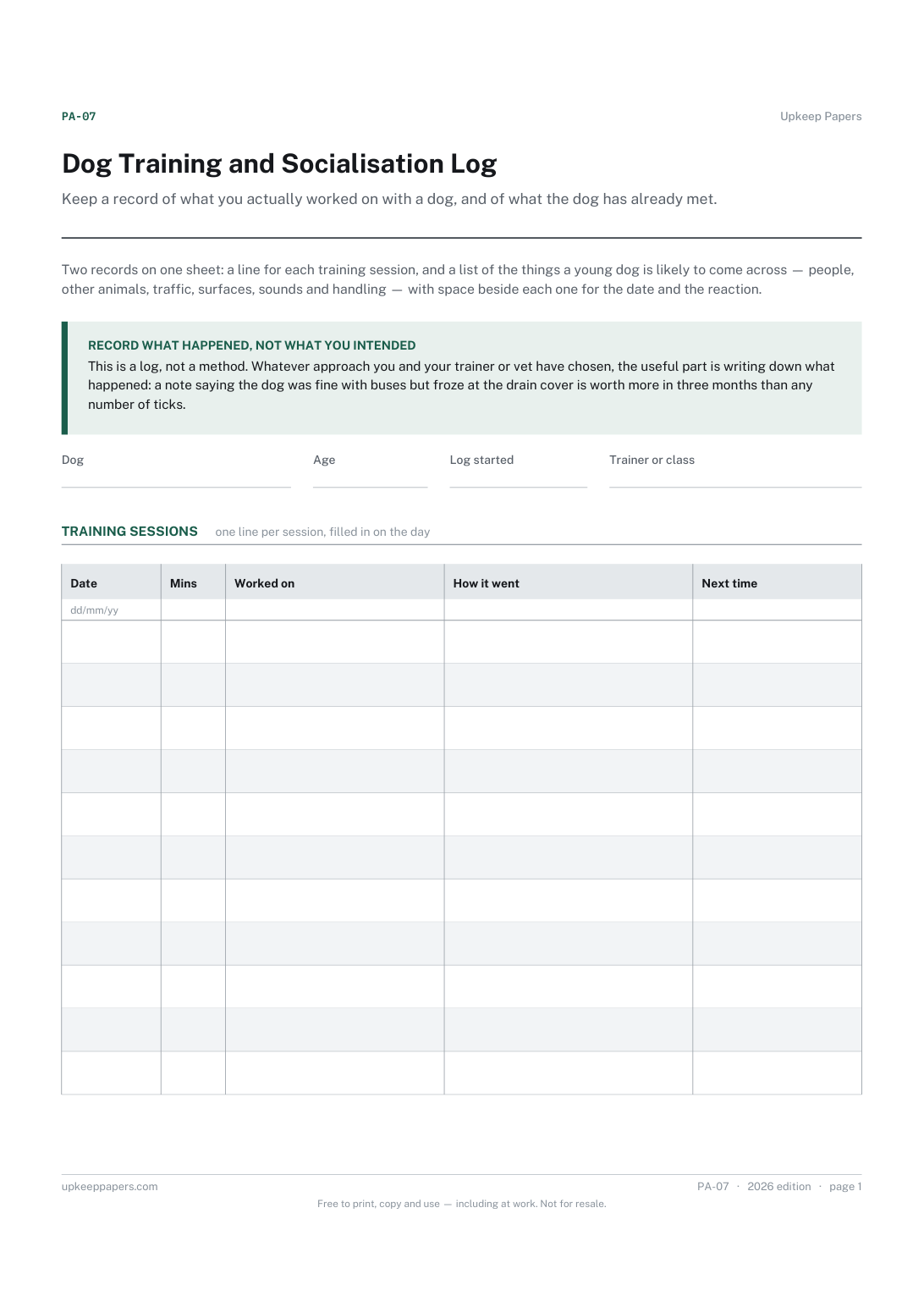
Keep a record of what you actually worked on with a dog, and of what the dog has already met. The notes column is the point — a reaction written down at the time is worth more later than a tick.
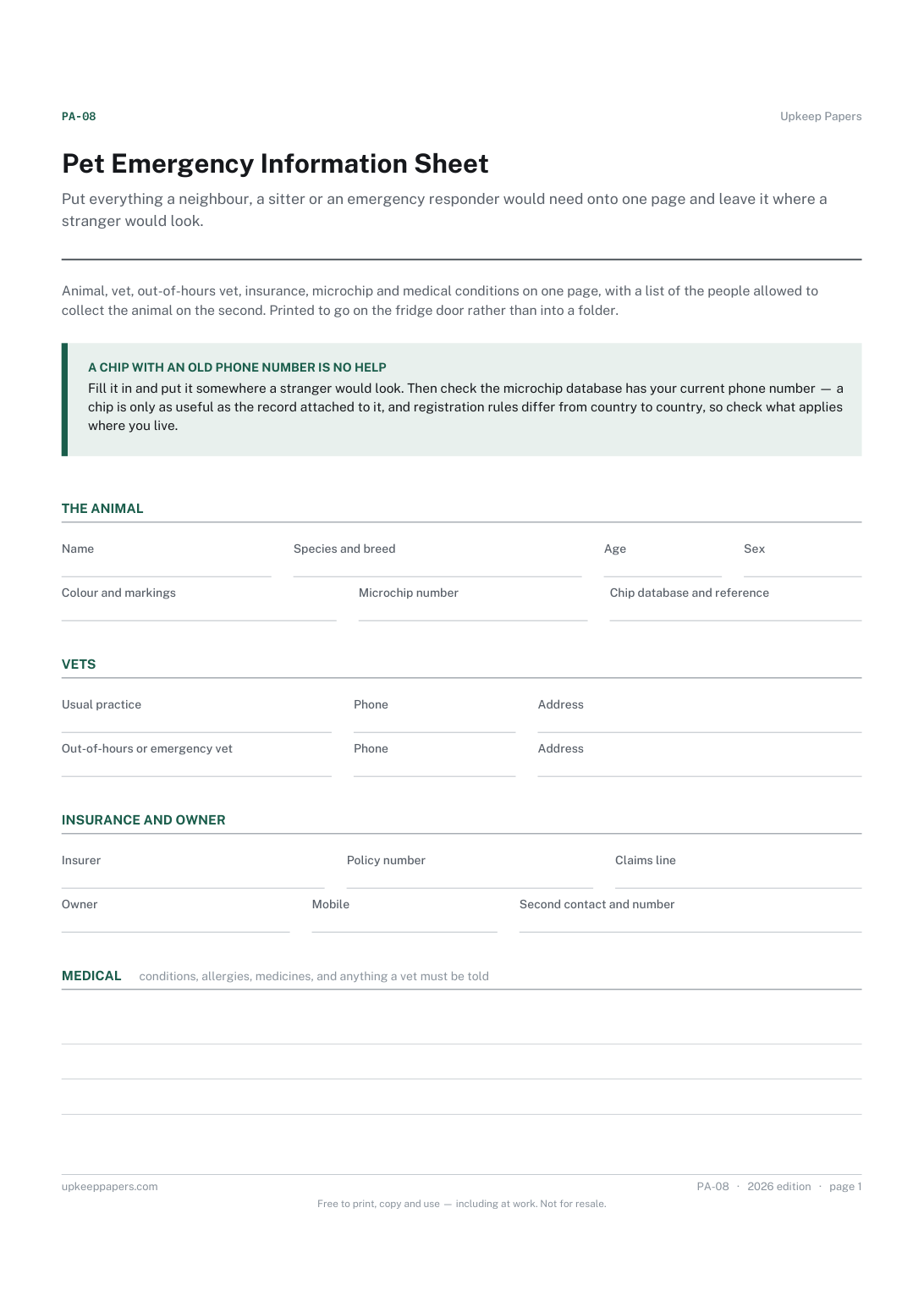
Put everything a neighbour, a sitter or an emergency responder would need onto one page and leave it where a stranger would look. It answers the questions that get asked when you are not there to be asked.
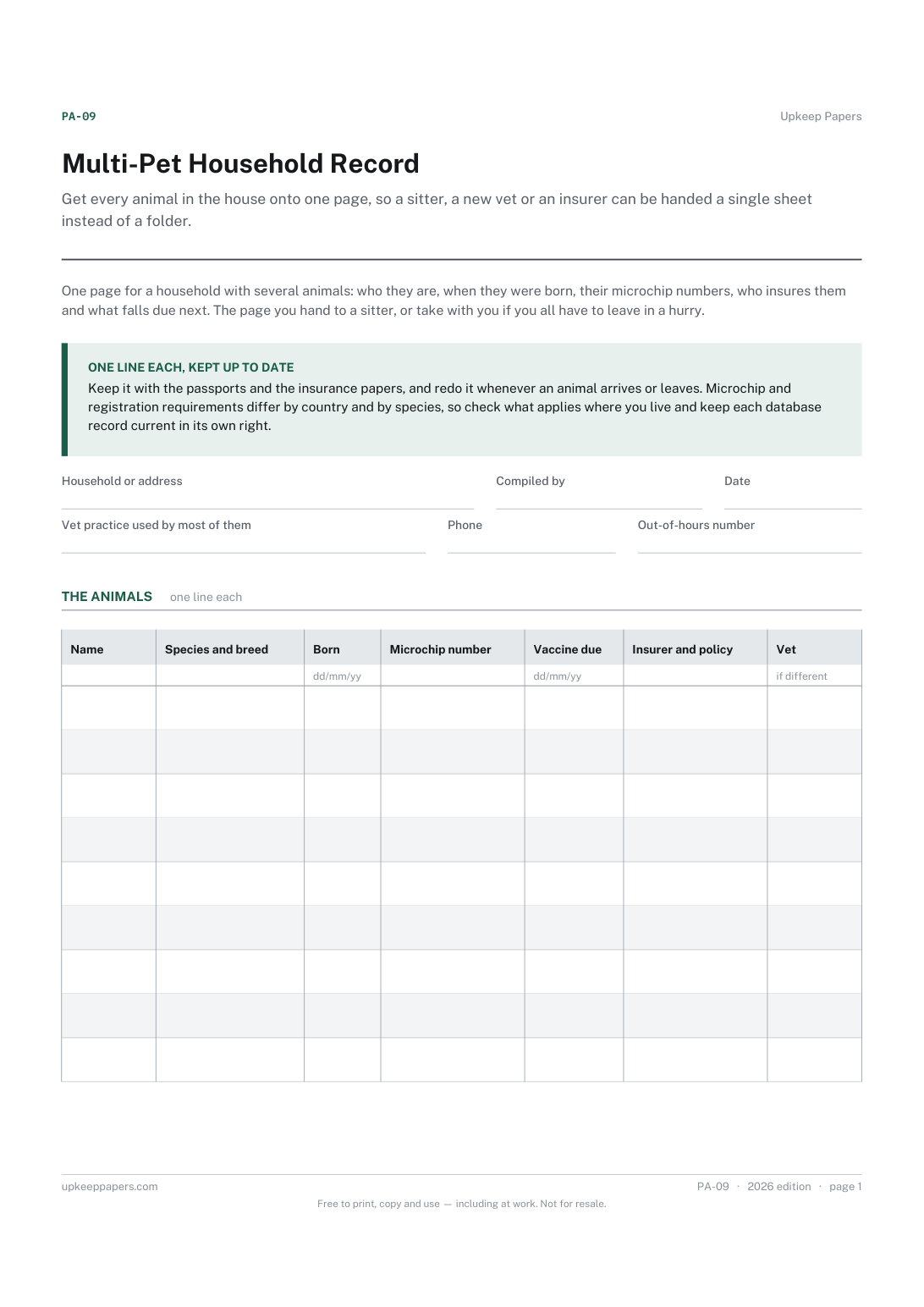
Get every animal in the house onto one page, so a sitter, a new vet or an insurer can be handed a single sheet instead of a folder. It also carries the feeding and medication detail that stops the wrong bowl going to the wrong animal.
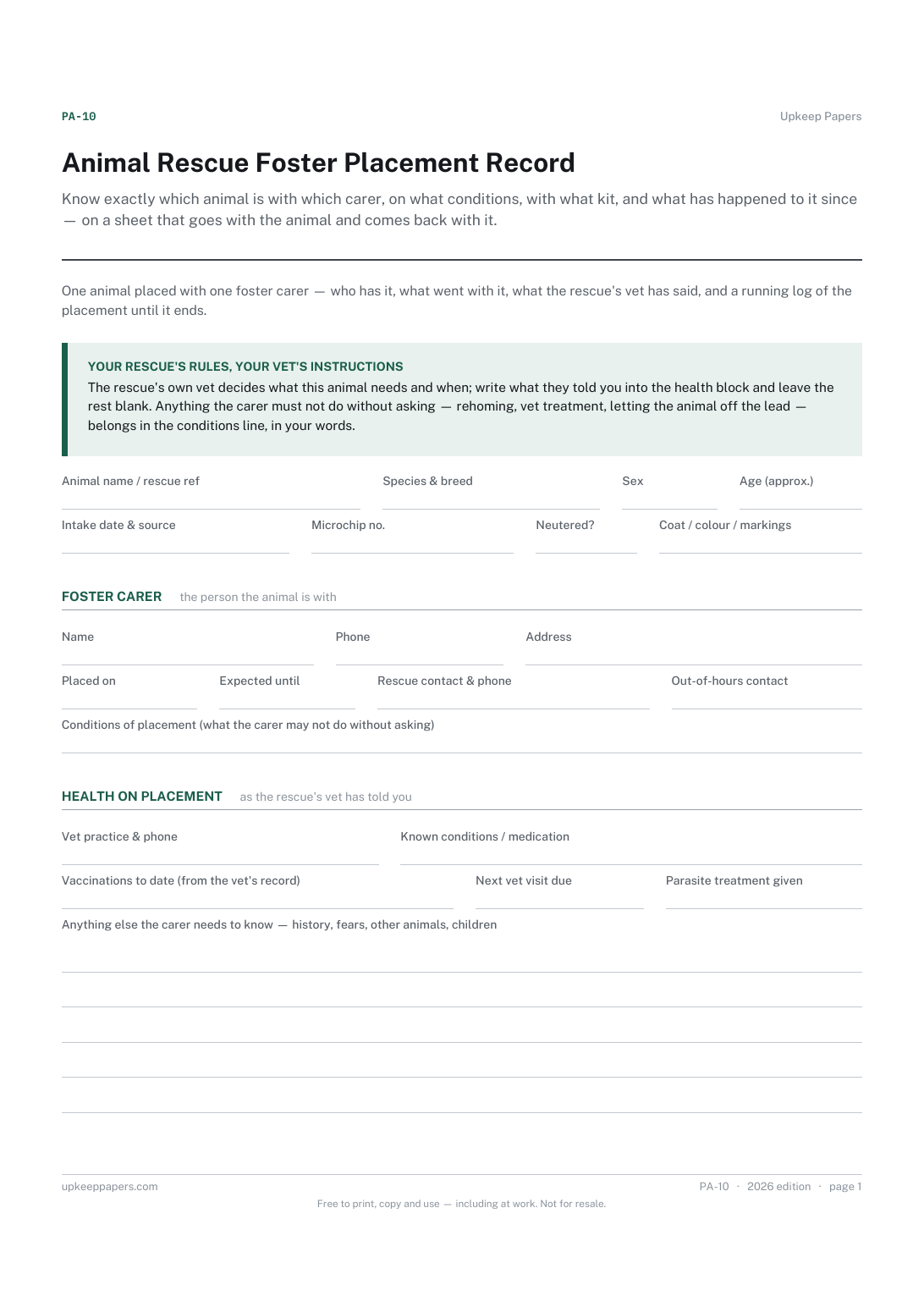
Know exactly which animal is with which carer, on what conditions, with what kit, and what has happened to it since — on a sheet that goes with the animal and comes back with it.
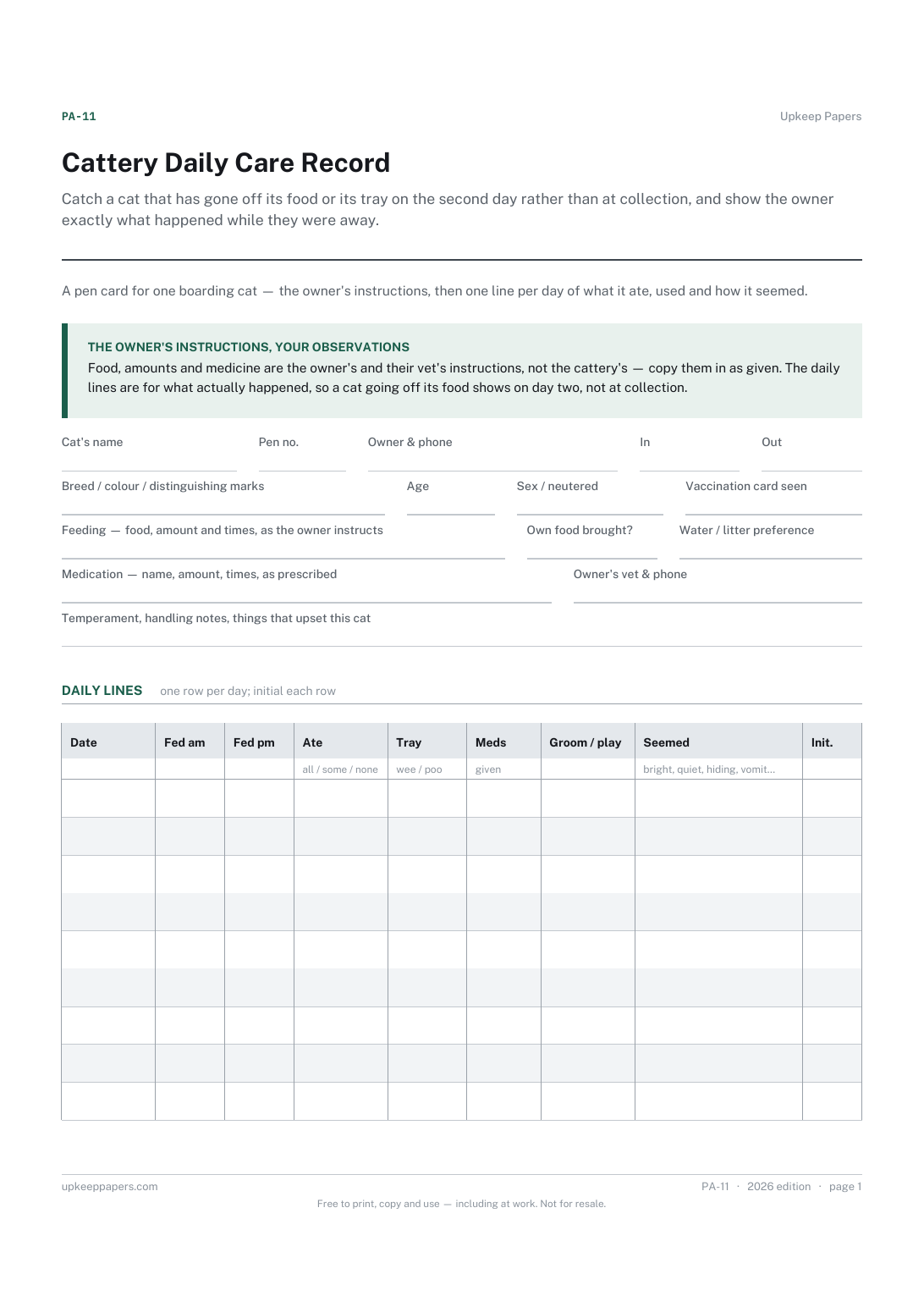
Catch a cat that has gone off its food or its tray on the second day rather than at collection, and show the owner exactly what happened while they were away.
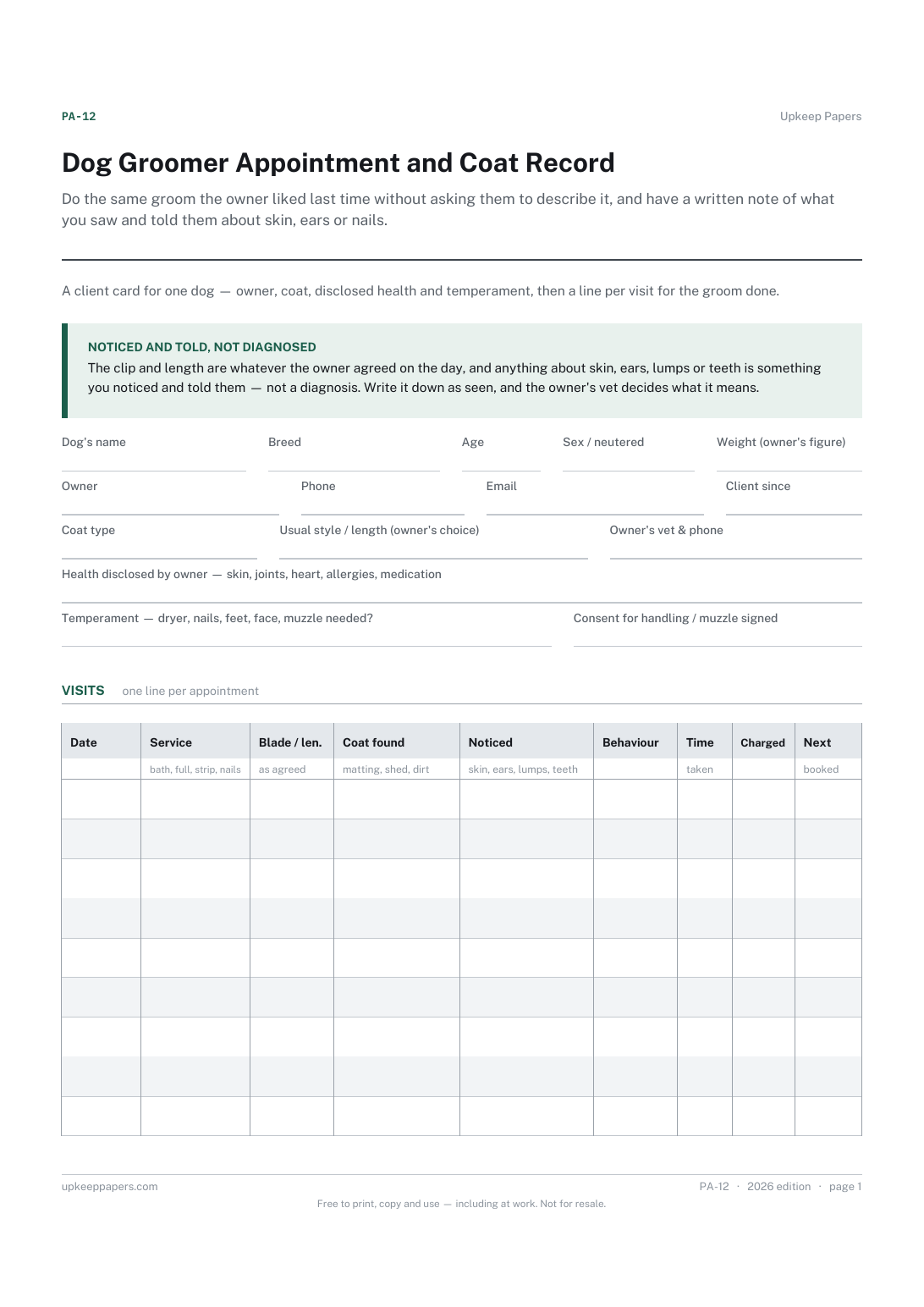
Do the same groom the owner liked last time without asking them to describe it, and have a written note of what you saw and told them about skin, ears or nails.
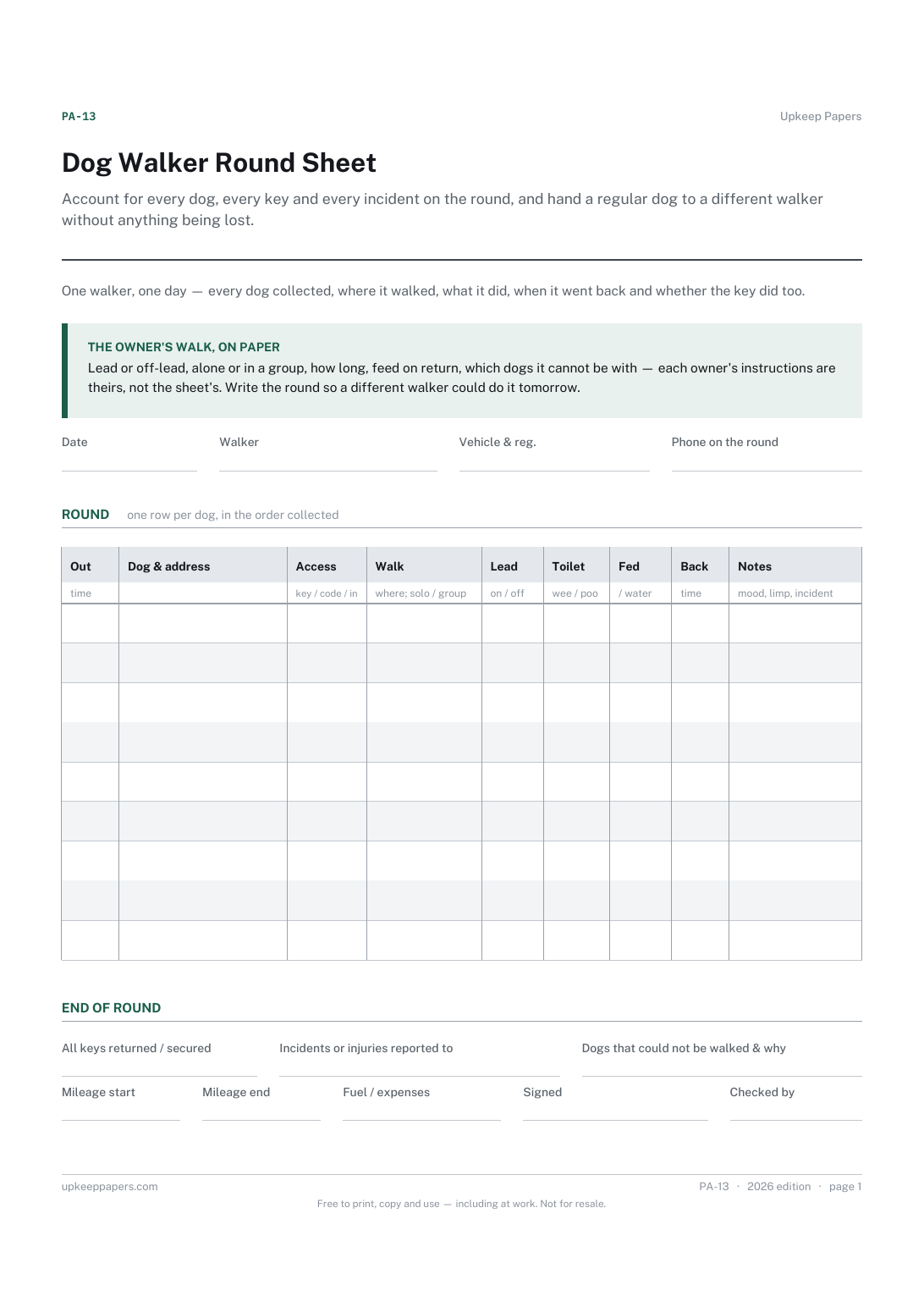
Account for every dog, every key and every incident on the round, and hand a regular dog to a different walker without anything being lost.
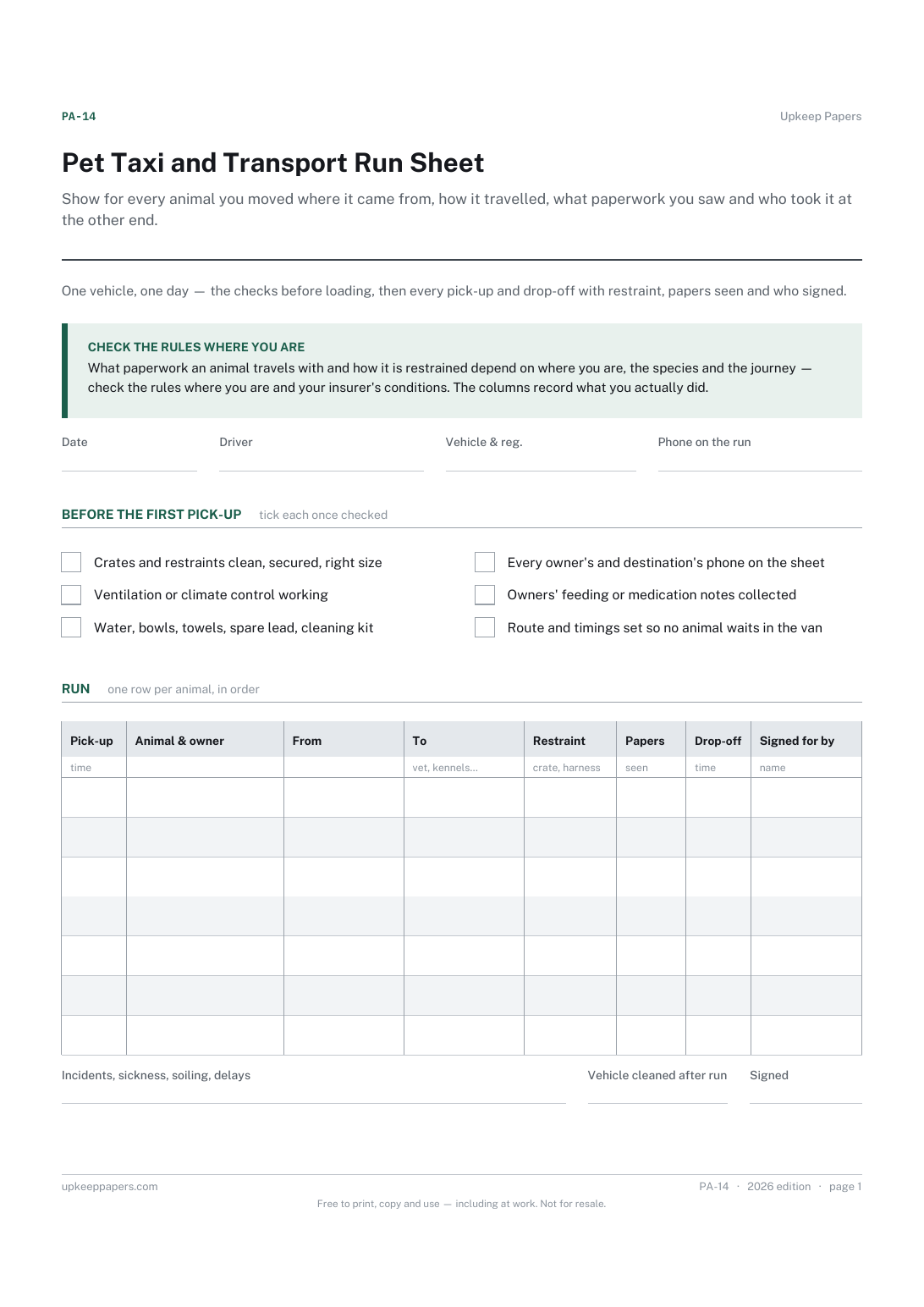
Show for every animal you moved where it came from, how it travelled, what paperwork you saw and who took it at the other end.
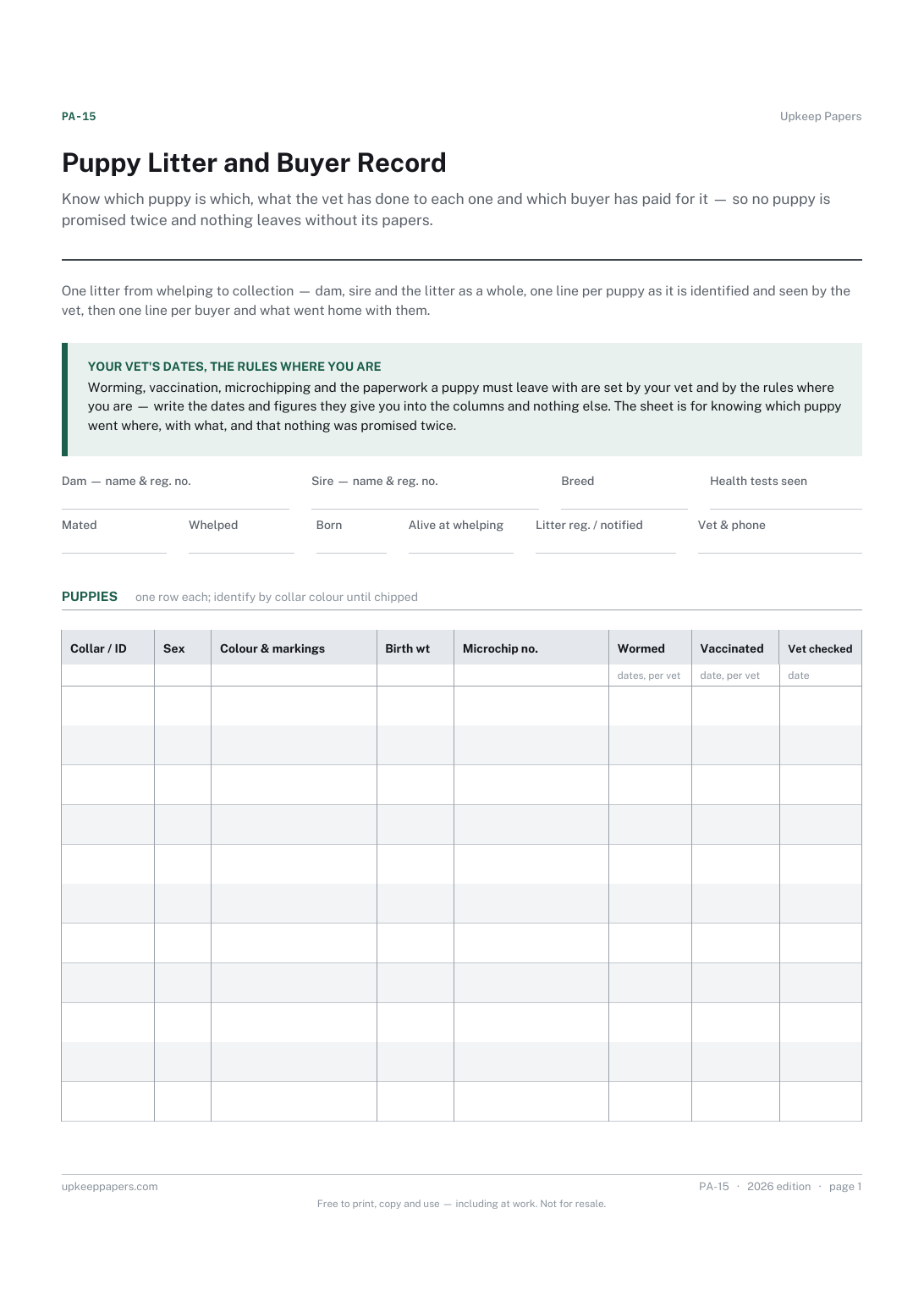
Know which puppy is which, what the vet has done to each one and which buyer has paid for it — so no puppy is promised twice and nothing leaves without its papers.
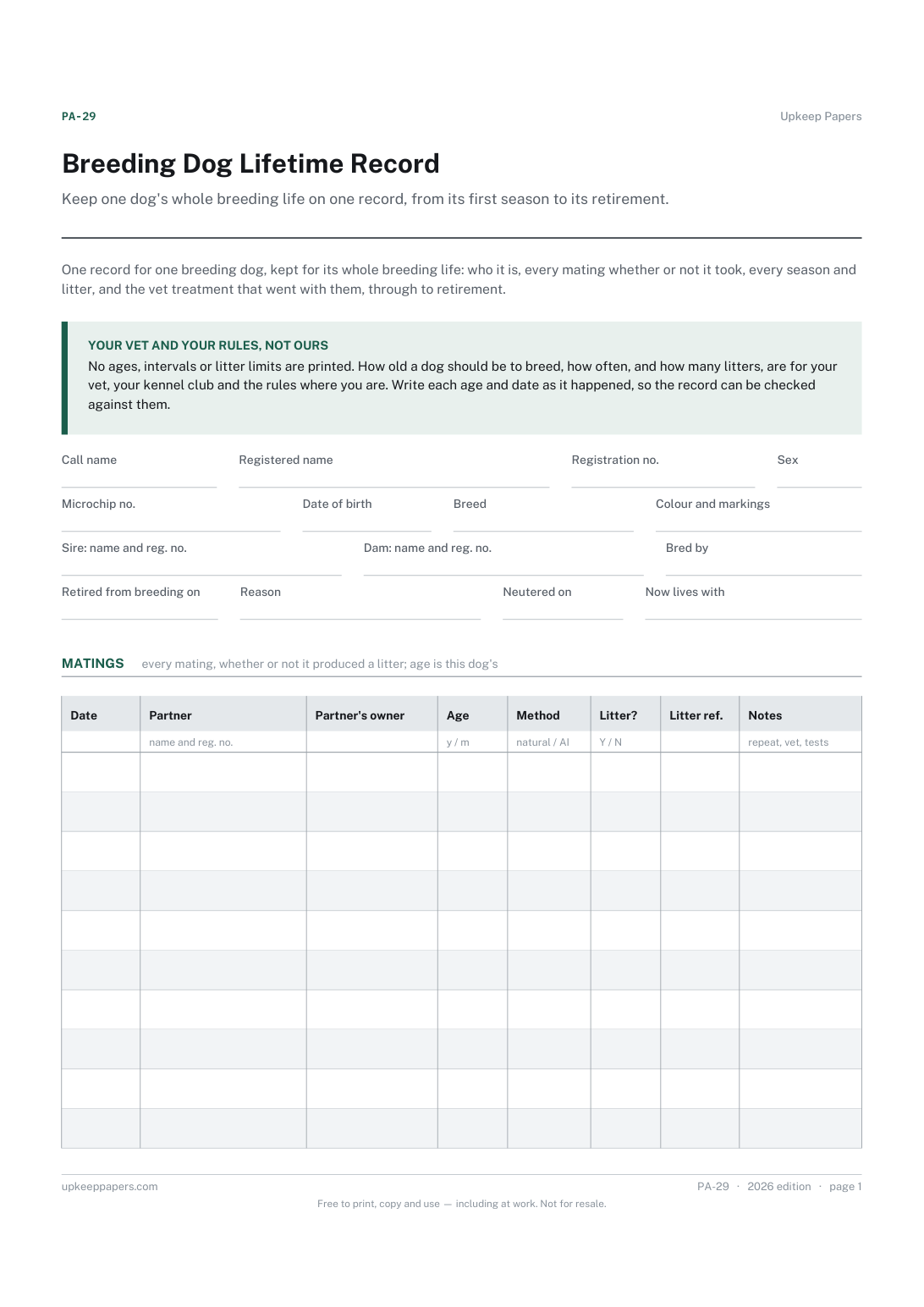
Keep one dog's whole breeding life on one record, from its first season to its retirement. Ages at mating, litters and caesareans are then there to check, not pieced together from memory.
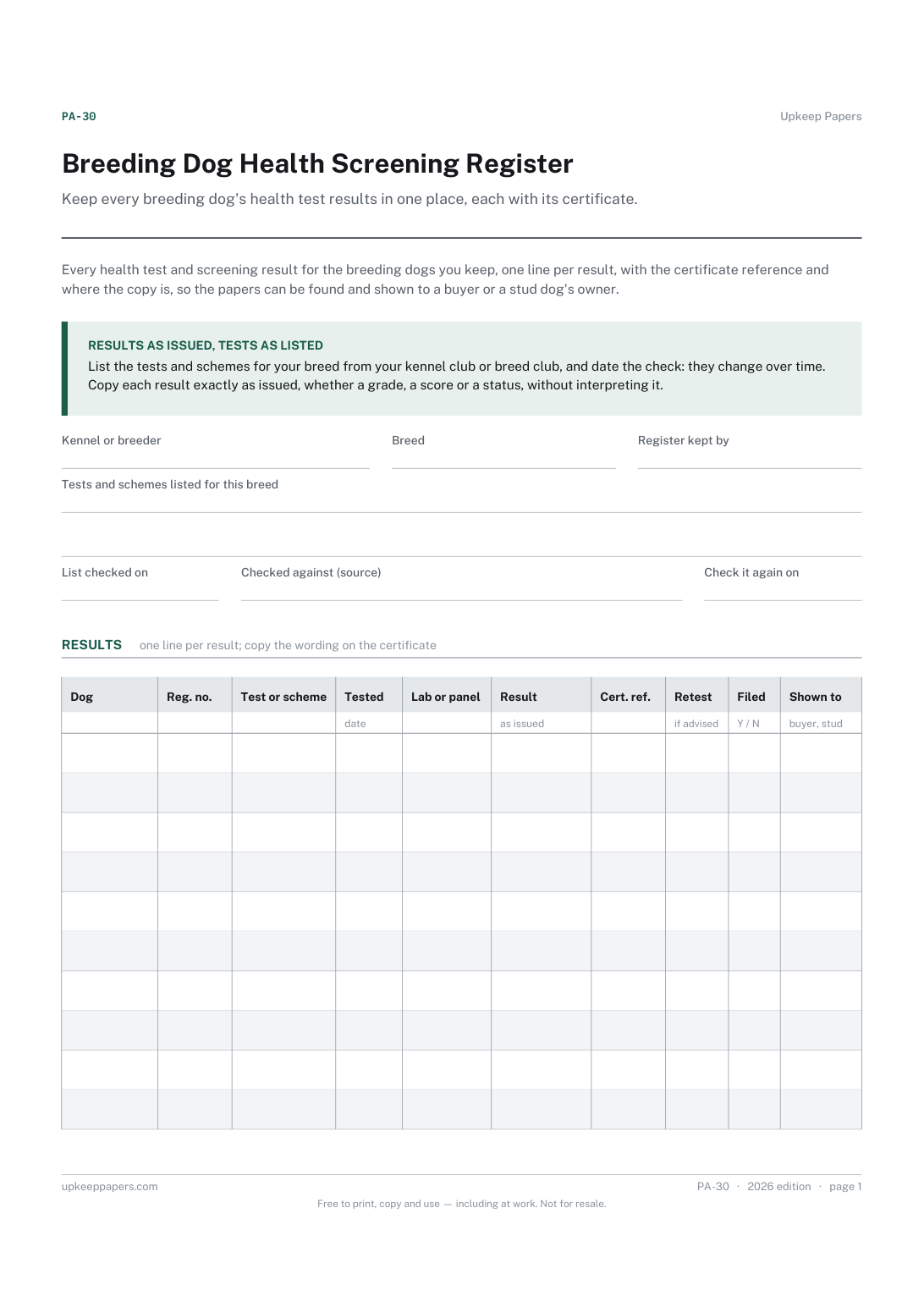
Keep every breeding dog's health test results in one place, each with its certificate. When a buyer or a stud dog's owner asks, the answer is one line away.
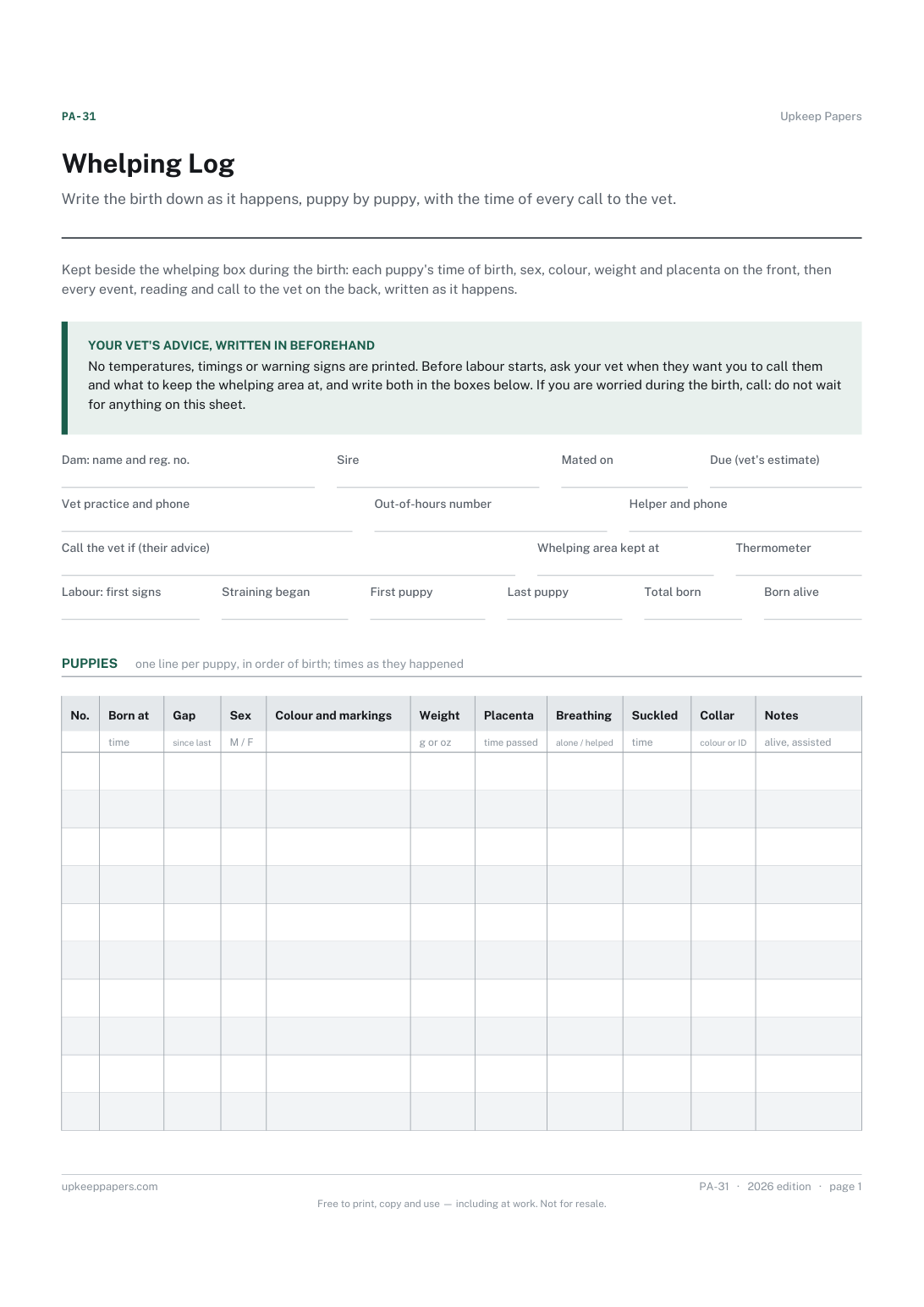
Write the birth down as it happens, puppy by puppy, with the time of every call to the vet. Nothing then has to be remembered later in a tired blur.
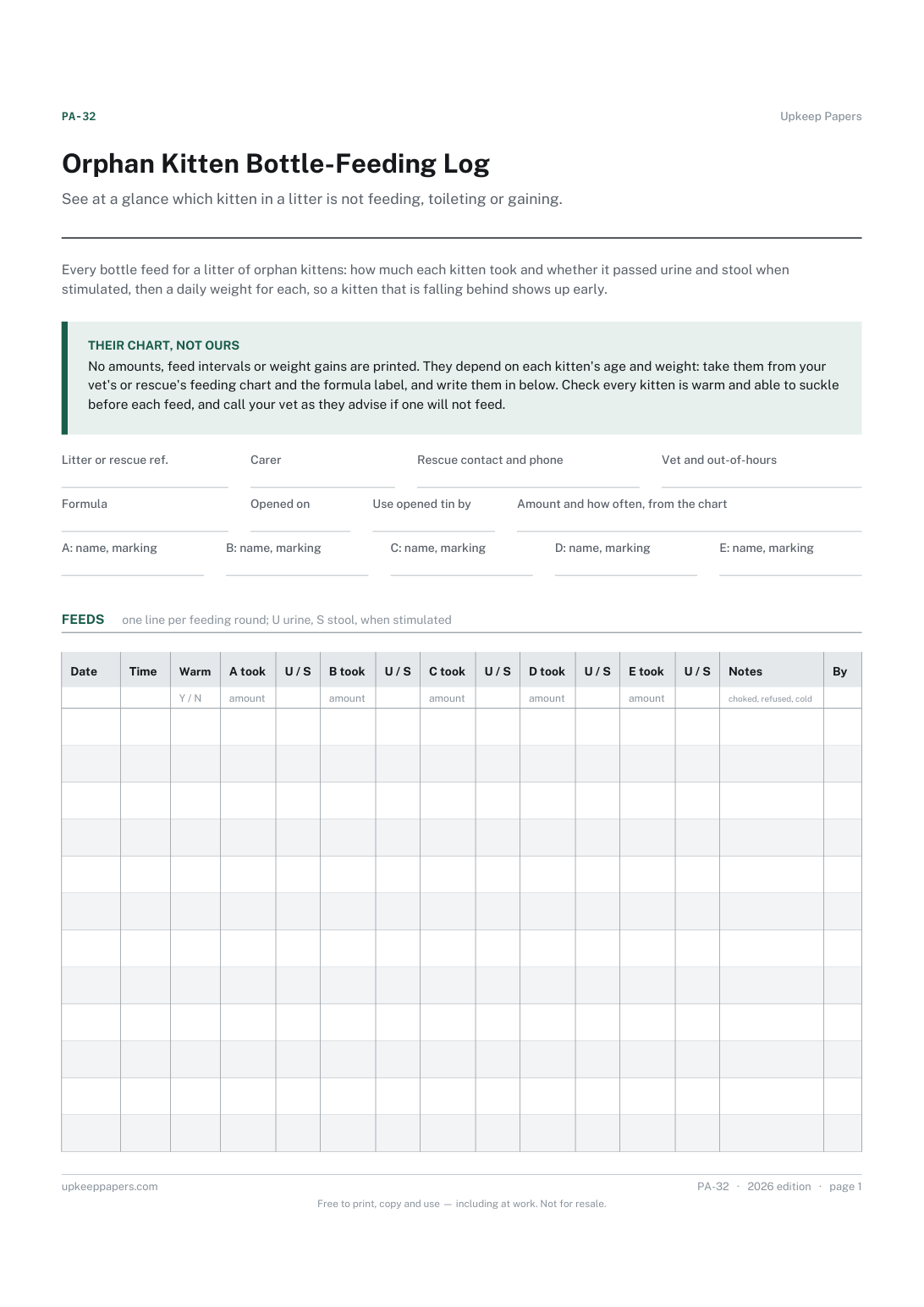
See at a glance which kitten in a litter is not feeding, toileting or gaining. In the first weeks a slow kitten can go downhill quickly.
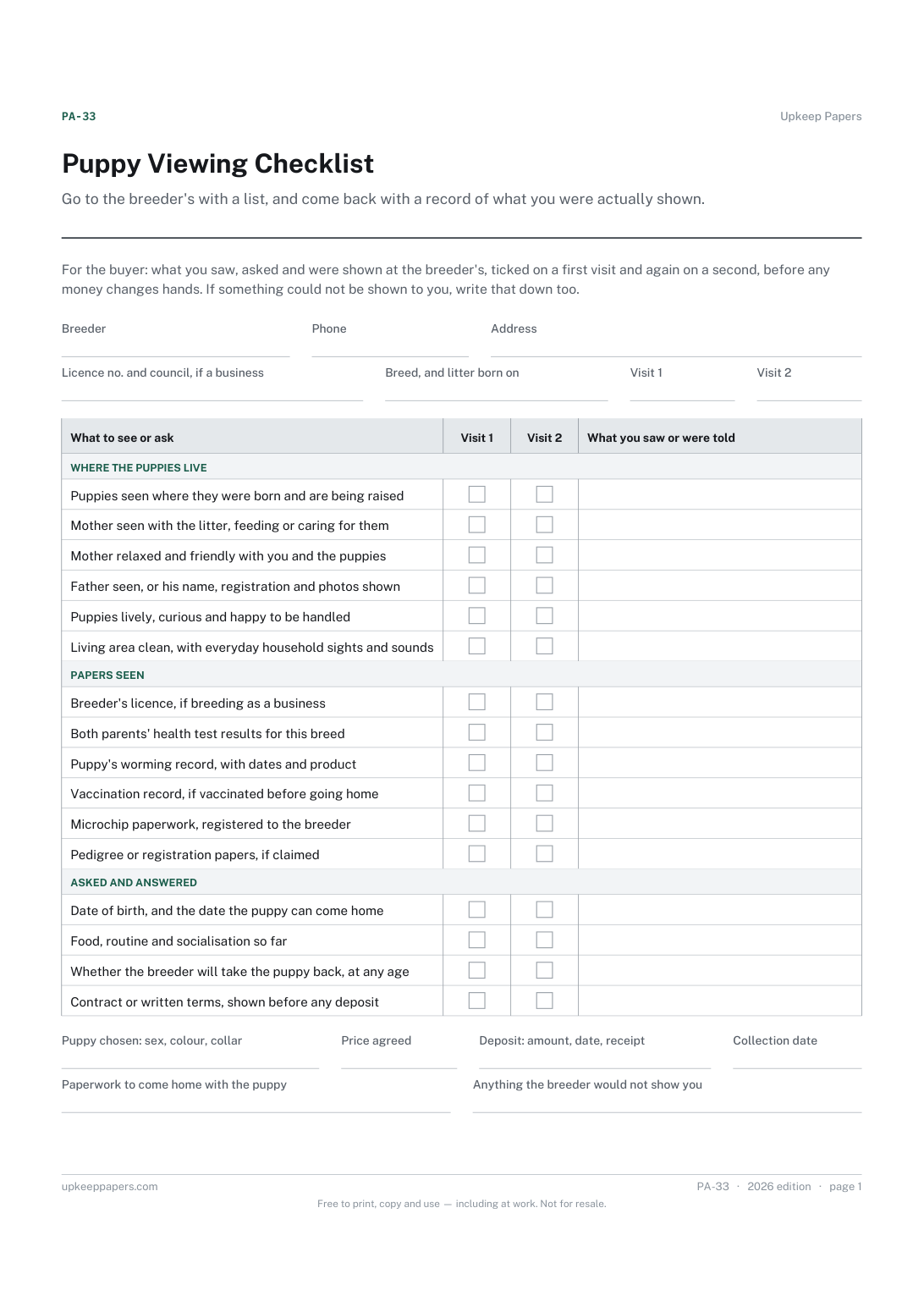
Go to the breeder's with a list, and come back with a record of what you were actually shown. A second visit with the same list shows what changed.
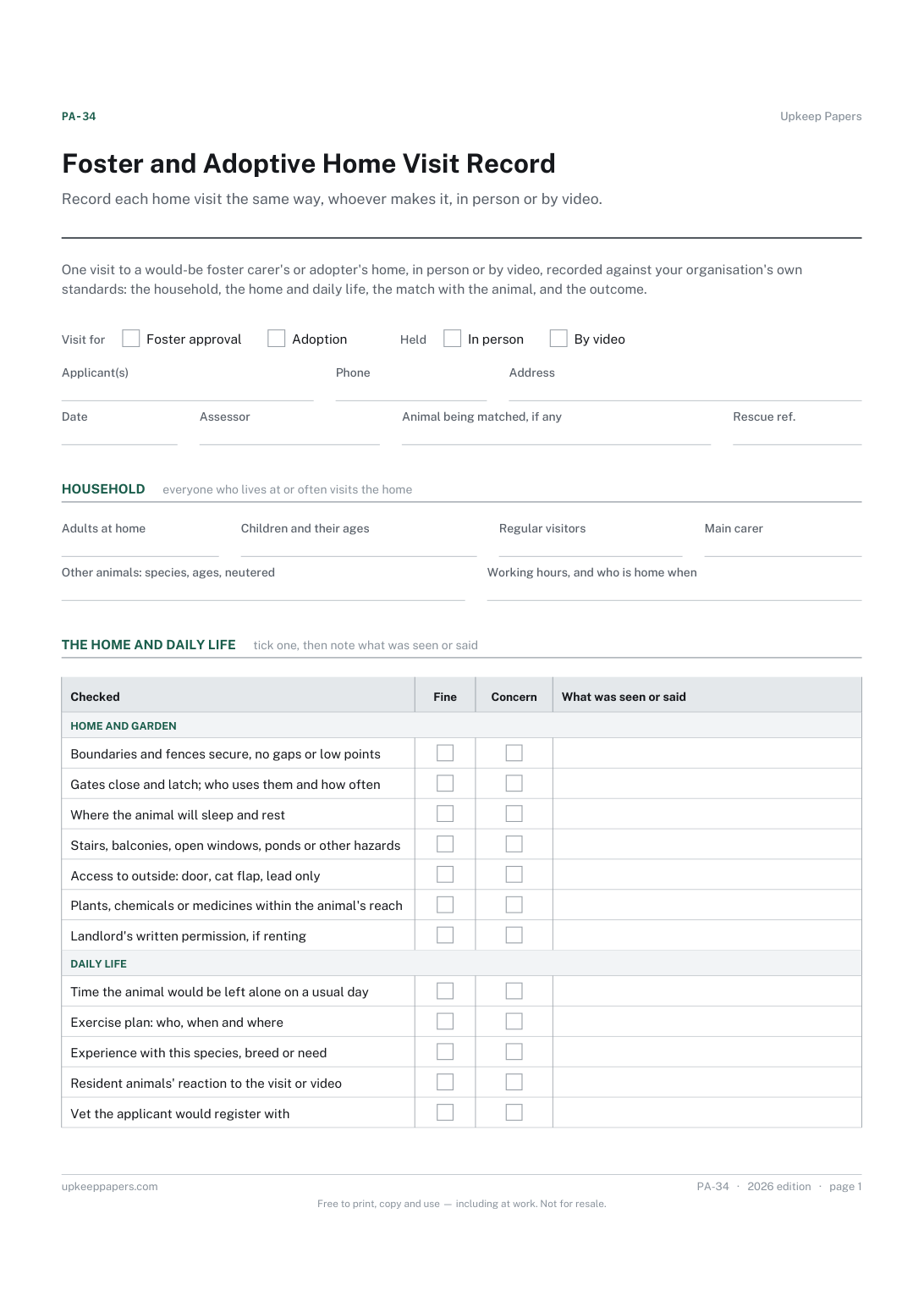
Record each home visit the same way, whoever makes it, in person or by video. The approval then rests on what was seen, written down.
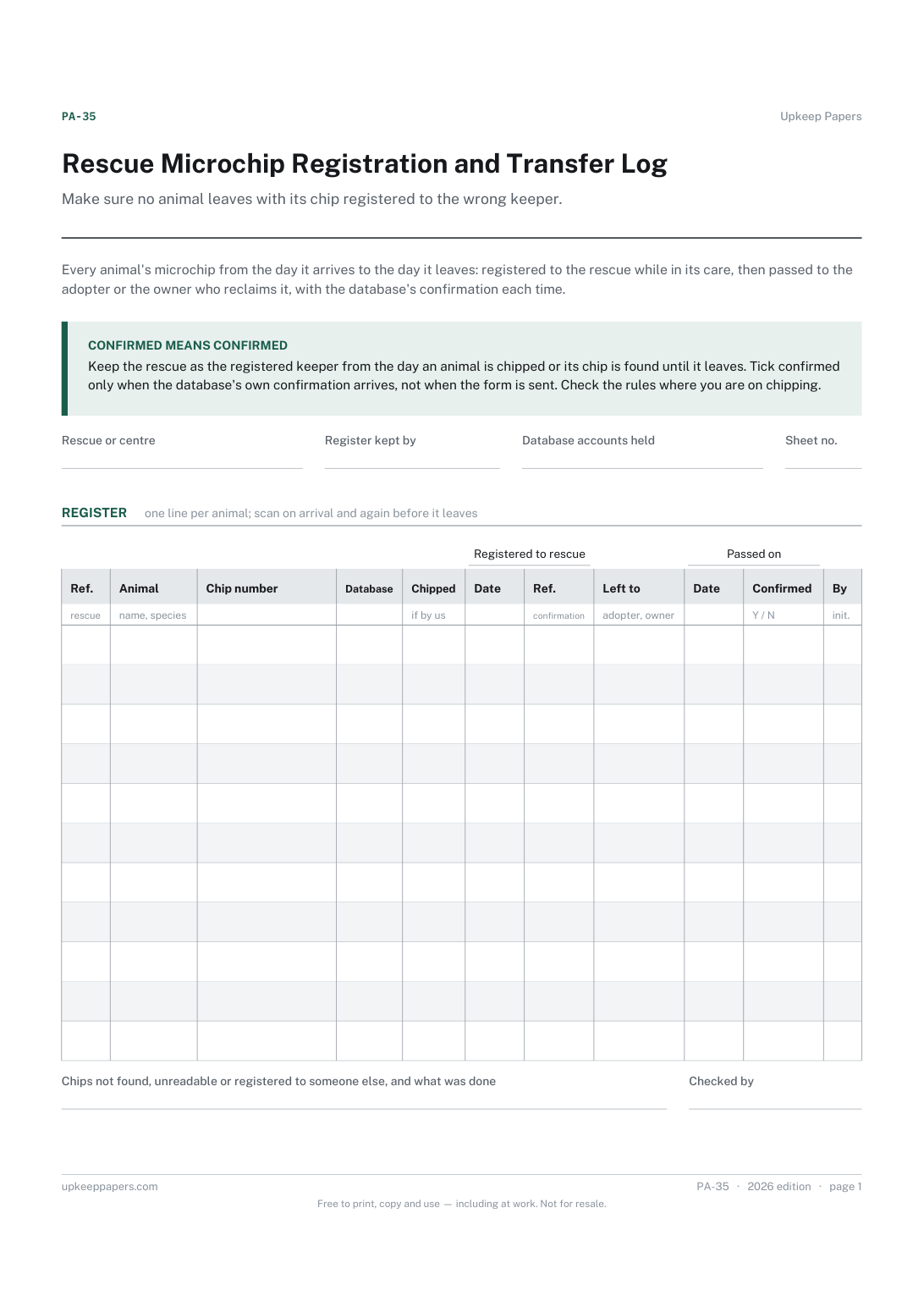
Make sure no animal leaves with its chip registered to the wrong keeper. Every change is dated and confirmed by the database.
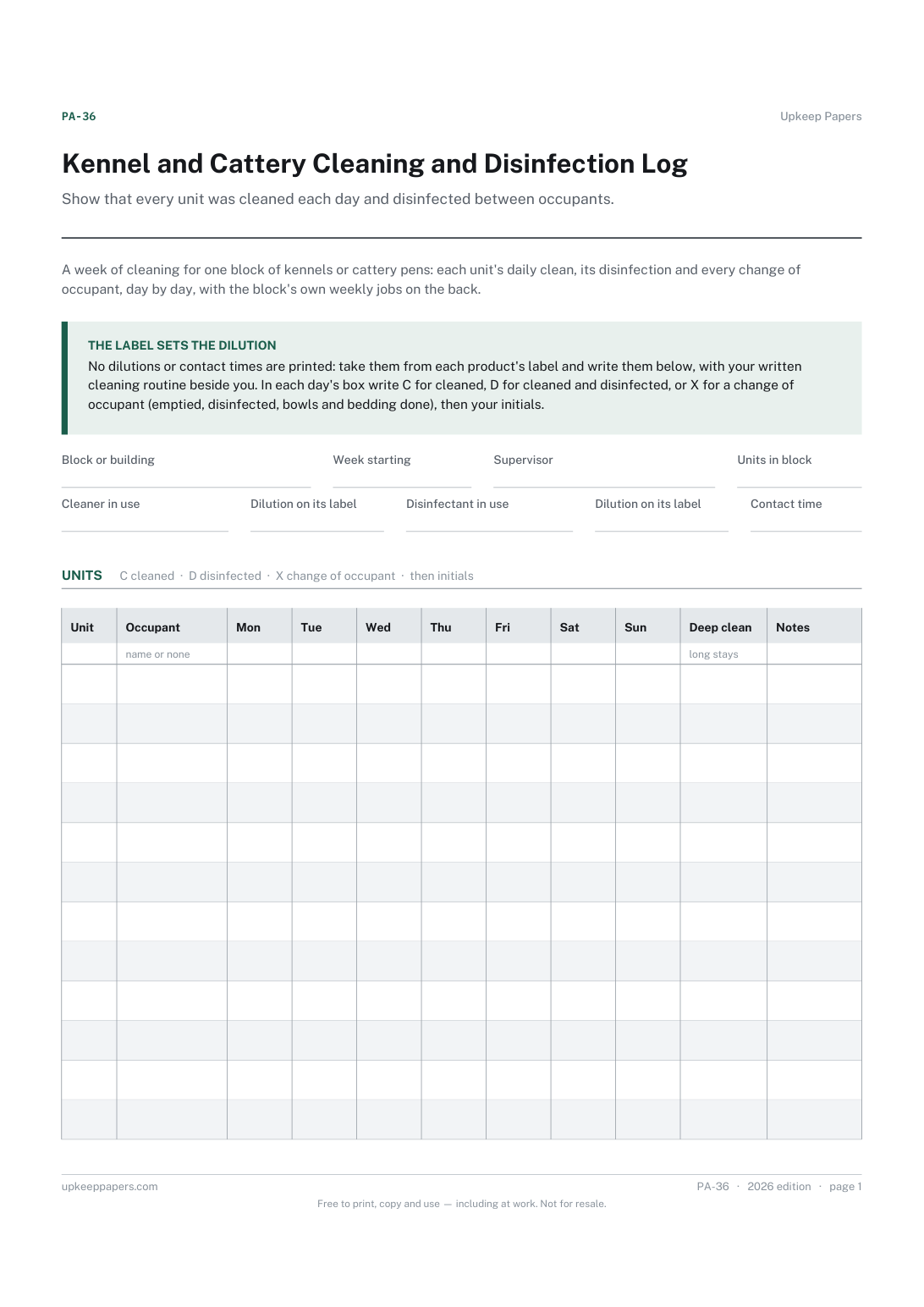
Show that every unit was cleaned each day and disinfected between occupants. The week is on one grid, unit by unit, with the products and their label dilutions.
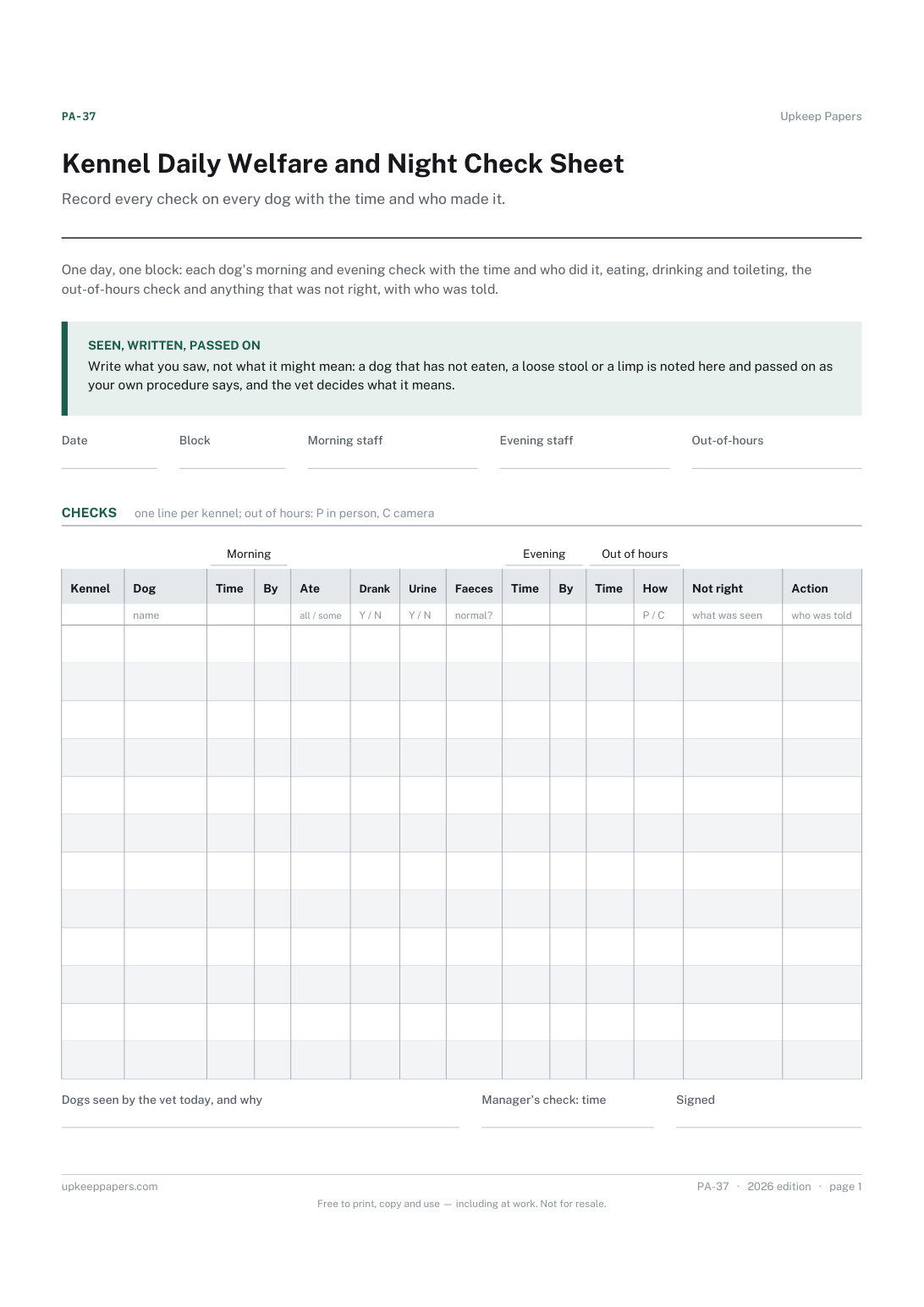
Record every check on every dog with the time and who made it. A dog that has not eaten or has a loose stool is then passed on the same day.
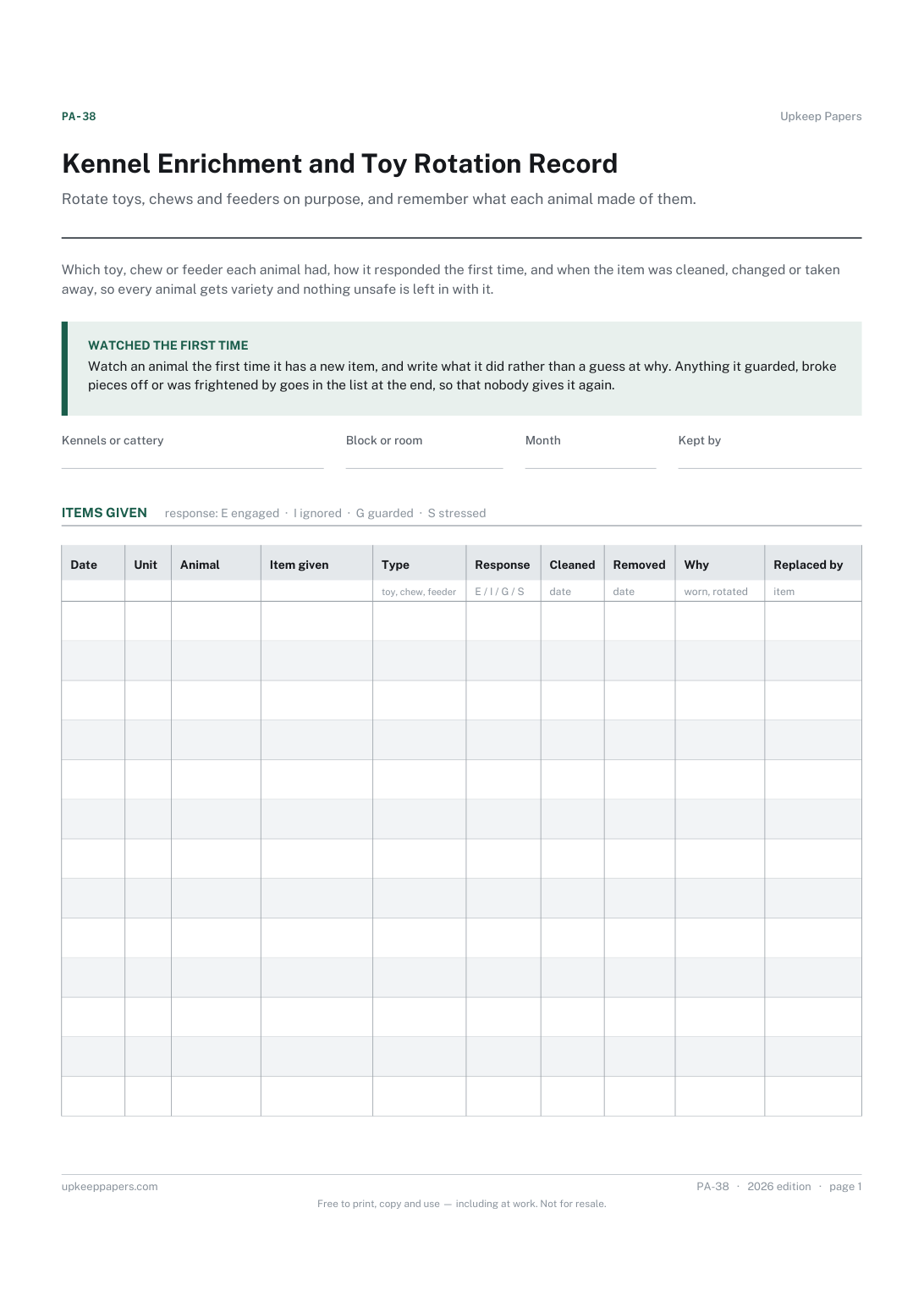
Rotate toys, chews and feeders on purpose, and remember what each animal made of them. Items it guarded or broke are listed so nobody gives them again.
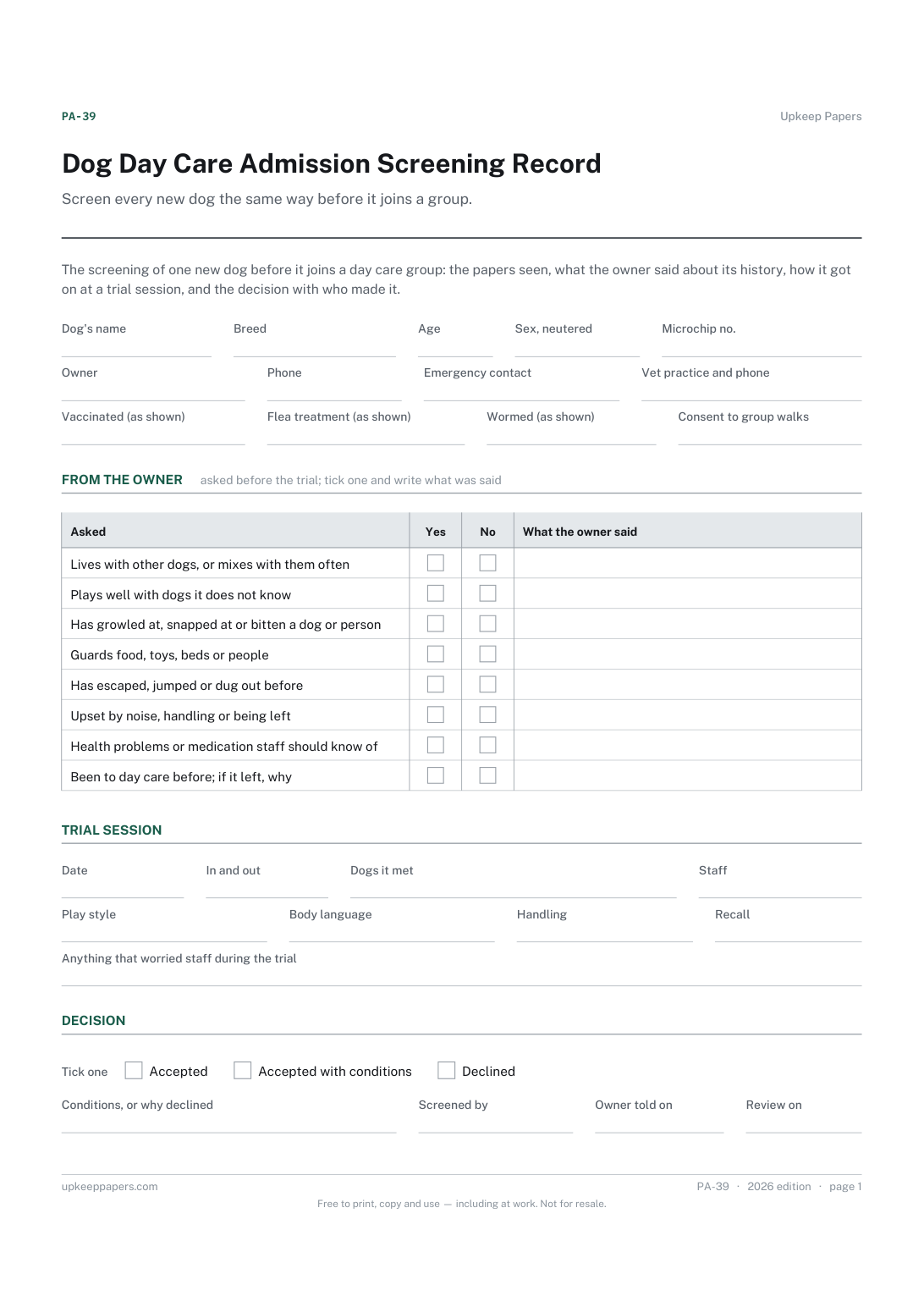
Screen every new dog the same way before it joins a group. The decision and who made it are written down with what it was based on.
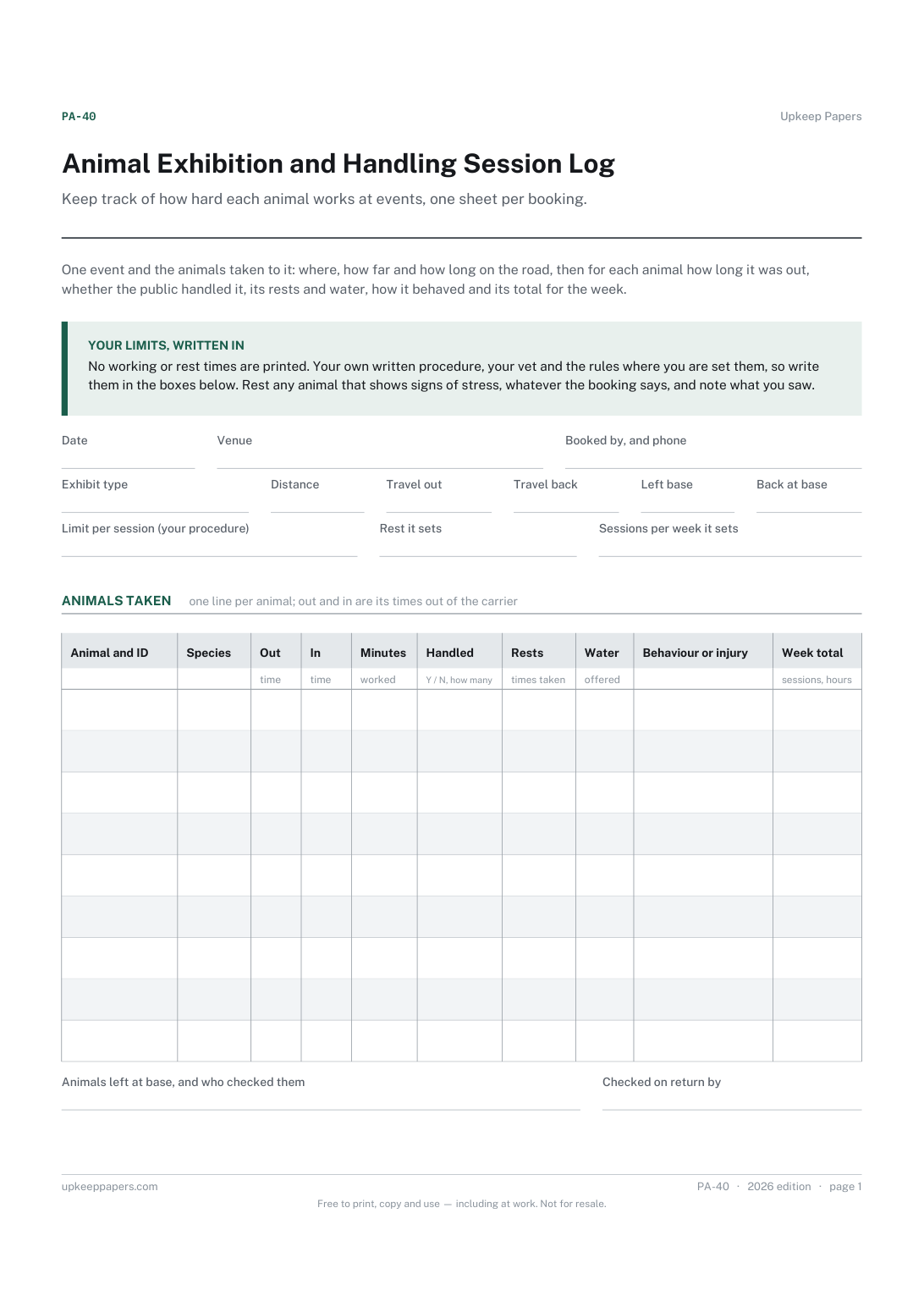
Keep track of how hard each animal works at events, one sheet per booking. A weekly total shows when one is being used more than the rest.
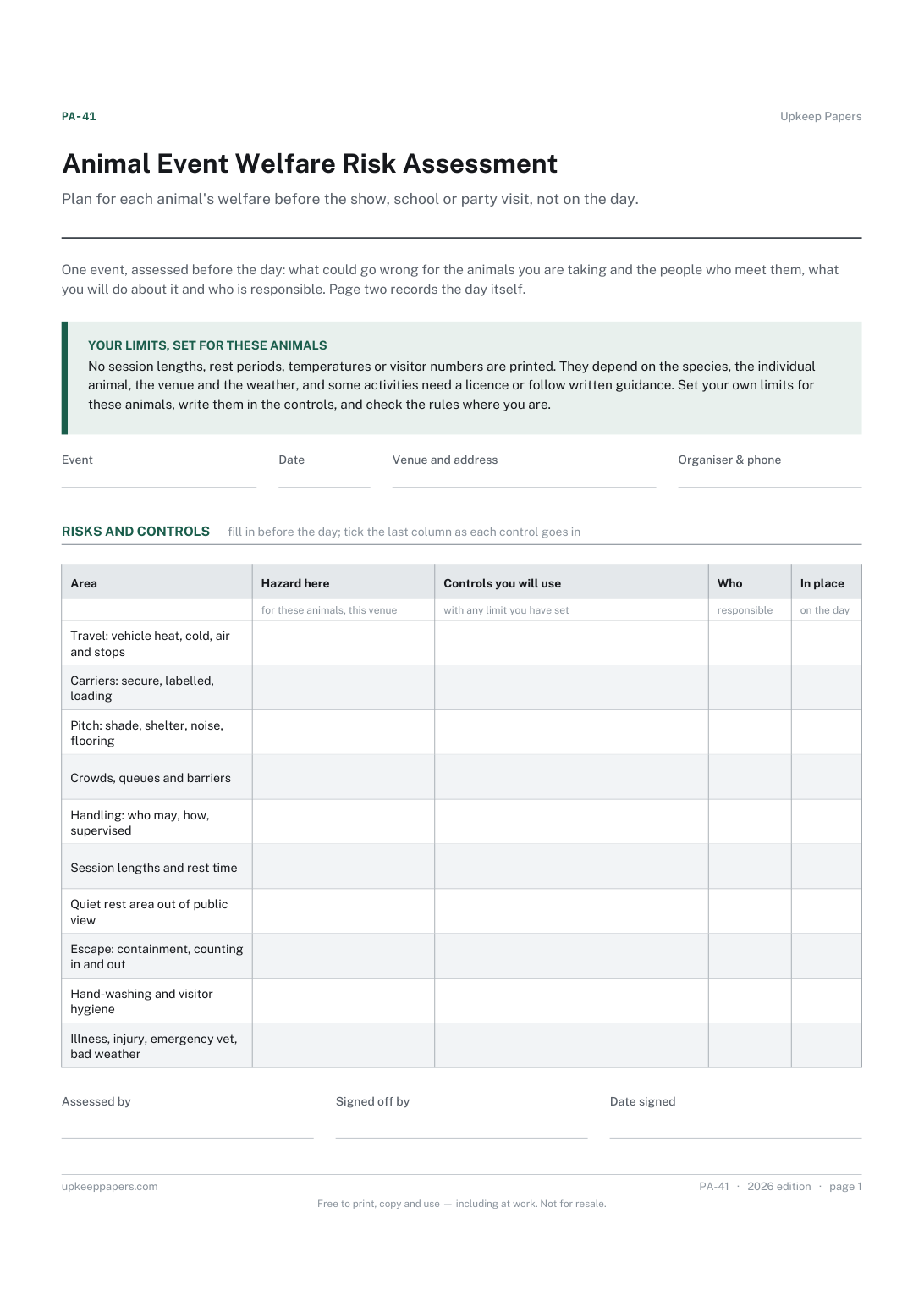
Plan for each animal's welfare before the show, school or party visit, not on the day. The second page records working and rest time, and what to change next time.
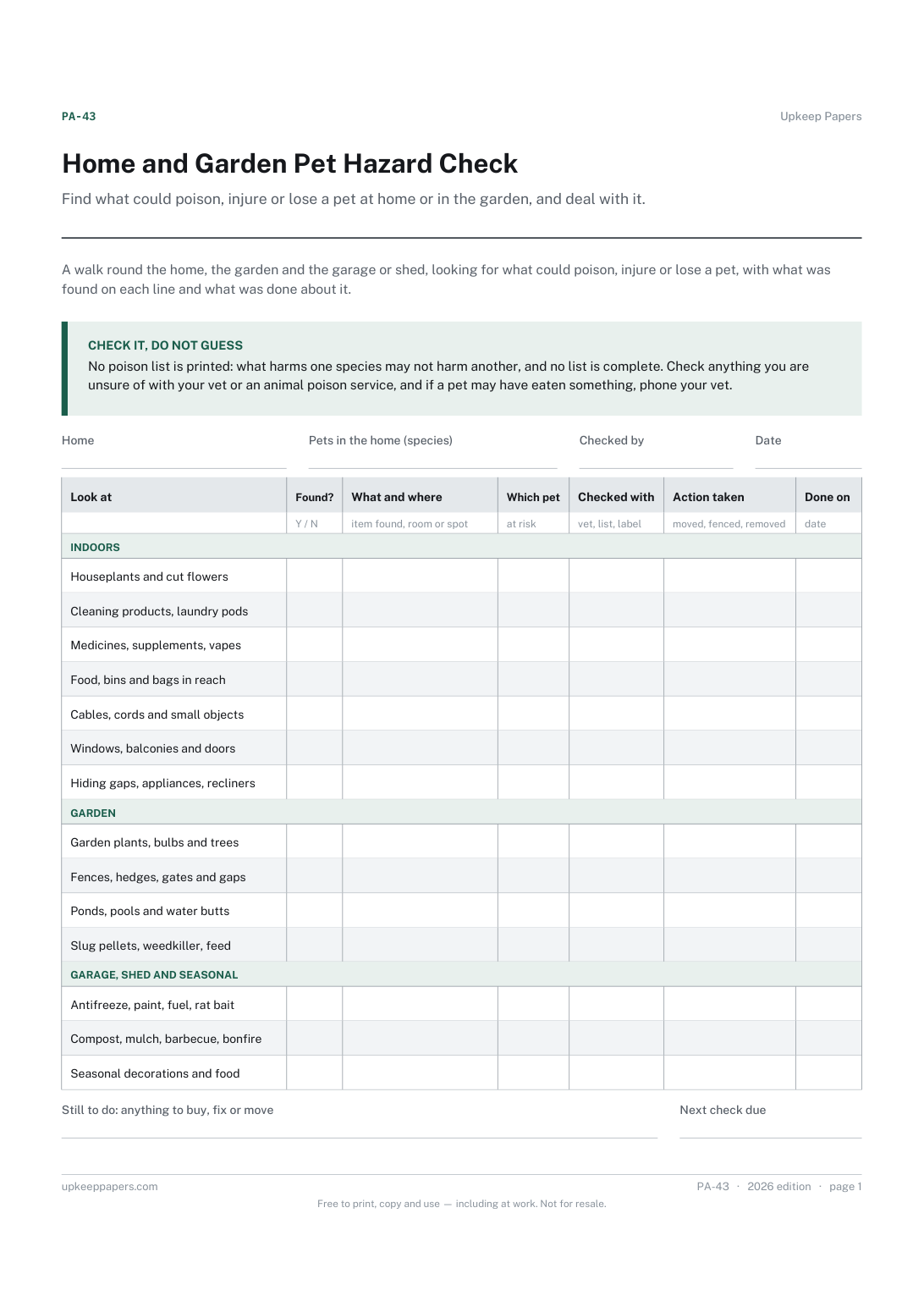
Find what could poison, injure or lose a pet at home or in the garden, and deal with it. Each find gets an action and a date, so the walk-round leads somewhere.
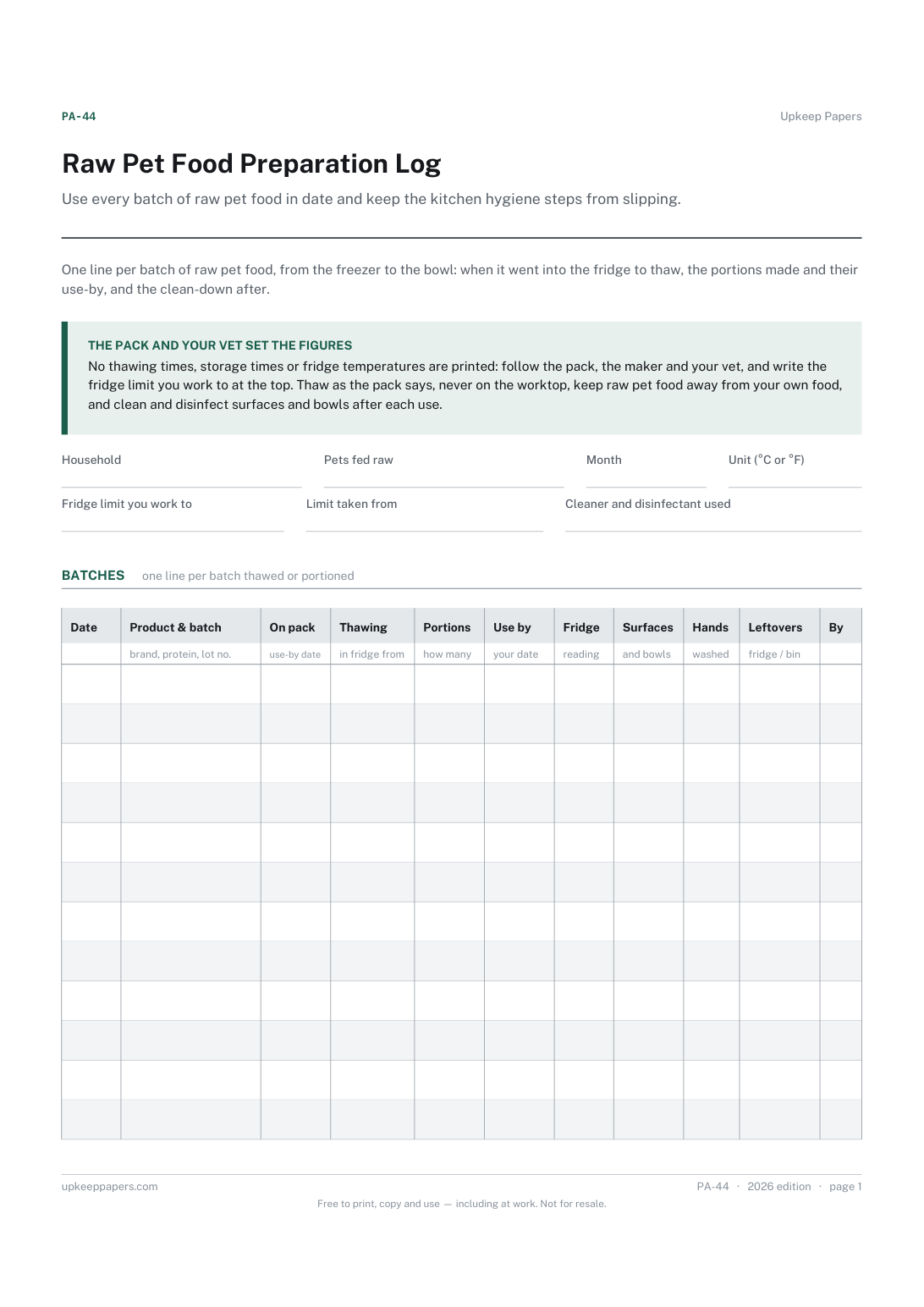
Use every batch of raw pet food in date and keep the kitchen hygiene steps from slipping. One line per batch shows what was thawed, when, and who cleaned down after.
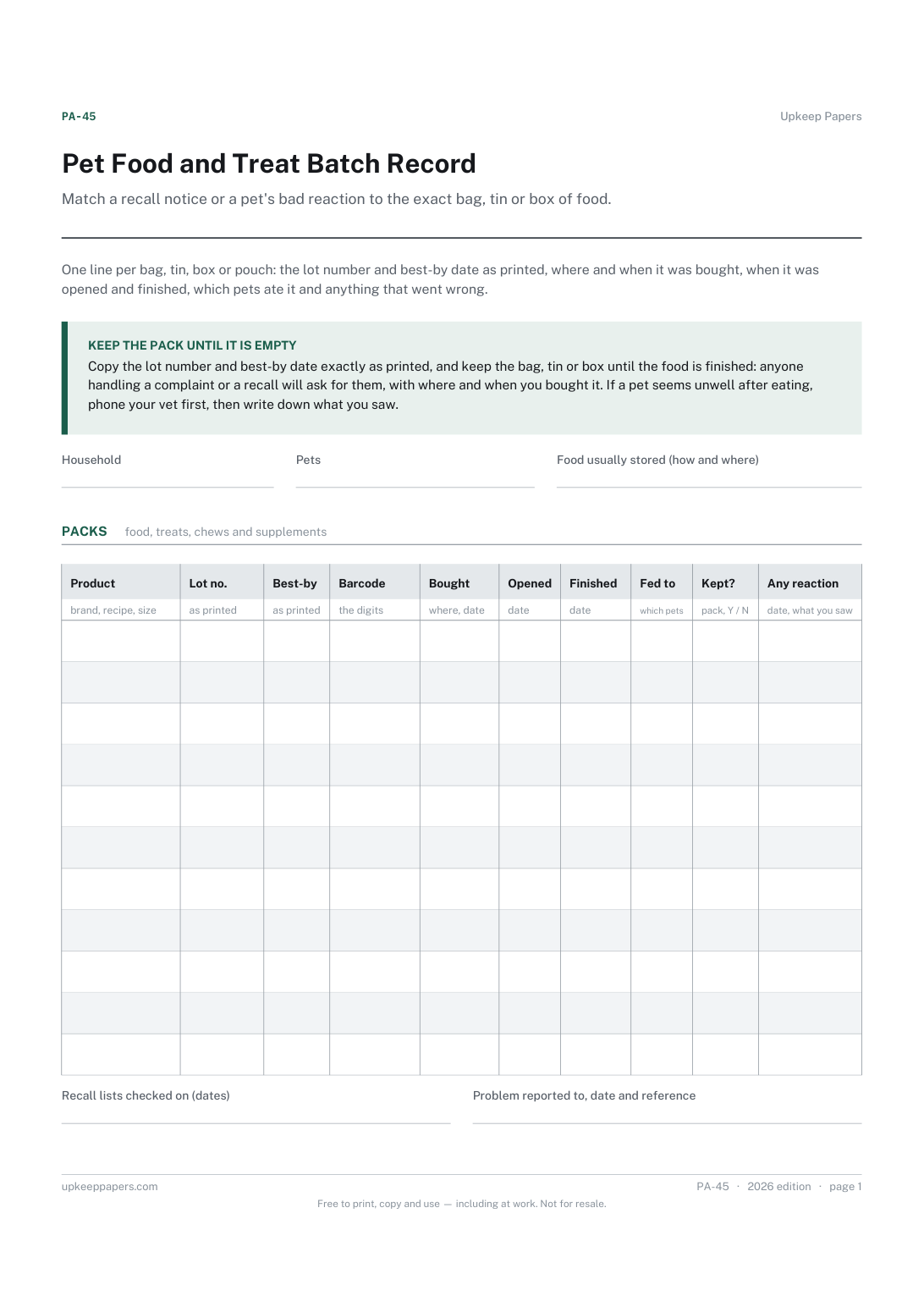
Match a recall notice or a pet's bad reaction to the exact bag, tin or box of food. The details a maker asks for are written down before the pack goes in the bin.
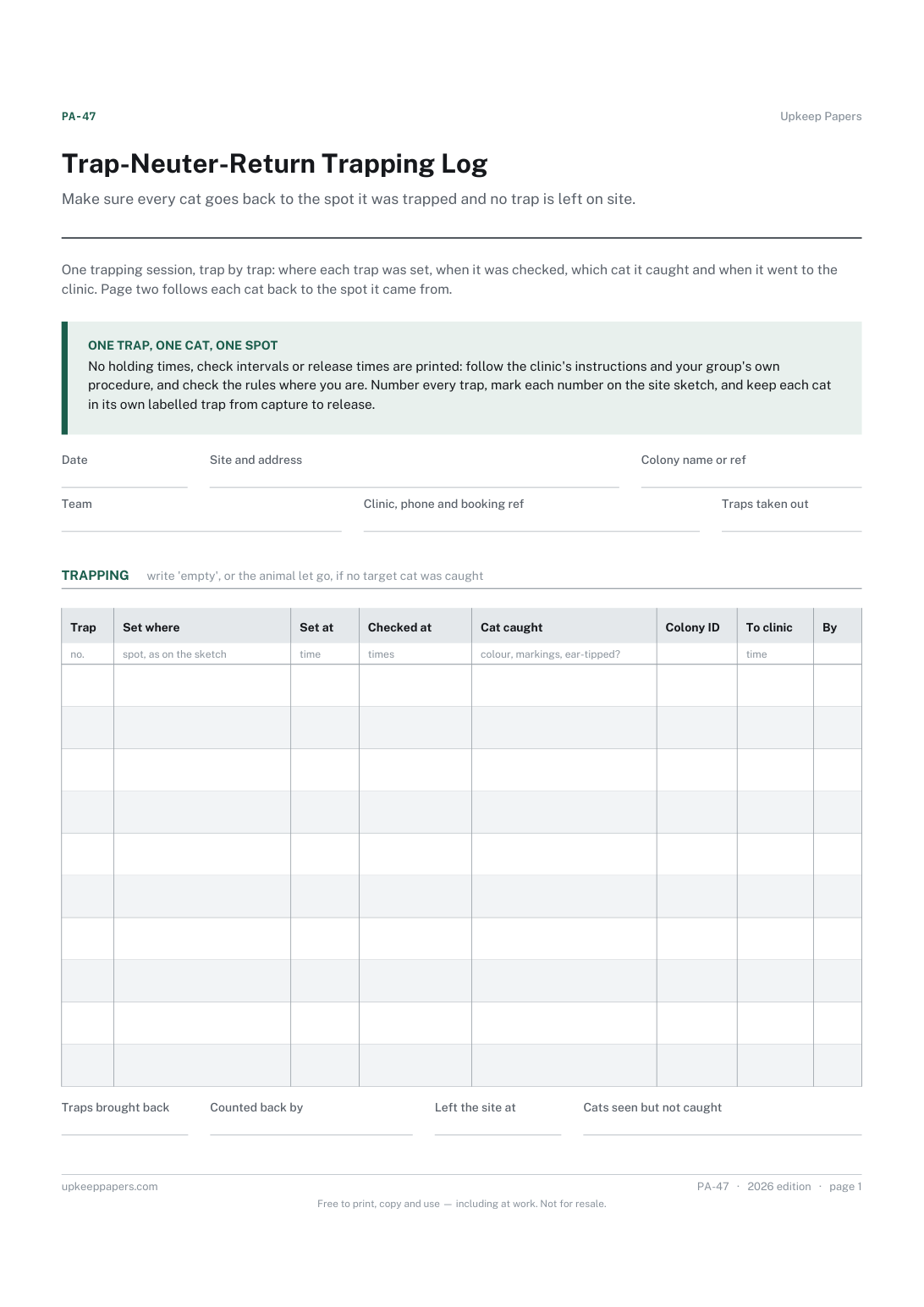
Make sure every cat goes back to the spot it was trapped and no trap is left on site. Trap numbers link the trapping, the clinic notes and the release.
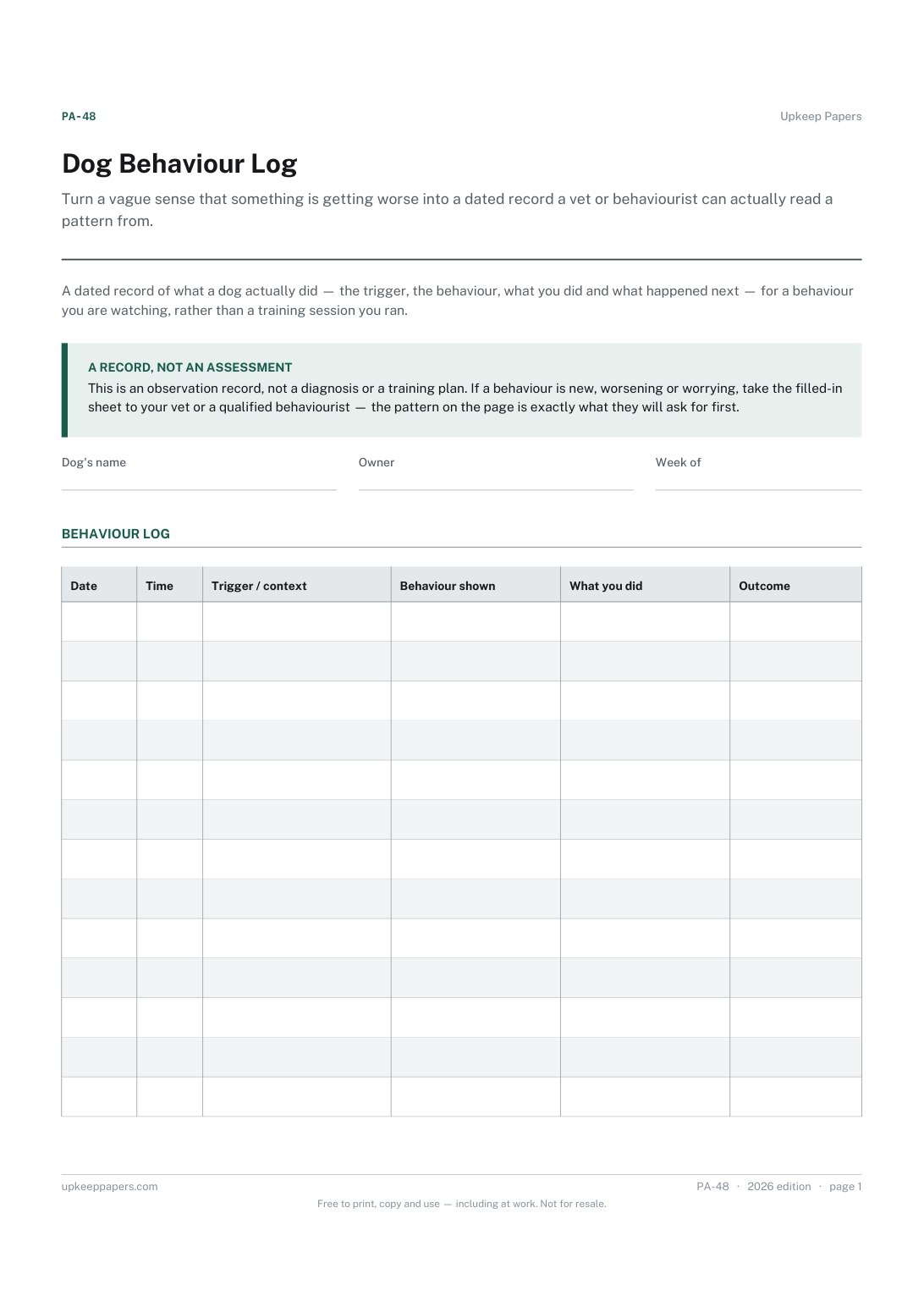
Turn a vague sense that something is getting worse into a dated record a vet or behaviourist can actually read a pattern from.
Elsewhere in the library
The paperwork that covers the whole building — service history, registers, warranties and the seasonal rounds.
Heating, hot water, ventilation, drainage and water supply — the fixed systems that need servicing on a schedule.
Alarm tests, extinguisher checks and the records that prove they happened.
Mowers, saws, generators, washers, compressors and tractors — hour-based servicing and the part numbers you can never find.
Cars, motorcycles, motorhomes, trailers and boats — service history, schedules and pre-use inspections.
Pools, hot tubs and private water supplies — chemistry logs and test records.
Maintenance logs, periodic inspections and changeover checklists for let property.
Trailers, horseboxes, caravans and boats — annual service records, pre-use inspections and the towing figures you should never be guessing at.
Inventories, service logs and the working paperwork a small workshop, a trade or a van actually runs on.
Cleaning schedules, rotas, deep-clean checklists and the dated records a cleaning routine is supposed to leave behind.
The paperwork of changing address — moving, viewing, snagging, renovating and switching the supplies over.
Sowing plans, plot layouts, greenhouse logs, compost records and fruit tree histories — blank wherever the answer depends on where you garden.
Husbandry records for reptiles, amphibians, fish, small mammals and birds — the readings, feeds and weights that keep an animal well.
The sheet that goes out in the van: what was quoted, what was fitted, what it took and what the customer signed.
Job cards, parts, road tests and the paperwork that follows a car through a workshop from booking in to handing back.
Shifts, runs, checks and hours — for the people whose office is a vehicle.
Goods in, picked, packed, counted and despatched — the paper trail down the aisle.
Rooms turned round, guests arrived, faults reported and the shift handed over.
Prep done, tables planned, lines cleaned, waste counted and the till cashed up.
The till, the stockroom, the shelf edge and the routines that open and close the door.
Batches made, yields counted and where every ingredient came from.
Pitches let, hook-ups metered, blocks cleaned and the site walked.
What was done to whom, with what, and what they said about it last time.
The gig booked, the stage plotted, the set played and the show reported.
Firings, cuts, pours and settings — written down so the good one can be repeated.
Setup, times, tyres and fuel — the numbers that make the next session faster.
Team sheets, scorebooks, training plans and the club admin behind a fixture.
Rotas filled, halls booked, collections counted and volunteers looked after.
What kit exists, who has it, whether the backup ran and when the licence expires.
Units let, keys issued, payments tracked and loads moved.
Flock and herd records, medicine and movement books, and the application records that have to be produced when somebody asks.
Project planners, stash inventories and machine logs — for quilting, sewing, printing, modelling and selling what you make.
Shot lists, kit inventories and job records — for getting the shot, insuring the kit and finding out what the work actually pays.
Logbooks and trip plans for time spent outdoors — dives made, water paddled, rounds played.
Sheets for the hour you spend standing in front of a car you are thinking of buying, and for comparing it afterwards with the others you saw.
Inspection records for hives and colonies, built so this week's visit can be read against the last three.
Due-date charts and care records for horses and ponies, with the intervals left blank for the ones your own farrier, vet and dentist give you.
Visitor sign-in pages and key registers — who is in the building, who let them in, and what has not come back.
Per-fill fuel and cost records, kept unit-neutral so the same sheet works wherever you buy fuel and whatever your odometer reads in.
Kit checks, expiry dates and restocking — dated on paper and signed by whoever actually did them.
Logbooks for the things people do for the love of it, built to hold hours, conditions and the incident nobody wants to reconstruct from memory.
What is on the shelf, how much of it you want there, and what needs reordering before the recipe stops.
What seed you actually have, whether it still germinates, and what the plot really produced.
The dated, initialled rounds that show a space was actually attended to rather than merely meant to be.
Session logs and equipment records for training — what you did, and what your kit has done.
Itemised records for collections and valuables — what you own, what it cost, and what can be evidenced about it.
The paperwork a committee, a small office or a one-person project runs on — minutes, agendas, actions, decisions, risks and issues.
The money paperwork a one-person business runs on — invoices, estimates, receipts, orders, price lists and the sheets that show what a job really cost.
The records a small employer actually needs: hours, leave, rotas, reviews, training and the two checklists that make starting and leaving orderly.
Permits, method statements, diaries and inspection registers for building sites, yards and anywhere work is done under control.
Blank sheets for a classroom, a tutor, a club or an evening's babysitting — registers, marks, seating, reading and trips.
The paperwork a sports club, a society or a village hall committee runs on — members, subs, kit, duties, scores and fixtures.
Sheets with no subject at all — blank logs, blank checklists, tally sheets and report forms you head yourself.
Records for a working kitchen — what a dish costs, what was made from which batch, what was checked, cleaned and thrown away.
Two sheets for going somewhere: a packing list you write once and reuse, and a road trip planned day by day.

Every sheet, binder, game and puzzle on Upkeep Papers is free to download, with no email and no account. Making them is not free: each one takes days of research, design and checking, and the site costs money to run. If something here saved you time, you can buy us a coffee. It is entirely optional: nothing is locked, and nothing changes if you don’t.
Buy us a coffee Opens PayPal in a new tab. Any amount, and nothing changes if you would rather not.