Mould and Casting Record
Know how many pulls a mould has taken and which mix gave a clean cast, so a tired mould is retired before it ruins a job rather than after.
SD-22 1 page
Everything here is free. Making it takes time and money. Everything here is free.
 Buy us a coffee
Studio crafts and making · SD-25
A free printable resin pour log sheet — date, piece, resin and batch, the mix as weighed, pigment, room temperature and humidity, demould and how it cured.
One page. Choose your paper size — both versions are laid out identically, so neither one gets shrunk to fit.
Print it and write on it
Fill it in type and save
The fillable versions have real form fields — open them in any PDF reader, type into them and save. Printing help.
Find out why last month's pour was flawless and this week's is tacky, by having both written down side by side.
Resin artists, river-table and turning-blank makers, jewellery and casting hobbyists, and anyone whose results vary with the weather.
One page, top to bottom:
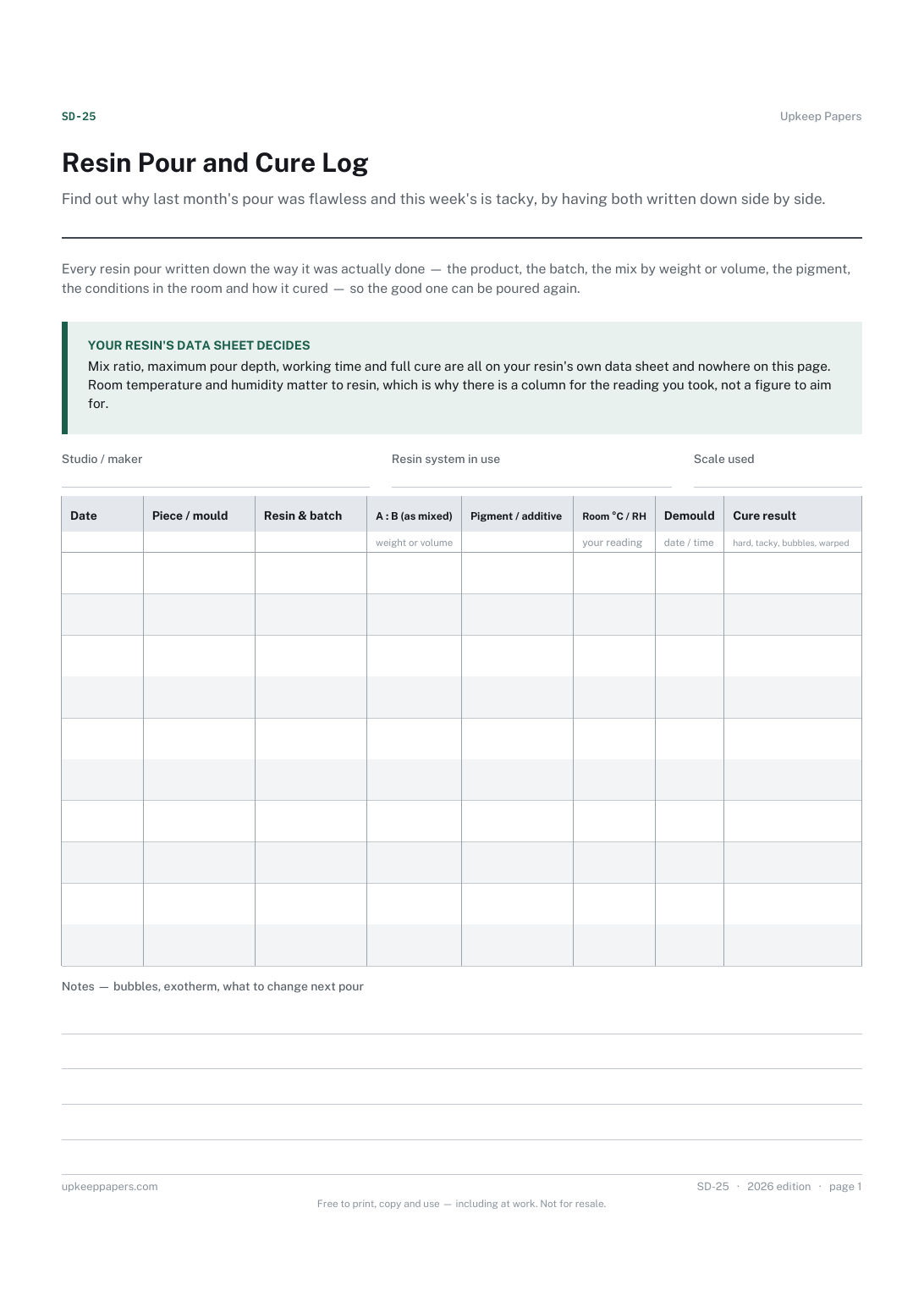
Printed under the title: Every resin pour written down the way it was actually done — the product, the batch, the mix by weight or volume, the pigment, the conditions in the room and how it cured — so the good one can be poured again.
Your resin's data sheet decides. Mix ratio, maximum pour depth, working time and full cure are all on your resin's own data sheet and nowhere on this page. Room temperature and humidity matter to resin, which is why there is a column for the reading you took, not a figure to aim for.
Write-on lines: Studio / maker · Resin system in use · Scale used
Table, 10 rows: Date · Piece / mould · Resin & batch · A : B (as mixed) · Pigment / additive · Room °C / RH · Demould · Cure result
Ruled lines: Notes — bubbles, exotherm, what to change next pour
Because every resin has its own, and getting it from anywhere but the maker's data sheet is how pours go wrong. This sheet is for what you did with that data: the actual weights, the actual room, the actual result.
Because they change the working time and the finish, and they are the thing most people forget to write down. The column is for your reading from your own thermometer or hygrometer; there is no target on the sheet.
Know how many pulls a mould has taken and which mix gave a clean cast, so a tired mould is retired before it ruins a job rather than after.
Make a batch traceable, so a good one can be repeated and a bad one can be traced back to what went into it.
Stop running out of the one thing that halts the studio, by counting it against a reorder point you set instead of noticing when the box is empty.
Record the things a finished object cannot tell you later: which dye lot, which hook you really used, and how much was left over.

Every sheet, binder, game and puzzle on Upkeep Papers is free to download, with no email and no account. Making them is not free: each one takes days of research, design and checking, and the site costs money to run. If something here saved you time, you can buy us a coffee. It is entirely optional: nothing is locked, and nothing changes if you don’t.
Buy us a coffee Opens PayPal in a new tab. Any amount, and nothing changes if you would rather not.