Fence and Boundary Inspection Record
Record the fence walk and the faults, including who is responsible for each boundary before money is spent on it.
LK-37 1 page
Everything here is free. Making it takes time and money. Everything here is free.
 Buy us a coffee
Garden and growing · GG-11
A hedge laying record — each boundary length named once, then every laying, coppicing, trimming and repair logged with the style, stakes and who did it.
2 pages. Choose your paper size — both versions are laid out identically, so neither one gets shrunk to fit.
Print it and write on it
Fill it in type and save
The fillable versions have real form fields — open them in any PDF reader, type into them and save. Printing help.
Give a hedge that is laid once in a working lifetime a history, so the next person to lay it knows the style, the year and which gaps were planted up.
Smallholders, allotment sites, estate and churchyard volunteers, and anyone with a garden boundary that is a living hedge rather than a fence.
2 pages, in this order:
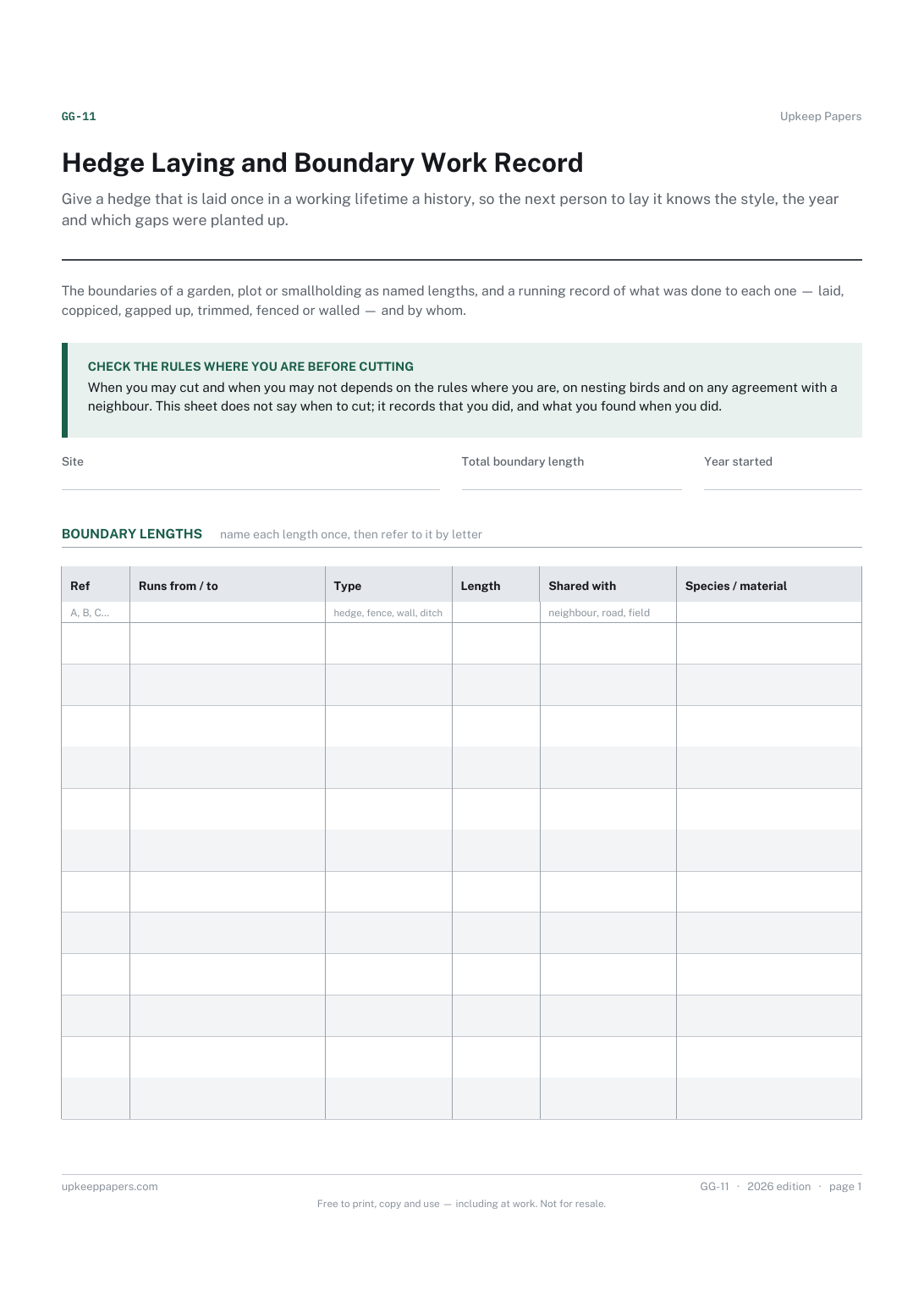
Printed under the title: The boundaries of a garden, plot or smallholding as named lengths, and a running record of what was done to each one — laid, coppiced, gapped up, trimmed, fenced or walled — and by whom.
Check the rules where you are before cutting. When you may cut and when you may not depends on the rules where you are, on nesting birds and on any agreement with a neighbour. This sheet does not say when to cut; it records that you did, and what you found when you did.
Write-on lines: Site · Total boundary length · Year started
Table, 12 rows: Ref · Runs from / to · Type · Length · Shared with · Species / material
Table, 21 rows: Date · Ref · Work done · Style / method · Stakes & binders · Gaps planted up · Done by · Look again · Notes
Because cutting seasons depend on the rules where you are, on nesting birds and on any arrangement with a neighbour, and none of those are ours to state. Check the rules where you are, then record what you did and when.
In the same tables. A boundary is often a mix — a laid hedge with a post-and-wire fence in the gaps — and the Ref column lets one length carry both. Routine fence inspection has its own sheet in the property category.
Record the fence walk and the faults, including who is responsible for each boundary before money is spent on it.
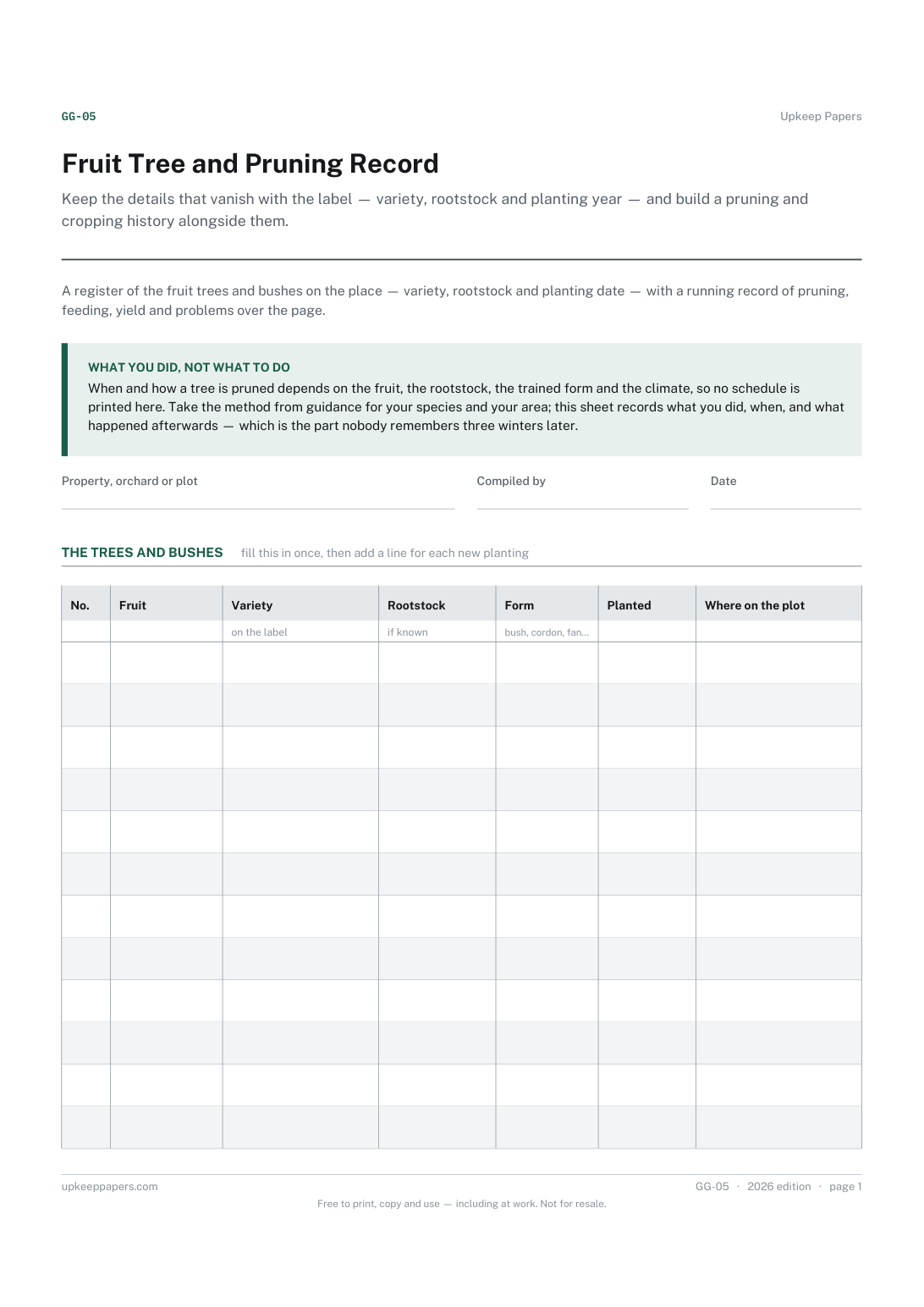
Keep the details that vanish with the label — variety, rootstock and planting year — and build a pruning and cropping history alongside them.
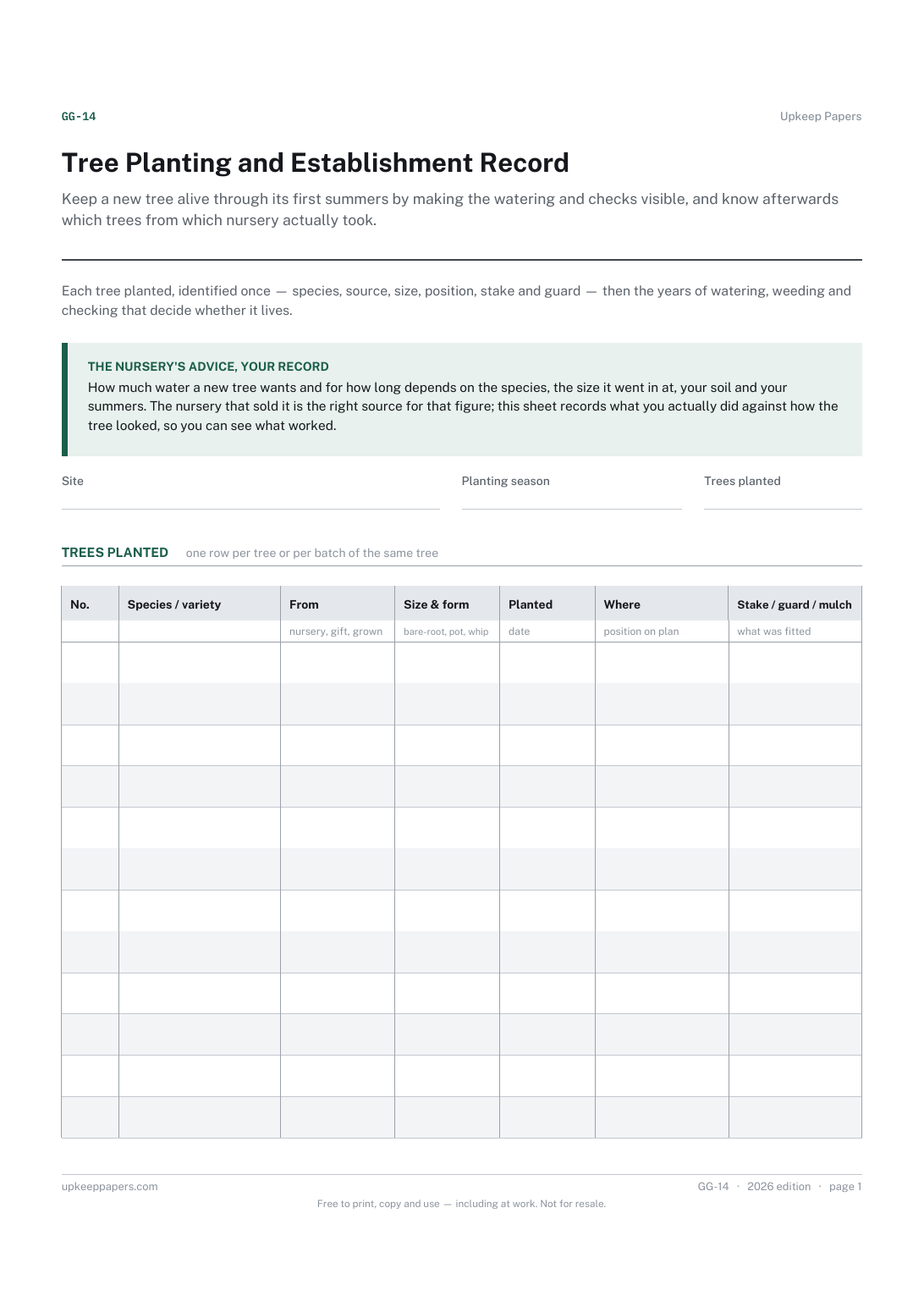
Keep a new tree alive through its first summers by making the watering and checks visible, and know afterwards which trees from which nursery actually took.
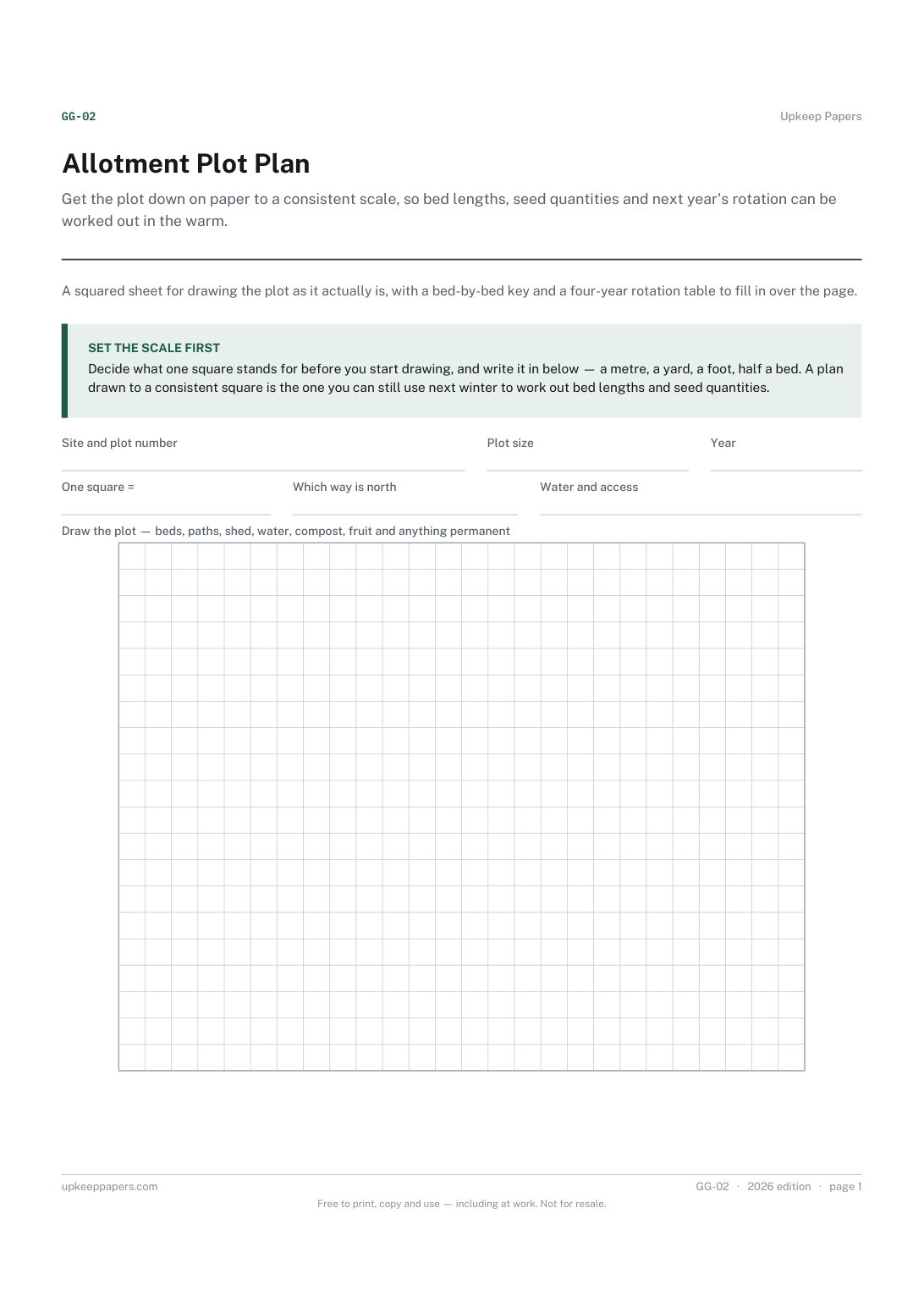
Get the plot down on paper to a consistent scale, so bed lengths, seed quantities and next year's rotation can be worked out in the warm.

Every sheet, binder, game and puzzle on Upkeep Papers is free to download, with no email and no account. Making them is not free: each one takes days of research, design and checking, and the site costs money to run. If something here saved you time, you can buy us a coffee. It is entirely optional: nothing is locked, and nothing changes if you don’t.
Buy us a coffee Opens PayPal in a new tab. Any amount, and nothing changes if you would rather not.