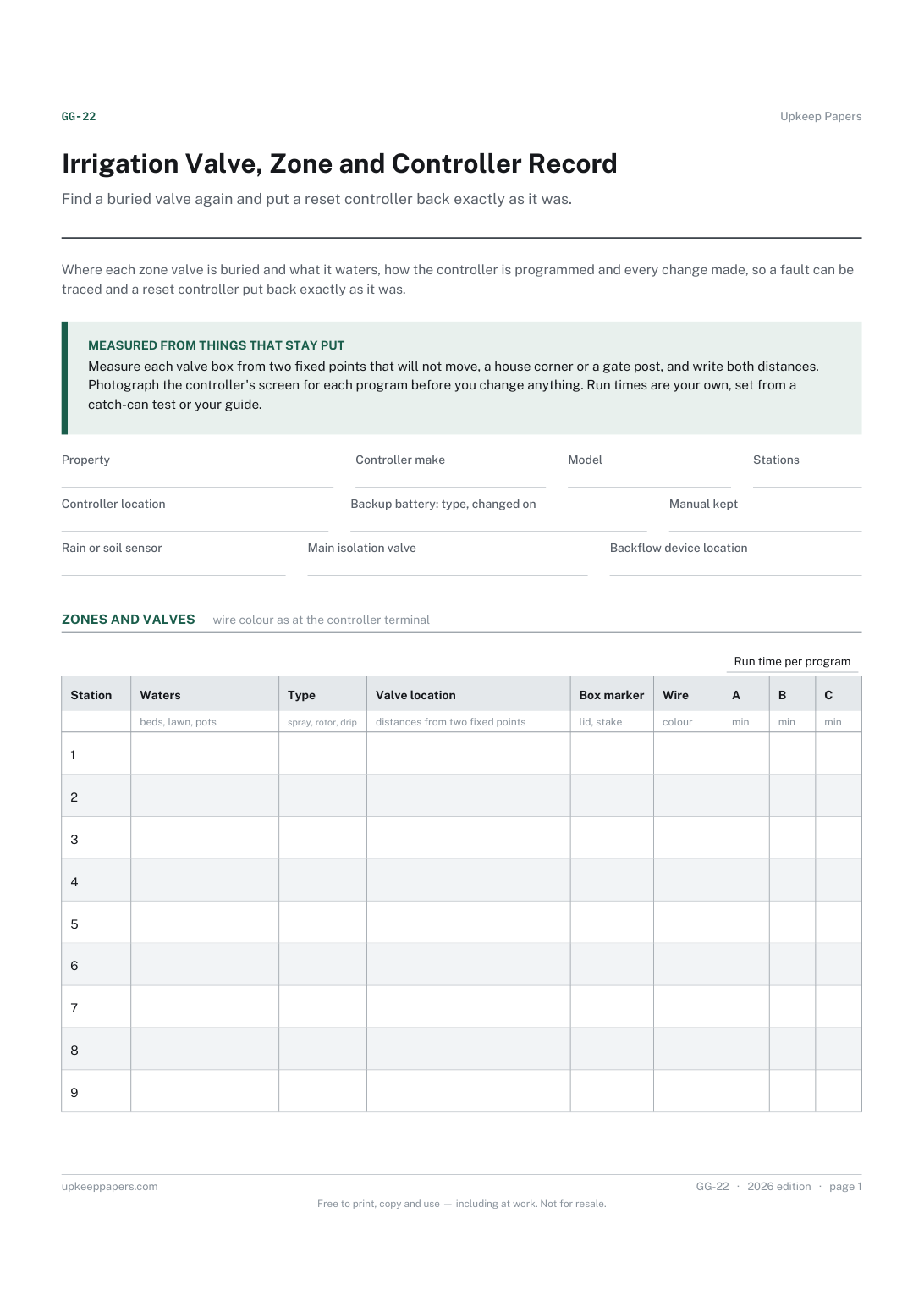
Irrigation Valve, Zone and Controller Record
Find a buried valve again and put a reset controller back exactly as it was. Every program, start time and run time is written down before anything is changed.
GG-22 2 pages
Everything here is free. Making it takes time and money. Everything here is free.
 Buy us a coffee
Garden and growing · GG-21
A free printable sprinkler audit worksheet: faults fixed, catch cans mapped and read, then average depth, low-quarter evenness and a new run time worked out.
2 pages. Choose your paper size — both versions are laid out identically, so neither one gets shrunk to fit.
Print it and write on it
Fill it in type and save
The fillable versions have real form fields — open them in any PDF reader, type into them and save. Printing help.
Set run times from what a zone actually puts down instead of the controller's default. The same test shows up dry corners and heads that need moving.
Homeowners, gardeners, groundskeepers and irrigation installers checking a sprinkler zone.
2 pages, in this order:
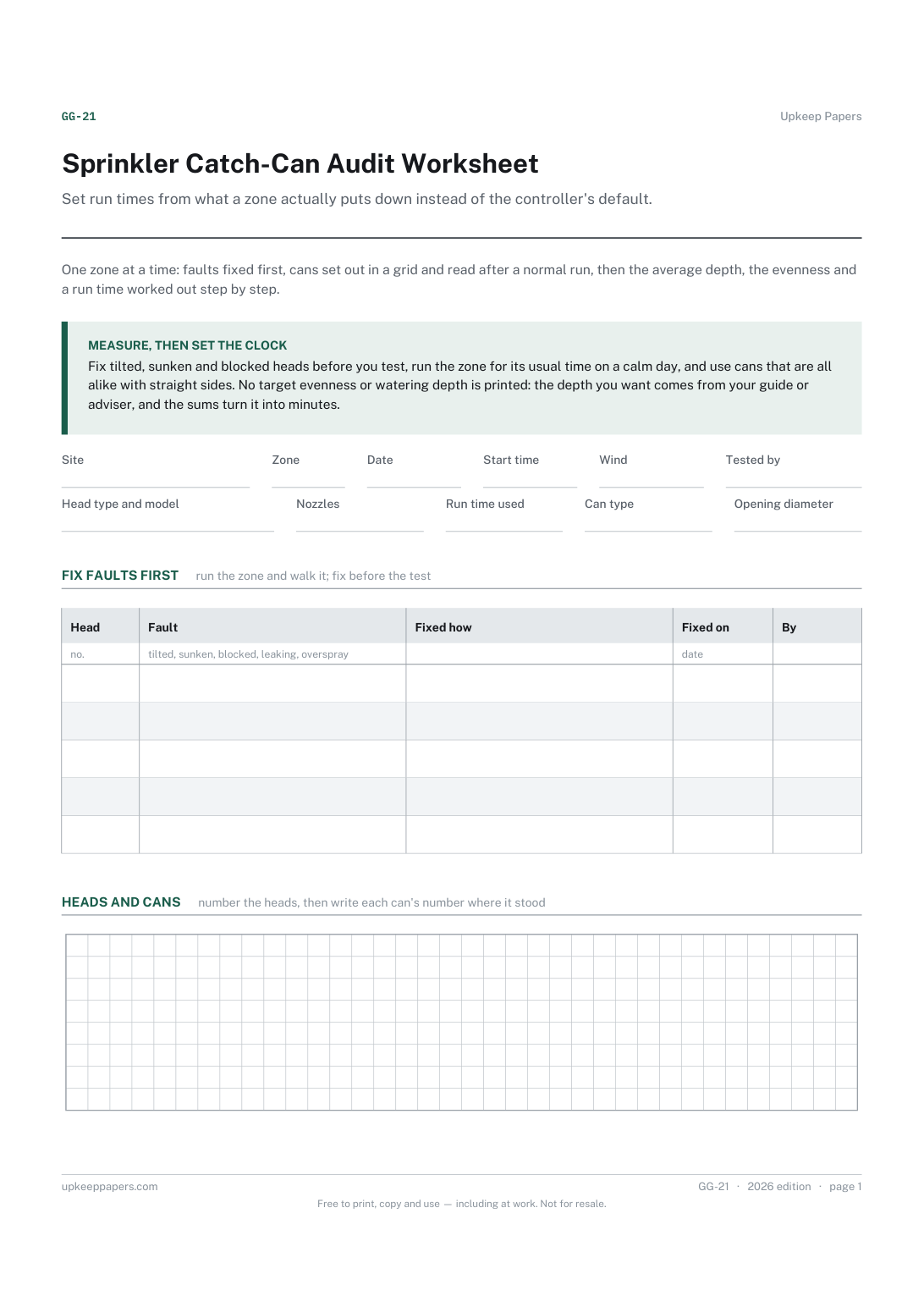
Printed under the title: One zone at a time: faults fixed first, cans set out in a grid and read after a normal run, then the average depth, the evenness and a run time worked out step by step.
Measure, then set the clock. Fix tilted, sunken and blocked heads before you test, run the zone for its usual time on a calm day, and use cans that are all alike with straight sides. No target evenness or watering depth is printed: the depth you want comes from your guide or adviser, and the sums turn it into minutes.
Write-on lines: Site · Zone · Date · Start time · Wind · Tested by · Head type and model · Nozzles · Run time used · Can type · Opening diameter
Also printed: Head · Fault · Fixed how · Fixed on · tilted, sunken, blocked, leaking, overspray · date
Squared grid
Also printed: Can · Caught
Write-on lines: Unit used · Cans set out · Read by · Cans knocked over or left out
Also printed: Average catch, A · add up every can and divide by the number of cans · total · ÷ cans · Low-quarter, B · a quarter of the cans, rounded: average the lowest that many · how many · their total · ÷ how many = B · Evenness · the low quarter against the average, as a percentage · Depth per run · if you measured volume: ml ÷ cm² gives cm, × 10 gives mm · opening area = 3.142 × radius × radius = · cm² · A ÷ area = · Rate per hour · the depth per run scaled to sixty minutes · depth per run · ÷ run time in minutes · per hour · New run time · only from a depth you have chosen from your own guide · depth you want · ÷ rate per hour · minutes
Write-on lines: Run time now set · Set on · Controller program · Test again on
Ruled lines: Notes: dry or wet spots on the sketch, heads to move or change
The sheet does not print one. Targets differ between guides and between spray and rotor heads, so take any figure from your adviser or the guide you follow. The test gives your own figure, and a change after fixing heads is easy to compare.
Divide the volume by the area of the can's opening. With millilitres and square centimetres the answer is in centimetres, and ten times that is millimetres. With straight-sided cans you can also measure the water's depth with a ruler.
Find a buried valve again and put a reset controller back exactly as it was. Every program, start time and run time is written down before anything is changed.
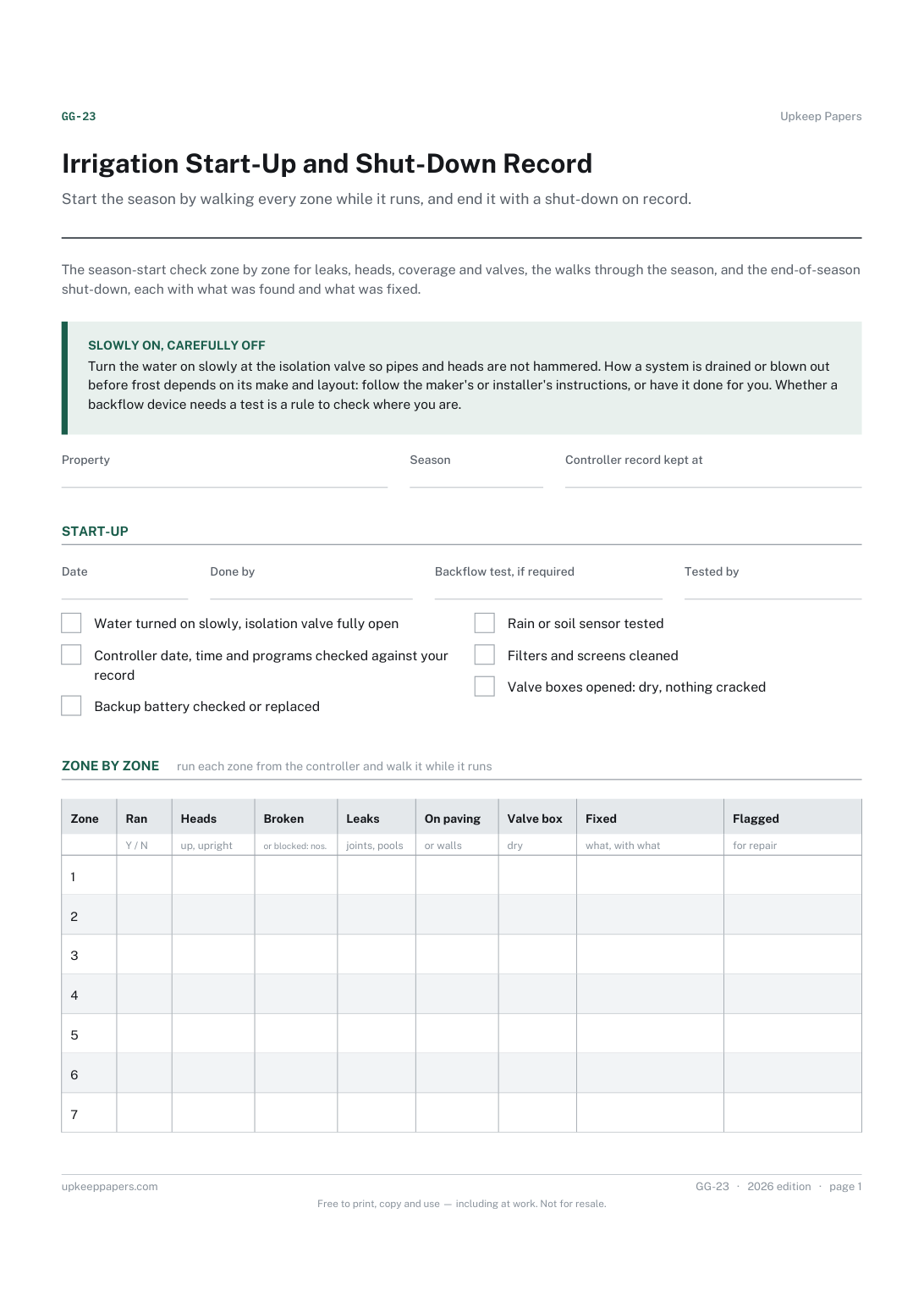
Start the season by walking every zone while it runs, and end it with a shut-down on record. Faults are written against their zone, so nothing is forgotten by spring.
Set out what waters what, how, and how often, then keep a dated record through the season alongside the system checks that stop a blocked emitter going unnoticed.
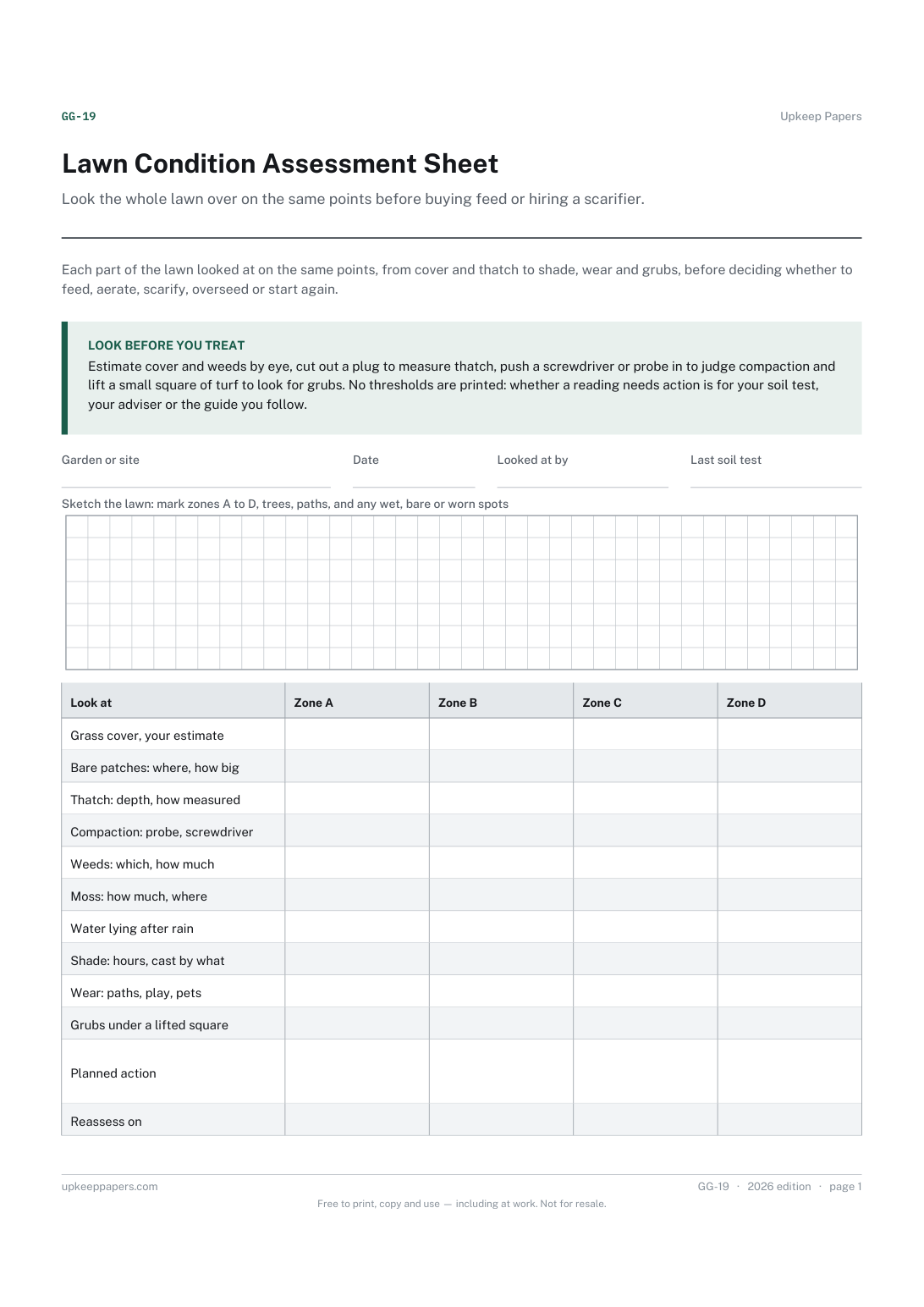
Look the whole lawn over on the same points before buying feed or hiring a scarifier. Writing down what each zone shows makes it clear which problem to tackle first.

Every sheet, binder, game and puzzle on Upkeep Papers is free to download, with no email and no account. Making them is not free: each one takes days of research, design and checking, and the site costs money to run. If something here saved you time, you can buy us a coffee. It is entirely optional: nothing is locked, and nothing changes if you don’t.
Buy us a coffee Opens PayPal in a new tab. Any amount, and nothing changes if you would rather not.