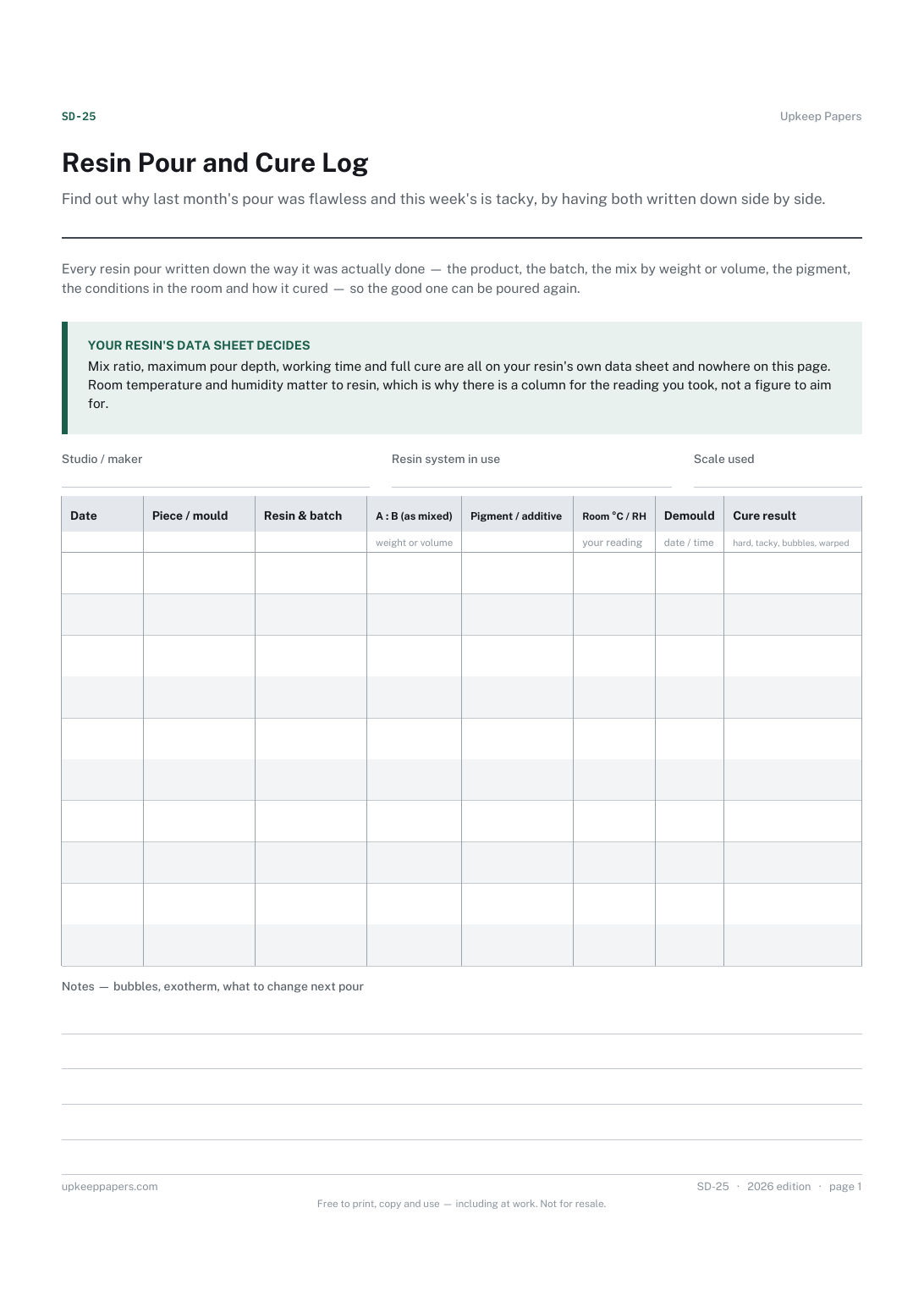
Resin Pour and Cure Log
Find out why last month's pour was flawless and this week's is tacky, by having both written down side by side.
SD-25 1 page
Everything here is free. Making it takes time and money. Everything here is free.
 Buy us a coffee
Studio crafts and making · SD-22
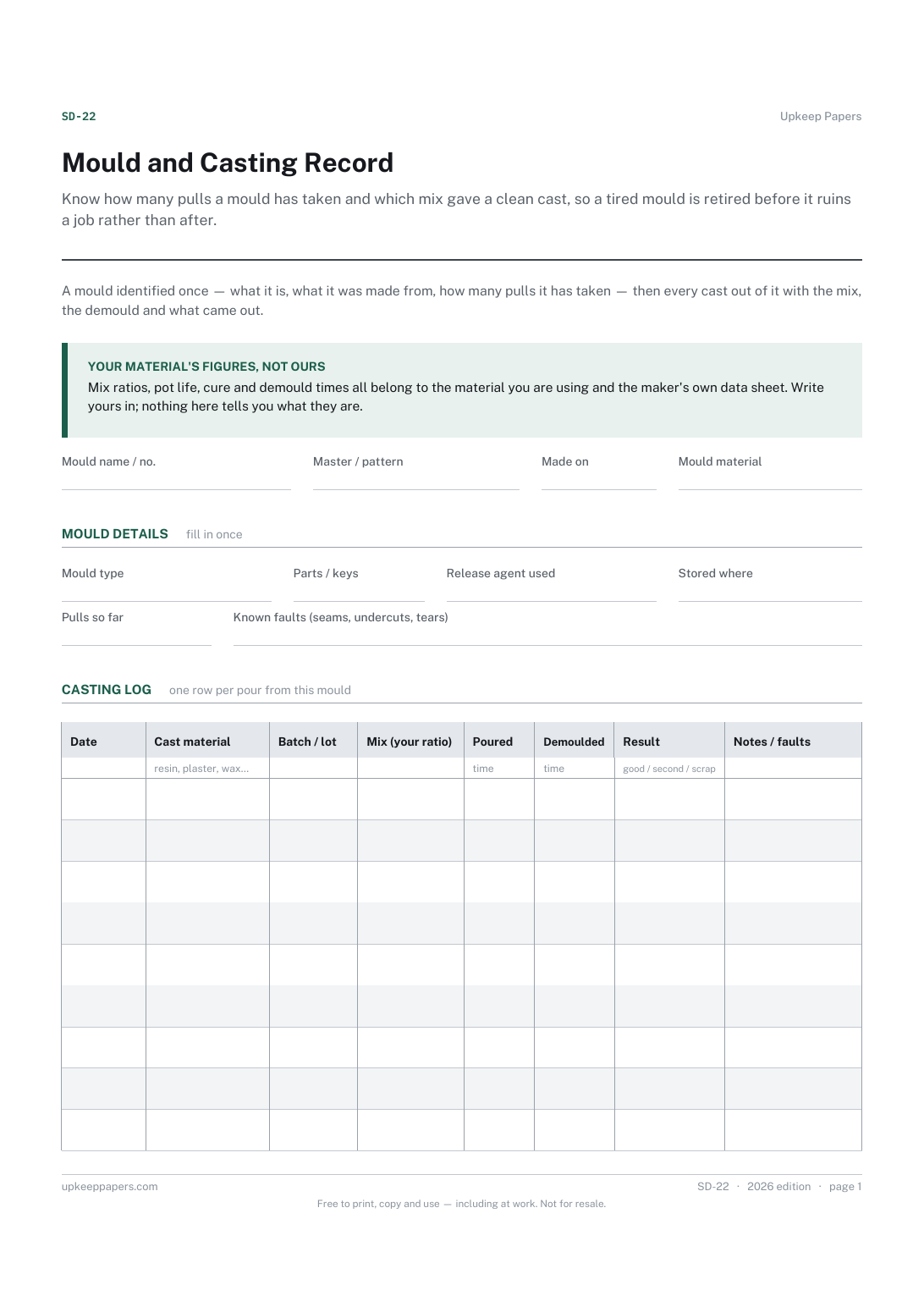
Casting record sheet — one mould identified once with its material, keys and known faults, then a log of every pour: batch, mix, demould and result.
One page. Choose your paper size — both versions are laid out identically, so neither one gets shrunk to fit.
Print it and write on it
Fill it in type and save
The fillable versions have real form fields — open them in any PDF reader, type into them and save. Printing help.
Know how many pulls a mould has taken and which mix gave a clean cast, so a tired mould is retired before it ruins a job rather than after.
Resin, plaster, wax, concrete and small-scale metal casters; ceramicists slip casting; prop, model and jewellery makers.
One page, top to bottom:
Printed under the title: A mould identified once — what it is, what it was made from, how many pulls it has taken — then every cast out of it with the mix, the demould and what came out.
Your material's figures, not ours. Mix ratios, pot life, cure and demould times all belong to the material you are using and the maker's own data sheet. Write yours in; nothing here tells you what they are.
Write-on lines: Mould name / no. · Master / pattern · Made on · Mould material
Write-on lines: Mould type · Parts / keys · Release agent used · Stored where · Pulls so far · Known faults (seams, undercuts, tears)
Table, 9 rows: Date · Cast material · Batch / lot · Mix (your ratio) · Poured · Demoulded · Result · Notes / faults
Because they belong to the material you are using, not to us. Two resins from the same supplier can differ, and plaster and wax behave differently again. Take the figures from your own data sheet, write in what you did, and the sheet becomes your record of what worked.
Per mould. The point is the running history of that one mould — its pull count and where it is starting to fail — which is lost if pours from several moulds are mixed on one page.
Find out why last month's pour was flawless and this week's is tacky, by having both written down side by side.
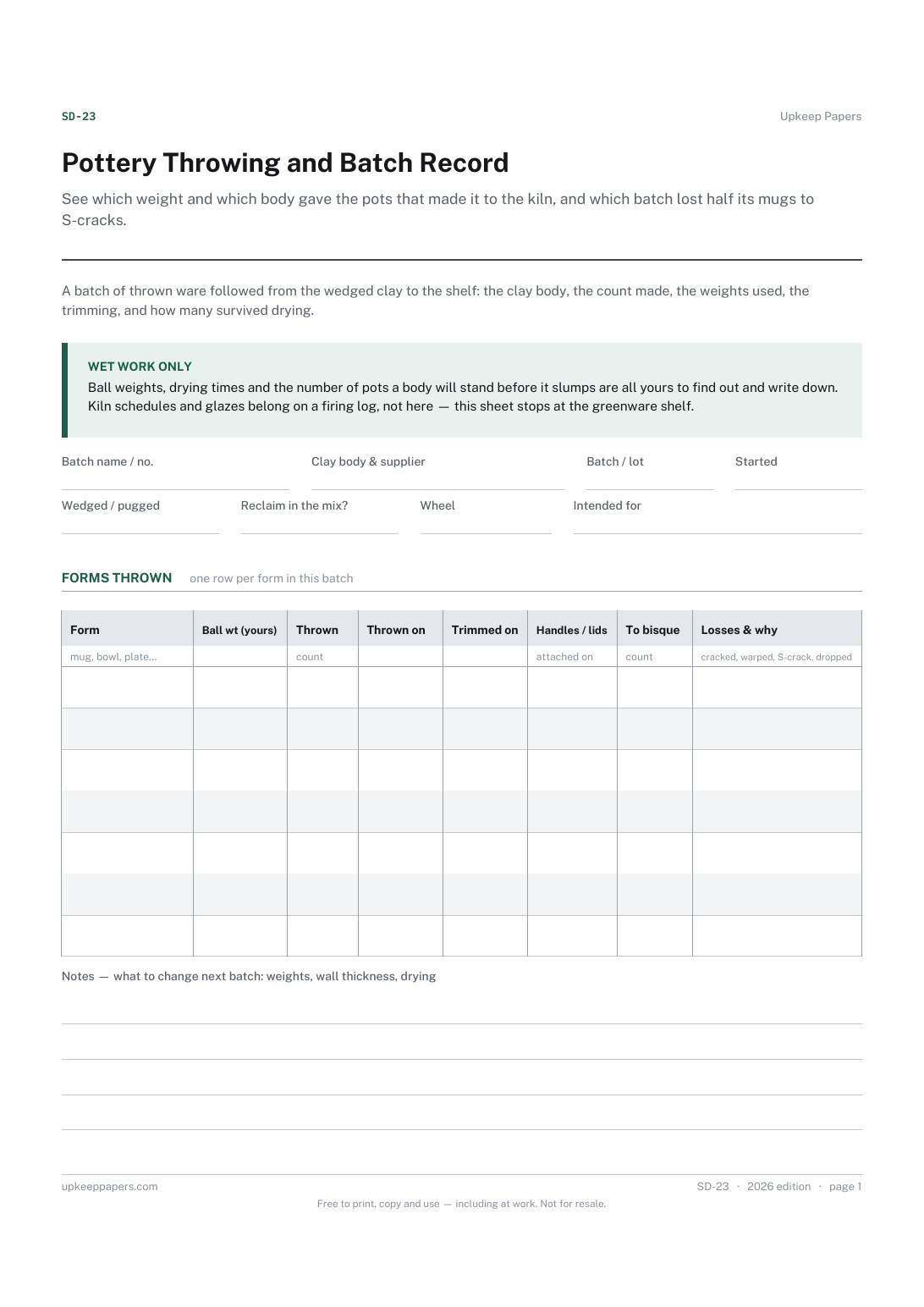
See which weight and which body gave the pots that made it to the kiln, and which batch lost half its mugs to S-cracks.
Make a batch traceable, so a good one can be repeated and a bad one can be traced back to what went into it.
Record the settings that produced each print, so a good result can be repeated and a failed one diagnosed instead of guessed at.

Every sheet, binder, game and puzzle on Upkeep Papers is free to download, with no email and no account. Making them is not free: each one takes days of research, design and checking, and the site costs money to run. If something here saved you time, you can buy us a coffee. It is entirely optional: nothing is locked, and nothing changes if you don’t.
Buy us a coffee Opens PayPal in a new tab. Any amount, and nothing changes if you would rather not.