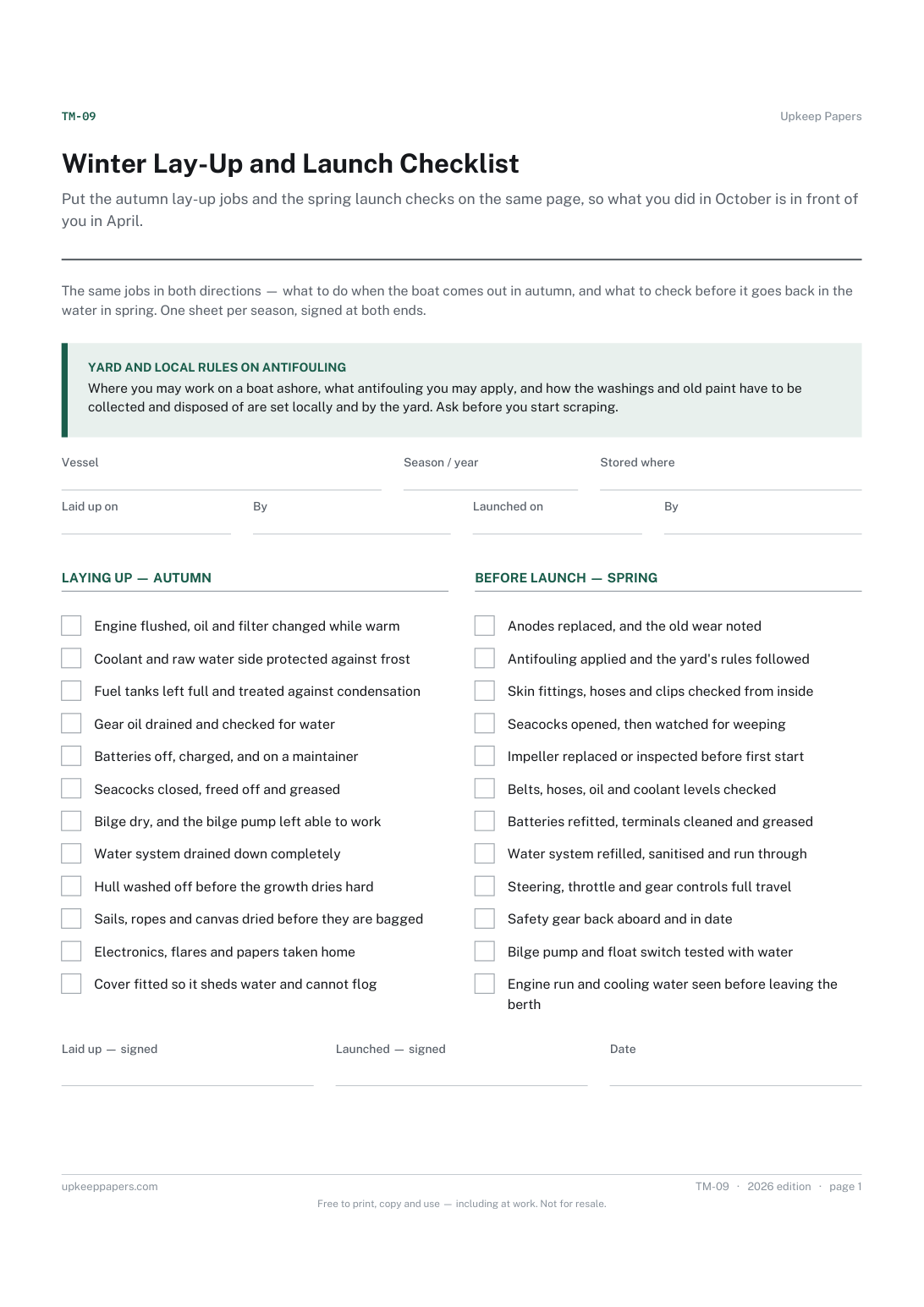
Winter Lay-Up and Launch Checklist
Put the autumn lay-up jobs and the spring launch checks on the same page, so what you did in October is in front of you in April.
TM-09 1 page
Everything here is free. Making it takes time and money. Everything here is free.
 Buy us a coffee
Trailers and marine · TM-26
A free printable sail inventory: every sail with its maker, year, cloth and lengths, a season check one column per sail, and a log of repairs.
2 pages. Choose your paper size — both versions are laid out identically, so neither one gets shrunk to fit.
Print it and write on it
Fill it in type and save
The fillable versions have real form fields — open them in any PDF reader, type into them and save. Printing help.
Know what each sail is, how old it is and what it needs before the season starts. The season check turns into the sailmaker's job list, and the repair log shows what each sail has already had done.
Yacht and dinghy owners, and clubs or schools with a loft full of sails.
2 pages, in this order:
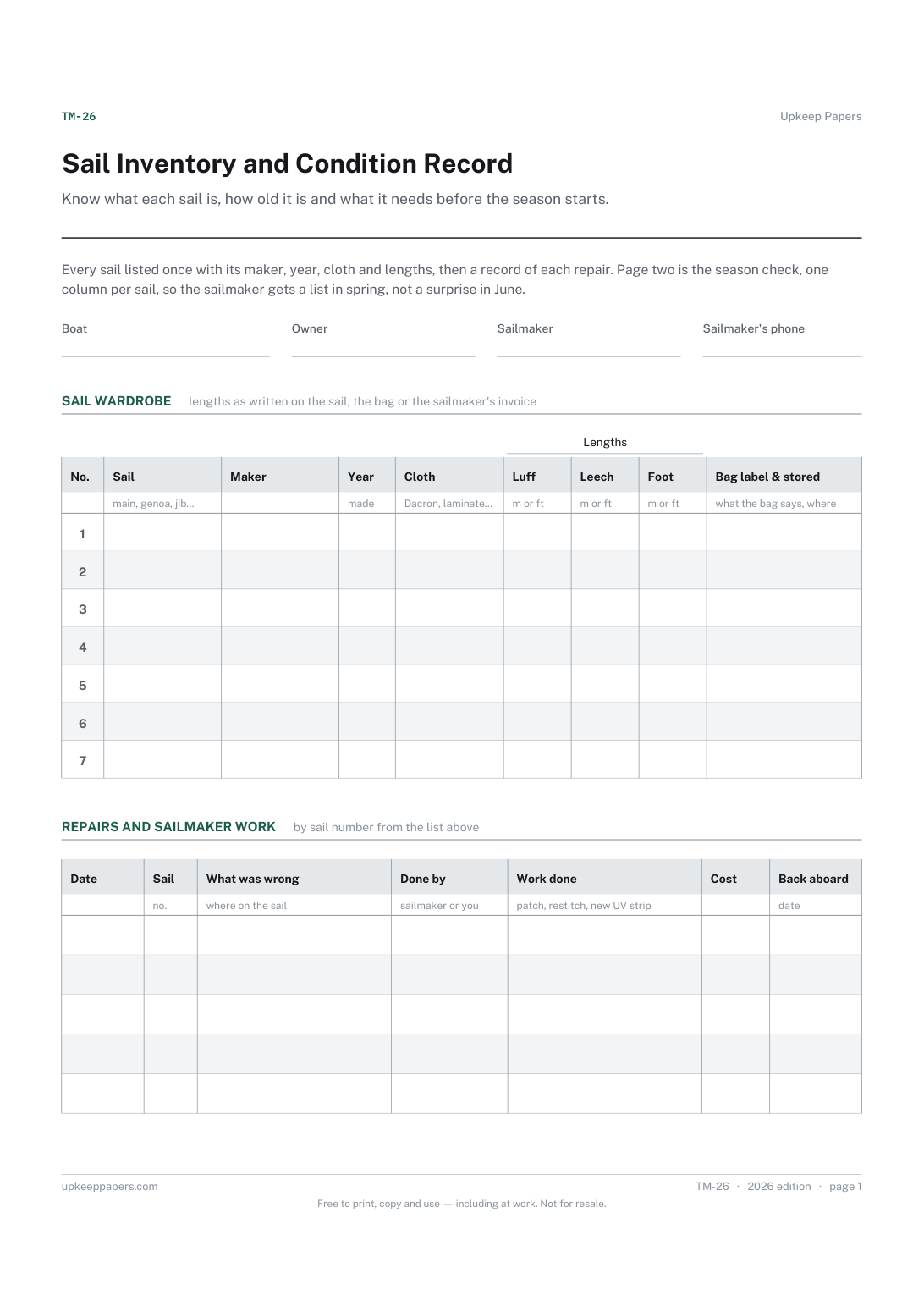
Printed under the title: Every sail listed once with its maker, year, cloth and lengths, then a record of each repair. Page two is the season check, one column per sail, so the sailmaker gets a list in spring, not a surprise in June.
Write-on lines: Boat · Owner · Sailmaker · Sailmaker's phone
Also printed: Lengths
Table, 7 rows: No. · Sail · Maker · Year · Cloth · Luff · Leech · Foot · Bag label & stored
Table, 5 rows: Date · Sail · What was wrong · Done by · Work done · Cost · Back aboard
Also printed: Sail number, from page one · Check · Date checked · Cloth and seams · Cloth: tears, holes, mildew, hard creases · Seams: stitching worn or broken, often on the sun side · UV strip or sail cover: faded, brittle or lifting · Corners and edges · Head, tack and clew: rings, webbing and patches · Leech: leech line, its cleat, the tabling · Luff: tape or bolt rope, slides, cars or hanks · Foot: bolt rope or slides, outhaul fitting · Reef points, cringles and reef patches · Battens and chafe · Batten pockets, end caps and elastic · Battens: cracked, split or missing · Chafe at spreaders, shrouds, stanchions, pulpit · Telltales, sail numbers and insignia · Bag sound, label readable, sail stowed dry · Verdict · Overall: good, fair or poor · Action: none, repair or replace · Checked by
Write-on lines: Sent to the sailmaker on · Sails sent · Collected on
Ruled lines: Notes: how each sail sets, and anything to ask the sailmaker
Because it depends on the cloth, how the sail is used and stored, and how much sun it sees. A cruising sail and a racing laminate age very differently. The sheet records what you find each season; when to replace a sail is for you and your sailmaker to judge.
OK means nothing to do. W means watch it: a small wear point or a faded strip to look at again soon. R means it needs a repair before the sail is used hard.
Put the autumn lay-up jobs and the spring launch checks on the same page, so what you did in October is in front of you in April.
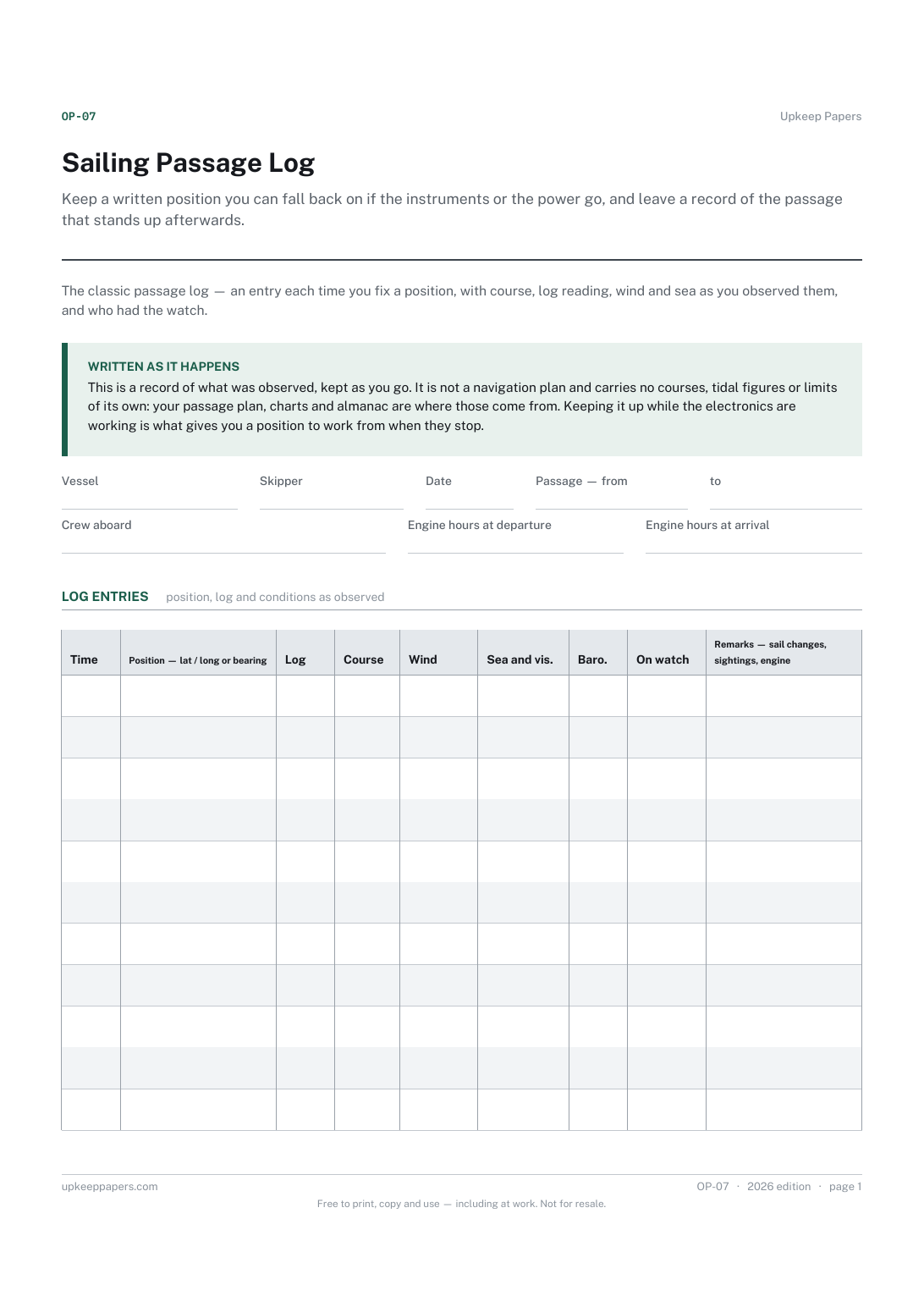
Keep a written position you can fall back on if the instruments or the power go, and leave a record of the passage that stands up afterwards.
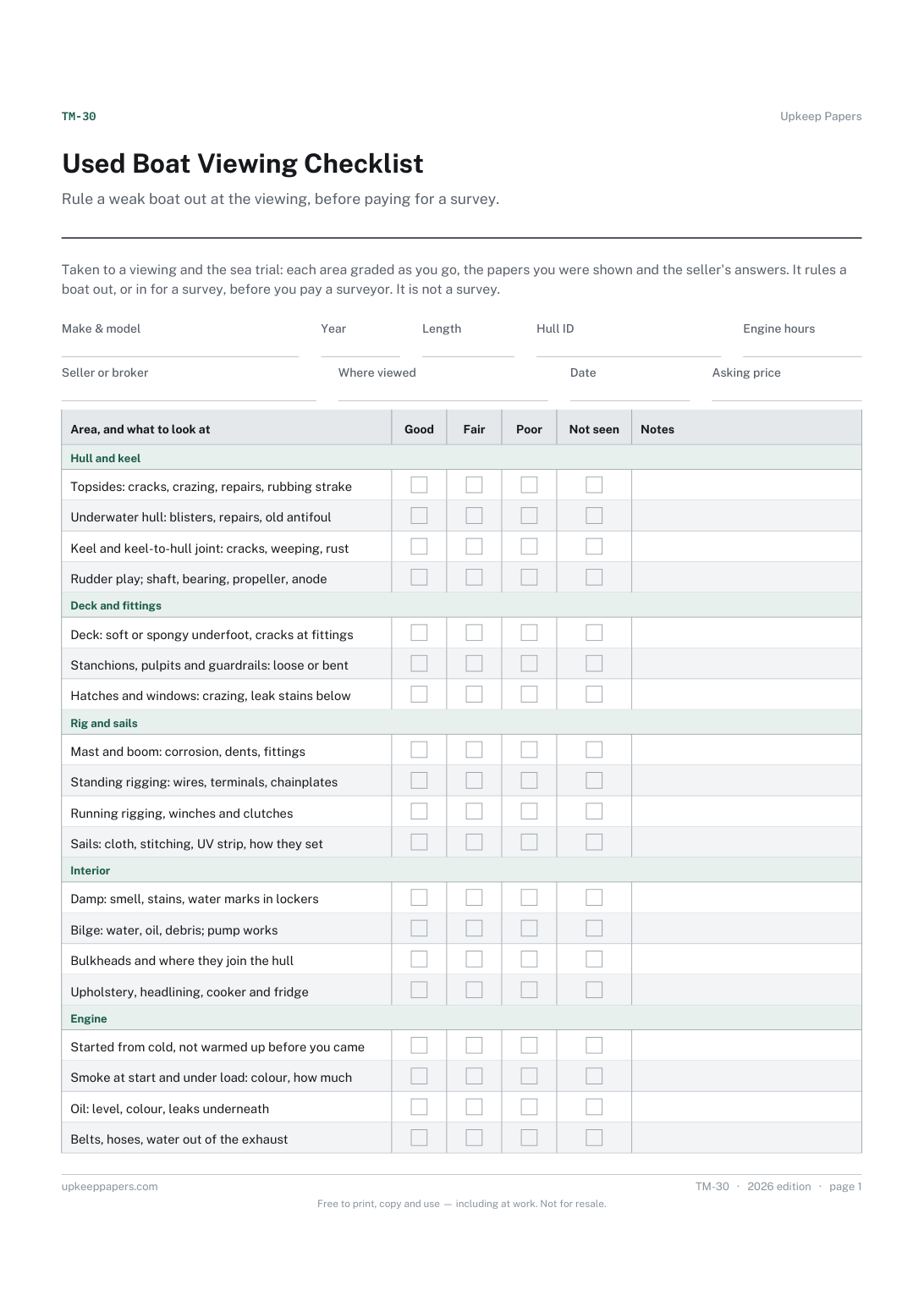
Rule a weak boat out at the viewing, before paying for a survey. Each area is graded good, fair or poor with notes, and the papers and answers sit beside it.
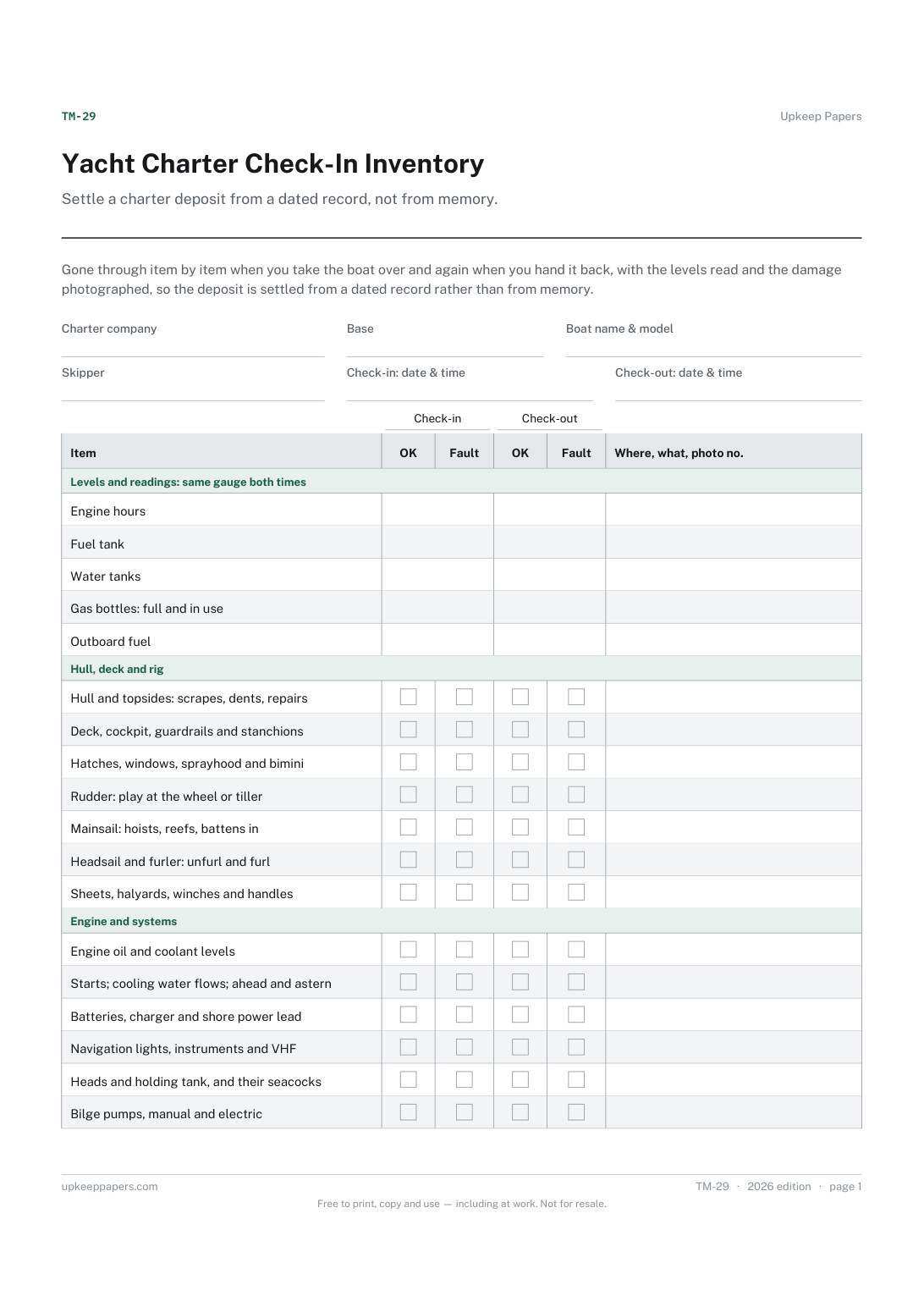
Settle a charter deposit from a dated record, not from memory. Every item is checked at handover and again at return, with the levels read and photos numbered.

Every sheet, binder, game and puzzle on Upkeep Papers is free to download, with no email and no account. Making them is not free: each one takes days of research, design and checking, and the site costs money to run. If something here saved you time, you can buy us a coffee. It is entirely optional: nothing is locked, and nothing changes if you don’t.
Buy us a coffee Opens PayPal in a new tab. Any amount, and nothing changes if you would rather not.