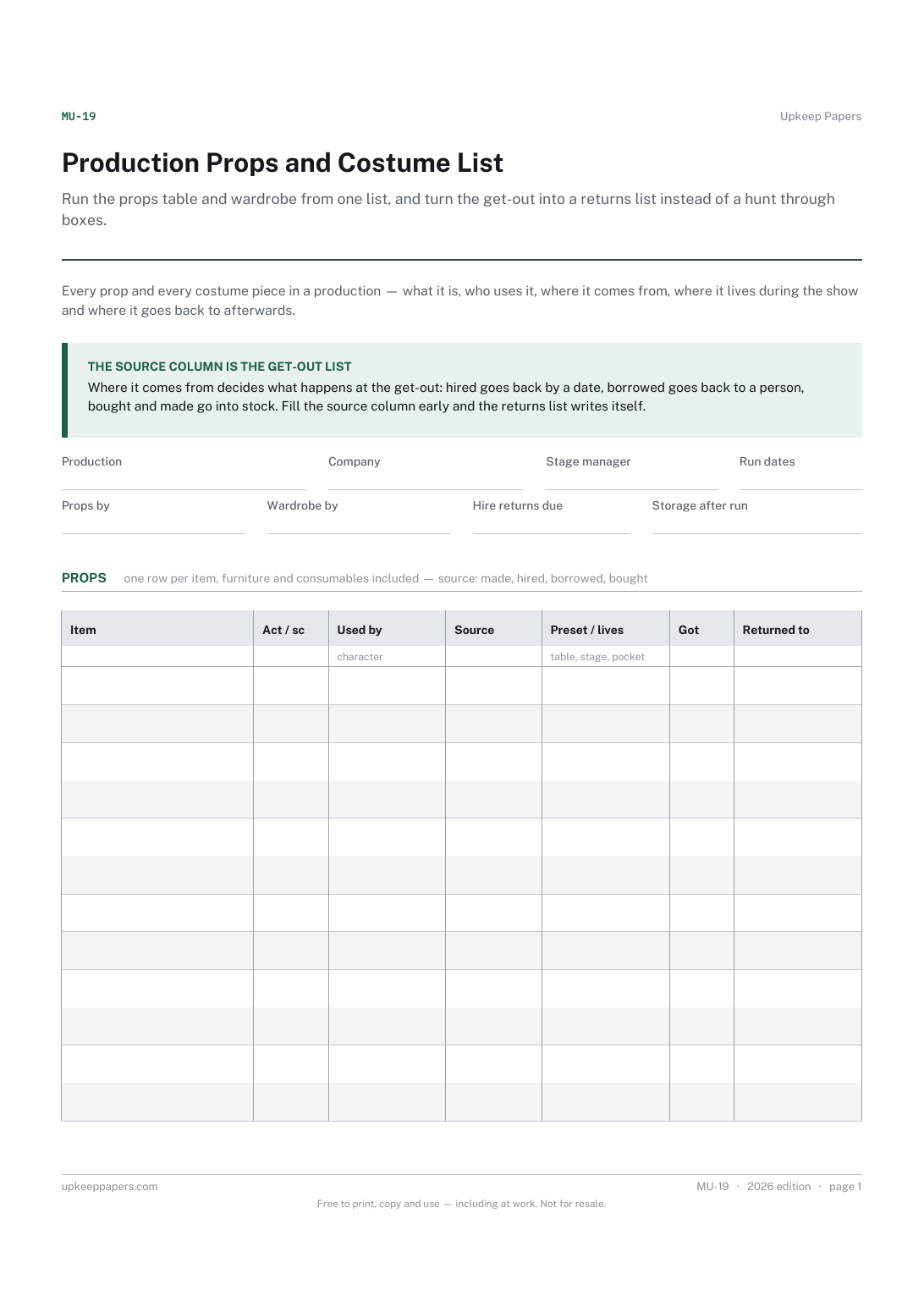
Production Props and Costume List
Run the props table and wardrobe from one list, and turn the get-out into a returns list instead of a hunt through boxes.
MU-19 2 pages
Everything here is free. Making it takes time and money. Everything here is free.
 Buy us a coffee
Music and performance · MU-13
A free printable lighting cue sheet — cue number, go point, the look, fade time and follow-on for every cue, in the order the board operator reads them.
One page. Choose your paper size — both versions are laid out identically, so neither one gets shrunk to fit.
Print it and write on it
Fill it in type and save
The fillable versions have real form fields — open them in any PDF reader, type into them and save. Printing help.
Give the operator and the caller the same list, written so a cue can be taken from the words on the page without the designer in the room.
Lighting designers, board operators and deputy stage managers on amateur and professional productions, and school and college shows.
One page, top to bottom:
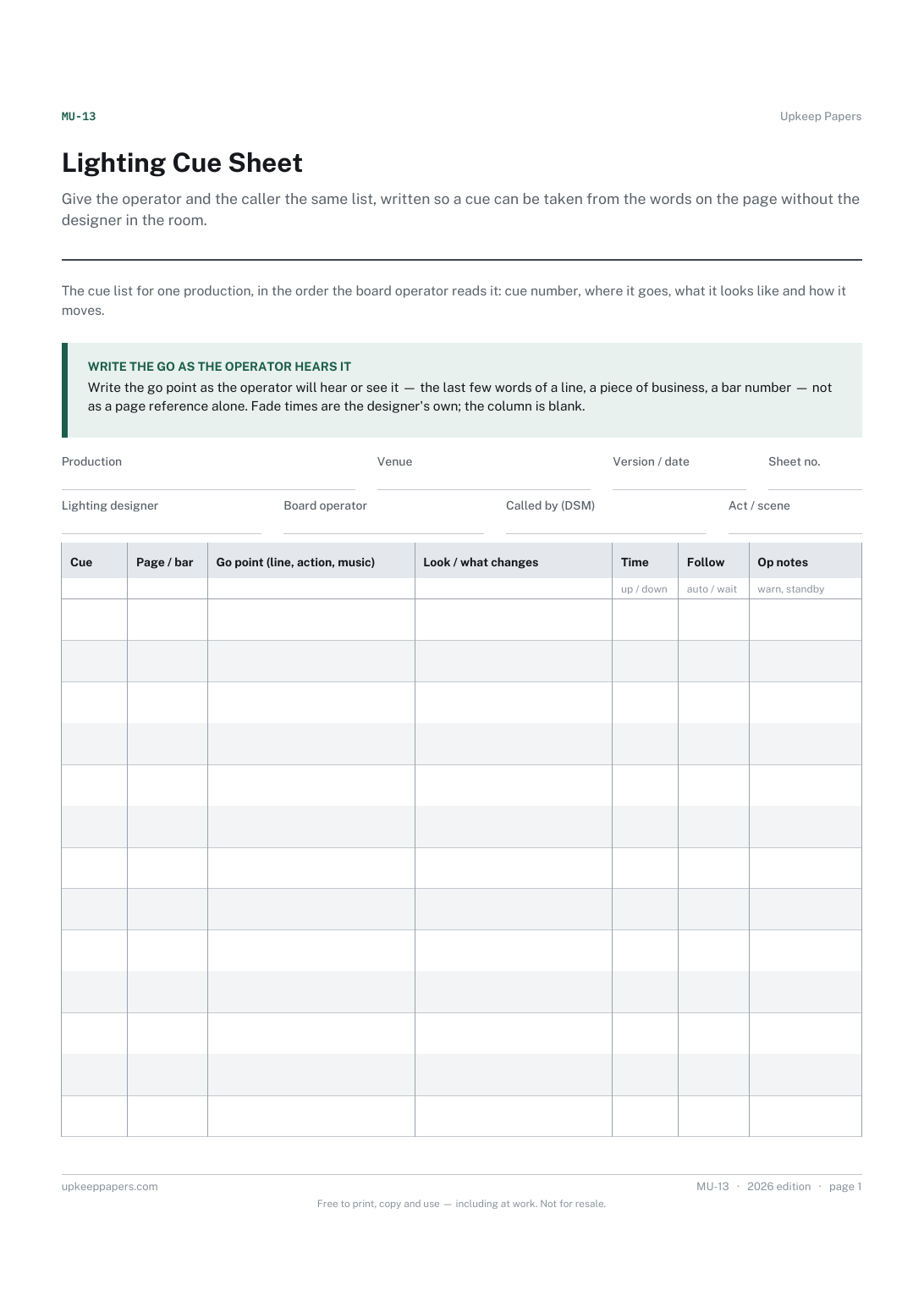
Printed under the title: The cue list for one production, in the order the board operator reads it: cue number, where it goes, what it looks like and how it moves.
Write the go as the operator hears it. Write the go point as the operator will hear or see it — the last few words of a line, a piece of business, a bar number — not as a page reference alone. Fade times are the designer's own; the column is blank.
Write-on lines: Production · Venue · Version / date · Sheet no. · Lighting designer · Board operator · Called by (DSM) · Act / scene
Table, 13 rows: Cue · Page / bar · Go point (line, action, music) · Look / what changes · Time · Follow · Op notes
Because fade times belong to the designer and the show. A printed default would be wrong for almost every cue; the column is there to be written in from the plotting session.
You can, with the same columns — cue, go point, what happens, time. If a show has many of both it is usually clearer to keep a separate sheet per department so the operators are not reading past each other's cues.
Run the props table and wardrobe from one list, and turn the get-out into a returns list instead of a hunt through boxes.
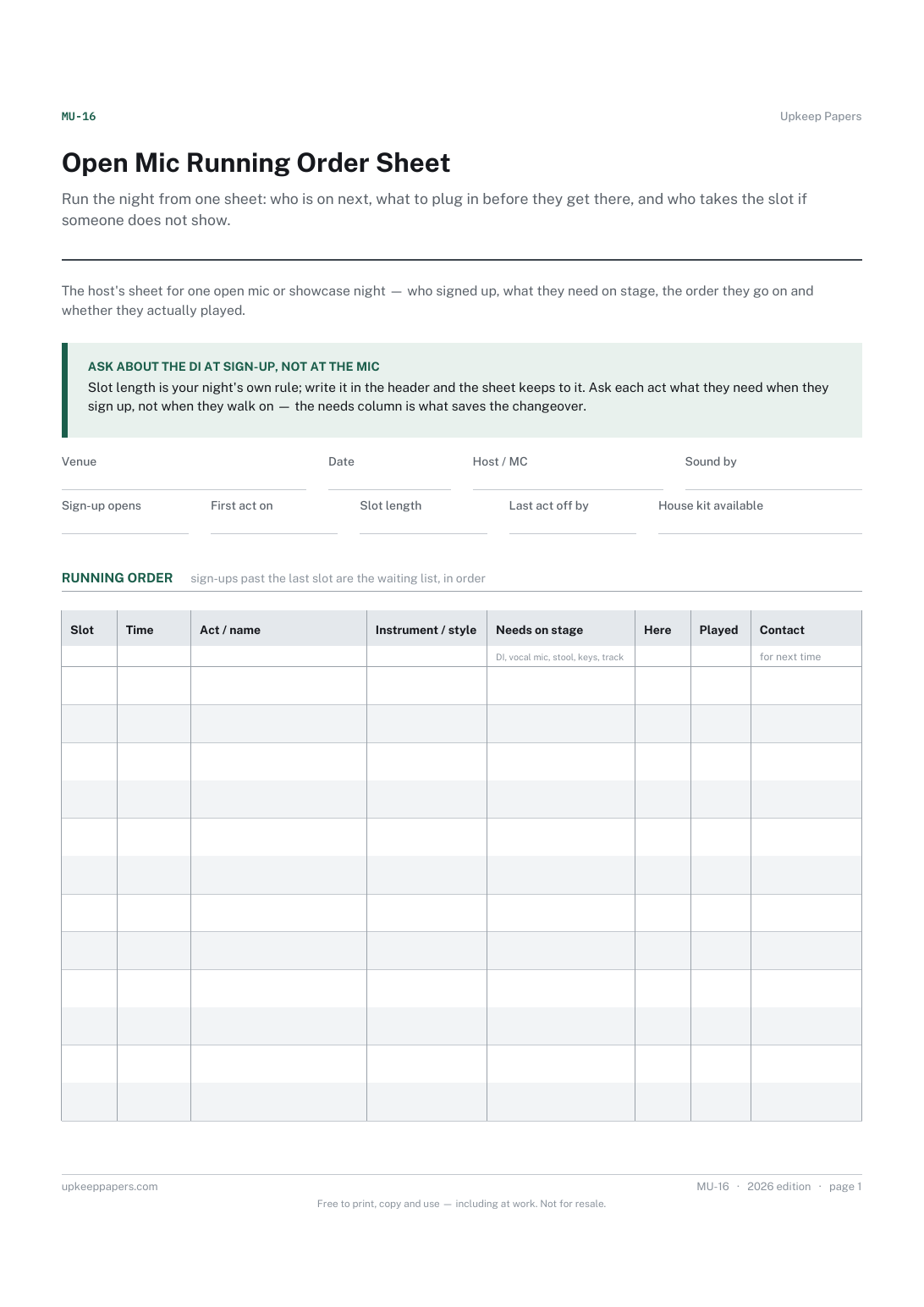
Run the night from one sheet: who is on next, what to plug in before they get there, and who takes the slot if someone does not show.
Get the day out of one person's head and onto a page everybody can read, so the event does not stall when the organiser is dealing with something else.
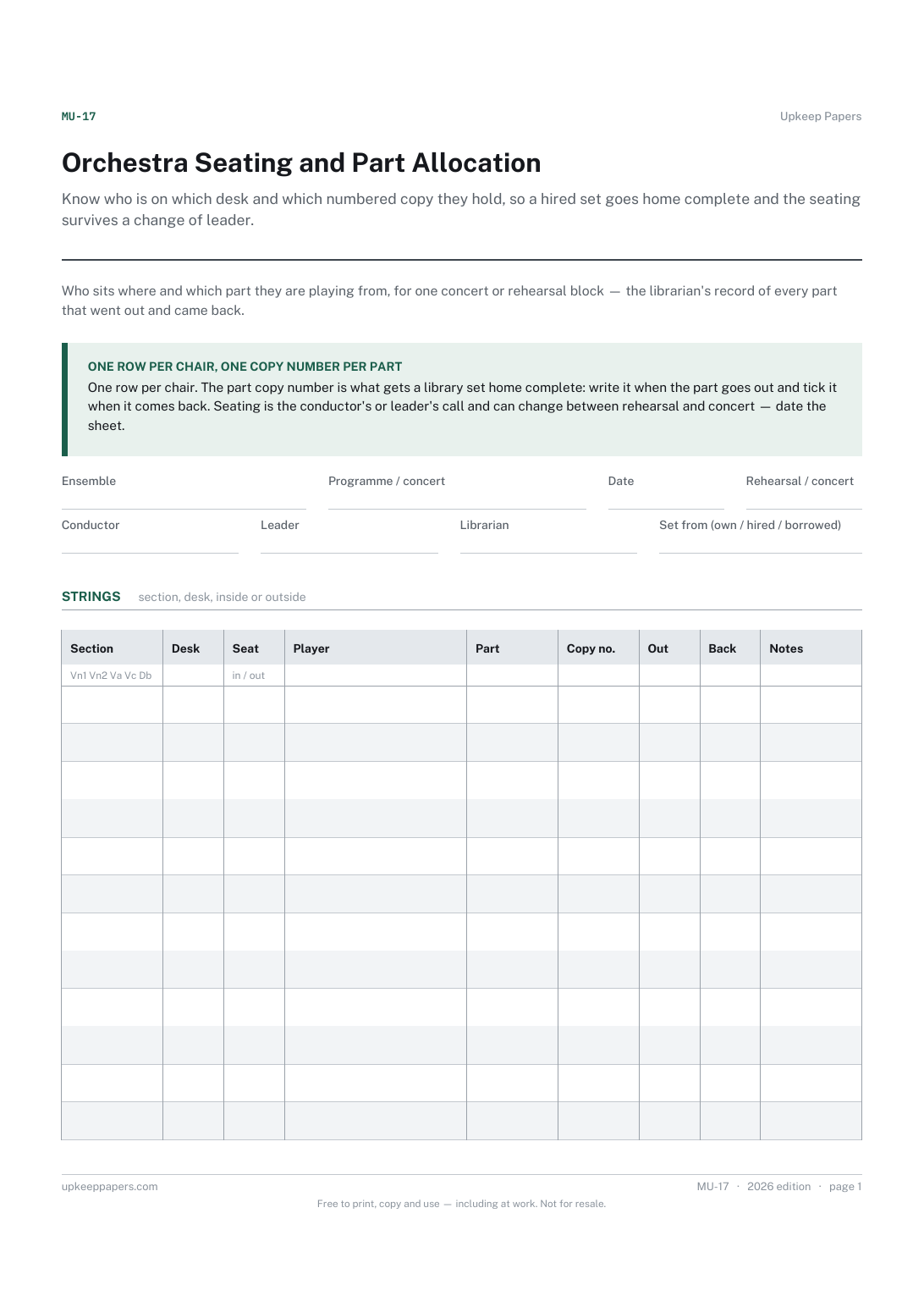
Know who is on which desk and which numbered copy they hold, so a hired set goes home complete and the seating survives a change of leader.

Every sheet, binder, game and puzzle on Upkeep Papers is free to download, with no email and no account. Making them is not free: each one takes days of research, design and checking, and the site costs money to run. If something here saved you time, you can buy us a coffee. It is entirely optional: nothing is locked, and nothing changes if you don’t.
Buy us a coffee Opens PayPal in a new tab. Any amount, and nothing changes if you would rather not.