
Item Provenance and Documentation Sheet
Record the history of a single item and where its paperwork lives, including the gaps, so the chain is not reconstructed from memory by somebody else later.
CV-02 2 pages
Everything here is free. Making it takes time and money. Everything here is free.
 Buy us a coffee
Collecting and valuables · CV-09
A free printable art inventory — artist, title, medium and size, edition number, whether it is framed, where it hangs and the provenance file reference.
One page. Choose your paper size — both versions are laid out identically, so neither one gets shrunk to fit.
Print it and write on it
Fill it in type and save
The fillable versions have real form fields — open them in any PDF reader, type into them and save. Printing help.
List pictures with the details that identify them — medium, size, edition number — and record where each one hangs or is stored.
Private collectors, people furnishing a house with original work, and anyone listing the art in a property for a move, a valuation or an estate.
One page, top to bottom:
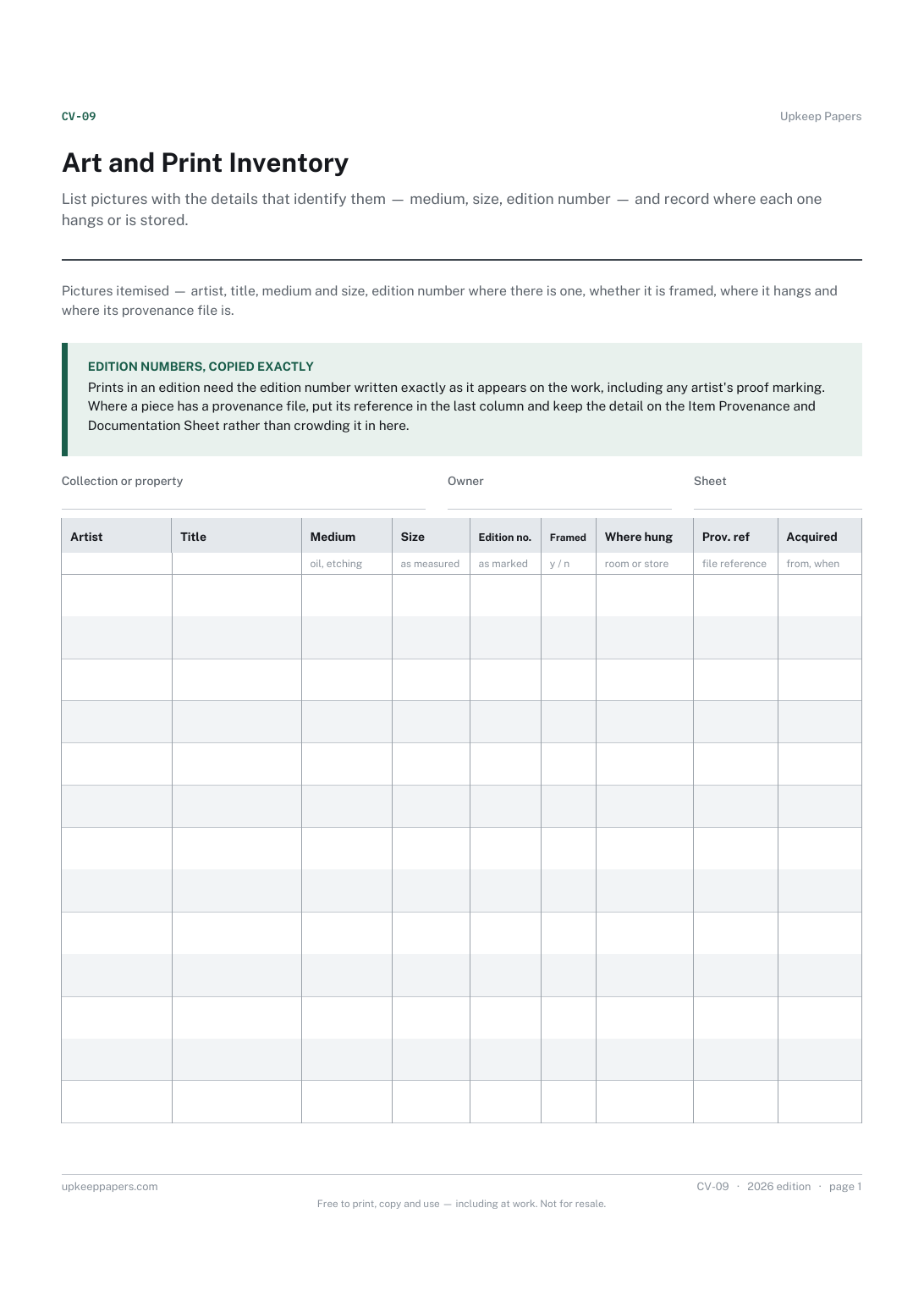
Printed under the title: Pictures itemised — artist, title, medium and size, edition number where there is one, whether it is framed, where it hangs and where its provenance file is.
Edition numbers, copied exactly. Prints in an edition need the edition number written exactly as it appears on the work, including any artist's proof marking. Where a piece has a provenance file, put its reference in the last column and keep the detail on the Item Provenance and Documentation Sheet rather than crowding it in here.
Write-on lines: Collection or property · Owner · Sheet
Table, 13 rows: Artist · Title · Medium · Size · Edition no. · Framed · Where hung · Prov. ref · Acquired
Because a valuation is one professional's opinion, on one date, in one market, and no form can supply it. This sheet records what the work is and where it is; the Collection Inventory and Valuation Record has space for a valuation and the name of whoever gave it.
Only for pieces where the history matters. For those, the Item Provenance and Documentation Sheet holds the ownership chain and the paperwork, and this inventory just carries its file reference.
Record the history of a single item and where its paperwork lives, including the gaps, so the chain is not reconstructed from memory by somebody else later.
Itemise a collection properly, so that identification, acquisition and any valuation exist somewhere other than in your head.
Keep a catalogue of finished work and where it went, which is the record galleries, insurers and tax authorities ask for and working artists rarely have.
List what you own before you need to, so a claim or a police report starts from a document rather than from trying to remember a burgled room.

Every sheet, binder, game and puzzle on Upkeep Papers is free to download, with no email and no account. Making them is not free: each one takes days of research, design and checking, and the site costs money to run. If something here saved you time, you can buy us a coffee. It is entirely optional: nothing is locked, and nothing changes if you don’t.
Buy us a coffee Opens PayPal in a new tab. Any amount, and nothing changes if you would rather not.


