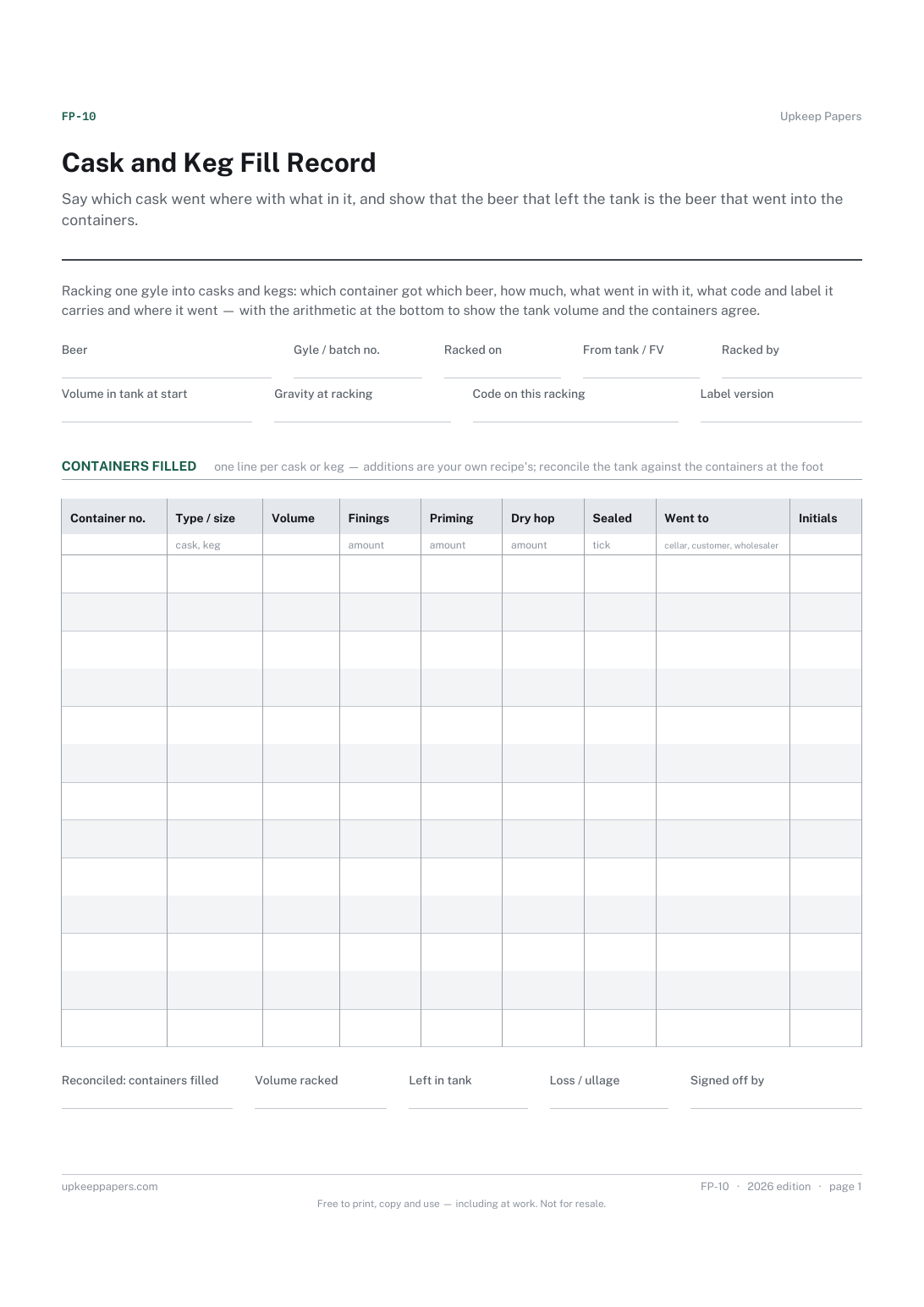
Cask and Keg Fill Record
Say which cask went where with what in it, and show that the beer that left the tank is the beer that went into the containers.
FP-10 1 page
Everything here is free. Making it takes time and money. Everything here is free.
 Buy us a coffee
Food production and artisan makers · FP-06
A free printable brew day sheet for a small brewery — grist, hops and additions with supplier lots, mash and boil figures, yeast, fermenter and readings.
2 pages. Choose your paper size — both versions are laid out identically, so neither one gets shrunk to fit.
Print it and write on it
Fill it in type and save
The fillable versions have real form fields — open them in any PDF reader, type into them and save. Printing help.
Brew the same beer again, and say which bag of malt and which hop lot went into the gyle a customer is asking about.
Microbreweries, nano and cuckoo brewers, and anyone brewing to sell rather than for the kitchen table.
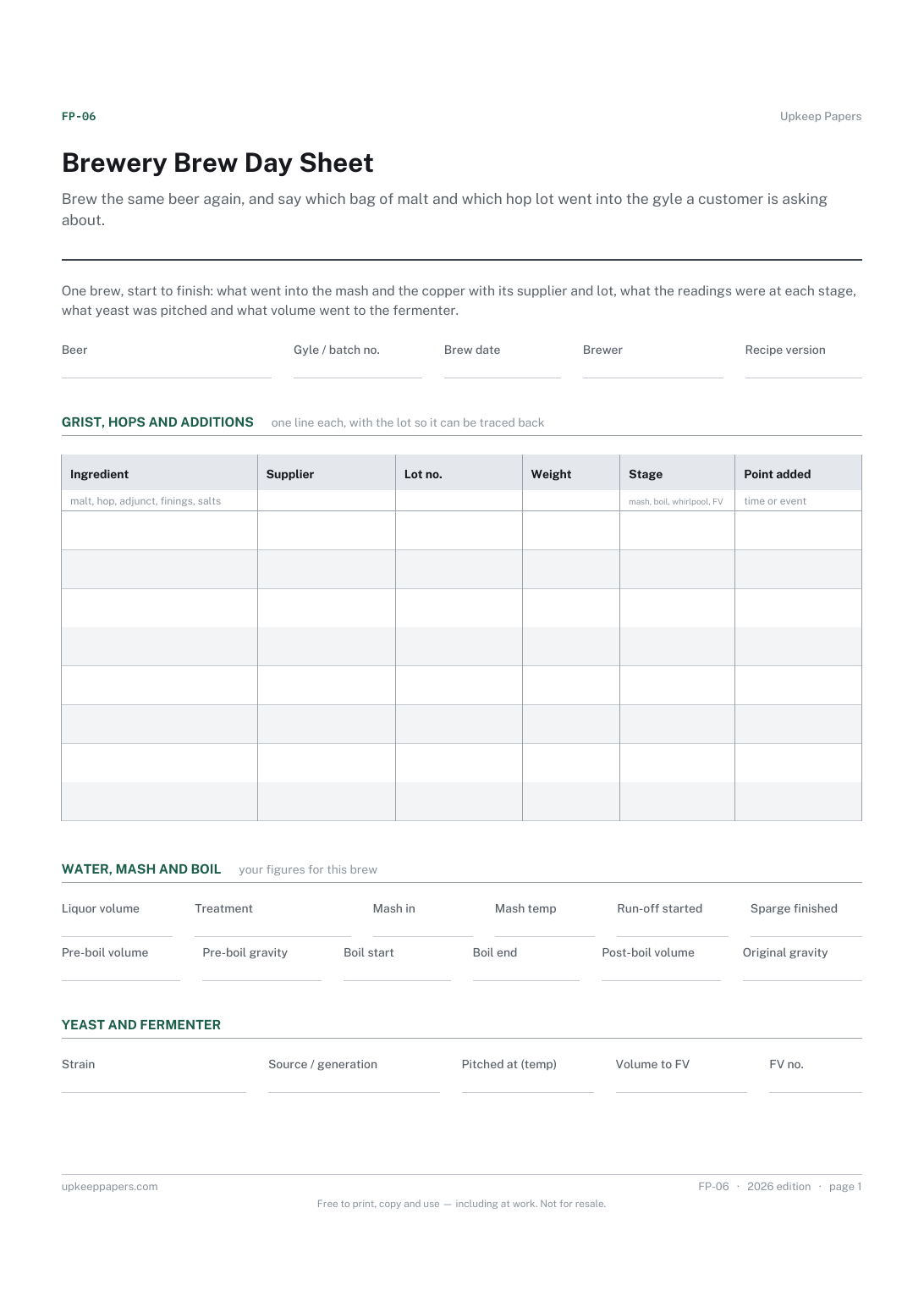
2 pages, in this order:
Printed under the title: One brew, start to finish: what went into the mash and the copper with its supplier and lot, what the readings were at each stage, what yeast was pitched and what volume went to the fermenter.
Write-on lines: Beer · Gyle / batch no. · Brew date · Brewer · Recipe version
Table, 8 rows: Ingredient · Supplier · Lot no. · Weight · Stage · Point added
Write-on lines: Liquor volume · Treatment · Mash in · Mash temp · Run-off started · Sparge finished · Pre-boil volume · Pre-boil gravity · Boil start · Boil end · Post-boil volume · Original gravity
Write-on lines: Strain · Source / generation · Pitched at (temp) · Volume to FV · FV no.
Table, 12 rows: Time · Stage · Temp · Gravity · pH · Volume · Initials · Notes
Ruled lines: Notes — anything different about this brew, problems, what to change next time
Because they are the recipe, and the recipe is yours. The sheet gives you the blanks so that what you actually did on this brew is recorded next to what you used — which is what you need when the next batch tastes different.
That sheet follows one batch through fermentation to bottling for a hobbyist. This one is the brew day only, with supplier lots on every ingredient because a commercial brewer has to trace them.
Say which cask went where with what in it, and show that the beer that left the tank is the beer that went into the containers.
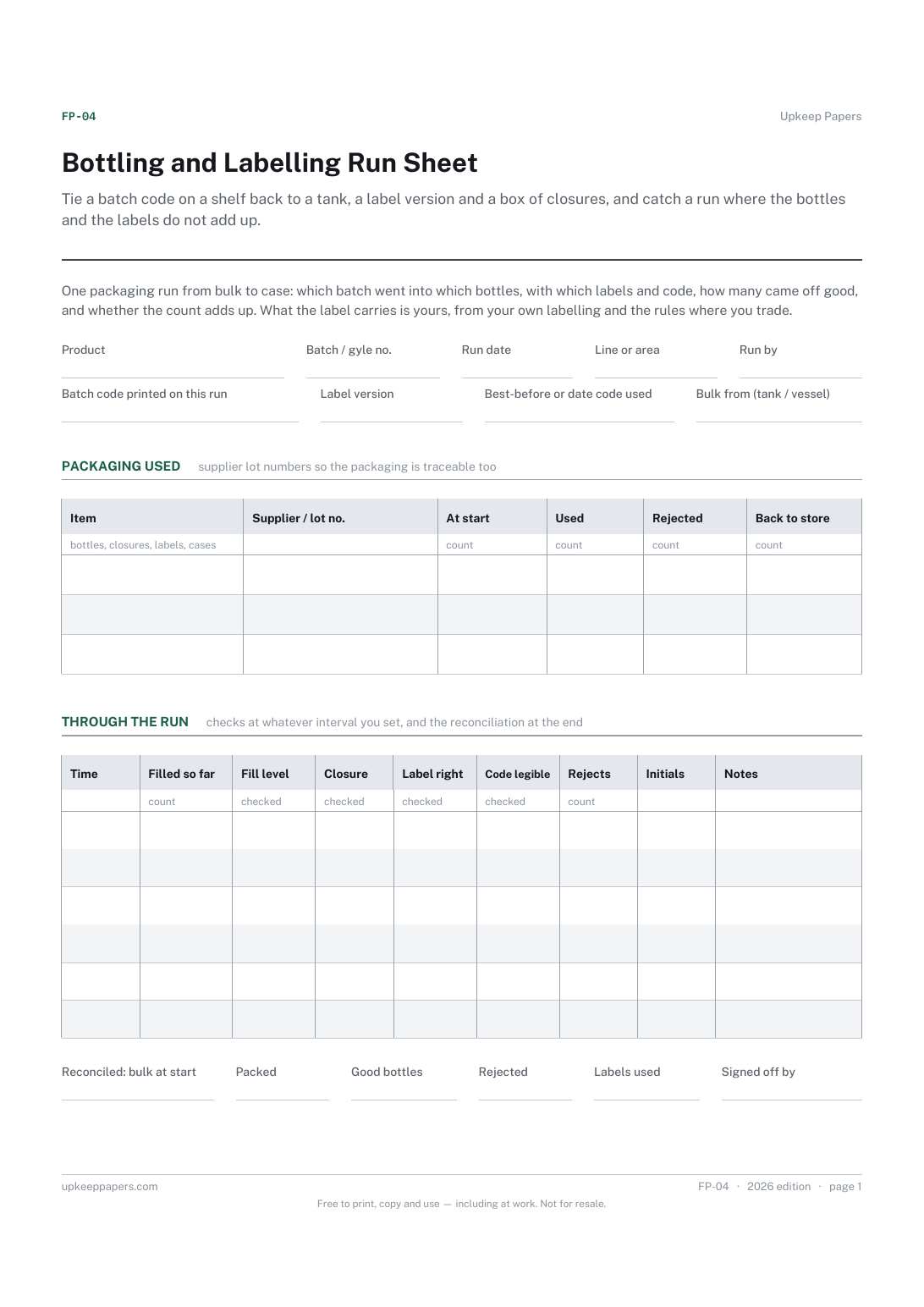
Tie a batch code on a shelf back to a tank, a label version and a box of closures, and catch a run where the bottles and the labels do not add up.
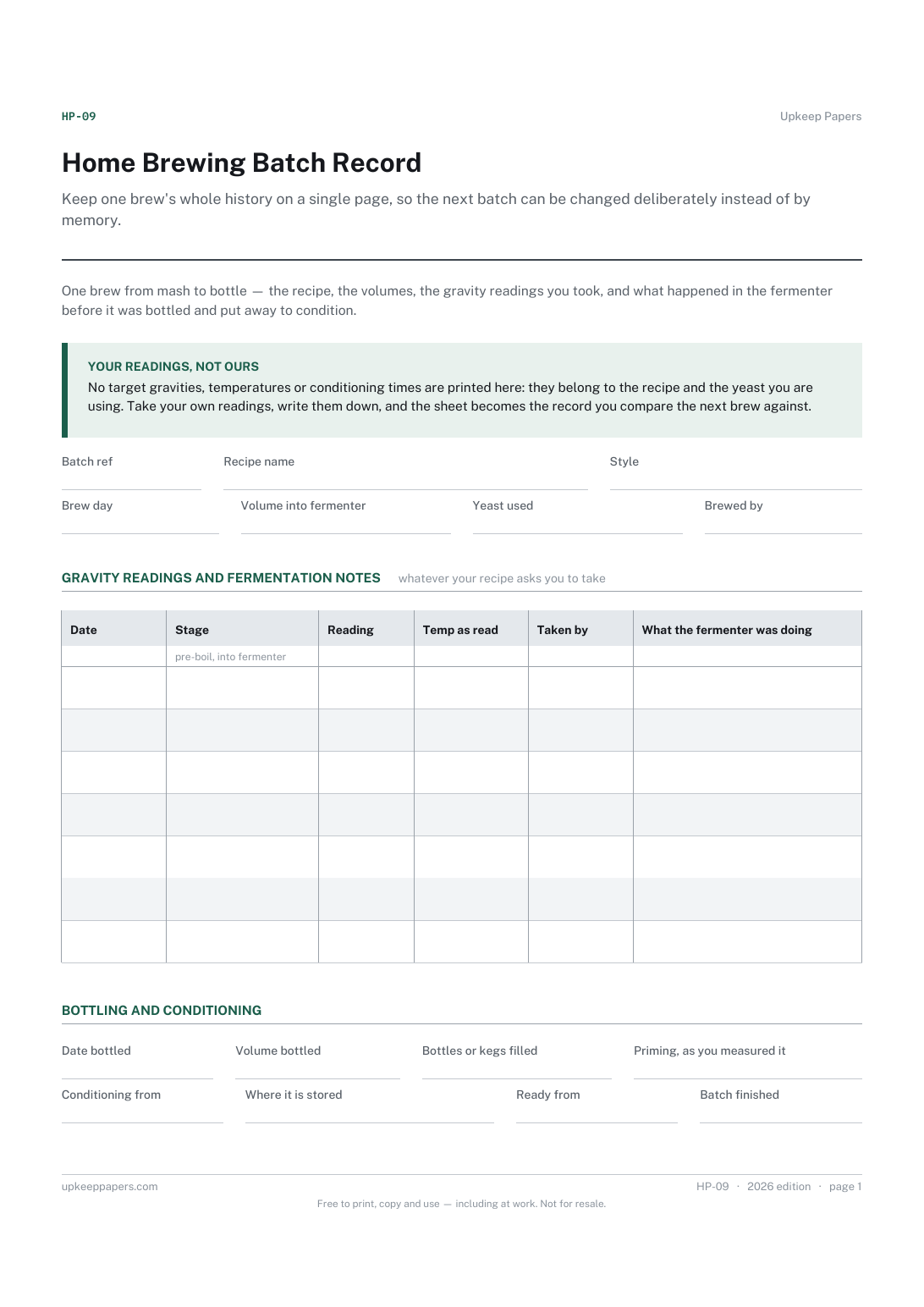
Keep one brew's whole history on a single page, so the next batch can be changed deliberately instead of by memory.
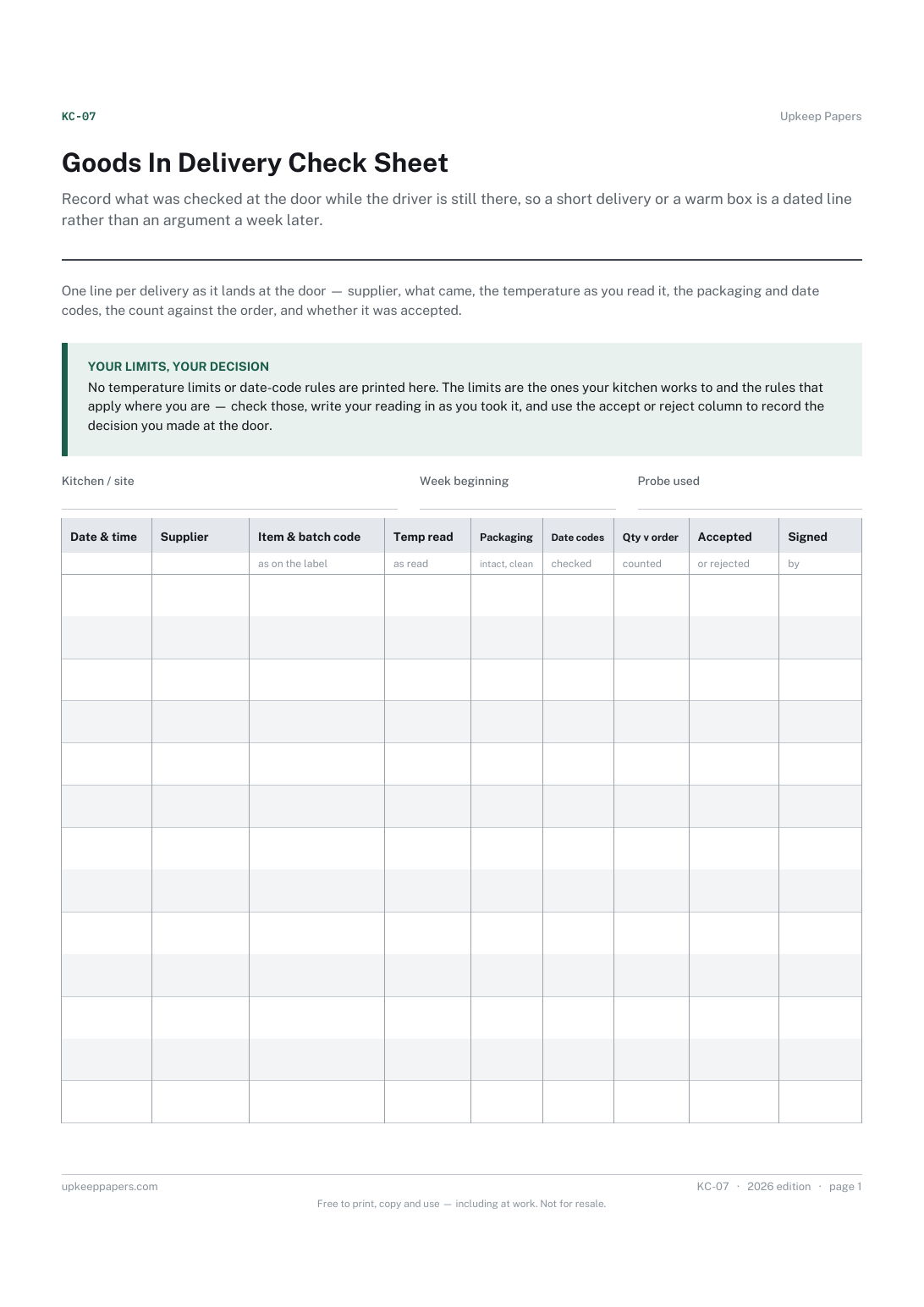
Record what was checked at the door while the driver is still there, so a short delivery or a warm box is a dated line rather than an argument a week later.

Every sheet, binder, game and puzzle on Upkeep Papers is free to download, with no email and no account. Making them is not free: each one takes days of research, design and checking, and the site costs money to run. If something here saved you time, you can buy us a coffee. It is entirely optional: nothing is locked, and nothing changes if you don’t.
Buy us a coffee Opens PayPal in a new tab. Any amount, and nothing changes if you would rather not.