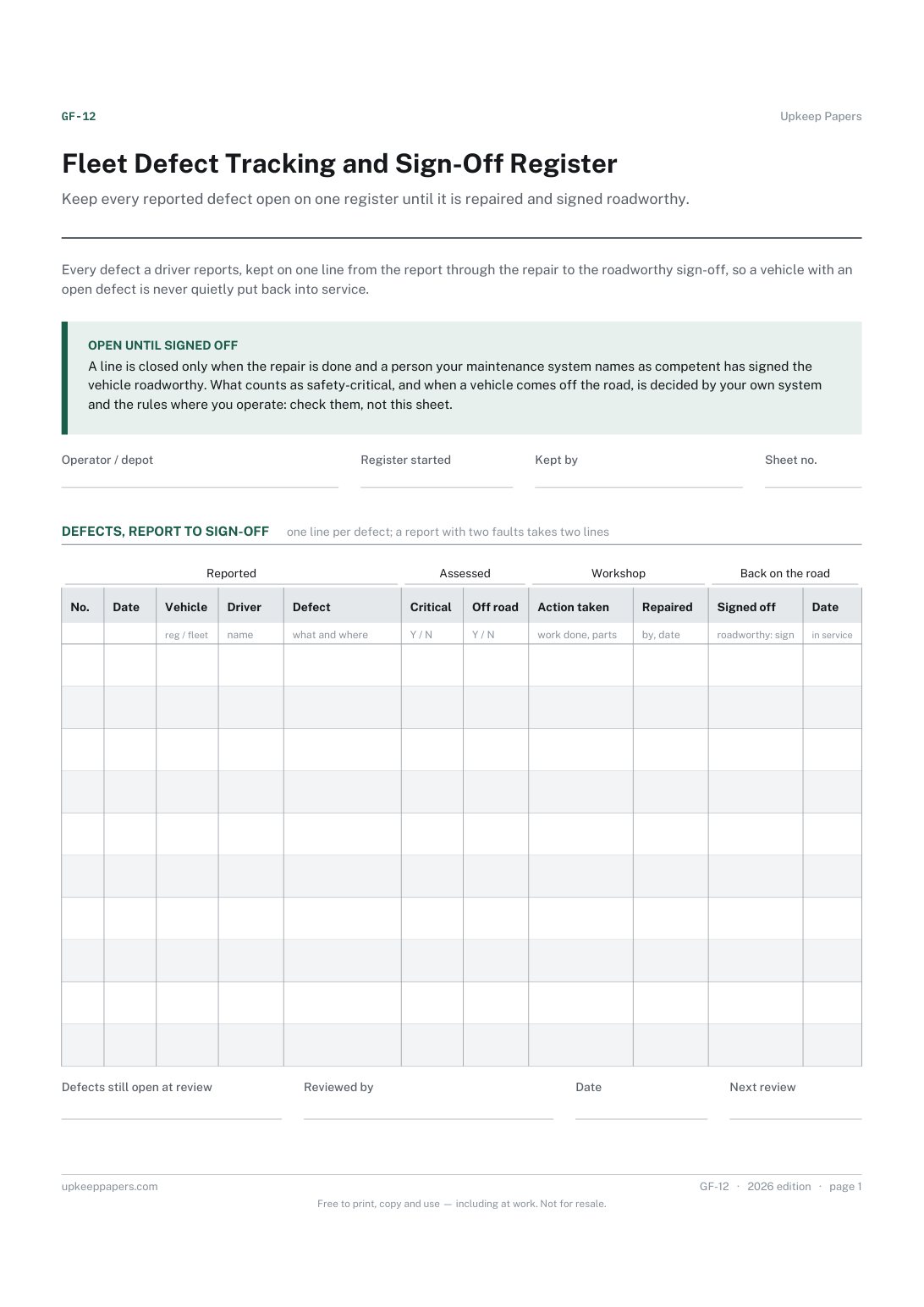
Fleet Defect Tracking and Sign-Off Register
Keep every reported defect open on one register until it is repaired and signed roadworthy. A count of the open lines at each review shows what is still waiting.
GF-12 1 page
Everything here is free. Making it takes time and money. Everything here is free.
 Buy us a coffee
Running costs and fleet · GF-11
A free printable wheel nut re-torque record: each refitted wheel, the torque it went on at, the re-check after settling, any loose nut and who signed it off.
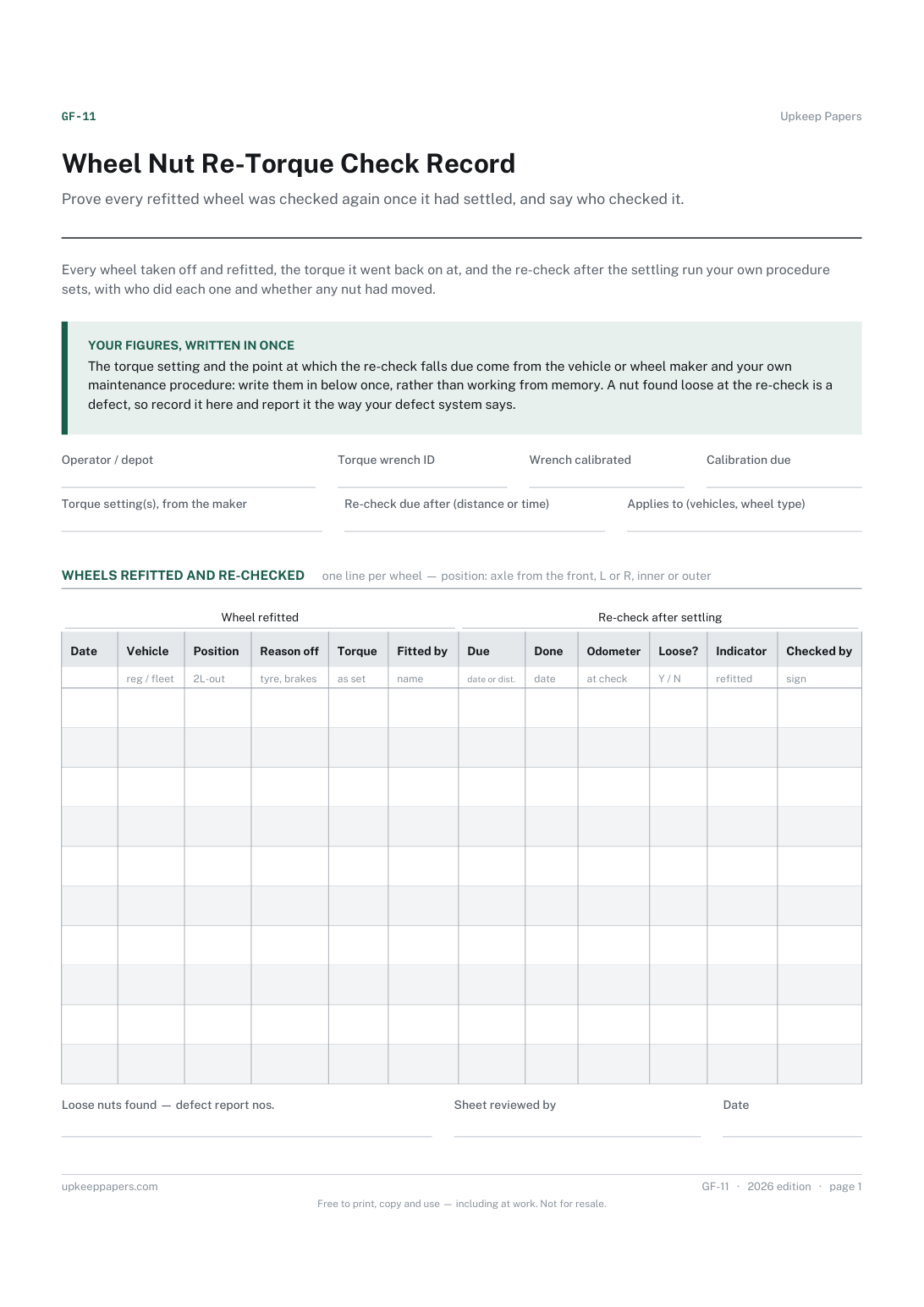
One page. Choose your paper size — both versions are laid out identically, so neither one gets shrunk to fit.
Print it and write on it
Fill it in type and save
The fillable versions have real form fields — open them in any PDF reader, type into them and save. Printing help.
Prove every refitted wheel was checked again once it had settled, and say who checked it. The wrench, its calibration and your own torque figures sit at the top, so every check is made against the right numbers.
Fleet engineers, workshop staff and transport managers looking after lorries, buses, coaches or vans whose wheels come off for tyres, brakes or hub work.
One page, top to bottom:
Printed under the title: Every wheel taken off and refitted, the torque it went back on at, and the re-check after the settling run your own procedure sets, with who did each one and whether any nut had moved.
Your figures, written in once. The torque setting and the point at which the re-check falls due come from the vehicle or wheel maker and your own maintenance procedure: write them in below once, rather than working from memory. A nut found loose at the re-check is a defect, so record it here and report it the way your defect system says.
Write-on lines: Operator / depot · Torque wrench ID · Wrench calibrated · Calibration due · Torque setting(s), from the maker · Re-check due after (distance or time) · Applies to (vehicles, wheel type)
Also printed: Wheel refitted · Re-check after settling
Table, 10 rows: Date · Vehicle · Position · Reason off · Torque · Fitted by · Due · Done · Odometer · Loose? · Indicator · Checked by
Write-on lines: Loose nuts found — defect report nos. · Sheet reviewed by · Date
Because both depend on the vehicle, the wheel and the fixings, and come from the maker and your own maintenance procedure. A printed figure would be right for some fleets and wrong for others, so the sheet leaves a blank at the top for yours.
A re-check is only as good as the wrench used for it. Writing the wrench and its calibration on the same sheet lets anyone reading the record later see that the torque was applied with a tool that was in date.
Keep every reported defect open on one register until it is repaired and signed roadworthy. A count of the open lines at each review shows what is still waiting.
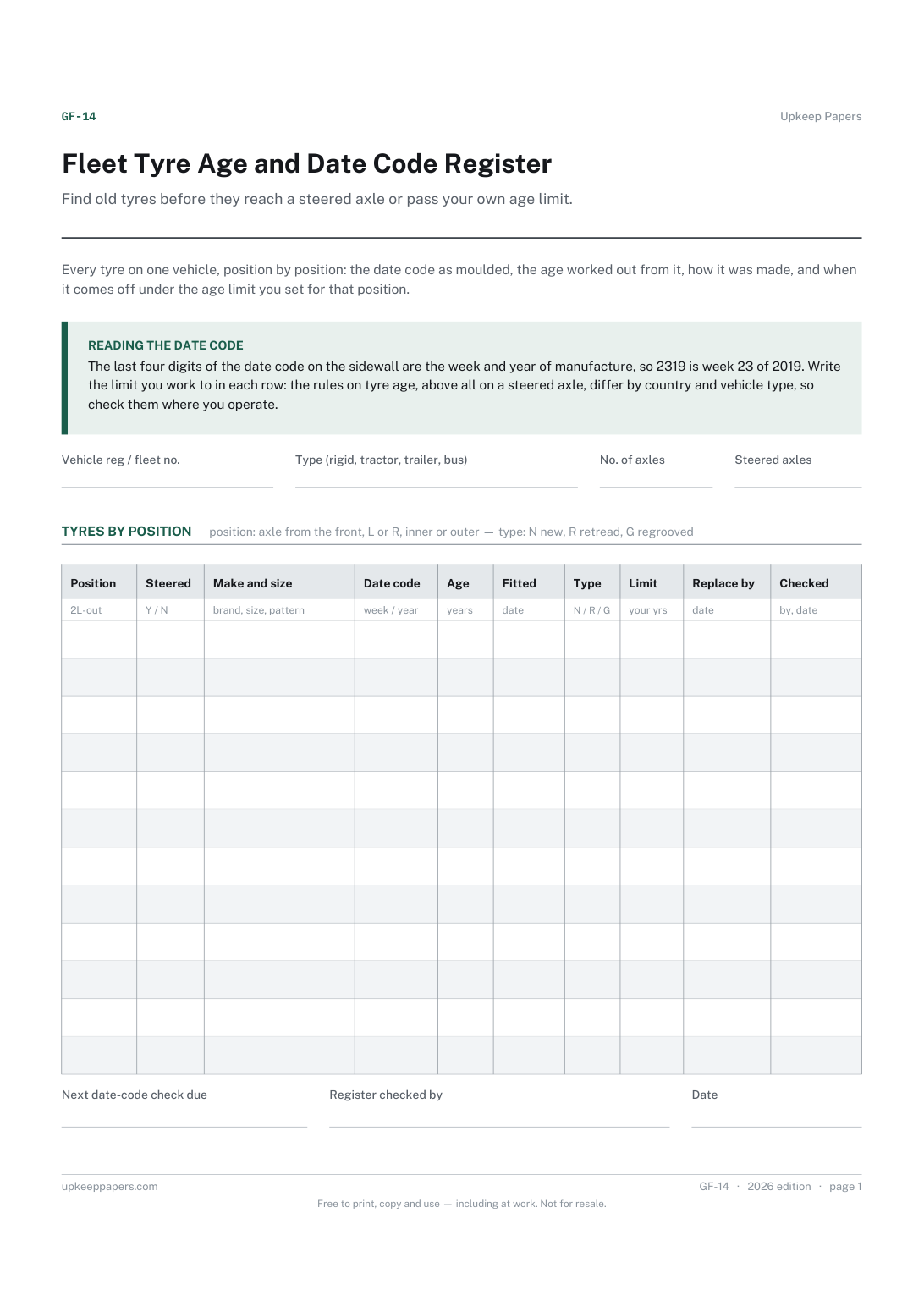
Find old tyres before they reach a steered axle or pass your own age limit. One sheet per vehicle, read position by position from the sidewall date codes.
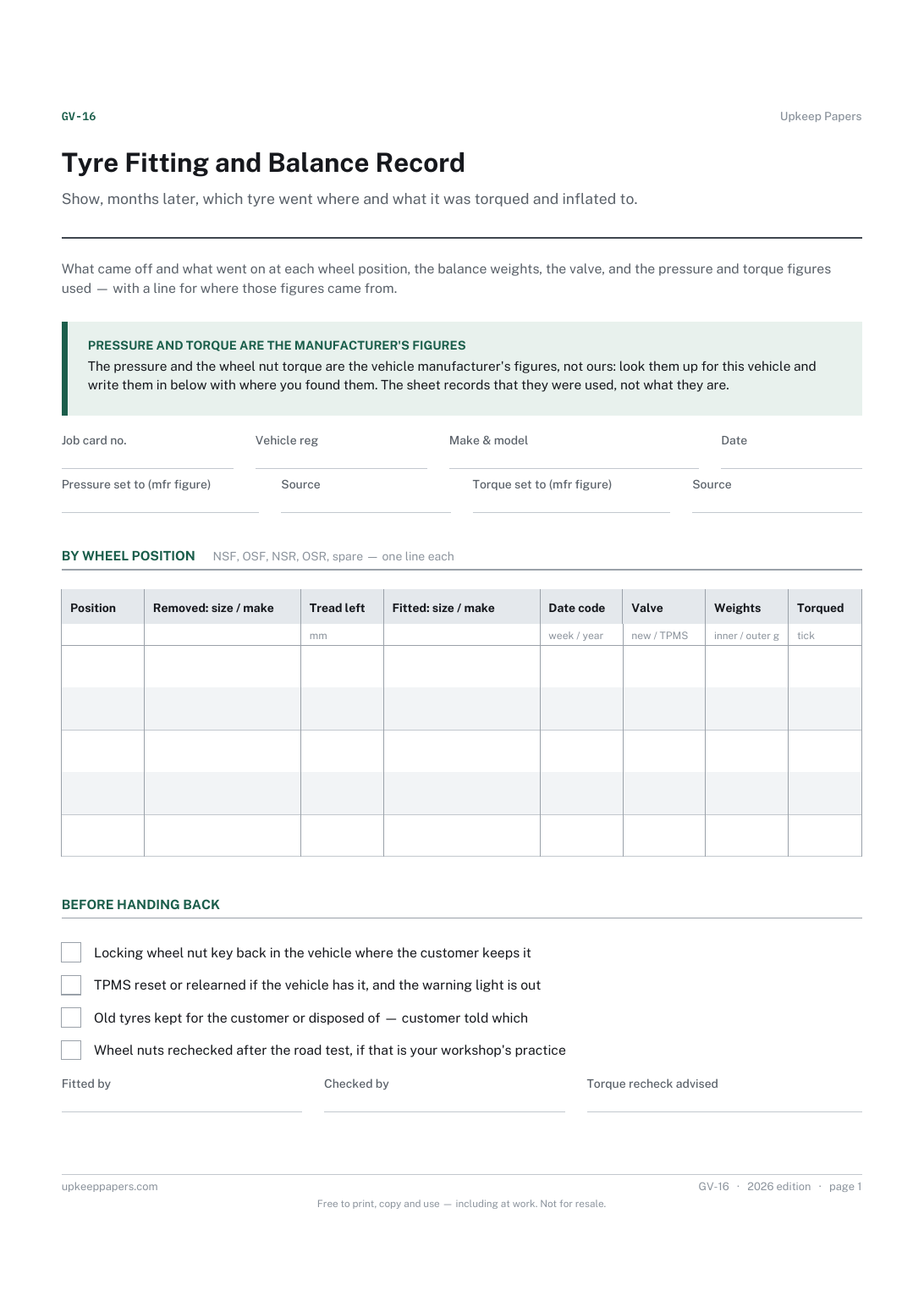
Show, months later, which tyre went where and what it was torqued and inflated to. The source of those figures is on the sheet too.
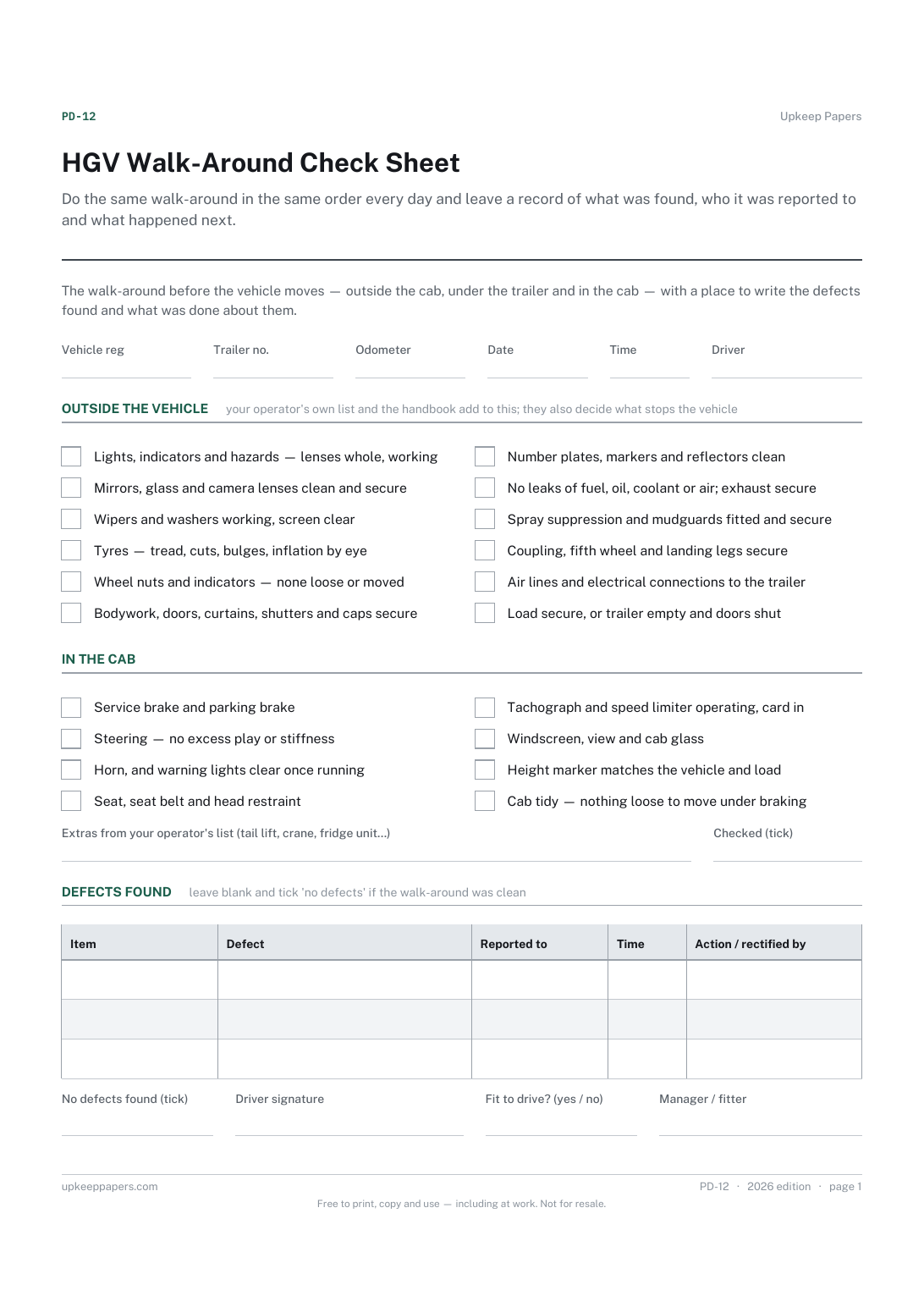
Do the same walk-around in the same order every day and leave a record of what was found, who it was reported to and what happened next.
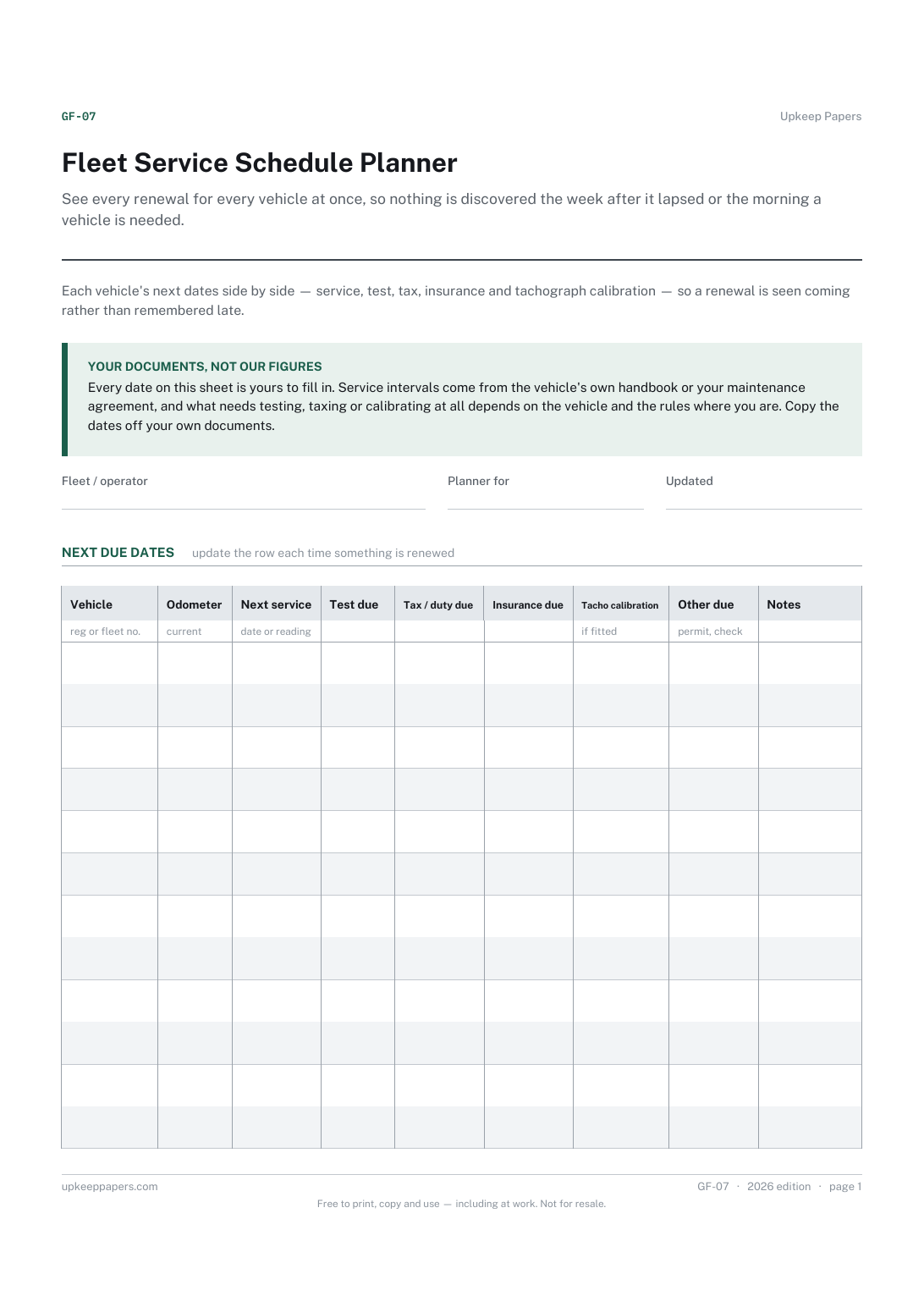
See every renewal for every vehicle at once, so nothing is discovered the week after it lapsed or the morning a vehicle is needed.

Every sheet, binder, game and puzzle on Upkeep Papers is free to download, with no email and no account. Making them is not free: each one takes days of research, design and checking, and the site costs money to run. If something here saved you time, you can buy us a coffee. It is entirely optional: nothing is locked, and nothing changes if you don’t.
Buy us a coffee Opens PayPal in a new tab. Any amount, and nothing changes if you would rather not.