Key Control Register
Know at a glance which keys are out and with whom, and be able to say honestly how many copies of any of them exist.
AS-02 1 page
Everything here is free. Making it takes time and money. Everything here is free.
 Buy us a coffee
Access and visitor control · AS-09
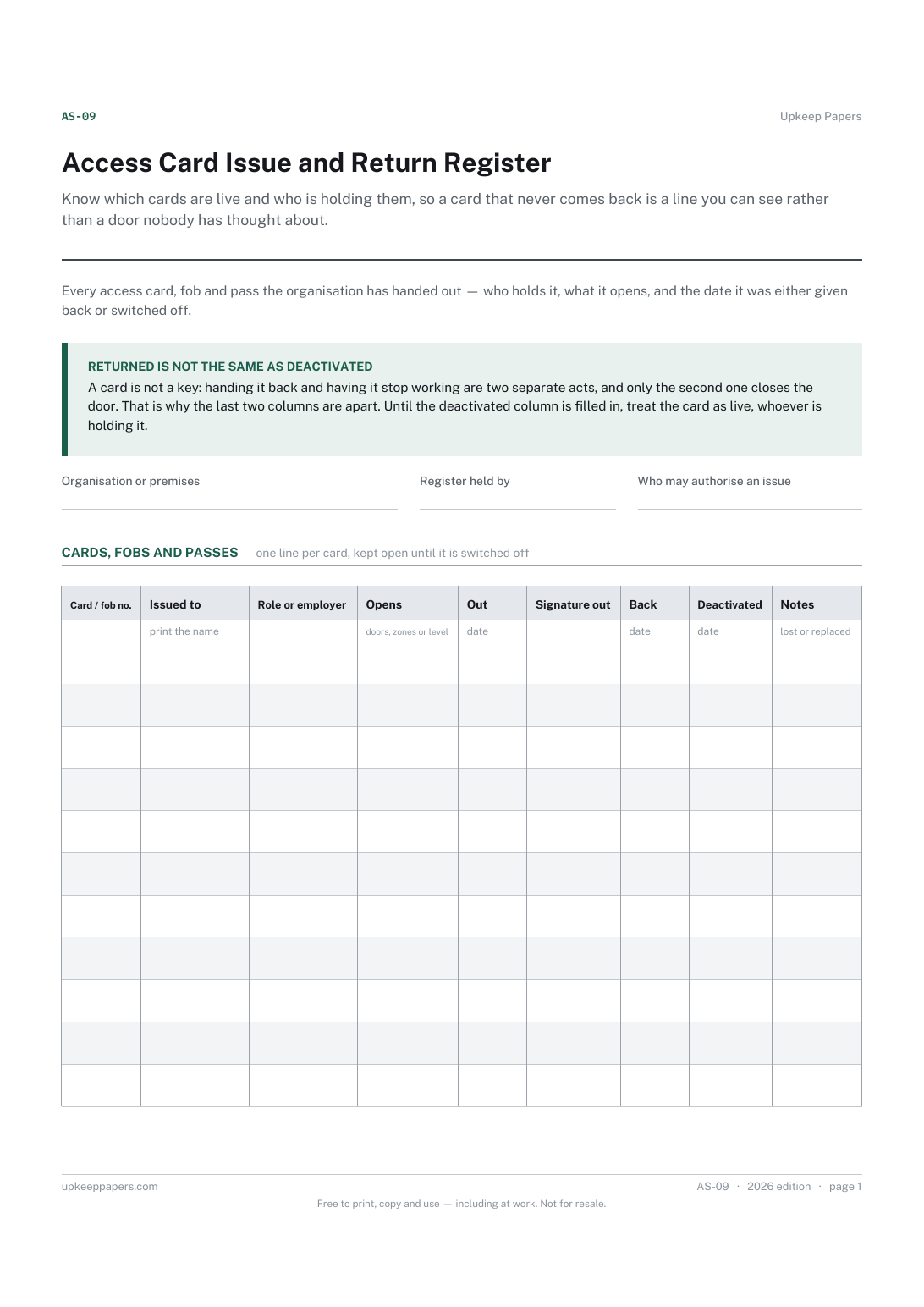
A free printable access card register — every card, fob and pass issued, who holds it, what it opens, and the dates it came back and was switched off.
One page. Choose your paper size — both versions are laid out identically, so neither one gets shrunk to fit.
Print it and write on it
Fill it in type and save
The fillable versions have real form fields — open them in any PDF reader, type into them and save. Printing help.
Know which cards are live and who is holding them, so a card that never comes back is a line you can see rather than a door nobody has thought about.
Whoever looks after door entry at an office, factory, school, site or managed building, and anyone who hands out fobs for a block of flats.
One page, top to bottom:
Printed under the title: Every access card, fob and pass the organisation has handed out — who holds it, what it opens, and the date it was either given back or switched off.
Returned is not the same as deactivated. A card is not a key: handing it back and having it stop working are two separate acts, and only the second one closes the door. That is why the last two columns are apart. Until the deactivated column is filled in, treat the card as live, whoever is holding it.
Write-on lines: Organisation or premises · Register held by · Who may authorise an issue
Table, 11 rows: Card / fob no. · Issued to · Role or employer · Opens · Out · Signature out · Back · Deactivated · Notes
Because they are two different things. A card handed to you on someone's last day still opens every door it opened yesterday until somebody removes it from the system, and plenty of cards are deactivated that never come back at all. Keeping the dates apart shows which of the two actually happened.
No. That one is for cut metal keys, which can be copied and cannot be cancelled. This is for cards and fobs, which cannot usefully be copied but can be switched off remotely — a different problem with a different last column.
Know at a glance which keys are out and with whom, and be able to say honestly how many copies of any of them exist.
Know how many keys exist and where they are, so you can tell whether a lock genuinely needs changing.
Record who was actually on site and for how long, which is not always the same thing as what a timesheet says.
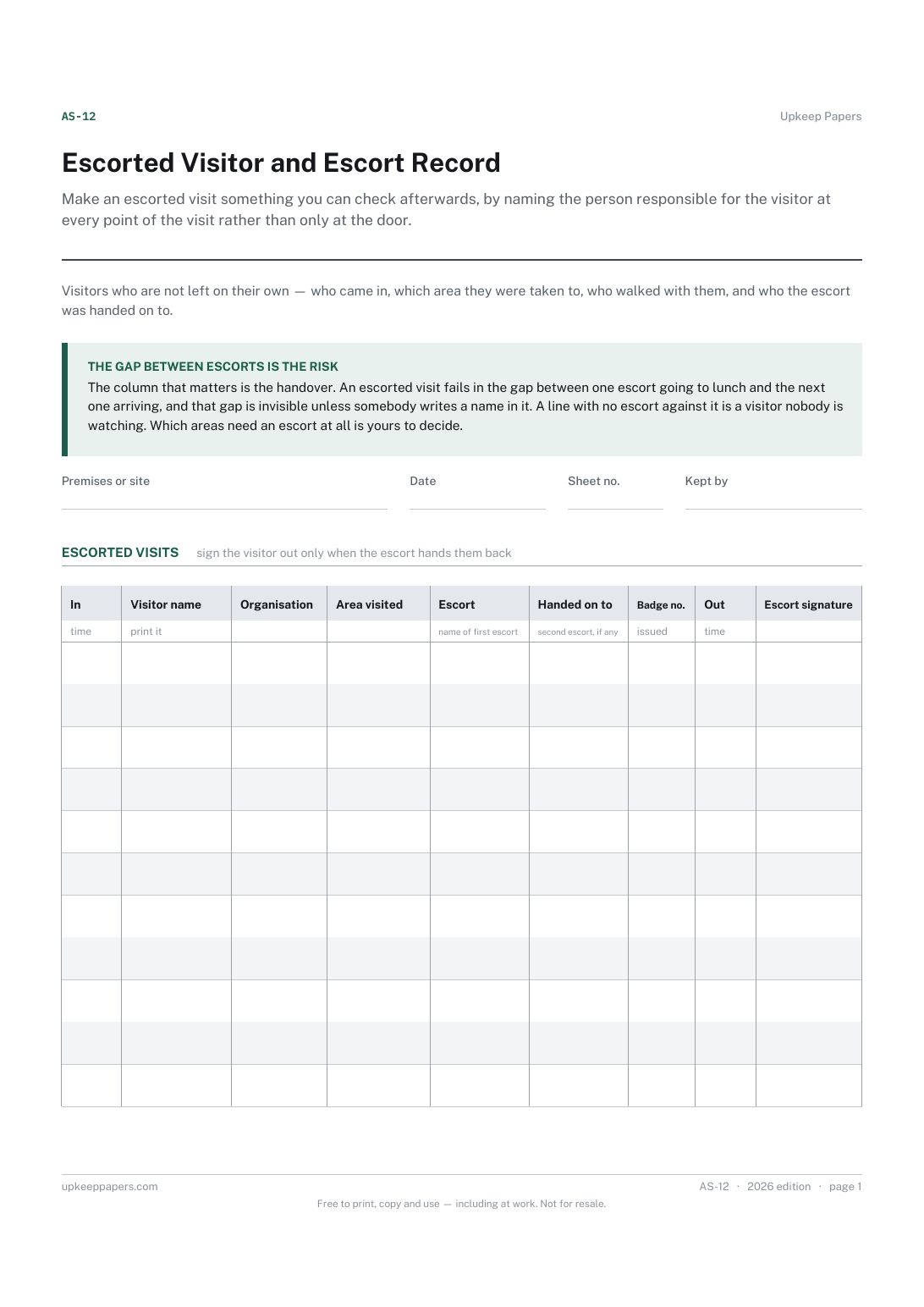
Make an escorted visit something you can check afterwards, by naming the person responsible for the visitor at every point of the visit rather than only at the door.

Every sheet, binder, game and puzzle on Upkeep Papers is free to download, with no email and no account. Making them is not free: each one takes days of research, design and checking, and the site costs money to run. If something here saved you time, you can buy us a coffee. It is entirely optional: nothing is locked, and nothing changes if you don’t.
Buy us a coffee Opens PayPal in a new tab. Any amount, and nothing changes if you would rather not.