Hay, Straw and Forage Stock Record
Know in October whether the forage will last until spring, instead of finding out in February when everyone else has sold theirs.
LK-29 2 pages
Everything here is free. Making it takes time and money. Everything here is free.
 Buy us a coffee
Livestock and smallholding · LK-66
A free printable forage analysis record: five batches of hay, haylage or silage side by side, with source, lab results as reported and the ration change made.
One page. Choose your paper size — both versions are laid out identically, so neither one gets shrunk to fit.
Print it and write on it
Fill it in type and save
The fillable versions have real form fields — open them in any PDF reader, type into them and save. Printing help.
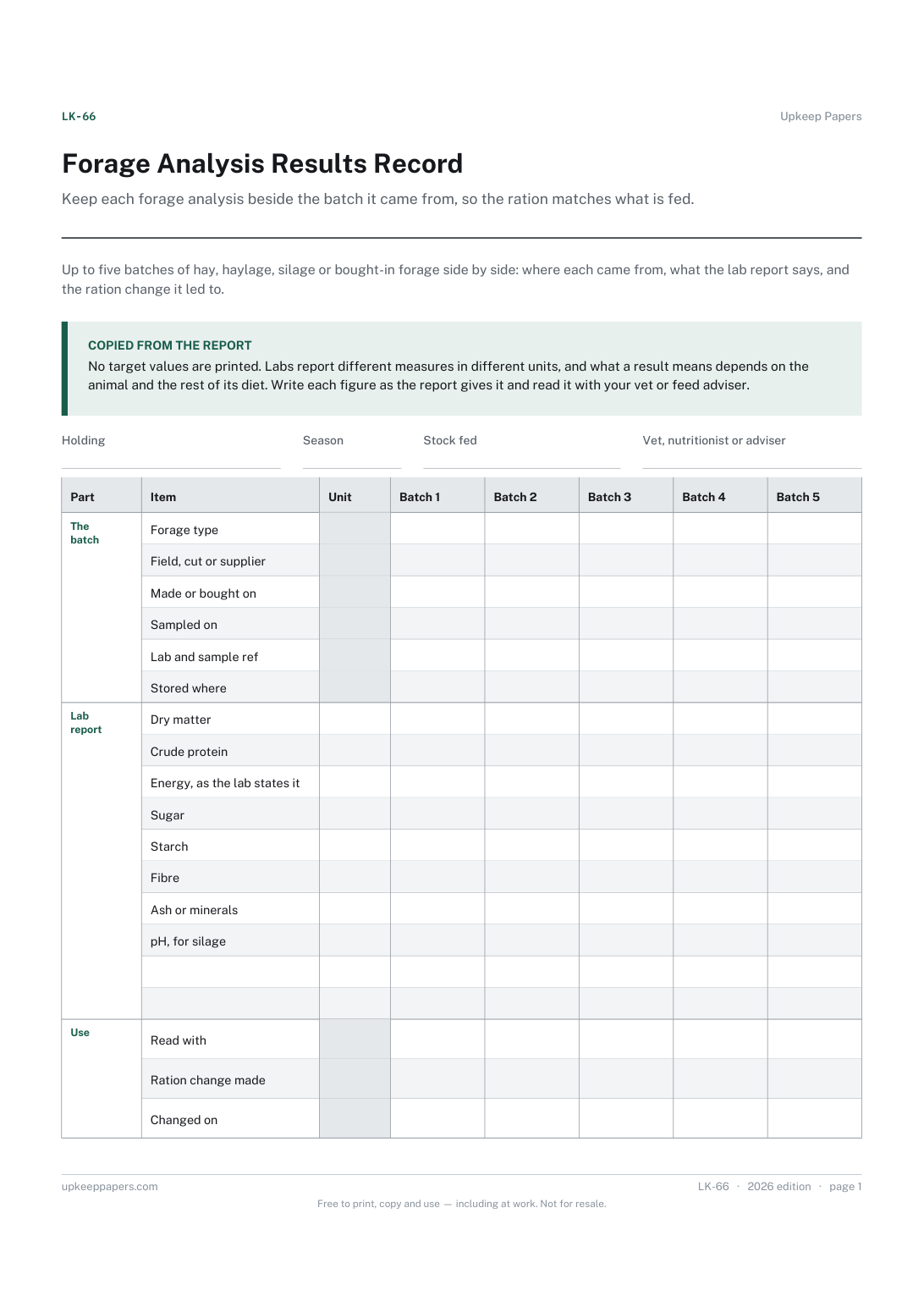
Keep each forage analysis beside the batch it came from, so the ration matches what is fed. Five batches sit side by side for comparison.
Livestock and horse keepers who have their hay, haylage or silage analysed.
One page, top to bottom:
Printed under the title: Up to five batches of hay, haylage, silage or bought-in forage side by side: where each came from, what the lab report says, and the ration change it led to.
Copied from the report. No target values are printed. Labs report different measures in different units, and what a result means depends on the animal and the rest of its diet. Write each figure as the report gives it and read it with your vet or feed adviser.
Write-on lines: Holding · Season · Stock fed · Vet, nutritionist or adviser
Table, 0 rows: Part · Item · Unit · Batch 1 · Batch 2 · Batch 3 · Batch 4 · Batch 5
Also printed: Forage type · Field, cut or supplier · Made or bought on · Sampled on · Lab and sample ref · Stored where · The · batch · Dry matter · Crude protein · Energy, as the lab states it · Sugar · Starch · Fibre · Ash or minerals · pH, for silage · Lab · report · Read with · Ration change made · Changed on · Use
Ruled lines: Notes: how each batch fed, and how the stock did on it
Because what a result means depends on the species, the animal's work, growth or production and the rest of the diet, and labs do not all report the same measures in the same units. Read the figures with your vet, nutritionist or feed adviser.
The stock record counts bales in and out and how many weeks are left. This sheet records what is in the forage, so the feeding can be planned around it.
Know in October whether the forage will last until spring, instead of finding out in February when everyone else has sold theirs.
Record what each group is fed and what feed actually costs across a year, which is usually the largest bill on a smallholding.
Put the feeding instructions where the feeding happens, written so that somebody who has never done it can do it correctly.
Record condition scores consistently over a year, so changes are visible at the points in the cycle where they matter.
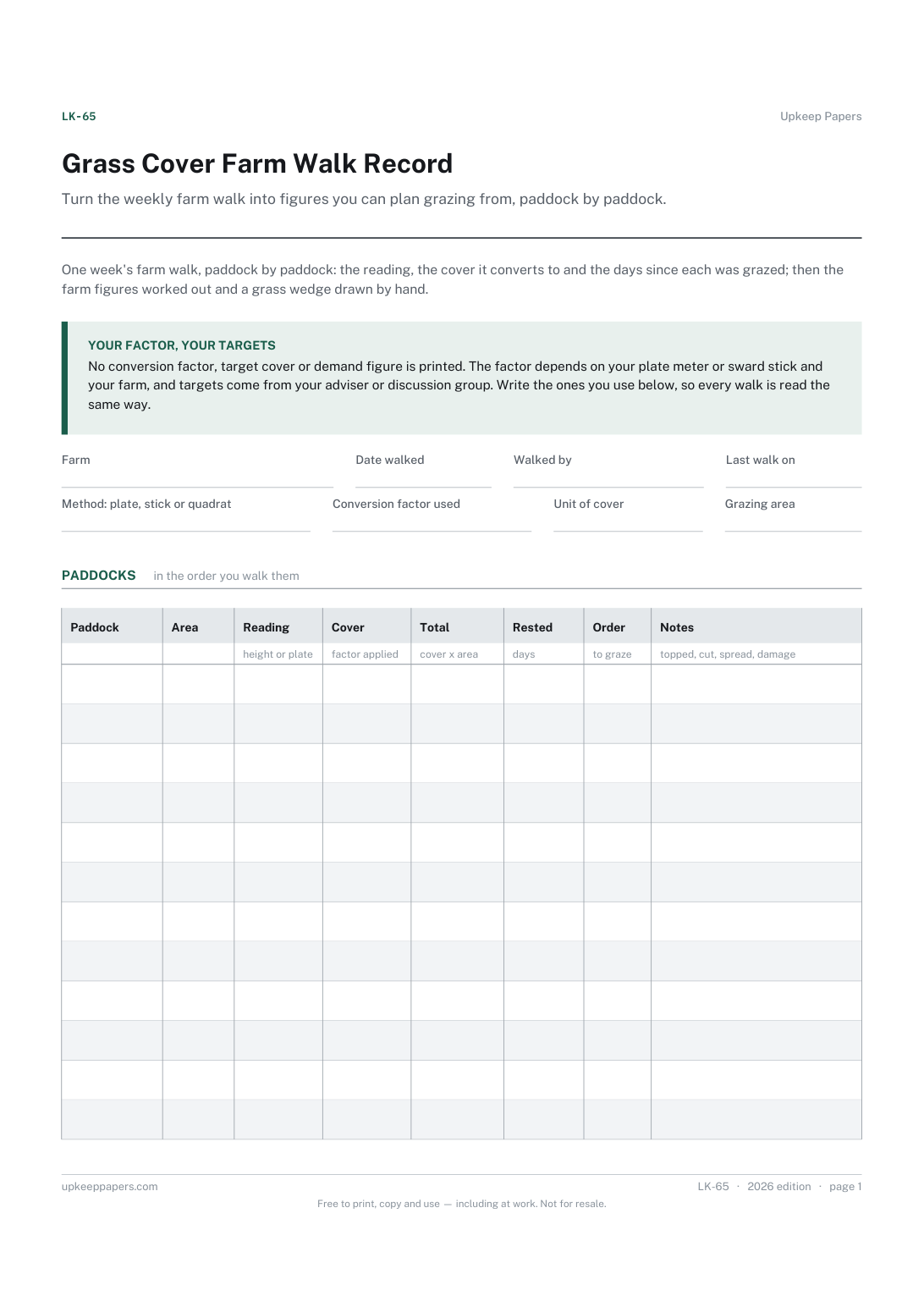
Turn the weekly farm walk into figures you can plan grazing from, paddock by paddock. A hand-drawn wedge shows the surpluses and deficits at a glance.

Every sheet, binder, game and puzzle on Upkeep Papers is free to download, with no email and no account. Making them is not free: each one takes days of research, design and checking, and the site costs money to run. If something here saved you time, you can buy us a coffee. It is entirely optional: nothing is locked, and nothing changes if you don’t.
Buy us a coffee Opens PayPal in a new tab. Any amount, and nothing changes if you would rather not.