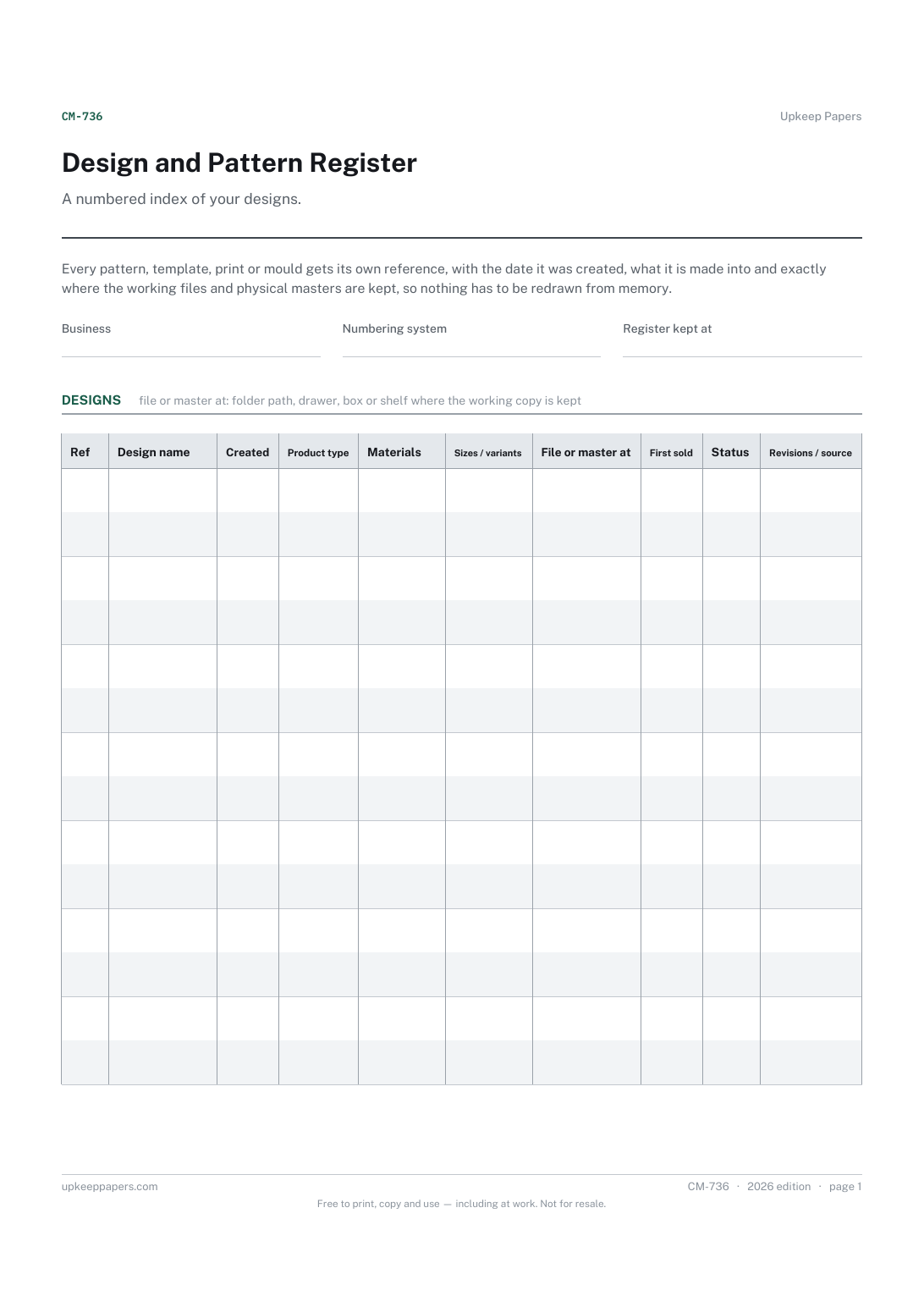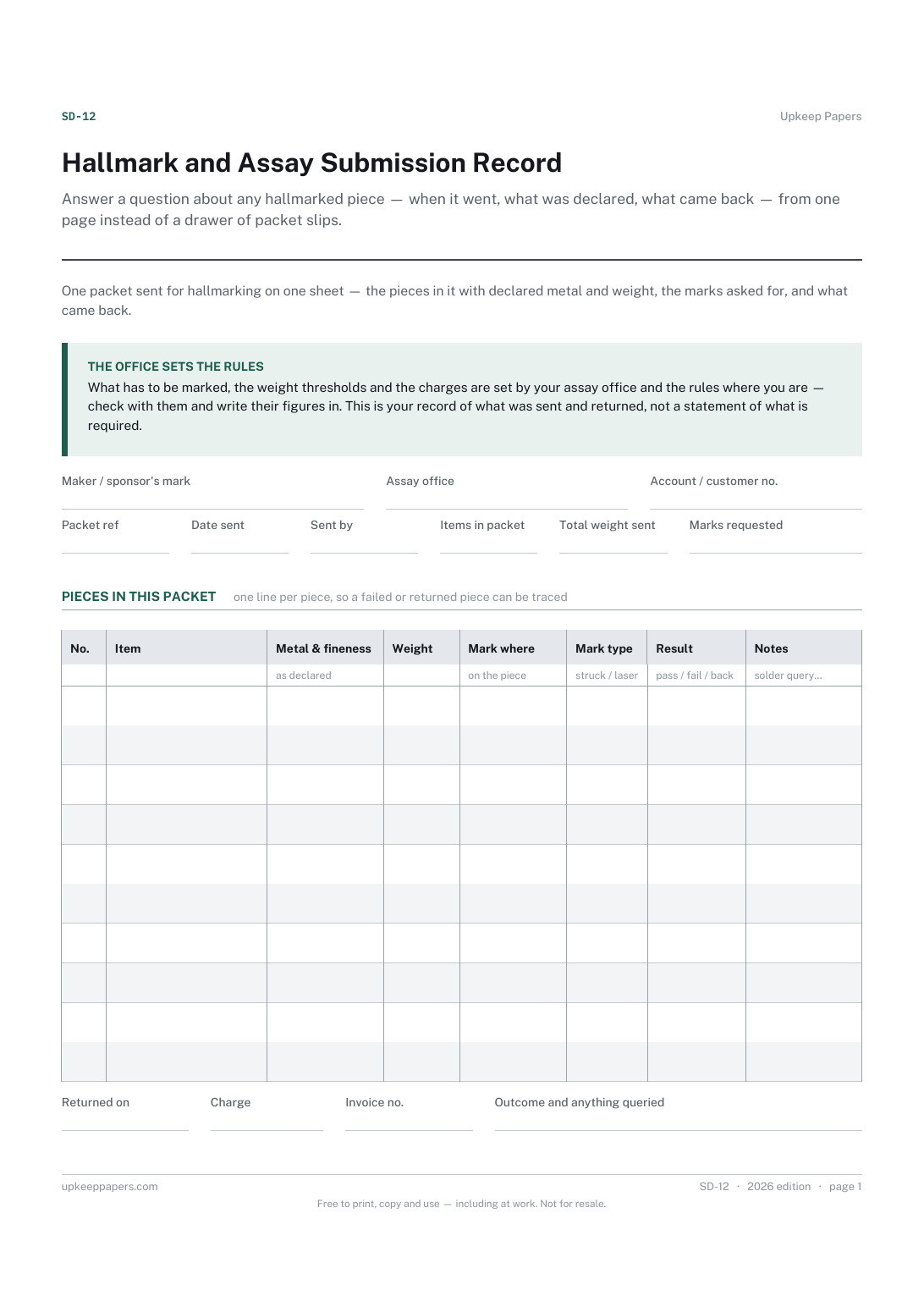
Hallmark and Assay Submission Record
Answer a question about any hallmarked piece — when it went, what was declared, what came back — from one page instead of a drawer of packet slips.
SD-12 1 page
Everything here is free. Making it takes time and money. Everything here is free.
 Buy us a coffee
Studio crafts and making · SD-15
Jewellery project sheet — one piece from brief to finish, with the metal, stones and findings used, hours at the bench, hallmark packet and price.
2 pages. Choose your paper size — both versions are laid out identically, so neither one gets shrunk to fit.
Print it and write on it
Fill it in type and save
The fillable versions have real form fields — open them in any PDF reader, type into them and save. Printing help.
Work out a price, a repeat or a repair from what the piece actually took in metal, stones and hours, instead of from memory.
Jewellers and silversmiths making one-off or small-run pieces, students keeping a bench record, and makers who sell and need to know what a piece cost them.
2 pages, in this order:
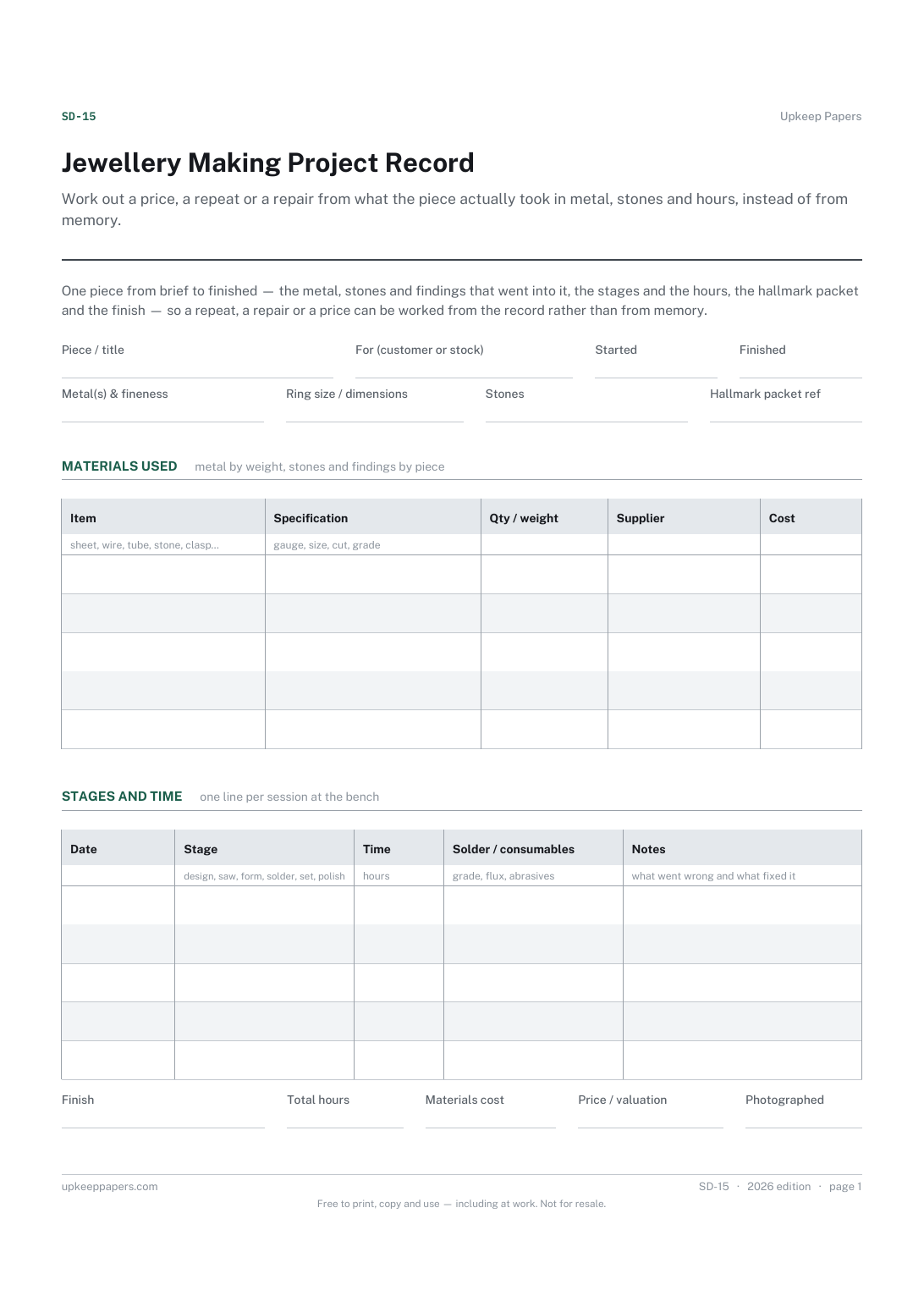
Printed under the title: One piece from brief to finished — the metal, stones and findings that went into it, the stages and the hours, the hallmark packet and the finish — so a repeat, a repair or a price can be worked from the record rather than from memory.
Write-on lines: Piece / title · For (customer or stock) · Started · Finished · Metal(s) & fineness · Ring size / dimensions · Stones · Hallmark packet ref
Table, 5 rows: Item · Specification · Qty / weight · Supplier · Cost
Table, 5 rows: Date · Stage · Time · Solder / consumables · Notes
Write-on lines: Finish · Total hours · Materials cost · Price / valuation · Photographed
Squared grid
No. What you charge for your hours and how you mark up materials is your own decision. The sheet gives you the true inputs — hours, metal weight, stone and finding costs — and a blank for the price you settled on.
The packet reference goes in the header, and the full submission is on the Hallmark and Assay Submission Record, so one packet of several pieces is only written up once.
Answer a question about any hallmarked piece — when it went, what was declared, what came back — from one page instead of a drawer of packet slips.
Record identifying detail and paperwork for each piece before it is needed, which is invariably after something has gone.
Record the things a finished object cannot tell you later: which dye lot, which hook you really used, and how much was left over.
Keep a catalogue of finished work and where it went, which is the record galleries, insurers and tax authorities ask for and working artists rarely have.
The same subject, with a version you can fill in on screen.

Every sheet, binder, game and puzzle on Upkeep Papers is free to download, with no email and no account. Making them is not free: each one takes days of research, design and checking, and the site costs money to run. If something here saved you time, you can buy us a coffee. It is entirely optional: nothing is locked, and nothing changes if you don’t.
Buy us a coffee Opens PayPal in a new tab. Any amount, and nothing changes if you would rather not.