Boiler Service Record
Keep the proof of annual servicing that boiler warranties commonly ask for, and an index of which engineer did what.
HS-01 2 pages
Everything here is free. Making it takes time and money. Everything here is free.
 Buy us a coffee
Home systems · HS-25
A free printable boiler pressure log: gauge readings, filling-loop top-ups and radiators bled across a heating season, judged against the range in your own manual.
2 pages. Choose your paper size — both versions are laid out identically, so neither one gets shrunk to fit.
Print it and write on it
Fill it in type and save
The fillable versions have real form fields — open them in any PDF reader, type into them and save. Printing help.
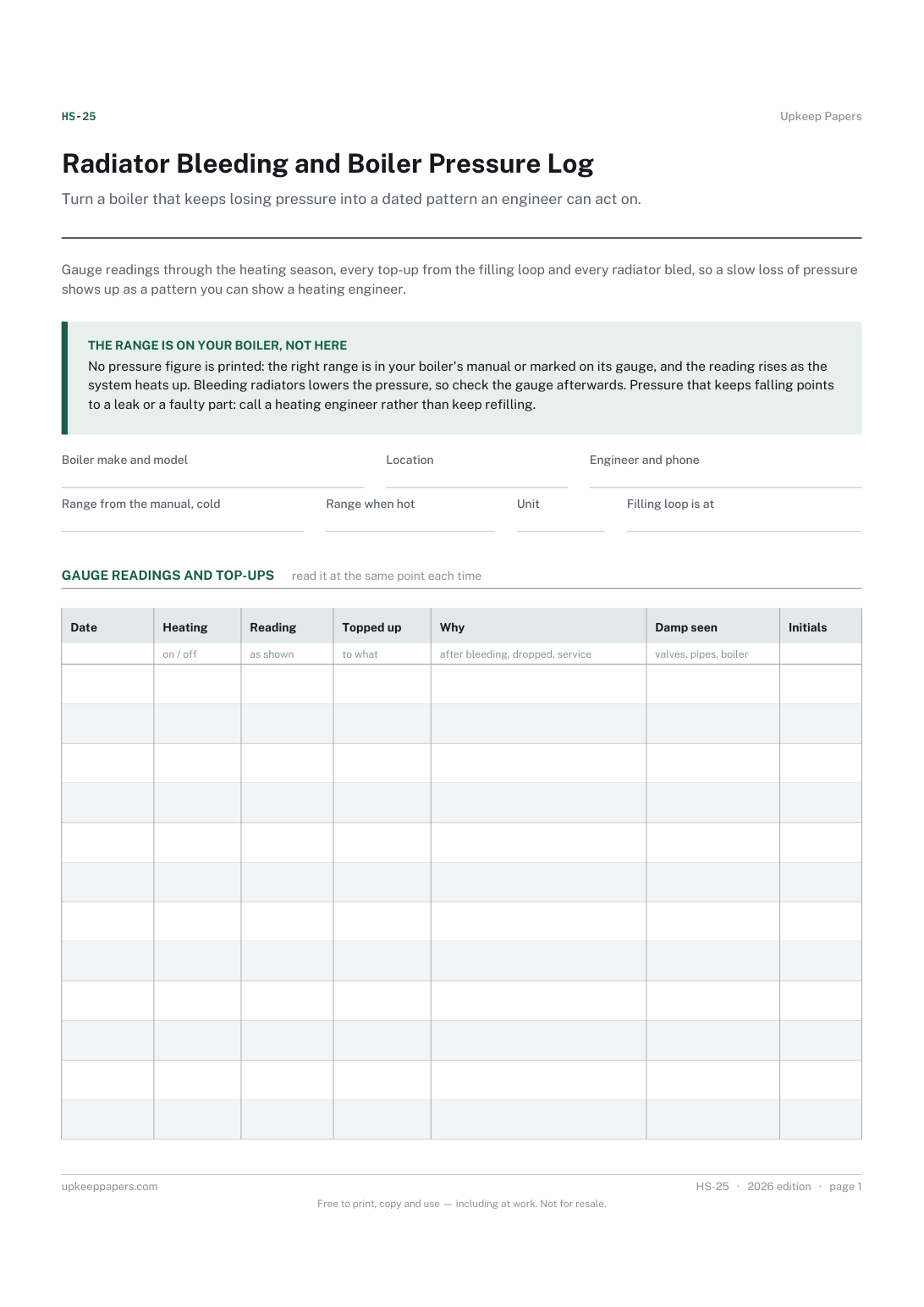
Turn a boiler that keeps losing pressure into a dated pattern an engineer can act on. Every gauge reading, top-up and radiator bled goes on one record across the heating season.
Households with a sealed central heating system and a boiler with a pressure gauge, and landlords who get the call that the boiler keeps losing pressure.
2 pages, in this order:
Printed under the title: Gauge readings through the heating season, every top-up from the filling loop and every radiator bled, so a slow loss of pressure shows up as a pattern you can show a heating engineer.
The range is on your boiler, not here. No pressure figure is printed: the right range is in your boiler's manual or marked on its gauge, and the reading rises as the system heats up. Bleeding radiators lowers the pressure, so check the gauge afterwards. Pressure that keeps falling points to a leak or a faulty part: call a heating engineer rather than keep refilling.
Write-on lines: Boiler make and model · Location · Engineer and phone · Range from the manual, cold · Range when hot · Unit · Filling loop is at
Table, 21 rows: Date · Heating · Reading · Topped up · Why · Damp seen · Initials
Table, 9 rows: Radiator · Date · Cold at top · Air out · Warm after · Gauge after · Initials
Write-on lines: Top-ups this season · Engineer called on · What they found
Whatever your boiler's manual or the marks on its gauge say. It differs between makes and models and rises as the water heats up, so a single printed figure would be wrong for many systems. Copy your own cold and hot range into the boxes at the top.
Because a system that loses a little pressure over weeks can look fine on any single day. A dated list of top-ups shows how fast it is falling, which is what an engineer needs when looking for a leak or a faulty valve.
Many people do, following the boiler and radiator makers' instructions. If you are unsure, or the system is not one you know, ask a heating engineer. Either way, log it here and check the pressure afterwards, because bleeding lowers it.
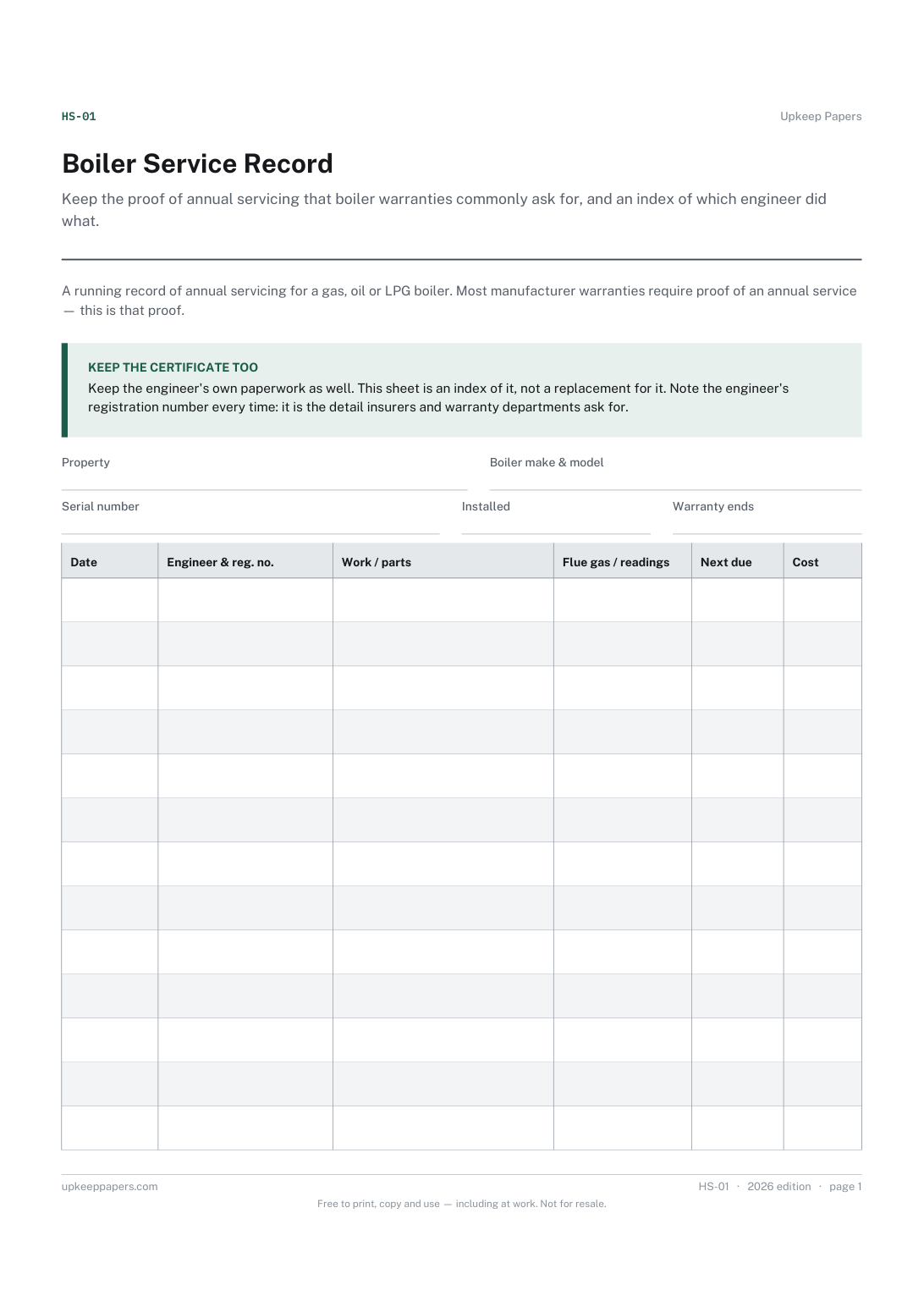
Keep the proof of annual servicing that boiler warranties commonly ask for, and an index of which engineer did what.
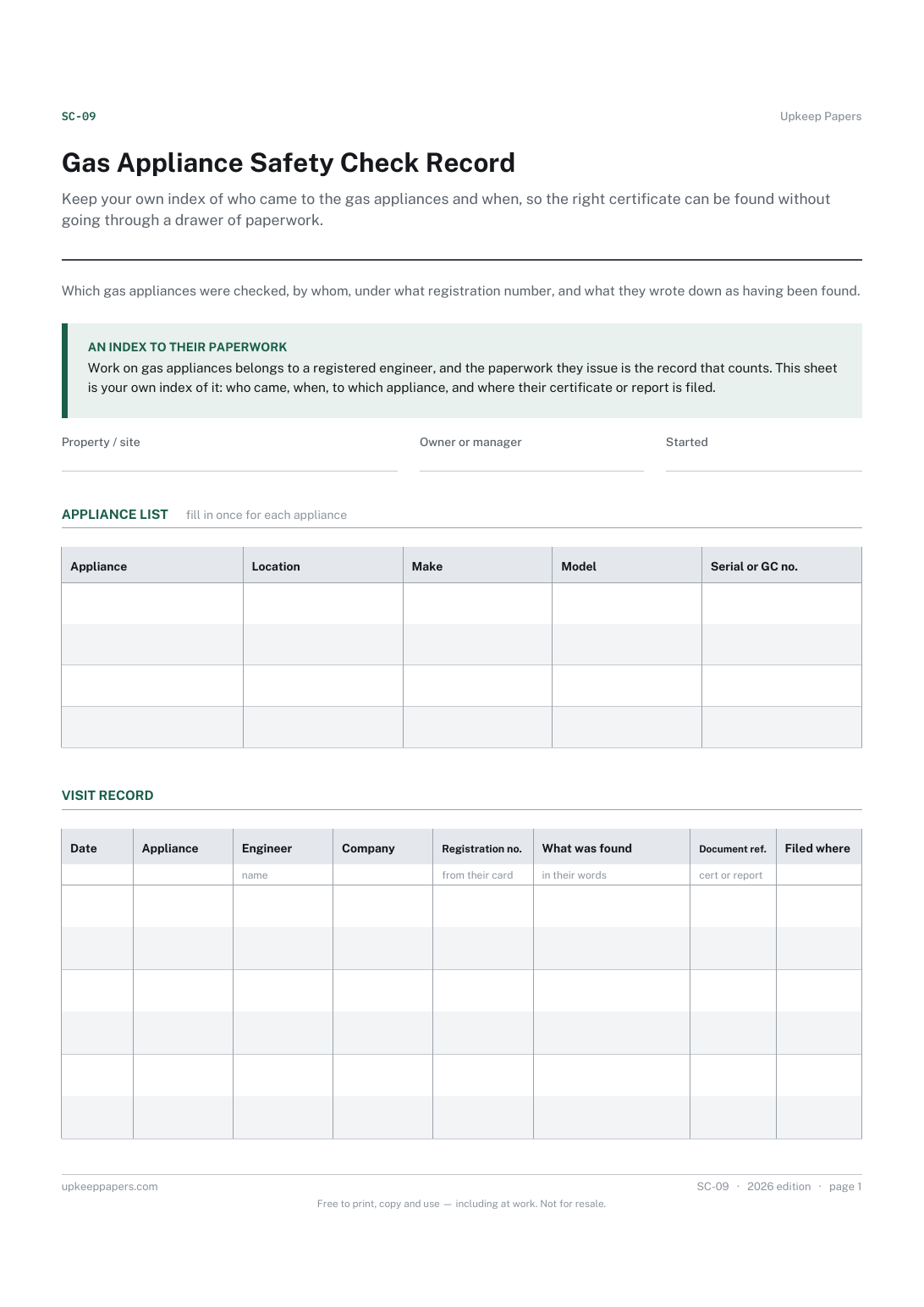
Keep your own index of who came to the gas appliances and when, so the right certificate can be found without going through a drawer of paperwork.
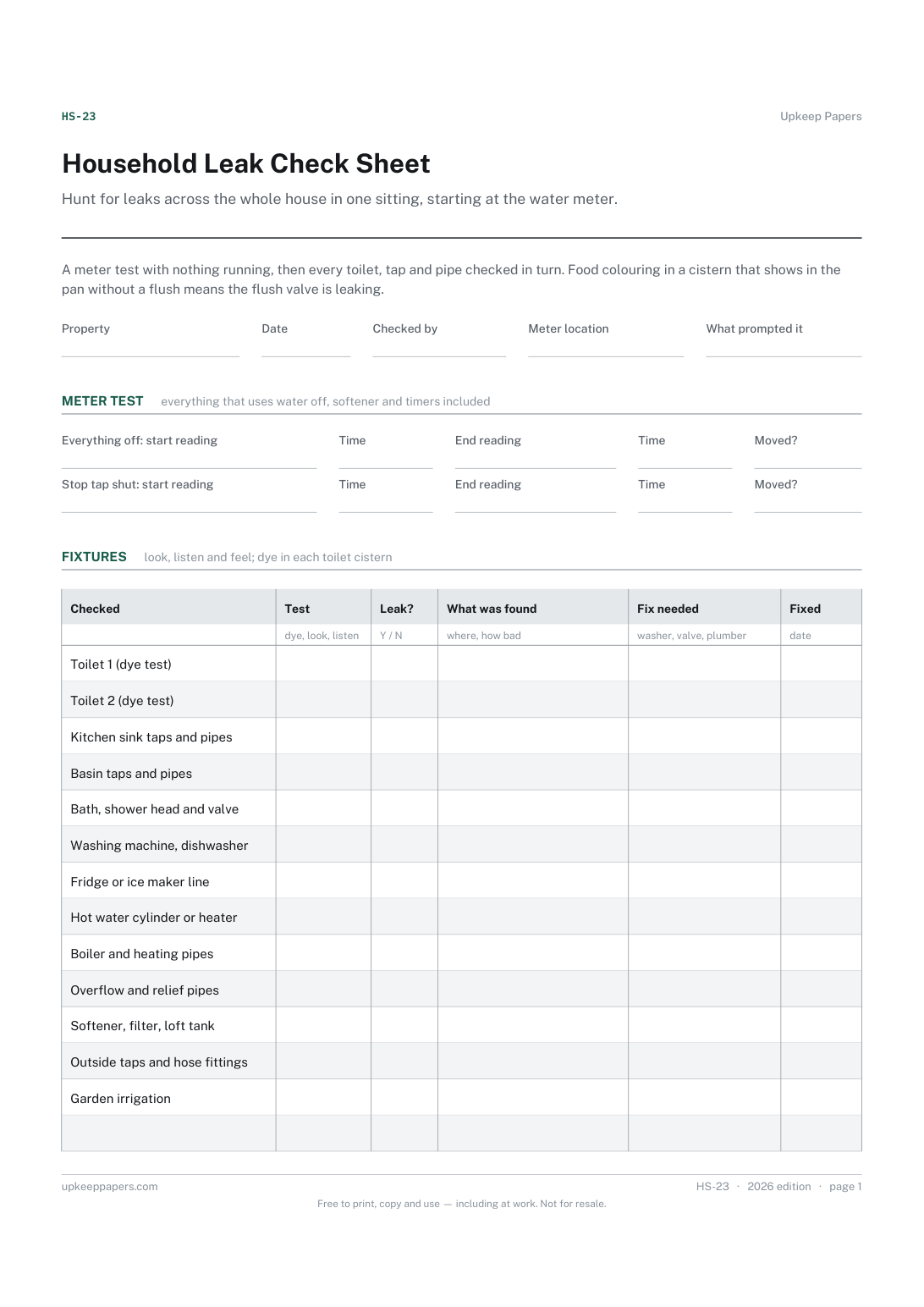
Hunt for leaks across the whole house in one sitting, starting at the water meter. Every toilet, tap and outside pipe gets a line, so a dripping cistern or a weeping relief pipe is found and fixed rather than paid for on the bill.
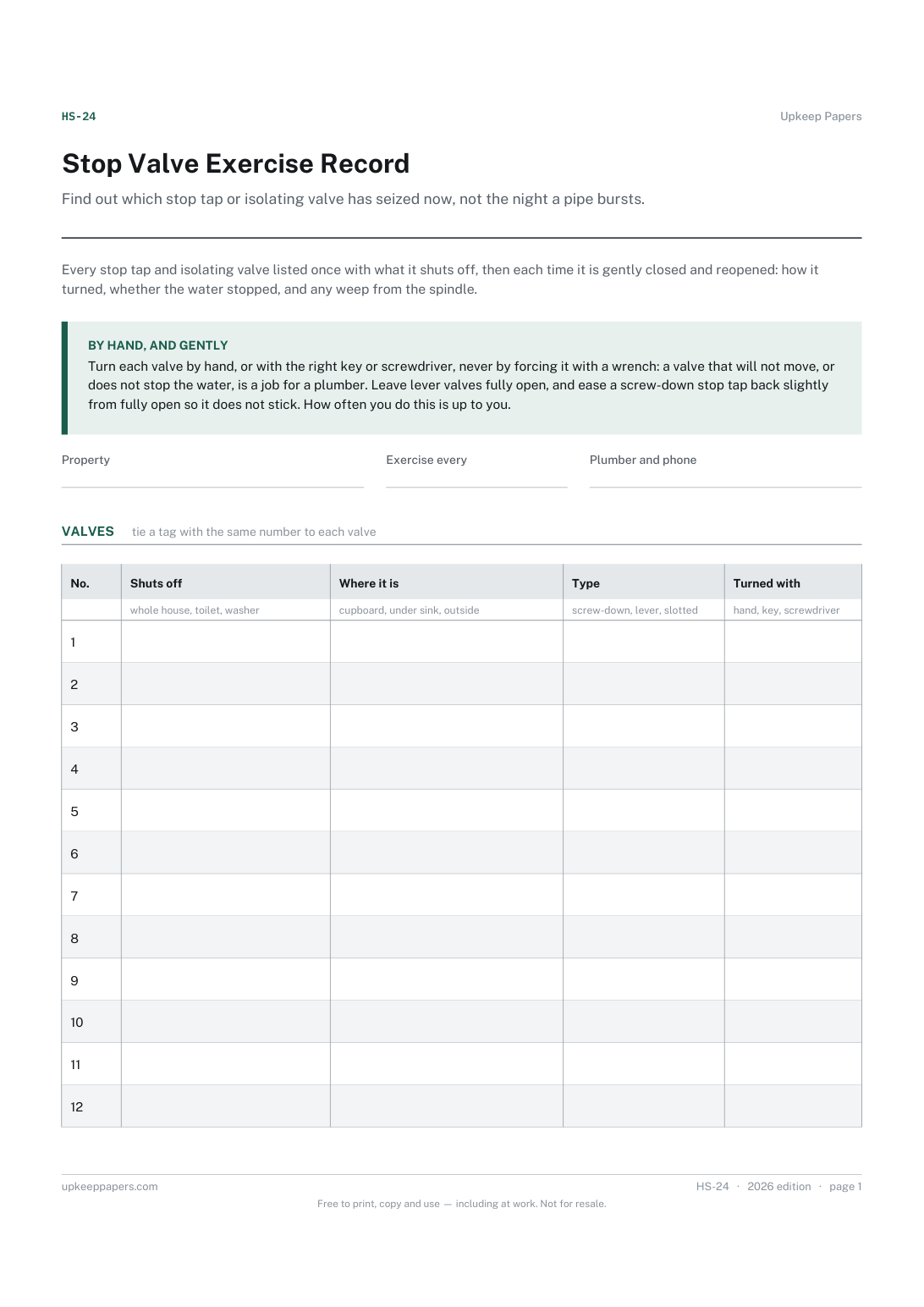
Find out which stop tap or isolating valve has seized now, not the night a pipe bursts. Each valve is listed once, and each gentle turn off and back on is written down with how it felt.
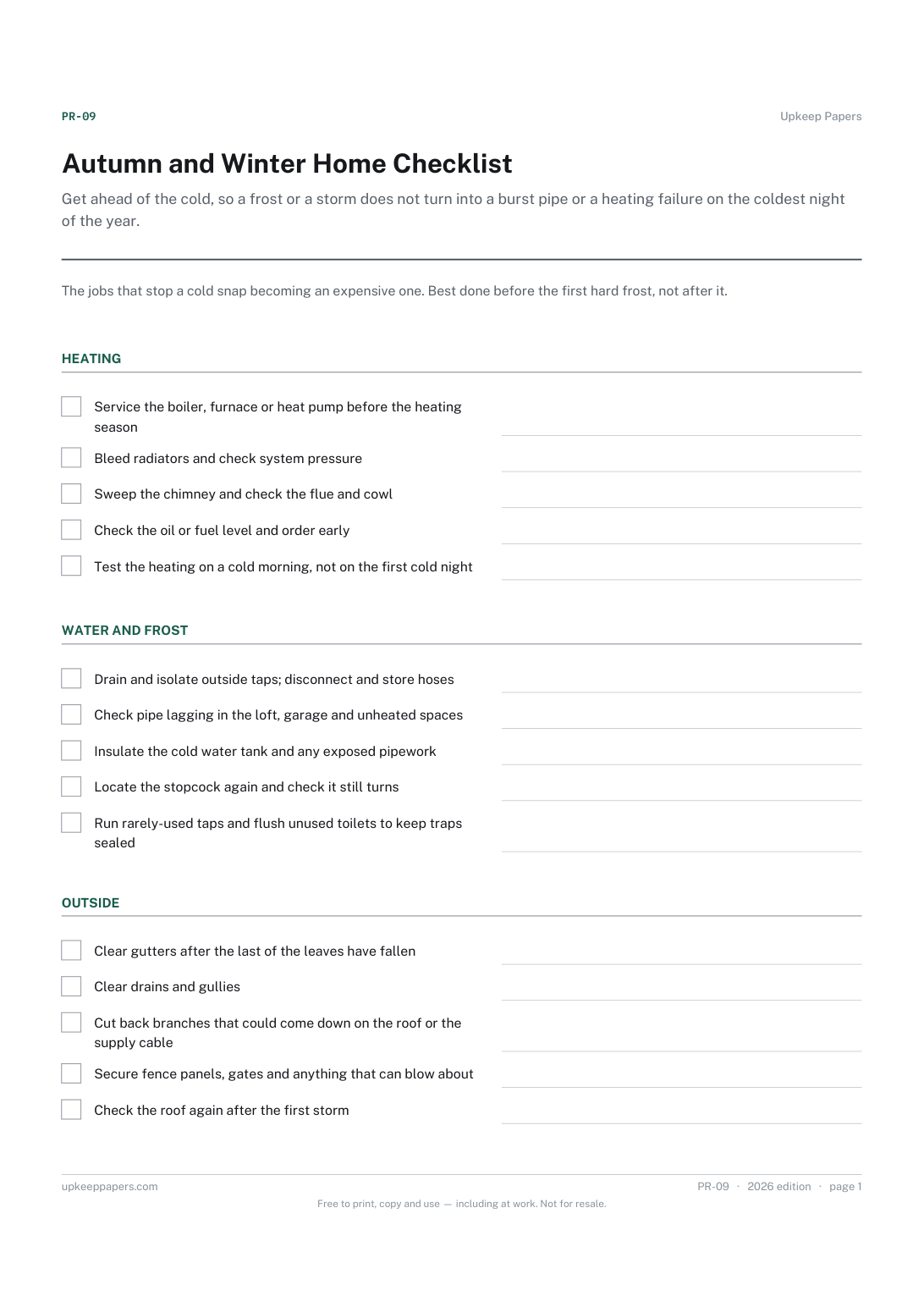
Get ahead of the cold, so a frost or a storm does not turn into a burst pipe or a heating failure on the coldest night of the year.

Every sheet, binder, game and puzzle on Upkeep Papers is free to download, with no email and no account. Making them is not free: each one takes days of research, design and checking, and the site costs money to run. If something here saved you time, you can buy us a coffee. It is entirely optional: nothing is locked, and nothing changes if you don’t.
Buy us a coffee Opens PayPal in a new tab. Any amount, and nothing changes if you would rather not.