Knitting Project and Yarn Record
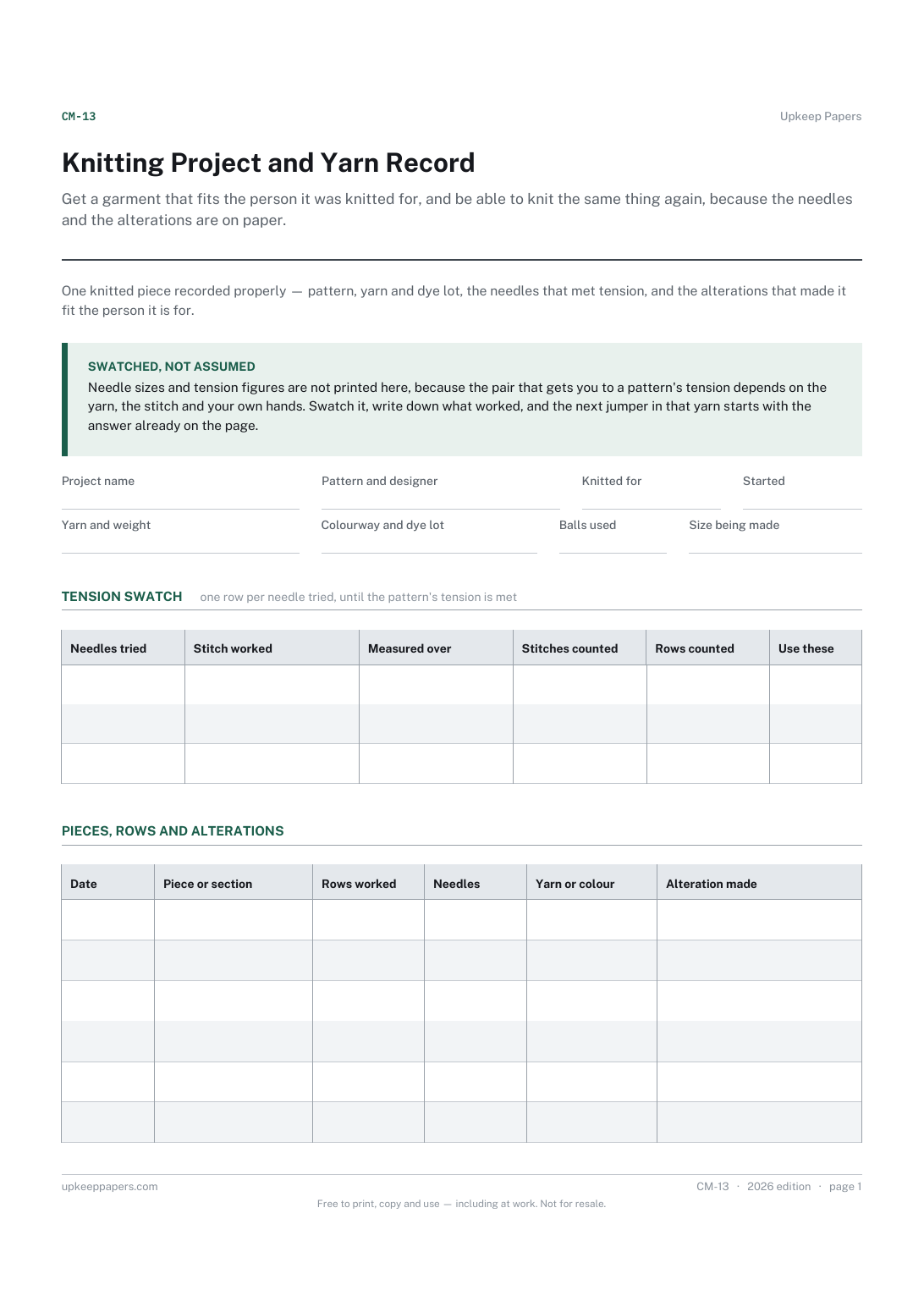
Get a garment that fits the person it was knitted for, and be able to knit the same thing again, because the needles and the alterations are on paper.
CM-13 1 page
Everything here is free. Making it takes time and money. Everything here is free.
 Buy us a coffee
Craft and making · CM-12
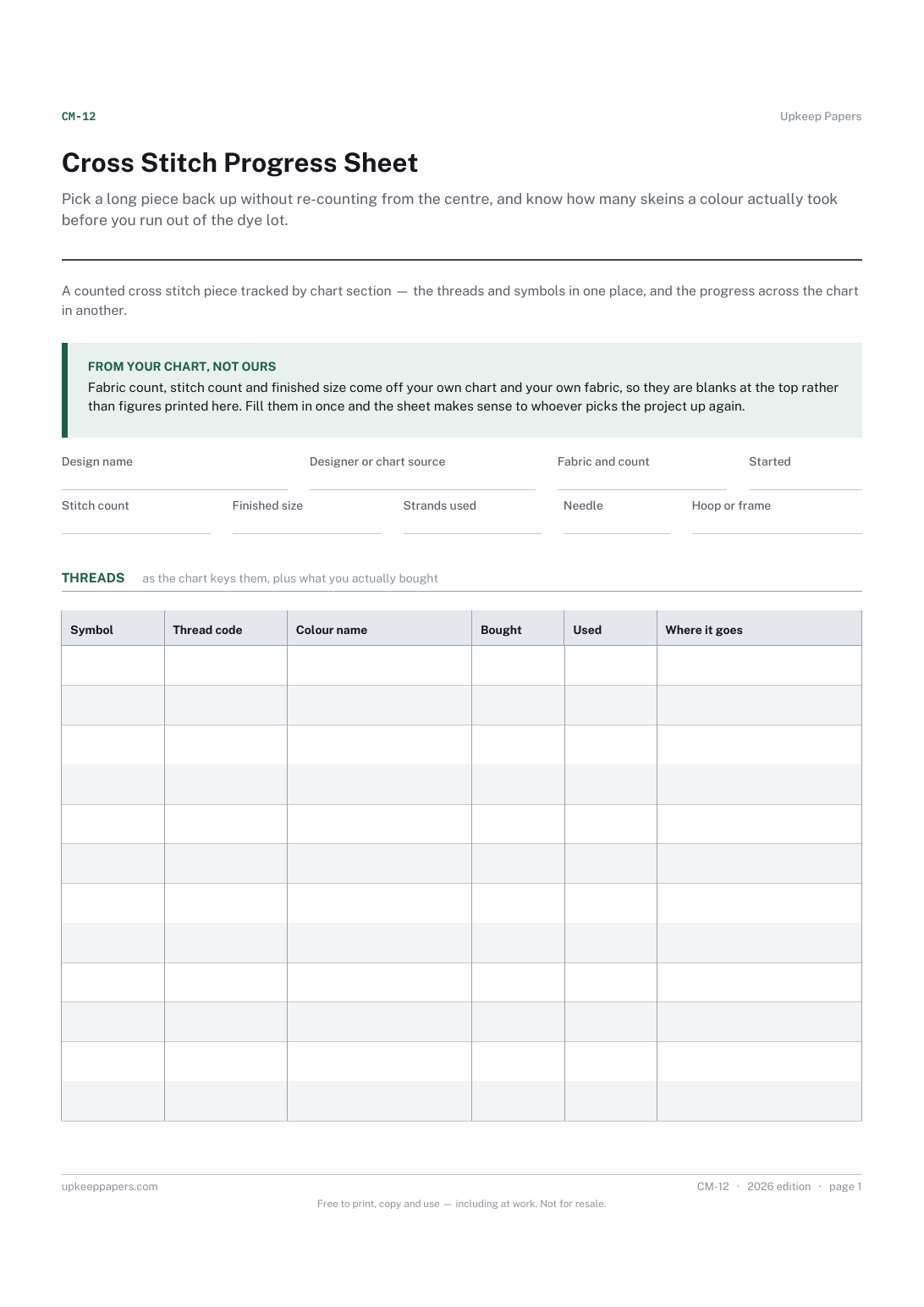
A free printable cross stitch progress chart — the thread list with symbols and skeins used, and a section-by-section record of what is stitched so far.
2 pages. Choose your paper size — both versions are laid out identically, so neither one gets shrunk to fit.
Print it and write on it
Fill it in type and save
The fillable versions have real form fields — open them in any PDF reader, type into them and save. Printing help.
Pick a long piece back up without re-counting from the centre, and know how many skeins a colour actually took before you run out of the dye lot.
Counted cross stitch and blackwork stitchers working from a chart, especially on pieces that take months rather than an evening.
2 pages, in this order:
Printed under the title: A counted cross stitch piece tracked by chart section — the threads and symbols in one place, and the progress across the chart in another.
From your chart, not ours. Fabric count, stitch count and finished size come off your own chart and your own fabric, so they are blanks at the top rather than figures printed here. Fill them in once and the sheet makes sense to whoever picks the project up again.
Write-on lines: Design name · Designer or chart source · Fabric and count · Started · Stitch count · Finished size · Strands used · Needle · Hoop or frame
Table, 12 rows: Symbol · Thread code · Colour name · Bought · Used · Where it goes
Table, 22 rows: Date · Chart page or block · Stitches done · Backstitch · Time at it · Where you stopped
Because those belong to your chart and the fabric you chose, and a printed figure would be wrong for every piece but one. They are blanks at the top, filled in once, so the rest of the sheet makes sense to whoever picks the project up.
Because the date tells you nothing when you come back in six months. A note saying which block you were on and which direction you were working saves an hour of counting.
Get a garment that fits the person it was knitted for, and be able to knit the same thing again, because the needles and the alterations are on paper.
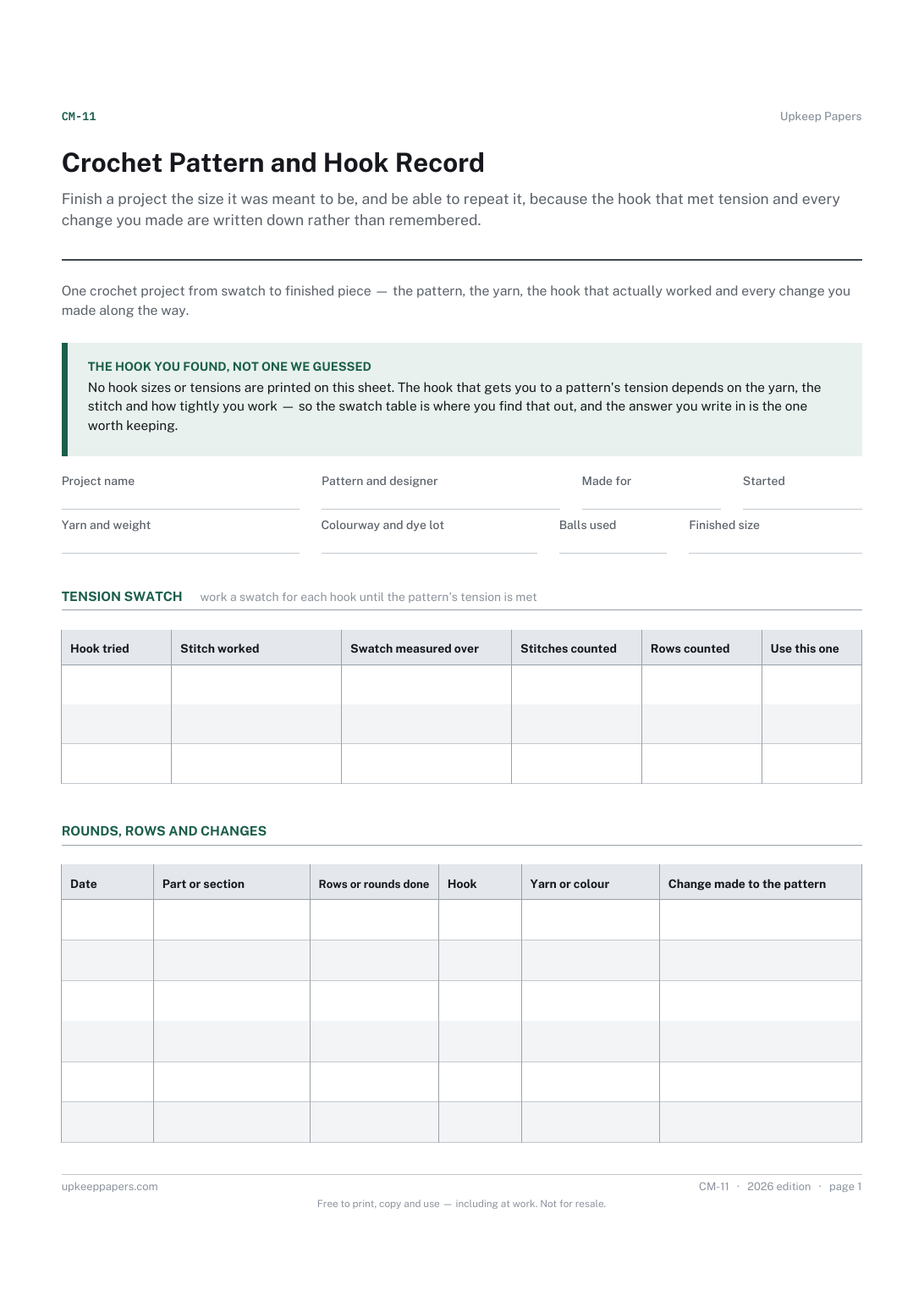
Finish a project the size it was meant to be, and be able to repeat it, because the hook that met tension and every change you made are written down rather than remembered.
Record the things a finished object cannot tell you later: which dye lot, which hook you really used, and how much was left over.
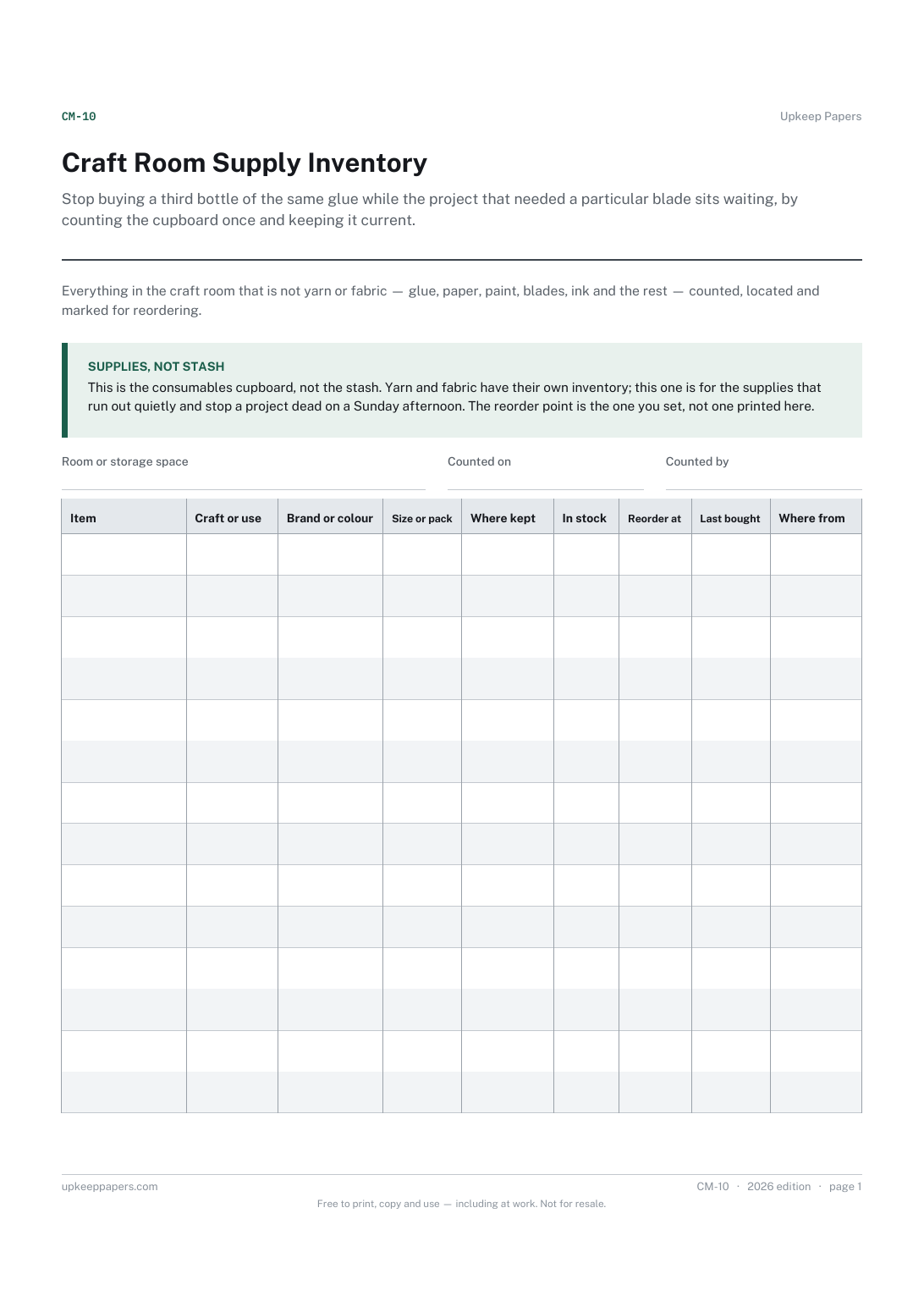
Stop buying a third bottle of the same glue while the project that needed a particular blade sits waiting, by counting the cupboard once and keeping it current.

Every sheet, binder, game and puzzle on Upkeep Papers is free to download, with no email and no account. Making them is not free: each one takes days of research, design and checking, and the site costs money to run. If something here saved you time, you can buy us a coffee. It is entirely optional: nothing is locked, and nothing changes if you don’t.
Buy us a coffee Opens PayPal in a new tab. Any amount, and nothing changes if you would rather not.