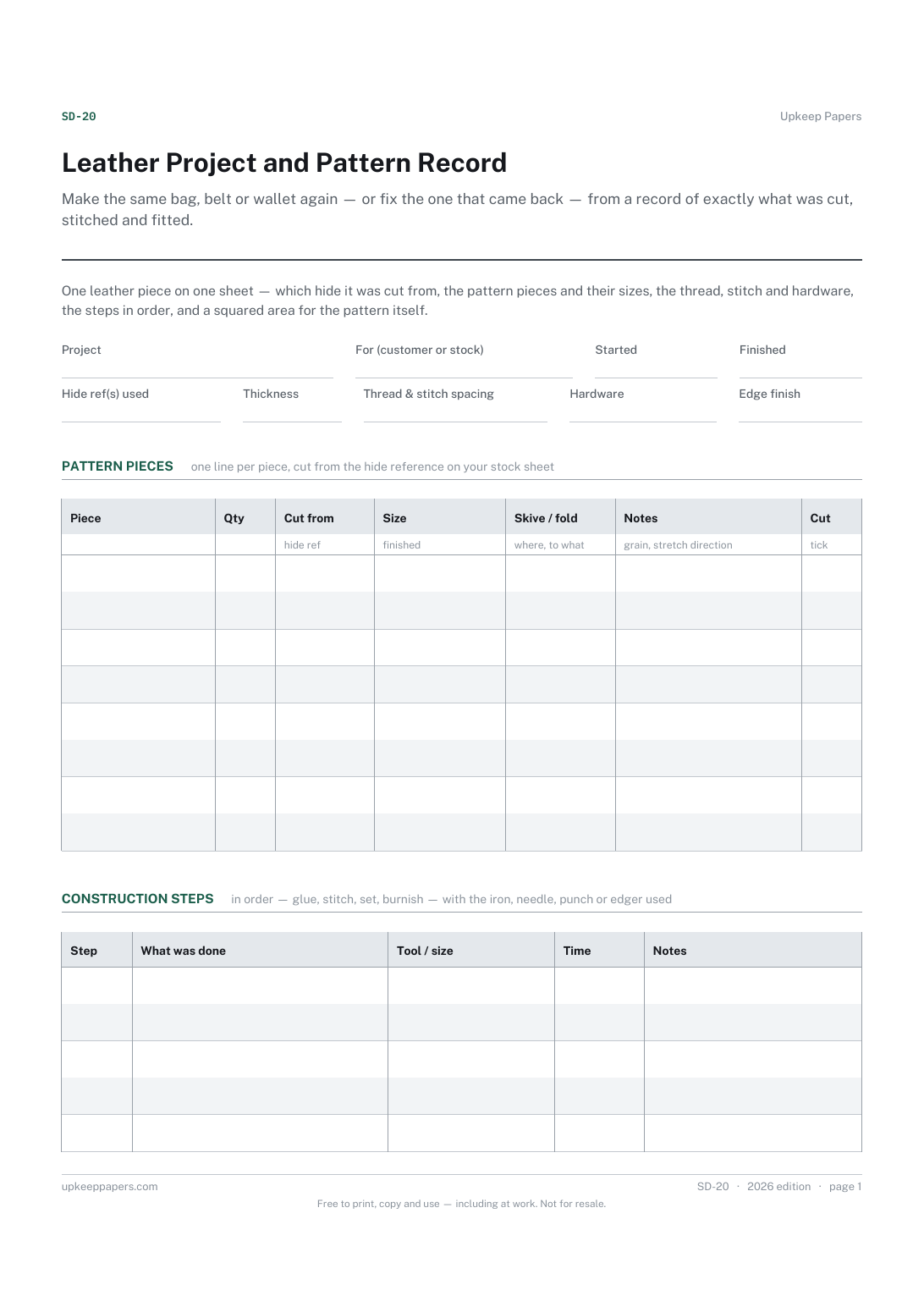
Leather Project and Pattern Record
Make the same bag, belt or wallet again — or fix the one that came back — from a record of exactly what was cut, stitched and fitted.
SD-20 2 pages
Everything here is free. Making it takes time and money. Everything here is free.
 Buy us a coffee
Studio crafts and making · SD-14
A free printable leather stock sheet — every hide, side and offcut with type, thickness, area, supplier and cost, and a log of the cuts taken from each.
2 pages. Choose your paper size — both versions are laid out identically, so neither one gets shrunk to fit.
Print it and write on it
Fill it in type and save
The fillable versions have real form fields — open them in any PDF reader, type into them and save. Printing help.
Know what leather is really on the shelf and how much of each hide is left, before quoting a job or ordering more.
Leatherworkers, saddlers, bag and belt makers and small workshops buying leather by the hide or side.
2 pages, in this order:
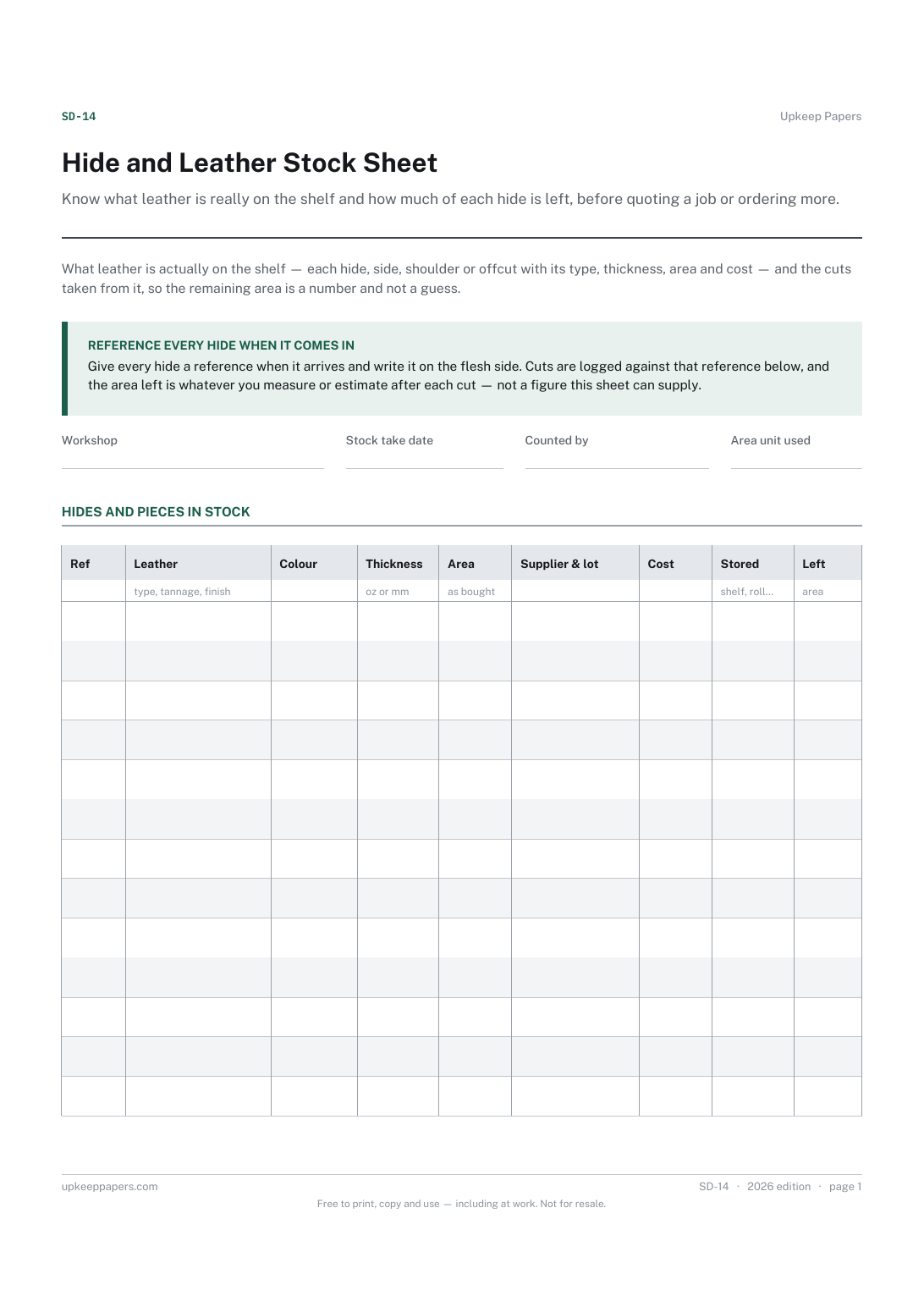
Printed under the title: What leather is actually on the shelf — each hide, side, shoulder or offcut with its type, thickness, area and cost — and the cuts taken from it, so the remaining area is a number and not a guess.
Reference every hide when it comes in. Give every hide a reference when it arrives and write it on the flesh side. Cuts are logged against that reference below, and the area left is whatever you measure or estimate after each cut — not a figure this sheet can supply.
Write-on lines: Workshop · Stock take date · Counted by · Area unit used
Table, 13 rows: Ref · Leather · Colour · Thickness · Area · Supplier & lot · Cost · Stored · Left
Table, 22 rows: Date · Hide ref · Project / piece · Area used · Area left · Notes
Because suppliers sell in different units — ounces or millimetres for thickness, square feet or square metres for area — and mixing them is how stock goes wrong. Write the unit you use at the top and stick to it for the whole sheet.
As exact as your quoting needs. A rough estimate after each cut is far better than none; the point is that the figure exists and was updated by the person who made the cut.
Make the same bag, belt or wallet again — or fix the one that came back — from a record of exactly what was cut, stitched and fitted.
Get the ball band's detail onto paper before the band is lost, especially the dye lot, which exists nowhere else once it is gone.
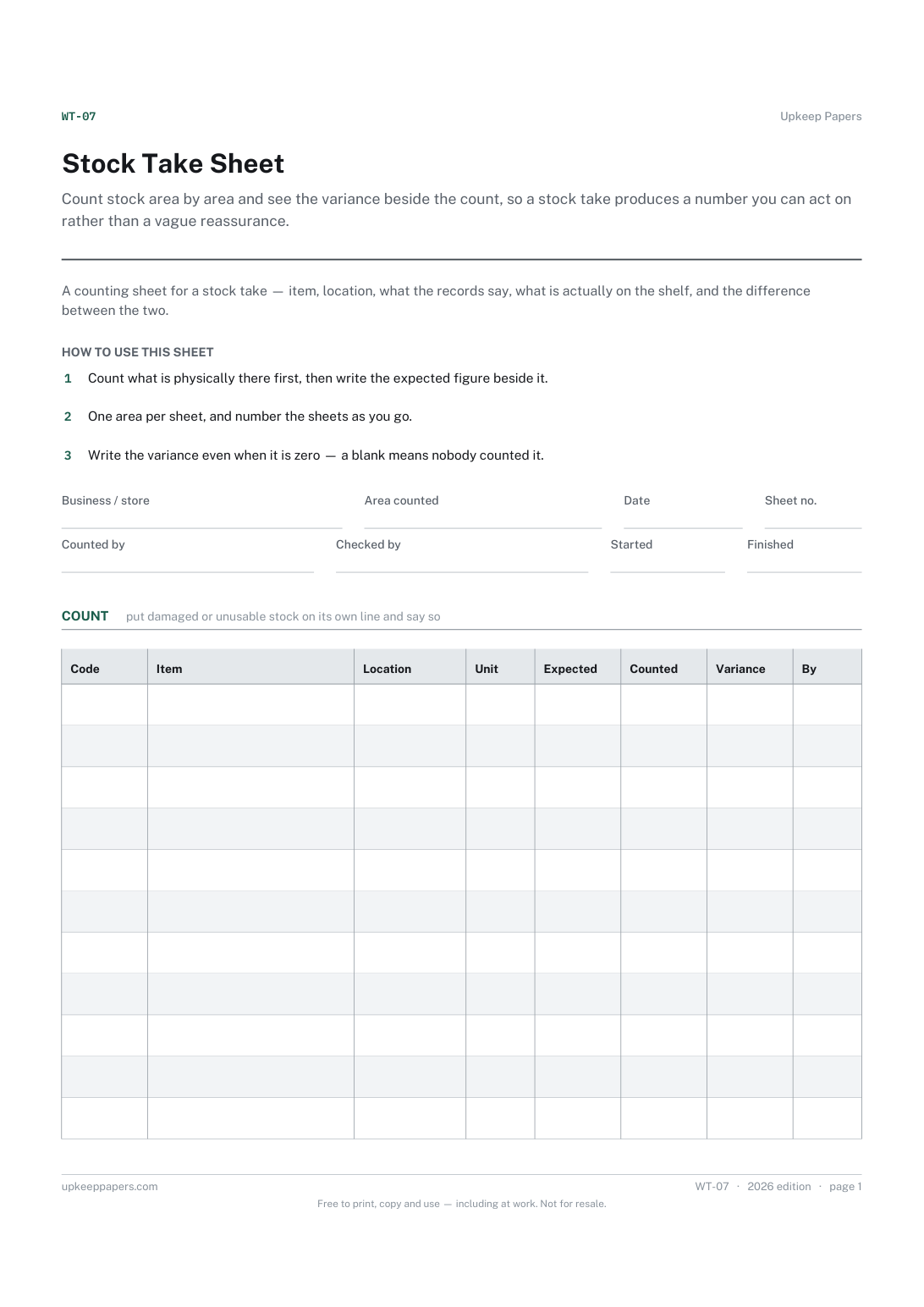
Count stock area by area and see the variance beside the count, so a stock take produces a number you can act on rather than a vague reassurance.
Turn reordering from a guess into a decision, by recording the level you have chosen to hold against what is actually on the shelf.

Every sheet, binder, game and puzzle on Upkeep Papers is free to download, with no email and no account. Making them is not free: each one takes days of research, design and checking, and the site costs money to run. If something here saved you time, you can buy us a coffee. It is entirely optional: nothing is locked, and nothing changes if you don’t.
Buy us a coffee Opens PayPal in a new tab. Any amount, and nothing changes if you would rather not.