Welding Settings and Test Weld Record
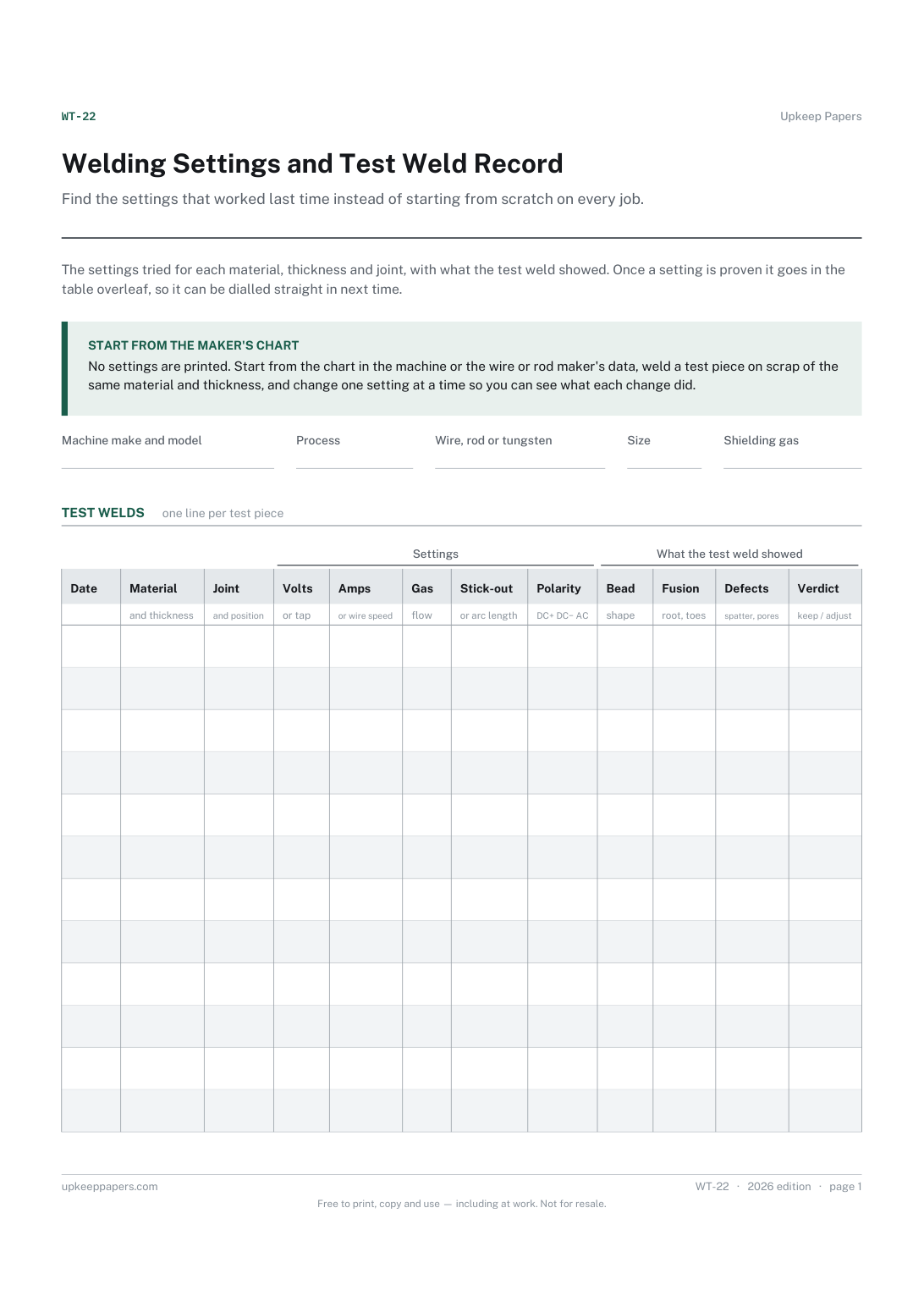
Find the settings that worked last time instead of starting from scratch on every job. Each test weld is written down with what it showed, and the good ones are copied to a table of proven settings overleaf.
Workshop and tools · WT-21
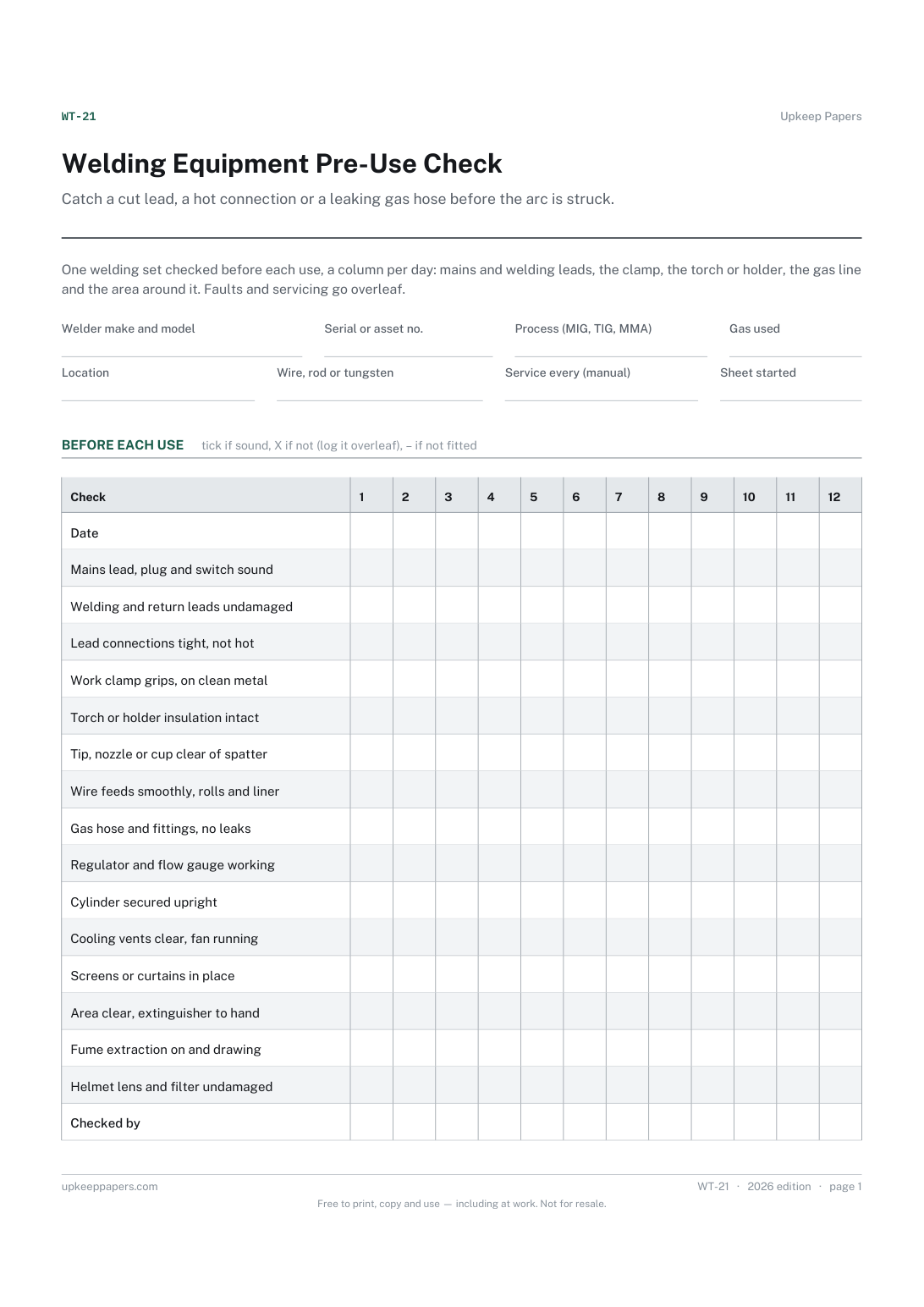
A free printable welding equipment check sheet: a column per day for leads, clamp, torch, gas line, screens and extraction, with faults and servicing overleaf.
2 pages. Choose your paper size — both versions are laid out identically, so neither one gets shrunk to fit.
Print it and write on it
Fill it in type and save
The fillable versions have real form fields — open them in any PDF reader, type into them and save. Printing help.
Catch a cut lead, a hot connection or a leaking gas hose before the arc is struck. Faults and servicing go on the back, so the set's history stays with it.
Fabricators, maintenance welders, college workshops and anyone who keeps a MIG, TIG or stick welder in regular use.
2 pages, in this order:
Printed under the title: One welding set checked before each use, a column per day: mains and welding leads, the clamp, the torch or holder, the gas line and the area around it. Faults and servicing go overleaf.
Write-on lines: Welder make and model · Serial or asset no. · Process (MIG, TIG, MMA) · Gas used · Location · Wire, rod or tungsten · Service every (manual) · Sheet started
Also printed: Check · Date · Mains lead, plug and switch sound · Welding and return leads undamaged · Lead connections tight, not hot · Work clamp grips, on clean metal · Torch or holder insulation intact · Tip, nozzle or cup clear of spatter · Wire feeds smoothly, rolls and liner · Gas hose and fittings, no leaks · Regulator and flow gauge working · Cylinder secured upright · Cooling vents clear, fan running · Screens or curtains in place · Area clear, extinguisher to hand · Fume extraction on and drawing · Helmet lens and filter undamaged · Checked by
Out of use until put right. No settings, pressures or service intervals are printed. Servicing follows the welder's manual; write its interval on the front. Anything marked X stays out of use until it is put right, and goes in the table below with what was done.
Table, 8 rows: Date · Item · Fault found · Out of use · Put right · Back in use · Initials
Table, 6 rows: Date · Work done · Parts fitted · Done by · Next due
Yes. The checks cover all three; mark the ones a set does not have, such as the wire feed on a stick welder, with a dash rather than leaving them blank, so it is clear they were not missed.
Because the maker sets it, and how soon a set needs blowing out depends on how hard it works and how dusty the workshop is. Write the interval from your own manual in the box on the front.
Find the settings that worked last time instead of starting from scratch on every job. Each test weld is written down with what it showed, and the good ones are copied to a table of proven settings overleaf.
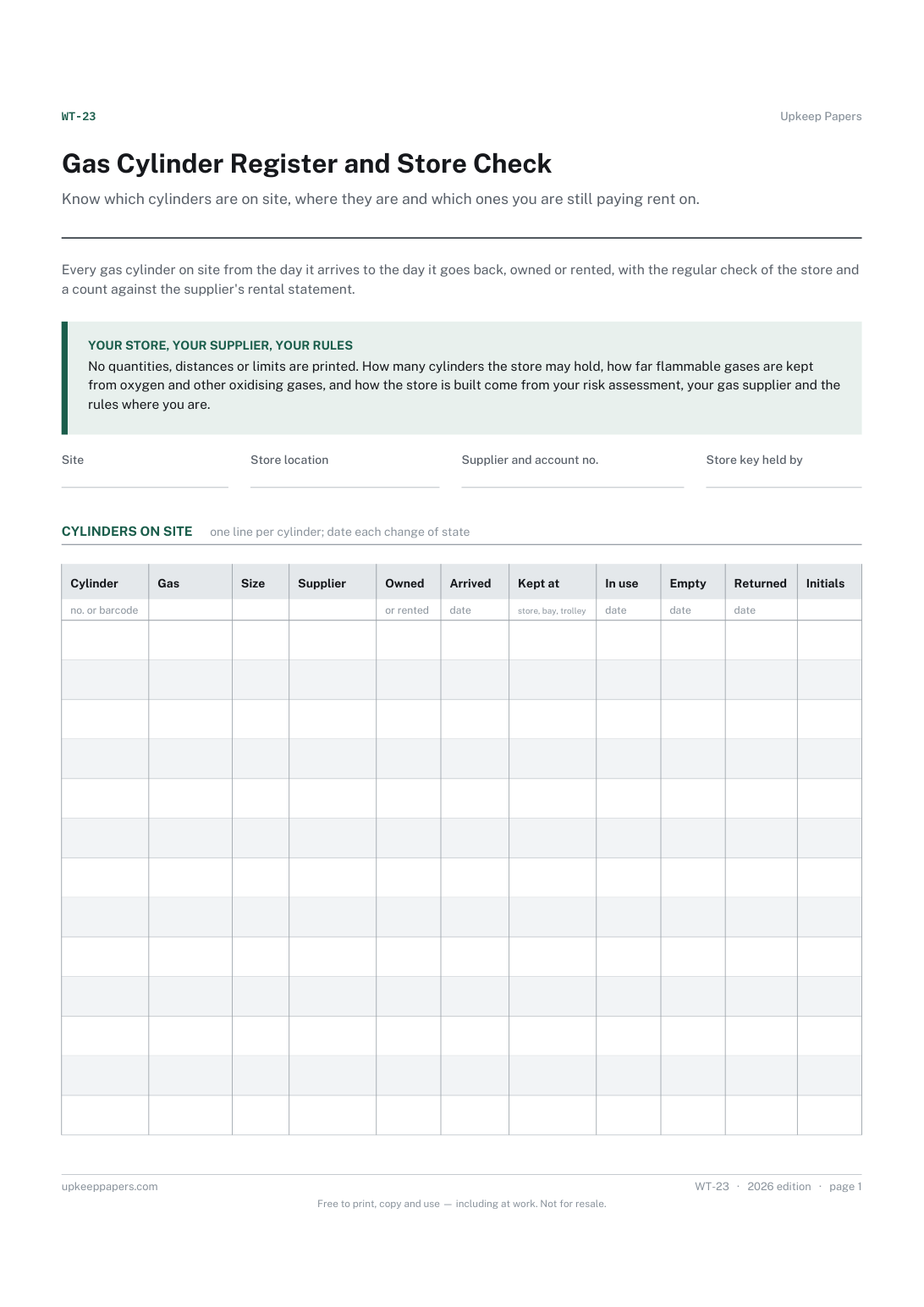
Know which cylinders are on site, where they are and which ones you are still paying rent on. The store checks sit behind the register, so the two are kept together.
Control work that makes heat, flame or sparks, and record the after-check that catches the fire that starts once everyone has gone home.
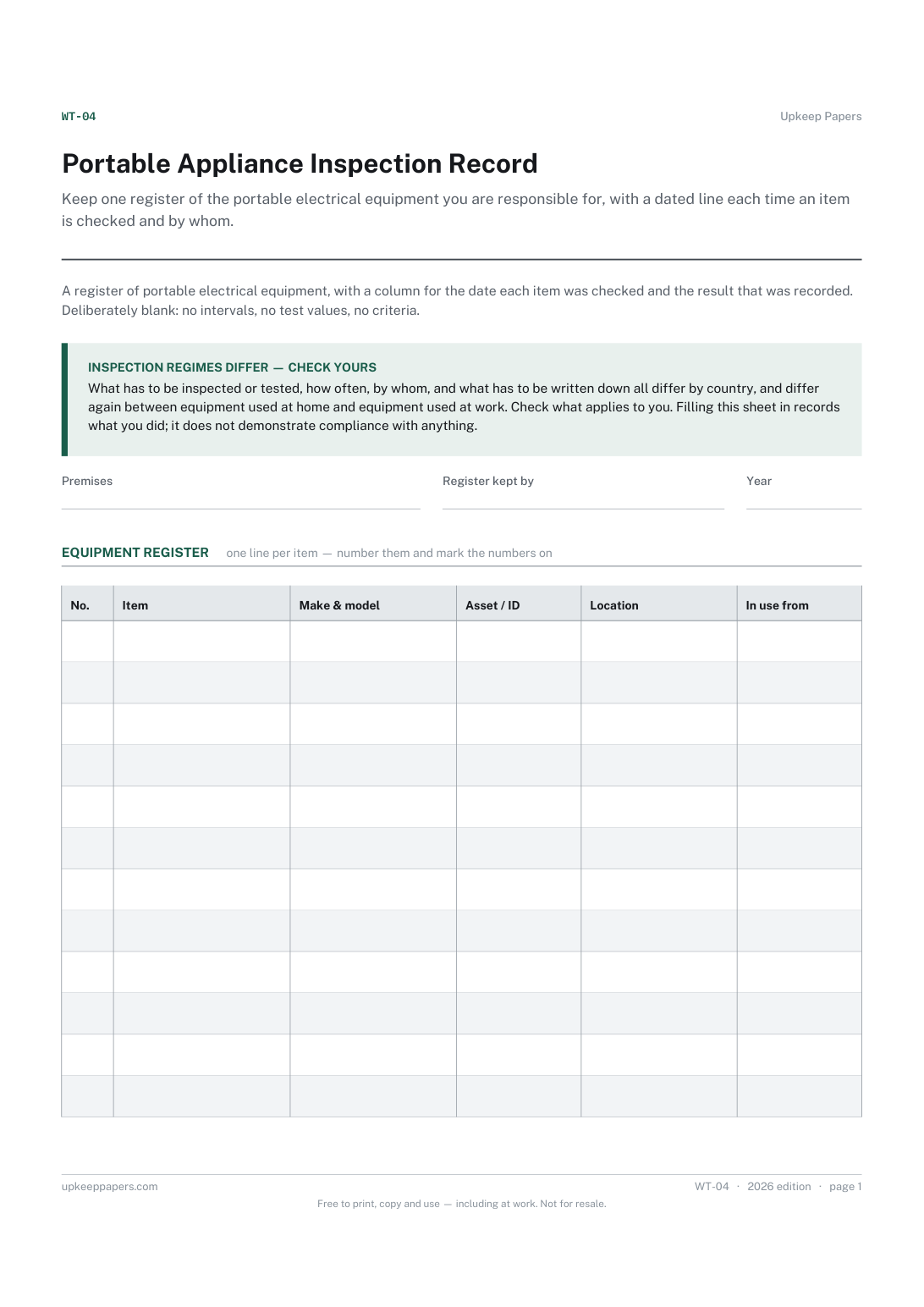
Keep one register of the portable electrical equipment you are responsible for, with a dated line each time an item is checked and by whom.
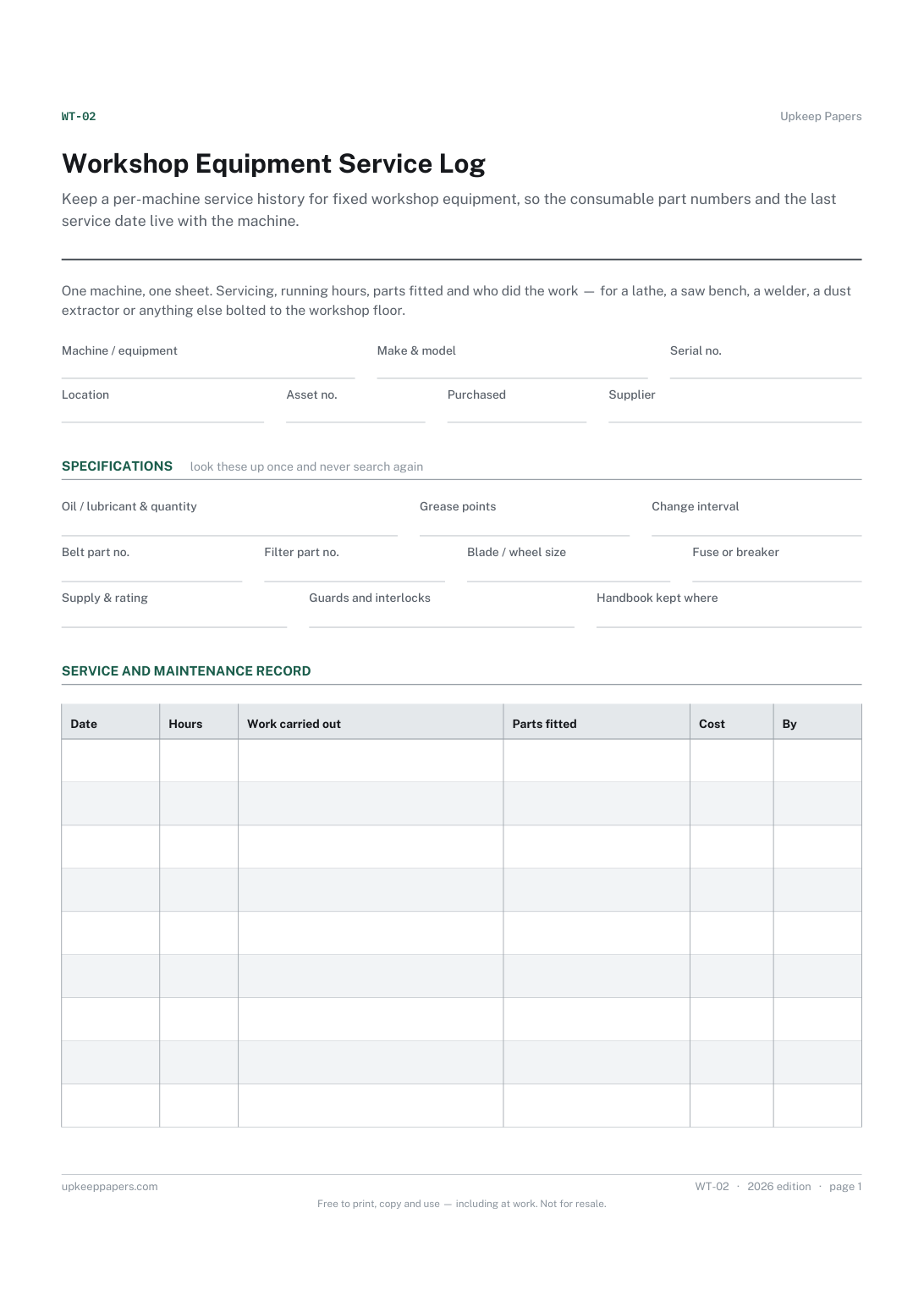
Keep a per-machine service history for fixed workshop equipment, so the consumable part numbers and the last service date live with the machine.
Every sheet, binder, game and puzzle on Upkeep Papers is free to download, with no email and no account. Making them is not free: each one takes days of research, design and checking, and the site costs money to run. If something here saved you time, you can buy us a coffee. It is entirely optional: nothing is locked, and nothing changes if you don’t.
Opens PayPal in a new tab. Any amount, and nothing changes if you would rather not.