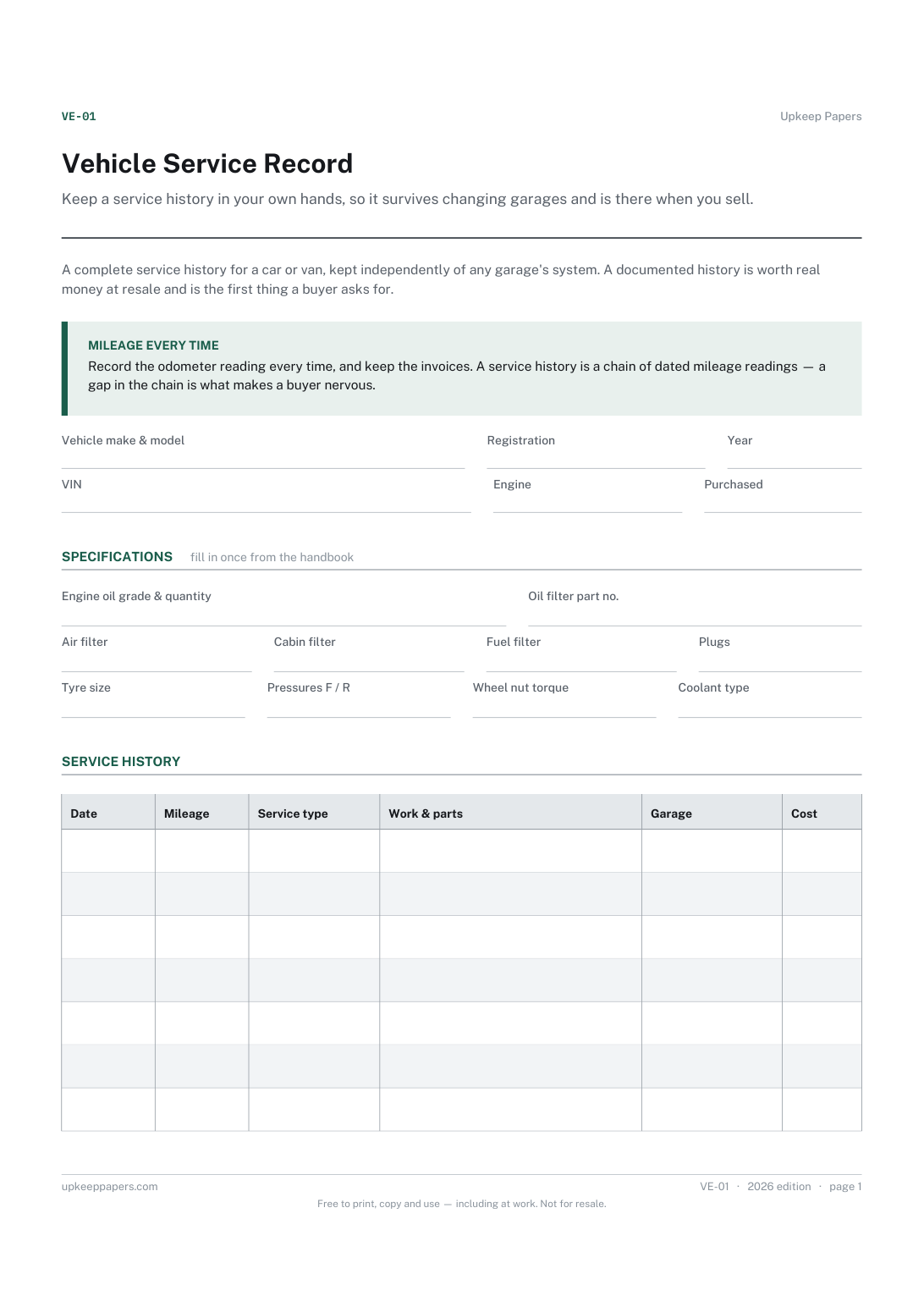
Vehicle Service Record
Keep a service history in your own hands, so it survives changing garages and is there when you sell.
VE-01 1 page
Everything here is free. Making it takes time and money. Everything here is free.
 Buy us a coffee
 Vehicle buying and selling · VB-01
A free printable used car inspection checklist — cold start, panels, tyres, fluids, warning lights, test drive and a faults-and-costs table, on two pages.

2 pages. Choose your paper size — both versions are laid out identically, so neither one gets shrunk to fit.
Print it and write on it
Fill it in type and save
The fillable versions have real form fields — open them in any PDF reader, type into them and save. Printing help.
Carry out the same inspection on every car you view, so a decision made in somebody's driveway is based on what you saw rather than what you remember.
Private buyers viewing three to six cars over a fortnight, and anyone helping a friend or a son or daughter buy their first one.
2 pages, in this order:
Printed under the title: One sheet per car, filled in on the driveway while you are standing in front of it. Print one per viewing and lay them side by side afterwards, when nobody is watching you decide.
What this sheet is, and is not. This is a buyer's own walk-round, not a professional inspection. It exists because people forget checks when a stranger is standing beside them — anything expensive is still worth paying an independent inspector to look at before money changes hands.
Write-on lines: Make and model · Registration · Year · Date viewed · VIN / chassis number · Engine and gearbox · Colour · Advert reference
Write-on lines: Asking price · Mileage on the clock · Mileage at the last stamp · Former keepers · Seller — name and town · Private or trade · Phone · Do the mileages agree?
Write-on lines: Warning lights with the ignition on, before starting · Still lit once it has started
Table, 5 rows: Wheel · Make and model · Size · Tread depth · Date code · Condition and damage
Write-on lines: Engine oil — colour and level · Coolant · Brake fluid · Gearbox and other
Ruled lines: Test drive — clutch, gears, brakes, steering, temperature, noises
Table, 5 rows: Fault · How bad · Who quoted · Cost to fix · Off the price?
Write-on lines: Decision · Offer made · Outcome
No. It is a buyer's own walk-round, and its job is to stop you forgetting a check while somebody is standing beside you. Anything expensive — structural repair, a cambelt, a gearbox, a hybrid battery — is worth paying an independent inspector or a marque specialist to look at before money changes hands.
Because tread depths, emissions limits, roadworthiness tests and what counts as acceptable corrosion are set nationally and change, and because tyre pressures, service intervals and fluid specifications are the manufacturer's, not ours. The sheet records what you found; the standard it is measured against should come from the handbook and from the rules where you live.
Because a one-page version means either dropping the test drive or shrinking the writing space until nobody uses it. The first page is what you can check standing still; the second is the car moving, and what putting it right would cost.
Keep a service history in your own hands, so it survives changing garages and is there when you sell.
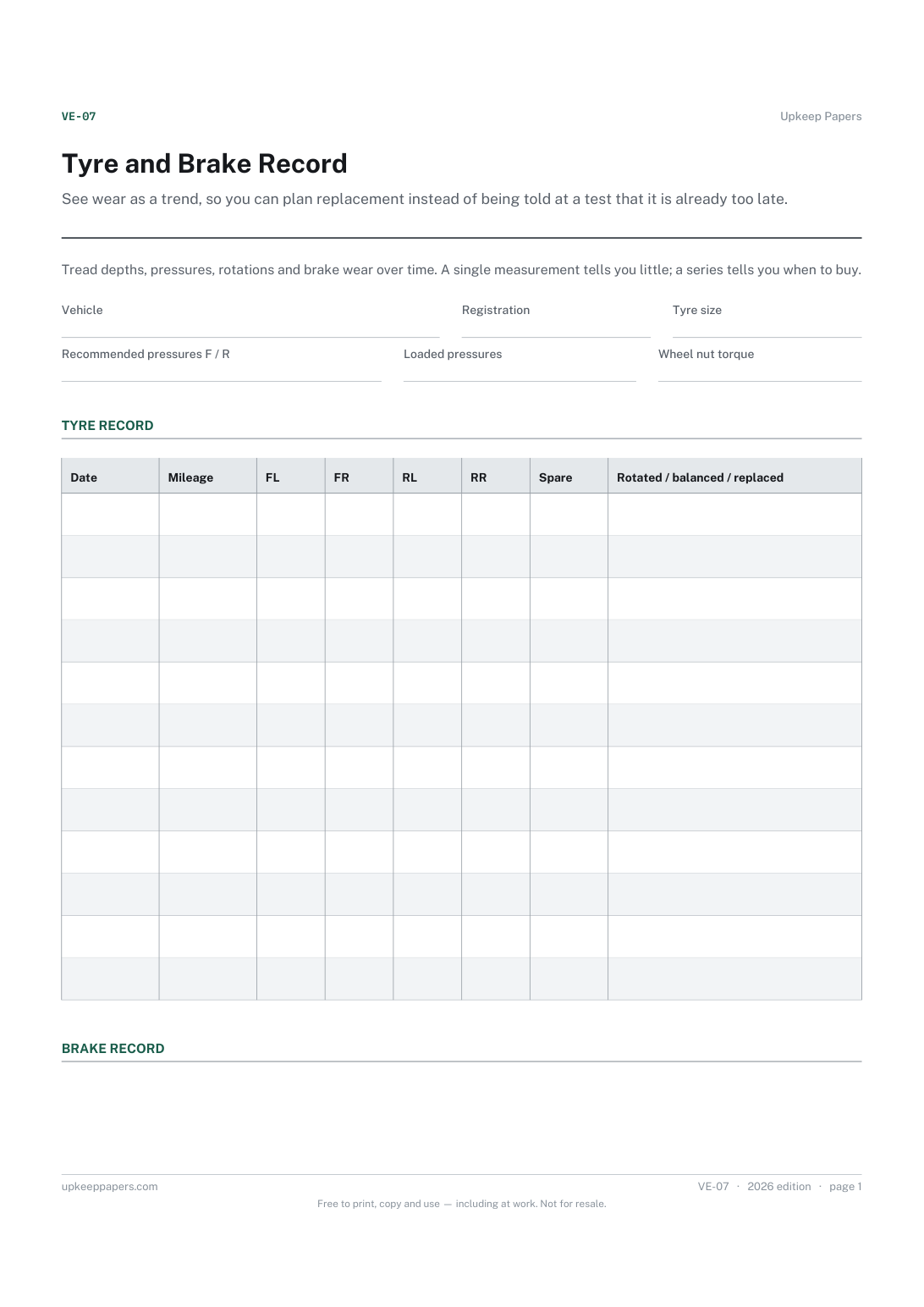
See wear as a trend, so you can plan replacement instead of being told at a test that it is already too late.
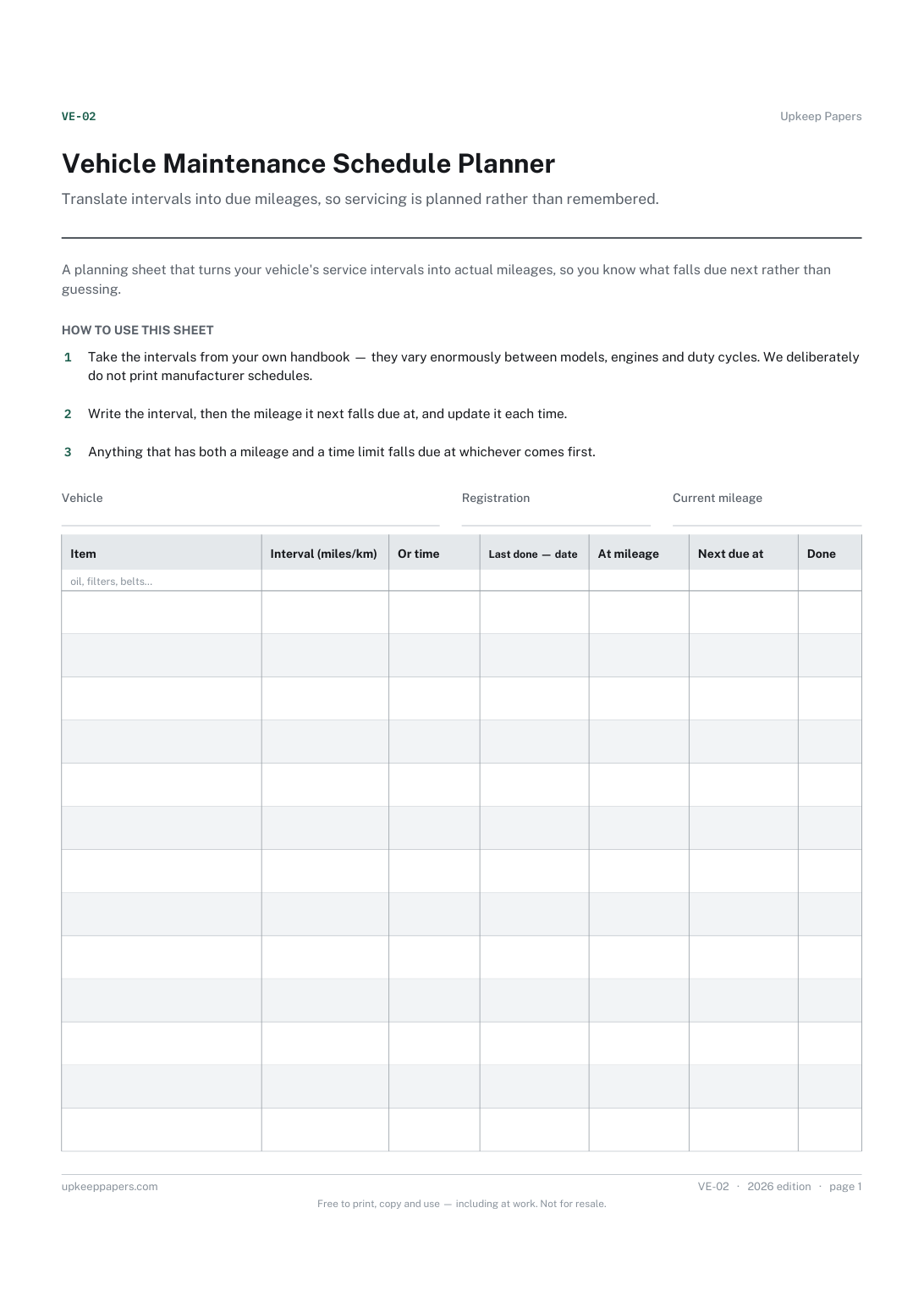
Translate intervals into due mileages, so servicing is planned rather than remembered.
See what a vehicle actually costs to run and spot a change in fuel consumption early, which is often the first sign that something mechanical is wrong.
The same subject, with a version you can fill in on screen.
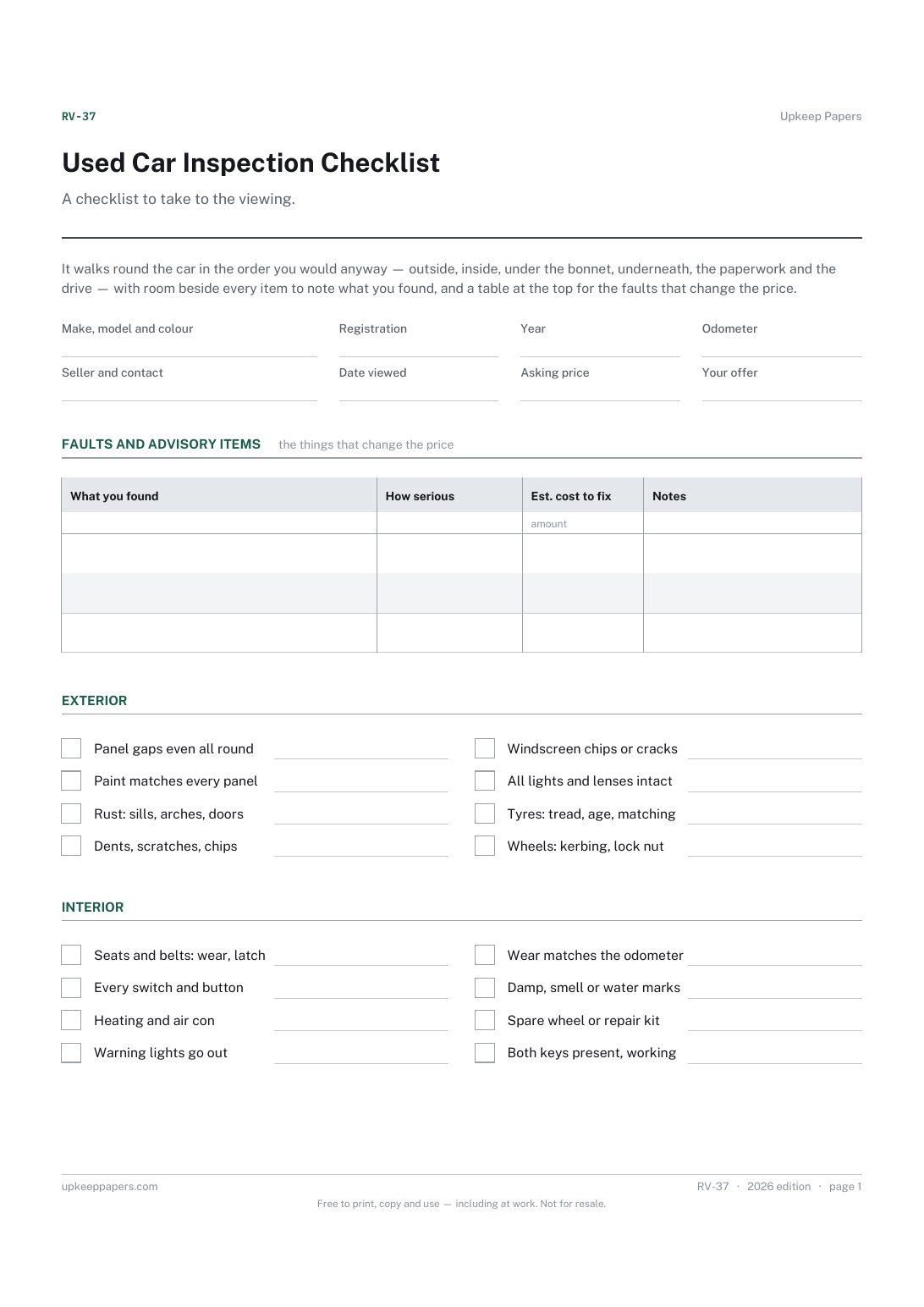
Nothing forgotten in the moment because the seller is talking.
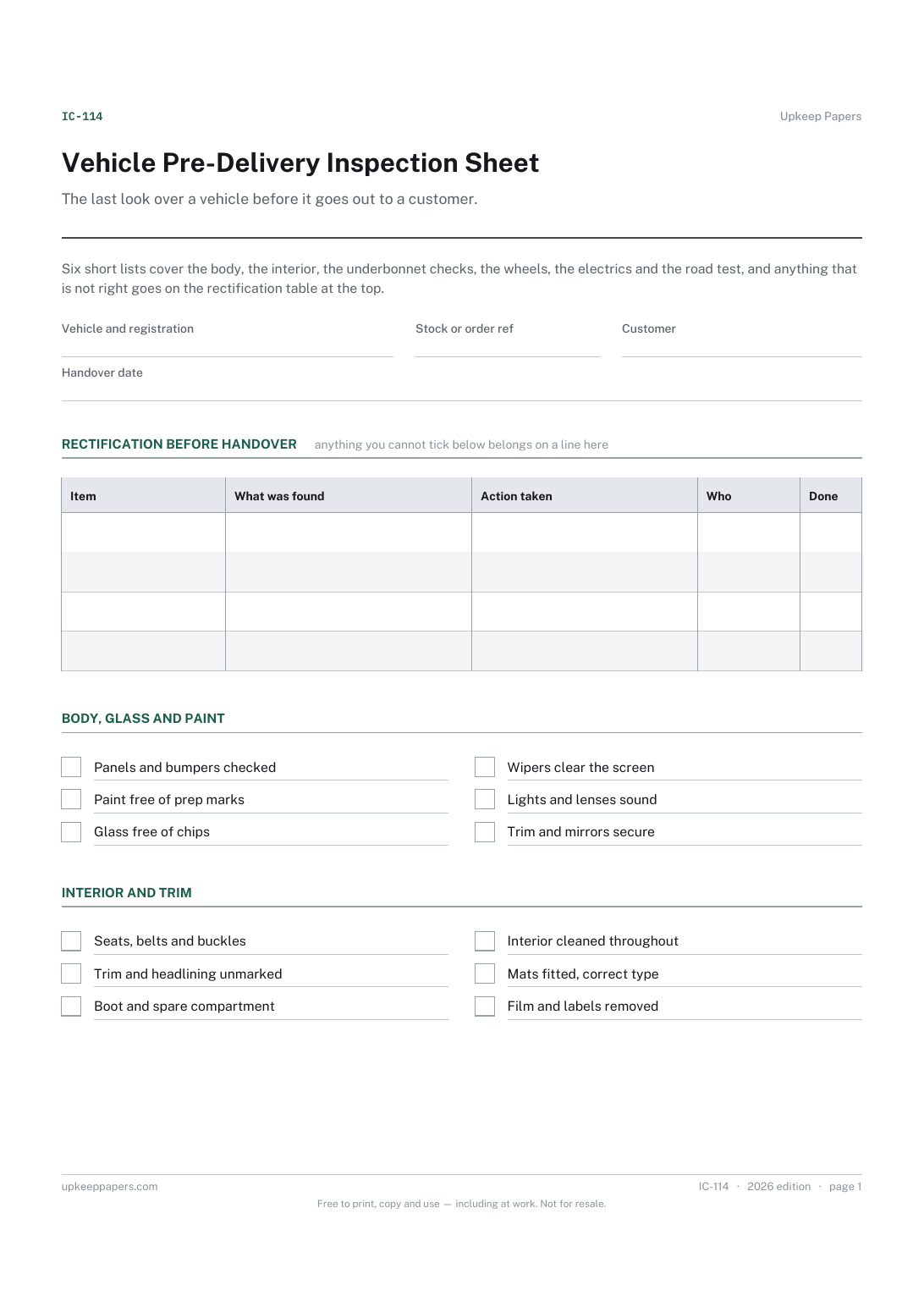
Exactly what was checked before the vehicle left, and by whom.

Every sheet, binder, game and puzzle on Upkeep Papers is free to download, with no email and no account. Making them is not free: each one takes days of research, design and checking, and the site costs money to run. If something here saved you time, you can buy us a coffee. It is entirely optional: nothing is locked, and nothing changes if you don’t.
Buy us a coffee Opens PayPal in a new tab. Any amount, and nothing changes if you would rather not.