Drone Flight Log
Keep your own continuous record of flights, hours and battery cycles, and capture an anomaly on the day it happened rather than reconstructing it months later.
HB-01 1 page
Everything here is free. Making it takes time and money. Everything here is free.
 Buy us a coffee
 Category
Logbooks for the things people do for the love of it, built to hold hours, conditions and the incident nobody wants to reconstruct from memory.
Hobbies generate records too: hours flown, batteries cycled, the conditions on the day, the thing that went oddly and was forgotten by the weekend. These are personal logs and they print no rules, because what is permitted where you are is set locally, differs between countries and changes.
Keep your own continuous record of flights, hours and battery cycles, and capture an anomaly on the day it happened rather than reconstructing it months later.
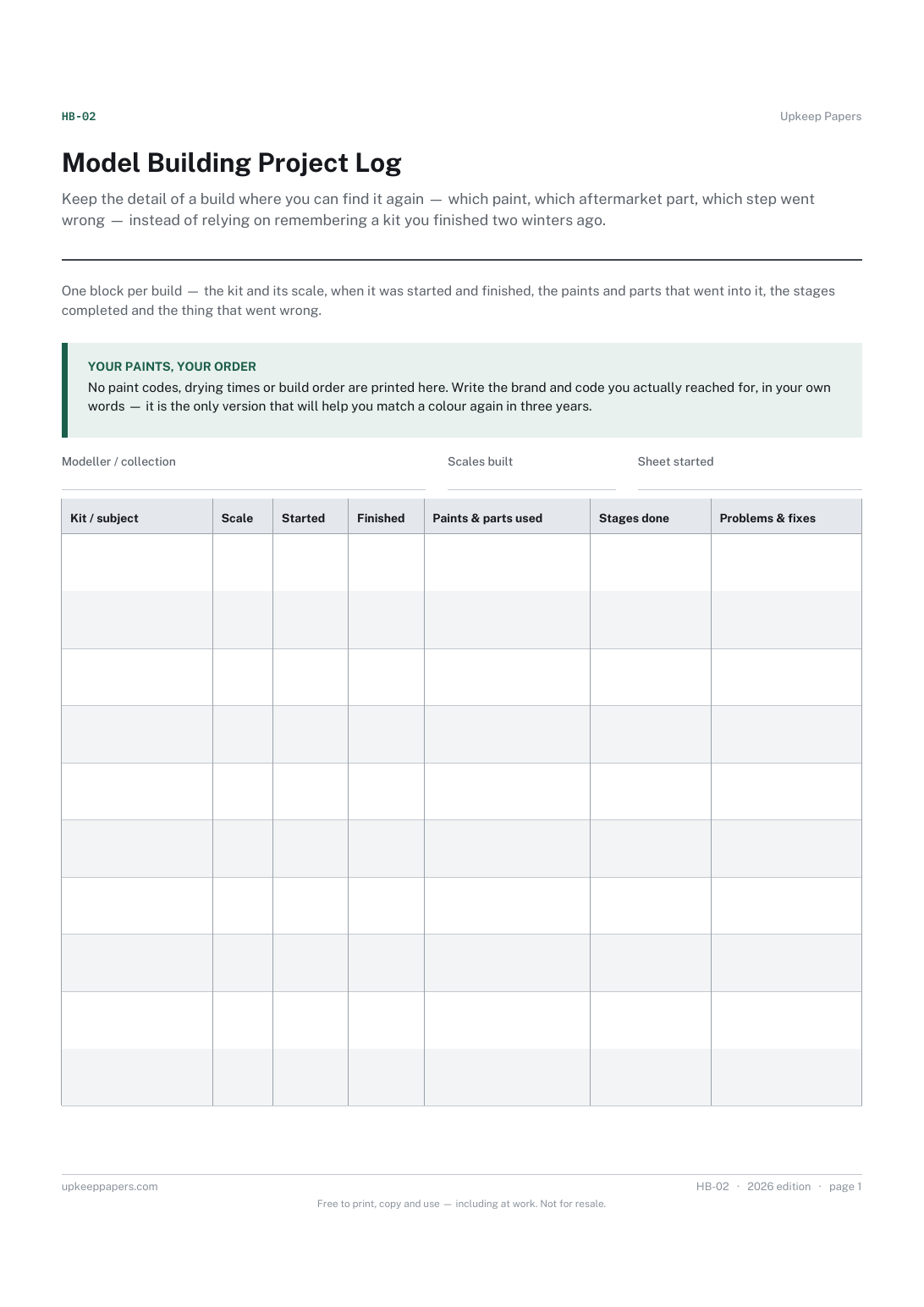
Keep the detail of a build where you can find it again — which paint, which aftermarket part, which step went wrong — instead of relying on remembering a kit you finished two winters ago.
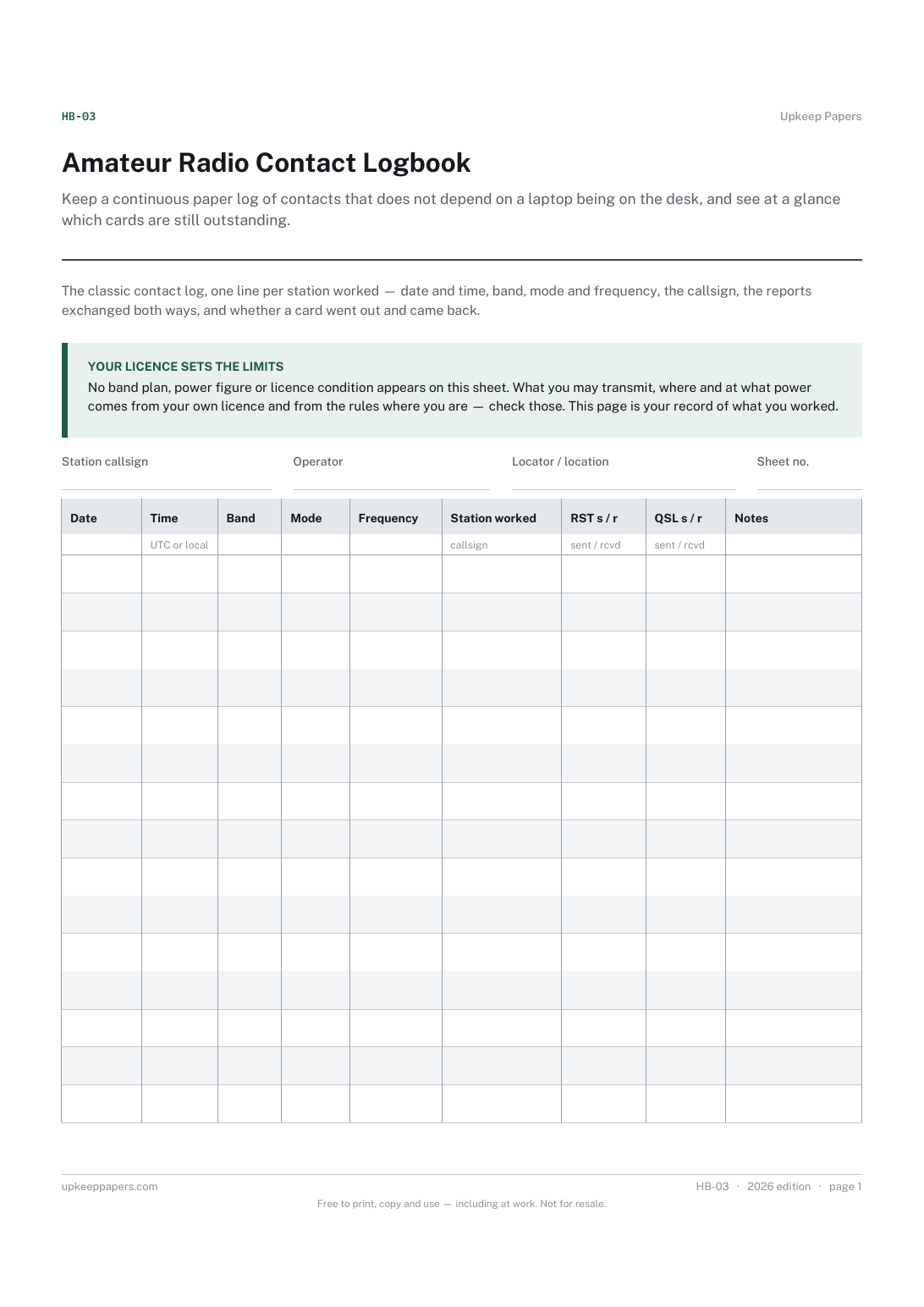
Keep a continuous paper log of contacts that does not depend on a laptop being on the desk, and see at a glance which cards are still outstanding.
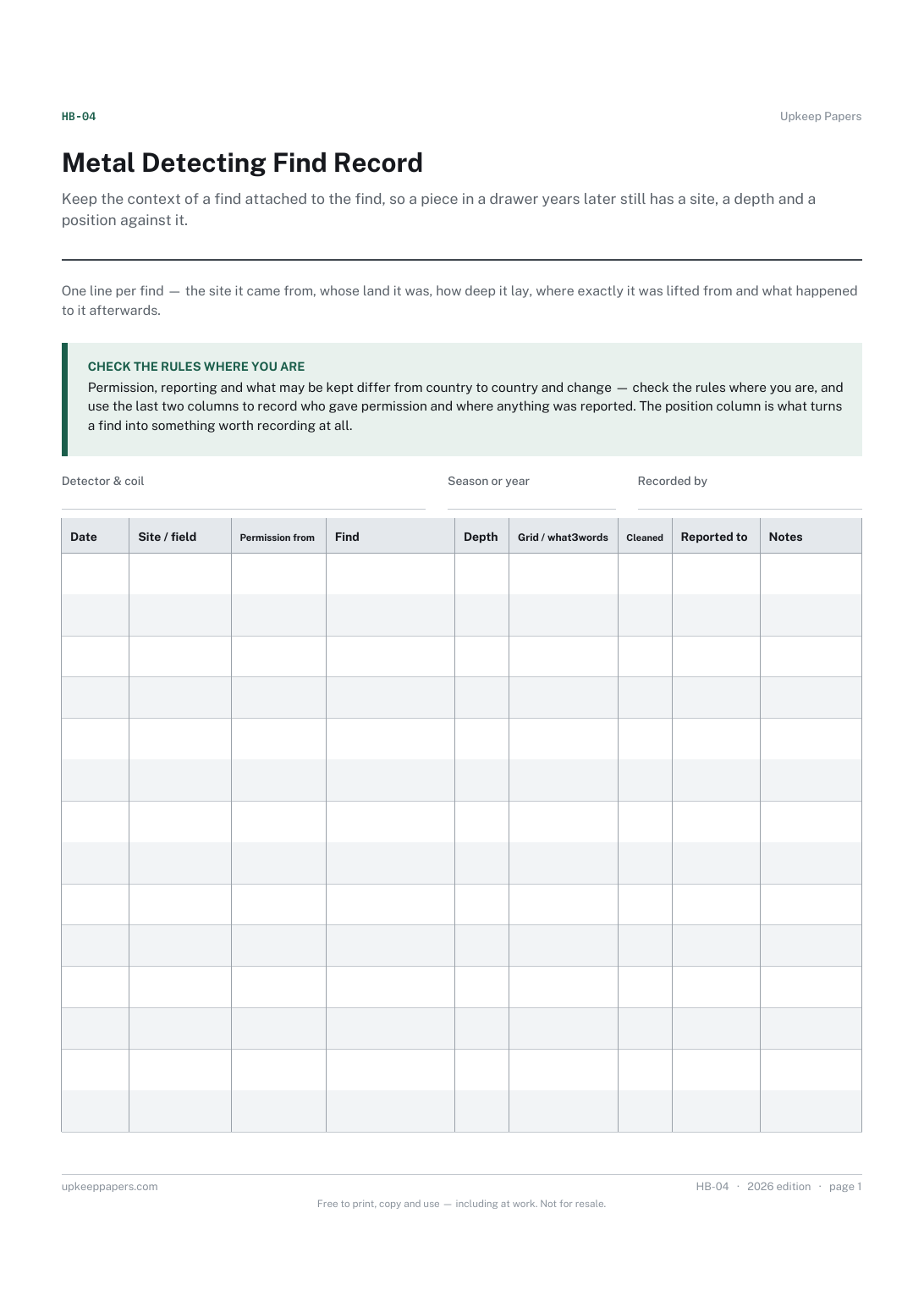
Keep the context of a find attached to the find, so a piece in a drawer years later still has a site, a depth and a position against it.
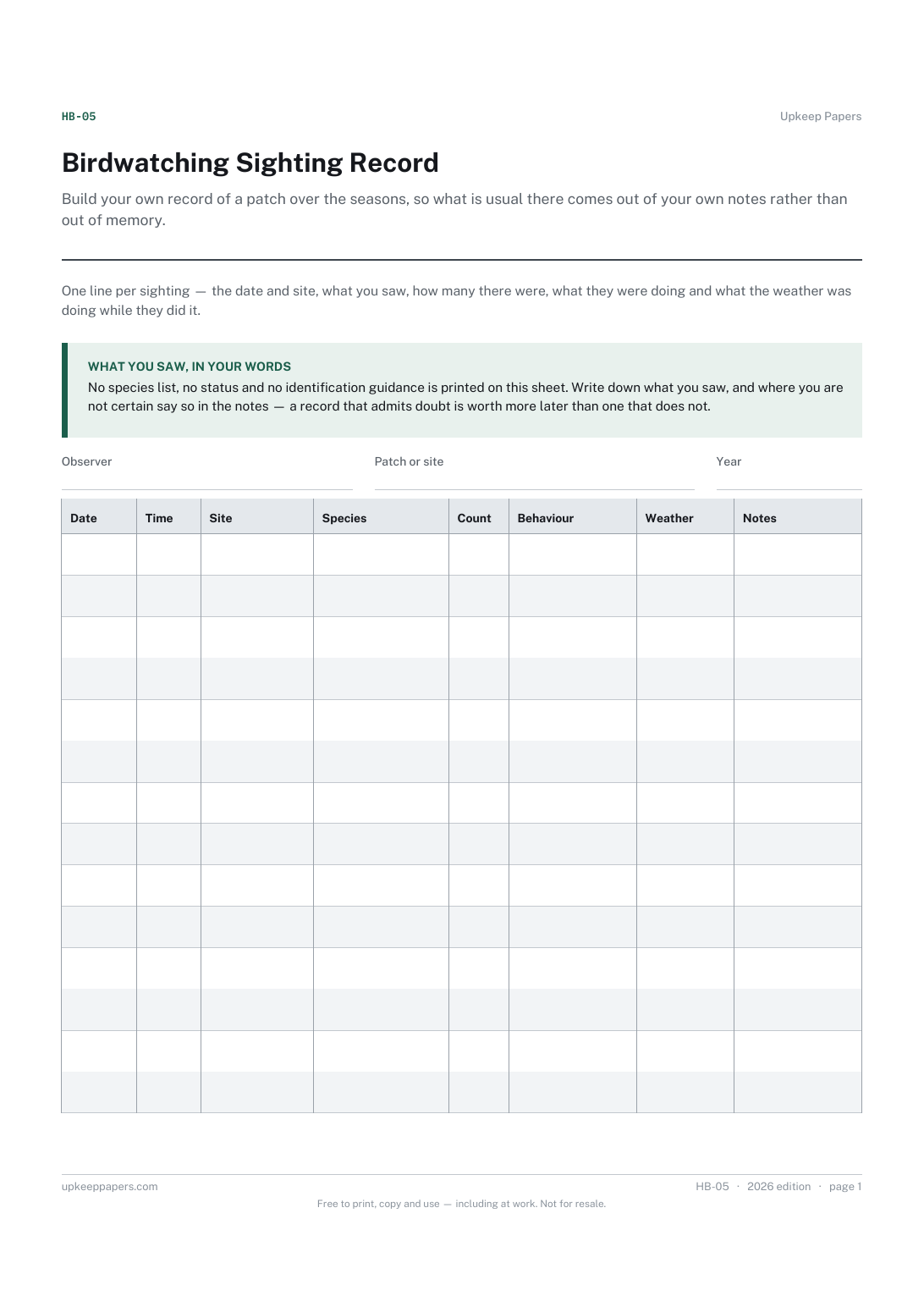
Build your own record of a patch over the seasons, so what is usual there comes out of your own notes rather than out of memory.
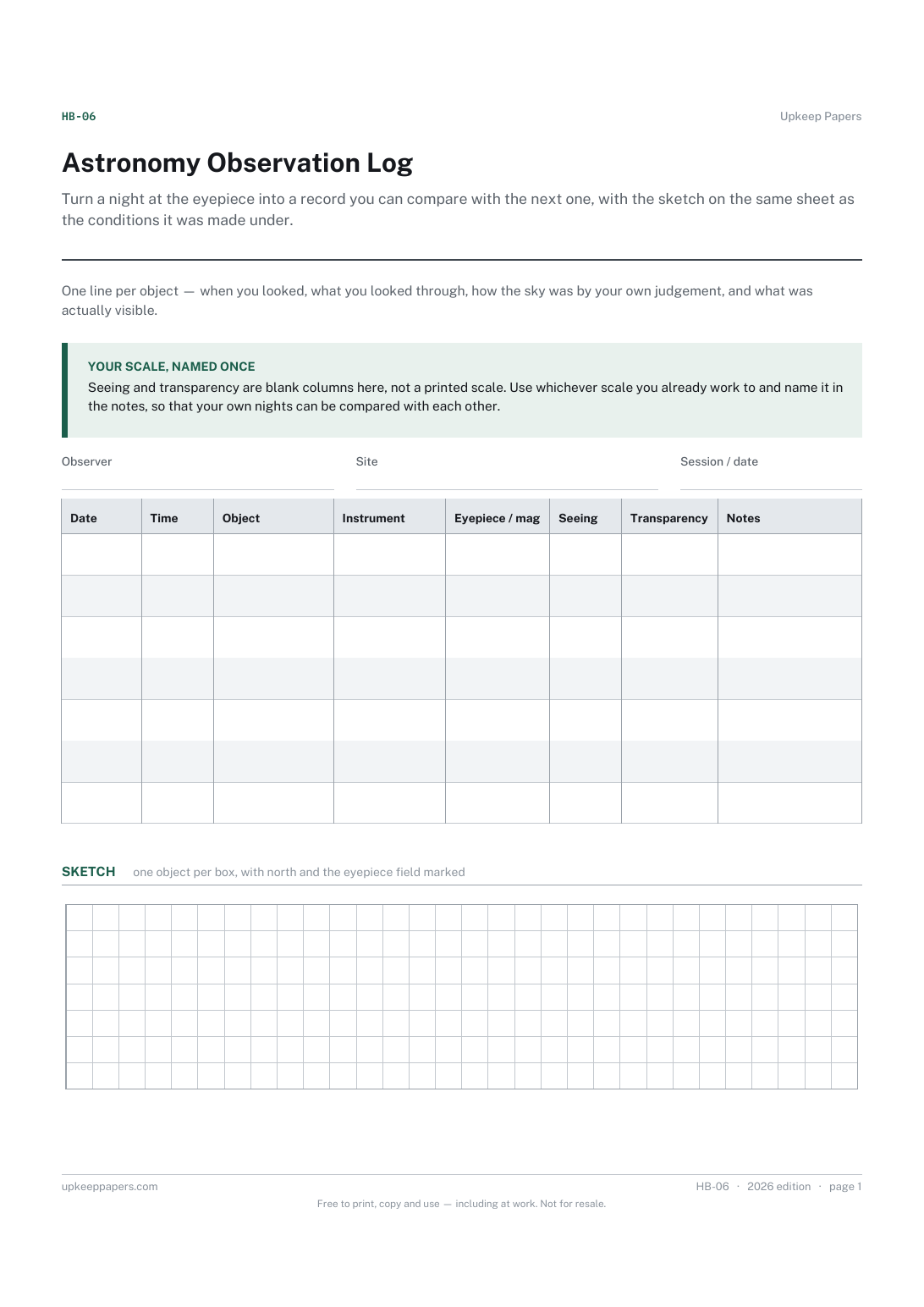
Turn a night at the eyepiece into a record you can compare with the next one, with the sketch on the same sheet as the conditions it was made under.
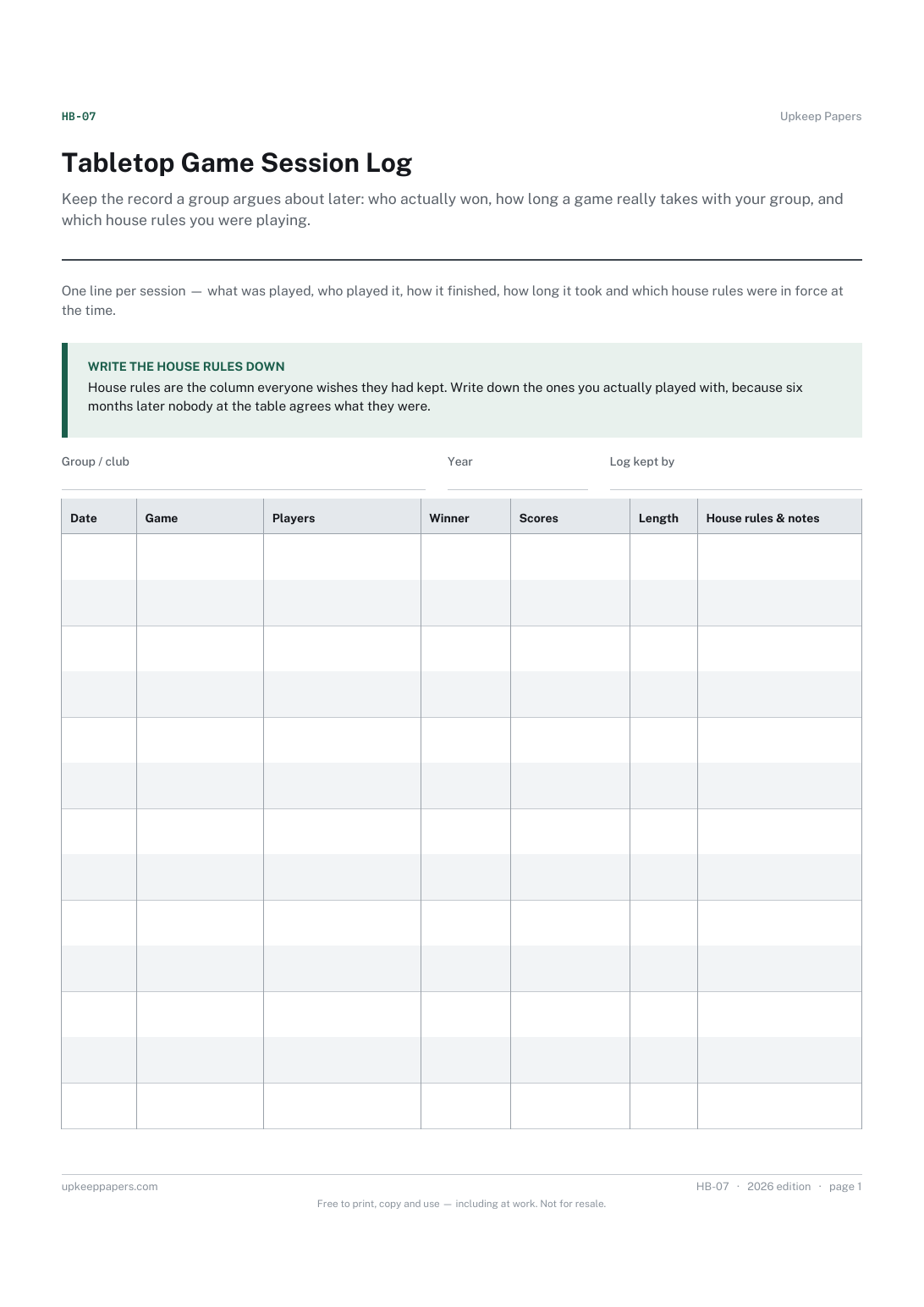
Keep the record a group argues about later: who actually won, how long a game really takes with your group, and which house rules you were playing.
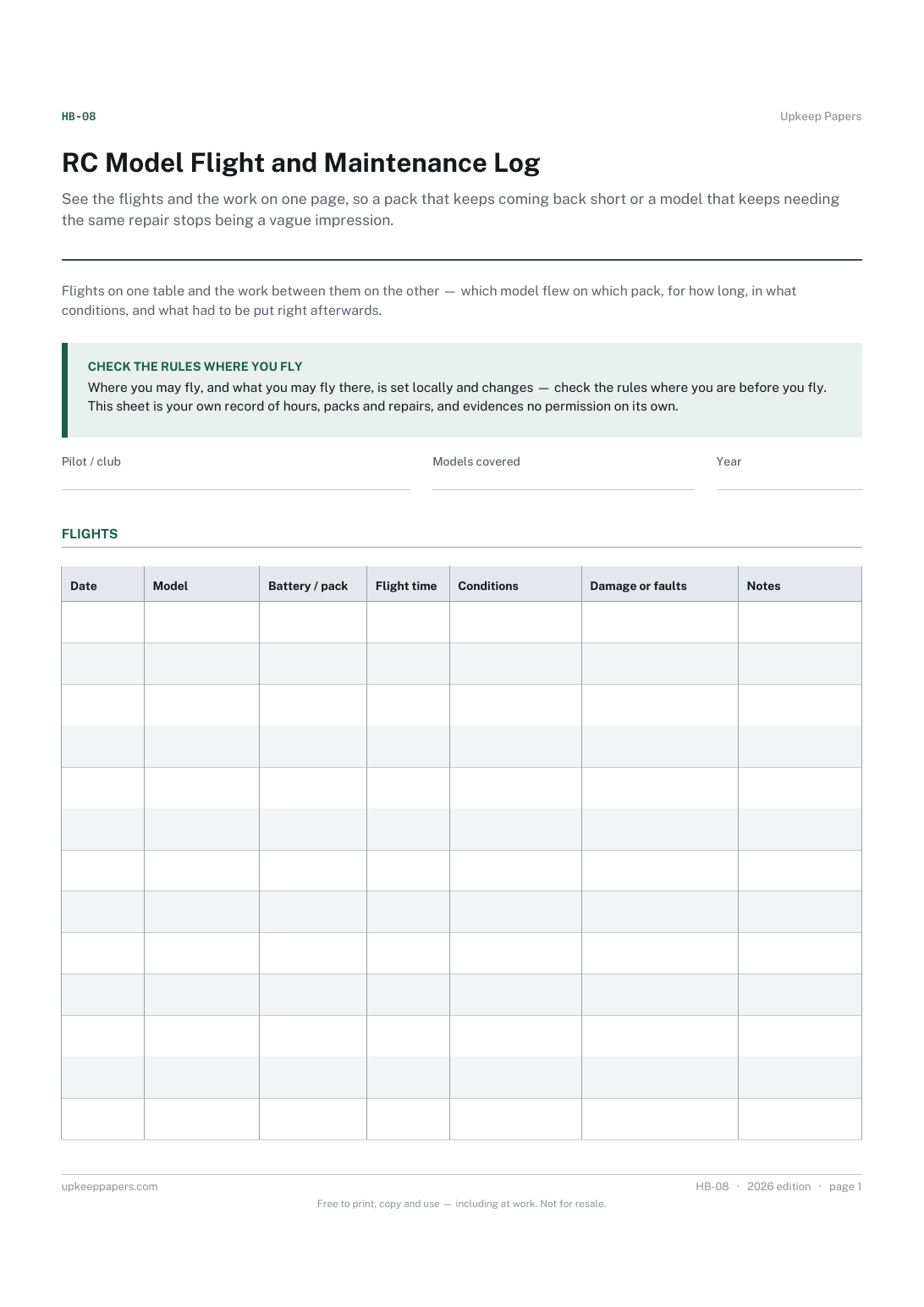
See the flights and the work on one page, so a pack that keeps coming back short or a model that keeps needing the same repair stops being a vague impression.
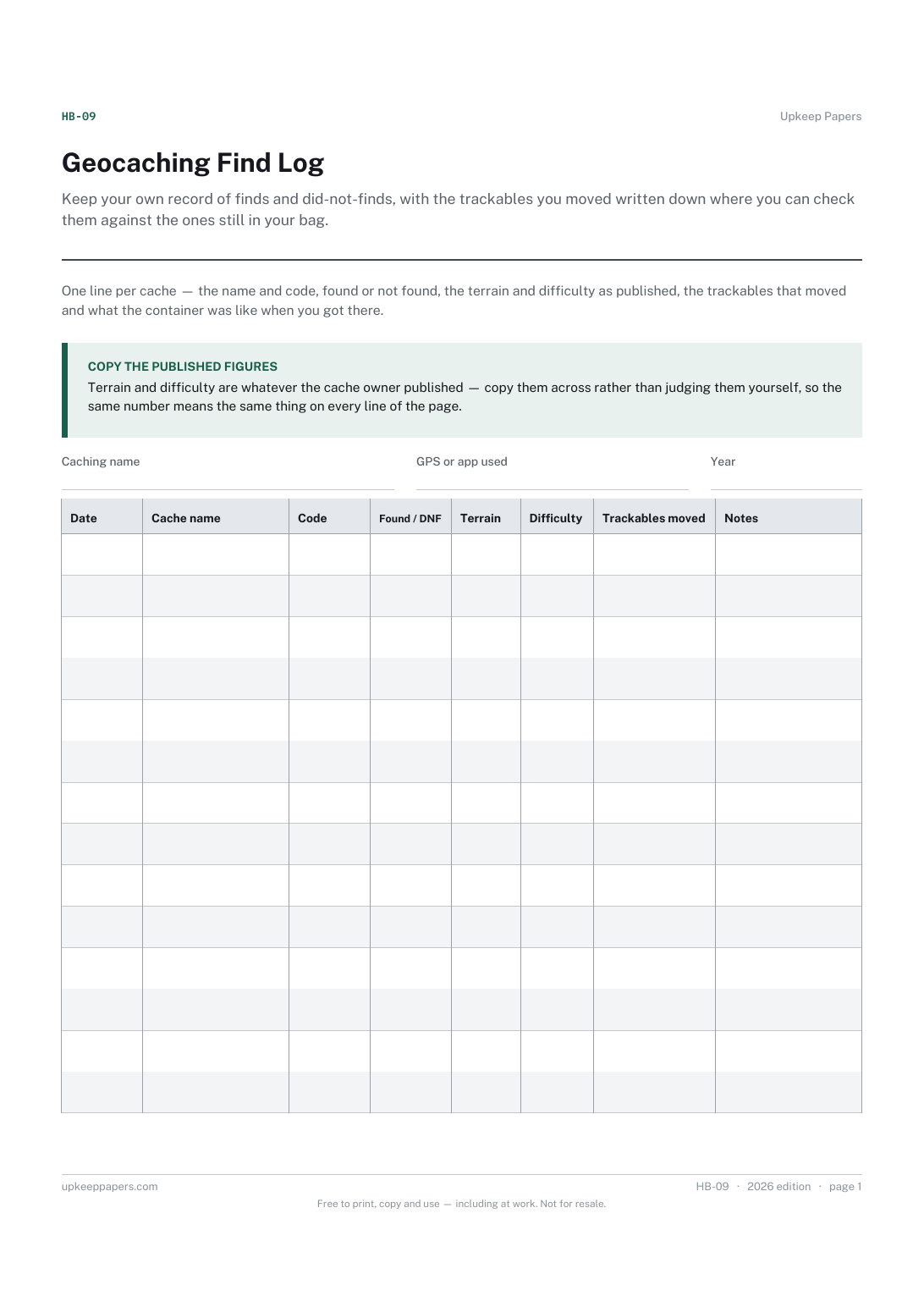
Keep your own record of finds and did-not-finds, with the trackables you moved written down where you can check them against the ones still in your bag.
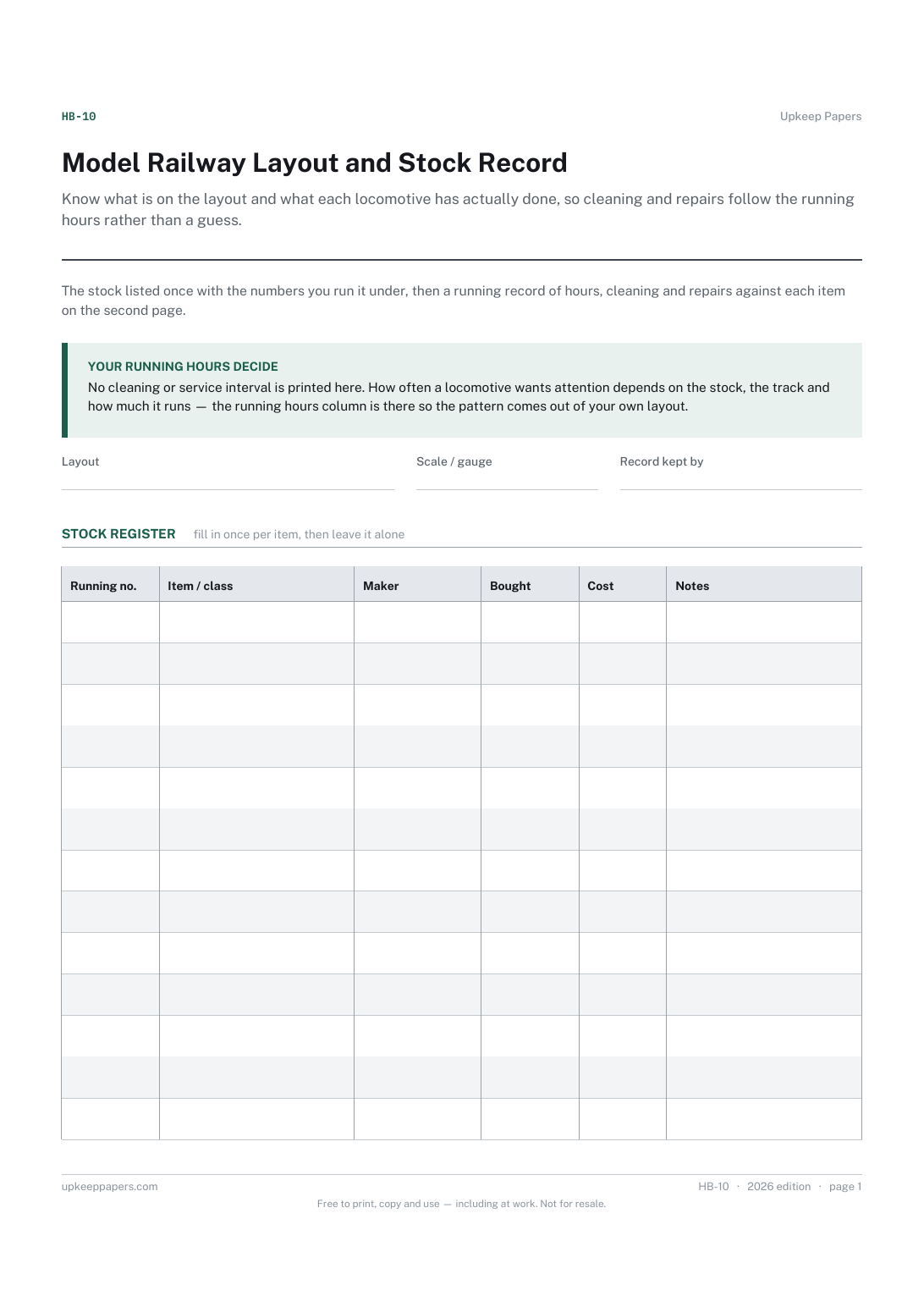
Know what is on the layout and what each locomotive has actually done, so cleaning and repairs follow the running hours rather than a guess.
Elsewhere in the library
The paperwork that covers the whole building — service history, registers, warranties and the seasonal rounds.
Heating, hot water, ventilation, drainage and water supply — the fixed systems that need servicing on a schedule.
Alarm tests, extinguisher checks and the records that prove they happened.
Mowers, saws, generators, washers, compressors and tractors — hour-based servicing and the part numbers you can never find.
Cars, motorcycles, motorhomes, trailers and boats — service history, schedules and pre-use inspections.
Pools, hot tubs and private water supplies — chemistry logs and test records.
Maintenance logs, periodic inspections and changeover checklists for let property.
Vaccination and health records, sitter instructions and the emergency details somebody else would need if you were not there.
Trailers, horseboxes, caravans and boats — annual service records, pre-use inspections and the towing figures you should never be guessing at.
Inventories, service logs and the working paperwork a small workshop, a trade or a van actually runs on.
Cleaning schedules, rotas, deep-clean checklists and the dated records a cleaning routine is supposed to leave behind.
The paperwork of changing address — moving, viewing, snagging, renovating and switching the supplies over.
Sowing plans, plot layouts, greenhouse logs, compost records and fruit tree histories — blank wherever the answer depends on where you garden.
Husbandry records for reptiles, amphibians, fish, small mammals and birds — the readings, feeds and weights that keep an animal well.
The sheet that goes out in the van: what was quoted, what was fitted, what it took and what the customer signed.
Job cards, parts, road tests and the paperwork that follows a car through a workshop from booking in to handing back.
Shifts, runs, checks and hours — for the people whose office is a vehicle.
Goods in, picked, packed, counted and despatched — the paper trail down the aisle.
Rooms turned round, guests arrived, faults reported and the shift handed over.
Prep done, tables planned, lines cleaned, waste counted and the till cashed up.
The till, the stockroom, the shelf edge and the routines that open and close the door.
Batches made, yields counted and where every ingredient came from.
Pitches let, hook-ups metered, blocks cleaned and the site walked.
What was done to whom, with what, and what they said about it last time.
The gig booked, the stage plotted, the set played and the show reported.
Firings, cuts, pours and settings — written down so the good one can be repeated.
Setup, times, tyres and fuel — the numbers that make the next session faster.
Team sheets, scorebooks, training plans and the club admin behind a fixture.
Rotas filled, halls booked, collections counted and volunteers looked after.
What kit exists, who has it, whether the backup ran and when the licence expires.
Units let, keys issued, payments tracked and loads moved.
Flock and herd records, medicine and movement books, and the application records that have to be produced when somebody asks.
Project planners, stash inventories and machine logs — for quilting, sewing, printing, modelling and selling what you make.
Shot lists, kit inventories and job records — for getting the shot, insuring the kit and finding out what the work actually pays.
Logbooks and trip plans for time spent outdoors — dives made, water paddled, rounds played.
Sheets for the hour you spend standing in front of a car you are thinking of buying, and for comparing it afterwards with the others you saw.
Inspection records for hives and colonies, built so this week's visit can be read against the last three.
Due-date charts and care records for horses and ponies, with the intervals left blank for the ones your own farrier, vet and dentist give you.
Visitor sign-in pages and key registers — who is in the building, who let them in, and what has not come back.
Per-fill fuel and cost records, kept unit-neutral so the same sheet works wherever you buy fuel and whatever your odometer reads in.
Kit checks, expiry dates and restocking — dated on paper and signed by whoever actually did them.
What is on the shelf, how much of it you want there, and what needs reordering before the recipe stops.
What seed you actually have, whether it still germinates, and what the plot really produced.
The dated, initialled rounds that show a space was actually attended to rather than merely meant to be.
Session logs and equipment records for training — what you did, and what your kit has done.
Itemised records for collections and valuables — what you own, what it cost, and what can be evidenced about it.
The paperwork a committee, a small office or a one-person project runs on — minutes, agendas, actions, decisions, risks and issues.
The money paperwork a one-person business runs on — invoices, estimates, receipts, orders, price lists and the sheets that show what a job really cost.
The records a small employer actually needs: hours, leave, rotas, reviews, training and the two checklists that make starting and leaving orderly.
Permits, method statements, diaries and inspection registers for building sites, yards and anywhere work is done under control.
Blank sheets for a classroom, a tutor, a club or an evening's babysitting — registers, marks, seating, reading and trips.
The paperwork a sports club, a society or a village hall committee runs on — members, subs, kit, duties, scores and fixtures.
Sheets with no subject at all — blank logs, blank checklists, tally sheets and report forms you head yourself.
Records for a working kitchen — what a dish costs, what was made from which batch, what was checked, cleaned and thrown away.
Two sheets for going somewhere: a packing list you write once and reuse, and a road trip planned day by day.

Every sheet, binder, game and puzzle on Upkeep Papers is free to download, with no email and no account. Making them is not free: each one takes days of research, design and checking, and the site costs money to run. If something here saved you time, you can buy us a coffee. It is entirely optional: nothing is locked, and nothing changes if you don’t.
Buy us a coffee Opens PayPal in a new tab. Any amount, and nothing changes if you would rather not.