Car Setup Sheet
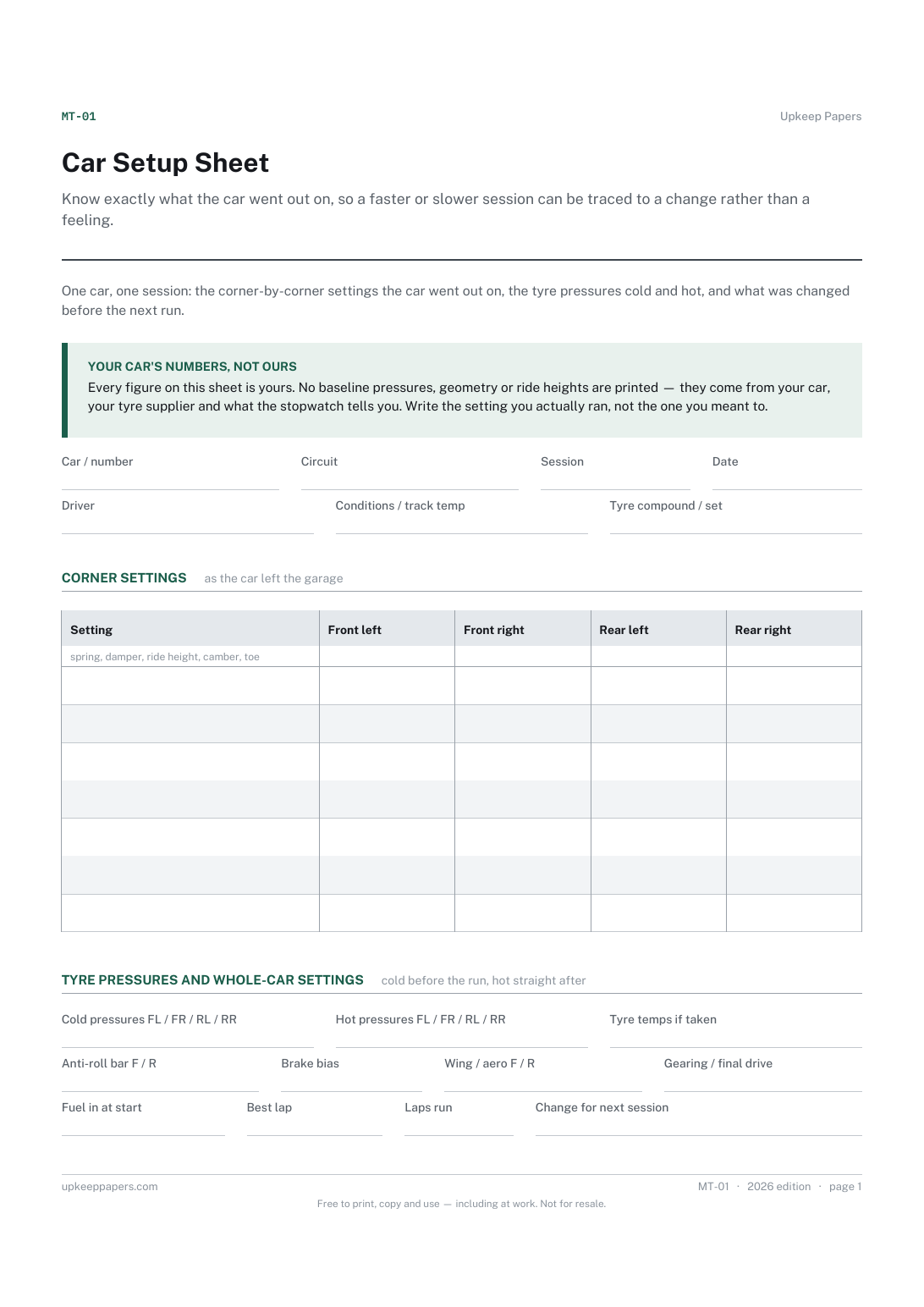
Know exactly what the car went out on, so a faster or slower session can be traced to a change rather than a feeling.
MT-01 1 page
Everything here is free. Making it takes time and money. Everything here is free.
 Buy us a coffee
Motorsport and track days · MT-08
A race fuel calculation sheet — fuel in, added, left and used per session with laps run, so consumption per lap is measured and the next load worked from it.
One page. Choose your paper size — both versions are laid out identically, so neither one gets shrunk to fit.
Print it and write on it
Fill it in type and save
The fillable versions have real form fields — open them in any PDF reader, type into them and save. Printing help.
Replace a guessed fuel load with a measured one, so the car neither runs dry on the last lap nor carries weight it does not need.
Club racers, endurance and sprint teams, and track-day drivers who want to know what the car actually uses on a given circuit.
One page, top to bottom:
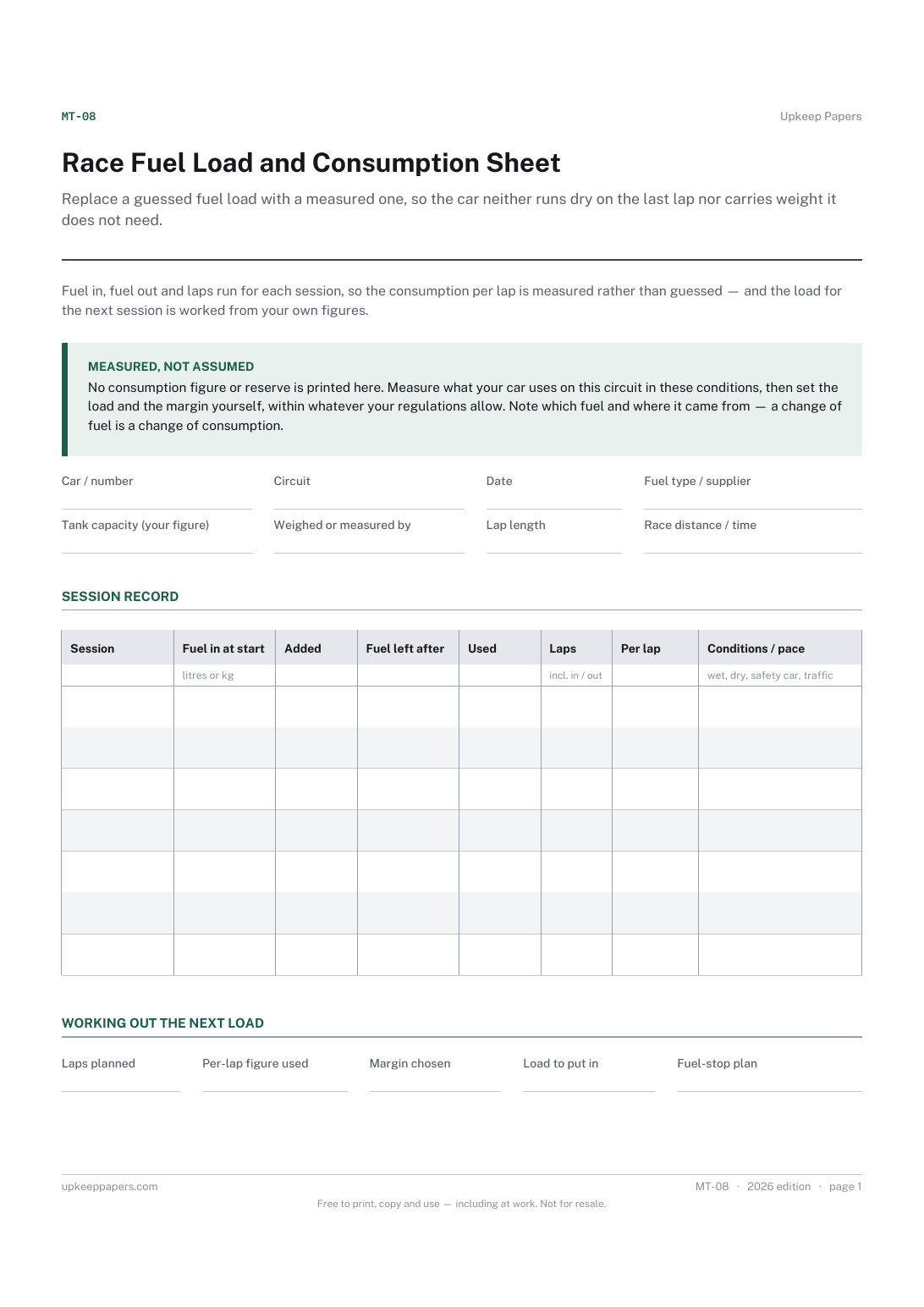
Printed under the title: Fuel in, fuel out and laps run for each session, so the consumption per lap is measured rather than guessed — and the load for the next session is worked from your own figures.
Measured, not assumed. No consumption figure or reserve is printed here. Measure what your car uses on this circuit in these conditions, then set the load and the margin yourself, within whatever your regulations allow. Note which fuel and where it came from — a change of fuel is a change of consumption.
Write-on lines: Car / number · Circuit · Date · Fuel type / supplier · Tank capacity (your figure) · Weighed or measured by · Lap length · Race distance / time
Table, 7 rows: Session · Fuel in at start · Added · Fuel left after · Used · Laps · Per lap · Conditions / pace
Write-on lines: Laps planned · Per-lap figure used · Margin chosen · Load to put in · Fuel-stop plan
Because consumption depends on the engine, the circuit, the driver and the weather, and a reserve is a judgement about risk that only you can make within your regulations. Measure, then decide.
Whichever you can measure accurately with the equipment you have. Be consistent on one sheet, and if your regulations set a limit in one unit, work in that unit.
Know exactly what the car went out on, so a faster or slower session can be traced to a change rather than a feeling.
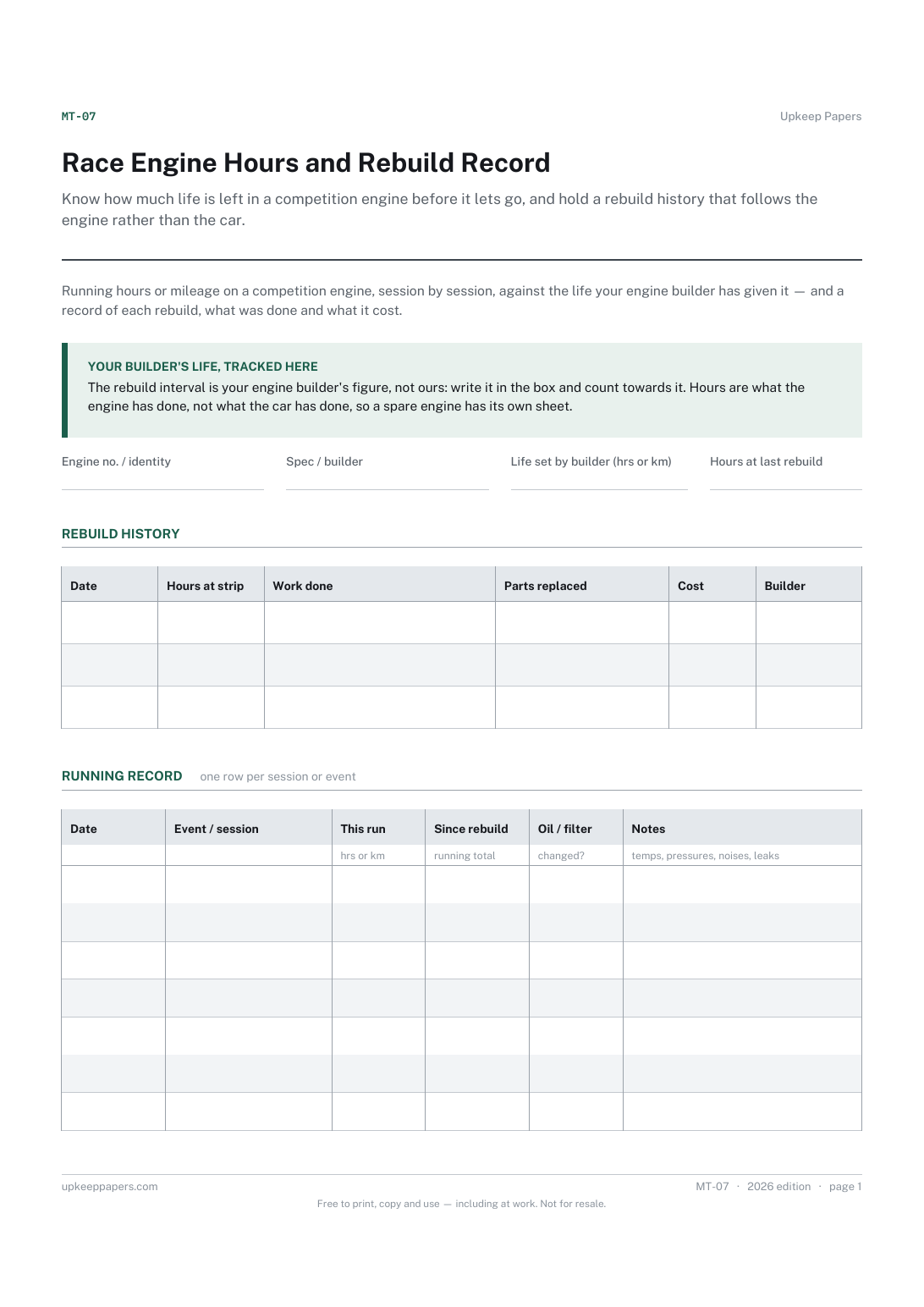
Know how much life is left in a competition engine before it lets go, and hold a rebuild history that follows the engine rather than the car.
See what a vehicle actually costs to run and spot a change in fuel consumption early, which is often the first sign that something mechanical is wrong.
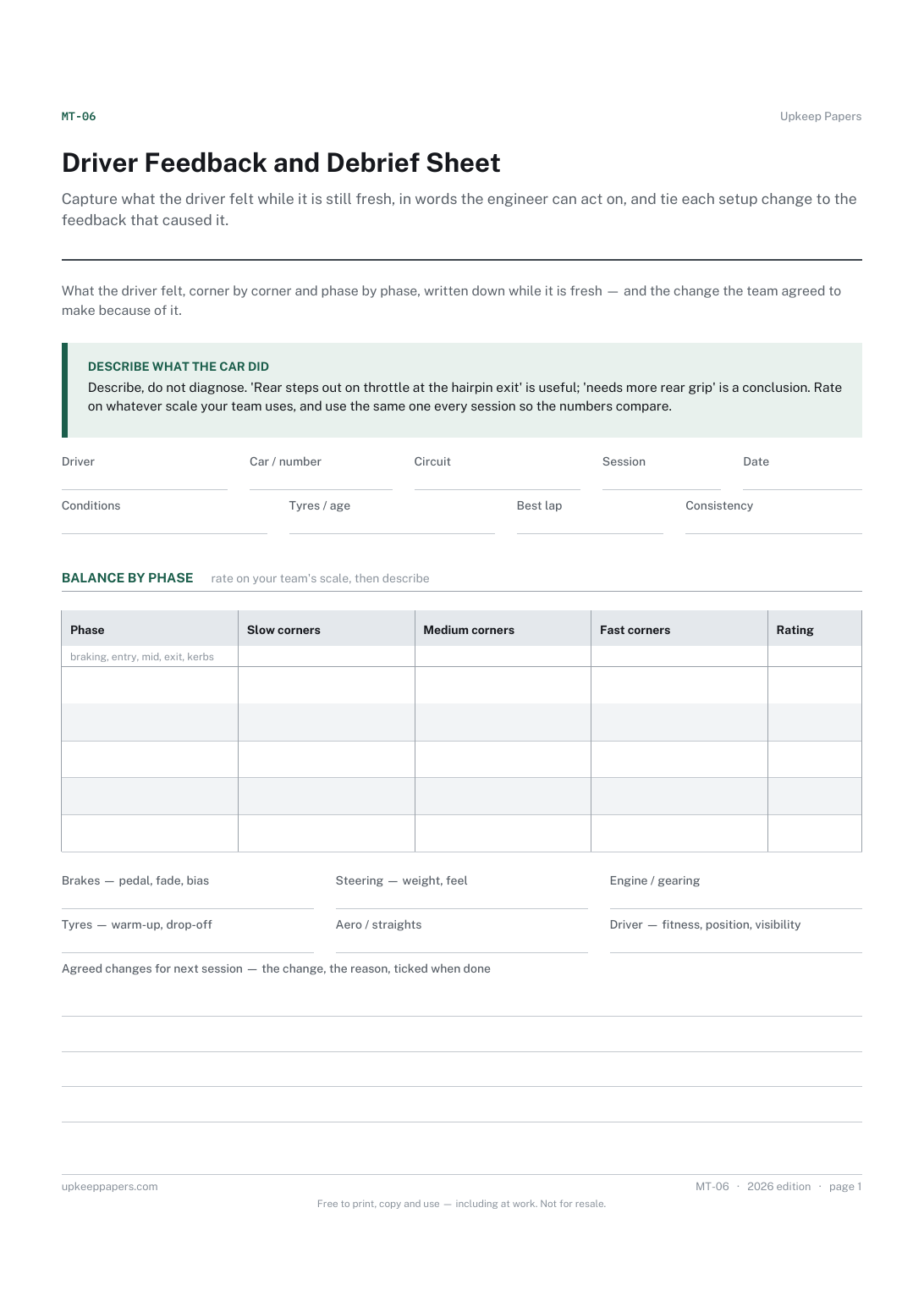
Capture what the driver felt while it is still fresh, in words the engineer can act on, and tie each setup change to the feedback that caused it.

Every sheet, binder, game and puzzle on Upkeep Papers is free to download, with no email and no account. Making them is not free: each one takes days of research, design and checking, and the site costs money to run. If something here saved you time, you can buy us a coffee. It is entirely optional: nothing is locked, and nothing changes if you don’t.
Buy us a coffee Opens PayPal in a new tab. Any amount, and nothing changes if you would rather not.