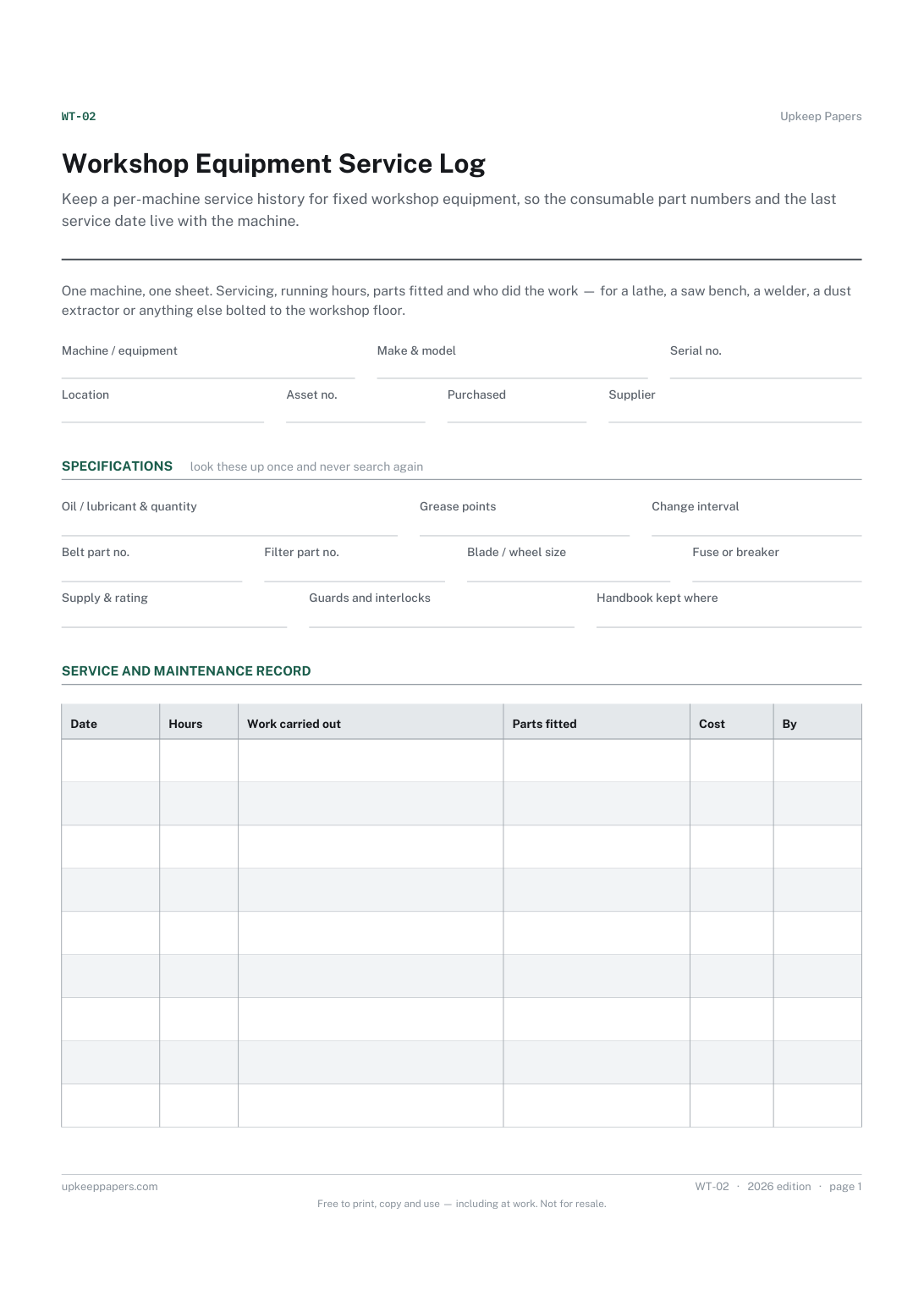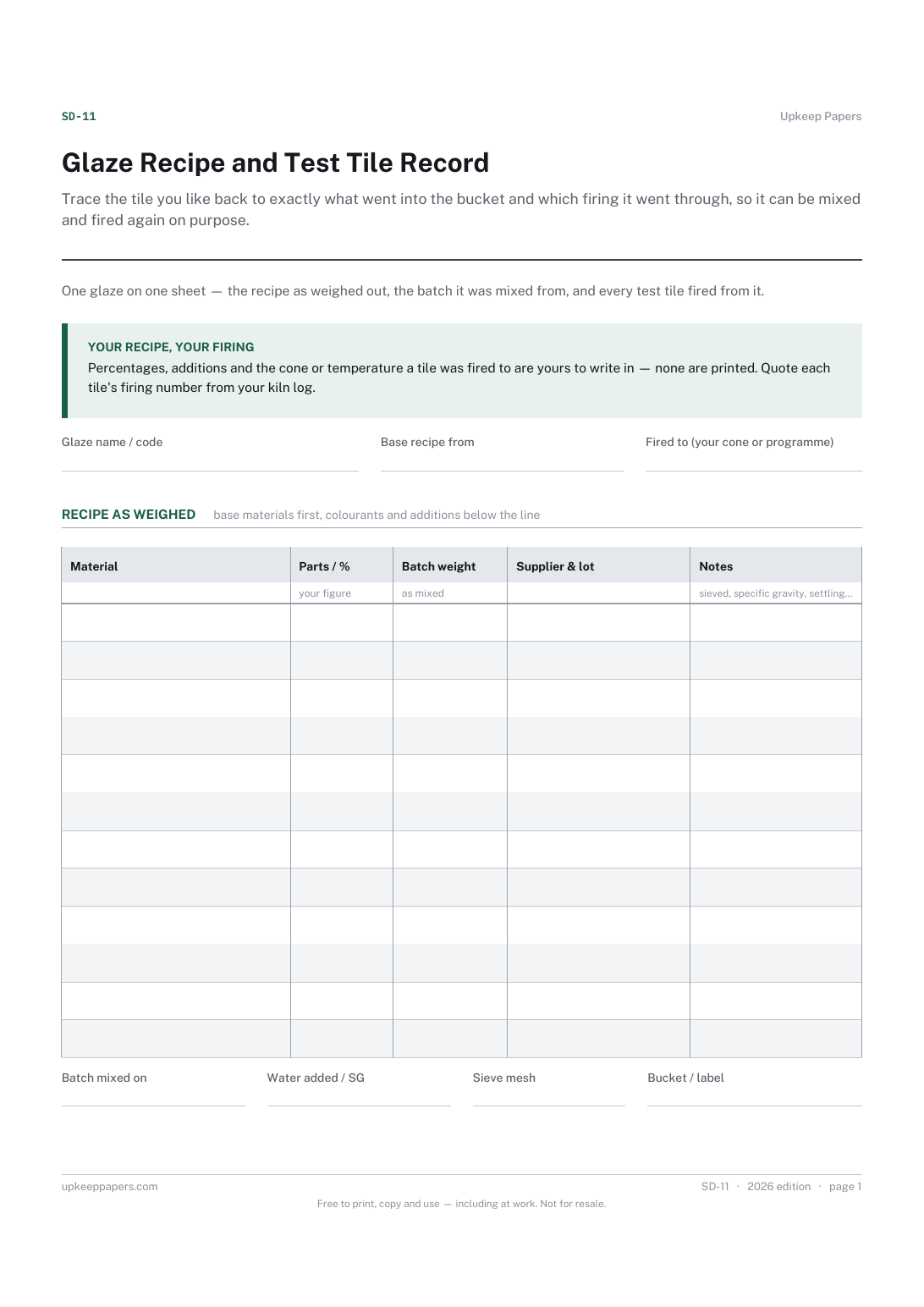
Glaze Recipe and Test Tile Record
Trace the tile you like back to exactly what went into the bucket and which firing it went through, so it can be mixed and fired again on purpose.
SD-11 2 pages
Everything here is free. Making it takes time and money. Everything here is free.
 Buy us a coffee
Studio crafts and making · SD-17
A free printable kiln firing log sheet — one firing per page with the load, the schedule as set, readings as it ran, the witness cones and what came out.
2 pages. Choose your paper size — both versions are laid out identically, so neither one gets shrunk to fit.
Print it and write on it
Fill it in type and save
The fillable versions have real form fields — open them in any PDF reader, type into them and save. Printing help.
Give every firing a number and a record, so a good result can be repeated and a bad one explained instead of guessed at.
Potters, ceramicists, glass makers and shared studios with an electric, gas or wood kiln — anyone who has ever opened a kiln and wondered what was different.
2 pages, in this order:
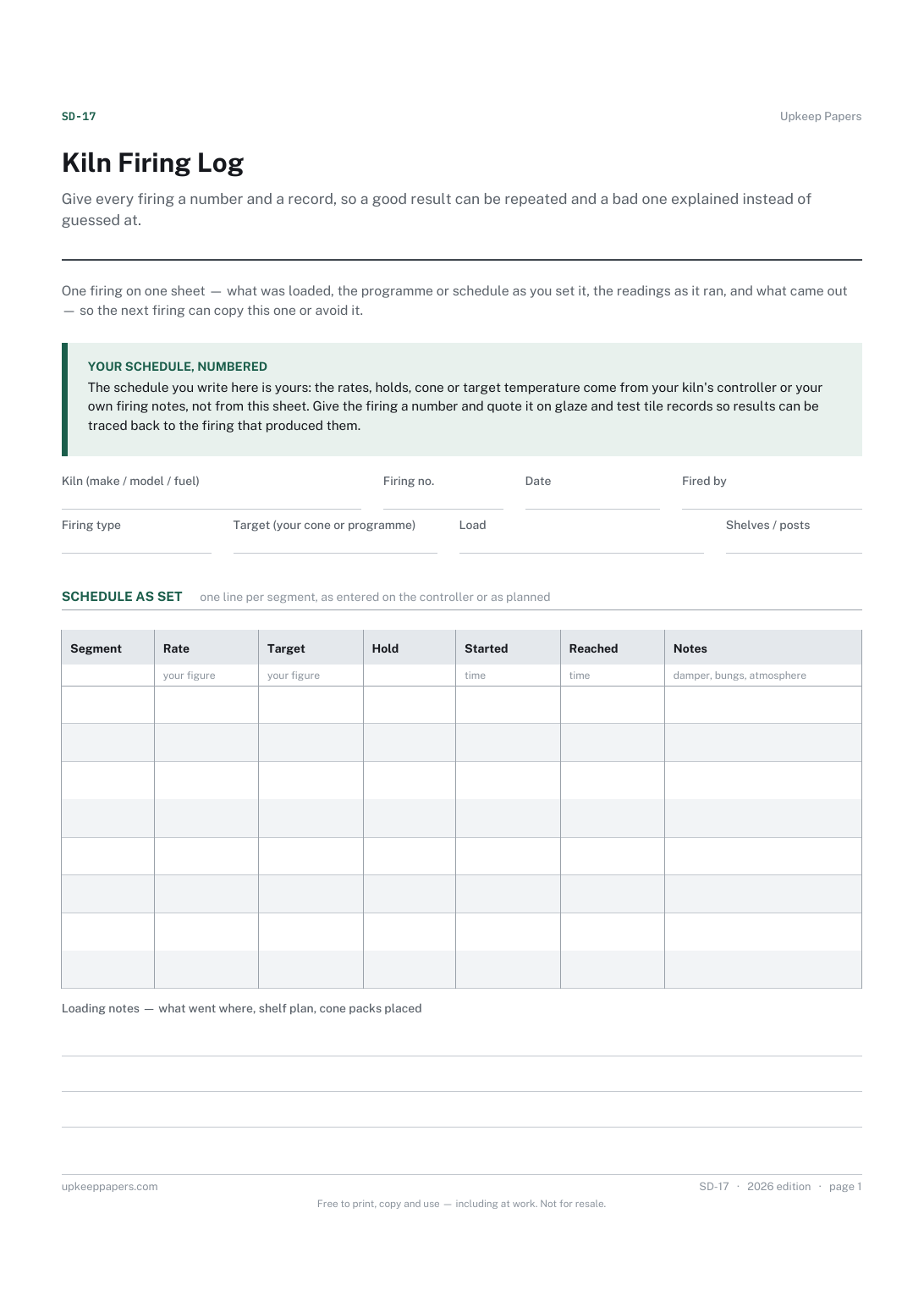
Printed under the title: One firing on one sheet — what was loaded, the programme or schedule as you set it, the readings as it ran, and what came out — so the next firing can copy this one or avoid it.
Your schedule, numbered. The schedule you write here is yours: the rates, holds, cone or target temperature come from your kiln's controller or your own firing notes, not from this sheet. Give the firing a number and quote it on glaze and test tile records so results can be traced back to the firing that produced them.
Write-on lines: Kiln (make / model / fuel) · Firing no. · Date · Fired by · Firing type · Target (your cone or programme) · Load · Shelves / posts
Table, 8 rows: Segment · Rate · Target · Hold · Started · Reached · Notes
Ruled lines: Loading notes — what went where, shelf plan, cone packs placed
Table, 18 rows: Time · Reading · Cones / colour seen · Atmosphere / damper · Action taken
Write-on lines: Unloaded · Cones (top / mid / bottom) · Results · Faults · Kiln wear noted · Repeat?
Because a schedule belongs to a kiln, a clay body and a glaze, not to a form, and a printed one would be wrong for most readers. Your controller, your supplier's guidance for your clay and your own results are the source; the sheet gives them a place to be written down.
Yes — the readings table has a column for atmosphere and damper, and the schedule table works as a plan rather than a programme. Use the notes column for stoking or burner changes.
Trace the tile you like back to exactly what went into the bucket and which firing it went through, so it can be mixed and fired again on purpose.
Make a batch traceable, so a good one can be repeated and a bad one can be traced back to what went into it.
Record the settings that produced each print, so a good result can be repeated and a failed one diagnosed instead of guessed at.
Keep a per-machine service history for fixed workshop equipment, so the consumable part numbers and the last service date live with the machine.

Every sheet, binder, game and puzzle on Upkeep Papers is free to download, with no email and no account. Making them is not free: each one takes days of research, design and checking, and the site costs money to run. If something here saved you time, you can buy us a coffee. It is entirely optional: nothing is locked, and nothing changes if you don’t.
Buy us a coffee Opens PayPal in a new tab. Any amount, and nothing changes if you would rather not.