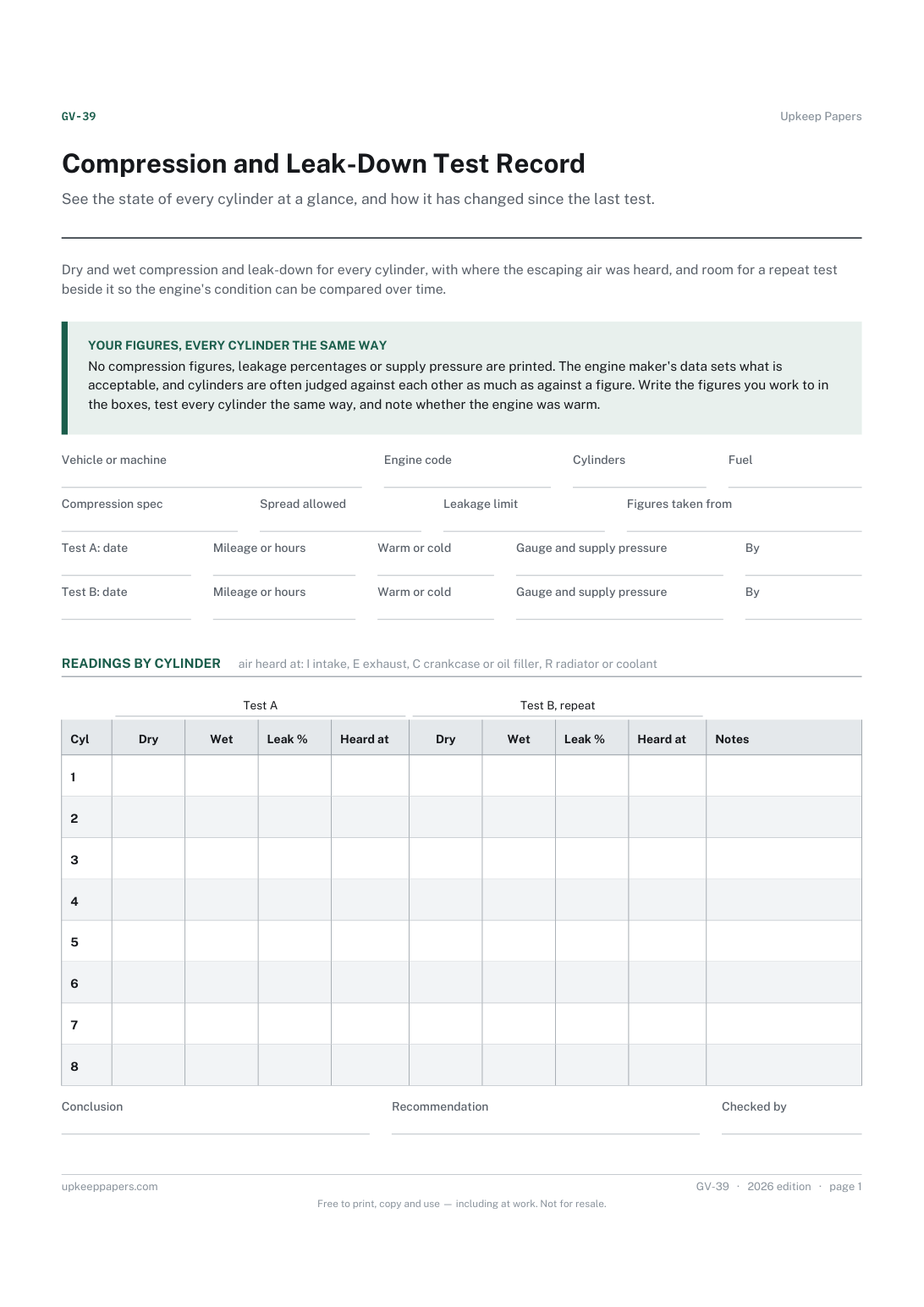
Compression and Leak-Down Test Record
See the state of every cylinder at a glance, and how it has changed since the last test. A low reading means more once you know where the air is escaping.
GV-39 1 page
Everything here is free. Making it takes time and money. Everything here is free.
 Buy us a coffee
Garage and vehicle workshop · GV-40
A free printable engine rebuild measurement sheet: bores, pistons, ring gaps, journals, bearing clearances, end float and deck height against your own spec.
2 pages. Choose your paper size — both versions are laid out identically, so neither one gets shrunk to fit.
Print it and write on it
Fill it in type and save
The fillable versions have real form fields — open them in any PDF reader, type into them and save. Printing help.
Keep every measurement from an engine rebuild on one sheet, against the spec you built to. The figures are the proof the engine was built right, and the starting point if it ever comes apart again.
Engine builders, machine shops, restorers and home mechanics rebuilding a car, motorcycle or marine engine.
2 pages, in this order:
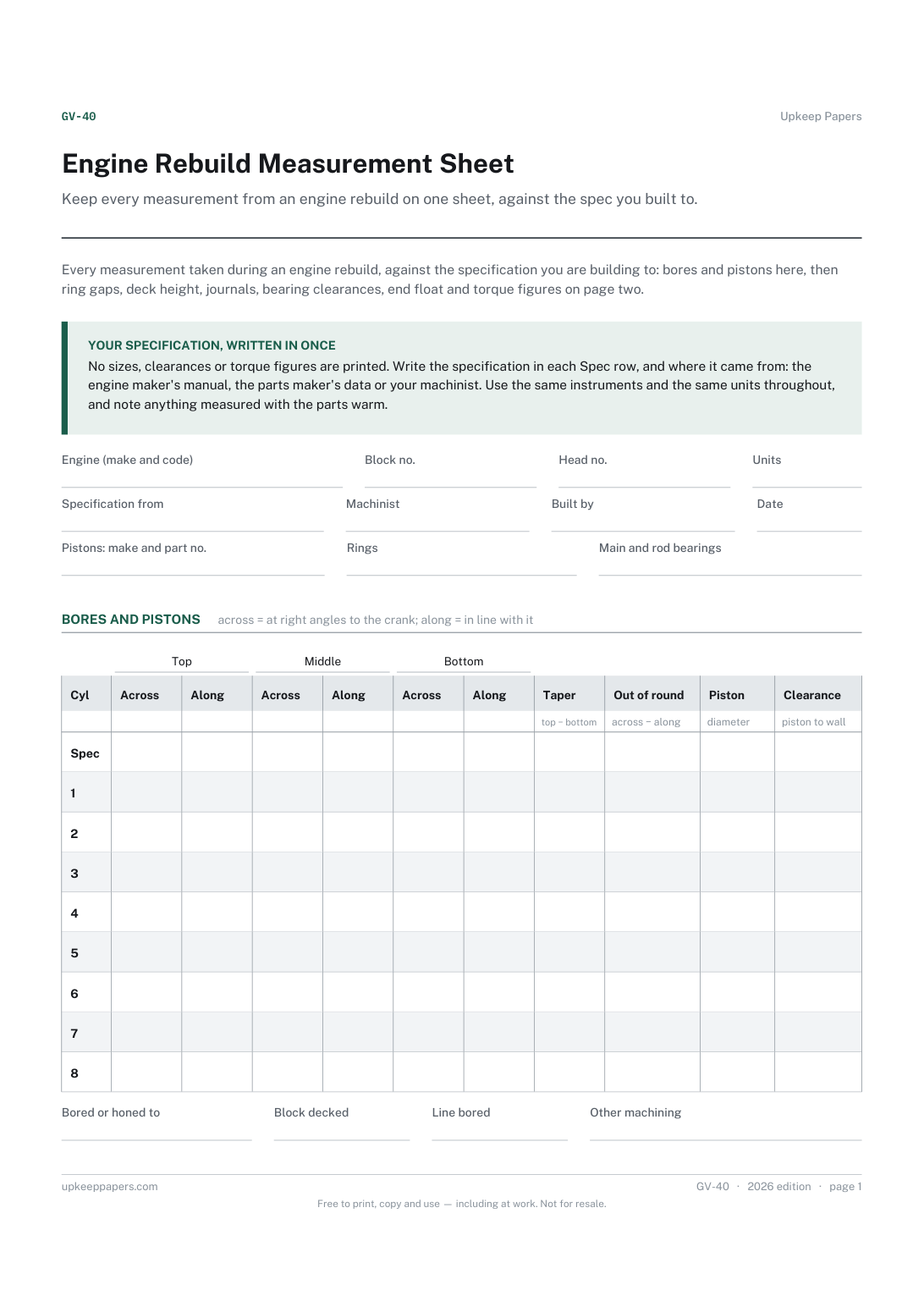
Printed under the title: Every measurement taken during an engine rebuild, against the specification you are building to: bores and pistons here, then ring gaps, deck height, journals, bearing clearances, end float and torque figures on page two.
Your specification, written in once. No sizes, clearances or torque figures are printed. Write the specification in each Spec row, and where it came from: the engine maker's manual, the parts maker's data or your machinist. Use the same instruments and the same units throughout, and note anything measured with the parts warm.
Write-on lines: Engine (make and code) · Block no. · Head no. · Units · Specification from · Machinist · Built by · Date · Pistons: make and part no. · Rings · Main and rod bearings
Also printed: Top · Middle · Bottom · Cyl · Across · Along · Taper · Out of round · Piston · Clearance · top − bottom · across − along · diameter · piston to wall · Spec
Write-on lines: Bored or honed to · Block decked · Line bored · Other machining
Also printed: Ring gaps · Valve to piston · Cyl · Top · Second · Oil rail · Rod side · Deck height · Inlet · Exhaust · Notes · clearance · Spec
Also printed: Main · Journal · Bearing bore · Clearance · Spec · Rod
Write-on lines: Crank end float: spec · Measured · Clearances measured with · Torque used: mains · Rods · Head · Figures from · Measured by · Checked by · Date
Every engine has its own sizes and clearances, and a performance build may use different ones from the maker's. Write the specification you are building to, and where it came from, so anyone reading the sheet later knows what it was judged against.
The tables have eight lines per cylinder and journal, which covers most engines. For more, use a second copy for the remaining cylinders and note it on both.
See the state of every cylinder at a glance, and how it has changed since the last test. A low reading means more once you know where the air is escaping.
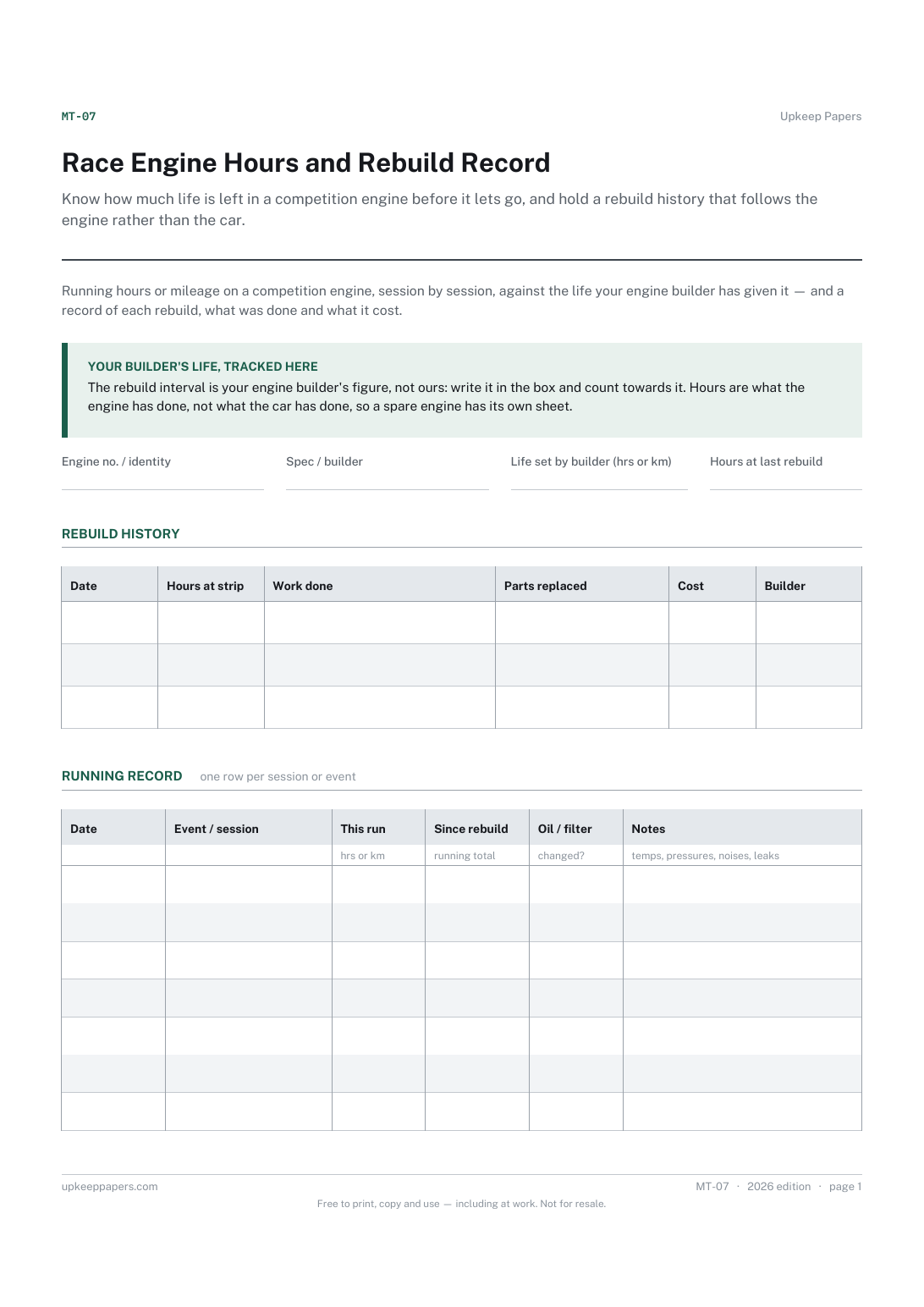
Know how much life is left in a competition engine before it lets go, and hold a rebuild history that follows the engine rather than the car.
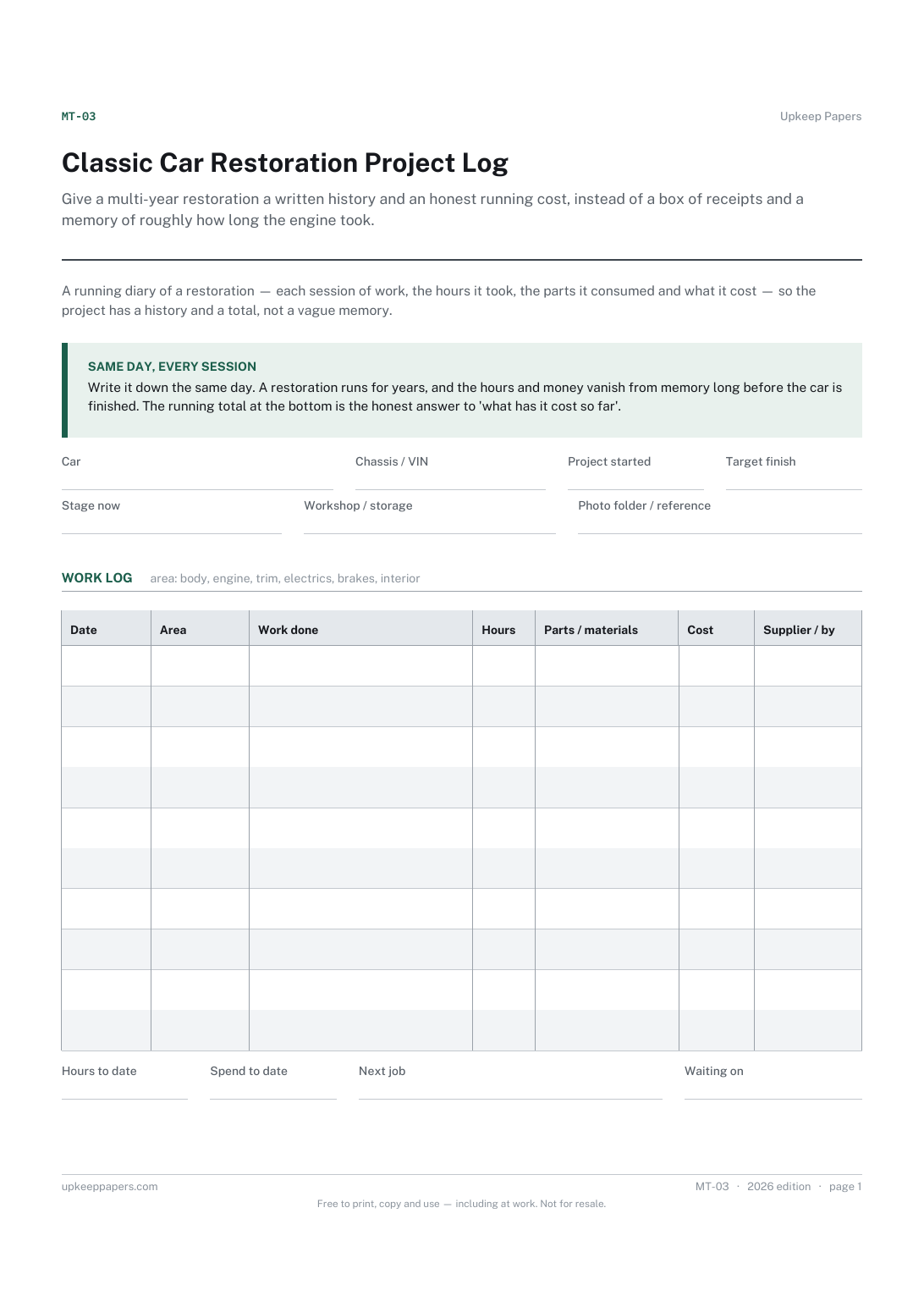
Give a multi-year restoration a written history and an honest running cost, instead of a box of receipts and a memory of roughly how long the engine took.
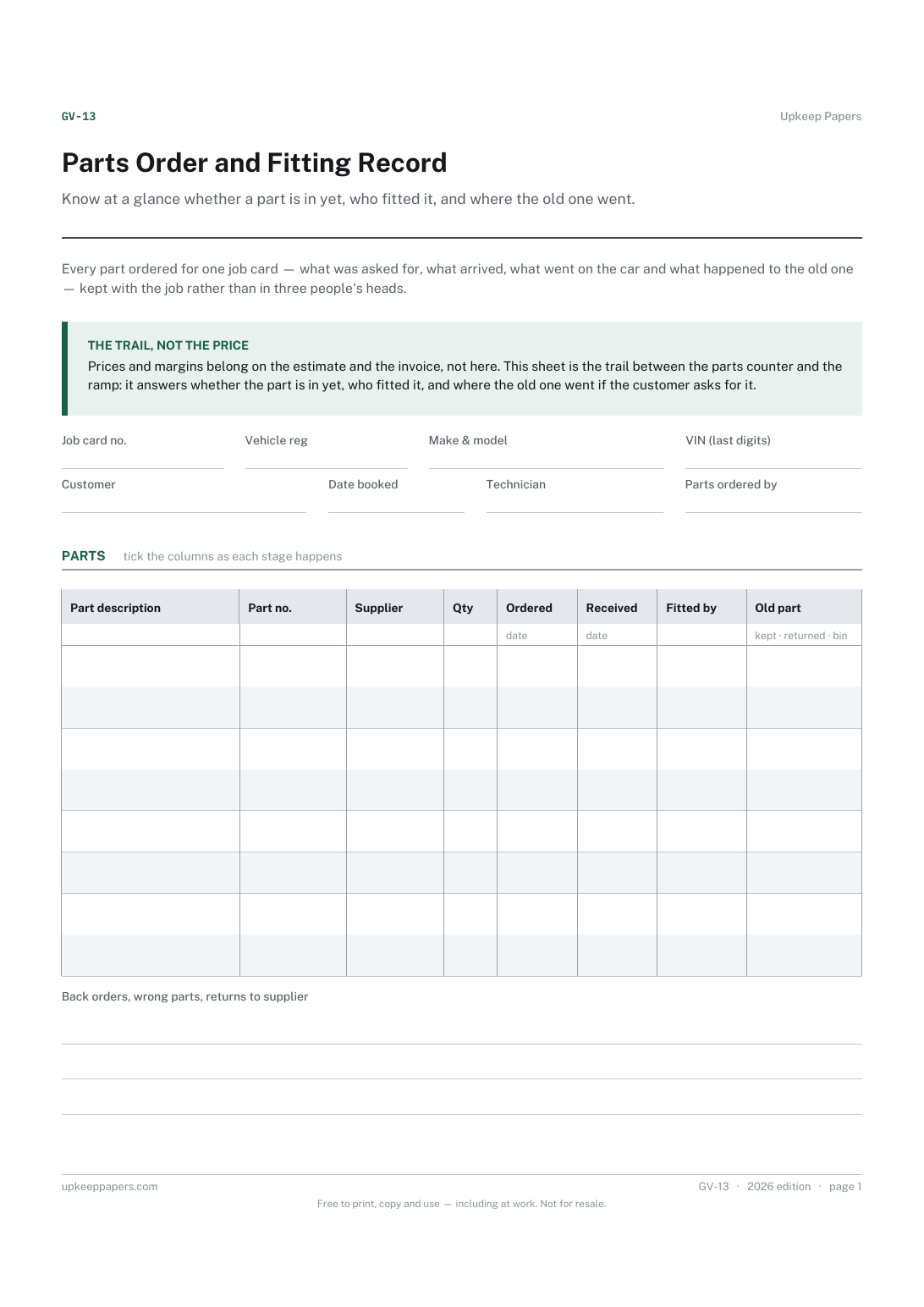
Know at a glance whether a part is in yet, who fitted it, and where the old one went. The customer who asks for it back gets an answer.

Every sheet, binder, game and puzzle on Upkeep Papers is free to download, with no email and no account. Making them is not free: each one takes days of research, design and checking, and the site costs money to run. If something here saved you time, you can buy us a coffee. It is entirely optional: nothing is locked, and nothing changes if you don’t.
Buy us a coffee Opens PayPal in a new tab. Any amount, and nothing changes if you would rather not.