Tool and Equipment Inventory
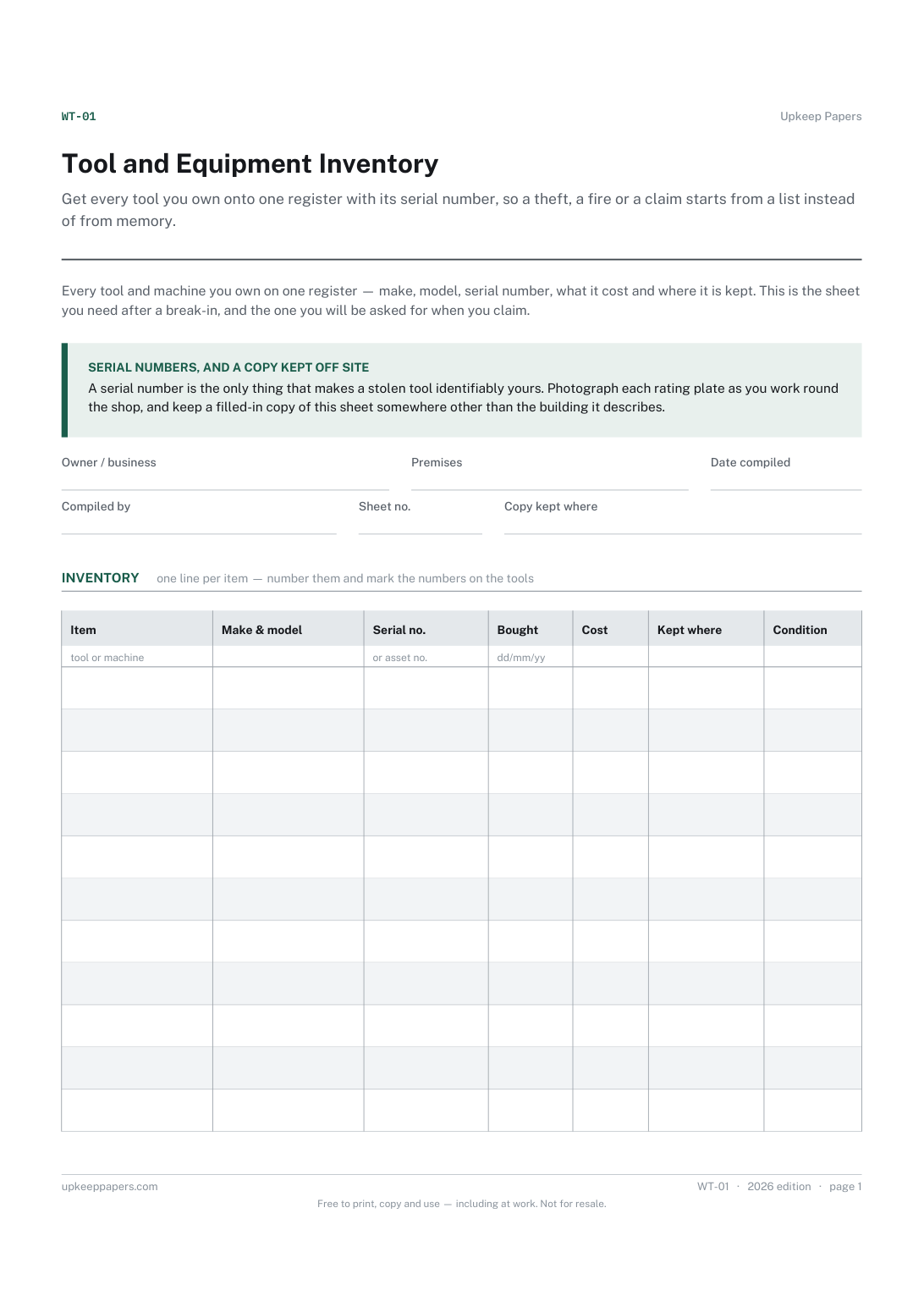
Get every tool you own onto one register with its serial number, so a theft, a fire or a claim starts from a list instead of from memory.
WT-01 1 page
Everything here is free. Making it takes time and money. Everything here is free.
 Buy us a coffee
 Category
Inventories, service logs and the working paperwork a small workshop, a trade or a van actually runs on.
A workshop generates two kinds of paper: the record of what you own and what condition it is in, and the record of the work that went out of the door. These sheets cover both, and they are deliberately blank — inspection regimes and record-keeping duties differ by country, so none of them prints an interval or a pass mark.
Get every tool you own onto one register with its serial number, so a theft, a fire or a claim starts from a list instead of from memory.
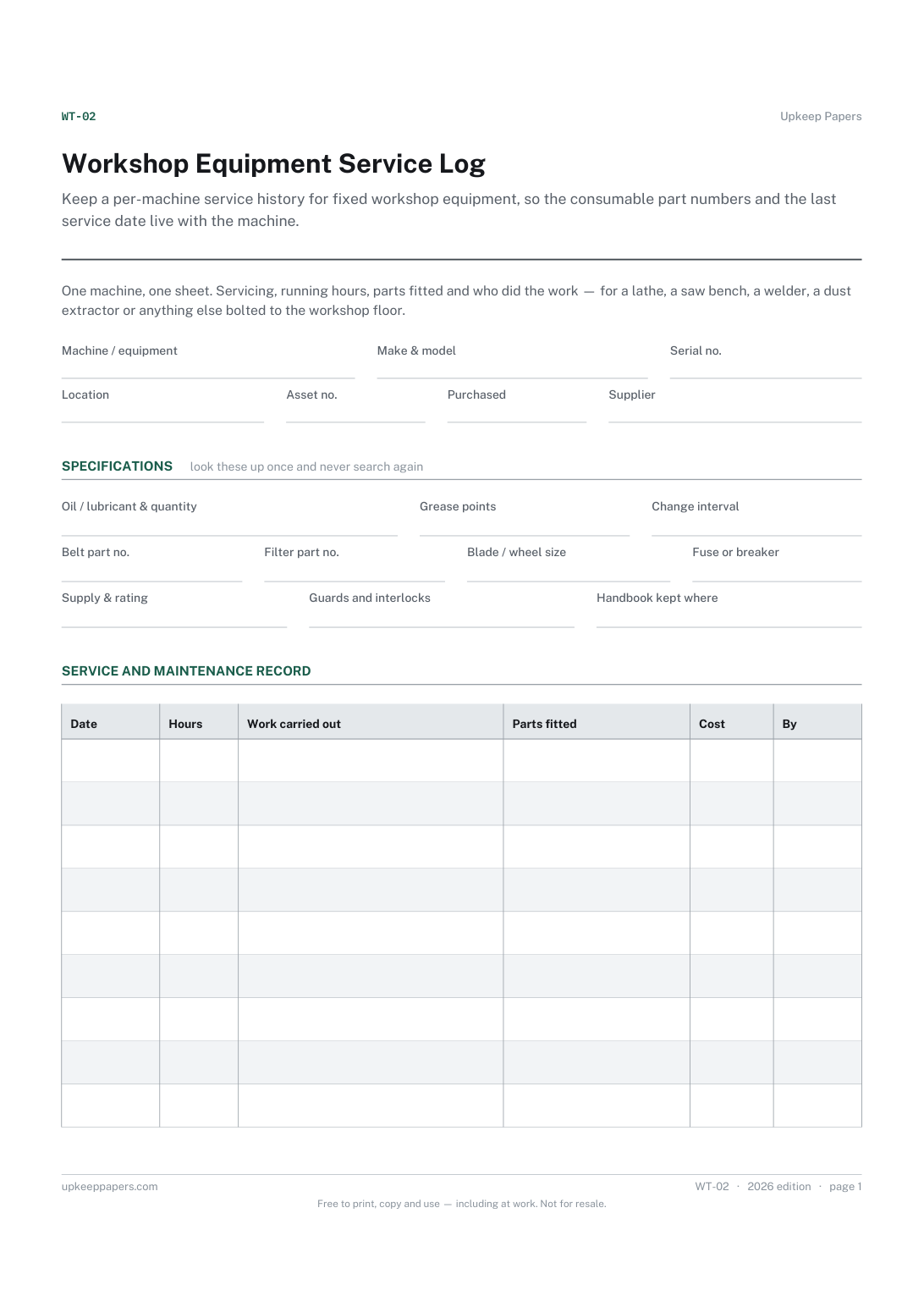
Keep a per-machine service history for fixed workshop equipment, so the consumable part numbers and the last service date live with the machine.
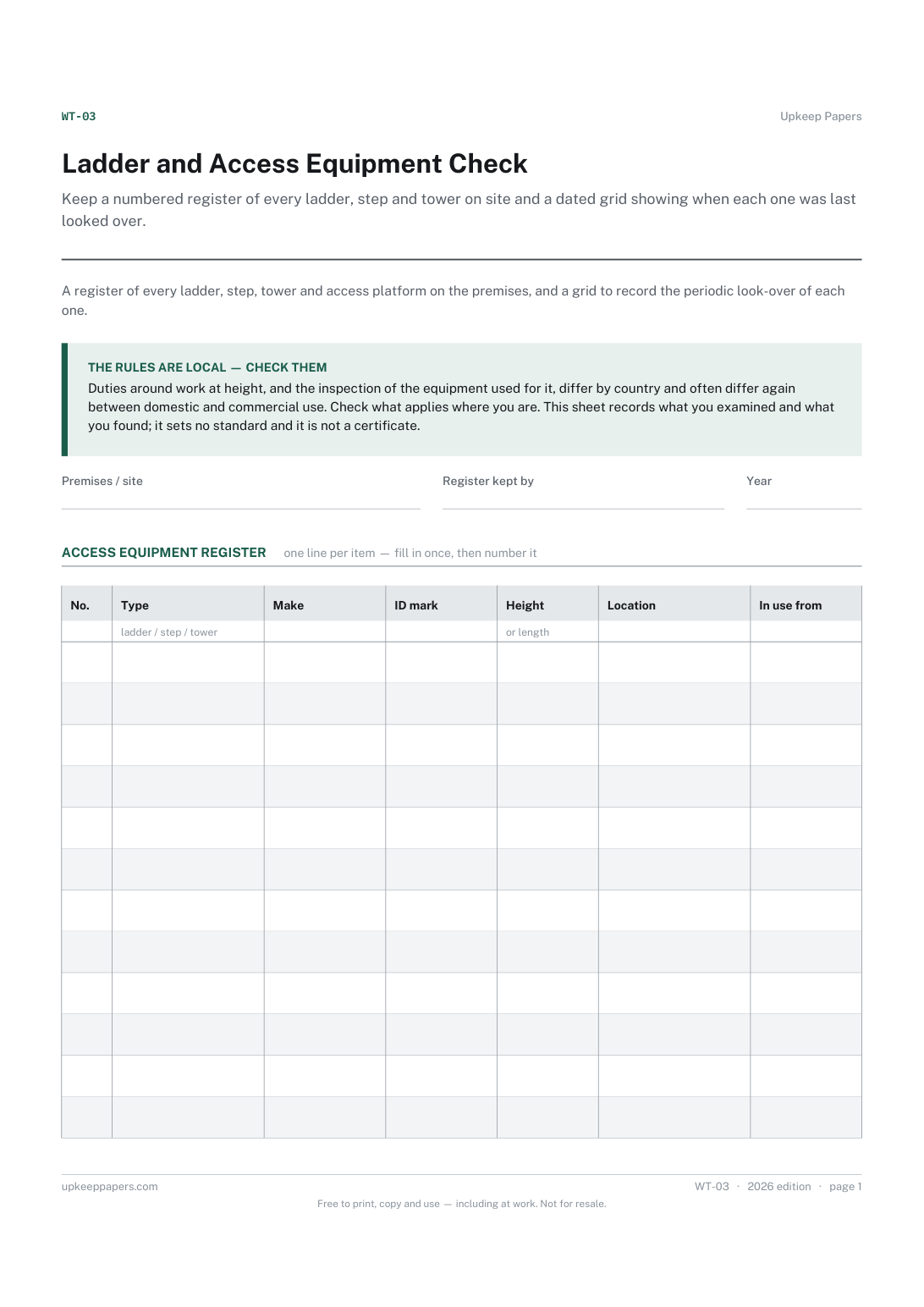
Keep a numbered register of every ladder, step and tower on site and a dated grid showing when each one was last looked over.
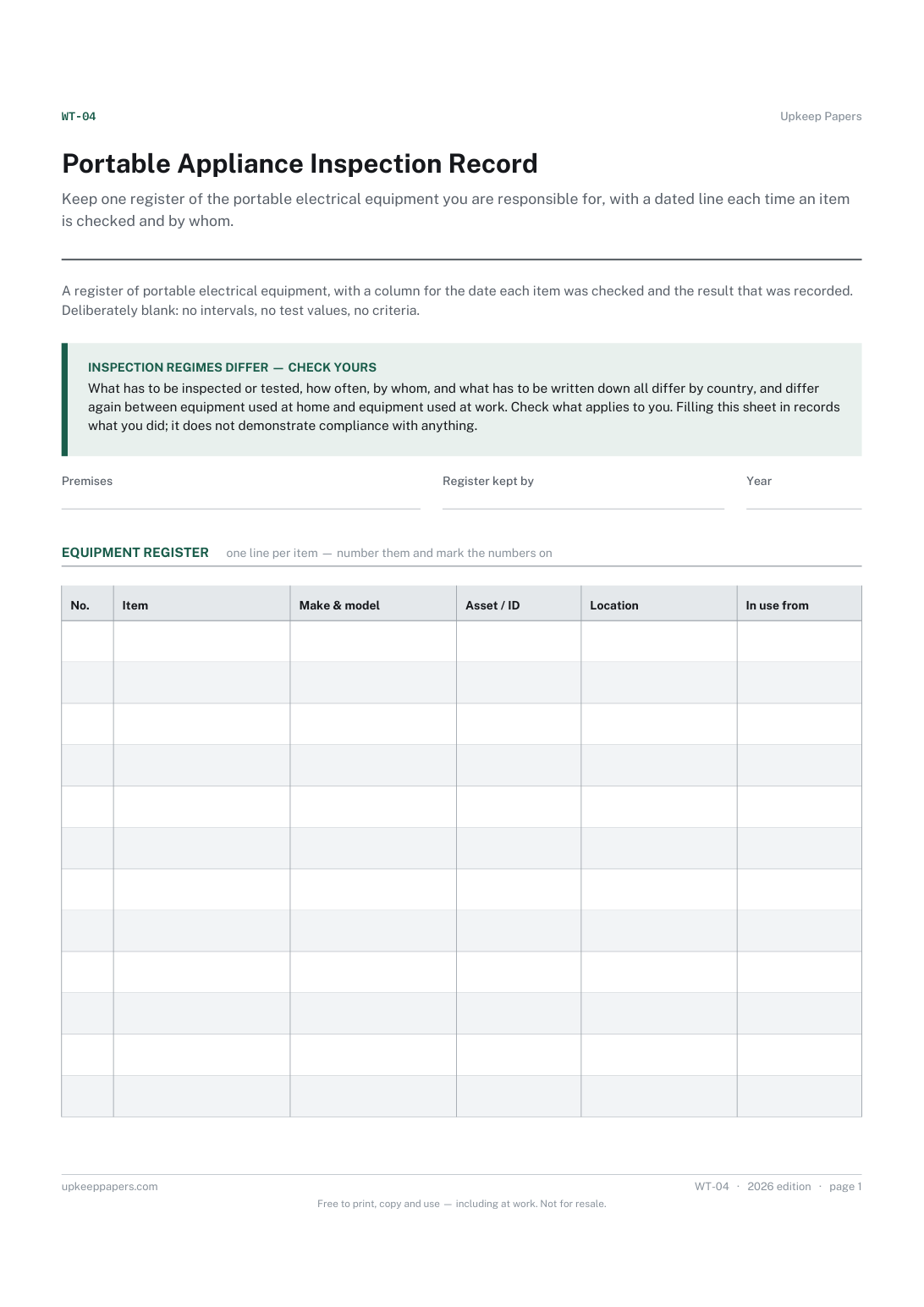
Keep one register of the portable electrical equipment you are responsible for, with a dated line each time an item is checked and by whom.
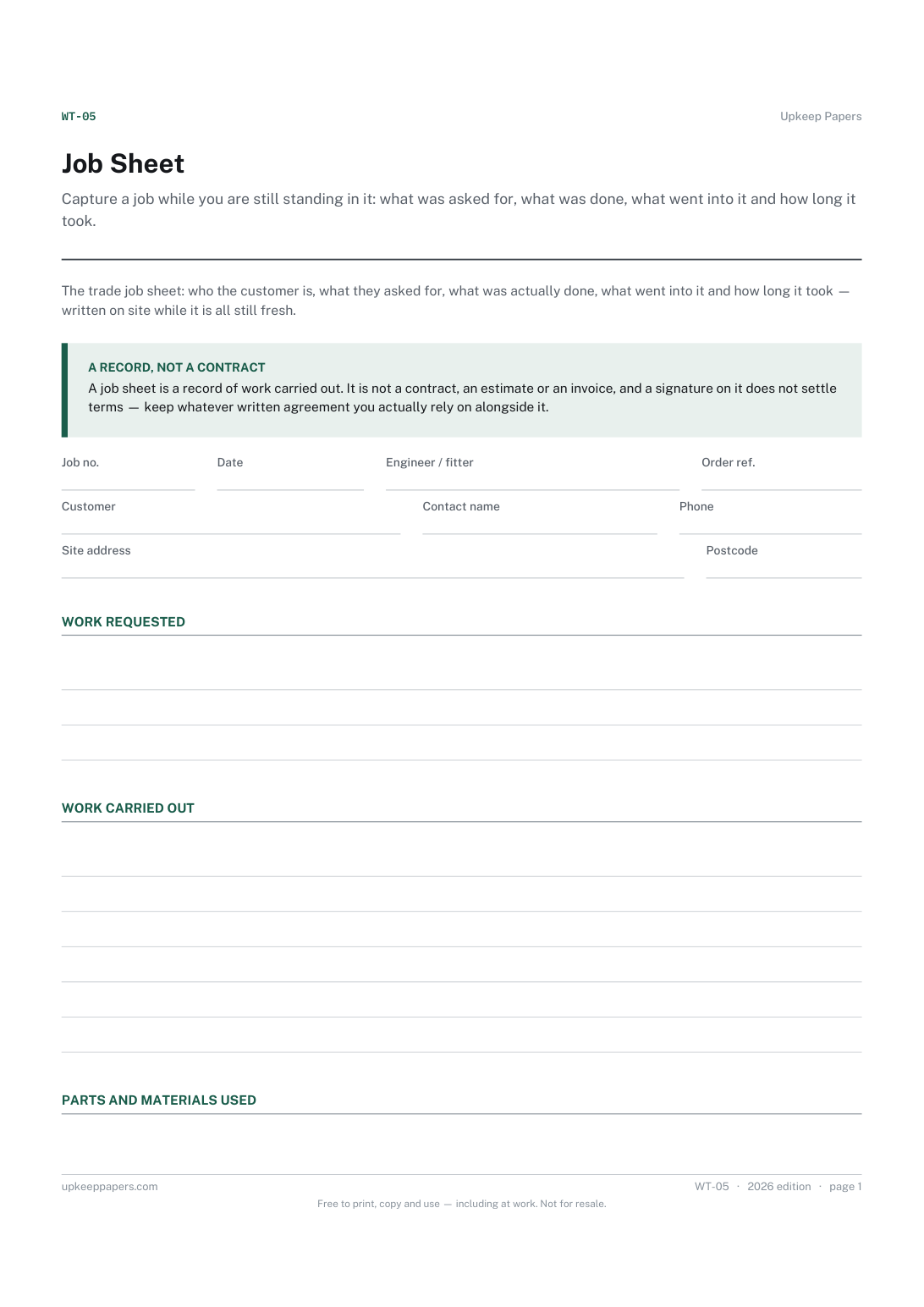
Capture a job while you are still standing in it: what was asked for, what was done, what went into it and how long it took.
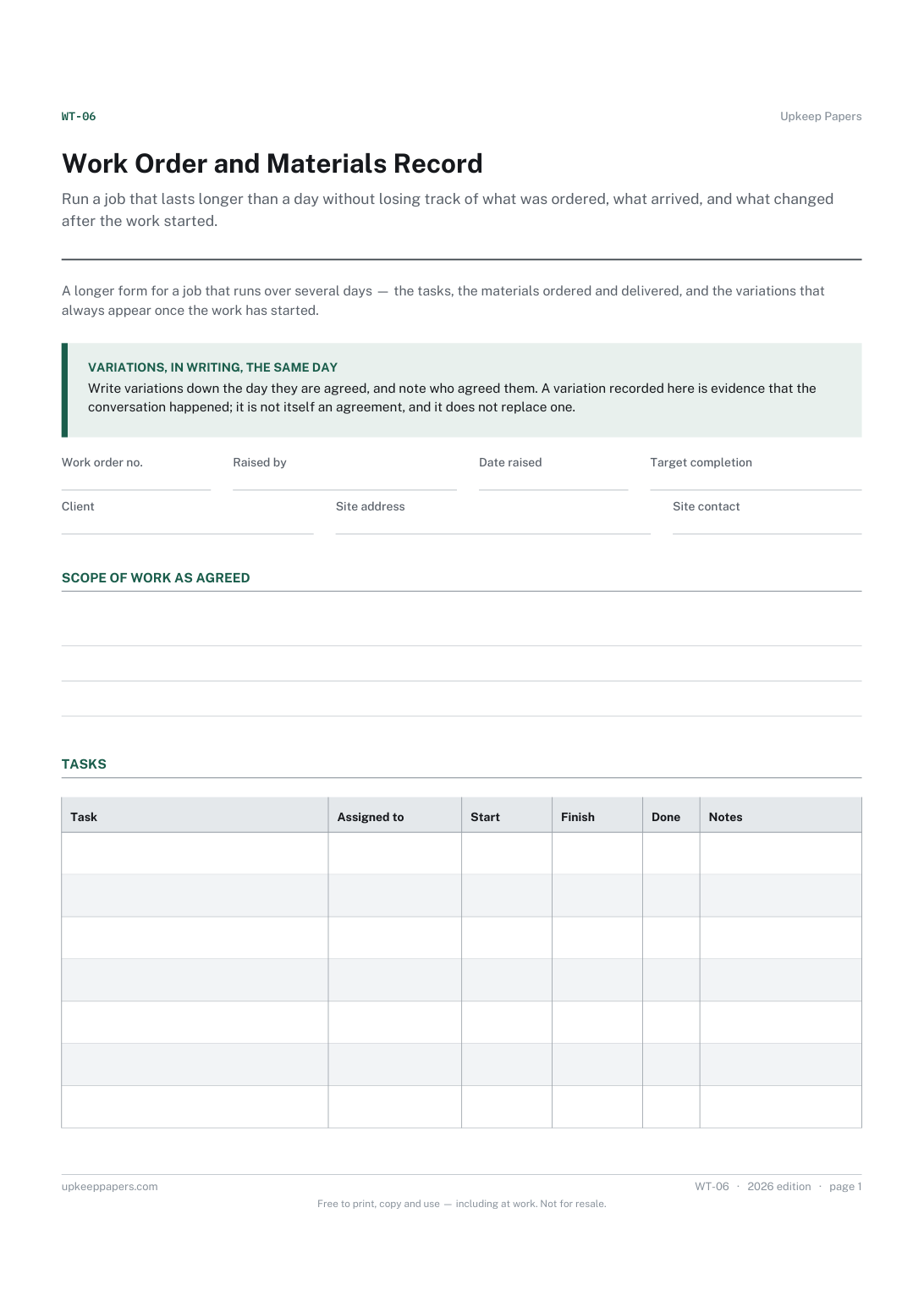
Run a job that lasts longer than a day without losing track of what was ordered, what arrived, and what changed after the work started.
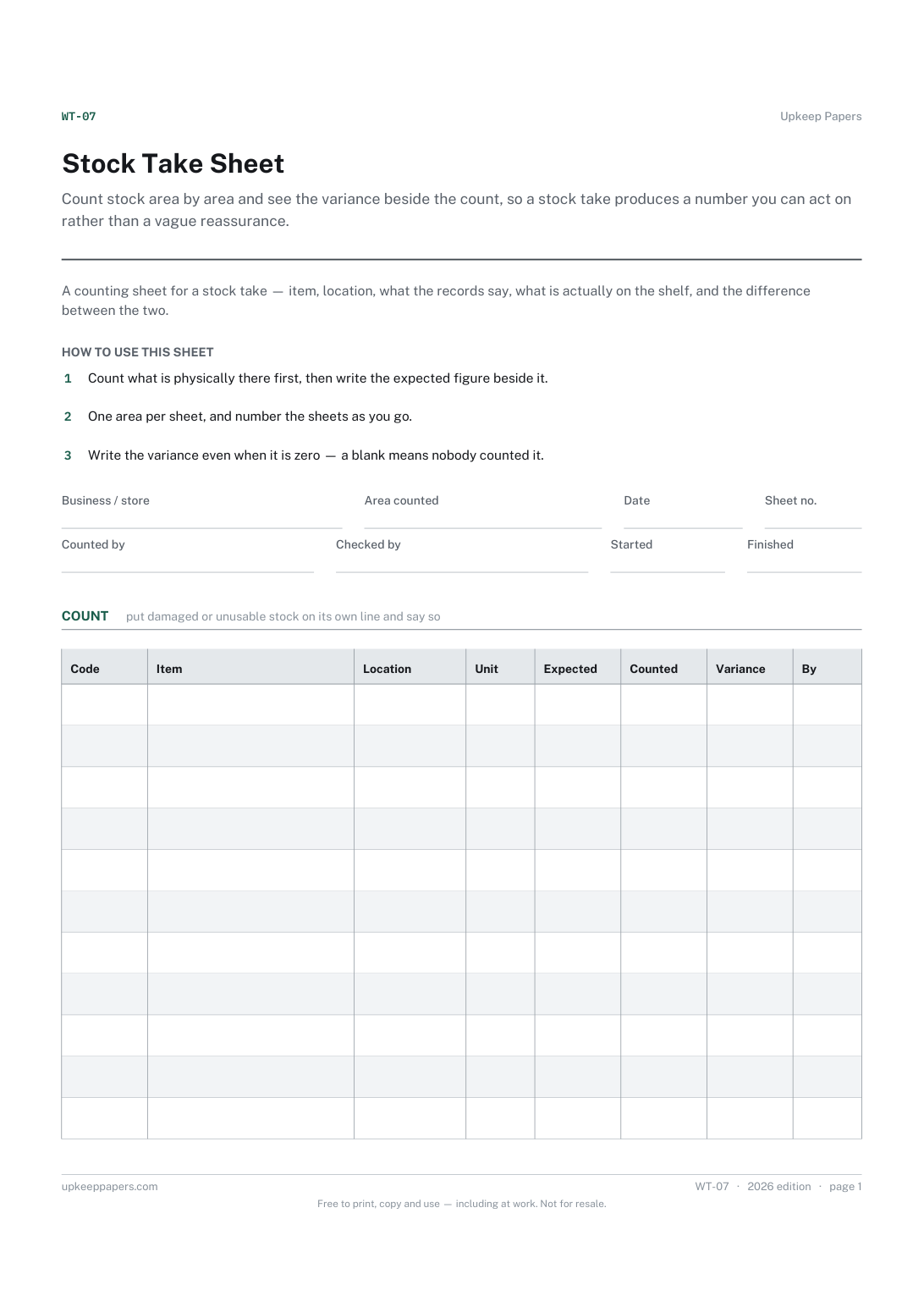
Count stock area by area and see the variance beside the count, so a stock take produces a number you can act on rather than a vague reassurance.
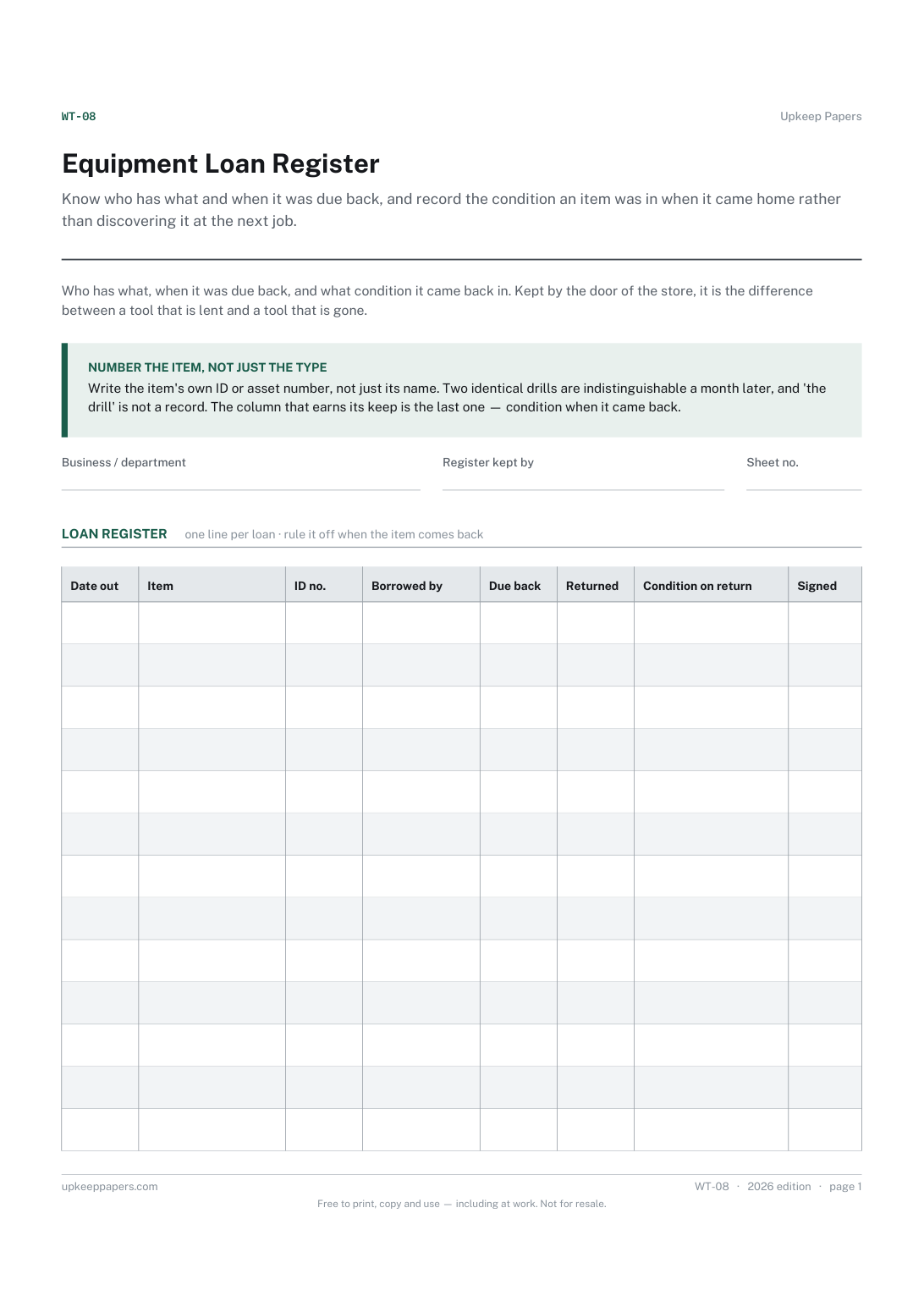
Know who has what and when it was due back, and record the condition an item was in when it came home rather than discovering it at the next job.
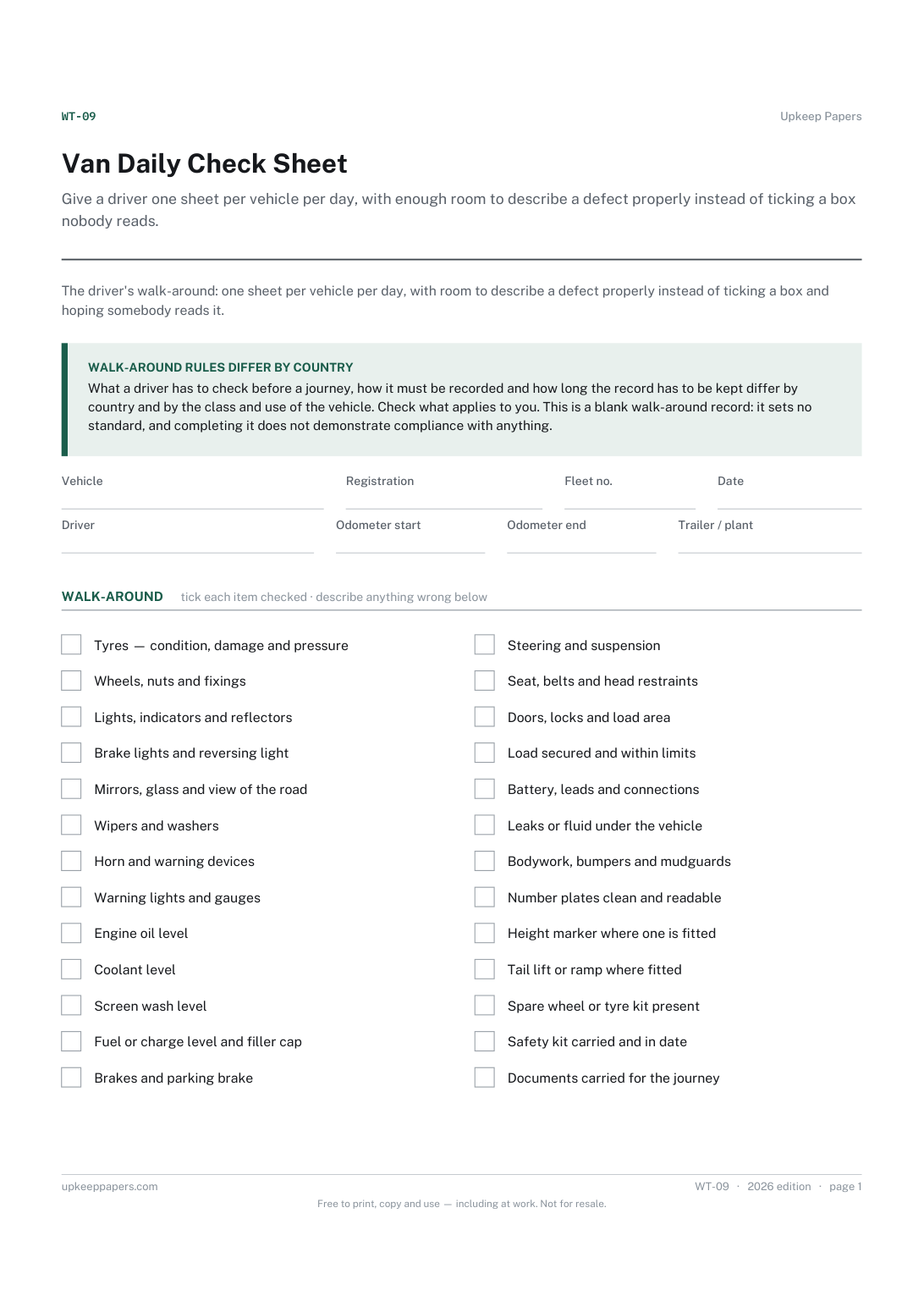
Give a driver one sheet per vehicle per day, with enough room to describe a defect properly instead of ticking a box nobody reads.
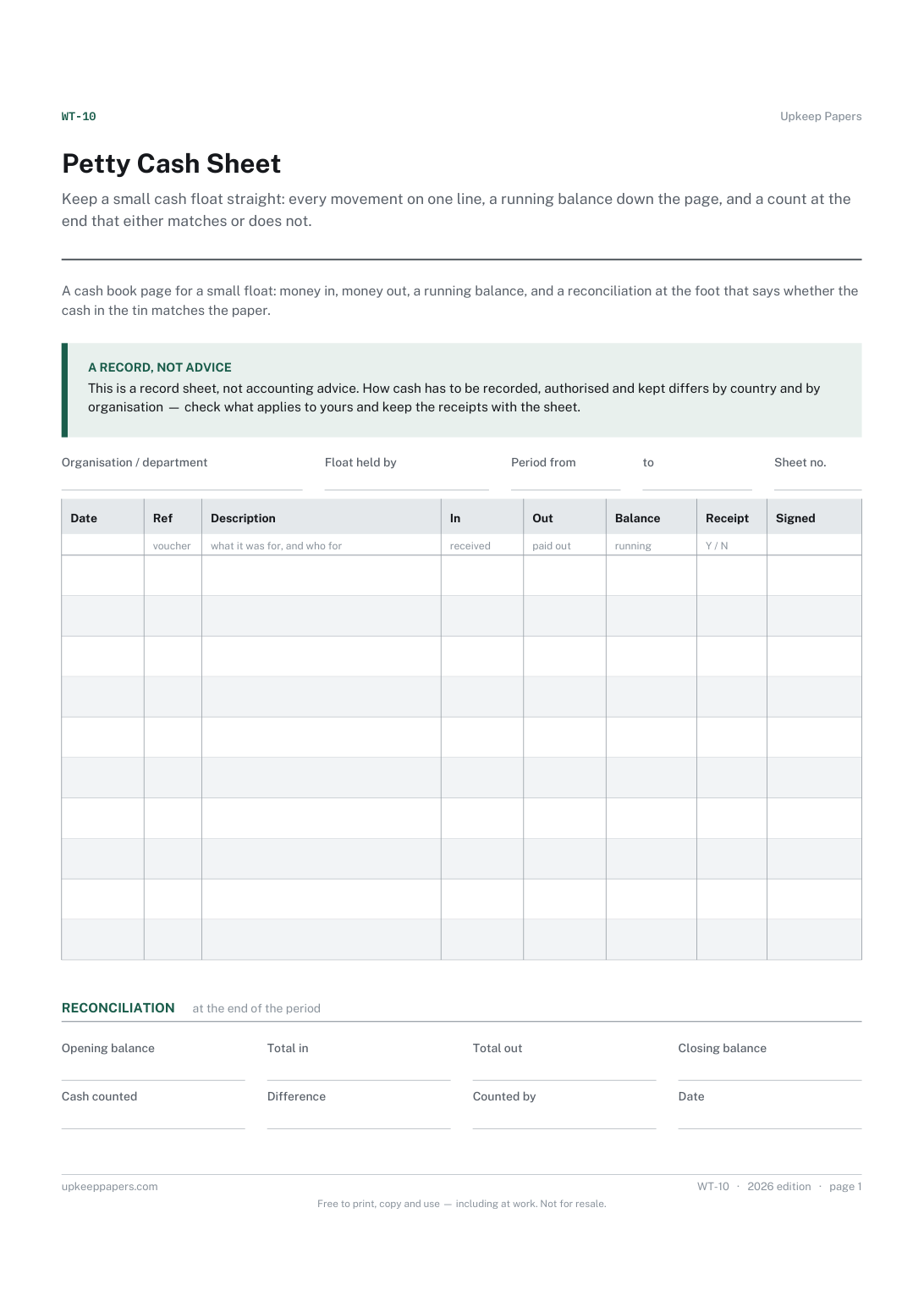
Keep a small cash float straight: every movement on one line, a running balance down the page, and a count at the end that either matches or does not.
Keep a week of daily walk-around checks on a single sheet that lives with the machine, so the record is made where the machine is rather than in an office.
Turn reordering from a guess into a decision, by recording the level you have chosen to hold against what is actually on the shelf.
Record what the business owns rather than what is in the shed: a numbered list with cost and disposal, which is what an insurer or an accountant asks for.
Send goods with a note, or check a delivery in properly, with the discrepancy line that settles arguments weeks later.
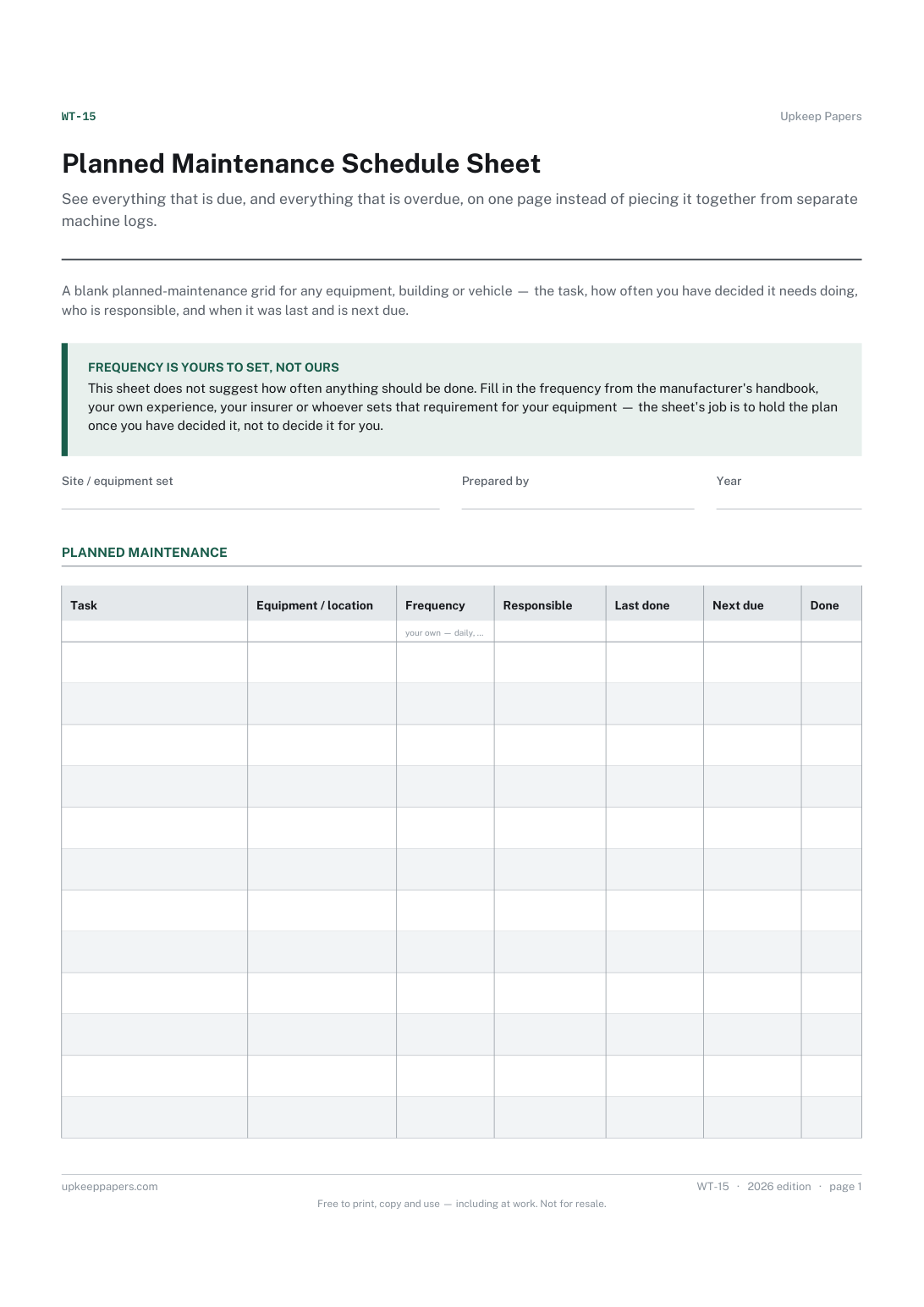
See everything that is due, and everything that is overdue, on one page instead of piecing it together from separate machine logs.
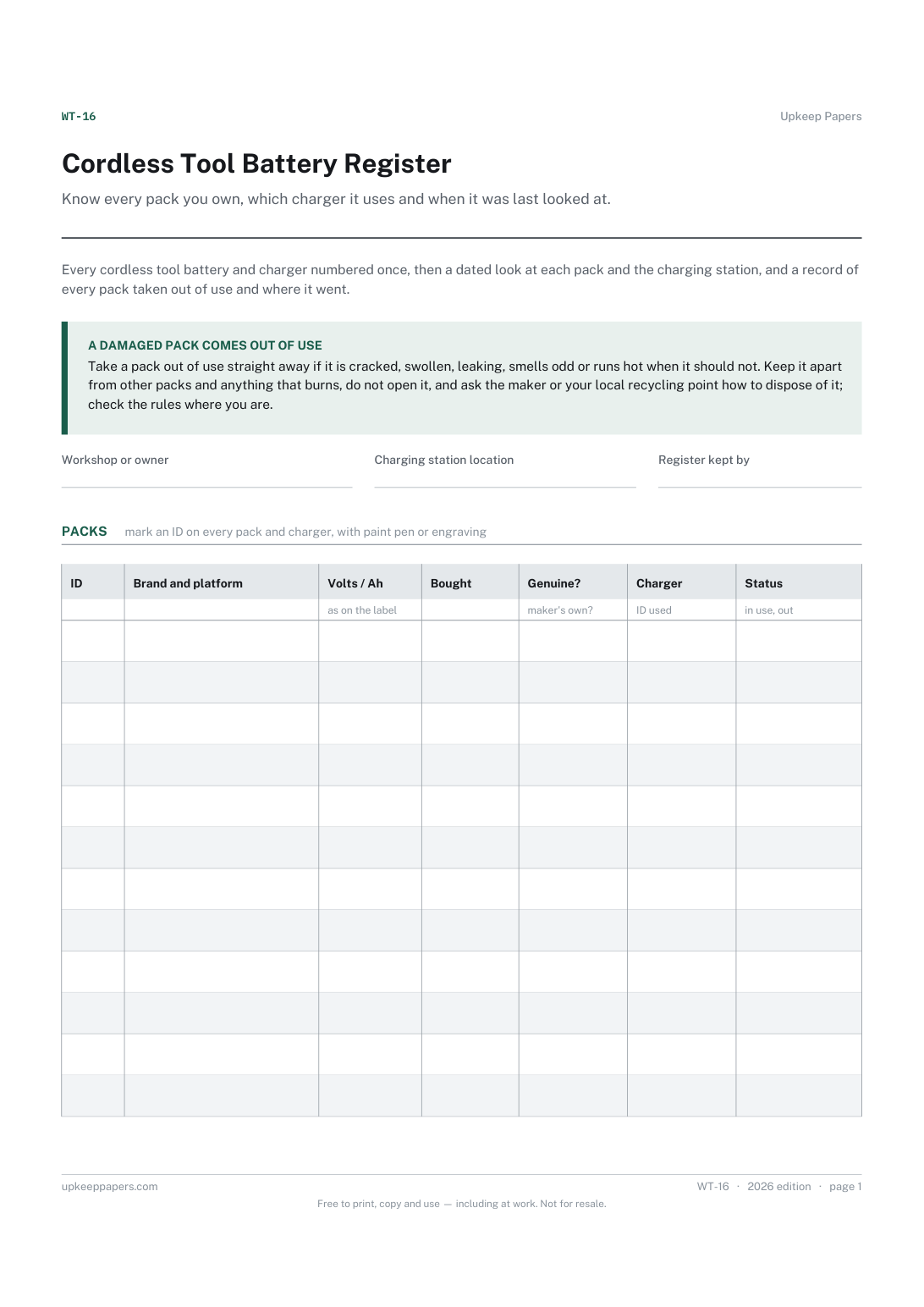
Know every pack you own, which charger it uses and when it was last looked at. A swollen or cracked pack is written out of use, not put back on charge.
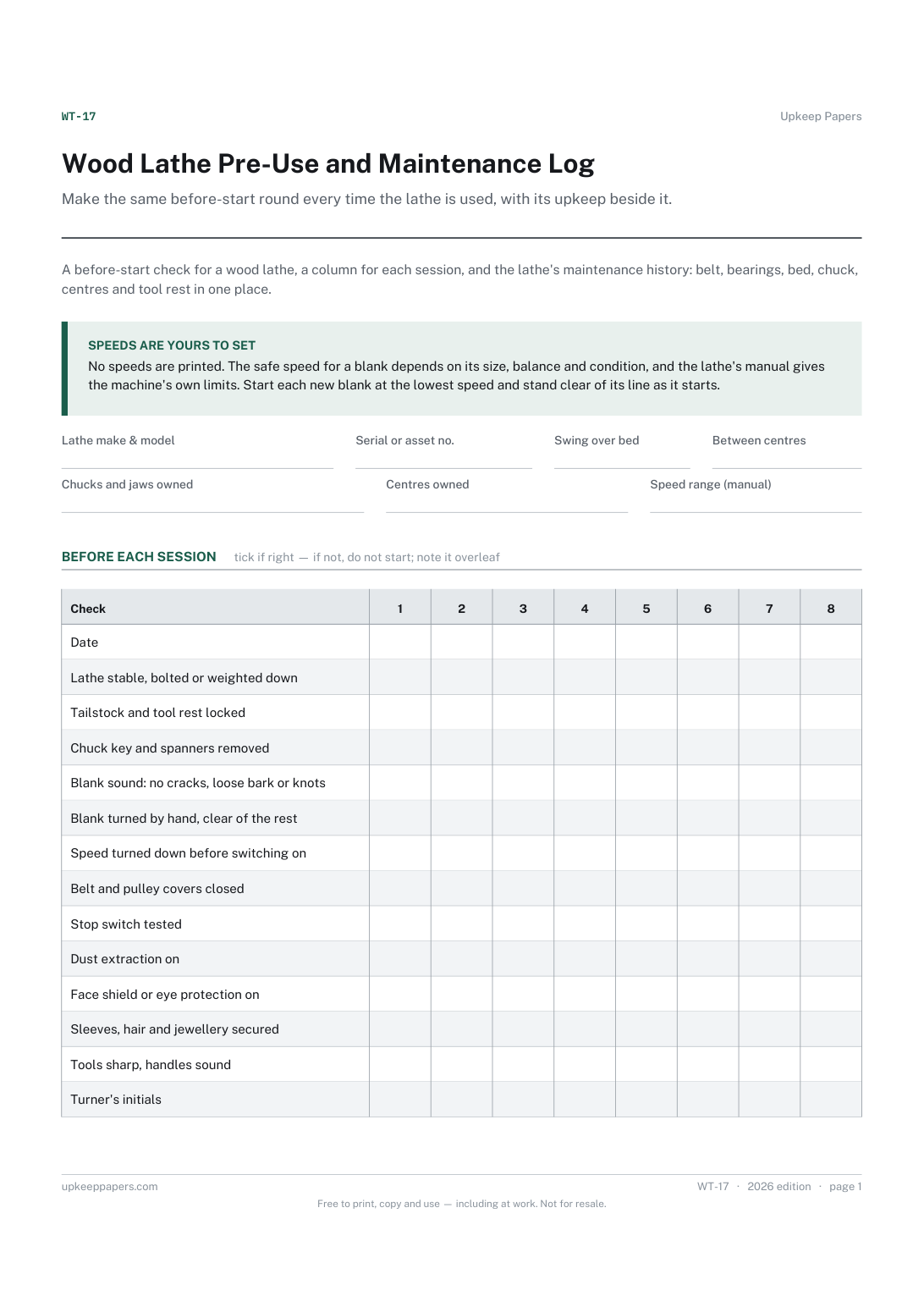
Make the same before-start round every time the lathe is used, with its upkeep beside it.
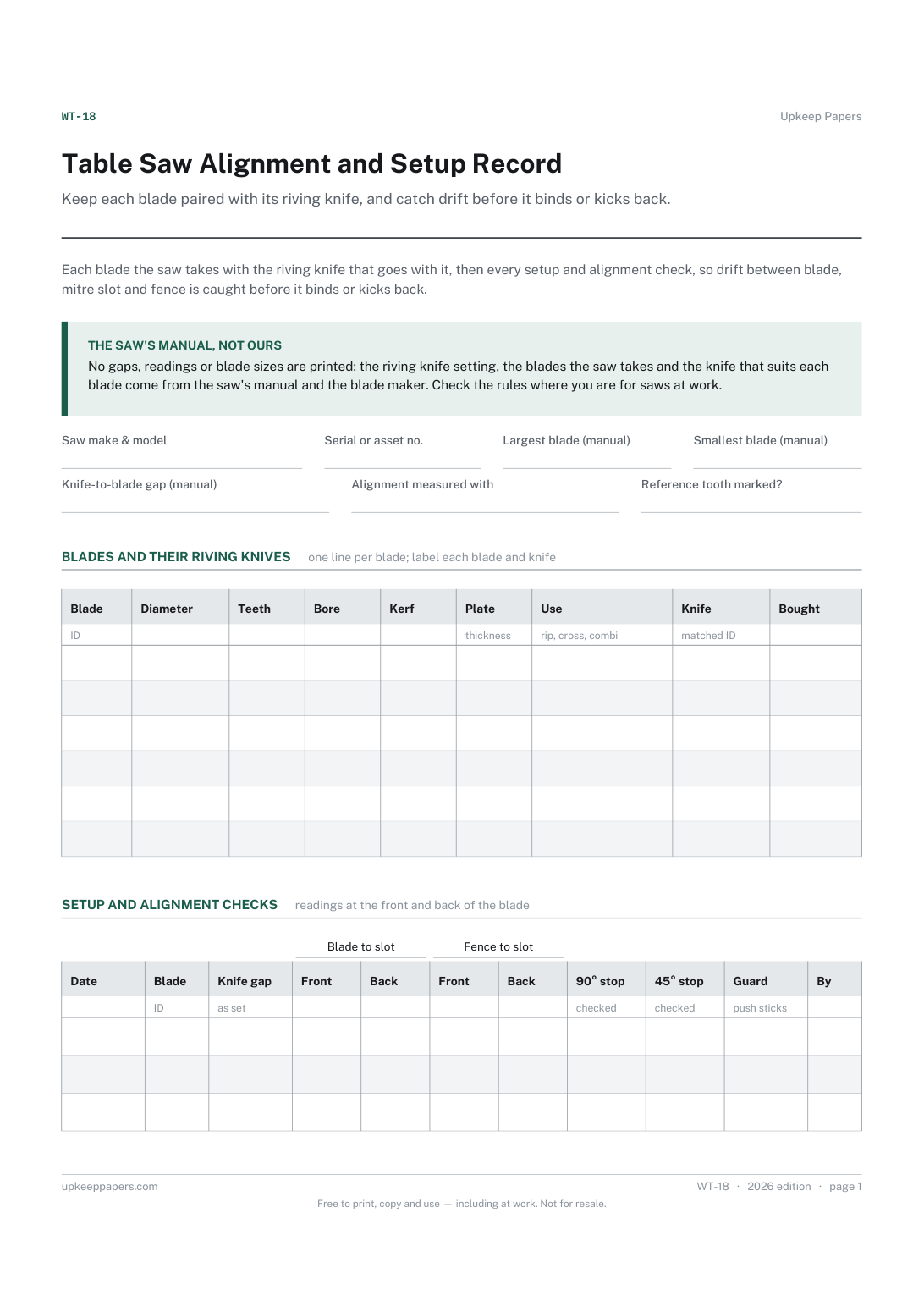
Keep each blade paired with its riving knife, and catch drift before it binds or kicks back.
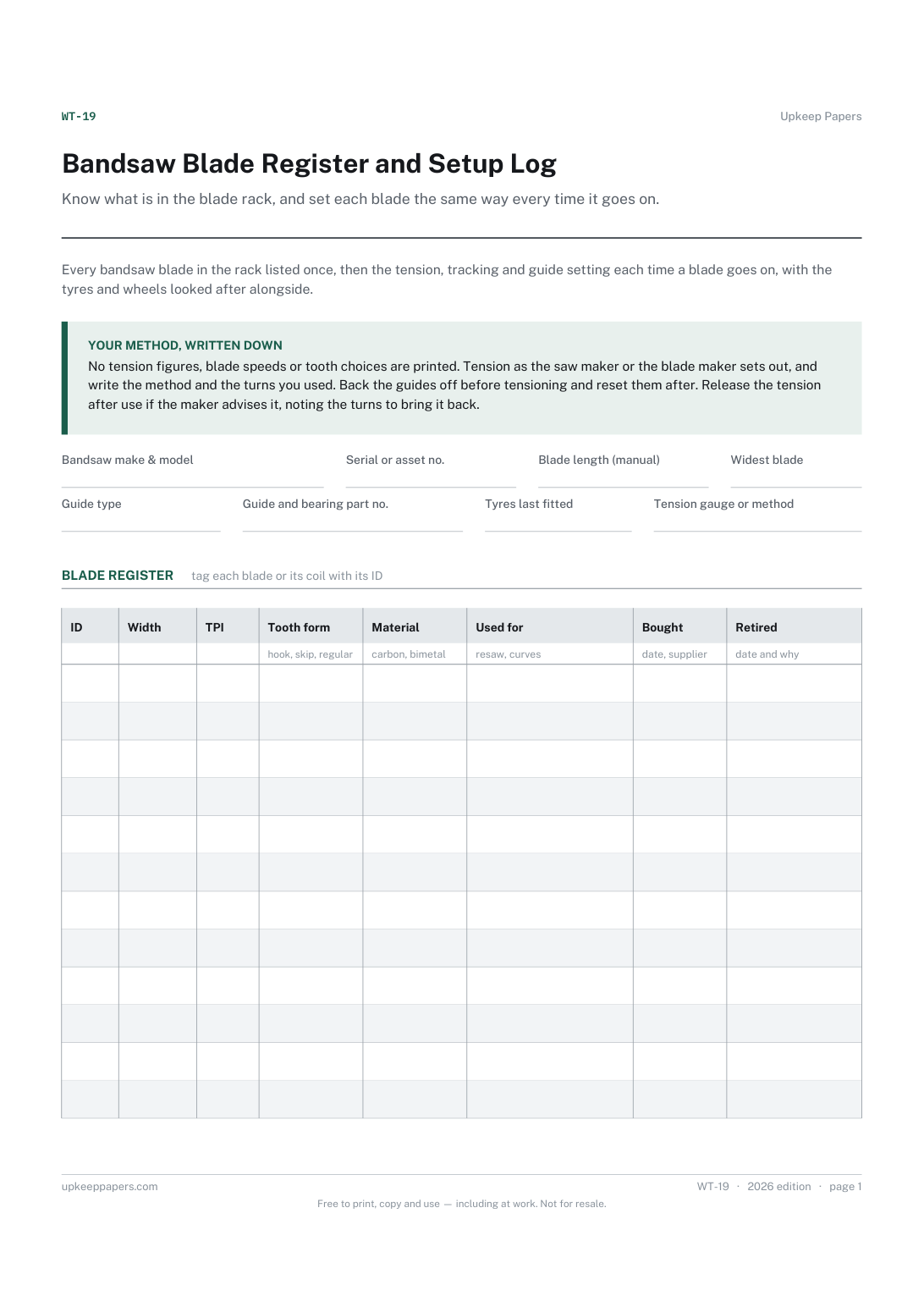
Know what is in the blade rack, and set each blade the same way every time it goes on.
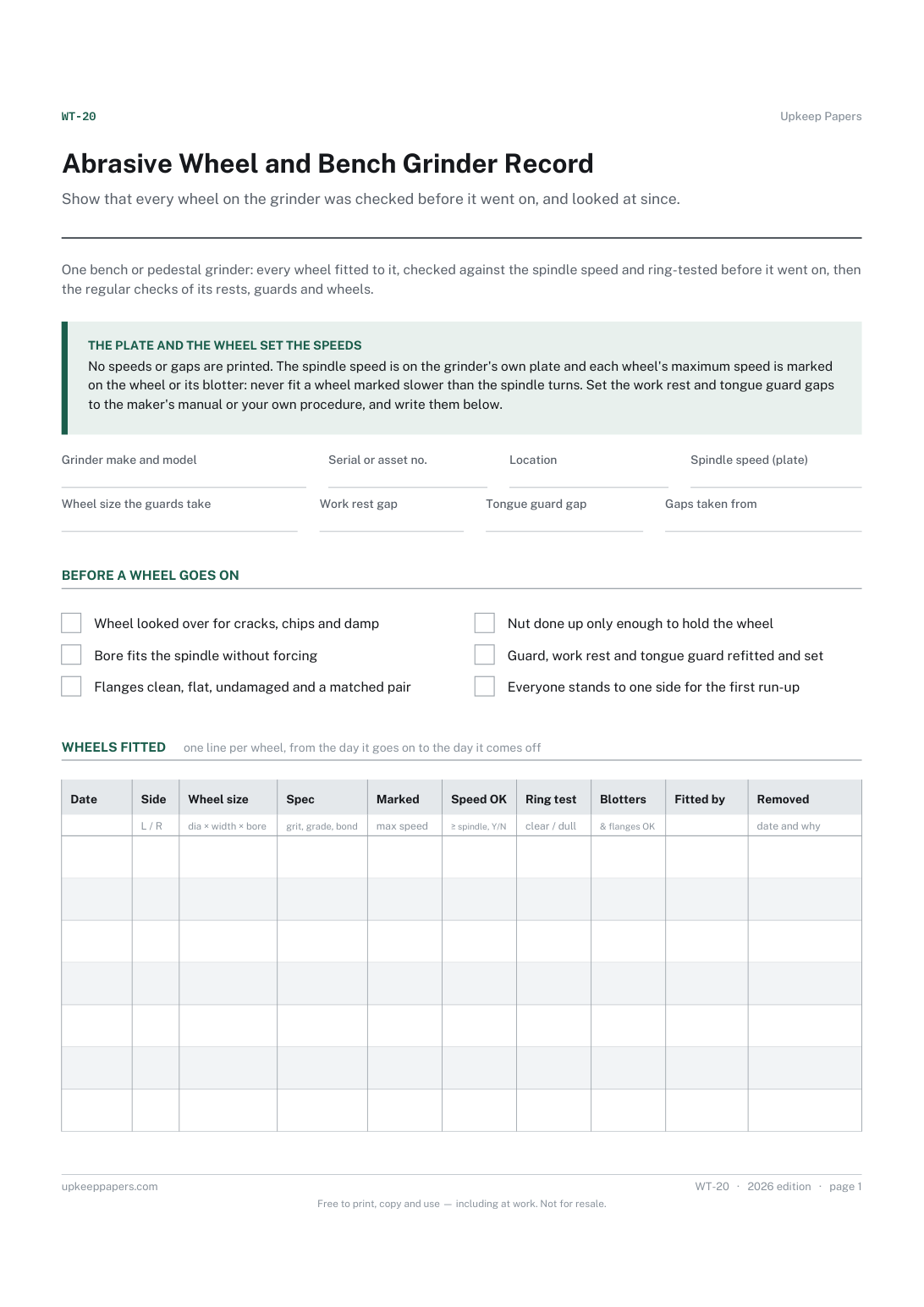
Show that every wheel on the grinder was checked before it went on, and looked at since. The rest and tongue guard gaps open up as a wheel wears, and the regular checks catch them.
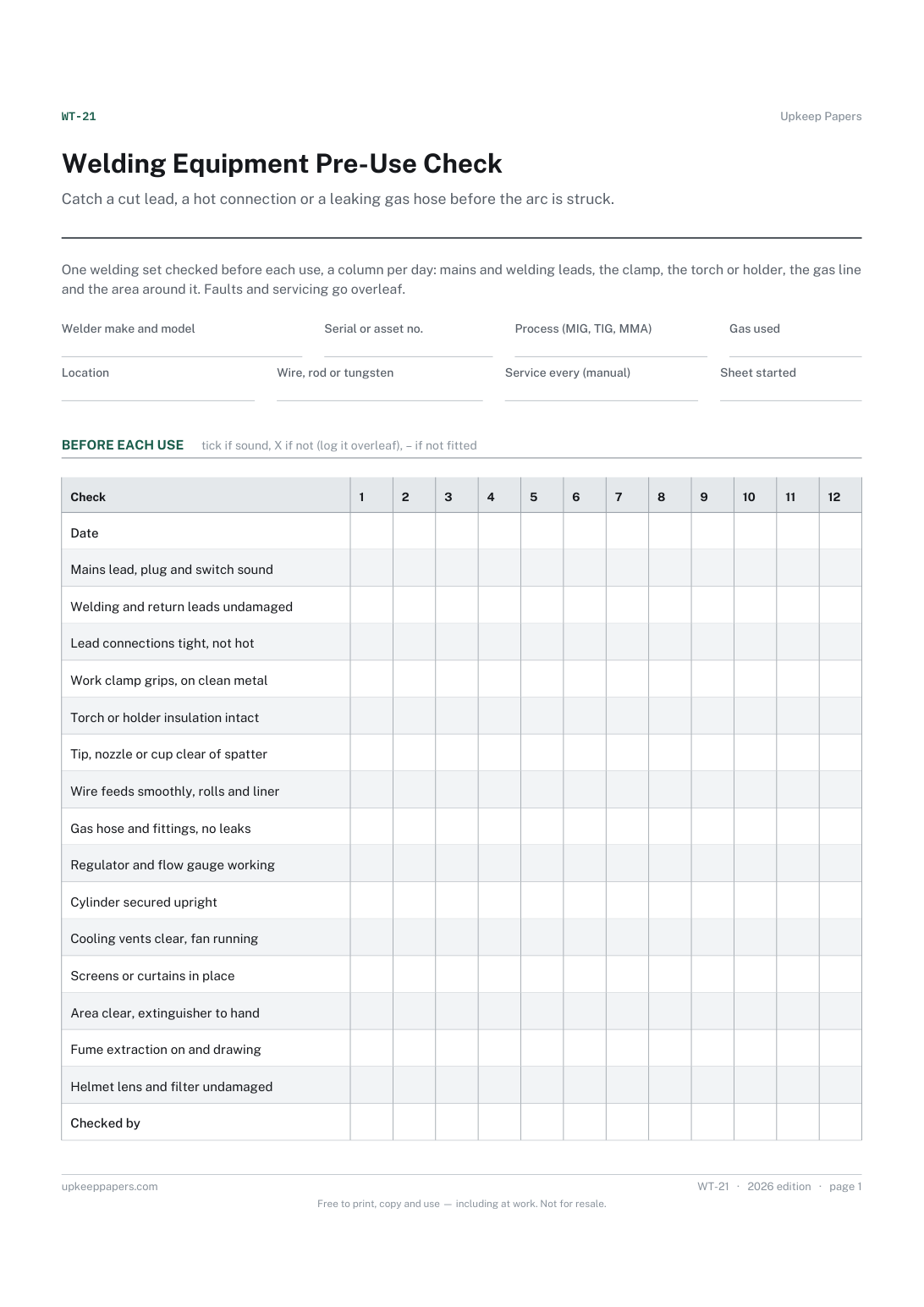
Catch a cut lead, a hot connection or a leaking gas hose before the arc is struck. Faults and servicing go on the back, so the set's history stays with it.
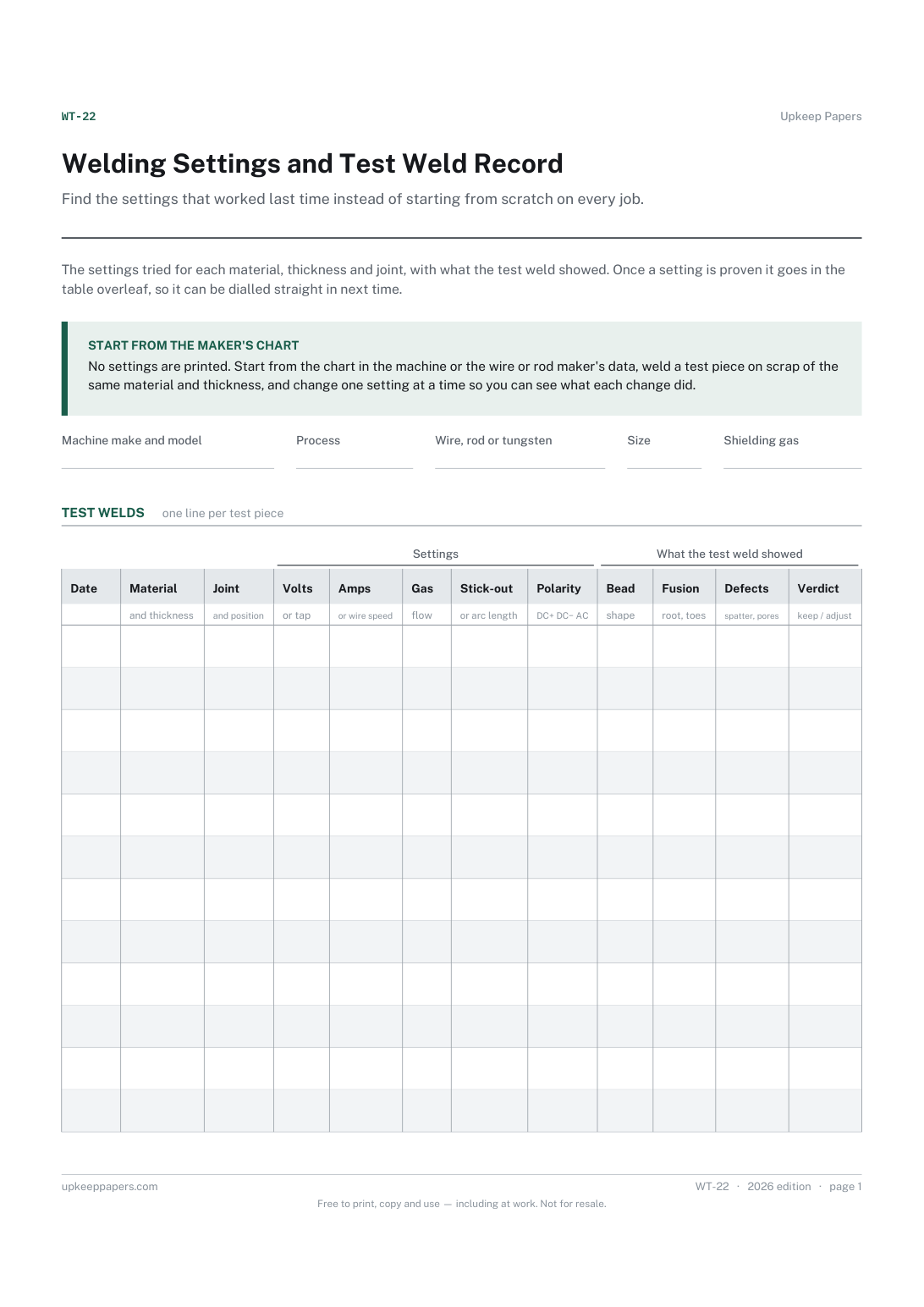
Find the settings that worked last time instead of starting from scratch on every job. Each test weld is written down with what it showed, and the good ones are copied to a table of proven settings overleaf.
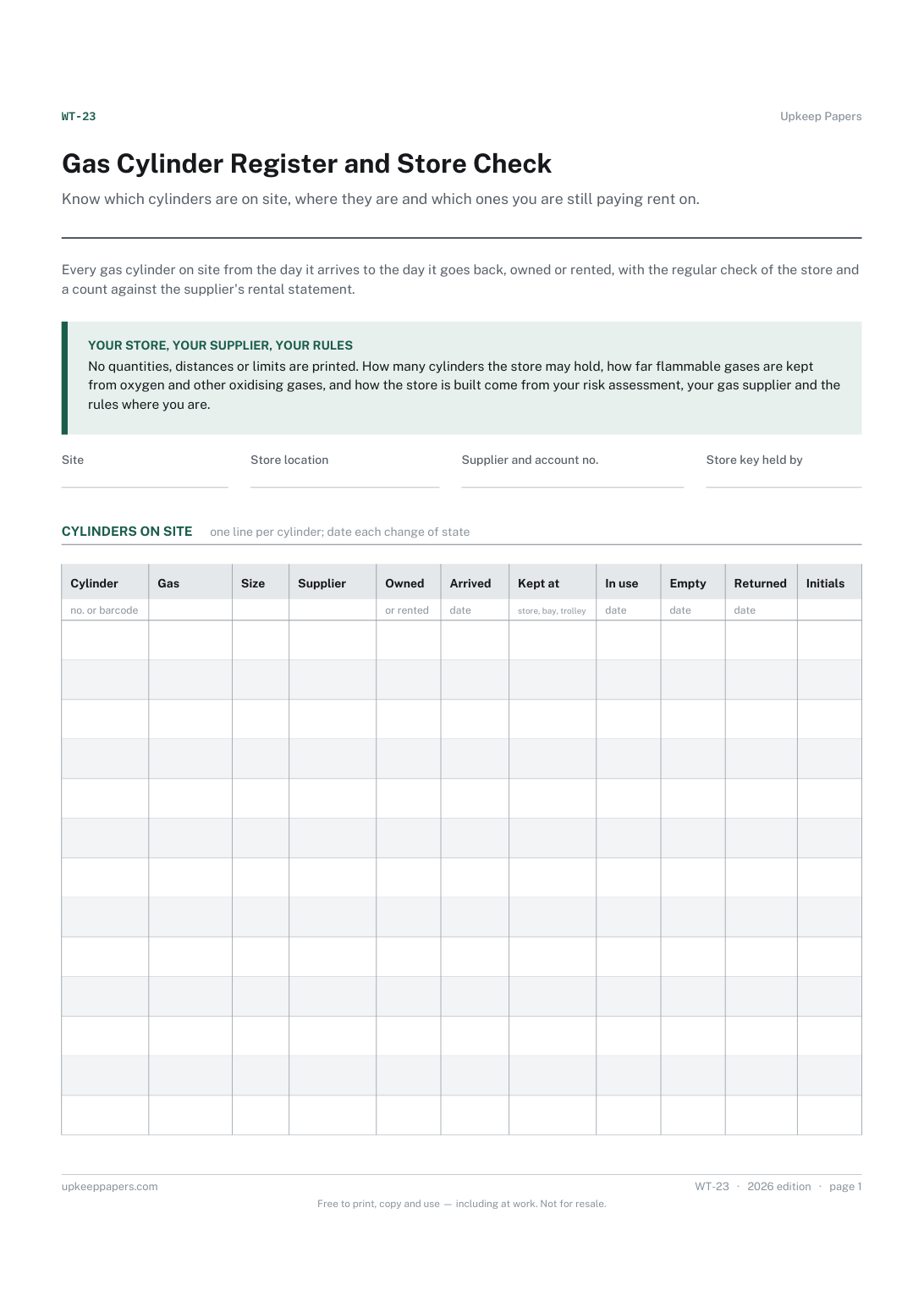
Know which cylinders are on site, where they are and which ones you are still paying rent on. The store checks sit behind the register, so the two are kept together.
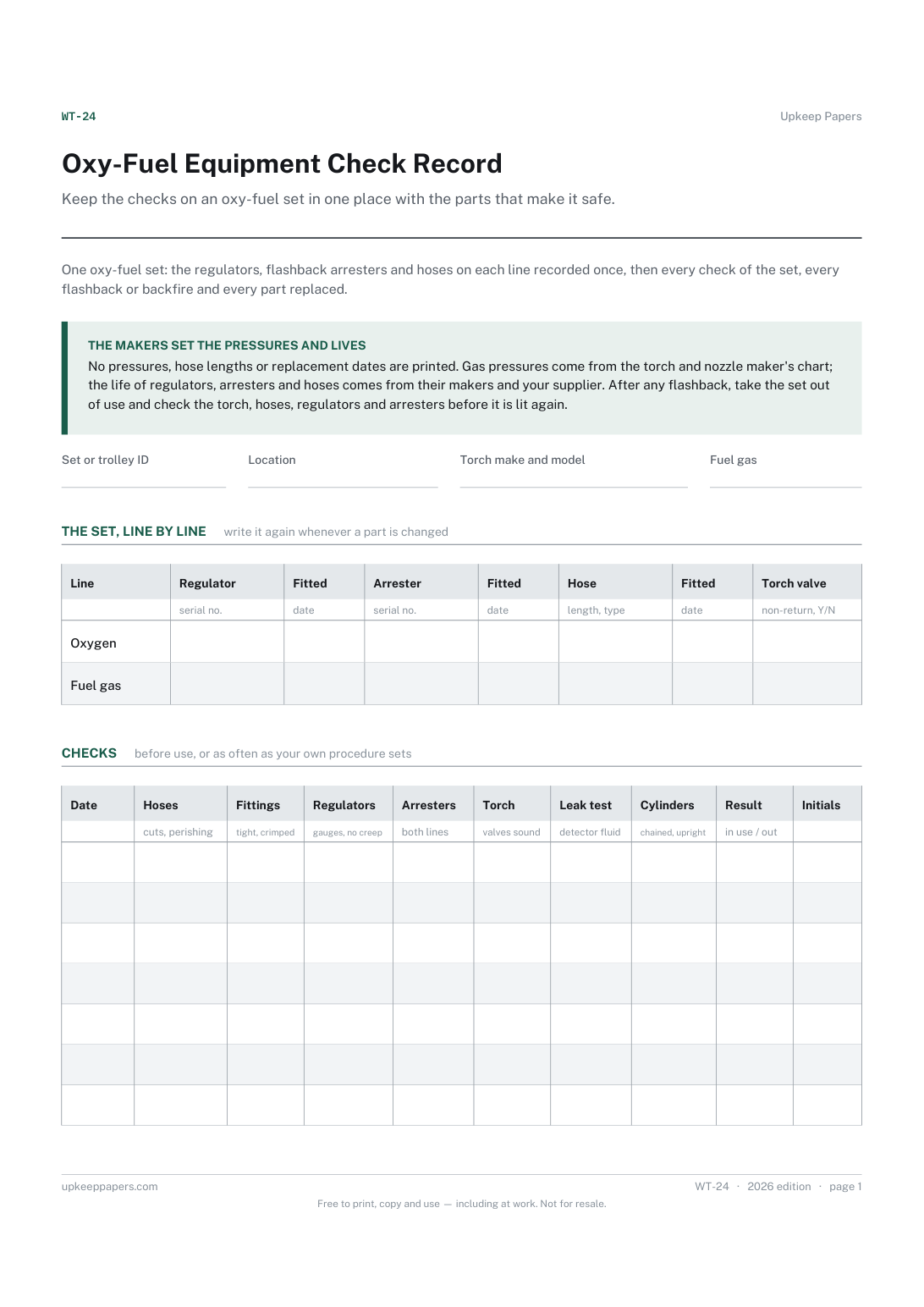
Keep the checks on an oxy-fuel set in one place with the parts that make it safe. After a flashback, the sheet shows what was checked and replaced before it was lit again.
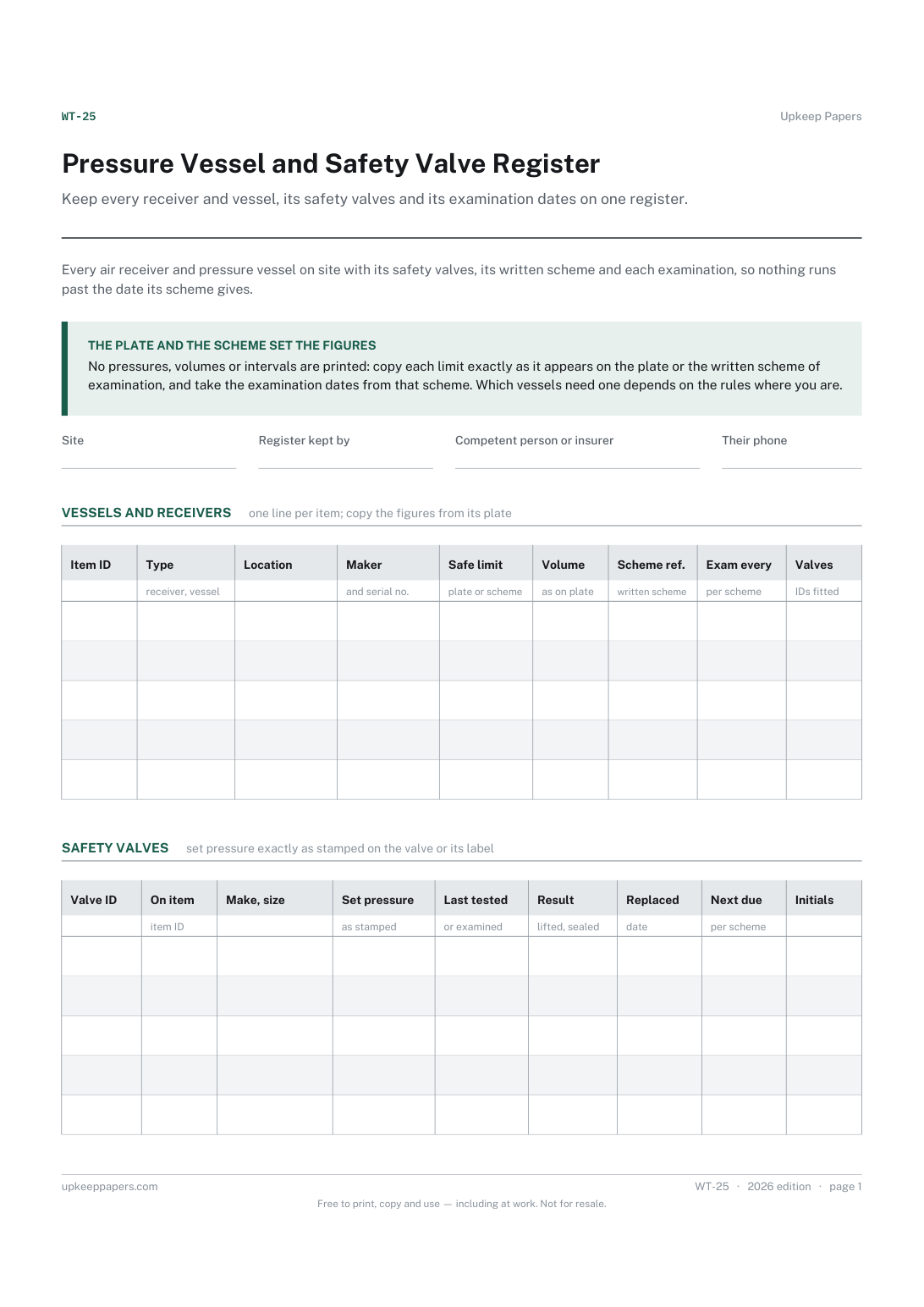
Keep every receiver and vessel, its safety valves and its examination dates on one register. Nothing then runs past the date its written scheme gives without someone seeing it.
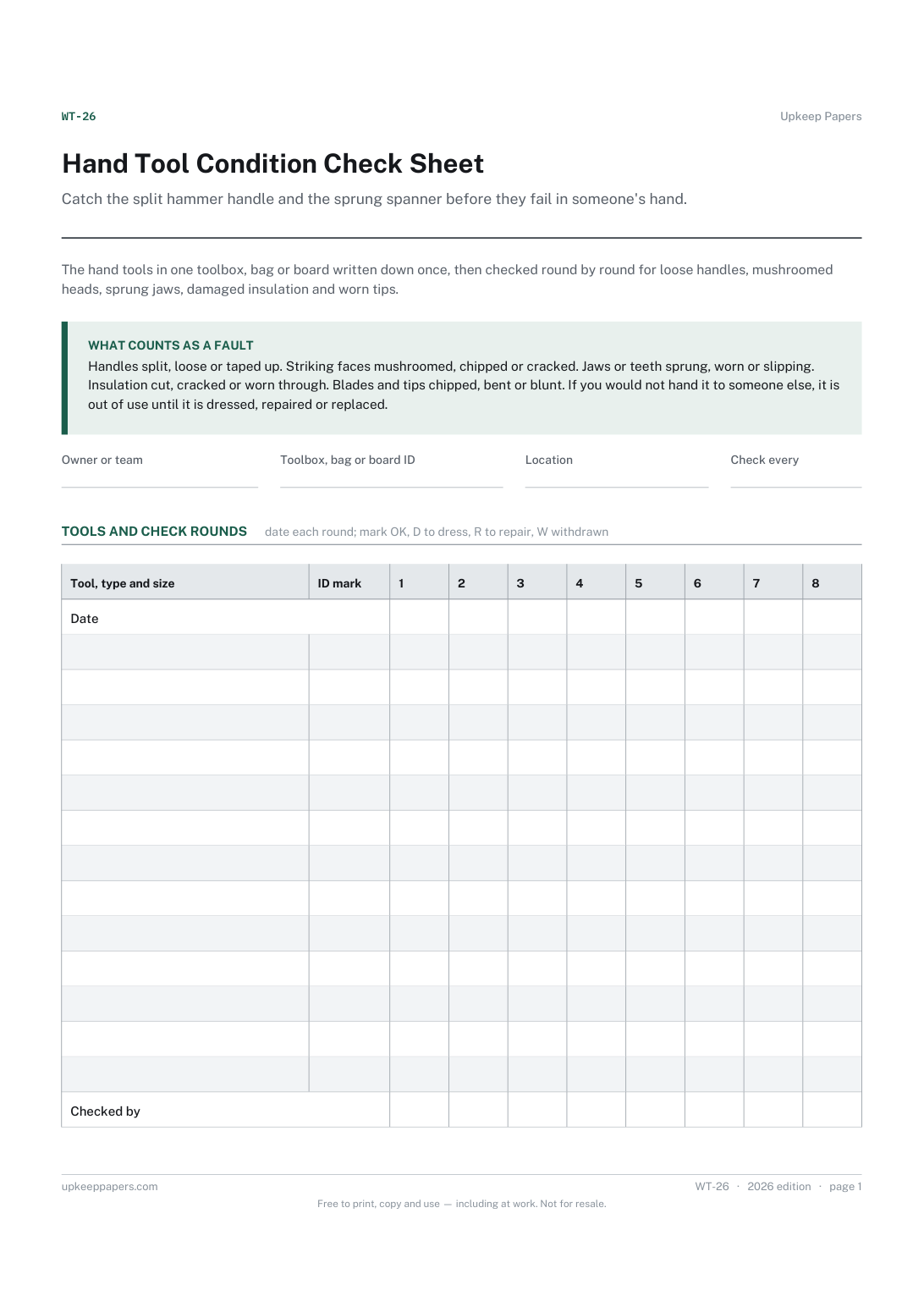
Catch the split hammer handle and the sprung spanner before they fail in someone's hand. Every tool withdrawn, dressed or repaired is logged with what was done.
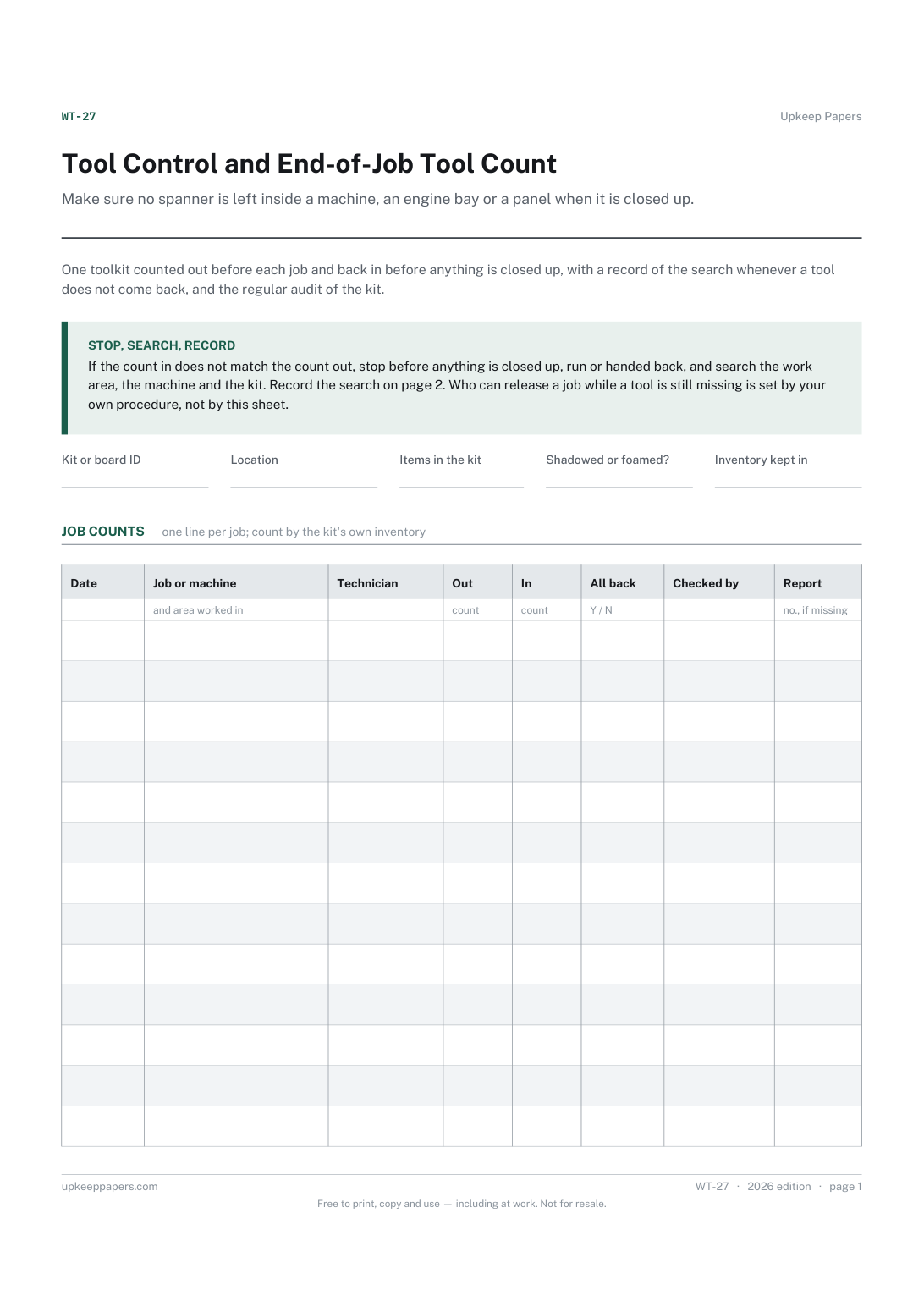
Make sure no spanner is left inside a machine, an engine bay or a panel when it is closed up. Every count is signed, and every missing tool has a recorded search.
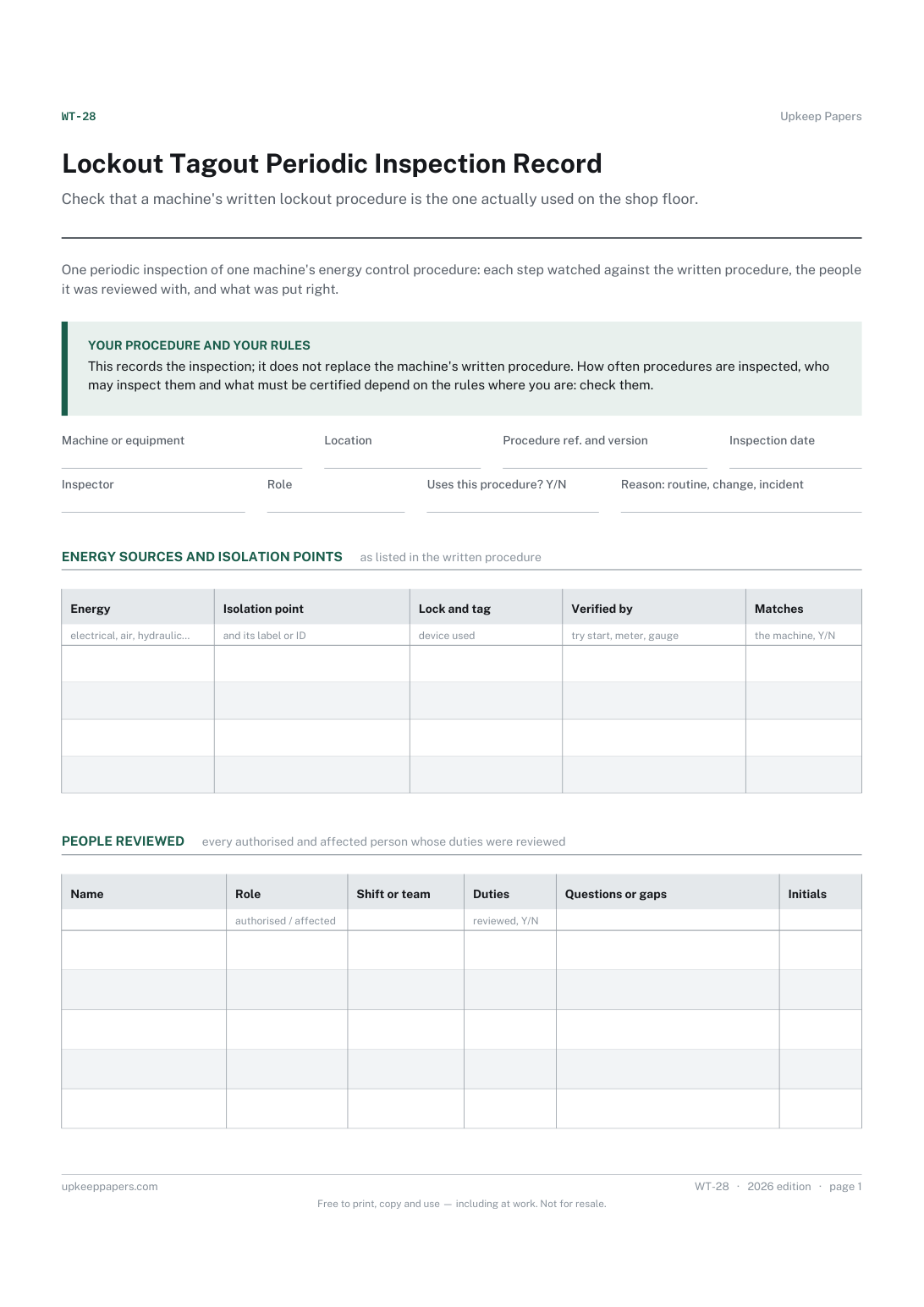
Check that a machine's written lockout procedure is the one actually used on the shop floor. Each deviation found is written down with what was done about it.
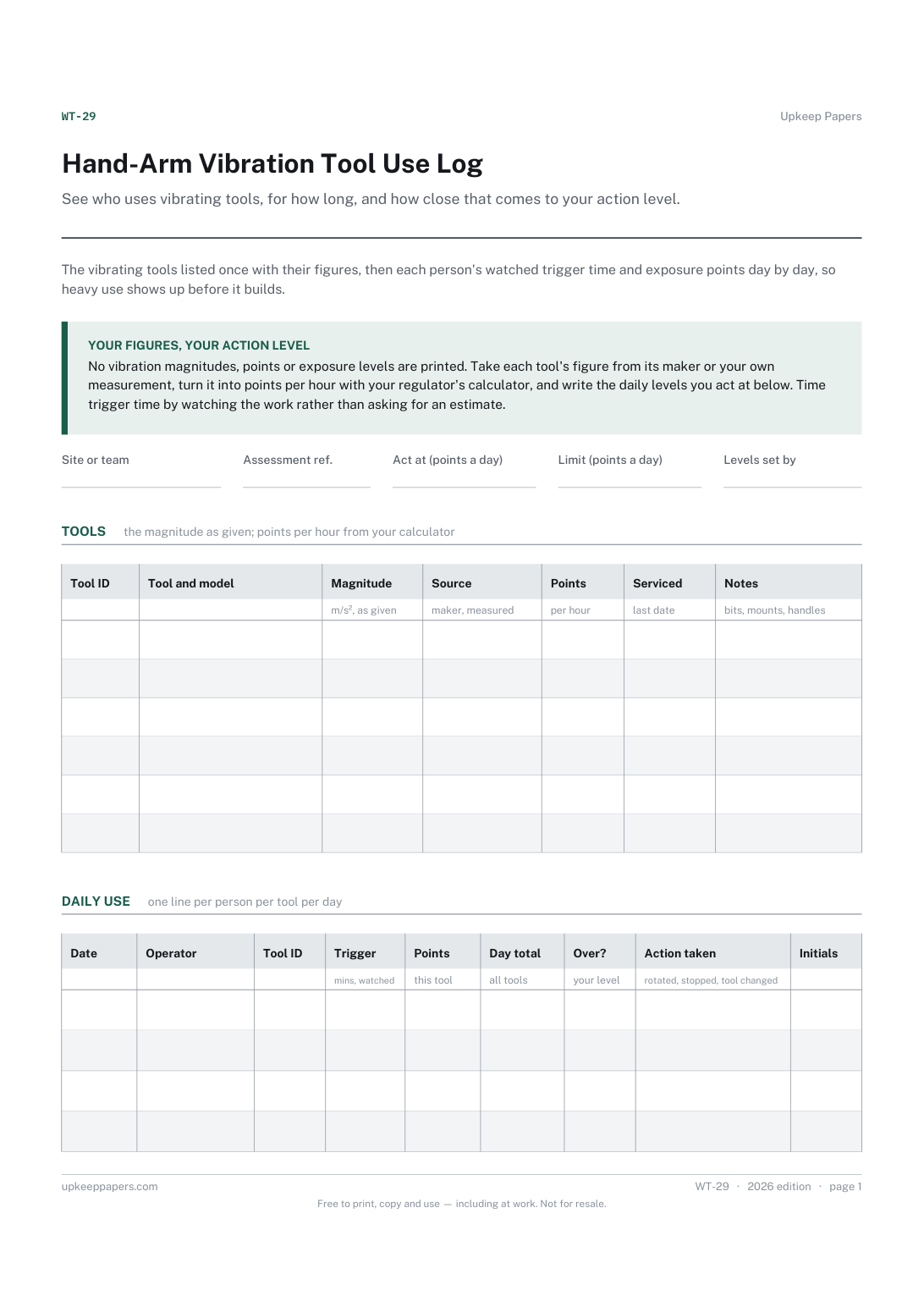
See who uses vibrating tools, for how long, and how close that comes to your action level. A day over the level shows up on the sheet, with what was done about it.
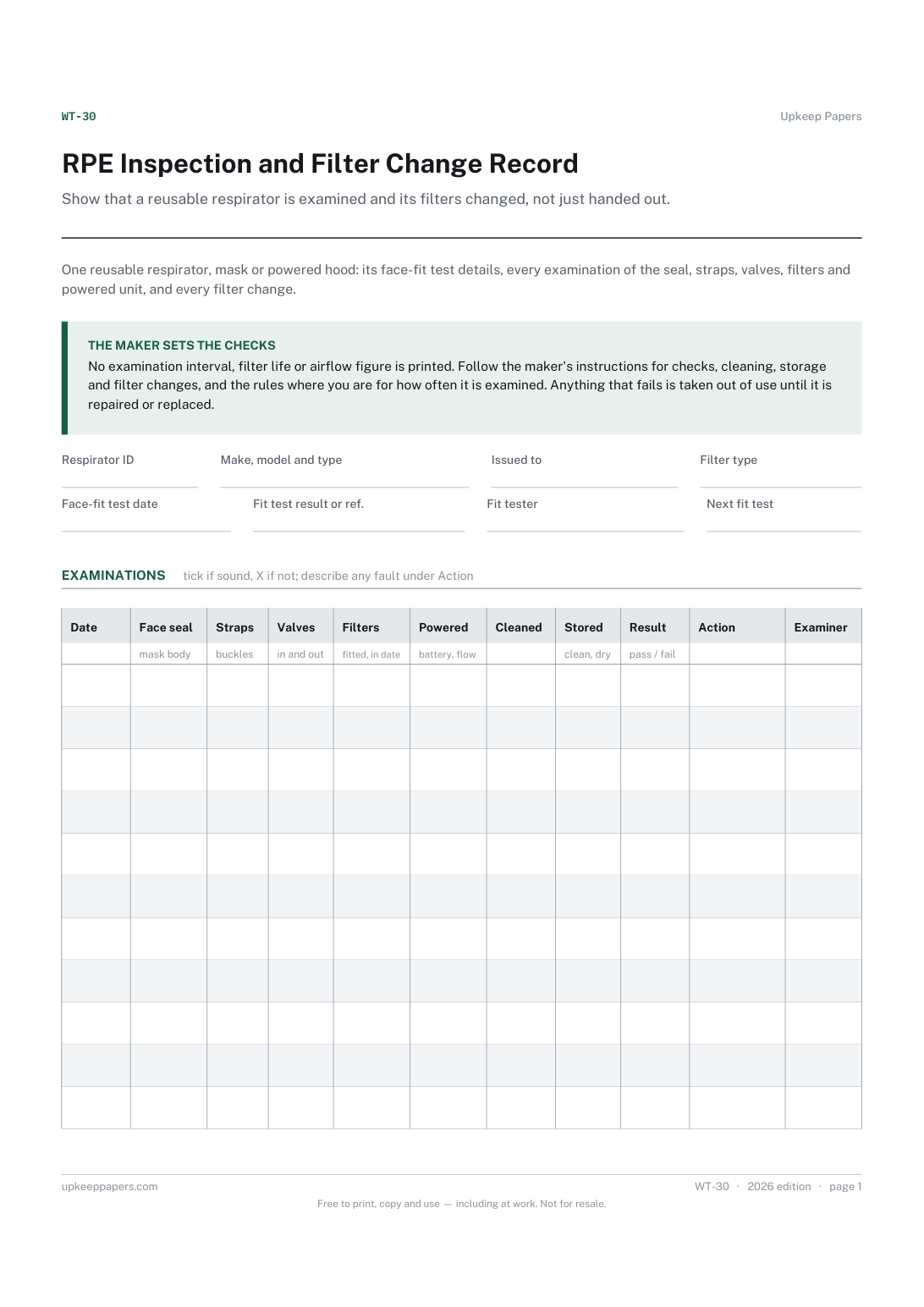
Show that a reusable respirator is examined and its filters changed, not just handed out. A failed check takes it out of use until it is repaired or replaced.
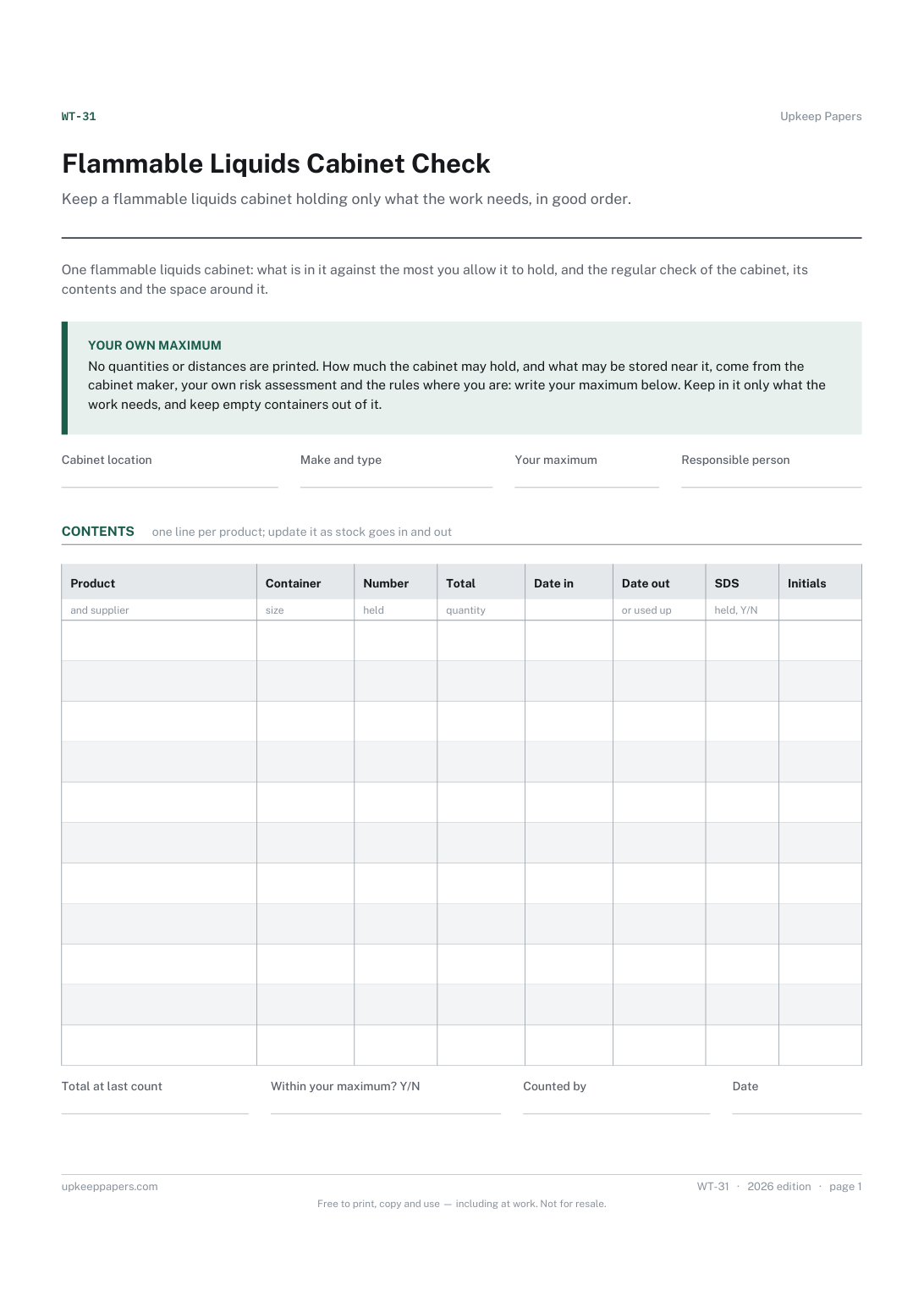
Keep a flammable liquids cabinet holding only what the work needs, in good order. The contents list shows what is in it, and the checks show how it is kept.
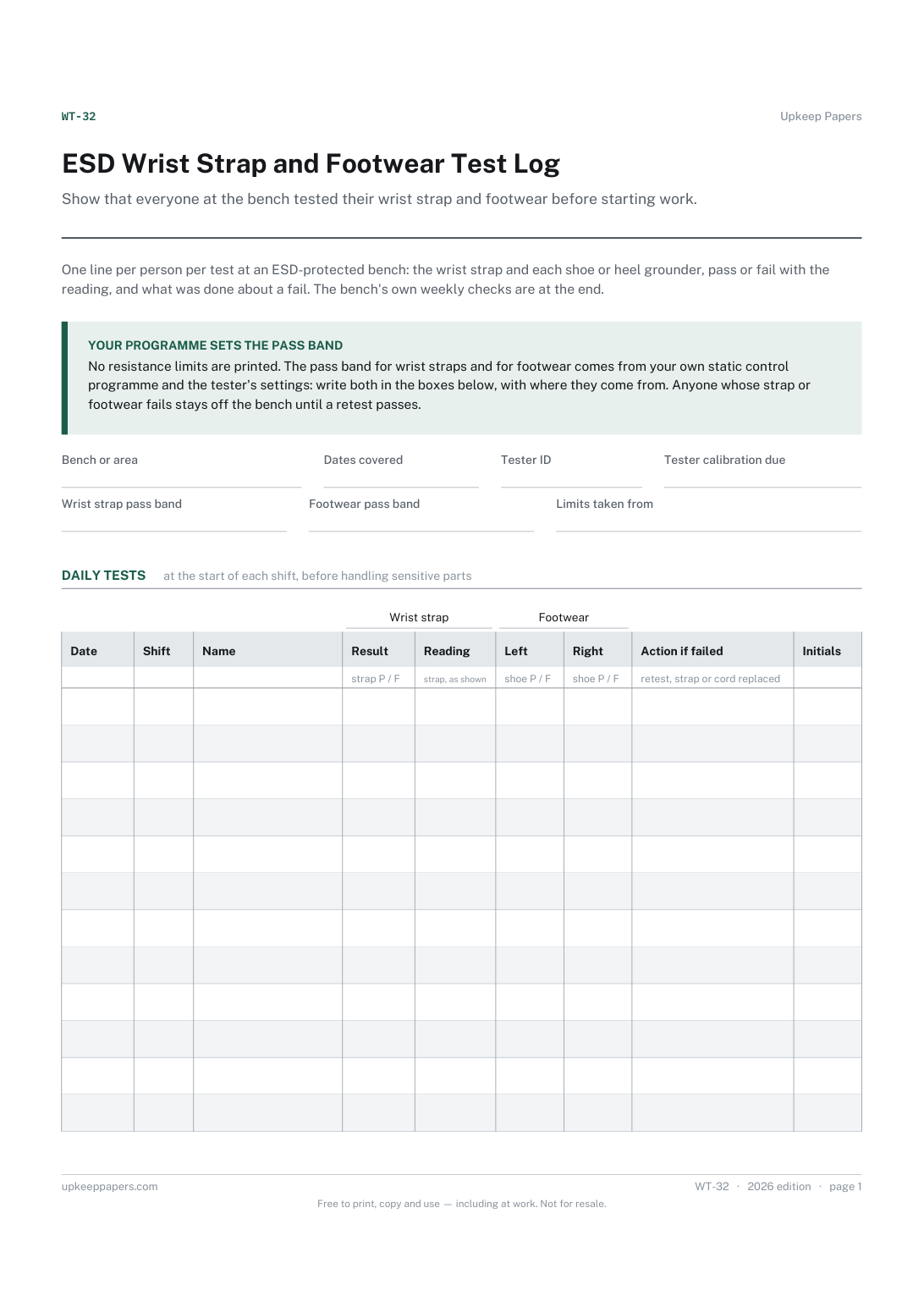
Show that everyone at the bench tested their wrist strap and footwear before starting work. A failed strap only does harm if nobody notices and someone works on with it.
Elsewhere in the library
The paperwork that covers the whole building — service history, registers, warranties and the seasonal rounds.
Heating, hot water, ventilation, drainage and water supply — the fixed systems that need servicing on a schedule.
Alarm tests, extinguisher checks and the records that prove they happened.
Mowers, saws, generators, washers, compressors and tractors — hour-based servicing and the part numbers you can never find.
Cars, motorcycles, motorhomes, trailers and boats — service history, schedules and pre-use inspections.
Pools, hot tubs and private water supplies — chemistry logs and test records.
Maintenance logs, periodic inspections and changeover checklists for let property.
Vaccination and health records, sitter instructions and the emergency details somebody else would need if you were not there.
Trailers, horseboxes, caravans and boats — annual service records, pre-use inspections and the towing figures you should never be guessing at.
Cleaning schedules, rotas, deep-clean checklists and the dated records a cleaning routine is supposed to leave behind.
The paperwork of changing address — moving, viewing, snagging, renovating and switching the supplies over.
Sowing plans, plot layouts, greenhouse logs, compost records and fruit tree histories — blank wherever the answer depends on where you garden.
Husbandry records for reptiles, amphibians, fish, small mammals and birds — the readings, feeds and weights that keep an animal well.
The sheet that goes out in the van: what was quoted, what was fitted, what it took and what the customer signed.
Job cards, parts, road tests and the paperwork that follows a car through a workshop from booking in to handing back.
Shifts, runs, checks and hours — for the people whose office is a vehicle.
Goods in, picked, packed, counted and despatched — the paper trail down the aisle.
Rooms turned round, guests arrived, faults reported and the shift handed over.
Prep done, tables planned, lines cleaned, waste counted and the till cashed up.
The till, the stockroom, the shelf edge and the routines that open and close the door.
Batches made, yields counted and where every ingredient came from.
Pitches let, hook-ups metered, blocks cleaned and the site walked.
What was done to whom, with what, and what they said about it last time.
The gig booked, the stage plotted, the set played and the show reported.
Firings, cuts, pours and settings — written down so the good one can be repeated.
Setup, times, tyres and fuel — the numbers that make the next session faster.
Team sheets, scorebooks, training plans and the club admin behind a fixture.
Rotas filled, halls booked, collections counted and volunteers looked after.
What kit exists, who has it, whether the backup ran and when the licence expires.
Units let, keys issued, payments tracked and loads moved.
Flock and herd records, medicine and movement books, and the application records that have to be produced when somebody asks.
Project planners, stash inventories and machine logs — for quilting, sewing, printing, modelling and selling what you make.
Shot lists, kit inventories and job records — for getting the shot, insuring the kit and finding out what the work actually pays.
Logbooks and trip plans for time spent outdoors — dives made, water paddled, rounds played.
Sheets for the hour you spend standing in front of a car you are thinking of buying, and for comparing it afterwards with the others you saw.
Inspection records for hives and colonies, built so this week's visit can be read against the last three.
Due-date charts and care records for horses and ponies, with the intervals left blank for the ones your own farrier, vet and dentist give you.
Visitor sign-in pages and key registers — who is in the building, who let them in, and what has not come back.
Per-fill fuel and cost records, kept unit-neutral so the same sheet works wherever you buy fuel and whatever your odometer reads in.
Kit checks, expiry dates and restocking — dated on paper and signed by whoever actually did them.
Logbooks for the things people do for the love of it, built to hold hours, conditions and the incident nobody wants to reconstruct from memory.
What is on the shelf, how much of it you want there, and what needs reordering before the recipe stops.
What seed you actually have, whether it still germinates, and what the plot really produced.
The dated, initialled rounds that show a space was actually attended to rather than merely meant to be.
Session logs and equipment records for training — what you did, and what your kit has done.
Itemised records for collections and valuables — what you own, what it cost, and what can be evidenced about it.
The paperwork a committee, a small office or a one-person project runs on — minutes, agendas, actions, decisions, risks and issues.
The money paperwork a one-person business runs on — invoices, estimates, receipts, orders, price lists and the sheets that show what a job really cost.
The records a small employer actually needs: hours, leave, rotas, reviews, training and the two checklists that make starting and leaving orderly.
Permits, method statements, diaries and inspection registers for building sites, yards and anywhere work is done under control.
Blank sheets for a classroom, a tutor, a club or an evening's babysitting — registers, marks, seating, reading and trips.
The paperwork a sports club, a society or a village hall committee runs on — members, subs, kit, duties, scores and fixtures.
Sheets with no subject at all — blank logs, blank checklists, tally sheets and report forms you head yourself.
Records for a working kitchen — what a dish costs, what was made from which batch, what was checked, cleaned and thrown away.
Two sheets for going somewhere: a packing list you write once and reuse, and a road trip planned day by day.

Every sheet, binder, game and puzzle on Upkeep Papers is free to download, with no email and no account. Making them is not free: each one takes days of research, design and checking, and the site costs money to run. If something here saved you time, you can buy us a coffee. It is entirely optional: nothing is locked, and nothing changes if you don’t.
Buy us a coffee Opens PayPal in a new tab. Any amount, and nothing changes if you would rather not.