Used Car Pre-Purchase Inspection Sheet
Carry out the same inspection on every car you view, so a decision made in somebody's driveway is based on what you saw rather than what you remember.
VB-01 2 pages
Everything here is free. Making it takes time and money. Everything here is free.
 Buy us a coffee
Vehicle buying and selling · VB-10
A free printable project car buying checklist — identity and numbers, corrosion, mechanicals and completeness, with a table of what is missing or still to do.
2 pages. Choose your paper size — both versions are laid out identically, so neither one gets shrunk to fit.
Print it and write on it
Fill it in type and save
The fillable versions have real form fields — open them in any PDF reader, type into them and save. Printing help.
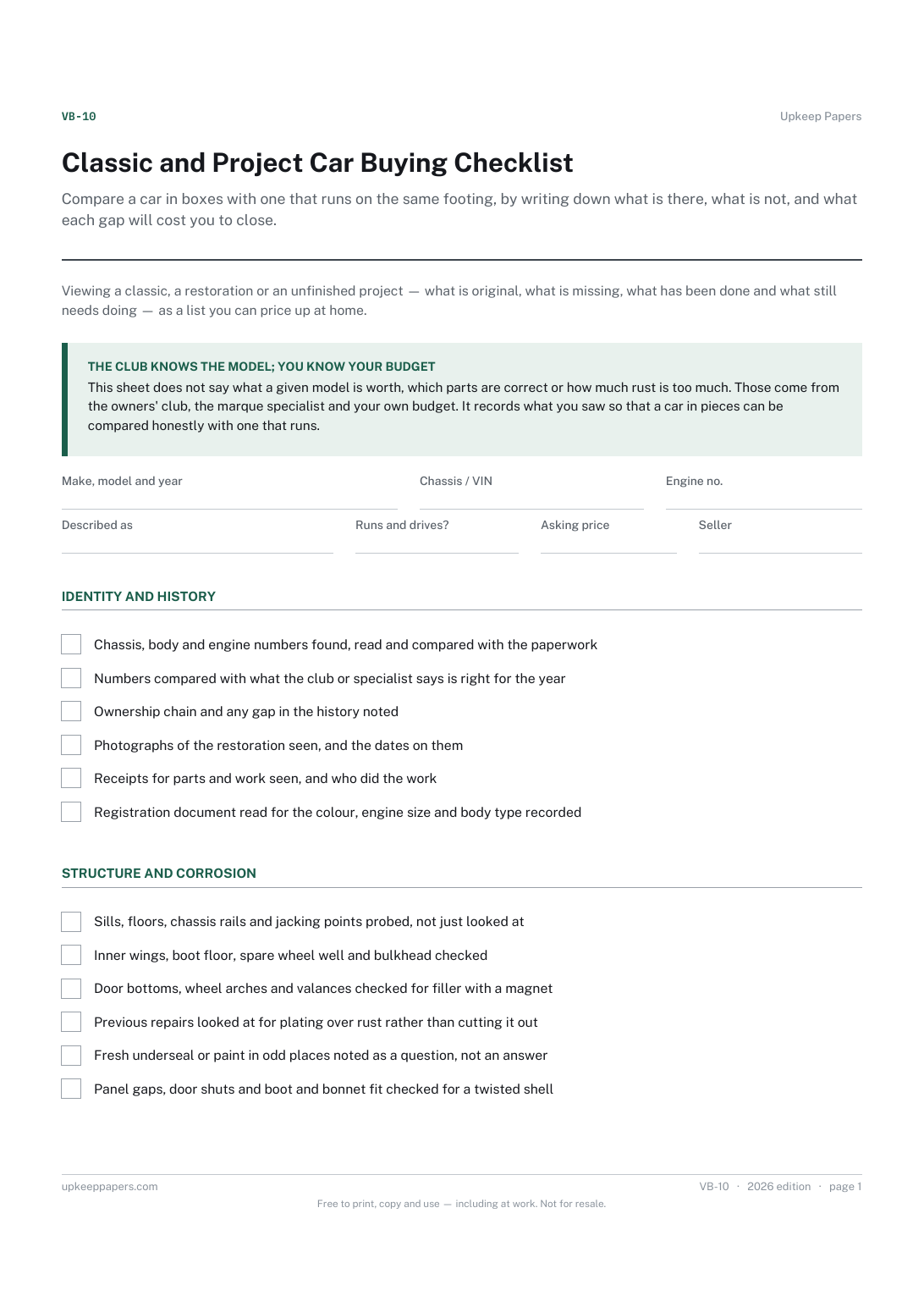
Compare a car in boxes with one that runs on the same footing, by writing down what is there, what is not, and what each gap will cost you to close.
Buyers of a classic, a part-finished restoration or a bare project, and anyone who has ever underestimated a box of parts.
2 pages, in this order:
Printed under the title: Viewing a classic, a restoration or an unfinished project — what is original, what is missing, what has been done and what still needs doing — as a list you can price up at home.
The club knows the model; you know your budget. This sheet does not say what a given model is worth, which parts are correct or how much rust is too much. Those come from the owners' club, the marque specialist and your own budget. It records what you saw so that a car in pieces can be compared honestly with one that runs.
Write-on lines: Make, model and year · Chassis / VIN · Engine no. · Described as · Runs and drives? · Asking price · Seller
Table, 10 rows: Item or job · Present? · Condition · Where to source · Your estimate
Because both are model-specific and change with the market. The owners' club and a marque specialist know which numbers, colours and parts are right for a particular year, and what a car in this state is fetching. The sheet gives you the list to take to them.
Skip the running checks and say so in the fields at the top. The completeness table matters more on a non-runner, because the missing parts are the price.
Carry out the same inspection on every car you view, so a decision made in somebody's driveway is based on what you saw rather than what you remember.
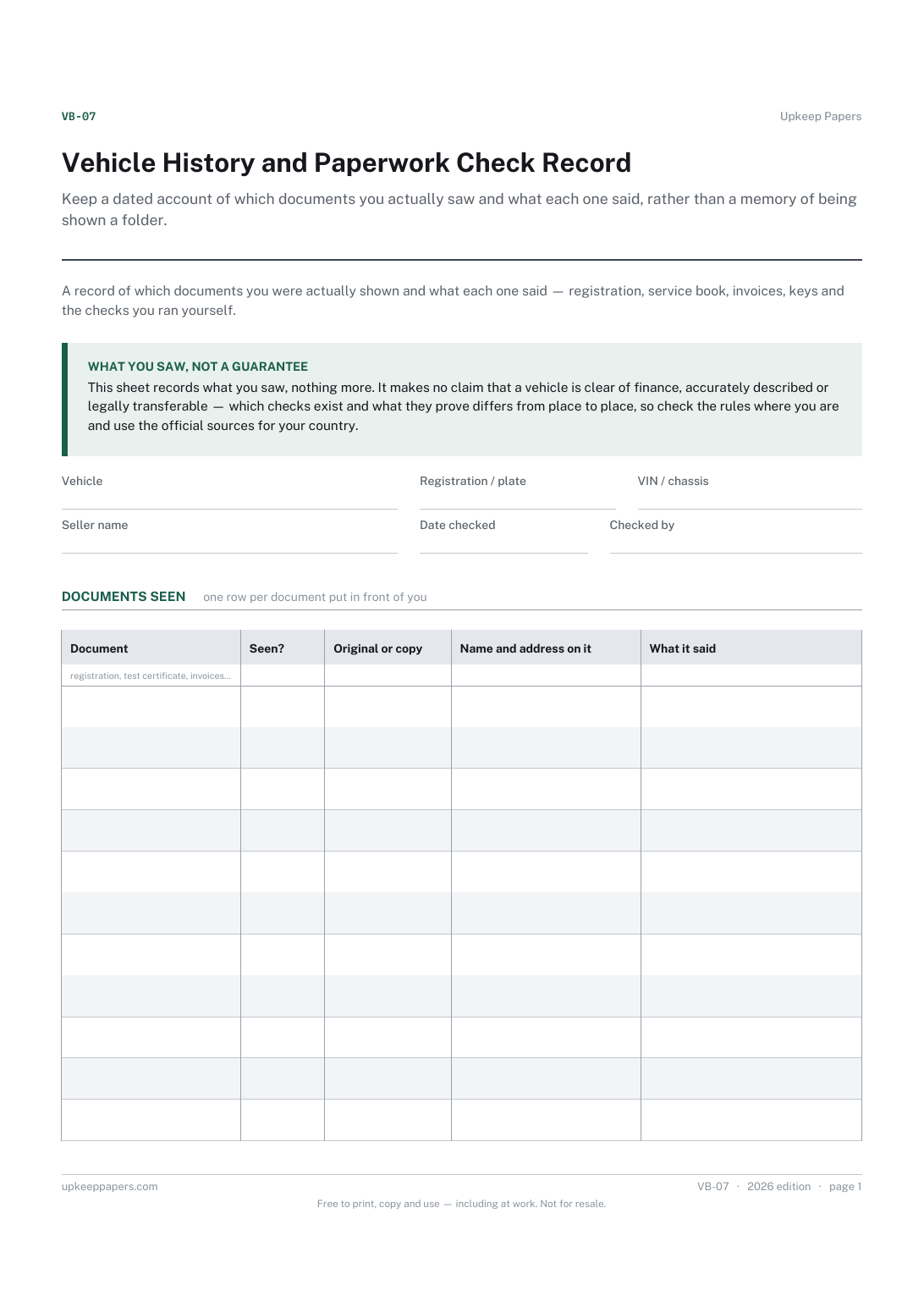
Keep a dated account of which documents you actually saw and what each one said, rather than a memory of being shown a folder.
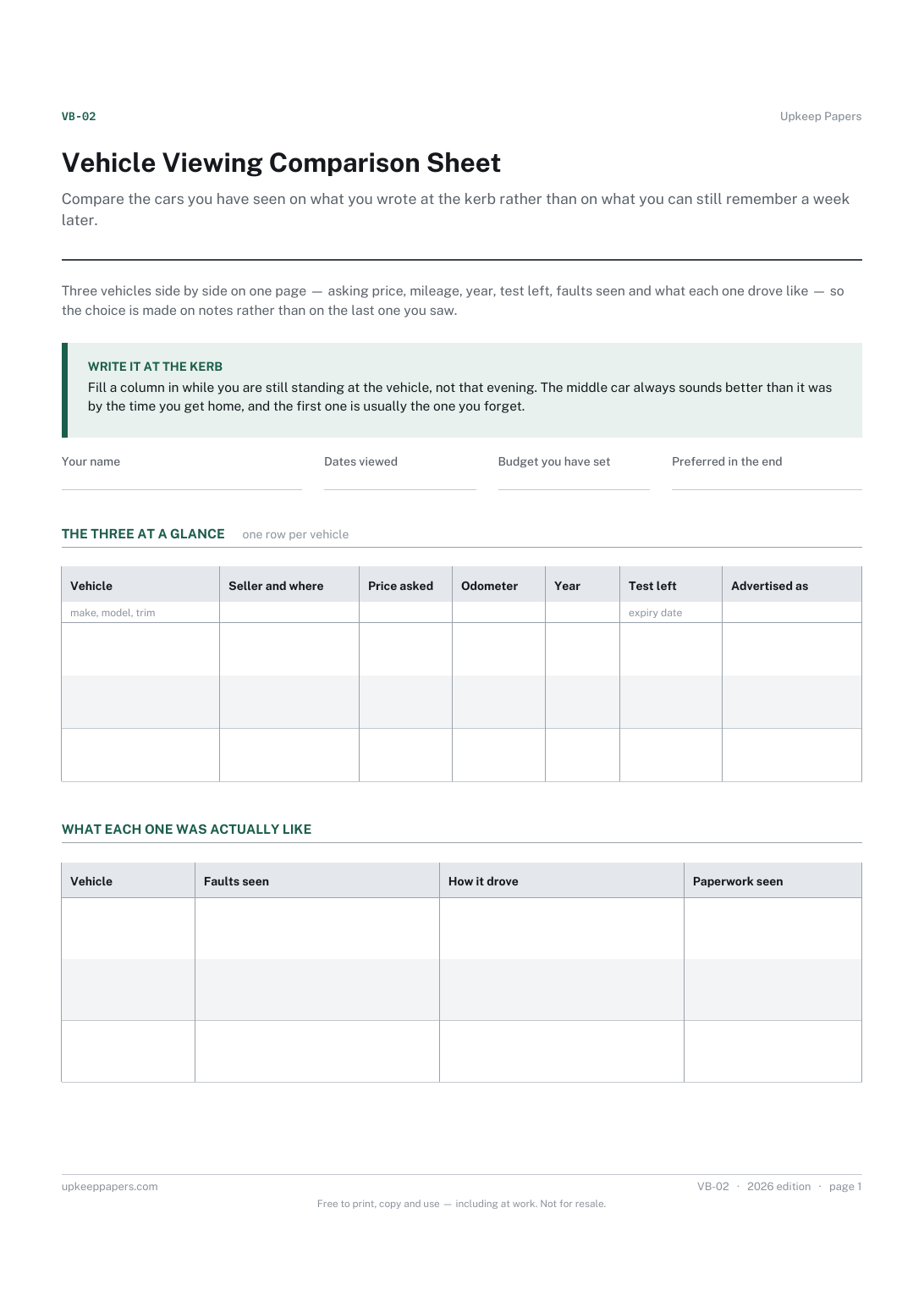
Compare the cars you have seen on what you wrote at the kerb rather than on what you can still remember a week later.
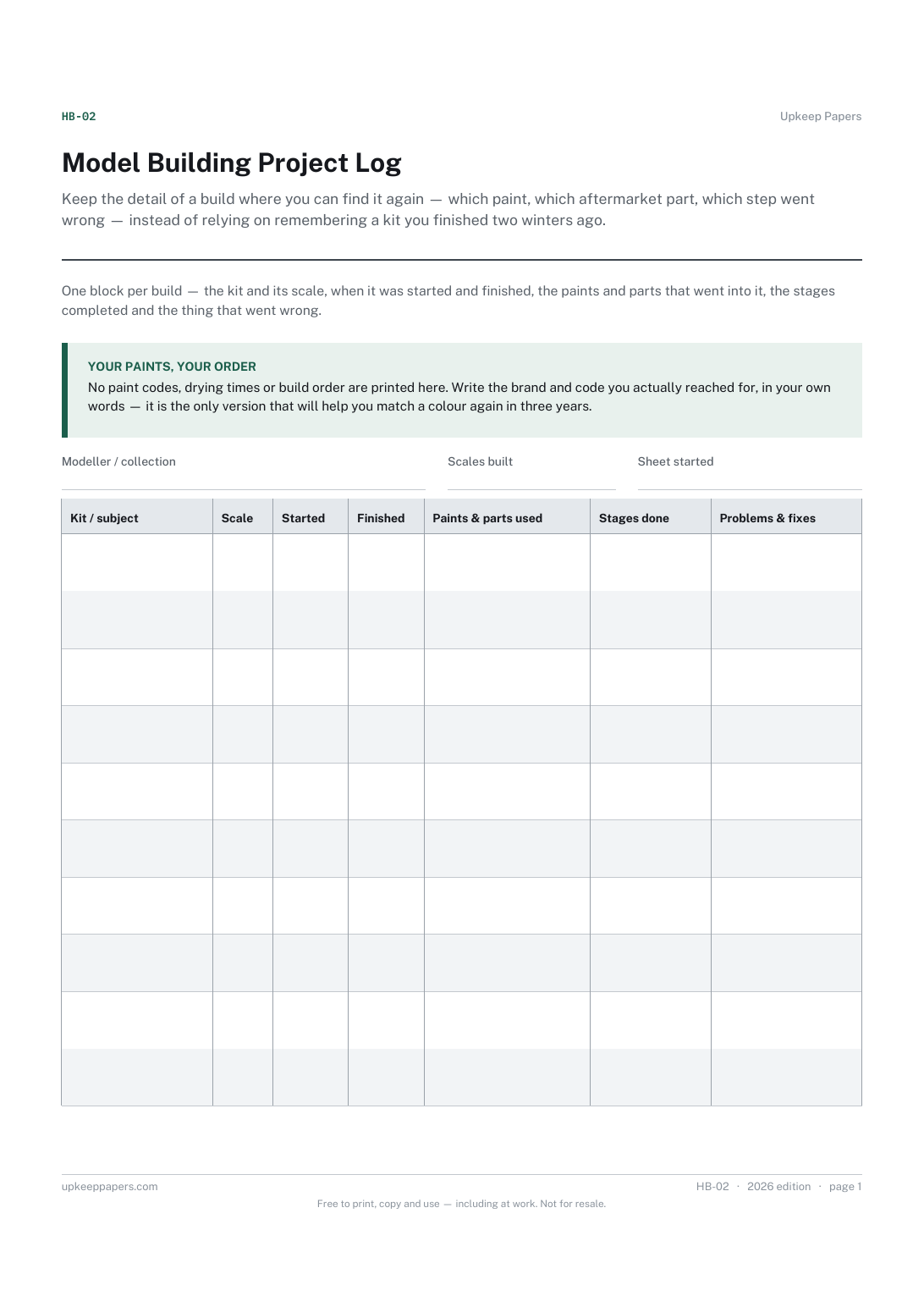
Keep the detail of a build where you can find it again — which paint, which aftermarket part, which step went wrong — instead of relying on remembering a kit you finished two winters ago.

Every sheet, binder, game and puzzle on Upkeep Papers is free to download, with no email and no account. Making them is not free: each one takes days of research, design and checking, and the site costs money to run. If something here saved you time, you can buy us a coffee. It is entirely optional: nothing is locked, and nothing changes if you don’t.
Buy us a coffee Opens PayPal in a new tab. Any amount, and nothing changes if you would rather not.