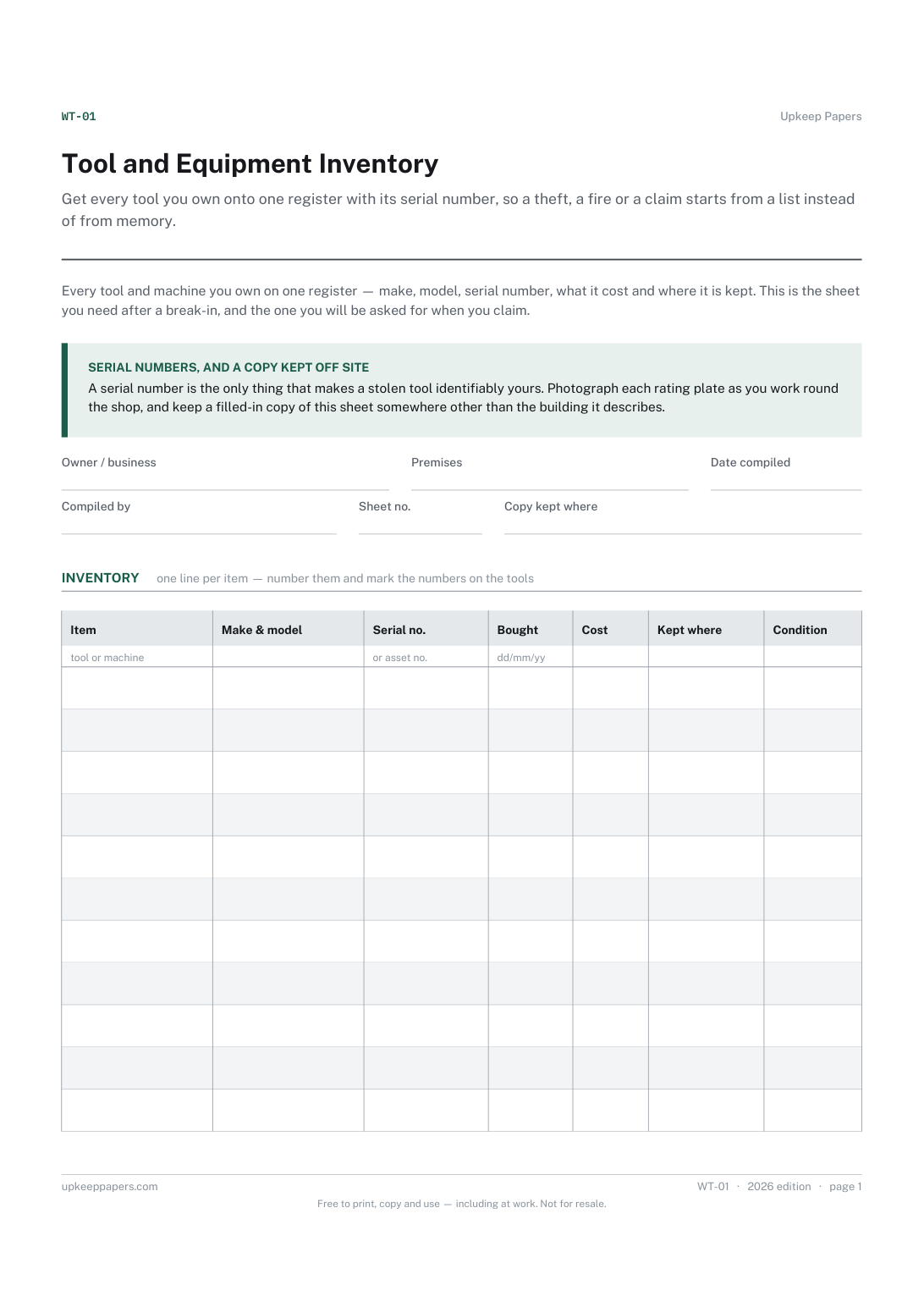
Tool and Equipment Inventory
Get every tool you own onto one register with its serial number, so a theft, a fire or a claim starts from a list instead of from memory.
WT-01 1 page
Everything here is free. Making it takes time and money. Everything here is free.
 Buy us a coffee
Workshop and tools · WT-27
A free printable tool control sheet: a toolkit counted out before each job and back in after, with missing tool reports and a regular audit of the whole kit.
2 pages. Choose your paper size — both versions are laid out identically, so neither one gets shrunk to fit.
Print it and write on it
Fill it in type and save
The fillable versions have real form fields — open them in any PDF reader, type into them and save. Printing help.
Make sure no spanner is left inside a machine, an engine bay or a panel when it is closed up. Every count is signed, and every missing tool has a recorded search.
Maintenance teams, aircraft and vehicle technicians, and anyone working where a forgotten tool can damage a machine or hurt someone.
2 pages, in this order:
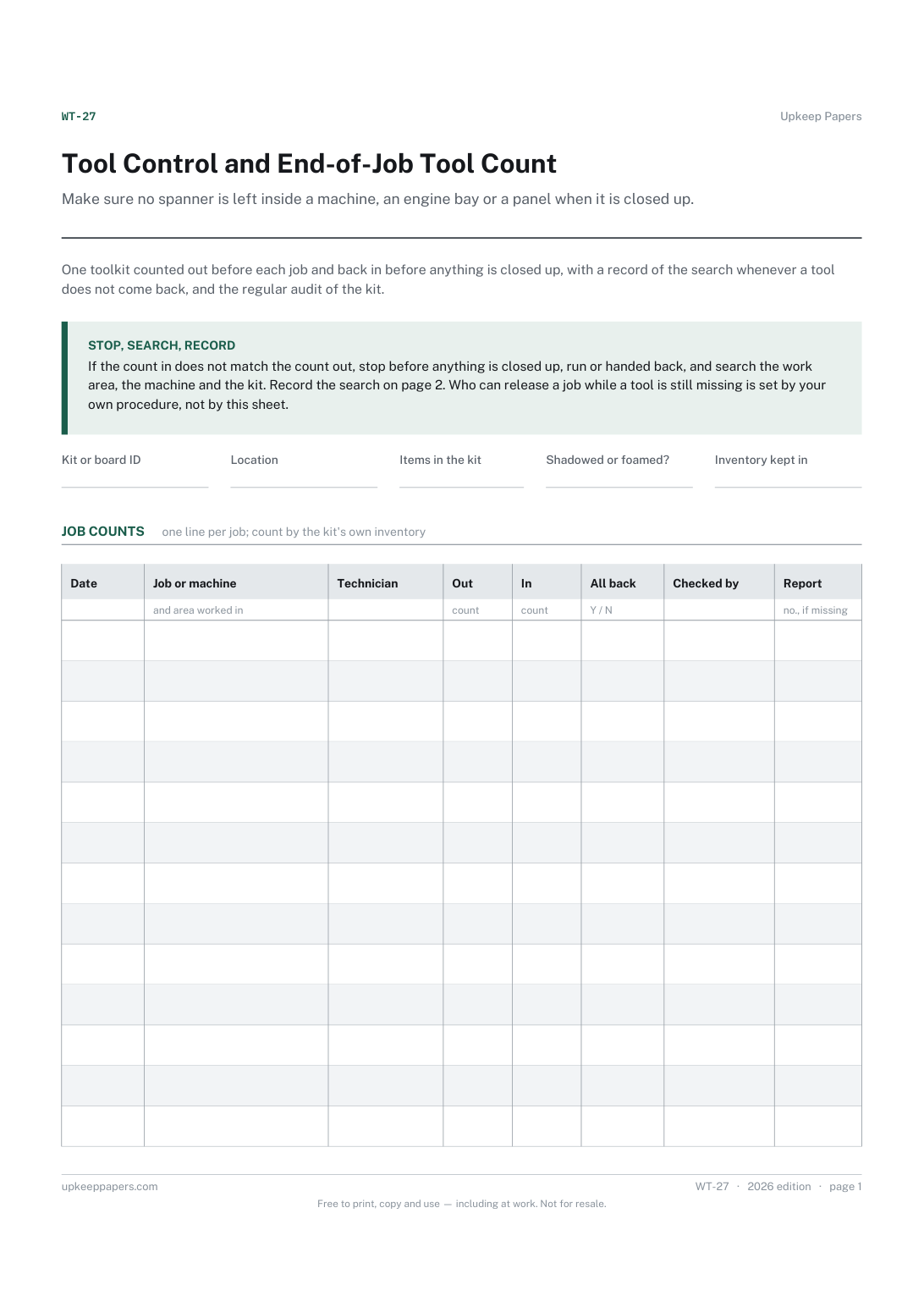
Printed under the title: One toolkit counted out before each job and back in before anything is closed up, with a record of the search whenever a tool does not come back, and the regular audit of the kit.
Stop, search, record. If the count in does not match the count out, stop before anything is closed up, run or handed back, and search the work area, the machine and the kit. Record the search on page 2. Who can release a job while a tool is still missing is set by your own procedure, not by this sheet.
Write-on lines: Kit or board ID · Location · Items in the kit · Shadowed or foamed? · Inventory kept in
Table, 20 rows: Date · Job or machine · Technician · Out · In · All back · Checked by · Report
Table, 4 rows: No. · Date · Tool and ID · Last seen · Searched · Found? · Job · Reported to
Table, 4 rows: Date · Audited by · Count · Missing · Damaged · Replaced · Initials
A tool left inside a machine, an engine or an electrical panel can damage it when it starts, or hurt the next person who opens it up. A count before closing up catches it while the covers are still off.
Who can release the job is set by your own procedure. The sheet records the search, where the tool was last seen, whether the job was released or held and who was told, so the decision is written down.
Get every tool you own onto one register with its serial number, so a theft, a fire or a claim starts from a list instead of from memory.
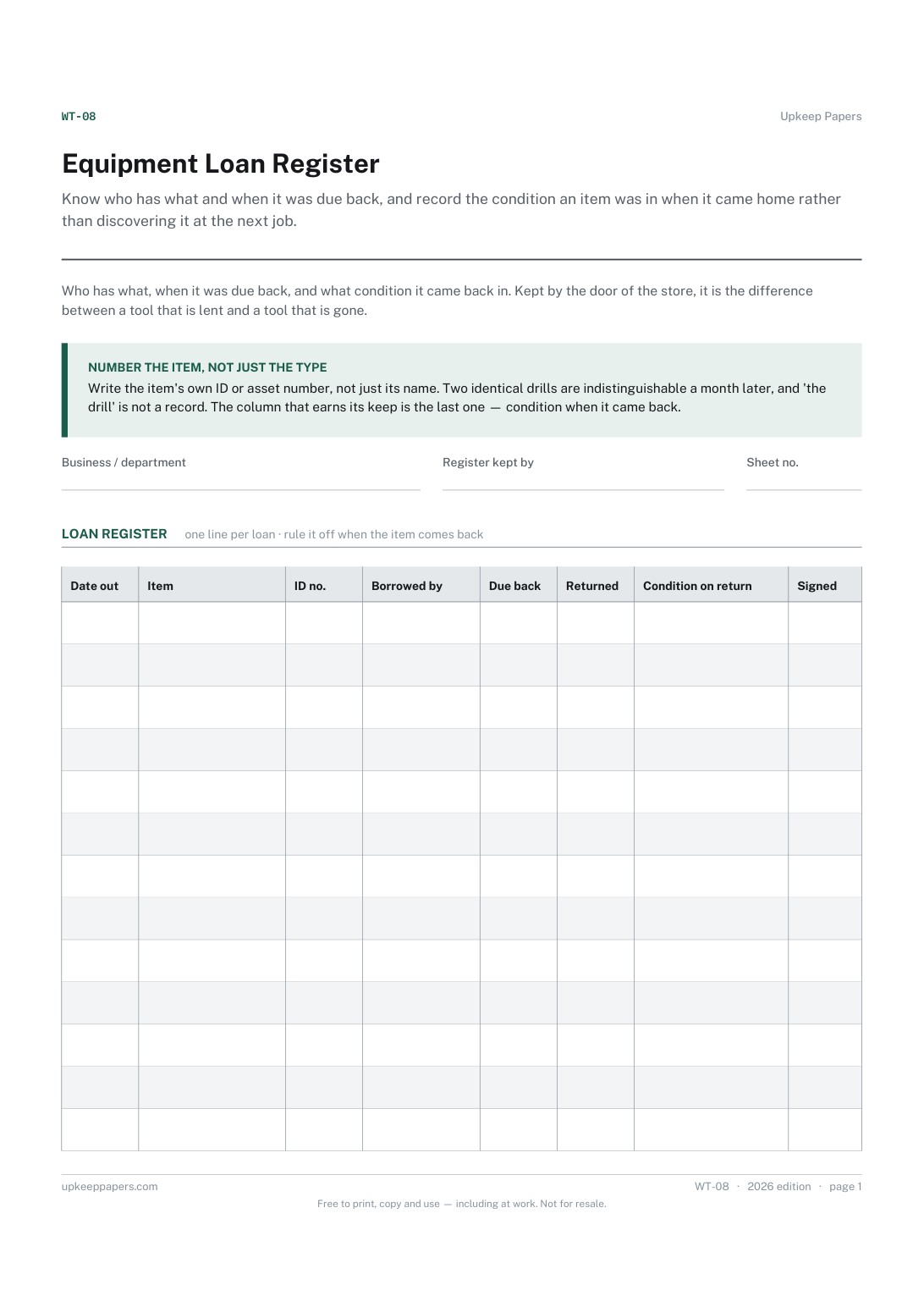
Know who has what and when it was due back, and record the condition an item was in when it came home rather than discovering it at the next job.
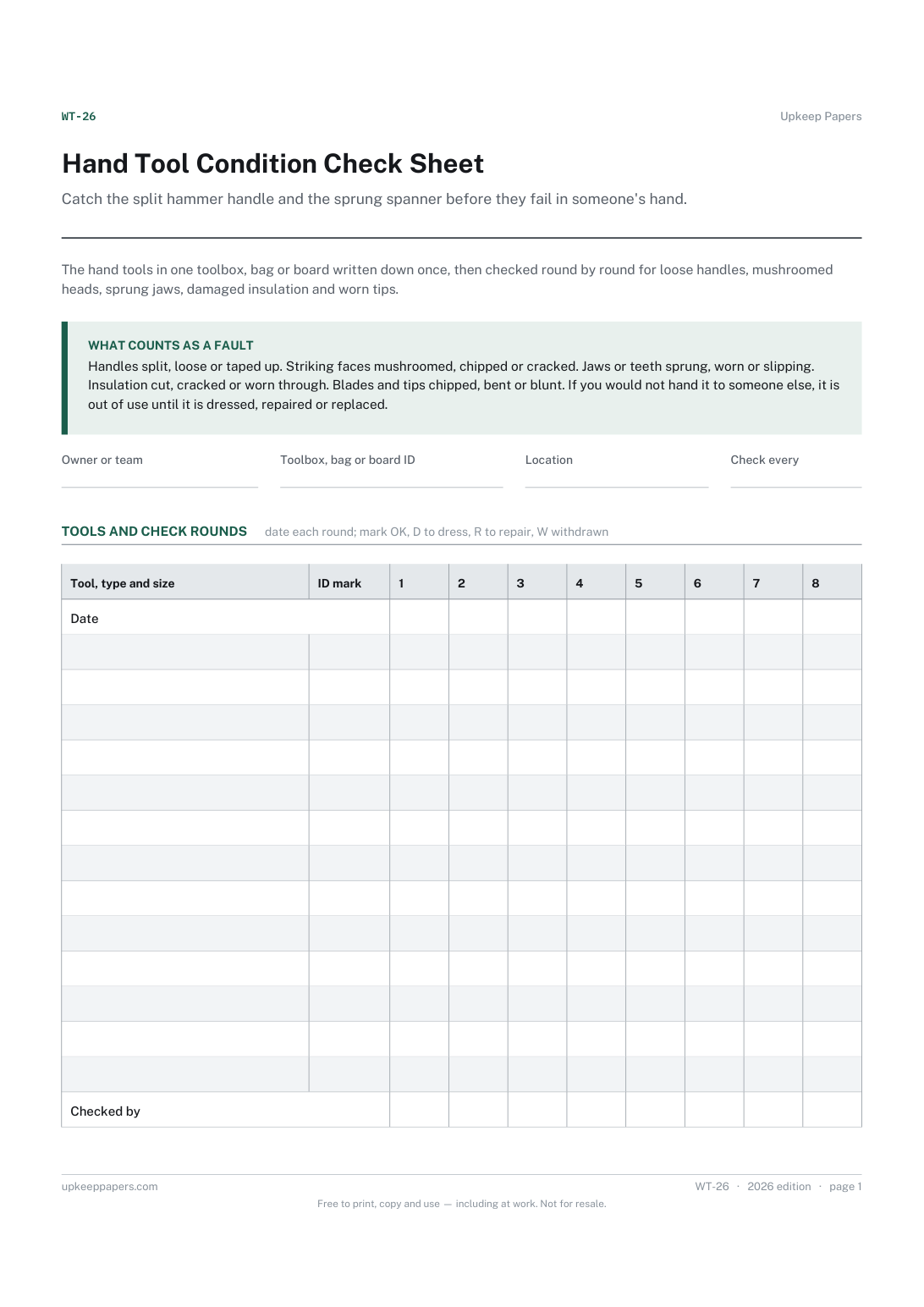
Catch the split hammer handle and the sprung spanner before they fail in someone's hand. Every tool withdrawn, dressed or repaired is logged with what was done.
Record what the business owns rather than what is in the shed: a numbered list with cost and disposal, which is what an insurer or an accountant asks for.

Every sheet, binder, game and puzzle on Upkeep Papers is free to download, with no email and no account. Making them is not free: each one takes days of research, design and checking, and the site costs money to run. If something here saved you time, you can buy us a coffee. It is entirely optional: nothing is locked, and nothing changes if you don’t.
Buy us a coffee Opens PayPal in a new tab. Any amount, and nothing changes if you would rather not.