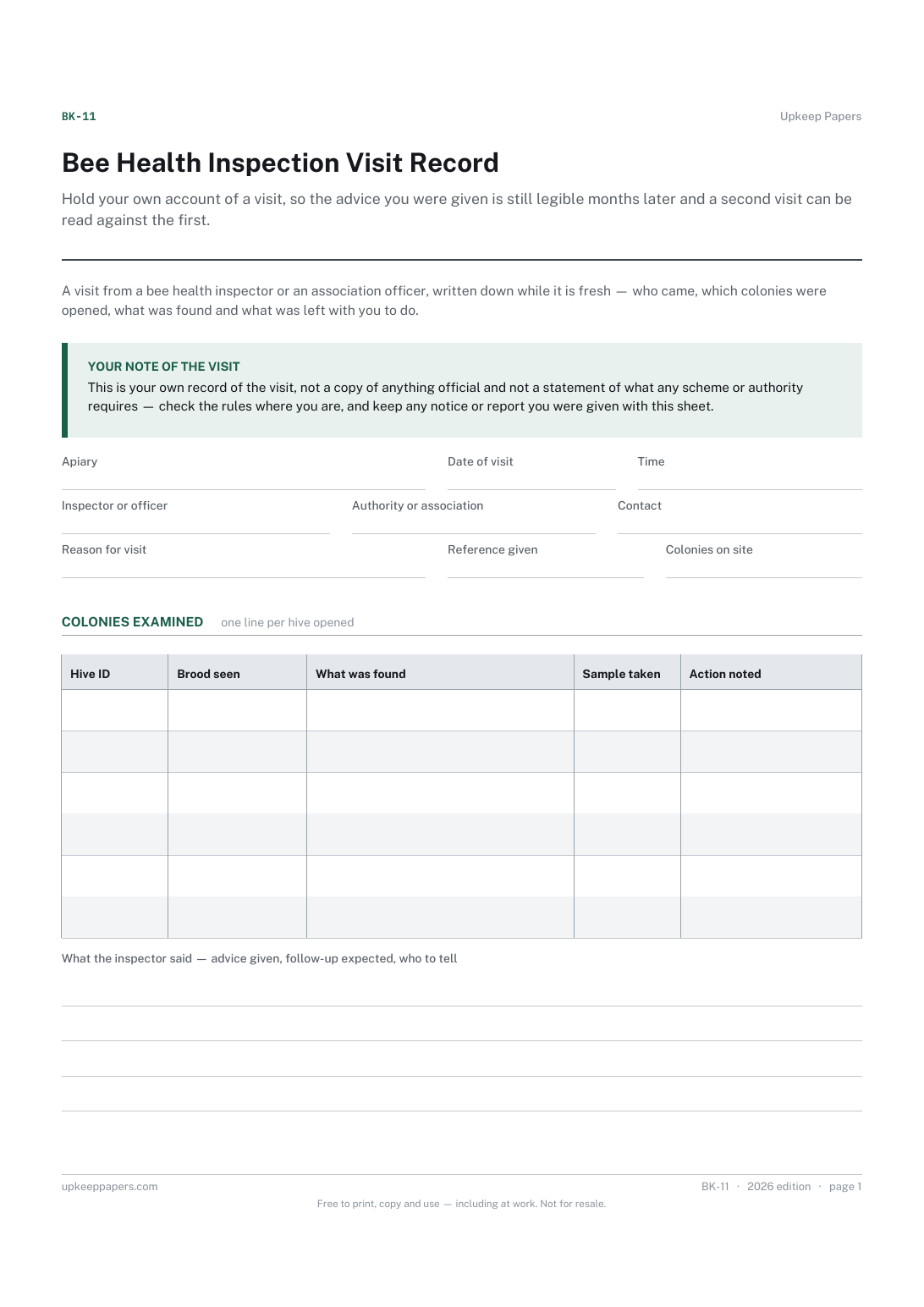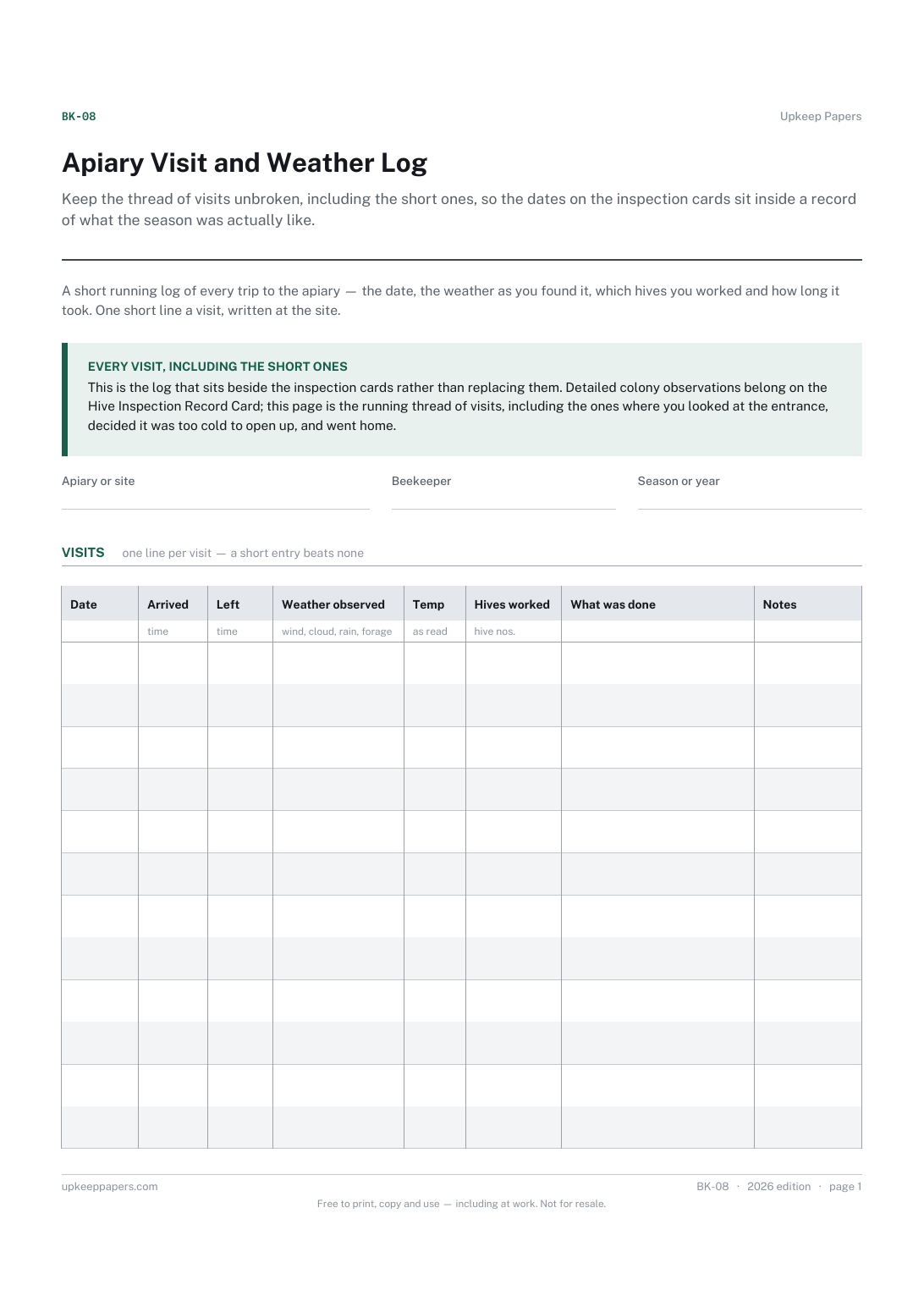
Apiary Visit and Weather Log
Keep the thread of visits unbroken, including the short ones, so the dates on the inspection cards sit inside a record of what the season was actually like.
BK-08 1 page
Everything here is free. Making it takes time and money. Everything here is free.
 Buy us a coffee
Beekeeping · BK-16
A free printable Asian hornet monitoring log: stations numbered once, every check, hornets seen at the hives, and each report sent with its reference.
2 pages. Choose your paper size — both versions are laid out identically, so neither one gets shrunk to fit.
Print it and write on it
Fill it in type and save
The fillable versions have real form fields — open them in any PDF reader, type into them and save. Printing help.
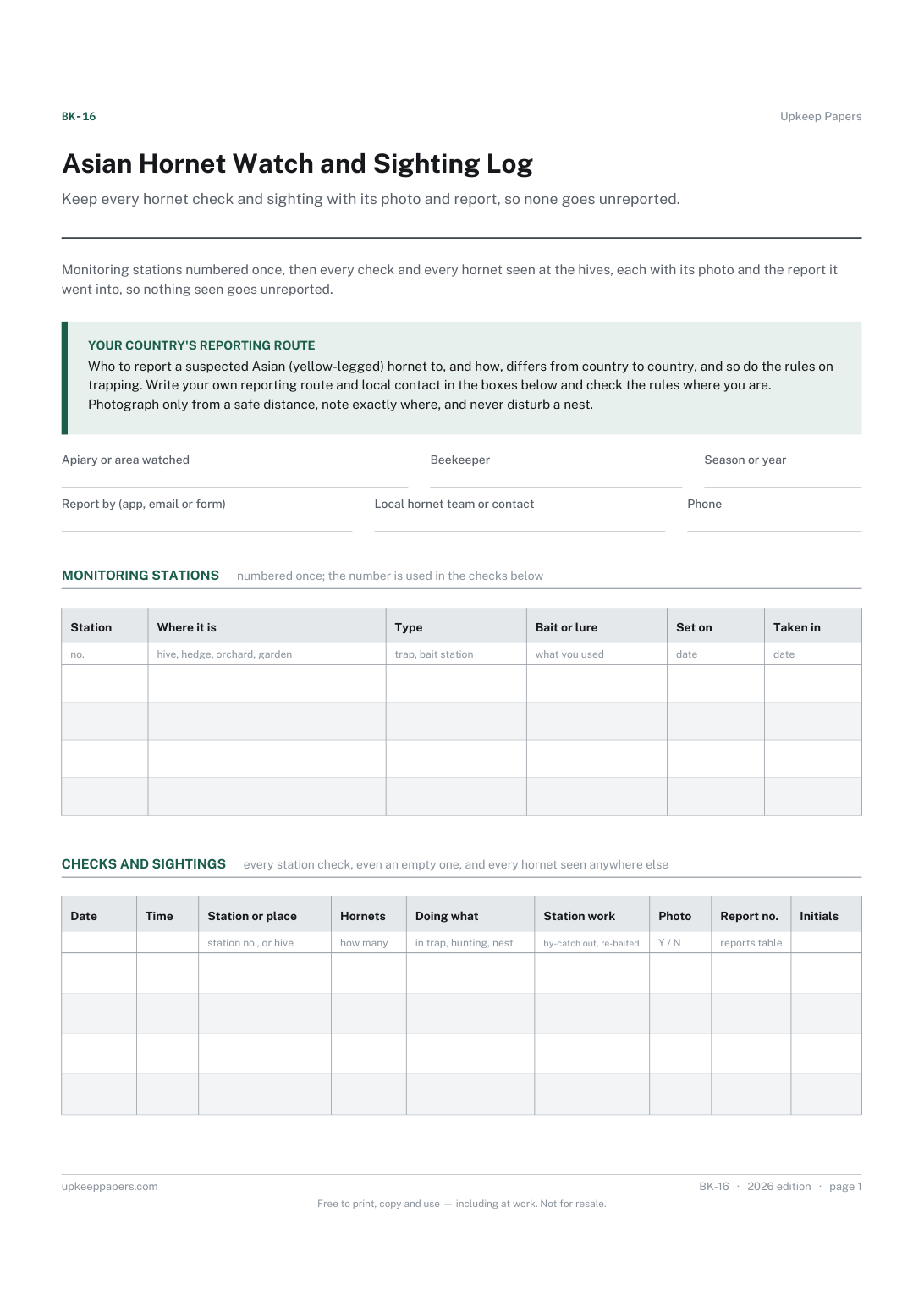
Keep every hornet check and sighting with its photo and report, so none goes unreported. A sighting scribbled on a seed packet is one that never reaches the people tracking down nests.
Beekeepers, association hornet watch volunteers and anyone running monitoring stations near hives.
2 pages, in this order:
Printed under the title: Monitoring stations numbered once, then every check and every hornet seen at the hives, each with its photo and the report it went into, so nothing seen goes unreported.
Your country's reporting route. Who to report a suspected Asian (yellow-legged) hornet to, and how, differs from country to country, and so do the rules on trapping. Write your own reporting route and local contact in the boxes below and check the rules where you are. Photograph only from a safe distance, note exactly where, and never disturb a nest.
Write-on lines: Apiary or area watched · Beekeeper · Season or year · Report by (app, email or form) · Local hornet team or contact · Phone
Table, 4 rows: Station · Where it is · Type · Bait or lure · Set on · Taken in
Table, 17 rows: Date · Time · Station or place · Hornets · Doing what · Station work · Photo · Report no. · Initials
Table, 6 rows: Report no. · Date · Sent by · Photo sent · Location given · Reference · Outcome
Because the route differs from country to country and changes over time, and where the hornet is already established, single sightings may not be wanted at all. Write the current route from your national authority or association in the box at the top, and the sheet stays right for your area.
Because a run of empty checks shows the station was being watched, and when the first hornet does turn up, the date of the last empty check tells the hornet team roughly when it arrived.
No. What to put in a station, and whether trapping is advised where you are at all, is guidance from your national authority or association. Write what you used in the stations table, so a change of bait can be read against the results.
Keep the thread of visits unbroken, including the short ones, so the dates on the inspection cards sit inside a record of what the season was actually like.
Hold your own account of a visit, so the advice you were given is still legible months later and a second visit can be read against the first.
Build a run of comparable inspections for one colony, so a failing hive can be told apart from a normal one by looking at the page rather than by memory.
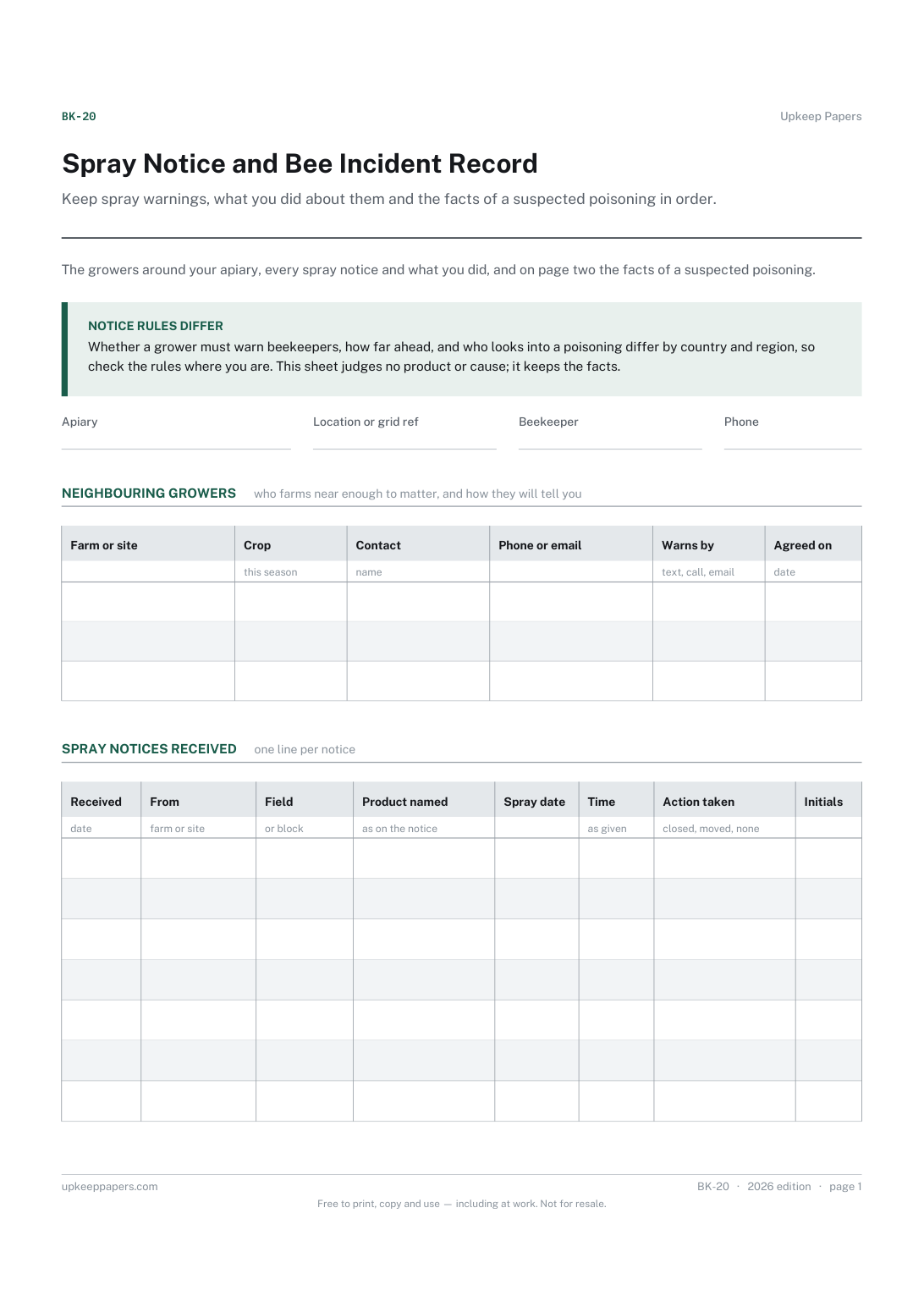
Keep spray warnings, what you did about them and the facts of a suspected poisoning in order. When something goes wrong, the dates, photos and samples are what anyone looking into it will ask for.
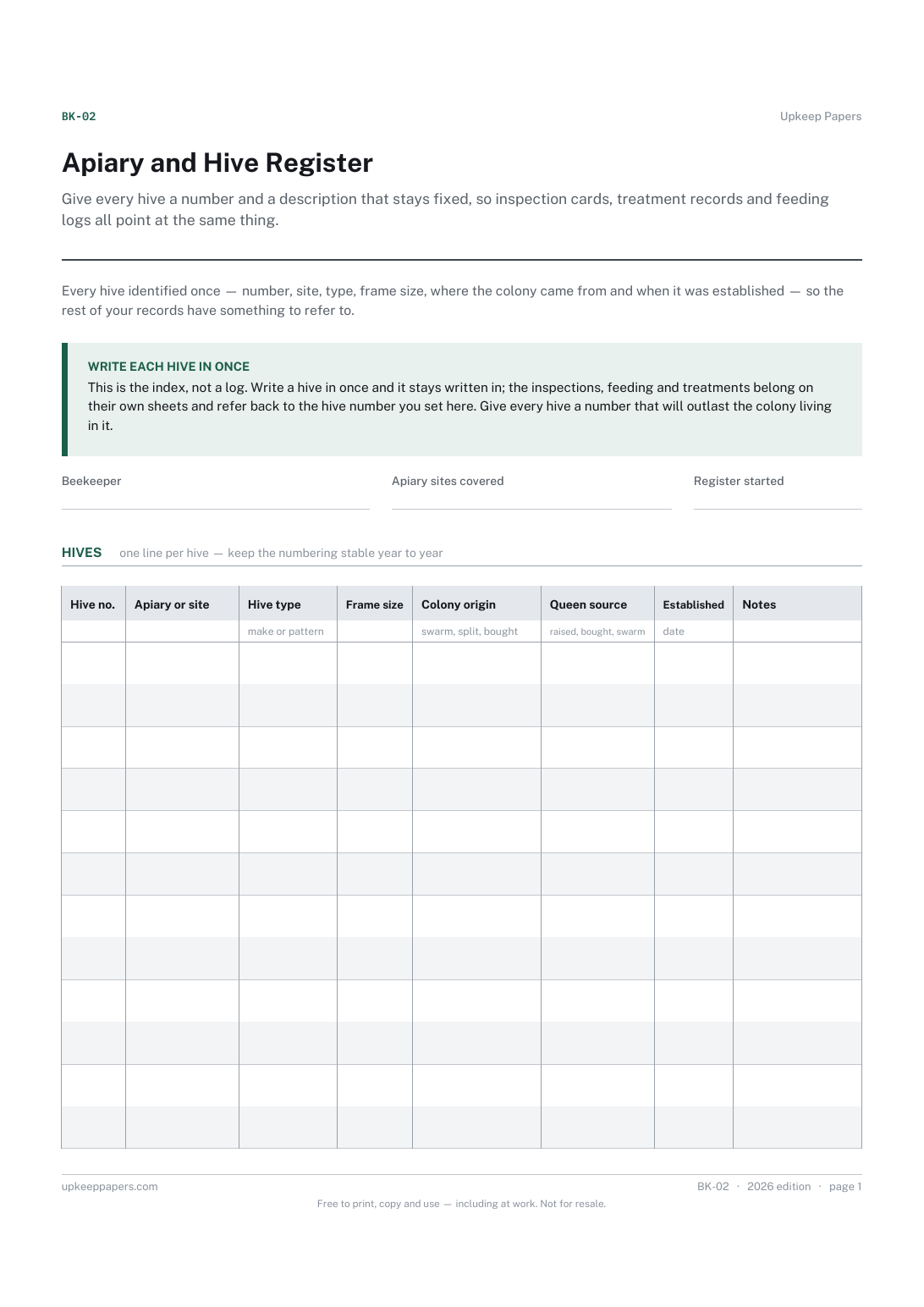
Give every hive a number and a description that stays fixed, so inspection cards, treatment records and feeding logs all point at the same thing.

Every sheet, binder, game and puzzle on Upkeep Papers is free to download, with no email and no account. Making them is not free: each one takes days of research, design and checking, and the site costs money to run. If something here saved you time, you can buy us a coffee. It is entirely optional: nothing is locked, and nothing changes if you don’t.
Buy us a coffee Opens PayPal in a new tab. Any amount, and nothing changes if you would rather not.