Animal Rescue Foster Placement Record
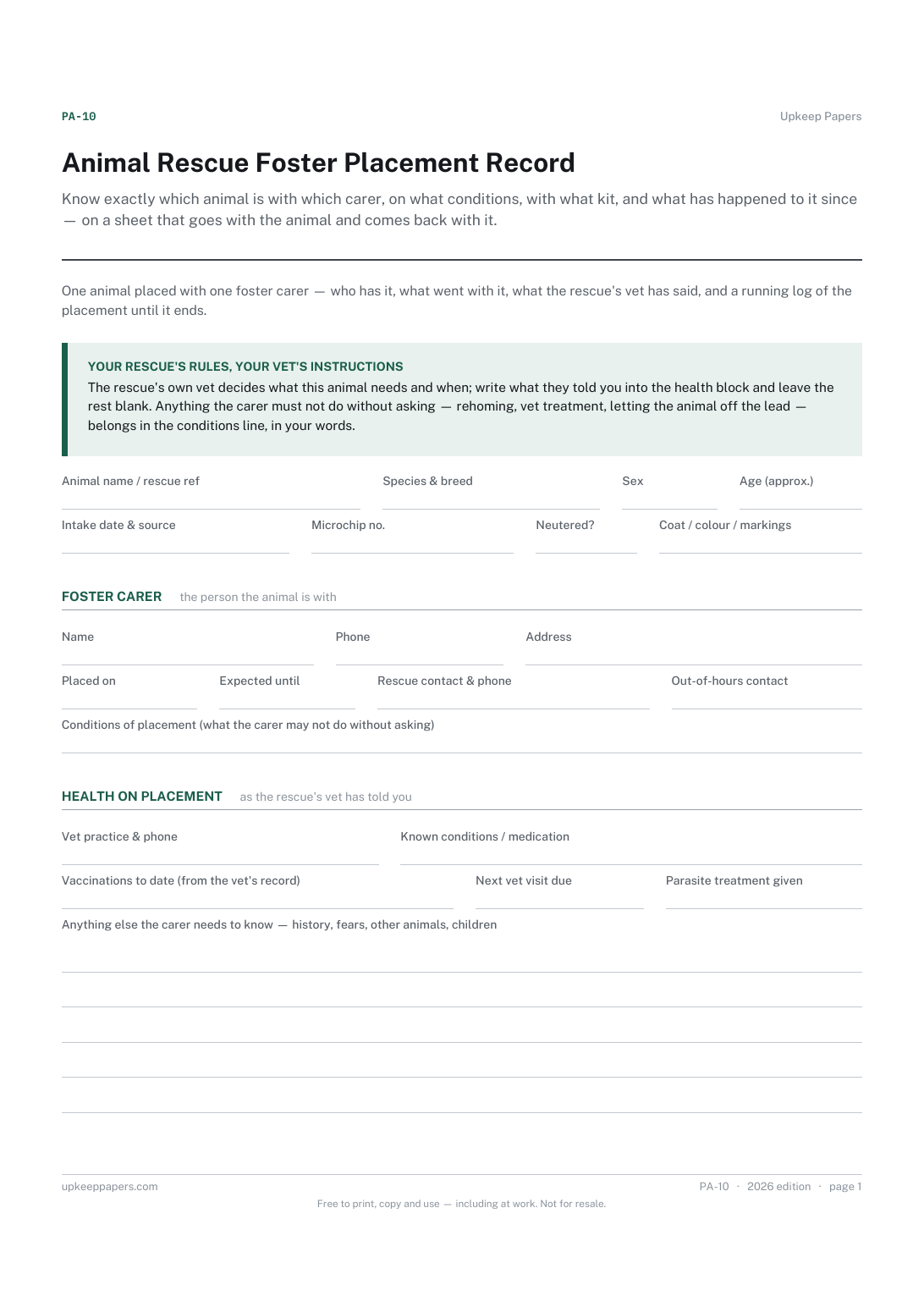
Know exactly which animal is with which carer, on what conditions, with what kit, and what has happened to it since — on a sheet that goes with the animal and comes back with it.
PA-10 2 pages
Everything here is free. Making it takes time and money. Everything here is free.
 Buy us a coffee
Pets and animals · PA-32
A free printable kitten bottle-feeding log: each feed with the amount every kitten took and its toileting, then daily weights for a litter of up to five.
2 pages. Choose your paper size — both versions are laid out identically, so neither one gets shrunk to fit.
Print it and write on it
Fill it in type and save
The fillable versions have real form fields — open them in any PDF reader, type into them and save. Printing help.
See at a glance which kitten in a litter is not feeding, toileting or gaining. In the first weeks a slow kitten can go downhill quickly.
Foster carers and rescue volunteers hand-rearing orphan kittens.
2 pages, in this order:
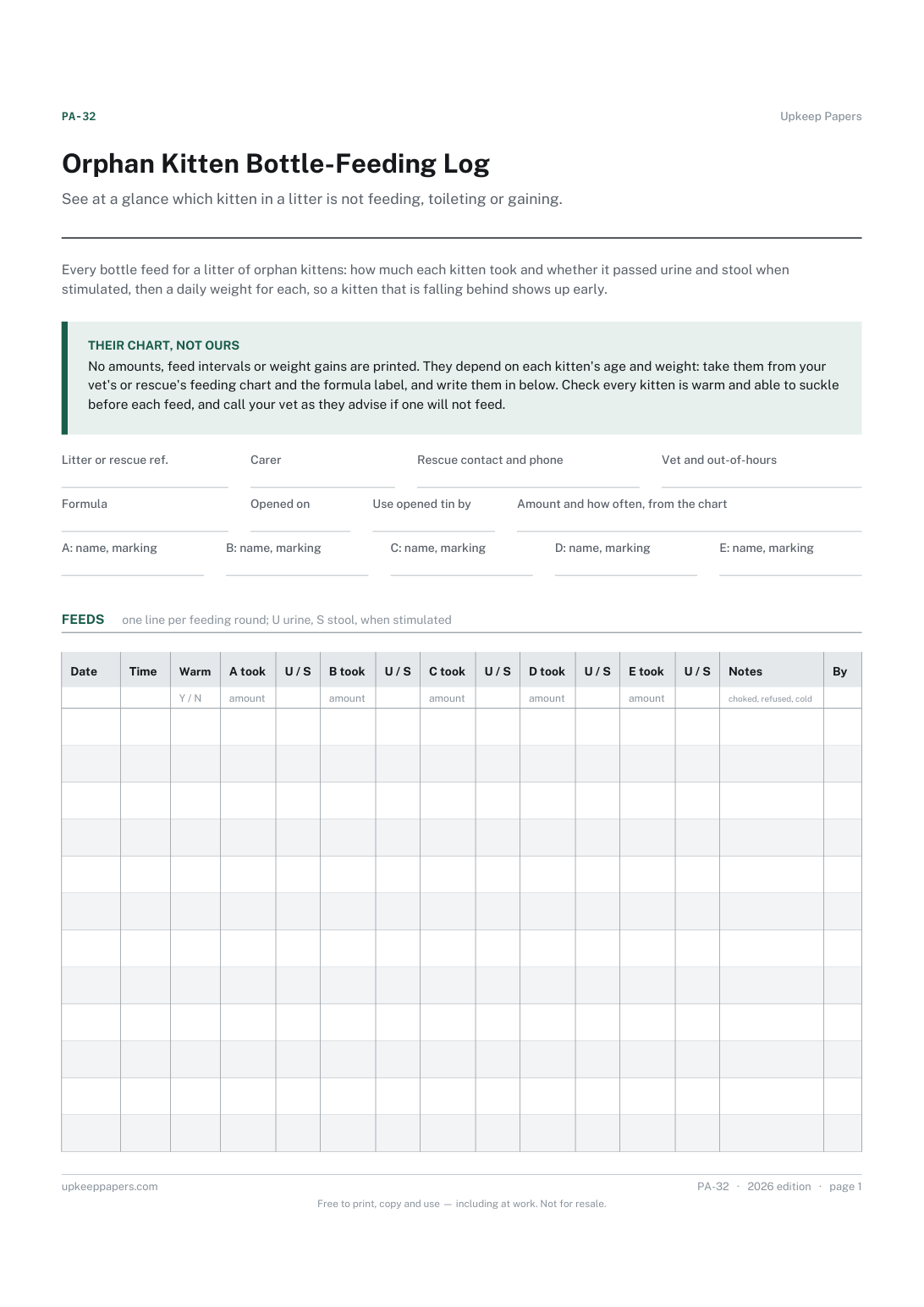
Printed under the title: Every bottle feed for a litter of orphan kittens: how much each kitten took and whether it passed urine and stool when stimulated, then a daily weight for each, so a kitten that is falling behind shows up early.
Their chart, not ours. No amounts, feed intervals or weight gains are printed. They depend on each kitten's age and weight: take them from your vet's or rescue's feeding chart and the formula label, and write them in below. Check every kitten is warm and able to suckle before each feed, and call your vet as they advise if one will not feed.
Write-on lines: Litter or rescue ref. · Carer · Rescue contact and phone · Vet and out-of-hours · Formula · Opened on · Use opened tin by · Amount and how often, from the chart · A: name, marking · B: name, marking · C: name, marking · D: name, marking · E: name, marking
Table, 24 rows: Date · Time · Warm · A took · U / S · B took · U / S · C took · U / S · D took · U / S · E took · U / S · Notes · By
Table, 7 rows: Date · Time · Kitten A · Kitten B · Kitten C · Kitten D · Kitten E · Notes
Write-on lines: Weaning started on · Vet checks (dates) · Returned to rescue or adopted on
It depends on the kitten's age and weight, and on the formula. Take the amounts and feed intervals from your vet's or rescue's feeding chart and the formula label, and write them at the top of the sheet. The log then shows whether each kitten is taking what the chart asks for.
Because a kitten that is not gaining can look fine for a day or two. A daily weight at the same time on the same scale shows the trend early, which is what your vet or rescue will ask for.
Know exactly which animal is with which carer, on what conditions, with what kit, and what has happened to it since — on a sheet that goes with the animal and comes back with it.
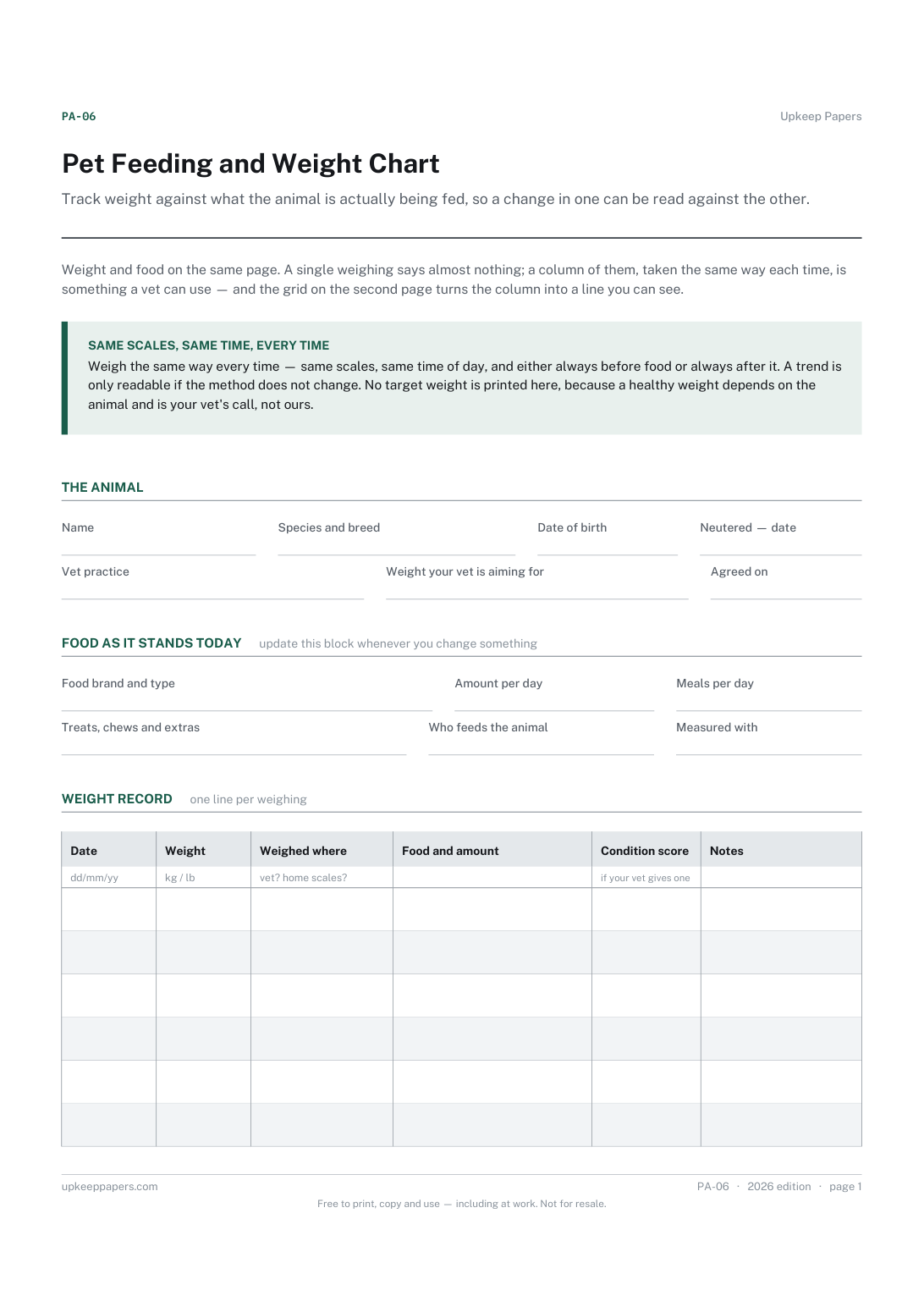
Track weight against what the animal is actually being fed, so a change in one can be read against the other. A single weighing tells you very little; a column of them taken the same way each time is something a vet can use.
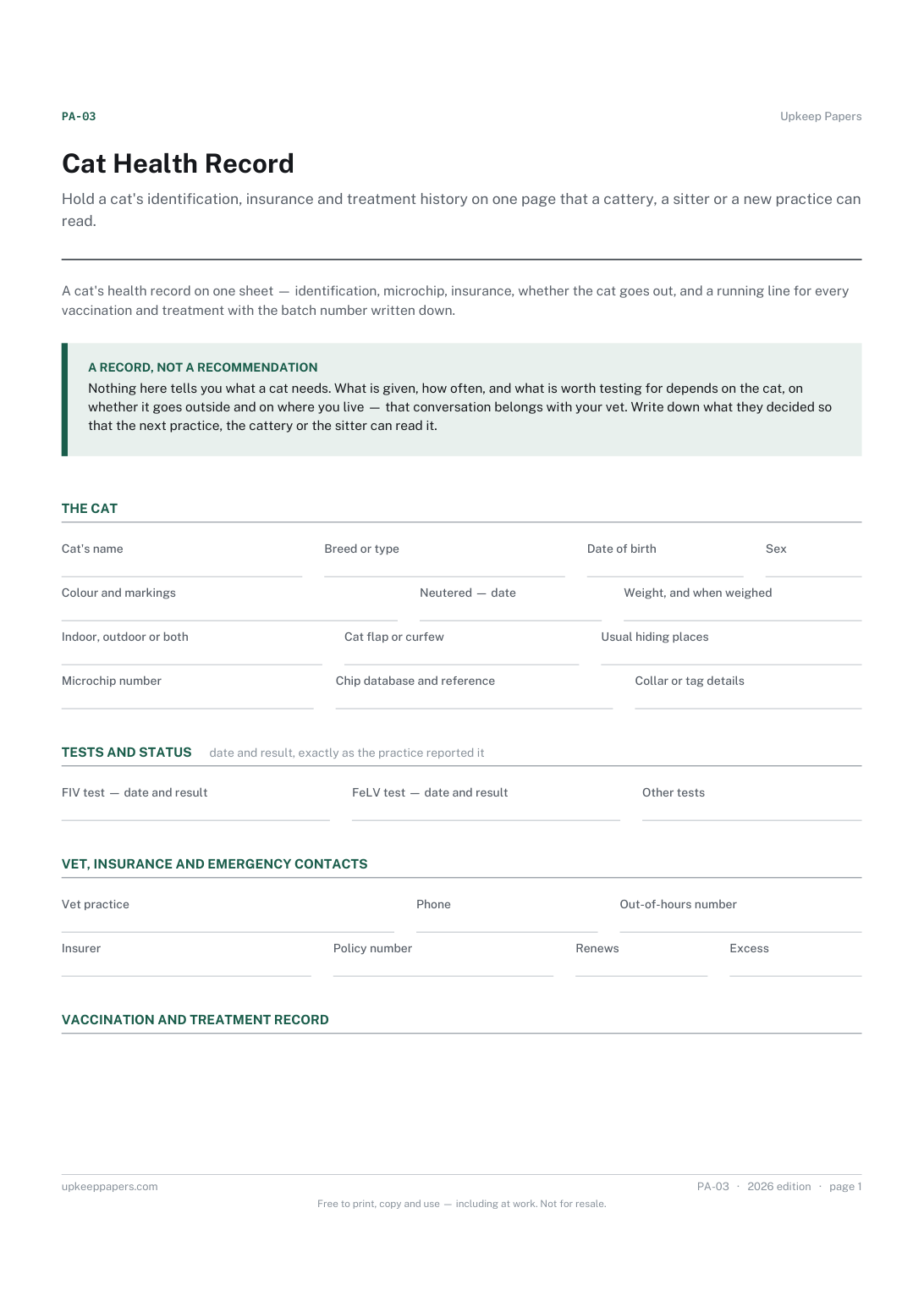
Hold a cat's identification, insurance and treatment history on one page that a cattery, a sitter or a new practice can read. It has room for the things that are specific to cats and get left off general pet forms.
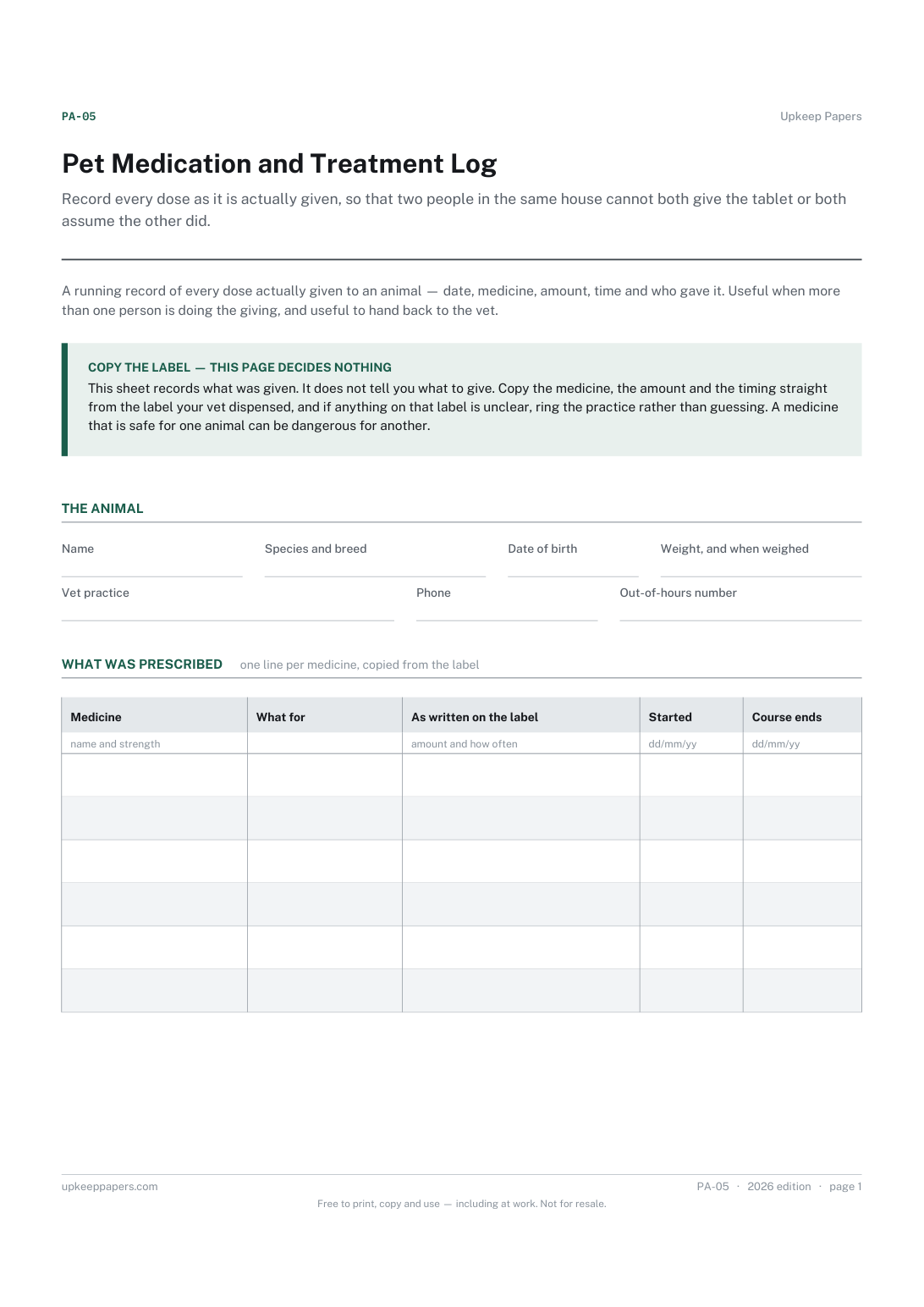
Record every dose as it is actually given, so that two people in the same house cannot both give the tablet or both assume the other did. It also gives your vet something factual to read at the follow-up.

Every sheet, binder, game and puzzle on Upkeep Papers is free to download, with no email and no account. Making them is not free: each one takes days of research, design and checking, and the site costs money to run. If something here saved you time, you can buy us a coffee. It is entirely optional: nothing is locked, and nothing changes if you don’t.
Buy us a coffee Opens PayPal in a new tab. Any amount, and nothing changes if you would rather not.