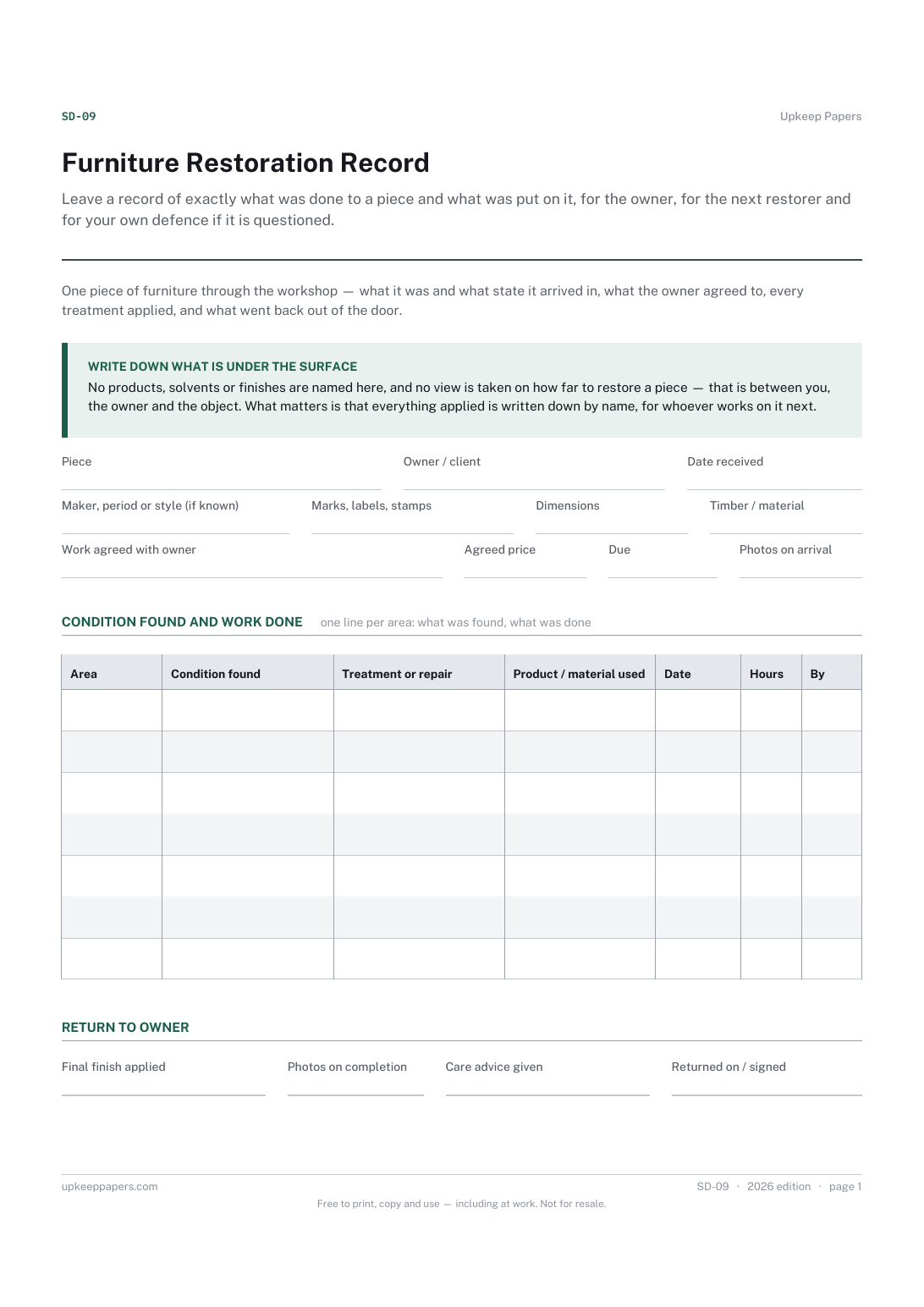
Furniture Restoration Record
Leave a record of exactly what was done to a piece and what was put on it, for the owner, for the next restorer and for your own defence if it is questioned.
SD-09 1 page
Everything here is free. Making it takes time and money. Everything here is free.
 Buy us a coffee
Studio crafts and making · SD-05
A free printable craft commission form — the client's brief, the price, deposit and dates agreed, and each stage approved on the way to the finished piece.
One page. Choose your paper size — both versions are laid out identically, so neither one gets shrunk to fit.
Print it and write on it
Fill it in type and save
The fillable versions have real form fields — open them in any PDF reader, type into them and save. Printing help.
Make sure maker and client are picturing the same object before work starts, and have a record of who approved what if the finished piece is questioned.
Makers who take commissions — furniture, ceramics, jewellery, textiles, metalwork, glass — and anyone selling one-off pieces to order.
One page, top to bottom:
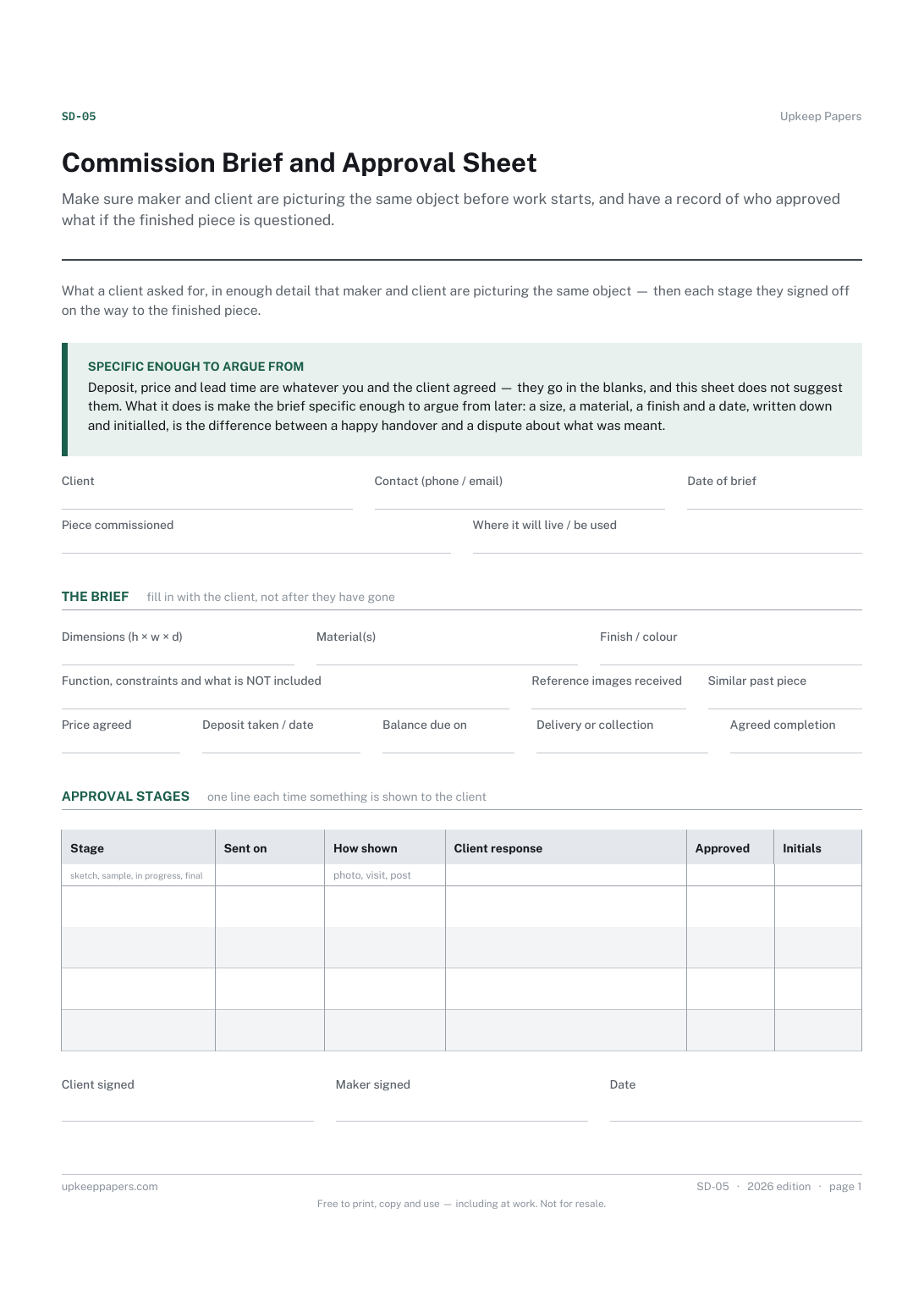
Printed under the title: What a client asked for, in enough detail that maker and client are picturing the same object — then each stage they signed off on the way to the finished piece.
Specific enough to argue from. Deposit, price and lead time are whatever you and the client agreed — they go in the blanks, and this sheet does not suggest them. What it does is make the brief specific enough to argue from later: a size, a material, a finish and a date, written down and initialled, is the difference between a happy handover and a dispute about what was meant.
Write-on lines: Client · Contact (phone / email) · Date of brief · Piece commissioned · Where it will live / be used
Write-on lines: Dimensions (h × w × d) · Material(s) · Finish / colour · Function, constraints and what is NOT included · Reference images received · Similar past piece · Price agreed · Deposit taken / date · Balance due on · Delivery or collection · Agreed completion
Table, 4 rows: Stage · Sent on · How shown · Client response · Approved · Initials
Signature strip: Client signed · Maker signed · Date
Because those are terms you set for your own business, and they differ by craft and by piece. The sheet leaves the blanks and asks you to write what was agreed, which is the only version that matters if there is a disagreement later.
It is a record of what was agreed and approved. Whether you also need written terms, and what they say, depends on the rules where you trade — check them.
Leave a record of exactly what was done to a piece and what was put on it, for the owner, for the next restorer and for your own defence if it is questioned.
Keep one card per customer so the history of what was done, what it cost and when the next visit is due lives in one place.
Give a receipt for money taken and keep an identical copy, with the balance still owed written on both halves.
Write an invoice by hand when you need one, in a layout that leaves room for whatever your country requires rather than assuming a set of fields.
The same subject, with a version you can fill in on screen.
Who the customer is and how to reach them.
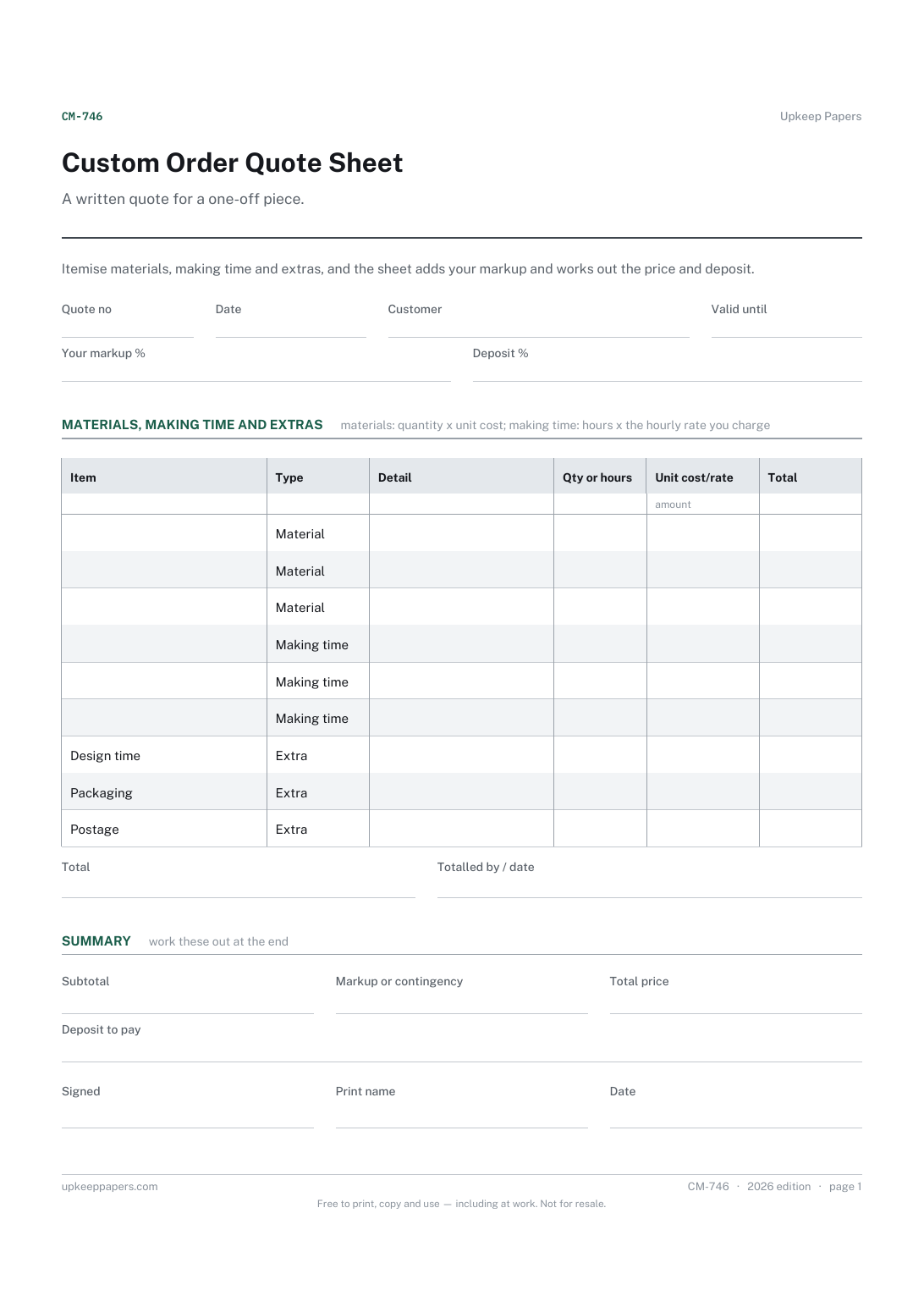
Materials itemised with quantity and unit cost.

Every sheet, binder, game and puzzle on Upkeep Papers is free to download, with no email and no account. Making them is not free: each one takes days of research, design and checking, and the site costs money to run. If something here saved you time, you can buy us a coffee. It is entirely optional: nothing is locked, and nothing changes if you don’t.
Buy us a coffee Opens PayPal in a new tab. Any amount, and nothing changes if you would rather not.