Collection Inventory and Valuation Record
Itemise a collection properly, so that identification, acquisition and any valuation exist somewhere other than in your head.
CV-01 1 page
Everything here is free. Making it takes time and money. Everything here is free.
 Buy us a coffee
Collecting and valuables · CV-04
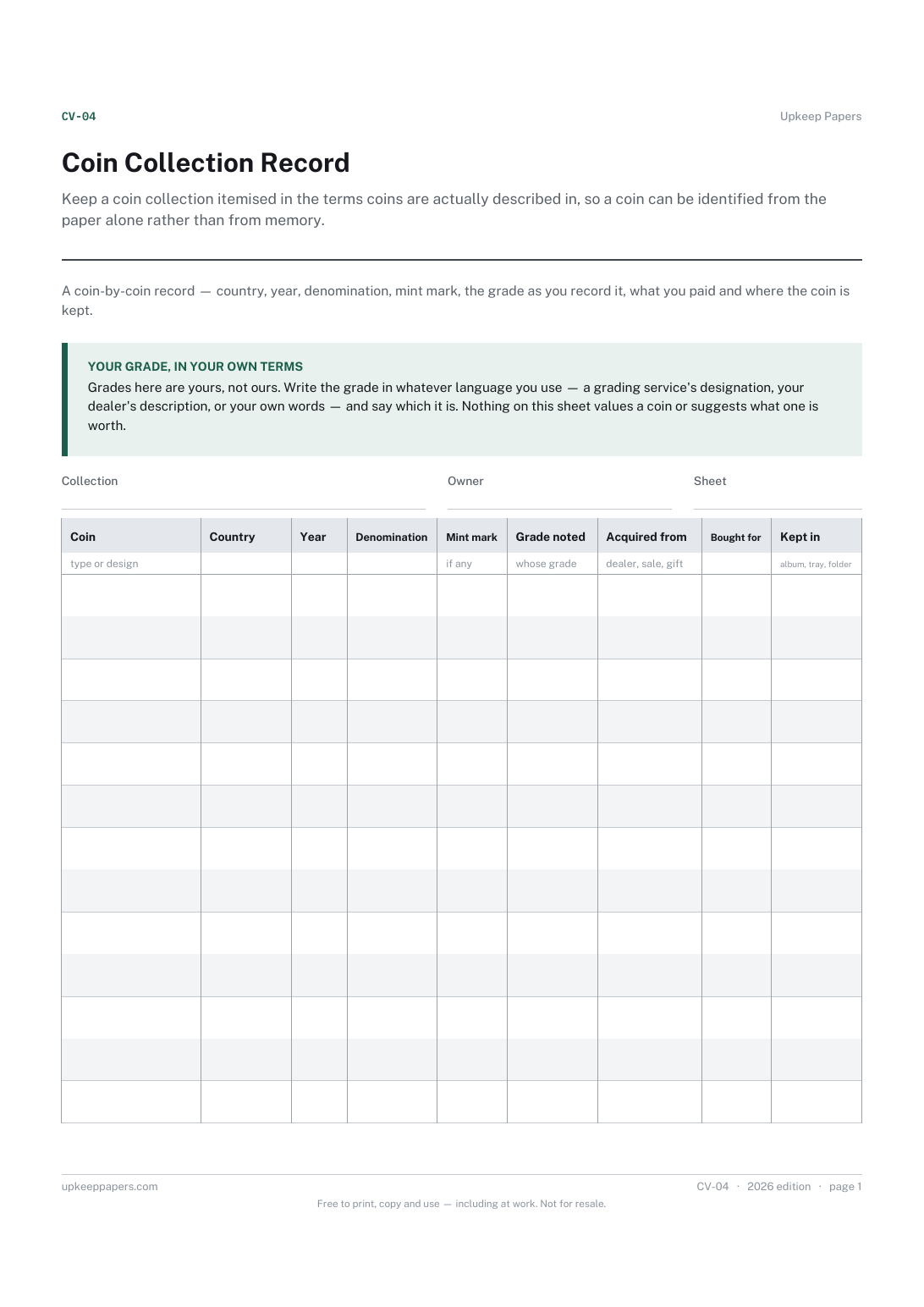
A free printable coin collection record — country, year, denomination, mint mark, the grade as you record it, what you paid and where each coin is kept.
One page. Choose your paper size — both versions are laid out identically, so neither one gets shrunk to fit.
Print it and write on it
Fill it in type and save
The fillable versions have real form fields — open them in any PDF reader, type into them and save. Printing help.
Keep a coin collection itemised in the terms coins are actually described in, so a coin can be identified from the paper alone rather than from memory.
Coin collectors of any size, and anyone who has inherited a collection and needs to work out what is in it before deciding what to do with it.
One page, top to bottom:
Printed under the title: A coin-by-coin record — country, year, denomination, mint mark, the grade as you record it, what you paid and where the coin is kept.
Your grade, in your own terms. Grades here are yours, not ours. Write the grade in whatever language you use — a grading service's designation, your dealer's description, or your own words — and say which it is. Nothing on this sheet values a coin or suggests what one is worth.
Write-on lines: Collection · Owner · Sheet
Table, 13 rows: Coin · Country · Year · Denomination · Mint mark · Grade noted · Acquired from · Bought for · Kept in
Because grading language differs between countries, services and dealers, and a scale printed here would quietly overwrite the one you already use. The column takes your grade and asks whose it is, which is the part that matters when somebody reads the sheet later.
A coin's value is a market opinion on a date, not a fact a form can supply. There is a column for what you paid, and the Collection Inventory and Valuation Record has room for a valuation and who gave it.
Itemise a collection properly, so that identification, acquisition and any valuation exist somewhere other than in your head.
Record the history of a single item and where its paperwork lives, including the gaps, so the chain is not reconstructed from memory by somebody else later.
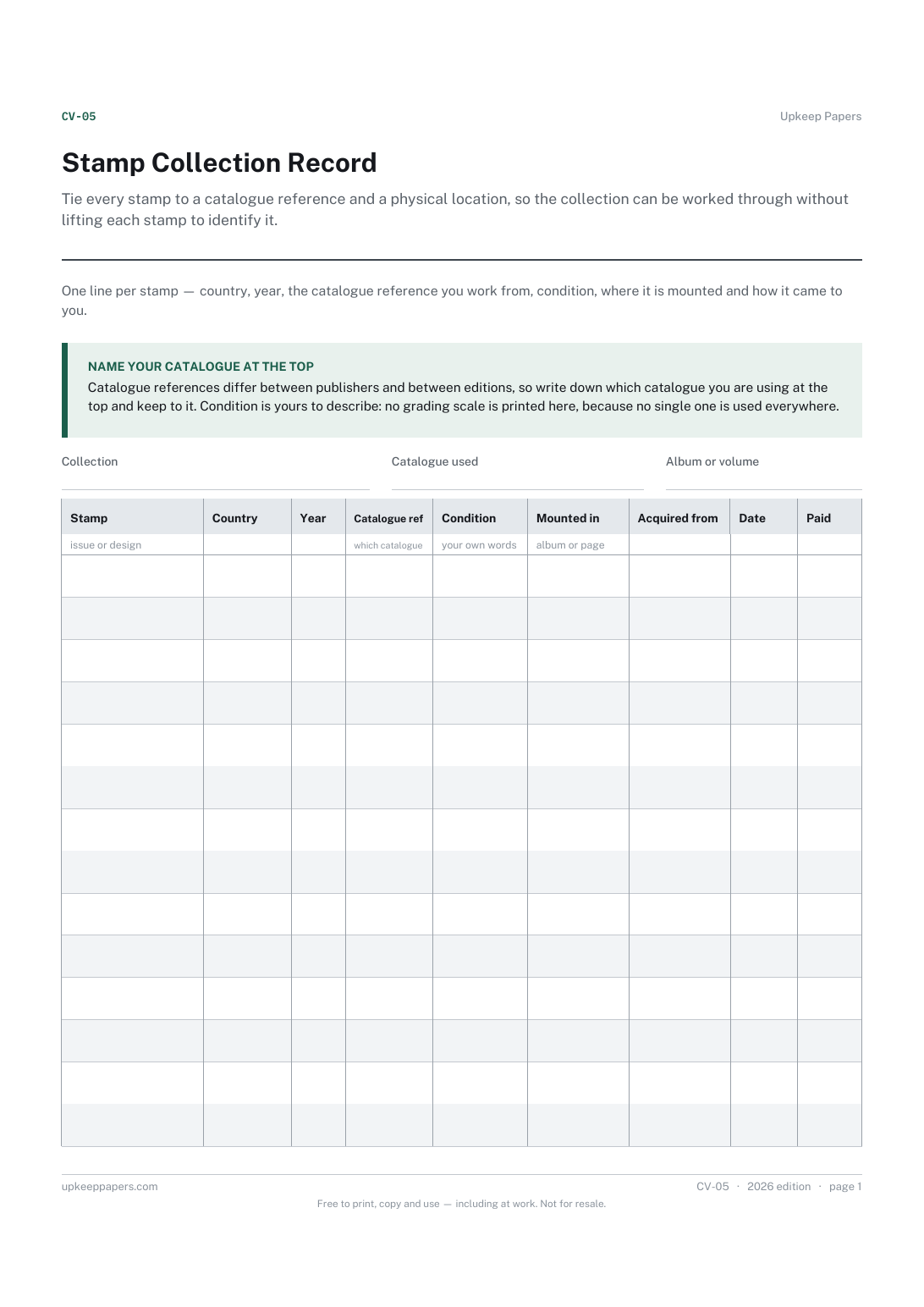
Tie every stamp to a catalogue reference and a physical location, so the collection can be worked through without lifting each stamp to identify it.
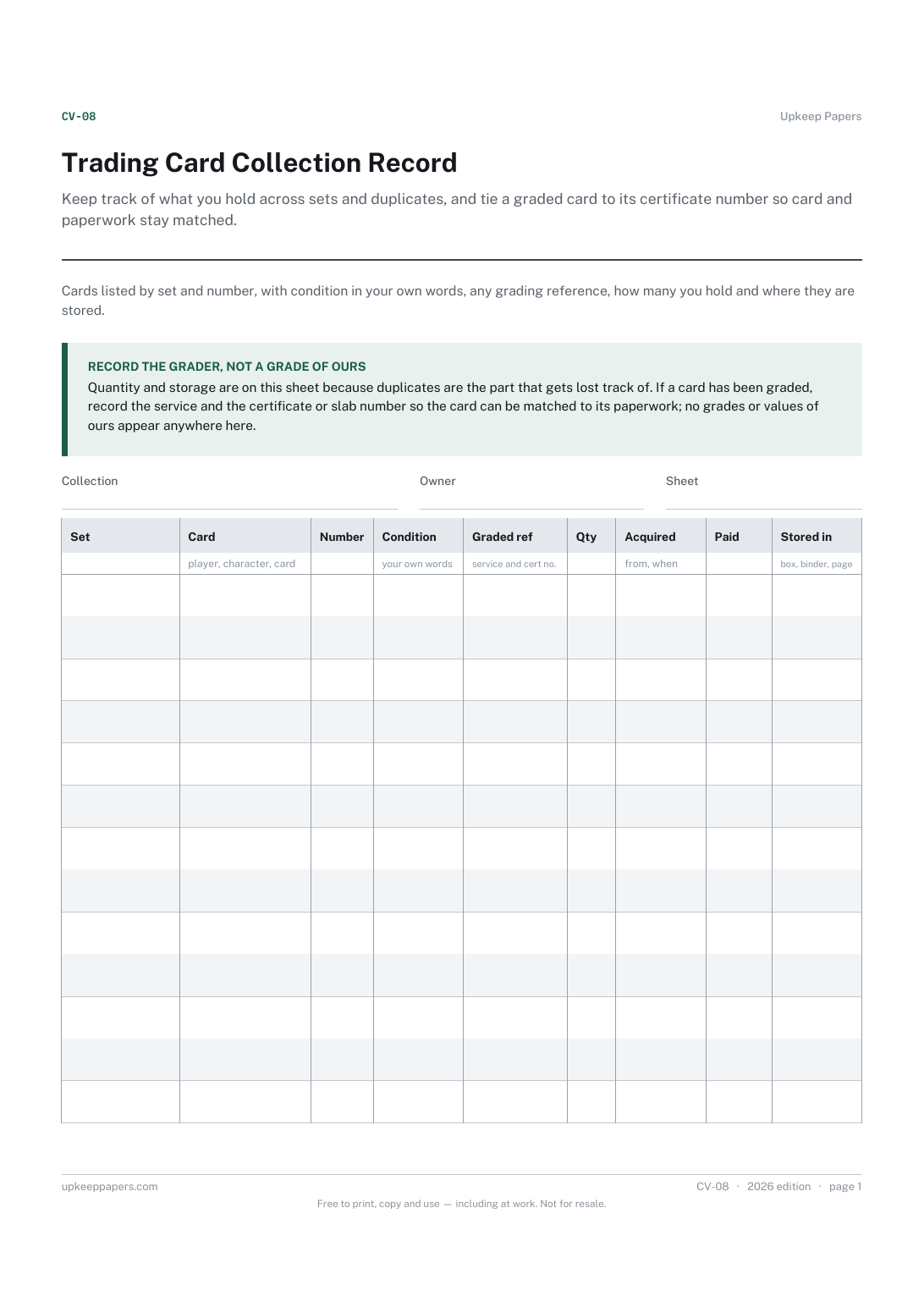
Keep track of what you hold across sets and duplicates, and tie a graded card to its certificate number so card and paperwork stay matched.
The same subject, with a version you can fill in on screen.
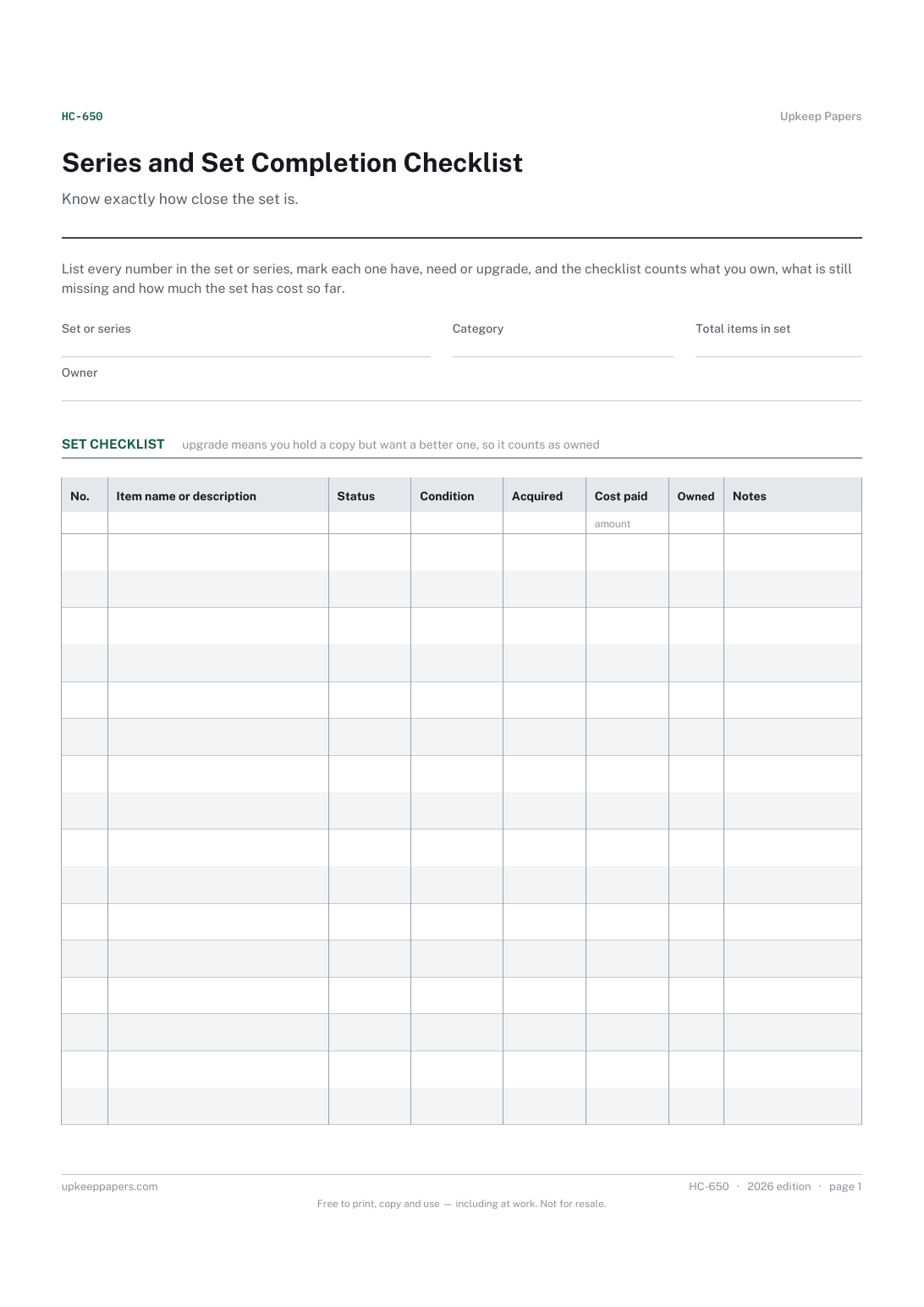
Every item in the set by number and name.

Every sheet, binder, game and puzzle on Upkeep Papers is free to download, with no email and no account. Making them is not free: each one takes days of research, design and checking, and the site costs money to run. If something here saved you time, you can buy us a coffee. It is entirely optional: nothing is locked, and nothing changes if you don’t.
Buy us a coffee Opens PayPal in a new tab. Any amount, and nothing changes if you would rather not.