Grazing and Paddock Rotation Plan
Track rest as well as grazing, because the rest period is the part of rotational grazing that actually does the work and the part nobody records.
LK-28 1 page
Everything here is free. Making it takes time and money. Everything here is free.
 Buy us a coffee
Livestock and smallholding · LK-65
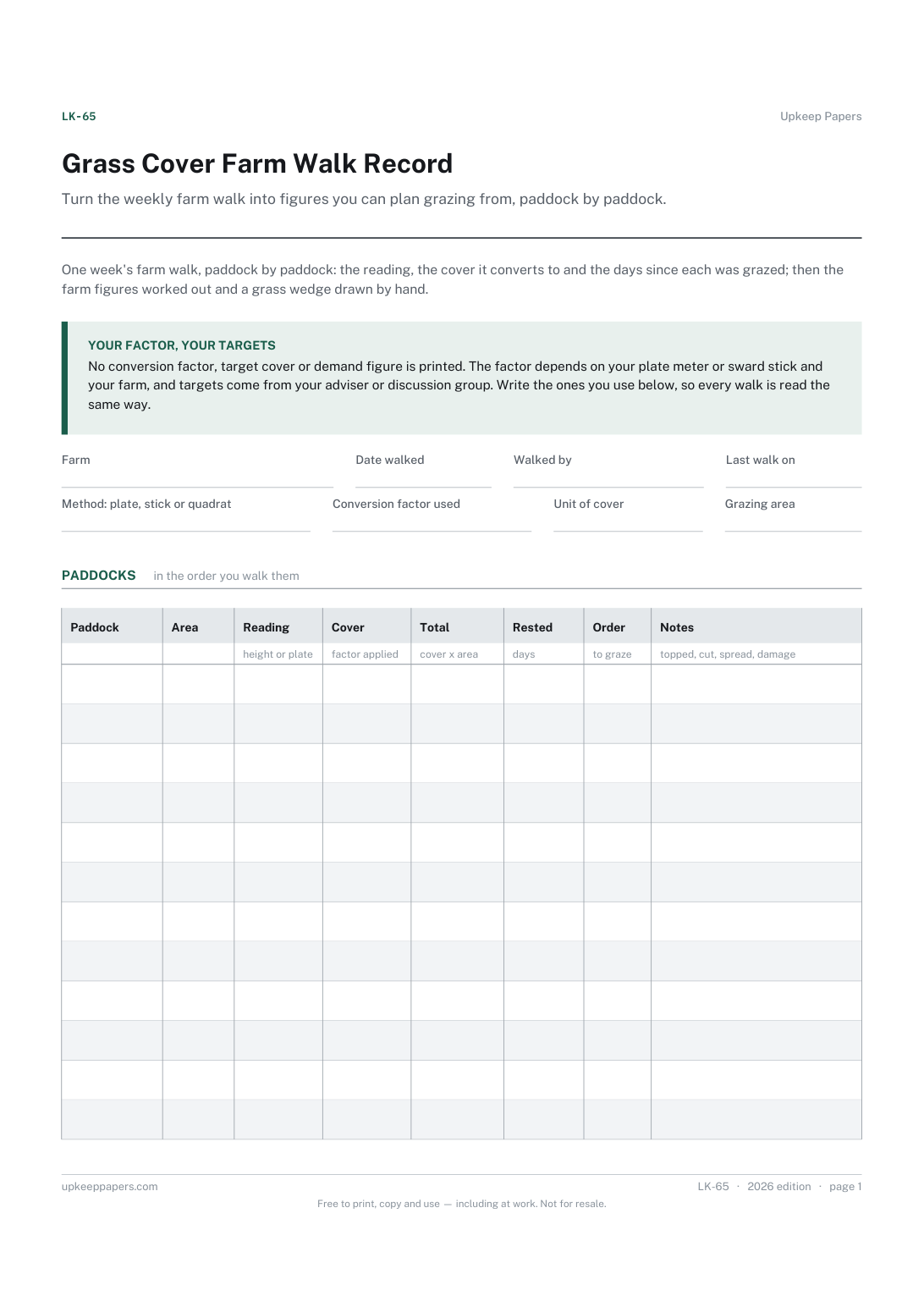
A free printable grass measuring sheet for the weekly farm walk: paddock readings, cover and days rested, the farm average, growth and demand, and a wedge to draw.
2 pages. Choose your paper size — both versions are laid out identically, so neither one gets shrunk to fit.
Print it and write on it
Fill it in type and save
The fillable versions have real form fields — open them in any PDF reader, type into them and save. Printing help.
Turn the weekly farm walk into figures you can plan grazing from, paddock by paddock. A hand-drawn wedge shows the surpluses and deficits at a glance.
Dairy, beef and sheep farmers who measure grass with a plate meter, sward stick or quadrat.
2 pages, in this order:
Printed under the title: One week's farm walk, paddock by paddock: the reading, the cover it converts to and the days since each was grazed; then the farm figures worked out and a grass wedge drawn by hand.
Your factor, your targets. No conversion factor, target cover or demand figure is printed. The factor depends on your plate meter or sward stick and your farm, and targets come from your adviser or discussion group. Write the ones you use below, so every walk is read the same way.
Write-on lines: Farm · Date walked · Walked by · Last walk on · Method: plate, stick or quadrat · Conversion factor used · Unit of cover · Grazing area
Table, 12 rows: Paddock · Area · Reading · Cover · Total · Rested · Order · Notes
Write-on lines: Total cover on the grazing area · Average farm cover · Stock on the grazing area · Growth since last walk · Demand · Days ahead · Target you work to, and its source
Squared grid: Mark your cover scale up the left edge, write each paddock under its bar, and rule your own target line across
Ruled lines: Decisions: grazing order, paddocks to take out, surplus or deficit
Because the factor depends on the meter or stick and on the farm, and targets change with the season, the stock and the system. Your adviser or discussion group gives the ones to use; the sheet has blanks for them so every walk is measured the same way.
The rotation plan records which stock went on and off each paddock and how long it rested. This sheet measures the grass itself each week, so the next move can be planned from the covers.
Track rest as well as grazing, because the rest period is the part of rotational grazing that actually does the work and the part nobody records.
Know in October whether the forage will last until spring, instead of finding out in February when everyone else has sold theirs.
Record applications properly at the time, including the conditions, so the record stands up when a buyer, an inspector or a neighbour asks about it.
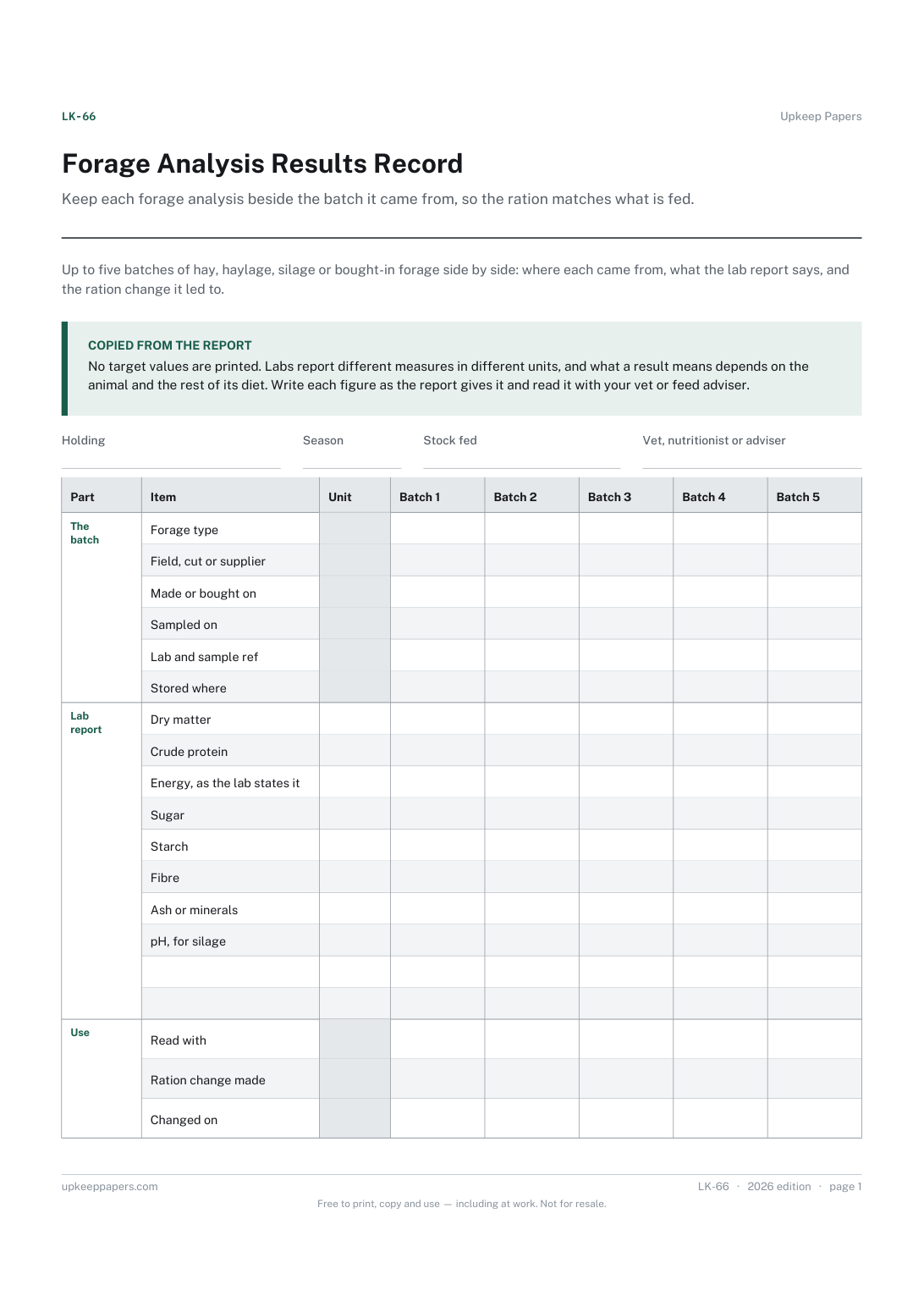
Keep each forage analysis beside the batch it came from, so the ration matches what is fed. Five batches sit side by side for comparison.
Record what each group is fed and what feed actually costs across a year, which is usually the largest bill on a smallholding.

Every sheet, binder, game and puzzle on Upkeep Papers is free to download, with no email and no account. Making them is not free: each one takes days of research, design and checking, and the site costs money to run. If something here saved you time, you can buy us a coffee. It is entirely optional: nothing is locked, and nothing changes if you don’t.
Buy us a coffee Opens PayPal in a new tab. Any amount, and nothing changes if you would rather not.