Livestock Movement Record
Keep your own copy of every movement on and off, with the reference numbers that make it possible to answer a question about a load six months afterwards.
LK-05 1 page
Everything here is free. Making it takes time and money. Everything here is free.
 Buy us a coffee
Livestock and smallholding · LK-64
A free printable livestock quarantine record: where bought-in animals came from, tests and treatments, a daily health check grid and the release agreed with a vet.
2 pages. Choose your paper size — both versions are laid out identically, so neither one gets shrunk to fit.
Print it and write on it
Fill it in type and save
The fillable versions have real form fields — open them in any PDF reader, type into them and save. Printing help.
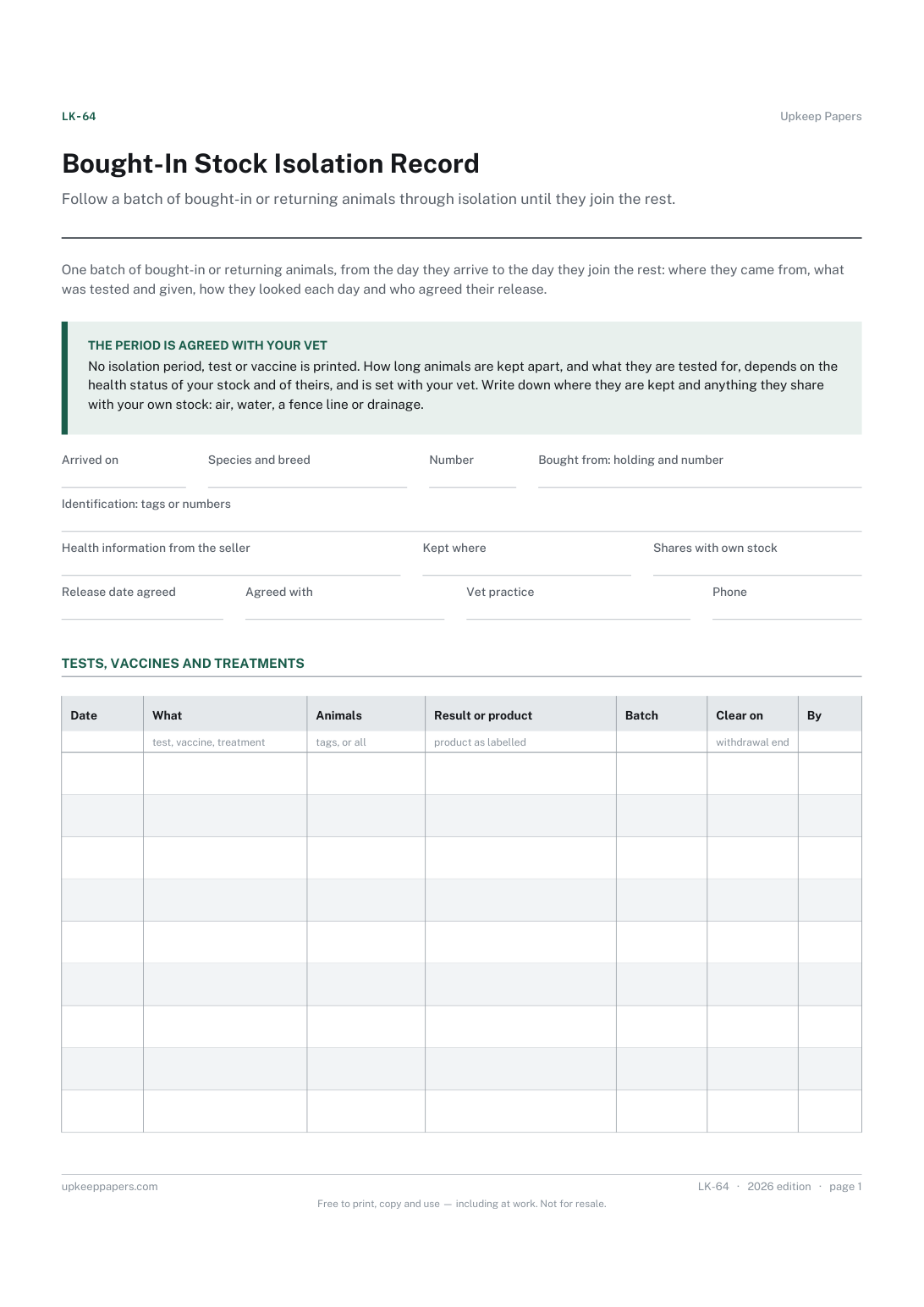
Follow a batch of bought-in or returning animals through isolation until they join the rest. The tests, the daily checks and the vet's agreement are all on one record.
Farmers and smallholders buying in cattle, sheep, goats, pigs or camelids, or bringing animals home from shows and grazing away.
2 pages, in this order:
Printed under the title: One batch of bought-in or returning animals, from the day they arrive to the day they join the rest: where they came from, what was tested and given, how they looked each day and who agreed their release.
The period is agreed with your vet. No isolation period, test or vaccine is printed. How long animals are kept apart, and what they are tested for, depends on the health status of your stock and of theirs, and is set with your vet. Write down where they are kept and anything they share with your own stock: air, water, a fence line or drainage.
Write-on lines: Arrived on · Species and breed · Number · Bought from: holding and number · Identification: tags or numbers · Health information from the seller · Kept where · Shares with own stock · Release date agreed · Agreed with · Vet practice · Phone
Table, 9 rows: Date · What · Animals · Result or product · Batch · Clear on · By
Table, 20 rows: Date · Day · Eating · Condition · Cough · Discharge · Lame · Skin · Dung · Notes · By
Write-on lines: Released to the main group on · Agreed with · Animals held back, and why
Signature strip: Signed · Print name · Date
There is no single period: it depends on the diseases in question, the health status of both farms and the tests involved, and some need longer than others. Agree it with your vet and write the date on the sheet.
No. The movement onto the holding still goes on your livestock movement record and any official reporting. This sheet follows what happens to the batch after it arrives.
Keep your own copy of every movement on and off, with the reference numbers that make it possible to answer a question about a load six months afterwards.
Keep the visitor record that matters when disease is traced, and make the boot dip a thing that is recorded rather than assumed.
Keep a medicines book that answers the two questions that actually get asked: what went into which animals, and when they are clear.
Keep track of which tag is on which animal, including the replacements that otherwise break the chain between an animal and its records.
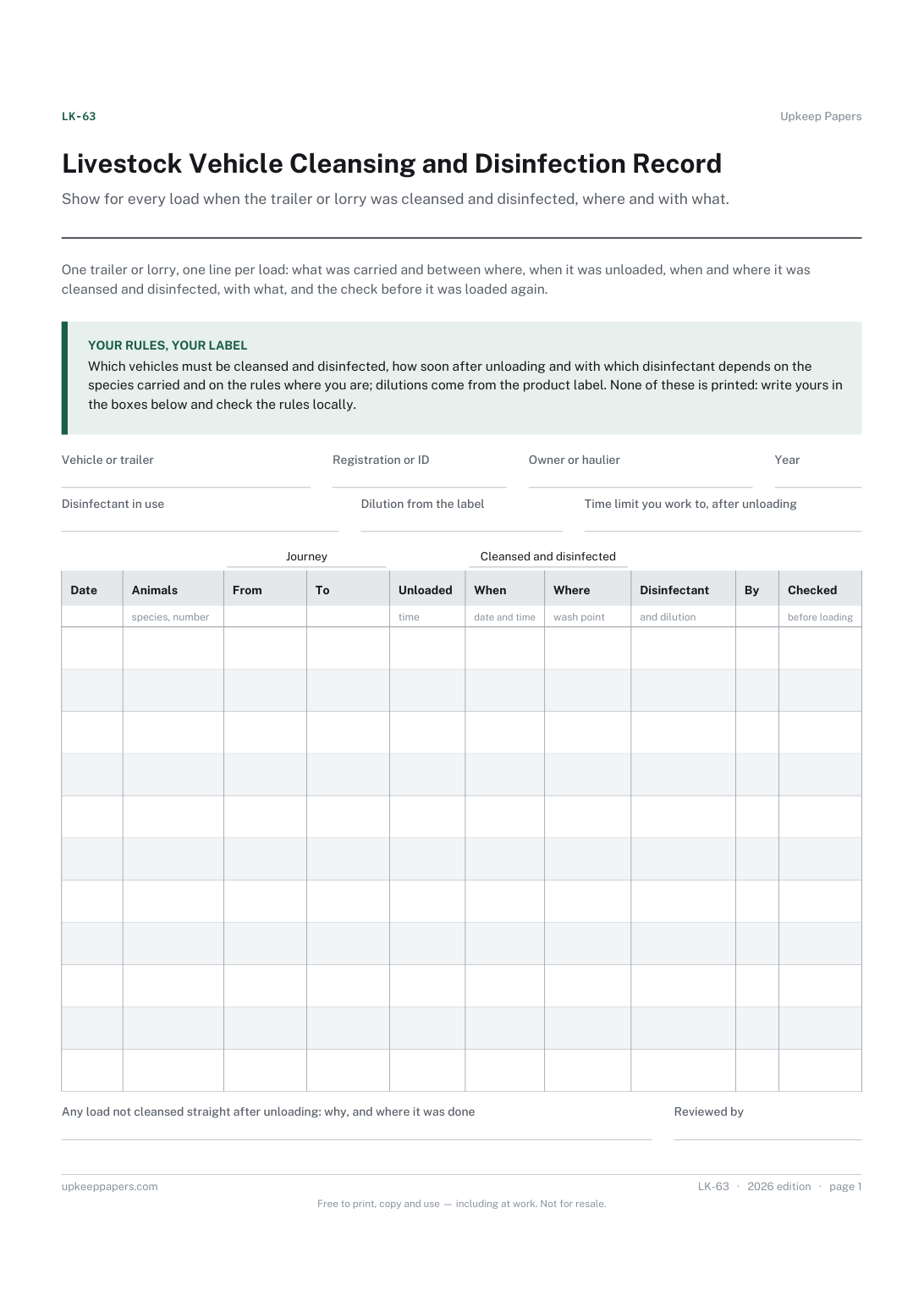
Show for every load when the trailer or lorry was cleansed and disinfected, where and with what. It also records who checked it before the next animals went on.

Every sheet, binder, game and puzzle on Upkeep Papers is free to download, with no email and no account. Making them is not free: each one takes days of research, design and checking, and the site costs money to run. If something here saved you time, you can buy us a coffee. It is entirely optional: nothing is locked, and nothing changes if you don’t.
Buy us a coffee Opens PayPal in a new tab. Any amount, and nothing changes if you would rather not.