Horse Vet Visit and Treatment Record
Keep the veterinary history and the insurance position in one place, which matters when a claim depends on showing continuity.
EQ-11 1 page
Everything here is free. Making it takes time and money. Everything here is free.
 Buy us a coffee
Equine records · EQ-27
A free printable horse temperature chart: up to six horses, morning and evening readings for a month, each against the horse's own normal, not a printed range.
2 pages. Choose your paper size — both versions are laid out identically, so neither one gets shrunk to fit.
Print it and write on it
Fill it in type and save
The fillable versions have real form fields — open them in any PDF reader, type into them and save. Printing help.
Spot a horse running above its own normal while there is still time to keep it apart. It suits new arrivals in isolation and in-contact horses during an outbreak.
Yard managers, horse owners and anyone looking after new arrivals, isolating horses or in-contact horses.
2 pages, in this order:
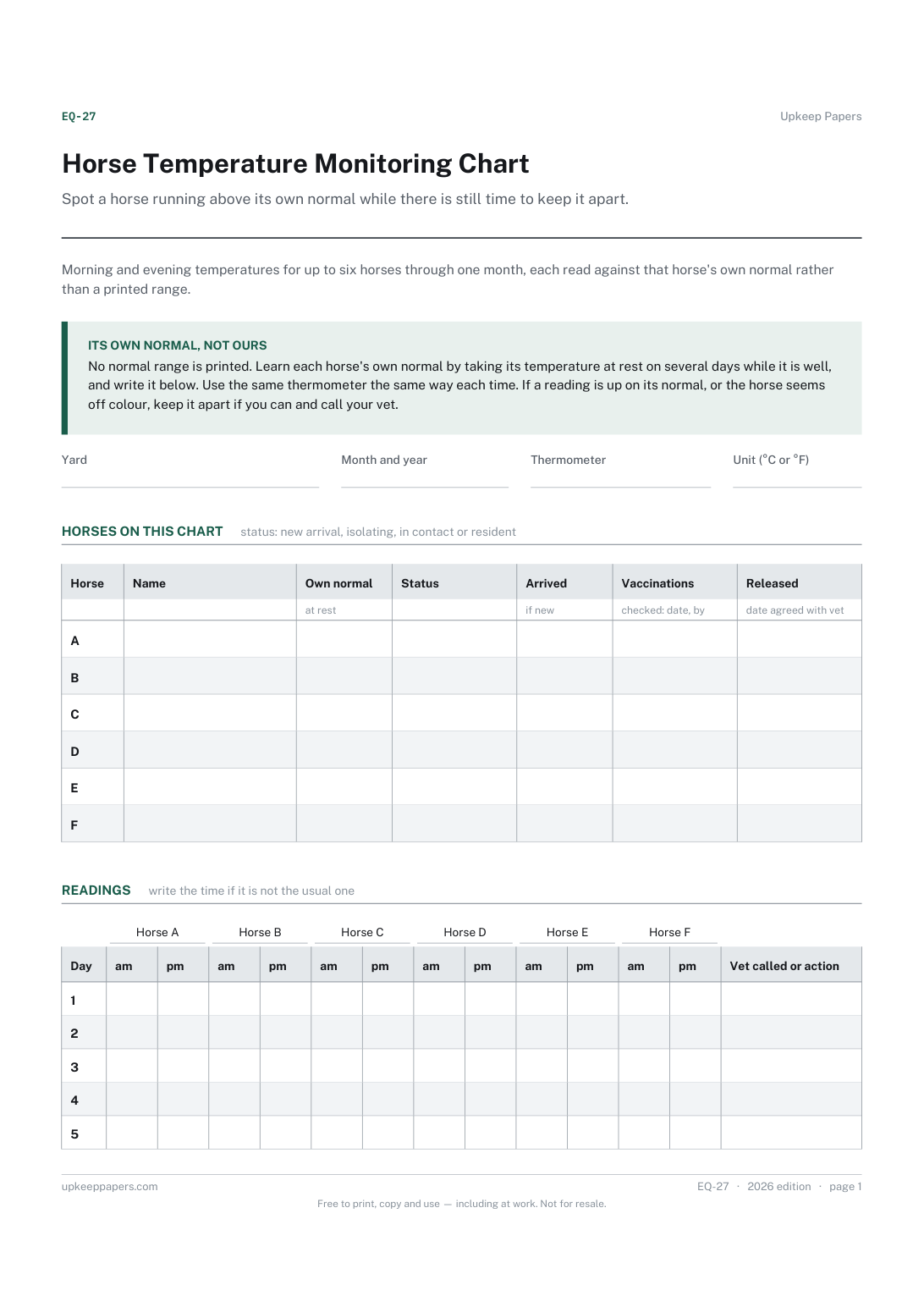
Printed under the title: Morning and evening temperatures for up to six horses through one month, each read against that horse's own normal rather than a printed range.
Its own normal, not ours. No normal range is printed. Learn each horse's own normal by taking its temperature at rest on several days while it is well, and write it below. Use the same thermometer the same way each time. If a reading is up on its normal, or the horse seems off colour, keep it apart if you can and call your vet.
Write-on lines: Yard · Month and year · Thermometer · Unit (°C or °F)
Also printed: Horse · Name · Own normal · Status · Arrived · Vaccinations · Released · at rest · if new · checked: date, by · date agreed with vet
Also printed: Horse A · Horse B · Horse C · Horse D · Horse E · Horse F · Day · Vet called or action
Also printed: Horse A · Horse B · Horse C · Horse D · Horse E · Horse F · Day · Vet called or action
Because horses vary, and a reading that is ordinary for one can be raised for another. The chart asks you to learn each horse's own normal at rest and to read every number against that. Your vet can tell you what change should prompt a call.
Yes. Use the A columns and leave the rest blank, or keep one chart a month for a horse on longer monitoring. The top table still records its normal and its status.
Keep the veterinary history and the insurance position in one place, which matters when a claim depends on showing continuity.
Keep a vaccination history with batch numbers, which is the record a competition venue, a livery yard or an insurer will ask to see.
Keep the visitor record that matters when disease is traced, and make the boot dip a thing that is recorded rather than assumed.
Introduce a new horse step by step and keep a daily record of how the herd responds. A horse kept off the hay shows up on paper before it shows in its weight.
Give whoever is standing in for you one page with everything they need, on the stable door rather than in a folder at home.

Every sheet, binder, game and puzzle on Upkeep Papers is free to download, with no email and no account. Making them is not free: each one takes days of research, design and checking, and the site costs money to run. If something here saved you time, you can buy us a coffee. It is entirely optional: nothing is locked, and nothing changes if you don’t.
Buy us a coffee Opens PayPal in a new tab. Any amount, and nothing changes if you would rather not.