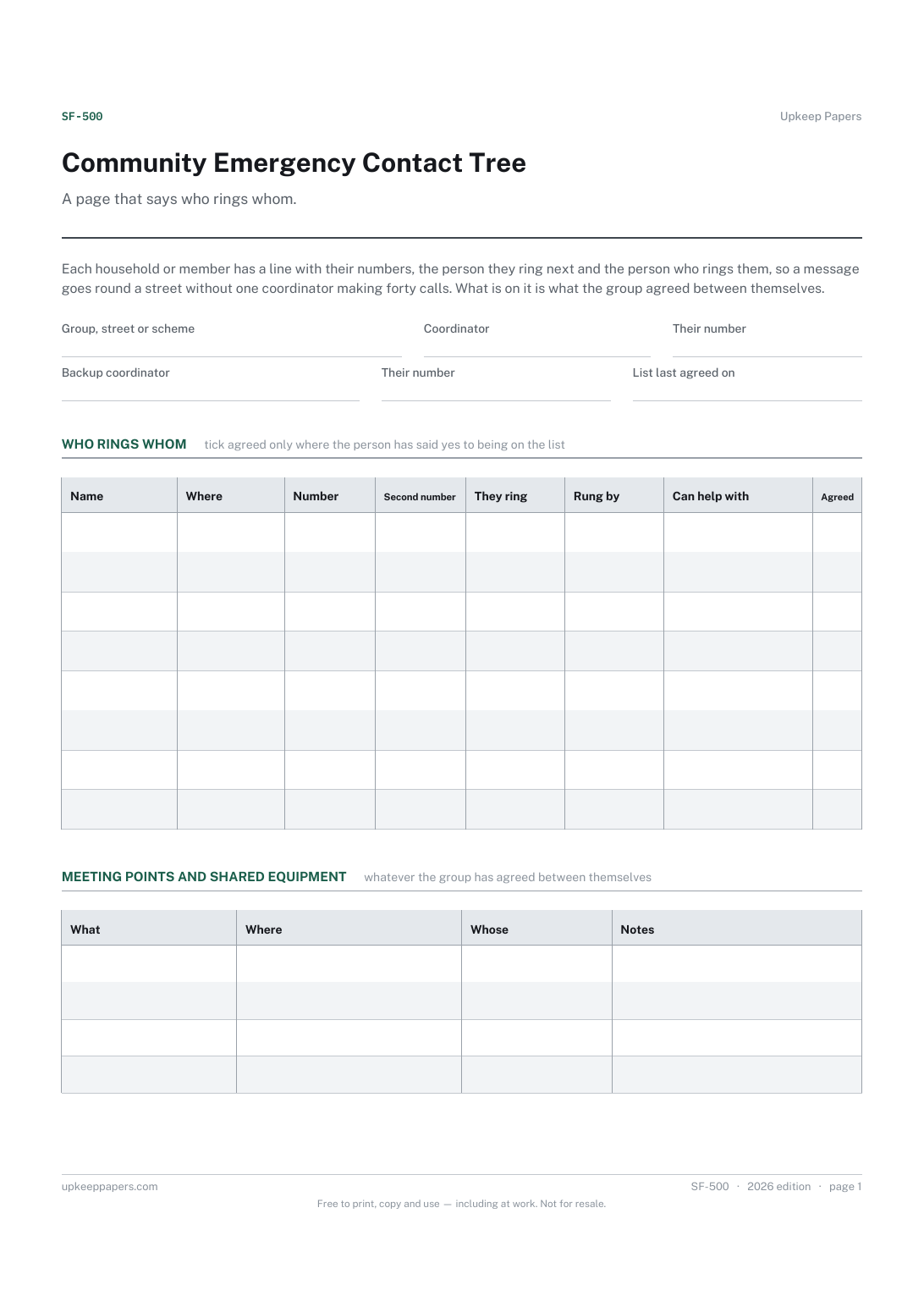
Community Emergency Contact Tree
Every household or member, with the numbers that actually get answered.
SF-500 Form PDF Online
Everything here is free. Making it takes time and money. Everything here is free.
 Buy us a coffee
Safety, records and practical forms · SF-495 · Log
Free printable neighbourhood watch log — date, time, place, what was seen, who reported it, the reference given and follow-up. PDF and browser versions.
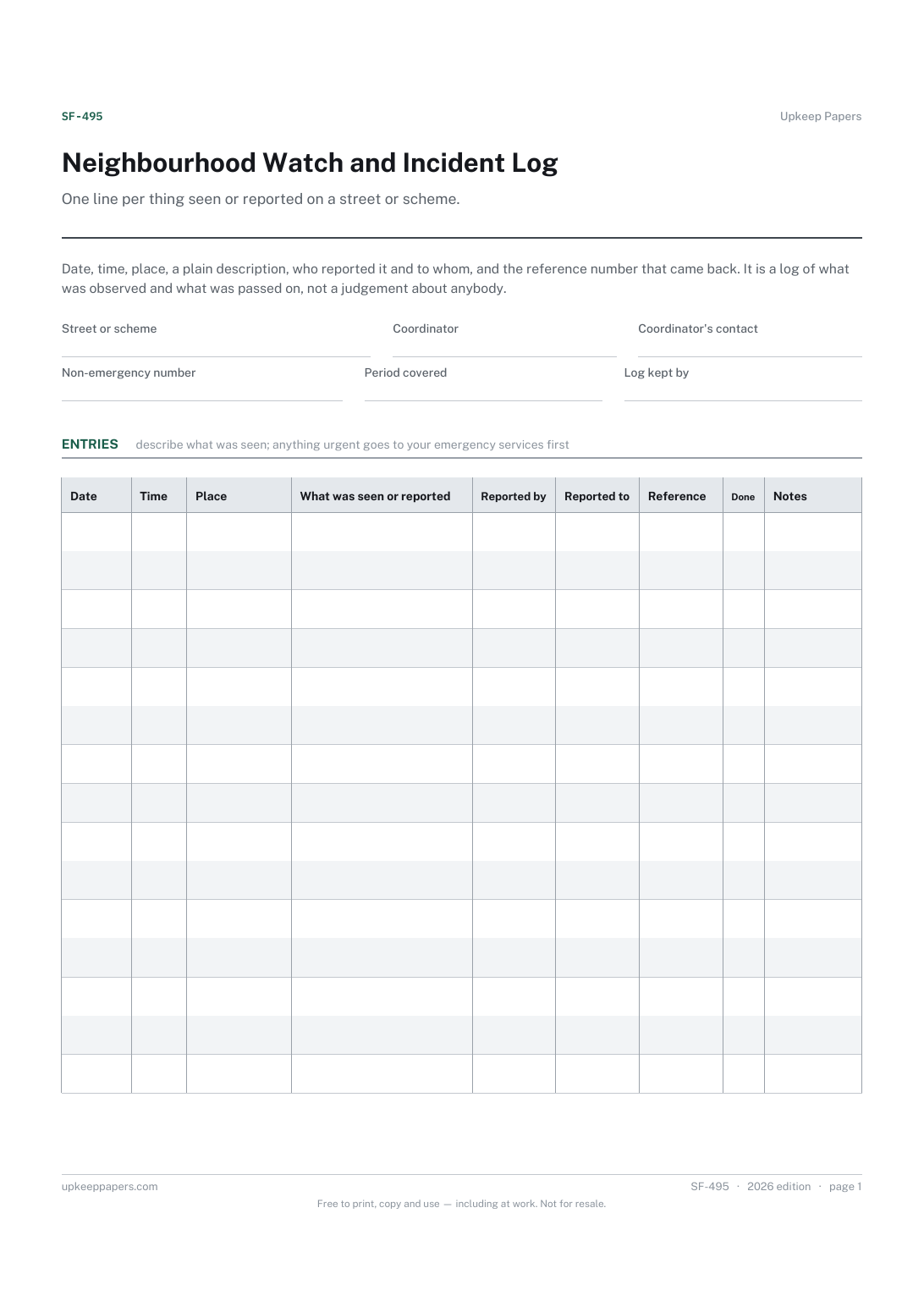
2 pages. The A4 and US Letter files are laid out identically, so neither is shrunk to fit.
Print it and write on it
Fillable PDF type and save
Or no download needed
Fill it in onlineThe fillable versions have real form fields — open them in any PDF reader, type into them and save. Printing help.
The same sheet, on screen. Tick, type, add or remove rows, then print it or download the completed version as a PDF. Everything stays in your browser — your entries are kept in this browser's own storage on this device, nothing is uploaded, and there is no account.
One line per thing seen or reported on a street or scheme. Date, time, place, a plain description, who reported it and to whom, and the reference number that came back. It is a log of what was observed and what was passed on, not a judgement about anybody.
Neighbourhood watch coordinators, residents' associations, street groups keeping a shared record, and households on a lane or estate who want the pattern in one place rather than in a group chat.
The printable is laid out inside a box that fits both A4 and US Letter, so the two files are identical and neither one is scaled. The fillable PDF has real form fields. The online version keeps what you enter in your own browser and builds the completed PDF on your device.
Download the A4 or US Letter file to match the paper in your printer, open it in a PDF reader and print at 100% — not "fit to page", which shrinks the writing space. Both files leave a 14 mm margin, which clears the unprintable edge on home printers. To print the online version with your entries in it, use the Print this sheet button, which prints only the sheet and none of the page around it. More on printing.
Anything urgent goes to your emergency services first — a log entry is not a report and reaches nobody. Write the line afterwards, with the reference they give you.
Think about who will read the sheet before you do. A shared log circulates, and what you write about a neighbour is subject to the rules on personal information where you are. Describing what was seen is usually enough.
The number a police force, council or housing provider gives when a report is logged. It is the only reliable way to find that report again, and it makes a run of entries traceable rather than anecdotal.
No. If your scheme, force or council has a form, use theirs. This sheet is the street's own copy, which is what a coordinator needs when somebody asks what has been happening.
The browser version saves in your own browser on the device you used and sends nothing anywhere, so a coordinator can keep it on one machine and print copies for meetings.
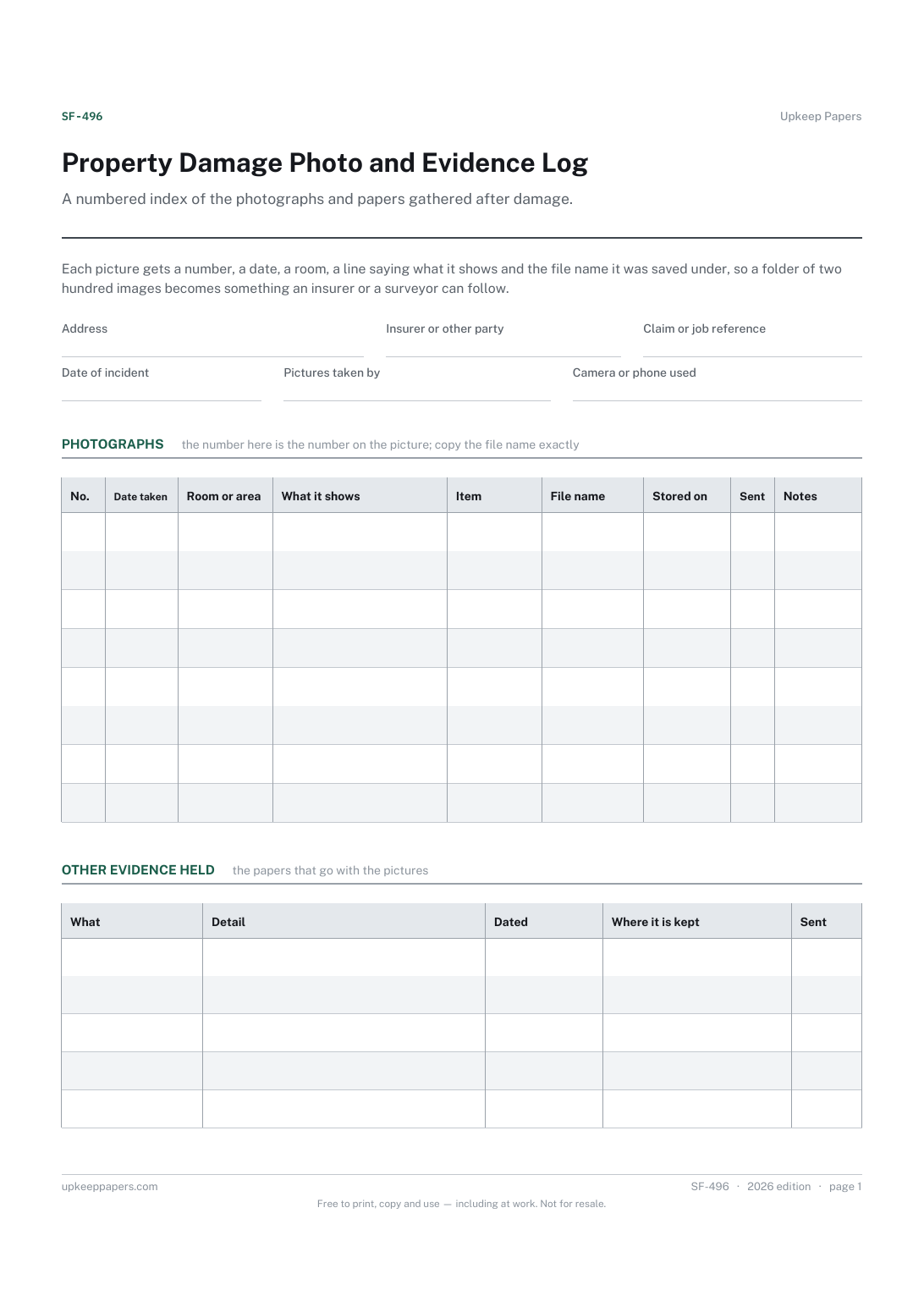
Every household or member, with the numbers that actually get answered.
Every photograph numbered, dated and described in a line.
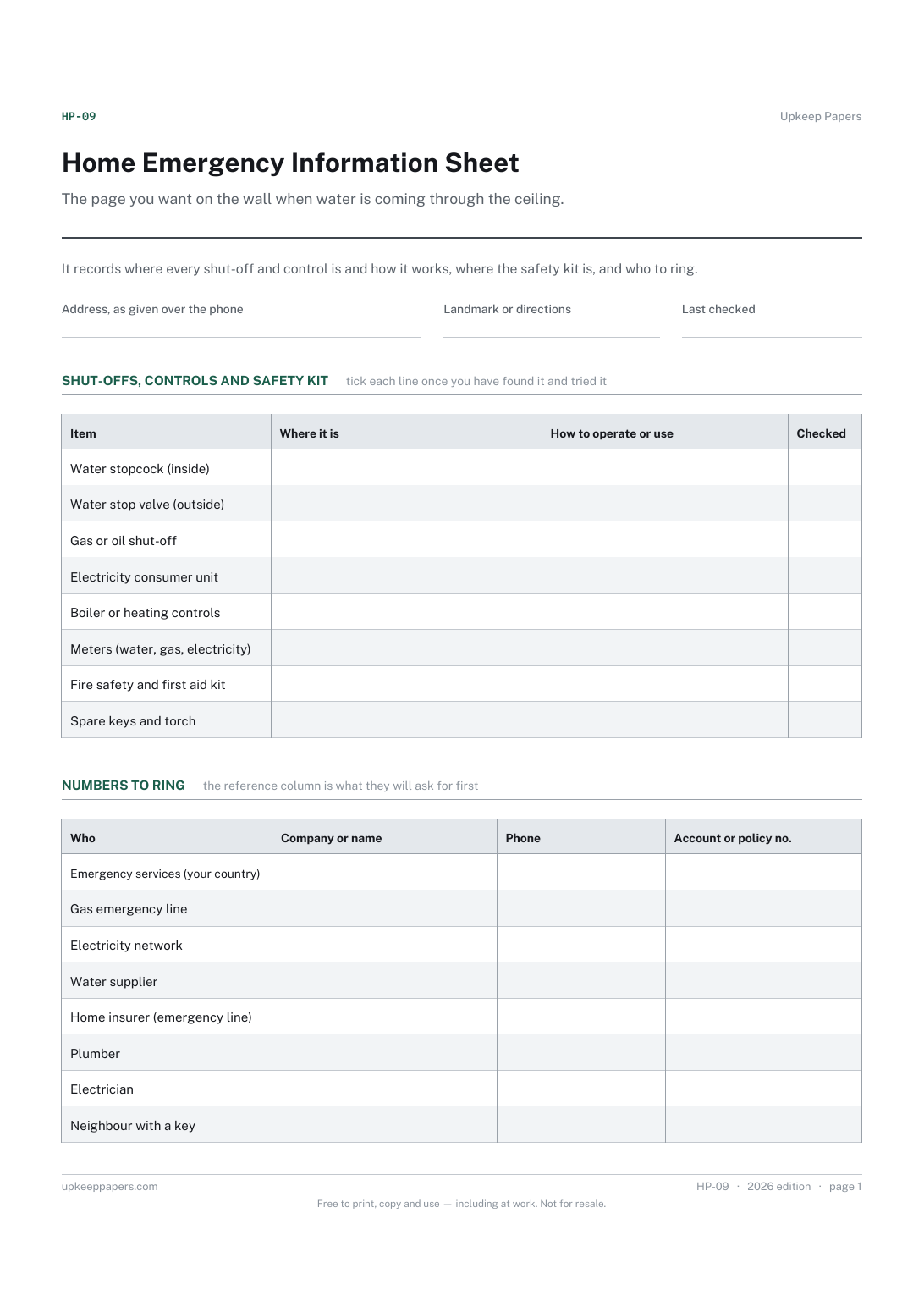
Where the stopcock, the gas or oil shut-off and the consumer unit are, and how to use them.
Printable sheets, workbooks and tools on the same subject.
Keep a contemporaneous record of a shift, written as things happen rather than reconstructed at the end of it.
Capture an incident properly on the day, in the affected person's own words, with the witness details and equipment notes that become impossible to gather later.
Keep observations and conclusions in separate columns, which is what makes a record useful when somebody else reads it back.

Every sheet, binder, game and puzzle on Upkeep Papers is free to download, with no email and no account. Making them is not free: each one takes days of research, design and checking, and the site costs money to run. If something here saved you time, you can buy us a coffee. It is entirely optional: nothing is locked, and nothing changes if you don’t.
Buy us a coffee Opens PayPal in a new tab. Any amount, and nothing changes if you would rather not.