Neighbourhood Watch and Incident Log
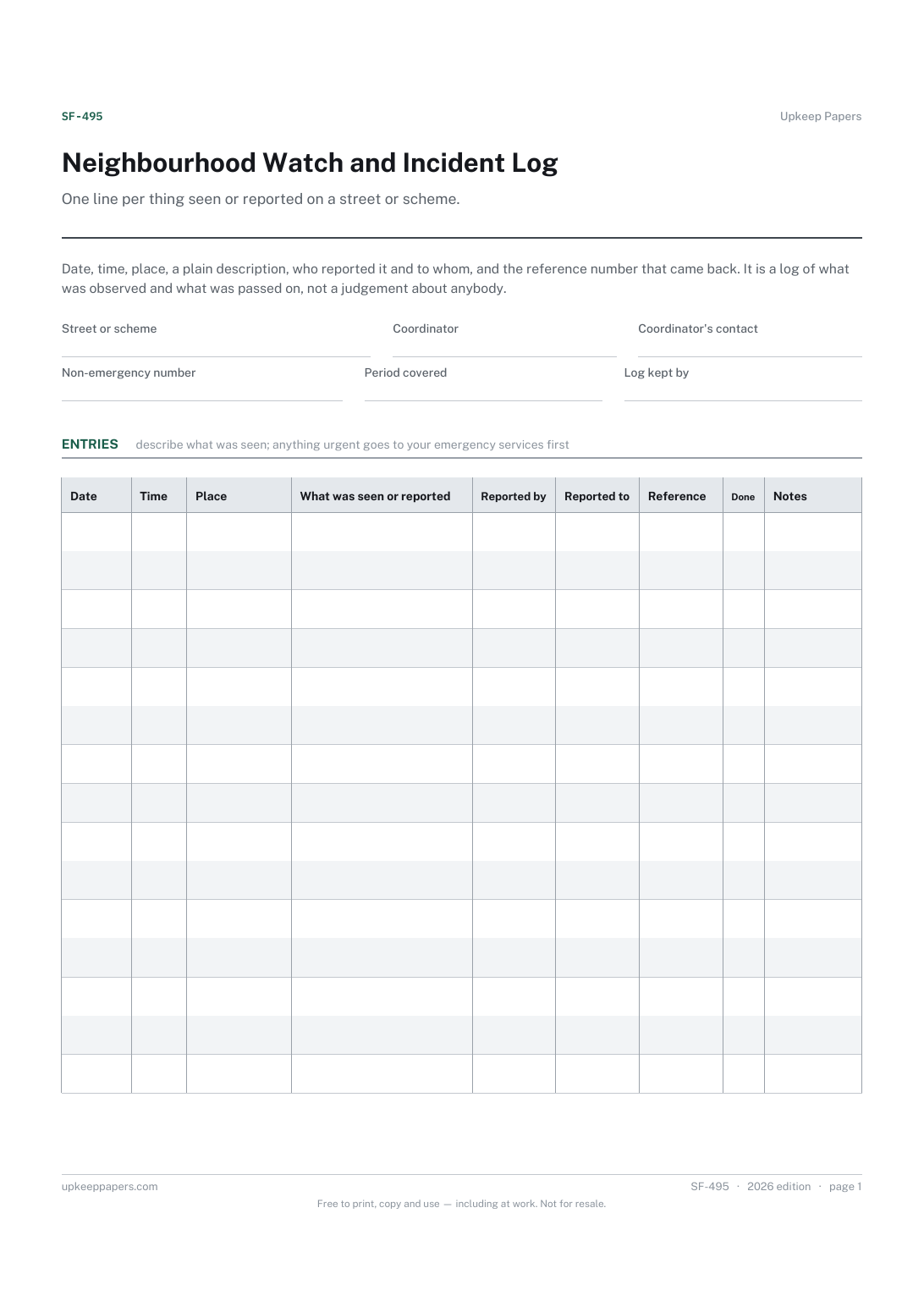
What was seen or reported, when and exactly where.
SF-495 Log PDF Online
Everything here is free. Making it takes time and money. Everything here is free.
 Buy us a coffee
Safety, records and practical forms · SF-500 · Form
Free printable contact tree for a street or group — who rings whom, numbers, what each person can help with, and the meeting points agreed. PDF, browser.
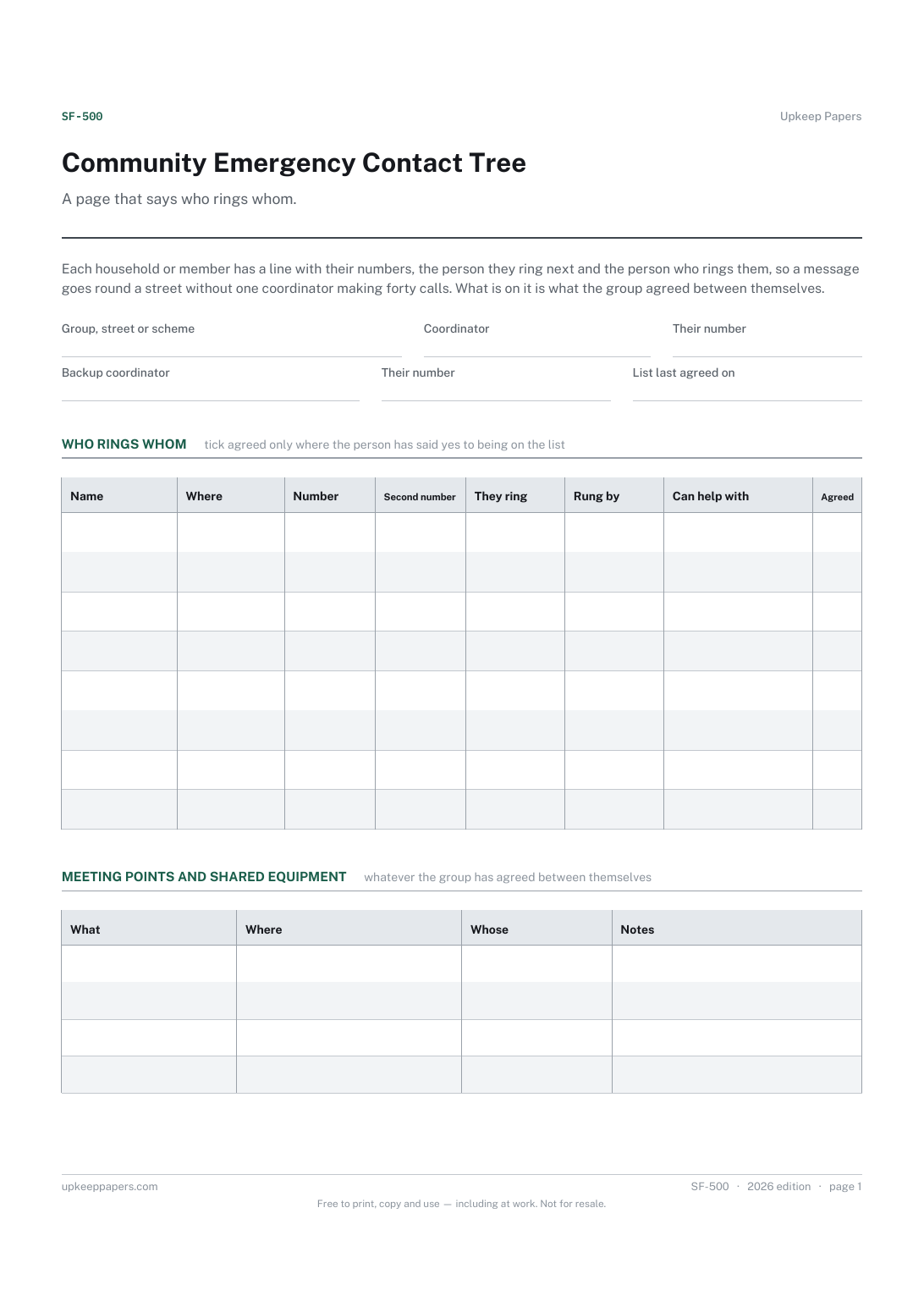
One page. The A4 and US Letter files are laid out identically, so neither is shrunk to fit.
Print it and write on it
Fillable PDF type and save
Or no download needed
Fill it in onlineThe fillable versions have real form fields — open them in any PDF reader, type into them and save. Printing help.
The same sheet, on screen. Tick, type, add or remove rows, then print it or download the completed version as a PDF. Everything stays in your browser — your entries are kept in this browser's own storage on this device, nothing is uploaded, and there is no account.
A page that says who rings whom. Each household or member has a line with their numbers, the person they ring next and the person who rings them, so a message goes round a street without one coordinator making forty calls. What is on it is what the group agreed between themselves.
Street groups and residents' associations, village and parish schemes, allotment sites and clubs, church and volunteer groups, and any set of neighbours who have decided to have a list before they need one.
The printable is laid out inside a box that fits both A4 and US Letter, so the two files are identical and neither one is scaled. The fillable PDF has real form fields. The online version keeps what you enter in your own browser and builds the completed PDF on your device.
Download the A4 or US Letter file to match the paper in your printer, open it in a PDF reader and print at 100% — not "fit to page", which shrinks the writing space. Both files leave a 14 mm margin, which clears the unprintable edge on home printers. To print the online version with your entries in it, use the Print this sheet button, which prints only the sheet and none of the page around it. More on printing.
Ask, and tick the agreed column when they say yes. A contact list circulates by definition, and how personal information may be shared is set by the rules where you are, so a name and number goes on with the person's knowledge.
One person with forty calls to make is a single point of failure and a long wait for number forty. A chain shares the calls out, and the who-rings-them column shows immediately where the chain has broken.
Anything urgent goes to your emergency services, not round a phone tree. A contact tree is for passing word between neighbours — a road closed, a supply off, somebody who has not been seen.
Date it, hand out fresh copies when it changes, and ask people to tell the coordinator when a number changes. The browser version makes reprinting a corrected sheet quick.
Many groups do both. A printed sheet still works when a phone is flat, a network is down or the person holding it is not in the group chat.
What was seen or reported, when and exactly where.
Who to ring about a person, with the relationship and two numbers each.
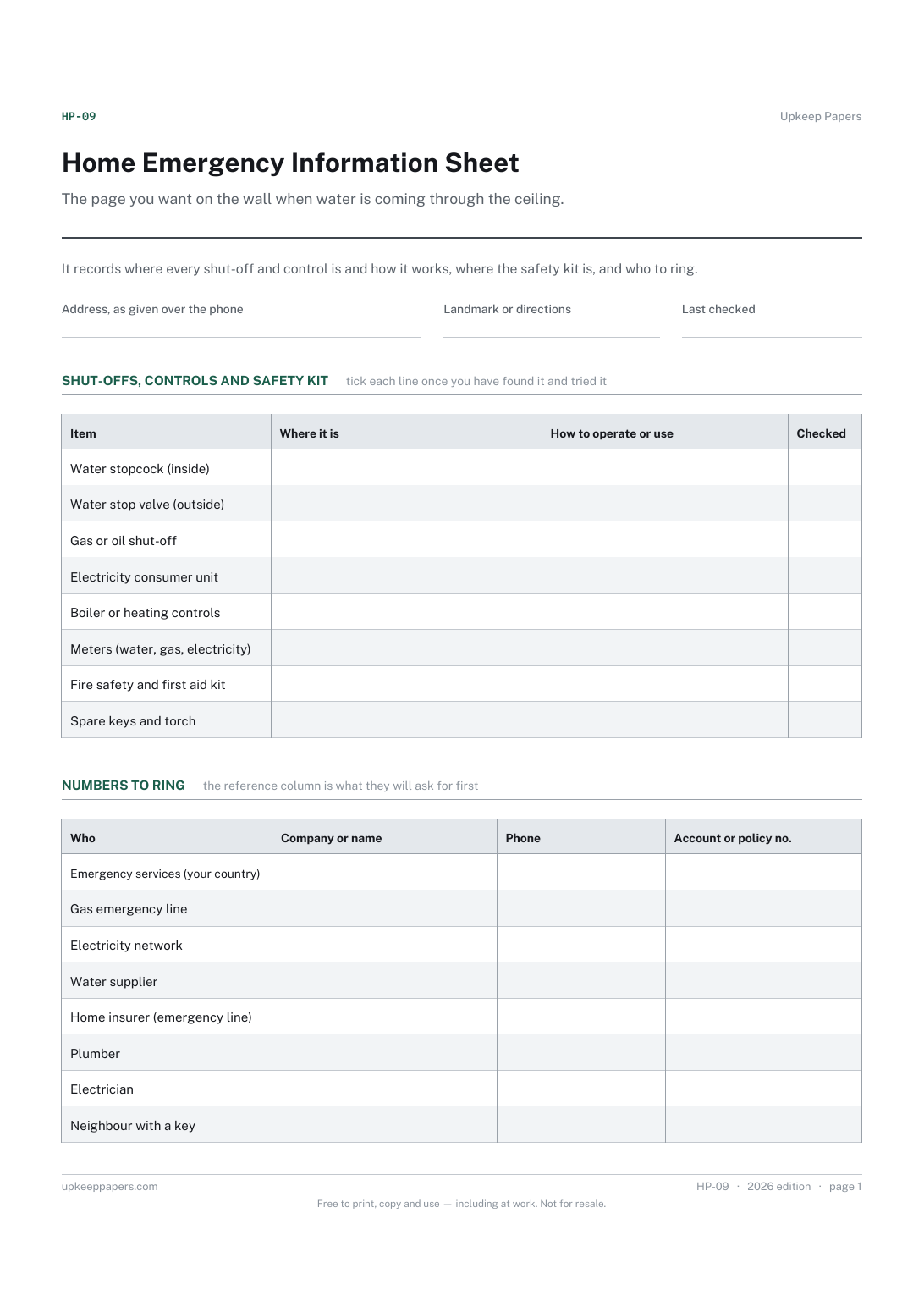
Where the stopcock, the gas or oil shut-off and the consumer unit are, and how to use them.
Printable sheets, workbooks and tools on the same subject.
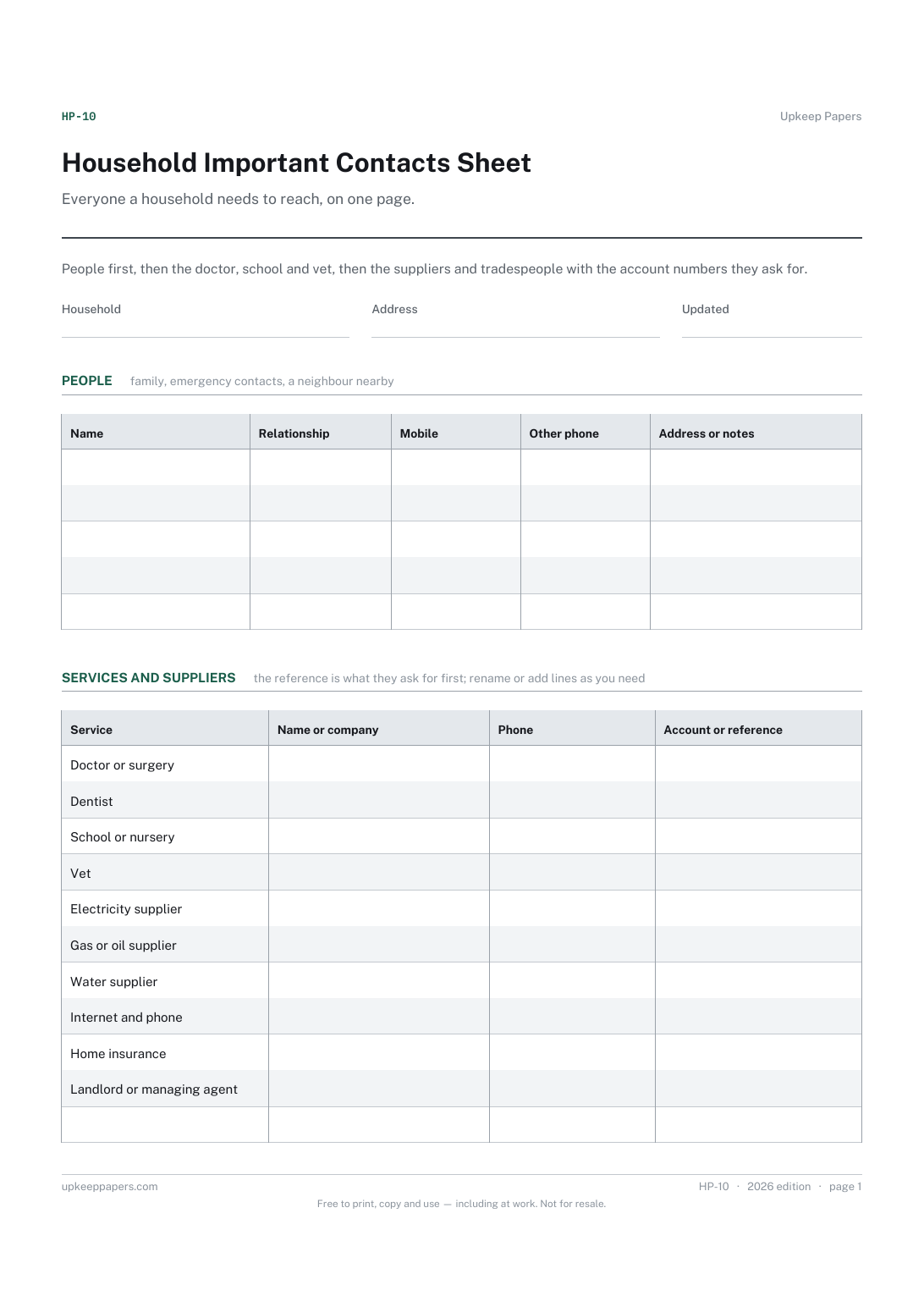
Put the numbers somebody needs in one place, so a house-sitter, a babysitter, a visiting relative or a tenant is not searching for them at the worst moment.
Type your household’s emergency information once and print a clean sheet to pin up where it can be found.

Every sheet, binder, game and puzzle on Upkeep Papers is free to download, with no email and no account. Making them is not free: each one takes days of research, design and checking, and the site costs money to run. If something here saved you time, you can buy us a coffee. It is entirely optional: nothing is locked, and nothing changes if you don’t.
Buy us a coffee Opens PayPal in a new tab. Any amount, and nothing changes if you would rather not.