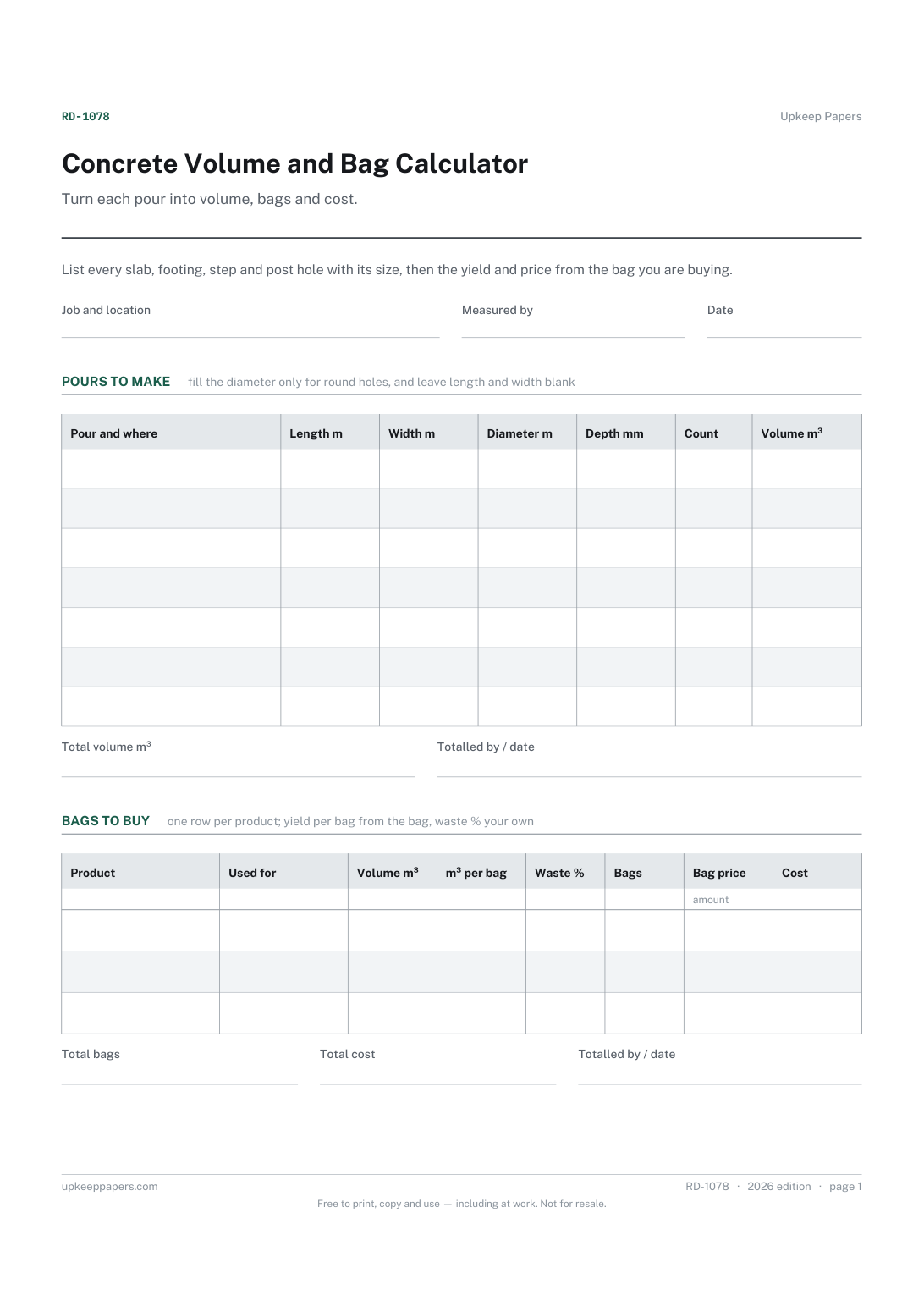
Concrete Volume and Bag Calculator
The volume of every slab, footing, step and post hole you plan to pour.
RD-1078 Form PDF Excel Online
Everything here is free. Making it takes time and money. Everything here is free.
 Buy us a coffee
Renovation and DIY Projects · RD-1081 · Form
Free fence calculator: panels, posts and post-fix bags for each run from your panel and post sizes, then gravel boards, caps and cost. Excel, PDF, browser.
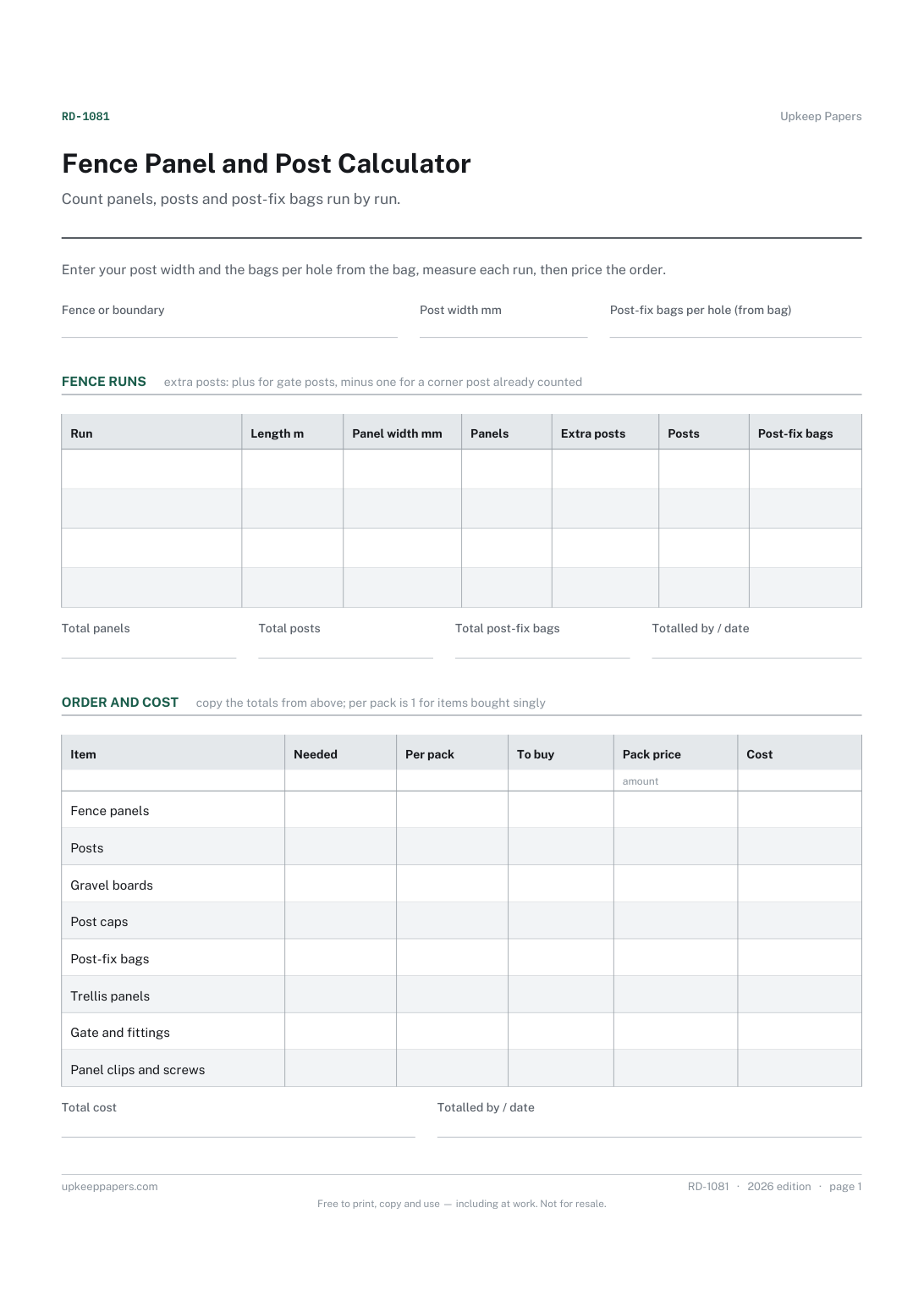
One page. The A4 and US Letter files are laid out identically, so neither is shrunk to fit.
Print it and write on it
Fillable PDF type and save
Spreadsheet formulas included
The fillable versions have real form fields — open them in any PDF reader, type into them and save. Printing help.
The same sheet, on screen. Totals and figures are worked out as you type, rows can be added or removed, and you can print it or download the completed version as a PDF. Everything stays in your browser — your entries are kept in this browser's own storage on this device, nothing is uploaded, and there is no account.
Count panels, posts and post-fix bags run by run. Enter your post width and the bags per hole from the bag, measure each run, then price the order.
Homeowners replacing a garden fence or putting up a new one, and anyone checking a fencer's materials list or a merchant's quote before paying.
The printable is laid out inside a box that fits both A4 and US Letter, so the two files are identical and neither one is scaled. The fillable PDF has real form fields. The workbook uses plain formulas only — SUM, IF, COUNTIF and the like — so it opens in Excel, LibreOffice and Google Sheets without anything breaking, and every calculated cell is grey so you can see which figures it worked out.
Download the A4 or US Letter file to match the paper in your printer, open it in a PDF reader and print at 100% — not "fit to page", which shrinks the writing space. Both files leave a 14 mm margin, which clears the unprintable edge on home printers. To print the online version with your entries in it, use the Print this sheet button, which prints only the sheet and none of the page around it. More on printing.
Each bay is one panel plus one post. The run length, less one post, is divided by the panel width plus the post width and rounded up, so a short final bay counts as a whole panel that you cut down or swap for a narrower one.
A straight run of panels has a post at each end and one between every pair of panels, which is always one more post than panels. Where two runs meet at a corner they share a post, so enter minus one in extra posts on one of them.
From the post-fix or concrete bag, which usually states how many bags a typical post hole takes. The sheet supplies none. If you are mixing your own concrete, the concrete calculator works holes out by volume instead.
If you are fitting them, there is one gravel board under each panel and one cap on each post, so copy those totals into the order table. Leave the rows blank if your fence does not use them.
The volume of every slab, footing, step and post hole you plan to pour.
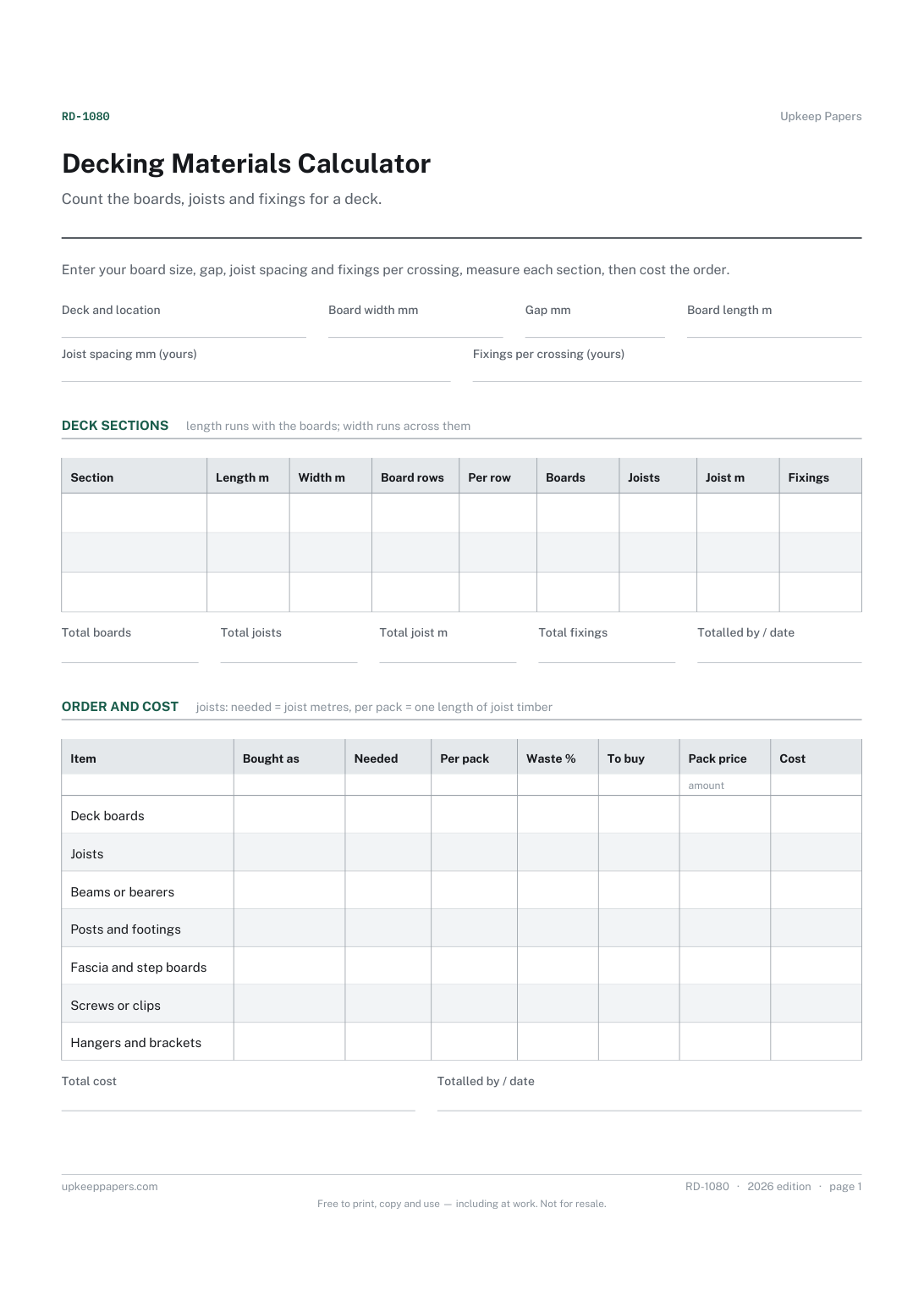
Rows of boards across each section from the board width and gap.
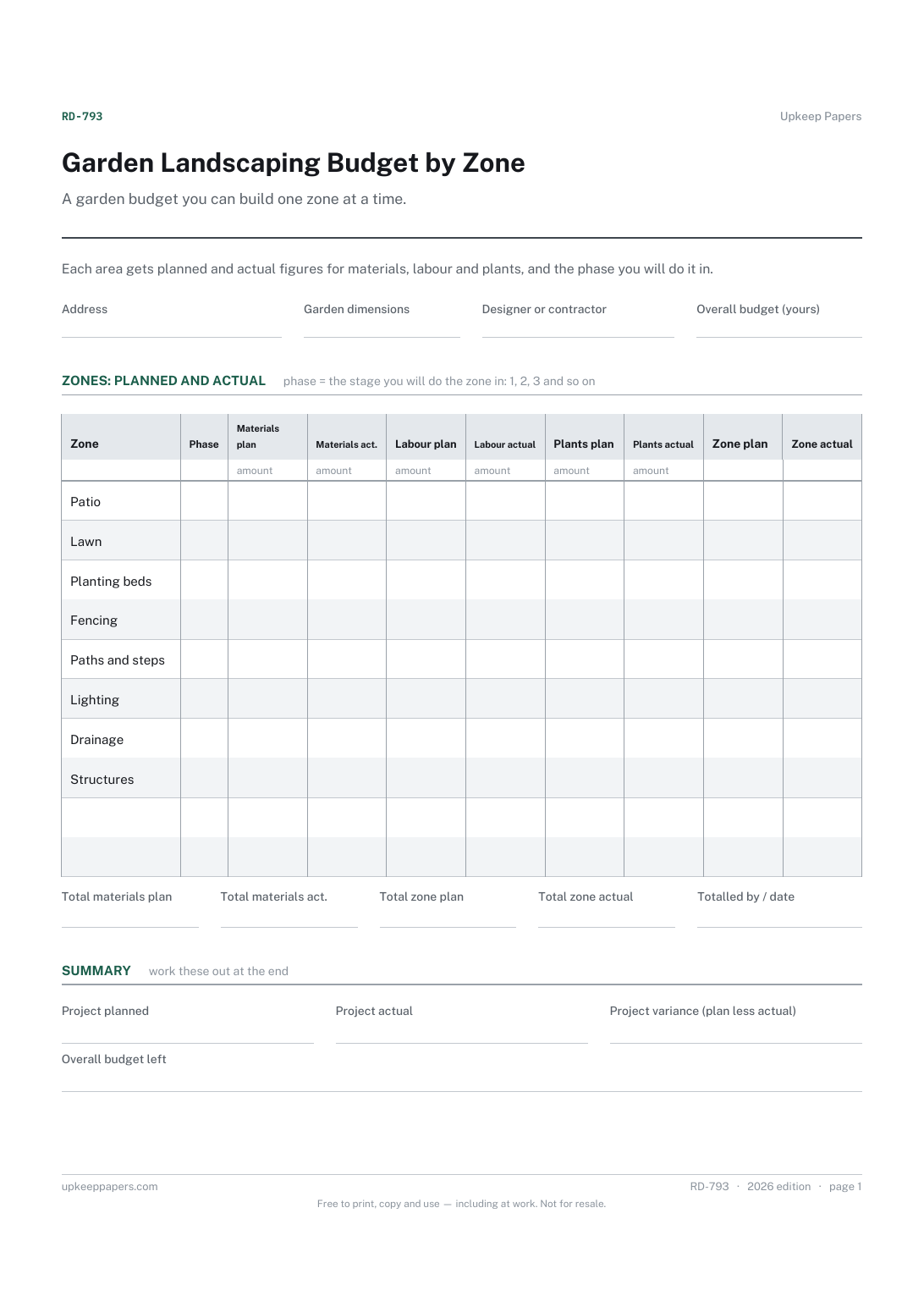
What each zone of the garden is expected to cost in materials, labour and plants.
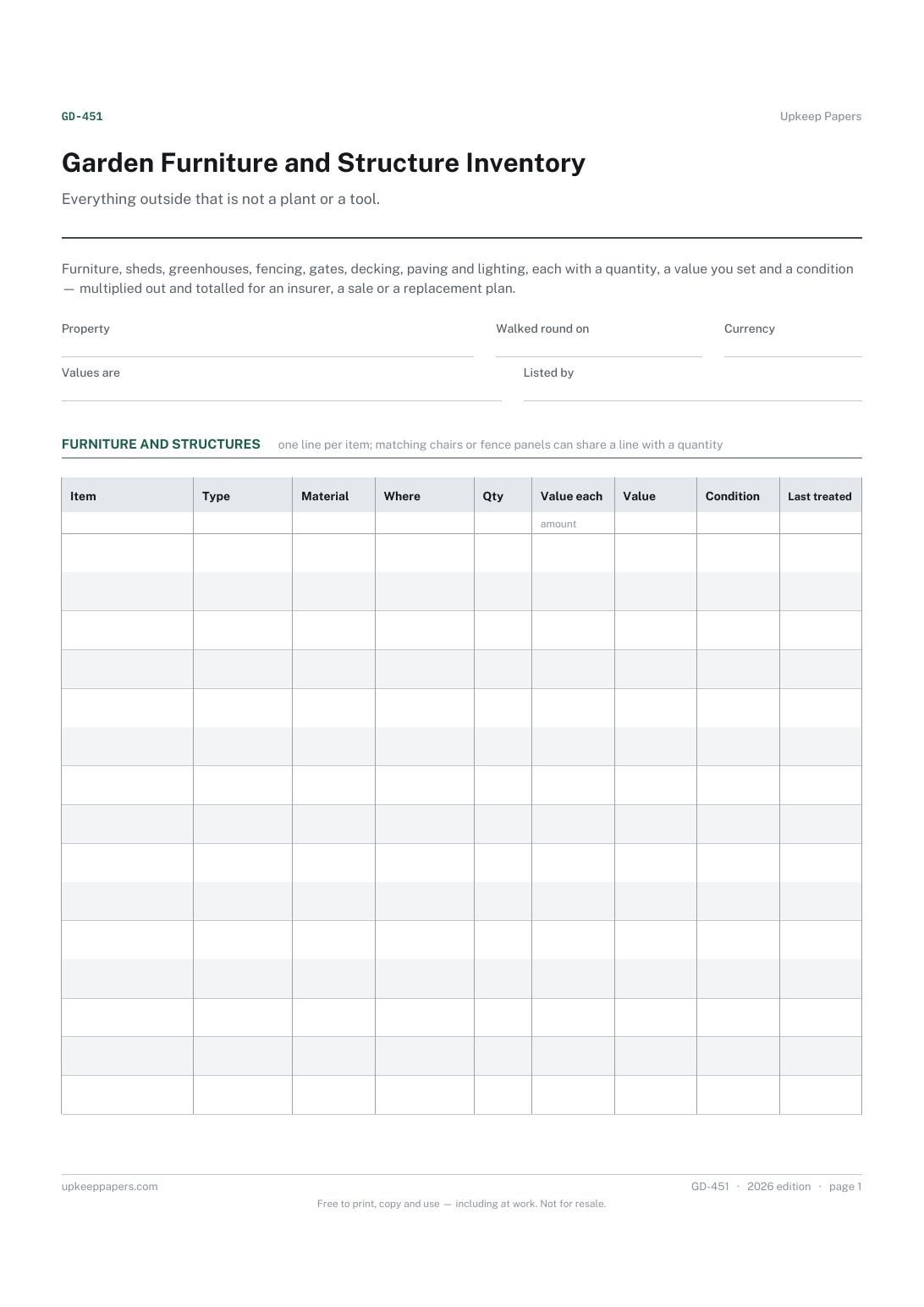
Every structure and piece of furniture outside, with where it stands.
Printable sheets, workbooks and tools on the same subject.
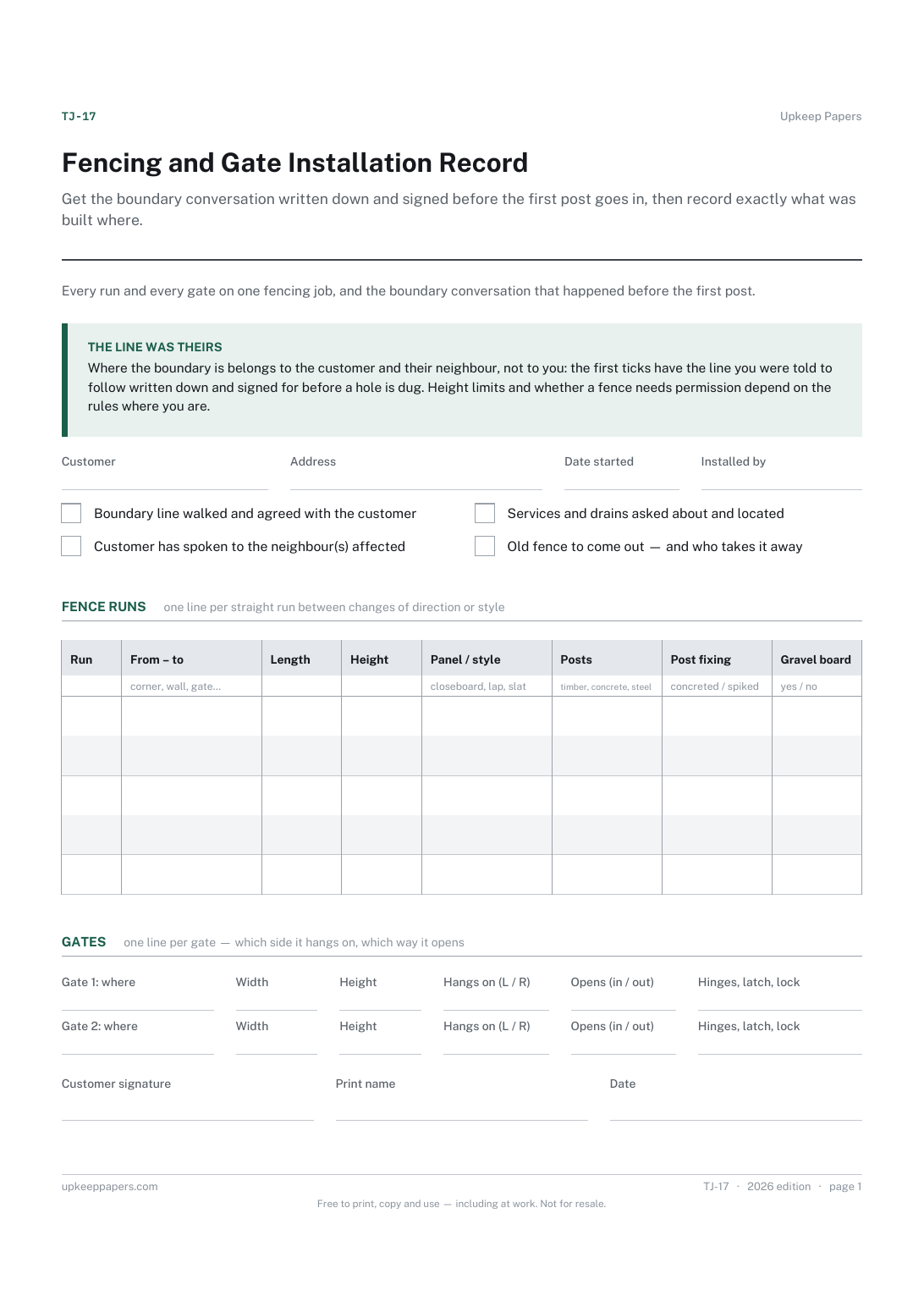
Get the boundary conversation written down and signed before the first post goes in, then record exactly what was built where.
Record the fence walk and the faults, including who is responsible for each boundary before money is spent on it.

Every sheet, binder, game and puzzle on Upkeep Papers is free to download, with no email and no account. Making them is not free: each one takes days of research, design and checking, and the site costs money to run. If something here saved you time, you can buy us a coffee. It is entirely optional: nothing is locked, and nothing changes if you don’t.
Buy us a coffee Opens PayPal in a new tab. Any amount, and nothing changes if you would rather not.